



Abstract
Currently, news is dominated by the negative impacts of climate change rather than by solutions. Based on previous research, we propose that the standard way of reporting (problem-focused) leads to learned helplessness and decreases motivation to engage in climate action. On the other hand, using constructive narratives (solution-focused) should decrease helplessness and increase motivation to engage in climate action. We thus conducted an experiment with N = 1,359 participants (quota-based sample of the German population). Results showed that reading constructive narratives significantly decreased participants’ helplessness ratings. On the other hand, standard narratives increased climate change attitudes. Furthermore, mediation analysis hinted toward a relationship between a decrease in helplessness and higher motivation to act. As constructive narratives effectively reduced helplessness and reduced helplessness, in turn, was related to higher motivation to act, they could support climate change mitigation by increasing climate action and thereby become a powerful tool within climate change communication.
Keywords
Introduction
There is no doubt that climate change poses a fundamental threat to humanity, with consequences that are already visible worldwide (e.g., droughts, floods, and heat waves) and with more severe consequences to be expected in the near future (Macedo, 2023). That makes the development of effective strategies to mitigate climate change of utmost importance. One such strategy is to improve climate change communication, especially in a way that enhances the public’s motivation to engage in climate action. There is already an abundance of climate change communication interventions, targeting climate change attitudes (like belief in climate change, human-causation of climate change, policy support, worry about climate change), as well as climate change action (behavioral intentions and real behavior). There are a wide range of approaches, for example, tackling norms (working-together normative appeals, Howe et al., 2021; dynamic norms, Campbell et al., 2023; social norms, Cialdini & Jacobson, 2021) and providing information about scientific consensus of climate change (van der Linden, 2021). Other approaches aim at decreasing psychological distance (McDonlad et al., 2015; Van Lange & Huckelba, 2021), or having people write a letter to future generations (intergenerational framing, Syropoulos & Markowitz, 2023; Wickersham et al., 2020). Furthermore, there are more emotional based approaches like inducing negative or positive emotions (Brosch, 2021; Chapman et al., 2017; Schneider et al. 2021). Currently, there is an ongoing debate in climate change communication about the advantages and disadvantages of the latter, that is about the effectiveness of climate change messages either eliciting negative emotions (like anxiety and helplessness) or positive emotions (like hope) on climate change attitudes and motivation to act (see Brosch, 2021).We argue that continuously being exposed to problem- instead of solution-focused messages will lead to learned helplessness and, in turn, reduce people’s willingness to engage in climate change action. More specifically, in our research, we want to investigate the impact of the standard (problem-focused) journalistic approach of reporting about climate change on learned helplessness, attitudes about climate change, and motivation to engage in climate change action compared to constructive journalism (solution-focused). We argue that the current mainstream reporting style leads to learned helplessness and is detrimental to the public’s motivation to take action.
Standard Versus Constructive Reporting
Research pointing toward the problems related to standard reporting (problem-focused) is not new: Earlier research has shown that the negative focus, which is prevalent in news reporting (Lengauer et al., 2012; Niven, 2001), can cause fear, stress, and depression in the audience (Pfefferbaum et al., 2014) and can be detrimental for people’s well-being (Boukes & Vliegenhart, 2017). As a result, people turn away from news, which improves well-being but also leaves the public uninformed about important topics (de Bruin et al., 2021; Schäfer et al., 2024). This issue has prompted the idea of constructive journalism. Constructive journalism refers to a way of reporting that involves “ [. . .] applying positive psychology techniques to news processes and production in an effort to create productive and engaging coverage, while holding true to journalism’s core function” (McIntyre & Gyldensted, 2018, p. 23; see also Mast et al., 2019). Even though still being a relatively new concept, recent research shows the advantages of constructive journalism. For example, Overgaard (2023) showed that constructive social media posts increased self-efficacy and news credibility. In another study by Overgaard (2021), a reduction of anger and anxiety within the context of the COVID-19 pandemic was found for participants who read constructive social media news. Similarly, Schäfer et al. (2023) showed that restorative narratives about COVID-19 lead to a higher endorsement of news, higher quality ratings of the news article, and more positive emotions. However, there is also research on potential drawbacks: even though Van Antwerpen et al. (2023) found in their repeated-measure experiment a positive effect on mood, results for constructive journalism concerning trust in information and text comprehension were mixed (either positive or negative depending on control variables).
News Reports About Climate Change: The Role of Positive and Negative Emotions
Regarding news reports about climate change, a similar trend toward negative reporting can be observed: while solutions are also reported (Hase et al., 2021), there is still a strong focus on the negative consequences of climate change (Stecula & Merkley, 2019). In line with previous research, this type of reporting is related to feelings like anxiety (Brulle et al., 2012; Olausson, 2011). However, results on whether eliciting positive or negative emotions is beneficial or detrimental for public engagement with climate change are mixed. In their article on “reassessing emotion in climate change communication” the authors caution against labeling certain emotions like for example, anger or hope as simply good or bad (Chapman et al., 2017), emphasizing the complexity of emotions and that emotional-appeals might have very different impacts on the individual level.
This is also reflected in the scientific evidence regarding the impact of different emotions on climate action, motivation to engage in more environmental friendly behavior, and support for action. In the following we thus, first give an overview of the positive impacts of negative emotions followed by research pointing toward possible drawbacks. Similarly, for positive emotions, we will present research regarding the positive impacts as well as possible drawbacks.
While reporting with a strong focus on the negative consequences of climate change is related to feelings like anxiety (Brulle et al., 2012; Olausson, 2011), climate anxiety, in turn, is positively related to climate action (Maran & Begotti, 2021; Whitmarsh, 2022). Furthermore, research shows that problem-focused reporting leads to an increase in belief in climate change and support for action (Feldman et al., 2014). That is also in line with research about the relationship between emotions and climate change action: negative climate messages were shown to be positively related to higher reports of (collective) efficacy (Hornsey et al., 2015) and motivation to engage in climate adaptation (Hine et al., 2016; note however that this was also true for messages providing specific adaptation advice).
On the other hand, there is also evidence showing negative effects of problem-focused reporting about climate change: Feldman and Hart (2021) found that participants, who read Twitter-based news stories about climate change with a focus on climate impact, showed a higher increase in fear, a decrease in efficacy beliefs, hope, and perceived news credibility compared to those who read Twitter-based news stories about climate change with a focus on action. Whether or not eliciting negative emotions could lead to, for example, feelings of helplessness and induce a passive state is still an ongoing debate in climate change communication literature (see Brosch, 2021).
Another line of research on messages about climate change has shown a positive effect of climate change messages eliciting positive emotions (like hope) not only on participants’ well-being but also on their support for climate action (Bury et al., 2020; Geiger et al., 2021) as well as their support for climate policies (Feldman & Hart, 2018). However, there is also evidence showing that eliciting hope has no effect on motivation to act collectively (Van Zomeren et al., 2019) or can even be detrimental to people’s motivation to mitigate climate change (Hornsey & Fielding, 2016). More specifically, Hornsey and Fielding (2016) showed that optimistic messages lead to a decrease in risk perception and distress compared to pessimistic messages, which in turn resulted in lower motivation to mitigate climate change for optimistic messages. Whether or not messages that are aimed to increase hope are beneficial or not in the context of climate change communication is still unclear. In their meta-analysis, Geiger et al. (2023) did not find that hope is detrimental to climate action, but at the same time, evidence of a positive impact of hope was inclusive.
Our research ties in with research on emotion-based interventions; however, our focus is different in that (i) our main construct of investigation is learned helplessness, and (ii) we want to compare narratives that are written in a journalistic style rather than simple messages. To our knowledge, research investigating the impact of standard (problem-focused) journalism versus constructive journalism on the topic of climate change is still sparse. One important paper that assessed the impact of constructive journalism on the topic of climate change showed that a catastrophically-framed news story about an environmental issue resulted in negative affect while the solution-framed news story resulted in more positive affect. Furthermore, the solution-framed news story increased intentions to take action, while the opposite was true for the catastrophically-framed news story (Baden et al., 2019). Furthermore, in another, very recent paper Höhle and Bengtsson (2023) are argue that constructive journalism is an important tool for education about climate change that could counteract climate change denial and apathy.
Learned Helplessness and Motivation to Engage in Climate Action
There is a large body of research linking (learned) helplessness to behavior (intention) in the context of climate change. Learned helplessness results from being confronted with uncontrollable aversive events or stressors (uncontrollable meaning that in the face of the aversive event, all attempts of responding in a way to eliminate the aversive event do not lead to the desired outcome; Seligman, 1972). More specifically, the idea of learned helplessness assumes that being unable to control a past aversive event teaches one to be helpless in the face of current or future events even though one could, in principle, control these present or future events. 1 The negative effects of helplessness on behavior in the context of climate change as been demonstrated in several studies: In the study of Landry et al. (2018), the authors showed that learned helplessness is detrimental to pro-environmental behavior. More specifically, the authors showed that learned helplessness is a moderating factor between environmental concern and behavior.
Similarly, in the study of Salomon et al. (2017), inducing climate change helplessness (the belief that one’s actions cannot influence climate change) in participants was related to more energy consumption.
Furthermore, Gunderson (2023) found that helplessness was negatively related to environmental concern as well as action. More specifically, Gunderson (2023) argues that people are de facto helpless (“real helplessness”) in addressing environmental issues at an individual level, and that the concept of “learned helplessness” masks this fact. Other research, however, found that hope and boredom were more important predictors of intentions to take climate action than helplessness (Geiger et al., 2021). More specifically, while helplessness was correlated with the intention to take action, the effects were small.
Given that people are confronted with standard news reporting on a daily basis, in our research, we focused on the concept of learned helplessness as defined by Seligman (1972). We assume that if people are confronted with constructive narratives instead of standard narratives (problem-focused), learned helplessness will be reduced and, in turn, motivation to engage in climate action will increase. 2
Passive Risk Taking
Additionally, we want to investigate whether there is a relationship between passive risk taking tendencies and learned helplessness as well as motivation to engage in climate action (exploratory analysis). Passive risk taking is defined as “[. . .] foregoing an opportunity to act to reduce outcome variance” (Keinan & Bereby-Meyer, 2012, p. 705). In the study of Arend et al. (2020), for example, cyber-security behavior intentions as well as actual behavior were negatively correlated with participants' passive risk taking tendencies. Similar to Arend et al. (2020), in which not taking precautions against cyber attacks (being passive) puts people at risk of being victims of cyber-crime, for the topic climate change, inaction by not engaging in any behavioral changes to mitigate climate change seems to fall in a similar category.
Thus, we assume that passive risk taking tendencies might be an important predictor of motivation to engage in climate action. Regarding learned helplessness, there is, to our knowledge, no research directly linking learned helplessness to passive risk taking tendencies. However, other research shows a connection between avoidant behavior and depression as well as anxiety (Barlow, 2004; Ottenbreit & Dobson, 2004). Therefore, we want to investigate whether there is a relationship between learned helplessness and passive risk taking tendencies.
The Present Study
The aim of the current study is to investigate whether constructive narratives about climate change can reduce learned helplessness and increase motivation to engage in climate action. Furthermore, the influence of passive risk taking on learned helplessness and motivation to engage in climate action will be explored, as well as whether the narratives also have an impact on participants’ attitudes toward climate change.
Methods
This study was preregistered under https://aspredicted.org/X4D_QYN. Data and R script can be accessed via https://osf.io/jqnhe/. The German version of the scales developed (with a description and the results from a pre-test to assess scale reliability, N = 27 participants) as well as the German version of the narratives can be accessed via https://osf.io/y276d/. APA ethical standards were followed in the conduct of the study reported in this article and informed consent was collected from the participants at the beginning of the study. Participants were not exposed to any risk exceeding the risks of everyday life. Participants were fully debriefed about the aims of the study and had the opportunity to withdraw their consent at the end of the study. Data anonymization was ensured and participants were fully debriefed about data protection, anonymization, and confidentiality of the data collected. In line with the rules of the country in which data was collected, no decision from an ethical review board was required for the reported study.
Participants
Data collection was done in cooperation with the panel provider Bilendi&respondi. The participants were compensated for taking part in the study. In total, data from N = 1,377 participants from Germany (quota-based sample regarding age and gender) was collected. After excluding participants who participated twice in the study N = 1,359 remained. Out of those n = 673 reported to be female, n = 684 were male, and n = 2 non-binary. The mean age was M = 46.61 years (SD = 15.29). Regarding education n = 4 participants did not graduate, n = 151 had a secondary modern school qualification (Hauptschulabschluss), n = 476 had a secondary school certificate (Realschulabschluss), n = 183 a vocational baccalaureate diploma (Fachabitur), and n = 544 a higher education entrance qualification (Abitur). Regarding political attitude, the mean value was M = 3.85, SD = 1.16 (on a 7-point scale, ranging from 1 liberal to 7 conservative). Regarding attitude toward the climate change movement mean value was M = 4.21, SD = 1.72 (on a 7-point scale, ranging from 1 “strongly object to the movement” to 7 “I strongly support the movement”). Participants were randomly distributed to one of five conditions: control group n = 272, standard narrative energy transition n = 284, standard narrative city development n = 270, constructive narrative energy transition n = 271, constructive narrative city development n = 262.
Material
Narratives
In total, five narratives were developed: two constructive narratives (2 topics: energy transition and city development), two standard narratives (2 topics: energy transition and city development), and one neutral narrative for the control group about diving. Note that throughout the manuscript, whenever we refer to “standard narratives,” reporting that is problem-focused is meant. Furthermore, for participants in either the constructive or the standard narrative group, a short introduction about climate change was presented to ensure that everyone received at least a certain level of information about climate change. The length of the short information text about climate change was 494 words. The control group received a short information text about diving before reading the neutral narrative. The length of the neutral short information was 472 words.
Narrative Development
Narratives were developed based on the “Criteria for Solutions Journalism” (Solutions Journalism Network, n.d.) and the PERMA model (Seligman, 2011). Note that the terms solutions journalism and constructive journalism are used interchangeably (Aitamurto & Varma, 2018). The rating criteria focused on whether the core aspects of journalism were addressed, whether the manipulation worked (constructive vs. standard), whether the criteria of solutions journalism were adhered to, and whether the criteria of the PERMA model were adhered to. All questions can be found in the appendix (Tables A1 –A3).
Narratives were rated based on those criteria by an independent rater. The length of the narratives was between 960 and 1,022 words. All narratives were constructed in the same way: first, participants read a short introduction, some general facts, and then either a constructive or a standard part. Narratives are available at https://osf.io/y276d/.
Learned Helplessness
Learned helplessness was measured twice (pre- and post-intervention) using a version of the Learned Helplessness Scale (Quinless & Nelson, 1988) that was adapted to the topic of climate change. The questionnaire consisted of seven statements, for example: “I feel like I have little control over the mitigation of climate change.” (see Table A4). Two statements were reverse-coded. Participants had to indicate how much they agree with the statements on a 7-point scale ranging from “not applicable at all” to “completely applicable.” Cronbach’s alpha for the Learned Helplessness Scale – Climate Change (LHS-C) (pre-intervention) was α = .49. The learned helplessness difference score was calculated by subtracting the pre-intervention values from the post-intervention values. Thus, a positive sign denotes an increase in learned helplessness and a negative sign a decrease in learned helplessness.
Motivation to Engage in Climate Action
To measure motivation to engage in climate action the Motivation Toward the Environment Scale (MTES; Pelletier et al., 1998) from Grønhøj and Thøgersen (2017) was adapted to fit the topic of climate change. The adapted questionnaire (Motivation Towards the Environment Scale – Climate Change; MTES-C) consisted of six statements (see Table A5). There were two subscales assessing (1) intrinsic motivation (3 items) and (2) amotivation (3 items). Statements were formulated in third-person perspective. For example: “This person has an interest in putting a stop to climate change.” Participants had then to indicate how similar they feel to the person on a 7-point scale ranging from “not similar at all” to “very similar.” The MTES-C score was then calculated by subtracting participants’ amotivation ratings from their motivation ratings. Motivation to engage in climate action was measured twice (pre- and post-intervention). Cronbach’s alpha for the MTES-C (pre-intervention) was α = .89 for the intrinsic motivation items and α = .89 for the amotivation items. The motivation to engage in climate action difference score was calculated by subtracting the pre-intervention values from the post-intervention values. Thus, a positive sign denotes an increase in motivation to engage in climate action and a negative sign indicates a decrease in motivation to engage in climate action.
Climate Change Attitudes/Attitudinal Concern About Climate Change
Climate change attitudes were measured twice (pre- and post-intervention), using the items from van der Linden et al. (2019). The questionnaire consisted of four items (for response scales and items, see Table A6). Cronbach’s alpha for climate change attitudes (pre-intervention) was α = .90. The climate change attitudes difference score was calculated by subtracting the pre-intervention values from the post-intervention values. Thus, a positive sign denotes an increase in climate change attitudes, that is, higher worry about climate change, higher belief in the existence of climate change and that climate change is man-made, and higher support for action; and a negative sign a decrease in climate change attitudes. Note that throughout the manuscript, we will additionally use the term attitudinal concern about climate change when referring to the mean scores of the four attitude items (belief in climate change, belief in human causation of climate change, worry about climate change, and support for action).
Passive Risk Taking
Participants’ tendency to engage in passive risk taking (PRT) was measured on a shortened version (PRT-S) of the original PRT Keinan & Bereby-Meyer (2012); see Table A7. Participants had to indicate how likely it is that they would show the behavior described for each statement on a 7-point scale ranging from “1—very likely” to “7—very unlikely” (note that the scale was reverse coded for better interpretability). Cronbach’s alpha for the passive risk taking scale was α = .66.
Willingness to Engage in Climate Action
To measure willingness to engage in climate action, participants were given the opportunity to donate to a climate change organization by clicking on one (or all) of 5 links. However, only n = 4 participants actually clicked on one or more of the links provided. Thus, the measurement was omitted from the analysis.
Climate Change Knowledge and Confidence in Climate Change Knowledge
Climate change knowledge was measured using seven statements about climate change (4 true and 3 false). Five items were adopted from Sundblad et al. (2009) and two items were taken from our own knowledge test. Participants had to indicate after each statement whether they believed that the statement was correct (for the statements, see Table A8). Cronbach’s alpha for the knowledge test was α = .30. After each statement participants’ confidence in their assessment was measured, by asking them to state “how certain are you that your answer is correct?” on a 4-point scale ranging from “I have guessed” to “very certain.” Cronbach’s alpha for the confidence scale was α = .83.
Pro-Environmental Behavior
Participants’ pro-environmental behavior was measured using a 12-item questionnaire. The scale was developed based on the definitions of the subtypes of environmentally significant behavior by Stern (2000): activist behavior, non-activist behavior in the public sphere, non-activist behavior in the private sphere, and other environmentally significant behavior. For the development of the scale, only the definitions of the first three subtypes were adapted to the context of climate action: (1) activist behavior, meaning active involvement in climate organizations and demonstrations, (2) non-activist behavior in the public sphere, meaning non-activist behaviors, that support the goals of the climate movement by either actively taking part in events organized by climate activists or publicly supporting the climate movement or climate-friendly politics, and (3) non-activist behavior in the private sphere, focusing mainly on green consumerism. Two items were directly derived from Stern’s (2000) definition of non-activist behavior in the private sphere. Additionally, three items from the measure for pro-environmental behavior by Homburg and Stolberg (2006) were translated into German and adapted to the context of climate change (for the items, see Table A9). Participants had to indicate how often they showed the behavior described in the statements in the past year on a 7-point scale ranging from “never” to “very often.” Cronbach’s alpha for the pro-environmental behavior scale (PEBS-C) was α = .87.
Attitude Toward the Climate Movement
Participants’ attitude toward the climate movement was assessed using one item asking participants about their attitude toward the climate change movement on a 7-point Likert scale ranging from “I am strongly opposing the movement” to “I strongly support the movement.”
Text Comprehension
To control whether or not participants read the narratives thoroughly and whether they comprehended the narratives, they received statements about the content of the texts and had to indicate whether those were true or false. Participants received three statements after reading the short information text and four statements that differed depending on which narrative was shown to them (see Table A10). A text comprehension score was calculated based on the four statements that were tailored to the respective narrative. Generally participants mean correct response were about 80% or above, with one exception (77% for the city standard narrative): Menergy_constructive = .84, SDenergy_constructive = .24; Menergy_standard = .84, SDenergy_standard = .22; Mcity_constructive = .80, SDcity_constructive = .22; Mcity_standard = .77, SDcity_standard = .19.
Procedure
Participants first received some information about the study. Afterward, demographics, political attitude, and attitude toward the climate movement were assessed. Regarding the measures, attitudes about climate change, knowledge about climate, and confidence in knowledge were assessed. Afterward, the scales for learned helplessness, pro-environmental behavior, motivation to engage in climate action, and passive risk taking were presented randomly. Then, participants received one out of the five narratives. To ensure that participants stayed on the page with the narrative for at least a minimal amount of time, the “next” button was hidden for 1 minute for the introductory text and 1.30 minutes for the main narrative. Afterward, the post-measures of learned helplessness and motivation to engage in climate action were displayed randomly, and then the post-measure of attitudes about climate change was displayed. Finally, participants had the opportunity to click on one or more of the provided links to donate to a climate change organization (behavioral measure). Participants were then fully debriefed about the study and had the opportunity to withdraw their data.
Results
Descriptive Results
Means, standard deviations, and correlations of the difference scores (post–pre) of learned helplessness, motivation to act, and attitudes toward climate change, as well as the scores of passive risk taking, climate change knowledge, and confidence in climate change knowledge are displayed in Table 1. Table 2 displays the means and standard deviations of the difference scores for the three variables of interest (learned helplessness, motivation to act, and attitudes toward climate change) separately for each group (control, standard, constructive).
Means, Standard Deviations, and Correlations With Confidence Intervals.

Note. M and SD are used to represent mean and standard deviation, respectively. Values in square brackets indicate the 95% confidence interval for each correlation. The confidence interval is a plausible range of population correlations that could have caused the sample correlation (Cumming, 2014).
p < .05. **p < .01.
Means and Standard Deviations for Learned Helplessness, Motivation to Act, and Attitudes Toward Climate Change Separately for Each Group: Control, Standard, Constructive.

Note. Means and standard deviations for learned helplessness, motivation to act, and attitudes toward climate change.
Topic Dependency
To investigate whether the scenarios’ topic impacted participants’ learned helplessness, motivation to engage in climate action, and climate change attitudes ratings, we conducted multiple t-tests (see Table 3). Note that we compared the difference scores (post–pre intervention ratings) for the two topics within each condition (standard and constructive). Results showed that there was no difference in ratings for the different topics. Thus, the scores for energy transition and city development were combined in all the analyses.
Means, Standard Deviations, and t-Test Results for Difference Scores (Post–Pre Intervention Ratings) for the Four Different Narratives: Constructive Energy Transition, Constructive City Development, Standard Energy Transition, and Standard City Development.

Note. In the analysis we compared the difference scores (post-pre intervention ratings) for the two topics energy transition and city development to investigate whether there was a topic dependency. Topics were compared for the constructive and the standard condition separately. For significance an alpha level of α = .05/6 = .008 (Bonferroni correction) is assumed.
Investigating the Impact of Constructive Versus Standard Narratives on Learned Helplessness, Motivation to Act, and Climate Change Attitudes
We conducted a MANOVA to test whether the constructive narratives had an influence on the difference scores of learned helplessness (pre-registered), motivation to act (pre-registered), and climate change attitudes (exploratory). Results showed a significant difference in the scores for the three conditions: F(2, 1356) = 3.48, p = .002, Pillai’s Trace = .015. As group sizes of the three conditions differed (control condition in comparison to the other two conditions), we conducted three Levene’s tests for homogeneity of variance (for learned helplessness, motivation to act, and climate change attitudes). In all cases results were not significant: F(2, 1356) learned helplessness = 0.415, p learned helplessness = .660, F(2, 1356) motivation to act = .005, pmotivation to act = .995, and F(2, 1356)attitudes = .952, pattitudes = .386, thus, homogeneity of variance can be assumed. Thus, in a second step, one-way ANOVAS for each difference score were conducted. Note, that while Bartlett test of homogeneity of variances was not significant for all three ANOVAS (K2[2] learned helplessness = 2.233, plearned helplessness = .327, K2[2] motivation to act = .111, p = .946, K2[2] attitudes = 4.779, pattitudes = .092), the normality assumption was violated (Shapiro–Wilk normality test: Wlearned helplessness = .964, plearned helplessness < .001, Wmotivation to act = .918, pmotivation to act < .001, Wattitudes = .870, pattitudes < .001). As a one-way ANOVA is considered to be quite robust for large sample sizes, we decided to calculate the ANOVAs as pre-registered. However, we additionally conducted a Kruskal–Wallis test for all three dependent variables.
The one-way ANOVA for the learned helplessness difference score revealed that there was a statistically significant difference between at least two groups (F[2, 1356] = 5.05, p = .006). Furthermore, the Kruskal–Wallis test was significant: Χ²(2) = 13.71, p = .001. Tukey’s HSD Test for multiple comparisons found that the mean value of the learned helplessness difference score was significantly different between standard and constructive narratives (padjusted = .008, 95% CI = [0.16, 1.36]). More specifically, for participants who received the constructive narratives, their learned helplessness scores decreased (Mconstructive = −1.03, SDconstructive = 4.29; Mstandard = −.27, SDstandard = 4.23; t(1081.9) = −2.94, p = .003). The one-way ANOVA for the motivation to act difference score revealed that there was no statistically significant difference between the groups (F[2, 1356] = 0.57, padjusted = .567). Furthermore, the Kruskal–Wallis test was not significant: Χ²(2) = 1.29, p = .526. Note, however, that descriptively the standard narratives had the highest scores (Mstandard = 0.68, SDstandard = 3.59) compared to the constructive narratives (Mconstructive = .58, SDconstructive = 3.59) and the control group (Mcontrol = .40, SDcontrol = 3.53). The one-way ANOVA for the climate change attitude difference score revealed that there was a statistically significant difference between at least two groups (F[2, 1356] = 4.87, padjusted = .008). Furthermore, the Kruskal–Wallis test was significant: Χ²(2) = 15.07, p < .001. Tukey’s HSD Test for multiple comparisons found that the mean value of the climate change attitude difference score was significantly different between control and standard narratives (p = .008, 95% CI = [−0.90, −0.11]). More specifically, for participants who received the standard narratives their climate change attitude scores increased (Mstandard = 0.94, SDstandard = 2.33; Mcontrol = 0.43, SDcontrol = 2.36; t(532.58) = 2.90, p = .004). In Figure 1 the comparison of the three scores for each group is displayed.
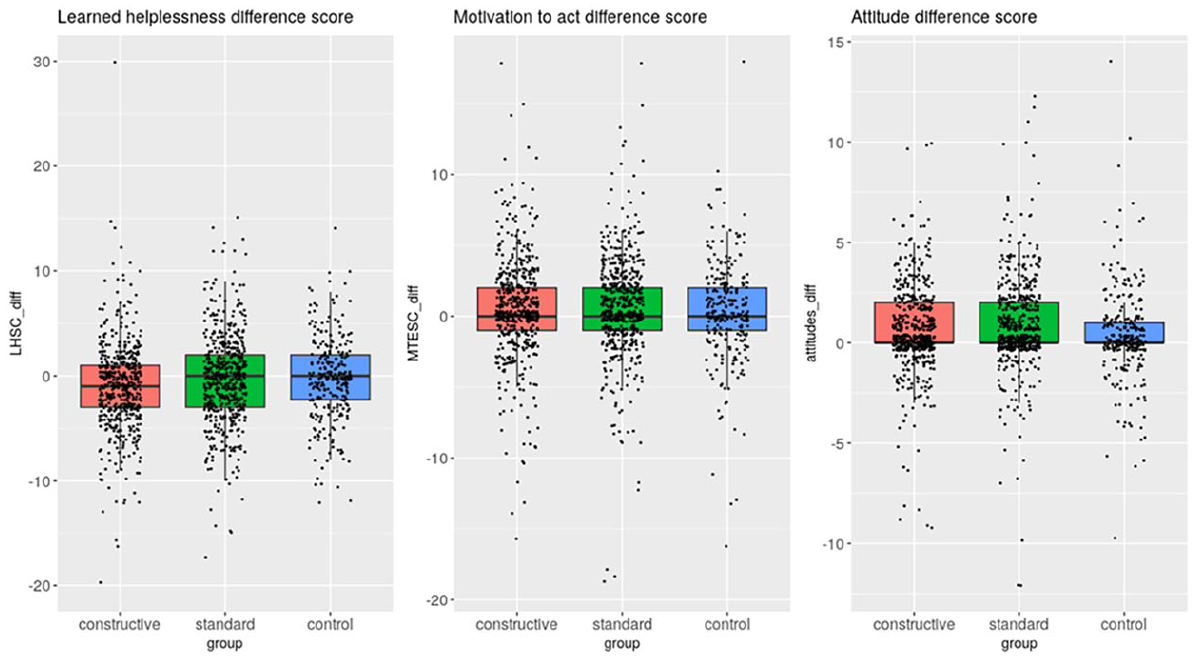
Comparison of change scores for the different groups (red: constructive, green: standard, blue: control).
Taken together, our results show that receiving constructive narratives significantly reduced participants’ learned helplessness, while standard narratives led to an increase in participants’ attitudinal concern about climate change.
Multiple linear regressions were conducted to corroborate the results from the MANOVA and investigate the influence of the other constructs measured on learned helplessness, motivation to engage in climate action, and climate change attitudes. Dependent variables were the post-intervention scores of learned helplessness (LHS-Cpost), motivation to engage in climate action (MTES-Cpost), and climate change attitudes. In all models, age, gender, education, political attitude, passive risk taking, and pre-intervention scores (LHS-Cpre, MTES-Cpre, climate change attitudes pre-intervention) were added as control variables (pre-registered).
Learned Helplessness
Results showed that the investigated variables explained a significant amount of variance for the LHS-Cpost score, F(12, 1281) = 120.4, p < .001, R2 = .53, R2 Adjusted = .53. More specifically, there was a negative relationship between LHS-Cpost scores and being in the constructive narratives group (b = −0.76, t[1281] = −2.52, p = .012) (for model comparison, see Table B1, in the appendix). Furthermore, there was a positive relationship between higher scores on the passive risk taking scale and LHS-Cpost scores (b = 0.06, t[1281] = 4.13, p < .001). Taken together, our results corroborate the findings from the MANOVA: Being in the construction narratives group was negatively related to participants’ learned helplessness. Furthermore, higher passive risk taking scores were related to a higher learned helplessness score.
When adding pro-environmental behavior, climate change knowledge, confidence, and attitude toward the climate movement to the model (exploratory), results remained significant for the constructive narrative group: (F[16, 1265] = 91.62, p < .001, R2 = .54, R2 Adjusted = .53; b = −0.77, t[1265] = −2.53, p = .011). Furthermore, there was a negative relationship for knowledge (b = −1.30, t[1265] = −2.01, p = .044) and attitude toward the climate movement (b = −0.16, t[1265] = −1.98, p = .047) (for model comparison, see Table B2, in the appendix). Put differently, those with more accurate knowledge about climate change and more positive attitudes toward the climate movement reported lower post-intervention helplessness values.
Motivation to Engage in Climate Action
Results showed that the investigated variables explained a significant amount of variance for the MTES-Cpost score, F(12, 1281) = 502.2, p < .001, R2 = 0.82, R2 Adjusted = 0.82. In line with the MANOVA there was no significant relationship between the MTES-Cpost score and the groups. There was a negative relationship between higher scores on passive risk taking scale and MTES-Cpost scores (b = −0.04, t[1281] = −3.38, p < .001). Furthermore, there was a positive relationship between age and MTES-Cpost scores as well as education (for model comparison and results, see Table B3, in the appendix).
When adding pro-environmental behavior, climate change knowledge, confidence, and attitude toward the climate movement to the model (exploratory), results remained significant for the passive risk taking scale: F(16, 1265) = 382.7 p < .001 R2 = .83, R2 Adjusted = .83; b = −0.04, t(1265) = −3.44, p < .001. Furthermore, there was a positive relationship for knowledge (b = 1.83, t[1265] = 3.07, p = .002) and attitudes toward the climate movement (b = 0.32, t[1265] = 4.20, p < .001). Put differently, those with more accurate knowledge about climate change and more positive attitudes toward the climate movement reported higher post-intervention motivation to engage in climate action (for model comparison, see Table B4 in the appendix).
Climate Change Attitudes
Results showed that the investigated variables explained a significant amount of variance for the attitudespost score, F(12, 1281) = 564.1, p < .001, R2 = .84, R2 Adjusted = .84. More specifically, there was a positive relationship between attitudespost scores and being in the standard narratives group (b = 0.56, t[1281] = 3.45, p < .001). There was a negative relationship between higher scores on passive risk taking scale and attitudespost scores (b = −0.04, t[1281] = −4.57, p < .001). Furthermore, age, gender, education, and political attitudes were significant predictors (for results and model comparison, see Table B5, in the appendix). Taken together, our results corroborate the findings from the MANOVA: Being in the standard narratives group was positively related to participants’ attitudes toward climate change. Furthermore, lower passive risk taking scores were related to an increase in participants’ attitudinal concern about climate change. When adding pro-environmental behavior, climate change knowledge, confidence, and attitude toward the climate movement to the model (exploratory), results remained significant for the standard narrative group: F(16, 1265) = 440.1, p < .001, R2 = .85, R2 Adjusted = .85; b = 0.50, t(1265) = 3.11 p = .002. Furthermore, there was a positive relationship for knowledge (b = 2.63, t[1265] = 7.05, p < .001) and attitudes toward the climate movement (b = 0.17, t[1265] = 3.56, p < .001) (for model comparison, see Table B6, in the appendix). Put differently, those with more accurate knowledge about climate change and more positive attitudes toward the climate movement reported higher post-intervention climate change attitude values.
Mediation Analyses
Exploratory, we investigated whether learned helplessness and climate change attitudes play a mediation role concerning motivation to engage in climate action. We compared the standard narratives, constructive narratives, and the control group. Learned helplessness and climate change attitudes were entered as mediator variables while controlling for age, gender, education, political attitude, and passive risk taking. The R-package lavaan (Rosseel, 2012) was used for computation (number of bootstraps n = 10000). For the analysis, the three groups (standard, constructive, control) were dummy coded to allow for comparison. Furthermore, as the R-package lavaan is restricted to two-level variables only, the education variable was entered as a continuous variable into the model. The n = 2 participants who indicated non-binary as gender were randomly assigned to either the category female or male. As our model contains two mediators we added the covariance of the two mediators to the model and specified contrasts for the indirect effects.
We ran two analysis: first, we compared the standard narratives and the control group with the constructive narratives (as the ANOVA results showed that learned helplessness was reduced for the constructive vs. the standard narratives). Second, we compared the standard narratives and the constructive narratives with the control group (as the ANOVA results showed that attitudes were higher for the standard narratives compared to the control group). Results showed a significant indirect effect of constructive narratives on the difference score of motivation to engage in climate action, mediated by the difference score of learned helplessness for both analysis (see Figures 2 and 3, Tables B7 and B8 in the appendix). Note, however, that p-values barely reached significance (b1 = −0.06, 95% CI [−0.13, 0.00], p1 = .049; b2 = −0.06, 95% CI [−0.13, 0.00], p2 = .049). There was no significant indirect effect of standard narratives on the difference score of motivation to engage in climate action, mediated by the difference score for attitudes toward climate change for both analysis (b1 = 0.07, 95% CI [−0.01, 0.15], p1 = .072, b2 = −0.07, 95% CI [−0.01, 0.15], p2 = .072). Furthermore, according to Hu and Bentler (1999) values close to 0.95 for the comparative fit index (CFI) and the Tucker–Lewis index (TIL), and a value smaller than .06 for the root mean square error of approximation (RMSE) indicate a relatively good fit. While this was true for our CFI and RMSE values, the value for TIL was smaller than 0.95 (TIL = 0.735). Model fit was thus not ideal in both cases. Furthermore, results revealed that for the constructive narratives, learned helplessness scores were not only reduced compared to the standard narratives but also compared to the control group. For the standard narratives, climate change attitudes scores were not only higher compared to the control group but also compared to the constructive narratives group.

Mediation analysis: comparison control vs constructive and standard versus constructive.

Mediation analysis: comparison standard vs control and constructive versus control.
Taken together, results hint toward an indirect effect of constructive narratives on motivation to engage in climate action by reducing learned helplessness, which in turn was related to an increase in participants’ motivation to engage in climate action.
Discussion
Aim of the current study was to investigate whether constructive narratives about climate change can reduce learned helplessness and increase motivation to engage in climate action. Our results showed that constructive narratives significantly reduced participants’ learned helplessness. Furthermore, a reduction in learned helplessness, in turn, increased participants’ motivation to engage in climate action.
As has been shown in previous research, constructive reporting can reduce negative emotions like anxiety (Overgaard, 2021, 2023), while research on (learned) helplessness showed its detrimental effects on climate change action (Gunderson, 2023; Landry et al., 2018). Bringing those two lines of research together, we showed that constructive narratives are an important tool for climate change communication as they reduce learned helplessness. Furthermore, reduced learned helplessness was related to higher motivation to act, albeit for both mediation models, significance was just barely reached. In future research, it might be interesting to investigate the effects of constructive vs. standard narratives by including additional measures. For example, Geiger et al. (2021) showed that hope and boredom were more important predictors of intentions to take climate action than helplessness. Additionally, it would be interesting to measure self efficacy. Research showed that self efficacy is positively related to climate action (Doherty & Webler, 2016; Meijers et al., 2023). Moreover, there might be a possible overlap between the concept of self efficacy and how we measured learned helplessness; it would be thus important to investigate the relationship between the two constructs (Bandura, 1978).
Climate Change Attitudes
We investigated whether constructive narratives had an impact on participants’ climate change attitudes (exploratory analysis). Results showed that participants who received standard narratives reported an increase in participants’ attitudinal concern about climate change. While we did not find a mediation effect for attitudes, correlational evidence (Table 1) showed that higher attitudinal concern about climate change was positively related to higher motivation to act. This is in line with research of Feldman et al. (2014), showing that problem-focused reporting leads to an increase in belief in climate change and support for action.
Standard Versus Constructive Reporting
Our results showed that constructive narratives can be effective in reducing learned helplessness. Furthermore, mediation analysis results hinted toward a mediation effect of learned helplessness between constructive narratives and motivation to act. However, our results also showed that standard and not constructive narratives increased participants’ attitudinal concern about climate change. Furthermore, as there was also correlational evidence that higher attitudinal concern was positively related to motivation to act, dismissing standard narratives as tool to inform the public might be counterproductive.
Nonetheless, as discussed before, there are negative effects of problem-focused reporting (negative impact on people’s well-being, Boukes & Vliegenhart, 2017; causing fear, stress, and depression, Pfefferbaum et al., 2014), with problem-focused reporting still accounting for the majority of news (Lengauer et al., 2012; Niven, 2001). Thus, while problem-focused reporting on climate change should be by no means completely replaced, introducing more solution-focused reporting on climate change into the mainstream media might be an efficient tool to counteract the negative effects of problem-focused reporting.
Passive Risk Taking
We investigated whether passive risk taking is related to post-measures of learned helplessness, motivation to engage in climate action, and climate change attitudes. Our results revealed that participants who scored higher on the passive risk taking scale also reported higher post-intervention scores of learned helplessness, lower post-intervention scores of motivation to engage in climate action, and lower post-intervention attitudinal concern about climate change. Regarding learned helplessness, there is, to our knowledge, no previous research that investigates a direct relationship with passive risk taking. However, there is other research linking avoidant behavior to depression and anxiety (Barlow, 2004; Ottenbreit & Dobson, 2004). Furthermore, our results could be related to the theoretical work of Martinko and Gardner (1982) in which they draw a connection between learned helplessness and passive and maladaptive behavior in organizations. With respect to motivation to engage to climate action, results showed that people with higher passive risk taking tendencies reported lower motivation to engage in climate action. Furthermore, there was a negative correlation between passive risk taking and participants’ pro-environmental behavior (see Table 1). Those results are in line with findings of Arend et al. (2020), in which they showed a negative relationship between passive risk taking tendencies and cyber security. Moreover, when investigating the relationship between the passive risk taking score and subscales of the pro-environmental behavior scale (activist behavior, non-activist behavior in the public sphere, non-activist behavior in the private sphere), results showed that there was only a significant negative correlation for the last subscale (non-activist behavior in the private sphere), that included items like “I refrain from air travel” (r[1357] = −.28, p < .001). This is in line with findings from Keinan et al. (2021), who showed that passive risk taking tendencies are related to a different type of risk behavior regarding COVID-19 than active risk taking tendencies.
Lastly, there was also a negative relationship between high passive risk taking scores and climate change attitudes. Keinan and Bereby-Meyer (2012) showed in their research that passive risk taking is related to cognitive avoidance, concluding that the tendency for passive risk taking might suggest that people are not fully realizing the risks or avoid thinking about them. For future research, it might be thus interesting to investigate whether passive risk taking tendencies are related to a general tendency to not realize that certain inactions are tied to risks or—like in our case—dismissing the existence of the risk altogether.
Motivation to Act
While we did not find any direct effect of constructive or standard narratives on our motivation to act scale, correlational evidence showed that both learned helplessness and climate change attitudes were related to motivation to act. Furthermore, when running mediation analysis, results showed that constructive narratives had an indirect effect on motivation to engage in climate action by reducing learned helplessness, which in turn was related to an increase in participants’ motivation to engage in climate action. While there is a wide range of possible ways to take action, our scale does not assess any specific types of action (e.g., buying more environmental friendly products, participating in protests) but is rather a more general assessment of motivation to engage in climate action (e.g., “This person enjoys finding new ways to engage in climate protection”). Given that there is a wide range of research pointing out that individual lifestyle choices are only having little environmental impact, if any (e.g., Chater & Loewenstein, 2023; Mazar & Zhong, 2010; Wapner & Willoughby, 2005) and can even be detrimental to supporting environmental friendly policies (e.g., tax increase on carbon emissions, Chater & Loewenstein, 2023; Werfel, 2017) it would be an important next step to investigate whether motivation to act does relate to actual behavior (see also limitations) and if so, what type of behaviors are influenced (activist behavior, support for policies, consumption choices).
Limitations
Our study has several limitations. First, participants only received one narrative. In further research, multiple narratives covering various topics should be presented. Second, as learned helplessness results from continuous confrontation with negative stimuli, the long-term effects of constructive narratives to counteract the effect of standard reporting should be investigated. Third, our attempt to measure actual behavior via clicks on links to climate change organizations was unsuccessful. Thus, in future studies, other behavioral measurements, like the Work for Environmental Protection Task (WEPT; Lange & Dewitte, 2022), could be employed to investigate whether our results generalize to climate change behavior.
Conclusion
Our results showed that constructive narratives can effectively reduce learned helplessness. Furthermore, results hint toward a relationship between reduced learned helplessness and higher motivation to act. Thus, introducing more articles into mainstream news based on constructive journalism principles could support climate change mitigation by increasing the public’s motivation to engage in climate action and thus be a valuable addition to the current tools in climate change communication.
Footnotes
Appendix A—Measures
The German version of the scales developed (with a description and the results from a pre-test to assess scale reliability, N = 27 participants) as well as the German version of the narratives can be accessed via https://osf.io/y276d/.
Appendix B—Results
Mediation Model Parameters for Model With Two Direct Effects (Standard vs. Control and Constructive vs. Control) on MTES-C.

| Model path relationships | Coefficient | SE | 95% CI | z | p |
|---|---|---|---|---|---|
| Standard versus control→MTES-C | 0.04 | 0.07 | [−0.11, 0.19] | 0.57 | .571 |
| Constructive versus control→MTES-C | 0.01 | 0.07 | [−0.13, 0.16] | 0.16 | .871 |
| Standard versus control→LHS-C | −0.02 | 0.07 | [−0.16, 0.12] | −0.30 | .765 |
| Constructive versus control→LHS-C | −0.19 | 0.07 | [−0.34, −0.05] | −2.58 | .010** |
| Passive risk taking→LHS-C | 0.10 | 0.03 | [0.04, 0.15] | 3.34 | <.001*** |
| Age→LHS-C | 0.05 | 0.03 | [0.00, 0.11] | 1.82 | .068 |
| Gender→LHS-C | −0.08 | 0.06 | [−0.19, 0.03] | −1.40 | .162 |
| Education→LHS-C | 0.03 | 0.03 | [−0.03, 0.09] | 1.05 | .295 |
| Political attitude→LHS-C | 0.04 | 0.03 | [−0.02, 0.10] | 1.30 | .192 |
| Standard versus control→attitudes | 0.24 | 0.08 | [ 0.09, 0.39] | 3.17 | .002** |
| Constructive versus control→attitudes | 0.11 | 0.08 | [−0.04, 0.26] | 1.43 | .154 |
| Passive risk taking→attitudes | −0.06 | 0.03 | [−0.12, −0.01] | −2.26 | .024* |
| Age→attitudes | 0.10 | 0.03 | [ 0.04, 0.16] | 3.46 | <.001*** |
| Gender→attitudes | −0.14 | 0.06 | [−0.25, −0.03] | −2.49 | .013* |
| Education→attitudes | 6.64e-03 | 0.03 | [−0.05, 0.07] | 0.22 | .828 |
| Political attitude→attitudes | 6.18e-03 | 0.03 | [−0.05, 0.06] | 0.24 | .813 |
| LHS-C→MTES-C | −0.06 | 0.03 | [−0.13, 0.00] | −1.97 | .049* |
| Attitudes→MTES-C | 0.07 | 0.04 | [−0.01, 0.15] | 1.80 | .072 |
Note. MTES-C = Motivation to engage in climate action; LHS-C = Learned helplessness.
p < .05. **p < .01. ***p < .001.
Acknowledgements
We want to thank our research assistant Ericka Zapanta for her support in this project.
Authors’ contributions
NS developed the research idea. NS and VW administered the project and developed the study concepts. VW and NS developed the methodology of the study and analyzed the data. VW was responsible for the development of the materials and the study implementation. NS was responsible for the visualization of the results. NS wrote the original draft. All authors were responsible for reviewing and editing the original draft. All authors approved the final version of the manuscript for submission.
Availability of Data and Material
The German version of the scales developed (with a description and the results from a pre-test to assess scale reliability, N = 27 participants) as well as the German version of the narratives can be accessed via  . The data and analysis code (R) that produces all results and figures of this article will be made available latest by the time of the final publication.
Consent to Participate and Debriefing
Informed consent was collected from the participants at the beginning of the study. At the end of the study participants were fully debriefed about the purpose of the study and had the opportunity to withdraw their data.
Declaration of Conflicting Interests
The author(s) declared no potential conflicts of interest with respect to the research, authorship, and/or publication of this article.
Funding
The author(s) disclosed receipt of the following financial support for the research, authorship, and/or publication of this article: This research was funded by the Federal Ministry of Education and Research (BMBF) and the Baden-Württemberg Ministry of Science as part of the Excellence Strategy of the German Federal and State Governments.