




Abstract
Climate change is a complex, multisystem phenomenon that disrupts human development both directly and indirectly through the interactions of interconnected systems. This article outlines the physical, social, and psychological impacts of exposure to climate disasters, which are already increasing in frequency and ferocity across the globe. Climate change poses particular challenges for billions of people with vulnerabilities related to geography, age, injustice, poverty, and many other social or economic disadvantages. In this article, we apply resilience and positive development frameworks to describe the resources and processes at the level of the individual, the family, and the community that can prepare and support people as they contend with the impacts of climate change. To illustrate these frameworks in action, we give examples of promising interventions that focus on mobilizing powerful human adaptive systems to build hope, agency, social cohesion, and a shared sense of belonging. We conclude by calling on developmental scientists to engage in research, interventions, and collaborative advocacy to address the unprecedented and existential threat posed by climate change.
There is now no doubt that climate change is underway and already posing serious threats to human life and well-being. Global temperatures have increased by over 1.2°C in response to rising greenhouse gas concentrations, which are now higher than they have been for millions of years. Around the globe, record-breaking heat waves, wildfires, hurricanes, droughts, flooding, and coastal inundation have become commonplace, causing untold suffering. Underscoring the increasing frequency and severity of climate-fueled disasters, the United States’ National Oceanic and Atmospheric Administration (NOAA; NOAA National Centers for Environmental Information [NCEI], 2022) reported that the number of billion-dollar disaster events per year in the country has increased from an average of 6.3 from 2000–2009 to 20 in 2021.
United Nations (UN) Secretary-General António Guterres described the 2021 report of the Intergovernmental Panel on Climate Change (IPCC, 2021) as nothing less than “a code red for humanity—the alarm bells are deafening, and the evidence is irrefutable” (UN, 2021, para. 2). Even now, climate scientists believe the planet is on the brink of irreversible tipping points, such as changes in ocean currents that would have catastrophic impacts (Steffen et al., 2018). Feedback loops with cascading effects are evident: for example, as the Arctic permafrost melts in response to higher temperatures, it releases large quantities of methane, causing further warming. Avoiding the most catastrophic climate effects requires immediate, rapid, and large-scale reductions in greenhouse gas emissions, but most countries are not on track to achieve adequate reductions (United Nations Climate Change, 2022).
The magnitude of this unprecedented threat casts doubt on the future of human civilization, leading many to identify climate change as an existential crisis. How, then, can developmental scientists contribute to the urgent task of protecting development for current and future generations? Clearly, the first priority must be risk reduction, including reductions in greenhouse gas concentrations. However, even with urgent action at a global scale, the planet will face a hotter and more unstable climate for decades if not centuries (US Global Change Research Program [USGCRP], 2018). Therefore, even as we advocate for urgent climate action, developmental scientists must take action to support the capacity of people of all ages—and particularly young people—to cope with what inevitably lies ahead, collaborating with other scientists, practitioners, and policymakers to build multiple-system resilience against the threats of climate change.
This article begins by highlighting how climate change disrupts human development both directly and indirectly through the interactions of interconnected systems. We describe the physical and psychological impacts of exposure to climate disasters, noting the injustice inherent in how these are distributed, which in turn exacerbates existing inequalities. Next, we discuss how a multisystem understanding of climate change can advance efforts to envision and implement multisystem solutions. Specifically, we use resilience and positive development frameworks to identify factors and processes across systems (familial, social, cultural, economic, etc.) that can support positive adaptation to climate change in individuals and communities. We provide examples of interventions that mobilize naturally occurring adaptive systems to build hope, agency, social cohesion, and a shared sense of belonging in the face of loss and uncertainty. We conclude by calling on developmental scientists to respond to the climate crisis through creative research, effective local and global interventions, and collaborative advocacy.
Impacts of Climate Change on Human Development
The effects of climate change are becoming ever more evident, amplifying the frequency and intensity of acute disasters such as floods and wildfires, while also causing longer-term damage in the form of droughts, desertification, and rising sea levels. However, due to interactions across all levels of human ecology, the effects of climate change have dynamic repercussions across regional, national, community, family, and individual systems (Evans, 2019; Sanson, Malca, Van Hoorn, & Burke, 2022). The direct consequences of climate disasters for physical health, including deaths and injuries, diseases, respiratory conditions, and malnutrition, are now well-documented (Watts et al., 2021). However, climate-fueled disasters also instigate cascading chains of events that damage the infrastructure that supports human life and development, such as education systems, health systems, transportation systems, food production, and distribution systems, as well as waste disposal systems. Some of these impacts may take years to become noticeable. Prolonged famine-related malnutrition, for example, can cause neurological damage, cognitive impairment, and physical disabilities (Anderko et al., 2020; Sanson, Malca, & Van Hoorn, 2022; Watts et al., 2021). As mosquito habitats expand, so does the geographical range of pathogens like the Zika virus, which poses serious risks to children’s physical and cognitive development. The damage may even span generations: When climate change reduces the quantity and quality of food available to pregnant women, the developing child’s health suffers (Blakstad & Smith, 2020).
There also is an established relationship between climate change and conflict. Climate crises threaten political and economic stability by damaging resources like habitable and arable land; it is for this reason that the UN Security Council describes climate change as a “threat multiplier” (United Nations News [UN News], 2019). The World Bank predicts that hundreds of millions of people will be displaced due to climate change by 2050 (Rigaud et al., 2018). Already, millions of “climate refugees” have been forced to leave their homes due to extreme temperatures, failed food production, unavailability of clean water, destruction of housing and other infrastructure, or the conflicts that have arisen as a result of these events. Multiple studies show that increasing temperatures and changes in rainfall patterns are associated with increases in violence and conflict between individuals, groups, and nation-states (Hsiang et al., 2013). In the aftermath of disasters, community violence and domestic violence can increase, and some parents turn to more punitive parenting practices (Molyneaux et al., 2019; Sanson, Malca, Van Hoorn, & Burke, 2022).
People with existing vulnerabilities are most likely to be impacted by climate-related damage and loss. For example, individuals with disabilities (around 15% of the global population) are especially likely to face injury or death during a disaster (Bennett, 2020). Although these vulnerabilities were neglected for many years, disaster risk reduction efforts have recently increased their focus on addressing special needs related to disabilities, exemplified by the Sendai Framework for Disaster Risk Reduction 2015–2030 adopted at a UN world conference in 2015 (Stough & Kang, 2015). Another salient vulnerability is older age. A review by Gamble and colleagues (2013) found that older adults face higher risk during and after exposure to heat waves and other extreme weather events, as well as infectious diseases and declining air quality. Older adults are likely to have lower socioeconomic status and higher levels of dependence on others, and they may also have decreased mobility, functional limitations, declining immune function, increased frailty, waning cognitive capacities, and multi-morbidity that make them less able to escape from disasters and survive injuries and illnesses incurred during them. When Hurricane Katrina hit the United States in 2005, almost 50% of the deceased were older than 75 years (Jonkman et al., 2009).
Young people are arguably the age group that is most vulnerable to climate change, for multiple reasons (Thoma et al., 2021). Younger children and youth depend on care and protection from adults (parents and other carers). In disaster situations, those who supervise and care for children are likely to be stressed and preoccupied or worse, unavailable through death, injury, or separation. Young people also are overrepresented among the impoverished sectors of many nations. Poverty is associated not only with greater disaster exposure but also with greater vulnerability to disaster effects, such as poor health care and inadequate nutrition (Fothergill, 2017). Moreover, children have less mature neural and immune systems and less capacity for detecting and responding to dangers (American Public Health Association [APHA], 2019; Oberg et al., 2021; United Nations Children’s Fund [UNICEF], 2021). They breathe more air and drink more fluid for their body weight than adults, and these characteristics, along with their shorter height, their tendency to spend more time on the ground, and to engage in more hand-to-mouth motions, all increase their exposure to air, water, and soil pollutants, and disease vectors (APHA, 2019). For such reasons, the World Health Organization has estimated that over 80% of the physical health impacts of climate change will be experienced by children (McMichael et al., 2004).
Furthermore, today’s children are likely to experience multiple climate-related stressors whose impacts will accumulate over their lives. Thiery et al. (2021) showed that, even if warming is limited to 1.5°C, a child born in 2020 is on average likely to experience up to 24 times as many climate-induced extreme weather events (heat waves, wildfires, crop failures, droughts, river floods, and tropical cyclones) in their lifetime as someone born in the 1960s. UNICEF (2021) recently developed the Children’s Climate Risk Index (CCRI) that rates nations on 57 variables, from the risk of direct exposure to climate and environmental disasters (e.g., disease or drought) to broader systemic factors, like health and nutrition systems, education, sanitation, poverty, communications, and social protection. UNICEF found that approximately 1 billion children globally—nearly half of the world’s children—live in countries (predominantly in the Global South) that are at an “extremely high-risk” from the impacts of climate change. Furthermore, it found that almost every child is exposed to at least one serious climate or environmental hazard, and 850 million children—approximately one-third of all children globally—are exposed to four or more hazards, leading to the conclusion that the climate crisis “is already having a devastating impact on the well-being of children globally” (UNICEF, 2021, p. 9).
There also is growing recognition of psychological effects from climate-related disasters, both experienced and anticipated. Among adults, psychological effects of disaster exposure include anxiety, depression, sleep disturbance, post-traumatic stress, and suicidal thoughts, all of which may develop into full clinical disorders (Cianconi et al., 2020). Children’s psychological responses include many of the same symptoms and disorders, as well as somatic complaints, attachment disorders, and regressive behaviors (Burke et al., 2018). Many young people report feelings of grief, hopelessness, and despair. Rates of post-traumatic stress disorder (PTSD) symptoms among children and youth following climate-related disasters often are high, although they vary considerably across studies, as well as by child age, gender, type of disaster, and degree of exposure. For example, 4 months after floods in Pakistan, 73% of children aged 10–19 years displayed high levels of PTSD symptoms, with displaced girls more affected (Ahmad et al., 2011). In contrast, in a study by Yelland and colleagues (2010) of students who experienced bushfires in Australia (ages 8–18), only 10% reported severe or very severe PTSD symptoms 1 year after the fires, while 17% reported moderate symptoms, and most of the remainder reported mild symptoms. These investigators found that younger children reported more symptoms, but no sex differences were found. The design of these studies may shape their core findings, because the effects of disaster vary with developmental timing and the severity of disaster exposure, and also change with the passage of time (Masten et al., 2015). In addition, there may be cumulative mental health effects for children who experience a sequence of climate-related disasters, especially if they do not receive adequate support (Leppold et al., 2022).
Another class of psychological effects from climate change arises from anticipation of worsening climate impacts (Clayton, 2020). The majority of people worldwide are now concerned about the future effects of climate change on their lives. A Pew Research Center (2022) survey of 24,525 adults in 19 nations in North America, Europe, and the Asia-Pacific region found that 75% saw climate change as a major threat to their nation, and only 5% did not regard it as a threat. Similar findings emerged from a recent survey of 10,000 youth, aged 16–25 years, from 10 nations in both the Global North and Global South (Hickman et al., 2021). Survey results indicated that most youth were experiencing levels of climate anxiety high enough to impact their everyday functioning. Almost 60% of respondents reported feeling “very” or “extremely” worried about climate change, whereas only 5% were not worried. In addition, 58% of young people reported feeling betrayed by their government’s inadequate responses to the climate crisis, and this sense of betrayal corresponded with their level of climate anxiety. Even more concerning, 56% of the youth believed that humanity is doomed—that we will not rise to the challenge of climate change and therefore face catastrophe. The term “eco-anxiety” has been coined to describe these reactions. However, this label ignores the wide array of reported emotional reactions to climate change besides anxiety, and can have the connotation that such feelings are unfounded, when they may more accurately be viewed as rational, albeit distressing, reactions (Sanson, Malca, Van Hoorn, & Burke, 2022)—a better label may be “climate distress.”
Building Resilience of Current and Future Generations to Climate Threats
Addressing the complex threats posed by climate change to human development requires attention to the multisystem processes that protect individuals in the near term and nurture resilience for the future. Models of resilience and positive development offer important theoretical perspectives, empirical evidence, and practical guidance about what can be done to prevent, mitigate, or counter the risks posed to human development by climate change, particularly among children and youth (Masten, 2021; Sanson, Malca, Van Hoorn, & Burke, 2022). These models are informed by research on promotive and protective factors and related processes that support positive human development, particularly in the context of adversity and disaster. The nature and severity of threat exposures, as well as individual, family, and community vulnerabilities, certainly matter for human adaptation in the context of climate crises, but so do the resources, protections, and capabilities at multiple-system levels that can be mobilized on behalf of human survival and development. Decades of past research on resilience among those who overcome diverse threats associated with acute and cumulative adversity align well with the growing body of research specifically focused on responses in the context of climate-related disasters and multisystem strategies for risk reduction or resilience enhancement.
Resilience in contemporary research on human development is broadly defined as the capacity to adapt successfully to adversity, through processes engaging multiple systems within and around the person (Masten et al., 2021; Ungar & Theron, 2020). Decades of research on who does well or recovers from adverse life experiences has uncovered consistent evidence on key factors associated with better outcomes in the wake of acute and chronic threats, ranging from child maltreatment to climate-related disasters. Research on positive development in diverse contexts around the world has identified strikingly similar predictors of positive adaptation, often described as “assets” or “resources” in the individual and the context (e.g., Hawkins et al., 2009; Lerner et al., 2005; Petersen et al., 2017).
The capacities and resources associated with resilience in development include individual skills, behaviors, and mind-sets, such as problem-solving, self-regulation skills, optimism, hope, self-efficacy, a sense of belonging, and a sense of meaning or purpose; interpersonal resources and support from relationships with family members, teachers, friends, and mentors; and engagement with broader social resources and supports provided by effective schools, religious and cultural traditions, and safe communities invested in the well-being of children, youth, and families. Systematic reviews corroborate many of these widely observed predictors of positive adaptation in situations of adversity (e.g., Fritz et al., 2018; Meng et al., 2018).
Families, schools, and communities provide resources and protection against adversities in the present while they also prepare for future disasters and nurture resilience for the future of their citizens. Resilience capacity can be strengthened through policies at local and societal levels that support the ecological systems that support children, youth, and families, ranging from green space or clean water to child care, tax credits, or health care for families with children, and funding for community efforts to improve schools, safety, or opportunities for youth leadership.
Some of the factors associated with positive development are generally promotive, regardless of risk or adversity exposure, while others are particularly important when threat levels are high, showing a protective or buffering effect akin to vaccines or airbags in an automobile (Masten et al., 2021). Some resilience factors work both ways; for example, children with good problem-solving skills or strong bonds with supportive caregivers generally fare better in development, but these advantages become even more significant for functioning or development when risk or adversity is high.
The empirical literature focused specifically on how children adapt to climate change, particularly in regard to successful strategies for improving resilience, is limited to date (Sanson, Malca, Van Hoorn, & Burke, 2022). However, the need for this research is only growing in urgency as the world braces for more frequent and intense disasters (Masten, 2021; Sanson, Malca, Van Hoorn, & Burke, 2022). Emerging evidence suggests that many well-known assets, such as hope, agency, and belonging, will prove useful in the context of addressing climate adversity (Sanson, Malca, Van Hoorn, & Burke, 2022). Meaning-focused coping strategies have been shown to protect psychological well-being in Swedish youth facing climate change concerns (see Ojala, 2022). Certain activities may also equip youth to face intensifying climate-related challenges, such as spending time in nature (Thoma et al., 2021) and engaging in environmental activism (Ojala, 2022). Participating in collective action, such as joining protests, is linked to a sense of agency or self-efficacy that appears to counter the fear and helplessness generated by concerns about climate change (Sanson & Bellemo, 2021). Other protective and promotive factors include trust in scientific organizations, the ability to engage in positive reappraisal, and a sense of purpose.
Researchers have noted striking parallels in resilience factors identified across system levels important to human development, including families, schools, and communities (Masten et al., 2021). This observation has led scholars to conclude that resilience factors reflect adaptive capacities that both support and emerge from the positive interaction of socio-ecological systems and the people within them. Theoretically, aligning resilience processes within and across levels has the potential to increase the power and reach of interventions to bolster adaptive responses to multisystem adversities. For some time, humanitarian agencies and governments, as well as the World Bank, have advocated for interventions that combine multiple sectors and levels of intervention in efforts to promote healthy development of children globally (e.g., Sayre et al., 2015). It is challenging, however, to evaluate the efficacy of multisystem and multisector interventions tailored to situational, individual, and cultural differences.
Three Major Strategies of Intervention to Address the Threats of Climate Change to Human Well-Being and Development
With challenges posed by climate change already present and urgent, efforts to reduce disaster risk and promote resilience to climate change cannot wait for researchers to understand and evaluate all the possibilities for action. Although it is vital at any given time in history to advance and verify the effectiveness of interventions to adversity and improve their implementation, stakeholders—including families, educators, and policymakers, as well as humanitarian agencies—are charged with protecting people in their care from today’s dangers and preparing them to face future hazards. As a result, evidence-informed resilience frameworks for intervention have emerged alongside research frameworks, with the goal of translating the best evidence at hand to guide practice and programs, even as additional knowledge accumulates about specific threats and the best response strategies (Masten, 2021).
Three basic approaches to intervention have emerged from research on resilience in the context of adversity, including major disasters (Masten, 2021). The first approach, risk reduction, aims to prevent or lower the intensity and cumulative level of threats to human survival and development. The second approach is to boost access to resources associated with positive development. The third approach is to mobilize powerful adaptive systems that buffer or protect against harmful effects of adversity and drive positive adaptation.
Risk reduction, as noted above, is widely recognized as the most critical strategy in the context of the existential threats posed by climate change. UNICEF’s (2021) report on the Climate Change Risk Index makes a powerful case for viewing the climate crisis as a children’s rights issue due to enormity of the risks it poses to young people, both those already born and those yet to be born, and the high vulnerability of children and youth. The most important form of risk reduction is rapid lowering of greenhouse gas emissions on a global level, through strategies directed at multiple-system levels. If we do not succeed in lowering this global risk to the earth’s climate, there will be little we can do to prevent massive suffering for people of all ages, everywhere.
At the same time, there are other strategies to lower risk levels from climate-related disasters. For example, local communities can conduct disaster risk analyses and raise public awareness about potential climate hazards. They may install warning systems, plan evacuation routes, fortify homes, schools, or hospitals, and relocate people to less vulnerable locations in advance of disasters. In these disaster risk reduction (DRR) efforts, special attention needs to be given to children’s well-being, such as training adults (e.g., caregivers, teachers, and first responders) about the vulnerabilities and needs of children during crises.
Children and youth can be involved in DRR efforts in many age-appropriate ways. There is a growing appreciation for the roles that children can play in DRR, by learning and educating others about disaster risk reduction as well as through active participation (Amri et al., 2018; Ronan et al., 2016). Moreover, engaging children in DRR efforts may have the dual benefit of lowering actual levels of risk while building resilience, particularly in regard to a sense of agency, hopefulness, and self-efficacy, identified in the literature as key drivers of resilience (the focus of the third strategy). Amri and colleagues (2018) reviewed studies of DRR education for children as well as studies of child participation in DRR. Results of education studies were mixed, although generally positive in terms of increasing awareness or knowledge. Results of studies that engaged children in undertaking DRR activities appeared to be more promising, although their review uncovered no studies with a control group. Case examples suggested that when youth are included in global meetings on DRR for climate change, they exert some influence on the reports and decisions arising from those meetings. In their report on children and DRR from the perspective of the agencies comprising the Children in a Changing Climate coalition, Back and colleagues (2009) highlighted the benefits of “child-led” DRR. In addition to influencing decision makers, they argued that child-led efforts can be cost-effective, build a sense of youth agency, enhance peer to peer communication and education, and prepare children to be informed and empowered future citizens. In their review of child-centered DRR, Ronan and colleagues (2016) reported that both parents and teachers prefer programs that involve interactive problem-solving strategies, likely reflecting the appeal and benefits of active engagement for all stakeholders in education.
Slowing the course of climate change, of course, requires collective desire to do so. Lawson and colleagues (2019) demonstrated the potential of intergenerational child-to-parent learning in an experimental study designed to build climate change concern among parents indirectly through a curriculum for their middle school–aged children. This 2-year curriculum included hands-on activities, field-based learning experiences, and children interviewing their parents. Parents of children in the treatment group showed a greater increase in climate change concerns than those in the control group, with changes in parents’ concerns mediated by those of their children. The changes were largest for more politically conservative parents and for fathers, who typically express fewer concerns about climate change. These investigators also suggested that early adolescence may be a window of opportunity for increasing climate concern among youth, before climate attitudes become more politically influenced or solidified.
The second approach to promoting resilience, boosting assets and resources, also includes a broad array of strategies. Most basic among these strategies is the provision of survival needs, including clean water, food, medical care, and shelter. For young children and other vulnerable populations, survival needs include caregivers. Another set of resource-boosting strategies focuses on economic supports for those in need, such as direct cash transfers or tax benefits. Other efforts can be directed at ensuring access to quality child care, education, work opportunities, the tools for learning including internet access, play and recreational activities, and support for the systems that generally foster opportunities for all ages to develop their potential. Building or restoring homes, schools, playgrounds, libraries, and community services are all examples of this approach. The challenges faced across the world during the pandemic underscored the importance of providing and restoring resources for adults and children and the systems that support their development in communities, as well as supporting the people and businesses who operate all these systems (Masten & Motti-Stefanidi, 2020; Ringsmuth et al., 2022).
Assets and resources that promote positive adaptation and development can also be viewed as forms of “capital,” or resources that can generate additional resources (Emery & Flora, 2006), including human, financial, social, cultural, or natural resources. The Recovery Capitals Framework (RCF) promoted by collaborators in the Australian Institute for Disaster Resilience provides an evidence-informed planning guide to disaster recovery (Quinn et al., 2022). The framework was developed through a comprehensive participatory process engaging cross-sectoral researchers and practitioners, focused on resources in the form of various kinds of capital and deeply informed by practice and cultural context as well as research evidence. The RCF is highly congruent with socio-ecological models of human development (Bronfenbrenner & Morris, 2006) as well as multisystem models of resilience, and it has been adapted for use in various cultural contexts, including Indigenous people in Australia and New Zealand.
The third approach to promoting resilience involves restoring or mobilizing promotive and protective processes that foster positive adaptation or recovery in the context of diverse hazards. These strategies include efforts to restore a sense of safety, security, belonging, and hope for the future, as well as efforts to counter feelings of helplessness and despair that can accompany experiences or anticipation of disasters, through action and activities that build collective as well as individual self-efficacy and agency (Hobfoll et al., 2007). Reuniting families, restoring homes, and generally connecting displaced people to places and people where they can belong are well-recognized strategies for promoting resilience in the aftermath of disasters. Qualitative, quantitative, and case studies on disaster recovery also note the general effectiveness of restoring familiar routines, such as school schedules, family rituals, and traditional cultural practices, as well as sports or social activities with friends, all of which can convey a sense of meaning as well as normalcy (Masten, 2021; Masten et al., 2015).
Programs that are offered in school settings are generally well-received by children and parents alike, most likely because the setting itself is a familiar and normal gathering place that is equipped to use resources from multiple sectors to promote education, health, and child protection (Masten et al., 2015; McCalman & Bainbridge, 2021; Theron, 2021). Along with religious and civic organizations, schools offer chances to foster the development of supportive relationships, problem-solving skills, self-regulation, agency, and a sense of belonging. Save the Children, for example, developed a “Journey of Hope” program for building resilience among children after disaster that follows an in-school recovery model after the emergency phase of response has passed (https://www.savethechildren.org.au/our-work/our-programs/australia/journey-of-hope). The school-based curriculum was designed to foster social and emotional skills, along with positive problem-solving and coping, and tailored to different age students. This program was implemented following Hurricane Katrina and successfully adapted for other disasters, including bushfires in Australia. Another example of school-based programming following Katrina is the Youth Leadership Program (Osofsky et al., 2018). This program was designed to mobilize self-efficacy and school spirit while reducing trauma symptoms, and it supported student-led efforts to plan and implement activities to rebuild the community and prepare for future disasters. Participating students showed gains in self-efficacy compared to their peers. Among all youth, increasing self-efficacy was related to decreasing post-traumatic stress.
DRR education programs can serve to increase children’s awareness and knowledge (Amri et al., 2018), but didactic programs are not as effective as their action-based counterparts at boosting children’s resilience or engagement. Youth benefit the most from climate change education programs that promote empowerment and agency with “participatory, interdisciplinary, creative, and affect-driven approaches” (Rousell & Cutter-Mackenzie-Knowles, 2020, p. 191). Participatory DRR approaches can serve to build resilience in children and youth (Ronan et al., 2016; Sanson, Malca, Van Hoorn, & Burke, 2022), in part because they can develop a sense of agency (Peek et al., 2018). In Australia, for example, where bushfires are a chronic and worsening hazard, the government-funded Country Fire Authority developed a student-led inquiry-based disaster education program for students called “Survive and Thrive,” which was delivered by firefighters in a bushfire-prone region. Results of a pilot study indicate that children enjoyed the program and gained a sense of agency along with more knowledge (Gibbs et al., 2018).
Many emerging programs around the world engage youth as change agents for climate action, ranging from “green schools” (e.g., Green Schools National Network in the United States) and nature-based early childhood education (e.g., Powers & Ridge, 2018; Sobel, 2017) to youth-led activism, such as the Fridays For Future climate strike movement initiated by Greta Thunberg in 2018. UNICEF (2021) encourages adults to consult directly with children and young people to elicit their ideas about the world they will inherit. When adults listen to young people speak about climate change, they learn new creative solutions, and in turn, they help the youth to build the agency and capacity they will need to adapt to the impacts of climate change.
Recommendations for Developmental Scientists
Climate change is the defining challenge of our time and for the foreseeable future, shaping the lives of children already born and those to come. With urgent action, we may avoid the most catastrophic consequences that could destroy our planet’s basic regulatory systems and precipitate the collapse of human civilization. But even with such action, scientists predict a perilously unstable climate at least for the rest of this century, with increasing temperatures, rising seas, and extreme weather events. As we have highlighted in this brief review, the repercussions of these climate changes for human lives are many and varied, disrupting human development directly and indirectly through the interplay of multiple interconnected systems. Given that the central purposes of developmental science focus on advancing our understanding of human development and well-being, and translating this understanding into policy and practice, it is imperative for developmental scientists to contribute to global efforts to address this unprecedented threat.
To understand the developmental implications of climate change, there already is a literature, though far from complete, that documents the physical and psychosocial impacts of climate change, which encompass the experience of both sudden disasters and slower-acting changes, and shows the mental health consequences of climate-related terror and dread. Literature on poverty and forced migration is also relevant: the World Bank estimates that up to 132 million people will be pushed into extreme poverty as a result of climate change by the end of this decade (Jafino et al., 2020); and the Institute for Economics and Peace (2022) projects the climate-fueled displacement of over 1 billion people by 2050.
A critical role for developmental scientists is to help prepare and support current and future generations who will experience the worst effects of climate change. In doing this, they can draw guidance from research on resilience in the context of complex disasters. However, to date, most of this work has been carried out in the Global North, and there is a pressing need for research and program development in the Global South where climate impacts will be most keenly felt. Promising programs from specific cultures will require careful but rapid adaptation to new cultural contexts and the particular profile of threats posed by climate change in those regions.
Protecting young people and preparing them for the future requires proactive, coordinated, multisystem strategies that integrate knowledge from multiple disciplines to nurture the adaptive capacities of children and the systems that support them. Since many interacting systems (families, schools, economies, etc.) shape resilience, and since time is of the essence, it is likely that many approaches will need to be implemented simultaneously, guided by the best evidence available when action is required. Multidisciplinary developmental scientists and practitioners, in partnership with leaders in nongovernmental organizations (NGOs) and governments, will need to serve as translators and trainers to implement and adapt interventions. When new evidence emerges about climate-related risks and protective strategies, stakeholders and response teams will need to be informed rapidly, and the scientific community will need to develop alternatives to “dissemination as usual” that deliver critical information to communities in acute crisis. Similarly, developmental scientists must accelerate efforts to document best practices in cultural and contextual adaptation of resilience programs to facilitate rapid tailoring to diverse climate conditions in different regions, accounting for key differences among individuals, families, schools, communities, and cultures.
Peek (2022) has called for a new approach to disaster research that has implications for climate change research as well. With funding from the National Science Foundation, Peek and colleagues launched the CONVERGE initiative at the University of Colorado Boulder dedicated to connecting and training disaster researchers. Through the Natural Hazards Center, CONVERGE offers training and research funding to academics and diverse professionals, with a particular focus on supporting disaster-affected researchers. During COVID-19, this group convened over 1,000 researchers in working groups to facilitate collaborative responses and research. Interdisciplinary teams of this kind are essential for advancing research and action on climate change.
We expect that hope, agency, and a shared sense of belonging are crucial to the effort to engage all generations, and particularly young people, in positive efforts to both mitigate climate change and adapt to its impacts. Evidence on child-centered DRR efforts to date suggests that programs engaging multiple stakeholders (e.g., children, parents, teachers, community members) in disaster resilience education that is collaborative, active, and problem-solving in orientation have promising potential to simultaneously prepare households and communities for relevant climate change threats, provide a sense of hope to participants, and equip future generations with resilience-building tools (Amri et al., 2018; Ronan et al., 2016). Although many knowledge gaps remain, the climate crisis requires informed action now, even as we continue to expand evidence on risk and resilience processes in diverse populations across the globe.
Given the scale and urgency of the climate crisis, efforts to prepare and protect the next generation need to be transformative. In their report on the climate crisis as a child rights crisis, UNICEF (2021) recommended investments that improve access to resilient water, sanitation, and hygiene (WASH) services; to health and nutrition services; and to social protection and poverty-reduction programs. This report also advocated for investing in education on climate change and sustainability, which can build knowledge and skills to prepare children and youth for future work in a green economy; improve sustainability practices to reduce emissions at the individual, institutional, and community levels; and empower children, adolescents, and adults to participate in climate mitigation, adaptation, and climate-resilience activities.
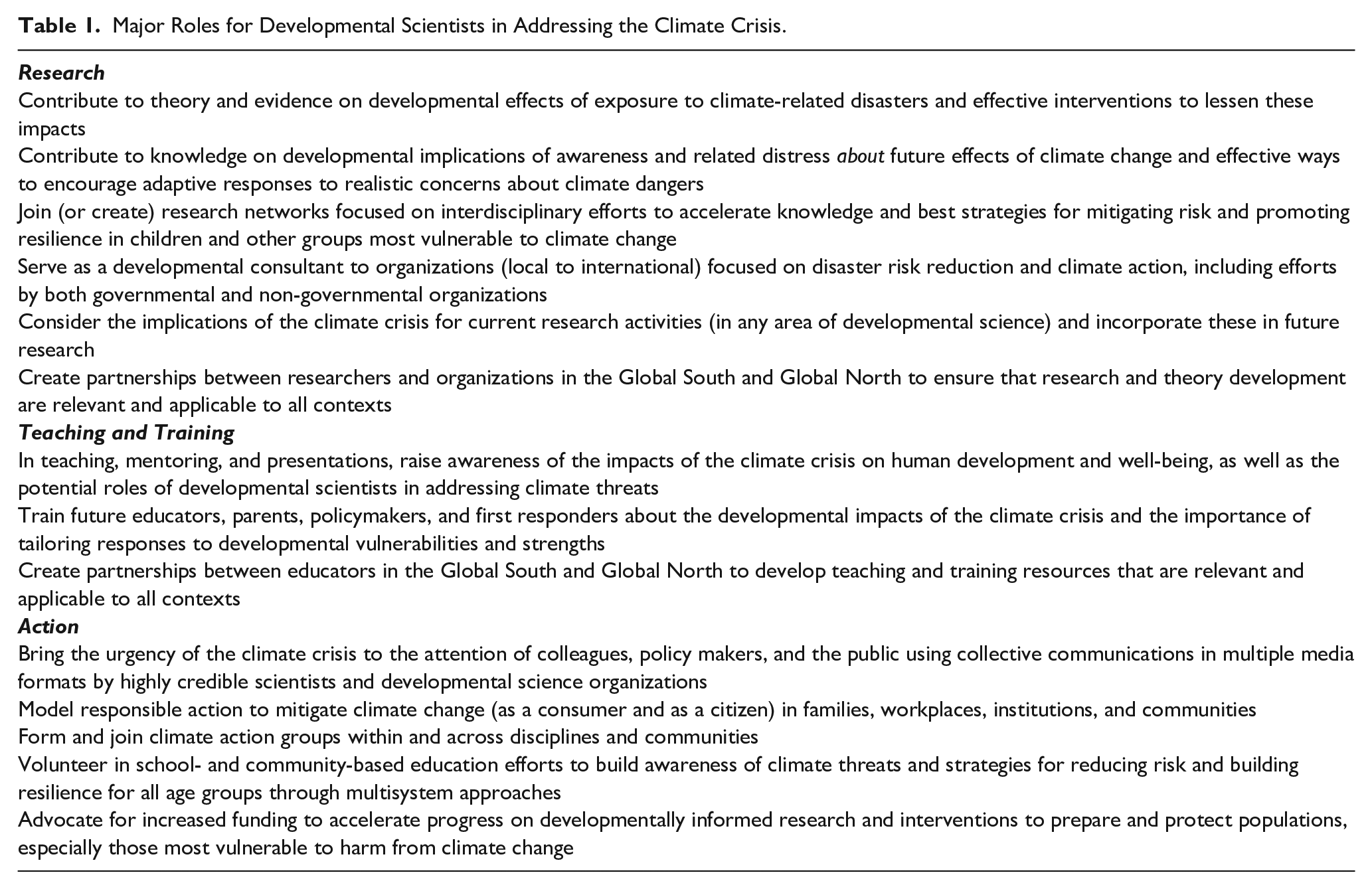
We urge developmental scientists to consider the ways that they can engage individually and collectively in responding to the climate crisis, not only as people with skills in teaching, research, and practice, but also as citizens who can take action. Table 1 provides examples of major roles that developmental scholars could play in response to the threats of climate change, from evaluating resilience-promoting interventions to training diverse professionals and first responders about the needs of children and other vulnerable populations during crises. Most importantly, we must use our knowledge, expertise, and credibility to promote action and advocacy for transformative action at a global scale. 1 In the powerful words of the UN report on the climate crisis as a child rights issue, “Only with [. . .] truly transformative action will we bequeath children a liveable planet” (UNICEF, 2021, p. 9).
Major Roles for Developmental Scientists in Addressing the Climate Crisis.
Conclusion
Climate change poses unprecedented threats to human life and development on a global scale. It is a multisystem, cascading catastrophe in slow motion, punctuated by acute disasters such as wildfires and extreme weather events, threatening all the systems that support healthy development. Moreover, the burden of risk falls with profound inequity on young people, historically marginalized groups, lower income countries, and individuals with existing vulnerabilities. There is an urgent need to accelerate our efforts to reduce risk and bolster resilience at multiple-system levels. Developmental scientists have crucial roles to play: (1) sounding the alarm about threats of climate change to human development; (2) disseminating existing research-based knowledge about risk and protective processes in the context of a changing climate; (3) contributing to future research essential to advancing knowledge and its applications with respect to what works for whom in diverse contexts and systems; (4) engaging and supporting youth to join and lead response efforts commensurate with their stake in the future; and (5) collaborating with other scientists and practitioners to accelerate our collective response to this existential threat.
Footnotes
Declaration of Conflicting Interests
The author(s) declared no potential conflicts of interest with respect to the research, authorship, and/or publication of this article.
Funding
The author(s) received no financial support for the research, authorship, and/or publication of this article.
