




Abstract
The differential susceptibility model proposes that some children are more susceptible to both positive and negative peer relationships than others. However, experimental evidence supporting such a proposition is relatively scarce. The current experiment aimed to help address this gap, investigating whether Chinese (pre)adolescents who have higher levels of general sensitivity to the environment (i.e., higher levels of sensory processing sensitivity [SPS]) would be more strongly affected by peer acceptance and rejection. (Pre)adolescents aged 8.75–15.17 (N = 1,207, Mage = 11.19 years, 59.7% boys) randomly received four hypothetical vignettes describing either peer acceptance or peer rejection. Before and after this manipulation, they reported on their positive and negative mood. We assessed (pre)adolescents’ SPS using (pre)adolescent self-reports, as well as caregiver reports for a subset of (pre)adolescents (n = 480). Results supported differential susceptibility to peer rejection and acceptance for self-reported SPS, but not caregiver-reported SPS. (Pre)adolescents with higher levels of self-reported SPS not only had stronger increases in positive mood upon peer acceptance (susceptible “for better”; β = .09, p = .001) but also stronger increases in negative mood upon peer rejection (susceptible “for worse”; β = .09, p = .023). These findings illustrate the short-term dynamics that may underlie differences in children’s long-term susceptibility to acceptance or rejection by peers.
Keywords
Peers are important sources of social influence in children’s lives, particularly in the (pre)adolescent life phase. Some children and adolescents are generally well-liked by peers (Rose et al., 2022) while others may be disliked by their peer group (Lorijn et al., 2022). Such peer acceptance and rejection constitute consequential social environments: peer acceptance is associated with positive developmental outcomes such as academic achievement and prosocial behavior (Closson & Hymel, 2016; Wentzel et al., 2021), whereas peer rejection is a risk factor for various negative developmental outcomes such as aggression and depressive symptoms (Platt et al., 2013; Yue & Zhang, 2023). However, not all children and adolescents are equally influenced by peer acceptance and rejection—there are individual differences in susceptibility to peer effects (Sayler et al., 2022). For instance, some children and adolescents are more vulnerable to the negative effects of peer victimization (Rudolph et al., 2021), or experience more positive outcomes under peer acceptance (Wentzel et al., 2021). Therefore, it is important to better understand such individual differences in susceptibility to peer rejection and acceptance during the (pre)adolescent years.
Several theoretical models exist that can explain individual differences in susceptibility to peer rejection and acceptance (or environmental factors in general), each with a different emphasis on the positive versus negative nature of environmental factors and child outcomes. One such model is the diathesis–stress model, suggesting that some (pre)adolescents possess vulnerability factors that exacerbate the link between negative environments and negative functioning (Monroe & Simons, 1991). In contrast, the vantage sensitivity model suggests that some (pre)adolescents possess factors that amplify the link between positive environments and positive functioning (Pluess & Belsky, 2013). Reflecting a combination of both models, the differential susceptibility model proposes that some (pre)adolescents possess susceptibility factors that make them more prone than others to be influenced by both positive and negative environmental exposures, “for better” and “for worse” (Belsky & Pluess, 2009). This model thus potentially identifies (pre)adolescents who are not only more negatively affected by peer rejection but are also more likely to benefit from peer acceptance. The present study examined this hypothesis.
Important Considerations for Testing Differential Susceptibility to Peers
When testing for differential susceptibility, there are two important considerations. First, it is essential to examine both positive and negative environments and outcomes because the model’s core assumption is that some (pre)adolescents are more susceptible to both positive and negative environments, as reflected by changes in both positive and negative outcomes (Slagt et al., 2016). Such examination allows us to comprehensively test the model’s “for better” side (i.e., greater positive outcomes under positive environments) and “for worse” side (i.e., greater negative outcomes under negative environments). Without such a comprehensive test, it is hard to discern differential susceptibility from diathesis–stress effects (i.e., greater negative outcomes under negative environments) or vantage–sensitivity effects (i.e., greater positive outcomes under positive environments; Slagt et al., 2016).
Second, it is essential to select a susceptibility marker that aligns with the differential susceptibility model in that it may capture heightened susceptibility to both positive and negative environments (Slagt et al., 2017). This marker should also be well documented within the differential susceptibility literature, potentially enabling accumulating evidence on the existence of a general differential susceptibility marker. A marker that satisfies these conditions is sensory processing sensitivity (SPS), a general trait of sensitivity in humans (Aron et al., 2012). This trait was initially proposed by the SPS theory (Aron & Aron, 1997), which was more recently integrated into a broader meta-framework of Environmental Sensitivity where the SPS trait was advanced as a reliable psychological marker capturing individual differences in general susceptibility to both negative and positive social and environmental stimuli (Greven et al., 2019; Pluess, 2015). Both experimental studies in adults (Acevedo et al., 2014) and longitudinal studies in children (Lionetti et al., 2019; Slagt et al., 2018) have shown that adults and children with high levels of SPS are more susceptible to social stimuli and environments regardless of the valence (i.e., happy and sad facial photos, positive and negative parenting). Individuals high on SPS are characterized by greater awareness of others’ mood and subtle social cues and higher emotional and physiological reactivity (Aron & Aron, 1997; Aron et al., 2012). Therefore, (pre)adolescents high on SPS may more readily register cues of peer acceptance or rejection and perceive them more intensely, leading to amplified emotional reactions and greater impacts on their well-being.
In sum, to comprehensively examine (pre)adolescents’ differential susceptibility to peer acceptance and rejection, it is essential to examine both positive and negative outcomes and use a sensitive susceptibility marker such as SPS. Although this study is the first to provide this particular combination, there is indirect evidence to support the hypothesis of differential susceptibility to peer acceptance and rejection.
Indirect Evidence for Differential Susceptibility to Peer Acceptance and Rejection
The first line of indirect evidence comes from correlational studies that have examined individual differences in susceptibility to various peer effects, which can be further distinguished based on the type of susceptibility examined. The first type is susceptibility to peer influence, which refers to the extent to which youths’ behaviors become more similar to those of their peers in outcomes such as delinquent behavior (Slagt et al., 2015), substance abuse (Duell et al., 2022), and sexual risk behaviors (Choukas-Bradley et al., 2014). The second type is susceptibility to peer behavior, which involves youths’ emotional reactions or psychological (mal)adjustment to the behaviors of peers toward them such as peer victimization (DiLalla et al., 2015; Kretschmer et al., 2013; Rudolph et al., 2021), friendship conflict and closeness (Tung et al., 2019), and supportive and negative relationships with their best friend (Fischer et al., 2022). Both types of studies have revealed individual differences in (pre)adolescents’ outcomes, including externalizing behavior (e.g., delinquency, aggression, and substance use), sexual risk behaviors, and maladaptive emotion regulation, depending on their SPS, personality, temperament, genotype, and experimentally measured susceptibility to peer influence (except for Tung et al., 2019). However, most of these correlational studies have examined only the positive or negative aspects of peer environments and outcomes, and no study has focused on both peer acceptance and rejection in particular.
The second line of indirect evidence comes from experimental studies that have manipulated both positive and negative peer effects in children and adolescents, such as peer approval versus peer disapproval (Reijntjes et al., 2011; Thomaes et al., 2010), getting many versus few “likes” in a simulated social media platform (Lee et al., 2020), or gaining versus losing status in a simulated social media platform (Grapsas et al., 2021). Generally, these studies have found that experimentally induced peer effects were more pronounced among children and adolescents with higher levels of certain individual characteristics, such as fear of negative evaluations and narcissistic traits. Although these studies were not theorized from a differential susceptibility perspective and thus did not examine a well-grounded differential susceptibility marker, they do provide evidence of individual differences in susceptibility to experimentally manipulated peer effects.
Evidence from experiments is important to support differential susceptibility to peer influences (Güroğlu, 2021; Prinstein & Giletta, 2021). First, experiments can directly manipulate microenvironments to both the positive and the negative ends, providing a direct test of the “for better” and “for worse” side of the differential susceptibility model (Slagt et al., 2017). Second, while experiments technically test for differential reactivity (i.e., at the moment) instead of differential susceptibility (i.e., across development; see Slagt et al., 2017), they can help understand children’s real-time reactions to short-term changes in their environment. Experimental designs thus provide a valuable complement to correlational research examining longer time frames (for a review see Slagt et al., 2016) and may help identify mechanisms underlying long-term developmental changes and processes (e.g., Reijntjes et al., 2011). Thus, the present study experimentally manipulated peer acceptance and rejection to investigate whether (pre)adolescents are differentially susceptible to peer acceptance and rejection, depending on their SPS.
Potential Age Differences in Differential Susceptibility to Peer Acceptance and Rejection
Research suggests that the influence of peers becomes more salient during adolescence (Silk et al., 2012), possibly due to a greater need for independence from parents, increased time spent with peers, and the developmental task of maintaining peer relationships during adolescence (Bagwell & Bukowski, 2018; Frijns et al., 2013; Lorijn et al., 2022). Older children may also be more reactive to cues of peer acceptance and rejection due to increased social comparison tendencies (Silk et al., 2012). Thus, children may become more susceptible to peer acceptance and rejection as they age. However, it is not clear whether differential susceptibility to peer acceptance and rejection would also become more pronounced with age. Thus, in our sample of 9- to 15-year-olds, we investigated whether age moderated the hypothesized peer manipulation and differential susceptibility effects.
The Present Study
The present study examined whether experimentally manipulated peer acceptance versus rejection would differentially affect changes in (pre)adolescents’ positive and negative outcomes depending on their SPS. We used a between-subjects experimental design. (Pre)adolescents randomly received either a peer acceptance or peer rejection manipulation consisting of four hypothetical vignettes describing peer interactions. We used brief manipulations and therefore looked at short-term outcomes sensitive to subtle change, that is, changes in (pre)adolescents’ positive and negative mood from before to after the manipulation.
We used a large Chinese sample (N = 1,207) given the urgent need for peer influence research in non-Western countries (Laursen & Veenstra, 2023). We assessed (pre)adolescents’ SPS using self-reports for all (pre)adolescents and caregiver reports for a subset of (pre)adolescents (n = 480). We expected support for the differential susceptibility model, such that SPS would significantly magnify not only increases in positive mood upon peer acceptance but also increases in negative mood upon peer rejection (i.e., “for better” and “for worse”). We also explored whether the main effects of peer rejection and acceptance and the interaction with SPS would become more pronounced with age.
Method
Participants
Data for this experiment were collected within a larger cross-sectional project (Liu, van Dijk, Lin, et al., 2023) and the second wave of a longitudinal study (Liu, van Dijk, Deković, & Dubas, 2023). Participants were 1,207 Chinese (pre)adolescents aged 8.75–15.17 (59.7% boys; Mage = 11.19, SD = 1.39), recruited from a public middle school (i.e., Grades 7 and 8) and a public elementary school (i.e., Grades 4–6) in a city located in central China. All 1,207 (pre)adolescents who began and completed the experiment were also included in all analyses. We also had 480 caregiver reports (78.5% mothers, 18.5% fathers, and 2.9% other relatives) available for most (pre)adolescents (86.80%) participating in the second wave of the longitudinal study (sample statistics for the subset of participants with caregiver data are Mage = 10.13; SD = 0.61; range = 8.75–12.08; 60.2% boys). Sample sizes were sufficient. Based on a conservative small effect size (f2 = .02), at least 395 participants were needed to obtain a power of .80 (using G*Power 3.1.9.2 with the Linear multiple regression fixed model, R2 increase, α = .05, one tested predictor, and a total of eight predictors; Faul et al., 2007). We obtained written informed consent from schools and caregivers and verbal assent from participating (pre)adolescents. The ethics review board of the faculty of Social and Behavioral Sciences at Utrecht University approved this study (approval number: 20-601).
Procedure and Measures
(Pre)adolescents participated in this study in their classrooms with one headteacher and one researcher present. The researcher gave instructions and answered questions about the questionnaires when necessary. (Pre)adolescents first completed a battery of questionnaires which included the SPS measure and other measures not relevant to the current study.
Sensory Processing Sensitivity
SPS was assessed using a validated Chinese version of the 12-item Highly Sensitive Child Scale (HSC; Liu, van Dijk, Lin, et al., 2023; for the original version, see Pluess et al., 2018). Items of this scale assess sensitivity to positive environmental influences (e.g., “I love nice smells,” 4 items) and negative environmental influences (e.g., “I find it unpleasant to have a lot going on at once,” 8 items). The HSC total score assesses the general trait of sensitivity. Both (pre)adolescents and caregivers of a subset of (pre)adolescents reported on the HSC scale. We rephrased all items in the third person (i.e., “my child”) for caregivers, who provided their responses online via a link shared by headteachers. Previous research demonstrated partial metric and partial scaler invariance between child- and caregiver-reported SPS for this measure (Liu, van Dijk, Lin, et al., 2023). Items were rated on a 7-point Likert-type scale ranging from 1 = not at all true to 7 = extremely true. We calculated the SPS total score as the mean across all items. Internal consistency 1 was sufficient for caregiver reports (ω = .77) but somewhat low for (pre)adolescent self-reports (ω = .53). Despite this, we used both measures because self-report provides a more direct assessment of sensitivity-related thoughts and feelings for (pre)adolescents (Weyn, Bijttebier, et al., 2022). In addition, researchers have suggested that “measures can demonstrate meaningful and consistent predictive validity despite low reliability” (McNulty et al., 2019, p. 991). Further inspecting this scale, confirmatory factor analysis (CFA) also revealed good model fit of the hypothesized bifactor structure of the self-reported HSC scale in our current sample (Pluess et al., 2018) (comparative fit index [CFI] = .91; root mean square error of approximation [RMSEA] = .034; standardized root mean square residual [SRMR] = .03), supporting construct validity.
Pre-Manipulation Mood
After completing the questionnaires, (pre)adolescents’ pre-manipulation mood was assessed using 8 items, capturing both positive mood (4 items; i.e., feeling “happy,” “relaxed,” “friendly towards classmates,” and “satisfied with classmates”) and negative mood (4 items; i.e., feeling “sad,” “nervous,” “angry towards classmates,” and “angry towards yourself”). We adapted these items from previous research (i.e., Allwood et al., 2011; Silk et al., 2012; Williams, 2009) to match our study goal (i.e., having both positive and negative outcomes) and manipulation (i.e., involving interaction with classmates). Items were rated on a 4-point Likert-type scale ranging from 1 = not at all to 4 = very. We calculated positive and negative mood as the mean of corresponding items. Internal consistency was somewhat low for pre-manipulation positive mood (ω = .56) and sufficient for negative mood (ω = .63).
Peer Manipulation
Next, the peer manipulation took place, which consisted of four hypothetical vignettes describing peer interactions in the school setting familiar to (pre)adolescents at this age. (Pre)adolescents were instructed to read the vignettes and imagine that they were the protagonist of the stories. Vignettes described a hypothetical interaction between the (pre)adolescent and classmate(s) whose gender was not specified (i.e., classmates were referred to as “they,” “the kid,” “kids,” etc.) in the school setting. (Pre)adolescents were randomized at the individual level to either the acceptance condition (n = 618) or the rejection condition (n = 589) within classroom. Vignettes had the same start but different endings for the two experimental conditions: either a positive ending (peer acceptance condition) or a negative ending (peer rejection condition). Vignette themes were as follows: (1) your request to borrow money from a classmate was either harshly rejected or enthusiastically accepted; (2) you accidentally overheard some classmates either speaking ill of you or saying something nice about you; (3) you were either ignored or helped by a couple of classmates on a rainy day when your newly bought stationery tumbles to the wet ground; and (4) you were either harshly rejected or eagerly wanted by a group of classmates for a group project. We based these vignettes on validated vignettes developed to measure children’s rejection sensitivity (Downey et al., 1998; see our adapted and the original vignettes in the Supplementary Materials).
Post-Manipulation Mood
After the manipulation, (pre)adolescents completed the post-manipulation mood measure, which was the same as the pre-manipulation mood measure. Internal consistency was acceptable for post-manipulation positive mood (ω = .84) and negative mood (ω = .77). Finally, (pre)adolescents read one final “happy” vignette, intended to make them leave the experiment on a positive note, followed by four mood items (i.e., feeling “happy,” “relaxed,” “sad,” and “nervous”) to check if their mood stabilized upon reading the last positive vignette. 2 (Pre)adolescents were thanked and received a highlighter as a gift for participation.
Analyses
First, we examined inter-correlations among the study variables. Second, to examine equivalence of experimental conditions on study variables before the manipulation, we conducted analyses of variance (ANOVAs) and chi-square tests. Third, to check if the manipulations were effective (i.e., if the peer acceptance and rejection induced changes in positive and negative mood), we conducted repeated-measures ANOVAs with Condition as the between-subjects factor and Time (pre- vs post-manipulation) as the within-subjects factor. Fourth, to examine our main research question, that is, whether the manipulation-induced changes in mood were dependent on SPS, we conducted hierarchical multiple regression analyses to examine the main and interaction effects of Condition and SPS on post-manipulation mood. We controlled for pre-manipulation mood to examine mood changes induced by the manipulation. We ran four separate regression models for positive and negative mood, using self- or caregiver-reported SPS. In the following step, we performed simple slope tests to probe significant interactions within each condition. Our test of differential susceptibility relied on the slope of positive mood on SPS in the peer acceptance condition (i.e., the “for better” side of the differential susceptibility model) and the slope of negative mood on SPS in the peer rejection condition (i.e., the “for worse” side of the differential susceptibility model; Slagt et al., 2016). Fifth, to examine the moderating role of age, we added age and its two-way and three-way interactions with Condition and SPS to the four hierarchical multiple regression models.
Most mood variables had a negatively skewed distribution. Hence, for our main research question, we used a bootstrap procedure with N = 5,000 bootstrap samples in Mplus. All regression analyses were done in Mplus (version 8.7). All other analyses (e.g., ANOVAs) were conducted in SPSS. Most of our data were complete, with only 0.8% missingness. Little’s Missing Completely at Random (MCAR) test on all study variables indicated that data were missing at random, χ2 (29) = 63.28, p < .001. Therefore, for the regression analyses, we used full information maximum likelihood (FIML) to handle missing data (Enders & Bandalos, 2001). For all other analyses, pairwise deletion was used. Finally, for all regression analyses, we applied a false discovery rate procedure within each regression model to control for the inflation of Type I error rates (Benjamini & Hochberg, 1995). Data, all analysis code, and relevant study materials are available through the Open Science Framework at https://osf.io/xdcsr/.
Results
Equivalence of Experimental Conditions
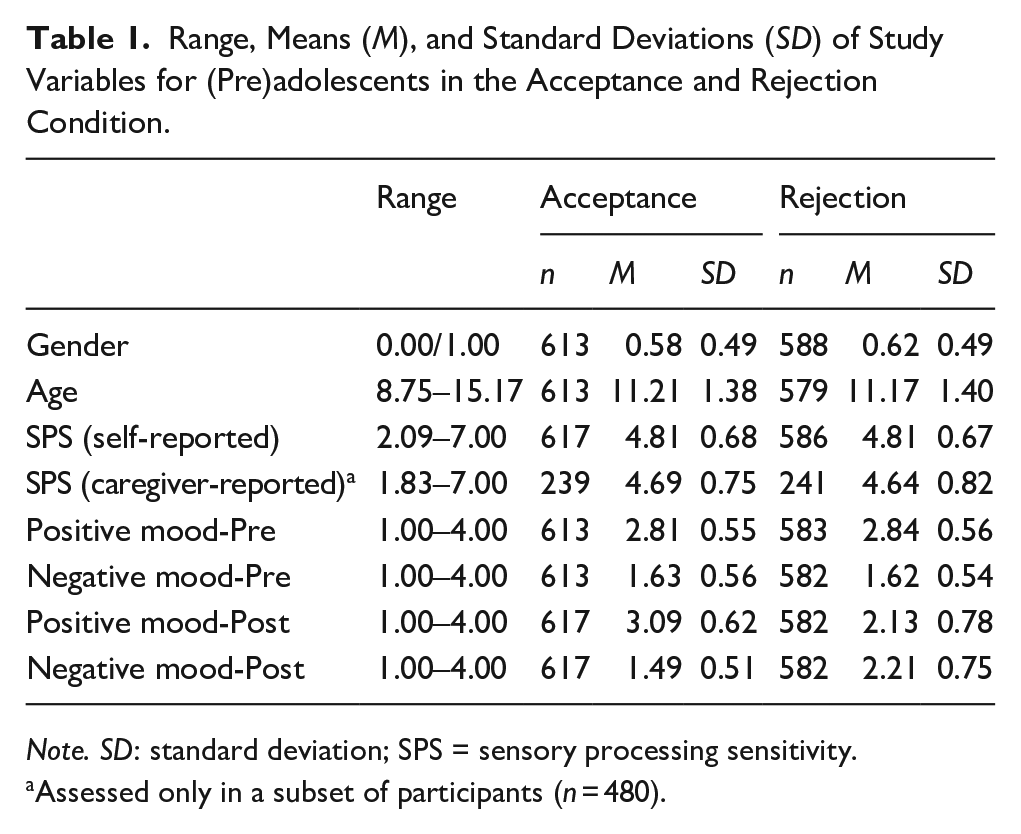
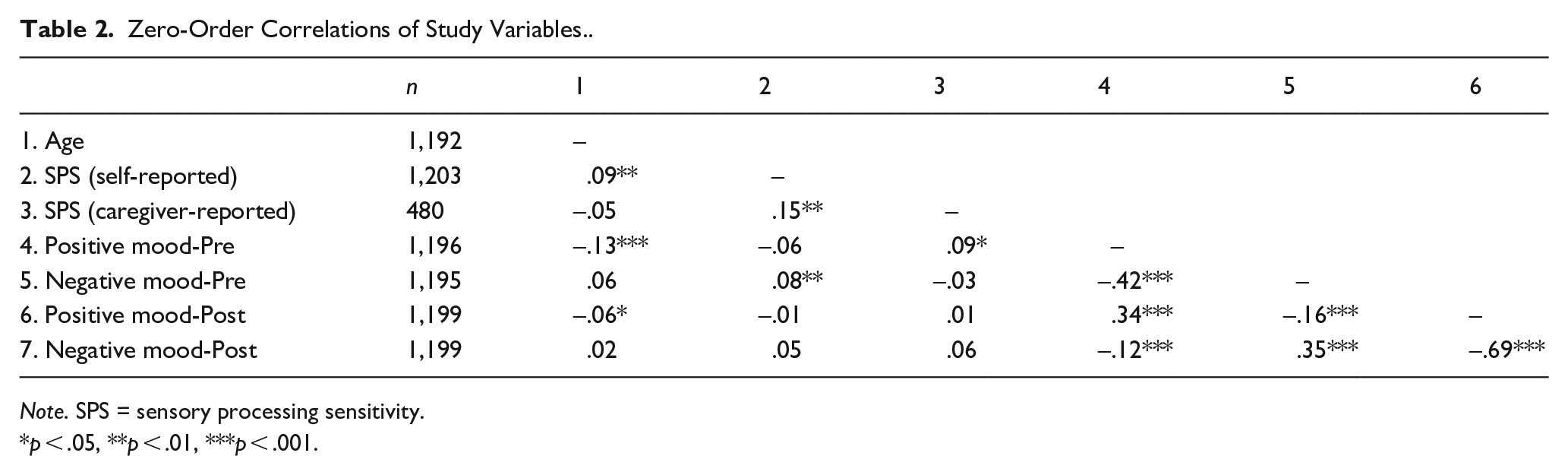
Table 1 presents descriptive statistics for each condition and Table 2 presents zero-order correlations among the study variables. (Pre)adolescents in the peer acceptance and peer rejection condition did not significantly differ from each other concerning gender, age, SPS, and pre-manipulation positive and negative mood (all ps > .05), indicating successful randomization. Experimental conditions were also equivalent when we inspected only the subset of (pre)adolescents with caregiver data.
Range, Means (M), and Standard Deviations (SD) of Study Variables for (Pre)adolescents in the Acceptance and Rejection Condition.
Note. SD: standard deviation; SPS = sensory processing sensitivity.
Assessed only in a subset of participants (n = 480).
Zero-Order Correlations of Study Variables..
Note. SPS = sensory processing sensitivity.
p < .05, **p < .01, ***p < .001.
Manipulation Check
Table 1 displays scores on positive and negative mood pre- and post-manipulations for each condition. A 2 (Time) × 2 (Condition) mixed ANOVA revealed a significant Time by Condition interaction for positive mood, F(1, 1191) = 620.12, p < .001, ηp2 = .34, and for negative mood, F(1, 1190) = 371.75, p < .001, ηp2 = .24. Planned comparisons using dependent t-tests revealed a significant increase in positive mood and a significant decrease in negative mood in the acceptance condition (d = .52 and –.27; ps < .00), and a significant increase in negative mood and a significant decrease in positive mood in the rejection condition (d = .67 and –.78; ps < .00). Thus, the manipulation effectively induced medium-to-large changes in (pre)adolescents’ mood. The manipulation was also effective when we inspected only the subset of (pre)adolescents with caregiver data.
Does SPS Predict Changes in Positive and Negative Mood?
We expected that (pre)adolescents with higher levels of SPS would have greater increases in positive mood after the acceptance manipulation and greater increases in negative mood after the rejection manipulation.
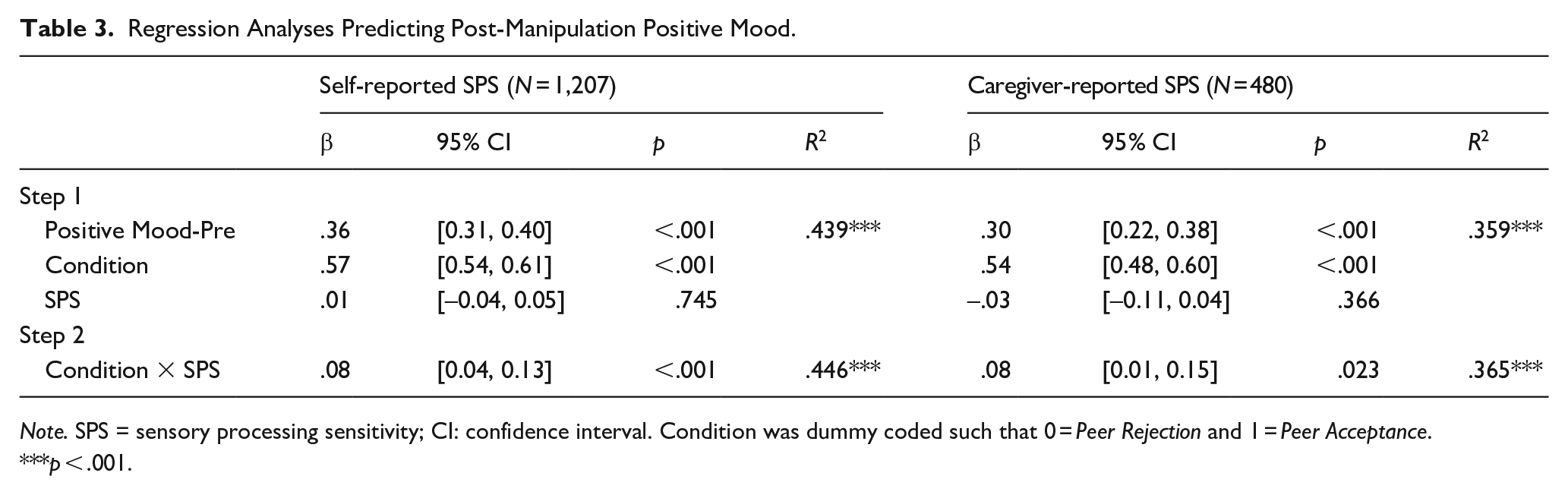
Regarding changes in positive mood, the Condition × SPS interaction was significant, both when self-reported SPS (β = .08, p < .001) and caregiver-reported SPS (β = .08, p = .023) served as moderators (Table 3). For self-reported SPS, simple slope analyses revealed that higher SPS scores significantly predicted (1) stronger increases in positive mood in the acceptance condition (β = .09, p = .001), as expected; and (2) stronger decreases in positive mood in the rejection condition (β = –.08, p = .043; Figure 1(a)). For caregiver-reported SPS, simple slopes were non-significant for both conditions, albeit in the expected directions (β = .05 and β = –.10 for the acceptance and rejection conditions, respectively, ps > .05; Figure 1(b)). Thus, the “for better” side of the differential susceptibility model was supported when using (pre)adolescent self-reported SPS, but not caregiver-reported SPS.
Regression Analyses Predicting Post-Manipulation Positive Mood.
Note. SPS = sensory processing sensitivity; CI: confidence interval. Condition was dummy coded such that 0 = Peer Rejection and 1 = Peer Acceptance.
p < .001.
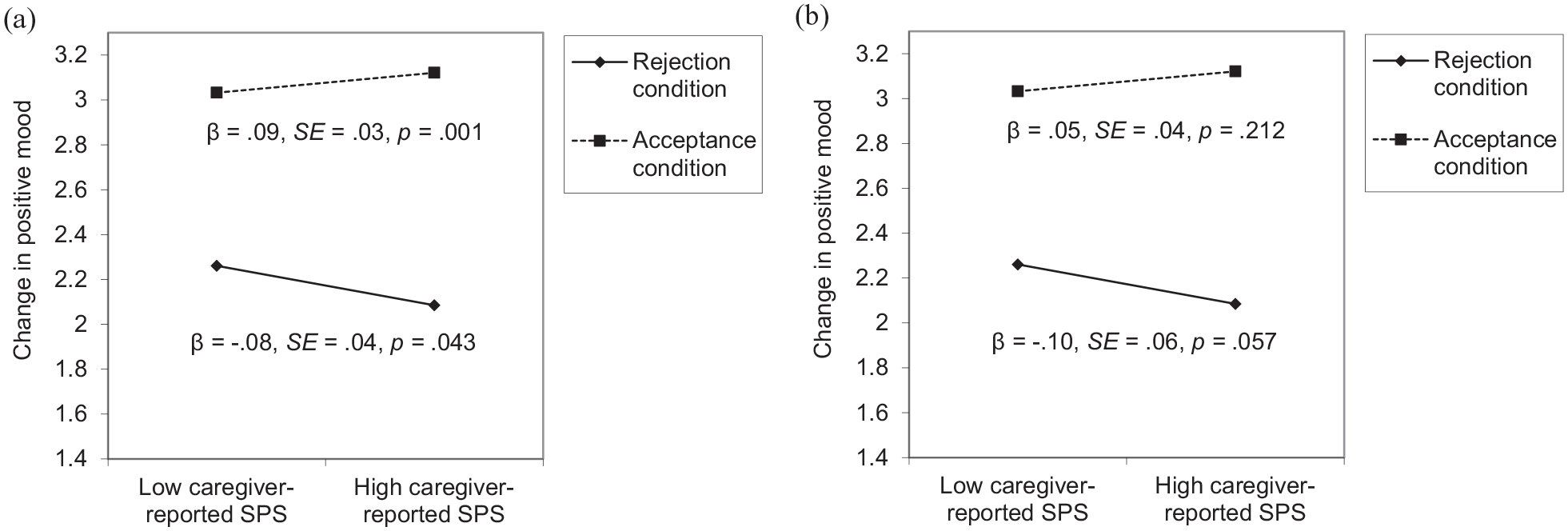
Changes in Positive Mood (i.e., Post-Manipulation Positive Mood After Controlling for Pre-Manipulation Positive Mood) as a Function of Condition (Peer Acceptance vs Rejection) and (a) Self-Reported SPS (N = 1,207) and (b) Caregiver-Reported SPS (N = 480).
Regarding changes in negative mood, the two-way interaction between Condition and SPS was significant when self-reported SPS served as moderator (β = –.07, p = .003), and was non-significant, albeit in the expected direction, when caregiver-reported SPS served as moderator (β = –.06, p = .087; Table 4). Simple slope analyses revealed that higher self-reported SPS scores significantly predicted (1) stronger increases in negative mood in the rejection condition (β = .09, p = .023), as expected; and (2) stronger decreases in negative mood in the acceptance condition (β = –.05, p = .047; Figure 2). Thus, the “for worse” side of differential susceptibility was supported when using (pre)adolescent self-reported SPS, but not caregiver-reported SPS. All results reported in Tables 3 and 4 remained significant after applying the false discovery rate procedure.
Regression Analyses Predicting Post-Manipulation Negative Mood.
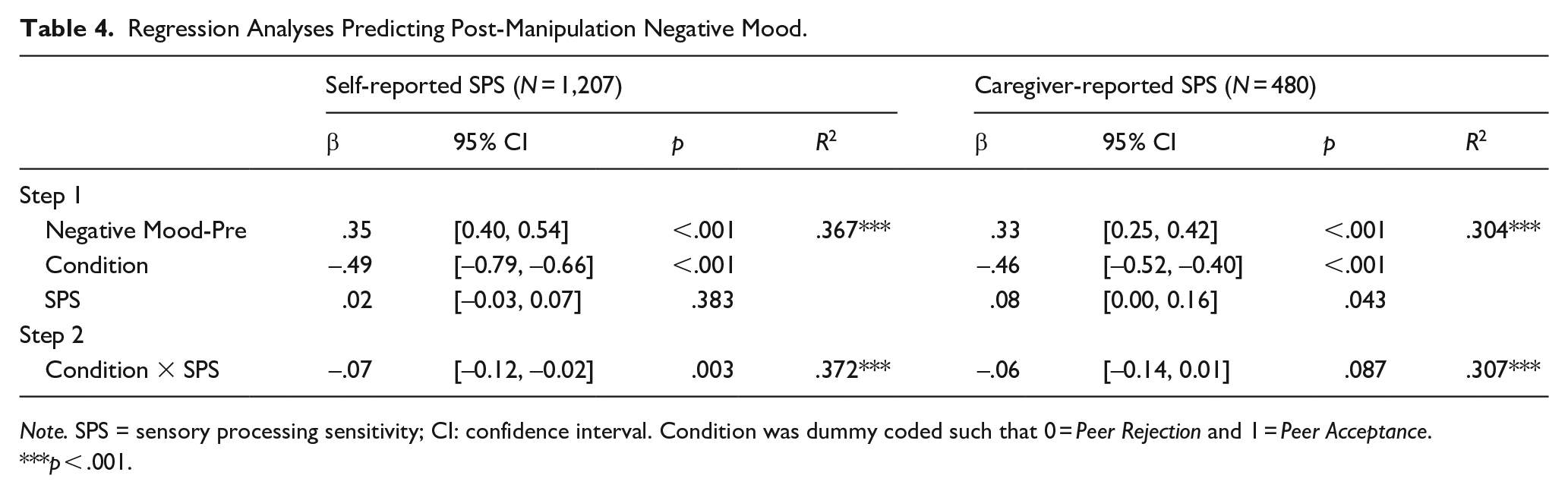
Note. SPS = sensory processing sensitivity; CI: confidence interval. Condition was dummy coded such that 0 = Peer Rejection and 1 = Peer Acceptance.
p < .001.
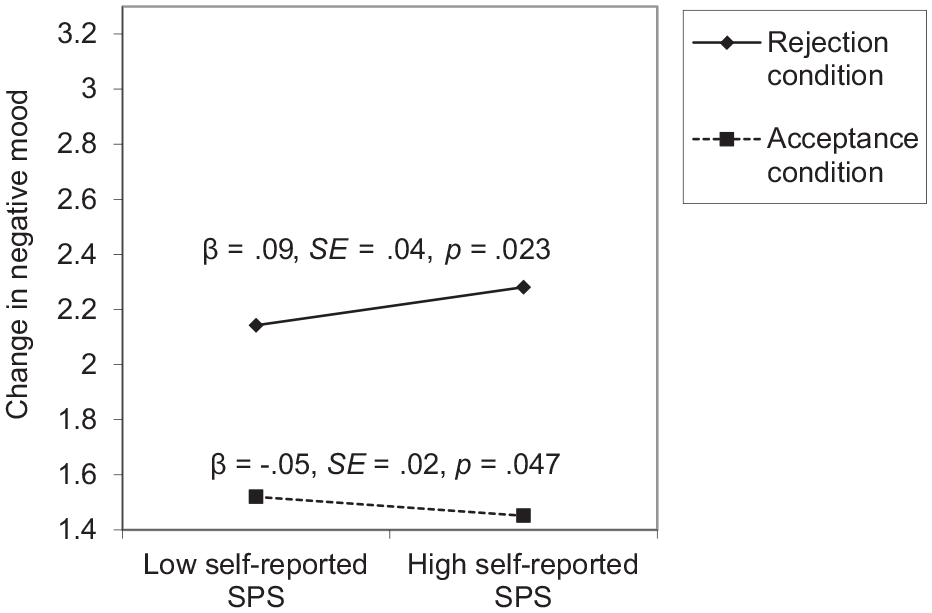
Changes in Negative Mood (i.e., Post-Manipulation Negative Mood After Controlling for Pre-Manipulation Negative Mood) as a Function of Condition (Peer Acceptance vs Rejection) and Self-Reported SPS (N = 1,207).
Age as a Moderator
We explored whether changes in mood in response to the acceptance versus rejection manipulation would be more pronounced among (pre)adolescents with older ages and if age would moderate the Condition × SPS interaction. We found no significant two-way or three-way interaction effects concerning age for either self- or caregiver-reported SPS (Supplementary Tables S1 and S2). Thus, neither peer manipulation effects nor differential susceptibility effects varied by (pre)adolescents’ age.
Discussion
The present experiment examined whether Chinese (pre)adolescents would be differentially susceptible to experimentally manipulated peer acceptance and rejection—as reflected in changes in their positive and negative mood. We used (pre)adolescent self-reports and caregiver reports of SPS as markers of differential susceptibility. Results revealed support for differential susceptibility to social evaluation by peers when using self-reported SPS: self-reported SPS predicted not only stronger increases in positive mood and stronger decreases in negative mood upon peer acceptance (“for better”), but also stronger increases in negative mood and stronger decreases in positive mood upon peer rejection (“for worse”). We found no support for differential susceptibility to social evaluation by peers using caregiver-reported SPS.
Individual Differences in Susceptibility to Peer Acceptance and Rejection
Our results showed that (pre)adolescents differ in the extent to which they are affected by the same peer interactions. This aligns with previous longitudinal and experimental studies showing that the same peer experiences affect different (pre)adolescents more or less strongly (e.g., Fischer et al., 2022; Grapsas et al., 2021; Lorijn et al., 2022; Thomaes et al., 2010). Moreover, as previous victimization experiences can exacerbate the effects of manipulated peer social feedback on youths’ emotional responses (e.g., Lansu et al., 2017; Lee et al., 2020), it is possible that sensitivity (indexed by SPS) may serve as a catalyzer, increasingly sensitizing youth for peers’ social feedback.
It should be noted that in this experiment, we tested (pre)adolescents’ real-time reactions to a single exposure to either peer acceptance or peer rejection. Thus, strictly speaking, we provided evidence for short-term differential reactivity (Slagt et al., 2017). However, being accepted or rejected by peers likely happens repeatedly in (pre)adolescents’ social lives. Emotional responses to every single interaction may build up and translate into behavioral outcomes over time, especially so for (pre)adolescents who are more susceptible to their peers (i.e., long-term differential susceptibility). From a developmental perspective, it would be important for future research to examine the possibility of short-term differential reactivity translating into long-term differential susceptibility.
Our findings also highlight the importance of peers in (pre)adolescence: We found strong main effects of our peer rejection and acceptance manipulation on (pre)adolescents’ mood. Thus, even the short-term imagination of four episodes of peer interaction can induce changes in (pre)adolescents’ self-reported mood. This finding illustrates the significant role that peers may play in (pre)adolescents’ emotional experience and mental health (Herd & Kim-Spoon, 2021). It also resonates with studies using Cyberball, showing that a 2–3 min episode of playing a computerized ball-tossing game is enough to trigger feelings of ostracism and increase negative mood in (pre)adolescents (Sebastian et al., 2010). Thus, peer acceptance and rejection seem to be very meaningful experiences in (pre)adolescence that may shape some (pre)adolescents’ development even more than others.
SPS as a General Susceptibility Marker
The SPS trait was originally proposed as a “fundamental individual difference” (Aron & Aron, 1997, p. 347) and recently advanced as a psychological marker of differential susceptibility (Greven et al., 2019; Pluess et al., 2018). However, current evidence supporting SPS as a general susceptibility marker mostly stems from Western cultures and from research investigating the parenting environment (Lionetti et al., 2019; Slagt et al., 2018). Adding to existing findings, our study revealed that (pre)adolescents with higher levels of self-reported SPS had stronger emotional responses to peer rejection and acceptance. This finding complements previous work on SPS and peers (Fischer et al., 2022) and converges with evidence of SPS capturing heightened emotional reactivity to environmental information (for a review, see Greven et al., 2019). The present study therefore extends evidence of SPS as a marker of differential susceptibility to the peer domain (as most studies focused on parenting) and to the Chinese culture (as most studies included Western samples).
Collectively, these findings suggest that SPS might capture variation in sensitivity to social environments regardless of the valence and domain of the environment (positive and negative, parenting and peer relations), time interval (short and long), and culture (Western and Chinese). This may imply that SPS indeed functions as a marker of general environmental sensitivity (Pluess et al., 2018), although ideally, different environments, time intervals, and cultures would be examined within a single study. Moreover, it remains to be tested whether this general function of SPS also manifests within the same (pre)adolescents and for different types of environments. Recent work examining differential susceptibility to both parenting and peer domains found that 34% of the children and adolescents were highly susceptible to one context but highly non-susceptible to another (Sayler et al., 2022). To better understand the domain specificity of SPS, future studies would need to investigate different domains of social relationships—such as parents and peers—within a single study.
Self-Reported Versus Caregiver-Reported SPS
The present research also examined caregiver-reported SPS as a marker of differential susceptibility to peer acceptance and rejection. We found no differential susceptibility effects using caregiver SPS. This result is consistent with recent research that failed to find mother-reported SPS as a susceptibility marker to parenting effects in adolescents (Weyn, Van Leeuwen, et al., 2022). Yet, it contradicts the finding of one longitudinal study supporting mother-reported SPS as a susceptibility marker to parenting effects in kindergarteners (Slagt et al., 2018). As the latter study included kindergarteners and not adolescents, possibly caregiver-reported SPS is an effective susceptibility marker only in younger children. Why might this be? We propose several possible explanations. First, compared to young children, (pre)adolescents increasingly seek independence from caregivers, form more social networks outside the family, and have more secrets from caregivers (Frijns et al., 2013). Consequently, young children’s traits may be more accurately observed by caregivers than (pre)adolescents’ traits (De Los Reyes & Kazdin, 2005). In addition, (pre)adolescents may have also learned not to display these experiences openly (e.g., due to internalization of social norms or the development of coping mechanisms to self-regulate these experiences). This potentially makes their initial emotional responses to situations even less visible to caregivers (indeed, inter-rater agreement was low; r = .15). Hence, for (pre)adolescents, self-reported SPS may be a better susceptibility marker. Second, (pre)adolescents reported both on SPS and their mood. Yet, shared informant variance seems an unlikely explanation, as previous research assessing both SPS and outcomes using caregiver reports also failed to find SPS moderation in adolescents (Weyn, Van Leeuwen, et al., 2022). Finally, the smaller sample size for caregiver reports may have reduced statistical power in detecting significant interactions compared to child reports.
Potential Age Differences in Differential Susceptibility to Peer Acceptance and Rejection
We explored whether differential susceptibility effects would become more pronounced with age. They did not. This suggests that the extent to which SPS captures heightened reactivity to peer rejection and acceptance is similar for our sample ranging in age from the pre- to the middle-adolescent period. Given that heightened neural response to social exclusion is already present by preadolescence (Tang et al., 2019), both pre- and middle-adolescents may be in a developmental period of heightened social sensitivity more generally. Consequently, individual differences in susceptibility to peers may be similar across the ages we studied.
Moreover, we did not find that the main effects of peer acceptance and rejection increased with (pre)adolescents’ age. This result is inconsistent with other research that found greater impacts of peer rejection on pupillary response with age in a sample of 9- through 17-year-old (Silk et al., 2012), but is in line with research that found similar neural responses to social exclusion in (pre)adolescents (Tang et al., 2019) and similar impacts of social exclusion on mood among young and middle adolescent groups (Abrams et al., 2011; Sebastian et al., 2010). Given the mixed findings and the relatively young age of our participants (i.e., Mage = 11.19 years), it would be premature to reject the moderation effects of age on manipulation effects or differential susceptibility effects based on this study.
Strengths, Limitations, and Future Directions
This research has several strengths. First, it is the first study that examined (pre)adolescents’ differential susceptibility to social evaluation by peers that combined the following important features: (1) inclusion of both positive and negative environments and outcomes, (2) use of an experimental design, and (3) selection of a well-established susceptibility marker aligning with the differential susceptibility model. Second, our use of a non-Western sample allows for an examination of the cultural generalizability of SPS-based differential susceptibility, although a cross-cultural study is needed to directly examine subtle cultural differences. Third, our study was well-powered: our vignette-based manipulation induced medium-to-large changes in (pre)adolescents’ mood, and our (pre)adolescents sample size was sufficient to detect differential susceptibility effects at least for child reports.
This research also has its limitations. First, the internal consistency of the (pre)adolescent-reported SPS was somewhat low (i.e., ω = .53). Possibly, the 7-point Likert-type scale with only three anchors (1 = not at all, 4 = moderately, and 7 = extremely) was challenging for our sample, given that they had no prior experience filling out questionnaires, and were on average quite young (Liu, van Dijk, Lin, et al., 2023). Low reliability in our current sample may also be due to the homogeneous nature of the sample (recruited from a single city) and the limited variance of the total score (i.e., SD = 0.68) (Streiner, 2003). To increase internal consistency, future research could use a simplified 5-point Likert-type scale with five anchors, use a more heterogeneous and older sample, or use an improved measure of SPS (e.g., the HSC-21; Weyn, Van Leeuwen, et al., 2022). Similarly, internal consistency for pre-manipulation positive mood was also somewhat low (i.e., ω = .56), which may be due to the small number of loosely connected items used (i.e., feeling happy, relaxed, friendly, and satisfied). Although low reliability reduces power (Mueller & Knapp, 2018), we still found differential susceptibility effects. These effects can be validly interpreted: low reliability implies that the target is imprecisely measured—not that the target is wrongly measured (McNulty et al., 2019). Accordingly, researchers have argued that reliability is not a necessary condition for valid measurement (Borsboom et al., 2004; Haynes & Heiby, 2004; Moss, 1994). Nonetheless, future studies could try to replicate our findings using more reliable measures (e.g., Weyn, Van Leeuwen, et al., 2022). Second, we used a between-subjects design, whereas the differential susceptibility model inherently describes a within-subjects phenomenon: the same (pre)adolescents who have the most positive development in a positive environment would also have the most negative development in a negative environment. From our results, we do not know if (pre)adolescents whose positive mood increased most upon peer acceptance were also the ones whose negative mood decreased most upon peer rejection. Thus, the results from our between-subjects design should be corroborated by results using within-subjects designs. Future research could expose the same (pre)adolescents to both positive and negative peer effects, using separate manipulations in a counterbalanced order (see Slagt et al., 2017, for an example). Third, we used vignettes to manipulate peer acceptance and rejection while staying within ethical boundaries. However, (pre)adolescents’ responses to hypothetical situations may not necessarily correspond with their responses to real-life interactions with peers. Future research could try and enhance ecological and external validity, for example by exposing (pre)adolescents to peer experiences in a Virtual Reality context (Verhoef et al., 2022) or by creating a social media platform to manipulate social feedback by alleged peers (Lee et al., 2020). Such replication is important, since it may also help minimize the possibility that (pre)adolescents in our study were aware of our expectations for their mood to change. It is possible that (pre)adolescents with higher SPS are more sensitive to such demand effects.
Conclusion
In conclusion, we found that (pre)adolescents with higher levels of self-reported SPS (but not caregiver-reported SPS) had stronger emotional responses to manipulations of peer rejection and acceptance. Our findings suggest that positive and negative peer interactions may have greater impacts on (pre)adolescents with higher levels of SPS than those with lower levels of SPS. We add to the current knowledge on SPS as a marker of differential susceptibility, showing that (a) for (pre)adolescents, self-reported SPS may more accurately capture variations in susceptibility to peer experiences than caregiver report, (b) SPS is a differential susceptibility marker to positive and negative peer experiences, and (c) SPS functions as a differential susceptibility marker, not only in Western countries but also in China. Our findings may ultimately have practical value as well. Negative peer interactions may be more disturbing to (pre)adolescents with higher levels of SPS, whereas positive peer interactions may be more beneficial to these same individuals. Thus, (pre)adolescents with higher levels of SPS might benefit more from classroom-based interventions promoting positive peer interactions and preventing negative peer interactions or from interventions and counseling helping them cope with negative peer interactions.
Supplemental Material
sj-docx-1-jbd-10.1177_01650254231198852 – Supplemental material for Are (pre)adolescents differentially susceptible to experimentally manipulated peer acceptance and rejection? A vignette-based experiment
Supplemental material, sj-docx-1-jbd-10.1177_01650254231198852 for Are (pre)adolescents differentially susceptible to experimentally manipulated peer acceptance and rejection? A vignette-based experiment by Danni Liu, Anouk van Dijk, Maja Deković and Judith Semon Dubas in International Journal of Behavioral Development
Footnotes
Code Availability

Data Availability
Declaration of Conflicting Interests
The author(s) declared no potential conflicts of interest with respect to the research, authorship, and/or publication of this article.
Funding
The author(s) disclosed receipt of the following financial support for the research, authorship, and/or publication of this article: This research was supported by the China Scholarship Council Grant (201906870051) awarded to D.L.
Research Involving Human Participants and/or Animals
All procedures performed in this study were in line with the principles of the Declaration of Helsinki. This study was approved by the Faculty Ethics Committee of the Social and Behavioural Sciences Faculty of Utrecht University.
Informed Consent
Informed consent was obtained from all individual participants of the study.
Supplemental Material
Supplemental material for this article is available online.
Notes
References
Supplementary Material
Please find the following supplemental material available below.
For Open Access articles published under a Creative Commons License, all supplemental material carries the same license as the article it is associated with.
For non-Open Access articles published, all supplemental material carries a non-exclusive license, and permission requests for re-use of supplemental material or any part of supplemental material shall be sent directly to the copyright owner as specified in the copyright notice associated with the article.
