




Abstract
For 15 years Instagram has industrialised and platformised the everyday practices of creating and sharing images. Across that time, users’ profiles became archives that offer a biography of their lives, their visual practices and the platform itself. In this article we use a novel combination of data donation, computational and scroll back interview methods to develop an intimate form of platform biography centred on users’ archives. We draw on 22 co-analysis interviews with participants who have used Instagram for a sustained period of time as part of their creative work or practice. Participants scrolled back through their Instagram profile, manually sorted 500 images printed out from their Instagram archive, and explored a machine visualisation of the algorithmic clustering of their entire archive. We propose three orientations participants take in reflecting on their personal, creative and professional use of Instagram: creative work and their everyday life, the curation of eras of their lives, and creative experiments with the flow afforded by Instagram’s algorithmic and ephemeral feeds. We argue these orientations help to articulate the value that Instagram users place on their archives, and their enduring use of the platform, in relation to its algorithmic, promotional and creator cultures.
Introduction
For 15 years Instagram has industrialised and platformised the everyday practices of creating and sharing images (Leaver et al., 2020). For users who have been on the platform for much of that time, their profiles are an archive that offers a biography of their lives, their visual practices and the platform itself (Barassi and Zamponi, 2020; Breckner and Mayer, 2023). This article is part of a multi-year project where we use a combination of cultural and computational methods to explore the relationships between our everyday image-making practices and the algorithmic models of Instagram (Brown et al., 2024; Carah et al., 2023a; Carah et al., 2023b). We draw on 22 interviews with Instagram users to explore how their stories and posts are both an archive of their lives and visual practices and an account of the platformisation of Instagram.
In the earlier phases of this project, we developed a purpose-built machine vision system that approximated the capacity of Instagram to cluster images together based on latent visual patterns. Using that tool, we were able to explore both the visual cultures of Instagram and how machine vision systems made sense of them (Brown et al., 2024; Carah et al., 2023a). In doing this work we became increasingly aware of the everyday archives of images we were exploring, and the ordinary users and creators who jointly produced them through their use of the platform. We wanted to talk to creators about these visual cultures, but were finding that many of the visual cultures we were exploring were not neatly organised around particular hashtags, scenes or communities.
There is a rich tradition of research focussing on Instagram’s creator cultures and how they build community and negotiate visibility (Abidin, 2016; Cotter, 2019; Duffy and Wissinger, 2017). These include using hashtags and producing content organised around specific cultural practices. Researchers have investigated Instagram cultures and the work of creators in areas including fitness, food, galleries, graffiti, fashion, beauty, pole-dancing and so on (Are, 2022; Ayres, 2022; Barbala, 2024; Chua and Teo, 2026; Entwistle and Wissinger, 2023; Kubler, 2023; Leaver et al., 2020; MacDowall and de Souza, 2018). Building on these currents, we turned our attention to Instagram users who had been on the platform for an extended period of time and used their profile as part of their creative practice, sometimes but not always entwined with their creative livelihoods in the arts, media and cultural sectors. In doing so, we aimed to explore what these users could help us understand about Instagram’s everyday archives and the relationship between their practices of making and sharing images and the development of a digital platform that uses automated models to optimise attention and engagement (Brown et al., 2024; Carah et al., 2023a; Nieborg and Helmond, 2019; Nieborg and Poell, 2018). Instagram users’ practices of self-expression are entwined with the ‘temporal structures of social media’ (Barassi and Zamponi, 2020) that are defined by both the immediacy and ephemerality of algorithmically-tuned feeds and the creation and curation of archives that endure on profiles and accounts. Over the course of a decade and a half our everyday practices of making and sharing images have been integrated into the industrial process of training machine vision models (Andrejevic, 2019). This training period has been a formative stage in the development of models that can synthetically generate and augment images at scale (Carah et al., 2023a).
By using a novel combination of data donation, computational and scroll back interview methods we develop an intimate form of platform biography (Burgess and Baym, 2020; Gomez Ortega et al., 2025; Robards and Lincoln, 2017). A platform biography is an account of how the development of features and business models at the platform-level is intertwined with users and their participatory cultures. Platform biographies account for both how the process of platformisation shapes, channels and constrains users; and how users engage in creative negotiations and adaptations in and around processes of platformisation that they do not control. By describing our approach as a form of intimate platform biography we emphasise how we begin with users’ own personal archives, and how those archives function as both a biography of their own lives and a biography of the platform. Intimate platform biographies are personal narratives that also tell a story about the experiences, feelings and effects of platformisation. We explore not only how users practically navigate platforms, but also how in using platforms to creatively narrate their own lives they also develop astute, despondent and ambivalent accounts of the development of the platform.
The intimate platform biography we undertake contends with our Instagram archives not only as sites of biographical self-expression but also as sites where we find ourselves living in everyday data cultures where we begin to understand how something as mundane and intimate as the images we create feed larger processes of datafication that are then ‘fed back into our everyday lives’ (Burgess et al., 2022). Our intention is that intimate platform biographies might get us closer to ‘datafication’s social dynamics and material effects’ by spending time in the place where ‘people feel these processes most deeply, and where they have the most capacity to act upon them, albeit in constrained and ethically complicated ways’. We felt this ambivalence most acutely in this project where we weren’t always sure what the interviews were about. We weren’t, for instance, interviewing influencers or creators to understand how they navigated algorithmic platforms, we were instead putting participants’ personal, and often intimate, archives on the table and in a machine vision model and asking them: can you tell us a story?
Scroll, print, cluster: Doing intimate platform biography with Instagram archives
To recruit participants who used Instagram as part of their creative, and sometimes professional, practices we used a snowball method through the personal, creative and professional networks of the five researchers who worked on the project. Our 22 participants included DJs, photographers, designers, musicians, barbers, influencers, artists, researchers and journalists. They had all used Instagram for more than 5 years and the volume of images in their archive varied with some archives having as many as 3800 images and others as few as 300. Participants downloaded an archive of the posts and stories they had published or archived on their account. Using purpose-built code, we then extracted their images for them to review, and to delete any images they wanted to. The researchers then processed their images using a purpose-built machine vision model and randomly selected 500 images to print as photographs. Once the images were printed and clustered, we met with the participant for a co-analysis interview that unfolded in three steps. Participants were paid for their time and effort participating in the project and given the option of keeping their printed-out images.
Scroll back
In the first step of the interview, we undertook a ‘scrollback’ through their Instagram profile (Robards and Lincoln, 2017). Participants narrated what they post, how their practices have changed over time, and how their posts relate to their lives and professional or creative practices. We also invited participants to reflect on the shifts in their image-making practices and relate these to larger shifts and changes in the platform itself (for instance, like the introduction of carousels or the rise of photo-dumping).
Print and sort
In the second step we gave participants a stack of 500 randomly selected photographs we printed from their profile and stories posts and asked them to organise them in any way they liked. This process took time, and as an order emerged, we discussed with participants their choices. This prompted reflections on their archive, disconnected from the chronological order of their profile. Where time allowed, we did this process of sorting twice, asking participants to sort their images using a different logic. Participants organised their images in a variety of ways, and we inductively created a taxonomy of sorting logics, that included sorting images based on:
periods in their life.
colours, patterns, shapes and lines in the composition of images.
how the image made them feel.
the rhythm and flow between the images and how they fit together in sequences.
the curatorial style of their profile.
Algorithmically cluster
In the third step we asked participants to open and explore the machine visualisation of their own archives and interpret its outputs in relation to their own practices. Our machine vision tool consists of a three-step data processing pipeline (Burgess et al., 2021; Carah et al., 2023a; Tan and Angus, 2020): (1) embedding, where images are mapped into numeric feature vectors, (2) clustering, where images are associated with each other based on similarities perceived by computing distances in their numerical embeddings, and (3) creating a visualisation, where clusters of images are presented in an interface for exploration (see Figure 1). On the left-hand side of the visualisation are clusters of images, the number in the pink box indicates how many images are in that cluster. If the user clicks on a cluster, they are taken into a second layer of clusters. As they move through the clusters they can see how the machine vision system has grouped their images in increasingly fine-grained ways.
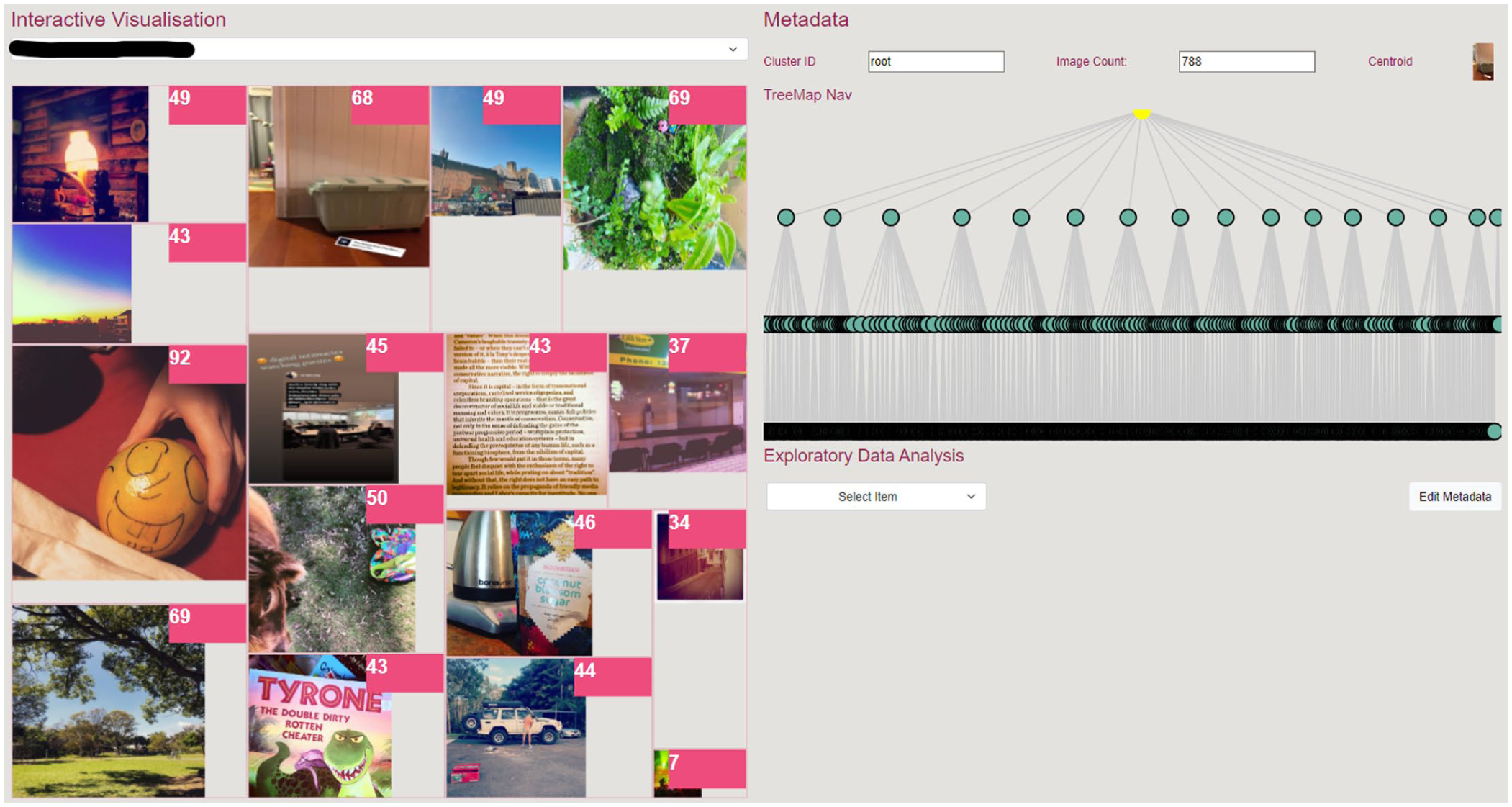
The user interface of our machine vision system.
While participants navigated this model, we prompted them to discuss how they thought the algorithmic model organised their images and how they related that to their own narration of their archive. Machine vision tools are useful not only for exploring platform-scale questions about classification and recommendation, but also as part of participatory approaches that elicit and develop the platform and algorithmic imaginaries of Instagram users. Likewise, our personal archives of images are useful not just for reflecting on our own practices, but positioning them in relation to the larger process of platformisation. After the completion of the interviews, the researcher who conducted the interview coded the transcript and wrote a reflection on key findings. To inductively interpret findings the research team conducted two co-analysis sessions together where each participant was discussed.
By moving back and forth between their profile, the printed-out images and the machine vision system we explore their images on, off and underneath the platform. This practice of organising an interview around multiple tasks with images is similar to other methods that use creative techniques like sorting, drawing and writing to get participants to explore their ‘algorithmic autobiographies’ (Bishop and Kant, 2023; Ni Shuilleabhain et al., 2023). The process stimulates the platform and algorithmic imaginaries (Bucher, 2017) of participants as they offer a range of creative, thoughtful and frustrated responses to how the platformisation and algorithmic curation of their images by algorithmic models reflects and diverges from their own practices. This situated method of co-analysis contributes to efforts to investigate the algorithmically-curated and ephemeral nature of Instagram’s culture and platformisation (Bainotti et al., 2021; Cornelio and Roig, 2020). Participants describe how their practices of expressing themselves, often over the course of a decade of their lives, are entangled with the development of platform interfaces, features, algorithms and business models.
Orientations towards Instagram archives
Through our co-analysis process we iteratively developed orientations that our participants articulated in relation to their archive and the platform. Participants don’t belong exclusively to a single orientation, we instead present them here as orientations that these and other Instagram users might move within as they navigate their personal, creative and professional uses of Instagram. Where these orientations reflect previous research findings we argue they help to consolidate arguments in the field about Instagram, especially with regard to the use of Instagram by creative workers (Caliandro and Graham, 2020). In the analysis that follows we present our findings around three orientations: creative work, eras and flow. Firstly, we examine the practices of participants who oriented their use of Instagram around their creative work and their everyday life. Secondly, we explore the practices of participants whose orientation to their Instagram account was strongly organised around the curation of eras of their lives. And thirdly, we document practices of participants who orient their archive around creative experiments with the flow afforded by Instagram’s algorithmic and ephemeral feeds.
Creative work and personal archive
Eight participants situated their orientation towards their Instagram archive in relation to their creative work. Importantly, they were not the ‘content creators’ often focussed on in accounts of Instagram’s promotional and creator economy (Duffy and Wissinger, 2017). Our participants who articulated this orientation worked in a range of creative roles including as musicians, journalists, dancers, photographers, barbers and designers. They used Instagram to promote their work, organise communication with clients, and build networks with other creative workers in their sector. They described Instagram as a practical tool and explained their efforts to understand how its algorithmic feeds worked, along with their strategies for gaming, leveraging and optimising their visibility. While some participants told a story about developing increasingly organised activities for generating engagement, most described complicated entanglements between their professional and personal use of Instagram. This included ambivalent feelings about Instagram and the everyday intimacies of posting about themselves, and sometimes a measured distance from their account. Participants described having multiple accounts with different orientations that contained the connection between Instagram and their creative work to a specific account, often with a sense of different accounts having different kinds of audiences and forms of publicness.
While their strategies for posting reflected the ‘visibility labour’ and ‘entrepreneurial’ subjectivities of influencers (Abidin, 2016; Duffy and Wissinger, 2017), they distinguished themselves from ‘influencers’ or ‘creators’ whose primary activity was creating content for Instagram. One participant, Harper, explained some of the nuanced dynamics in the use of Instagram as she had moved from working as an acrobat in a circus company to being a professional dancer. Acrobats tended to post and share tricks with each other, while dancers tended to post more sparingly or post less dance and more lifestyle content. In her view, they are ‘trying to look like a cool person more than they are trying to look like a dancer’. Harper explained that she ‘couldn’t be bothered’ having a professional Instagram account. But she has been ‘subconsciously trying to change the way I post because I want to look like more the kind of person that gets work in the way I want to get work, which is less circus and more dance’. The norms among dancers also fit better with her values because ‘it seems like they are posting about enjoying their lives and their friends and silly things as well as dancing’. Harper felt very few circus performers or dancers could sustain a career without Instagram. She explains though that there are periods where she feels anxious and ‘I just stop using it but I consume more. I spend more time on it consuming and scrolling and looking at other people and comparing myself to other people and all that shit’. Parker echoed Harper’s sense of how Instagram had become crucial to building authenticity and legitimacy within professional creative networks. He began to craft an Instagram account around his creative work as a barber and furniture restorer to build a client base and distinguish himself from ‘everyday barbers’. He explained that he understood how influencers-built audiences on Instagram, but wanted to distance himself from influencer culture by explaining how he was more focussed on signalling to other barbers in the local scene, and his clients, that he belongs.
Participants also described how the publicness of their professional identity shaped and constrained their use of Instagram. Arlo, who worked as a journalist at a national broadcaster, explained that although he wanted to use Instagram to stay in touch with friends, and share and say whatever he was interested in, when he worked on a national show, he picked up many new followers. These followers came because his employer tagged him in stories, he shared stories on his account, or audiences just searched and found him. Although he didn’t deliberately use his account professionally, the crossover between personal life and professional identity meant that on his account he increasingly had to move within the editorial guidelines of current and potential future employers. Like Arlo, Mica told us how Instagram functioned as a portfolio of their artistic practice as a photographer, and over time became their default website or business card. Through her archive she was able to narrate how her visual language developed, and offer a critical view about how the process of platformisation afforded, shaped and disrupted their art practice. This orientation reflected accounts of how artists use Instagram to manage their portfolios, cultivate audiences and reach curators, galleries and collectors (MacDowall and Budge, 2021).
Four participants explained to us how, even if they made a livelihood in creative and cultural sectors, they used their Instagram account to document their everyday lives and to update family and friends, and avoided self-consciously refining their use of Instagram to promote or organise this work (Barbour and Heise, 2019; Caldeira et al., 2020; Ibrahim, 2015). What we observed is an account of everyday forms of creative curation that participants distinguished from their professional work. Raine had an account highly curated around her practices of collecting and reselling vintage clothes, interwoven with the private life of home, plants and the everyday. Raine explained that she shaped her account around ‘mostly pretty visual things. Things that I found aesthetically pleasing like the colour and composition. Lots of my dogs because I find them very, very pleasing. Also just more like a daily journal’. These practices were often centred on the everyday intimacies of home life, families and friends. The composition of scenes from home referenced feelings of love and affection towards where she lived and the people, she shared her life with. Sage had a separate Instagram account that she used for her creative work but chose deliberately to talk only about her personal account in the interview in order to delineate the boundary between the personal sharing and the publicness of their work. She often posted because they enjoyed it with a relative disregard for the platform and its algorithmic brokering of visibility. While participants chose an account to discuss in the interview, many of them described having separate accounts with different orientations between public/private, work/personal and serious/shit-posting. The perspectives of these participants highlight the significance of ordinary and mundane uses of Instagram by creative professionals alongside or pushing against the attention economy imperatives of influencer and creator cultures.
Eras
Six participants narrated their biography on the platform as a series of curated eras. For some, these eras were organised around particular aesthetics that would change over time. For others, they were organised around the publicness of their posts and accounts as they worked out how to perform the public, creative and intimate aspects of their identities. Their profiles document practices of trying out, imagining, performing and negotiating the self, they function as ‘visual biographies’ that document ‘change and transformation at the time they take place’ (Breckner and Mayer, 2023). This work of performing the self was shaped by changes in the platform’s technical affordances and cultures. Their orientation to their archive drew attention to the creative and curatorial work of experimenting with the medium as part of working on the self, often explaining fine-grained distinctions in the sequences of images on their profiles. Casey, scrolling her profile, came across a series of posts she described as ‘the hippy era’ and then later another sequence of images that was ‘more recent slow living, beach, forest, like hippy vibe 2.0 but not as woo-woo. I don’t know. The time period in my head is different’. These accounts also brought to the fore how Instagram archives document practices of working out stories about ourselves. Jean identified how the eras of her Instagram evolved with her own creative training as an interior designer, as posts about mundane everyday life started to shift towards more deliberate aesthetic choices.
The participants who spoke from this orientation were mostly young women who had grown up on the internet, and had ambivalent feelings about the intimate practices of self-representation on a platform that was driven by logics of publicity and promotion. Tumblr was frequently invoked, especially by Charlie and Scout, as a platform where these practices were learned. Scout described her younger self as being less careful about what she posted, describing an earlier era as ‘excessive’ in the sense that she posted a lot and shared too much intimate content about her life. She described one of the consequences of being an ‘‘online since teen years’ person’ is that ‘all of your awkward phases are immortalised on the internet’. When prompted she explained that as she has ‘gotten older’ she’s become more ‘self-conscious’ about what she posts, whereas when she was younger, she was ‘definitely posting more, and posting more crap . . .just living my silly little life, kind of without consequence’. What we discern here is a sense of earlier eras characterised by much more exploratory and playful forms of self-expression. Charlie also connected changes in her own expressive style with changes in her life, including who she was dating or hanging out with and where she was living.
Sable explained how her ‘art hoe’ era was formative in learning to publicly curate and perform her identity. She associated her own presence or absence in her images in different eras with how ‘secure’ she felt about her identity. Charlie also talked about a period where she stopped posting for a while unintentionally because ‘I guess I felt at a really like transitional time within myself, so I wasn’t feeling super confident in my aesthetic. It was not worth sharing or anything like that’, but then she entered a ‘fringe era’ when she started to feel like a ‘bad bitch’ and began to post again.
For young women who are skilled curators of internet cultures, and adept at incorporating trending vibes into their own archives, they sometimes find themselves more visible than they anticipated. Sable learned to create a profile that was ‘so curated’, using a range of apps like Preview Instagram, VSCO and Afterlight, to edit and test images. She learned some of these techniques while doing an internship at a social media agency where an influential ‘Tumblr girl’ worked. Sable adapted some of their techniques for her own profile. The ‘art hoe’ aesthetic she developed had a ‘moment’ in internet cultures and some of her posts got a lot of engagement. On one occasion she was sent headphones by a brand and asked to do promotional posts in return, which she did, but then ‘got really embarrassed’ and deleted the posts as soon as she could because she ‘felt weird about it’. The story articulates how practices of intimate curation and expression can intersect with the promotional and attention economies of the platform in unexpected ways. But at the same time, they were adept at reformulating and shifting to another era or vibe to outpace or evade these logics.
Charlie narrated how shifts in the eras of her life were represented in the vibe of her images. Pointing to an early era of posts Charlie explained this was her ‘Island Girl’ era which involved a ‘live diary’ or ‘blogging’ posting style that suited the pre-algorithmic feed Instagram culture. As she moved through her profile, she narrated key shifts in her vibe and aesthetic. As she scrolls, she says, ‘so now we have a distinct vibe change. This is my Lana Del Rey era’ and then tells the researcher there is ‘at least five to go through’.
Researcher: So the last one, are we categorising as mountain life? Charlie: Mountain life. Researcher: Now we’re in Lana Del Rey? Charlie: Yeah. So mountain life has been the last 12 months, and then Lana, I think, was a bit briefer period, but we’ll see when she changes [laughs] to something else.
The Lana Del Ray era characterised by ‘old Hollywood’ vibe with ‘warm hues’ and grainy ‘vintage filters’ shifts to a ‘Southern Gothic-esque vibe’, ‘she’s in the graveyard. She’s with her bones running around’. When we turned to the machine vision model with Charlie, she initially felt it couldn’t work out her eras, but then both Charlie and the interviewer exclaimed ‘oh my god’ as they discovered a cluster with all the images of her pet snake, and a cluster with all their images of bones, and other clusters of selfies with her in different styles and hair colours. The clusters of different objects and colours were a kind of proxy for her eras.
Over time, the publicness of eras is managed by participants through their practices of review, reorganisation and archiving. Scout described herself as a ‘digital hoarder’ because she archives a lot but never deletes anything. Her profile is a curated version of her archive and reflects her somewhat ‘re-writing’ history. For Scout the technical affordances of archiving enabled her to negotiate the public and private presentations of her eras, which sometimes generated ambivalent feelings because while she could hide images, Instagram’s use of her archives as data felt insidious. Casey also articulated ambivalent feelings about how the curation of images underplayed ‘the level of ridiculousness that I have inside me’. She explained that her images made her appear ‘so calm’, and that she had ‘always struggled with that, holding both parts of myself in that way, of being really creative and deeply feeling and all of that with also being very unserious and playful’.
What these participants’ orientations towards the eras of their archives reveal is their playful experiments with the parts of themselves they choose to give public expression to. Charlie describes herself as a third person character in her eras, Scout quietly archives away outmoded experiments, and Casey looks at her account and observes her profile is just ‘corners’ of her world, small and deftly curated still life scenes in a larger complicated whole. What dissolves in these accounts of eras is any sense of a binary between ‘real self’ and ‘Instagram self’. What we observe emerging instead are practices of imagining and projecting ourselves into particular vibes, giving expression to moods and feelings during particular periods of their life, and locating themselves within larger currents in online cultures. What their Instagram archives capture is ongoing practices of using media to experiment creatively with exploring and envisioning the self as narratives, vibes and feelings. These eras are typically grounded in formative experiences and practices of learning to be in a different mode with themselves. Casey explained that their ‘slow living’ era involved documenting daily practices and goals with text overlays. At one point the researcher and Casey are talking about how their Instagram archive is interesting because it captures all of these otherwise ephemeral practices of documenting and narrating the self over time. Working out how to be ourselves is ‘completely normal’ but printing out our Instagram archive and going through it to see all those practices documented is unusual. Jean and Raine both talked about how the change from a chronological feed meant that they picked up on particular ‘looks’ to identify groups that they belonged to, and that the algorithmic-tuning of the feed towards particular aesthetics shaped their own eras and vibes.
When we moved onto the machine visualisation Casey was hoping it would analyse her. ‘Like a mood ring?’ the researcher asks and Casey says ‘yeah’. But they were disappointed that the machine sorted them based on how the objects in the images looked rather than what they ‘meant’. They observed that the machine could not distinguish between their ‘hippy 1.0 and then 2.0’ vibes. Sable found a series of images of people in bed, some of them her own bed, some cuddling friends in bed, some movie stills of people in bed: ‘That’s crazy. Which one should I click on next? What’s this on? This is like photos of friends, mainly . . .with film cameras. Yeah, what the hell? That’s crazy’. Although there was some surprise at the particular patterns the model would construct in its clustering, what seems to stick out in these explorations of the machine is a sense of non-meaning. The machine can group their images together but not in ways that reflect their sense of what their archives mean to them. When asked why the machine clustered images of live music, but they didn’t, Sable says ‘I don’t think I was really like looking for them to be honest. Whereas I thought like yeah more obvious ones for me were like my hobbies, like art vibes and like the people around me rather than like things I go to’. When the researcher asks why they think the machine might do this they seemed bored and offered an operational explanation, ‘I don’t know. I don’t know. Do they like look that I like live music so that they can suggest more artists for me to see because that’s like all the ads that I get on Instagram now?’ This disinterest in imagining explanations for the machinic clustering of their images contrasts with the many poignant and intimate moments in the interviews, together with their frequently expressed sense of the ‘insidious’ way that Instagram observed and datafied their personal and intimate archives.
Flow
Five participants had a critically reflective orientation towards the algorithmic culture of Instagram. They weren’t interested in ‘gaming’ the algorithm for visibility but instead developed a form of posting that was attuned to the algorithmic form and affordances of digital platforms’ feeds, interfaces and searchable databases (Bucher, 2017). Their orientation referenced the feeling of living in the ‘always-updating’ temporality of social media (Lupinacci, 2021) while at the same time rejecting an instrumental approach to the ‘visibility game’ (Cotter 2019). Ferd, Paul, Drew and Alice all posted long sequences of stories, frequently more than 10 at a time and sometimes up to 100. These practices both cut against, and reflected, Instagram’s algorithmic logic. While the platform is tuned to discourage excessive posting, their practices were a deliberate exploration of the endless flow and associative logic of Instagram feeds. Ferd explained that this mode of posting sequences of images emerged from his practice as a research-based artist exploring ‘found images on the internet’. In earlier forms of digital culture there was curatorial skill in finding ‘rare’ images that no one else could find, but now we are ‘drowning’ in searchable, shareable and networked images, they are less ‘rare’ objects to be collected and more ‘live’ objects to be circulated. Ferd began to think about how to bombard people with sequences of images that reflected the pulsating flow of digital media where images acquired value when placed into a flow or association with other images.
Ferd catalogues the images he finds on the web in a series of folders: ‘I’ve got cute animals, music, mushrooms, Ireland, swimming, art ideas, restless beat, crabs, erotica, La Isla Bonita, architecture, junior curators, Wizards of Ipswich, iconic duos, swords, yoga, grants, kinetic typography, food, toilets, ABC, wizards, films, dinosaurs, L.A’. To create sequences of images he navigates through the folders, mimicking the promiscuous machinic patterns of platforms’ automated models to find images he can associate with each other in both incongruent, poignant and amusing ways. He begins with a colour, an object, a shape and then finds other images proximate to that pattern that he can link together, without trying to think of the meaning or narrative of the sequence. Creating the sequences is a live practice or performance where ‘you think about what’s going to come after this?’.
When Ferd laid out his printed images on the table during the interview he began to sort the random collection into the kinds of folders he had and then began to show the researcher how he could quickly build sequences by looking for patterns in and across the collections. Mica, another visual artist, demonstrated a similar practice of sequencing images but for exhibition in galleries rather than live performance on Instagram. When Ferd opened the machine vision model and saw that it had reproduced some of the collections in his folders, he felt that model had proven he was able to create a visual language that referenced the machine-driven internet where models pick up a ‘feature’ of the image like a colour but not ‘the image itself’. Ferd referenced this back to abstract art movements that explored the mathematical and machinic logic of industrial culture, Mondrian and utopian modernist painters who ‘flattened’ their representations of urban culture. He sees a similar logic here, interested not in what the machine says about the images, but what giving the images to the machine says about the machine. He’s interested in how it reflects back to us a culture where we experience pleasure in flows of images sequenced together in rhythmic patterns.
Where Ferd had created an elaborate folder structure for collecting the detritus and junk of the internet, Paul spent a lot of time searching within the archives of cultural institutions for images of art, film and architecture. Over time, he began to carefully curate sequences of images that explored the visual language of films he watches. In one exchange we talked about how he enjoys juxtaposing images by looking for an ‘image from one film that references another image from a film or a painting’. He described a sequence he posted where he put an image of the famous shot of Sigourney Weaver from Alien 3, with the alien coming in from the side of frame, alongside the Passion of Joan of Arc by Carl Dreyer that the shot is an ‘obvious reference’ to. Where Ferd compiled a kind of underground archive of internet slop, Paul found pleasure in searching the ‘official’ archives of institutions and creating playful sequences of images within the medium of Instagram stories. Paul shared Ferd’s sense of how Instagram allows him to play with the associations between images, and sees his own practice as following in a tradition of ordinary people not just ‘learning’ about culture at museums, but cultivating their own practices of appreciation in and around their collections.
When we went to the machine clustering, we kept finding clusters the machine had created that were similar to his own sequences. In one cluster the machine has brought together Hieronymus Bosch’s Garden of Heavenly Delights, an epic NASA image of deep space, and a still from Guillerma del Toro’s Pan’s Labyrinth. Together they have an other-worldly and monstrous feeling. Paul said the cluster evokes a mood and that he’d feel ‘very smug’ if he had created these associations himself. He was interested in how the machine reflects an emergent form of composition via patterns that evoke affective associations. He suggested that filmmakers might use tools like this to develop the visual language of a film - colour, light at different times of day, architecture. He mused that when Michael Mann made Heat he ‘probably spent like a week or two just driving around L. A’. taking photos to find the visual language of the film, but if you were doing it today ‘you could get a machine like this to just load up all the Getty images taken of L.A. at night [or] or in that period, and just start going from there’. Neither Paul or Ferd seek to optimise their practices to the algorithms of the platform’s attention economy. But their practices are platform-centric in the sense that they are attuned to the affordances of platform culture, and in Ferd’s case are a commentary on the algorithmic hyper-flow of digital cultures.
Like Ferd and Paul, Alice also narrated a rhythmic flow of posts when she started sorting through her archive. Our exchange as she sorts evoked the rhythm of her profile, a creative, funny and whip smart documentation of life. She stops at a photo of a ‘serious life event’ and then moves again to a post about a time a ‘doctor laughed at me’. This flow continues: a meme about lady finger bananas being better than cavendish, a meme about drum’ n’bass DJs being asked if they have any music with words in it, a poll that says ‘hungover AF and having to volunteer with children, yes/no’. Many of these images are fragments of sequences of stories that are posted in a single flow where Alice takes selfies and then overlays them with text as a way of telling a story. When I asked about this practice she kept on moving ‘no toilet paper in a club, that can go in. . . where’s the one of me just talking to myself? Here it is. That is going to be a very big category’. And then, ‘I’m sure there could be its own category of only talking about how I’m a Gemini’. And then, ‘this is my Year 8 boyfriend dumped me over Easter break, but I didn’t have any credit left in my phone so I couldn’t respond, because it was over text. It’s a very 2008 moment. . . it’s one of those things that I really think about all the time’. When prompted, Alice described these selfies as ‘not particularly flattering’ and a sort of ‘shit posting’ in a ‘silly’ and ‘approachable’ way. Alice’s flow produces a relatable mode where she often appears as a narrator, interspersed with posts about DJs and mixes she is listening to, and video from her own live sets, with relatable anecdotes about everyday life that frequently deal with everyday intimacies across family, relationships, gender and race.
Alice, Ferd and Drew all exhibit this creative and associative, sometimes ‘shitposting’, flow with their own archive. Both Ferd and Drew interrupted their own stories by picking up memes and showing them to us. Drew created a ‘general shit posting’ pile of ‘dumb posts’. He explained that he discovered this mode on a trip to Japan where he ‘lived blogged’ images of signs and scenes including lots of ‘stupid shit’ and ‘general silliness’. He pointed to an image of a sign that says ‘BIC drug’ that he captioned ‘mind if I get a big drug?’. For both Ferd and Drew, the glut of images that make up even our own archive is encountered in ambivalent ways. It interrupts our efforts to represent ourselves. It leaves us recognising at moments how our archives are embedded in larger commercial platforms we do not control, and illustrates that our responses to this situation include generating creative modes of expression, appreciation and interpretation. For Alice though, this mode of posting creates a form of relatability that creatively navigates funny and serious presentations of the self within the always-on non-narrative sequences of the platform (Kanai, 2019). Ferd, Drew and Alice all seemed to be making a performative point about how our own intimate biography is always on the verge of being sliced and spliced by the medium in which we construct it.
Intimate platform biographies
The approach to intimate platform biography we developed in this project enabled us to identify different orientations people employ to give value and meaning to their archives within a commercial and computational digital platform. Our participants articulate how the orientations to creative work, eras and flow are not fixed positions, but emergent practices that they can move between as they explore how to use Instagram in ways that are valuable to them. Participants focussed on creative work were situated along a spectrum of uneasiness towards wilfully promoting themselves. Those who narrated their archive in terms of eras displayed an ambivalence towards the way the platform captured and shaped their self-expression, particularly through formative periods in their lives. While participants who articulated their archive in terms of flow performed a playful reflexivity towards the algorithmic feeds of the platform. For participants like Drew, Riley and Scout their ambivalence about Instagram extended to political, economic and environmental issues. Drew pointed out that how machine vision is ‘used in the real world’ is what matters, offering the example of Instagram using machine vision to shadow ban content relating to Gaza. When we asked him how his own images were used by Instagram, he responded ‘probably evilly. I don’t know. Whatever’ and then playfully said Instagram was not ‘inherently bad for me personally but when you scale that up by billions of users, it’s probably going to be a lot of computational power. Maybe I’m the only one who should have an archive’. This position is an insightful one, he recognises the value of his own archive in his own life, while pointing to the larger social process of building computational models that have value for Instagram. What we see in this practical and knowing participation in the corporate digital enclosure is a subjective mode of creative and reflexive ‘making do’.
By orienting the interviews around participant’s archives, rather than current uses of Instagram, intimate platform biographies explore how their lives, creative practices and the development of platforms intersect over time. Intimate platform biography contributes to efforts to understand the ‘multifaceted and contingent process’ through which the technical development of media interplays with cultural practices of adoption, domestication, and adaptation (Lesage, 2013). In doing so, we can pay attention to how stories users’ intimate biographies of their use of Instagram reflect, and help us to interpret, the development of Instagram as a medium (Natale, 2016). Our participants’ stories tracked alongside Instagram’s shift from a ‘real time’ to a ‘right time’ algorithmic platform (Bucher, 2020; Lupinacci, 2024). In these stories we observed a subjective mode that reflects Skeggs and Yuill’s (2016) formative account of the rhythmic nature of life on digital platforms. They argue that algorithmic models ‘shape our experience and existence through a recursive or recombinant set of relations between code in space and time’ that are attuned to platforms’ commercial interests. Following Skeggs and Yuill’s account, our interviews helped to articulate the interplay between the algorithmic optimisation of flow and our own life rhythms. Platforms operate as ‘rhythmedia’ (Carmi, 2020), tuning the flow of content to optimise attention with models that position users and content proximate to one another in the hyper-dimensional latent space of the model. The participants in our study made creative choices about what their archives mean and how they develop, but the algorithmic models that process their archives and organise their feeds have only proxy-based calculations. Participants like Ferd, Paul, Drew and Alice all seemed to be playing with Instagram as rhythmedia, in creative and ambivalent ways. Even if Instagram created rhythms that kept them scrolling for longer, that didn’t mean they ‘felt right’ about those rhythms.
In this article, we’ve set out an approach to intimate platform biographies as a way of working with participants to explore how the development of platforms and our own uses of them become entwined over time. When we gave participants their printed out images, they tended to create order that situated their images in the intimate and creative practices and temporality of their lives. As we moved through the platform, their archive and the machine visualisation we hoped initially that the interviews would stage an encounter with the algorithmic logic of platforms, but when they then moved to the machine visualisation our most consistent finding was ambivalence and disinterest in its mode of organising their images. In a technical sense participants could see how the machine, as a proxy for Instagram’s algorithmic models, operated on their images. And, they could see how their archives functioned as data within Instagram’s commercial model. However, there was not a sense that these forms of explanation were either revelatory or practically useful. Instead, what we glean from the interviews is how participants used them to say something about the value they placed on their archive. Our approach is critically productive in thinking about how we embed practices of observability and explainability within everyday digital cultures. By situating ourselves with participants’ orientations we can begin with what they think is valuable as a way to think more productively about Instagram’s ‘computational capacity’ without losing ‘the wider rhythms and the lifeness we were concerned to investigate’ (Skeggs and Yuill, 2016).
By exploring their archives on, off and underneath the platform, the intimate platform biographies we developed with participants helped to jointly craft not better explanations of how Instagram works but more meaningful accounts of what we place value on in our everyday digital cultures. What seemed important was creating enduring ways of articulating and protecting their sense of the value their archive had to them, along with the imaginative and creative practices it embodied, as distinctive from how their archives were used within the process of platformisation. In addition to using machine vision tools for describing visual cultures on Instagram, or exploring Instagram’s modes of classification and recommendation, we can also use them to examine with participants how platform logics are situated in relation to, and different from, their own archives and life rhythms. The challenge is to realise the political value of algorithmic imaginaries that are neither too algorithmic or too imaginary. Understanding what platforms and models do with our archives only becomes meaningful if it is grounded in accompanying explanation of the structural and commercial logics of platformisation that shape those models alongside the values we bring to our ongoing practices of archiving our lives on digital media.
Footnotes

Ethical considerations
Ethics approval for this project was granted by The University of Queensland. Approval number: 2021/HE001737.
Funding
The authors disclosed receipt of the following financial support for the research, authorship, and/or publication of this article: This research was supported by an Australian Research Council Discovery Project (grant number DP200100519). The machine visualisation tool and methods for the project were developed in collaboration with Daniel Angus, Jean Burgess and Xue Ying Tan.
Declaration of conflicting interests
The authors declared no potential conflicts of interest with respect to the research, authorship, and/or publication of this article.