




Abstract
This article examines how influencers establish agency amidst precarious working conditions both on and off platforms. Findings from over 50 in-depth interviews show that influencers in Slovenia do not gain agency through platform-centred practices as described in existing literature. Influencers use platform features with minimal effort across the entire cycle of cultural production, which includes content creation, distribution, and monetisation—a phenomenon referred to as ‘platform lethargy’. Instead, influencers gain agency through diverse income streams and the support of Instagram husbands and family members. Precarity is not alleviated by using intimacy as a tool in practices of relational labour with audiences, but by relational work that connects actual intimate relationships with economic transactions. This study sheds light on the integration of social media platforms into a pre-existing hustling culture and is relevant for the de-westernisation of research on platformised creative work.
Introduction
Precarity is a common feature of labour in the creative industries (Alacovska, 2022; McRobbie, 2016) and extends to the field of social media influencers, where platforms have introduced an additional layer of instability to already precarious working conditions. Research on the work of influencers explores how they gain agency under algorithmic systems and emphasises practises centred on platforms (Cotter, 2019; Duffy and Meisner, 2023), platform-mediated relationships within influencer communities (Bishop, 2019; O’Meara, 2019) and audiences (Glatt, 2023). While they offer valuable insights, the existing studies have a limited scope in understanding the interplay between precarity and agency, as they focus too much on platforms and overlook how social networks and pre-existing local constellations can shape worker precarity and agency (Qadri, 2021). Focusing our empirical setting into Slovenia, a country of 2 million inhabitants in the Balkans, we offer a perspective on influencer precarity not exclusively from the Global South or North, but from a semi-peripheral context.
Drawing on diverse economies approach (Gibson-Graham, 2008) and relational economic sociology (Zelizer, 2012), this study focuses on everyday, interpersonal and kinship contexts and shows how the precarity of influencers is refracted through local forms of organisation. Diverse economies in which influencers operate and the relational work with family members illustrate how influencers in a small country in the Balkans gain agency amidst precarity. Furthermore, this study shows that influencers in the semi-periphery are indifferent to platforms, across the cycle of cultural production that includes content creation, distribution and monetisation, which we refer to as ‘platform lethargy’. This is both an emotional response and an act of refusal to engage with platform mandates and maintain platform-mediated relationships. Platform lethargy is underpinned by a specific algorithmic knowledge about the small Slovenian platform market.
We contribute to the literature on platform labour by illuminating the reproductive resources available to workers beyond platforms and scrutinise practises located ‘at the edges of the field's conceptual and methodological boundaries’ (Van Doorn and Shapiro, 2023: 3). This study also contributes to the literature on human-computer interaction (HCI), which calls for further research on how platform-mediated work (Tawanna et al., 2017; Qadri, 2021) and algorithmic encounters (Lomborg and Kapsch, 2020) unfold in non-Anglophone spaces, and highlights the opportunities to learn from the (semi-)periphery to the centre.
The following section presents a literature review of influencer precarity and highlights a research gap. Then, the diverse economies approach and the concept of relational work are introduced. The article continues with an overview of the empirical setting and methodology, followed by a presentation of the results and a discussion.
Influencers as precarious platformised creative workers
Work in the creative industries has persistently been associated with irregular work, long hours, low pay and the lack of benefits and social protection (McRobbie, 2016), making precarity a fundamental element of the working conditions of cultural producers (Alacovska, 2022; Alacovska and Bille, 2021). Precarity also extends to the realm of platform-based cultural production and influencers (Duffy, 2017; Poell et al., 2021). The term ‘precarity’ embodies three different meanings (Waite, 2009): the ontological experience of human existence (Butler, 2006); a class condition (Standing, 2016); or a labour market condition (Kalleberg, 2009). In the context of influencers, the focus is on the latter meaning, where precarity is presented as a labour market condition characterised by an insecure income, individualisation, risk offloading and a lack of social protection and job security (Duffy, 2017). Recently, the pendulum swung in a slightly different direction, highlighting how platforms introduce an additional layer of precarity into influencers’ working conditions. Terms such as ‘visibility game’ (Cotter, 2019) and ‘algorithmic precarity’ (Duffy, 2020: 103) describe how an inscrutable algorithm boss can hinder livelihoods.
The literature on influencers opens up an analytical space for worker agency under precarity. Worker agency emphasises the idea that individuals ‘immunise themselves from precarity through various means’ (Alberti et al., 2018: 449), both individually and collectively, to improve their working conditions (Paret and Gleeson, 2016). Influencers develop ‘algorithmic gossip’, theories and strategies related to the workings of recommendation algorithms (Bishop, 2019), and form ‘engagement pods’ by agreeing to engage with each other's social media posts to boost metrics (O’Meara, 2019). Influencers utilise what Baym (2018: 9) refers to as relational labour, ‘ongoing, interactive, affective, material, and communicative work’ that involves using intimacy to build friend-like relationships with the audience (Glatt, 2023). Duffy and Meisner (2023) have documented four strategies to navigate platform governance: 1) suppression, 2) experimentation and 3) circumvention, all of which assume that influencers are responsive to the whims of platforms. They also found 4) resignation, which consists of accepting the platforms’ punitive measures as inevitable (see also Are and Briggs, 2023). Our study offers a different perspective on influencer agency, as our findings suggest that agency under precarity is not achieved through platform-centred practises or platform-mediated relationships, but by having multiple sources of income and relying on the support of family members. Influencers participate in the entire cultural production process, which includes content creation, distribution and monetisation, with minimal engagement with platform features. This disinterested stance towards platforms is referred to as ‘platform lethargy’. It comprises both an emotional response and a deliberate refusal to adapt to platform requirements. This behaviour is shaped by context-specific algorithmic knowledge (Cotter, 2022) that stems from the discourse on the smallness of Slovenia.
This study addresses numerous research gaps in the current literature on influencer precarity. First, studies are still limited to Western creative hubs (New York, London, Los Angeles) or China. We need more research to understand how the precarity of influencers unfolds beyond these global creative centres. Second, we do not know much about how workers’ interactions with platforms and the decoding and interpretation of algorithms differ in different societies and in non-Western spaces (Lomborg and Kapsch, 2020). Third, it is equally important to extend the exploration of platform-based creative labour beyond platform purview. Relationships that might contribute to worker agency outside the scope of platforms (e.g., households, assistants) are rarely considered. Altogether, the existing literature examines the nexus of influencer precarity-agency too narrowly, overlooking the role of social networks, local constellations and diverse economies in which influencers are embedded.
The aim of this study is to address these research gaps. To address the first research gap, we move away from the global creative hubs and examine influencer precarity within hustling culture in semi-peripheral Slovenia. To address the second research gap, we investigate how influencers engage with platforms and decipher algorithms in this context. The second objective is to recognise the diversity of influencers and their income strategies. In doing so, we take inspiration from recent studies on creative labour that have begun to rethink precarity by recognising the diverse economies that sustain precarious livelihoods (Alacovska, 2022). The third objective is to explore influencers’ relationships beyond those mediated by platforms and how these may contribute to influencer agency. To achieve these objectives, we use the diverse economies approach (Gibson-Graham, 2008) and relational work from economic sociology (Zelizer, 2012).
Theoretical framework: Diverse economies and relational work
The diverse economies approach recognises the plurality of relational and economic exchanges in economic analysis and considers marginalised, hidden and alternative economic practices such as barter, in-kind payments and care as important economic activities (Gibson-Graham, 2008; Gibson-Graham and Dombroski, 2020). Recent sociological studies have taken the diverse economies framework as a useful approach to studying precarious creative labour, claiming that amid the wageless life, cultural producers engage in various income-generating practices and concomitantly downsize material needs to be able to make a living (Alacovska, 2022). Danish visual artists engage in practices of formal paid and unpaid work, cash in hand work, barter, favour swapping and consumption work, embedded in interpersonal community and kinship relations. We read of an artist who exchanges her artworks for free dental services, an arrangement made by her ex-boyfriend (Alacovska and Bille, 2021). Although social media influencers fall under the umbrella of creative labour, we know very little about how they make their livelihoods and organise support structures beyond platform purview. Bridging lacunae between diverse economies approach and influencers as platformised creative workers, we employ Viviana Zelizer's relational economic sociology and the concept of relational work to analyse the diverse economic lives.
Zelizer (2012) introduced relational work as a response to the notion that economy and intimacy represent ‘hostile worlds’ and contends that they intermingle. People manage them through relational work, an ongoing process in which people define, strengthen and dissolve social ties through economic transactions. The basic unit of analysis of relational work is relational package. It consists of a meaningful social tie (spouse, friend), an economic transaction (wage, barter, gift), and the medium of exchange (money, vouchers, coupons). Through relational work, people endeavour to make ‘good matches’ between economic transactions and social ties. A salient type of relational work is earmarking, the process by which people distinguish between media of exchange in accordance with particular relationships. In the US, for example, there was a separate term for money earned by women, known as ‘pin money’, which was considered more frivolous compared to the earnings of male partners. There are also instances where relational mismatches occur when people's relational efforts fail or are absent altogether (Zelizer, 2011).
Relational work perspective has been applied to a variety of case studies (see Bandelj, 2020 for an overview). Important for this study is the work that applies this framework to platform-based creative labour. Artists on Patreon disguise the economic nature of their audiences’ payments through parasocial relational labour, compensating them with self-disclosures, real-time interactions, exclusive content and expert knowledge (Hair, 2021). Creative freelancers on digital labour platforms engage in relational work as a coping response to platform precarity and algorithmic normativity. Freelancers offer their clients gifts of time, free revisions and self-disclosure, and invent alternative currencies like hand-drawn birthday cards, memes and gifs (Alacovska et al., 2024). Both studies illuminate the emotional toll that overwork and self-exploitation take on creative workers through relational work. These studies provide a relevant foundation for the current investigation and contribute to our understanding of how creatives engage in relational work, but they leave the dynamics of actual intimate relationships of creative workers unexamined.
This study addresses this research gap by examining the relationships of influencers beyond those mediated by the platforms. A cursory glance at influencers’ content suggests that they are masterminds of navigating connected lives of economy and intimacy. They often show their family in their content and work with male partners, a phenomenon known in internet parlance as ‘Instagram husbands’ (Lorenz, 2023). Relational work perspective will aid in exploring relations that happen behind the scenes and go into the substance of diverse economies. It allows a shift in the unit of analysis from algorithmic management to the broader relational dynamics that underpin the influencer industry. It will help to scrutinise how workers secure their precarious livelihoods (Alacovska, 2022) and organise support structures beyond platform purview. Furthermore, it will also help us take into account the Slovenian context. Zelizer (2011) argues that individuals draw upon historically accumulated meanings and cultural templates as they match relations and economic transactions.
Methodology
Empirical setting
In line with the ex-centric perspective (Alacovska and Gill, 2019), the empirical setting of this study is semi-peripheral Slovenia, a small country in the Balkans, characterised by a post-socialist capitalism in which informality, part-time entrepreneurship and a central role of the state coexist (Bandelj, 2016). The Slovenian economy is characterised by a ‘subsistence-oriented risk-sharing system’ consisting of four pillars: 1) work within the formal economy, 2) moonlighting, 3) family support and 4) the state with social transfers. In this ‘hustling culture’, people make a living through multiple income streams from the formal and informal economy. The shadow economy, moonlighting and family assistance subsidise the institutions of formal employment and the state and are a means of improving living standards through the untaxed exchange of services. The balance between the four pillars has changed since the transition from socialism to capitalism in the 1990s, with an increasing proportion of risks being transferred to the private family sphere (Jaklič et al., 2009).
Data collection and analysis
First, we compiled a list of Slovenian influencers and categorised them into nano, micro, macro, and big categories based on their follower count (see Table 1). We employed algorithmic triangulation (Christin, 2020), utilising the algorithmic systems of Instagram, TikTok, and YouTube to identify potential participants. The first inclusion criterion for inclusion to the list aligned with Abidin's (2016) definition of influencers as ordinary internet users garnering substantial social media followings through narrations of their personal lives. This meant that personal life had to be central in their content, with variations into niches like beauty, gaming, fashion, and parenting. The second inclusion criterion was at least five transactions with brands, agencies, or platforms in exchange for content creation.
Influencer categories by followers and interview count.
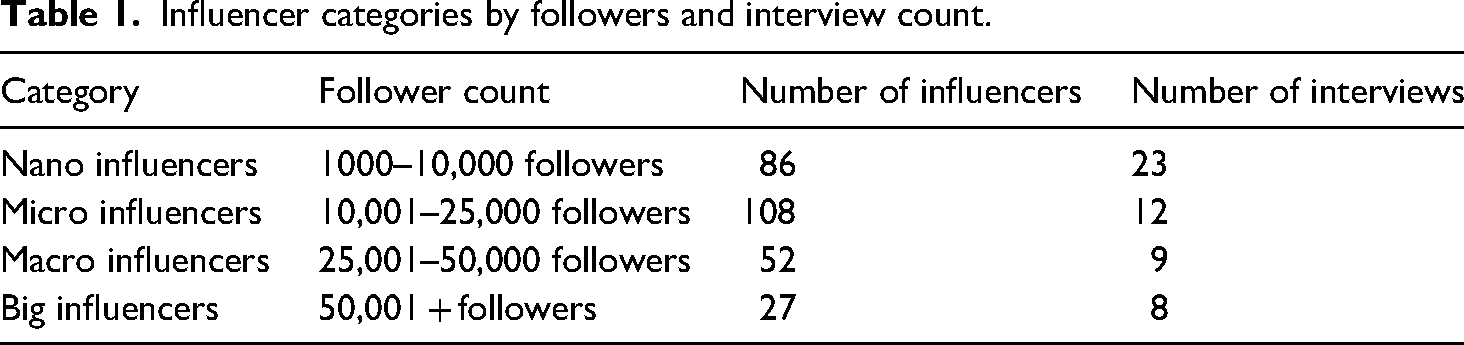
To capture the diversity, we used stratified random quota sampling. We invited every tenth person on the list by sending an email. If they did not respond or declined, we invited the next person on the list. Altogether, we conducted 52 in-depth semi-structured interviews with influencers, three male partners, and 11 representatives of agencies and brand companies, and attended 15 marketing events in Slovenia between September 2022 and March 2023. Saturation was achieved at approximately 30 interviews with influencers. We ensured a proportional share of influencers from each category based on follower count. The gender representation in the sample mirrors the feminised nature of social media influencing (Duffy and Hund, 2015), with 39 participants identifying as female and 13 as male.
Interviews were primarily conducted in person, with 12 of them conducted via Zoom. We identified relational work (Zelizer, 2012) as an analytical lens prior to data-gathering and structured the interview questions accordingly. We followed a semi-structured protocol asking about working conditions, income generation strategies on and off platforms, people who help with the influencer business, economic transactions, exchange media, and interactions with platforms. Interviews lasted between 43 and 157 minutes. The interviews were audio recorded and transcribed. Interviewees were given pseudonyms. Thematic analysis combining inductive and deductive coding (Braun and Clarke, 2006) was employed. Deductive coding was informed by experiences of precarity, offline and online income-generation strategies and Zelizer's (2012) concepts of relational packages (social ties, economic transactions, media of exchange), and interactions with platforms. Inductive coding yielded unexpected codes, such as the concept of platform lethargy. While we anticipated that higher-order codes would focus on metrics, algorithms, and platform interactions, the lower-order codes revealed surprising differences. For instance, instead of engagement with platforms and metrics, we encountered data coded as ‘not caring about platforms,’ ‘not caring about metrics,’ ‘low cost-per-mille’ 1 and ‘lack of effort in content creation’. Another unexpected finding was that under the higher-order code of algorithms, the lower-order codes included ‘not dealing with algorithms’, ‘smallness of Slovenia’, ‘nothing works in Slovenia’, and ‘God knows’.
Findings
The initial section of the findings delves into the interactions of Slovenian influencers with platforms, illustrating how this dynamic plays out in a semi-peripheral context by proposing the concept of platform lethargy. The following section recognises the diverse economies within which influencers operate, highlighting their varied income-generating practices as a means of establishing agency amidst precarity. The subsequent section elucidates the second agentic practice, which involves influencers relying on family members and the relational work techniques this reliance requires.
Platform lethargy: Influencers’ interactions with platforms
In this section, we explain influencers’ interactions with platforms and introduce the concept of ‘platform lethargy’ which describes influencers’ indifference to platforms throughout their labour process, which includes content creation, distribution and monetisation (Poell et al., 2021: 39).
In terms of content creation, influencers need to follow the trends on the platforms, which requires the consumption of others’ content. However, participants consistently stated that they do not have the time for that. Many mentioned that their partners or parents play a crucial role in keeping them up to date with platform and content trends, as Agnes explained: ‘I spend about 10 min a day on my phone, but my husband scrolls a lot and then tells me how to pose when we take photos’. The creation of content is based on the metric success of previous posts. However, when asked about the influence of metrics on content creation, influencers often responded with a quote from Steve Jobs that people do not know what they want until you show it to them. Rather than adhering to the platforms’ always-on mandate, influencers reported that they do not have specific schedules for their posts and that family members often remind them that they have not posted in a long time.
The support of family members in the creation of content was a recurring theme: mothers helping to stage images, fathers acting in videos and boyfriends taking videos and photos. Family members often provide resources for content creation, such as tripods, cameras and ring lights. However, many people behind the scenes of content creation does not automatically mean high-quality content. Marketing managers have noted in interviews a lack of effort in content creation. Regarding the numerous courses that teach individuals how to create short lifestyle videos, Emma said: ‘They can take as many courses as they want, but at the end of the day, no one puts it into practice.’
A disengaged attitude towards platforms was also evident in the distribution of content, which is primarily concerned with improving the visibility. This means interacting with algorithms, anticipating their changes and reacting accordingly (Poell et al., 2021). The interviewees expressed a divergent attitude towards algorithms: ‘I don’t deal with algorithms at all’ (Laurie) or ‘You never know, so why bother’ (Nuriel). Regarding experiences of being shadowbanned, Cassandra laughingly shared: ‘Here we are collectively shadowbanned’ alluding to the smallness of Slovenia. The latter aspect came up repeatedly in discussions about algorithms. Influencers’ algorithmic knowledge was underpinned by the Slovenian smallness: ‘I have tested all the theories from YouTube and it's all bullshit. It probably works if you want to go viral in other markets, but not in Slovenia’ (Michael). Others also emphasised Slovenia's uniqueness: ‘Algorithm is, there is no algorithm’ (Claire). These comments show how the influencers draw on the pre-existing cultural repertoire of Slovenia's smallness to make sense of the algorithms. The discourse about a small market influences how they understand and interact with algorithms, or rather, how they do not interact with them. Influencers assume that they lack agency over algorithms to improve the visibility of their content and therefore do not engage with them. This reflects Cotter's (2022) argument that the social context shapes encounters with algorithms and that people's manoeuvring around algorithms only makes sense when viewed against the backdrop of their social world. There was a noticeable lack of effort in the process of distributing content with the aim of gaining visibility. This also became clear in the discussions about the content monetisation.
The success of content distribution is then translated into metrics that determine the monetisation of the content. Nevertheless, influencers conveyed a lack of interest in metrics, with statements such as, ‘Mere numbers will not satisfy you; you'd burn out and lose the thrill’ (Tea). Metrics were not important to the brands either. Josh explained that he did not need to report on engagement in metrics, ‘Why should PlayStation care about their reach in Slovenia?’ Some influencers are part of the YouTube Partner Programme, which allows them to monetise content by displaying ads in videos. When asked about their revenue streams, influencers repeatedly forgot about YouTube and had to be reminded that they even had it.
In Slovenia, AdSense does not bring significant revenue because of lower purchasing power:
Here, the cost-per-mille is low. If I had an American audience, I could earn 5 Euros with each ad, but here I get 55 cents. I could try to get an audience abroad, but that's too much work. There are easier ways to make money. (Tea)
In addition to metric success, relationships with followers, built and maintained through the platforms’ relational infrastructures, are a key component of influencers’ success. However, participants shared that they are engaged with minimal effort. For example, they reply to direct messages but rarely take these conversations further. They also prefer to ‘just like the comments’ rather than reply. Some even reported that they do not read comments at all and leave this activity to their partners because they do not want to read hateful comments.
As such comments attest, Slovenian influencers are indifferent to platforms in their labour process, which includes content creation, distribution and monetisation. Interviews with individuals where the core of their work revolves around self-promotion justify considering the sincerity of their narratives, which to some extent are structured around ‘the pitch’ and portraying themselves in a more favourable light (Sender, 2005: 244). Nonetheless, the interviews with influencer marketing managers in the Slovenian influencer industry substantiate the argument of influencers’ indifference: ‘It's like shopping on AliExpress, what is promised and what is delivered are very different things. Their portfolios look great, but what they deliver is actually rubbish’ (Sarah). Betty described influencers’ behaviour as ‘excessive self-care’ because they often do not meet deadlines and ghost them.
Influencers participate in the entire cultural production process, which includes creation, distribution, and monetisation, with minimal engagement with platform features. This disinterested stance towards platforms is termed ‘platform lethargy’. This notion draws from Hu's (2022) concept of digital lethargy to describe the affect of being passive and avoiding decisions in the context of digital capitalism, which requires an active, empowered, and expressive personhood. The term lethargy refers to forgetfulness and lack of motivation, capturing influencers’ indifferent attitude towards platforms.
Platform lethargy encompasses both an emotional reaction to platforms and an affective infrastructure that animates action in the form of a refusal to conform to and adjust themselves to platforms’ mandates, as well as to establish, maintain, and cater to platform-mediated relationships. Platform lethargy, as an emotional response and an act of refusal, is rooted in specific algorithmic knowledge (Cotter, 2022) from the semi-periphery, where complementors are cognisant of their position in a devalued platform market. Consequently, they believe they lack agency over platforms and are therefore indifferent to them. Influencers do not seek to exercise agency in relation to platforms and refuse the script of having to care, expressing the sentiment ‘I would prefer not to’ (Žižek, 2006). Nevertheless, this is not a withdrawal from work, as they do post on platforms, distribute their content, and monetise this activity, but they do so on their own terms. The belief that one lacks agency paradoxically grants agency, as influencers did not express subjective feelings of algorithmic precarity. Lethargy also differs from resignation (Are and Briggs, 2023; Duffy and Meisner, 2023) in the sense that resignation occurs after experiencing punitive platform measures, whereas influencers in Slovenia are indifferent from the outset.
Platform lethargy may be the outcome or the source of diverse income streams and relational work, as elaborated in the following sections. Influencers narrated interactions with platforms in relational terms, acknowledging partners and family members who assist them in their activities. Moreover, many asserted that they do not need to prioritise platforms and visibility since this is not their primary source of income. The lingering question is: If influencers do not derive their main income from platforms, how do they sustain their precarious livelihoods?
Diverse income streams: Unravelling influencers’ precarious livelihoods
When we read influencers’ livelihoods for diversity considering them not just as platform-native cultural producers but as embedded in diverse economies, an intriguing pattern unfolds. Regardless of the follower count, they have diversified income streams and are enmeshed in webs of alternative economies to sustain precarious livelihoods.
Influencers in the micro and nano categories are students, receive welfare state transfers for unemployment or maternity leave, or have standard employment. They often shared that influencing is not their main source of income, as expressed by Arabella: ‘This is not my main source of income and I’m at peace with myself that numbers don’t matter.’ Moonlighting is common, as their primary jobs often interfere with influencing. For instance, a social media manager at an agency uses her employer's equipment to create content as an influencer during working hours. Influencers devise creative and covert payment systems, such as using family members’ companies, PayPal, and UpWork. This transforms influencing into informal paid work, monetised economic activity that operates outside the regulations of tax and labour authorities (Alacovska, 2018). Transactions also take the form of non-monetised market exchange, as influencers are often paid in kind with vouchers, vitamins, or barter promotions on social media for dental services. They treat influencer income as ‘nice-to-have’ rather than a ‘must-have’. Unlike previous studies suggesting that creative labour is sustained by downsizing and minimising living costs (Alacovska and Bille, 2021), Slovenian influencers engage in platformised creative labour to enhance and elevate their material standard of living.
Influencers with a larger number of followers (macro and big categories) have their businesses legally registered as self-employed entrepreneurs. Their large following suggests that they are more dependent on influencer income but the interviews reveal that they have many business ventures and like smaller ones, dispersed income. Tamara works with fashion brands for product placement, offers online fitness classes and owns a fitness studio thanks to generous investments of her parents that is also rented out to other instructors. Cassandra is another case in point. She is a beauty influencer who has her own beauty salon and utilises makeup products from influencing in her salon thus reducing operating costs. For this group, influencing is just one of many hustles that allowed them to build various businesses on top of their large following. They started as influencers but evolved into fully-fledged entrepreneurs.
In their economic practices, influencers follow the traditional Slovenian sustenance model. This involves having multiple income streams often through semi-illegal economic practises to achieve a higher material living standard or to promote bigger investments. Another aspect where Slovenian hustling culture comes to the fore is that influencers consistently emphasised that family members and partners are the linchpin of their business.
‘This is our family business’: Dynamics of relational work in the household
The second agentic practice of influencers under precarity is their reliance on the help of their family members. Partners, parents and even grandparents help with content creation, manage finances, invest and provide equipment. In return, influencers employ a wide range of techniques to match economic transactions and media of exchange with intimate ties: they gift, barter, pay and bribe with myriad exchange media. Influencers receiving support from their families reflects Slovenia's hustling culture and subsistence-oriented risk-sharing system, where historically the role of family members was central for economic survival. This long-standing feature has now extended into the realm of the platform economy.
Gender differences are evident among influencers. Female influencers tend to rely more on support from their intimate partners, whereas male influencers establish stricter boundaries around economy and intimacy.
Female participants actively demonstrate their involvement in relational work, highlighting the emotional challenges of balancing economic and intimate aspects within their relationships with male partners. Tamara's boyfriend helps her by assisting with website maintenance, investing in her clothing brand, and helping with order packaging. Despite his insistence on not expecting anything in return, Tamara expressed a sense of guilt about seeking his help when he returns home from work. To reconcile this, she engages in relational work by gifting him vouchers for clothing and food supplements obtained from her collaborations.
Partners play a role in generating content ideas and assisting with editing, and they are pivotal for managing the business side of influencing. One Instagram husband proudly shared,
She didn't know anything about business, so I said, ‘Let me take you under my wing and teach you a little bit.’ I set her up with a new email address, taught her how to write emails, and how to negotiate prices.
Bella shared how her husband ‘likes numbers and manages finances’. Similarly, Cora commented, ‘He goes out with friends and distributes my business cards, shows others my Instagram, and writes to brands for collaborations. This is our family business.’ In return, female influencers reported that they pay for their holidays and ensure to collaborate on services that both can enjoy together, such as spa visits. When a boyfriend acts in the content, money is the payment medium. In this case, relational tensions arose because partners wanted a larger share of influencers’ income. Lisa shared her frustration with her boyfriend wanting 50% of the revenue if he appears in her content: ‘It's my account, my followers, and it's not fair that he gets half of my revenue, so I split it 70:30 in my favour.’
When creating content together, influencers mentioned that providing ‘extra care’ to their male partners is essential. Nadine explained, ‘Everything is reflected in the content. We have to be in the right mood for shooting, and I have to ensure we don’t argue on those days.’ Influencers mentioned being highly attentive to their partners’ emotions and having strategies to ensure their well-being, such as bringing food to the shooting sessions. In these intimate relations, sex becomes media of exchange. One Slovenian influencer employed her husband in her mega-successful clothing company and recently made a problematic statement in a podcast interview when asked about how she navigates the relationship with her husband working for her: ‘A lot of women will not agree with me on this one but sometimes you have to spread your legs’, alluding to having sex whenever her partner desires. A similar sentiment was also shared by one of the interviewees: ‘Just have sex with him in a public space and then he becomes your slave, he becomes crazy about you’ (Lucia).
Not all partners support their significant others being influencers. In these instances, bribes were used to smooth over relational tensions:
He makes such statements that I take advantage of him, so I play this game of bribing him with ice cream from collaborations. When I got a baby carriage, I made it clear to him that now we can spend the money allocated for a carriage on him. (Frankie)
When a partner did not approve, emotional burdens were even heavier. Tara shared that she is very tired of constantly having to prove to her husband that this benefits the whole family and that sometimes she ‘feels like collapsing’. A significant mismatch in relationships between intimate partners unfolded publicly when an ex-boyfriend lodged a complaint with the Slovenian Labour Inspectorate. The accusation was that an influencer was using her underage children to endorse products on Instagram without the necessary work permit from the Labour Inspectorate, as required by media law for children in commercials. Consequently, the influencer was fined 1000 Euros and issued an apology, citing her lack of awareness regarding this regulation. In response to this incident, she took the initiative to establish a Chamber of Slovenian Content Creators with the aim of educating others on regulatory compliance.
Female influencers employ various techniques such as gifting, bartering, paying and even resorting to bribes to make relational matches with their intimate partners. However, relational matches do not inherently imply fairness, rather they just signify the continuity of the relationship (Zelizer, 2011). Female influencers carry emotional burdens, and their relational work and subsequent matches frequently adhere to the traditional script of patriarchy. Female influencers reported being aware of potential ‘ego issues’ resulting from earning more money than their male partners. To avoid relational mismatches, they engaged in watchful performance of relational work by earmarking money from influencing for common use like paying for holidays, weddings or groceries. They earmark influencer income in such a way that it functions as pin money which historically refers to supplementary household income earned by women that was deemed more frivolous and less serious than that of their male partners (Zelizer, 2011). By earmarking their income in this way, influencers signal financial submissiveness despite earning more, reproducing patriarchal dynamics within households.
While there are cases where girlfriends assist their influencer boyfriends, male influencers generally set stricter boundaries between their influencer activities and intimate relationships. They express concerns that their fame could be exploited by their female partners. If male influencers do rely on their girlfriends for assistance, it tends to be in tasks that are not visible on social media, such as editing videos. In exchange, they often cover shared expenses like subscriptions: ‘She edits my videos, and in return, I pay for the Netflix subscription’ (Jean).
Male influencers prefer to rely on the assistance of their family members, such as fathers and mothers appearing in videos. However, when asked what they give their parents in return, they often reported giving nothing, explaining that their parents do this for them out of love. Male influencers indicated that they do not gift family members anything because the nature of their collaborations with brands differs from those of female influencers. They more often collaborate for technical devices like keyboards and headphones, which they personally use and are not easily shared with others. This suggests that male influencers engage to a lesser extent in relational work within their households.
Both female and male influencers utilise family resources to mitigate precarity. Parents were reported to invest in their children's businesses to diversify their income streams. They also offer various forms of assistance. For instance, Kay's mother takes him on her business trips around Europe so he can create travel content at zero cost. Parents also provide access to workspaces, as influencers often have designated places and offices in their parents’ basements or childhood rooms. Parents facilitate the informal economy by providing legal means through which transactions with brands can be processed: ‘My mum has a registered business, so I pay 80 Euros in taxes every month. If I had registered it in my name, it would be 500 Euros’ (Tessa).
It is important to note that parents require much less relational work and emotional effort, and influencers feel less indebted to their parents. As a result, economic transactions with parents are framed in different terms, such as tokens of gratitude and care, rather than as gifts, barter, payments, or bribes as described in the case of intimate partners above. Influencers express gratitude by gifting their parents goods and vouchers to thank them for providing legal means for transactions: ‘Mum needed a new jacket so I gave her a voucher for 150 Euros so she could buy a proper one’ (Tessa).
As a thank-you gesture for her mother acting as her accountant, Deborah cleans her mother's house every Saturday and regularly gives her creams and clothes. Electronic devices are frequently given as gifts to family members: ‘Mobile phones are passed down the family, to brothers, sisters, and grandparents’ (Tea). Influencers reported accepting product placement requests from brands and agencies with their parents’ needs in mind, framing it as a form of care: ‘My father has problems with blood pressure, so I agreed to promote vitamins with Omega-3 and gave him everything’ (Cassandra). Finally, grandparents’ involvement in influencer content was also portrayed as an act of care. Frankie shared,
My cousin and I are both TikTokers, and Grandma finds it funny when we dance. So, we included her in the content, and then her neighbours told her that she was famous, and she was so proud […] she's alone, and we take care of her in this way.
Relational work with parents and grandparents was a more seamless process than with intimate partners. However, the prevalent reliance on family resources conceals a significant drawback—it contributes to the perpetuation of class inequalities. Parents must possess the resources to be able to assist influencers. This reliance underscores the importance of at least a middle-class background for pursuing a career as an influencer (Duffy, 2017), similar to other creative professions (Alacovska and Bille, 2021). Among the 52 interviewees, only 16 mentioned facing moderate difficulty in managing their monthly income, while all others reported managing with ease. One influencer who transitioned to an influencer marketing manager role shared how she had to do this because her family lacks the resources to support her influencer career:
Those who live in beautiful houses can create beautiful content. I couldn't record myself in a perfect bathroom showing how I shave my legs and apply body lotion. People succeed because they have money, they can attend events and socialise. I can't afford that. I don't have wealthy parents. (Amelia)
Discussion and conclusion
The aim of this study was to examine the nexus of influencer precarity-agency within Slovenia's hustling culture. Influencers employ two main strategies to gain agency under precarious working conditions: having multiple income streams and relying on assistance from family members and ‘Instagram husbands’. In return, influencers engage in relational work to facilitate viable matches between economic transactions and intimate relations, and invent various alternative currencies such as vouchers, subscriptions, and intimacy. These diverse economic practises are the primary means by which influencers in Slovenia cope with and manage precarious livelihoods.
Our findings contrast with existing accounts of influencer precarity from the Anglo-American empirical settings that emphasise the attenuation of precarity through platform-centric practises such as algorithmic gossip (Bishop, 2019), engagement pods (O’Meara, 2019) and the use of intimacy as a tool in practices of relational labour (Glatt, 2023). Influencers in Slovenia participate in the entire cultural production process, encompassing content creation, distribution, and monetisation, with minimal engagement with platform features. We conceptualised this disinterested stance towards platforms as ‘platform lethargy’. It encompasses both an emotional reaction to platforms and an act of refusal to conform to platform mandates. This behaviour is informed by a distinct algorithmic knowledge (Cotter, 2022) derived from the discourse of Slovenia being an irrelevant platform market. Platform lethargy is evident in not keeping up with content trends, producing mediocre-quality content, not seeking visibility on platforms through engagement pods or algorithmic gossip, neglecting monetisation metrics, forgetting about YouTube AdSense, and minimally engaging with followers by merely liking comments without responding, or even ignoring comments altogether. Instead, Slovenian influencers navigate precarity by utilising informal social support networks and engaging in relational work that connects actual intimate relationships with economic transactions occurring outside of platforms.
Collectivising the risks of precarity across multiple income streams, family members and intimate partners affords influencers agency in relation to social media platforms. Similar to creative workers on gig platforms (Alacovska et al., 2024), influencers resist algorithmic normativity through relational work. As a result, they can withdraw relational labour with audiences but not relational work with intimate social ties which comes with drawbacks. Relational dynamics within households reproduce long-standing inequalities in creative industries across class and gender lines (Alacovska, 2022). Relationships with partners often fit, reflect and reinvigorate broader patriarchal, heteronormative relationships of economic and emotional dependency.
Familial relational dynamics resemble the traditional Slovenian subsistence model of survival, in which unofficial institutions of moonlighting and family subsidise official institutions of formal employment and the state (Jaklič et al., 2009). With the rise of influencers, social media platforms have been inserted into the traditional Slovenian subsistence model. Herein, it could be said that moonlighting and family assistance also subsidise social media platforms. This resonates with Aleksandra Piletić's argument (2023: 18) that platforms have ‘plugged into’ prior forms of accumulation. The utilisation of multiple livelihoods and family support mirrors the established cultural framework of Slovenia in how influencers match social ties, transactions, and media. This finding contributes to the literature on relational work, aligning with Bandelj's (2020) suggestion to investigate cultural variations in the assembling of relational packages. The Anglophone literature highlights the significance of social media platforms in influencers’ relational packages, but in Slovenia, family relations play a crucial role in influencers’ relational work strategies.
This article contributes to the HCI literature, calling for more research on how platform-mediated work unfolds across geographies (Qadri, 2021). The concept of platform lethargy illustrates how human interactions and responses to algorithms play out in non-Western spaces, exposing the algorithmic flaws and frictions caused by contextually inappropriate, or in this case, irrelevant design. Despite influencers’ lethargic attitude towards platforms, this does not mean that platforms should adopt the same attitude towards them, as they are ultimately the beneficiaries of these collective hustles. The practical implications of this study call for the platforms to create more community-centred benchmarks of success, so that even content producers from countries like Slovenia could receive fair compensation. The current standards of success used by platforms only perpetuate the notion that ‘geography is destiny’ as is often said in the Balkans.
Future research should acknowledge the centrality of kinship to economic exchange and incorporate it into platform labour research, keeping in mind that (platform) capitalism does not stop at lovers’ doors (Zelizer, 2011). Given the rise of the hustling culture (Ticona, 2022) and the growing importance of familial capital in the West (Piketty, 2017), is it possible that comparable relational work can also be observed among influencers elsewhere? Secondly, influencers framed grandparents’ appearances in their content as acts of care and often allocated goods obtained through influencing for social reproduction, prompting a question previously raised by Alacovska and Gill (2019): can creative labour be redefined as care work? Addressing this necessitates a closer examination of how platforms intersect with social reproduction, as already highlighted in studies by Jorge et al. (2022) and Duffy (2017, Chapter 6).
Footnotes
Funding
The article was created as part of the doctoral training of the first author, who is included in the “Junior Researchers” programme funded by the Slovenian Research and Innovation Agency.

Notes
Authors’ biographies
Tinca Lukan is a PhD researcher at the University of Ljubljana and research fellow at Alexander von Humboldt Institute for Internet and Society in Berlin. Her research explores the working conditions of social media influencers from the perspective of economic sociology. Tinca is also an elected committee member at the European Council for Doctoral Candidates and Junior Researchers where she is interested in the labour market analysis and promotion of science communication in academia. She is also a science communicator herself, promoting sociology on TikTok under the handles Tinca_Lukan.
Dr. Jožica Čehovin Zajc is an Assistant Professor at the Centre for Organisational and Human Resources Research, at the Faculty of Social Sciences, University of Ljubljana and teaches methodological courses at the Faculty of Health Sciences, University of Ljubljana. Her research interests include sociology of work, working conditions, health of employees and communication studies.