




Abstract
Many of the causes and impacts of environmental and social issues may seem invisible, while others are apparent yet overlooked. Journalists act as focal agents shaping how society addresses these issues, including climate change and social inequality. In this article, we investigate how journalists act as visibility agents – that is, agents who make visible such issues in the media, culture, and society more generally. Drawing on interviews with Nordic journalists, this exploratory qualitative study shows how journalists address the (in)visibility of environmental and social issues in four primary ways: uncovering wrongdoing, moderating false and inadequate information, explaining complex social/environmental topics, and popularizing issues. The study advances literature on mediated visibility and the relationships between journalists and political and economic leaders by explaining how the former approach the task of visibilizing environmental and social problems.
Keywords
Introduction
Environmental and social issues are major topics in societal discussions due to the increasing number of extreme weather events, ever-present social inequalities, and proliferating corporate pledges to social responsibility and climate neutrality. While a variety of actors, such as regulators, non-governmental organizations, and social movements, can play a role in informing publics on these issues, one group is specifically tasked with information provision: journalists. As they produce and disseminate information in the media, journalists can affect society’s understanding of such issues. Furthermore, one of the central functions of journalism is to hold those in power accountable, something that applies to businesses and politicians alike.
The relationship between mass media and environmental and social issues has gained increasing attention in academia. Scholars have usually focused on specific topics, such as inclusion and gender equality in media reporting (Hartley and Askanius, 2021) as well as climate change and environmental degradation (e.g. Brüggemann, 2017; Hiles and Hinnant, 2014; Schäfer and Painter, 2020). With regard to these topics, researchers have at times emphasized journalists’ decisions to “make things visible” (Niemelä-Nyrhinen and Uusitalo, 2021: 179). In existing scholarship, the journalistic examination of environmental and social issues is frequently viewed through the lens of journalistic advocacy or activism. For example, journalists have been shown to feel the tension between acting as advocates of particular issues and adhering to the ideal of objective journalism (Mocatta et al., 2023).
More broadly, it has been argued that the significance and visibility of events in society continue to largely depend on how the press manages mediated visibility (Trottier, 2017). Scholars have noted that journalists wield power by influencing which actions and actors gain visibility and which remain unseen (Bacon and Nash, 2012). This allows them to exercise symbolic power, especially by revealing hidden practices (Thompson, 2005). The relationship between journalists and power holders has been theorized as a “media game” where actors engage in deliberate strategies to manage their visibility (Bacon and Nash, 2012).
In this article, we investigate how journalists act as visibility agents – that is, actors that play a pivotal role in making organizational practices visible (Harness et al., 2024). Harness et al. (2024: 5591) have recently suggested that “more empirical research is necessary to understand the complexities between visibility agents and organizations.” We argue that journalists represent an insightful context to study the (in)visibility of environmental and social issues because they are expected to address both ubiquitous, visible claims and hidden, invisible information on these issues. For example, journalistic media have been criticized for not fulfilling their role as watchdogs for politicians and businesses, specifically in terms of monitoring and exposing (i.e. making visible) corporate misconduct (Kalogeropoulos et al., 2015; Usher, 2017). In this article, we aim to contribute to a more nuanced understanding of how journalists act as visibility agents who affect the (in)visibility of environmental and social issues. Hence, we ask the following research question: How do journalists address the (in)visibility of these issues through their work? To answer this question, we conducted an exploratory qualitative study in the Nordic countries based on in-depth interviews with journalists. Our findings contribute to the literature on mediated visibility and the relationships between journalists and political and economic leaders (Bacon and Nash, 2012; Thompson, 2005; Trottier, 2017; Uldam, 2018) by documenting four ways in which journalists act as visibility agents and interact with the (in)visibility of environmental and social issues: uncovering wrongdoing, moderating false and inadequate information, explaining complex social/environmental topics, and popularizing issues.
Visibilizing environmental and social issues
Environmental and social issues are usually complex phenomena that many stakeholders have different views about. Previous scholars have highlighted how important it is for these issues to gain visibility, focusing on issue attention, framing, and news value criteria, which keep such issues on the agenda (Berglez, 2023). Visibility is crucial for creating public awareness and enhancing the urgency of actions (Kunelius and Roosvall, 2021). Brighenti (2010) conceptualized visibility as recognition: the significance of being seen to be acknowledged in society. According to Brighenti (2010), mass media can “visibilize” (p. 34) actors and actions or engage in the “invisibilization of hard-to-deal-with social problems” (Brighenti, 2010: 51). Brighenti (2007) also noted that visibility can be understood in the tradition of arcana imperii – invisibility bestows on the powerful the capacity to control, and it enables them to exercise power. Hence, as a construct, visibility is always relational and positional, and it can be defined as “an aspect of social life that enables us to introduce thresholds of relevance and selective attention” (Brighenti, 2010: 44). Previously, visibility was considered empirically; for example, in relations between corporations and activists where the latter used social media to promote their causes, while the former may have used the visibility of activists as means of surveillance (Uldam, 2018). However, corporations are not the only actors who can use visibility to their advantage. As visibility agents, journalists influence how the visibility of different actors and issues is configured (Harness et al., 2024; Trottier, 2017). Harness et al. (2024) have suggested that visibility agents can generally have inquisitorial, adversarial, associative, or advocative relations with organizations when addressing (in)visibility.
Climate change is a pressing environmental and social issue. Rudiak-Gould (2013: 128) suggested that it can be seen from the perspective of “constructive visibilism,” according to which the phenomenon is made visible through communication. He argued that climate change might be visible to communities that experience its effects firsthand, while others might be protected from it; thus, for them, it may remain invisible. Similarly, one might say that social problems are often only visible to those who suffer because of them (Brighenti, 2010). Indeed, environmental and social issues can feel distant and invisible in people’s daily lives, and the deliberate or unintentional restriction of information about them may result in their relative invisibility. While a variety of actors may affect the visibility of these issues, journalists play a special role in influencing which actions and actors receive visibility and which remain invisible (Bacon and Nash, 2012). Scholars working on mediated visibility have emphasized the dual nature of visibility, as the “media game” (Bacon and Nash, 2012) involves attempts to be seen and recognized as well as attempts to conceal (Bacon and Nash, 2012; Brighenti, 2010; Uldam, 2018). In this game, hiding is also a way of exercising power, which occurs not only by keeping actions and actors away from public scrutiny but also by surveilling – that is, “instilling a sense of being suspected” (Uldam, 2018: 45).
Most typically, media outlets exercise symbolic power by revealing information, as “previously hidden practices and events [are] given an entirely new status as public and, indeed, politically explosive events; the invisible [is] made visible for all to see” (Thompson, 2005: 31). While (in)visibility has been primarily associated with unearthing the hidden truth, environmental and social issues can also involve other facets of (in)visibility. For example, several organizations inform their stakeholders about their environmental, social, and governance activities, as well as their corporate social responsibility (CSR) practices. In these cases, rather than a lack of information, there is an excess of it, which can apply even to publicly available information; there might also be different views of what matters. This can result in the relative invisibility of the most impactful phenomena.
Visibility agents are embedded in their societal contexts, and they are affected by a variety of expectations. Regarding journalism, scholars have pointed out how journalists might perceive tensions when advocating for certain social issues, as advocacy (and even more so activism) can conflict with traditional journalistic ideals of objectivity (Mocatta et al., 2023). When there is considerable agreement on the issue at hand, advocacy may be more acceptable for journalists (Wade, 2011). Thus, acting as a visibility agent is entangled with norms regarding the parties involved. Therefore, we argue that journalism represents an interesting context to examine how visibility agents act regarding social and environmental issues.
Visibility agents may also encounter obstacles in their work. For various reasons, environmental and social problems can be difficult topics for journalists to provide information on (Hiles and Hinnant, 2014; Strauß, 2022; Weder et al., 2021). For instance, reporting on these problems and the complex markets they are linked to (Doyle, 2006; Tambini, 2010) requires substantial knowledge and expertise (Hiles and Hinnant, 2014). As reporters are bombarded with PR spin (Davis, 2000; Doyle, 2006), they are at risk of being used to unintentionally give a platform to false green claims (Strauß, 2022); hence, they need to be particularly skilled at holding decision-makers and companies to account. At the same time, it can be difficult for journalists to acquire information about complex social problems (Manning, 2012), which are often the product of global supply chains and power structures that can silence stakeholders. For example, journalists were heavily criticized for failing to act as watchdogs before the global banking crisis of 2007–2009 (Kalogeropoulos et al., 2015; Manning, 2012; Pollach and Hansen, 2021; Starkman, 2014; Strauß, 2022; Usher, 2017). Moreover, writing on issues such as climate change can subject journalists to withering criticism, hate speech, and questioning of their objectivity and professional skills (Hiles and Hinnant, 2014). Finally, journalists often lack the resources to conduct investigative journalism, and complex issues may not generate adequate interest among audiences (Doyle, 2006; Tambini, 2010; Usher, 2017). Therefore, it is crucial to understand how journalists act as visibility agents and deal with the (in)visibility of environmental and social issues.
Data and methods
To examine how journalists affect the (in)visibility of environmental and social issues through their work, we carried out an exploratory qualitative study in Finland and Sweden based on 22 semi-structured interviews conducted in 2022. Nordic journalists view themselves as detached watchdogs who seek to hold the powerful, including regulators and companies, to account (Ahva et al., 2018; Kalogeropoulos et al., 2015). They have also shown much interest in the emergence of sustainable journalism, understood as journalism that highlights challenges pertaining to environmental, social, and economic sustainability (Berglez, 2023; Berglez et al., 2017).
The study’s participants are described in Table 1. To collect our sample, we looked for journalists who had written more than one news article about environmental and social issues for Finland’s main legacy news media websites. Using the snowballing technique, we asked informants for suggestions about other potential participants. Among these suggestions were Swedish journalists whom the Finnish informants followed and collaborated with; these were added to the sample.
Research participants.
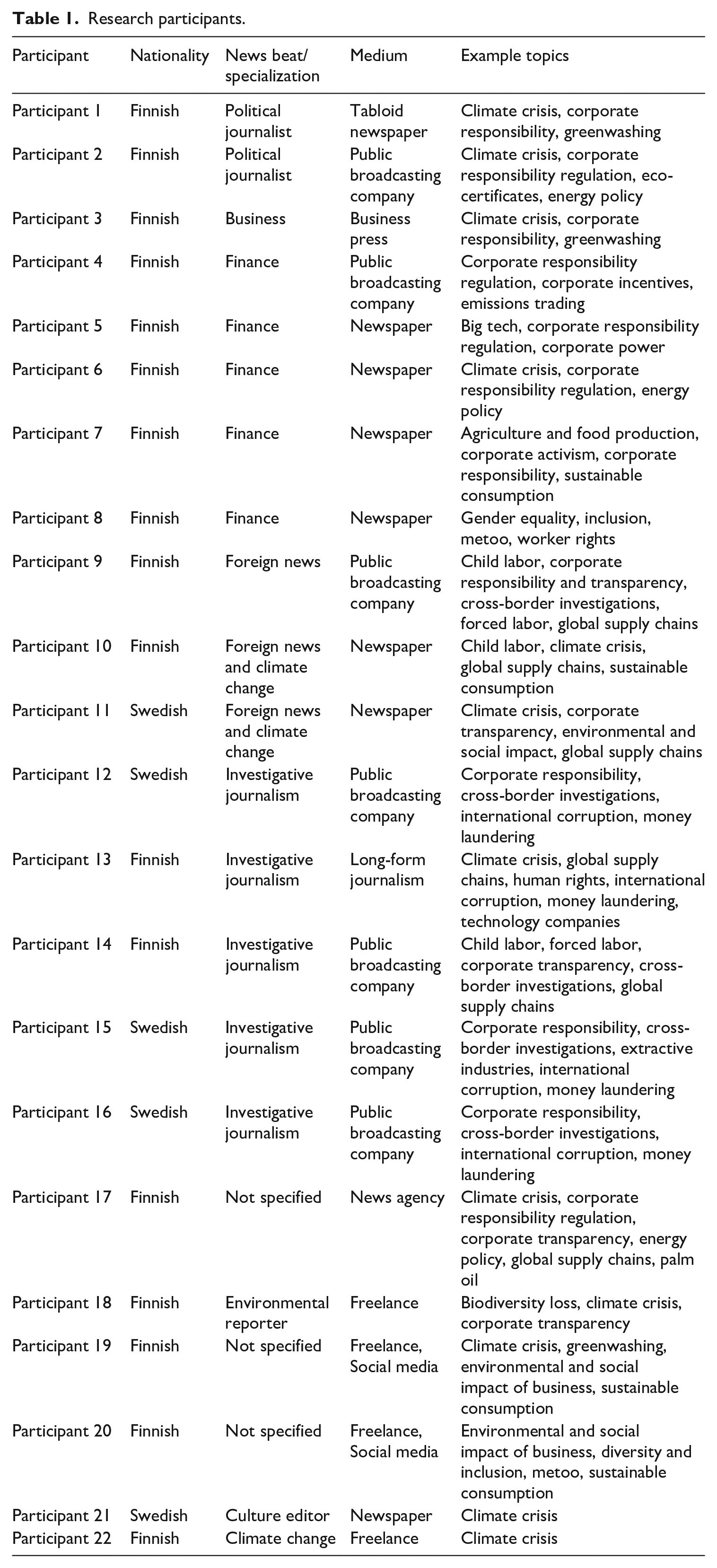
The participants wrote for various beat sections and media, and their reporting was not limited to environmental and social issues. They represented more than 10 news brands. At most, three participants worked for the same news section of the same organization. Participants 17, 19, and 20 were freelance journalists who had not been assigned a specific area but had been able to select their topics quite freely.
As shown in Table 1, the interviewees had written about a variety of environmental and social topics, such as the climate crisis and biodiversity loss, greenwashing, ethical consumption, diversity, worker rights, the ethics and transparency of global supply chains, international corruption and money laundering, corporate responsibility regulation, and energy policy. In the interviews, we focused on the topics the journalists were acquainted with.
First, the interviewees were asked to describe their positions and work by, for example, reflecting on how they presented themselves in public sources. Then, they were asked to share in more detail their experiences of writing or producing specific stories related to the example topics (see Table 1) – how they got the idea; how they experienced the process, and how they reflected on the outcomes of their reporting. We inquired about the relationships the journalists had with decision-makers, their sources, and their audiences to better understand how they positioned themselves. Therefore, we were able to examine journalistic work “from the inside out—to understand how the profession makes sense of itself” (Deuze and Witschge, 2018: 167). Since we primarily aimed to listen to the interviewees and ask follow-up questions (Rapley, 2004), the structure of the interviews changed to accommodate these aims. The interviews lasted approximately 1 hour and were carried out online. They were conducted in Finnish or English. In accordance with research ethics standards, all the interviewees were asked for their consent to carry out and record the conversations.
The interviews were transcribed for analysis. First, we inductively coded excerpts from the transcripts to determine how the participants verbalized their relationships with and acted on environmental and social issues as part of their work. This inductive coding enabled us to stay close to the data and understand the subjective perceptions (Hanitzsch and Vos, 2017: 127) of what it is like to conduct journalism about environmental and social issues. Initially, both authors analyzed a part of the data independently; then, they discussed the coding together. At this stage, we decided to treat the data as a single corpus, as our initial coding did not produce significant differences between the two countries, which exhibited a shared journalistic identity (Ahva et al., 2018).
Next, we considered our empirical observations vis-à-vis existing theories and started going back and forth between them (Dubois and Gadde, 2002). We began theorizing visibility as a focal component of the relationship between journalists and environmental and social issues because we noticed that the former discussed how they made visible these issues in different ways. This led us to distinguish between invisible and visible issues. In addition, we related the (in)visibility of the issues to the notion of perceived impact as the journalists tended to bring up monitoring and empowerment as key purposes of their work. Thus, we arrived at four ways of conceptualizing journalists’ relations with the (in)visibility of social and environmental issues, which are explained in the following section.
Findings
When examining environmental and social issues, journalists may aim to uncover wrongdoing, moderate false and inadequate information, explain complex social/environmental topics, and popularize issues (Figure 1). On the one hand, journalists can primarily aim to monitor and control elites or empower audiences (e.g. in the spirit of service journalism, Eide and Knight, 1999, solutions journalism, Aitamurto and Varma, 2018, and consumer journalism, (Kristensen and From, 2011). On the other hand, they can aim to make visible invisible social/environmental issues (typically by focusing on individual actors and actions) or issues that although visible, are made opaque by their complexity and systemic nature.
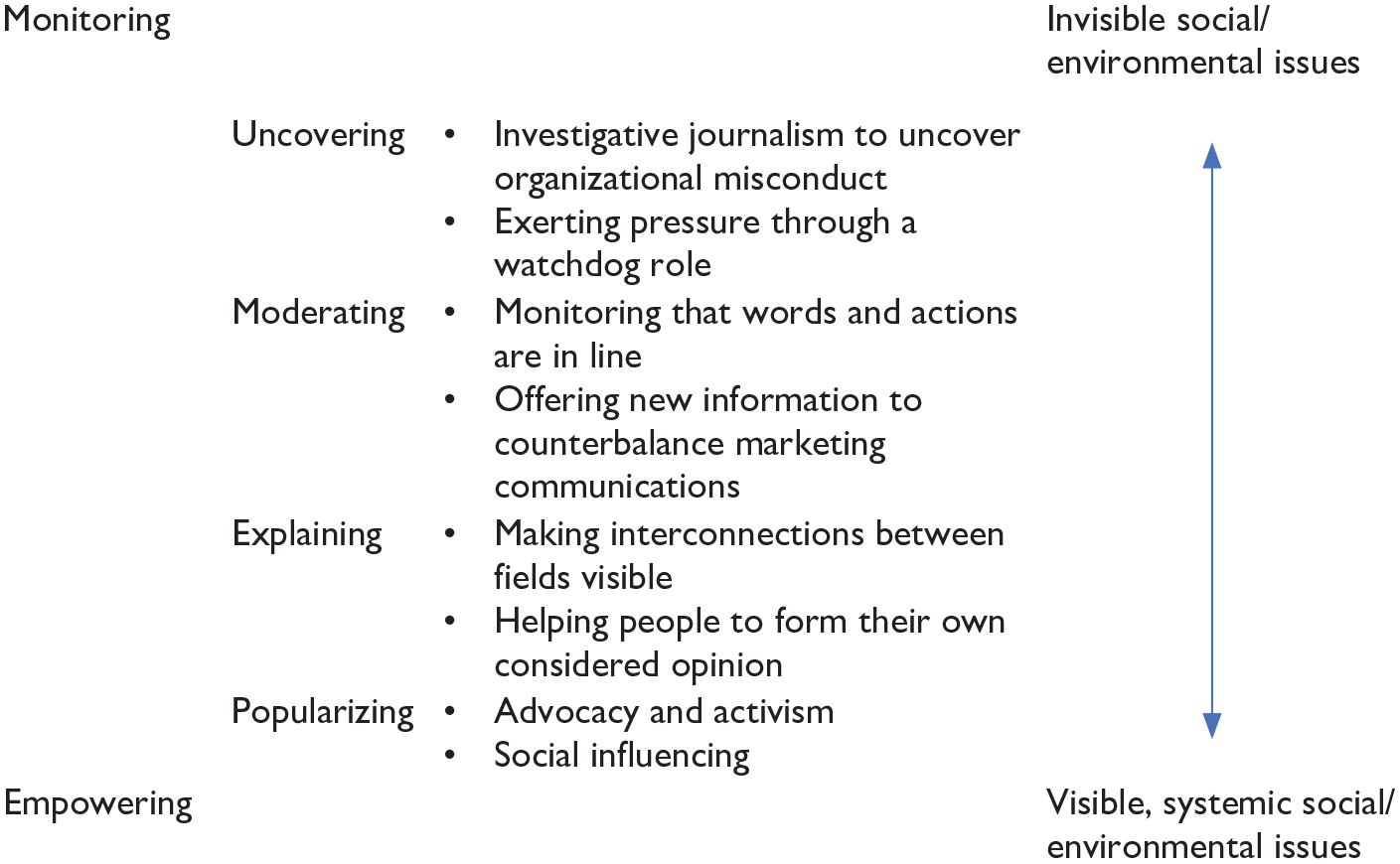
Four ways to address the (in)visibility of environmental and social issues.
Uncovering wrongdoing
Generally, journalists are expected to act as watchdogs and “revealers of hidden or enclosed information” (Bacon and Nash, 2012: 247); the failure to do so can be considered a failure of journalism (Hanitzsch and Vos, 2017; Starkman, 2014). As visibility agents, journalists often work against organizations, demanding accountability and monitoring corporate conduct (Harness et al., 2024). Monitoring whether organizations are as sustainable as they claim to be has become a central function of journalism. Investigative journalists seek to uncover abuses of power and discover “the hidden truth” behind, for example, green claims and opaque corporate structures (Participant 16). These journalists may seek to “make it a bit harder for them to behave in a bad way” (Participant 11) by making misconduct visible in exposés and the analyses, newsletters, and commentaries that follow. Participant 13 described their relationships with other actors and objectives as follows: My role is to facilitate the social movements and public pressure that make companies avoid misconduct and risk-taking concerning human rights or the environment in the future. My task is to be like a ghost of negative publicity when firms think about doing such things. (Participant 13)
Investigative journalists have reconfigured their position vis-à-vis organizations by engaging in international cooperation, thus amplifying the visibility of news stories, which can reach the global level.
What we’ve seen in the past is that journalism worked in a very national way, but companies can be very global. . . . So, I think the big change has been that when journalists started working as networks—international networks—it had an impact because we also became international. (Participant 16)
The topics of investigative journalism are typically linked to highly complex global networks, which afford limited or no access to outsiders such as journalists. Thus, the latter find themselves in situations where, for example, “everyone kind of knows that clothes are made in pretty inhumane conditions – it’s no longer news” (Participant 4), but obtaining evidence of this is extremely difficult. As a result, the problems and their root causes remain hidden. Investigative journalists have used innovative methods, such as GPS trackers, to uncover harmful practices in complex supply chains about which information is lacking. This secrecy can be the very reason that motivates such journalists to examine them.
We started gathering information [about these companies] and noticed quite quickly that one firm didn’t want us anywhere near it. It didn’t want us to film anywhere, and it wouldn’t give us an interview. There was just a wall. We wondered, “Why on earth [is it behaving like this]? Why is it so secretive?” (Participant 14)
Many participants said that they found it increasingly difficult to get interviews with companies and that they assumed that firms “tended to prefer giving interviews to journalists whom they believed didn’t have knowledge of certain things because they thought answering them would be easier” (Participant 11).
More and more often, corporations—but also the authorities and so on—respond by email and want to know the questions. And they get back [to us] via email with these kinds of answers . . . it’s just . . . you know . . . we need to write stories—we can’t use these answers. (Participant 11)
Organizations carefully choose what they communicate. Some of the participants said that they were able to establish dialogues with certain firms; despite this, though, they were unable to obtain the information they needed to examine the environmental impacts of these businesses.
[The firm] was very helpful and willing to cooperate. It answered the questions quickly, and it even let us film there and film the interview. It was quite open in this way. The problem is that it didn’t share the critical information. It pretended to be very transparent, but it did not share the most important information, which would have enabled us to evaluate its sustainability. (Participant 17)
Journalists can increase the visibility of environmental and social issues by “using one case as an example of what dishonesty looks like” (Participant 13). At times, their stories have also had direct effects on society by bringing inequity to light and changing future discourses and practices. In this regard, the biggest newspapers have the greatest media power. In small outlets, stories cannot have significant effects on society, unless the main news channels cite them. Reflecting on this power, a journalist from a large news outlet said the following: Poor leadership or corporate culture is not a [sufficient] reason for a media outlet of our size to go after a small company. It’s too big of a hammer to use. We need to think about the societal significance and scope of the issue. Is this a genuine, broad corporate responsibility issue that is socially relevant? (Participant 8)
In general, the participants had varying opinions on the societal impacts of stories. Most of them held views similar to the one expressed by Participant 9: “Whether the news story results in something is a matter outside journalism.” However, some shared the position of Participant 13, who said, “I’m happy if things change – if it becomes clear that a certain way of doing things needs to be changed for the better.” The participants also expressed opinions similar to the following one: “The role of journalism is also to monitor [legal compliance], take the side of the weak, and give a voice to those who have been mistreated” (Participant 8).
Moderating false and inadequate information
In addition to uncovering wrongdoing, many of the participants considered it their responsibility to “unpack [corporate sustainability claims] and look beyond marketing communications, possibly offering audiences different information” (Participant 9). With regard to this, Participant 22 said, “I hope that journalists have the know-how, time, and wits to put into perspective sustainability news.” In this context, the aim is not so much to uncover hidden wrongdoing but rather to moderate and, in a sense, counterbalance visible, exaggerated/false information, which can be found, for example, in sustainability marketing claims, as a form of public service to citizens and consumers. Therefore, journalists seek to make visible the invisible reality behind such claims. These two aims are not contradictory or mutually exclusive, as journalists may wish to show “how easy it is to talk and make promises that no one checks and how unreasonable it is for consumers to have to decide what is true and what is not – what they can trust – in this endless swamp of climate-related and environmental claims” (Participant 13). In this regard, Participant 10 said, I always wish that I could somehow stir up the consumer or be some kind of counterforce to this kind of communication. It seems to me that communication is a matter of trying to get as many marketing messages through as possible. That’s my angle on it. I think all the time that the angle is too uncritical. I deliberately try to be obnoxious in that sense, to neutralize the expectations concerning these “responsibility actions” [and bring them down] to a somewhat realistic level. (Participant 10)
Journalists can modify and moderate the visibility of sustainability claims, constantly checking “that words and actions are aligned” (Participant 6). This involves carrying out the tasks of professional journalism, such as challenging the narratives of businesses by asking tough questions, scrutinizing the scope of the impacts of advertised sustainability efforts, and offering different viewpoints. “Instead of just publishing a press release from a company that [exclaims,] “Wow! Our exports will take off again,” ask researchers, economists, and the like whether in light of all this, this is (a) profitable or (b) somehow ethically sustainable” (Participant 7).
Most of the participants were experts in environmental and social issues thanks to their work experience, education, and training. Therefore, they knew how to evaluate businesses’ claims and distinguish between big and small acts. In general, the increased visibility of sustainability talk was seen as having pushed journalism toward a more critical stance.
Five years ago you could be happy, and it was a bit exceptional for a company to communicate with a climate change angle. Now, the world has changed so much that there isn’t a business that doesn’t communicate with such an angle. This means that the role of the journalist has also changed a lot. Suddenly, there are many more opportunities to act as killjoys. (Participant 13)
The participants from the biggest newspapers said that in general, they received comments from firms, and they perceived communications professionals as skilled and proficient when it came to conveying sustainability issues. However, some of the interviewees felt differently. Participant 10 said, “They did answer, but I couldn’t get any kind of explanation from them for the contradictions [I brought to light].” Participant 3 explained the following: “If we ask questions about social responsibility, either we can’t get much out of the answers or the answers are too detailed.” When interacting with companies, journalists are in an excellent position to examine whether we are currently living in the green transition or in a sea of false green claims. The following words of Participant 7 speak to this issue: I entered the business news department with the preconception that all companies are bad and try to cheat and that all CSR work is just talk. That’s probably still my starting point. However, the more I talk to these companies, the more I see that they do real things. I also think that some of these real things seem very small. (Participant 7)
As shown above, the participants generally believed that it was unreasonably difficult for consumers to understand sustainability marketing claims, and they added that this could be a difficult task also for journalists. For this reason, some of them had helped organize and participated in training that provided tools to journalists to assess green claims, such as climate pledges. This training allowed them to ask the right questions to stem the overflow of information on some sustainability issues.
Explaining complex social/environmental topics
The visibility of environmental and social issues can depend on the complexity of the topic, as considerable information might be visible but not accessible or comprehensible to audiences. Some of the participants emphasized the task of explaining the world and educating the public. Journalists who perform this task are often known as “knowledge journalists” (Nisbet, 2013) or they are positioned as experts themselves because they specialize in issues such as climate change, energy policy, and CSR-related regulation. For instance, Participant 6 explained their tasks as follows: My role is sort of to explain, say, very technical decisions that have been made—the significance of them—to put them into context, to help people understand, or to help people form their own considered opinion on things. (Participant 6)
According to our interviewees, journalists were needed to “explain the world” (Participant 16) and investigate and make connections between visible fields. For example, the financial journalists in our sample (e.g. Participants 4 and 7) often examined how the economy was strongly linked to other fields, such as development, human rights, freedom of speech, animal rights, and climate change. The participants who understood their primary roles as educators or explainers of environmental and social issues were very interested in analyzing complex, abstract topics and were motivated to offer detailed explanations of macrophenomena to citizens.
We tend to refer to emission allowances in different ways, but people don’t even know what the emissions trading system is. So, I wanted to explain this; I wanted to write a story that provided background. Then, my colleague was like, “We can’t just educate people. We must find something more interesting.” (Participant 4)
The interviews showed the obstacles that journalists face as visibility agents. Journalists can face difficulties when disseminating and translating knowledge as many global environmental and social issues are rarely “hot topics” (Participant 4), and “interestingness is the only news criterion” (Participant 5) (see also Berglez, 2023). Journalists seek to provide important knowledge to the public even when they think that “quite a few readers have not read it because this stuff doesn’t touch people’s everyday lives in any way. You have to be quite interested and perhaps naturally drawn to the subject matter to read it” (Participant 6). In general, today’s “24/7 ‘ASAP’ journalism environment” (Usher, 2017: 377) has led to a situation in which reporters in newsrooms have no chance of producing in-depth accounts of phenomena. For example, Participant 5 lamented that they never had “the time and the ability to think about the DNA” of powerful social actors. To counter this trend, many of the interviewees had written books in which they explored certain issues in detail.
According to the participants, editorial practices were an important background condition for improving the visibility of topics. Participant 2, a specialized journalist, said that putting “the climate and the environment strongly on the agenda” was “a journalistic choice.” Newspapers can emphasize the importance of these issues by encouraging reporters to specialize in them and “put all their time into [such issues]” (Participant 2). The interviewees explained that specialization had helped them translate complex topics for their audiences and know how to immediately ask the right questions (e.g. Participant 2). Some of the participants also reflected on the different perspectives found between and within news departments in the same news organization.
They [other journalists in the department] follow the internal talk of the business world about climate change, and how it has gone forward, so they feel that maybe the problem has been solved. I see it from a much broader—and different—perspective. (Participant 10) In a way, I feel that I can bring a kind of new perspective to topics—[the perspective of] social responsibility or climate and the environment. (Participant 7)
The excerpts above illustrate how meanings are negotiated within news organizations and in public journalistic programs, and how journalists may feel that there is no coherence in how their organizations respond to, for instance, environmental issues. The following quote also shows this: In our newsroom, the fragmentation is quite palpable. I wish that in the future, climate policy were more of a general policy, instead of having this climate policy editor and then these other things. (Participant 2)
Based on these findings, it appears that individual initiative is quite often the reason that complex environmental and social issues gain visibility in the media, even though there are a few signs of organizational support. Hence, while the capacity of visibility agents might be constrained by organizational factors, their personal efforts can still contribute to visibilizing these issues.
Popularizing social and environmental issues
The visibility of environmental and social issues is also a question of enhancing the visibility of already known issues. It has been argued that actors who steer information flows in ways that suit their goals hold power in the hybrid media system (Chadwick, 2017). The freelance journalists in our sample (Participants 18–22) emphasized the aim of drawing attention to issues such as climate change and equality, as illustrated in the following interview excerpt: I’ve decided that I’m interested in the climate crisis and equality or egalitarianism. These are the things that I somehow keep taking a stand on because they are very strongly connected to each other, and I talk about them a lot. My angle is often consumption because that’s what I just wrote a book about, and money—what money is spent on—because I see that money really runs everything. So, sometimes, social influence can be just about opening up a topic—like, “This is how things work.” (Participant 19)
In this sense, journalists can empower audiences by popularizing topics. When they do so, they can be seen as change agents (Ahva et al., 2018; Hanitzsch, 2011) who have gained social and cultural capital by actively commenting on multiple platforms. They establish very different relationships with issues and audiences compared to reporters who work as investigative journalists or at news desks, and they are also relatively free to choose their own topics. Some can also be characterized as social media influencers (Mellado and Hermida, 2022), or “greenfluencers,” who seek to drive change in society and use their positions and platforms for this purpose. For example, Participant 20 said, “I am not interested in doing something that does not have an impact. I don’t see the point of it. The point of everything is that there is an impact on thinking, attitudes, actions, values – on something.”
Journalists who act as visibility agents believe that “transparency is the new objectivity” (Weinberger, 2009) as they have chosen to be transparent about their values, interweaving their own visibility with that of the issues they examine. As visibility agents, they can even work with organizations (Harness et al., 2024), as drawing attention to environmental and social issues is prioritized over maintaining a separation between journalists and other actors. Participant 22 explained that she had “abandoned a kind of very strict conception of journalism where the journalist has to maintain a firewall between her and all stakeholder groups or interest groups”; she added, “Fighting the climate crisis is so important [for me] that it goes beyond my ethics as a journalist.” The participants who also acted as environmental advocates often emphasized that the ecological crisis was the biggest realism of our time.
It [the ecological crisis] is happening fast, and solving it is the biggest realism. There are no other realisms that are bigger than it. So, in a way, I think that realism is comparable to, for example, human rights or children’s rights—the ultimate boundary conditions for everything we do as a society. (Participant 18)
This position is affected by journalists’ ability to express their voices and gain large followings, including on social media. Journalists are well equipped to channel social media conversations to their work and vice versa, and they can highlight topics that have been overlooked in the news. Journalists who have sizable followings on social media can leverage these resources in their work, often asking followers for comments and ideas for stories. Building their “own media” on social media platforms, they can use their time conversing with followers in the comment sections of posts and in private messages (Participant 20). Importantly, however, their presence is not limited to social media platforms as they function as active commentators, and their journalistic productions can be found on various media platforms and outlets, including public service media, podcasts, blogs, and Instagram. Some journalists even have commercial collaborations with brands on social media and in podcasts (Participants 19 and 20).
By being visible actors, journalists can increase the visibility of certain environmental and social issues. Similar to journalists who seek to “explain the world,” as mentioned above, journalists who describe themselves as change agents also frequently clarify complex, distant issues. They can do so efficiently by including their personal experiences and points of view in their journalism and commentary, thus enhancing the visibility of these topics.
Journalists who are active commentators can use their prominence to influence the thinking and practices of citizens; they can also change perceptions of media work and diligently seek to influence other journalists, thereby indirectly increasing the visibility of an issue. For example, one participant notes: “I don’t think that all the citizens of [nation] know who I am, but since journalists know, perhaps I can cause some ripple effects if I can influence their stories” (Participant 22).
Discussion
As a communicative phenomenon, visibility has become important for the social sciences (Brighenti, 2007, 2010), with visibility agents (Harness et al., 2024) such as journalists considered focal actors in the phenomenon. Furthermore, scholars have argued that recognizing the importance of mediated visibility requires understanding the intentional efforts made to produce social visibility (e.g. Trottier, 2017). Researchers have shown that journalists engage in a “media game” (Bacon and Nash, 2012) where they affect the visibility of actors and issues in different ways. They have also been interested in how visibility and invisibility function as strategic goals for various societal actors in public debates over environmental and social issues (Murray and Nyberg, 2021; Uldam, 2018). By conceptualizing journalism on these issues as a matter of (in)visibility (Bacon and Nash, 2012, Brighenti, 2007, 2010; Rudiak-Gould, 2013; Thompson, 2005), we showed how journalists can act as visibility agents (Harness et al., 2024). Specifically, we found four ways in which journalists engage in the media game beyond the investigation and uncovering of misconduct.
Our findings contribute to the literature on mediated visibility (Bacon and Nash, 2012; Thompson, 2005; Trottier, 2017; Uldam, 2018) by showing how visibilizing environmental and social issues is not just a matter of revealing hidden information; moderating and enhancing visibility can also be seen as core functions of visibility agents, as well as explaining seemingly concealed topics. Thus, our results show how visibility agents can prioritize different ways of addressing the (in)visibility and understanding of environmental and social issues. They also show that affecting the visibility of issues depends on contextual factors, such as expectations regarding the actors involved and organizational and individual resources that may constrain or enable the activities of individual visibility agents. In particular, we argue that the visibility of environmental and social issues in the media continues to greatly depend on the personal efforts of journalists. Hence, we link the practices of visibility agents to their contexts.
We also suggest that increasing the visibility and understanding of environmental and social issues is a central task for all journalists – beyond advocacy journalism (Mocatta et al. 2023; Wade, 2011). Above, we presented a framework that situates the ways in which journalists can relate to the visibility of environmental and social issues along a continuum that goes from making seemingly invisible issues visible to amplifying and clarifying already visible issues. We argue that this continuum brings to the fore how journalists address both power that arises from the invisibility of other actors (arcana imperii) and power that results from empowering citizens. Our framework shifts the focus to the relationships between journalists and the issues at hand and provides a more nuanced view of journalistic endeavors in the context of environmental and social problems.
Our sample was limited to journalists who had reported on environmental and social issues in the Nordic region. We encourage future researchers to examine whether the findings of the present study hold in other cultural contexts and journalistic fields, as well as how journalists in general perceive the task of making social and environmental issues visible.
Footnotes
Funding
The author(s) disclosed receipt of the following financial support for the research, authorship, and/or publication of this article: The research was conducted with the financial support of The Foundation for Economic Education (No: 22-12458) and Media Industry Research Foundation of Finland (20220149).
Informed consent
Informed consent was obtained in writing by informing the interviewees of the conditions for interviews and asking for their willingness to participate. In addition, the interviewees were informed of processing their personal data in accordance with GDPR and the university guidelines.
