



Abstract
This article suggests that the adoption of hybrid business models coupled with the establishment of an ethical advertising platform could help counter the emergence of news deserts. The latter are geographic areas and policy issues lacking coverage because of the crisis of the commercial model of news provision. Three clusters of characteristics are used to streamline and compare business models: (1) revenue models, (2) patrons and their motives, and (3) legal frameworks for the incorporation of the organization. Hybrid business models are designed by mixing the principles underpinning the Benefit Corporation or the Low-profit Limited Liability Company (L3C), with the basic characteristics of commercial and non-profit news organizations. The term ethical advertising refers to promotional activities that non-profits and other organizations dedicated to social goals normally undertake, including marketing, fundraising, or public-awareness campaigns. Based on data published by the Internal Revenue Services, this article argues that a digital platform for ethical advertising could face a demand worth over $1 billion a year. Additionally, this platform could effectively match non-profits’ demand for an audience with a pro-social attitude with non-profit and hybrid news organizations’ need for additional revenue streams.
Keywords
Introduction
For over a decade, causes and consequences of the crisis of the commercial model of news provision have been important features of academic research. Many authors describe this crisis as a complex problem still requiring structural solutions. News provision and markets in the United States exemplify the crisis and are the focus of this article: there, the consequences are particularly far-reaching because the proportion of news media adopting the commercial model is very large in relation to the alternatives. Public service media, for example, are considered under-developed because ‘media subsidies are largely seen (. . .) as deeply un-American’ (Pickard, 2019: 99). Albeit to different degrees, many other markets and countries are similarly affected.
Since the 1990s, the difference between for-profit and non-profit has been blurring together with the boundaries between the roles of public and private actors (Kolk, 2016), the emergence of hybrid organizations (Cooney, 2012), and the diffused adoption of Corporate Social Responsibility (CSR) programmes (Banerjee, 2008). Hybrids mix the value systems of business organizations and charities (Lüdeke-Freund et al., 2016) and propose ways of managing the tensions emerging from the parallel pursuit of economic and social goals. Granting that commercial quality news media can suffer from these same tensions, hybrid organizational forms represent alternatives to the commercial model worth considering.
This article discusses the potential of hybrid business models for quality, digital news media, designed for organizations incorporated as Benefit Corporation or Low-profit Limited Liability Company (L3C). It also argues that these models can be supported by the establishment of a digital platform for ethical advertising. The term ethical advertising refers here to promotional activities, such as marketing, fundraising or public-awareness campaigns, carried out by organizations focusing on social goals. Hence, a digital platform for ethical advertising would act as an intermediary between non-profit organizations needing to promote their activities, and hybrid and non-profit news organizations providing advertising space and delivering the attention of a membership with a pro-social attitude.
The article’s arguments are presented as follows: first, a short literature review explains causes, effects and proposed solutions to the crisis of the commercial model of news provision. Second, a streamlined framework compares the commercial and non-profit models. Third, the same framework is adopted to explain business models for news media that mix principles of the hybrid organizational models with real features of the commercial and non-profit models. Finally and before the conclusions, the case for a digital platform for ethical advertising is made.
News deserts: causes and solutions
The proliferation of Internet connections and the multiplication of digital media transformed the negative trend experienced by incumbent news brands into a downward spiral. Estimates show that the average circulation of daily newspapers in the 1990s was 6.3% lower than in the 1980s. In the 2000s and in parallel with the diffusion of wide bandwidth data transmission, circulation dropped further by 16% to reach 28 million copies in 2018, 54% of the circulation’s level of 1980 (based on Pew Research Center’s Journalism Project, 2019).
In the US and at the national level, only a few newspapers were successful in translating the traditional model to digital markets by implementing paywalls: the New York Times, the Washington Post and the Wall Street Journal (Pickard, 2019). However, the main factor explaining the crisis of the commercial model was declining advertising revenue (McChesney, 2016), as this could typically represent 80% of the total for newspapers (Pickard, 2019). After peaking in 2005, combined advertising revenues (print and digital) plummeted to roughly $18 billion in 2016 (Benson, 2018). With the flourishing of digital outlets and the decrease in circulation of daily newspapers and magazines, businesses and advertising agencies moved a consistent share of their marketing activities online. As a result, in 2019, $130 billion was spent on digital ads (54.2% of the total) and only about $110 billion on traditional advertisements (Shaban, 2019). In the digital advertising market, Google and Facebook collect two-third of the total revenue (see Shaban, 2019), while newspapers are marginal players: in 2018, only 35% of their total revenue came from digital advertising (Pew Research Center’s Journalism Project 2019).
The crisis of the commercial system of news provision led to the emergence of ‘news deserts’, geographic areas and policy issues that lack coverage, and a problem for news media and for democracy (Napoli et al., 2018; Pickard, 2019). Citizens that are less informed tend to avoid political debates, they are less likely to stand for office or even vote in the elections. Also, without local and specialized watchdogs, corruption remains largely undetected (Pickard, 2019). Furthermore, quality newspapers and public service media provide the general public with common experiences, and so their demise exacerbates the creation of echo chambers, polarization and social conflicts (Sunstein, 2017).
News deserts are not only a US phenomenon: scholars found them in Australia, Brazil, New Zealand and the Netherlands (Gulyas and Baines, 2020). Others described ‘local media gaps’ when local media content is not adequately relevant to local communities (Gulyas and Baines, 2020). Through this concept, it is possible to consider the broader consequences from local news’ low quality, in addition to their scarcity or complete absence. Local media gaps affect communities in China (Gulyas and Baines, 2020), Ukraine, Kazakhstan (Dovbysh and Lehtisaari, 2020) and certainly in many other parts of the world.
Scholars have proposed different solutions to the crisis of commercial news organizations, the emergence of news deserts or local media gaps, and their consequences on democracy and society in general. News organizations adopting the non-profit model is a popular one, although it is generally considered a partial cure for the crisis rather than a structural solution (Cagé, 2016; Pickard, 2019). Bollinger (2010) suggested that universities would become more prominent news outlets supporting the types of journalism most affected by the crisis. Crowdfunding is also a solution cited in many analyses, although a distinction should be made between ‘mission crowdfunding’, which can be the first step towards establishing a news organization based on membership (see Batsell, 2017), and ‘project crowdfunding’, funding for a particular action, such as an investigation, using an existing digital platform (see Vogt and Mitchell, 2016). More comprehensive are those solutions that invoke the establishment of subsidies from national and local authorities (Pickard, 2019), also directed to journalists (Pickard and Stearns, 2011), or to consumers in the form of vouchers (McChesney, 2016). Additionally, there are two suggestions that are also in line with the main proposal of this paper: the adoption of the L3C model (Pickard, 2011) and the Non-profit Media Organization (NMO), hybrid organizations that mixes the stability of non-profit media, with the more democratic governance settings of a joint-stock company (Cagé, 2016).
A streamlined approach to the analysis of news business models
A business model is the analysis of the ‘rationale, infrastructure, capabilities, and use of resources that enables stakeholders to create value for themselves and for the organization’ (Sparviero, 2019: 243), where value is both economic and social. In line with this definition, a business model is approached in a holistic sense, but also ‘streamlined’ because defined from only three basic clusters of characteristics. These are (1) revenue models, (2) patrons and their motives, (3) the legal framework for the incorporation of the organizations, and they are selected to allow a comparison between organizations with different priorities, social and economic.
This first cluster includes primary and secondary revenue models. Subscription and membership models are primary revenue models because they provide the bulk of necessary income. The first provides news as a private good to customer segments by adopting paywalls. Metered paywalls and freemium versions allow temporary or partial access for sampling the content. Alternatively, the news is provided as a public good under creative commons licence in the membership model: members pay a one-off or recurring fee and benefit from different types of rewards and recognitions proportionately to these voluntary contributions. Secondary revenue models generate supplementary income. These include data services, the organisation of events, content syndication, training and micropayments or crowdfunding of projects. Although it can be very important, as argued above, advertising nowadays represents a secondary revenue model for a majority of digital quality news media.
The second cluster refers to ‘patrons’, individuals or institutions that provide the basic capital required for establishing and expanding the organization. They play a key role in the governance of the organization and in the formulation of its strategy. Individual patrons are investors or philanthropists; institutional ones are institutional investors and foundations. Investors provide capital primarily for a private benefit: for a rent and for increasing the value of their assets more in general. Philanthropists and foundations are donors and supporters of the organization’s social mission. They provide irrevocable capital for social benefits.
The last cluster of characteristics depends on the legal framework used for the incorporation of the organization. Public or private for-profit enterprises are allowed to redistribute economic surplus and must prioritize the financial interests of their investors (Murray, 2017), while non-profit organizations must be operated exclusively for exempt purposes as set forth in section 501(c)(3) the Internal Revenue Code, which include religious, educational, scientific, literary or charitable (Sparviero, 2020). Additionally, these organizations are not allowed to distribute any earnings to private shareholders or individuals or to engage in lobbying. Because of this status, these organizations are exempt from paying income taxes and are eligible to receive tax-deductible contributions (Internal Revenue Service [IRS], 2019a, 2020b).
Commercial and non-profit business models of news provision
The commercial model of news provision is adopted by for-profit enterprises, which generate an income from subscriptions and other secondary revenue models, including advertising. Shareholders, individuals and institutions, own the capital and participate in the governance of the organization. Typically, they aim at increasing the value of their own investment by supporting a growth strategy. This business model allows obtaining resources from large pools of capital. As customers compare the value and the price of the subscription with other available options, the success of a growth strategy depends on the scale of the market and the competition. Sustainability entails distributing profits. News organizations that are public companies are particularly under pressure to increase profit levels on a regular basis, as they compete for capital with fast-growing enterprises from other sectors. In the short term, profits might be produced by cutting costs, but in the medium and long run, growth depends on increasing the value that a growing pool of customers draws from the service. Higher value is delivered with more and better content, generally, with more reporters and at a higher total cost. Hence, only a relatively large and growing demand can contribute to the sustainability of the organization by providing an adequate level of revenue while keeping the price of the subscription competitive. Secondary revenue models generate additional income and support the quest for competitiveness.
News organizations adopting the non-profit model generate revenue from membership fees and secondary revenue models. Sustainability entails recovering production costs. Members and patrons trust the organization and support its mission. The difference between them lies in the amounts provided. The fundraising strategy of non-profit news organizations clearly distinguishes between supporters that contribute to the revenue (i.e. the members) and those that contribute to the capital (i.e. the patrons), although all donors ‘want to be part of the larger cause’ (Hansen and Goligoski, 2018) and so they share its values. Ultimately, philanthropists and foundations’ delegates are usually part of supervisory boards, while members are not necessarily represented (Sparviero, 2020). Secondary revenue models can play an important role, but commercial advertising is rarely adopted. From researching non-profit magazines, Maguire (2009) revealed the existence of a trade-off between selling commercial advertising and donations.
News organizations adopting the non-profit model have proliferated in recent years. Many of them deliver state and local news and/or information from investigative journalism (Nisbet et al., 2018). Nonetheless, the non-profit model presents some shortcomings: first, gathering resources from foundations is expensive and time-consuming (Hamilton, 2009). If non-profit organizations focus too much on expanding secondary revenue models, they can be de-legitimized or experience a ‘mission drift’, that is, the deprioritizing of social impact in favour of economic sustainability (Sparviero, 2019). This business model, however, also presents some advantages, particularly when it is compared to the commercial model of news provision. First, without re-distribution of economic surplus and thanks to a ‘lighter’ tax bill, non-profit news organizations require fewer resources than commercial news organizations with a similar scope. Second, these organizations are built on irrevocable gifts by founders and donors (Cagé, 2016), hence on basic capital that is not volatile. Third, they bear the potential for high levels of trust, because there is a convergence of interests between the organization, patrons and members.
Hybrid business models for quality digital news media
The hybrid organizational forms for the incorporation of organizations considered clusters of characteristics in this article are the Benefit Corporation and the L3C. They are hybrid because they allow the re-distribution of economic value and the pursuit of social goals, even when the latter represents a cost for shareholders. Hence, they are a mixture of, and at the same time different from, for-profit and non-profit organizations.
The following requirements define Benefit Corporations (Shackelford et al., 2020): (1) the purpose must include either a general or a specific public benefit; (2) directors must consider broader stakeholder interests as part of their fiduciary duties; and (3) its performance is reviewed annually using a third-party assessment. The Benefit Corporation was created from the example of the B Corporation certification process designed by B-Labs (Cooney, 2012). This certification is available to all organizations around the world that obtain at least 80 points from the B Impact Assessment (BIA), and it is based on the evaluation of the ways the company’s operations and business model impact workers, community, environment and customers (Certified B Corporation, 2020).
Like non-profits, L3Cs must further the accomplishment of one or more charitable or educational purposes without engaging in lobbying or focussing on the production of income or the appreciation of property (Cooney, 2012). Contrary to non-profits, L3Cs can have a layered capital structure composed of a variety of sources, including non-remunerated Programme Related Investments (PRI) or other donations, and remunerated private investments. A clear advantage of this type of status is access capital that can be made cheaper by the possibility of subsidizing its rent from donations (Florin and Schmidt, 2011).
In simple words, a Benefit Corporation is a for-profit corporation that integrates social goals, while the L3C is a non-profit organization that invests in generating revenue from service activities. On one hand, the type of journalism and content produced depend on the mission of the organization, the scale of the potential audience and the existence of competition for this audience. To simplify, two types of journalistic activities provide the primary content of quality news media: new facts reporting and investigative journalism. These can be mixed in different proportions leading to a continuum of solutions, which, complemented also by other forms of journalism, produce a variety of configurations fitting the two business models.
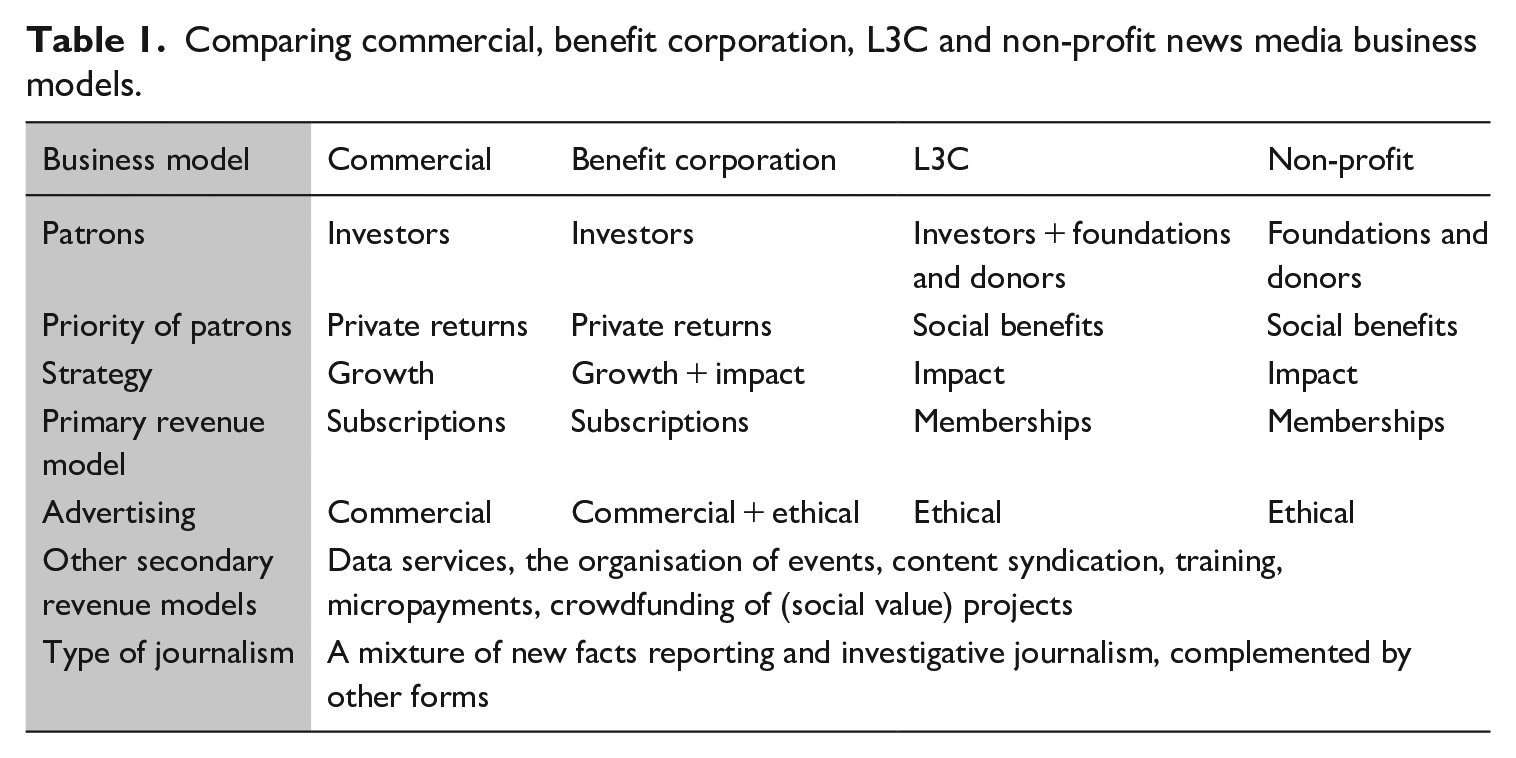
On the other hand, key elements of these business models are consequences of the legal framework: they include the patrons and the organization’s overall strategy, which is an extension of patrons’ priorities. Patrons of Benefit Corporations are private investors believing that a pro-social attitude supports economic performance, and a privately owned, for-profit organization can have a positive influence on society (Benefit Corporation, 2020). They are interested in the positive, social impact of the organization, although private returns through a growth strategy are prioritized. Applied to news organizations, this would imply the use of subscriptions for the primary revenue, and leveraging the audience’s pro-social attitude to crowdsource and/or crowdfund projects with social goals. Additionally to social impact, these projects could provide subsidized content and increase the scope and the value of the organization. This feature was adopted, for example, by the newspaper Guardian, which currently receives funding from the Bill & Melinda Gates Foundation for the entire ‘Global Development’ section (e.g. Hodal, 2021). Subsidized content should be freely accessible to maximize impact, effectively making subscriptions a freemium model. Both ethical and commercial advertising are viable options for this business model.
The main patrons of news organizations incorporated as L3C should be donors and foundations, complemented by some private investors embracing its social mission. These news media should allow free access and re-use of content in order to maximize social impact. The primary revenue model should be memberships, while paid services (e.g. access to databases, training and events) would complement and diversify the revenue model. Ethical advertising could represent an interesting opportunity for a secondary revenue model. Table 1 summarizes the characteristics of the different business models.
Comparing commercial, benefit corporation, L3C and non-profit news media business models.
A digital platform for ethical advertising
In 2015, 1,184,547 non-profit organizations produced a revenue of $2.9 trillion. About 298,440 of them with annual gross receipts of at least $50,000 submitted a detailed tax exemption form (990 or 990-EZ) (IRS, 2018, 2020a). Data from detailed forms show that the total expenses per year in promotions and advertising was almost $12 billion, on average, between 2010 and 2016 and growing to $12.8 billion in the latest period (2014–2016) (Calculations based on IRS, 2019b). For a comparison, Nisbet et al. (2018) reported that 32,422 journalism and media-related grants distributed by 6568 U.S. foundations between 2010 and 2015 totalled $1.8 billion, about $300 million a year. The latter amount corresponds to only 2.4% of the total expenses in promotion and advertising paid by the largest, non-profit organizations (i.e. the top 25%). Hence, a symbolic demand of $1 billion a year for ethical advertising provided by a digital platform is rather realistic: it would represent less than 8% of the total expenses in promotion and advertising of the category concerned, when digital advertising typically represents circa 50% of the total, as mentioned above.
Nevertheless, a potential demand does not necessarily translate into revenue. Competition and market conditions would reflect on the price and performance offered, and at such price, there might not be enough space available to use up $1 billion worth of advertising. However, the potential demand from non-profit organizations does not justify alone this platform. First, many commercial and non-commercial organizations stopped advertising with Google and YouTube because the programmatic trading algorithm leads to advertising appearing on websites of antisocial organizations or next to content that negatively reflects on the brand (Grierson et al., 2017). A digital platform for ethical advertising could guarantee that advertising subsidizes organizations promoting social values and that it is displayed next to ethical content attracting a variety of different organizations.
Second, advertising spaces offered by non-profit and hybrid news organizations bear high returns for ethical ads because of the pro-social attitude of targeted members. Particular campaigns could also be good matches for the values expressed in particular content, like an ad by an organization promoting social justice and a journalistic piece denouncing social inequalities. As long as there is a convergence of values between content and ads, advertising revenue should not distort or influence the choice of content. Furthermore, for higher returns, instead of tracking internet behaviour as commercial advertising platforms do, non-profit and hybrid news organizations could ask their members to reveal their priorities in terms of social values.
Third, thanks to ethical digital advertising, non-profit and hybrid news organizations could generate revenue while avoiding the negative consequences that commercial advertising has on their mission’s perception and on the support of members (as discussed above). Ethical advertising could have a positive effect on news brands because perceived as acts supporting other socially-driven organizations.
Conclusion
This article suggests that quality news media struggling with economic sustainability should consider adopting a hybrid business model. It also argues that potential hybrid and existing non-profit news media would benefit from a digital platform for ethical advertising, and the synergies between organizations pursuing social goals that this platform could trigger. On the one hand, news organizations would benefit from advertising revenue that would not alienate their membership but contribute to legitimize their social mission. On the other hand, organizations with social goals could promote their activities and run public-awareness campaigns by accessing a receptive audience of donors defined geographically and by values.
There are many foundations supporting non-profit news media that could leverage the creation of such a platform, as this would allow for cross-subsidizations between projects that are recipients of their funding. In fact, the most active news media donors in recent years are also supporting non-profit organizations with a variety of social missions. These include the Bill and Melinda Gates, Ford, Knight and the Open Society Foundations (see Benson, 2018). The level of expenses in promotion and advertising activities carried out by large non-profit organizations show that there is a demand for this type of service. This demand would also be higher considering that a platform for ethical advertising could have a global reach, by supporting a global network of non-profits and hybrid news organizations.
The Benefit Corporation model could be an alternative to commercial news organizations primarily dedicated to new facts reporting at the local and state level. They would engage a critical mass of local customers because of their focus and commitment to social goals relevant to their audience. The social focus could compensate for the lower value that they deliver in comparison with similar national outlets, as subscribers would pay a price that is partly also a donation. The L3C model could be an alternative to non-profit news organizations primarily dedicated to investigative journalism. This model would be particularly suitable for news organizations that are not (adequately) supported by large foundations and donations but are determined and capable of integrating paid services.
Although this article focussed on the US, non-profit news media around the world could also benefit from ethical advertising and hybrid business models. Of course, differences in regulations exist and should be considered. For example, social enterprise models similar to the L3C exist in Belgium, Italy and UK. In France, Portugal, Spain and Greece these models tend to be particular forms of cooperatives (Defourny and Nyssens, 2012). In Germany, social enterprises tend to combine non-profit and for-profit legal forms (von der Heydte, 2020). Although based in the UK, the Guardian is an example of a hybrid news organization with multiple legal forms: it is a for-profit, certified B corporation (Hazard Owen, 2020) owned by a non-profit trust (The Guardian, 2015).
The example of the Guardian also shows that the hybrid business models’ attributes outlined here are only indicative: it is a for-profit news organization displaying the features used in this article to describe a non-profit one. Hybrid organizations are social structures that are innovative because they deviate from the social rules of established categories by mixing and incorporating different institutional logics (Sparviero, 2020). They creatively adapt to different environments. Defining fixed categories and characteristics of hybrid organizations somehow clashes with their fluid essence.
Finally, at least in the US, the adoption of hybrid organizational forms for news organizations and the establishment of a digital platform for ethical advertising are unlikely to offset the loss of journalistic activity once financed by advertising revenues. Only a revision of the role of news organizations in society and the commitment to finance it with public subsidies is a comprehensive solution (Pickard, 2019). Nonetheless, subsidies to local, state or specialized news media should be used as multipliers, to allow news organizations that have grassroots support to increase their scope and the value of their services. Hence, the adoption of hybrid forms does not replace the need for subsidies; it is a complementary process for producing more organizations worth of public support.
