




Abstract
In this article, we explore the tensions and blurred boundaries between dominance and resistance in promotional contexts by critically examining the notion of ‘visibility’, a commonly used yet largely unproblematised concept within the field of promotion. More specifically, we argue that contemporary promotional industries sustain and perpetuate a post-panoptical ‘regime of visibility’ underpinned by three modalities: (1) visibility as recognition, which associates being watched with empowerment while downplaying it as surveillance; (2) visibility as transient, which stresses visibility as a scarce resource that requires continuous work; and (3) and visibility as an end-goal, that is, as an end in itself rather than means to achieve something else. Acknowledging the existence of this regime opens up avenues for a productive analysis of the coexistence and mutual constitution of dominance and resistance within promotion in the digitalised communication environment, beyond debates about ‘authenticity’ or ‘woke washing’. We note that promotional industries structure visibility as a desirable and even inevitable requirement for both reinforcing and reconfiguring social arrangements. Consequently, they foster a mirage that celebrates the actions of individuals without actually producing meaningful change, while obscuring invisibility as an equally valid strategy of resistance.
Introduction: tensions and power in promotional practices of (in)visibility
On 2 June 2020, social media timelines and feeds around the world were populated by row after row of black squares. Accounts traditionally used to promote goods and services, as well corporate and individual brands, shared instead a single black square with the hashtag #blackouttuesday. This was in solidarity with the Black Lives Matter protests that stormed the United States after George Floyd, a 46-year-old black man, was tortured and killed by a white police officer in Minneapolis. Streaming services such as Spotify, Amazon Music and Apple Music also joined the initiative, with specially curated playlists and an 8 minute 46 second moment of silence, the estimated time that the police officer knelt over Floyd’s neck until killing him. For one day only, promotional activities appeared to be halted, with individuals and corporations opting out of social media visibility to denounce structural racism in the United States and elsewhere.
In the aftermath of Blackout Tuesday, debates focussed on the supposed sincerity or cynicism driving this initiative. Although some applauded the stance taken against racism by promotional industries (Hurst, 2020), others argued that sharing black squares in digital media was no more than ‘performative activism’, ‘performative allyship’ or ‘woke-washing’, with corporations cynically drawing on social causes to increase profits (Sobande, 2020; Vredenburg et al., 2020). Yet focussing on the motives behind initiatives like Blackout Tuesday risks overlooking the wider context in which promotional practices operate. While scholars have convincingly argued that logics of branding, advertising and public relations permeate almost all sectors of contemporary society (Wernick, 1991), questions of justice and identity have also shaped the field of promotion (Khamis, 2020). Hence, an increasing number of individuals rely on promotional work to garner attention for their grievances. That was the case of the three co-founders of Black Lives Matter, who asked designers to create a logo – a visual tool often associated with promotion – to identify the movement (Bloem & Kempenaars, 2019). Boundaries between authenticity and commodification, as well as between acts of dominance and resistance, are therefore not only blurred within the realm of promotion, ‘but this blurring is more expected and tolerated’ (Banet-Weiser, 2012, p. 13 italics in the original).
We consequently argue that discussions in the field should engage more critically with how promotion reconfigures and responds to the specific political, economic and technological arrangements in which practice unfolds, without resorting to binaries or oversimplifications. More concretely, we suggest that an examination of the stated social significance of visibility, particularly of the broader arrangements underpinning and conditioning the belief that acts aimed at maintaining or disrupting power hierarchies should necessarily happen in public, 1 is needed (see Draper, 2020). Visibility, as we outline below, has become reified within promotional activities – even by individuals and organisations not directly involved in promotional industries – as an empowering and romanticised ideal, while being also celebrated as a form of labour and source of profit (Abidin, 2016; Banet-Weiser, 2018; Duffy & Hund, 2019).
In this article, we add to these critiques by stressing that visibility is neither neutral nor spontaneous. Instead, drawing on recent works aiming to problematise it (Brighenti, 2010b; Flyverbom, 2019; Lyon, 2016; Magalhães & Yu, 2022), we hold that visibility is structured and disciplined to favour specific ways of seeing and showing, particularly in the current digitalised communication environment. More specifically, we hold that promotional industries and promotional work foster a promotional regime of visibility, that is, a way of constructing the ‘realm of seeable and sayable’ (Bucher, 2018, pp. 82–83), to encourage individuals and organisations to engage in promotional activity that may sustain or reconfigure power relations in public. This promotional regime of visibility is underpinned by three interrelated modalities: (1) visibility as recognition, which associates being watched with empowerment while downplaying it as surveillance; (2) visibility as transient, which stresses visibility as a scarce resource that requires continuous work; and (3) and visibility as an end-goal, that is, as an end in itself rather than as a means to achieve something else.
As we outline below, acknowledging the existence of the promotional regime of visibility opens up new avenues for a productive analysis of the coexistence and mutual constitution of dominance and resistance within promotion, beyond debates about ‘authenticity’ or ‘woke washing’. Promotional industries foster this regime to posit visibility as a desirable – even inevitable – asset for reinforcing and reconfiguring social arrangements, yet one that is nonetheless fragile and fleeting. This in turn legitimises promotional work itself, perpetuating its existence as the locus of expertise for both securing and managing visibility. The regime consequently highlights that there is nothing natural or inevitable about visibility. By emphasising the supposed necessity of visibility, the promotional industries normalise the use of visibility as a strategic tool to perpetuate existing power arrangements; at the same time, we argue, the regime fosters a mirage of social justice that celebrates the actions of individuals, rarely produces meaningful change, and obscures invisibility as an equally valid strategy of resistance.
Visibility as strategic but uncontrollable processes
Visibility is a common term in promotional scholarship, with academics and practitioners positing it as one of the main aims guiding promotion, an asset that underpins and shapes contemporary digitalised practice, as well as a reward acquired by those who secure attention from desirable audiences, especially the media (e.g., Aronczyk et al., 2017; Banet-Weiser, 2018; Bishop, 2019; Draper, 2020; Duffy & Hund, 2019; Kanai & Gill, 2020; Savolainen et al., 2022; Sobande, 2019). Visibility has also been described as a form of labour and potential source of profit, particularly in the case of celebrities and influencers trying to capture gazes towards themselves as well as the goods and services they are associated with (Abidin, 2016). Beyond the world of celebrity, the self-branding industry promises rewards for individuals who publicly communicate authenticity, self-reflexivity and values such as entrepreneurialism and individualism that resonate with markets, particularly labour markets (Whitmer, 2019). Reputational risk is therefore secondary to preserving visibility. As Whitmer (2019) notes, ‘In a context in which building a reputation is necessary to remaining relevant, self-promotion is non-negotiable’ (p. 6). Thus, as Duffy and Hund (2019) argue, ‘[v]isibility is a resonant, even romanticized, ideal of the social media age, one championed by marketers, exhorted by entrepreneurs, and peddled by the mouthpieces of Silicon Valley platforms’ (p. 4996).
Similarly, scholars in social movements and activism have observed that communicative efforts aimed at challenging dominant social arrangements are underpinned by a belief that acquiring, maintaining and/or managing visibility is indispensable (Jiménez-Martínez, 2021; Neumayer & Rossi, 2018; Uldam, 2018). Hence, and despite their differences, individuals and organisations behind acts of dominance and resistance coincide on drawing on the logics of an ‘attention economy’ (Davenport & Beck, 2001), engaging in practices that capture, sustain or distract specific gazes and glances from events, individuals or organisations. As Brighenti (2007) notes, ‘[a]dvertisement is an activity that consists in producing high-visibility objects [. . .] not so much at making you buy something, but rather at having you looking at certain things rather than others’ (p. 333). Activists in turn practise ‘antagonistic politics through visibility’, campaigning ‘for the visibility of their own topics of choice’ (Brighenti, 2010b, pp. 99–100).
Many academics, promotional workers and activists consequently perceive and promote visibility strategies as a central component for the maintenance, subversion and reconfiguration of power relations. Without visibility, the argument goes, people, locations, products and events do not exist in a meaningful way (Dayan, 2013; Thompson, 2020). Notwithstanding this ubiquity, visibility has attracted limited attention in its own right. Scholars and practitioners in promotion have largely unproblematised and under-theorised it, portraying it as something that simply ‘happens’. Moreover, studies mentioning visibility may fail to situate themselves as part of broader debates, lacking consistent frameworks and treating visibility ‘in its own terms, as a local concept’ (Brighenti, 2007, p. 325). Recent scholarship in sociology, media studies, surveillance, organisational studies and other fields has nonetheless tried to course-correct. 2 Various authors—most notably Italian sociologist Andrea Brighenti—have attempted to establish visibility as a specific sociological category, differentiating it from related phenomena such as visuality and transparency, and stressing it as a political, aesthetic, and technological field where power is produced and contested through ‘perceptual forms of noticing, managing attention and determining the significance of events and subjects’ (Brighenti, 2010a, p. 52; see also Flyverbom, 2019; Lyon, 2016; Magalhães & Yu, 2022; Thompson, 2005, 2020; Voirol, 2005). Visibility, as stressed by these scholars, refers to a series of processes aiming to make or prevent something or someone becoming public and knowable, to organise and govern social matters. 3
As noted in recent discussions, the processes that underpin visibility have three main characteristics. First, they are relational, requiring at least two actors between which frictional power relations are established. Second, they are strategic, because actors attempt to manage visibility to achieve particular goals. Third, they are uncontrollable, because the desired effects of visibility cannot be determined in advance (Brighenti, 2010b; Bucher, 2018; Thompson, 2005; Voirol, 2005). They are also highly contingent, because they depend on temporarily and spatially situated technical, political and economic arrangements, which can also encompass specific modalities of visibility such as surveillance, recognition, transparency, secrecy or opacity (Brighenti, 2010b; Bucher, 2018; Flyverbom, 2019; Magalhães & Yu, 2022).
Visibility processes therefore involve concretely situated agency and strategy with the aim of directing an audience’s gaze towards objects, individuals or ideas to make them knowable or unknowable; determining what is appropriate and possible to see; and synchronising attention (Brighenti, 2010b; Thompson, 2020; Voirol, 2005). Yet the impossibility of controlling these processes means that visibility has to be managed (Dayan, 2013; Flyverbom, 2019). Such management has become the domain of promotional industries (Aronczyk et al., 2017; Draper, 2020), which measure visibility according to metrics evaluating ‘eyeballs’, loyalty, engagement and affect (Watson & Noble, 2014). Visibility management is consequently a fundamental driver for promotion in the service of domination and resistance, motivated by promises of stability, novelty and/or social change realised through sustained attention, desirable interpretations, sales, brand loyalty and/or political recognition.
Although visibility is implicated in the struggles over power obtained via promotion, not all actors have the same access to material and symbolic resources, and they are rarely equally visible to each other, recognised as equal participants in markets, or equal citizens in the political sphere. As Brighenti (2007) notes, ‘asymmetries and distortions of visibility are the norm, vis-à-vis the exception of perfect intervisibility’ (p. 326; see also Magalhães & Yu, 2022; Thompson, 2020). Moreover, there is not a linear relationship between modalities of visibility – or invisibility – and empowerment or disempowerment, given that their potential outcomes are uncertain and ambiguous. Discourses that posit corporate transparency as ‘good’ overlook its capacity to produce opacity and control (Flyverbom, 2019); claims that social recognition is a necessity for resistance gloss over the fact that authorities can make dissent hypervisible by highlighting it as radical, irrational and unreasonable (Cammaerts, 2015); being the focus of too much attention may bring paralysis and vulnerability rather than recognition to those observed (Duffy & Hund, 2019); and tools employed to measure visibility – such as number of views, clicks and likes on social media – are not neutral, but predominantly favour white, cis-gendered and heterosexual gazes (Banet-Weiser, 2018; Iqani & Baro, 2017). Acquiring visibility therefore consists not simply of being seen, but actually being seen on specific terms: reaching the ‘correct’ visibility, one that will deliver desired outcomes, is what matters (Dayan, 2013, p. 143).
The promotional regime of visibility: recognition, transience and end-goal
Because of the contingent and strategic nature of visibility, scholars have noted that individuals and organisations engage in struggles that reinforce or reconfigure specific ‘regimes of visibility’. These regimes concur ‘in the definition and management of power, representations, public opinion, conflict and social control’ (Brighenti, 2010b, p. 126), synchronising attention, as well as rewarding and punishing what is appropriate and possible to show and see, know and govern (Bucher, 2018; Magalhães & Yu, 2022; Martin-Barbero, 2009; Ranciere, 2004; Thompson, 2005). In other words, human interactions are routinely and normatively organised around manufactured, and potentially shifting, patterns of showing and seeing that naturalise or discourage ways of acting, and which are structured and manifested through political, aesthetic, financial and technological arrangements. As Bucher (2018) notes, ‘the realm of the seeable and sayable is constructed to make a particular regime of visibility appear’ (pp. 82–83, our emphasis).
Foucault, for instance, famously noted that past societies were based on a ‘culture’ or regime of spectacle, in which the impressive visibility of a few – such as the sovereign – was used to exercise power over the invisible many, while in the 16th century a different type of regime based on surveillance emerged. Here, the many were continuously observed by the normalised and invisible gaze of a few, as in the oft-cited example of the Panopticon (Foucault, 1979). Later on, in the 20th century, visibility became structured around media technologies and media organisations, which gave shape to a predominantly synoptic regime in which again the invisible many – the ‘mass’ – were seeing the few, such as politicians, celebrities or criminals (Mathiesen, 1997). 4 Synoptic regimes are, however, uneven in their topography, and within the ‘mass’ some groups continued (and continue) to be vulnerable to surveillance, as their social categorisation (for example, as racialised individuals, or migrant workers) constructs them as ‘other’, suspect or threatening to dominant interests and in need of constraint (e.g., Browne, 2015; Pallister-Wilkins, 2022; Wallace, 2018) – sometimes with fatal results. Thus, surveillance and synoptic regimes of visibility may co-exist, where individuals have to manage the tensions these create in their day-to-day lives.
The growth of the media as central to contemporary regimes of visibility has disentangled visibility from the here and now, enabling people to see distant times and locations and constructing ‘gazes’ that can synchronise geographically dispersed audiences (Dayan, 2013; Thompson, 2005; Voirol, 2005). Although situated visibility has continued to exist, visibility has become increasingly associated with appearing or ‘trending’ on the media (Banet-Weiser, 2018, p. 24), and failure to do so may be perceived as a ‘death by neglect’ (Thompson, 2005, p. 49). Actors managing their own visibility – or the visibility of others – therefore engage in continuous struggles to achieve it in and through the media.
With the development of digital technologies, specifically networks and platforms, scholars have engaged in discussions concerning the characteristics and associated struggles of newer regimes of visibility that have emerged (Brighenti, 2010b; Bucher, 2018; Flyverbom, 2019; Lyon, 2016; Magalhães & Yu, 2022; Thompson, 2020). Some of these discussions have noted that, while panoptic and synoptic features remain, visibility has taken a predominantly post-panoptical character: instead of the central gaze of the state, actors such as corporations, media organisations and other individuals are also watchers; surveillance has taken the form of collecting data generated by individuals rather than overt observation of masses; eyes looking at us – often those of platforms – aim to predict future behaviours rather than simply categorise current ones; gathered information is employed not only for security but also for commercial purposes; audiences are increasingly profiled and approached as commodities themselves; and crucially, there is an unprecedented level of voluntary exposure and exhibitionism in the form of ‘sharing’ or ‘connecting’ (Bolin & Jerslev, 2018; Flyverbom, 2022; Haggerty & Ericson, 2000; Lyon, 2016).
One of these post-panoptical regimes is what we call the promotional regime of visibility. This promotional regime underpins but is also perpetuated by promotional work, and posits visibility as a desirable, required and ultimately inevitable aim required to accomplish personal, political and financial achievements (Dayan, 2013; Duffy & Chan, 2019). Moreover, it is structured around three overlapping modalities, which we discuss in more detail below: (1) visibility as recognition, (2) visibility as transient, and (3) visibility as an end-goal. The modalities are not purely an outcome of specific communication technologies. They have ideological effects on the behaviour and strategies of individuals and organisations, as well as on the maintenance of contemporary promotional practice, by normalising specific understandings about what is possible, appropriate and advantageous to show and see. Acknowledging the existence of this regime opens up avenues of analysis to explore how dominance and resistance are constituted within promotion in the digitalised communication environment, shedding light on both outside structures as well as inside dynamics (following Flyverbom, 2022), which can be found even among individuals and organisations that claim to be outside or against the realm of promotion.
Visibility as recognition: being watched as empowerment
The first modality stresses exposure and the act of being seen as a source of recognition. It is underpinned by the fact that developments in communication technologies have unsettled previous concentrations of symbolic power, enabling a greater number of people to distribute visual, aural and textual forms to direct attention to – or conceal – particular representations (Thompson, 2020). Digital media are consequently presumed as tools and institutions that individuals and organisations employ to synchronise collective attention, with visibility becoming ‘a right frequently and sometimes violently claimed’ (Dayan, 2013, p. 139) rather than a privilege of those in power.
From this perspective, and echoing Arendt, Honneth and Fraser, lacking visibility results in the deprivation of social, political or economic rewards (Brighenti, 2010b; Dayan, 2013; Thompson, 2020). Struggles for recognition by minorities, indigenous peoples, women and economically precarious populations are thus frequently focussed on securing the discursive visibility they require to strengthen their claims to redistribution (Dutta & Elers, 2020). 5 Significantly, promotional industries exploit this perception. Branding, public relations and advertising practitioners often cite visibility as a source of empowerment that reconfigures oppression and marginalisation into aspiration and recognition (Banet-Weiser, 2018; Gray, 2013; Kanai & Gill, 2020), encouraging individuals to produce content that can be looked at and shared through digital platforms to (allegedly) raise awareness about social causes, forge connections, increase personal status and generate profit, among other benefits (Whitmer, 2021; Zulli, 2018).
However, stressing visibility as recognition underplays the fact that it is continuously employed as a weapon of surveillance, particularly in today’s promotional landscape. Foucault (1979) famously states that visibility is ‘a trap’ (p. 200) when arguing that being seen is not so much a matter of recognition, but a way of being subject to forms of discipline by invisible authorities, such as the state or, more recently, private corporations (Uldam, 2018). Doorways to visibility – that is, to supposed recognition, understanding and representation – can simultaneously subject individuals and marginalised groups to punishing gazes to protect dominant social arrangements (Cammaerts, 2015; Gossett et al., 2017, p. xxiii). Feminist media organisations, for instance, employ digital technologies to promote their politics more directly, yet this exposes them and their clients to trolling and gaslighting (Edwards et al., 2020). Similarly, social media influencers base their labour on creating and sustaining media visibility, yet once they reach it, they are pressured – sometimes aggressively – to act in specific ways by the very same gazes they were originally seeking (Duffy & Hund, 2019; Whitmer, 2021).
Being visible also subjects individuals to tracking and data harvesting (Neumayer et al., 2021; Uldam, 2018), with visibility employed to control rather than empower them (Brighenti, 2010b; Gray, 2013). Actors who are locatable and can therefore be made visible are more likely to become subjects of surveillance. For example, surveillance of racialised communities and individuals is a long-established tool for their exploitation and continues as a mechanism of border management in contemporary migration controls (Browne, 2015; Chouliaraki & Georgiou, 2022). Being visible to resist power constitutes both risk and opportunity in such circumstances. In contrast, institutions and organisations such as the state or corporations, which govern the structures underpinning dominant regimes of visibility, are less visible producers and users of surveillance (Flyverbom, 2019; Magalhães & Yu, 2022). Their position is enhanced by corporate discourses that depoliticise surveillance, justifying it as a way to deliver better information, products or services to precisely targeted audiences (Christl, 2017; Uldam, 2018). However, such strategies are potentially vulnerable because surveillance is not an exclusive prerogative of those in power: social movements surveil too, for example, when denouncing police brutality (Cammaerts, 2018), or when accusing corporations of being silent on social issues, or merely ‘woke-washing’ (Sobande, 2019). Moreover, when practices of surveillance by dominant groups themselves become visible, they can be countered and undermined in the pursuit of justice. Browne (2015), for instance, highlights the ways in which slave communities resisted anti-Black surveillance by disrupting it through counter-surveillance communicated via cultural forms such as song, dance, and trickery, allowing some to escape and secure their freedom.
The promotional regime of visibility is consequently underpinned by continuous tensions between the promise of being rewarded with recognition and profit, and the fear of greater covert and overt datafication as well as loss of privacy. Nonetheless, and despite the potential of reciprocal gazes, authorities and promotional industries frame the solution to the tension between recognition and surveillance as a predominantly individual affair. Regulations such as the GDPR in Europe, for instance, have made surveillance more visible, yet each individual is responsible for configuring – at least nominally – how they prefer to be monitored. Visits to a new website are often accompanied by long lists of privacy settings as well as ‘agreements’ stating how corporations and marketing professionals will use personal data, yet they are written in such technical jargon that they obscure rather than illuminate the extent and purpose of such surveillance (Flyverbom, 2019; Magalhães & Yu, 2022). People are therefore offered an illusion of control, encouraging them to nominally manage their visibility but without substantially altering the power dynamics that underpin it.
Visibility as transient: being watched as a scarce resource
The second modality is transience: visibility is stressed as a scarce resource, impossible to fix and constantly in transition. As Bucher (2018) notes, earlier disciplinary societies were governed by a ‘threat of visibility’, with each individual potentially subjected to the same centralised gaze, as in the case of the Panopticon. Yet, the post-panoptic algorithmic structures of social media make contemporary visibility much more unstable. Digital communication technologies are designed to make visibility unequal, with timelines and feeds arranged to show only what the algorithm determines is of most interest (Bucher, 2018; Cotter, 2019). And while they promote visibility, algorithms themselves are invisible, reflecting the role of the media in making ‘the structures of such visibility invisible’ (Brighenti, 2010b, p. 77; see also Flyverbom, 2019).
These arrangements, and the greater number of individuals and organisations producing content (Dayan, 2013), posit visibility as a scarce resource. Contrary to promises of universality and voice, digital communication technologies have been designed in ways that ensure that access to visibility is predominantly controlled by private corporations, imposing limits about what can be shown and seen (Bucher, 2018; Neumayer et al., 2021), and encouraging fleeting glances rather than permanent gazes, as in platforms such as Instagram, TikTok or Snapchat (Zulli, 2018). Martin-Barbero makes this point when noting that, although digital technologies have apparently facilitated access to visibility, their ‘levity, speed and mobility make disappear what we wanted to make visible’ (2009, 32:30).
In the same manner that recognition positively depicts visibility, transience frames visibility as a reward to which people should aspire, rather than as a threat (Bucher, 2018). This is fostered and exploited by the promotional industries, which push for the ongoing (re)invention of distinction to mitigate the risk of invisibility, obsolescence and declining profits that can accompany familiarity (Gray, 2013; Kanai & Gill, 2020). As Brighenti (2010b) notes, ‘the normal is neither noticed nor thematised’, and only the ‘out of the ordinary’ attracts attention (p. 25). Yet, despite this ephemerality, visual, textual and aural forms can leave traces. Brands such as PanAm or Brim coffee remain alive as ‘zombies’, even after the goods they originally promoted have disappeared (Powers & Pattwell, 2015), and temporally limited offline events can be given new life through repeated circulation of images and videos online. These possibilities of persistence open up transience as a target for activists seeking to exploit visibility as resistance and mean that those that have profited from being visible may ‘find themselves suddenly haunted by visibility’ (Brighenti, 2007, p. 335), in ways that undermine their power, their pursuit of capital, and force them to respond to criticism. For example, the use of cancelling by ‘othered’ communities online (e.g., #Black Twitter) continues a long history of calling out unacceptable elite behaviour by marginalised communities (Clark, 2020). For brands, such calling out remains a constant threat, as L’Oreal discovered when they faced a backlash for joining Blackout Tuesday, after it emerged that 3 years earlier they had fired transgender model Munroe Bergdorf when she spoke out against racism. In a related example, the circulation of anti-brutality videos and messages on Twitter by communities of Black Lives Matter activists, maintained their visibility over time and was found to prompt media coverage to which elite audiences were more likely to respond (Freelon et al., 2018). In a different context, campaigns such as Greenpeace’s ‘Let’s Go! Arctic’ (Davis et al., 2016) aim to ensure that forms of haunting or ‘maddened’ visibility (Brighenti, 2007, p. 335) continue to trouble organisations such as Shell, by maintaining a permanent potential for disruption based on their reputation as an environmentally damaging organisation. In this way, activists of all kinds resist visibility’s transience, continuously reactivating narratives and events that recall problematic associations and produce ‘maddening’ visibility for dominant actors.
Transience reveals visibility to be a fleeting reward that can easily be withdrawn or compromised and therefore requires continuous work. Social media influencers, for instance, whose highly precarious careers are constructed not only by acquiring but also by maintaining visibility, try to decipher and ‘game’ an invisible algorithm, seeking ways to produce content that may sustain the attention of specific gazes (Cotter, 2019). Their visibility depends on disciplining themselves to develop content that fits with ever-changing rules and expectations, rather than showing what they want. Similarly, ‘brand activism’, ‘corporate political activity’ or ‘corporate activism’ highlight social causes already embraced by intended consumers, such as feminism, anti-racism or environmental protection, instead of advocating for more controversial or radical issues (Sobande, 2019).
The transience of visibility in promotional work ensures that, despite an increasing facility to create visual, aural and textual contents, and a potential for broader geographical circulation, decisions about what should be visible depend on pre-determined norms about what will attract the attention of different audiences, and for how long (Gray, 2013). This brings us to our final modality: the pursuit of visibility as an end-goal.
Visibility as an end-goal: being watched as an end in itself
The third modality of the promotional regime of visibility relates to how visibility is approached as an end in itself rather than as means to achieve something else. As Banet-Weiser (2018) observes, individual and corporate behaviours have increasingly been structured within economies of visibility, ‘so that visibility becomes the end rather than a means to an end’ (p. 23, italics in the original). In other words, the goal is simply being noticed, rather than being noticed to produce meaningful change. The significance of economies of visibility is evidenced, for instance, by the greater number of individuals attempting to become social media influencers, constructing a career based fundamentally on being noticed (Abidin, 2016; Whitmer, 2021). Economies of visibility can also be found at the core of Blackout Tuesday, whose ultimate aim was showing support for a cause, rather than effectively tackling or challenging systemic racism (Sobande, 2020). A particularly worrying development is that economies of visibility have also permeated those trying to reconfigure social arrangements. Many NGOs, social movements and initiatives such as subvertising have become more concerned with the short-term goal of being socially noticed, often justifying it as a way of raising awareness, rather than accomplishing longer-term structural changes (Cammaerts, 2018; Lekakis, 2020).
The modality of visibility as an end-goal is partly underpinned by technical and commercial infrastructures. Social media metrics examining clicks, likes, shares or eyeballs are employed to evaluate the success or failure of communicative efforts and ultimately exchange them for profit (Abidin, 2016; Duffy & Hund, 2019). Visibility is consequently structured to emphasise individualism rather than collective politics, depicting people as consumers or precarious entrepreneurs who are solely responsible for their own well-being. Instead of persuading people to take part in political projects, current arrangements encourage bodies, goods, races, nations or dissent to be traded as marketable products (Banet-Weiser, 2018; Gray, 2013; Whitmer, 2021). These transactions appear to be neutral, yet they are skewed to favour the preferences of male, cisgender, heterosexual, white and Anglo-Western European gazes and are underpinned by the need to generate (invisible) data and economic surplus from the visible traces that individuals leave behind when using communication technologies (Neumayer et al., 2021). Consequently, ‘visibility becomes a supply and demand market’, leading to the question ‘of what is worth being seen at which price’ (Brighenti, 2007, p. 327).
Measures of visibility as an end-goal are productive not only for the pursuit and reproduction of capital. They also act as stand-ins for political participation, which, through a focus on the individual, exploit ideas of personal change, difference and transformation while perpetuating dominant social arrangements (Gray, 2013; Sobande, 2019). Pre-existing asymmetries are emphasised and profited from, domesticating resistance into ‘acceptable’ formats. Challenges to the status quo are not silenced but encouraged as long as they become visible in the form of a t-shirt, likes and shares, black squares or statements claiming to increase awareness, as in Nike’s recent call to ‘Believe in something. Even if it means sacrificing everything’ (Banet-Weiser, 2018; Dauvergne, 2017; Kanai & Gill, 2020). The modality of visibility as an end-goal therefore empties resistance of social or political nuance, remaining ‘void of anything but the message to resist’ (Gulbrandsen et al., 2020, p. 17).
Concluding discussion: making the promotional regime of visibility appear
As outlined in the previous discussion, the promotional regime of visibility posits the latter as an indispensable and inevitable requirement to foster both dominance and resistance. The regime encourages individuals and organisations to capture, sustain or distract gazes and glances to secure attention for specific types of social order. The regime, however, constructs visibility as a universally desirable asset that is fragile and fleeting, and which must be managed at all times (Dayan, 2013; Flyverbom, 2019; Thompson, 2005). Such management directly benefits promotional industries, because they claim to provide the knowledge and expertise that can help different actors manage their visibility to achieve their objectives, including social recognition, political legitimacy or material benefits (Aronczyk et al., 2017; Draper, 2020).
Visibility is therefore not something that spontaneously ‘happens’, but it is structured and disciplined to favour specific ways of seeing and showing. We identified three modalities that underpin this specific regime: (1) visibility as recognition, which associates being watched with empowerment while downplaying it as surveillance; (2) visibility as transient, which stresses visibility as a scarce resource that requires continuous work; and (3) visibility as an end-goal, that is, as an end in itself rather than means to achieve something else (Figure 1).
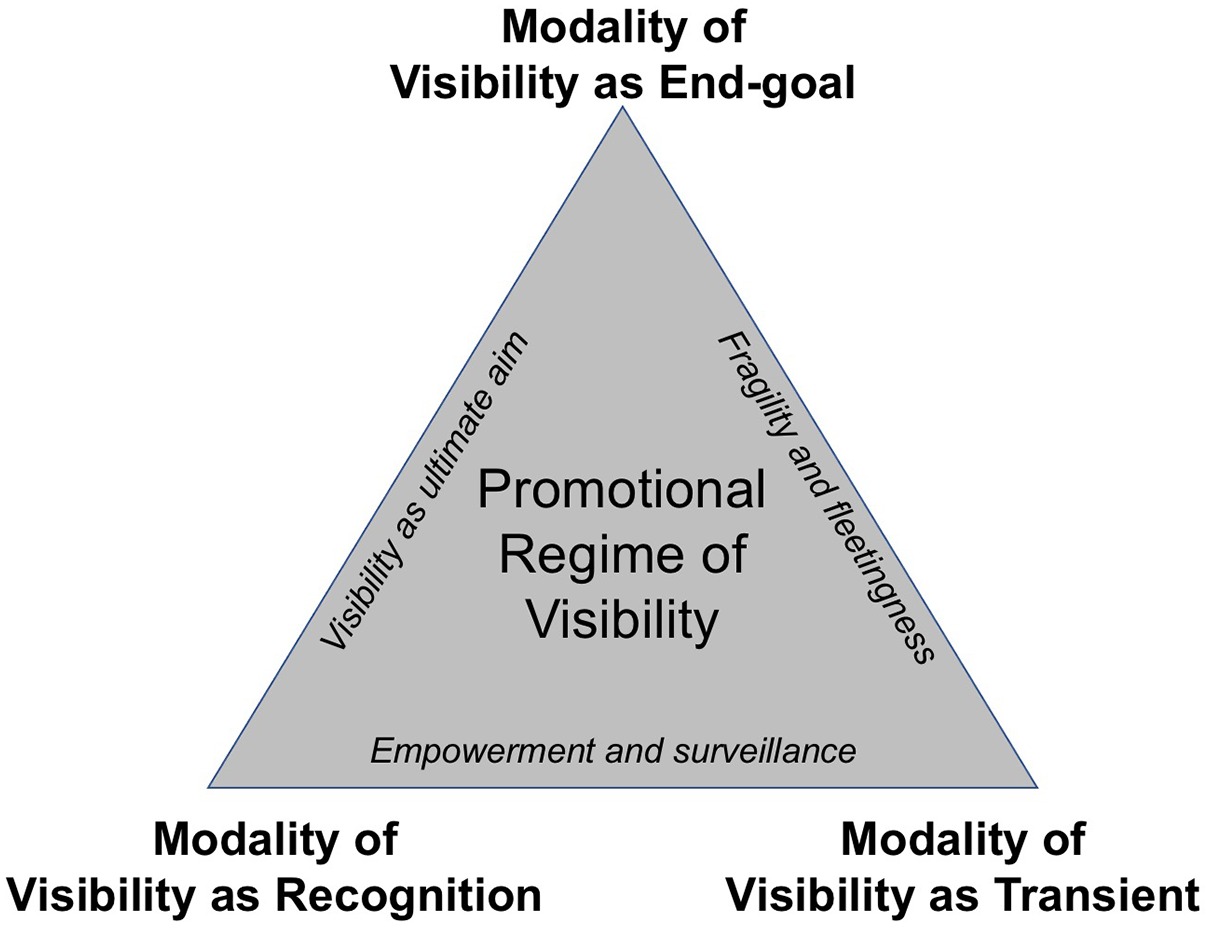
The promotional regime of visibility.
The three modalities exist in tension and entanglement with each other, underpinning the ways in which dominance and resistance emerge through promotional work. For example, Recognition associates visibility with different kinds of empowerment. For marginalised groups, it generates attention and potentially a higher social status, even on a global scale. For corporations, it may mean higher profits, greater social legitimacy and more robust customer loyalty. In both cases, however, visibility also invites surveillance, including police monitoring of online and offline activity, silencing campaigns, or demands for greater transparency in business practices. At the same time, transience incentivises the constant pursuit of an endlessly fleeting and fragile visibility, with promotional work trying – not always successfully – to control what is seen, by whom, where, and for how long, even as surveillance demands increasing organisational openness. Micromanaging visibility in this way runs the risk of reinforcing it as an end-goal, positing communicative actions as the ultimate aim, instead of political or social change in the form of redistribution of power or material resources. None of the modalities operates independently of the others; their interactions shape the unfolding of promotional practice over time, but they do it in such a way that the promotional regime of visibility itself remains fundamentally uncontested and hidden.
By making the promotional regime of visibility appear, we can shed light on how visibility is produced, reproduced, contested and reconfigured in and through contingent and specific arrangements of promotional work. Following previous promotional scholarship (e.g., Banet-Weiser & Mukherjee, 2012; Dauvergne & LeBaron, 2014; de Bakker et al., 2013), we note that dominance and resistance become mutually dependent forces within promotion, connected by the belief that the maintenance, negotiation or contestation of power relations should necessarily happen in public. This allows public relations, branding and marketing practitioners to serve both dominant and disruptive actors, adjusting to the ways in which power struggles evolve in response to their work, and giving the impression that promotional industries can be equally employed to sell shoes or defeat racism – sometimes at the same time (Adi, 2019; Bloem & Kempenaars, 2019). Even if those in positions of power have more resources for establishing and sustaining visibility under their own terms, they require the help of promotional experts who point out that visibility is fragile and continuously subject to questioning or attack. In this way, promotion becomes constitutive of dominance and resistance, simultaneously present in decisions about how to protect value and manage risk, control instability, but also assert rights, challenge hegemony and centre the marginalised.
By deconstructing this specific regime, we can open up new research avenues for critiquing contemporary forms of visibility. Rather than purely focussing on what is seen or hidden, questions can instead focus on the political, economic and technical arrangements structuring and perpetuating contemporary forms of visibility (see Flyverbom, 2022). Visibility is thereby prevented from being ‘post-hegemonic’ in the sense that Cammaerts (2015) argues happens with neoliberalism: a totality that is beyond critique, an inescapable necessity of contemporary societies. On the contrary, acknowledging that visibility is neither natural nor inevitable demonstrates that resistance can take the form of opting-out of the ‘visibility mandate’ (Duffy & Hund, 2019, p. 4984), for instance, by avoiding social recognition and representation in the media. This insight helps to explain why environmental activists have purportedly employed invisibility as a tactic to circumvent authorities (Lester & Hutchins, 2012), and why organisations on the radical left wary of the corporatisation of digital platforms have opted for digital opacity (Morgans, 2018) – actions that make no sense if visibility is reified. Examples like these highlight the contingent nature of visibility and throw into sharp relief the value of secrecy, anonymity, disconnection and other forms of invisibility as political tools, in what can be termed, reversing Haggerty and Ericson’s (2000) observation, ‘the reappearance of disappearance’.
The promotional regime of visibility invites us to critically engage with contemporary assumptions that without visibility, neither dominance nor resistance are possible. On the contrary, as Foucault (1979) famously stated, power can be exercised through invisibility. Echoing Fraser’s (2013) and Butler’s (2016) discussion on recognition, a more critical approach pushes us to challenge the belief that visibility is an inevitable requirement for action and that people necessarily benefit from it. Although making social injustices visible may lead to their public condemnation, such awareness does not necessarily result in tangible changes, as campaigns exposing the environmental damage and human exploitation committed by global brands such as Coca-Cola, Nike or Nestlé demonstrate (Dauvergne, 2017; Flyverbom, 2019). Furthermore, visibility may damage the very same individuals it supposedly seeks to empower, as when the visibility of trans people is exploited to advance hegemonic agendas and ultimately weaken resistance (Gossett et al., 2017). As Silverstone (2007) notes, ‘visibility is only just the beginning’ (p. 26).
Visibility can consequently be managed and weaponised in ambivalent and contradictory ways, as an instrument to support and strengthen dominant power structures, as well as a tool for resistance and disruption of these arrangements. In the case of Blackout Tuesday, the visibility of George Floyd’s murder pushed powerful corporate actors to a suspension of visibility that can be interpreted as an attempt to shore up organisational legitimacy by distancing themselves from the structural inequalities to which they may contribute, such as low wages and precarious employment. At the same time, this suspension of visibility was the outcome of demands by activists and consumers, with the latter calling for boycotts of brands and corporations when these remain silent on social causes (Lekakis, 2020; Sobande, 2019; Vredenburg et al., 2020).
Celebratory and critical reactions to this and similar episodes demonstrate the complex ways in which visibility is strategically used as a tool in struggles for social justice. We agree that the motivations of individuals and organisations claiming to encourage social change through promotional acts should continue to be scrutinised. Nonetheless, we also suggest that the promotional regime of visibility shows that it is equally important to question the terms on which visibility is promoted as desirable and necessary to sustain or challenge power relations, and why; to ask who benefits from those terms; and to interrogate whose visibility is fostered while others remain hidden. Attention should be paid not only to what is shown or concealed, but also to the ways in which technologies, vested interests and hierarchical arrangements are shaped by the modalities of recognition, transience and end-goal, thereby perpetuating a regime of visibility that encourages exposure and exhibitionism as a necessity for knowing and governing actors, forms and objects, while obscuring invisibility, disconnection and secrecy as alternative paths for resistance and change.
Footnotes
Acknowledgements
The authors would like to thank Simon Cottle, Melissa Aronczyk, Eleftheria Lekakis, Bart Cammaerts, Francesca Sobande, Michael Skey and João Carlos Magalhães for their valuable comments on earlier drafts of this article. They would also like to thank the editors and anonymous reviewers for their comments, which substantially improved the manuscript.
