




Abstract
In the age of Artificial Intelligence (AI), the goalposts for how we judge creative work are changing. New tools, new collaborators and new creative processes are transforming the way we make, look at and talk about the value of creative work. This shift is widely discussed in Western scholarship. However, there are certain voices still missing from this discussion. These are the voices of the Global Majority, or the Next Billion Users. The perspectives and values found in global digital cultures represent a massive user base of designers, AI ethicists, cultural changemakers, artists, creatives and users whose contribution to this debate could very well represent the next paradigmatic shift in how we approach creativity. Global AI cultures demand our attention. Going forward, media scholars need to diversify and decolonialise approaches to digital creative labour in the Age of AI by drawing attention to the values and creative practices of global digital cultures. This article is structured around six strategic concepts: Recognition, Resituate, Remix, Resistance, Regenerate/Repair and Reimagine. We propose this framework to decenter universality and problematise normativity. These concepts are meant to provoke new associations and patterns of thought, moving us away from pre-conceived notions of what creativity is to adopt new, equitable and diversified notions of creative work.
Keywords
Introduction
The introduction of generative AI tools has changed the fundamental landscape of the creative industries worldwide. As Western firms have adapted their policies and increasingly handed over the reins to AI-enabled software, they have caused outrage and strikes even at the heart of the film industry, in Hollywood. In 2023, actors, writers and screenwriters went on a 5-month strike to protest, in part, the use of AI technology in film and television projects (Anguiano and Beckett, 2023). The second-longest strike in Hollywood history cost the Californian economy 6.5 billion USD and brought a bubbling issue in the creative industries to the forefront (Patten, 2023). Meanwhile, as the appetite for more and better AI software is growing in the West, a greater need for human labour to train these models is emerging and having its own devastating effects in the Global South. In Kenya, U.S. companies are outsourcing jobs to a large employment-seeking population, promoting AI jobs as the future. However, the gruelling work of sifting, categorising and labelling large mountains of often dangerous and triggering content is having nefarious effects, with many employees developing severe mental health side effects, all while being paid as little as 2 USD per hour (Stahl et al., 2024). Across the world, the effects of generative tools are putting workers under pressure. It is a matter requiring the urgent attention of media scholars. How we define and speak about the issue from now on will influence our discipline’s perspective on the value of creativity as capital or labour (Lee, 2022). However, it is not enough to theorise on the role of AI in changing creativity from the WEIRD (Western Educated Industrialized Rich and Democratic) point of view, it must also encompass the values and creative practices of global digital cultures (Arora, 2024a; Qadri et al., 2024).
The Global South represents the internet’s majority user base, and their participation in the data economy is starting to be reckoned with (Dal Yong, 2021; Jaramillo-Dent et al., 2022; Mehta, 2019). However, they are faced with a range of challenges, ranging from geopolitical, infrastructural, accessibility- and censorship-based (Poell, 2014), the issue of bias and misrepresentation (Katzman et al., 2023), all while their labour is poorly valued, which is why outsourcing to countries like Kenya is a common practice amongst U.S. firms. As AI-enabled technology threatens to reproduce representational harms and further entrench data colonialism into the global data economy (Ghosh et al., 2024; Kotliar, 2020), turning to digital cultures in the Global South represents an opportunity to better valorise their labour and change the narrative about Global South users as not just data points but valuable voices in this conversation. The creative digital cultures of the Global South and their participation in the platformised creator economy particularly show us that creative work happens everywhere, and deserves to be contextualised. For example, for Indian content creators in semi-urban regions, social media platforms are a way into the global conversation (Herman and Arora, 2023) or a place for education (Bhatia et al., 2023). We focus here on the constraints global digital cultures face in the Age of AI to be able to address the challenges and mitigate them to enable freedoms of invisibility and safety for those most likely to be harmed. However, we also look at why creative practices in global digital culture could be a source of inspiration when it comes to the future of the internet. Users in the Global South engage in social media platforms critically. They are pragmatic about their affordances and constraints but move ahead as the benefits outweigh the harms (Arora, 2024a). We can learn from these approaches new modes of relationality (Reviglio and Alunge, 2020), new definitions around collaboration and creativity (Arora, 2024a) and more sustainable systems of care (Carroll et al., 2019).
New creative standards that acknowledge and reflect multicultural and diverse global AI cultures are needed. Crosscultural creative standards will help us design better AI tools, services and platforms that prioritise the needs, concerns, experiences and aspirations of chronically neglected user communities and their environments. This article is structured around six strategic concepts: Recognition, Resituate, Remix, Resistance, Regenerate/Repair and Reimagine. We propose this framework to decenter universality and problematise normativity in creative value. These concepts are meant to provoke new associations and patterns of thought and move us away from preconceived notions of creative work towards more meaningful and inclusive approaches to AI development and use. Under the advent of AI, this is especially crucial as AI threatens to further devalue creative work, separating creativity from its labour aspect and reconceptualising it as a generator of value under the Intellectual Property framework (Lee, 2022). It is becoming crucial to ask ourselves: What does our definition of creativity value, and how might cross-cultural aesthetic standards change these normative understandings?
The first R of our framework, Recognition, addresses how we recognise and reward creativity in the making of global digital cultures. Questions of authorship, ownership and attribution are critical concerns here. While recognition addresses who gets to be rewarded for creative work, Resituate focuses on where creativity is embedded, contextualised and placed in a creative economy mediated by platforms and AI curation. In AI-enabled platforms, creativity can be considered to be distributed which problematises the localisation and identification of creative work. In the global network of platform-assisted circulation and distribution that the internet represents, content is endlessly created, remixed and proliferated. The focus on Remix aims to show this process as an aesthetic practice which not only helps localise cultures of new media art production but also puts into question artistic values around collaboration and authorship. Remix brings us to our next strategic concept as we propose to understand the concept of resistance through the lens of the Indian term ‘jugaad’. This term refers to practices of meaning-making in conditions of scarcity and emphasises the innovative and improvisational aspects of creativity. Then, the twinned concepts regenerate/repair consider how we capture new, more inclusive data when training and designing creative AI tools, drawing on Ubuntu ethics. Finally, reimagining is a call to action. How can we design new futures and think of new potentialities using AI tools?
Decolonising creativity
Humanities scholars are familiar with the idea of decolonising our institutions, decolonising education and decolonising the art canon (Chandra and Human, 2024; MacGill, 2023), but decolonising creativity itself remains a relatively unchartered territory. Canonised concepts in creative and cultural industries scholarship often eclipse Global South users and practices. For example, the commonly accepted notion of the creative class as creative workers who are young, urban and mobile workers involved in knowledge-production work or working in the fields of arts and media (Florida, 2003) is already being critiqued for its racial (Hashimoto, 2021), socio-economic and city-centric focus (Lin and de Kloet, 2019) and gendered lens (Dent, 2020). The advent of the creator economy and the new digital labourers known as influencers recalibrated the power dynamics between the mainstream media industries and the creative worker (Glatt, 2023). The global platform creator economy is a global, intertwined system of creative work distribution, in which creators participate through the lens of their local contexts and ‘vernacular realities’ (Herman and Arora, 2023: 2). Recent empirical work has revealed a wide spectrum of creative engagements from the Global South with social media platforms for connection, enjoyment, political activism, resistance and belonging (Jaramillo-Dent et al., 2024).
Opportunities for both empowerment and further marginalisation are on the horizon within the context of the rise of AI technology. As Arora notes, with the right ethical guardrails, ‘the Global South’s rich socio-linguistic and cultural diversity generates an immense volume of data in various multimodal forms and languages, which can enable AI models to become more robust and representative of the global population’ (Arora, 2024b : 3). However, if we are to lapse in the building of such equitable safeguards, the Global South can become particularly vulnerable to representational harms (Katzman et al., 2023). The term representational harms refers to the misrepresentation that in this context, ‘applying a Western gaze to Non-Western contexts’ can cause damage, especially to ‘those with traditionally marginalized identities, subjecting them to incorrect and often dehumanizing stereotypes about their identities’ (Ghosh et al., 2024: 463). Furthermore, representational harms influence meaning and culture through the cultural artefacts they produce that are embedded with bias. Related to this concept is the idea of data orientalism, where Kotliar (2020) argues that the algorithmic gaze is ‘simultaneously a continuation of the colonial gaze and its complete opposite’, a truly intercultural digital object (Kotliar, 2020: 934). In this context, navigating the potential pitfalls of the extractive data economy whilst also trying to leverage the opportunities that these AI-enabled platforms provide is the landscape that digital users find themselves manoeuvring in.
Diversifying creative media content: The 6R approach
This framework responds to the call to democratise creativity by reevaluating our Western through decolonising and Indigenising creative thought has already been issued from the perspective of creative data justice (Arora, 2024b). The 6R model attends to assessing the power dynamics behind infrastructures and platforms studies (Davis and Xiao, 2021; Poell et al., 2024) and the making of digital media content in diverse cultures across digital media studies as a whole (Mutsvairo and Bukenya, 2023; Schoon et al., 2020). Our framework helps scholars mediate between answers by celebrating the specificity and local contexts and in global AI vernacular cultures and platforms. We must take the opportunity that this moment of technological change offers us to reevaluate not only what collaboration and creativity with machines means, but also what truly inclusive creativity could represent (Figure 1).
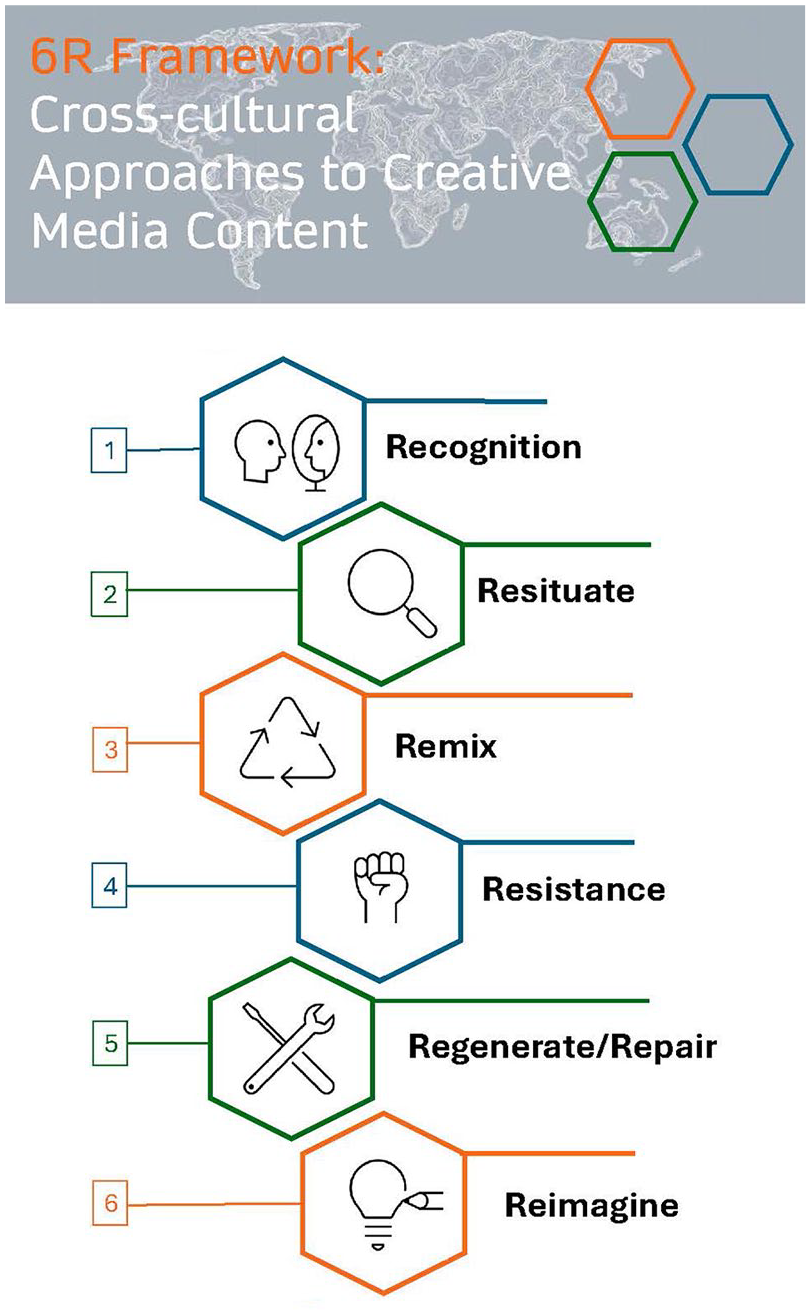
The 6R Framework for cross-cultural approaches to creative media content. Authors’ own.
Recognition
The topic of recognition addresses what is fair creative value in global AI cultures, or who gets recognised for their creative work. What is authentic recognition? Who is considered a creator, and by whom? Does authorship have more importance than curation as a creative act? When creative reuse is the clear pathway to virality and fame, why does attribution still matter? Through the lens of recognition, we want to unpack the diverse creators and their contributions to the making of media content. Digital culture has been reckoning with the myriad of ethical problems around the question of recognition, culminating with the rising call for equitable and fair provenance and ownership with the rise of AI (Fiesler and Bruckman, 2014; Perkel, 2016). For example, content misattribution and the appropriation of content from black communities has been a problem that resurfaced with issues such as ‘digital blackface’ (Jackon, 2014). The term denotes the practice of using African-American Vernacular English (AAVE) and other digital objects such as GIFs and memes by white and non-Black people, thus ‘making anonymous claims to a Black identity through contemporary technological mediums’ (2014). The challenges surrounding appropriation, attribution and authenticity online are inextricably intertwined with questions of race, identity and how we value and use digital cultural artefacts.
With AI, attribution and authenticity are becoming even more complicated. If we are to tackle issues of provenance and authenticity when it comes to identifying who is driving creative content with generative AI, it is important to note that making judgements on the ‘quality’ of creative work has historical precedent, driven by specific gatekeepers and standardised rubrics. For instance, in the 16th century, European artists were valued based on rubrics developed by art connoisseurs, art dealers, and elites in the cultural world that gave value to characteristics of craftsmanship and technique, originality, coherence, complexity (Arora and Vermeylen, 2013). Definitions of craftsmanship and originality also encompass our functional and technological expectations of creative work, such as the way and where to access it, authorship, how it is curated and how to use and distribute it. As Valdovinos Kaye et al. (2021) write, ‘The term “romantic authorship” arose in the 18th century, when self-styled author geniuses began to more aggressively assert their rights to control the exclusive access to their creative works’ (p. 3199).
Questions of expanding authorship and our definitions of creativity far predate the Age of AI. The myth of the isolated, genius author who produces work untainted by collaboration with author industry actors such as editors or agents is a distinctly Western idea, which we can contrast with the more collectivist approaches to producing cultural objects (Damich, 1988). Cases from the Global South can help decenter and provoke our expectations surrounding how creative work is produced and by whom. In the Western context, intellectual property rights, including copyright, help protect the individual creative rights of a work. In other contexts, the idea of ownership over a creative work vastly differs. Many artisanal communities in Global South countries pass down the knowledge of their traditional arts and crafts through generations, such as the saree-producing cooperatives of Pochampally from Telangana, India or Kantha sarees from Bangladesh (Arora et al., 2023). These cooperatives offer a different meaning of creative ownership, one based on community and collaborative work. What Craig (2011) has called relational authorship, or the idea of expanding our conception of authorship to account for relationality in the process of production, finds itself in contrast with the myth of the author. The different value systems that underlie these two approaches to cultural production are clear. However, these are still specific concerns the advent of AI brings into focus regarding the political economy of the creative platform industry.
Focusing on recognition would therefore not only influence how we define the producer of creative work but also how we reward them and give them attribution as they feed the data economy. Referring back to the saree-producing villages of Pochampally, what are the societal, global and economic notions of ownership of these handicraft designs as they get absorbed in the large language models (LLMs) of today? A decolonial framework would mean advocating ‘that marginalized creative communities have agency over how their data is utilized’ (Arora, 2024b: 2). How can this be operationalised in this data economy? How can we make sure equitable and fair principles guide us in this process of recognition? The focus on a single creator being rewarded should depend on the creative act. Collaboration is key to many functioning systems of art and culture production, including in the digital sphere, but to those who make their living online such as content creators and influencers, recognition is everything. Other important factors need to be addressed, such as how authorship can be monetised sustainably and collaboratively. In this context, as argued by Herman and Arora (2023), it is key to ‘consider the local impacts and vernacular realities of algorithmic platforms, particularly as they form the basis of new labour models (i.e. the “creator economy”)’ (p. 15).
Resituate
Our definitions of creativity influence our own perceptions of where creativity occurs. To address this place-making for creative media content, we need to first consider what kind of creativity we want to identify. The theme resituate is about repositioning and relocating creativity itself. Creativity online happens in a variety of forms. Generative media platforms such as Dall-E or Midjourney have recently gained a lot of attention, but creativity can also be enabled through platforms that host suites of digital tools such as Adobe Photoshop, in social media through templates provided by the platform itself, or transversally, across platforms and as a distributed network of remix and reproduction, such as in meme culture (Chateau, 2024). AI recommendation systems in media platforms play a role in the visibility and distribution of creative work (Herman and Arora, 2023; Herman and Moruzzi, 2024). In the context of the content creators and influencers, this sheds light on another unequal power balance, as ‘creators outside of the West may be particularly reliant on platforms to distribute their work’ (Herman and Arora, 2023: 15).
Work in meme scholarship can help us understand creativity as a distributed network of nodes in a global digital culture and navigate between degrading and dissolving significance and expanding and enhancing public culture (Boudana et al., 2017). Vernacular platform creativity can reflect more collectivist approaches to creation, through the use of remixing. Meme culture not only theorises this collectivist play with creation but also play with meaning, as memes playfully subvert notions of authenticity and intention through irony. Meme culture embraces ‘polyvocality’, or many voices speaking at once. As a logic, meme-ing spreads units of digital culture across the world by encouraging users to take up, reproduce and remix their infinitely replicable formats. This endless circulation creates artefacts without a fixed meaning, that have gone through many iterations and alterations (Chateau, 2024; Milner, 2013). As such, many users, contexts and different forms of expression can be held in tension in the same artefact. When it comes to considering who has been responsible for creative work in this equation, the limit does not exist. The author might find themselves completely removed from their initial creation, which has suffered an endless amount of remixing and changes since its inception. One could also argue that all those who have contributed to the meme’s virality, not only the remixers but those who have liked, shared and distributed it, have been implicated in the creative process. This asks us to unmoor ourselves from traditional conceptions of the author of creative work, and embrace a more distributed notion of creativity.
This notion of fixed, fluid creative forms collecting meaning and interpretations as they float through platforms finds a parallel in Lee’s (2022) work on rethinking creativity. Lee’s work asks us to consider what are the aesthetic forms that are used in service of the political economy and what are the ones left out by contrasting copyright and intellectual property to ‘unfixed creative ideas’:
to understand creativity via the lens of the copyright hardly recognises the value of unfixed creative ideas and the tacit knowledge of cultural producers, maintenance and development of which takes time and unpaid labour. Equally important is that the copyright framework, which is quality-neutral, lowers our expectation of creativity to ‘non-copying’ and to demonstrating ‘a degree of labour (skills or judgement)’. (p. 603)
The value of understanding creativity as a form of collective intelligence that exists in a distributed form on the internet is not a popular one amongst the owners of the social media platforms we use to mediate our creativity, because it is not a profitable one. Instead of individualising content production and rewarding creators individually, it insists on a commons of creativity. Meme culture is here a prime example of collectivist values around creativity already existing at large. Memes could never spread without their necessary remixing and reproducing by all users who have come into contact with them. Such a logic of circulation defies the boundaries of platforms and uses the vehicles of play and humour to unite users.
Remix
Remixing, re-appropriating and reproducing are very much interwoven into the fabric of our social platforms. Take affordances like TikTok’s ‘dueting’ feature (Herman, 2023), the re-sharing of stories on Instagram, or, at its most fundamental level, screenshotting. All of these take the capturing and recycling of a unit of digital culture as the departure point for sharing or participating in a conversation. By tapping a few buttons, a user can quickly and easily tap into the global conversation by remixing other user’s content and using shared audio clips. However, we can also interrogate the motive of platforms in encouraging collaboration, dueting and reuse in digital culture. Apps such as TikTok are famous for having an interface that explicitly encourages remixing as a form of creativity and rewards it through algorithmic success (Collie and Wilson-Barnao, 2020). TikTok’s powerful curatorial algorithm dictates which content makes it onto the ‘For You Page’ FYP, the user’s landing page and the app rewards content creators who make viral content. Thus, as Collie and Wilson-Barnao have argued, the very perception of creative content has shifted: it is no longer measured according to artistic considerations but its ability to attain virality. Therefore, scholars have described the platforms as ‘encourag[ing] spreadability by circumscribing creativity’ (Valdovinos Kaye et al., 2021: 3196). We have already addressed the questions of whether we can value collaboration as a form of creativity and whether originality be understood as an individual or collective process of creation. However, turning to the platforms that supply these tools, it is important to equally consider what tools are used in the creative remixing process and what they allow users to do. Who controls these tools and do they dictate what things look like? How do users interact with them and how does it impact their creative experience? What data are they trained on, and what harmful effects could these have? What does our definition of creative value, and how might intercultural aesthetic standards change that?
Platforms are organised by algorithms that sort, organise and show us content based on calculations made using vast amounts of data. The question of biased data, skewed datasets and representational harms rears its ugly head here again, a red thread unfortunately inextricable from the question of creative data. Bias in search and recommendation systems in information retrieval platforms such as Google can have profoundly harmful epistemological consequences, and we rely on these platforms more and more to co-construct knowledge (Noble, 2018). Cultural production being influenced by algorithmic cultures has become a key issue when thinking of creativity in the age of AI. Media studies scholars have already written at length about how algorithmic curation affects the diversity of cultural products consumed by users of such platforms (Anderson et al., 2020; Seaver, 2019; Ugander and Epstein, 2024). Beyond algorithmically organised media feeds, creativity happens on a host of other platforms that also depend on algorithmically generated recommendation systems for other tools. AI-enabled creative platforms offer users a suite of digital tools to make content. Key when looking at making creativity accessible and diverse in this regard is to look at the datasets and data that train the AI models offered in these creative suites. These suites, such as Canva, offer templates, ready-made files that are already designed and can be easily filled in by participants. Templates represent a form of platform-mediated remix. These templates also embody platforms’ economic logics as they create and provide data that is easy to parse for algorithms. The use of these also raises the question of whether templates and AI-enabled tools standardise and homogenise output, a recurrent debate in the field of creative AI scholarship (Steyerl, 2023).
What is there to be done within the constraints of platform affordances and algorithmic recommender systems? How free are users to actually remix? When remixing is encouraged by platforms as a way to attain virality, it connotes a shift in how we define both creativity and the notion of remix. Templates seem to embody a prescriptive form that can be filled in using stock images and other material provided by the host platforms, where skewed datasets and biased data can again be a problem (Crawford and Paglen, 2021). When it comes to material such as stock images, a focus on ethical and responsible labelling of creative content is imperative. There is still much work to be done on data labelling that takes into account cultural differences. Critical media literacy combined with a decolonial framework should be the basis of more research in this area (Arora, 2024; Lacković, 2020). Furthermore, this should be understood as part of platform and AI-enabled creative literacies that will become key matters of concern in the upcoming years.
Resistance
Within the platform economy, users use platforms to media for communication, belonging, activism, and friendship. Although platforms enable and constrain certain behaviours through affordances, users often find creative ways to negotiate platform power through creative practices. The concept of resistance speaks to such practices. Jaramilo-Dent’s work on migrant agency and platformised belongings illustrates the tension at the heart of using platforms for connection. She describes ‘platformed belongings as creative, narrative, and agentic practices deployed by migrants—and other marginalized groups—that instrumentalize platform vernaculars and affordances to construct their identity’ (Jaramillo-Dent et al., 2024: 244). Migrant agency shows us how platforms can facilitate ‘horizontal forms of agency’ and belonging (p. 253). However, not all politicised communities might enjoy the same privileges on platforms. Marginalised communities, ostracised by their governments, such as the LGBT community in Uganda, use creativity to evade censorship and governmental control (Strand, 2019). Therefore, creative resistance is in some cases a necessity, and in some a choice.
Creative resistance entails rethinking what it means to be a user and what it means to use a platform. Users from these communities might remix affordances to suit their needs. This type of remix as resistance should be reconceptualised as an intrinsically cross-cultural creative practice, as it is already present as an ethic across many Global South cultures. For example, the Indian term ‘jugaad’ means ‘to improvise, particularly as a response to scarce resources and rigid social systems’. Jugaad has become an ethic of its own, a mindset for creativity and creation within a resource-poor context. It is now even defined in OED as ‘the use of skill and imagination to find an easy solution to a problem or to fix or make something using cheap, basic items’ (Arora, 2024b: 58). Similarly, writing about African Arts, Adesokan (2023) notes that remix and reuse are intrinsic to an African approach to new technologies: ‘When new media of reproduction appear, so does a predisposition toward repair and reuse, especially in contexts where new tools are ill afforded’ (p. 313). Tendencies towards resisting prescriptive contexts of use are therefore already embedded in many cultures, and the aesthetic tradition of remixing takes on more subversive notions. Creativity becomes a practice that reclaims power and agency.
Resistance does not have to be only aimed towards vertical power structures but can be situated horizontally, at a collective level. We can conceptualise collective creative work as everyday activism. Here, tied with the notion of reciprocity and collectivity, creative resistance takes on a new dimension. Peer support and peer-based learning are also key values in the Global South that renegotiate our expectations around creativity (Bhatia et al., 2023). Applying these insights to what we know of the creator economy, more research should be done on how upskilling and mutual support from other creators manifests. Is it in the form of communities through informal and peer-based learning? How are resources shared, and how are platforms re-shaped by such practices? What might users, designers and platform owners learn from these practices of reuse and resistance?
Regenerate/repair
As has been mentioned throughout this article, datasets are representative of the data that happened to be collected for them; they are not representative of a global, diverse and heterogeneous population. Regenerate addresses this issue. How do we build new, more inclusive data? How do we measure the representativeness of data? What is authentic data? How can we reimagine how we depict certain communities once we have included their perspective? Reproduction and renewal are placed in tension with each other. Inclusivity and equity within data ecosystems is a multifaceted question that is rooted in ethical and philosophical concerns surrounding representation.
Here, the ethics of reuse, and regeneration with synthetic data come into play. Synthetic data refers to fabricated data that is used to train LLMs. What are the ethical issues with using synthetic data? It is produced from data already produced by LLMs, meaning that LLMs trained on biased datasets will produce biased output which will be further integrated into more machine learning algorithms as synthetic data. The representativeness of data then strays further and further away from its source. However, AI-generated content and synthetic data can also be used as an opportunity to repair past data bias and shift from reproducing datasets to regenerating datasets that train AI models. New ways of producing data can be conceptualised based on more relational ethic systems, and creators. In relation to creativity, the question of authenticity comes back into play. For example, how, and who can decide on value when assessing a so-called authentic creative output as opposed to a synthetic output?
Regenerating data also means considering questions of sustainability. Instead of adding data to an already precarious data economy, we must make responsible choices about how to collect and preserve data responsibly, ethically and sustainably. Data loss is already an emerging issue in our society (Thylstrup, 2023). For the current data we have to continue to be valuable and operational, there must be continuous investments in data management systems in order to preserve data and make it valuable for human generations to come. Different data collection and storage systems could show us the way in this regard. Alternative epistemic modes, such as Indigenous structures can be useful for preserving and structuring knowledge (Carroll et al., 2019). Ubuntu ethics are an orienting set of values based around the common good, reciprocity and human flourishing through communal living that is key to African philosophy. Ubuntu data ethics emphasise relationality, providing different perspectives on privacy and data (Reviglio and Alunge, 2020). The common value of creative and intellectual goods represents shared prosperity for a community, another perspective that challenges the separation of creative products and intellectual property under copyright law in the West.
Reimagine
Our last theme, reimagine, focuses on future-making with AI in the creative sector. We acknowledge the innate human need to create something beautiful and add value to the world and want to examine that urge to create. The role of situated meaning, context and lived experience in the value of creative work is all too crucial when we consider decolonising creativity. Embodied experience and local contexts inform practices of meaning-making and picturing the future. For example, the colonial past of some countries has been argued to create a different relational temporality (Ngo, 2019). However, looking forward, the use of AI can assist creative processes of re-thinking temporality. How can we use AI to generate different futures? Or to reimagine the past? Can we capture alternative histories, and what is their value? AI-assisted technology can help us not only depict and rethink the methodologies we use to train ourselves to think of the future. How can we reimagine how we represent certain peoples, cultures and values? Can AI tools creatively reimagine fundamental human concepts? How do we recognise creativity and reward it?
In this light, our perspective when it comes to AI tools would be enriched by shifting discourses from automating to assisting creativity. As argued by Payal Arora, marginalised communities adopt technology more easily and more enthusiastically (Arora, 2024a). What can we learn from the values of repair and regeneration that may change our future? These ethical principles by which many already live their lives in the Global South can promote a sustainable approach to technology, a crucial question in the context of the climate catastrophe. The CARE principles of Indigenous Data Governance is a movement grounded in Indigenous worldviews that aims to address the ecological impact of the data economy, sustainable data practices and the role of AI in fostering environmental resilience (Jennings et al., 2023). The principles (Collective Benefit, Authority to Control, Responsibility and Ethics) aim to enhance the representation of Indigenous Peoples within the data governance for greater use and benefit from data and are guided by Indigenous Knowledge, passed down intergenerationally, about biodiverse land. To respect our land and future, value-based relationships should replace our current extractive and hierarchical ones.
Such future-oriented and value-based systems of care are found throughout the Global South, with an example from the African-American community that has recently been popularised in global fiction. Afrofuturism is originally a term used to denote African-American speculative fiction that treats depictions of a technologically enhanced future. Its character is often utopic in nature, depicting a world where technology has been appropriated by the African community to attain a more advanced futurity, as seen in Black Panther (Ryzik, 2018). As Okidegbe(2022) notes, Afrofuturism does not only project technology into the future but reimagines it within a fairer and more equitable future: ‘the orientation of Afrofuturism is to build a future that is more than a mere improvement over the status quo and one that is free from the legacies of slavery, carcerality, and hierarchies that have forced those with marginalized identities into state sanctioned vulnerability’ (p. 36). As an ethical framework, it has been applied within scholarship as a theoretical tool that forces us to re-think and re-conceptualise algorithms (Okidegbe, 2022) and Artificial Intelligence (Ajunwa, 2023).
Conclusion
Cultural values surrounding creativity are different in the Global South. Cultural, political, ethical and normative contexts of use influence creative values, and give rise to communities where collectivity and collaboration are valued assets and ways of working. As these contexts become further embedded in the data economy, attribution, proper representation and data justice are key areas of focus when we heed the call to decolonise creativity. The 6R framework proposed here allows us to think of the Global South’s population not just as data points but as co-creators. Through this framework, we can appropriately recognise local creative communities and resituate them in the global creative economy. We understand the value of remix and repair as productive work. We regenerate new data and forms and representation and reimagine what role we see AI technology play in the Global South. The 6R framework interlaces deep concerns about ethics of care throughout all six concepts, and we can see key issues such as representational harms, data justice and attribution recur throughout. That is because the framework is not meant to separate and isolate these areas of ongoing debate but to show us that they are deeply intertwined and must be addressed through a variety of cross-cultural approaches.
