




Abstract
This article introduces and applies a situational, interactional, and processual theoretical framework to explore how folk theories of journalism shape people’s news use and trust decisions in specific, real-life circumstances. Following the “episode method”, 48 semi-structured interviews conducted with Austrian young adults revealed that objectivity and impartiality are regarded as the two cornerstones of journalism, aligning with Austria’s traditional journalistic culture. Thus, for Austrian young adults, informing oneself is a search for the ultimate truth. Whether objectivity and impartiality are thought to be actually found in journalism shapes (dis)engagement with it. Different news consumption and trust decisions emerged from interviewees who believe that journalists manage to be impartial and objective versus ones believing that journalists cannot or do not want to. Whereas the former recalled using and trusting information sources that they regarded as reputable, the situation is more nuanced for the latter. They showcased trust decisions ranging from reliance on external information sources to reliance on oneself to discern the truth. Those findings suggest that despite the emergence of new forms of journalistic actors and work, traditional journalistic values and norms remain central in audiences’ news use and trust decisions.
Introduction
Examining how people understand journalism is crucial to grasp what they expect from it and how those expectations inform their actions. Specifically, unearthing these expectations is important to clarify how they shape news consumption and trust decisions, thus advancing scholarly understandings of current and future trends in journalism-audiences relations. This article seeks to achieve such an understanding by drawing on the concept of “folk theories of journalism” (Nielsen, 2016) to illuminate the connection between the meanings that audiences attach to situational news consumption and their trust decisions.
Folk theories are culturally available symbolic resources that provide orientations for navigating the world and reaching specific goals (Mont’Alverne et al., 2023; Swidler, 1986). Folk theories of journalism – that is, lay understandings of what journalism does and should do (Nielsen, 2016) – shape how people engage with journalism or not and for what purpose (Toff and Nielsen, 2018). By adopting a situational, interactional, and processual perspective (Blöbaum, 2021), our study sheds light on folk theories of journalism held by young adults and how these understandings shape their decisions about using and trusting the news in specific, real-life circumstances.
To that end, we conducted 48 semi-structured interviews employing the episode method (Palmer, 2019 ) with Austrian young adults. Our findings reveal that objectivity and impartiality are regarded as the two cornerstones of journalism, which aligns with Austria’s traditional journalistic culture (Hanitzsch et al., 2019; Riedl, 2019). Thus, for Austrian young adults, informing themselves is a search for the ultimate truth. Whether objectivity and impartiality are thought to be available in journalism shapes their (dis)engagement with it. Different news consumption and trust decisions emerged from interviewees who believe journalists manage to be impartial and objective versus ones believing that journalists cannot or do not want to. Whereas the former recalled using and trusting information sources that they regarded as reputable, the latter showcased trust decisions ranging from reliance on external sources of information to reliance on themselves.
This article offers important theoretical and empirical contributions to the literature. For one, it introduces a new framework that combines a processual approach to trust (Blöbaum, 2021) with the concept of folk theories of journalism (Nielsen, 2016). The framework allows a nuanced examination of news media trust, centered on audiences’ understandings of journalism in their everyday lives. Moreover, it illuminates how folk theories held by Austrian young adults shape their decisions to consume and trust the news. Such a focus on young adults is crucial, for it provides valuable insights into future trends.
Young adults’ understanding of journalism and trust strategies
Young adults’ understanding of journalism has been widely investigated as well as debated (see Barnhurst and Wartella, 1991). As underlined by Ohme et al. (2022), young adults constitute a particularly fruitful access point for connecting established understanding of the past with an outlook into what is and will be changing. Interest in young adults’ understandings of journalism has been renewed given the continuously evolving contemporary news media environment (Cotter and Thorson, 2022). As a result, several studies, though not always drawing from the concept of folk theories, have investigated the topic and unearthed patterns emerging across diverse national contexts. Specifically, the normative expectations of neutrality, objectivity, impartiality, and factual accuracy in journalism tend to be stable across time and uniform across social classes and age groups in Finland (Manninen, 2018). Similarly, in Germany (Schneiders, 2024) and Italy (Garusi and Splendore, 2023), young adults value factual and neutral reporting amid the complex and contradictory ensemble of public voices that constitute their media environments. Furthermore, young adults in in the United States (Edgerly, 2017) and the Netherlands (Swart and Broersma, 2022) have been shown to apply the traditional journalistic norms of neutrality and objectivity to delineate what is news and what is not.
Therefore, findings from research across Western countries generally show that young adults find normative expectations of neutrality and objectivity to be important; traditional journalism remains recognizable as a cultural form, even for people detached from it (Swart and Broersma, 2024). However, regarding the role of normative expectations in shaping news use, findings have been mixed across geographical contexts. For instance, Schwaiger et al.’s (2022) results suggest that Swiss young adults want journalism to tell the truth and think that traditional news outlets, not social media, meet that expectation. Marchi (2012), by contrast, has highlighted that young adults in the United States tend to prefer opinionated news pieces on blogs and social media over allegedly objective ones published by established news outlets.
There is limited research on how young adults use and trust news in everyday situations (Cotter and Thorson, 2022). However, distrust tends to be prevalent in that demographic group (Matsa et al., 2018). In a comparative analysis of the United Kingdom, the United States, and Brazil, Eddy (2022) found that young adults are highly skeptical of most information and that those skeptical of mainstream sources tend to distrust them but favor alternative sources, and vice versa. Similarly, Wunderlich et al.’s (2022) results reveal that German young adults, unlike their older counterparts, do not inherently trust any single information source but instead compare various sources to find the truth (see also Swart and Broersma, 2022; Garusi and Splendore, 2023).
Moreover, young adults can go to great lengths to assess the trustworthiness of news. For example, Swart and Broersma (2022) present a taxonomy of tactics that young Dutch adults use to that end. These tactics range from those rooted in explicit knowledge, such as drawing upon prior knowledge of the topic or cross-referencing sources, to those associated with the use of implicit knowledge, including relying on one’s intuition. In Austria – where our study was also conducted – Russmann and Hess (2020) found that young adults tend to rely on a variety of news outlets that they perceive as being reputable and, consequently, trust them.
Against that backdrop, in this article we aim to connect research on young adults’ expectations of journalism, news consumption, and trust by adopting an interactional, processual, and situational perspective. To that aim, the next section introduces the concept of “folk theories of journalism”, which is useful for understanding how people’s expectations inform their news consumption and trust decisions.
Folk theories of journalism
Folk theories are “non-authoritative conceptions of the world that develop among non-professionals and circulate informally” (Eslami, 2016: 2372). They are a form of expectations based on experience, not necessarily systematically checked, that constitute cognitive frames through which the world is interpreted (Rip, 2006). The robustness of folk theories derives “from their being generally accepted, and thus part of a repertoire current in a group or (…) culture more generally” (Rip, 2006: 349). Contrary to scientific theories, aimed at the accumulation of knowledge, folk theories constitute culturally available symbolic resources that people rely on to develop “strategies of action,” meant as ways of organizing actions in order to reach specific goals (Nielsen, 2016; Swidler, 1986).
Importantly, folk theories “guide our behaviors, shape how we perceive our options, and inform decisions we make” (Mont’Alverne et al., 2023: 1134). In other words, folk theories are integral to the foundations that people rely on when interacting with their environments (Ytre-Arne and Moe, 2021). On the one hand, folk theories can be normative - that is, focused on how things ought to be. As underscored by Smejkal and Urbániková (2024), such evaluations are a manifestation of normative expectations because they reveal the criteria employed to interpret reality. On the other hand, folk theories can be analytic – that is, centered on how things operate and why (Mont’Alverne et al., 2023: 1134).
The degree of congruence between those two levels can shape audiences’ evaluations of and engagement with journalism (Banjac et al., 2024; Smejkal and Urbániková, 2024). For example, Toff and Nielsen (2018) found that in the United Kingdom people’s belief that all relevant news is available online and easily accessible can foster a news media diet based on digital media. Focusing on the United Kingdom as well as Spain, Palmer et al. (2020) have highlighted that the idea that the press should act as a watchdog, but does not, can promote news avoidance. The findings of those studies suggest a connection between folk theories of journalism and news consumption. However, more theoretical and empirical efforts are needed to understand how folk theories of journalism can inform audiences’ trust decisions specifically (although see Panievsky et al., 2024).
News consumption and trust decisions
Scholars generally agree on defining trust as an attitude characterized by “the willingness of the audience to be vulnerable to news content based on the expectation that the media will perform in a satisfactory manner” (Hanitzsch et al., 2018: 5; see also Fawzi et al., 2021; Van Dalen, 2020). However, definitions of trust as an attitude are too broad to grasp its functioning (Blöbaum, 2021; Uth, 2024); such a broad perspective on trust can lead to what Panievsky et al. (2024) have called “trust-centrism”, namely the reduction of the audiences-journalists relationship to issues of trustworthiness evaluations. To understand trust in news media, it is necessary to grasp people’s beliefs about news media (Panievsky et al., 2024). Thus, integrating a folk theory approach with the study of trust in news from an interactional, situational, and processual perspective can be useful to avoid trust-centrism (see Blöbaum, 2021; Uth, 2024).
According to Blöbaum (2021), trust is a risky decision made within a specific interaction between a trustor and a trustee, in opposition to a generic attitude of will. For trust to occur, a specific trustor has to voluntarily enter into a relationship of dependence with a specific trustee. Therefore, trust can be understood as a situational decision to make oneself vulnerable to a specific risk instead of as an attitude toward journalism. The specific risk in relation to journalism cannot be generalized because it depends on how the trustor conceives journalism and what she expects to receive from interacting with it. Such an interactional, situational, and processual understanding of news media trust recommends a comprehensive framework that encompasses preceding and succeeding phenomena often overlooked or conflated in trust-centric research, including ideas about journalism, news consumption choices, perceptions of trustworthiness, trust, and the enactment of trust (Blöbaum, 2021; Panievsky et al., 2024; Uth, 2024).
Taking such a perspective on trust involves recognizing that even if the outcome is the same – trust or lack thereof – the decision-making processes involved still deserve in-depth exploration (Polkinghorne, 1988). In line with that reasoning, Figure 1 illustrates a processual perspective on news media trust integrated with literature on folk theories of journalism in a conceptual framework. At base, normative and analytic folk theories of journalism shape people’s news consumption decisions (Mont’Alverne et al., 2023). Driven by certain beliefs about journalism and specific goals to achieve, people use some information sources but not others (Juarez Miro, 2023). Once a specific source is used, people assess its trustworthiness by evaluating the extent to which normative expectations are fulfilled in that specific interaction (Uth, 2024). Building upon perceptions of trustworthiness, trust is thus a conditional state characterized by positive expectations that involves temporarily setting aside vulnerability and uncertainty through a “trust decision” (Uth, 2024: 394). News media trust is therefore enacted through actions taken after suspending vulnerability and uncertainty – that is, acting as if certain possible futures will not materialize (Lewis and Weigert, 1985). The outcomes of such actions, such as feelings of genuine or misplaced trust, may impact beliefs about what journalism does – that is, analytic folk theories.
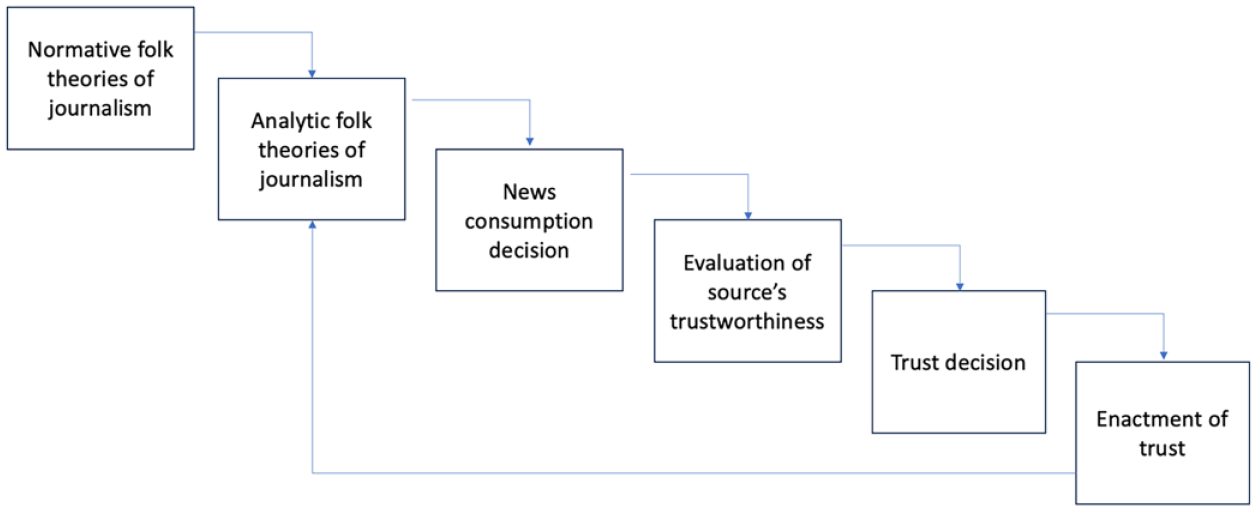
Conceptual framework for a processual approach to study folk theories and news media trust.
In integrating literature on folk theories with research on news consumption and trust, we argue that these research strands can be put into dialogue to better grasp the nuanced relationship between audiences and journalists without losing sight of people's everyday lives. Focusing on the specific population of young adults, we formulated two research questions:
RQ1: What normative and analytic folk theories of journalism do young adults maintain?
RQ2: How do folk theories of journalism shape news consumption and trust decisions?
To address those research questions, we conducted 48 semi-structured interviews with Austrian young adults. The method allowed participants to reflect on and narrate their understandings of journalism that, in analysis, were divided into normative and analytic folk theories. To integrate a processual approach to news media trust, the interviews followed the episode method (Palmer, 2019), which allowed examining how interviewees’ folk theories informed their decisions to use and trust news. Before delving into the results, the next section details this research methodology.
Method
For a context of our study, Austria offers an interesting case of analysis. While Austria is understudied in terms of audiences’ understanding of journalism (Riedl and Eberl, 2022), it provides a suitable context to study how young adults understand, use, and trust news in their daily lives. For one, Austria has recently experienced scandals concerning murky relationships between politicians and news media actors that have likely impacted the traditionally high levels of news media trust in the country (Newman et al., 2023). Even so, the quality press continues to rank among the most reputable and trustworthy information sources in Austria (Newman et al., 2023; Russmann and Hess, 2020). Therefore, the Austrian media environment, marked by significant shifts yet also stability in recent years, is comparable to that of many other Western democracies (Nölleke et al., 2023).
To address the research questions guiding our study, 48 semi-structured interviews with Austrian young adults were conducted between April and May 2024. For the research, “young adults” were operationalized as 18- to 25-year-old Austrian residents. Lasting between 25 and 60 minutes, interviews were conducted by Communication Science students in fulfillment of a practical course on Qualitative Methods. To homogenize the interview approach, all students were taught how to conduct semi-structured interviews and received identical instructions (Banjac and Hanusch, 2022). To minimize their risk of inviting socially desirable answers, the students were told that they would be graded based on their ability to facilitate a smooth discussion during the interviews, and not on their content (Banjac and Hanusch, 2022). Given the presence of international students in the class, interviews were conducted in German or English; the students translated the interviews conducted in German into English. Students were supervised by the first author, who was responsible for the class, and determined that the interview interactions were fluid enough to guarantee the quality of the collected data.
Research participants were selected by the interviewers from their social networks. Students were encouraged to select interviewees who varied in terms of gender, occupation, place of residence, and familiarity with journalism. Ultimately, the sample approximated gender balance and consisted of both students and workers residing in different parts of Austria and with varying degrees of familiarity with journalism. Most interviewees had been born in Austria, while a small minority had been born in Germany. Nevertheless, all interviewees had lived in Austria for at least a few years and were native German speakers, which, as revealed in the interviews, led them to rely on the Austrian information landscape for their daily news. Because these young adults had gained the right to vote in political elections only recently, understanding social institutions, such as journalism and politics, was especially relevant to them (see Aalberg and Jenssen, 2007; Ha et al., 2013). To maintain the interviewees’ anonymity, throughout this article we refer to them according to a progressive code (Int1, Int2, Int3. . .). The study received IRB approval from the University of Vienna; the approval ID-code is: 20240119_002.
The final interview guide, prepared by the first author in collaboration with the students, contained five sections. The first section concerned the role that journalism plays in interviewees’ everyday lives. The second and third sections relied on the episode method (Palmer, 2019). In the second one, interviewees were asked to recount an episode in which they felt the need to inform themselves on an “important” topic, with “important” being an intentionally vague term used to understand interviewees’ perspectives. In the third section, interviewees were asked to recount an episode in which they felt the need to inform themselves on a controversial topic. Both sections included the same questions, regarding the information sources used, the interviewees’ expectations, and whether those expectations were met. Later, regarding trust decisions, interviewees were asked how they assessed the reliability of the information received and how they employed it in their everyday lives. After that, the fourth section of the guide addressed the relationship between journalism and politics, with particular focus on the upcoming elections in Austria. Last, the fifth section delved into perceived differences and similarities between journalists and other actors producing information, including laypeople, bloggers, and social media influencers.
Regarding data analysis, an explanatory narrative investigation was conducted, which aims to explain why an outcome – in our case, trust or lack of it – occurred the way that it occurred (Polkinghorne, 1988: 170–177). Both categorizing and connecting techniques were employed; the former aims at categorizing and comparing data elements while the latter at juxtaposing them in time and space (Maxwell and Miller, 2008). In our study, news consumption and trust decisions recalled by the interviewees were first categorized through content analysis; second, the folk theories that made those decisions reasonable from the interviewees’ points of view were investigated retrospectively (Polkinghorne, 1988). The latter endeavor entailed connecting several data elements within the same interview in order to understand the context in which news consumption and trust decisions were made (Maxwell and Miller, 2008).
Findings
Before delving into the folk theories of journalism held by Austrian young adults, it is necessary to outline what they mean by journalism and journalists. In the contemporary high-choice media environment (Van Aelst et al., 2017) people are less likely to confidently define what counts as journalism and to have a shared idea of it (see Banjac and Hanusch, 2022; Daniller et al., 2017). Nevertheless, in line with other studies (see Tsfati et al., 2023, on the Swedish context; Garusi and Splendore, 2023, on the Italian context with a specific focus on young adults), interviewees consistently drew clear-cut boundaries between journalists and other actors producing information, such as bloggers, social media influencers, and laypeople.
When interviewees talked about journalists, they primarily imagined people working for news organizations, especially national ones. For example, when asked to define who a journalist is, Int5 replied: “Let’s say a person, receiving a task from their boss. Then they start looking for people to interview and write columns for the magazine or articles for the newspaper. Just like how it’s commonly presented in movies.” For Int25, working for news organizations makes journalists “accountable for what they’re doing,” unlike bloggers and social media influencers, who “say stuff and do stuff that’s more based on their personal opinion and on their personal experiences” (Int9). A word commonly used to describe journalists was “professional:” for example, Int42 said that “Journalists are trained professionals whose primary objective is to report the news objectively” (emphasis added). In sum, Austrian young adults hold a clear and consistent idea of what journalism and journalists are, and this idea aligns with traditional conceptions of professional news-making actors.
In this section, we first explore normative and analytic folk theories of journalism (RQ1), after which we examine how those types of folk theories can shape news consumption and trust decisions among Austrian young adults (RQ2).
Normative folk theories of journalism
Concerning normative folk theories of journalism, homogeneous perspectives emerged among the interviewees. Two types of normative folk theories were highlighted, that regard what journalism should be useful for and what journalism should do.
What journalism should be useful for
To Austrian young adults, journalism should help people to learn about and understand the world in which they live. As Int42 argued: “Journalism serves as the foundation for knowledge, insight, and understanding by allowing us to make sense of our surroundings, connect with others, and navigate life’s challenges.” The interviewees stressed that journalism should help them to make informed decisions, especially in times of heightened anxiety and uncertainty. For example, Int37 highlighted that journalism played a crucial role in guiding her decision-making process regarding COVID-19 vaccination. Similarly, Int21 reported that, thanks to journalism, “I was able to navigate the COVID-19 pandemic and make informed decisions to protect myself and others.” Along with informing immediate decisions, interviewees underscored the central role of journalism in helping them to understand the future. For example, Int36 emphasized how journalistic reporting on climate-related issues has helped her adopt an environmentally friendly lifestyle. Int6, meanwhile, was more concerned about potential volatility on the job market and wanted journalism to warn him about it.
On journalism’s role in facilitating informed decision-making, interviewees strongly emphasized that journalism should be a source of empowerment for informed citizens. In particular, they recognized journalism’s important role in advancing social equality and justice. In that vein, Int40 explained that she “wanted to know more about racial inequality because it is a pervasive societal issue that impacts individuals and communities on a profound level. Understanding its root causes, manifestations, and potential solutions is crucial for fostering social equity and justice.” Talking about femicides, Int31 stressed that “If people get killed, other people should also know about it in order to create awareness, so things like that happen less often.”
Another prominent issue in interviewees’ normative folk theories regarding journalism’s purposes centered on facilitating social interactions and discussions. Young adults expressed that journalism should help them to understand “how to navigate social settings, being able to talk to people about specific topics” (Int34). Alluding to the community-building role of journalism, Int2 reported that, without journalism, she would miss “the shared excitement over a new recipe or the latest book recommendations that lead to late-night conversations and the sense of belonging to a community.”
Interviewees not only delineated what journalism should be helpful for but also expressed normative beliefs on how those purposes should be achieved. Thus, in the next section, we explore young adults’ normative folk theories about what journalism should do.
What journalism should do
In articulating what journalism should do in order to fulfill its purpose, the interviewees consistently stressed the importance of impartiality. As summarized by Int1, “A good journalist does not have a biased point of view,” or at least should refrain from letting any biases influence their work, particularly in terms of political orientation, as emphasized by Int31: “Political views should not be incorporated into reporting.” Thus, ideas of traditional detached reporting were common among the young adults, who emphasized that “a journalist should simply be an observer, reflect everything as it is and thereby report it” (Int19).
Especially regarding controversial topics, interviewees expressed the normative expectation that journalists should present all sides of an issue without adopting a stance, again invoking traditional norms, in this case, balanced reporting. For example, referring to the Palestine-Israel conflict, Int11 argued that news pieces “should be written in a certain way that does not push you to one side or the other.” On the same topic, Int19 maintained that “We (the citizens) have the right to neutral reporting. Hopefully, I will simply be informed about the situation and understand the context.” According to the interviewees, aside from conducting research and hearing from all sides involved, journalists should put their emotions aside to produce unbiased reporting, which again alludes to the ideals of traditional objectivity and a detached observer. Regarding the Ukraine-Russia conflict, Int6 argued that “If the coverage was neutral and not too emotional, I would say that it has a better chance of being less biased and fair information.” On the same topic, Int5 expressed the need for journalism to be unemotional and to provide “concrete, precise statements” instead.
Furthermore, young adults invoked the objectivity norm to refer to the separation of facts from opinions, thereby assuming the existence of an ultimate truth. Expressing that normative folk theory, Int34 argued that in journalism there should be “no subjectiveness, no personal opinions, just objective, good, real information.” For Int22, objectivity is the essence of journalism: “For me, journalism needs to be objective, or I don’t think it’s professional journalism.” For the interviewees, impartiality and objectivity in journalism tend to go hand in hand. For instance, Int29 stated that “media should stay as unbiased and as objective as possible.”
Altogether, for Austrian young adults informing oneself is a search for the ultimate truth. Apart from expressing the desire for objective and impartial journalism, the interviewees also outlined whether or not such a normative expectation is generally met – that is, their analytic folk theories –, which shaped their news consumption and trust decisions.
Analytic folk theories, news consumption and trust decisions
Regarding RQ2, the analytic folk theories of Austrian young adults exhibited greater diversity than the normative ones. In particular, interviewees’ perspectives were divided into folk theories about journalism as indeed being impartial and objective and folk theories to the contrary. This division influenced interviewees’ decisions about using and trusting journalistic sources, especially concerning important and/or controversial topics, as emerged in the episodes recounted by interviewees.
When normative expectations are met: Use of and trust in reputable sources
Austrian young adults who understood journalism to be impartial and objective recalled using and trusting information sources that they considered to be reputable. For example, Int2, who stated that “the big media outlets have many sources and do good journalism,” recalled using the Austrian public service broadcasting to get informed about healthy eating habits. She considered the source to be trustworthy due to its established reputation, and decided to trust it, thus suspending any doubt that the information received may not be objective and impartial. As a result, Int2 adjusted her diet accordingly. In the same way, Int10, who stated that “the media is a very good neutral source to get various information from,” reported turning to the newspaper Der Standard to learn more about the Ukraine-Russia conflict. She considered the newspaper to be trustworthy given its perceived respected reputation: “Der Standard is a classic news site in Austria, and a lot of friends of mine and Austria as a country generally depend on reliable news sources like Der Standard.” Consequently, Int10 decided to suspend any doubts regarding the objectivity and impartiality of the information received, which led her to conclude that “we’re all not really that safe, we don’t have as much safety around us as we think,” with reference to fears of a possible war directly involving Austria as well.
Related to the normative folk theories being articulated around traditional journalistic norms and values, the sources regarded as being reputable by this group of Austrian young adults were all established news outlets in the media landscape. Among them, the public service broadcasting and the newspaper Der Standard were most prevalent. On the contrary, these young adults were highly skeptical of information provided by non-professional social media accounts. For instance, regarding the upcoming European elections in June 2024, Int3 did not want to inform herself on social media because “there can be a lot of fake news spread around, as usual.” Those results corroborate Russmann and Hess’ (2020) findings that the Austrian quality press still plays a crucial role in Austrian young adults’ news media repertoires.
When normative expectations are not met: From trust in information sources to trust in oneself
Whereas Austrian young adults who believe that journalism is impartial and objective reported consistent patterns in news use and trust decisions, the situation is more nuanced for ones holding the opposite folk theory. In that case, interviewees’ understandings can be categorized into two groups: ones maintaining that journalism cannot be impartial and objective and ones maintaining that journalists intentionally avoid being impartial and objective. Concerning the former, Int25 summarized the argument as follows: “I personally think that everyone is biased. So, journalists are no exception. Journalists are just people, like everybody, so obviously, their political viewpoint influences their work as journalists.” Meanwhile, regarding the latter, namely the folk theory that journalists actively avoid impartiality and objectivity, young adults accused journalists of being deliberately slanted for political purposes. Interviewees who aligned with that perspective stated, for example, that “every newspaper company has its own opinions, and they are trying to convince the people (. . .), they change their wordings to make you believe other stuff” (Int26). Added to those folk theories about journalistic work in general, the young adults applied their understanding of journalists as being intentionally biased to specific cases. For instance, Int19 argued that journalists’ political opinion “distorts the view of the Israel-Gaza war and allows only one side.” Even if not widespread, arguments about economic influences as sources of journalistic bias emerged as well: “When it comes to media, it’s not only the power, but also the money, which are yin and yang with each other” (Int29).
Despite differences in explanations for why journalists and their work fail to be impartial and objective, this group of interviewees showed similar patterns in news consumption and trust decisions. As illustrated in Figure 2, the analytic folk theory that journalists are not objective and impartial shaped young adults’ decisions to consume certain information sources over others. Their evaluations of these sources’ trustworthiness further informed their decisions to trust them or not. Young adults’ trust decisions can be placed on a spectrum, ranging from reliance on external information sources to reliance on oneself. It is important to note that these consumption and trust decisions are not mutually exclusive, for the same person can make different decisions under different circumstances.
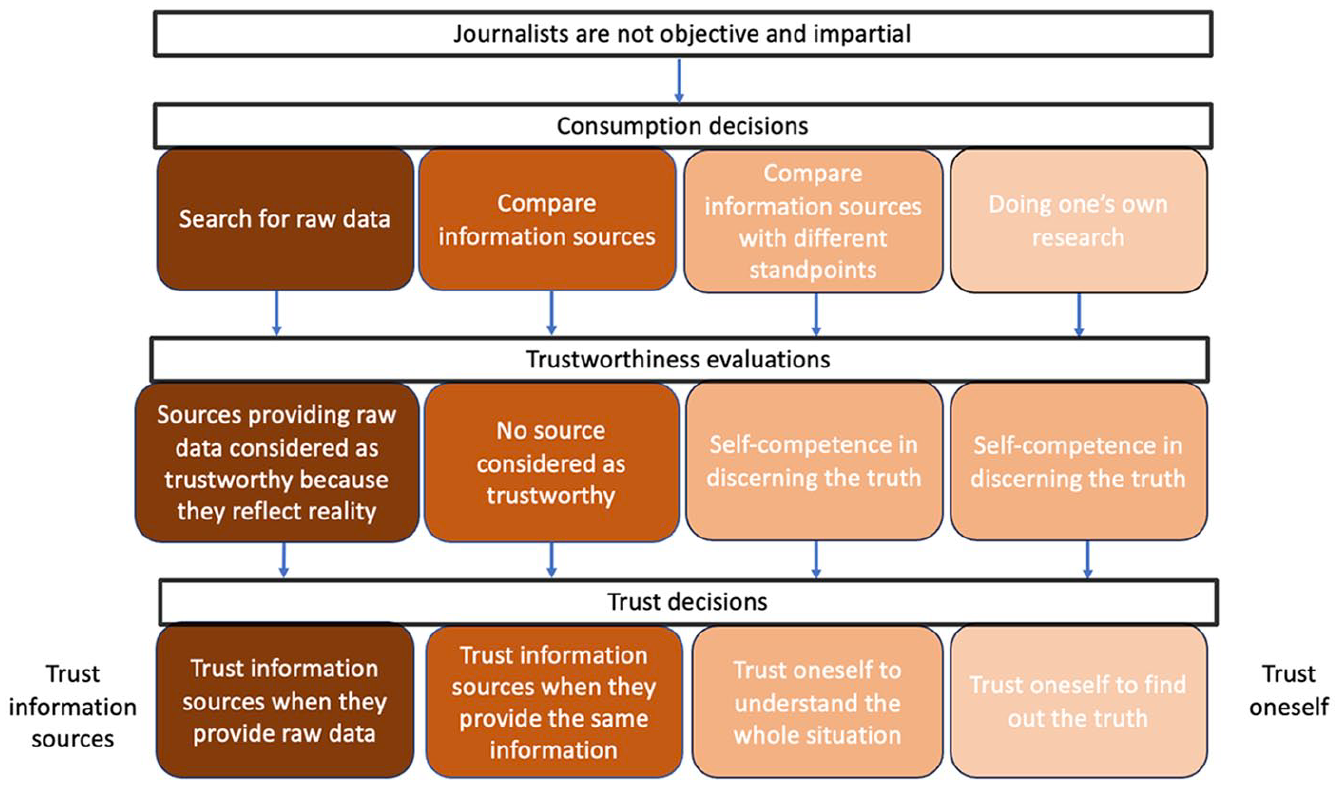
Types of news consumption and trust decisions made by interviewees who do not think that journalists are objective and impartial.
As Figure 2 shows, starting from the left end of the spectrum, young adults believing that journalists cannot or do not want to be impartial and objective reported consulting a variety of information sources. They considered only those providing raw data to be trustworthy, understanding this as the only way to discern the truth about distant events. Raw data can encompass videos or photos, as in Int25’s case, who used the Telegram channel of “a certain part of the Ukrainian army” to know about the Ukraine-Russia conflict. As he explained: “When I read news about the war, I relied a lot on footage of something that had happened.” Considering that information “always has to do with the incentive of the person who is pushing [it],” Int25 deemed videos and photos to be trustworthy based on his perception that they reflect reality. Thus, deciding to trust the army’s Telegram channel, he concluded that “I feel like I have a pretty good understanding of what is going on.” Besides photos and videos, raw data can also include datasets. For example, Int31 sought out statistics on femicides to know the exact numbers and considered people from the association providing them as trustworthy because “they are studies and statistics from knowledgeable people.” Based on that perception of trustworthiness, Int31 decided to trust the information provided by that source, assuming objectivity and impartiality in the statistics provided.
Consistent with other studies on young adults’ news use (see Garusi and Splendore, 2023; Swart and Broersma, 2022), various consumption and trust decisions involved comparing multiple information sources to grasp the truth. In that endeavor, the underlying premise was that although no source of information can be considered to be trustworthy on its own account, it is more likely to be accurate if other sources support it. As explained by Int42: “Each source has its strengths and weaknesses, but by cross-referencing information and critically evaluating sources, I feel more confident in the accuracy and reliability of the news I consume.” With particular regard to immigration policies in Germany, Int32 reported that “I went on the Internet and then googled it and read through several articles and compared them with each other.” As put by Int32, this strategy allowed “getting to the truth.”
The third type of news consumption and trust decision generally took place regarding issues involving several sides. As with the second type, no information source was considered to be trustworthy. What differs, however, is that news consumption was directed at seeking information sources with different standpoints, and trust was placed on one’s ability to access the objective and impartial truth. In that case, the underlying folk theory was that information sources support different stakeholders involved in an issue, and they all attempt to sway audiences in their favor. As Int35 explained regarding the Palestine-Israel issue: “You always need to hear the story from both sides, because both sides are corrupted, both sides are pushing their own agendas;” therefore, “If you want to formulate an opinion that you can trust, I believe that you should consider both perspectives.” Regarding the upcoming European elections in June 2024, Int9 reported having used news outlets with different political orientations because “you cannot just look at the topic from one side and form an opinion. You need to have complete knowledge of the situation in order to form an objective opinion.” In that way, interviewees shifted the responsibility of producing trustworthy information from journalism to themselves.
Still about trust in oneself, some interviewees argued that not even a partial truth can be gleaned from professional journalism. That type of news consumption and trust decision relates to the idea that journalists deliberately choose to be biased. Austrian young adults who shared that folk theory tended to conduct their own research on the Internet in order to find the truth. Regarding politics, Int34 explained: “I really try to do my own research and falsify some information and validate other information. And I feel like that’s something that you have to take into your own hands.” Concerning the Ukraine-Russia conflict, Int1 reported looking for true information on several Internet forums and relying on her critical thinking to put the pieces together. In line with Int34, she argued that the responsibility to find out true information is on the public: “I think it is more about the people who read it. They cannot be naive and have to be critical with the news they read. They can’t just expect everything that they read to be 100% authentic and not biased. They also have a responsibility.”
Overall, the findings indicate that normative and analytic folk theories matter for the news consumption and trust decisions undertaken. For Austrian young adults, informing oneself is a search for the ultimate truth. Whether this truth is thought to be available from journalism shaped their (dis)engagement with it: different types of news consumption and trust decisions emerged between those who believed that journalists manage to be impartial and objective and those who believed that they cannot or do not want to.
Discussion and conclusion
Taking an interactional, situational, and processual perspective on news media trust, we began this article by delineating how normative folk theories of journalism – popular beliefs of what journalism ought to do – and analytic folk theories of journalism – popular beliefs about what journalism does (Mont’Alverne et al., 2023; Nielsen, 2016) – inform the basis of news consumption and trust decisions. From there, we have tackled the current “trust-centrism” in news media trust research (Panievsky et al., 2023), that reduces journalists-audiences relations to issues of perceived trustworthiness. Instead, we formulated a framework that allows a nuanced examination of news media trust, centering audiences’ understandings of journalism in their everyday lives. We relied on 48 semi-structured interviews employing the episode method (Palmer, 2019) to investigate that process in Austrian young adults’ lives. Young adults offer a valuable access point for grasping how established understandings of the past connect with what is and will be changing in journalism (Ohme et al., 2022).
Our findings suggest that Austrian young adults hold very similar ideas of what journalism should be useful for. In particular, interviewees believed that journalism should help them to understand the world, especially by empowering them and guiding them in making informed decisions. They also stressed journalism’s role in providing knowledge useful for navigating social settings. The assumption underlying those folk theories is an asymmetrical relationship between audiences and journalists. In that relationship – as the interviews thoroughly revealed – journalists play the role of news facilitators, while audience members act as passive consumers. Even when Austrian young adults referred to the empowering role that they think journalism should have, they emphasized the information that they wanted to receive over the possibility of making their voices heard.
Regarding what journalism should do, impartiality and objectivity were central for the Austrian young adults interviewed. Likewise, the literature shows that young adults across countries with different media systems endorse the traditional journalistic values of impartiality and objectivity (e.g. Schneiders, 2024, in Germany; Garusi and Splendore, 2023, in Italy; Manninen, 2018, in Finland; Edgerly, 2017, in the United States). Thus, although new forms of journalistic actors and work have emerged, traditional journalistic values and norms remain central in young adults’ understanding of journalism. That trend suggests that those ideals may survive longer than expected by arguments about current crises in journalism (see Zelizer et al., 2021).
Our research has also suggested that the normative folk theories expressed by Austrian young adults concerning what journalism should be useful for and what journalism should do are shared by Austrian journalists. According to Riedl (2019), Austrian journalists traditionally view themselves as being objective and neutral facilitators of news (see also Hanitzsch et al., 2019). In another analysis, Schönhagen (2001) has argued that the norms of objectivity and impartiality are deep-seated in the German-language journalistic culture. Austrian young adults’ reliance on those folk theories may signify the strength of journalism as an institution in the country. In other words, journalists may have been able to convey those normative expectations via metajournalistic discourse (Carlson, 2016) by prioritizing the values of impartiality and objectivity at the expense of others (e.g. authenticity, empathy, etc.).
Regarding analytic folk theories, interviewees were divided into two groups: those who considered journalists to be impartial and objective and those who thought journalists cannot or do not want to be impartial and objective. The most prevalent source of journalistic bias in the interviewees’ narratives was political power, and not financial motives, differently from what emerged in other studies (Nelson et al., 2024, on the United States; Garusi and Splendore, 2023, on Italy). Reasons for that trend can be traced back to the traditionally strict and controversial relationship between journalism and politics in Austria (see Eberl et al., 2018), where, also due to the limited scale of the landscape, politicians and journalists share strong personal ties (Magin and Stark, 2015).
Furthermore, recent scandals concerning murky relationships between politicians and news media leaders have occurred in Austria, which may have diffused the idea of a corrupted press (Newman et al., 2023). Moreover, Austrian politicians have publicly accused journalists of producing politically biased information, while Austrian journalists have nourished the debate around “fake news” (Egelhofer et al., 2020). These phenomena are important given findings indicating that elite discourse about fake news can decrease audiences’ trust in journalism (Van Duyn and Collier, 2019). Therefore, Austrian young adults’ folk theories and the news consumption and trust decisions informed by them may have been shaped by those events and the public discourse surrounding them.
Our analysis also unearthed different types of news consumption and trust decisions between Austrian young adults who think journalism is objective and impartial and ones who do not. The former recalled using and trusting information sources considered to be reputable, whereas the latter showcased four types of news consumption and trust decisions, including trusting a diversity of information sources to provide true information and trusting oneself to reach truthful interpretations. That result underscores the need – a need that is particularly acute in the contemporary high-choice media environment (Van Aelst et al., 2017), to investigate news media trust while keeping people’s everyday lives in sight, with the aim of grasping how they navigate and make sense of the vast amount of information around them.
Overall, our findings validate taking an interactional, situational, and processual approach to news media trust (see Blöbaum, 2021) that is connected with a folk theory approach. In our study, such a framework allowed revealing that, despite rapid changes in the contemporary media environment (Van Aelst et al., 2017), for Austrian young adults, news consumption and trust decisions remain directed at accessing an objective and impartial truth. Other studies have revealed that news media trust pertains little to objectivity and impartiality, as seconded by the Austrian young adults interviewed. For example, Schmidt et al. (2019) found that audiences in marginalized communities in the United States expect journalists to act as good neighbors who lean toward responsibility, integrity, and inclusiveness. In that case, as in ours, unmet expectations led to a lack of trust in journalism. For that reason, understanding how people with different expectations use and trust information sources in different situations is a central challenge facing news media trust research.
Footnotes
Acknowledgements
The authors would like to thank the Faculty of Social Sciences at the University of Vienna for the financial support provided to cover the proofreading costs for this article.
Funding
The author(s) received no financial support for the research, authorship, and/or publication of this article.
