



Abstract
This article investigates the media entertainment habits of Norwegian teens and the strategies employed by domestic media organisations to attract them amidst competition from transnational streamers and social media. Drawing on interviews with media professionals and teens, we analyse how the notions of ‘home advantage’ and cultural proximity hold up in a media environment defined by abundant global options. The findings suggest that while teens appreciate local relevance, their sense of ‘home’ is multifaceted and extends beyond national borders, leading domestic media to focus on broad, popular formats and collaborations with content creators.
Keywords
Introduction
Young people spend more time on screen entertainment than ever, but they spend more time on some types of entertainment and less on others. For domestic media, a widely held concern is that youth migrate from traditional film and television industries to transnational streamers and social media (Autenrieth et al., 2021; Lowe and Maijanen, 2019; Sundet and Lüders, 2023; Van Dijck and Poell, 2015). They are thus faced with the challenge that youth prefer streamers like Netflix and Disney+ and entertainment on social media.
This article compares how Norwegian media organisations conceive of entertainment with a youth appeal and how youth portray their media entertainment experiences. We are especially focused on the younger youth segment, that is, teens who still live at home. 1 Theoretically, we examine whether domestic media still could be said to have a ‘home advantage’, namely, that audiences are more likely to prefer content that is closer to their cultural backgrounds and experiences (De Sola Pool, 1977; Straubhaar, 1991). We draw on interviews with nine industry informants who produce and commission content to attract a young audience and a qualitative study with 24 teens. This combined industry-youth perspective thus denotes a research approach that explores screen entertainment from both media industry professionals and youth themselves. The aim is not to identify industry misconceptions about youth, but to explain the youth challenge as related to how domestic media attempt to become relevant to teens in a situation characterised by competition from social media entertainment and transnational streamers. We ask, what are home advantages to teens, and how are home advantages construed by domestic media organisations in strategic efforts to attract youth?
Norway is a small media market characterised by media welfare principles: this includes an emphasis on universally available communication systems, institutional editorial freedom, strong public service organisations, and a positive view of state intervention (Enli et al., 2019; Syvertsen et al., 2014). However, as we will show next, the competitive challenges caused by global platforms and transnational media entrants cannot be attributed solely to the smallness of the Norwegian media market.
Domestic legacy media are challenged on two fronts
Domestic legacy media face increased competition on two fronts: transnational streamers and social media platforms. Despite being driven by different industry dynamics and distinct business models (Lotz, 2017), they still vie for the same time and attention of young people. This shift has raised concerns among domestic media organisations about their potential irrelevance to new generations accustomed to the ubiquitous presence of global streamers and social media.
First, public and private legacy media face challenges with engaging viewers (young viewers especially) and need to respond to increasing competition from transnational streamers (D’Arma et al., 2021; Doyle, 2023; Potter et al., 2024; Sundet, 2021; Sundet and Lüders, 2023). These services likely complement rather than replace what domestic media offer (Doyle, 2023; Lobato, 2019; Lotz, 2021), but they nonetheless alter media market dynamics. As a response, domestic media attempt to re-engage youth by building on audience data and insights, and tailoring content and storytelling to their preferences (Sundet and Lüders, 2023). Other strategies (not limited to reaching youth) include efforts to differentiate offerings, mimic the features of transnational streamers, and probe co-productions (D’Arma et al., 2021).
Companies like Netflix collaborate with domestic legacy media and strategically develop a brand narrative of diversity to appeal to audiences locally (Asmar et al., 2023). While Netflix offers different libraries of content in different countries (Lobato, 2019; Lotz et al., 2022), its catalogues in European countries favour and push English-language and US productions, further raising concerns of market domination and power imbalances (Iordache, 2022). Such concerns echo earlier debates about cultural imperialism (Lobato, 2019; Morley and Robins, [1995] 2002), but the economic and technological conditions of multinational streamers (Netflix in particular) enable novel content and library strategies (Lotz, 2021). Key among these might be how the market scale and subscription model of transnational streamers allow for targeting ‘subscribers based on tastes and sensibilities that are often not sufficiently popular to be addressed by services aiming for a national “mass” audience’ (Lotz, 2021: 207).
Second, social media have become important providers of media entertainment, which has resulted in public and private legacy media facing competition from this new entertainment sector. Social media as platforms for entertainment have grown so substantial that they constitute their own industry of content creators who rely on the infrastructures of platforms to produce diverse content (Abidin, 2018; Arriagada and Bishop, 2021; Cunningham and Craig, 2019; Poell et al., 2022). Like with transnational streamers, social media and content creators are especially popular with younger audiences, but their popularity extends to older demographics. However, unlike older generations, today’s teens have always assumed the place of global platforms as a part of life. A worry for national media is that the media habits of teens mark a generational shift, indicating that they will not, as a life course effect, adapt to the media habits of older generations. Such concerns bolster a narrative of legacy media becoming irrelevant for new media generations (Olsen et al., 2024; Potter and Steemers, 2021).
A strategic response has been for legacy media to promote and publish their content on platforms (Røsok-Dahl and Olsen, 2024; Van Es and Poell, 2020). However, this raises concerns about over-dependence on platforms (Bonini and Mazzoli, 2022; Meese and Hurcombe, 2021; Nielsen and Ganter, 2022; Olsen et al., 2024). The downsides of platform-dependency (like lack of editorial control, power asymmetries, data surveillance) are reflected in legacy media reconsidering their reliance on social media for promoting content (Meese and Hurcombe, 2021; Olsen et al., 2024).
Home advantage for domestic media?
The ways in which domestic media are challenged by transnational media companies and platforms tie in with decades-old developments of globalisation and the commercialisation of culture, accompanied by ideas of cultural imperialism, especially regarding the dominance of US culture. Such deterministic explanations of cultural flows are dismissed by David Morley and Robins ([1995] 2002), who emphasise the need to consider ‘cultural identity’ as a heterogeneous and already exogenously influenced entity, where audiences bring their own experiences into encounters with non-domestic (often Anglo-American) productions. They do not, however, dismiss how well American audiovisual media appear to travel, arguing that this is what engages and unites audiences across the world (Morley and Robins, [1995] 2002: 62).
Morley and Robins ([1995] 2002: 63) moreover echo a central tenet in theories of cultural proximity, arguing that viewers prefer content in their own language when it is available. This is principally identical to Ithiel De Sola Pool’s (1977) argument about the home advantage of domestic media: once they catch up with US productions, they are protected by barriers of language, social support, and culture. Joseph Straubhaar’s (1991) work on cultural proximity likewise posits that audiences are more likely to consume media content that is closer to their cultural backgrounds. Grounded in audience data from Latin American countries, Straubhaar (1991) concluded that audiences express a manifest preference for national productions, complemented by a second layer of cultural proximity – a preference for content that resembles their home countries.
Later works have expanded the notion of proximity to encompass multiple dimensions, such as language-familiarity (Bengesser et al., 2023; Mast et al., 2017; Straubhaar, 2007), genre proximity, value proximity, and thematic proximity (Straubhaar, 2007), or emotional and cosmopolitan proximity (Jensen and Jacobsen, 2020). Some of these later works arose from the need to explain why audiences find non-domestic productions appealing (Bengesser et al., 2023; Jensen and Jacobsen, 2020). For example, in a study of young adult Danes, Cathrin Bengesser, Andrea Esser, and Jeanette Steemers (2023: 102) concluded that exposure to Anglo-American content fosters linguistic and cultural familiarity to American and British screen productions. Young Danes appeared more familiar with English than with other Scandinavian languages, and the most popular productions were those in English (surpassing Danish productions). This, the authors suggest, denotes how English-language content feels like a second culture for young Danes.
Although we gain insights into how audiences relate to and identify with cultural productions, this field of research thus seems to have reduced its focus on audience preferences for domestic content. Instead, ‘proximities’ suggests multiple content and stylistic characteristics that reverberate with viewers – whether these relate to national identity or other facets of viewer-identities. This nuance is not fully acknowledged by Amanda Lotz, Oliver Eklund and Stuart Soroka (2022) in their otherwise well-developed critique of proximity theories. They argue for the necessity to consider how proximity theories were developed for linear, limited choice, ad-supported services and past transnational media flows, asserting that ‘proximity’ (regardless of how many proximity-dimensions are included) no longer suffices as a theoretical model.
If proximity is understood narrowly, as a preference for domestic content, Lotz et al. (2022) offer an essential critique. This line of criticism is moreover supported by a study of Australian teens – for whom the Australianness of a production was rarely emphasised as an important factor for liking a drama series or film (Potter et al., 2024). However, if proximity encompasses various ways of identifying with content, their criticism becomes less pertinent. Such broad conceptions of proximity may also help explain the appeal of content creators and social media. While rarely used as an explanatory notion in audience research on social media, the perception of social media feeds as reflections of one’s multifaceted self and feelings of belonging (Lee et al., 2022; Lüders, 2024; Schellewald, 2023) tie in with the idea of proximity in the sense of identifying with content.
Nevertheless, Lotz et al. present a convincing argument for the notion that viewer motivations may extend beyond proximity, highlighting the need for audience research to ‘refine notions such as proximity’ (2022: 519). By analysing teen media practices alongside how Norwegian media organisations understand entertainment appealing to youth, our aim is not to add to the endeavour of including ever more proximity-dimensions but to return to the original home advantage thesis: Norwegian teens are heterogeneous but at least share one identity-trait: they live in Norway. In addressing our research question, we thus consider how the Norwegian context matters. This is not to say that we define ‘home’ as an essentialist understanding of what it entails to be ‘Norwegian’ but that we explore if and how various conceptions of being Norwegian play into cultural preferences.
Methods and data
This article relies on interviews with nine industry informants who produce and commission content to attract youth (conducted in 2022/2023) and a qualitative study with 24 teens aged between 15 and 19 years old (conducted in 2022).
Media industry interviews
Overview of media industry informants.
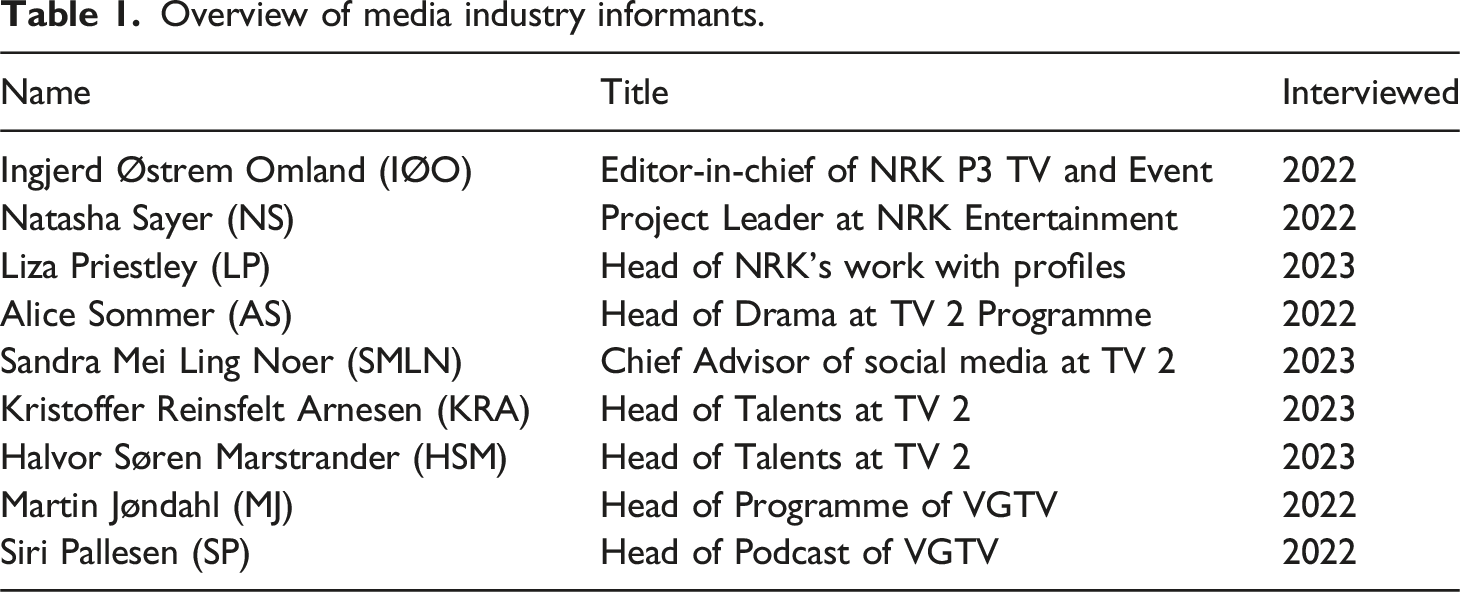
Interviews were conducted face-to-face between November 2022 to June 2023, each lasting approximately 60 minutes. The interviews consisted of two parts. First, we utilised a semi-structural interview guide to ask about informants’ perception of youth audiences and (youth) entertainment, the challenges they face in catering to youth, and the strategies they employ to produce content for this demographic.
Industry statements with responses.
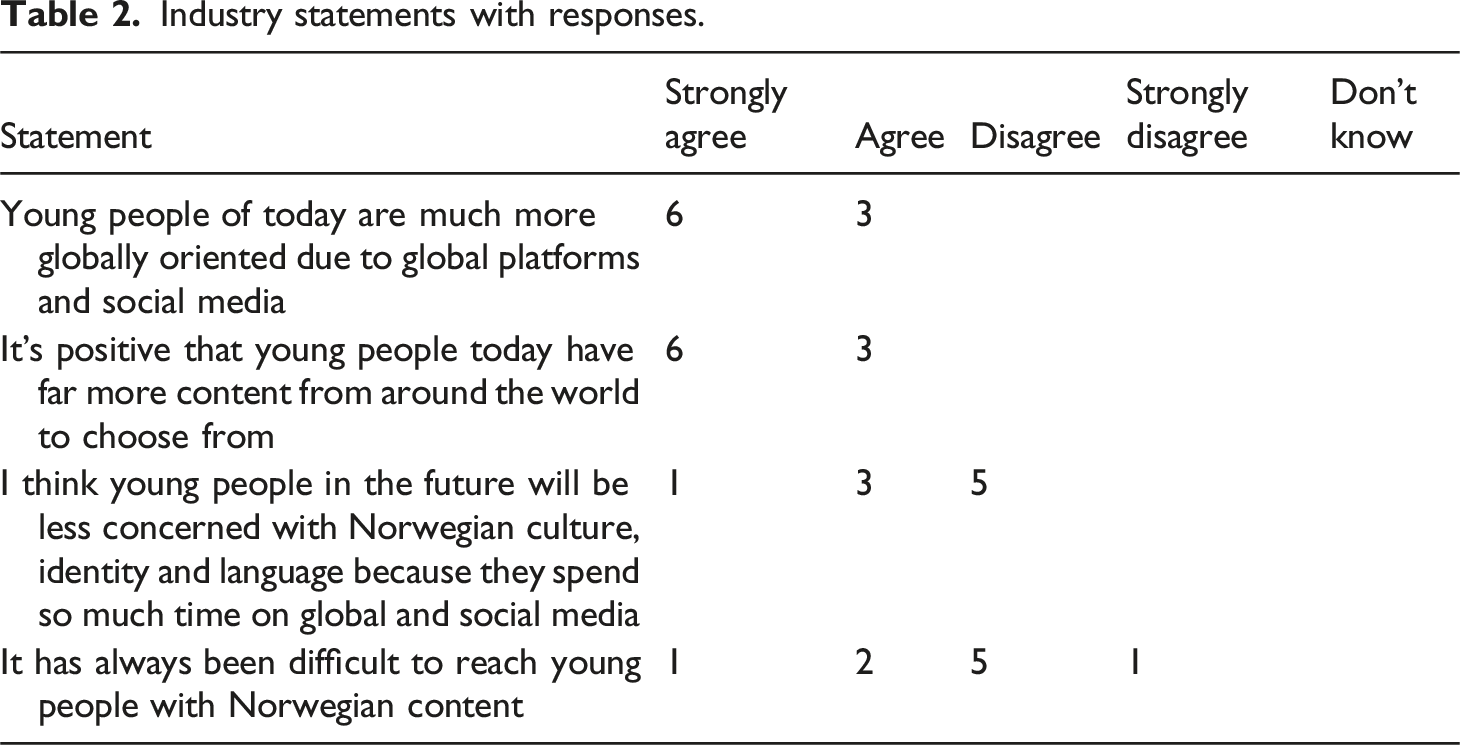
Youth study
Overview of teens interviewed and their top five ranked cards for media entertainment.
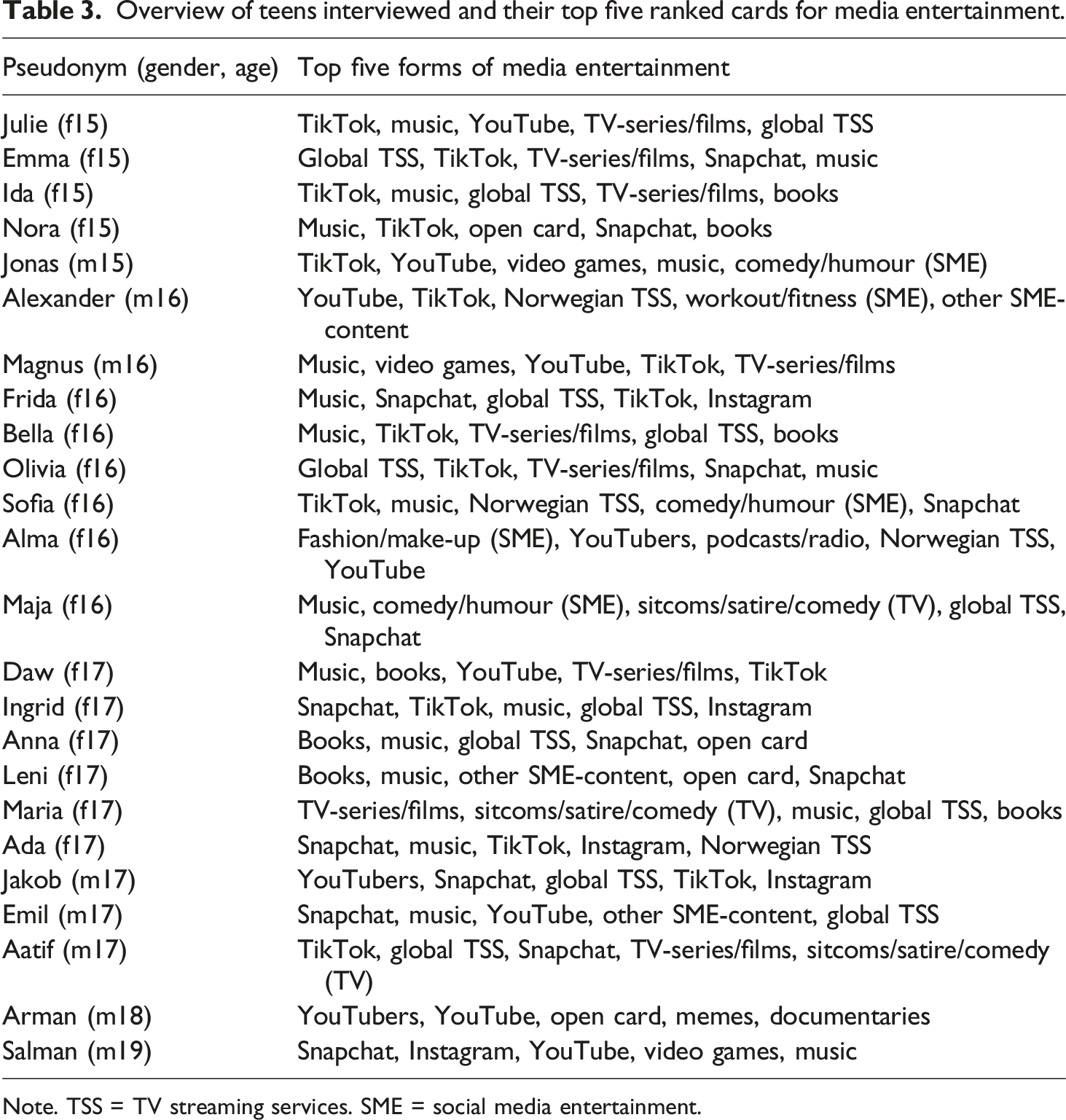
Note. TSS = TV streaming services. SME = social media entertainment.
As part of the interviews, participants were given 30 cards and placed these on a nine-column grid, where the right end reflected media, platforms, and content they considered most important as entertainment, and the left end reflected those they considered least important (see Figure 1). Example of how Alexander sorted the cards (translated from Norwegian to English). For online interviews, the Q-Tip online tool was used (https://qtip.geography.wisc.edu/). Cards sorted under column 1 (left) are least important, and cards sorted under column 9 (right) are most important as entertainment.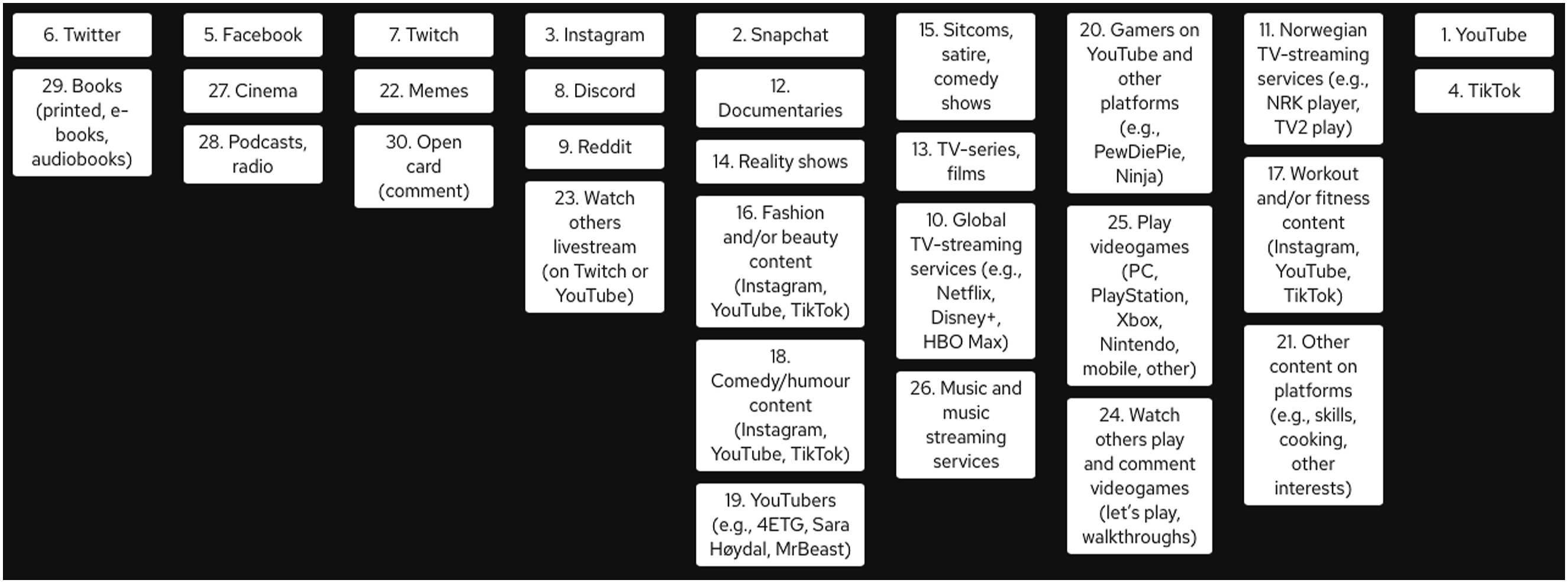
In the first part of the interviews, participants were asked questions related to the cards placed on the grid. For media, platforms and types of content participants considered important, they were asked why these were important, how these fitted into the context of their daily lives, and how they liked Norwegian productions and content. In the second part, we asked participants to reflect on, for example, peer influence on media habits, and about the use of content creators in legacy media productions.
This article does not include a full analysis of the ranking exercise, but Table 3 presents the participants and their top five ranked cards for media entertainment.
Analytical approach and findings
Interviews were transcribed and thematically analysed (Braun and Clarke, 2006), based on concepts relevant to our objective of exploring how domestic media organisations construe home advantages to attract young audiences, and what home advantages are to teens. Our analysis thus draws on proximity theories for exploring domestic media strategies and for exploring what and where ‘home’ is for teens. In the interviews with media industry informants, central themes relate to ideas about strengths of being culturally aligned with Norwegian youth cultures, including opportunities of working with and benefitting from content creators and influencers popular among youth. In the teen interviews, core themes include the place of Norwegian screen productions within pre-dominantly Anglo-American preferences; social media entertainment as important by representing idiosyncratic interests; and the position of content creators as part of the Norwegian celebrity culture. In the analysis, we combine findings from interviews with industry informants and teens: first by addressing the challenge presented by transnational streamers, and thereafter by attending to social media entertainment and content creators.
Transnational streamers, domestic media strategies, and youth preferences
The media industry informants expressed how transnational streamers intensified competition for both audience attention and content rights, creating a shift from a ‘national competition’ to a ‘world championship’, a shift also described in previous studies (Ihlebæk and Sundet, 2023; Sundet, 2021). While the new rules of being in a ‘world championship’ apply to all age groups, informants expressed particular concern about youth, as they were believed to be the first to explore transnational streamers and leave legacy media behind. Consequently, they expressed an interest in understanding young people’s media habits to ‘win back youth’ (see also Lowe and Maijanen, 2019; Olsen et al., 2024; Sundet and Lüders, 2023).
Moreover, informants described how youth use global streamers and social media as their primary sources of entertainment, posing a challenge for national media. However, informants did not view being globally oriented as something negative, and all agreed with the statement, ‘It’s positive that young people today have far more content from around the world to choose from’ (Table 2). At the same time, on a strategic level, many feared being forgotten, suggesting a generational shift in the media habits among youth. AS (TV 2) articulated this sentiment, stating, ‘We cannot take for granted that youth will be loyal to us just because we have always been there. They are used to shopping around. We need to earn their trust’. Similarly, IØO (NRK) emphasised: ‘We must be attractive to every new generation. If not, we run the risk of becoming irrelevant in the future’. Language and cultural proximity were hence not believed to suffice as home advantages for attracting future generations. Instead, such advantages must be built, maintained, and earned through strategic work.
Two frequently mentioned strategies relate to home advantages and warrant further exploration. The first involved creating representative youth culture niches that reflect the daily lives, culture, and identity of youth. Many highlighted the significance of local familiarity and relevance as a competitive advantage over transnational streamers. This strategy is based on two premises: first, that there is something distinct about youth and youth culture that the media can effectively reflect. As one NRK informant argued: ‘Every young generation wants their imprint for posterity that they can go back and look at. (…) There is something about the music, clothes, culture, and language that is telling about the young generation – who they are and where they stand’ (IØO, NRK). As she further explained, youth symbols, slang, and music were crucial for building loyalty and demonstrating that NRK genuinely cared about teens: the public broadcaster did not just provide something for them to watch; it was meant for them.
This strategy also builds on a second premise: that there is something distinct about domestic youth culture that national media can reflect better than transnational streamers. As a result, this strategy aims to use local authenticity and cultural proximity to re-engage with young people. This seems to build on the idea of a domestic ‘cultural youth identity’. AS (TV 2) stressed the importance of ‘national stories’ as an alternative to the ‘universal’ stories provided by global streamers: There are many places you can get international stories, but who will tell the Norwegian stories? (...) If people choose to spend time on us, it’s because we have something different to offer than the global streaming players. We’ll tell what wouldn’t have been told without us.
Creating niche content to reach youth is, however, a demanding strategy. Several highlighted the difficulties of catering to specific niches, especially in a smaller country like Norway, where each niche can be quite limited. Thus, whereas AS (TV 2) considered it important to tell domestic stories, she also noted a shift away from producing content that accurately reflected the reality of youth towards broader and more popular formats: Creating a drama series that resonate with all young audiences is quite challenging. In contrast, larger entertainment and reality shows Kompani Lauritzen [Norwegian reality format], Forræder [The Traitors], Spillet [The Game] and Maskorama [The Masked Singer] tend to appeal to broad audience groups. These reality shows are more likely to be enjoyed as a family, whereas drama series are often watched individually.
This brings us to the second strategy: creating popular entertainment to attract everyone – including youth. Here, we find a shift in genre from teen drama to reality television, humour, and broader entertainment shows. KRA (TV 2) explained, ‘When you make a programme so broad that it reaches many people – we managed to reach 1.5 million people with Kompani Lauritzen – you also get young people. You reach everyone’. Others highlighted the importance of shared viewing experiences, insisting that television, even in the age of transnational streamers, had much to gain from creating shared experiences and larger events: ‘I think, paradoxically, that the larger and more diverse the content offering becomes, the more we need to gather around some stories and feel that we are sharing and co-experiencing them with others’ (AS, TV 2). Hence, this strategy reflects a notion of home advantage by emphasising the value of creating popular content that fuels national conversations and a sense of national community. Humour was often mentioned as a genre well suited to create such conversations: ‘Humour is often very domestic and based on shared references. The community you get by laughing at the same things defines you more than watching the same television crime series’ (AS, TV 2).
Turning from media industry informants to teens, Table 3 demonstrates the continued importance of TV-shows and films: only four participants did not rank TV-series/films, other TV-genres, or TV-streamers among their top five forms of entertainment. Most had a clear preference for Anglo-American productions and expressed familiarity with US and UK culture, history, society, and language (see also Bengesser et al., 2023). They largely relied on transnational streamers, with catalogues that enabled them to watch shows that matched their specific preferences: Ok, we have Bridgerton. We have Gilmore Girls. I’m watching Seinfeld again. We have a K-drama called So not worth it that I’m re-watching. We have Hemlock Grove, based on a book that’s a bit gloomy. We have Twenty-Five Twenty-One, also a K-drama. We have Kim’s Convenience, which I’m re-watching. I’ve just finished Heartstopper, same with Shadow and Bone. I really like watching [series], it brings me so much joy. And I can kind of relate to the characters, which is nice (Maria).
Maria was especially fond of TV-series, and few matched her ability to recall the shows she had recently enjoyed. However, what she shares with many others, is a preference for watching a variety of productions: US and UK series, new and old series, and niche productions of their liking (in Maria’s case, K-dramas and young adult fantasy). Her practice of re-watching favourites is also common among many. And while transnational streamers might prioritise and give more visibility to certain titles, they also include niche shows and older programmes. Most also picked up recommendations from friends and social media: ‘Mainly TikTok, because often on TikTok, they show a scene from a series or film, and it’s like, “Oh, this looks interesting”, and I add it to my watchlist’ (Daw).
Overall, participants skewed towards non-domestic content. There was, however, some variability among them, and for most also a place for Norwegian shows. Moreover, few explicitly dismissed Norwegian productions as inferior in quality. The dominance of non-domestic content was instead a result of availability and choice, similar to Anna Potter and colleagues’ (2024) study of Australian teens. Many had to be prompted a bit to talk about Norwegian productions, though when they did, they regularly pointed to the familiarity that comes with the Norwegian context. This home advantage is discernible when Salman and Arman, both participants with immigrant backgrounds, talked about Svart humor (NRK, 2017-2018), a comedy show featuring stunt interviews in Grønland; an inner-city multicultural neighbourhood in Oslo (see Naerland and Dahl, 2022 for a case-study). Before we got Netflix, we watched a lot of NRK, we watched Svart humor. It was fun because it was on Grønland, that’s where the person was most, you know. And we always hang out on Grønland, so it was fun, and we watched it all the time. What’s fun with Svart humor is that it’s about foreigners, so we can relate, right? Like he says something is ‘grise-dyrt’ [literally ‘pig-expensive’, Norwegian slang for very expensive], and those Muslims are like, no, not pork, I only eat halal. So, it’s immigrant humour (Arman).
Svart humor is about immigrant cultures in Norwegian society. Arman ‘can relate’ because of his background: growing up as a Muslim and second-generation immigrant in Oslo. Regardless of background, ‘relatability’ is a value when participants talked about Norwegian productions. Bella preferred Norwegian comedy shows, ‘because English, or at least American ones are often too much, but Norwegian shows keep it more down to earth. They’re not too over-dramatic, or, like, too silly’. Olivia related to the Norwegian teen drama Lik meg (NRK, 2018-2024), because it ‘addresses a lot of familiar topics, and I find it fun to watch because you recognise yourself in the series’. Though, as she added, ‘but it’s not like I think, “oh, now I’ll watch some Norwegian TV or shows”’.
A barrier to watching Norwegian shows is thus simply that there is so much else to choose from. However, family-friendly reality shows seemed to strike a specific chord that can be understood as home advantage. Shows like Kompani Lauritzen (TV2, 2020-), 71 grader nord [No Boundaries] (TVNorge, 1999-), and Mesternes mester [Champion of the Champions] (NRK, 2009-) were frequently mentioned as programmes participants would watch, often in a family-setting. These are competition-based reality-series, featuring Norwegian celebrities and athletes. Some participants, like Jakob, Ingrid, and Sofia, were fond of both Norwegian reality shows and global formats. While shows like Ex on the beach (FEM/Discovery+, 2018-) were watched with friends or alone, ‘when I’m home with the family it’s 71 grader nord and Kompani Lauritzen’ (Jakob). This family-viewing setting also explained why others would occasionally watch these shows (see also Potter et al., 2024). For Jonas, Ida, Ada, Julie, Alexander, and Salman, these were shows they would watch if they were home when their parents were watching: Kompani Lauritzen is fun. We’re a sports family, and my brothers have been in the military, so it’s easy for us to laugh at those unfit people. (...) And Mesternes Mester, I used to watch it, but not so much now. Depends on what celebrities participate, if I know who they are. Weren’t that many this year (Ida).
Reality show participants are increasingly influencers and content creators, and we will return to this in the next part of the analysis.
Social media entertainment and content creators: Niche cultures and home advantages
Social media platforms and content occupy a prominent position among the media forms participants consider important (Table 3). This reflects how social media are an integral part of daily life and how their appeal relates to how they mirror individual interests and preferences (see also Lee et al., 2022; Lüders, 2024, 2025; Schellewald, 2023). For most, it seemed subordinate whether content was in Norwegian or English, and many noted that Norwegian content creators became less central from tween to teen years. What mattered for participants was finding their way to content that reflected them. Perhaps because of how TikTok and Instagram populate feeds with content partly detached from whom users follow, keeping track of the names of content creators is difficult. Alma followed ‘body positivity people on Instagram to get things that impact me in a good way. (…) And some architects because I like architecture. But I don’t remember names’. Bella likewise explained: I’m very fond of food and interior, and of course figure-skating, so I spend a bit of time on that. Food is fun, because you might try it out yourself. Same with interior-design, it makes me want to do the same. (…) I don’t follow specific persons, but often the same persons pop up, but I can’t remember their names.
This is not to say that participants did not relate to selected content creators. Yet given the emphasis placed on authenticity and relational labour in research on influencers and content creators (see, for instance, Arriagada and Bishop, 2021; Cunningham and Craig, 2019), it is noteworthy how participants considered community-building and ‘being authentic’ as part of the ‘job description’ for content creators. Emil noted how content creators ‘often talk in this “we-form”. I think they try to create this sense of community, that it’s like us followers together with the creator’. Ingrid was one of several who referred to the common practice of having Q&As with followers: They answer and are open. It’s a way to include followers and create interesting content. (…) Many share a lot from their own lives, you get this sense of knowing them personally. Many have this ‘I take you into a day in my life’. Like, they talk to you as if you were a friend.
This awareness does not necessarily diminish the experienced value of these parasocial relations. For example, Magnus was fully cognisant of the techniques his favourite YouTubers use to connect to audiences. At one point, he brought up the British YouTuber DanTDM, ‘who I watched when I was much younger, right’. He portrayed how he had watched a recent video of DanTDM with his toddler-son (‘it’s cool how he doesn’t show his son’s face’): And then I remember a couple of years back, when he said his wife was pregnant. And there were so many memories, like, they just flowed back, it’s almost like I’ve grown up with some of them. DanTDM especially. I used to watch him daily. And I see how he’s grown as a person and as a content creator. And I’ve grown older, it’s like parallels almost. (…) He’s like the perfect YouTuber for kids. Because he’s such a nice person. Who creates kids-content, Minecraft-videos. And he’s so good at it and making people feel they’re a part of it.
The affection that characterises how Magnus talked about his childhood favourite YouTuber illustrates how certain content creators can achieve a profound role in teen lives. Magnus now considered himself too old to watch DanTDM and had largely moved on to other YouTubers. But sentiments like ‘growing up’ alongside favourite content creators signal long-term relations of personal significance.
Thus far, we have demarcated a distinction between following content rather than creators while at the same time, acknowledging how participants articulated awareness of and appreciated the relational labour of content creators. Some of these are top-tier content creators that participants have grown up with and relate to in some way or another. For most participants, Norwegian content creators were unquestionably part of the domestic celebrity culture. Hence, they considered these profiles to be self-evident celebrities in legacy media: It doesn’t matter how you’re famous, if you used to be an ice skater or if people watch you on YouTube. There are probably some who don’t think it’s the right type of celebrity. (…) To have influencers participate in celebrity-shows, I think it’s completely right and reasonable. You’re absolutely a celebrity if 100.000 people see you on TikTok every day. You’re much more of a celebrity than a cross-country skier who gave up 30 years ago (Emil).
Participants further expressed an interest in legacy media productions featuring well-known Norwegian content creators. And while some questioned how ‘authentic’ content creators are in their own content, seeing them in a reality show would showcase their ‘real’ side: ‘On reality shows there are many influencers who do fashion, but when you get to see them more, you see their other side, their natural side’ (Jakob). Sofia likewise reflected: Farmen Kjendis [Norwegian celebrity-reality] is fun because you know who the people are. It’s people you’ve seen on social media. Or maybe they used to be football-players years ago and now they’re on social media. It used to be like, ‘on social media you can see these real persons’. But it’s no longer that way, so it’s like, ok, on Farmen Kjendis, you really get to see real people. You’ve seen them on social media, but now you see them in a completely different setting. So, it’s clever to include these celebrities, like how does Sophie Elise react to being on a farm.
For the media industry informants, the popularity of content creators and profiles among youth implied that they worked extensively to recruit them in their entertainment offerings: ‘Profile-based content has been one of our biggest entertainment successes. If you have a good idea and someone to promote it and share it with an audience, it can elevate into something greater’ (KRA, TV 2). Similarly, one informant working in a division focusing on ‘profile-based entertainment universes’ explained: ‘We think of content as content universes. (…) As soon as we started working that way, we gained more power of definition among youth’ (MJ, VGTV). ‘Power of definition’ is used here to refer to the influence that shapes the understanding and perception of the world among youth.
There were numerous strategic reasons why industry informants wanted to utilise content creators and influencers. One reason was to benefit from their authenticity and intimacy to build loyal relationships with young audiences, a point also acknowledged in the teen interviews. Many referred to the industry trope ‘people follow people’, highlighting the value of well-known people like content creators when aiming to build loyalty and trust: ‘Young people ‘shop’ around but are loyal to what they like. (…) They are more loyal to people and profiles – ‘people follow people’ – that’s the whole point of influencer culture’ (IØO, NRK). Or as SP (VGTV) stated, ‘A good strategy is to use big profiles that already have an established fan base’. Many emphasised how the connection teens had to certain content creators and influencers invited for new industry-audience relations characterised by deeper engagement among teens.
Another rationale was how profiles could be leveraged to promote productions and generate buzz on social media, that is, exploit the promotional power beholden by these as social media natives: ‘We want to create attention around our content. It’s a big bonus that we have many profiles that have dedicated followers who want to see what they are up to’ (SMLN, TV 2). Underlying statements like these was the value of ‘familiar faces’: ‘For the audience, TV 2 are the people on TV 2. (…) That’s why profiles are essential for us. They are our showcase’ (KRA, TV 2). Some of the referred content creators, influencers, and profiles were well-known celebrities, meaning that collaborating with them would attract media coverage and further boost attention and promotion.
Finally, informants emphasised the importance of utilising content creators and influencers to attract talent and develop innovative formats. Several informants argued that attracting content creators means attracting individuals with the necessary skills and talent for the future. As explained by MJ (VGTV): We learn a lot from gamers, YouTubers, TikTokers and influencers. Everything from how you tell a story to content and ideas. (…) Look at MrBeast. He takes a ten-hour TV series and packs it down to a 25-minute episode. (..) You get ADHD by watching, but you learn a lot.
Others emphasised the importance of appealing to content creators and influencers, despite the challenges of collaborating with them due to their different work logic and commercial collaborations: ‘We must be attractive to content creators, profiles and future programme hosts. (…) We must position ourselves as a media house for the younger generation. We must make sure TV 2 is an attractive place to come when you have new ideas and thoughts’ (HSM, TV 2). This strategy can be seen as an effort to ‘bring home’ young audiences by using content creators whom young audiences perceive as embodying the concept of ‘home’.
Conclusions and implications
Our analysis portrays what it implies to grow up in a media world of abundance and choice, and how this is reflected in preferences for a variety of screen entertainment, some of which connect to what and where ‘home’ is for teens. Examples are niche productions where transnational streamers have an advantage accrued from their global reach (Lotz, 2021), and social media entertainment tying in with idiosyncratic preferences. ‘Home’ is also what connects teens to their social world: entertainment preferences they share with friends and family, or that connects to a Norwegian context. Our analysis further explicates how industry informants activate home advantage ideas when reflecting on attracting youth. They express self-confidence in their ability to mirror representative youth niche cultures and emphasise a societal obligation to tell ‘Norwegian stories’. Home advantage ideas are also evident in efforts to offer popular entertainment formats that attract everyone. The interviews further demonstrate the importance of domestic content creators. By recruiting profiles, legacy media benefit from their reach into youth segments, their assumed ability to be authentic, and their capabilities to develop innovative formats.
We will elaborate on three findings and discuss their implications for refining notions like proximity and home advantages. First, we find that youth like content offered by domestic legacy media, but it is not their home turf. Our teen interviews indicate that the problem is not that domestic media do not make high-quality content or that they are detached from contemporary youth lives and cultural currents. Rather, the Norwegian context is but one of a multitude of contexts teens relate to and turn to for entertainment. With Morley and Robins, we might also question the idea of a ‘pure, internally homogenous, authentic, indigenous culture’ and acknowledge how ‘every culture has, in fact ingested foreign elements from exogenous sources, within the various elements gradually becoming “naturalised” within it’ ([1995] 2002: 129). This is likely an even more accurate depiction today, and while transcultural flows do not eradicate a sense of nationally grounded culture and heritage, what is experienced as culturally relevant or proximate expands beyond national identity. It is not so much that domestic content is experienced as irrelevant, but that teens have a ‘world of content’ to choose from.
A second key finding is that domestic legacy media seem to have a stronger home advantage in popular and broad formats like humour and reality shows compared to drama series. Domestic humour and reality operate under different production logics and meet different audience needs, competing on other terms. While teens express a desire to watch international ‘world-class’ drama series, they also enjoy domestic humour and reality shows. Many of these productions are based on international formats, which allow them to represent international brands and connect to worldwide paratexts, all the while showcasing Norwegian celebrities who speak Norwegian and reference Norwegian culture. The appeal of these shows also stems from how they feature domestic celebrities, comedians, content creators and online profiles. Compared to news media (Meese and Hurcombe, 2021; Olsen et al., 2024), this speaks to how entertainment formats can sidestep becoming too platform dependent. By involving content creators in their productions, domestic media leverage the platform-reach of creators while evading the downsides of platform-dependence.
Our objective with this article was not to expose misconceptions about youth but to explore the challenges domestic media face in staying relevant to teenagers. Far from identifying misconceptions, we find an alignment in the understanding of reality among industry and teen informants. A third key finding is thus that the combined industry-audience perspective foregrounds how industry perceptions align with youth experiences. The issue is not that the industry fails to comprehend the situation, but that youth are preoccupied with screen entertainment elsewhere and have an overwhelming amount of content to choose from.
The combined perspective offers insight into the relevance and limitations of proximity as an explanatory notion for understanding audience motivations and industry strategies. The idea of home advantages, as derived from a shared national context, resonates with industry perceptions and partly with teen practices. However, home advantages manifest in ways that differ from traditional interpretations. The domestic context ‘converts’ to home advantages for formats related to humour and for reality shows featuring influencers and content creators whom youth know from social media. We also find that what and where ‘home’ is varies, not only among teens but also between teens and industry workers. Industry informants operate with the metaphor of bringing youth ‘home’, but for most teens, what feels culturally home is a manifold space of largely non-domestic entertainment from transnational streamers and social media. Adjustments of proximity theories developed for a time of limited choice and mass audience (Lotz et al., 2022) must hence consider the abundance of content and choices available, but also what constitutes ‘home’, both within the media industry and among audiences. ‘Home’ does not refer to a single entity and likely never has.
Footnotes
Author contributions
Declaration of conflicting interests
The authors declared no potential conflicts of interest with respect to the research, authorship, and/or publication of this article.
Funding
The authors disclosed receipt of the following financial support for the research, authorship, and/or publication of this article: This article is produced in association with the research project hosted by the University of Oslo, ‘GLOBAL NATIVES? Serving young audiences on new media platforms’, funded by the Research Council of Norway under Grant Number 315917.
Ethical statement

Data Availability Statement
The research data for this study will not be shared in a data repository. Anonymising qualitative data is difficult and requires extensive redaction (to avoid the possibility of re-identifying study participants through background information) and hence reduces the quality of data for re-use purposes.