




Abstract
This article contributes a missing insight into the everyday experiences of local journalists when reporting on stories involving Muslims. Using qualitative interviews with local and national journalists on their experiences of reporting stories involving Muslims, I investigate how ideas of belonging shape their journalistic practices. The study finds that the experiences of national journalists mirror the Othering of Muslims found in studies of press discourse, reflecting national newspapers’ preoccupation with questions relating to the loyalty and belonging of British Muslims. In contrast, the experiences of local journalists’ and their very different interpretations of journalism built on ideas of community, audience and public interest reflect conscious efforts towards fairer reporting on stories involving Muslims. Using Charles Taylor’s concept of social imaginaries to make sense of these findings, I demonstrate how the accounts of the local journalists reflected a social imaginary of their audiences that very much included, rather than excluded, local Muslim communities. This inclusive social imaginary became reflective of the practices of local newspapers, both in terms of their media outputs and their own journalistic identity.
Keywords
Introduction
In their meta-analysis of 345 studies on Muslim representation in the media of mainly Western countries, Ahmed and Matthes (2017) find a dominant, shared tendency of the media to negatively frame Muslims as the dangerous ‘Other’ in opposition of liberal, Western values. Similarly, research focussing on the analysis of British newspaper coverage reflects how Muslims are represented in ways that draw on historical, often Orientalist stereotypes while portraying British Muslims as the problematic outsiders of British society (Baker et al., 2013; Moore et al., 2008; Poole, 2002). Stories involving Muslims are dominantly framed around a discourse of cultural incompatibility (Poole, 2019), a failure to integrate or as what Modood (2019) describes as the ‘illegitimate child of British multiculturalism’ (p. 122). This preoccupation with questions of belonging and citizenship has become a prevailing theme that cuts across studies of Muslim representations in the media across disciplines (e.g. Jaspal and Cinnirella, 2010; Malcolm et al., 2010).
Journalists often sit as arbitrators amongst the multiple representations on offer, making sense of conflicting accounts and how a story should be framed (Said, 1997). Yet little is known about how journalistic practices and judgements contribute to the production of negative Muslim representations in media discourse. Studies of newspaper coverage have been invaluable in providing an insight into the anti-Muslim bias within the British press but cannot provide direct empirical evidence about how news stories about Muslims came to be reported in a particular way, or the tensions that might underlie how a story has been framed. The study makes an important contribution to this missing insight by shifting the focus of analysis from newspaper coverage to those who produce this content, that is, journalists themselves. Using rich data from 23 in-depth qualitative interviews with professional journalists working for British newspapers, the study provides a ‘behind the stories’ investigation into the reporting and framing of stories involving Muslims across different types of newspapers.
The study uncovers significant differences in the experiences of national and local journalists when it comes to reporting on stories involving Muslims. These findings demonstrate how different interpretations and understandings of journalism’s roles and responsibilities to their audiences lead to different ways of representing Muslims. In this article, I discuss the implications of these findings for how journalism practices can either perpetuate long-standing media biases or create the necessary conditions for fairer, more balanced coverage. Using Charles Taylor’s concept of social imaginaries, I discuss how the interviews with local journalists reflected a significantly different social imaginary of their audiences compared to that of national journalists. Muslims were seen to be an integral part of the local communities they served rather than the problematic ‘Other’ as seen in national newspaper coverage. This inclusive social imaginary became reflective of the practices of local newspapers, both in terms of their own journalistic identity and the stories they produced.
Literature review
Citizenship, belonging and representation
For more than two decades, scholars from across academic fields have examined the representation of Muslims and Islam in British newspapers (Ahmed and Matthes, 2017; Baker et al., 2013; Bleich et al., 2015; Jaspal and Cinnirella, 2010; Moore et al., 2008; Morey and Yaqin, 2011; Poole, 2002, 2019). This now considerable field of research consistently underscores the over-prevalence of disproportionately negative media representation of Muslims, often reproducing historical Orientalist stereotypes (Said, 1997) and oversimplified, homogeneous depictions of Britain’s diverse Muslim communities (Ahmed and Matthes, 2017). Moore et al. (2008), for instance, highlight how two-thirds of newspaper articles between 2000 and 2008 framed British Muslims as a terrorism threat, a problem (in terms of incompatible differences); or generally in opposition to British values (p.3). An over-arching theme of ‘Othering’ dominates this coverage (Said, 1997), relegating Muslims as cultural outsiders of British society. This reductive image of British Muslims is juxtaposed as a confrontational ‘Us’ against ‘Them’ framing narrative set against an imagined self-image of what constitutes Britishness.
Patterns of media coverage demonstrate that Muslims have become increasingly represented as a cultural threat to the Western liberal way of life (Ahmed and Matthes, 2017). This critical shift in the media’s scrutiny of the ‘Britishness’ of Muslims became even more pronounced after the London terrorist attacks of 7/7. Media narratives about Muslims become framed as what Morey and Yaqin (2011) describe as ‘a project of national repair and cultural retrenchment’ (p. 66).
Recent analyses of major British newspaper stories further evidence this shift to a discourse of cultural incompatibility where Muslims become the problematic minority group within integrationist models of citizenship (Poole, 2019: 480). These studies concentrate on specific high-profile news events, such as the Jyllands-Posten controversy (Meer and Mouritsen, 2009); the Charlie Hebdo incident (Jenkins and Tandoc, 2019; Luengo and Ihlebæk, 2019); the Trojan Horse Affair (Poole, 2018); the UK ban on anti-Islamic Dutch MP Geert Wilders (Poole, 2012); the wearing (and banning) of the Muslim veil (Khiabany and Williamson, 2008; Williamson, 2014) and the grooming gangs scandals (Cockbain, 2013; Cockbain and Tufail, 2020) for a more qualitative analysis of the framing of Muslims around issues of citizenship, national identity, Britishness, multiculturalism and liberal values. Across media coverage, Muslims are positioned within what Poole (2012) describes as ‘a discourse of the nation’, leading to the creation of ‘insiders and outsiders within a polarised identity politics’ (p.164). By homogenising Muslims as cultural outsiders, Muslims have become relegated as a separate imagined community to the rest of British society (Baker et al., 2013).
National and local representations of Muslims
Studies examining press coverage in the UK focus on national newspapers, reflecting how different types of newspapers report on Muslims depending on news values, style and audiences (Poole, 2002). Tabloid newspapers, for instance, are more likely to adopt discourses linking Muslims to terrorism and conflict (Baker et al., 2013). Broadsheets often frame coverage around a ‘clash of civilisations’ narrative which places Muslims in opposition to Western values, or on Muslims as evidence of the failure of multiculturalism (Moore et al., 2008: 15). Right-leaning newspapers tend to be more negative towards Muslims than left-leaning ones (Bleich et al., 2015). While left-leaning newspapers generally more diverse in their representation of Muslims, they also struggle with Muslims more than with other minorities due to their strong anti-religious, pro-secular position and the defence of liberal values such as freedom of expression (Poole, 2002).
There is little direct empirical analysis of how local British newspapers report on Muslims, and how this differs from the national press. Local media in general gets much less scholarly scrutiny compared to the national media (Nielsen, 2015) and comparisons in terms of ethics, journalism practices and normative values are even rarer (Firmstone et al., 2022). In relation to coverage involving Muslims, recent research indicates that regional news television in the UK presents a significantly higher proportion of stories showing a supportive sentiment towards Muslims compared to the more confrontational and negative tone often adopted by national news broadcasters (Hanif, 2021). The research also finds that regional news channels are more likely to include stories about local initiatives by Muslim communities and stories where Muslims have been victims of Islamophobia. There are little (if any) comparable findings that focus on local newspapers and their coverage of Muslims.
More generally, journalism scholarship points to several characteristics of local journalism that might make it more amenable to the more inclusive and supportive reporting of Muslims found in regional television news channels. Local newspapers tend to have distinctive newsroom cultures shaped by closer relationships to their readers (Wahl-Jorgenson, 2009) where journalists and readers are seen to be part and parcel of a single community with common values and goals. Local journalists perceived responsibilities to the local community and local readers often translates to a more considered approach to reporting and a reluctance to sensationalise or disparage their own communities (Firmstone et al., 2022; Frost, 2006).
In this article, I explore how these different characteristics of local journalism can lead to different ways of representing Muslims compared to national journalism. This is particularly important for two key reasons. Firstly, most of our understandings about how Muslims are represented in the media is based on national newspaper coverage. While this research gives an important overview of the dominant negative bias against Muslims, it is not possible to interpret the intentions behind these representations, nor the wider social and cultural drivers that might influence journalism practices in the reporting of stories about Muslims. Secondly, the article addresses a major gap in the field about how different interpretations about journalist’s roles and responsibilities – particularly regarding the audiences and publics they serve – might directly impact on how stories about Muslims are told.
In this article, I introduce Charles Taylors’ concept of social imaginaries as a useful analytical tool to explore this further, including how ideas of belonging and inclusion can directly impact on the everyday practices of journalists. Taylor (2004) introduces the concept of social imaginaries as the shared understandings and assumptions that people within a society have about their collective lives. This includes understandings of ‘the ways that people imagine their social existence, how they fit together with others, how things go on between them and their fellows, the expectations that are normally met and the deeper normative notions and images that underlie these expectations’ (Taylor, 2004: 23). The social imaginary provides a framework for common practices and a sense of legitimacy in society, reflecting a collective understanding of the morals, beliefs, values and symbols that dictate how members should interact and live together. Ideas become embedded into the social imaginary through the interweaving of understandings and practices. In this article, I relate this to how both national and local journalism practices are built upon particular social imaginaries which in turn reinforce or challenge how journalists report on stories involving Muslims.
Methods
In contrast to most of the content-analysis based research in the field, I used in-depth qualitative interviews to address the significant gap in the field of research on Muslim media representations to directly consider journalistic framing practices as opposed to the framing of journalistic products (Baden, 2019). Qualitative interviews can provide an authentic insight into the experiences of journalists in the reporting of stories involving Muslims, while also exposing the ‘the unpronounced, illogical and dissonant sides of journalism’ (Zelizer, 2004: 111) missing from studies of content-analysis.
A sample matrix was created to recruit a broad cross-section of the British journalists with a diverse range of experiences including tabloid/broadsheet, right-leaning/left-leaning newspaper titles, local/national and Muslim/non-Muslim (see Table 1). This included a mix of senior/junior journalists as well as news agency and freelance journalists in recognition of the conditions that journalists now work under.
Sample breakdown.
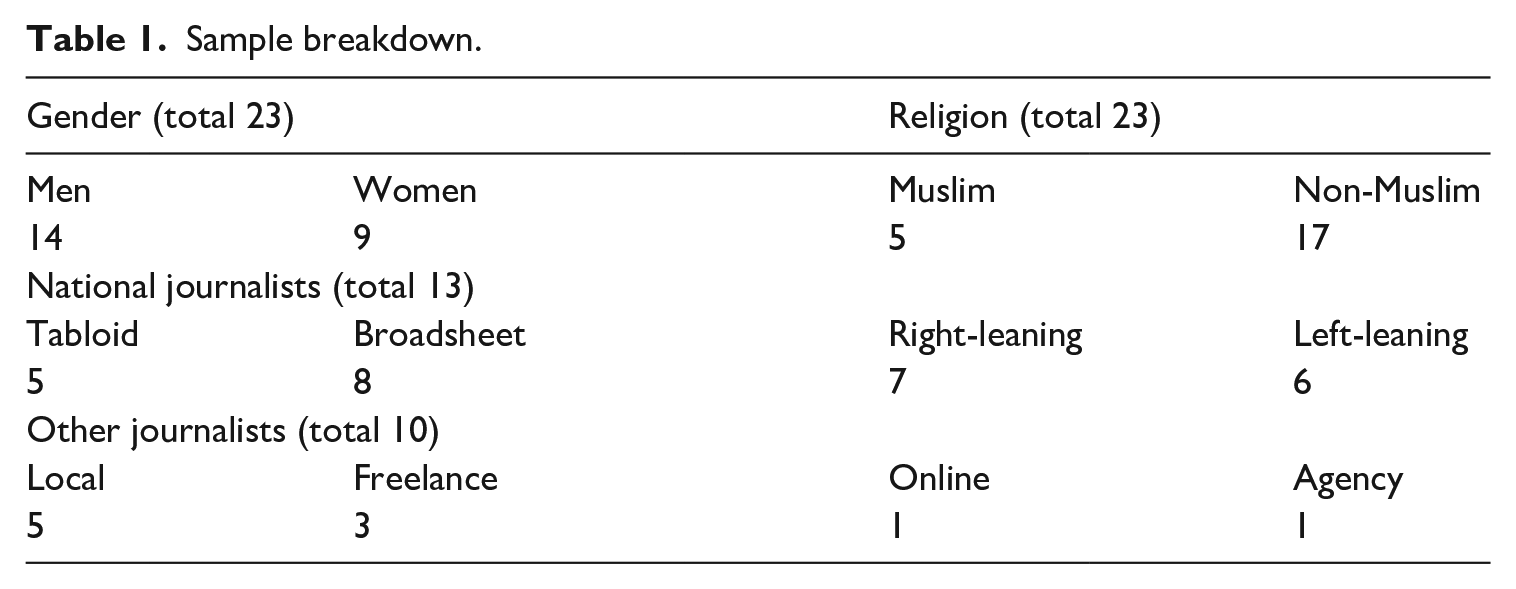
The sampling procedure comprised multiple stages. Initially, a selection of journalists who had covered Muslim-related subjects was compiled by shifting through hundreds of online articles from various newspapers. After identifying this pool, journalists were approached in successive waves to achieve a balanced representation across the sample spectrum. For instance, if an initial tranche yielded more left-leaning newspaper journalists, the subsequent tranche would prioritise recruiting right-leaning counterparts and vice versa. This iterative approach entailed four recruitment and interview rounds in total (for sample breakdown, see Table 1). Journalists from the right-leaning newspaper titles were much more difficult to recruit. Right-leaning newspapers have come under considerable criticism for the way they portray Muslims and, as similar studies have found, journalists working for these newspapers are more reluctant to participate in this type of research (Holohan and Poole, 2011).
A total of 23 (n = 23) in-depth semi-structured qualitative interviews with British newspaper journalists were carried out between January to July 2018. The interviews were carried out mostly in person and each lasted approximately 60 minutes. An interview schedule was drawn up to serve as a flexible guide for the interviewer. This was divided into four sections: 1. Questions about participants personal journeys into journalism; 2. Questions about Journalism as a practice; 3. Specific discussions about articles written by journalist involving Muslims; 4. Questions about the general debate on the negative representation of Muslims.
The interviews specifically sought to investigate the interplay between journalists’ conceptualisation of their professional role and identity and the practical execution of news production. For this reason, an integral component of interviews involved a dialogue about published articles authored by journalists which involved Muslims and Islam, covering diverse subject matter including terrorist attacks and ‘grooming gangs’, to discourse on Islamophobia, controversies regarding the Muslim veil and local or regional matters concerning mosques or charitable initiatives led by local Muslims.
Pseudonyms were used to anonymise all interviewees for consistency. Some journalists had expressed concerns about being identified in their interviews, particularly if they were being critical of the newspapers they worked for. Interviews were audio-recorded and transcribed, and then analysed using a thematic discourse analysis. This version of thematic analysis overlaps with discourse analysis in its consideration of the broader assumptions, structures and meanings underpinning of the themes emerging from the data (Braun and Clarke, 2006: 85).
Findings
A national imaginary of Muslims
Throughout the interviews with national journalists, I found that their experiences of reporting on stories involving Muslims mirrored the characteristics of the negative representations cited in studies of newspaper coverage. The same tropes and discourses about Muslims as a problematic part of British society were seen to be embedded within the culture of newsrooms. Senior tabloid journalist Stephen, for example, shared:
I have often had these conversations with colleagues in which I have questioned their journalism - they absolutely refused to accept they’re behaving in a racist or an unethical way. And you say why do you portray Muslims like this, and they say because that is what they are like, that they are violent. I mean that’s what you get, and they genuinely believe it and there is evidence you know they are terrorists.
Examples of this could be seen across my data, including in interviews with journalists working for more liberal, left-leaning broadsheet newspapers that usually championed anti-racism and ethnic minority causes. Muslims were often a source of tension for these newspapers as their religious beliefs and practices were seen to contradict other liberal causes such as feminism or LGBTQ+ rights. The wearing of the headscarf and the burka by Muslim women can be seen as a case in point in the following two interview excerpts:
We’ve had writers not necessarily in [our newspaper], but certainly in the liberal press fighting in the past that it’s the job of white women to tear off hijabs and face coverings of Muslim women (Patrick, left-leaning broadsheet journalist) I remember after one of the terrorist attacks, when a gay guy who was a prominent figure on the newspaper said I was walking down the high street and I saw this woman coming towards me in a burka. And you know I just felt profoundly threatened by her [. . .] I think there was a lot of sympathy for him in the [news]room that, you know, he’s got a point that woman could be hiding a bomb under her burka. (Francesca, left-leaning broadsheet journalist)
While almost all the journalists I interviewed projected a critical view of this anti-Muslim bias within national newspapers, there was a sense that these views were embedded as almost normal within the fabric of the national British press industry. Rather than reflecting an overt and direct anti-Muslim racism or Islamophobia, the separation and differentiation of the Muslim ‘Other’ had become the systemic norm for reporting on stories about Muslims. This reflects how, as Holohan (2014) points out, ‘racialised discourses are constructed systematically through the stream of narratives that emerge from a particular perspective’ (p. 41). Part of this relates to the long-standing lack of diversity within national newspaper organisations (Poole, 2019), but also a failure to recognise Muslims as an integral part of the national social imaginary. As broadsheet journalist Patrick told me:
Well, [the media] just sees Muslims as if they are not people like us. We will talk about them. We won’t talk to them. We won’t listen to them. Of all we know about British Muslims, of all this country knows about British Muslims, 99.9% [sic] of it is either reported or written by white people. So, the perspective on their lives is a completely outsider perspective.
I also found a strong consensus amongst national journalists about the commercial value of stories about Muslim that generated fear and anxiety amongst news reading audiences. The demand for these types of stories was seen to be driven by existing prejudices held by audiences against Muslims, and further stoked by the newspapers. Broadsheet journalist Brendan, for example, spoke about the fear factor that made news stories on Muslims more appealing to readers:
It (is) all about inflaming the prejudices and playing on the fears of the readership because people want to read this stuff. And it (is) very much that kind of ramp up the fear factor, what people are most afraid of. Stoke their fears make them afraid, make them want to read, make them prejudice, all that kind of stuff.
By positioning Muslims as the ‘Other’, it was difficult to see how ideas of audiences and the wider British public served by newspapers included Muslims as part of that national social imaginary. In one example, I asked broadsheet journalist Karen why British newspapers might choose to frame stories on Muslims this way:
You’ve got the terrorism and, you know, going right back to 9/11 [. . .] I don’t know. It’s just the ‘Other’ isn’t it. You know, I suppose it is the dress [. . .] the burka, the hijab and all that. It’s just sort of [. . .] because it looks alien.
The interviews demonstrate how Muslim-related stories are not only framed by underlying questions of belonging or alienation but around anxieties about Muslims and a particular fear of their culture. They are seen as a danger to ‘our’ way of life or, as Karen later told me, ‘for changing British communities beyond recognition’. By reflecting back the fears and anxieties of their readers, national newspapers were seen to win audience loyalty by positioning their audiences and themselves in solidarity against the Muslim ‘Other’. As tabloid journalist Martin told me:
It’s about pandering to your readers’ prejudices, giving back to them in terms of what they already think of them [Muslims]. So, it’s like a signalling to say we are on your side, you are under threat, but you know we will always stand by you.
Overall, the study found an underlying sense of the ‘deserving’ nature of negative media representations to be at least partially due to the actions of Muslims themselves – in their religious beliefs and choices, cultural practices or the actions of a very small minority of their communities. At the same time, journalists’ accounts show negative representations about Muslims to be problematic and unacceptable in a liberal and egalitarian British society. This reflects the contradictory nature of negative Muslim representations as driven by the concurrent need to both accommodate Muslims as minorities of multicultural, liberal British society while simultaneously questioning their cultural right to belong.
Communities: Audiences and public interest
In contrast, the study found a very different social imaginary in the interviews with local journalists. This reflected a desire to produce much more nuanced and less sensationalist coverage about Muslims aimed at informing readers in measured ways compared to national newspapers. Furthermore, local journalists were quick to distance their journalism practices from those of national newspapers when it came to stories involving Muslims. Elliott, a local journalist working for a newspaper based in an area in the Northwest of England with a significant Muslim population, described how he differentiated the local press from national newspapers:
I would think certain newspapers do definitely have more of an agenda whether they are right leaning or left leaning. We wouldn’t put a negative spin on the work that these groups do. I think we probably do cover them differently. The local and regional press have a very important role to play in perhaps countering the more biased agendas of the national press. I think that is certainly our case.
Elliott himself had produced a range of what could be characterised as more ‘positive’ proactive stories about Muslims, including the charitable efforts of various inter-faith projects driven by local Muslim community groups. Other local journalists similarly discussed how they would seek out alternative stories as part of their active commitment to delivering a more diverse range of representations of Muslim communities to their audiences.
A key differential between the ethics of local journalism and that of national journalism is seen to be the proximity of the local journalists to the communities they serve (Frost, 2006). Frost elaborates how this close relationship often results in ‘placing a different emphasis on first the approach to the source and the story, and then the way the story is used when published’ (p.278). This further leads to a more thoughtful approach to the story with a reluctance to sensationalise (Frost, 2006). This differential was very evident across the interviews with local journalists. As a local journalist working in the south-west of England, Catherine, pointed out ‘Being a local journalist, you are much more connected to the community that you’re working for because you are in it every day [. . .] I feel a responsibility because if I wrote something about somebody that wasn’t true, or slightly took a quote out of context and it was an unfair representation, I would have to look that person in the face.’
Deuze (2005) argues that a multiculturalist approach to journalism requires a slow and subtle change in the consensual professional understanding of what serving the public really means. This involves a shift from a ‘primary top-down meaning to an increasingly bottom-up application’ (p.456), where journalists actively seek out engagement amongst their diverse communities. When it came to reporting on Muslim-related stories, this prioritised sense of community directly impacted on how local journalists interpreted their own journalism practices including the application of norms such as objectivity. London-based local journalist Ben, for example, emphasised how his journalism practice involved actively avoiding ‘punching down’ on already marginalised sections of the communities his newspaper served, and instead ‘punching up, where it’s about highlighting evidence based, valid concerns and giving them the platform upwards.’ Other local journalists spoke about the importance of adopting a more reflexive positioning to the norm of objectivity to provide a counterpoint to the negative narrative on Muslims coming from both the national media and from social media. In one example, local journalist Thomas shared how he would actively challenge these narratives following a terrorist event to ensure that readers knew that local Muslim communities were not to blame:
I made a conscious decision to do those stories because I think it’s important that the narrative that all Muslims are terrorists is challenged. There’s no better opportunity or time to do that than in the aftermath of a terror attack because there would be people going “fucking Mussies” on social media. I think it’s important as many people as possible should see it - you know there’s a spike in Islamophobia and attacks after every time there is a terror attack.
Through the close connections they shared with their local communities, the local journalists in the study adopted a more reflexive approach to implementing the norms and values of journalism practices (such as objectivity) in line with this prioritised sense of community (which included Muslims) (Haq, 2024). Professional values such as objectivity and balance were seen to be central to local journalism practices, but they balanced this with a felt responsibility to intervene where necessary. This meant that local journalists were more likely to use their platform to challenge negative views of Muslims in their efforts to ensure an informed news service in the interest of all sections of their communities. In contrast, the interviews with national journalists reflected a missing sense of agency that manifested as a resignation to reproducing the anti-Muslim media bias due to different structural imperatives such as organisational and commercial pressures.
This approach highlights the communitarian role of local journalism, where journalists tailor their practices in a way that conforms to journalistic standards and mitigates civic atrophy (Tandoc and Thomas, 2015). Such an approach involves reconceptualising the relationship between the journalists and their audience to one where journalists not only recognise Muslims as an integral part of the communities they serve, but also reflect this recognition in the stories that they produce. Local journalist Elliott, for instance, highlighted how he would consciously challenge stereotypical views of Islam and Muslims wherever possible in his work:
I certainly do my fair bit of that because I do think there is a lot of ignorance around Islam at the moment in this country. Islam is a religion of peace, despite people using that line, you know, mockingly.
In another interview, Ben explained to me how this level of intervention had become central to his role as a local journalist:
The reason I attempt to go the extra mile in my reporting and try to do more community focused stories is to attempt to get a more, I guess it’s a devalued word, but a more truthful picture of where the community is and the real lives of the people within it [. . .] The reason it’s important to tell stories truthfully and accurately is to push back against this dehumanising narrative that is out there.
While local journalists uphold the principle of serving the public interest in their coverage of Muslim-related topics, they also conscientiously weigh the potential adverse repercussions of their reporting on local Muslim communities. The findings support recent research from Wahl-Jorgensen (2024) who reported that editors of local outlets based in deprived or marginalised areas demonstrated strong commitments to the fostering of positive representations of marginalised members of the local community and of community diversity. Wahl-Jorgensen contends that local journalists wield an epistemic authority derived from their intimate, reciprocal ties with the communities they serve, thereby empowering them to challenge representation injustices as trusted insiders within the community fabric.
From these accounts, it is possible to envisage the role of local journalism as a form of counter-public discourse, where journalists’ modes of address are very consciously presented against the dominant Othering narratives of national newspapers. Viewing their local publics as localised citizens rather than news consumers seeking out the latest sensationalist story on Muslims enabled the local journalists to recognise and reject the homogenised, sensationalist representations of Muslims that dominate national press coverage in favour of a more multicultural and multi-perspectival reporting of news events (Deuze, 2005). Deuze describes this approach as one which shifts the orientation of journalists towards a multicultural society in which news becomes contextualised accordingly and where the positions of minorities are redefined.
Returning to Charles Taylor’s concept of social imaginaries, it became evident from the accounts of the local journalists I spoke to that the social imaginary of their local community very much included, rather than excluded, Muslim communities. The voices of these communities were valued as part of public debate. Other voices that potentially caused them harm, and risked disrupting the harmony of the wider community that Muslims were an integral part of, were challenged. This social imaginary became reflective of the practices of their society (Taylor, 2004: 91), both in terms of their local communities and their own journalistic identity and practices. Negative Muslim representation did not reflect their identity as journalists nor as local citizens. Instead, a different ‘social imaginary’ built on the position of a shared cultural community, rather than from a position of seeing Muslims as the problematic Other, became the starting point for their journalism practice.
Rather than adopting the ‘Othering’ frames of national newspapers where Muslims (‘Them’) are placed in opposition to British society (‘Us’), local journalism’s purview of Muslims as an integral part of local society shape how they report on stories. Here, a shared local identity informed the basis of their journalistic practice rather than a divided, national identity where Muslims are represented as outsiders. Such an approach reflects a much more inclusive way of imagining Britishness in line with Taylor’s (2004) concept of social imaginaries as a way of understanding how people ‘imagine’ how they ought to live together as a collective.
The social imaginary further supports a repertoire of practices by providing a common understanding of how people should engage with one another and the world around them. This shared framework enables the development and reinforcement of specific practices that are in line with the values and expectations of the social imaginary (Vertovec, 2012). The accounts of the local journalists I interviewed presented the case where the social imaginary of both journalism and citizenship became re-articulated to a much more inclusive representation of Muslims in British society. This demonstrates the cyclical relationship between understandings and practice at the heart of social imaginaries – where practices are not only contextualised by the understandings behind the social imaginaries but act to reinforce the social imaginary itself (Taylor, 2004).
Conclusion
The study demonstrates how national and local journalists’ very different social imaginary of Muslims influenced their journalism practices when it came to reporting on stories involving Muslims. These differences had the potential to represent Muslims either as the ‘Other’, problematic outsiders of British society or as an integral and valued part of local communities. The experiences of national journalists mirrored studies of newspaper coverage when it came to Muslims – namely, that Muslims are portrayed in ways that position them outside of cultural norms, as antagonistic and alien, as troublesome and deserving of the negative ways in which they are represented. The study found that national journalists believed there was often a commercial imperative behind negative representations, where stories involving Muslims were framed around the fears and anxieties held by audiences to appeal to newspaper consumers. While many of the national journalists I interviewed were critical about the way Muslims were portrayed, their accounts highlight how normalised these representations have become as the starting point on Muslims both within the press industry and for its perceived audiences.
The interviews with local journalists underscore the transformative potential inherent in reconsidering journalists’ perceptions of audience preferences and needs, which in turn can engender alternative approaches to reporting on Muslims. Such reframing positions Muslims as an inclusive component of British society rather than relegating them to the problematic status of the ‘Other’. The local journalists’ conceptions of audiences and their corresponding responsibilities to, and relationships with them reflect the feasibility of reporting on stories in ways that integrate, rather than alienate, Muslims within their chosen social imaginary.
This research makes an important empirical contribution to the field of research on media representations by providing a much under-researched insight into the experiences of journalists themselves when it comes to reporting on Muslims. It demonstrates the need to reconceptualise how journalists view their audiences and the wider public to develop a social imaginary that positions Muslims as an integral part of British society, rather than as problematic ‘Others’. Taylor (2007) argues that a transformation in social imaginary leads to formerly accepted practices becoming reinterpreted to a new meaning. Over time, new ideas and perspectives may emerge that challenge or complement existing beliefs within the social imaginary. As these new concepts are introduced and integrated into the collective understanding, they can lead to shifts in practices as individuals adapt to or adopt these novel ways of thinking and behaving (Vertovec, 2012).
Future research into this area of study may help to shed light into ways for the anti-Muslim media bias to be redressed. The experiences of local journalists contributed such an important normative insight into this issue. However, they only represented a part of the overall sample. This is a potential sampling limitation of the study as all of them worked in areas with relatively large Muslim populations. It could be seen to contribute to explaining their vested interest in challenging negative representations of Muslims, particularly as other researchers suggest that local journalists based in areas with very small Muslim populations can be less concerned about Muslim-related issues (Holohan and Poole, 2011). While the study considers the experiences of the local journalists as integral to highlighting the possibilities for change across all media when it comes to negative Muslim representations, it does not seek to make the claim that these findings can be generalised to local journalism across the board. Moving forward, future research could focus on how a wider sample of local journalists report on stories involving Muslims, further considering the potential impact of the increasing commercialisation pressures faced by the local newspaper industry.
The study highlights the role that journalists can play towards the accommodation of difference in a pluralistic, multicultural society. It suggests that an awareness of their own potential role in perpetuating media biases and inequalities can lead journalists to become active agents in challenging the entrenched practices within their own newsrooms that reproduce and perpetuate anti-Muslim narratives. Without this localised connection and inclusive social imaginary, the national journalists were less likely to intervene and more likely to succumb to the reproduction of dominant (often hegemonic) cultural narratives about Muslims.
Footnotes
Acknowledgements
None.
Data access statement
Due to confidentiality agreements with research participants, supporting data cannot be made available.
Funding
The author disclosed receipt of the following financial support for the research, authorship, and/or publication of this article: This work was supported by the Economic and Social Research Council under Grant [number ES/X004112/1].
