




Abstract
This article asks how the rise in use of SVOD in the United Kingdom during 2020 impacted people’s expectations of public service television (PSTV). Drawing on 56 qualitative interviews with 28 UK participants conducted in 2019 and 2020, the article uses the COVID-19 lockdown to explore how disruption to the context of viewing might shape the cultural meanings people attach to PSTV. Challenging dominant approaches that measure audience assessments of public service media (PSM) against normative criteria, this article focuses instead on the processes through which people’s cultural meanings about PSTV are formed. Examining the interplay of their encounters with, expectations and evaluations of television, it reveals the divergent meanings our participants brought to linear and on-demand television. The article concludes by examining the implications of these expectations for PSM policy and for the ways in which we research people’s viewing experiences and choices amidst the rise of VOD.
Keywords
In August 2020, the UK media regulator Ofcom (2020) released a report on the impact of the first COVID-19 lockdown in Spring 2020 on TV viewing habits. The research demonstrated that in the UK television viewing surged, driven primarily by a doubling in the amount of time that people spent watching subscription video-on-demand (SVOD) services, such as Netflix, Disney+ and Amazon Prime Video. The general trend in viewing behaviour that began in lockdown has continued. SVOD use increased to 67% of all households in the second quarter of 2022 (Ofcom, 2022). Meanwhile, despite a brief increase over the first lockdown, the decline in viewing of broadcast TV witnessed before 2020 accelerated. Although broadcasters’ viewing share (59%) remained well above that of SVOD (18%) in 2021, lockdown appeared to have catalysed the adoption of SVOD services at the expense of broadcast TV viewing.
What these industry statistics are unable to reveal is how these changing audience behaviours might alter the cultural meanings people attach to television. If the adoption of SVOD changed people’s understanding of television as a medium, this would have specific ramifications for the UK’s public service media organisations (PSMs), which are still primarily watched through linear broadcast television. 1 Drawing on qualitative research with UK participants conducted in 2019 and 2020, this article asks: How did the rise in use of SVOD in the UK impact the meanings audiences attach to public service television (PSTV)?
Theorising audience’s cultural meaning-making
The rise of SVOD, and associated processes of digitisation and platformisation, have been understood to present challenges to the normative values underpinning PSTV. The growing use of global streaming services has led to increased commercialisation and pressure to meet the demands of audiences and advertisers over cultural and educational objectives (Andersson Schwarz, 2016; Bonini and Mazzoli, 2022; D’Arma, 2018; Donders, 2021; Suárez Candel, 2017; Van Dijck and Poell, 2015). With declining audiences, particularly amongst younger viewers (Rodríguez-Castro et al., 2021; Tambini, 2015: 1413), the legitimacy of public service media (PSM) as a system is seen to be at risk (Campos-Rueda and Goyanes, 2022; Gonser et al., 2017). Yet despite recognition of the importance of audience engagement to the future of PSM, there is relatively little research into audiences in academic studies of PSM.
As Donders (2021) argues, most of the academic literature on PSM is either normative or focuses on industry and policy practices. These studies understand the value of PSM to be created by PSM institutions and then communicated to the public (see e.g. Cañedo et al., 2022). The small number of audience studies of PSM tend to replicate this approach, typically adopting survey methodologies to measure audiences’ assessments of PSM against pre-existing normative values, such as independence and trustworthiness (Campos-Rueda and Goyanes, 2022; Sehl, 2020). What is missing from this body of research is an examination of the ways in which publics might participate in the creation of value through their actions as audiences (Arvidsson and Bonini, 2015: 166). In doing so, existing studies overlook the fact that audience attitudes towards PSM are cultural meanings constructed, in part, through people’s encounters with television. These cultural meanings contribute to wider evaluations of PSM, not least through evidence-based approaches to policy (such as those adopted by media regulator Ofcom, in the United Kingdom) that assess the value of PSM through audience research. To understand these public assessments of and attitudes towards PSM captured in existing academic and industry research, we need to interrogate to the processes through which audiences create meanings around their media use.
We argue, therefore, that to understand the meanings that people attribute to PSTV, we need to observe the ways in which audiences’ encounters with television shape the expectations and values that they attribute to PSTV. We theorise this as a circular, reinforcing process, in which encounters shape expectations, which shape values, which shape encounters and so on (see Figure 1). Moores (1996: 72) argues that the early stages in which new media technologies are adopted present particularly valuable opportunities to ‘observe situated practices of lay interpretation and cultural distinction at work’. Examining the adoption of SVOD within people’s households during the COVID-19 pandemic, therefore, provides a useful site through which to examine how people’s encounters with SVOD informed their expectations and evaluations of PSTV.
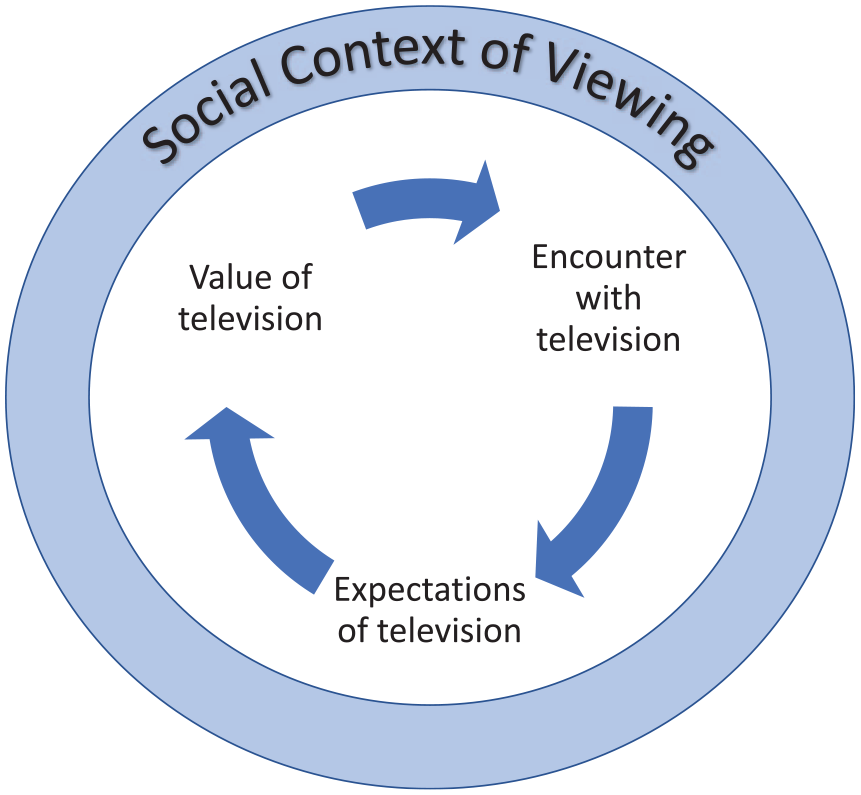
Theorising cultural meaning making about television.
The interplay of encounters, expectations and values is shaped by the social contexts within which people’s television viewing take place, which are subject to change over time. Earlier studies have shown that the adoption of new media technologies is embedded within domestic and media routines and dynamics (see e.g. Gray, 1992; Moores, 1996; Morley, 1986). Yet, existing studies of SVOD audiences tend to separate out VOD from other forms of viewing (Frey, 2021; Giglietto et al., 2019; Lüders and Schanke Sundet, 2021; Mikos, 2016; Steiner and Xu, 2020; Valiati, 2019). 2 Furthermore, this work focuses almost exclusively on self-selecting tech-savvy and heavy media users, obscuring questions of media and technological literacy that have emerged as central in research examining the ways in which audiences navigate the material infrastructures of platform culture (Couldry and Hepp, 2013; Das and Ytre-Arne, 2018). Drawing on critical reception studies of the 1980s and 1990s, this article recognises that the meanings audiences attach to PSTV are constructed within the ‘reception contexts, [. . .] day-to-day settings and practices’ (Moores, 1996: 9–10) of their media use. In doing so, it responds to several recent calls for audience studies to re-situate media consumption within the everyday (see e.g. Couldry and Hepp, 2013; Deuze, 2011; Livingstone, 2015; Turner, 2021). To understand the ways in which the up-take of SVOD during the COVID-19 pandemic might have altered the meanings associated with PSTV, we need to situate SVOD use within an understanding of wider domestic and media consumption contexts and study beyond self-selecting and highly engaged media users.
In this article, we focus on television for two reasons. First, the COVID-19 lockdown in the United Kingdom had a particular impact on audiovisual consumption, as the data from Ofcom above reveals. Second, television remains central to PSM, being used by 60% of European citizens in 2021 (European Broadcasting Union [EBU], 2022a), compared to 44% for radio (EBU, 2022b). However, we recognise the limitation in focusing on audiovisual media at the expense of radio, music streaming and websites, which are often overlooked in studies of PSM, and register the need for qualitative audience research that holistically examines people’s use of the range of media services provided by PSMs. In recognition of the need to understand PSTV use within the context of a converged media environment, television was broadly defined to include all forms of video content accessed in the home, regardless of device, ranging from linear and streamed television to video accessed through social media and online video services (e.g. YouTube and Twitch).
Methodology
Responding to calls for audience research that pays attention to ‘context and everyday life, to cultural communities, and to processes of interpretation’ (Ytre-Arne and Das, 2018: 283), we conducted two waves of in-depth semi-structured interviews with UK adults. The first wave took place in August and September 2019 in the homes of 30 participants, where interviews were conducted according to a schedule that explored the industrial, technological and socio-cultural factors shaping people’s viewing practices with a focus on how they found and decided what to watch. The second wave returned to 28 of the same participants in May 2020 for follow-up semi-structured interviews that focused on how their TV viewing practices changed during the COVID-19 pandemic. Although the UK government was beginning to relax lockdown restrictions, people were largely still confined to their homes with significant limitations on socialising. For this reason, these interviews were conducted via phone, Skype, Zoom or Teams. This gave us a dataset of 58 approximately hour-long semi-structured interviews which were transcribed, thematically analysed and coded using NVivo. 3 Here we focus on the 56 interviews from the 28 participants involved in both waves of the research.
To ensure that our dataset provided insights into the media and technological literacies and coping strategies of participants as they navigated a complex and changing media ecology, we selected participants with a range of TV technologies and included those who placed little value of television, alongside more invested participants. To guarantee diversity of participants in terms of disability, ethnicity, age, gender and class (determined by socio-economic group), participants were recruited and screened by a market research recruitment agency using a participant screening document created by the research team. According to data gathered in 2019, within our sample of 28 participants, three had Freeview built into their TVs, versus 25 who had a set-top box (STB). Seven used a dongle, such as an Amazon Firestick or Chromecast. 24 claimed to use BBC iPlayer; 20 ITV Hub; 11 All4; 5 My5 and 4 UKTV Play. With regards to paid-for subscriptions, 19 reported having Netflix; 11 Amazon Prime; 5 Sky Go; 4 NowTV and 1 Virgin TV Go. Our participant information is summarised in Table 1 below. 4
Participant information.
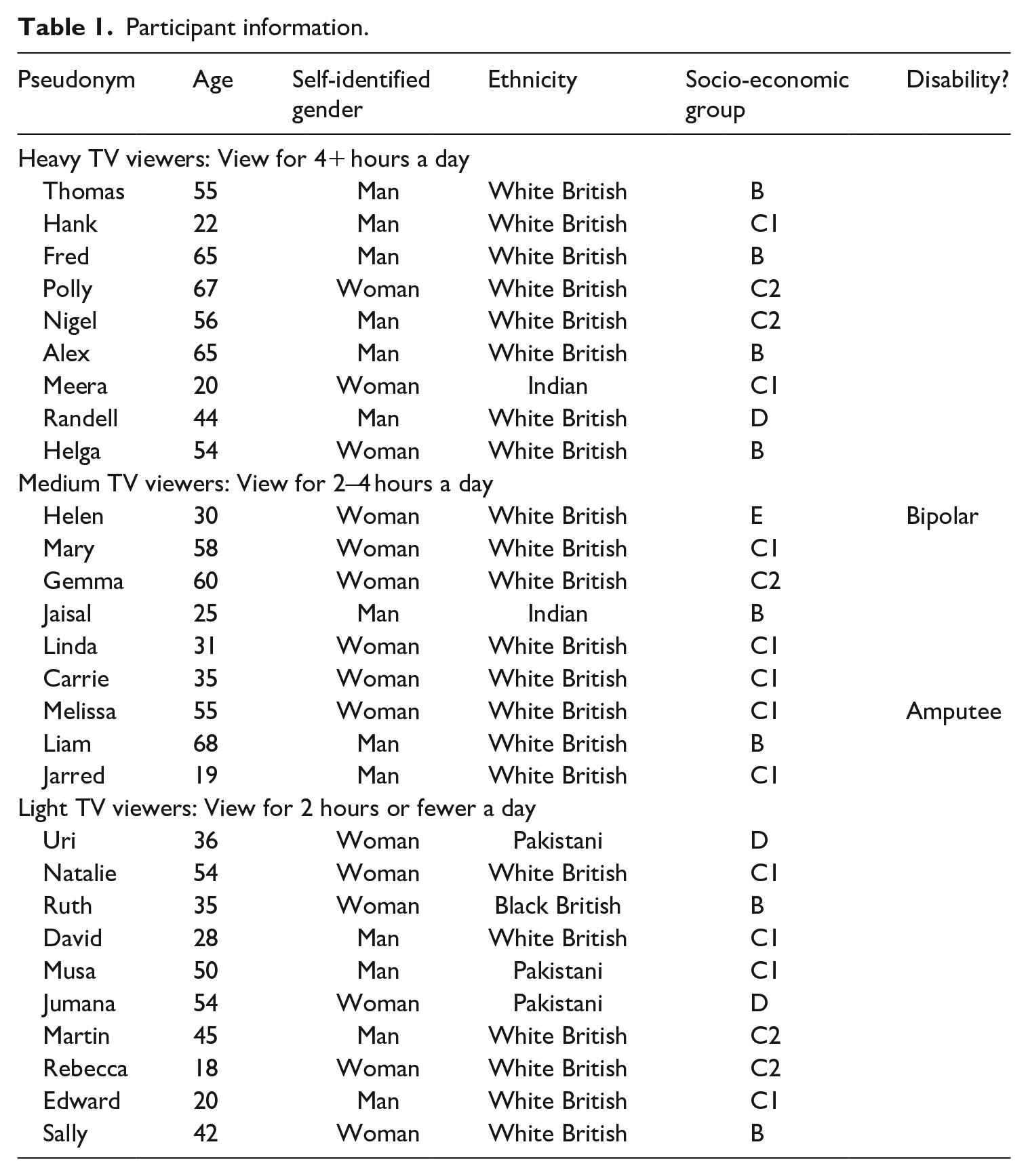
Our sample also included participants who were affected by COVID-19 in a range of ways, including adult children who had returned home from university, parents juggling home schooling and work, people who were furloughed and those still going out to work, those relatively unaffected by COVID and those who had friends and/or relatives affected by the illness.
One benefit of examining attitudes towards PSTV through a wider study that is not focused solely on PSM organisations, is that it enables analysis of PSM in the context of people’s broader viewing behaviours and attitudes. This is particularly important because our study revealed a general lack of understanding across our participants of the UK’s PSM system. Although most participants understood the BBC to be a PSM, there was less understanding that the other free-to-air broadcasters (ITV, Channel 4 and Channel 5) had public service remits. Some participants perceived the BBC to be operated directly by government. For example, David (28, M, White, C1) stated that, ‘[the] BBC is sort of . . . is it government run? I think it is, is it? I don’t know. See, I don’t even know. Who owns the BBC?’ One participant even claimed that ‘we haven’t got a public service television programme as such in the UK, whereas in some countries they’ve actually got their dedicated ones, haven’t they?’ (Liam, 68, M, White, B). Our methodological approach allowed for a more natural conversation about our participants’ engagement with PSTV that was not determined by their understanding of the UK’s PSM system. It also enabled us to situate people’s attitudes towards PSTV in relation to wider changes in their media practices catalysed in part by the COVID-19 lockdown.
COVID-19 and the uptake of SVOD
In line with Ofcom’s quantitative research, we found an increased uptake of SVOD services during the first COVID-19 lockdown. In 2019, most of our participants under 35 were habitual users of VOD and streaming, typically defaulting to on-demand services when watching television. By contrast, older participants, particularly those over 55, were more likely to have never used a SVOD service, instead defaulting to linear TV. These older participants primarily discussed PSTV channels and programmes when describing their viewing practices, typically across a wide range of genres. By May 2020, most of our participants were turning to streaming services as part of their habitual viewing activities, with the older participants integrating SVOD services into their TV-viewing routines. Gemma (60, W, White, C2) and Melissa (55, W, White, C1) are typical of this shift. In 2019, both Gemma and Melissa’s television viewing was driven by linear TV, particularly PSTV. They both watched a range of genres from PSTV providers and strongly associated quality drama with ITV and the BBC. By May 2020, Gemma had begun to integrate SVOD into her viewing routine after Sky offered her a new STB that provided access to Netflix: I would say it’s probably a good 50:50 actually. Half Netflix, half normal TV. [. . .] We’ll have a flip round, have a look at what’s on [linear TV]. If there’s nothing we want to watch or whatever, then we’ll move over to Netflix.
Similarly, it was only during lockdown that Melissa tried SVOD for the first time, after a relative gave her access to their Netflix account. Like Gemma, although she still regularly watched BBC and ITV, Netflix was increasingly replacing them in primetime. As Melissa described, ‘at 9 o-clock, or maybe even sooner, we’re watching a film [on Netflix]’. Another participant, Fred (65, M, White, B) summed up this trend when he stated: I think it’s [lockdown] accelerated a trend, which is mostly a trend away from live TV and to streaming services. [. . .] I’d say there wouldn’t be many days we wouldn’t watch something on Netflix. It’s something I would say has probably now become our most common platform.
There were three broad reasons why our participants adopted SVOD during lockdown: technological, social and industrial. The removal of technological barriers reduced the risk, time investment and energy associated with the choice to try a new kind of television (Hartmann, 2009: 35–36). Much like Melissa, several participants described how their adult children encouraged them to subscribe to SVOD services (particularly Netflix) by sharing their login details. Other participants mirrored Gemma’s experience of being offered a new STB by their pay-TV operator just before lockdown, which removed the technological barriers to accessing Netflix. This was particularly important for our older female participants who, in 2019, were more likely to describe difficulties in using TV technologies (Johnson et al., 2020).
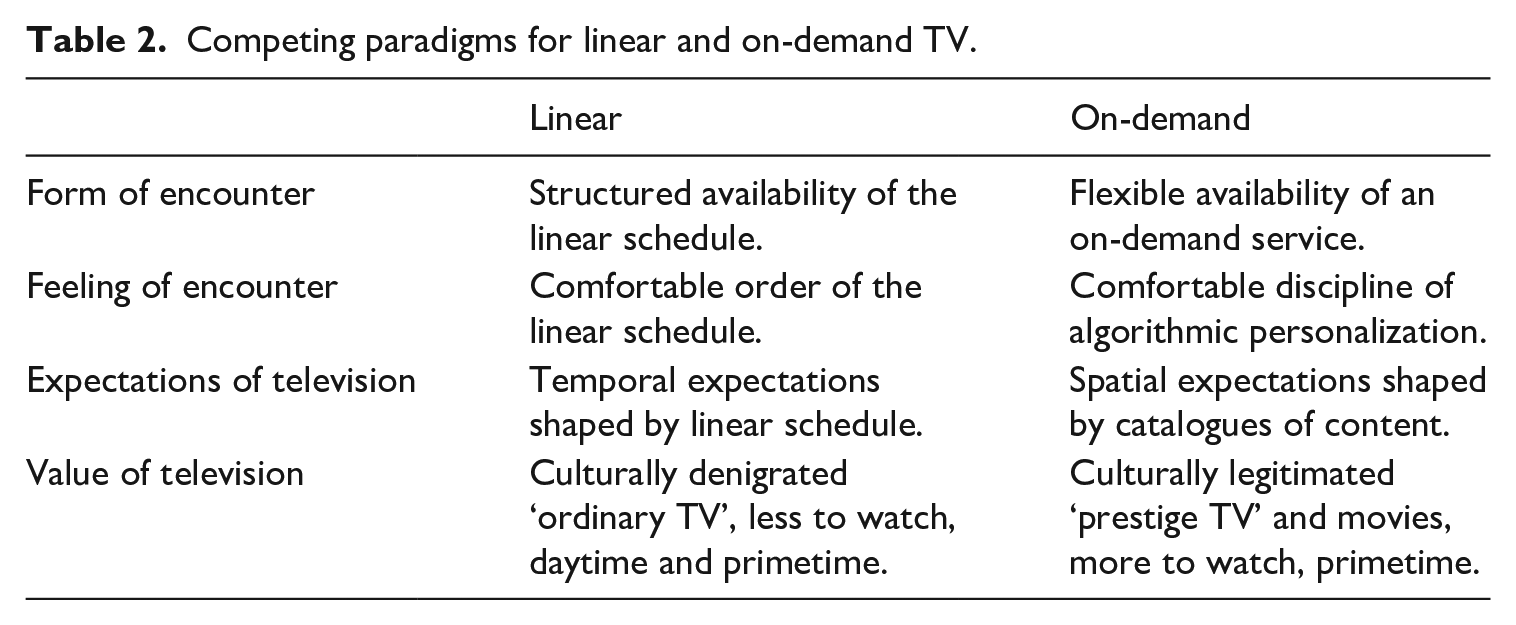
However, as we shall go on to see, changes to the social and industrial contexts of television viewing and production also shaped the adoption of SVOD and it is here that we see the interplay of people’s shifting encounters, expectations and evaluations of television most clearly. In examining these factors, we identify four interrelated aspects of COVID-19’s impact on our participants’ changing attitudes towards television: the form of their encounters with television, the feeling of their encounters with television, their expectations of television, and the values attributed to television (Table 2). The rest of this article will take each in turn, examining how the changing social and industrial context of the COVID-19 lockdown altered people’s encounters with, expectations and evaluations of television and led to very different attitudes towards PSTV and SVOD. The conclusions consider the implications of this for future work on PSM, SVOD and media audiences.
Competing paradigms for linear and on-demand TV.
Form of the encounter: flexible availability versus structured availability
The COVID-19 lockdown altered our participants’ encounters with television. Television became a far more integral part of their social interactions, crucial to maintaining relationships within and beyond the home. In 2020 we found a significant increase in communal viewing as several participants described actively coming together as a family to watch television in the evenings. Musa (50, M, Asian, C1) exemplified this change, describing in 2020: One of the biggest things that has changed, is that collectively as a family we’ve downloaded quite a few series and we’ve sat there in the evenings and watched them together, which rarely happened prior to the lockdown. [. . .] I think it makes us feel a bit better that we’ve started watching something together and talking about it and what have you.
Here television provided the resources for the family to share time together and talk. It reminds us of Morley’s (1986: 22) arguments that television viewing is not always the expression of an individual’s desire to watch a specific programme, but can be used to provide ‘a context for encounters between family members, where the content of the television programme they are watching together may often simply serve as a common experiential ground for conversation’. As Lull (1980: 203) argues, ‘Television viewing is a convenient family behavior which is accomplished together’, facilitating feelings of family solidarity and reducing interpersonal discord.
The formal characteristics of linear and on-demand television informed our participants’ decisions about which TV services they turned to for family viewing during lockdown. The structured availability of the linear television schedules has been more readily associated with communal viewing, understood to provide opportunities to bring people together for shared experiences in contrast to the individuating tendencies of VOD (see e.g. Dhoest and Simons, 2016: 178; 181; Turner, 2019: 225). However, for several of our participants VOD services supported the familial solidarity created through communal viewing because the flexible availability of the content in on-demand catalogues helped our participants to find programmes that fit the different needs and routines of the whole household. Indeed, as Musa above indicates, downloading entire series for the family to watch together became a new routine that provided order, rhythm and solidarity for the household during lockdown.
The flexible availability of programming in on-demand systems also enabled our participants to maintain social connections beyond the home, what Lull (1980: 202–203) refers to as ‘communication facilitation’. With lockdown reducing the opportunities that people had to meet with others outside of their household, many participants described television as an important talking point for online conversations with friends and family. For example, Helga (54, W, White, B) discussed how her and her husband had changed their viewing choices to maintain their social connections with friends: Even old things that were on years ago that never interested us at the time, we’re watching those, probably because we’re desperate to watch what everybody else is watching. And to keep in with, you know, to keep that connection with friends that we haven’t seen physically. That’s our common connection.
VOD services were valued not because they enabled Helga to select the programmes that she preferred, but because they provided resources to underpin her social connections, even if that involved watching programmes that did not particularly interest her. This accords with the findings of Frey’s (2021: 170) qualitative analysis of VOD viewers, that choices were often driven by a desire to ‘keep up’ socially with friends and family, both in person and on social media. The flexible availability of on-demand content enabled our participants to catch-up with programmes that people were talking about, facilitating involvement in conversations and helping to maintain social bonds.
At a time when lockdown confined people to their homes and limited their ability to socialise, television provided our participants with a valuable resource for maintaining social connections within and beyond the home. While our participants described watching more linear and on-demand TV, the form of their encounters with each differed. The structured availability of the linear schedules is designed to match the rhythms of everyday life. However, during the disruptions of lockdown, it was the flexible availability of VOD services, which make catalogues of content available on-demand for long periods of time, that enabled our participants to find something to watch that suited the needs of the entire household and to catch-up with missed programmes in order to maintain social connections beyond the home.
Feeling of the encounter: comfortable discipline versus comfortable order
The flexible availability of VOD services also helped our participants as they turned to television to negotiate the emotional challenges of the lockdown. Across our sample, participants articulated an increased emotional connection with television, which was described as a ‘lifesaver’ (Helga, 54, W, White, B), ‘therapist’ (Jaisal, 25, M, Asian, B) and ‘sanity checker’ (Carrie, 35, W, White, C1). Some of our participants described actively seeking out certain kinds of programmes and avoiding others in their attempt to use television to regulate their feelings. The algorithmic personalisation of SVOD services meant that these services were experienced as spaces that made it easier to find programming to manage the stresses of lockdown and to avoid encountering programmes that increased anxiety. Ruth (35, W, Black, B) epitomised this when describing her tendency to default to Netflix: ‘I just went to Netflix and went to something that was recommended me, because I always watch that kind of stuff. So it would be in there if it was going to be anywhere’. What Ruth is describing here is an on-demand space that is highly structured by datafication and algorithmic processes designed ‘to sort, classify, and hierarchise people, places, objects, and ideas’ (Hallinan and Striphas, 2016: 119) in order to predict users’ tastes, preferences and desires (Johnson, 2019: 144). Ruth’s account of using Netflix here, accords perfectly with Webster’s (2014: 144, emphasis added) argument that recommendation algorithms ‘impose a comfortable discipline on our choices, making our encounters with media a bit more orderly and rational’. Although VOD services are often positioned as offering people greater control over their viewing (Frey, 2021), here Netflix is valued as much for providing a safe space where Ruth feels that she will always be able to find what she needs.
Our participants’ experiences of VOD in managing the anxiety of COVID-19 contrasts with their experiences of linear television during lockdown. Most of our participants described watching more linear television during the initial weeks and months of lockdown, a shift that was particularly driven by an increase in viewing news. Rebecca (18, W, White, C2), for example, claimed ‘we are essentially watching the news every night because we’re like, we just want to know what’s happening in the world. I’m definitely watching it, I’d say like 90% more than I was before, and a lot more in sort of TV form’. When asked specifically about the UK’s main public service broadcasters – BBC and ITV – the majority of participants who claimed that PSBs had become more important during lockdown made reference to broadcast news provision. For example, Nigel (56, M, White, C2) stated that the BBC was playing ‘more of a role when it comes to the facts, you know, the news. Which leads me on to say I’ve probably watched more news than I’ve ever done since lockdown’. Similarly, Helga (54, W, White, C1) claimed that the BBC One and ITV channels had become more important ‘because we get the updates, we get the facts’.
However, many of our participants also described reducing their viewing of TV news over the first months of the lockdown to regulate their anxiety levels. For example, Polly (67, W, White, C2) stated, ‘I’m trying not to watch the news because I was getting upset watching it’. This led several of our participants to describe avoiding linear television altogether. The fear of encountering a news bulletin had made Natalie (55, W, White, C1) ‘frightened to put the telly on. Frightened of seeing things’. Instead, she was turning to her smartphone and to YouTube, where she felt she had more control over the media she encountered. Having previously typically watched the news with dinner, Mary (58, W, White, C1) claimed that ‘at the moment I would definitely not put the news on ‘cause I am sick of hearing all about this. [. . .] I just think, “Oh, you know what? Tonight I just want to watch a Miss Marple.” So then I would just go straight to BritBox [UK SVOD service]’. Other participants described turning to YouTube to watch PSTV new bulletins, where the ability to select specific five-minute segments of broadcast TV news made it easier to regulate the potentially anxiety-inducing impact of the stories they might encounter. Across these examples, linear TV was experienced as an environment in which anxiety-inducing news is difficult to avoid, in contrast to the comfortable discipline of on-demand spaces where consumption of TV news can be regulated or avoided altogether.
The concerns that some of our participants expressed about encountering news on linear television partly stemmed from the disruptions to the linear TV schedules during the early months of COVID in which breaking news bulletins and televised government announcements appeared in spaces previously occupied by light entertainment, soaps or reality television. These changes upset the ontological security previously provided by the linear schedules. Silverstone (1994: 19) argues that the reproduction of the structures of the household day in the broadcast schedules embeds television into the quotidian patterns and habits that form the familiar and predictable ordering of everyday life through which ontological security is sustained. If the recommendation algorithms of on-demand services provide a comfortable discipline to our encounters with VOD, then the ordering of the broadcast schedules around the routines of everyday life provides a comfortable order to our encounters with linear television. The COVID-19 pandemic was a catastrophic event that for many disrupted the familiar and predictable routines and habits that sustain ontological security, including the linear TV schedules. On the one hand, our participants turned to television as a source of ontological security, seeking out narratives and experiences that brought them sanctuary, escape and connection. On the other hand, the pandemic upset the comfortable order provided by the familiarity of the linear schedules, turning broadcast TV (for some) from comforting to anxiety-inducing and leading many to turn to the comfortable discipline of SVOD services instead.
Expectations of the encounter: spatial versus temporal expectations
Combined, the form and feeling of our participants’ encounters with television shaped the expectations that they had of linear and on-demand TV. This emerged most clearly in relation to our participants’ attitudes towards the halting of television productions because of lockdown. Many of our participants were highly cognisant of the fact that Covid-19 halted much television production, but largely discussed this in relation to linear television, rather than SVOD. Reductions to the screening of nightly soap operas, cancellation of tentpole light entertainment shows and the loss of sports programmes led to the perception that there were no, or very few, new programmes being made for PSTV. For example, Jarrod (19, M, White, C1) claimed that the BBC ‘can only really do reruns of stuff at the moment. They can’t really present anything new’. Although COVID-19 affected production across the entire TV industry, the structured availability of content on linear television meant that its impacts were far more visible in the gaps that appeared in the schedules of linear channels than within the catalogues of SVOD services.
The scheduling changes that resulted from these production challenges disrupted people’s viewing habits, opening up the space for new on-demand routines to be formed. David (28, M, White, C1), for example, described the loss of key programmes within the linear schedules in terms of a shift from defaulting to linear to on-demand environments: When you’d get home from work, you’d scroll through and be like ‘oh, that looks like a new programme on Channel 4!’ Whereas now, I’m not doing that as much ‘cause I’m kinda thinking there’s nothing new that’s going to be on. [. . .] Now, I’m more just going – when you open Sky up, it brings all your recordings and ‘continue watching this’ on Netflix. (David, 28, M, White, C1)
Other participants also described the changes to the linear PSTV schedules as driving them to increase their viewing of SVOD. For example, Randell (44, M, White, D) described how ‘Normally I watch a lot of soaps. [. . .] Now it’s just limited, so I’ve been watching some stuff on Netflix’. Participants who had previously defaulted to linear television, described starting their viewing journeys instead in on-demand and online environments.
Accompanying observations that there was nothing new on linear TV, were frequent complaints from our participants about a perceived increase in repeats on PSTV channels. Meera (20, W, Asian, C1), for example, when asked about the importance of PSTV channels such as BBC One and ITV, stated, ‘they have become less [important] because I feel like a lot of everything that they’re showing is just a repeat’. Again, for some participants this was a significant driver in shifting to SVOD. For example, Polly (67, W, White, C2) primarily watched drama and entertainment programmes from the main PSTV channels before lockdown. When asked why she subscribed to Netflix during lockdown, she exclaimed, referring to her pre-lockdown habits, ‘we always have our tea at night for Come Dine With Me. [. . .] but they’re all repeats’. Although repeats were widely criticised on linear television, by contrast VOD services were frequently valued as spaces to re-watch old content. Mary (58, W, White, C1), for example, described re-watching PSTV drama series on UK SVOD service BritBox, while Edward (20, M, White, C1) turned to SVOD services like Netflix to re-watch movies that he had seen before.
The contrasting attitudes that our participants had towards re-watching content on linear versus SVOD services points to the different expectations each mode of TV viewing carried. Bruun (2019: 89) argues that the television industry is currently marked by tensions between two television paradigms: linear and non-linear. Linear TV is characterised by time-structured access to programmes, with schedules and content that mirror the temporal structures of the everyday life of audiences. Non-linear TV is characterised by on-demand access to content within the spatial structures of catalogues and interfaces with no fixed temporal logic to its content. Our research suggests that viewers bring different expectations to linear and non-linear television. For our participants, linear television provided a comfortable order shaped by the structured availability and temporal expectations of the schedules. Our participants expected to encounter certain kinds of programmes at certain times of day. Within these temporal expectations, encountering previously watched programming in a slot where they expected to see new programmes was experienced as the loss of an opportunity to watch something new. By contrast, SVOD services were shaped by the flexible availability and comfortable discipline offered by the spatial expectations of the catalogue. Our participants expected to encounter a catalogue of both new and old content organised and ordered in ways that helped them to find something to watch. Within these spatial expectations, encountering previously-watched programmes was experienced as a welcome opportunity to re-watch loved content, rather than as the loss of loved content (as in the case of repeats on linear).
Value of the encounter: culturally legitimate versus culturally denigrated
The different expectations that our participants expressed towards linear and on-demand television carried with them different evaluations of television. The genres most readily associated with SVOD by our participants – movies, comedy and drama series – were also more likely to be associated with pleasurable re-watching. By contrast, complaints about repeats on linear TV were more likely to be oriented towards the everyday, familiar programmes Bonner (2003) terms ‘ordinary television’, such as Who Wants to be a Millionaire and Come Dine With Me, that are experienced as less amenable to re-watching. Although linear television was associated with a wide range of genres, disruptions to the structured availability expected of the schedules meant that it was also understood to offer less to watch. By comparison, SVOD was associated with a far smaller range of genres, but with providing far more to watch. Here our participants replicated broader socio-cultural value systems in which the cultural legitimation of television depends upon the valorisation of certain genres (serialised dramas/comedies and movies) and modes of watching (on-demand) contra more ‘ordinary’ genres associated with linear television. As Newman and Levine (2012: 2–3) argue, ‘the cultural legitimation of television is premised upon a rejection and a denigration of “television” as it has long existed, whether in the form of conventional programming (Deal or No Deal), low-tech viewing (real-time, with commercials), or the elite conception of a mass audience too passive or stupid to watch differently’. These value systems are further apparent in the tendency of many of our participants to associate SVOD viewing with primetime.
These linear and non-linear expectations also shaped the ways in which our participants talked about and evaluated the UK PSMs’ broadcast video-on-demand (BVOD) services. In 2019, most of our participants across all demographics were familiar with and used the PSMs’ on-demand services, particularly BBC iPlayer (Johnson et al., 2020). However, these services were often negatively compared to SVOD services, particularly in relation to the size of their catalogues and their useability, with complaints about difficulties with sign-in, delays in getting content to load, problems with audiovisual quality and missing features. For example, when asked in 2019 why he defaulted to Netflix, Hank (22, M, White, C1) explained that ‘it’s ‘cause I think it’s [Netflix’s] got a bigger, wider range of things that’s on it. [. . .] Whereas obviously BBC only has what’s on BBC’. Implicit in Hank’s comment that iPlayer only has ‘what’s on BBC’ is an association of BVOD services with linear television schedules. One consequence of this association was that many of our participants had ‘linear’ expectations of BVOD. For example, in 2019 our participants were far less likely to browse on BVOD services for something to watch, compared to SVOD services. Jaisal (25, M, Asian, B) for example, claimed, ‘ITV Hub, Channel 4, 4 On Demand, or BBC iPlayer – I’ll never go into there to browse what they have because it’s so limited’. In describing the perceived limitations of BVOD catalogues our participants not only referred to the number of programmes, but also the length of time that programmes were available for. Linda (31, W, White, C1) epitomised this when she claimed in 2019, ‘The thing about iPlayer is I think it’s quite limited the time that things are on there . . . like available to watch for’. Here, BVOD services carry some of the temporal expectations of linear television, with smaller catalogues of content tied to the linear schedules and only available for a limited period of time.
By 2020, more of our participants described turning to BVOD services to access boxsets of programmes and to browse for something to watch. For some this was because they had more time to dedicate to finding something to watch. For others it stemmed from a recognition that the BVOD services were retaining programmes for longer within their catalogues. 5 However, it was SVOD that functioned as the example through which our participants described their move away from linear. Our participants’ expectations of BVOD appear to reflect Johnson’s (2017: 133–135) argument that BVOD services combine the characteristics of linear and non-linear, leading to what Bruun (2019: 70) refers to as an emergent ‘third television paradigm’ in which the tensions between linear and non-linear expectations are played out. For our participants in 2019 and 2020, BVOD sat somewhat uncomfortably between the spatial expectations of non-linear television – offering access to catalogues of content that are not quite as expansive as those of SVOD – and the temporal expectations of linear – retaining strong associations with the time-limited availability of the linear broadcast schedules.
Conclusion
In this article we have argued that to understand people’s attitudes towards PSTV we need to move from evaluating their responses to normative values to examining how audiences construct cultural meanings about television. We argue that these cultural meanings are formed in the interplay of people’s encounters with, expectations and evaluations of television, situated within their contexts of viewing. The COVID-19 lockdown, as a moment of significant disruption to people’s social, cultural, economic and technological contexts of viewing, offered a useful site through which to explore how changes in context influenced the interplay of people’s PSM encounters, values and expectations, and revealed two competing paradigms for linear and on-demand television, with BVOD services somewhere in between. Although many of our participants continued to watch and value PSTV, the flexible availability, comfortable discipline and spatial expectations of SVOD services tended to be more highly valued. Not only were SVOD services more commonly associated with culturally legitimated genres, they were also experienced as better able to help our participants find the content that fulfilled the sometimes new role that television was playing in their lives.
Unpacking these processes of cultural meaning-making around television draws attention to television not just as the viewing of programmes, but also as a socio-cultural experience that is differentially framed by linear and on-demand services (Johnson, 2019). This is not to argue that expectations held by our participants were always met. Some of our participants, particularly those with a longer history of using SVOD, expressed frustration with the on-demand services that they used, replicating some of the concerns unearthed by Frey’s (2021) study of VOD users, such as an ambivalence towards personalisation or frustrations with the content and recommendations provided. Our participants’ expectations were, therefore, framed by the context (both current and historical) within which they watched. For several of our older participants, their frustration with linear television during the pandemic stemmed from the disruption of long-standing expectations shaped by years of habitual use. These participants often encountered SVOD services with few pre-existing expectations and experienced them as novel spaces in terms of both the experience and content that they provided. The question remains whether their encounters with SVOD services will now shape their expectations and evaluations of linear TV and BVOD. Certainly, the comments of our participants with a longer history of habitually using SVOD suggest that on-demand expectations are shaping wider meaning-making about what television is and should be.
Our participants valued many aspects of the current PSTV services that they used. However, there is a danger that as people shift their default viewing behaviour from being primarily driven by linear to integrating on-demand into their routines, their expectations of what television is, and should be, will be increasingly shaped by transnational SVOD services. Our research suggests that when compared to these, UK PSTV could be found wanting – for not providing as large a catalogue of programmes, for offering less ‘legitimate’ genres, and for operating on-demand services that are limited in their range of content and quality of user experience.
It is important to recognise that these expectations and evaluations do not occur in a vacuum, but stem from the structural advantages that the major transnational SVOD providers have over nationally based PSM organisations. The major SVOD services against which the UK’s PSTV providers are being compared – Netflix, Amazon Prime Video, Disney+ – are very different, but are all characterised by the advantages that stem from greater access to data, capital and scale of operation (Johnson, 2019; Evens and Donders, 2018). National PSM organisations are never going to be able to compete at the same level as these transnational corporations. Framed in this way, the core question for future PSM policy becomes one of how to ensure that the underpinning aims of PSM as a social intervention are fulfilled in the wake of competition from such large transnational players operating in a platform economy. Answering this question requires examining the impact of SVOD services, and the wider platform ecosystem that supports them, on the ability of PSM organisations to fulfil their public service remits. Our research suggests that an unequal market will lead to unequal sets of expectations from audiences. To address this, we need a wide-reaching regulatory approach that places the public interest at the centre of platform, as well as public service media, regulation.
Beyond the specific implications for PSM regulation, our research raises broader issues for ongoing research into contemporary television industries and audiences. Running throughout our research is the importance of understanding the contexts within which people make choices about what to watch. It is reductive to understand these choices, that are shaped by complex, interconnected technical, social and industrial factors, as simply the expression of individual preference. Rather, we argue that these choices about what kind of TV to watch are shaped by the interplay of people’s encounters with, expectations and evaluations of television. To understand this process, we need to pay more attention to the ways in which people construct cultural meanings around television. Where work on meaning-making is often focused on specific programmes, we have demonstrated the importance of examining processes of cultural meaning construction around television as a medium, particularly at a time when television is undergoing a process of technological, industrial and socio-cultural transformation.
Footnotes
Acknowledgements
Thanks to David Morley and Ann Gray for their helpful comments on early drafts of this article, to Matt Hills for his contributions to the data collection and analysis of the first wave of the Routes to Content project in 2019, and to the University of Huddersfield for funding the research.
Funding
The author(s) received no financial support for the research, authorship, and/or publication of this article.
