




Abstract
This paper analyzes the role of print media in framing incidences of sexual harassment in public transport; particularly in the context of Bangladesh, where gender-based violence is highly prevalent in the public sphere. This article uses Douglas’ cultural theory to reflect on media practices and its institutional power to reframe the social problem through risk and blame attribution. We conducted a discourse analysis of 71 news articles extracted from four of the widely circulated and influential newspapers of Bangladesh. Our findings reveal that the hegemonic discourse of gender-based violence in public transport is systemic and/or primarily reliant on legal recourse. By contrast, discourses presenting sexual harassment as symptomatic of broader gender inequality is less frequent. Moreover, these media platforms belong to an assemblage of patriarchal social-power holders that collaborate with established law and order to facilitate a blame game, thereby relieving the same stakeholders of ownership and accountability. Given the power of news media in constructing meta-narratives of safety (and nudging policymakers), journalists must tread responsibly on issues of blame, women’s safety, and their rights to the city.
Introduction
In April 2019, a 29-year old entrepreneur in Bangladesh came up with a tagline Ga gheshe daraben na (roughly translates to ‘Don’t rub/brush against me’) printed on T-shirts and hairclips, warning men not to stand too close; a common occurrence in crowded public transport of Bangladesh. The promotional image of the product line featured the back of a woman wearing the brand’s T-shirt and hairclip bearing this message, standing inside a public bus. Minutes after the photos were posted on Facebook, it went viral and triggered a furious debate on social media platforms, TV talk shows, print media, and offline conversations. A piece of the discourse as quoted by leading national newspaper, The Daily Star, was ‘If they (women) wear t-shirts on a public bus, then they should be raped! which was deemed to be the most common and least violent threats in the comment section’ (Islam, 2019).
Although the tagline and subsequent comments are benign, it brings to light the prejudice and misogyny that is deeply entrenched in patriarchal societies of Global South. Numerous studies establish that women encounter and are accustomed to gender-based violence (GBV) and micro-aggressions in public spaces, including public transport (Brac Institute of Governance & Development, 2018; Phadke, 2013; Shah et al., 2017). Women commuters remain at the constant risk of sexual harassment or assault while waiting at the bus stop, boarding the bus, inside the vehicle, and on their way walking to and from home (ActionAid International, 2011, 2013; Anand and Tiwari, 2006). Crimes of women being assaulted and murdered on buses in Delhi and Dhaka are dramatized in news media, with riveting headlines and graphic details. From immediate expressions of shock and horror, the public discourse predictably shifts to victim blaming, counterfactual thinking, and a narrowly framed debate around law and order (ActionAid International, 2014).
Previous research shows that there are certain stereotypes portrayed by the media regarding sexual assault cases, which shape public opinion and perpetuate rape culture. For example, Mahood and Littlewood (1997) argues that media strategies potentially undermine public awareness of the extent of gendered harm caused by sexual harassment by presenting each case as an individual misconduct. Almost two decades later, McDonald and Charlesworth (2013) reiterate how an episodic treatment of sexual harassment by the media dilutes it as routine misbehavior, instead of contextualizing it as GBV.
Existing research also recognizes the critical role played by the media in setting the agenda for public discourse. While media discourse is only a part of the public discourse, it remains an integral source of information for institutions of law and order and policy makers. The media is a powerful social institution that influences and regulates other social institutions (Oxman-Martinez et al., 2009). Hodkinson (2017) states, that by choosing how many articles (and what kind) a newspaper will publish (or not publish) on a certain topic, it determines public significance of the matter and shapes public priorities. By doing so, the media establishes that certain crimes are more newsworthy or unacceptable than the other, and this has consequences for women’s participation in public life. A recent study finds that media reporting of violence in India deters women from stepping outside the home by 5.5% in the short-run (Siddique, 2020). Another report shows 47% of all debate around women and public transport, including budget allocation 1 for women’s right to safety in public places was triggered by the much publicized Jyoti Singh rape and murder case in Delhi’s public transport (ActionAid International, 2014).
With Bangladesh positioned to transition into a middle-income country, more economic opportunities have been opening up for women to participate in the public sphere, with an estimated 18.6 million women in the workforce (Bangladesh Bureau of Statistics, 2017). However much of this is seen as employment without empowerment as gender-based violence remains rampant. Banks (2013: 99) explains that ‘most Bangladeshi men hold on to patriarchal beliefs – viewing the mobilization of female labor as a necessary evil’ that challenges family honor and masculinity. Scholars argue that, sexual harassment in this context, stems from the refusal to accept the change in power dynamics, within the household and society. With increased female participation in workforce, there is also more visibility of women in public transport, leading to an increase in reporting of cases of assault and sexual harassment in recent times. Although GBV in Bangladesh has been widely documented, the issue has mostly been studied with respect to manifestation, prevalence and select experiences using sociology or criminology frameworks (Talboys et al., 2017), development studies framework (Khan, 2005), and behavioral science frameworks (Naved and Persson, 2005). Studies questioning the role of social institutions in qualifying and perpetuating the culture of GBV has been scarce. Moreover, representation of media discourse research for the region, beyond India is rare (Good, 2007). In particular, this review found only one study by Mowly and Bahfen (2020) exploring media coverage of street harassment of women in Bangladesh from the year 2010, but its scope is limited to tracing the growing prominence of ‘eve-teasing’ cases as first-page news items in the backdrop of Bangladesh enacting Family Violence Prevention and Protection Act the same year. Far too little attention has been paid to how media institutions facilitate, monitor, collaborate or challenge sexual violence in public transport and what function it serves in maintaining the status quo of social order. This study contributes to fulfilling that gap.
The purpose of this paper is to extend beyond individual-centered discourses and examine the role of social institutions, print media of Bangladesh in particular, in framing boundaries of public debate with regards to safety of women during their travels. Through a critical reading of 71 newspaper articles from four print media sources, this paper analyzes the portrayal of victims and perpetrators and maps the network of stakeholders who serve as primary sources of information, thereby enjoying the privilege of offering self-serving narratives. This paper uses Douglas’ work on risk and blame, combined with Fairclough’s critical discourse analysis (CDA) to argue that mainstream news media promotes conflicting discourses on risk and blame based on unequal relations of gender, privilege and power and contributes to the broader systemic inability of confronting the root cause of the problem.
Theoretical framework
News media has always been the subject of interest of applied linguists and discourse analysts due to ease of access to language data and the significance of the media as institutions responsible for shaping culture, politics, and social life. Media discourses have largely been studied from two vantage points. Firstly, through textual analysis using the concept of dialogism and voices (Bakhtin, 1986), framing (Goffman, 1981), process, structure and style of the news story (Bell, 1991, 1998) and the role of media in public debate (Tannen, 1998). Secondly, scholars have studied the broader connections of media text through interdisciplinary frameworks of critical discourse analysis (CDA) (Fairclough, 1992, 1995a, 1995b), social practice and language in the news (Fowler, 1991) and the relation of societal structures and discourse structures (Van Dijk, 1991).
Drawing on Fairclough’s 3D model of CDA (text, discursive interaction, and social context), we observe that no text can be analyzed devoid of the context where it was produced. Importantly, CDA is different from other approaches in its treatment of power. Fairclough and Wodak (1997: 258) states ‘discourse works ideologically, configuring and conditioning society and culture, contesting, and reproducing power relations, while remaining curiously transparent or invisible even to the people who use it’. With that in mind, we realize it is not enough to study media discourse without a proper understanding of the cultural context from which it emerges and is embedded in. Hence this paper tangentially draws upon Mary Douglas’ seminal work on culture, risk and blame.
In Cultural Bias, Douglas (1978: 31) establishes culture to be ‘system of persons who hold each other accountable’ referring to political implications of mutual accountability. Douglas’ work has evolved over the years to become an important framework for understanding how groups in society interpret risk and build trust or distrust in institutions creating and regulating risk (Douglas, 1982, 1989, 1992). In her book Risk and Blame (Douglas, 1992: 29), the author goes on to suggest that ‘reality of the danger is not the issue’ and we agree. This paper does not contend the reality of sexual harassment in public transport, rather we focus on how the issue is constructed and politicized by the news print media in particular. According to Douglas, culture is not static, but is constantly created and reiterated. She writes about ‘the admonitions, excuses, and moral judgments by which people mutually coerce one another into conformity’ (Douglas, 1985: xxiii). These judgments are not formed independently of the social context and ‘individuals may flit like butterflies from context to context’, changing the nature of their arguments as they do so (Rayner, 1992,: 107–108).
In this paper, we use Douglas’ concepts to operationalize the way cultural elements such as victim-blaming, patriarchy, claims of authority and justice are treated in Bangladesh media discourse. We examine the contestations around which certain aggressions are made to sound more dangerous than others, and who is held responsible and why. We combine that with CDA to explore how micro-framings of discourse (euphemisms and images) (Talbot et al., 2003) lead to macro pronouncements of economic systems, institutions, and ideologies (Entman, 1993; Fairclough, 1995b).
Methods
This study is part of an ongoing research exploring equitable access to urban mobility infrastructures in selected cities of India and Bangladesh. To examine how news print frames sexual violence in transport, we conducted a discourse analysis of news articles published in four of the country’s national daily newspapers that enjoy widest circulation and is ranked highly influential: Prothom Alo, The Daily Star, Kaaler Kontho, and Bangladesh Pratidin. Digitized versions of these papers were searched for the terms ‘sexual harassment in public transport’ and the same keywords in Bangla newspapers ‘ ’. The search and inclusion criteria was limited to first seven pages of digital archives of each portal, which produced a sample of 71 articles between the period of June 2010 till March 2021. All Bangla articles were translated to English before coding.
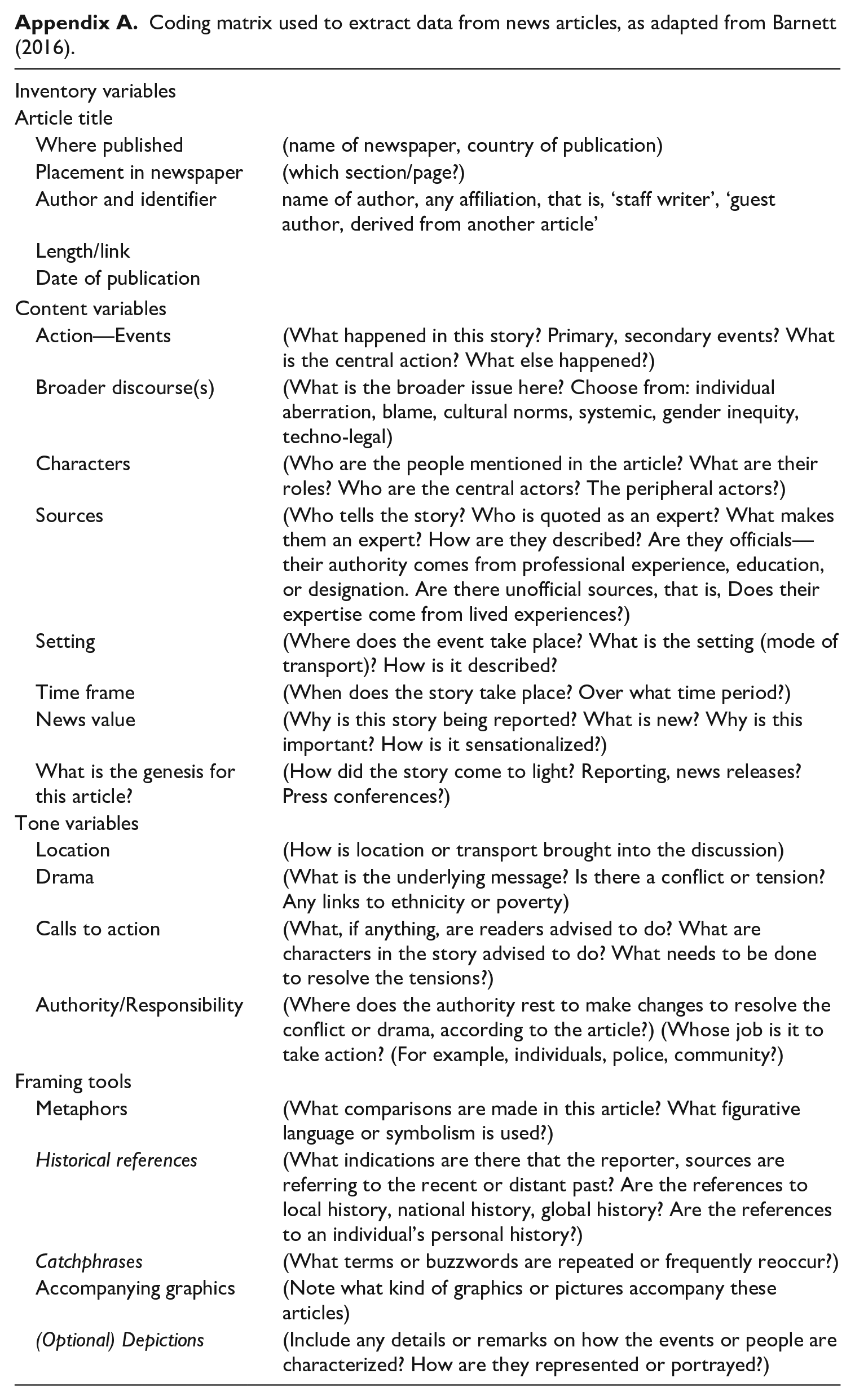
To operationalize the theoretical framework a matrix was developed to examine content (events, broader discourse, sources, settings), tone (authority, responsibility, dramatic tensions, and calls to action) and framing tools (metaphors, catchphrase, graphics. The matrix was adapted from previous frameworks by Altheide, 1996; Barnett, 2016 and examined texts for content (discourse, characters, sources, settings), tone (drama, calls to actions, responsibility) and framing (inclusion of metaphors, historical references), catchphrases (key words, images). See Appendix A. The matrix was applied as a coding tool to extract articles. Using open and axial coding methods, we identified discourses and frames to present our findings.
Of the 71 news articles, 50% were from the English daily and the other 50% from Bangla newspapers. In terms of news placement, almost half of the articles were hard news treated with gravitas on the first page, last page or ‘national news’ section of newspapers, whilst one-third of the articles were editorials or opinions on the inside pages. Only four articles were featured in the crimes section. Thirteen percent of articles were published as a special feature for women’s day or lifestyle feature sections. The articles on this topic were a mix of (i) hard news of mob violence, rape (or escape from) and murder; (ii) follow ups of legal action sought or taken (involving highway police, local magistrates or courts; (iii) press-releases of statistical studies undertaken by NGOs/academic institutions, and (iv) editorials or explainers.
Looking at authors, only a small fraction of the articles were written by men (11%), while one-third (32%) were written by women. Majority (56%) of the articles did not credit any authors and were labeled as ‘staff correspondents’. This is in line with the Global Media Monitoring Report (2015, pp 8-11) which claims stereotyping, derogatory portrayal of women, and underrepresentation of women’s voices in media coverage. This leads us to speculate that either male journalists were not (a) interested (because harassment is arguably regarded as ‘soft bytes’ and/or women’s issues while sports and politics are seen to be more men’s issues) (Macharia, 2020), (b) assigned due to heightened sensitivity, or (c) they did not want to be identified.
How is safety constructed in Bangladesh media discourse?
The analysis reveals that Bangladeshi media tends to focus on elements of fear, risk and danger when reporting on women’s safety. The majority of the news articles characterize victims and perpetrators as binary stereotypes, and amplifies voices of particular sect of the population while muting others. The analysis further sheds light on four prevalent discourses in the media, its collaboration with powerful institutions and how it facilitates a platform for juggling blame and responsibility between stakeholders. The following sections lays out, in detail, the major findings that emerged from the analysis.
Constructing second-hand realities
While some news articles had responsible headlines that focused on resources or assistance for women commuters, majority of the articles had titles that focused on amplifying danger, through (a) fear-inducing headlines (e.g. Danger lurks in every corner of the street, Prothom Alo, April 5, 2018), (b) disturbing statistics (e.g. 83pc women face abuse from public transport staff: study; The Daily Star, November 24, 2019) or (c) piquant details of escaping harassment (e.g. Thrilling account of Chittagong University student escaping rape from a running bus; Kaaler Kontho, November 29 2019) that only served to perpetuate perceived danger and corporeal fear.
The following is an excerpt from an article that amplified a woman’s escape from a potential rape situation on the bus.
The conductor slammed the[bus] door. I shouted and said- stop the bus, I want to get off. He pretended not to hear me. I was dialing 999 when the conductor came and snatched my bag. I kept screaming the whole time. The conductor pushed me against the door and I kicked the door with my foot and got out. One of the conductors kept pulling my hijab. (Kaaler Kontho, November 29, 2019)
While it may sound like a survivor’s account of escaping sexual harassment projects a ‘win’, it also constructs a supposed reality: that it is possible to escape potential sexual violence if you kick hard enough or scream loud enough. The article does not use this opportunity to remind readers that only small percentage of cases are ever reported, or how entrenched and systemic the prevalence of sexual violence in that particular bus route is, or where to find resources and assistance in situations like this. Articles that only highlight terrifying lived experiences do little to demystify the drama and fear. In fact, many women do not scream and shout in fear of further aggravating the situation. Even a judge was quoted saying ‘the media is more excited on reporting on cases of harassment or crime than it is on reporting judgements and verdicts’ (Prothom Alo, February 14, 2018). By dramatizing sexual violence, the media plays a passive role of disassociating it from the broader socio-economic everyday realities.
Dichotomy of representation through images, euphemisms, and othering
In an attempt to understand the characters and their roles involved in reporting of these cases, the analysis reveals a clear dichotomy in the portrayals of the victim and perpetrator. Custers and Van Den Bulck (2013) describe the perceived victim stereotype as female, vulnerable, more powerless than the perpetrator and unrelated to the perpetrator. Victims who fall outside the stereotype may be characterized as lacking credibility. The perpetrators are ‘typically men who are poor, psychotic, uneducated, or, immigrants (or a combination of these)’ (Custers and Van Den Bulck, 2013: 96). These character portrayals risk being oversimplistic and thus misleading.
This practice is noted in an article which repeatedly mentions that victim was accompanied by her brother on the bus during the occurrence of the harassment (Prothom Alo, October 9, 2020), in an attempt to build credibility of a ‘good girl’ who was accompanied by a male family member and not traveling alone. In a separate op-ed article on the brutal gang-rape and murder case of Zakia Sultana Rupa on a public bus, the author explains, Rupa fits into our imaginary picture of what a perfect victim must look like—attractive, fighting the good fight, studying law, looking for employment, without romantic entanglements that tarnish her image of being a virgin. All of these allow us to view her as worthy of our collective pity, even angst. Yet, when Rupa travelled by herself on public transportation, we talked about why she didn’t know better, but not about the culture of rape on public transportation in South Asia (Murshid, 2018).
Although the country sympathized with Rupa’s unjust nature of death, there was speculation about why she had to travel at night and counterfactual explanations of ‘if only she hadn’t been alone or traveled at night, she wouldn’t have fallen prey to the violence’. The author very aptly points out that not every harassment case receives public support or empathy because of these linear representations of how a victim should look, sound, and act.
Research indicates that the text of articles accompanied by photographs, especially those depicting victimization, enjoy longer reading time and audience attention (Zillmann et al., 2009). In our analysis, majority of the articles were accompanied with images of women in the popular head-in-hands, crying or crouching representation. By exposing readers to a daily diet of these powerful images of vulnerability, helpless, victimized women the media reinforces the fact that women are weak and need to be protected. This further fuels the perfect victim narrative shifting the conversation to how to protect women and not how to stop predators. It implicitly perpetuates or validates stereotypes related to their socially-accepted passive roles as helpless victims of violent acts. The box below illustrates some of the common images found within our reviewed articles (Figure 1).
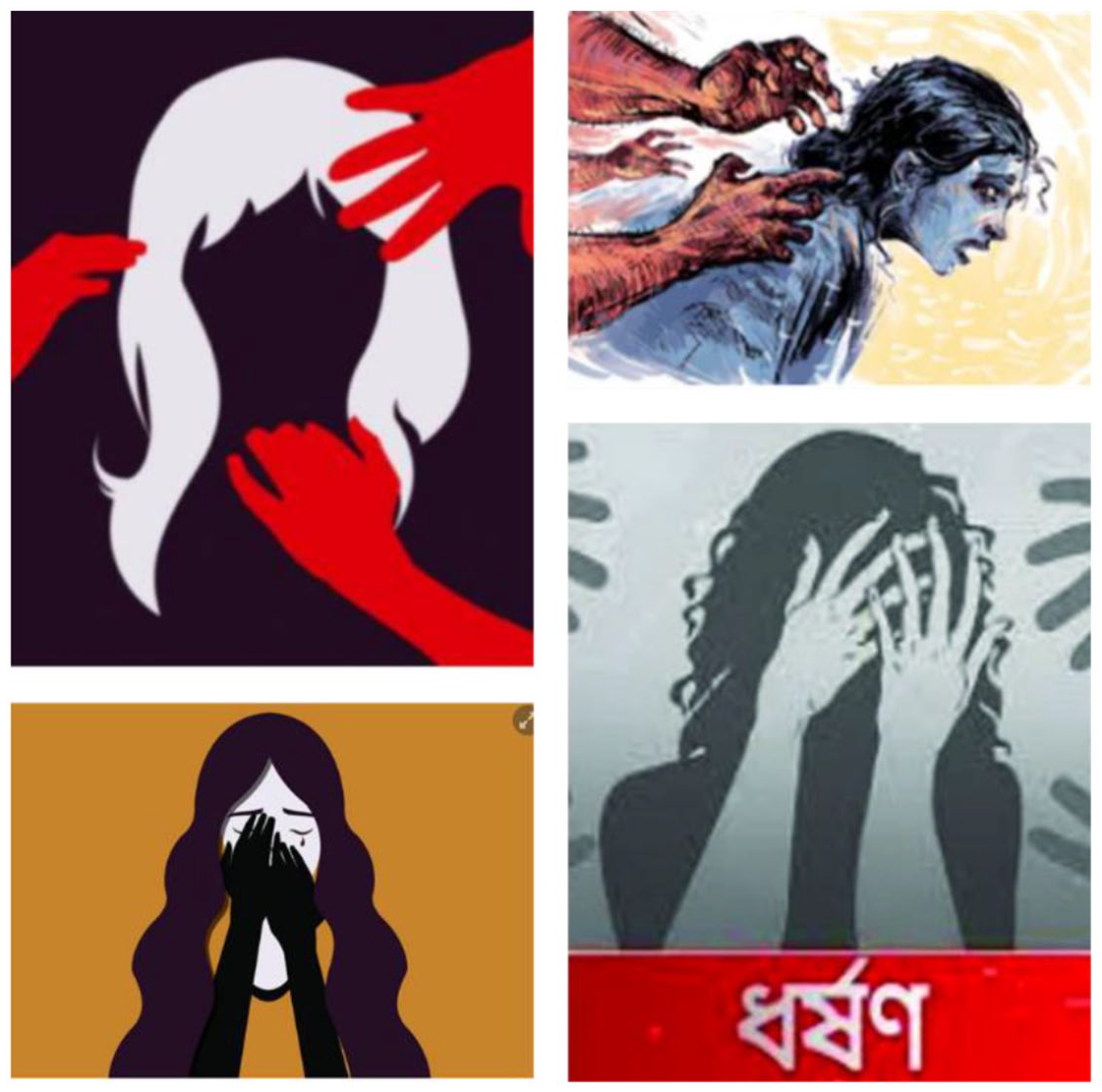
Images from reviewed articles in four national newspapers.
The analysis confirms that media discriminates harassment cases depending on the privilege and power of the parties involved. In Rupa’s case, since the perpetrators were working class and uneducated bus drivers and conductors, there were easy to sign off as social misfits, deviants or ‘bokhate’ (youth gone astray), wrecking disturbance in an otherwise safe city. This is further exemplified in an article which reports how an old ‘homeless beggar’ was arrested for touching and groping women on crowded streets and busy intersections (Bangladesh Pratidin, January 25, 2021). A follow up news on the ‘homeless beggar’ revealed that he in fact belonged to a well-off family (with wife and two kids) and would disguise himself as a beggar on his pursuit of harassing women, conveniently fitting into the role of the other. This suggests, that the perpetrator chose to identify as a socially disadvantaged individual as opposed to somebody with social capital, using class as a strategic scapegoat.
Similar frustration is also reflected in a first-person opinion piece: I felt somebody pulling my dress from the back seat on a bus. To my horror, I found that the man was trying to cut my dress with a blade. When I confronted him, most people on the bus took his side, saying a man his age could not do something like this (Islam, 2019).
Here, the society finds it unsettling to accept accusations against perpetrators who do not fit the stereotype. For instance older adults, religious preachers (imams), or men who look and dress formally are usually regarded as respectful members of society and hence deemed incapable of any wrongdoing. Thus, the media persists in its portrayal of victims and perpetrators through an arbitrary lens of gender and class, deciding which cases of harassment merits attention, and who gets penalized for it.
Whose voices matter?
The access to voice or lack thereof can produce specific relations of power within the system (Putnam et al., 1996). Foucault and Foucault (1972) argues that discourse, actualized through voices, can renegotiate power relationships. In our analysis, majority of the articles were found to cite police case files as official sources of data, ignoring the voices of survivors of assault (who are often excluded from reporting cases due to socio-institutional barriers such as stigma, threats, community pressure to settle the matter and the trauma of having to recount her experiences of assault in public). Most articles were reported contingent on ensuring there was sufficient proof and witnesses (bystanders). One article quotes ‘. . ..after being satisfied with “proof,” the court admonished punishment of 1 month jail to the perpetrator’ (Prothom Alo, October 9, 2020).
Sexual predators generally make untoward advances when the victim is alone, or in the dark, or when nobody is looking. So, to rely on witnesses and proof means most cases of harassment, which do not have ‘sufficient evidence’ are not officially recorded even if they are brought to attention. Plus, majority of women in Bangladesh are unaware of their legal rights and choices, and shy away from drawing attention (and shame) to themselves and their families.
The law enforcement and legal institutions, which are patriarchal in nature, further hinders reporting. Hence in relying on official information sources such as police and court documents, the news only highlights a small percentage of cases that surfaces. Due to victimization of the reporting process, several first-hand accounts of harassment (survivors’ voices), without witness or proof, get lost, dismissed, or muted.
The analysis also confirms that, access to the media is mostly controlled by socially dominant actors, both as reliable sources and expert voices in representing discourse and opinions. These sources are typically identifiable individuals with relevant professional experience, education, or well-known public figures who occupy some official position, such as gender rights activists (Bangladesh Women’s Federation, Bangladesh National Women Lawyers Association), NGOs (BRAC, ActionAid, Ain o Shalish Kendra), transport and legal stakeholders, and academics (Dhaka University, Jahangirnagar University). In a way, media is observed to be covertly transmitting the voices of authoritarian social power-holders, and in the process reproducing existing asymmetrical power relationships (Fairclough, 1995a).
The media also plays a significant role in downplaying the gravitas of harassment or violence. Words like sexual harassment or sexual violence is commonly replaced by ‘slilotahani’ (outrage of modesty), ‘slilotahanir shikaar’ (victims of indecency) stripping the violence and non-consensual aspect of the act. These euphemisms are often used by the law enforcement institutions (Kaaler Kontho, March 1, 2021) themselves, amplifying their prejudice and patriarchal values of associating harassment inflicted upon a woman with measures of her modesty or respectability. In an article by Prothom Alo titled Police asks women to counter harassment, the police Assistant Commissioner is quoted saying, ‘women should not be scared in these situations. They should be bold, brave, aware and confident instead of letting these incidents affect their self-esteem’ (Prothom Alo, May 27 2018).
Instead of citing resources or aids for women, the article focuses on what women should and should not do. Saying it is up to women to defend themselves in situations riddled with danger and/or else know their limits, this directive, very subtly, shifts the onus of reporting and resisting harassment onto the women.
Contestations of multiple discourse
The articles reveal contestations of multiple discourse in constructing sexual harassment in transport. See Table 1 for definitions of all four kinds of discourse identified. The Daily Star largely reported editorials that embedded a systematic and gender inequality discourse, while Prothom Alo combined systematic and legal lenses. On the other hand Kaaler Kontho and Bangladesh Pratidin focused on individual aberrations and legal remedies.
Four kinds of discourses, adapted from McDonald and Charlesworth (2013).
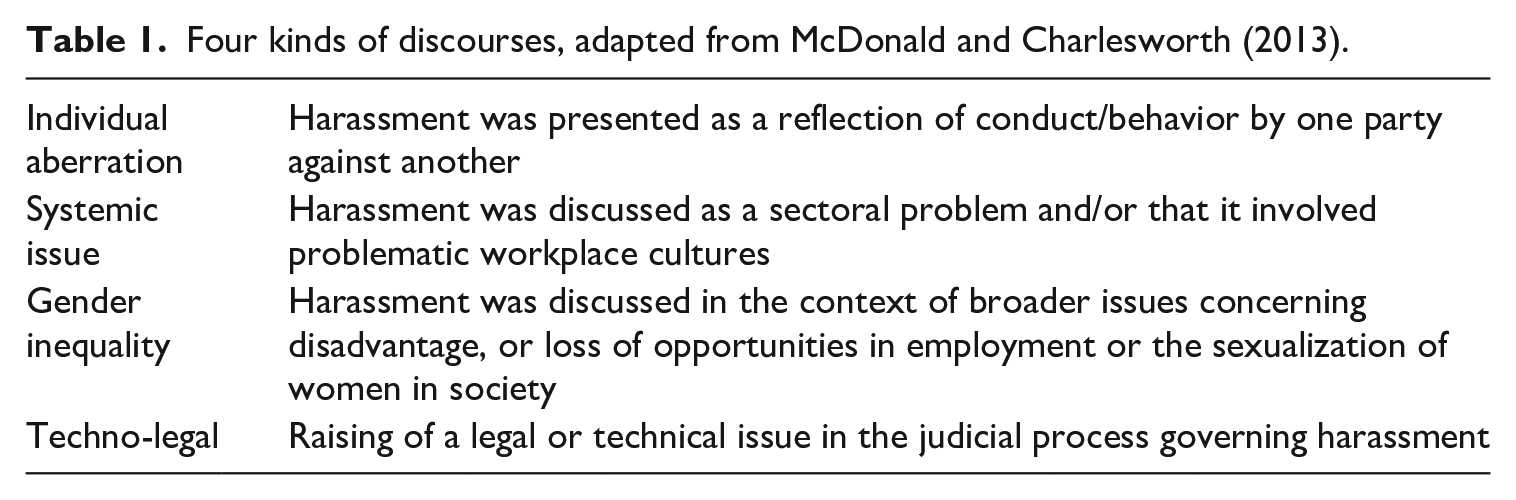
Only a few articles (n = 7; 10%) treated the issue as an individual act of aberration with no reference to past incidents or discussion of prevalence. The following excerpt illustrates the
When she tried to get off the empty bus, the bus helper grabbed her hand. In an attempt to get away, she poked him with her pen . . . After informing her classmates about the incident, the University students blocked the road to stop the bus and beat up the driver and supervisor on the street, before handing them over to the police (Prothom Alo October 17, 2020)
Here, the account merely reports how the incident unfolded, and describes a disciplinary response directed at an individual perpetrator. Easteal et al. (2012) argues that such reporting tends to portray harassment as isolated cases, ignoring the larger gendered power inequalities in society, and the victims’ experiences of non-physical abuse targeted at disempowering them.
The dominant discourse of sexual harassment in public transport is presented as a
In contrast, the
..the thing is though the idea of separate seats(for women) clashes with the principle of equality. The Road Transport Act 2017 emphasized the importance of ladies’ seat due to the reasons mentioned above. But is imposing such a strict liability reasonable? Should a male passenger surrender his seat (willingly or unwillingly) to a woman who is as capable as him?
(Khan)
The author himself seems confused and unconvinced of how and whether the law contradicts with notions of gender equality. He does not bring up the subject of equity or gendered mobility or transport poverty of women in his narrative to discuss the questions he poses. He indicates a general but grudging acceptance of reserved seats for women by gesturing it to be a ‘privilege’ that women enjoy and not a necessity for some women to travel safely.
Sixteen news articles (23%) deployed the
Few of the investigative news articles offered commentary on the state of affairs of sexual harassment cases that await social justice in Bangladesh. A prime example of this is the Rupa gang-rape and murder case, which triggered a news frenzy focusing on verdicts of death-by-hanging to four out of five perpetrators, health checks (including alcohol consumption check) for transport staff multiple times a year, and handover bus ownership to Rupa’s family as a form of restorative justice. The court had reasoned that if bus owners are penalized monetarily for heinous acts committed by their staff, they will adopt more preventive measures henceforth in ensuring better standards for women’s safety. Only one article did a follow up report 15-months later highlighting how the court’s verdict of transferring ownership was yet to be realized, as the bus body decayed in a police station pending paperwork, and all of its interiors had already been stolen or sold off.
Overall, the multiple discourses as evidenced from the analysis suggest there are contested constructions of sexual harassment in transport.
Juggling blame and accountability
One fundamental and explicit feature of these articles was the practice of juggling blame and pointing fingers. Victims and activists complained about rude and predatory behavior of transport staff and evasive bus owners. Bus owners excused bus drivers and conductors on the basis of poverty, users of substance-abuse and uneducated – hence relieved of expectations of moral conduct. Victim’s families complained of never receiving promised compensation declared by courts, while lawyers whined about their charge sheets being held up in court’s paperwork backlog. In turn, police criticized female victims ‘provoking’ such incidents by their attire, make-up, choosing to travel alone, or being out at night.
As per the articles, the ministry directed BRTA to monitor the installation of CCTV devices and mandated displaying national emergency hotline number stickers on all buses. BRTA officials claim that bus owners have been uncooperative in following these directives, quoting
Bus owners and labor (union) leaders are always looking for an excuse to call transport strike if we pressure them too much. Bus fee anarchy and extortion is their main motive. What can we do? (Kaaler Kontho, May 9, 2019).
In turn bus owners reported not being aware of such directives from the BRTA. Another article goes on to quote the Acting president of Transport Owners Association
[Since the bus rape incident], I tried to make the drivers and helpers understand. But it’s of no use. Almost 30% of our passengers are women in these routes, we may lose out on their business. I don’t know what else to do, I’ll go mad. (Prothom Alo, October 12, 2019).
This spells out the frustration of stakeholders with vested interests. The bus owners worry about losing out on one-third of their business if they can’t ensure safety for female commuters, whereas the drivers and conductors are typically day-wagers or paid-per-trip and so have little to lose if a few female commuters stopped riding their buses.
Figure 2 depicts the pathways of deflecting blame as analyzed from the codes. The arrows depict the direction of blame cast between the institutions. Instead of responding to an incident or accusation, the institutions level new allegations toward each other, in turn withdrawing their own liabilities.
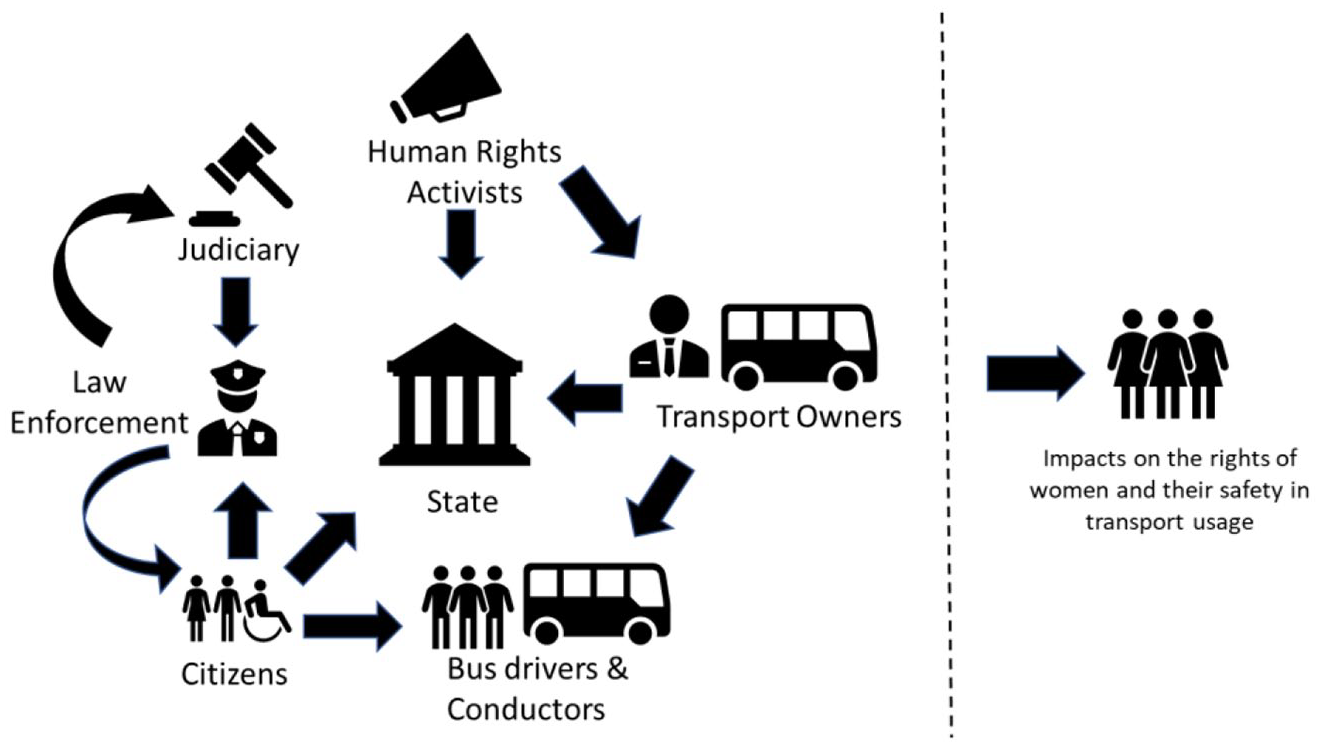
Pathways of blame.
In terms of call to action, analysis reveals that almost 43% (31) articles called on the State and its law enforcement to intervene, mediate and provide solutions. In contrast, less than 10% (9) articles held transport authorities responsible and five demanded legal reforms. Sixteen articles called for citizens to be more aware, informed and proactive in resisting harassment in public transport. One article indicated that the private sector and NGOs should step up and play active roles. Worth noting, several (14) articles did not make any recommendations or calls to action when it came to assigning accountability for incidences of harassment inside the bus. Given the lack of congruence between the calls to action by different media platforms, we observe that depending on market orientation and political affiliations, newspaper portals assume conflicting positions in their demand for accountability. In so doing, their influence on the system of justice is confusing since ‘if there is no standard diagnosis, it follows there will be no standard action required’ (Douglas, 1992: 6). This culture of shifting blame and zero ownership only serves to generate new narratives of blame, breed distrust in the system and contributes little to improve women’s safety.
Conclusion
Douglas has made two points that are particularly relevant to our study: firstly, accusations (what we refer to as blame pathways) are a technique of exclusion and control (Douglas, 1992); and secondly, ‘risk is always political’ (Douglas, 1992: 44), and serves vested interests of power relations. Our findings are significant in both respects. First it demonstrates the deeply politicized role of Bangladesh news media in shaping safety for women in public transport. Increasing women’s fear of traveling alone maintains their marginal participation in public life, and penalizes them for overstepping social boundaries. Through conscious semantics, social institutions such as the media tones down the role of offenders and perpetrators, but dials up the details of violence inflicted. It constructs a passive account of violence without a subject at the helm (‘woman was sexually assaulted while traveling’, instead of ‘40 year old man assaults woman in bus’). Feminist scholars argue that by omitting the perpetrator we look at the problem passively, leaving our biases and assumptions about the perpetrator unchallenged (Doering, 2015).
Secondly, majority of the discourses are presented as a systemic issue, or in pending legal recourse calling on the State and its actors to intervene. Clearly, there seems to be overwhelming expectations from the state, and we find that problematic because the state is comprised of a set of patriarchal institutions that work together (law enforcement, ministries, implementing authorities) to maintain power asymmetry and status quo. Moreover, the media facilitates a culture of blame that only serves to impair relationships and alienate the very institutions who have knowledge of what went wrong (O’Connor et al., 2011). Blame provides an early and artificial solution to complex situational problems. From fields of social science and medicine, Woods (2005: 488) reasons that the ‘accompanying threat of punishment and stigmatization for blame activates defensive mechanisms, drives out information about systemic vulnerabilities, stops learning, and undermines the potential for improvement’. By extension, this paper finds that by assigning blame contingent on gender, privilege and power of the parties involved, the media plays the role of an enabler; allowing vested parties to shift the burden of seeking solutions instead of owning some of the responsibility oneself. This interplay between the stakeholders and their political agenda, only generates fear, distrust in the public transport and is detrimental to the overall safety of women and their mobilities.
Through the integration of two theoretical approaches (Douglas’ theories and CDA) this study expands previous literature that have sought to understand the linkages between media discourse and gender rights based on the CDA perspective exclusively. CDA tends to assume discourses mediate the relationships between text and social practices. However as evidenced from this study, the media may be multiply positioned within a number of discourses, serving vested interests of the social order and relations of power. Using an integrated theoretical framework, we highlight the linkages between media discourse and culture in its construction of risk and blame, as both reproducing culture and produced by cultural elements of patriarchy, systems of justice, victim-blaming, prioritizing women’s honor over emancipation- all of which are prominently used to mask women’s rights to safe transport. Through this paper, we also address the calls of the Sustainable Development Goals (SDG) 5 and 11 that emphasizes cities need to be more inclusive toward marginalized and vulnerable populations. Given the critical role of news print media (social institutions) in shaping the discourse around women’s safety, we urge media-based practitioners to be wary of their discursive responsibilities of ensuring inclusive cities and equitable transport for all, and not perpetuating social exclusion in the name of safety.
However this analysis would be prone to fallacy if we did not reflect upon the bias arising from generalizing across four different newspapers with very different readership. Notably, the editorials of The Daily Star and Prothom Alo newspapers provide critical insights into the pressing issues in society and provide policy prescriptions. Readers and guest writers of papers are the very institutions that reign the social order: gender rights activists, advocates, judges, transport owners, labor associations, academics and intellectuals. In contrast, both Bangladesh Pratidin and Kaaler Kontho are priced lower and cater to a lower socio-economic strata of the population. The reporting for these two papers was mostly cursory or press releases with little to no reflection from the editorial team. These news articles provided over-simplified narratives, filtering out more abstract and conceptual structures or relationships, including systems, causality, change, context, and ambiguity.
Limitations
Debbie Lisle (2009: 148) points out that ‘the information that we get from it [media] is never neutral or innocent: it is always and always-biased’. As such, the reader should bear in mind that all the newspapers in Bangladesh are owned by corporate conglomerates, many of which also own transport fleets and supply chain logistics. As such the newspapers may serve as an instrument to uphold its parent company’s vested interests, reflecting the ideologies of the owner, the editor, and the reporters themselves.
One may argue that the potential influence of print media is limited in a country like Bangladesh where literacy rates are anyway low and structural poverty is widespread. According to the National Media Survey (NMS, 2020), print is the third preferred source of news after television and facebook, and a main source of news for only 8.4% of respondents. Hence generalizations across the entire population should be made with caution.
Finally, this study did not examine how audiences interact with print and electronic news media through social media. For example, social media allows users to comment on and challenge how published content frames sexual violence. Such social media interactions present an opportunity for further research and consideration in understanding the complex impact of media on public perceptions of sexual violence.
Future research directions
Arguably, we do not wish to present a linear interpretation of media influence, particularly given that the social media allows participatory opportunities for the audience to challenge the narratives that are presented through mainstream outlets. A recent NMS (2020) states that 18% of the Bangladesh population do not follow any news media, whilst 9.4% resort to Facebook for news updates. So to claim that media shapes public opinion is not entirely true. The course of audience interacting with media is a relationship of ‘encoding’ and ‘decoding’ messages (Hall, 1994). That is, media discourse can be simultaneously context-shaping and context-renewing. The audience may also read stories in a ‘resistible’ manner, directly challenging the messages conveyed to them. Future research opportunities should be directed at exploring these interactions since readers may have different interpretations of the same news depending on their intersectionalities of religious beliefs, gender, and class.
Footnotes
Appendix
Coding matrix used to extract data from news articles, as adapted from Barnett (2016).
| Inventory variables | |
| Article title | |
| Where published | (name of newspaper, country of publication) |
| Placement in newspaper | (which section/page?) |
| Author and identifier | name of author, any affiliation, that is, ‘staff writer’, ‘guest author, derived from another article’ |
| Length/link | |
| Date of publication | |
| Content variables | |
| Action—Events | (What happened in this story? Primary, secondary events? What is the central action? What else happened?) |
| Broader discourse(s) | (What is the broader issue here? Choose from: individual aberration, blame, cultural norms, systemic, gender inequity, techno-legal) |
| Characters | (Who are the people mentioned in the article? What are their roles? Who are the central actors? The peripheral actors?) |
| Sources | (Who tells the story? Who is quoted as an expert? What makes them an expert? How are they described? Are they officials—their authority comes from professional experience, education, or designation. Are there unofficial sources, that is, Does their expertise come from lived experiences?) |
| Setting | (Where does the event take place? What is the setting (mode of transport)? How is it described? |
| Time frame | (When does the story take place? Over what time period?) |
| News value | (Why is this story being reported? What is new? Why is this important? How is it sensationalized?) |
| What is the genesis for this article? | (How did the story come to light? Reporting, news releases? Press conferences?) |
| Tone variables | |
| Location | (How is location or transport brought into the discussion) |
| Drama | (What is the underlying message? Is there a conflict or tension? Any links to ethnicity or poverty) |
| Calls to action | (What, if anything, are readers advised to do? What are characters in the story advised to do? What needs to be done to resolve the tensions?) |
| Authority/Responsibility | (Where does the authority rest to make changes to resolve the conflict or drama, according to the article?) (Whose job is it to take action? (For example, individuals, police, community?) |
| Framing tools | |
| Metaphors | (What comparisons are made in this article? What figurative language or symbolism is used?) |
| Historical references | (What indications are there that the reporter, sources are referring to the recent or distant past? Are the references to local history, national history, global history? Are the references to an individual’s personal history?) |
| Catchphrases | (What terms or buzzwords are repeated or frequently reoccur?) |
| Accompanying graphics | (Note what kind of graphics or pictures accompany these articles) |
| (Optional) Depictions | (Include any details or remarks on how the events or people are characterized? How are they represented or portrayed?) |
Funding
The author(s) disclosed receipt of the following financial support for the research, authorship, and/or publication of this article: This work was supported by the Dutch Research Council (NWO) and Utrecht University, The Netherlands as part of the research project EQUIMOB – Inclusive Cities through Equitable access to Urban Mobility Infrastructures for India and Bangladesh under the research program Joint Sustainable Development Goal research initiative with grant number: W 07.30318.003.
