




Abstract
This article discusses the ‘computer game’ as a pragmatic concept. A dual nature of the computer game as both a pragmatic idea and a pragmatic meaning is introduced. Practical meanings of the computer game correspond with the concrete effects that engaging with computer games produces in an individual. Practical ideas of the computer game correspond with the subjectively constituted conceptual families concerning the computer game’s assumed practical meaning. Individual computer games can be considered flat or round depending on the range of their practical meanings. Thus, the article contributes to the study of cultural objects by offering a framework for examining the evolution and existence of such objects as cross-cultural practical entities – less in terms of communication, media, and materiality, and more in terms of concrete actions and events that individuals across societies commence and conceptualize.
Introduction
Various efforts to delineate and define computer games, digital games, and videogames have been undertaken since the proliferation of gaming research in the 2000s (see Arjoranta, 2019; Esposito, 2005; Karhulahti, 2015). Typically, such efforts have been ontological, and the goal has been to understand what these objects are (in comparison to other cultural objects). This article offers a view to the phenomenon from a pragmatic philosophical perspective, which is not so much ontological as it is functional. The below explains what it means to employ a pragmatic understanding of a field-defining term such as ‘computer game’, and how that understanding is relevant for those who perceive and examine these objects as part of culture(s). In this way, the article contributes to the study of cultural objects by offering a framework for examining the evolution and existence of such objects as cross-cultural practical entities – less in terms of communication, media, and materiality, and more in terms of concrete actions and events that individuals across societies commence and conceptualize.
The article first presents a short historical overview of pragmatism, which is followed by an extended explanation of the dual nature of the computer game as a pragmatic idea and meaning. The conclusions include one further inference that must be noted in advance: a conceptual ranging of flat (homogeneous practical meanings) and round (heterogeneous practical meanings) cultural objects.
Pragmatism
As a school or tradition of philosophy, pragmatism (Greek: πράσσειν, ‘to do’) is usually attributed to Charles Sanders Peirce, with particular reference to his pragmatic maxim. This maxim, introduced in Peirce’s (1878) eminent essay ‘How to Make Our Ideas Clear’, goes as follows: Consider what effects, that might conceivably have practical bearings, we conceive the object of our conception to have. Then, our conception of these effects is the whole of our conception of the object. (p. 293)
Regardless of Peirce’s willful efforts, his ideas were not always as clear as he wanted them to be. Within three decades, Peirce’s notes on pragmatism had begun to gather attention and were being more explicitly developed by his colleagues, including his good friend William James (1907), whose seminal Pragmatism: A New Name for Some Old Ways of Thinking paved the way for a more structured pragmatic theory. With a nod toward Peirce, James rephrases the point: the tangible fact at the root of all our thought-distinctions, however subtle, is that there is no one of them so fine as to consist in anything but a possible difference of practice. To attain perfect clearness in our thoughts of an object, then, we need only consider what conceivable effects of a practical kind the object may involve – what sensations we are to expect from it, and what reactions we must prepare. (pp. 46–47)
Following on from this, early pragmatism is often associated with John Dewey, who arguably refined the pragmatic way of thinking into its most systematic classical form. The Deweyan form of pragmatism is the one through which this article looks at the computer game. A quote from Dewey’s (2012 [1916]) Essays in Experimental Logic captures a modern understanding of the term: [data] are not objects but means, instrumentalities, of knowledge: things by which we know rather than things known . . . an idea is a draft drawn upon existing things, and intention to act so as to arrange them in a certain way . . . the meaning of an object is the changes it requires in our attitude. (pp. 43, 310; emphasis added)
Following Dewey, one may thus speak pragmatically of the computer game in two conceptual ways: as a practical idea that an individual holds about the computer game, and as a practical meaning that the computer game has for the individual. The former consists of the prearranged expectations that a person sets on things that they approach as computer games; the latter consists of the concrete effects that engaging with computer games produces in the person. In both cases, importantly, the conception of the computer game is for the individual. People conceive, hear, and think of computer games in specific (changing) ways because those ways help them live in a world where interacting with such objects is significant. A graphical account of the framework is provided in Figure 1 and explained in more detail later on.
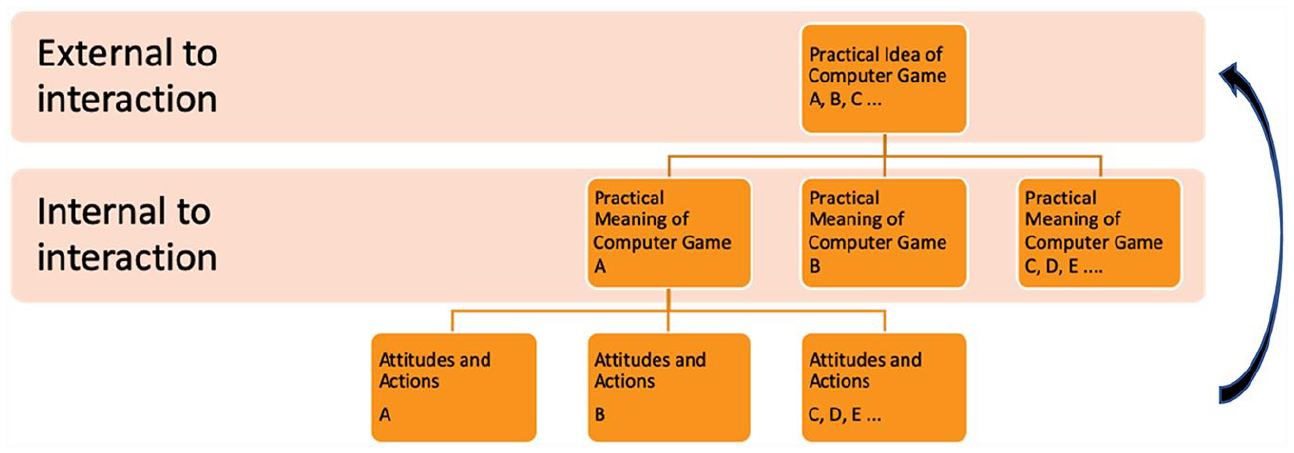
A pragmatic conceptualization of computer games. Read on, it makes sense later.
Computer game as a practical idea
To recap: as a practical idea, the computer game involves prearranged expectations that people set on things that they approach as computer games. That is to say, thinking of computer games in a specific manner adjusts individuals’ expectations on what computer games do to them and what the individuals are supposed to do to computer games. The consequences of these expectations are very concrete. For instance, the preconception of computer games as objects that challenge, contest, and evaluate their users keeps some individuals far from anything that reminds them of computer games; simultaneously, others with the same preconception get disappointed when the things that they approach as computer games end up not challenging, contesting, or evaluating them. In this sense, the practical idea of the computer game is also normative by nature, that is, engaging something as a computer game means assessing it by the standards set by one’s preconception of what it should be and do.
While there is no need to present generalizations about the (current) dominant practical ideas that people have about computer games (in the West or elsewhere), some examples will provide further context that is needed later. A good starter comes from Graeme Kirkpatrick (2013), who suggests, (the) development of a normative context in which great gameplay is esteemed, from high scores on arcade machines to organized competitions and professional tournaments, has been essential to the development of gaming as a cultural practice. (p. 128)
From the above viewpoint, an individual’s practical idea of the computer game could be described as a digital object that provides its players with competitive elements in one form or another. This is by no means anything like an analytical definition, but simply a description of (some) qualities that those who maintain this position expect computer games to have. For them, games like Conway’s Game of Life (1970), Sim City (1989), and Dear Esther (2012) that do not have explicit competitive elements would likely be ‘bad’ computer games, if they considered them as computer games at all.
More recently, Chris Bateman (2015) has proposed that, based on a review of multiple game and computer game definitions, competitive elements fall into two respective categories that people consider crucial in their play: one corresponding to the victory aesthetic and its variations and the other to the problem aesthetic and its variants. However, we must also recognize that the aesthetic values that are expressed through play cannot be constrained to challenges and puzzles. Even restraining our focus to games as goal-oriented activities, we must acknowledge the more general aesthetic enjoyment of reward [that] need not involve endurance of frustration or confusion. (pp. 406–407)
In the latter part of this quote, Bateman points out that many also think of computer games (and games) as creations that occupy their players not only via challenges, puzzles, and other competitive (or goal-oriented) elements but also by being ‘rewarding’ in a broader sense. For those whose practical idea of the computer game is in line with this heterogenetic preconception, such creations are expected to appear in many diverse forms and, hence, things like Conway’s Game of Life, Sim City, and Dear Esther may also be ‘good’ computer games in their own distinct ways (anatomically, aesthetically, and otherwise). While the amount of research on the cross-cultural understanding of the computer game concept is presently not too great, existing work (e.g. Azuma, 2009 [2001]; Hjorth and Chan, 2009; Szablewicz, 2011) implies that players with diverse backgrounds also differ in their conceptions of what computer games are. The practical ideas that we have of the computer game are likely influenced by our social, geographical, and other life factors (see also Jin et al., 2015; Shaw, 2010; Yoon and Cheon, 2014).
People around the world have different preconceptions of what a computer game is, what it does, and what we do with it. These preconceptions are practical ideas that people use when they engage things as computer games in their everyday environments, thus contributing to daily human (inter)action. Keeping in mind that ‘play’, ‘game’, and other related notions have always been conceptualized and framed differently in diverse aesthetics as well as linguistically refined cultural settings (e.g. Groos, 1901; Hein, 1968; Pellegrini, 2009), it is worth stressing that some individuals may lack the practical idea of the computer game entirely, which need not be a problem for them, especially if the computer game holds no major role in the individual’s life.
Computer game as a practical meaning
The practical meaning of a computer game is equal to the concrete effects that engaging it produces in an individual. In other words, playing things that are conceived of as computer games incites one to take various actions, attitudes, and changes thereof, and these effects construct the practical meaning of the computer game for the individual, in a hermeneutic manner (see Arjoranta and Karhulahti, 2014). Notably, this practical meaning of the computer game (internal to interaction) may or may not cohere with one’s practical idea of the computer game (external to interaction). This yields two important points: the computer game may and does have varying practical meanings for different players in different cultures, and the practical meanings that people associate with computer games (both generally and respectively) may and do evolve during the individual’s engagement with them. These two points are worth elaborating on further.
The varying practical meanings that distinctive computer games have for people are well demonstrated in a study by Pippin Barr (2008), who interviewed players and observed the ways in which different individuals engage with selected computer games. Barr used the specific framework of values, or ‘players’ beliefs about preferable conduct during play’ (p. 205), as a means to describe and analyze their play in terms of interaction. One of his case studies involved The Sims 2 (2004) with five respective players as qualitative participants. The participants generally agreed that, although the computer game in question lacked explicit win conditions, it provided them with clear objectives to pursue.
The value system is to create a loving environment . . . That’s the goal: to create interactions between people, and rewarding relationships, and happy people.
They’re trying to get you to create things, not destroy things.
I think it’s supposed to simulate real life . . . people like that because they usually wouldn’t be able to do things like that.
(N/A)
The most interesting part, I think, of it is the creating. Just the creative part of it.
These empirical data of player reactions voice the widely held premise that computer games, in their great diversity of genres and sorts, tend to encourage their players to do specific things that their designers have implemented in them as distinct values – as in this case to ‘create’ outcomes of various kinds in a simulated ‘real-life’ environment. These values, if they are acknowledged and undertaken, reflect the practical meaning that the computer game has for its player: a specific attitude that makes them actively pursue what The Sims 2 deems valuable.
The fact that most computer games imply specific practical meanings (attitudes and actions) does not, however, mean that all players acknowledge and undertake those practical meanings equally. Again, the participants of Barr’s study, despite having largely consistent views on what playing The Sims 2 is about, occasionally ended up taking differing attitudes and actions toward the computer game.
What I’m wanting is to get those bars, all those bars, at max. I’d see that as a good achievement.
(N/A)
I think how I play is more fast, get it over and done with . . . I just want to [finish] it.
To try other options to see how they act, it’s fun . . . I’d like to try each of them, to see.
Everybody wonders what it would be like to be someone else, and in this game you can be whoever you want and do whatever you want.\
From a pragmatic viewpoint, computer games can be conceived of as things with designed practical meanings that a large portion of their players acknowledge and undertake, thus making players act, behave, and think in ways that correspond to those practical meanings, albeit with the caveat that players may ignore those designed practical meanings and come up with their own. Again, none of the practical meanings need to correspond with the players’ practical ideas of what computer games are, or what a particular computer game is.
The observation that the practical meanings a computer game holds for a player may and do often change in time has been widely documented since the early days of gaming culture. A pioneering account comes from David Sudnow’s (1983: 32–56) phenomenological exploration of Breakout (1976), as the author first describes the computer game merely as a thing that he played ‘just for kicks’, later evolving into something that he explicitly uses to satisfy the daily ‘need for competition’, ultimately culminating in a stage during which he became so obsessed with it as to live out the next three months of my life almost exclusively within [its] microworld . . . when I wasn’t at the TV, I was practicing the sequence in my imagination.
In this particular case, the computer game in question remained physically the same, but the practical meaning it had for Sudnow (his changes in attitude and action with it) altered markedly over time. Similar processes have been observed often, especially in longer ethnographic studies on online play (e.g. Boellstorff, 2015 [2008]; Nardi, 2010; Pearce, 2009). The concrete effects that computer games have on their players tend to alter over time, not least when that time prolongs to months or years.
Conclusion
In the framework that is here considered classical pragmatism, objects are ‘events with meanings’ (Dewey, 1929: 318): our surroundings turn into objects as we interact with them, and so grant them with meanings of practice. These meanings, in turn, ‘existentially occurring are ideas [i.e.] apprehensions of meanings’ (pp. 303–305): our experiences of interacting with meaningful objects generate ideas of them that guide us in re-approaching such objects in the future. In this rubric, the computer game appears in two conceptual forms: as practical ideas of the thing (one’s preconception of what it is and does) and as a thing with practical meanings (what it actually does to one when playing it). This applies to the computer game both as a general concept (when speaking of an unspecified computer game) and as a particular instance of that concept (when speaking of a specific computer game). From the above, four culturally relevant conclusions can be drawn:
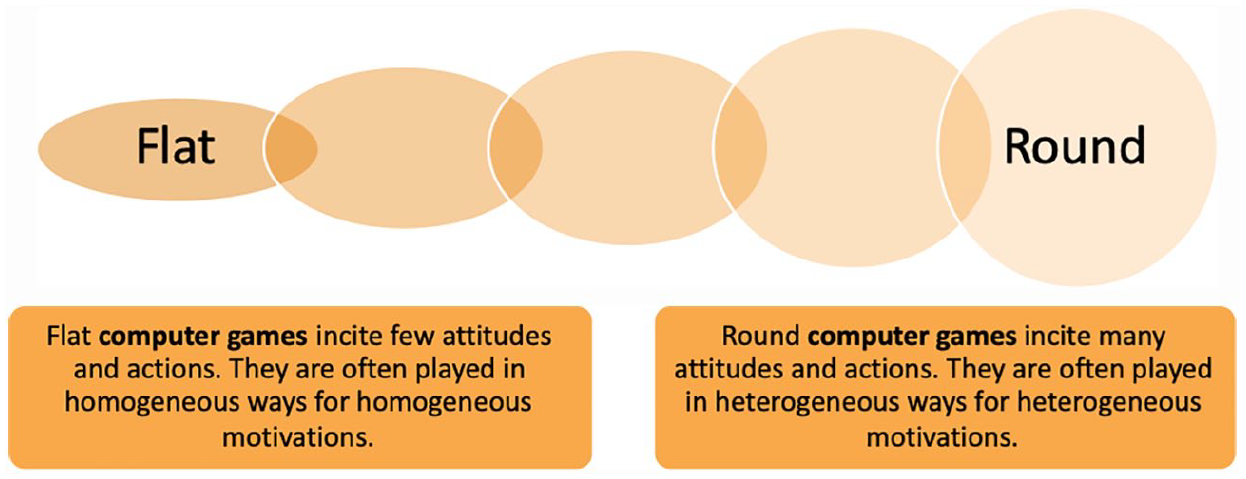
Flat and round computer games – no more, no less.
Acknowledging, observing, and studying a cultural phenomenon like the computer game entail conceptualizing it practically in terms of idea and meaning, respectively. This concerns computer games as a general cultural entity as well as single instances of computer game culture. As to the latter, the potentials of practical meaning vary depending on the nature of the computer game in question, ultimately determined by the empirical range of incited attitudes and actions. Following John Dewey’s (1929) pragmatic approach to culture at large, this empirical range naturally taxonomizes the perceived world into genres that evolve along with the individuals who engage them: The immediate qualitative differences of things cannot be recognized without noting that things possessed of these qualitative traits fall into kinds, or families . . . The presence in things of the generic form renders them knowable. Mind is but the ordered system of all the characters which constitute kinds, differing among men, differing according to differences of organic constitutions. (pp. 209–210)
The things that form culture(s) have practical meanings that correspond with the concrete effects that engaging with them produces in those who engage. Outside that engagement, the things appear to people as practical ideas, that is, subjectively constituted conceptual families of qualitative difference (and similarity) concerning their assumed practical meaning. People are different, and so are their practical ideas. The computer game holds both practical meanings and ideas, and as such constitutes a conceptual family, the existence of which makes conversing, observing, and living with such things possible. This also applies to other cultural objects, such as those of music, literature, and sports.
Footnotes
Acknowledgements
I thank John Richard Sageng and Jonne Arjoranta for their feedback on this article.
Funding
The author(s) disclosed receipt of the following financial support for the research, authorship and/or publication of this article: Academy of Finland supported this work financially. Direct funding for the study was received from Project 312397 and some of the editing work was done during Project 309382.
