




Abstract
As research on gaming disorder (GD) is growing globally, the need for a valid and reliable instrument to assess GD has become crucial. Therefore, the present cross-sectional study translated and evaluated the psychometric properties of Gaming Disorder Test (GDT) and Gaming Disorder Scale for Young Adults (GADIS-YA) into Malay language versions. The sample comprised 624 university students (females = 75.6%; mean age = 22.27 years) recruited via an online survey from May to August 2022, using a convenience sampling method. Participants completed both GDT and GADIS-YA scales and other relevant measures including Bergen Social Media Addiction Scale (BSMAS), Internet Gaming Disorder Scale-Short Form (IGDS9-SF), and time spent on social media and gaming. Results showed that both instruments reported satisfactory internal consistency, and confirmatory factor analysis supported the one-factor structure for GDT and two-factor structure for GADIS-YA. Both scales were strongly correlated with each other and with the IGDS9-SF, BSMAS, and time spent on social media and gaming, supporting concurrent validity. Measurement invariance of both scales was confirmed across gender and gaming time. These findings suggest that the Malay versions of GDT and GADIS-YA are reliable and valid measures of problematic gaming among Malaysian university students.
Introduction
The rapid growth of the internet has resulted in it being an indispensable and inseparable component of individuals’ daily lives. This has been aided by affordable data plans, fast connectivity, and stay at home orders imposed worldwide, which has resulted in an on-demand culture (Chen et al., 2022), especially in activities such as online gaming (Guo et al., 2022). It was reported that the gaming industry in Malaysia (where the present study was carried out) is projected to reach a value of 2.9 billion RM (∼0.64 billion USD) by 2025, where the majority of gamers are aged between 18 to 35 years old (Business Wire, 2021).
Unfortunately, as communication and recreation activities evolved, psychological pathologies have arisen among a minority of individuals due to the persistent evolution of technology leading to behaviors such as internet addiction and internet gaming disorder (IGD). Arguably the most concerning of problematic online behaviors concerns IGD which can be extremely absorbing and time-consuming, resulting in addictive behavior among vulnerable groups (Griffiths, 2020; Higuchi et al., 2017; Kuss & Griffiths, 2015; King et al., 2019). Based on a meta-analysis, it was estimated that Malaysians had a higher prevalence of internet addiction (19.2%) compared to the average prevalence estimate (17%) across Southeast Asia nations (Chia et al., 2020).
Problematic gaming appears to be a growing world health concern, in which gaming behavior is viewed as being on a continuum, ranging from non-problematic gaming to problematic gaming to addictive or pathological gaming (Griffiths & McLean, 2017). Recently, Kim et al. (2022) and Stevens et al. (2021) in their meta-analyses reported that the global prevalence of gaming disorder (GD) was 3.3% and 3.05%, respectively. Another recent meta-analysis by Gao et al. (2022) reported that the global prevalence of IGD among young adults was 10.4%, which was higher than the global prevalence among adolescents (8.8%). Therefore, one vulnerable group is university students, and GD may cause them various negative health outcomes, including poor academic performance, depression, anxiety (Darvesh et al., 2020; Gao et al., 2022), and poor sleep (Kristensen et al., 2021).
More recently, GD was formally included in the International Classification of Diseases (ICD-11) and classified as a mental health disorder by the World Health Organization (Pontes & Griffiths, 2020). The inclusion of GD in the ICD-11 and IGD in the Diagnostic and Statistical Manual of Mental Disorders (DSM-5) has brought to attention the need for researchers to develop problematic gaming instruments for assessment (King et al., 2020). However, methodological challenges, such as the heterogeneity of various screening tools, have posed difficulties in comparing and interpreting findings regarding GD (Pontes et al., 2021).
The Gaming Disorder Test (GDT; Pontes et al., 2021) and Gaming Disorder Scale for Adolescents (GADIS-A; Paschke et al., 2020) are both recently developed self-report instruments used to assess GD based on the ICD-11 diagnostic criteria. Currently, the GDT has been validated in a number of languages with promising psychometric properties including Bengali (Islam et al., 2022), Italian (Chiorri et al., 2023), Turkish (Cakiroglu & Alnak, 2021), Polish (Cudo et al., 2022b), Spanish (Maldonado-Murciano et al., 2021), German (Montag et al., 2019), traditional Chinese in Hong Kong (Wang & Cheng, 2020), simplified Chinese in mainland China (Pontes et al., 2021), and English in the UK (Pontes et al., 2021). The GADIS-A has been validated in Russian (Nazari et al., 2022), German (Paschke et al., 2020), and Farsi (Mazaherizadeh et al., 2022) language versions with promising psychometric properties. However, the two GD instruments were majority tested and developed in Western countries. Therefore, it is unclear if their psychometric properties are replicable in an Eastern country, especially Southeast Asian countries (i.e., Malaysia in this case).
Moreover, given that GADIS-A was originally developed for use among adolescents, its utility could be expanded if its reliability and validity was satisfactory among emerging adults. This would allow researchers to carry out direct comparisons of GD across the lifespan from adolescents and emerging adults using the same psychometric instrument. In many cases in the GD field, instruments developed among emerging adults are used among adolescent samples without any adaptation or alteration by the research teams carrying out the research. For example, the use of the nine-item Internet Gaming Disorder Scale which was developed with young adults has been successfully used among adolescent populations (e.g., Pontes et al., 2021; Teng et al., 2020). The present study is among the first to use a GD instrument originally developed with adolescents among a group of emerging adults. Therefore, the GADIS-A was renamed as the Gaming Disorder Scale for Young Adults (GADIS-YA) to align with the target population examined in the present study.
There is no translation and validation of the GDT and GADIS-A or any screening tools based on ICD-11 diagnostic criteria in the Malay language. Moreover, even though these instruments have been translated and evaluated across various countries, different language versions may have different psychometric properties, and it is uncertain whether the published psychometric findings for different languages are equivalent (Poon et al., 2021). Additionally, validation of these instruments would significantly facilitate the assessment of GD in cross-cultural studies.
In addition to the translations and validations of the GDT and GADIS-YA, measurement invariance across gender and time spent gaming is important when examining its psychometric properties. Measurement invariance is a crucial characteristic that determines whether the score variation of an instrument (e.g., the GDT and GADIS-YA in the present study) reflects actual differences between subgroups or whether the disparities arise from diverse interpretations of the instrument’s item descriptions, using the confirmatory factor analysis (CFA) framework (Gregorich, 2006). Understanding the differences in GD between genders and time spent gaming are useful for healthcare professionals making clinical decisions.
To date, there is no instrument used to assess GD among Malaysian university students using the ICD-11 criteria. The psychometric properties of the GDT and GADIS-YA are yet to be tested among Southeast Asian young adult populations. Although the GADIS-A was developed for adolescents, emerging adulthood is the next human development milestone after adolescence and the ‘adolescent brain’ does not stop developing and maturing until around the age of 25 years (Arain et al., 2013). In developmental terms, there is arguably little difference between late adolescence and early adulthood. On a more pragmatic level, using the same instrument to assess the transition is important. For example, future longitudinal studies on gaming issues from adolescence to emerging adulthood (e.g., spanning from 18 to 25 years of age) could be more accurately assessed with the use of the GADIS-YA validated across closely aligned human development stages. Therefore, having an instrument that can be consistently utilized without modifications becomes essential in this context. If the GADIS-YA is found to be valid for young adults, researchers could use the GADIS-A and GADIS-YA to assess individuals’ GD across adolescence and young adulthood in future studies. Moreover, testing the psychometric properties of the two-factor structure of the GADIS-YA in early adulthood could further confirm the consistency of the scale’s factor structure across life stages and assist healthcare professionals in the detection of related symptoms and consequences of GD.
Moreover, similar to parents in other Asian countries, Malaysian parents prioritize family values, which play a central role in childrearing due to the collectivistic nature of Malaysian society (Masiran, 2022). University students in Malaysia still heavily rely on support from their families such as financial assistance and are still influenced by parental control. Consequently, the items in the GADIS-A addressing parental aspects are entirely applicable to university students in Asian countries, including Malaysia. Therefore, a psychometric instrument that accurately and appropriately assesses GD is beneficial because it could assist healthcare professionals to better understand the significance and effect of GD as well as to enhance future research on GD in Malaysia.
The aim of the present study was to examine the psychometric properties of the Malay versions of the GDT and GADIS-YA among Malaysian university students. First, the validity and reliability of the GDT and GADIS-YA were examined using CFA. Second, the concurrent validity of the total scores of GDT and GADIS-YA with other measures, including Bergen Social Media Addiction Scale (BSMAS), Internet Gaming Disorder Scale-Short Form (IGDS9-SF), time spent on social media, and time spent on gaming were also investigated. Third, the measurement invariance of the GDT and GADIS-YA across gender and gaming time was examined.
Method
Translation Procedure of the GDT and GADIS-A
Following international guidelines (Eremenco et al., 2005), the translation of the GDT and GADIS-A from English to Malay involved several steps. First, two bilingual psychiatrists independently translated both instruments from English to Malay, which is the national language of Malaysia. The corresponding author then worked with the first and third authors and harmonized the two forward translations. Another two bilingual psychiatrists conducted back-translations of the instruments. In order to ensure cross-cultural equivalency for both instruments, an expert committee (including psychologists, psychometricians, and public health specialists) then reviewed all versions and consolidated them to develop prefinal versions of the GDT and GADIS-A (renamed the GADIS-YA). These prefinal versions were then pilot tested on a group of 10 undergraduate students from Universiti Putra Malaysia, who provided feedback regarding the use of inappropriate terminologies. After reviewing their comments, necessary refinements were made to create the final version of the instruments.
Participants and Data Collection
The study protocol was approved by the first author’s university ethics committee (JKEUPM; Reference Number: JKEUPM-2022-268). Participants were recruited through convenience sampling between May to August 2022 using Google Forms via online social media platforms including Facebook, WhatsApp, and Instagram. The inclusion criteria for the participating university students included: (i) being Malaysian; (ii) being aged 19 years and above; (iii) studying in a university in Malaysia; and (iv) having internet access. Those who agreed and were willing to participate voluntarily in the study were required to tick the consent statement “I agree to participate in the study” in the online consent form before being directed to complete the online survey.
Measures
Gaming Disorder Test
The GDT was developed according to the ICD-11 diagnostic criteria for GD (Pontes et al., 2021). It comprises four items and is rated based on a five-point Likert scale: 1 (never), 2 (rarely), 3 (sometimes), 4 (often), and 5 (very often). The four items comprise the construct of GD. The total score on the GDT ranges from 4 to 20 and a higher total GDT score indicates greater severity of GD (Chen et al., 2023).
Gaming Disorder Scale for Adolescents (GADIS-A) renamed the Gaming Disorder Scale for Young Adults (GADIS-YA)
The GADIS-A was also developed according to the ICD-11 diagnostic criteria for GD (Paschke et al., 2020). The scale comprises 13 items consisting of the cognitive behavioral symptoms subscale (CBS; Items 1, 2, 4, and 5), negative consequences subscale (NC; Items 3, 6, 7, 8, 9), and time-related information (Items 10–13). The first nine items (CBS and NC subscales) are rated on a five-point Likert scale from 0 (strongly disagree) to 4 (strongly agree) with total scores ranging from 0 to 36. The time-related information assesses symptom frequency using four response options: 0 (not at all), 1 (only on single day), 2 (during longer periods), and 3 (almost daily). The time-related information items are not used for the GD structure in the GADIS-A. Therefore, the GADIS-A comprises a two-factor structure (CBS and NC). A higher GADIS-A, CBS, or NC score indicates greater severity of GD (Chen et al., 2023). In the present study, the GADIS-A was renamed as the Gaming Disorder Scale for Young Adults (GADIS-YA) to align with the target population examined in the present study.
Bergen Social Media Addiction Scale
The BSMAS was developed according to Griffiths’ (2005) components model of addiction (Andreassen et al., 2016). It comprises six items and was developed based on six core components: salience, mood, modification, tolerance, withdrawal conflict, and relapse. All items are rated on a five-point Likert scale ranging from 1 (very rarely) to 5 (very often) with a total score ranging from 6 to 30. The six items comprise the construct of problematic social media use and a higher total BSMAS score indicates a greater severity level of problematic social media use. Currently, the BSMAS has been validated in many language versions (Chen et al., 2020a, 2020b; Leung et al., 2020; Lin et al., 2017; Monacis et al., 2017; Shin, 2022; Tung et al., 2022), including Malay (Tiong, 2020) and English versions for Malaysians (Tung et al., 2022).
Internet Gaming Disorder Scale-Short Form (IGDS9-SF)
The IGDS9-SF was developed according to the DSM-5 diagnostic criteria for IGD (APA, 2013; Pontes & Griffiths, 2015). It has nine items rated on a five-point Likert scale, ranging from 1 (never) to 5 (very often) with total scores ranging from 9 to 45. The nine items comprise the construct of internet gaming disorder and a higher total IGDS9-SF score indicates greater severity of IGD. Currently, the IGDS9-SF has been validated in many language versions and summarized in a recent systematic review (Poon et al., 2021), including Malay (Ling et al., 2021; T’ng & Pau, 2020) and English versions for Malaysians (Tung et al., 2022).
Other measures
The participants’ age (in years), gender (male or female), academic level (undergraduate or postgraduate), study major (science, education, engineering, art, or other), monthly household income (<4,850 Malaysian ringgit [RM], 4,851 to 10,969 RM, or ≥ 10,970 RM), time spent on social media (hours per day), and time spent on gaming (hours per day) were collected.
Data Analysis
The data were analyzed using descriptive statistics to summarize the participants’ characteristics, item properties, and scale properties. More specifically, means (and standard deviations) and frequencies (percentages) were used. Moreover, ceiling and floor effects of the GDT and GADIS-YA (including GADIS-YA subscales) were analyzed with a percentage where < 20% is acceptable (Garin, 2014). Apart from the descriptive statistics, both GDT and GADIS-YA were analyzed using confirmatory factor analysis (CFA), McDonald’s ω, Pearson correlation, and multigroup CFA.
CFA with the diagonally weighted least squares (DWLS) estimator was used to examine if the GDT had a one-factor structure and if the GADIS-YA had a two-factor structure. Several fit indices (comparative fit index [CFI], Tucker-Lewis index [TLI], root mean square error of approximation [RMSEA], and standardized root mean square residual [SRMR]) were used to examine if the factor structure was supported for GDT or GADIS-YA. CFI and TLI > 0.9 with RMSEA and SRMR < 0.08 indicating support for the factor structure (Lin et al., 2019; Nadhiroh et al., 2022; Nejati et al., 2020).
McDonald’s ω was used to examine the internal consistency for both GDT and GADIS-YA (including the two subscales in the GADIS-YA). A ω value > 0.7 indicates that a scale (GDT or GADIS-YA in the present study) has adequate internal consistency (Chirawat et al., 2022). Pearson correlations were used to examine how GDT and GADIS-YA scores associated with other measures, including BSMAS, IGDS9-SF, time spent on social media, and time spent on gaming. Moreover, GDT and GADIS-YA were expected to have (i) strong correlations with another problem gaming-associated instrument (i.e., IGDS9-SF), (ii) moderate correlations with other problematic internet use-related instrument (i.e., BSMAS), and (iii) weaker correlations with time spent engaged in online activities (i.e., time spent on social media and gaming). Moreover, the associations with time spent on social media use would be weaker than the associations with time on gaming.
Multigroup CFA was used to examine measurement invariance of the GDT and GADIS-YA across gender (male vs. female) and across gaming time (< 2 hours vs. ≥ 2 hours). For each instrument and each variable for invariance testing, there were three nested models: (i) configural model that did not constrain any estimations equal across variable groups (e.g., male and female); (ii) metric equivalence model that constrained all factor loadings equal across variable groups; and (iii) scalar equivalence model that constrained all factor loadings and item threshold equal across variable groups (Chen et al., 2022b; Pramukti et al., 2022). Measurement invariance is supported when ΔCFI (i.e., CFI difference between every two nested models) > −0.01; ΔRMSEA (i.e., RMSEA difference between every two nested models) < 0.015; together with ΔSRMR (i.e., SRMR difference between every two nested models) < 0.03 (for factor loading) or < 0.01 (for item threshold) (Chen, 2007; Chen et al., 2022a). All the statistical analyses were performed using the jamovi statistical software (version 2.3.2.1; https://www.jamovi.org/) with jmv (for descriptive statistics, internal consistency, and Pearson correlations) and semli (for CFA and multigroup CFA) modules.
Results
Characteristics of the Present Sample (N = 624)
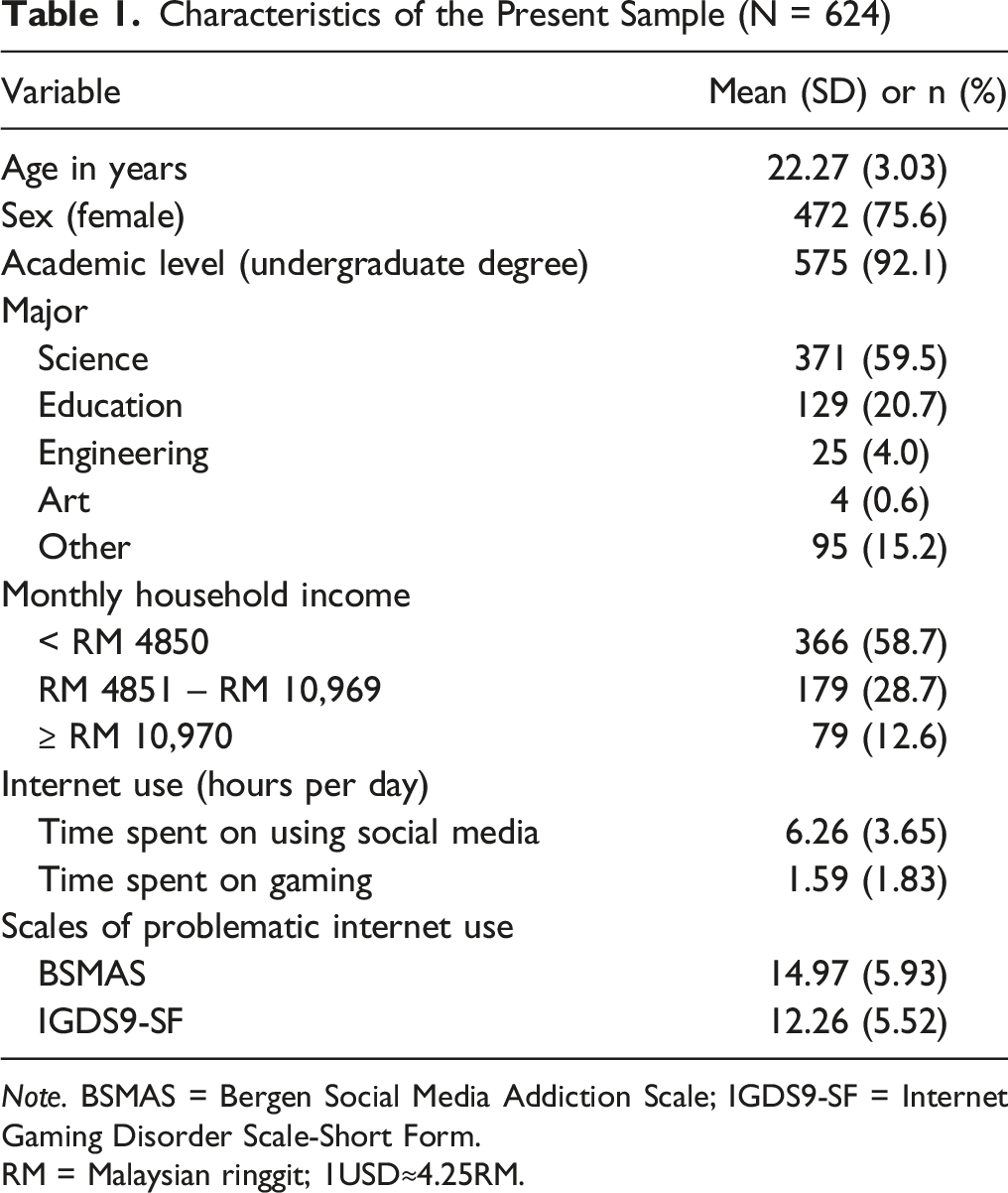
Note. BSMAS = Bergen Social Media Addiction Scale; IGDS9-SF = Internet Gaming Disorder Scale-Short Form.
RM = Malaysian ringgit; 1USD≈4.25RM.
Item Content and Item Properties of the Gaming Disorder Test (GDT) and Gaming Disorder Scale for Young Adults (GADIS-YA)
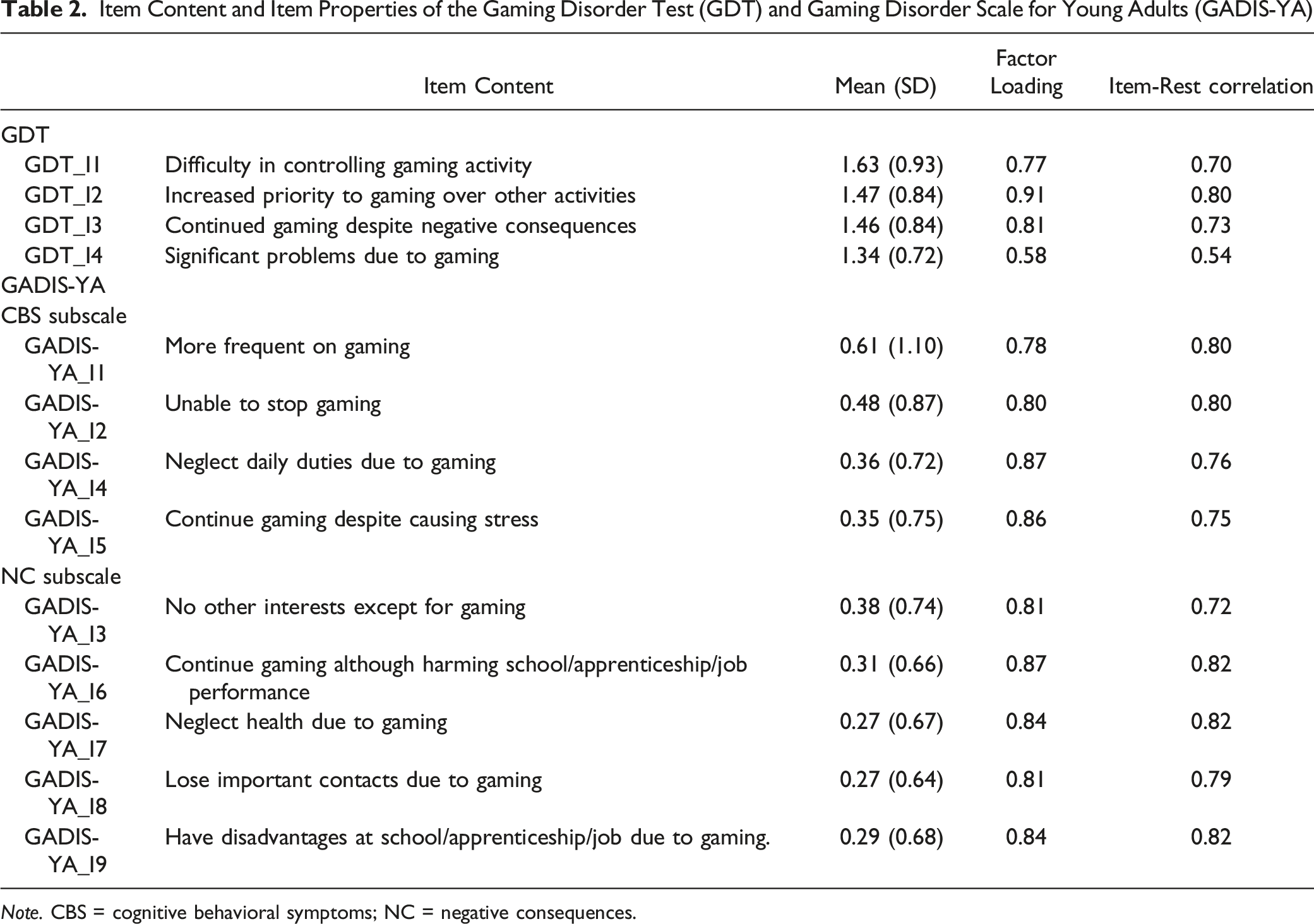
Note. CBS = cognitive behavioral symptoms; NC = negative consequences.
Scores on the GDT and GADIS-YA were strongly associated (r = 0.73; p < 0.01). Moreover, scores on both the GDT and GADIS-YA were strongly associated with IGDS9-SF scores (r = 0.70 and 0.79; p < 0.01). Although the GDT and GADIS-YA scores were significantly associated with BSMAS scores, the magnitudes were not strong (r = 0.28 and 0.27; p < 0.01). Moreover, GDT and GADIS-YA scores were significantly associated with time spent on gaming but relatively weakly (r = 0.16 and r = 0.16; both p < 0.001). Additionally, GDT and GADIS-YA scores were significantly (but even more weakly) associated with time spent on social media (r = 0.10 and r = 0.09; p = 0.01 and p = 0.02) (please see Supplementary Table S2 for details).
Measurement Invariance of the Gaming Disorder Test (GDT) and Gaming Disorder Scale for Young Adults (GADIS-YA) Across Gender (Male vs. Female) and Time Spent on Gaming (< 2 hours vs. ≥ 2 hours)
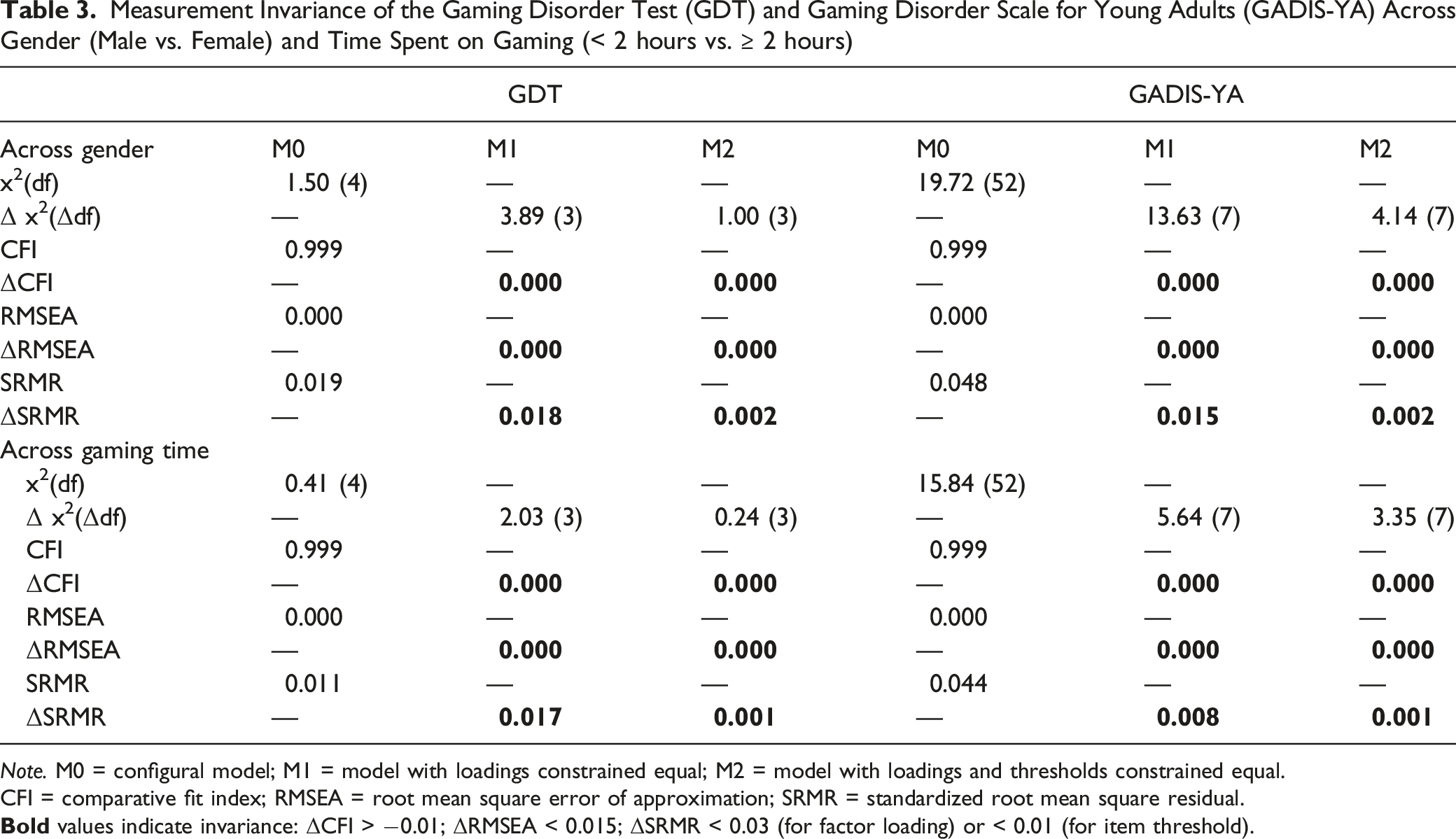
Note. M0 = configural model; M1 = model with loadings constrained equal; M2 = model with loadings and thresholds constrained equal.
CFI = comparative fit index; RMSEA = root mean square error of approximation; SRMR = standardized root mean square residual.
Discussion
In Malaysia, there is a growing research interest in the topic of GD (Ismail et al., 2021; Ling et al., 2021; Nik Jaafar et al., 2021; T’ng & Pau, 2020; Wu et al., 2023). To the best of the present authors’ knowledge, the present study is the first to translate and evaluate the psychometric properties of the Malay versions of the GDT and GADIS-YA among university students in Malaysia. Consistent with previous findings, the present study supported that the GDT has a single-factor structure (Cakiroglu & Alnak, 2021; Cudo et al., 2022b; Maldonado-Murciano et al., 2021; Montag et al., 2019; Pontes et al., 2021; Wang & Cheng, 2020) and the GADIS-YA has a two-factor structure (Mazaherizadeh et al., 2022; Nazari et al., 2022; Paschke et al., 2020). Furthermore, both the GDT and GADIS-YA demonstrated concurrent validity by significantly correlating with the IGDS9-SF, BSMAS, time spent on social media, and time spent on gaming. The measurement invariance (including metric equivalence and scalar equivalence) of both GDT and GADIS-YA was confirmed across gender and gaming time. Given the good validity found in the present study, the findings clearly indicate that the original GADIS-A is also capable of assessing GD among emerging adults. However, given that the target population in the present study was young adults, the GADIS-A was renamed GADIS-YA in the present study to avoid confusion when using it to assess GD among young adults.
The psychometric properties of the Malay version of the GDT demonstrated satisfactory level of internal consistency reliability in the present study, which was comparable to previous findings (Chiorri et al., 2023; Cudo et al., 2022b; Islam et al., 2022; Maldonado-Murciano et al., 2021). In concurrence with the existing literature (Islam et al., 2022; Wang & Cheng, 2020), the GDT score was found to be significantly correlated with the IGDS9-SF, BSMAS, time spent on social media, and time spent on gaming, supporting concurrent validity. These results are consistent with previous studies on the relationship between GD and time spent on gaming (e.g., Cudo et al., 2020; Evren et al., 2020; Li et al., 2021; Pontes et al., 2021) and time spent on social media (Wong et al., 2020), indicating that increased severity of GD symptoms may be related to longer time spent on gaming and social media.
Findings of the present study on GADIS-YA supported the previous three studies among groups of adolescents from Iran (Mazaherizadeh et al., 2022), Germany (Paschke et al., 2020) and Russia (Nazari et al., 2022); and two recent studies among groups of young adults from mainland China (Chen et al., 2023) and Taiwan (Wu et al., 2023). A recent meta-analysis found a higher prevalence of IGD among young adults as compared to adolescents (Gao et al., 2022). Another meta-analysis on the prevalence of GD in Southeast Asia also found that adults were more susceptible to GD compared to adolescents (Chia et al., 2020). As young adults have greater independence and access to smart devices, together with their technological proficiency and the lack of external monitoring (e.g., supervision by parents), this may increase their vulnerability to GD (Chia et al., 2020). Also, emerging adults’ brains continue to develop until about the age of 25 years. Therefore, it is important to evaluate the psychometric properties of the GADIS-YA among university students who are mostly young adults, in which it can be used in future longitudinal studies to identify GD among adolescents who become university students. Moreover, GADIS-A and GADIS-YA can help healthcare professionals to assess adolescents’ GD levels from adolescence to young adulthood which would help in assessing change in GD levels over this important developmental period. The identification of the two-factor structure found in GADIS-YA among early adulthood stage reinforces the potential of GADIS-YA as a valid tool for healthcare professionals, enabling them to gain a more comprehensive understanding of young adults’ gaming behaviors and patterns. Also, healthcare professionals can get valuable insights into the specific challenges faced by young adults with GD and develop tailored strategies to address their specific needs related to both cognitive behavioral symptoms and negative consequences (i.e., the two underlying factors in the GADIS-YA). Additionally, healthcare professionals can provide support and guidance to young adults and their families in navigating the challenges associated with excessive gaming and promoting healthy digital habits. Consequently, the GADIS-YA can be used for intervention and treatment purposes in a manner similar to its application among adolescents.
The measurement invariance of both GDT and GADIS-YA was found to be consistent across gender and gaming time in the present study, indicating that these two instruments can be used to reliably assess GD in different populations. More specifically, the metric equivalence model suggested that factor loadings were similar across gender and gaming time groups, and the scalar equivalence model suggested that values and means were also equivalent across groups. Previous studies have confirmed the measurement invariance of the GDT (Cudo et al., 2022b; Maldonado-Murciano et al., 2021) and GADIS-A (Nazari et al., 2022) across gender. Cudo et al., 2022a found that female gamers tend to use smartphones as a gaming platform, spend less hours in gaming per week, and experience lower levels of online flow as compared to male gamers. In addition, the insight into differences between male and female gamers on self-control, cognitive complexity, and impulsivity dimensions further illustrate the differences between these two groups (Cudo et al., 2020). On the other hand, to the best of the present authors’ knowledge, no studies have examined the measurement invariance of GDT and GADIS-YA across gaming time. Therefore, the present findings added to the literature that individuals with different gaming time can be compared using GDT and GADIS-YA.
The present study adds to the body of knowledge regarding validity and reliability of both GD instruments based on ICD-11 criteria in Southeast Asia. Interestingly, a recent meta-analysis demonstrated that the prevalence of GD appeared to be higher in Southeast Asia (Chia et al., 2020) and East Asia (Liao et al., 2022) than in other regions of the world. Another meta-analysis also reported that the prevalence of GD was higher in Asia than in Europe (Stevens et al., 2021). The higher rate of GD in Asia might be related to cultural differences (Chia et al., 2020; Liao et al., 2022). Consequently, it is important to consider the challenges of cross-cultural comparisons, including differences in cultural attitudes, towards gaming and variations in diagnostic criteria and GD assessment tools.
The translation and psychometric evaluation of the Malay language versions of the GDT and GADIS-YA have significant implications for the assessment and understanding of GD among Malaysians, as well as contributing to the cross-cultural validity of these instruments. Furthermore, the availability of valid measures in the Malay language allows for accurate comparisons of the prevalence and severity of GD between different cultures and across different countries and regions. Both valid measures would also facilitate healthcare professionals in the development and evaluation of effective interventions for GD in Malaysia. By identifying and addressing GD at an early stage, healthcare professionals (particularly psychologists, psychiatrists, university counselors, and other healthcare therapists) can provide timely support and assistance to those university students who are at risk or already experiencing problems due to GD. Moreover, brief assessment tools are preferable to minimize drop-out rates when conducting health research or evaluating clients prior to treatment. Therefore, the GDT, with just four items may be more suitable for health research purposes whereas the GADIS-YA may be of more use to health treatment providers in gaining a better understanding of how GD is affecting the lives of their clients. Consequently, researchers and healthcare professionals who are in need of a concise method for assessing GD can use the GDT as it is a valid and easily administered psychometric tool for assessment with culturally diverse samples (Wang & Cheng, 2020). In addition, healthcare providers and other treatment professionals may use GADIS-A and GADIS-YA to routinely monitor GD among adolescents and emerging adults given that the GADIS-YA was found to have promising psychometric properties in the present study among those in young adulthood.
The present study has several limitations. First, the use of convenience sampling method may limit the representativeness of the study findings. Moreover, the skewed gender distribution (i.e., three-quarters of the present sample were females) may have impacted the findings. Second, the study was cross-sectional, therefore causal relationships between the variables could not be determined. Third, the present study relied on self-report data, which may be subject to various methodological biases, such as social desirability bias and misrepresentation bias.
Conclusion
The Malay versions of the GDT and GADIS-YA are valid and reliable psychometric instruments used to assess GD based on the ICD-11 criteria. Importantly, both the GDT and GADIS-YA appear to be promising assessment tools that can be potentially used in both clinical and epidemiological studies in Malaysia.
Supplemental Material
Supplemental Material - Problematic Gaming in Malaysian University Students: Translation and Psychometric Evaluation of the Malay Language Versions of Gaming Disorder Test and Gaming Disorder Scale for Young Adults
Supplemental Material for Problematic Gaming in Malaysian University Students: Translation and Psychometric Evaluation of the Malay Language Versions of Gaming Disorder Test and Gaming Disorder Scale for Young Adults by Farah Raihana Ghazi, Wan Ying Gan, Serene En Hui Tung, I-Hua Chen, Wai Chuen Poon, Yan-Li Siaw, Ruckwongpatr Kamolthip, Jung-Sheng Chen, Shih-Wei Huang, Mark D. Griffiths, and Chung-Ying Lin in Evaluation & the Health Professions
Footnotes
Acknowledgments
We sincerely thank all the teaching faculty and research assistants who helped in the present study. We also thank all the participants for their involvement in the present study.
Author’s Contribution
Conceptualization, WYG, SEHT, C-YL; methodology, FRG, WYG, SEHT, I-HC, WCP, Y-LS, RK, J-SC, S-WH, MDG, C-YL; software, RK, C-YL; validation, FRG, SEHT, I-HC, WCP, Y-LS, J-SC, S-WH, MDG, C-YL; formal analysis, I-HC, J-SC; investigation, WYG, SEHT, I-HC, WCP, Y-LS, C-YL; resources, WYG, SEHT, C-YL; data curation, FRG, WYG, SEHT, WCP, Y-LS; writing–original draft preparation, FRG, WYG, SEHT, C-YL; writing–review and editing, I-HC, WCP, Y-LS, J-SC, S-WH, MDG, C-YL; visualization, I-HC, C-YL; supervision, WYG, C-YL; project administration, WYG, C-YL; funding acquisition, WYG, SEHT, WCP, Y-LS, C-YL. All authors have read and agreed to the published version of the manuscript.
Declaration of Conflicting Interests
The authors declare no potential conflicts of interest with respect to the research, authorship, and/or publication of this article. MDG has received research funding from Norsk Tipping (the gambling operator owned by the Norwegian government). MDG has received funding for a number of research projects in the area of gambling education for young people, social responsibility in gambling and gambling treatment from Gamble Aware (formerly the Responsibility in Gambling Trust), a charitable body which funds its research program based on donations from the gambling industry. MDG undertakes consultancy for various gambling companies in the area of player protection and social responsibility in gambling.
Funding
The author(s) disclosed receipt of the following financial support for the research, authorship, and/or publication of this article: This research was funded by the Ministry of Science and Technology, Taiwan (MOST 110-2410-H-006-115; MOST 111-2410-H-006–100), the National Science and Technology Council, Taiwan (NSTC 112-2410-H-006-089-SS2), the Higher Education Sprout Project, Ministry of Education to the Headquarters of University Advancement at National Cheng Kung University (NCKU), and the 2022 Southeast and South Asia and Taiwan Universities Joint Research Scheme (NCKU 35).
Ethical approval
The study protocol was approved by the Ethics Committee for Research Involving Human Subjects in Universiti Putra Malaysia (JKEUPM; Reference Number: JKEUPM-2022-268). The study was in accordance with the principles of 1964 Helsinki Declaration.

Data Availability Statement
Supplemental Material
Supplemental material for this article is available online.
References
Supplementary Material
Please find the following supplemental material available below.
For Open Access articles published under a Creative Commons License, all supplemental material carries the same license as the article it is associated with.
For non-Open Access articles published, all supplemental material carries a non-exclusive license, and permission requests for re-use of supplemental material or any part of supplemental material shall be sent directly to the copyright owner as specified in the copyright notice associated with the article.
