




Abstract
Children with visual impairments (VI) have numerous and well-documented health disparities that negatively impact their quality of life. Although physical education should serve as an avenue to reduce these disparities, physical educators often report being unprepared to work with children with VI. Physical education undergraduate programs also struggle to adequately address issues related to teaching children with disabilities. Hence, it is imperative that educational tools are identified that can more efficiently imbue the knowledge and skills related teaching children with VI in a physical education setting. The purpose of this study was to compare the effects of two types of educational podcasts (i.e., content acquisition podcasts and open-access podcasts) on preservice physical educators' knowledge and self-efficacy around teaching students with VI. The CAPs group had significantly higher knowledge gains compared to the control group but was non-significantly higher than the open-access group. The CAPs group significantly improved self-efficacy compared with the open-access and control groups. Implications for future research and suggestions for the use of educational podcasts within college and university settings are discussed.
Keywords
Introduction
Students with visual impairments (VI) have repeatedly cited negative physical education experiences (e.g., Haegele et al., 2019a; Haegele & Porretta, 2015). Haegele and colleagues (2022) recently reported youth with VI often expressed negative experiences when interviewed about the inclusiveness of their physical education experiences. One theme from this qualtative inquiry explicitly illustrated how these participants often felt completely disconnected from their physical education classes with little to no expectations to interact with their peers or the curriculum. These negative experiences partially stem from inadequately trained physical educators (e.g., Haegele et al., 2019b; Perkins et al., 2013). Indeed, students with VI’s experiences are unsurprising when considering that general physical educators often receive only a single adapted physical education 1 (APE) course throughout their physical education teaching education (PETE) programs (Piletic & Davis, 2010). Because PETE APE courses necessitate covering vast areas of content about teaching students with disabilities, such as special education law and specific disability characteristics, the depth of coverage of content is also lacking (McNamara et al., 2021, 2022).
In addition to the overwhelmingly negative experiences of students with VI in physical education and inadequately trained physical educators, children with VI have significantly lower physical activity levels and health outcomes compared to their abled-bodied peers (Haegele & Porretta, 2015; Haegele et al., 2019a). Further, students with VI frequently have considerable developmental gross motor delays at early ages and often struggle to overcome these persistent issues once they have recognized (Brian et al., 2021). Scholars have often ascribed these adverse trends in health and motor development to barriers that limit their ability to engage in physical activity and physical education (Haegele et al., 2022; Haegele & Porretta, 2015; Perkins et al., 2013). The insufficient preparation of physical educators to teach children with disabilities (Haegele & Porretta, 2015; McNamara et al., 2021; Perkins et al., 2013) is likely connected to these lower levels of physical activity and motor development of children with VI (Brian et al., 2021; Haegele & Porretta, 2015). Instructors of APE courses often cover content using broad strokes and only get to surface level content due to the constraints of having to address a large array of content areas and disabilities within a single course (McNamara et al., 2021). Hence, it is vital to identify effective media to provide preservice physical educators the content, skills, and confidence needed to properly teach students with VI (McNamara et al., 2022).
Educational Podcasts
Educational podcast is a term used to define podcasts specifically developed to educate and disseminate information (Drew, 2017; Shaw & McNamara, 2021). Over the last decade there has begun to be a substantial amount of research focused on the use and efficiency of educational podcasts, with many focusing on distributing information to college students (e.g., Carlisle et al., 2016; Kennedy et al., 2016). Scholars have demonstrated that educational podcasts can positively impact college students’ acquisition of content, self-efficacy, and perceptions towards a variety of topics (e.g., Kennedy et al., 2016; McNamara et al., 2021, 2022). These findings have been most robust within podcasts that are developed using well-established learning theories (e.g., Kennedy et al., 2016; McNamara et al., 2022), yet it has been noted that scholars often fail to utilize theoretical frameworks within the development stage of educational podcasts (McNamara & Drew, 2019).
Cognitive Theory of Multimedia Learning
The Cognitive Theory of Multimedia Learning (CTML) is a well-established learning theory based within the cognitive load theory (Sweller, 1988) and the dual-processing theory (Bagui, 1998), and has been used to guide the development of educational multimedia tools, such as educational podcasts, for over two decades (Mayer, 2001). The CTML has three main assumptions that drive the development of multimedia to optimize and reflect how people learn (Mayer, 2021). These assumptions include: (a) the dual channel assumption that learners “possess separate information processing channels for visually represented materials and auditory represented materials” (Mayer, 2008, p. 33), (b) the limited capacity assumption that learners “are limited in the amount of information that can be processes by each channel” (Mayer, 2008, p. 34), and (c) the active processing assumption that learners “engage in active learning by attending to relevant incoming information, organizing selected information into coherent mental representations, and integrating mental representations with other knowledge” (Mayer, 2008, p. 34). Mayer (2008) further outlines an instructional design process to develop multimedia, including CAPs, in accordance with the CTML and its’ foundation assumptions. The main components of this instructional design process include (a) the elimination of redundant information not relevant to the primary objective(s) of the presentation, (b) the precise and accurate representation of necessary information, and (c) the promotion of generative processing to enable the organization and integration of new and prior information.
Content Acquisition Podcasts
Content acquisition podcasts (CAPs) are rooted within the CTML (Mayer, 2021), which dictates that they are short in duration (i.e., approximately 10 minutes), and provide concise information about a specific topic through distributing both an audio narrative paired with still images (Kennedy et al., 2016). Numerous studies have shown that CAPs improve college students’ knowledge acquisition of content, application of skills, and self-efficacy, (e.g., Carlisle et al., 2016; Kennedy et al., 2016; McNamara et al., 2020). In addition, there is preliminary evidence to suggest the effectiveness of CAPs compared to other tools, such as practitioner-friendly articles and live presentations (Carlisle et al., 2016; Green et al., 2020). McNamara et al., 2022 recently compared the effects of CAPs aimed to improve preservice physical educators’ understanding of how to teach students with VI compared to a group that received a textbook chapter on the same content and a control group. The CAPs participants significantly improved in their knowledge test scores regarding teaching students with VI in a physical education setting compared with the other groups. The CAPs group also significantly improved their self-efficacy scores compared to the control. Additionally, the textbook group did not significantly differ in self-efficacy measures compared to the control group. These findings demonstrate the benefits of CAPs to provide concise information about critical aspects often neglected in PETE programs (McNamara et al., 2021, 2022). Further, they are promising given that these tools are often cited as flexible and accessible (e.g., McNamara et al., 2020). However, CAPs are only one form of educational podcasts among a growing pool of increasingly popular forms of podcasts that are being used to educate and inform college students and other populations (Fronek et al., 2016; McNamara et al., 2021; McNamara & Haegele, 2021). Hence, additional research is needed to grasp the efficiency of these various podcast tools across populations and contexts to understand their nuances and impact on learning.
Open-Access Podcasts
Commercially created podcasts, also called open-access podcasts, are freely available through the internet and are not connected to any specific curriculum or courses (Drew, 2017b). Dissimilar to CAPs, open-access podcasts do not adhere to any specific theoretical framework and do not have any parameters around using both audio and video channels. These podcasts have increasingly been identified to disseminate discipline- specific information and cultivate communities (Fronek et al., 2016; Wrather, 2016). For example, an emerging community of practice with knowledge frequently accessed and shared to replace or supplement traditional profession development was recently identified around physical education podcasts through interviews with physical education podcast creators and listeners (McNamara & Haegele, 2021). Open-access podcasts have been cited as unique learning tools that can provide a depth of information via conversational tones that keep learners engaged for extended periods of time, as well as develop unique relationships between the listener and the hosts that are often absent within online settings (Perks & Turner, 2019; Wrather, 2016). Drew (2017b) has argued for longer length podcasts as they might nurture higher-level cognitive skills as they allow for more time to engage with complex and analytical dialogue. These thoughts run in direct contrast to the CTML, which guide the development of CAPs and stipulates that shorter duration media helps learners to select relevant information and efficiently organize it (Mayer, 2008). McNamara & Haegele, 2021 examined preservice physical educators’ experiences and perceptions towards an open-access podcast focused on inclusive experiences among students with disabilities in physical education and found that college students enjoyed listening to the podcast. In addition, they reported that students believed it was more beneficial than more traditional methods of acquiring information, such as reading a book chapter. Nonetheless, major concerns have been raised about these podcasts, such as the lack of theoretical foundations and the content lacking validity and oversight (McNamara & Drew, 2019; McNamara & Haegele, 2021). Further, there is a dearth of literature around the efficiency of open-access podcasts as a learning tool (Fronek et al., 2016); thus, limiting the ability to assess their relevance as a learning tool.
Purpose
Given the many learning and flexibility benefits associated with educational podcasts it is vital to continue to explore the benefits of different types of podcasts to better comprehend their usefulness as a learning tool. Given that APE course instructors have expressed the inability to adequately cover relevant content related to teaching APE within one college course (McNamara et al., 2021), it is critical quality and efficient tools are identified to better prepare future physical educators. With that said, preservice physical educators would benefit from accessible content focused on teaching students with VI, who often have negative experiences in physical education spaces (Haegele et al., 2019, 2022; McNamara et al., 2021). Thus, we aim to compare the effects of CAPs that are focused on increasing preservice physical educators' knowledge and self-efficacy around teaching students with VI, with an open-access podcast and a control group. More specifically, this study is guided by two distinct research questions: 1. To what degree do CAPs impact undergraduate students’ knowledge of teaching students with VI in a physical education setting as compared to open-access podcasts and a control group? 2. To what degree do CAPs impact undergraduate students’ self-efficacy related to teaching students with VI in a physical education setting as compared to open-access podcasts and a control group?
Methods
This study featured a pretest-posttest comparison group quasi-experimental design with a sample of preservice physical educators.
Participants and Setting
Sample demographic variables.
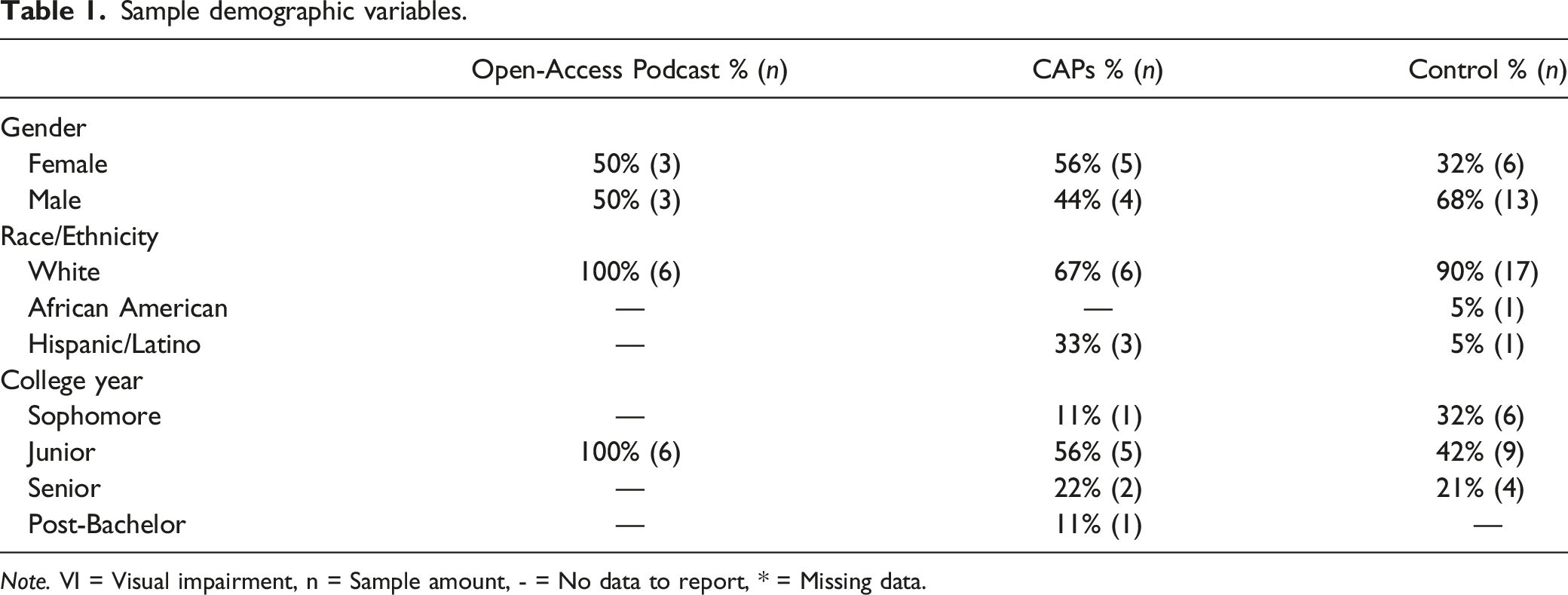
Note. VI = Visual impairment, n = Sample amount, - = No data to report, * = Missing data.
Podcasts
Both the CAPs and the open-access podcast used for this study were developed using a chapter focused on teaching students with VI in a physical education setting from the textbook “APE and Sport” (Winnick & Porretta, 2017). This textbook was selected for this study because it was recently identified as being one of the most popular textbooks used within introduction to APE college courses (McNamara et al., 2022). The CAPs group received two 10-minute CAPs developed using the CTML and guiding instructional design principles (Driver et al., 2014; Mayer, 2021). These CAPs were previously used in a similar study, with their development outlined in greater detail, that examined the impact of CAPs compared to this textbook chapter and a control group (McNamara et al., 2022). The open-access podcast group received one 48-minute podcast that included the lead author interviewing the author of the Winnick and Porretta (2017) textbook chapter on VI and physical education. The textbook chapter author was provided guiding questions prior to the interview, which included the same concepts covered within the CAPs, and within the podcast they discussed the main concepts found within the textbook chapter. This podcast was also guided by the same learning objectives use to develop the CAPs. Furthermore, the podcast interviewee was provided the test developed for this study, which were developed based on the content delivered by the CAPs, prior to recording the podcast to ensure each topic was discussed in detail. During the podcast recording, the lead author and interviewee used a checklist of main topics and test items to ensure fidelity and alignment with the CAPs. This episode was released via an open-access podcast focused APE related topics, allowing for participants to access the podcast via podcast streaming services, such as iTunes, which can be accessed here: https://soundcloud.com/scott-mcnamara-12/101-on-teaching-children-with-visual-impairments-in-pe
Data Collection
Initially, all the participants were provided identical links to the informed consent, a demographics survey, and a pretest via Qualtrics. The demographics section collected pertinent information about their participants’ personal characteristics (e.g., age, gender, college year). The pretest included a knowledge section (n items = 13) and a self-efficacy section (n items = 12) regarding teaching students with VI in a physical education setting. The knowledge section included multiple-choice items that were designed using the textbook chapter content used to develop the podcasts (Winnick & Porretta, 2017). Scoring of the knowledge test converts into a percentage between 0–100 and reported as a decimal (e.g., .50 – 1.00). The self-efficacy section was developed using the Physical Educators’ Self-Efficacy toward Including Students with Disabilities–Autism (PESEISD-A; Taliaferro et al., 2015) questionnaire, which was developed using Bandura and Walters (1977) self-efficacy theory. This section used a 10-point Likert scale (1 [cannot do at all] to 10 [highly certain can do]) and asked participants to rate their confidence to conduct tasks associated with the inclusion of students with VI in a PE setting. Further details on the test are detailed by McNamara et al. (2022).
After completing the pretest, those that were enrolled in the introduction to APE courses were randomly placed into two groups: (1) receiving two CAPs, and (2) receiving one open-access podcast. Next, those in the intervention groups were emailed either the CAPs or open-access podcast with instructions on how to view them. Participants were then provided with a posttest. Six weeks afterwards, all participants were provided with the retention test. Each test was identical to one another. At each stage of the procedures (i.e., pretest, posttest, retention test), participants were given a one-week period to complete the data collection. The participants within the CAPs and open-access podcast groups were also given one week to view their materials. The control group received no intervention. The lead author’s Institutional Review Board approved all procedures conducted in this investigation prior to data collection.
Data Analysis
Prior to any analyses, all tests for assumptions were passed. There were no significant outliers (via Boxplots), the distribution was normal (Shapiro-Wilk; p > .05), and there was equal variance among within-subject levels (Mauchly’s Test of Sphericity; p > .05). After assumptions testing, initial analyses showed no significant differences among groups for either knowledge (p = .632) or self-efficacy (p = .448). Furthermore, given the attrition rate from pretest to retention we conducted additional analyses and found no differences between completers and non-completers for knowledge (p = .169) or self-efficacy (p = .768) regardless of gender (p = .169–.768). Thus, our subsequent analyses based upon the current sample are supported.
To address research questions 1 and 2, two separate repeated measures ANOVAs were conducted to determine the effects of podcast type (CAPs, open-access, or control) on either knowledge or self-efficacy beliefs regarding teaching students with VI physical education across three time points. Effect sizes were calculated and reported using partial eta squared (η2p) with values interpreted as small (.01), medium (.06), and large (.14; Draper, 2018). If a main effect of group was detected, the investigators followed up with pairwise comparisons. A probability level of p ≤ .05 was used to determine statistical significance for all analyses using the SPSS (version 25.0; IBM Corp., Armonk, NY).
Results
Knowledge
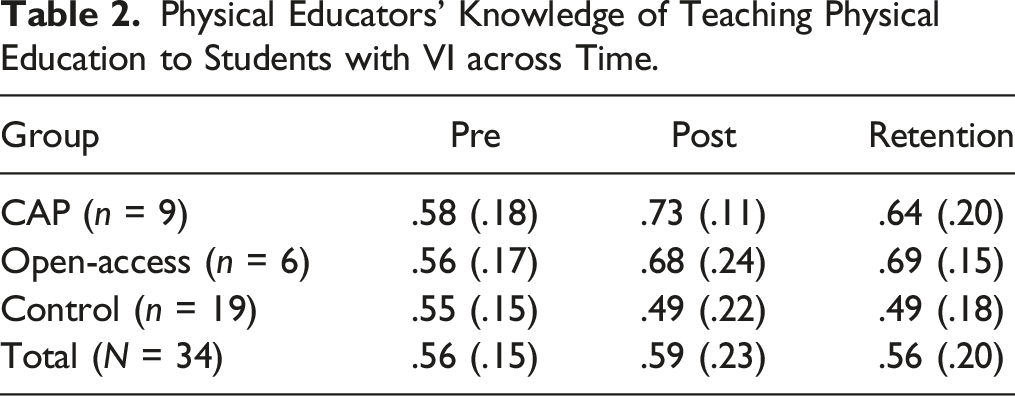
Physical Educators’ Knowledge of Teaching Physical Education to Students with VI across Time.
Self-Efficacy
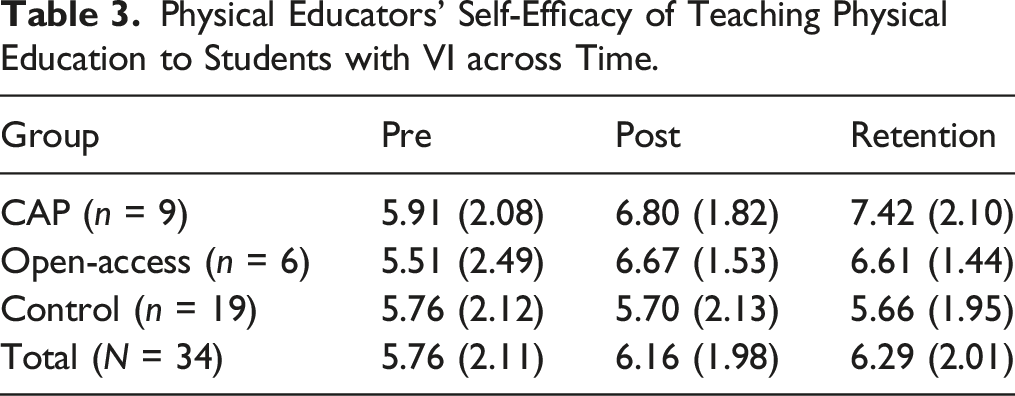
Physical Educators’ Self-Efficacy of Teaching Physical Education to Students with VI across Time.
Discussion
The purpose of this study was to compare the effects of two types of podcasts (i.e., CAPs and open-access podcasts) focused on increasing preservice physical educators' knowledge and self-efficacy around teaching students with VI. Findings from this investigation contribute to the expanding empirical evidence supporting the use of podcasts, regardless of type, as an effective teaching tool with college students (e.g., Carlisle et al., 2016; Kennedy et al., 2016). The CAPs group demonstrated higher knowledge and self-efficacy scores compared to both the open-access and control groups. However, the only significance detected was between the CAPs and control group with the knowledge gains. These preliminary findings suggest that CAPs may offer a viable means to learn information quickly and efficiently compared to longer duration podcasts. However, due to a low sample size and high attrition rates, it is important to view these results as preliminary and a precursor for larger studies that should examine the differences between these two distinct types of online learning tools. Nonetheless, the overall findings align with the growing literature base that demonstrates that podcasts are an effective learning tool for college students, regardless of the type. More specifically, these findings demonstrate that both CAPs and a non-theoretical grounded podcast can be a beneficial tool to increase college students’ knowledge and self-efficacy around working with students with VI. Identifying effective tools to inform future physical educators on this subject is imperative, as general physical educators are often reported as being ill-equipped to work with children with VI (Haegele et al., 2022; Perkins et al., 2013), as well as students with VI often have negative PE experiences and have lower motor skills compared to their peers without disabilities (Brian et al., 2021; Haegele et al., 2019).
For self-efficacy, both the CAPs and open-access groups showed increases from pre to post scores. The CAPs group showed gains in self-efficacy at retention while other groups showed slight reductions. This aligns with previous research showing the CTML helps to promote self-efficacy skills and learning (Mayer, 2021). For example, McNamara et al. (2022) found that CAPs improved future PE teachers’ self-efficacy in relation to working with students with VI when compared to reading a textbook chapter or a control. Indeed, when the CTML is applied to learning tools it has been suggested to lead to increased self-efficacy by encouraging active engagement and enhancing a sense of meaning and connection to the content (Mayer, 2021). Because CAPs use both audio and visuals (dual-processing) to convey information, this can enhance working memory capacity (Sweller, 1988) and potentially lead to further learning and self-confidence (McNamara et al., 2022).
The CAPs and open-access groups showed increases pre to post in knowledge scores, unlike the control group which remained constant. Indicating that podcasts, regardless of the type, may be a good pedagogical tool to teach about students with VI. Interestingly, only the open-access group had significant retention of the material. Drew (2017b) indicated that shorter podcasts appeared limited to a transmissive pedagogical approach and lessen the likelihood of nurturing higher-level cognitive skills due to a lack of time to engage with analytical dialogue. This logic conflicts with the foundational assumption of CTML, which states that learners have a limited capacity for information and that there is a need for short and segmented information to enable efficient processing (Mayer, 2021). Cavanagh and Kiersch (2022) further summarized the importance of creating multimedia that considers limited capacity in learning, by explaining that “if learners are presented with too much information too quickly, it will overwhelm their capacity limitation and information will be lost” (p. 12). Podcasts may inherently have the tools embedded within them to subvert working memory processing and capacity issues noted (Mayer, 2021). As podcasts allow listeners to easily pause and re-listen to material based on the context of their listening and their learning experience (Johnston et al., 2021; Maher et al., 2020; Roussel, 2011; Schreiber et al., 2010) and thus may reduce issues with overloading essential processing in working memory. Further research is needed, with larger sample sizes, to understand how these two learning tools differ in how they impact learning and retention of knowledge.
Additionally, the CTML has been criticized for not considering the social and cultural context in which learning occurs, as well as the role of motivation and affect in the learning process (Mayer, 2014; Park, 2015). It is well-known that social and motivational characteristics are key to the learning process, as they impact interest and attention (Krämer, 2010; Park, 2015). Survey and qualitative data demonstrates that college student open-access podcast listeners often listen for a mixture of social interaction, escapism, and educational purposes (Chung & Kim, 2016; McClung & Johnson, 2010; McNamara & Min, in review). Open-access podcasts listeners also often feel they develop a unique relationship with the podcast hosts and guests (McNamara et al., 2021; McNamara & Min, in review; Shaw & McNamara, 2021; Wrather, 2016). Since open-access podcasts often encourage hosts and guests to provide longer explanations embedded within anecdotes and personal experiences, listeners may be able to gain a deeper understanding of the content and concepts discussed. However, proponents of the cognitive load theory have suggested that anecdotes or discussion of materials that are merely interesting but not relevant to the instructional objectives can negate learning (Garner et al., 1989; Mayer et al., 2008). Hence, educational podcast creators and researchers should cautiously use stories and anecdotes purposively that are aligned with instructional goals (McNett, 2016).
The concept and terminologies around educational podcasts are considered to be relatively new and ambiguous, with terminology often being interpreted differently from one person to the next (Bottomley, 2015; Author Citation, 2019). Although findings from the current study demonstrate the positive effects of open-access podcasts, these findings should be viewed cautiously. The open-access podcast developed for this study was tailored specifically for learning purposes and guided by several fidelity steps (e.g., learning objectives, textbook) to ensure accuracy and alignment with the CAPs. However, open-access podcasts are not always developed educational intent, regardless of how they are used. Indeed, it is nearly impossible to determine the intent of the development of these podcasts without the creator specificizing their intentions. Making these tools quite different than CAPs, as CAPs follow a specific learning theory and are always intended to be used as learning tools. Along with calls for open-access podcast creators to identify their intentions with creating content, more debate is needed about the terminology around multimedia that are used used for educational and learning purposes, regardless of whether they are developed with educational intentions.
Given the inherent barriers with allocating enough time within a single required APE course, which is customary in most PETE programs (McNamara et al., 2021, 2022; Piletic & Davis, 2010), efficient tools, especially those that can provide information outside of valuable and limited class time, are valuable. Because topics around teaching children with disabilities, including APE, are often neglected within PETE programs (Haegele & Porretta, 2015), these tools may be a beneficial asset to finally address these inadequately addressed areas. College instructors should embed educational podcasts to introduce, enhance, and reinforce pertinent course content. Faculty can use these podcasts as teaching tools in their in-person classes to highlight an interesting perspective or to record key pieces of their lectures or class activities to listen to outside of class (Author 1, 2022d; Kratochwill et al., 2016). Regarding open-access podcasts, faculty should consider using them to introduce new topics to stimulate a discussion, or to hear from practitioners in their future fields (Author 1, 2022d). Findings from the current study point show that although different types of educational podcasts have relevance and learning benefits, it appears that CAPs are especially impactful, due in part to their efficiency and the fact they are short in duration (Kennedy et al., 2016). Furthermore, faculty should consider applying the CTML to the development of different multimedia tools used in their courses, as evidence suggests that the use educational podcasts grounded in theoretical frameworks are best known to be able to significantly improve learning outcomes (e.g., Kennedy et al., 2016; McNamara & Drew, 2019). Regardless of how future faculty use educational podcasts, more research is still needed to understand the nuances of the learning benefits of these different types of educational podcasts. Future researchers should also examine the use of different types of podcasts as learning tools to inform educators, including physical educators, to teach students with other types of disabilities.
Limitations
The limitations of this investigation should be acknowledged. A major limitation of this study was the large attrition rates. These may be attributed to data collection during the COVID-19 pandemic. The attrition rates led to a small sample size and unequal distribution of the sample among the groups. Reducing the power of the study and increasingly the likelihood of a Type II error. The high attrition rates have been attributed to studies conducted in online settings, especially ones that may lack relevance to participants (Lee & Choi, 2010; McNamara et al., 2022). Future research should establish larger sample sizes throughout the research process through making the content more relevant to participants and providing attractive incentives to decrease attrition. Furthermore, the use of open-ended survey questions and interviews in future research would provide useful insights and help contextualize future findings.
Conclusion
Educational podcasts, both open-access and CAPs, appear to be an effective and efficient tool to improve preservice physical educators content knowledge and confidence regarding teaching students with VI. College professors should consider embedding these tools into their introduction to APE course, as well as other courses, as a means to address areas around teaching children with disabilities, which are frequently insufficiently addressed within PETE programs (Haegele & Porretta, 2015). CAPs were found to significantly impact knowledge compared to a control, demonstrating their efficiency. However, the open-access podcasts demonstrated non-significant increases in knowledge scores compared to the control, as well as they were non-significantly lower than the CAPs group. This builds on well-established research to show that CAPs are an effective teaching tool for college students (Kennedy et al., 2016; McNamara et al., 2022); nonetheless, it is difficult to decipher their impact compared to open-access podcasts, especially given the low statistical power within this investigation. Open-access podcasts are a relatively new form of technology used within educational spaces (Fronek et al., 2016; Prince, 2020), and thus additional research is warranted to understand the nuances and benefits of this tool. Unlike CAPs, these tools are often not specifically developed for a specific course of set of students, as well as include a large range of quality of educational open-access podcasts and “expert” guests, the level of variance within this media type makes it difficult to empirically evaluate and examine their precise impact on the learning process. Nonetheless, it is imperative researchers examine and compare the benefits of this new and growing educational phenomena with other educational tools.
Footnotes
Declaration of Conflicting Interests
The author(s) declared no potential conflicts of interest with respect to the research, authorship, and/or publication of this article.
Funding
The author(s) received no financial support for the research, authorship, and/or publication of this article.
