




Abstract
Augmented reality (AR) has the potential to support individuals with special needs and to enable their development of daily living skills. This meta-analysis study examined the effect of AR on functional skills acquisition across individuals affected by different disabilities. Group design studies based on a random-effects model alongside the Preferred Reporting Items for Systematic Reviews and Meta-Analysis guidelines were used in this study. A total of 119 individuals with different types of disabilities (including intellectual disability, autism spectrum disorder, attention deficit hyperactivity disorder, Down syndrome, hearing disability, and visual disability) were obtained from seven studies. The overall effect size of AR across the seven studies was significant. The results showed that AR can be effective and helpful for individuals with disabilities to help them make daily decisions and guide their actions in society. The implications for practice and research as well as the possible areas that require further investigation are discussed.
Efforts to enable individuals with special educational needs (SEN) to obtain independence and achieve tasks of daily living have received considerable attention from the research community (LaRue et al., 2016; Westling & Fox, 2004). Those individuals are in a continuous need to acquire the skills necessary to help them complete everyday tasks and become independent learners (Jordan, 2013; LaRue et al., 2016). According to Garner (2009), the concept of SEN covers the students who require additional educational support due to disabilities or certain behavioral disorders. Functional skills refer to a broad range of abilities that are needed for an individual to perform self-care activities at home, school, and work. In addition, functional skills encompass a wide range of areas including vocational skills, social skills, and behavior management skills (Liberati et al., 2009; Stabel, 2013).
Assistive technology can help individuals with certain learning disabilities perform and develop various functional skills, it can also allow them to access support to complete a certain task or activity (LaRue et al., 2016). It has been argued that a lack of access to available technology to promote functional skills may have a negative impact on sense of self-worth, self-confidence and, individual’s overall personal judgment of well-being (Patterson & Pegg, 2009). It can also promote people to participate in everyday routines.
Augmented reality (AR) is defined as a technology that superimposes a computer-generated image on an individual’s view of the surrounding environment (McMillan et al., 2017). AR provides opportunities to promote lifelong learning among learners with a variety of needs (Gün & Atasoy, 2017; Ozdemir et al., 2018).
AR offers the potential to support individuals with SEN and enable the development of skills to support daily living (Bridges et al., 2019). The use of AR to develop functional skills may reduce dependence on traditional learning and teaching strategies, allow individualization of educational programs, and enable practice on a daily basis (Yuen, 2011). AR has been used in few previous studies to enhance certain functional skills such as wayfinding skills (Smith et al., 2017), numeracy (Drury-Stotz, 2018), shopping (Adjorlu et al., 2017), behavior management (Tentori & Hayes, 2010), literacy, and recreational skills (McMahon et al., 2016). Virtual overlays or interactive digital elements have been placed along with the mediated view of the physical environment such as sound, video, or 2D and 3D graphics to enhance the real-world environment (Aldowah et al., 2019; Al-Samarraie & Saeed 2018; Bridges et al., 2019).
The literature on the multiple uses of AR technologies in the context of special education points to the need for further investigation of the effectiveness of AR to increase functional skills acquisition among SEN individuals. In the context of this study, students with SEN are defined as students who have trouble with learning in school, who perform at a lower level than their peers, or who need special instruction to perform at an adequate level. Few meta-analysis studies have been conducted to address the effects of AR technology on SEN individuals (Damianidou, Foggett, et al., 2018). More precisely, few meta-analysis studies have examined the effectiveness of AR in SEN (Baragash et al., 2019; Damianidou, Arthur-Kelly, et al., 2018; Damianidou, Foggett, et al., 2018; Garzón & Acevedo, 2019; Tekedere & Göke, 2016). The majority of previous studies have explored the use of certain types of assistive technologies to support individuals with one or two types of disabilities, such as video modeling and video prompting (Gardner & Wolfe, 2013), and mobile technology (Cumming & Draper Rodríguez, 2017). Furthermore, there is a gap in knowledge on how AR-supported learning can help SEN individuals to learn the necessary functional skills and determine how this will affect individuals’ acquisition of these skills to participate in their life and communities. Based on these, there seems to be a lack of understanding of the effectiveness of AR to promote the learning of individuals with different disabilities in the literature (Barton et al., 2017).
This led us to ask the following question, “Does the use of AR increase the independence of individuals with SEN in performing functional tasks?” Thus, the purpose of this meta-analysis was to expand existing literature by addressing the effects of AR on teaching functional skills to individuals with SEN. Using group design studies, this study aims to offer an in-depth understanding of the effectiveness of AR in developing a sense of independence among learners and helping them to complete their daily living skills.
Method
This meta-analysis was performed based on the Preferred Reporting Items for Systematic Reviews and Meta-Analysis (PRISMA) guidelines (Moher et al., 2015), which consists of search strategy, selection criteria, data extraction, and data analysis using a defined review protocol (Liberati et al., 2009).
Search Strategy and Coding
A database search to identify and select the relevant AR studies on SEN individuals was conducted. The search covered a combination of databases through a targeted search in Google Scholar, followed by manual search of databases such as Elsevier, EBSCOhost, Taylor & Francis, and Springer, in order to identify relevant studies published between 2008 and 2019.
Because it was economically impossible to screen all the retrieved articles from Google Scholar for relevance, two additional measures were taken in an attempt to refine our result list. First, we selected those articles that had used the technology explicitly for individuals with SEN using terms such as “Augmented Reality” AND (“Special education” OR “Special needs” OR “Disabilities”) NOT (“Virtual Reality”). In addition, any paper related to virtual reality appeared in the results was not included in this meta-analysis. Secondly, we also identified studies that had actually used AR by using the search term “augmented technology” OR “augmented reality technology” OR “augmented space” OR “augmented smartphone application” OR “augmented systems.” The search list was created by the first author, who is well acquainted with the literature in this area of research. This procedure reduced the data pool to 809 articles. All studies of our previously created literature list were retained in these entries. In addition, the bibliographies of retrieved studies were examined for additional candidate studies. Additional sources from the reference lists of the included studies resulted in a total of six additional studies. All the identified studies were directly retrieved from the library or requested from the corresponding author. Based on the options provided, keywords were sought in the entire text (not only in titles, abstracts, and/or metadata). The types of disabilities associated with the use of AR applications included physical, mental, intellectual, or sensory impairments such as intellectual disability (ID), autism spectrum disorder (ASD), attention deficit hyperactivity disorder (ADHD), Down syndrome (SD), hearing disability (HD), and visual disability (VD).
Then, we created an initial coding sheet that was used to list information about the identified studies such as title, method, sample, technology characteristics, context, type of disability, and data analysis. We also coded information about the design of these studies (pretest/posttest or posttest only), the dependent variable(s) tested in the hypotheses, and outcomes. Both coding sheet and coding procedures were confirmed by jointly coding 21 studies. The identified studies were divided among two authors and each individually coded half of the studies. Both authors who coded the articles met when questions arose about coding a particular study. All potential articles were checked against the eligibility criteria before inclusion.
Eligibility Criteria
Previous studies had to meet the following criteria to be included in this meta-analysis: (a) the study used AR technology as an independent variable, (b) the study was conducted in experimental and quasi-experimental settings, (c) the study was published in English, and (d) the study included participants with additional needs. In addition, studies were excluded from this meta-analysis for the following reasons: (a) the study used qualitative method, (b) the study investigated the usability aspects of AR technology, and (c) the study used a single-subject design. Although we recognize the importance of investigative single-subject design studies, this meta-analysis was conducted by considering group design studies only. This is mainly because effect sizes from single-subject design should not be combined with group design studies for analysis (Beretvas & Chung, 2008). In addition, there are major differences in both study design and data analysis in which outcomes can be greatly influenced by these factors (Bates et al., 2016). Therefore, studies based on single-subject experimental designs were excluded from this meta-analysis. Furthermore, group design studies can provide aggregated information about the effectiveness of AR applications across a large group of SEN individuals. Through the selection process, a total of seven group design studies were included for meta-analysis (see Figure 1). The initial search result produced 809 studies identified through electronic searches of the mentioned databases, and 6 studies identified through manual search of references. After duplicates were removed, a total of 559 studies were screened at the title and abstract phase. During this phase, 512 studies were excluded (397 studies were nonrelevant, and 115 studies were not empirical studies). Full-text evaluation of the remaining 47 studies resulted in exclusion of 40 articles that employed single-subject design studies.
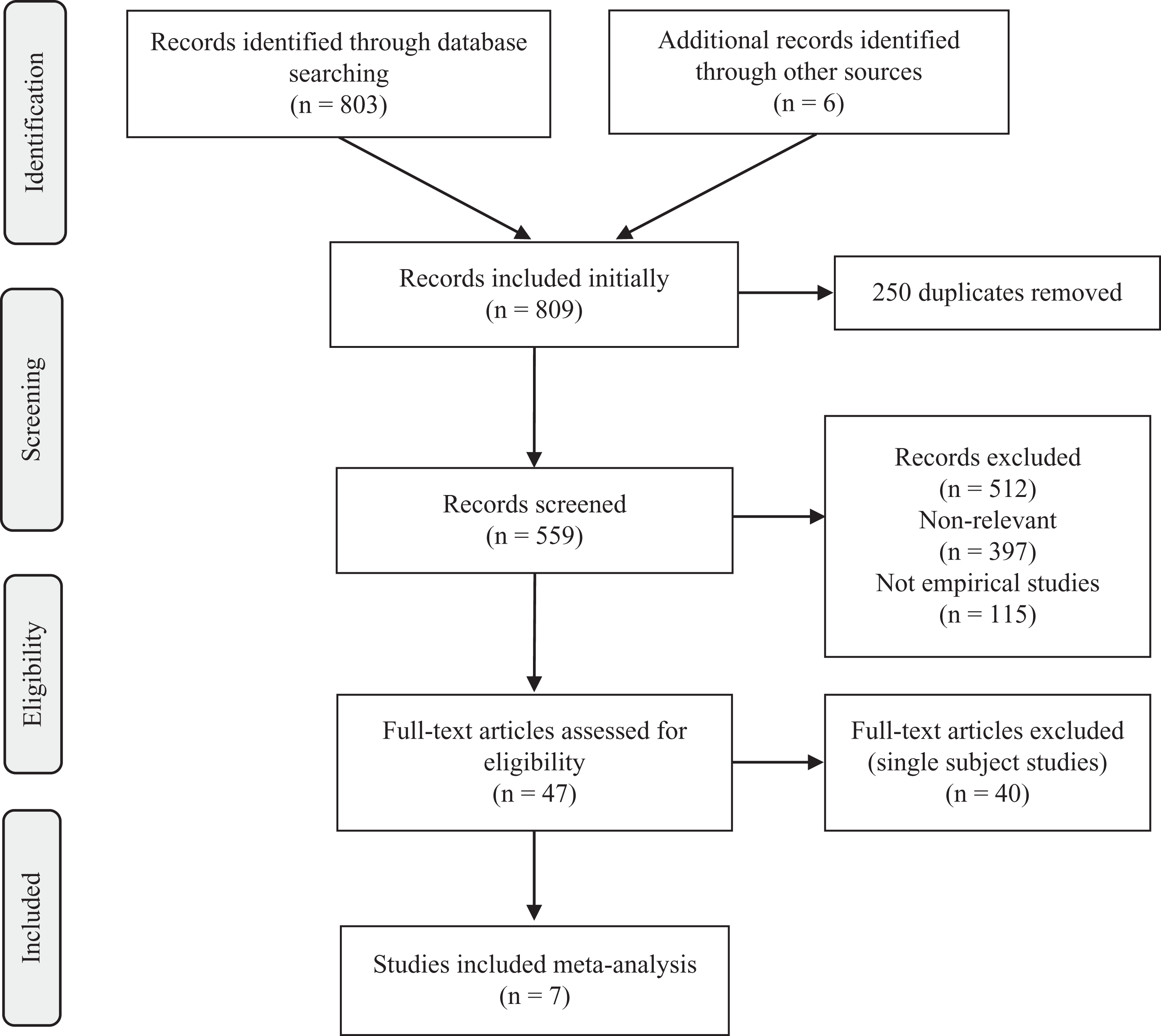
Preferred Reporting Items for Systematic Reviews and Meta-Analysis flow chart of the study selection process.
Descriptive Characteristics of Studies
The identified studies were classified according to authors, date of publication, type of disability, and the study design (see Table 1). A total of 119 participants were identified from the selected studies. Most participants were between 4 and 12 years, and two studies included participants older than 12 years. Males represented 76% of the participants and females represented 33%. In terms of the type of disabilities exhibited by the sample, 36 participants had VD (n = 36), ID and ASD (n = 34), HD (n = 20), DS (n = 18), and ADHD (n = 11). These studies examined the effects of AR on the improvement and acquisition of different functional skills. For example, two studies were on the numeracy skills to learn finance literacy for individuals with ASD and ID, two studies were on the visual skills of individuals with VD to learn wayfinding and shopping skills, one study was on learning literacy skills for individuals with HD, one study was on behavior management skills for individuals with ADHD, and one study was on the recreational skills for individuals with ASD. Of the seven studies, five had a quasi-experimental design (two within-subject, two between-subject, and one pretest–posttest without a control group), and two unidentified experimental design.
Descriptive Characteristics and Quality Assessment Results of the Selected Studies.
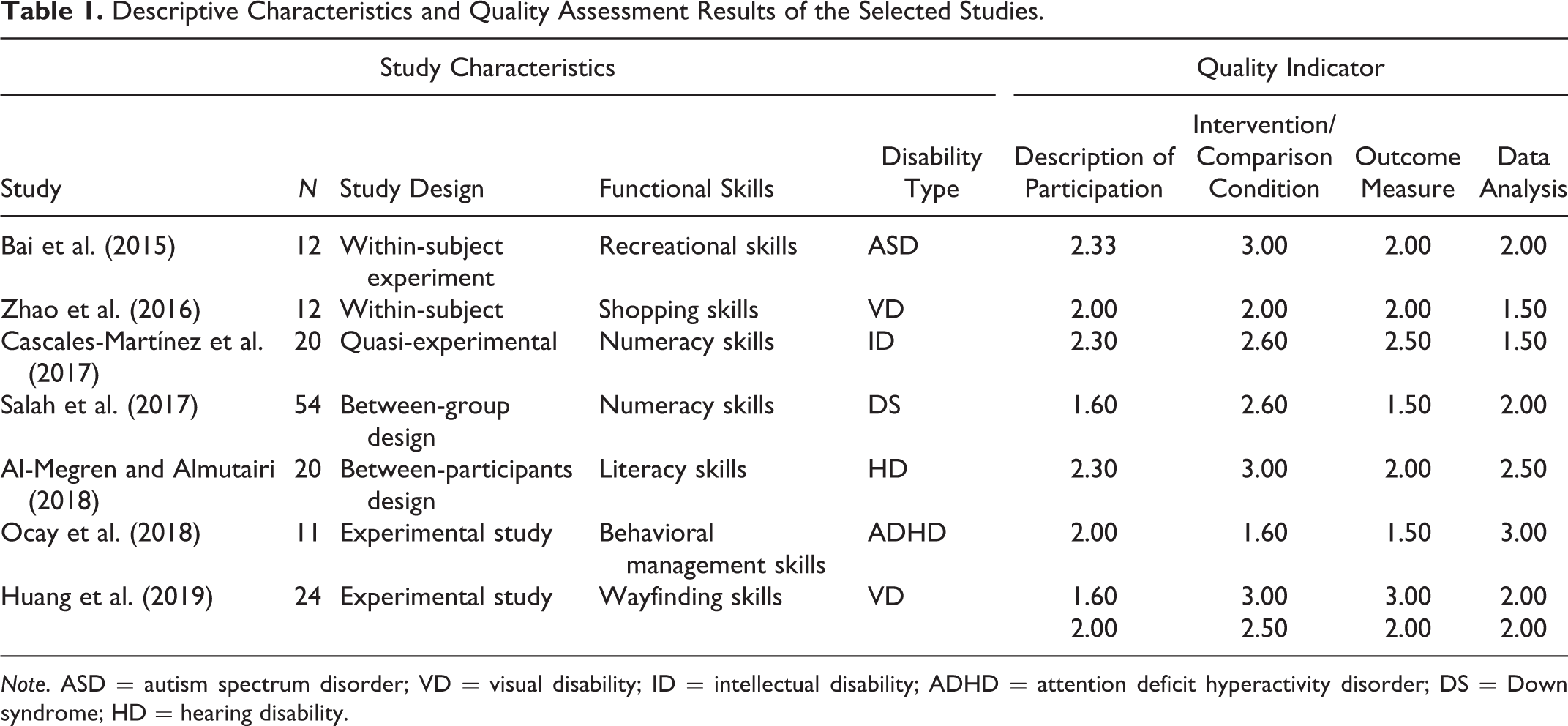
Note. ASD = autism spectrum disorder; VD = visual disability; ID = intellectual disability; ADHD = attention deficit hyperactivity disorder; DS = Down syndrome; HD = hearing disability.
Quality Evaluation
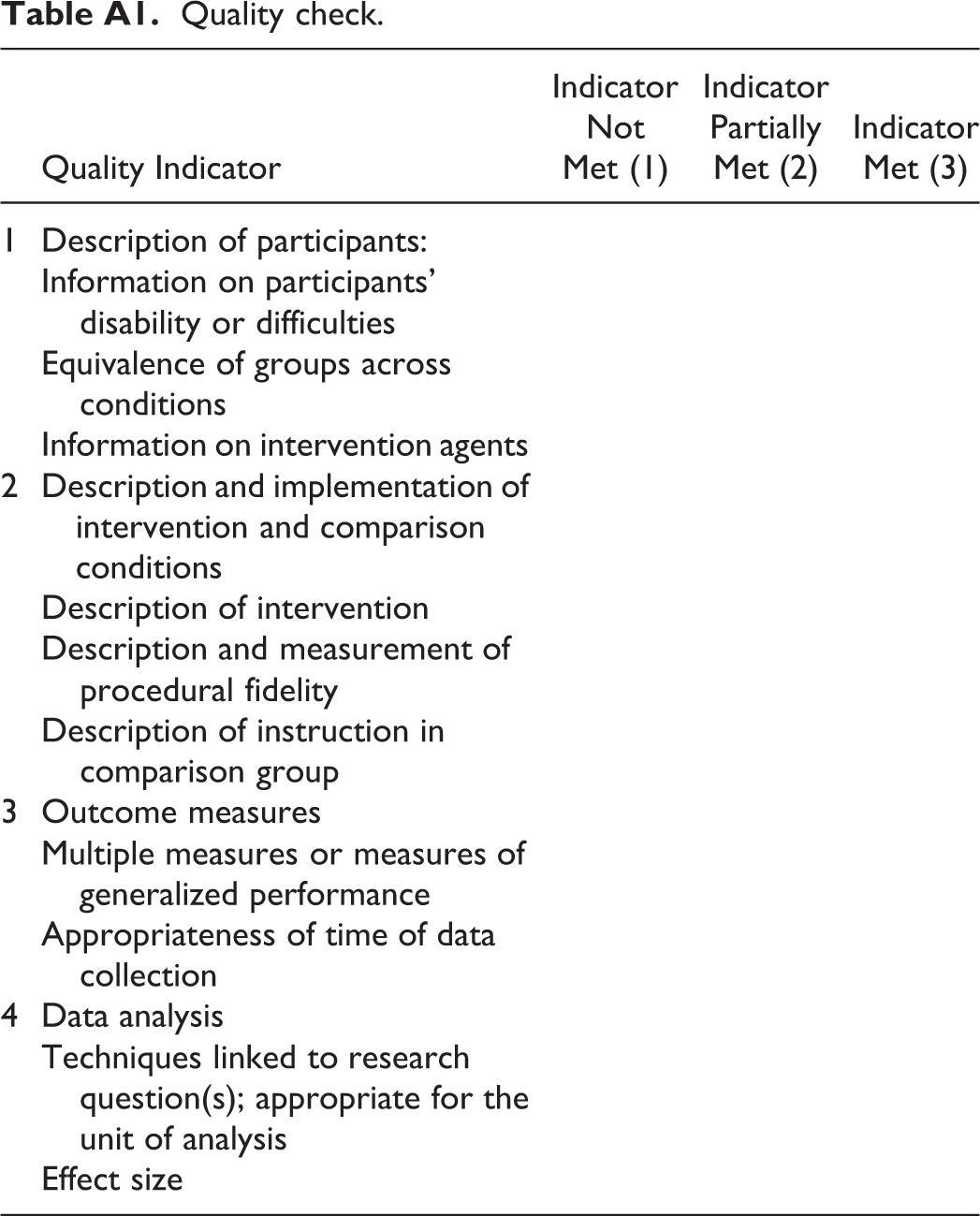
In this study, we used a coding manual to ensure coding quality. The development of the coding manual included items to code study descriptors suggested by Gersten et al. (2005): (a) description of participation, (b) intervention/comparison condition, (c) outcome measure, and (d) data analysis. The first and second authors followed the quality assessment procedure of coding criteria for a group design by Jitendra et al. (2011). The assessment was based on the four quality indicators. The coding criteria consisted of a 3-point rating scale with a score of 3 = indicator met, 2 = indicator partially met, and 1 = indicator not met. Based on this, each study must meet the minimal acceptable quality (Gersten et al., 2005). A summary of the four quality indicators used to assess the selected studies is provided in Appendix. The assessment result (see Table 1) showed an overall quality evaluation of 2.20 out of 3.00. The average score of intervention/comparison condition was the highest (2.50), while the average score of the description of participation, outcome measure, and data analysis was 2.00.
Meta-Analysis
To determine the effectiveness of AR in improving the daily life skills of individuals with SEN, the individual effect size estimate was computed for each study. Studies included in this meta-analysis were experimental studies with control and treatment groups and pretest design and posttest design. The Cohen’s d was calculated to test the effects of AR intervention as an effect size measure with a correction for small sample bias. This is because the Cohen’s d tends to be overestimated, for example, if the number of cases is small, then the values of effect size can be corrected to Hedges’ g. The standardized mean difference using Hedges’ g for small sample correction was calculated in the Comprehensive Meta-Analysis software using random-effects model (Borenstein et al., 2014). The effect size for each study was calculated by taking the mean pretest difference and posttest difference in the experimental group minus the mean pretest difference and posttest difference in the control group divided by the pooled pretest standard deviation that pools the data from the experimental and control group. In addition, the overall effect for all studies was calculated by using the random-effects model which considers the possibility of having study-level differences as an additional source, the variety of random influence, the appropriate type of research method, sample, and the type of AR intervention (Borenstein et al., 2011). Furthermore, heterogeneity of the studies was tested according to the Q and I2. In addition, the p value of the effect size from each study was calculated.
Results
Seven studies were included in this meta-analysis to determine the overall effect size of AR interventions on functional skills acquisition for individuals with SEN. The results of effect size (Hedges’ g) for the seven selected studies were extracted and analyzed. Figure 2 shows the effect size (Hedges’ g), the standard error, and the 95% confidence interval (CI) for each effect size from the selected studies. Hedges’ g for the seven selected studies was presented in the forest plot along with the results of the overall effect size for each study (see Figure 2). The effect size for the selected studies ranged from −1.421 to 6.59, which was relatively inconstant across the studies.
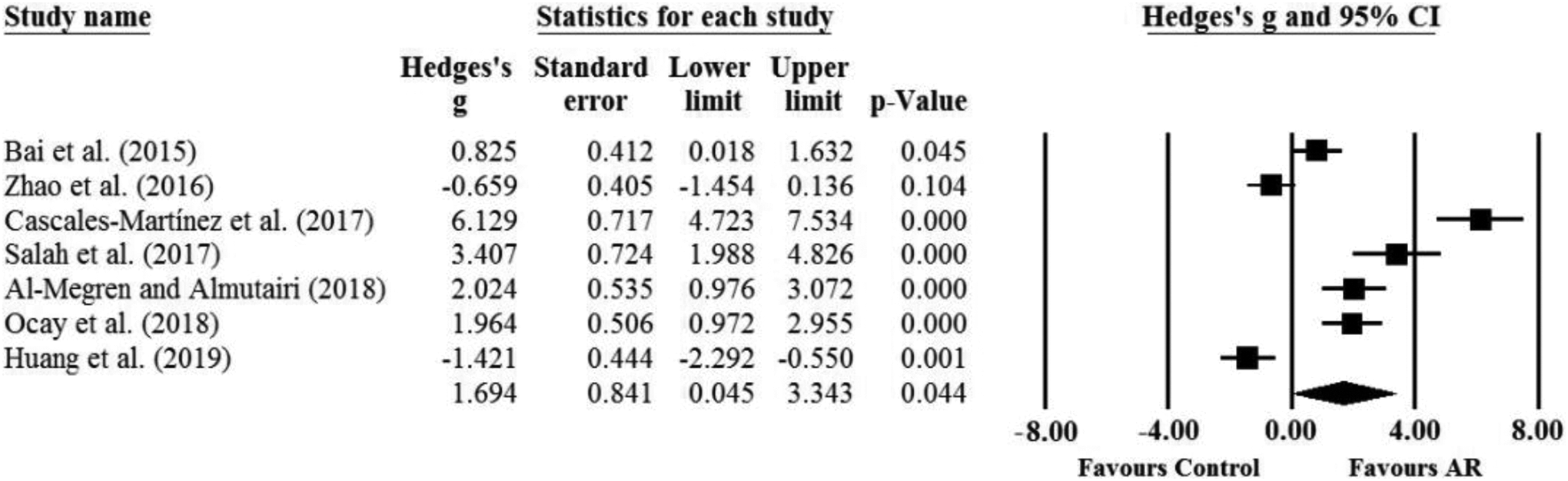
Results of the overall effect size of studies.
To determine if the effect size was sufficiently homogeneous across studies, the heterogeneity test of the effect sizes was performed. The test indicated that the heterogeneity was not statistically significant in the effect sizes across the studies: Q = 88.83, p < .001, and I2 = 93.25, indicating that almost 93% of total variability among effect sizes was not caused by sampling error but by true heterogeneity between the studies, and this indicates a large amount of heterogeneity as suggested by Huedo-Medina et al. (2006). In other words, the ratio of variation between the actual studies to the total variation was greater than 50% and the p value of heterogeneity test was less than .01. In addition, the p value was lower than .001, which was considered to indicate acceptable heterogeneity. These three values support the assumption of the random-effects model; therefore, a random-effects model was used.
The random-effects average was computed for the seven studies. The results showed a significant and large effect of AR on the functional skills acquisition of individuals with SEN. Furthermore, the effect size in terms of g was 1.694 (standard error of 0.841), 95% CI [0.045, 3.343], p < .05. This suggests that AR application can potentially increase functional skills acquisition of individuals with SEN. Participants who received AR made significantly greater improvements on measures of skills training as compared to those in the control group.
Discussion
This meta-analysis synthesized the findings from group design studies to assess the effectiveness of AR in increasing functional skills of individuals with SEN. Seven group design studies met the inclusion criteria, and the results suggest that AR can be effectively used to develop functional skills such as wayfinding, numeracy, shopping, emotional, literacy, and physical. The studies suggest that the development of independence can be achieved with the use of AR through videos and other learning resources.
Our finding supports previous work (Smith et al., 2017) highlighting the role of mixed reality in developing independence among individuals with SEN through the use of specific effective and efficient teaching strategies. It is believed that the use of AR could enable individuals to practice skills in real-life situations, mainly through a blend of both real-world and virtual elements. This involves the main aspects of viewing, hearing, and touching. The learning experience emerged from such use may significantly improve concentration, motivation, and collaboration with others to learn certain skills (Escobedo et al., 2012), thus increasing their knowledge acquisition. Bai et al. (2015) found that AR system can positively influence learning for individuals with ASD by engaging them in a diverse range of play ideas to improve their recreational skills. AR applications can also provide suggestions and guidelines that could promote the development of everyday skills and knowledge in a more effective way (Riva et al., 2016). According to Zhao et al. (2016), using AR applications to provide an effective visual cue may help people with impaired vision to learn and familiarize themselves with shopping locations. Furthermore, Huang et al. (2019) asserted that an AR-based sign-reading assistant may provide a useful tool for increasing comfort and confidence when visual wayfinding is impaired. Meanwhile, a role-play–based AR approach holds potential as an effective learning strategy (Dunleavy & Dede, 2014), for learners assuming roles within real-life settings. This study also addresses the potential of using AR in learning numeracy and literacy skills (Al-Megren & Almutairi, 2018; Cascales-Martínez et al., 2017; Salah et al., 2017). AR allows the development of new skills through task-specific training, which involves repeated practice of the same task in an environment with enhanced verbal or visual cues for HD, ID, and DS learners (Toglia et al., 2009). In general, repetitive practice of the same task or skill increases automaticity and reduces demands for attentional control, thus using AR in a focused task without distractions by individuals with SEN can help them perform operations independently (Jerome et al., 2007). Finally, behavior management skills were found to improve significantly when a learning activity is performed via an AR-based strategy (Ocay et al., 2018). AR enables the presentation of instructions in a step-by-step manner which can be particularly beneficial to individuals with SEN. A task analysis strategy was used to teach individuals to perform the sequences of activities more quickly while exerting less effort and making fewer errors than other forms of supportive technology.
The findings from the analysis presented here suggest there is strong evidence to indicate that using AR is a viable strategy for teaching functional skills to individuals with SEN. It is not only effective but also practical for use in different settings. It is advised that teachers and service providers should consider using AR-based learning strategies when training independent living skills. This study demonstrated that independence in a range of tasks can be enhanced with the use of AR by providing them an opportunity to practice and acquire new skills essential for improving their quality of life. This study suggests applying certain behavioral and constructive approaches in the AR learning activity in order to enhance functional skills of individuals with SEN.
Limitations and Future Works
The following limitations should be considered when interpreting the results of this meta-analysis. First, although a list of terms associated with AR was used in this study, there may have been recent studies published that were not included. Second, the small number of studies (n = 7) and participants (n = 119) may need to be treated with caution. Even though the studies reported positive effects of AR on individuals with SEN, it is still difficult to generalize our findings to the entire population of SEN. Generally, the results showed a positive impact of AR use on the development of individuals’ functional skills. Hence, future research should focus on how to apply certain AR-based learning strategies to teach these skills to individuals with SEN. Future research may considerably benefit from comparing individuals’ use of AR and virtual reality to promote functional skills acquisition. In addition, future research may consider examining the role of certain personal characteristics (e.g., personality, gender, and age) when using AR for learning certain functional skills. This may also include studying the mediating role of AR preferences on individuals’ sense of self-worth, self-confidence, and overall personal judgment of well-being.
Footnotes
Appendix
Quality check.
| Quality Indicator | Indicator Not Met (1) | Indicator Partially Met (2) | Indicator Met (3) | |
|---|---|---|---|---|
| 1 | Description of participants: Information on participants’ disability or difficulties Equivalence of groups across conditions Information on intervention agents |
|
|
|
| 2 | Description and implementation of intervention and comparison conditions |
|
||
| 3 | Outcome measures |
|
||
| 4 | Data analysis |
|
|
Declaration of Conflicting Interests
The author(s) declared no potential conflicts of interest with respect to the research, authorship, and/or publication of this article.
Funding
The author(s) received no financial support for the research, authorship, and/or publication of this article.
