



Abstract
Recent years have seen remarkable efforts to decentralize the deployment of infrastructure for sensors and Internet of Things (IoT) applications using emerging low-power protocols. These arrangements are predicated as bottom-up, decentralized, democratic, and participatory while still driven by the corporate logics of lock-in and scaling-up. Reporting on a multisite ethnographic study of a global decentralized IoT initiative, this article explores how a diversity of geographically dispersed contributors reckoned with and negotiated conflicting future visions of globality, locality, and growth. From a socio-material perspective, it argues that the imaginaries and actualizations of decentralization were strategically altered over time to balance unevenness of pace, expectations, and material commitments between different actors. The article offers a new critical perspective to think about infrastructure decentralization as more than the flip side of centralization but as a contingent and mobilizing concept and locates this case in discussions about the future of the Internet.
Introduction
The last decade has seen a resurgence of discussions about decentralization of information infrastructures that took place in the early stages of the Internet, open-source movements, peer-to-peer sharing, and globalized information networks. The current resurgence is partly thanks to the popularization of distributed technologies such as blockchain and a new wave of expectations about Web3 and the future of the Internet (Bogers and West 2012; Lustig 2019).
In relation to information systems, decentralization has two broad meanings. The first is technical, and denotes types of network topology or architecture with no single point of failure, and the resulting technical benefits of increased resilience, security, and resource optimization (Baran 1964; Kremenova and Gajdos 2019). Decentralization can also describe how information systems are governed and managed and is often associated with organizational or sociopolitical aspirations of more democratic and horizontal forms of control (Galloway 2004; Mikalef, Pateli, and van de Wetering 2021). In practice, the technical and governance aspects of decentralized and distributed systems are intertwined and have been studied at length by disciplines including systems engineering, computer science, cybersecurity, economics, and information systems research. 1
Network decentralization has been central to debates about technology sovereignty, self-determination, and inclusivity. But efforts to implement decentralization have often been criticized as ambiguous or misleading insofar as they try to reconcile conflicting aims such as “centralized leadership” and “permission-less” decision-making, or top-down value capture and bottom-up empowerment (Mathew 2016; Azouvi, Maller, and Meiklejohn 2019; Walch 2019; Schneider 2019). Such critiques tend to call out practitioners for lacking conceptual rigor, sometimes positioning decentralization as the flipside of centralization, or describing decentralization as a theoretical ideal doomed as soon as it allows for spaces of power concentration, however virtuous or vicious they may be.
This article extends these critiques by foregrounding the self-updating, contingent, and performative possibilities of decentralization. I explore how decentralization—as discourse and practice—can be instigated, constrained, reworked, and actualized through a collective reckoning with its tensions and ambiguities. The article draws on recent efforts to decentralize sensor networks, unfolding as part of a broader trend of mass digitalization, smart technologies, and Internet of Things (IoT). These developments take advantage of emerging wireless network protocols, the decreasing cost of sensors, open-source software, and a growing market of applications for smart cities, smart agriculture, hyperconnected supply chains, and so on. The article reports on a four-year multisite ethnographic study of an IoT initiative where people around the world were invited to take part in building a global decentralized low-power network. I give an in-depth account of an attempt to simultaneously fulfill the expectations of network growth, scalability and survivability, and bottom-up empowerment, openness, and inclusivity. Taking a socio-material perspective, I discus how decentralization discourses and actualizations evolved amid conflicting commitments and uneven temporal-spatial notions held by members of the initiative. Finally, I examine this brand of decentralization in the context of broader discussions about the future of the Internet.
What Is Contingent about Decentralization?
In thinking through change and decentralization this paper draws on two strands of science and technology studies, namely the sociology of expectations and social studies of infrastructure. The circulation of imaginaries, promises and expectations has been used to understand how collective imagination about the future can influence the trajectories, governance and social acceptance of innovation (van Lente 2012; Jasanoff and Kim 2013). A central argument in the sociology of expectations is that prominent visions and discourses about the future have always played a role in mobilizing investment, institutional support, and lending political legitimacy to technological innovation (Borup et al. 2006). The history of the Internet is one such case where metaphors like “the information superhighway” and techno-utopian visions and ideologies of openness, freedom of expression, and the market, alongside techno-organizational models of decentralization, importantly shaped the national policy that led to the design and implementation of ARPANET, TCP/IP, and further Internet technologies (Agre 2003; Flichy 2007; Wyatt 2021). Such future imaginaries are neither neutral cultural objects nor impartial prognoses of inevitable technological progress. They are informed by subjective ideas about what good, sustainable, and desirable futures might look like and, as such, they seek to have political traction—if not become self-fulfilling (van Lente 2012). An emphasis on contingency is key: today’s Internet of tech giant monopolies seems far removed from the early dreams of a bottom-up and democratic network, as Christopher Kelty (2022, para. 6) puts, “the internet we could have had no longer seems to exist.” Analyzing decentralization as promissory discourse rather than as a given helps us focus on what is contentious, contingent, and performative about such discourse. What futures are pursued through the technically and politically disruptive claims of decentralization? How are these claims altered and actualized in the process? And by whom?
As much as discourse, materiality is an important aspect of future-making because artifacts’ technical and material properties constrain and shape future innovation trajectories. This is particularly true of networks and technologies built on top of existing technical layers, which operate at a large-scale over long periods of time, where early design decisions can have enduring effects on future developments (Starosielski 2015).
The second strand of literature used in this paper speaks to such long-term, large-scale, dimensions of technological change. Historians of science and technology, social scientists, and information systems scholars have described how society shapes and is shaped by large technical systems and infrastructures (Williams 2019). Social studies of infrastructure is an interdisciplinary body of research that has developed theories and methods to answer questions of change, management, and governance of infrastructural systems (Bowker et al. 2010; Edwards et al. 2007; Star and Ruhleder 1996; Tilson, Lyytinen, and Sørensen 2010; Pollock and Williams 2010). Infrastructures in this frame are conceptualized as always in the making, embedded in (and built upon) existing socio-material assemblages of protocols, standards, people, institutions, and expanding spatially and over the long term (Star and Ruhleder 1996; Edwards et al. 2007; Ribes and Finholt 2009; Star and Bowker 2010; Karasti, Baker, and Millerand 2010). Following the evolution of network decentralization offers a method to examine how these are constituted by technical architecture and how different actors negotiate their politics of ownership, scaling up, and control (Constantinides and Barrett 2015; Chen, Pereira, and Patel 2021).
Many empirical studies informed by an interpretative sensibility use praxis, discourse, and other materials to trace the multiple dimensions of infrastructure. The work of building information infrastructures is largely “hidden in the background,” so much of their social, political, and ethical dimensions are not easily accessible (Bowker et al. 2010; Star and Bowker 2010). For this reason, researchers have largely relied on close ethnographic examination of where and when infrastructure work—infrastructuring—is performed, which typically demands a significant time commitment to the field. This has been particularly salient in settings involving multiple sites, domains, and temporalities where longitudinal and “biographic” approaches have been preferred (see Williams and Pollock 2012; Verhaegh, Oost, and Oudshoorn 2016; Hyysalo, Pollock, and Williams 2019).
This paper draws on concepts and theory from both social studies of infrastructure and the sociology of expectations to study the interplay between the performative and mobilizing functions of future socio-technical visions and the infrastructural dimensions of information systems described as “global,” “decentralized,” or “democratic.”
Empirical Case and Methods
This article reports on an ethnographic study of The Things Network (TTN), an IoT initiative founded in 2015 with the goal of “crowdsourcing” long-range wide area networks (LoRaWAN). 2 Since its inception, TTN attracted a diverse audience including professional developers, entrepreneurs, academic researchers, and nonexperts and grew steadily over the years—both in terms of installed infrastructure and number of contributors around the world. The core tenet of TTN was to enable geographically dispersed independent members to locally own, implement, and operate the LoRaWAN networks. The mantra of TTN, as articulated in slogans and a manifesto, alluded to values of freedom, democratization, openness, participation, and inclusive membership. The organization was set up as a not-for-profit enterprise domiciled in the Netherlands: “The Things Network Foundation” was conceived by the founders as a “community-based network” of global reach inviting contributors around the world to codevelop the project. 3 The main activities related to infrastructure building within TTN were carried out by two broad groups: the core team (comprising TTN staff) and external volunteering contributors. The core team instigated the project, proposed the architecture and model of the network, and ensured the availability of various shared resources including network servers, open-source software, a centralized knowledge base, and user interfaces, including application programming interfaces and graphic user interfaces. In turn, external contributors were responsible for the rollout, operation, and maintenance of local networks and their physical elements (gateways and nodes). The project drew diverse participants, ambitions, and political views as well as many different roles: software and hardware developers, community initiators, managers, network implementers, entrepreneurs, business developers, legal experts, and academic researchers. While anyone in the world could sign up as a member, the larger membership and consolidated base was mainly in central Europe, gradually spreading to other geographic locations (see below).
This study uses a multisited ethnographic approach (Hine 2007). It combines participant observations and semi-structured interviews with internal and external TTN participants, conducted between 2016 and 2020. I began fieldwork at an early stage in the life of TTN (around a year after its inception) involving a period of observation with the core team of developers and founders at TTN headquarters in Amsterdam as well as visits to multiple sites to access external contributors. The latter included online and colocated participation in meetups, IoT discussion forums, conferences, and technical workshops. Data were collected from the most active communities at the time, located mainly in the Netherlands, Switzerland, Belgium, Germany, Spain, Denmark, United Kingdom, United States, and Canada.
The body of mostly qualitative data comprises a combination of field notes, transcripts from interview recordings, logs of interactions in real-time communication channels, archives of press releases, blogs and discussion threads in a public online forum hosted by TTN, and other secondary data including internal metrics, statistics, and documents publicly available or directly provided by participants.
The data were analyzed through thematic coding using NVivo. The analysis followed an abductive approach where fieldwork, discourse analysis, and theorization were conducted in tandem and informed by the theoretical framework (Tavory 2014). As with any ethnographic method, the analysis was necessarily informed by the researcher’s background and sensitization with the theory and is reflective of the conditions at the time of data collection, such as the limited locations and informants accessible during fieldwork. 4
Co-constructing Decentralization, Growth, and Globality
In the five years leading to 2020, TTN exhibited a steady growth marked by key milestones, going from a prototype network to what was described by the founders as a “global network” (Griezman 2018). I analyze the evolution of the initiative during this period with reference to three phases distinguished by the relative size of installed infrastructure and moments of technical and organizational disruption (Table 1).
The Things Network (TTN) Evolution 2015-2020.
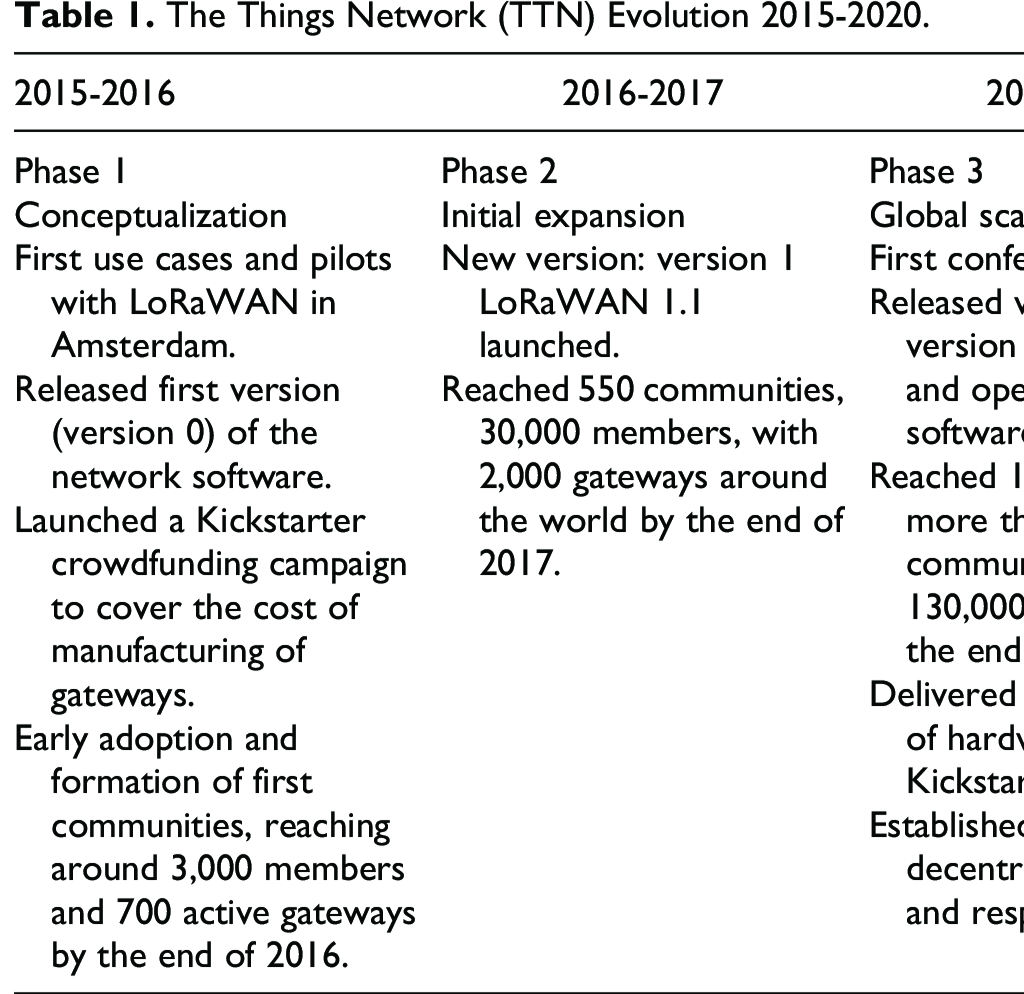
The initial conceptualization phase is marked by the trialing, early adoption, and validation of the first network’s proof of concept. A second phase of initial expansion saw the deployment of the first local networks and communities located mostly in Europe. This was a stage of technical and organizational adjustment, with several iterations of the network software and collective deliberation about questions of growth and sustainability. The third global scaling phase is marked by considerable growth of the installed base, the release of a major upgrade of the network architecture, and the establishment of regional strategic alliances.
Throughout the years, the conceptualization and promotion of TTN by the core team evolved significantly, from a community-oriented ethos underpinned by freedom and openness to a middle-ground proposition accommodating commercial and noncommercial agendas, open- and closed-source elements, and on-demand, value-added services. In 2016, a private enterprise—The Things Industries—was created to offer commercial services and sponsor the operations of The Things Network Foundation. At the time of writing, the organization maintains an open ecosystem model with a focus on infrastructure growth, network support services, and innovation. What follows traces this trajectory by foregrounding the interrelation between the materialities of low power, the imaginaries of growth and globality, and local infrastructuring.
Materialities of Low Power
TTN was founded in the context of an emerging family of IoT standards known broadly under the banner of Low Power Wide Area Networks (LPWANs). Most of the research presented in this paper was conducted during a period of fierce competition between different LPWAN standards, with no clear winners in the race for market dominance. LPWANs emerged in the early 2010s and have been growing in popularity thanks to their unique technical features. Compared to other wireless communication standards such as Wi-Fi and cellular, LPWANs satisfy a hitherto unfulfilled technical gap: low power consumption paired with long-range connectivity. 5 These features enable a cost-efficient means to deploy sensors running on batteries and transmitting small messages over unlicensed subgigahertz bands of the radio spectrum. Thanks to long-range communications (allowing for reduced infrastructure requirements) and the declining costs of hardware, 6 wireless sensor networks have become more commercially attractive for a variety of IoT applications including asset tracking, smart meters, environmental monitoring, and smart agriculture.
The relatively low cost of deploying low-power networks has also made feasible alternative topologies and implementation strategies that differ from the established centralized and capital-intensive model of telecommunications services provision. 7 In the landscape of LPWAN standards, LoRaWAN stands out as a “non-restrictive” and “pro-innovation”—albeit proprietary—standard 8 particularly well suited for low-cost deployments.
The LoRaWAN specification was published in 2015 by a consortium of large technology firms—the LoRa Alliance—with the goal of facilitating interoperability between vendors and network operators. The standard is defined as a star-of-stars architecture—a branching structure where some nodes serve as centralized hubs to connect to other nodes and network elements—which accommodates different models of implementation including conventional network subscription models, privately owned networks, and open communities of developers. A key component of LoRaWAN networks is the “gateway,” which acts as a hub aggregating messages from IoT devices (sensors) and relays them to a central network server.
TTN’s brand of decentralization was shaped by the technical features and cost-efficiencies afforded by LoRaWAN. Decentralization was defined with a modular network architecture known as “separation of concerns” where different elements could be decoupled or decentralized while others could remain closed or centralized (Figure 1).
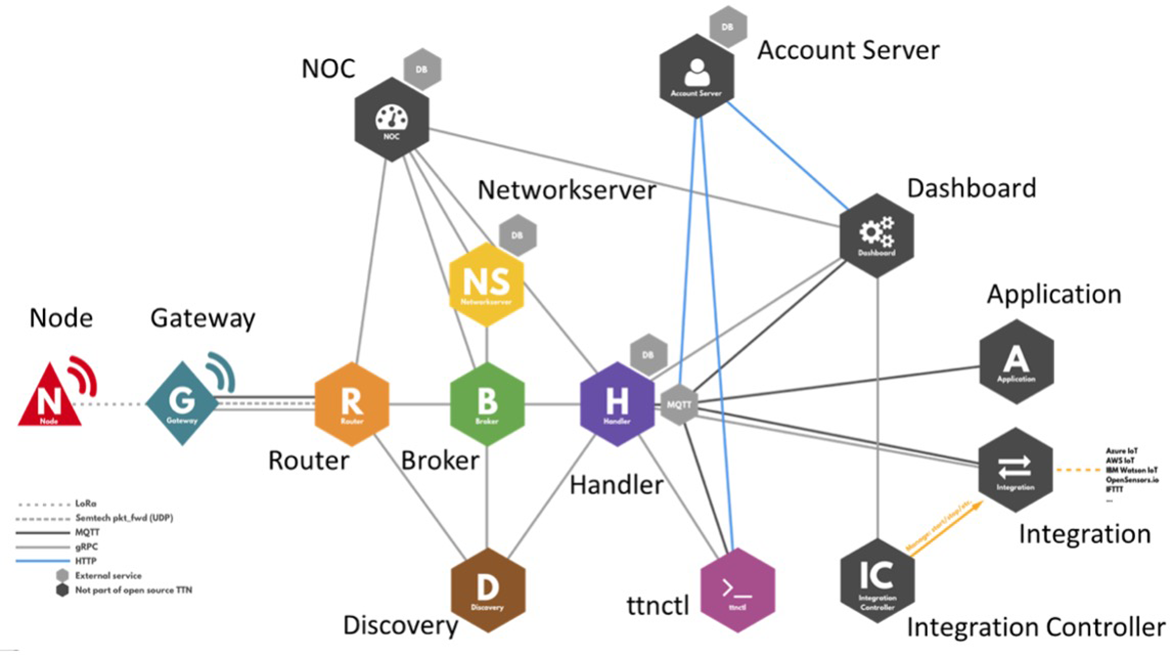
Diagram of an early version (version 2, April 2018) of The Things Network architecture. Some elements like the network operation center (NOC), the account server, and the dashboard were centralized, while others like the gateway and network server were decentralized.
One of the advantages of selectively decentralizing components is the ability to pool the use of more expensive resources and reduce delays in communication by placing resources physically closer to one another to ensure consistent quality and availability levels for the network. This was achieved at the stage of global growth (see Table 1, Phase 3) by negotiating strategic alliances with some of the more established local communities, following the star-of-stars logic of the network. The so-called regional clusters allowed key network components to be decentralized (e.g., network servers, application servers, join servers) by organizations working in close coordination with the core team. As announced at a conference in 2018 by the technical lead at TTN: The free public network, our flagship service, currently runs six clusters. The Things Network foundation operates EU, US, Brazil and Singapore, then there is the Swiss Open Network Infrastructure Association that runs a public network region in Switzerland, and finally Meshed in Australia operates a public TTN cluster.…We will be expanding gradually to UK, South Africa, Japan, China, Russia, India, more US, more Europe, so we have ongoing conversations with partners here. We are also still requesting proposition from the TTN community, and this is really adding public clusters to the public network. (Stokking 2018, minute 15:26)
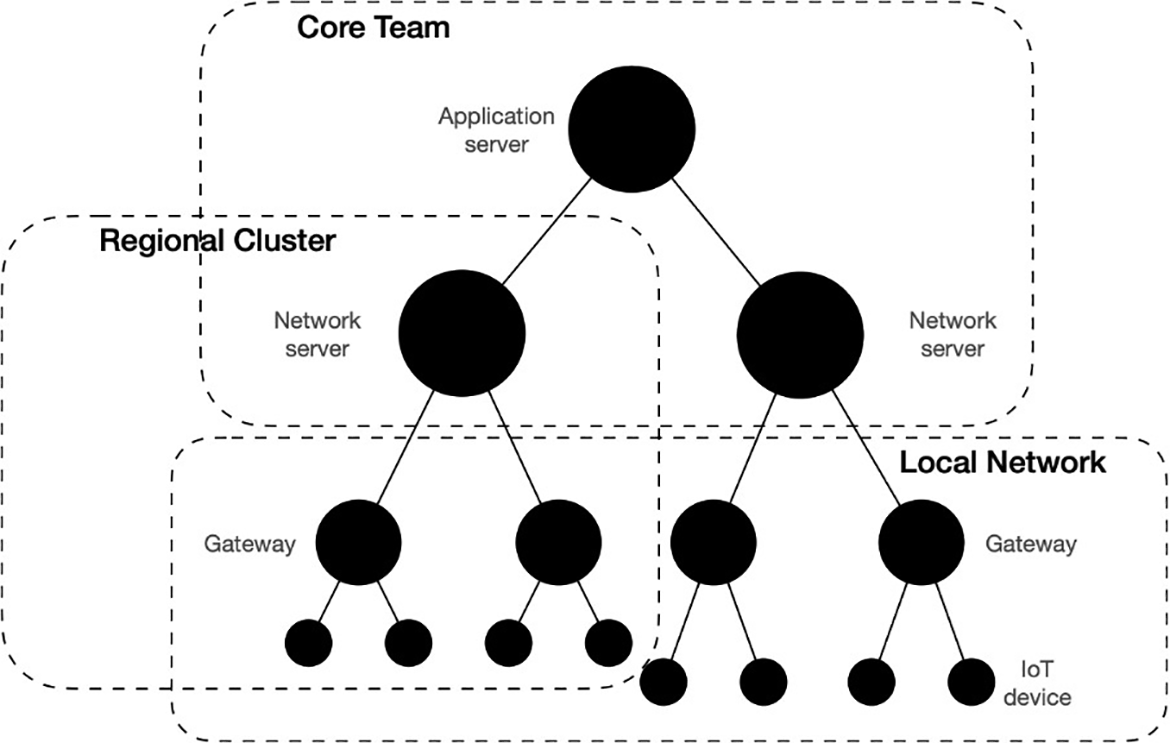
Partial decentralization of key network functions by regional clusters using the star-of-stars topology of LoRaWAN.
Imaginaries of Growth and Globality
From the outset, TTN was advertised as “a decentralized open and crowdsourced IoT data network, owned and operated by its users” (Griezman 2016). For most of the embryonic and initial growth periods of TTN, the idea of globality, rather than a concrete signifier of installed infrastructure around the world, was a stand-in for a future state of the network and a useful discursive device to mobilize expectations and attract contributors to the initiative, regardless of their location. Notions of growth and globality were conveyed through metrics that showed an upward trend such as growing number of members and active gateways, and inscribed in regularly updated figures and an increasingly more populated global map (Figure 3). The imaginary of globality did not evoke a static state, but one of continuous change and network growth. The global network construed by TTN’s core team aggregated geographically distributed local network deployments. This meant that the global scale would be primarily achieved through local infrastructuring.
In building TTN’s narrative and underlying network architecture, the founders often drew inspiration from the Internet’s history of growth from decentralized origins. During TTN’s initial growth phases in 2015-2018, the key elements of the network were open-sourced and free to access despite the costs involved and an absence of short-term reliable returns. In doing so, the core team prioritized attracting new members by subsidizing the operative costs and reducing the cost of joining. The imaginaries of growth and globality can thus be understood as rooted in a logic of network economics, given that overall exposure and increased adoption of the new standard were deemed to outweigh the costs of subsidizing the network’s operation, which was borne by the core team. This is key to understanding how the conceptualization of the decentralized network, informed by previous models and metaphors, was mobilized in the future tense—always in the process of becoming and always contingent on the work of others.
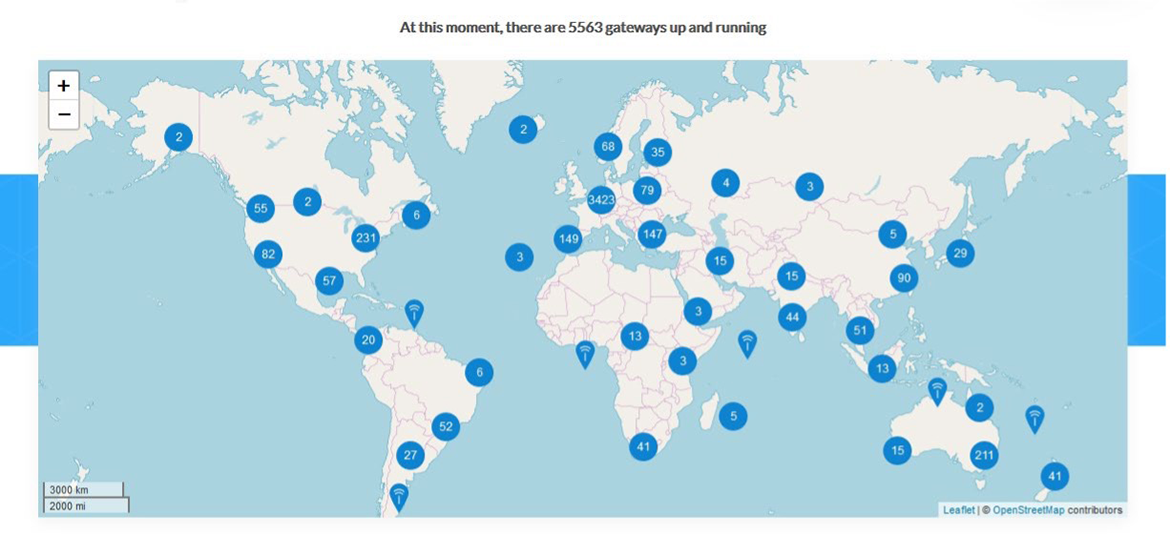
Live map of gateways displayed on The Things Network’s website (January 2019).
Network economics have been widely used to explain growth in longitudinal studies of large-scale infrastructure (Ciborra 2000; Hanseth and Lyytinen 2004; Monteiro et al. 2013). Economists have argued that the value of a network or communications standard increases with its “popularity,” that is, the number of users already on board (Economides 1996). Further adoption of a standard is driven by the number of users that have already adopted the standard, and this, in turn, attracts more users. An initial period of artificial growth where the first users are encouraged to join needs to take place before the network reaches a critical mass, or a tipping point, after which it should be able to “grow by itself.” As a larger user base forms, more products and services are added, and the credibility of the standard also increases (Liebowitz and Margolis 1994).
Expectations of growth raise questions about risks and responsibilities. Inextricable from network growth are the long-term effects of lock-in and path dependency. These effects were thoroughly acknowledged and debated within and outside TTN headquarters and surfaced at different points during my fieldwork. Lock-in was a concern to those involved in the deployment of local instances of TTN, particularly in the early stages when there was more uncertainty about LPWAN standards. The worry was that any choice of low-power standard entailed material investments in standard-specific hardware components. Opting for LoRaWAN meant acquiring critical building blocks that would be incompatible with other LPWAN standards, such as gateways, end devices, and testing equipment. Lock-in was also a software issue. A well-known limitation in the standard’s early life was the lack of interoperability options across LoRaWAN providers. This meant users and developers risked being locked into a single provider due to deliberate business design or to technical constraints. This was illustrated by a community initiator:
9
So, let’s say tomorrow TTN gets bought by Microsoft for example, or Google or ZTE, these are three different companies that would cause three different political problems in the organization. If TTN would go bankrupt that would cause a different problem. When I started the organization, I said all this stuff is open source, so if something happens with TTN we’ll just build a parallel network and we go back to it. (Initiator, August 2018) We officially traded our name “Omnia Connexia,” which is Latin for “connect everything.” And we did that on purpose, not to bound ourselves with our names to the Things Network. Because we all can expect that the LoRaWAN technology two years from now is nothing. I don’t know, I’m predicting but that’s our world. So maybe it’s Sigfox in two years, I don’t know. Then from a foundation perspective there’s no problem. We are still the human network of people that are interested in doing IoT. (Contributor, March 2017) It is clear that TTN is used because suddenly we have a new technology that allows solutions to problems that were previously difficult or expensive to solve. Many people join TTN without knowing what LoRaWAN is at that moment, and then they begin to explore LoRaWAN and they get to know it. If tomorrow we have another technology, these people will have the same motivation to migrate to that technology or complement what we already know with this technology. So I think that TTN has fostered a community, of course there will be people with commercial interests with LoRaWAN but also more open people who are willing to use other technologies when they arise, in fact it is not unusual in the forums of TTN to see people share their ideas even if they are not directly related to LoRaWAN. (Contributor, October 2018)
Local Infrastructuring
TTN’s model encouraged anyone to take part in building local instances of the network, and this attracted a mix of commercial, experimental, civic and academic interests. But a diversity of motivations predictably led to diverse views and priorities regarding governance, economic sustainability, management of common resources, and fair use. A recurring theme in discussions on the TTN public forum was the long-term viability of an open and free network. Some argued that free network access could eventually lead to counterproductive competition for free resources and potential unfair scenarios, such as freeriding, with uneven benefits and costs for users. Contributors voiced their concerns in different forums and explored creative measures to address survivability in the long-term.
Based on data from field visits and interviews with members of local communities, there was a continuum of views ranging from proponents of a fully free-access network on one extreme, to supporters of a subscription-based model on the other. This meant core developers were constantly faced with the challenge of synthesizing diverse and often conflicting views into a single coherent vision. Local groups were highly heterogenous in terms of size, user membership, subject matter expertise, and organizational structures; they were reflective of the local culture, politics, and socioeconomic realities and driven by diverse impetuses. Some explicitly pursued commercial and professional goals, while others joined to satisfy their curiosity, to learn and share knowledge, to do research, or to tackle specific local problems (e.g., measuring air pollution, automating car parking, geolocating bicycles). Contributors’ reasons were reminiscent of those found in previous studies of free and open-source (FOSS) communities and wireless community networks (WCN) (see, e.g., Hertel, Niedner, and Herrmann 2003; van Oost, Verhaegh, and Oudshoorn 2009; Jungnickel 2014). This is not surprising given that many TTN contributors were well acquainted or affiliated with the politics and practices of FOSS and WCN.
At the local level, contributors regularly held forums where people debated, discussed agendas, formed alliances, and tabled disagreements. This was more apparent when the need to manage more resources arose within communities, and during phases 2 and 3 when important organizational changes were being negotiated across the board. In some cases, consensus about infrastructure governance facilitated strategic planning regarding gateway locations and the optimization of local coverage to avoid duplication and fragmentation. In turn, disagreements often led to different subgroups and implementations coexisting in the same city or locality. As recounted by a community initiator: What we are trying to set up through the community here in Madrid is a system by which the community acquires the gateways, so they are installed in very favorable locations, at very high points. And this we are trying to organize through internet providers, some of which give Wi-Fi connection to communities that are remote or that do not have good coverage of fiber optics… On the other hand, we are also trying with the amateur radio community that already have really unique sites here in Madrid on high mountains for repeaters. [But] it is not something widespread at the moment. Right now, anyone who wants to buy a gateway, installs it and maintains it himself. (Initiator, October 2018)
Existing technical and organizational knowledge played an influential role in shaping efforts to implement local networks. Diversity of expertise among local members reflected how work, and responsibilities were organized around technical (network provisioning, hardware design, and application development), as well as organizational, legal, and commercial activities.
Overcoming the challenge of starting a network from scratch entailed a significant effort, both technically and organizationally. Provisioning a local network involved installing gateways, antennas, and other auxiliary elements and making them visible and configurable to other users on the TTN platform. Early adopters also faced the challenge of kick-starting a network and persuading an initial base of volunteering contributors. In conversations with network initiators, they often reported being confronted with a “chicken and egg dilemma.” Enlisting new members was viewed as key to crowdsourcing the growth of the network, yet this task was strikingly difficult in the absence of a concrete product to showcase the benefits of the new technology, particularly to individuals with little technical knowledge. …it’s a chicken or an egg problem: you have to have coverage, but you also need to show applications. We had limited funding to develop the two projects. (Initiator, February 2017) You have to have a network so you can actually do this stuff. So, what we’ve found is that we switched from developing things that can connect, to actually building that network infrastructure. (Initiator, July 2017) …okay let’s first provide the network, let’s make sure that there is a network and a group of people that understand how it works. Then we’re going to push up all the entrepreneurs in the environment and now we’re trying to make sure that we can actually effectuate [i.e., bring about] the business case. (Initiator, September 2017)
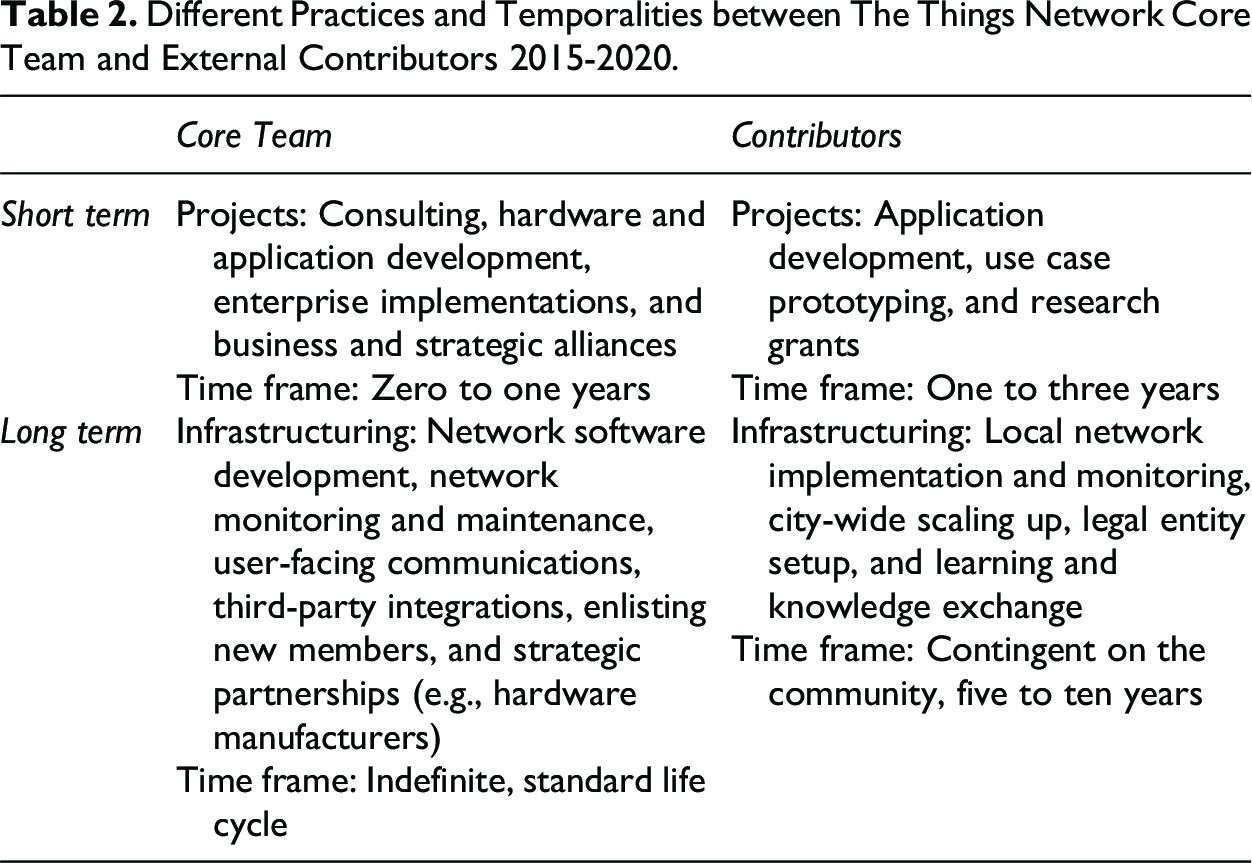
Temporal horizons and notions of sustainability were understood unevenly across the network (Table 2). Every year, the core team devised and updated plans of action in quarterly and yearly strategic roadmaps, including milestones for technical and business goals. Yearly roadmaps helped to set strategic visions and expectations of the initiative in the medium term to long term. Because the core team comprised mostly full-time staff, they carried out their duties following structured project management and agile software development methods. Long-term strategizing was also within the core team’s remit and entailed setting up business partnerships and strategic alliances, liaising with the standard developer, and coordinating with hardware and chip manufacturers to drive down the cost of implementation. Alongside long-term infrastructure work, core developers also engaged in short-term business ventures including technical support services, hosting commercial networks, and developing IoT applications. These business ventures were sources of revenue which supported the development and maintenance of the core network components.
By contrast, time frames at the local level were influenced by members’ specific aims, business opportunities, time commitments, and organizational capabilities. Some small groups remained bounded to small deployments managed as part time or side projects, whereas more stable communities and private ventures engaged more actively in long-term planning, for example, by drafting business plans or lobbying with local governments.
Different Practices and Temporalities between The Things Network Core Team and External Contributors 2015-2020.
Discussion
TTN’s decentralized model sought to reconcile a macro vision of globality and growth with self-governing dispersed infrastructuring on the ground. Global growth, as measured through gross figures, appears as a relatively uniform and predictable trajectory of growth spreading to 150 countries across five continents. Yet a closer look reveals highly situated, contingent, heterogenous, and irregular acts of infrastructuring. This ambivalence shows that the discourse and material embodiments of decentralization were always up for contestation—shaped by tensions and uneven conceptions of scale and responsibility.
Spatial and temporal scales were understood and used differently by different actors and yet enacted simultaneously. Such plurality of rhythms and forms of knowing and building the future inevitably lends itself to contestation, conflicts, power struggles, and even injustices (Valkenburg 2022). In their role as instigators, core developers were mainly concerned with realizing the global network and promoting the adoption of the standard. In turn, external contributors were more interested in locally relevant applications, where global-scale considerations were of second order. Imaginaries such as the “global network” allowed core developers to measure, anticipate, and communicate rates of adoption, geographical reach, and the overall installed capacity of the network. In turn, external contributors played a key role in materializing the global network through local infrastructuring even when, in practice, most of the use cases were highly context-specific and of local value. For contributors, the global network offered membership to a credible project: rather than being left to their own devices, they found common challenges across the network, a centralized hub of shared learning resources, and regularly maintained network software.
This case demonstrates the mutually constitutive relationship between ideas of decentralization and their operationalization. A decentralized network did not emerge organically out of nowhere. It was instigated by a core group who delineated and proposed to others the parameters of collaboration. In the process of decentralization, the core developers gave up some control to external contributors over the growth of the network, but retained the power to develop, maintain, and update the underlying network software and its features. 10 By encouraging external contributors to own and operate local networks autonomously, a trade-off was made between the ability to exert centralized control over the pace of growth and giving enough decentralized autonomy to contributors.
Despite lacking formal control mechanisms, core developers played the critical role of enabling contributors to perform local infrastructuring through a range of shared resources and strategic partnerships. Previous studies of decentralized and distributed systems have evidenced similar manifestations of shared or joint governance, where infrastructure managers have been able to steer the trajectory of infrastructure through tactics of “orchestration” such as indirect action, open interfacing, and collaboration with stakeholders (Dhanaraj and Parkhe 2006; Pollock, Williams, and D’Adderio 2016; Hanseth and Modol 2021). These strategies can be viewed as balancing acts that aim to find a satisfactory state between centralization and decentralization when consensus cannot be reached.
Network decentralization has been criticized for being an unhelpful metaphor or unworkable ideal, given that some form of hierarchy and power centralization will always be necessary to control information infrastructure. 11 Yet this sort of critiques tend to define decentralization as a static state of affairs, the opposite of centralization, which risks foreclosing more nuanced readings of the interrelations between the (performative) imaginings and actualizations of decentralization. The TTN case presented here shows that decentralization can be understood as more than the flipside of centralization—as a mobilizing concept in constant flux, co-constituted by technical affordances, situated material conditions, and even political conflict and disagreement. As Lauren Berlant (2016, 394) reminds us when thinking of infrastructure as commons, “the question of politics becomes identical with the reinvention of infrastructures for managing the unevenness, ambivalence, violence, and ordinary contingency of contemporary existence.”
Conclusion
This article offers a socio-material analysis of the evolution of a decentralized global low-power network. The study highlights the infrastructure building practices of both core developers in their leadership role and geographically dispersed contributors. In doing so, it reveals a host of dilemmas, ambivalences, and uneven costs and incentives associated with a decentralized information infrastructure. In this case, the concept of decentralization did not remain static but was tempered over time, shaped by technical architecture and an ongoing balancing of commercial and political interests across the network.
This study examines a site of decentralization that has remained understudied despite the wealth of discussions about digital transformation and a decentralized future Internet. Scrutiny of the far-reaching claims of decentralization seems ever more pertinent in a context where unfair value extraction and enduring inequalities are worsening (Kwet 2019), and new issues around pervasive sensing, surveillance, and prediction are arising as a result of data-driven innovation (Klimburg-Witjes and Bowker 2021; Domínguez Hernández 2023).
Infrastructure decentralization has always brought to the fore political questions of access, neutrality, sovereignty, privacy, trust, security, and equality (Mathew 2016; Möller and Rimscha 2017; Troncoso et al. 2017; Kremenova and Gajdos 2019). Previous community-led and bottom-up infrastructure experiments have been posited as potential remedies to some of the problems stemming from capitalist asset monopolization and asymmetries of power (Madon, Krishna, and Michael 2010; De Filippi and Tréguer 2016). Very often infrastructure decentralization efforts try to draw lessons from the past where the origins of the Internet are used as a template. While such parallels invoke genuine aspirations for another (i.e., better) Internet, the expectations of global reach and scalability also remind us of the technical and economic incentives to concentrate infrastructure control. In this ambivalence we can locate power contestation and struggle. Indeed, comparable discourses of democratizing innovation linked with platformization and innovation ecosystems have enabled infrastructure and platform controllers to exploit lock-in and network effects through opening up value creation while (re)centralizing value capture (Gawer 2021; Constantinides, Henfridsson, and Parker 2018). So too, much of the recent discourse of decentralization, blockchain, and Web3 has been infused with techno-utopian and libertarian ideas of freedom and permission-less exchange while, on close inspection, they have been criticized for veiling power concentration behind vague definitions and opaque technical architectures (Walch 2019).
This paper extends critical accounts of decentralization, without arguing it is impossible. I have foregrounded the contingent way in which decentralization is imagined, mobilized, altered, and implemented by different actors and highlighted the multiple discursive-material possibilities beyond the dichotomy of decentralized versus centralized. Even if used as a horizon or thought experiment, decentralization presents us with interesting opportunities to reimagine infrastructural systems and more horizontal forms of accountability, participation, ownership, and control. More (self)critical and experimental interventions that contend with the multiple faces and phases of decentralization are vital to reclaim those opportunities.
Footnotes
Author’s Note
This article is informed by material obtained from my PhD dissertation at the University of Edinburgh.
Acknowledgments
I thank Robin Williams and James Stewart for their advice throughout the study and feedback on early drafts of this article. I also thank the staff at TTN and all the participants who generously contributed their time to this study, as well as the anonymous reviewers for their constructive comments.
Declaration of Conflicting Interests
The author(s) declared no potential conflicts of interest with respect to the research, authorship, and/or publication of this article.
Funding
The author(s) received financial support for the research, authorship, and/or publication of this article: This research got funding from the SENESCYT excellence scholarship program (2015-2019) and support during writing from REPHRAIN UKRI grant EP/V011189/1.
