




Abstract
In the age of the Internet of Things (IoT), ethical considerations of digitally-led public health surveillance are crucial. However, their application becomes complicated due to an implicit dichotomy of ethical and legal factors. Decision-makers often omit ethical considerations, citing legal ones to justify how public health surveillance is approached and implemented. We propose an analytical framework informed by a further exposition of how influence and power are enacted at the macro, meso, and micro levelscorrelated to a spectrum of ethical practices. We then apply the spectrum of ethical practices to the four use cases of “Healthcare Delivery Using Drones”, “COVID-19 Pandemic in Canada”, “Air Quality and Air Pollution”, and “Heatwaves”. When technology deployment prioritizes efficiency over accessibility, it can exacerbate disparities, especially for individuals with lower socioeconomic status and literacy levels. To mitigate these issues, it is essential to incorporate public deliberation, co-design, and community engagement into decision-making processes. This approach advances the incorporation of diverse perspectives to better frame technology initiatives.
Keywords
Introduction
Background
Public health surveillance (PHS) support health systems by monitoring trends and reacting to crises based on collected data. 1 The Internet of Things (IoT) link up smart ecosystems where diverse devices transmit real-time data via technologies like Bluetooth and Wi-Fi. 2 While this allows for extensive and granular data collection, ethical concerns arise regarding privacy, security, and the clarity of terms governing data use.3,4 In free and democratic societies, where individual choice is valued, this dynamic should guide governments toward ethical practices that prioritize autonomy. 5 Typically, consent is binary (yes or no), however non-consent is deemed acceptable when mandated surveillance is claimed to benefit the public. 6 In this scenario, ethical principles can be relegated by legal considerations when implementing the IoT for PHS. 7 Clearly, the deployment of IoT technologies raises not only legal concerns but also ethical considerations regarding potential harms versus benefits.
An analytical framework
Ethics in IoT technologies as a code of conduct and sphere of influence may be analyzed using at least three levels of societal strata. The macro, meso, and micro levels are comprehensively described in the World Commission on the Ethics of Scientific Knowledge and Technology's working session, concept note. This final technical report on the ethical implications of the loT was published by the United Nations Educational, Scientific and Cultural Organization. 8
In politics where legislation and mandates for PHS are instituted at the macro level, the process can be arduous to execute and is typically unresponsive to the sentiments, values, and preferences of different social groups. Thus, they prevent bilateral dialogue in the short-medium term. 1 In a data governance framework, this practice would be called “directive transactions,” where power is unequal and cannot be redistributed, negotiated, or reciprocated. 9 Interestingly, one of the outliers could be whistleblowing. While legal in most institutional contexts, whistleblowing and the revelation and release of government secrets and procedures in the public interest versus government interests can be ethical from the perspective of the public but illegal according to governing authorities (see Figure 1). 10

Macro level - ethical and legal dichotomies.
Meso level - IoT technology
Smart communities, such as a physical network of long-term care facilities linked to healthcare systems, would operate at the meso level where “directive transactions” (i.e., exertion of control from top-down) are expected. 9 Bargaining (i.e., “rational discussions”, “fair fights”, or “negotiations”) is less tolerated unless unions and powerful associations/advocacy groups have a place at the power table 11 (See Figure 2).

Meso level - ethical and legal dichotomies.
Micro level - IoT technology
The home environment operates at the micro level where IoT technologies such as sensors are embedded within the living space and day-to-day activities, functioning in the background, and any data being shared can either be opportunistic or designated. 11 (See Figure 3). Interpersonal influence to encourage IoT technologies utilization may appear as “flattery”, “begging”, or even “shaming”.

Micro level - ethical and legal dichotomies.
Ethical and legal considerations for IoT technologies use in public health surveillance
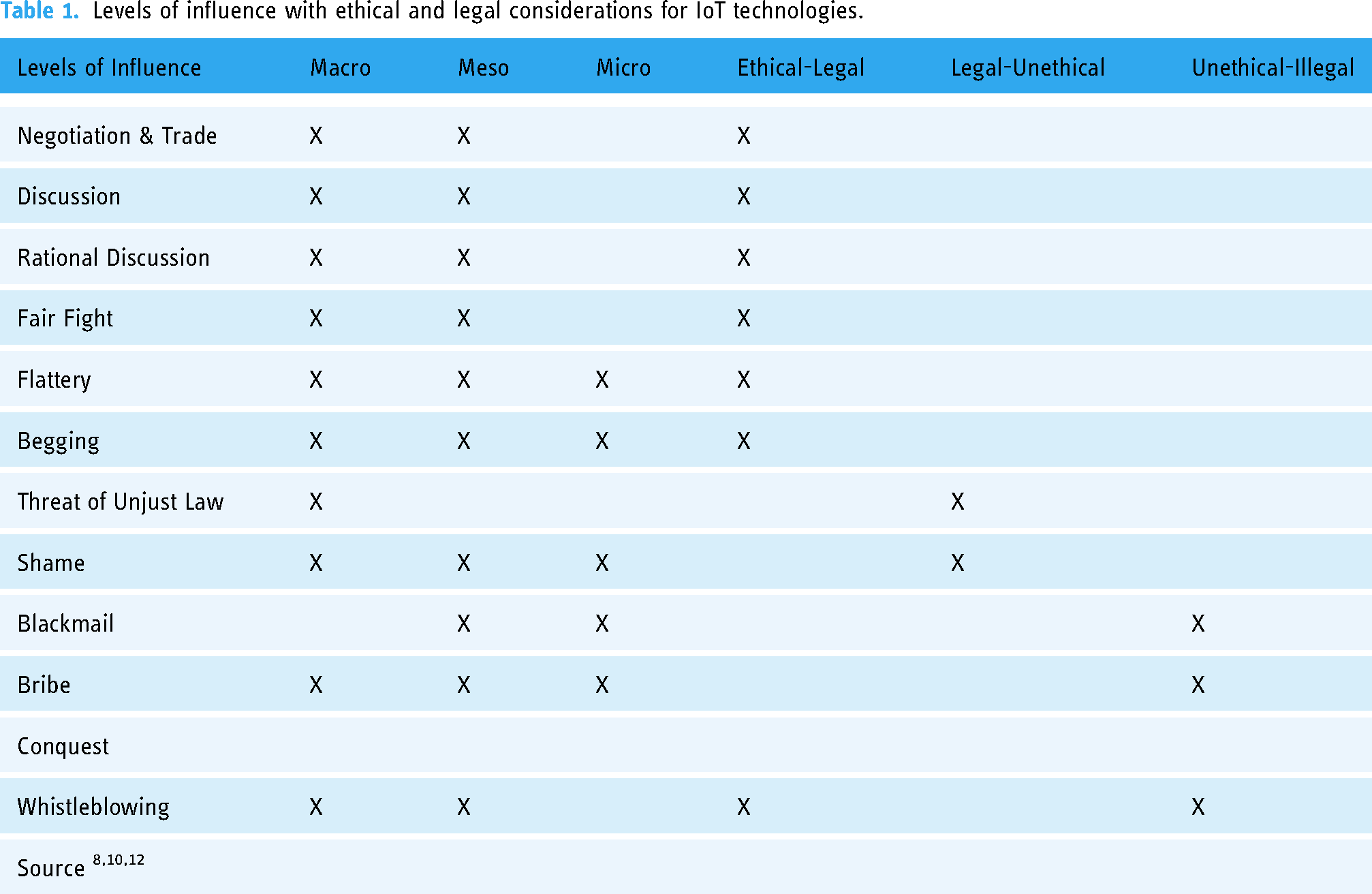
There exist practices on the ethics spectrum expounded by Herschel and Miori in their paper Ethics and Big Data. 12 Another author, Grant, notes that some practices lean towards using influence, 10 which we perceive as more socially acceptable or ethical, while others lean towards exerting control, 10 which we perceive as being less ethical or entirely unethical. 12 In Table 1, these dynamics are framed at the macro, meso, and micro levels also outlined in the COMEST's framework. 8
Levels of influence with ethical and legal considerations for IoT technologies.
Four use cases
The following four use cases (I-IV), namely, Healthcare Delivery Using Drones, COVID-19 Pandemic in Canada, Air Quality and Air Pollution, and Heatwaves are legal as far as they have government and/or institutional backing supported by the laws of the land. However, they have the capacity to promote unethical practices if unregulated or mismanaged (Table 2).
Public health surveillance during pandemics, climate change, air quality & global health.

Discussion
Ethical considerations for drone technology use in public health surveillance
At the macro (global) level, unmanned drones can potentially improve access to healthcare in geographically difficult-to-reach areas. 13 Drones offer solutions to overcome such constraints, enhancing services and reducing costs and waiting times. Drones have been employed to transport medications to mobile clinics in southwest Virginia's rural and underserved regions, including the mountainous Appalachian area. 13 Additionally, drones have facilitated the swift delivery of blood from Rwanda's capital city to local hospitals, significantly reducing delivery time from four hours to just 15 min. 13 In Canada, Drone Delivery Canada collaborated with Moose Cree First Nation communities residing in remote parts of Northern Ontario to deliver essential goods, including medical supplies. 13 There is a need to balance the potential benefits with protecting individual rights and information. Deployers of Flying Labs drones can explain to affected people that they do not surveil criminal activities or discriminate against targeted communities. Regarding power dynamics, the ethics of drone operations may vary across countries with some countries exerting more control over the drone technology and its applications. 13 This could lead to disparities in the benefits derived from these technologies. Community engagement to address ethical concerns is critical to ensure that the implementation of drone technology is respectful of cultural norms, values, and individual privacy rights.
Ethical considerations in COVID-19 pandemic surveillance in Canada
At the macro (national) level, several ethical considerations can be linked to the ArriveCAN application for collecting travel and health data during the COVID-19 pandemic very recently. 14 The precondition of providing proof of vaccination and a quarantine plan raises concerns about the privacy of users’ health information. 17 The inability to withdraw consent after successful entry may be seen as a violation of individuals’ control over their data. Imposing negative monetary incentives or denial of entry for non-compliance may disproportionately affect individuals with fewer resources, potentially creating inequities. 18 The lack of human involvement in verifying ad hoc quarantine requests by the system after Canada Border Services agents have already admitted travellers into Canada may be ethically problematic, especially if financial burdens are imposed from improper algorithmic decisions. 18 Thus, some federal government rules and regulations, while legal, may be deemed unjust by society. This raises questions about the ethical foundations of the regulations and their alignment with societal values.
Ethical considerations in the delivery of an air quality app for public health surveillance
At the meso level, the AirForU app for iPhones and Android devices provides real-time air quality updates and projections via the UCLA Health brand service. 15 Capturing air quality data and transmitting it to smart devices is useful for public health promotion and disease prevention strategies. Because smart devices such as smartphones can range from affordable to expensive their usage should generally not undermine or reduce equity. However, ethical considerations may arise concerning the accuracy of information presented in these tools. Institutions have a responsibility to present unbiased information and avoid manipulating perspectives through simulations. The use of technology in education may raise concerns about inclusivity, especially for students who cannot access to mobile apps and simulations for socioeconomic reasons, potentially exacerbating educational inequalities. In comparison, the power dynamic in education lies between educators, educational institutions, and students as these mobile apps are tested within microenvironments or in real-world settings.
Ethical considerations in public health surveillance of heatwaves
At the micro level, sharing thermostat data with entities who have the power to act may be in the best interest of individuals seeking to protect their health. 19 However, the required actions that occur after the data sharing are more important. The data-sharing process should prioritize the welfare of individuals to safeguard their health. Since equity-deserving groups have the least resources and capacity to change their circumstances, there must be just recognition and appropriate action to meet their needs. In our use case, ethical concerns arise when tailoring heat action plans to different contexts, such as modern homes, workplaces, schools, and refugee camps. 16 Discussions between municipalities and occupants must occur to ensure that the information is shared to benefit the occupants and users of the buildings, especially when it may save lives.
Recommendations for ethical internet of things technology use in public health surveillance
In sum, when technology deployment efficiency trumps accessibility concerns, top-down decision-making can worsen disparities, particularly for those with lower SES and literacy. Public deliberation, co-design and community engagement can help mitigate them.
At the macro level, public buy-in into governmental and intergovernmental oversight is vital when establishing standardized data governance, particularly for IoT-based PHS during pandemics and healthcare delivery using drones, ensuring that collected data is protected from misuse and does not lead to more disparities. For example, a data governance framework proposed for the 2009 H1N1 influenza pandemic can be utilized for future pandemics in Canada and modified in other global healthcare contexts.
20
However, work to systematically identify established standard ethical guidelines on drone deployment is underway.
21
At the meso and micro levels, the emphasis should be on co-designing IoT solutions with end-users to promote “rational discussions” and “negotiations” over IoT technology used in PHS.
22
While some local governments are implementing web tools for environmental equity surveillance (e.g., HealthyPlan.City), there is no clear evidence for co-design.
23
These recommendations underscore the significance of collaboration, equitability, and ethical data governance practices across all societal levels of digital PHS to improve the effectiveness and equity of health interventions.
The ubiquitousness of IoT technologies raises dual legal and ethical concerns due to potential harms versus benefits in the general population. Our perspective has provided multi-level societal contexts for why and how ethical problems with PHS ought to be confronted when using IoT technologies. Public health policymakers and other stakeholders should avoid the problematic types of influence outlined in our framework.
Footnotes
Acknowledgments
The authors acknowledge and are grateful for Dr Jennie Day's input, who reviewed a draft version of this article.
Author contributions
THP drafted the manuscript as the lead author; ML, AO, JB, ZB reviewed and edited two rounds of the draft manuscript; PPM conceptualized the project and served as the senior author.
Declaration of conflicting interests
The authors declared no potential conflicts of interest with respect to the research, authorship, and/or publication of this article.
Funding
The authors received no financial support for the research, authorship, and/or publication of this article.
Ethical approval
Ethical approval was not required.
Guarantor
THP
