



Abstract
Gene editing (GE) technologies are rapidly gaining traction as an alternative to genetically modified organisms (GMOs) in agriculture. While proponents claim the critical need for GE to address climate change and food security and assert its similarity to conventional breeding, critics argue that these technologies bring similar concerns to GMOs, such as supporting industrial agriculture and enhancing corporate control and ownership. But how do public groups make sense of these technologies? While incorporating public concerns is key to responsible and ethical innovation, minimal research explores how people make sense of emerging applications. We offer an exploratory Q study that investigates how one public group applies interpretive frames to understand applications of novel GE and related technologies. We find participants apply three different frames, invoking applications as (1) necessitating a system critical lens, (2) worthy of pragmatic of consideration, or (3) a deeply ambiguous prospect. These frames, we argue, articulate visions of particular sociotechnical futures, most of which are contrary or orthogonal to proponents’ assumptions. Instead, we find participants concerned less with the precision of techniques or the origin of genes used and more often with whether these applications reify dominant industrial practices and if viable alternatives exist.
Introduction
Gene editing (GE) is gaining traction as a significant alternative to the use of genetically modified organisms (GMOs) in agriculture. On the one hand, proponents—ranging from technology developers to policy makers—claim that the technology can assist in necessary food-system transitions (National Academies of Sciences Engineering and Medicine 2017; OECD 2014); in particular, proponents stress the urgent need for climate-resilient crops and for higher yield varieties that might enhance food security (Yadav, Thankappan, and Kumar 2021; Massel et al. 2021). On the other hand, critics (including environmental organizations) tend to view GE as the latest in a list of genetic engineering technologies that cement injustices perpetuated by earlier GMOs (ETC Group and Heinrich Böll Foundation 2018; Canadian Biotechnology Action Network 2020). Critics assert that applications of GE in agriculture introduce many of the same concerns as GMOs, such as corporate control of production and intellectual property, and that they fail to address underlying unsustainable or extractivist approaches to farming (Stone 2002; Helliwell, Hartley, and Pearce 2019). Between these different understandings of GE, lay people, or the general public, are left to grapple with a complex set of considerations when interpreting these technologies.
Understanding just how public interpretations might unfold is key to incorporating public concerns and priorities in technological design and facilitating responsible and ethical innovation (Owen et al. 2013; Jasanoff, Hurlbut, and Saha 2015). In this paper, we offer an exploratory Q study that investigates how GE is conceptualized by one group of interested individuals who are pursing education or are employed as research staff at a Canadian university. Of particular interest here are proponent claims about the promise of novel GE approaches in agriculture, which might miss altogether the concerns people raise. Understanding that “public” encompasses a range of possible conceptualizations, we propose studying the frames that one group might apply and the extent to which these frames might align (or not) with proponent claims. We explore these frames as a means for understanding this group’s future sociotechnical visions and how these intersect with agricultural GE applications. Following Stirling (2008) and Chilvers and Kearnes (2020), and as we discuss further in our Method section, our use of Q facilitates reflexive engagement with varied claims, allowing us to explore how participants deliberatively engage with them. As such, this study also offers methodological insight into the design of more open and reflexive public engagement with biotechnology development.
The New Possibilities of GE and Gene Drives (GDs)
Facilitated in large part by the discovery of Clustered Regularly Interspaced Short Palindromic Repeats (CRISPR) and its development as a simple and affordable GE tool, research on applications of GE has mushroomed in the past decade (Goold, Wright, and Hailstones 2018). Scientists are studying the use of CRISPR and other editing techniques to modify the genomes of agriculturally relevant organisms. Examples include developing staple crops that are resistant to diseases responsible for significant losses, such as rice blast fungus (Foster et al. 2018). Others aim to produce crops that are drought-tolerant (Shi et al. 2017), heat-tolerant (Yu et al. 2019), and salt-tolerant (Farhat et al. 2019). Other applications improve on-farm pest control (Gartland and Gartland 2018), as well as organisms’ nitrogen-fixation abilities, reducing the need for fertilizers (Wang et al. 2017). Some applications strive to improve livestock production, for example, by increasing pigs’ ability to digest feed or making them disease-resistant (Yang and Wu 2018). Still other applications target waste in the food system by developing nonbrowning varieties of crops such as apples, potatoes, and mushrooms (Waltz 2016, 2015).
Related GD technologies make use of editing techniques to enable the rapid spread of new traits throughout populations. GD can also be used to render pest populations extinct, by deploying traits that limit reproduction (Goold, Wright, and Hailstones 2018). Key agricultural GD technologies are those that reduce (or eliminate) the reproduction of pests (Courtier-Orgogozo, Morizot, and Boëte 2017); another application deploys traits for “hornlessness” across dairy cattle, with the goal of avoiding painful dehorning surgeries (Mueller et al. 2019).
Framing GE
Scholarship in science and technology studies (STS) has demonstrated that public understandings involve processes of interpretation, contestation, and negotiation, as groups participate in the production of scientific meaning and understanding (e.g., Jasanoff and Kim 2015; Irwin and Wynne 1996). With public views understood in this way, societal debates over new biotechnologies can be seen as involving competing “frames,” or schemes of interpretation, which various actors (public groups included) develop to make sense of complex issues such as new technologies (Jasanoff 2003; Levidow and Carr 1997; Levidow and Boschert 2008). As heuristic devices, frames by definition narrate or emphasize particular interpretations or meanings (and omit others) behind the purpose, novelty, and imagining of new objects. Both proponents and critics mobilize frames to leverage public support for, or opposition to, new technologies (Bain, Lindberg, and Selfa 2019). Thus, while some proponents may claim neutrality, scholarship has demonstrated that value judgments influence any evaluation of risks and uncertainties. Exploring the frames used by proponents, critics, and public groups alike can offer insight into the values that influence and motivate different actors (Krimsky 2019; Levidow and Carr 1997; Levidow 2003). Bringing public values to light, by exploring these frames for interpreting developments in genetic engineering, is crucial to making sure that applications of GE reflect these values in the first place (Jasanoff and Hurlbut 2018; Kofler et al. 2018; Shukla-Jones, Friedrichs, and Winickoff 2018). Furthermore, we view frames a key constituent of sociotechnical imaginaries—or visions of future social life and order that might be attained by, or supportive of, various technological projects (Jasanoff and Kim 2015, 2009). Frames, in this sense, are one of the discursive means by which sociotechnical imaginaries shift from future visions to stabilized and formalized realities supported by governing institutions (Jasanoff and Simmet 2021; Tozer and Klenk 2018). In other words, frames can shed light on how specific views translate to broader visions of the role of genetic engineering in society.
Investigating frames as they are being expressed by public groups, we argue, could elucidate the sociotechnical futures that groups articulate and then help influence which futures are incorporated into the design and governance of new applications, as opposed to being silenced by more powerful actors. In what follows, we review existing literature on proponent and public interpretations alike, highlighting the frames offered by proponents, and what we know (or do not know) about public understandings of this class of new technologies—including GE, GDs, and synthetic biology—particularly vis-à-vis proponent claims.
Proponent Frames of GE
Proponents have sought to differentiate GE from GMOs, which met intense opposition from public and environmental groups. Here, we draw heavily on Bain, Lindberg, and Selfa (2019) to review the key imaginaries employed by agricultural GE proponents. We focus on the discursive claims made by proponents—not their intentions. In this context, “proponent claims” are claims about GE made by a range of actors, including (drawing inspiration from Bain, Lindberg, and Selfa 2019) agricultural, biotechnology, and seed corporations; farm and agricultural commodity organizations; trade organizations; and biotechnology researchers and research centers. We also draw upon claims offered in key research studies authored by individual GE researchers and reports produced by large research networks such as the National Academies of Science, Engineering, and Medicine. These claims are particularly important because they are relevant to shaping the espoused purpose of GE applications, and the regulations and policy that might follow. For example, questions of precision that have surfaced in several research studies and reports have also arisen in regulatory decisions about GE agriculture in the United States and European Union (Bain, Lindberg, and Selfa 2019; Selfa, Lindberg, and Bain 2021).
A key imaginary is that, while most GM products on the market are staple crops developed to be either herbicide- or pest-resistant, the array of new products likely to enter the market will be more complex in terms of the techniques used, as well as the range of organisms involved and the number and complexity of genetic pathways involved (e.g., National Academies of Sciences Engineering and Medicine 2017). Linked to this claim is the idea that GE will offer a range of novel societal benefits, including many linked to climate adaptation (e.g., Yadav, Thankappan, and Kumar 2021; Goold, Wright, and Hailstones 2018; OECD 2014).
Another key imaginary employed by proponents is the categorization of GE as more akin to conventional breeding than GMOs (Bain, Lindberg, and Selfa 2019). Proponents emphasize that while GMOs are mostly transgenic (engineered to contain random insertions of new genetic material from other species via recombinant DNA technology), many versions of GE are “cisgenic” and so involve the combination of genes from sexually compatible species (National Academies of Sciences Engineering and Medicine 2017). Given that public groups are often wary of transgenesis and that transgenics are now facing more regulatory scrutiny than conventionally bred crops (Van Hove and Gillund 2017; Akin et al. 2017), it is unsurprising that proponents emphasize the potential of GE to produce non-transgenic modification such as deletions, “silencing” of genetic material, or insertion of material from the same species (e.g., Cressey 2013).
Furthermore, proponents emphasize that much greater “precision” is key to GE’s superiority to both recombinant DNA technology and conventional breeding (Bain, Lindberg, and Selfa 2019). For example, the National Academies of Sciences, Engineering and Medicine (2017) define genome engineering as “the use of tools that allow rapid and precise changes directly across chromosomes of living cells instead of limiting modifications at single genes.” Precision, many proponents claim, can allow for a wider range and higher stability of modifications (e.g., Kim and Kim 2019; Zhu, Li, and Gao 2020) as well as facilitate the non-transgenic modifications discussed above.
Public Understandings of GE
There is some evidence about what publics think about GE, but little information is available to date on whether proponents’ claims, frames, and imaginaries resonate with nonspecialist groups. Recent studies have explored how different groups are thinking about agricultural applications of GE and GD (e.g., Shew et al. 2018; Kato-Nitta et al. 2019; Rose et al. 2020), with evidence suggesting that public groups tend to view GE as similar but not equivalent to GMOs. For instance, emerging research into this topic suggests that some people will be more willing to consume GE organisms as compared to GMOs but less likely to consume GE organisms as compared to conventionally bred ones (Muringai, Fan, and Goddard 2020; Shew et al. 2018; Kato-Nitta et al. 2019). An extensive body of research on public perceptions of GMOs has documented that people interpret GMOs according to their sense of trust, perceived benefits at personal or societal levels, perceived risks to the environment and individual and societal health, knowledge and familiarity with GE techniques, demographic characteristics, and political views (Siegrist 2000; Durant and Legge 2005; Frewer et al. 2013; Costa-Font, Gil, and Traill 2008; Diamond, Bernauer, and Mayer 2020; Poortinga and Pidgeon 2005; Frewer et al. 2011; McComas, Besley, and Steinhardt 2014; Gaskell et al. 2004; Rose, Brossard, and Scheufele 2020; House et al. 2004; Wunderlich and Gatto 2015; Frewer et al. 2004; Libarkin et al. 2018). Scholars have also asked whether GMOs might perpetuate industrialized and corporate-controlled agriculture and its intellectual property framework to the exclusion of agroecological approaches; overall, the salience of such political–economic factors in shaping public perceptions remains underexplored (Vanloqueren and Baret 2009; Holt Giménez and Shattuck 2011; Calvert 2007; Jansen 2014; Amin et al. 2011).
In summary, we have some understanding of key reasons why people might support or object to GMOs—but limited clarity on the extent to which publics will interpret applications of GE and GD as analogous to GMOs. GE offers new features that—proponents argue—might cause public groups to interpret GE applications as different from GMOs. For example, proponents tend to assume that specific (novel) benefits will be particularly compelling, such as animal welfare (as found in initial studies by Ritter et al. 2019; McConnachie et al. 2019). But, is the “non-transgenic” nature of many GE products in fact compelling to public groups, and does it cause them to view GE products more favorably than GMOs? Do public groups interpret claims about the precision of GE as compelling? To date, little research has explored how publics evaluate these claims.
Toward an Opening Up of Public Understanding of GE
We explore how one public group is thinking about agricultural applications of GE, but following Stirling (2008), we do so with the aim of avoiding preexisting assumptions about frames, values, or rationales employed by the group. Such an approach places participants’ own interpretations at the fore, so that we might better understand the broader sociotechnical imaginaries pertinent to debates about GE innovation or policy in the near future.
A note on our inclusion of GDs in the study: thus far, opposition to GD appears to be more pronounced than opposition to GE, with an outright moratorium on research on GD raised at the Convention on Biological Diversity (Callaway 2018). GD in particular seems to diverge from GMOs because of the threat of enabling “super-Mendelian” or rapid capacity for next generation inheritance, but there is not much indication of how people might evaluate applications of GD (Jones et al. 2019). GD might be understood as quite a distinct set of technologies from GE due to pronounced concerns about the controllability and reversibility of unanticipated outcomes (National Academies of Sciences 2016). Initial research also suggests concerns about a potential “threat to existence” posed by some applications of GD, which threaten to cause population extinction—or are even designed to make populations go extinct. Our broader goal is to avoid a priori characterizations, so as to allow patterns to emerge from participant data. For this reason, we have opted to include GD examples in our investigation in order to explore, in an open-ended way, whether participant understandings of GD overlap or diverge from their understandings of GE.
In this paper, we ask: Do public participants’ perspectives on certain agricultural GE applications echo ways of thinking similar to those evident with GMOs? Do participants think about certain agricultural GD applications similarly or differently to how they think about certain GE applications? Overall, do participants’ patterns of thinking align with or contest the claims that proponents make about agricultural GE?
We begin addressing these questions via an exploratory study of students and junior staff (e.g., lab technicians or research assistants) drawn from departments and listserv across environmental studies (social sciences) and environmental sciences departments at an urban university in western Canada. The goal of this sampling approach is both its convenience, as is common in early stage investigations, and because this particular group has an interest in environmental issues generally (Riemer, Lynes, and Hickman 2014; O’Brien, Selboe, and Hayward 2018). As well, universities have been cited as a critical site where people, including younger generations, are incorporated into civic life (Flanagan and Levine 2010) and where they are engaged in cultural shifts relevant for today’s environmental challenges (Riemer, Lynes, and Hickman 2014). 1 While our study does not represent this group across a broader population (e.g., similar groups across Canada), it may offer insights or themes for further exploration. We hope to offer a methodological example of an in-depth study to characterize a public group’s conception of GE/GD in this early and mid-term phase of innovation, research, and development. In particular, our methodological approach highlights an example of an engagement exercise that “opens up” the object of study to deliberation, as we discuss further in the following Method section. We describe this methodological approach in more detail below, before moving to our results. The discussion emphasizes our finding that context-based considerations (e.g., the possibility of alternative solutions) prevail over questions of precision or the origin of genes used in applications.
Method
We selected Q methodology (Q henceforth) for our study, as this method is well-suited for facilitating a ground-up understanding of the patterns of thinking that a group might express on a given subject and, in particular, is useful for “opening up” elicitation processes to greater reflexivity. As a tool for studying subjective views, Q highlights why and how people hold specific opinions (Stephenson 1953; Addams and Proops 2000). It utilizes a small number of purposively sampled participants (twenty to forty) and ranks their agreement with opinion statements about a given topic; these rankings are analyzed statistically via factor analysis 2 to uncover groupings of shared opinions (Cairns 2012). Interview data are used to help interpret the resulting “factors,” which can be understood as discursive frames that actors use, such as to understand new technologies (e.g., Cairns and Stirling 2014; Davies, Alstine, and Lovett 2016). As Q does not assume a priori themes but rather allows them to emerge from the data, Stirling (2008) has suggested that Q can “open up” an elicitation process to greater reflexivity. Chilvers and Kearnes (2020) also recommend Q as a method that can facilitate deliberative reflexivity about the objects of study, such as specific technologies. Instead of focusing on extant frames and the degree to which people agree with them, Q allows people’s own frames to emerge by revealing which views are most salient, how they group together, and why (Wolf 2010; Ockwell 2008). Q methodology operates by making explicit the contingent nature of specific claims: as such, it facilitates a focus on how a specific group of concerned actors engages with a set of claims, and indeed, it highlights the contingency of these claims on the deliberative research exercise itself. Cairns and Stirling (2014) offer a useful example of using Q method with an STS lens to understand the different ways that actors frame a subjective discursive construct (in their case, geoengineering). Indeed, Q has been used in various STS studies toward these goals (e.g., Wolf 2010; Ockwell 2008; Cairns and Stirling 2014; Cairns 2012). Other critical environmental social science studies (see Eden, Donaldson, and Walker 2005; Damgaard, McCauley, and Reid 2022) have made use of Q for similar purposes.
Q involves the following steps: developing a “concourse” (or full diversity of perspectives on a topic), reducing the concourse to a set of Q statements (statements pertaining to the topic), conducting interviews in which participants rank agreement with statements, and undertaking statistical analysis and interpretation, alongside analysis of qualitative insights (Webler, Danielson, and Tuler 2009). Our approach to the Q method here also involved developing four specific sample applications to guide the study. Further detail on steps taken, and sample applications utilized, follows below.
Creating and Reducing the Concourse
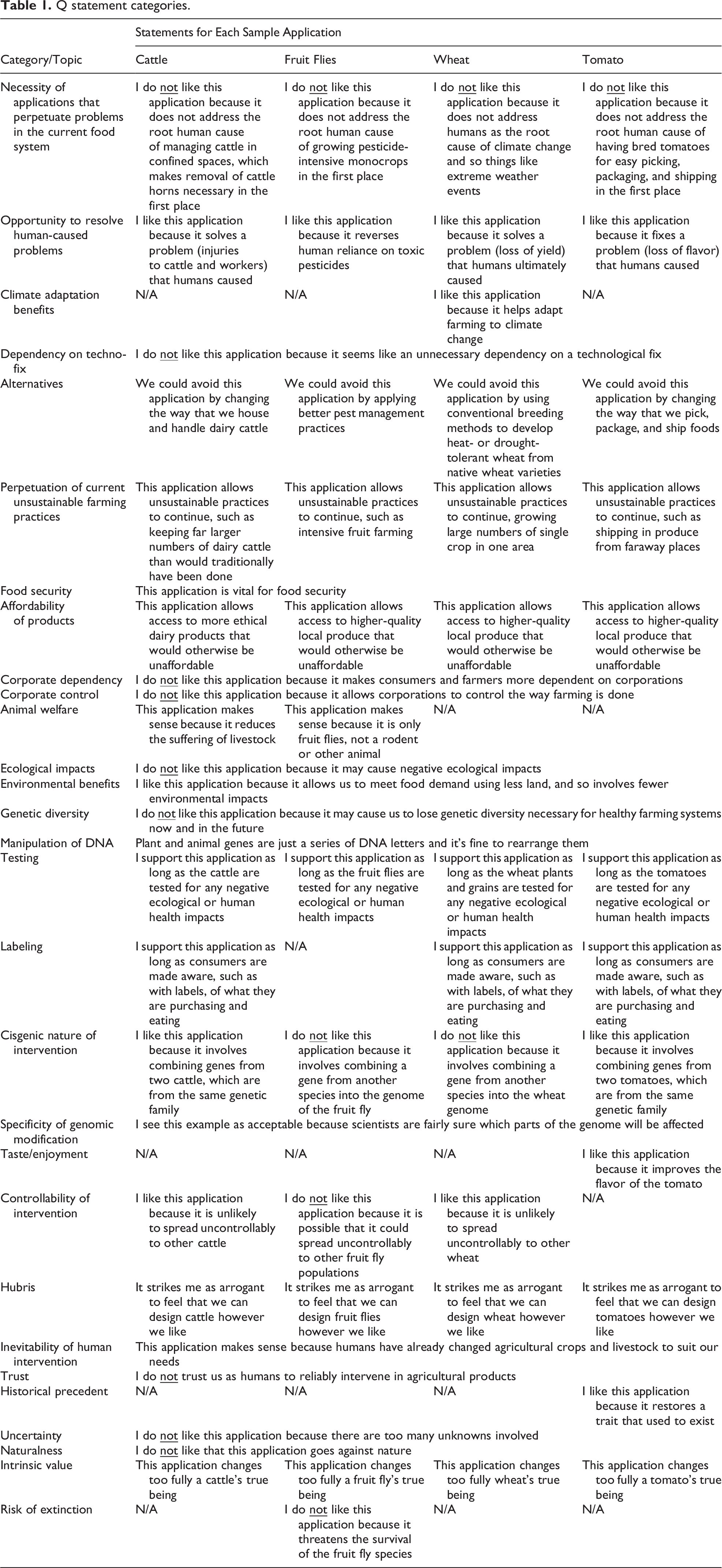
We began by convening two focus groups with nineteen participants in total to discuss GE and GD for agriculture. We introduced participants to a diverse set of GE and GD applications described below, coded all interview transcripts for themes raised (forming the “concourse”) and used this concourse to extract a set of Q statements (using verbatim statements where possible; see Table 1). 3
Q statement categories.
Selection of Sample Applications
The approach to Q used in this study diverges from other Q studies because we used multiple sample applications to guide interviews. Q studies often involve one Q set (or list of key statements), whereas we introduced participants to four sample applications, each with their own slightly different Q sets. This approach allowed us to study how participants interpreted a range of features, characteristics, techniques, and organisms of interest. The four sample applications were (1) a GE application to modify wheat for heat- and drought-tolerance (drawing upon Gartland and Gartland 2018; Shi et al. 2017); (2) a GE supermarket tomato edited to restore genes for heirloom tomato sweetness, previously lost (drawing upon Tieman et al. 2017); (3) a GD for polled cattle to reduce the need to dehorn dairy cattle and thus avoid farmworker injuries and painful dehorning processes for cattle (drawing upon Goold, Wright, and Hailstones 2018; National Academies of Sciences Engineering and Medicine 2017); and (4) a GD for controlling fruit fly populations in farming (drawing upon Buchman et al. 2018; Li and Scott 2016).
We selected the sample applications based on a thorough review of emerging GE and GD scholarly literature and science journalism. In selecting applications, we balanced attributes to ensure comparison along specific lines that key studies have highlighted as important: the differences between GE and GD applications, because initial evidence indicates that they pose distinct risks and may be perceived differently (National Academies of Sciences Engineering and Medicine 2016, 2017); comparisons between staple and non-staple crops, given that GE (unlike with genetic modification) will likely be increasingly applied to both; one instance of uncontrolled release of GD and one controlled, noting that reversibility of unexpected outcomes for some GE and GD is a key concern; and an application where the resulting product is arguably similar to conventional breeding, and one where the resulting GE product is unique, because debates in numerous jurisdictions have centered regulatory decision-making on this issue (Vives-Vallés and Collonnier 2020).
We presented participants with these four sample applications in the form of short (one to two paragraphs) textual descriptions. The text described, in lay terms, the type of technique used and the purpose cited by developers. We kept the text brief to avoid presuppositions and to avoid overwhelming participants with large amounts of information. We acknowledged the limited amount of information provided and encouraged participants to share questions. We also emphasized that the sample applications were intended for thinking rather than in-depth educational tutorials, an approach consistent with our overall goal of understanding initial reasonings.
Interviews (or “Q sorts”)
Interviewees were students and staff at the University of British Columbia affiliated with the departments of forestry, land and food systems, geography, chemical and biological engineering, and environmental studies. All participants expressed an interest but not expertise on GE or GD. Table 2 provides a general summary of the number of social and natural scientists and levels of education represented in the sample. 4
Q participant information.
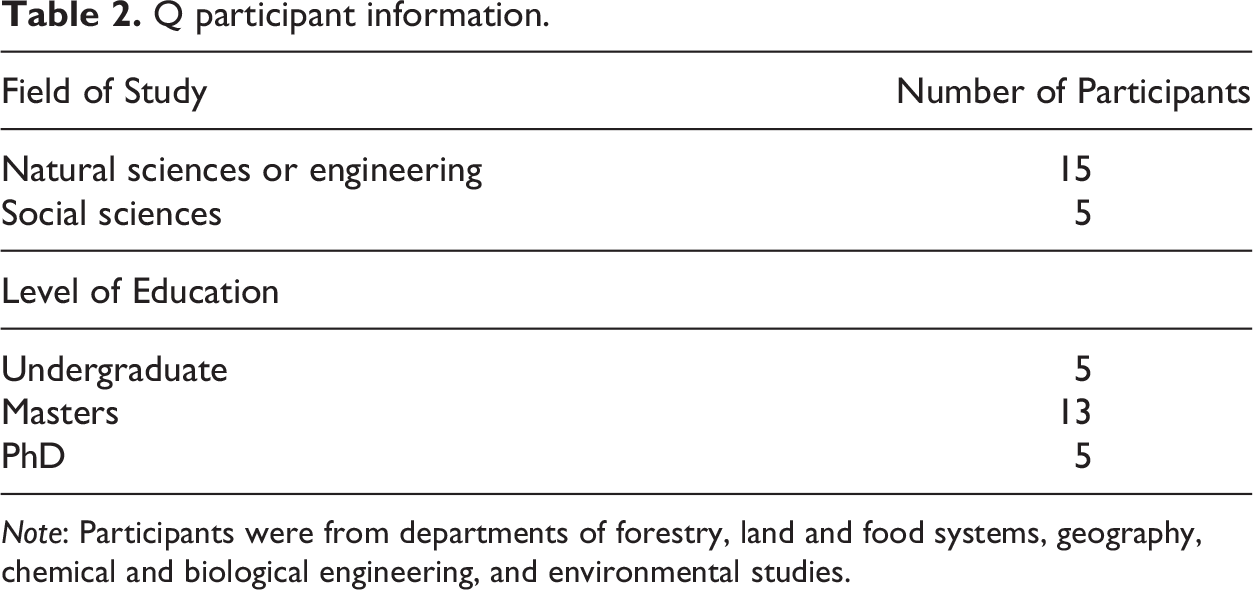
Note: Participants were from departments of forestry, land and food systems, geography, chemical and biological engineering, and environmental studies.
We piloted the interview protocol with two participants. Following preliminary testing, we modified the interview guide and several Q statements to improve clarity and ease of understanding. Next we conducted interviews in October and November 2019 in person at the University of British Columbia. Participants were each assigned two Q sorts based on two of the four sample applications, for a total of forty Q sorts or ten per sample application. Given that we used twenty-five statements (and that many of the statements/topics overlapped across sample applications), ten participants is considered sufficient for analysis (Webler, Danielson, and Tuler 2009).
Each interview involved asking participants to sort statements written on cards into a large posterboard containing a grid (see Figure 1). The grid had a forced normal distribution, so participants were required to place all their cards according to the given distribution, 5 which ranged from “most like how I think” on one side to “least like how I think” on the other. We explained that statements they most agreed with should be placed in the +4 box, and then those they agreed with but less strongly in the +3 boxes, and so on.

Q grid.
Interviews were recorded and lasted thirty to forty-five minutes per Q sort. We asked each participant to (1) review a written sample applications; (2) sort statements into two piles depending on level of (dis)agreement; (3) arrange statements on the Q grid in order to rank relative levels of (dis)agreement; and (4) review the final distribution to ensure satisfaction. Finally, (5) to ensure that any views not related to the twenty-five statements were captured, we closed each interview with general questions, including whether there were themes missing; in neither of the two focus groups did participants raise issues that diverged greatly from the statements provided (for instance, one interviewee discussed reduction of food waste as a possible alternative to GE). Throughout, we asked participants to explain aloud their reasonings.
Analysis and Interpretation
We used R software (R Core Team 2020) to statistically analyze the Q sorts for key patterns in participants’ thinking. We used principal component analysis, followed by factor analysis using the “qmethod” package (following Zabala 2014). 6 The results point to a set of possible factors or patterns in how participants ranked the statements provided.
These raw results require interpretation to be comprehensible as archetypal viewpoints or frames through which participants understand GE applications. We began by creating representative Q-sorts for each factor, following Davies and Hodge (2007). 7 We then developed a novel approach to interpretation whereby we drew an archetypal grid for each factor and sample application to aid visualization (see Figure 2). Next, we annotated each archetypal grid, following Watts and Stenner (2014), noting the statements that each factor most (+) or least (−) agreed with to understand the defining statements for each factor. We then examined statements that participants ranked differently or similarly across factors, following Zabala (2014), to understand how factors differed from each other. Next, we drafted “narrative factor interpretations” in an iterative process (again following Watts and Stenner 2014). Finally, we used interview transcripts to check our interpretations, producing descriptions of the main frames by which participants interpreted the four applications.
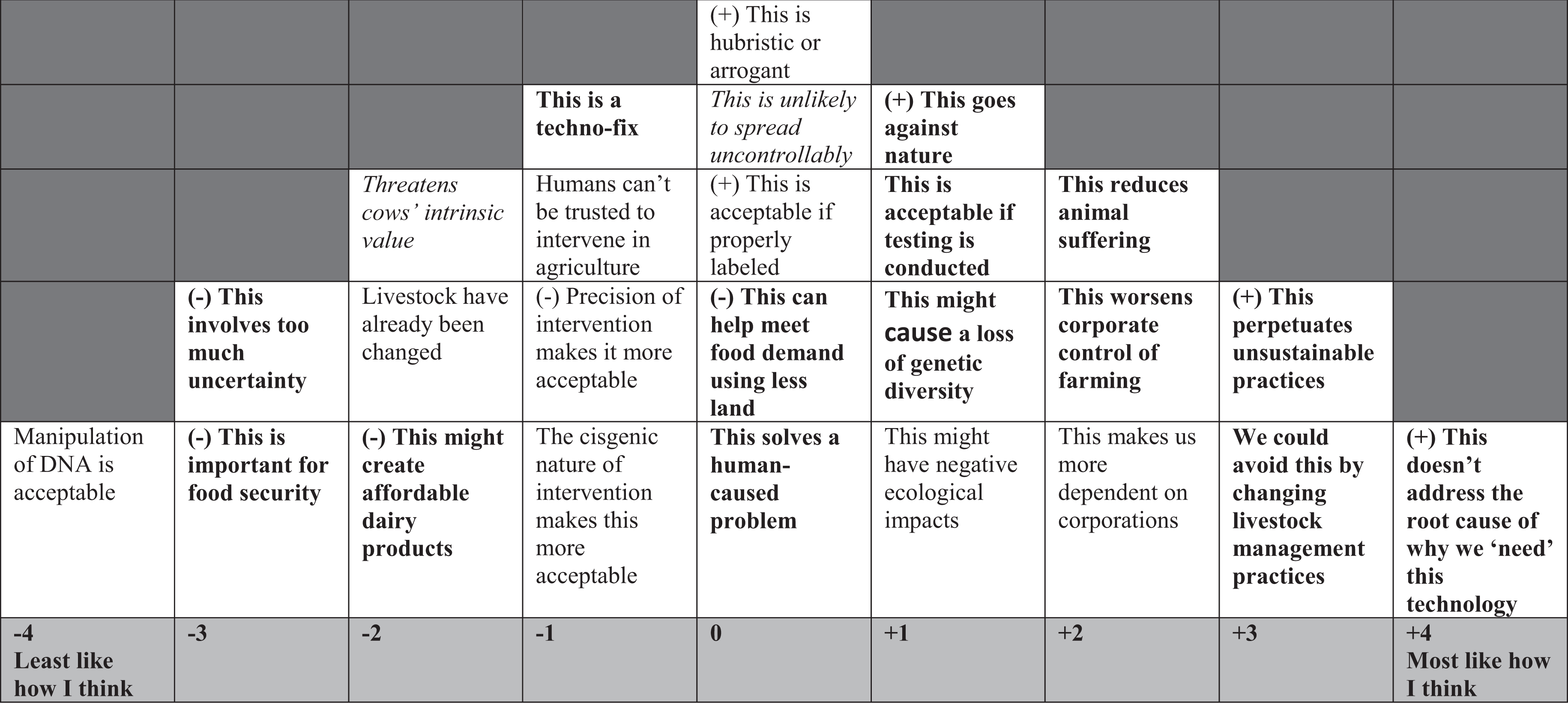
Sample annotated Q grid (for cattle, factor 1) with statements paraphrased for brevity. “Distinguishing statements” are in bold, “consensus statements” are in italics, following Zabala (2014). Items that are ranked higher for this factor compared with other factors (following Watts and Stenner 2004) are marked with (+) and those ranked lower for this factor compared with other factors are marked with (−).
Results
Three factors—or frames by which participants interpreted GE—characterize our findings. These include: factor 1, which we call “critical systems thinking;” factor 2, “pragmatic techno-optimism;” and factor 3, “ambivalent questioning.” In what follows, we describe how each factor corresponds to a frame, a way of thinking or making sense of the applications in question. We also assess the extent to which participants’ frames remained consistent across the two sample applications they received and summarize the extent to which claims about precision and origin of genes emerged across any of the three factors.
Table 3 below summarizes the results of our Q analysis. From this table, we can see that participant responses to the cattle and fruit fly (i.e., animal-based GD) sample applications grouped into all three categories and participant responses to the wheat and tomato (i.e., plant-based GE) grouped into two categories (factors 1 and 2 only). As Davies and Hodge (2012) note, these factors are not exclusive, and just because one individual aligns with one factor does not mean that they might not have other views that align with other factors. In the language of frames, an individual who uses one frame to understand applications might also apply another frame to a lesser degree.
Factor solutions and labels for each sample application of gene editing (GE) and gene drive (GD).
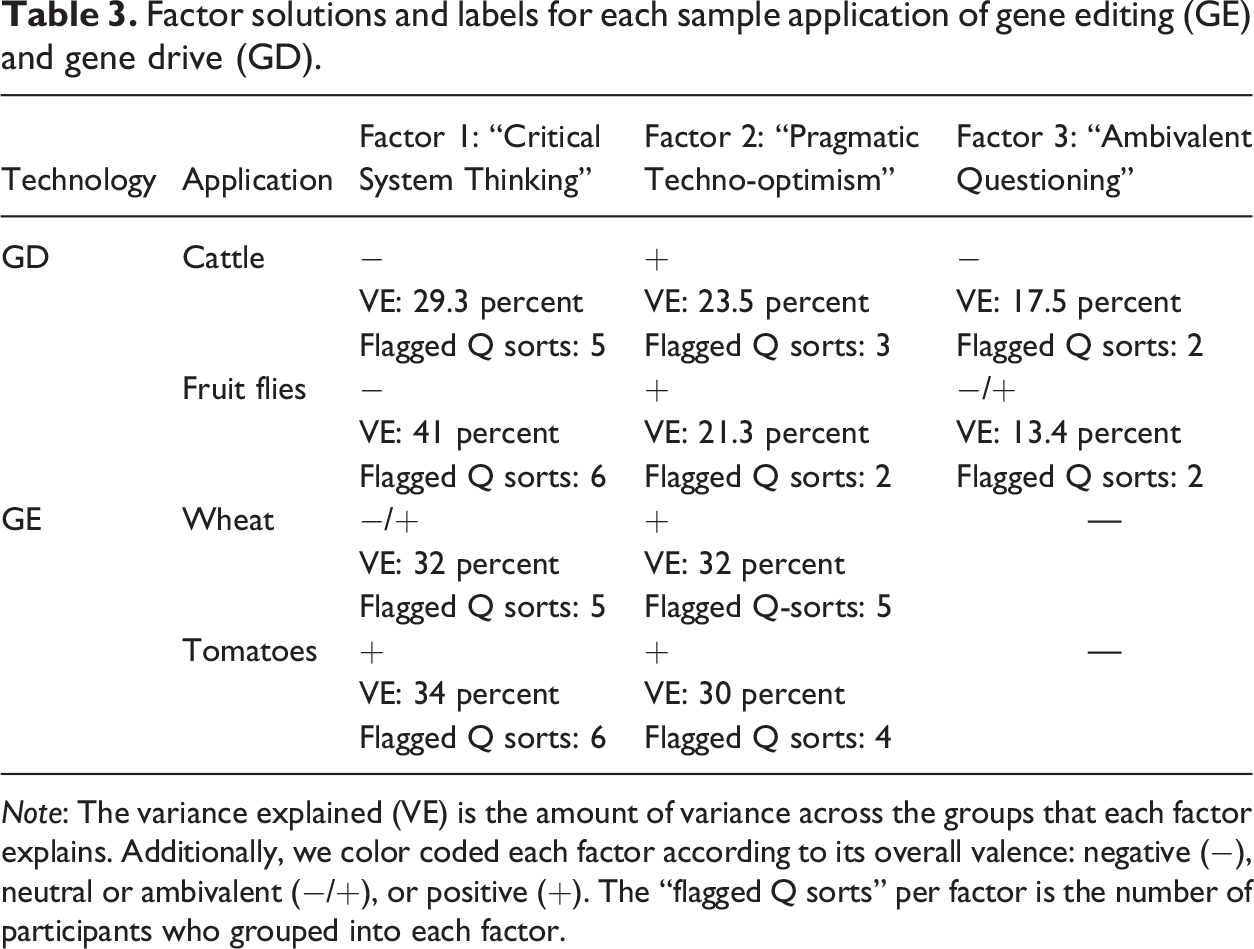
Note: The variance explained (VE) is the amount of variance across the groups that each factor explains. Additionally, we color coded each factor according to its overall valence: negative (−), neutral or ambivalent (−/+), or positive (+). The “flagged Q sorts” per factor is the number of participants who grouped into each factor.
Factor 1: Critical Systems Thinking
Those in factor 1 or the “critical systems thinking” frame tended to see the use of new GE and GD technologies as avoidable and unnecessary. They preferred changing livestock or pest management or using existing breeding practices to avoid the use of GE or GD. One participant stated that GE is unnecessary because it would be preferable that we address the “root problem” underpinning the technology. Crucially, the issue for participants with this frame did not appear to be questions of trust or a knee-jerk aversion to editing genomes, but rather that other approaches should be considered first. As one participant stated, “I don’t have a real aversion to editing genes, but I don’t have any particular desire to see that be our first effort…we should be looking into other opportunities before we go there.” Another commented that they have a “reasonable degree of trust” in editing techniques and that they “accept that there are unknowns” and that “there is an acceptable level of risk”; however, this participant preferred “the idea that we can do something behaviorally or managerially that would reduce the need for [the application] in the first place.” Systems-based alternatives included changing management practices, reducing the consumption of dairy, and reducing food waste. Some participants went a step further, arguing that these applications might even perpetuate an unsustainable farming system: for example, one questioned whether the fruit fly intervention might worsen problematic usage of pesticide-dependent monocultures.
Participants who aligned with a critical systems thinking frame appeared to have some flexibility in their views, particularly around the wheat, tomato, and cattle applications. Despite skepticism about the stated purpose of these applications (namely food security), several clarified they might be open to GE if the need was great enough and other options had been exhausted. For example, one expressed openness to the wheat application if it turned out to be essential to food security, while others expressed interest in its capacity for climate adaptation. One participant noted that pressure to create more “packageable” tomatoes through GE fulfills the unsustainable demand of air-freighting tomatoes from faraway places. Importantly, any inclination toward acceptance was framed in terms of broader critiques of the farming system in which the application is embedded. As one participant stated, they preferred the idea of breeding hornless cattle over dehorning them via surgery, but “wouldn’t support [the application] if it meant higher production for McDonalds and A&W” or if it exacerbated practices of packing many cattle into small living quarters. Another similarly commented that the application could be necessary “if other kinds of opportunities to change the conditions in which cattle are held are not viable…but I would prioritize other efforts first.”
Notably, participants who expressed this frame in response to the fruit fly application were particularly negative in their overall attitude toward the application. For example, one participant commented that they found the application of GD to flies to be a “savage thing” that felt “sad.” Some participants cited risks such as uncontrollability, and the potential for these technologies to spread without limit, such as escape of fruit flies into the wider environment.
Factor 2: Pragmatic Techno-optimism
Factor 2, or the “pragmatic techno-optimism” frame, was characterized by an overarching sense of pragmatism around these technologies. One participant commented that using technology is not a “dependency” and that “our ability to solve problems [isn’t] a bad thing.” These participants asserted that humans have already transformed agriculture and livestock and that these applications thus might not be much different from domestication and breeding of crops and animals. While this perspective may appear to echo proponents’ claims that GE is “natural” and akin to conventional breeding, participants with this pragmatic frame tended to view conventional approaches as highly manipulated. For instance, one participant commented that “farming isn’t…super natural anyway” and that “it’s naïve to say we’re not already designing cattle however we like.”
This group was benefit-optimistic compared to the critical systems thinking group. In other words, participants with a pragmatic techno-optimist frame were more concerned with whether a particular application might have a useful purpose than whether it would involve an unnecessary reliance on technology. This group acknowledged benefits that proponents use to justify GE and GD technologies, such as reducing animal suffering (in the cattle application); meeting food needs using less land (fruit fly application); assisting farmers in adapting to climate change (wheat application); and environmental benefits (tomato application). One participant distinguished between what they perceived as goals to benefit society versus more individual motives: “This is rearranging DNA for a specific purpose. It’s not like a designer baby where you want your child to have blue eyes.” In this frame, socially beneficial goals or a designated purpose for the greater good made the applications more worthy of consideration.
Some participants weighed alternatives using a logic akin to that used by participants in the critical system thinking frame—but crucially disagreed that changes to management practices “are ever going to happen,” in the words of one participant. Another participant agreed that there is a core problem with the way that tomatoes are picked, packaged, and stored (speaking to a deeper food system concern) but did not feel that this should eliminate the tomato application from consideration, because the participant felt it could bring important benefits to small farmers. Similarly, questions of root causes were not of particular concern for these participants. One commented that “whether humans caused the problem [of climate change] matters—but not in this context,” suggesting that edited approaches are acceptable ways of addressing a problem, regardless of whether the problem is human-induced. Another participant explained that despite holding some critical views on modern farming practices, they did not think the industry would ever shift away from such practices, noting that “the farming industry is not going to change whether or not you use this one application.” Importantly, participants with a pragmatic techno-optimist frame did not perceive alternate management practices or nongenetic technologies as necessarily preferable.
Of note is that this was the only frame that involved a sense of neutrality about the fruit fly application. While the other frames expressed worry about the possibility of GD enabling the spreading to other fruit fly populations, participants aligned with a techno-optimist frame did not emphasize such concerns.
Factor 3: Ambivalent Questioning
Ambivalence was less popular overall, appearing only in the cattle and fruit fly applications. While the logic associated with other factors is present in responses from people with an ambivalent questioning frame, an overarching uncertainty characterized these participants’ views: participants simply felt that these applications involved too many unknowns. One explained that they felt that “we know a lot about how genes are altered,” and another expressed that humans have had “many successes with manipulations” of genes; yet participants seemed overall ambivalent about how to weigh the arguments they were presented, expressing skepticism about some benefits and assurance about others. In summary, this factor was not substantively different in its claims and arguments than the other two factors and is thus best understood as a middle ground between the other primary types of frames present among participants.
Tracing Individuals with Multiple Frames
Table 4 traces how each of the frames used by twenty individual participants varied across the two applications they were given (one application of GE and one GD). The majority of participants (n = 12) tended to apply a single frames to the two applications they examined. Only some participants (n = 3) applied a pragmatic techno-optimism frame to GE and a critical systems thinking frame when presented with a GD application. Another set of participants (n = 4) shifted out of both frames into a more uncertain one when presented with GD applications. Notably only one participant expressed a critical frame in understanding the GE applications, and a pragmatic one for GD. An example of this shifting of frames across applications is evident in the logic articulated by one participant who adopted a pragmatic techno-optimistic frame regarding the wheat application, compared to an ambivalent questioning frame when discussing the cattle application. Despite their sense that the cattle application was not a “techno-fix” and did attempt to address a “valid problem” (participants’ comments are consistent with a pragmatic techno-optimism frame), they expressed an overarching sense of uncertainty about the acceptability of the cattle application.
Stability of frame across sample applications.
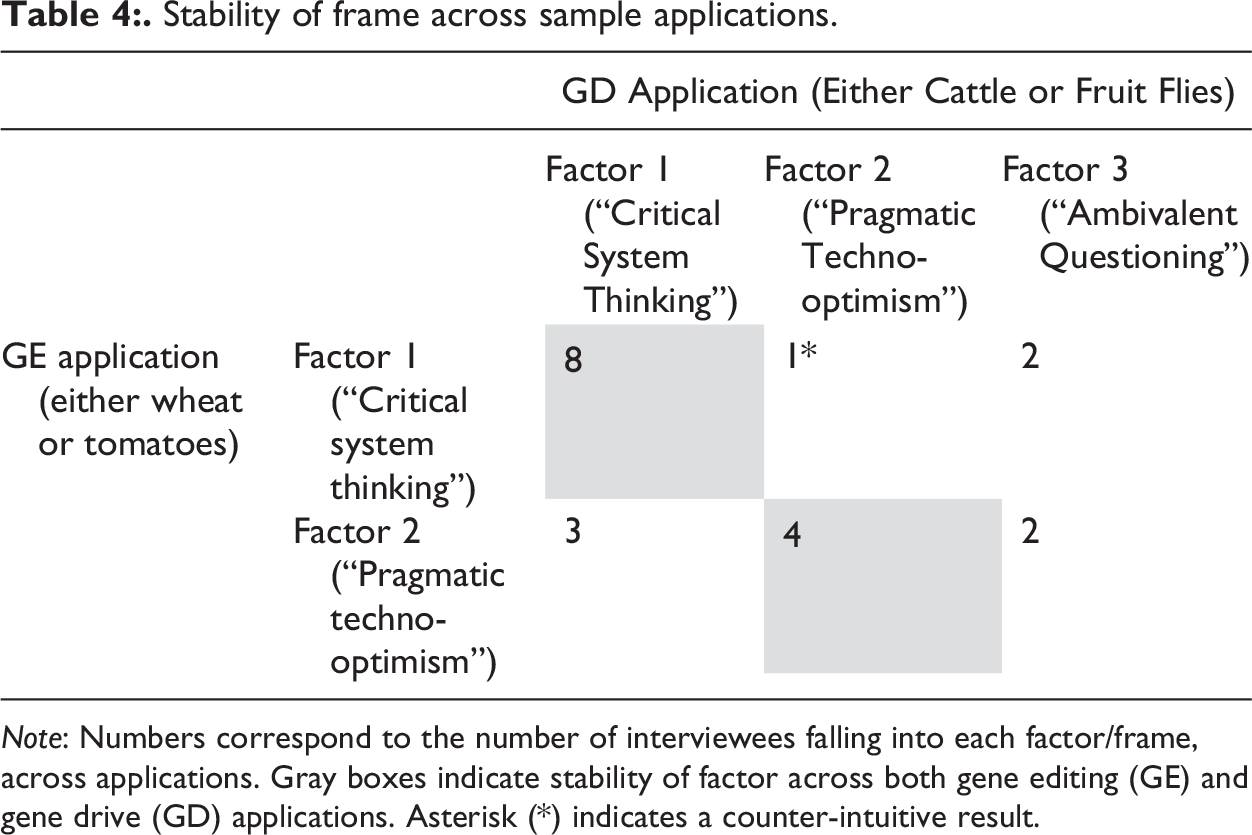
Note: Numbers correspond to the number of interviewees falling into each factor/frame, across applications. Gray boxes indicate stability of factor across both gene editing (GE) and gene drive (GD) applications. Asterisk (*) indicates a counter-intuitive result.
The fact that some individuals applied different frames to different applications suggests that individuals may not be fixed in the frames they apply, but instead adjust their thinking to the specifics involved. What exactly drives this variation is difficult to ascertain, but it is noteworthy that multiple participants commented on the utility of our methodology, which requested participants complete Q sorts for two distinct applications, so as to elicit these contrasts. One commented in their final reflection that there were “differences between ‘what do I think about this’ vs. ‘what do I think about this,’ given…climate change, given…food security issues.” Another commented, “it’s funny because you want to have this internal consistency, but when you change from animal to plant or when you change the circumstances around production…it sort of changes [things].” Indeed, multiple participants raised the difference between plants and animal applications. One participant stressed the importance of agency in influencing their understanding of acceptability in the sense that fruit flies may be seen to have agency and tomatoes do not.
Claims about Precision and the Origin of Genes
Proponents have argued that the precision involved in GE and GD applications makes them less risky than GM. Overall, we found that neither precision nor difference from GM featured prominently in the different positions expressed about various applications of the newer technologies. In the case of the cattle, fruit fly, and wheat, the precision required for the intervention itself (e.g., the degree of locus specificity with which a genetic cut or insertion was made) did not appear to motivate overall acceptance or rejection; in the tomato application alone, precision of the technique emerged as a feature of the frame, that is, within the top six statements. In their statement rankings, participants did not generate clear, immediate, or strong responses to matters related to precision or genetic origin. Statements about this topic emerged toward the center of participants’ Q sorts only (i.e., neither “a lot like how I think” nor “not at all like how I think”). 8 Several participants made this explicit: one commented that the combination of genes from different species was not alarming because “it has happened multiple times already.” One commented that the specific location of genes was not their concern so much as “the actual outcome” associated with the application. These views, however, did not necessarily indicate a lack of regard for the consequences of genetic manipulation; one participant clarified that “you can’t just randomly mess with genes…there’s huge potential to…seriously hurt people.” Instead, they clarified that what mattered to them was “what impact [modified genes] have,” and whether a modification “does something functional for the organism.”
Discussion and Conclusions
Our analysis found three frames that university-based participants used to understand applications of GE and GD technologies, which contrasted in notable ways with the frames that proponents tend to utilize. The critical systems thinking frame represented a significant departure from proponent understandings, emphasizing broader systems and contexts. Techno-optimist frames were closest to those of proponents. That is, proponents liken GE organisms to conventional ones in that both are argued to be natural, whereas participants likened GE organisms to conventional ones in the sense that both involve extensive human intervention. Similarly, participants with techno-optimist frames appeared to view certain climate, food security, or animal welfare benefits as compelling.
Questions of precision and genetic origins are key to proponent framing of GE but were not central to participants in our study. Instead, our findings suggest that many participants (particularly those applying a critical systems thinking frame) are articulating future visions that consider alternatives to GE and GD. These imaginaries emphasize the importance of considering genetic engineering as part of a suite of alternatives—including nonbiotechnological approaches that better address the root causes of agricultural challenges, such as reliance on industrial approaches. We note that these findings may not apply to other public groups and that they warrant further investigation in other public contexts. Below, we discuss whether participants’ views diverge from past critiques of GMOs and offer several reflections on opportunities for public participation in the governance of GE and GD.
New Techniques, Old Ways of Thinking?
Our findings indicate that specific details regarding precision or origin of genes did not drive participants’ views of the four sample applications. One possible explanation could be that participants did not believe GE applications to be more precise than previous forms of genetic engineering or other breeding methods. One of the advantages of a Q approach is that it allows the researcher to explore such questions: after participants rank each statement as with a survey, they also explain how they interpret it. These explanations helped confirm that interviewees did not necessarily contest whether GE is more precise than other breeding or engineering methods—rather, they were unconvinced by claims of precision as relevant to their overall evaluation of the applications in question. In fact, respondents who applied a critical system thinking frame were, with regard to the fruit fly application, strongly inclined to reject precision as relevant at all (i.e., they strongly disagreed that the precision of the technique mattered to them).
Another key finding was that many participants who held a critical systems thinking frame questioned the necessity of GE and GD. For these participants, their attitudes toward applications of this technology were based on how it might reify current problematic agricultural practices. What matters for some may not be whether GE or GD is more precise than GM or offers fewer transgenic insertions—but whether their use is justified and whether viable alternatives exist.
Such systems-level concerns have been documented in a range of scholarship on both genetic modification and GE. Extensive scholarship has documented that these critiques are a central reason for opposition or concern regarding GM. Key examples include concerns about the continuing expansion of industrial agriculture and the failure to address broader issues such as food insecurity (Fitting 2011; Holt Giménez and Shattuck 2011; Stone 2002; Tomlinson 2013; Schnurr 2015) or corporate control of intellectual property (Patel 2009; McAfee 2003; Carolan 2008). With GE, Helliwell, Hartley, and Pearce (2019) have found that actors such as non-governmental organizations (NGOs) may be reframing debates on GE, focusing not just on the veracity of benefit and risk claims but on questions like “is this truly necessary?” In studying GD for polled dairy cattle, Ritter et al. (2019) found that attitudes varied depending on the stated purpose provided to study participants, with participants more likely to view the application favorably if the purpose was animal welfare, as opposed to cost savings, or no stated purpose. Our results suggest that some participants may indeed understand new GE and GD applications using frames similar to those used to understand GM—notwithstanding proponents’ claims about the differences between GE and GM.
Of note is that while other scholarship has indicated that people may feel that GE empowers corporations and corporate control of agriculture (Helliwell, Hartley, and Pearce 2019, Rose et al. 2020), this did not appear to drive participants’ frames in this study. Participants did express a nearly universal concern regarding corporate control, raising associations that came to mind such as the privatization of seeds, Monsanto, and questions of ownership. However, they did not view the applications in question as worsening control. Instead, multiple participants explained that they viewed corporate control as already entrenched and not something they anticipated would worsen with the incorporation of GE and GD applications. Thus, while corporate control may have been a mobilizing concern in earlier iterations of genetic engineering, among this university-based group, pervasive corporate control was a given and so did not make or break a respondent’s overall impression of the technology.
In summary, then, we found that many participants utilized frames that differed from proponents’ imaginaries of GE, that is, they did not align with proponents’ claims about the importance of precision or the cisgenic nature of interventions. Furthermore, in a critical systems thinking frame GE is not necessarily seen to be akin to conventional breeding, sometimes explicitly citing associations with GMOs (Bain, Lindberg, and Selfa 2019). Instead, many participants articulated “visions of desirable futures” (Jasanoff and Kim 2015, 4) that included modes of agricultural production divergent from dominant industrial practices. As Jasanoff and Kim note, imaginaries “encode not only visions of what is attainable through science and technology but also of how life ought, or ought not, to be lived” (p. 4). In our study, many participants offered visions that GE and GD ought to be used only if other alternative solutions had been exhausted; others felt that GE and GD ought to be used because the modifications they entail offer tangible benefits and because humans have already extensively intervened in other agricultural products. These visions are not stable or uncomplicated; we saw participants grapple with the particulars of different applications, weighing questions of urgency (e.g., the level of perceived necessity), the organisms involved (e.g., animal vs. plant), and the viability of alternatives (e.g., feasibility of shifting to other management practices).
Our study did not produce findings regarding other aspects of proponent imaginaries documented by Bain, Lindberg, and Selfa (2019), such as the proposition that GE would help usher in a new Green Revolution or that it would democratize agricultural biotechnological innovation. Regarding the latter point, Montenegro de Wit (2020) suggest reasons to be skeptical of this claim, but it remains to be seen how public groups make sense of these aspects of proponent imaginaries.
Insights for Public Engagement on GE and GDs in Agriculture
In policy discourses about GM (and now GE and GD), publics are often assumed to lack the knowledge needed to make judgments about biotechnologies (Irwin and Wynne 1996). Furthermore, extensive scholarship has demonstrated that the goal of public engagement should not be to fill knowledge deficits in the minds of public groups (e.g., Hansen et al. 2003; Sturgis and Allum 2004). Instead, it is important to understand that values are embedded in policy discourses about biotechnologies, and public engagement can be a way to make visible these values (Wynne 2001).
Our analysis suggests that public engagement might need to shift away from asking people how they feel about the genetic origin of modified genes or the impact magnitude of genes modified. As Scheufele et al. (2021) point out, public engagement encompasses multiple goals—from influencing policy processes through to shaping the terms of public engagement itself. A more “opened-up” (Stirling 2008) form of engagement might offer publics a chance to question the assumptions and problem framings of a new technology. Such approaches might involve asking foundational questions such as: Do you believe there are alternatives that might substitute for this technology? Do you agree about the urgency or need to address the problems that are said to justify this technology? or, Do you see this technology as supporting an agricultural future you believe in? Such approaches might orient public engagement away from narrow conceptualizations of risk and benefits and toward the broader purpose-based and systems-level concerns publics appear to be emphasizing above all else (Van Hove and Gillund 2017; Helliwell, Hartley, and Pearce 2019). Examples of engagement activities that involve alternatives in deliberations are rare but worth emulating (see Van Hove and Gillund 2017).
Returning to our original question, we wonder if proponent arguments, which rely on claims about the power of precision and the origin of genes, might fail to cultivate broader public acceptance. Other public concerns, such as the ones found in this study, may instead require attention in the future, as innovation in the scope and use of GE technologies continues to evolve.
Supplemental Material
Supplemental Material, sj-docx-1-sth-10.1177_01622439221112460 - Does “Precision” Matter? A Q Study of Public Interpretations of Gene Editing in Agriculture
Supplemental Material, sj-docx-1-sth-10.1177_01622439221112460 for Does “Precision” Matter? A Q Study of Public Interpretations of Gene Editing in Agriculture by Sara Nawaz, Terre Satterfield and Rapichan Phurisamban in Science, Technology, & Human Values
Footnotes
Authors’ Note
Ethics review: The questionnaire and methodology for this study was approved by the Behavioural Research Ethics Board at the University of British Columbia. Informed consent was obtained from all individual participants included in the study.

Acknowledgments
We gratefully acknowledge Genome British Columbia (SOC005) for funding in support of this research. We also thank the Science, Technology, & Human Values editors and its anonymous reviewers, as well as the editors of this special issue on gene editing in agriculture, all of whom contributed valuable feedback on drafts of this paper.
Authors’ Contributions
Obtained funding: T.S. Conceived of and designed study: S.N., T.S., and R.P. Collected data: S.N. and R.P. Conducted analysis: S.N. and R.P. Contributed to writing: S.N. Contributed to editing and revising: S.N. and T.S.
Declaration of Conflicting Interests
The author(s) declared no potential conflicts of interest with respect to the research, authorship, and/or publication of this article.
Funding
The author(s) disclosed receipt of the following financial support for the research, authorship, and/or publication of this article: Genome British Columbia (SOC005).
Supplemental Material
Supplemental material for this article is available online.
Notes
References
Supplementary Material
Please find the following supplemental material available below.
For Open Access articles published under a Creative Commons License, all supplemental material carries the same license as the article it is associated with.
For non-Open Access articles published, all supplemental material carries a non-exclusive license, and permission requests for re-use of supplemental material or any part of supplemental material shall be sent directly to the copyright owner as specified in the copyright notice associated with the article.
