



Abstract
Altering the DNA of living organisms, also genetic modification, genetic engineering, or genetic manipulation, is playing an increasing and significant role in our lives, our food, and our environment. At the same time, the societal acceptance of this technology varies widely, and scientific uncertainties play a recurring role in the safety assessment of applications. In Europe, decision-making about genetically modified (GM) crops has become a laborious process in which scientific uncertainty and societal controversy are used as reasons to delay or halt GM crop authorizations as well as decisions about the legal status of new techniques such as gene editing. This article discusses the contributions and limitations of technocratic, participatory, and regulatory strategies that have been used to mitigate the situation. I will argue why scientific knowledge, input from participatory activities, and regulatory measures alone or all together are insufficient to resolve the deadlock in decision-making about biotechnology. I highlight the essential role of politics in this process because without political prioritization, gene editing in Europe will end up in the same deadlock.
Introduction
The regulation of genetically modified (GM) crops in Europe is a prime example of a wicked problem (see Jelsma 2001; Durant and Legge 2006; Bovenkerk 2010; Inghelbrecht, Dessein and Van Huylenbroeck 2014; Daviter 2017; Weimer 2019). Wicked problems (Rittel and Webber 1973) involve conflicting facts and values, lack a shared problem definition, and are famously difficult to solve. The regulation of GM crops in Europe fits these characteristics, and this has led to a situation where decision-making is stalling, both on GM crop authorizations and on the regulatory status of New Plant Breeding techniques (NPBTs) such as gene editing. In view of the present and future governance of gene editing, it is important to look back at and learn from previous strategies used to mitigate the genetically modified organisms (GMO) debate.
The authorization procedure for GM crops regulates importation and cultivation, and consists of an environmental risk and food safety assessment by the European Food Safety Authority (EFSA), followed by a voting round with the Member States (MS) on a draft decision from the European Commission (EC) based on the EFSA opinion. With significant delays (Smart, Blum, and Wesseler 2017), decisions on importation are taken by the EC without support of the MS (driven by economic reasons and the threat of international trade conflicts, among other factors). 1 During this time, decisions on GM crop cultivation have been deadlocked. Only one GM crop has been authorized for cultivation and its renewal process has been in legal limbo for more than a decade. 2 Meanwhile, decisions about the regulatory status of NPBTs have been under discussion since 2007, without conclusions being drawn (Abbott 2015).
Strategies used to mitigate the GM crop conflict, either directly or indirectly, have not improved decision-making in an appreciable manner. These strategies have consisted on adding more scientific research and expertise to reduce uncertainties, organizing public and stakeholder participation processes, and adapting regulations to be more evidence-based, precautionary, and inclusive. The current situation where applications for GM crop authorization end up not being approved nor rejected (the outcome of the member state’s vote is “no opinion” because a qualified majority 3 is never reached) does not engage with the variety of opinions about GMOs in Europe. Not engaging reaffirms the conflict about GM crops, which has led to a strongly polarized arena with little room for dialogue or transforming positions. Instead, it seems that the leeway within the existing regulatory framework is used by both national and European actors to obstruct the decision-making process about GM crops and new techniques.
This paper focuses on the role of politics in the debate and decision-making process. I argue that political conflict is evaded in European discussions about GM crops and NPBTs, and why it is urgent to acknowledge the political nature of the debate. After illustrating how calls for more science and stakeholder inclusion have been unsuccessful in facilitating decision-making, I argue why these will never provide an unambiguous and objective answer to political questions. Nevertheless, political decision-making at some point is needed, even in situations of uncertainty and controversy. I demonstrate that political decision-making about controversial technology applications is possible, through a brief discussion of the authorization process of Glyphosate containing herbicides in Europe. The debate about this case shows strong similarities to the GM crop discussion, but eventually a political decision was made to renew authorization for the herbicides, despite scientific uncertainty and strongly divided opinions among stakeholders and society. This leads us to ask: what withholds decision-making about GM crops? I conclude that GM crop regulation in Europe is a wicked problem by design, in which political decision-making is evaded by delegating responsibilities to scientific, societal, and legal actors, which underscores the importance of explicitly repoliticizing this decision-making process.
Evasion of Political Conflict through Delegation
Over the years, political actors have systematically delegated questions about GMOs back to scientific research, stakeholder consultations, and legal analysis—without success. The cases of “alarming studies” and the regulation of NPBTs illustrate why.
An alarming study is “a scientific or other study claiming that a technological innovation (e.g., a GM crop) poses a threat to human health or the environment which has not been acknowledged by the existing governance system” (Mampuys and Brom 2015a, 905). Mampuys and Brom (2015a, 2015b) have analyzed the debate and governance responses to a number of alarming studies about GMOs, published between 1999 and 2013. In most cases, these studies have been reassessed by national authorities and the scientific community and dismissed, but they keep turning up in scientific, societal, and political debates.
One of the most prominent examples of an alarming study is the Séralini case, which concluded that GM maize NK603 caused cancer when fed to rats (Séralini et al. 2012). The study results alarmed the authorities responsible for food safety, because the maize had been authorized for market release in the European Union (EU) since 2004. The Séralini study was reassessed for its scientific rigor by academic peers, national authorities across European MS, and by the EFSA (2012a). They deemed the results inconclusive, providing no justified reasons to revoke the EU market authorization of GM maize NK603. The article was retracted (Elsevier 2013) but republished in a newly established scientific journal (Séralini et al. 2014). The debate continued and actors on both sides kept defending and dismissing the study.
Despite the conclusions of its own scientific advisory body (EFSA), the EC decided to fund two research projects to provide more clarity on the issue of food safety of GM maize: the GMO Risk Assessment and Communication of Evidence (GRACE) project and the GM plants Two Year Safety Testing (G-TWYST) project. In addition, a third project was funded by the French Government (GMO90+). The projects developed and implemented opportunities for stakeholder participation in all key stages of the project, and the methodology for the safety assessment was adapted based on their input. These publicly funded research projects were extensive, costly, and time-consuming (each running for several years between 2012 and 2018), executed by an international consortium of scientists from different countries and disciplines and including stakeholders from industry as well as nongovernmental organizations (NGOs). All studies concluded that no adverse health effect could be attributed to the consumption of GM maize diets, compared with the consumption of non-GM controls (Schiemann, Steinberg, and Salles 2014; Coumoul, Servien, and Juricek 2018; Steinberg, Van der Voet, and Wilhelm 2019). In addition, the GRACE project concluded that mandatory feeding studies without a hypothesis had no scientific value for the risk assessment of GM crops (Schiemann, Steinberg and Salles 2014).
However, the EC did not formally acknowledge or reject the conclusions of the projects. Instead, referring to scientific uncertainty, the EC presented its conclusion that the requirement for conducting ninety-day feeding studies would not be revised (European Commission 2017a). At the same time, the EC renewed the market authorization for GM maize NK603. In conclusion, the situation remained basically unchanged despite extensive scientific input and stakeholder inclusion.
A similar process of delegation can be seen in the discussion on NPBTs—gene editing being one of these breeding techniques, which are more specific and precise compared to older forms of plant breeding. The resulting products of NPBT cannot always be easily distinguished from plants created with conventional breeding techniques or natural variants. This triggered the question of whether gene edited plants should be seen as GMOs from a legal and scientific perspective, and whether they should require a risk assessment.
The first EU working group on NPBTs was active between 2007 and 2011 (EPRS 2016). The EFSA adopted scientific opinions on the safety of three techniques called cisgenesis, intragenesis, and zinc finger nuclease (EFSA 2012b, 2012c). Over the years, more techniques were added to the list. Separate expert working groups on synthetic biology were set up upon request from the EC, focusing on the definition, risk assessment methodologies, and safety aspects (SCENIHR, SCCS, SCHER 2014, 2015a, 2015b). However, neither of these processes and reports resulted in decision-making by the EC about the legal status of NPBTs. Instead, more scientific expertise was brought to the table by consulting a newly established advisory body: the Group of Chief Scientific advisors, which issued a scoping paper and explanatory note on NPBTs and a statement on the regulation of gene editing (Scientific Advice Mechanism 2016, 2017, 2018). After a ruling of the European Court of Justice (Council of the European Union 2019), 4 the Council of the EU requested another study from the EC to clarify the legal situation of Novel Genomic Techniques (NGTs). 5 This study was published in April 2021 and included the results of both MS and stakeholder consultations in Europe (European Commission 2021). The report concludes again that the current legislation does not keep pace with recent technological developments and also that reported views are split on whether it needs to change. It also identifies knowledge gaps and recommendations to address them and emphasizes the need to inform and engage with the public and to assess varied views. The Commission ends its report postponing decision-making: “The follow-up to this study should confirm whether adaptation is needed and, if so, what form it should take and which policy instruments should be used in order for the legislation to be resilient, future-proof and uniformly applied as well as contribute to a sustainable agri-food system” (European Commission 2021, 59).
These examples illustrate that requests for more scientific and stakeholder input are a recurring phenomenon in the development and regulation of biotechnological techniques in Europe. This way, decisions that are eventually political are delegated back to science (“scientization”), stakeholder consultations, and legal analysis—but without any indication that such efforts will lead to political decisions.
While postponing decision-making can obviously also be a political strategy, the avoidance of political debate and decision-making has been labeled as “organized irresponsibility” (Van Asselt and Vos 2010, 282; see also Beck 1986). Similarly, Weimer (2015, 624) argues that political responsibility gets lost through the accelerating trends of politicization and scientization. Evading political deliberation is further facilitated through the decision-making procedures themselves. GM crop authorizations are in the legal category of implementing acts, which reduces decision-making to a voting procedure with MS representatives, which leaves ample room for political deliberation. In addition, the European Parliament can only object through nonbinding resolutions (Stratulat and Molino 2011). To prevent the governance process around gene editing from going down the same fruitless path as GMOs, I will argue why we need to adjust our expectations about the input of science, stakeholder consultations, and legal changes.
Adjusting Expectations from Science, Stakeholders, and Regulations
Common strategies from the field of regulatory science adopted to mitigate the conflict over GM crops in Europe focus on science, stakeholder participation, and the regulatory framework. But what can we actually expect from these strategies and what are their limitations?
Science Informs Expectations but Does Not Compel Action
Adding more scientific research or scientific experts is probably the number one strategy used to mitigate the conflict over GM crops and NPBTs. After the initial approval of several GM crops in the late 1990s, several MS were unsatisfied with authorization procedures, which led to a de facto moratorium between 1999 and 2003 on new authorizations until a broad set of measures was agreed on to improve the risk assessment, transparency, and (political) legitimacy of the decision-making process. For a detailed overview of the political process that led to these changes, see Skogstad (2003) and Morris and Spillane (2010). The assumption that more science will facilitate more objective and rational decision-making thoroughly permeates these debates. In the years that followed, more than 20 EFSA guidance documents have been published, providing detailed and increasing data requirements for the risk assessment. 6 These guidance documents, aiming to provide better science for the authorization process, have not improved decision-making. Similarly, more scientific research on alarming studies have also failed to form a consensus about the scientific validity of these studies, and they are still held up as proof that GMOs pose risks to humans and the environment (Séralini 2020; Testbiotech 2019; European Parliament 2020; Robinson, Fagan, and Antoniou 2016).
This indicates that more scientific data or expertise do not automatically result in (better) decision-making. Why is this? Science informs expectations about choices and their possible outcomes. Technical and scientific expertise are essential to “navigate causal complexity and reduce uncertainty” (Daviter 2018, 161). And yet, science is always provisional; it cannot produce unchanging facts about the world, because scientific uncertainty is endemic and irreducible. More importantly, science in itself does not compel action: it does not tell us what to do, let alone tell us what the “right” choice is in a certain situation. It provides knowledge that has a validity within a specific research context and methodology and until another piece of research proves otherwise. This also implies that science is not well-suited to deal with challenges that play a role in policymaking such as “shifting problem boundaries, incompatible and competing problem perceptions and unclear or evolving evaluative criteria” (Daviter 2018, 161). Policymaking here should be understood as a means of guiding decision-making based on generally or democratically accepted normative views on what is good and what makes a good society, taking into account both facts and values. In other words, framing the conflict about GMOs as an objective value-free scientific issue also dismisses normative and social factors from the debate, when questions about the meaning of risk and safety are particularly normative issues. This has also been pointed out by Kinchy (2012) who studied the GM crop debate in Mexico and Canada. Science policy cannot be separated into purely technical and political phases because they are intertwined: “risk assessments and their integration into regulatory policies are value-laden processes, though the values involved often remain implicit” (Winickoff et al. 2005, 106). This implicit presence of values downplays the role and responsibility of politics and hides value-related arguments under a veil of science.
In conclusion, science cannot provide an unambiguous objective answer to determine political decision-making on GMOs. However, it can help identify potential risks and provide estimates of how a GM crop will interact with the environment. Whether GM crops are safe enough and an acceptable option for agriculture and food production remains a political choice that requires political argumentation based on the use, interpretation, and prioritization of both facts and values.
Stakeholders Inform the Debate but Seldom Form Consensus
In the voting procedures on GM crop authorization, European MS quoted several reasons to reject or abstain from voting on questions related to public and stakeholder perspectives, such as “no agreed national position,” “negative public opinion,” and “risk of harm to the national agri-food industry” (European Commission 2017a, 3; and 2017b, 2). Calls for the inclusion of stakeholders 7 suggest that these activities can result in a collective positive vision or at least shared ground on which decisions can be built.
The relevance of stakeholder and general public perspectives has been highlighted in academic research for a long time (see, e.g., Wynne 1992; ESRC 1999). This has also been acknowledged by policy makers and politicians, but the way public participation has been implemented in practice has met with critique. For one, stakeholder participation activities have been criticized for being used in an instrumental way, that is, to convince people about the safety and benefits of GMOs. Here, participatory activities strongly focus on how rather than why stakeholder engagement should be taken up in the first place (Stilgoe, Lock and Wilsdon 2014).
These stakeholder activities (in the form of consensus conferences held in the 1990s in Europe) are presented as opportunities to inform the public: “Opposition has been taken to signify ignorance, and to imply the need for more education” (Hagendijk and Irwin 2006, 168). This is also known as the deficit model where stakeholder opposition is essentially treated as an obstacle that needs to be removed to improve decision-making (see, among others, Marris 2015; Hagendijk and Irwin 2006).
In addition, stakeholder activities often seem to be based on the assumption that peoples’ attitudes or perceptions of risk are inaccurate or irrational. This may result in “scientism” where participatory activities are constrained to a narrow frame of science and risk discussions, prematurely closing the underlying normative debate about whether it is good and necessary to do the thing that is being proposed. Symptoms of scientism can also be identified in criticism directed at recent stakeholder activities regarding both alarming studies and NPBTs.
The follow-up projects of the Séralini et al. (2012) study implemented opportunities for stakeholder participation in all key stages of the project. However, the results were met with critique from both sides of the spectrum. The European biotech sector and several scientists supported the results and emphasized the need to “re-instate science” in GMO safety assessment and eliminate unnecessary animal testing (EuropaBio 2018a, 2018b). On the opposite side, several NGOs and other scientists also criticized the results and the stakeholder process, arguing that the research was biased by a strong pro-GMO perspective, the results were misinterpreted, and “the actual risks” were being downplayed (GMWatch 2018; Testbiotech 2015a, 2015b). The results of the stakeholder consultation on NPBTs have met with similar criticism, for instance, “a recent consultation on future legislation to protect consumers and the environment from new forms of genetically modified organisms (GMOs) failed to address key questions on risk and allowed industry voices to dominate” (FOEI 2021, 2, emphasis added). Overall, a recurring pattern can be observed of stakeholder consultations that focus on a narrow risk discourse and are separated from a broader discussion on risk, promises, and expectations of GMOs (see also Marris 2015).
These and other misconceptions or assumptions about public attitudes have been discussed for many years (see Marris 1999; Marris et al. 2001; Wynne 1992). The differences in perspective have also been recognized by STS scholars as an issue of problem framing (see, e.g., Joly 2015; Felt and Wynne 2007). The actual problem is not the safety of a specific GM plant but the world associated with GM technology. The risk framing ignores that “public engagement research with risk is rarely simply about risk as defined by institutional science. It is also about innovation, about the kinds of society we value and wish science and innovation processes to collectively contribute toward; it is also about control, about who will take responsibility if things go wrong” (Macnaghten 2018, 22).
Serious consideration of these broader arguments also does more justice to the findings that people’s attitudes toward GM are in general ambivalent (Marris 2001) and that “instead of simply being ‘for’ or ‘against,’ people have more nuanced and sophisticated views on the issue” (Poortinga and Pidgeon 2006, 1707).
Broader insights from public perspectives seem to feed back into governance processes only to a degree (Hagendijk and Irwin 2006; Macnaghten 2018; Lock and Wilsdon 2014). While some draw the conclusion that engagement exercises don’t deliver on their promises (Scheufele 2011), others conclude that the promises of what such public engagement can deliver has not been realistic (Sturgis 2014; Horst 2014). In addition to the views of the general public, other stakes and power relations steer the governance of technologies like GM, such as the agricultural industry, trade and geopolitical interests, global economic inequality, and cultural domination (see, among others, Hagendijk and Irwin 2006; Busch and Bain 2004; Macnaghten 2018). These factors have also strongly contributed to the issue of GM becoming so political, triggering questions about the desirability of the technology and citizens’ say on that matter and perceptions of biased scientists and compromised governments by industry lobby on the one side and NGO’s as the purveyors of public values on agriculture and food production on the other.
In conclusion, participatory activities can contribute to the identification of underlying normative questions about a technology, which can then inform the political decision-making process. However, these activities are unlikely to result in a consensus about wicked problems such as GMOs. In general, public opinion research and the inclusion of stakeholders has shown a wide variety of (conflicting) views in society toward GMOs (Gaskell, Stares, and Allansdottir 2010; European Commission 2019). In other words, the general public and stakeholders cannot make decisions as an entity, because it is a pluralistic collective of individuals with varied views on “the good life,” “the common good,” and “a good society.” These different views cannot possibly be addressed all at the same time in policy-decisions and regulations. This means contested issues such as GMOs require political compromises in which not only safety risks, commercial interests, and trade or geopolitical tensions and conflicts are taken into account but also more fundamental questions about values as brought forward by the public. But even if executed in the most open, deliberative and democratic way, public engagement activities do not automatically feed into the governance process and result in political decision-making. After all, “The legitimacy of public engagement does not just depend on its inputs, but also on its outputs” (Van Oudheusden 2011; Scharpf, 1999), in particular its impact on governance (Stilgoe, Lock and Wilsdon 2014, 6).
Finally, supporters of “upstream engagement” (see, e.g., Wilsdon and Willis 2004) argue that the public should be involved earlier on in the process of innovation to influence policy as it is being made rather than retrospectively, when a technology is ready to be implemented. Although this is a valuable insight, in my view, we should not to be too optimistic or naive about this participatory strategy in the field of biotechnology for two reasons. Looking back at the early debate about synthetic biology being presented as a “new technology,” the question for gene editing is also whether the trenches of the “old” GM debate are not already too deep to start a fresh debate on other NPBTs. Second, upstream engagement will still be insufficient if its outcomes are not explicitly politicized in the governance processes.
Regulations Assign Responsibilities but Don’t Determine the Outcome of a Decision
Different perspectives on the safety and desirability of GM crops result in conflicting views about facts and values. In Europe since 2001, a regulatory framework has been developed to facilitate individual, national, and European decision-making regarding safety as well as broader values-based aspects of GM crops (see Table 1). This should, in theory, encourage people who want to develop, commercialize, and grow GM crops to do so, while enabling those with (fundamental) objections to avoid GMOs in agricultural systems and food. The safety assessment is a centralized procedure in which member states have to reach an agreement, while opting out from cultivation and labeling criteria facilitates national and individual differentiation.
The Main Genetically Modified (GM) Crop Regulations in Europe and Their Objectives.
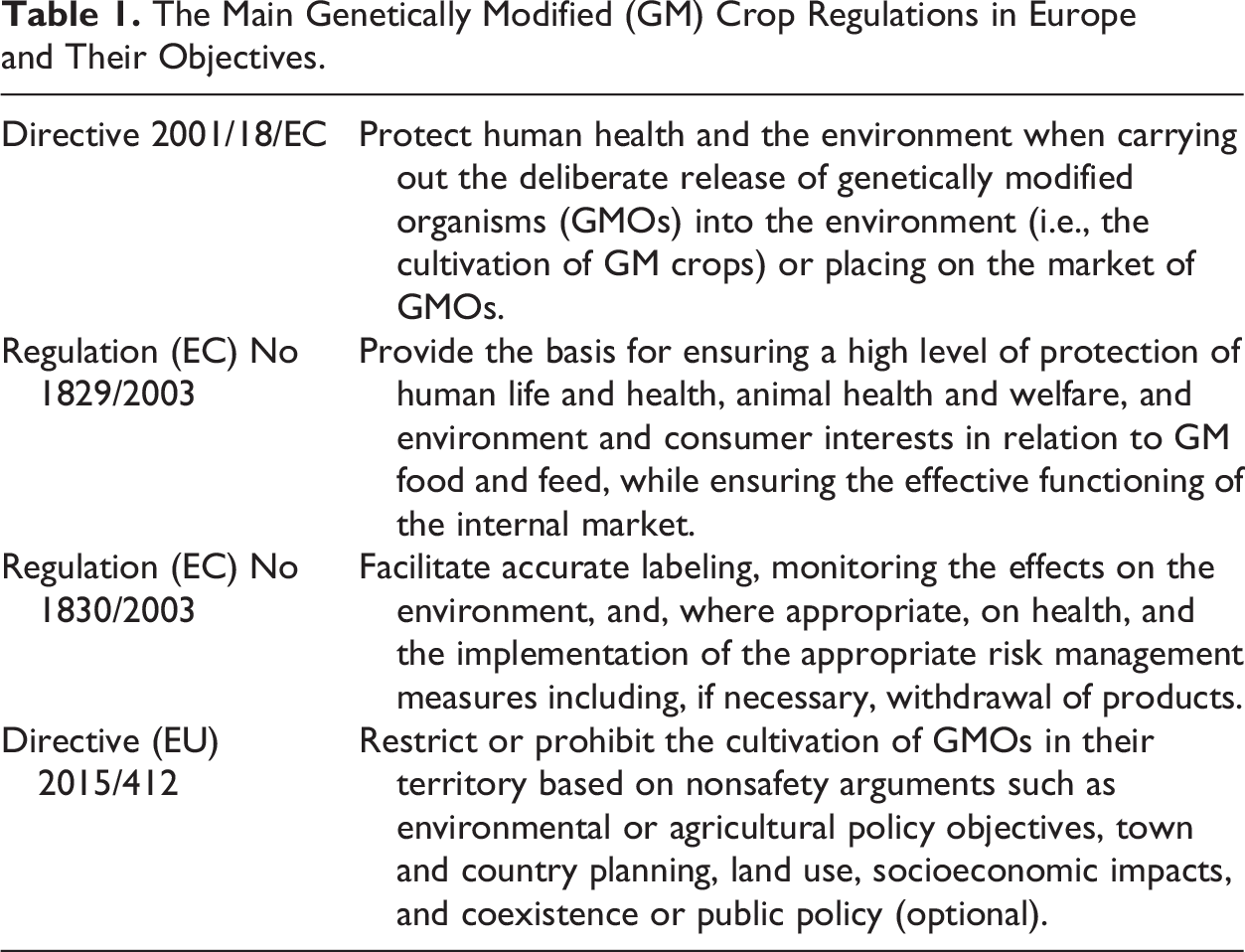
Regulations assign responsibilities and define rules on who needs to decide about what based on which criteria. EU regulations are designed and implemented through a co-decision procedure of the EC, The Council (representing the MS), and the European Parliament (representing EU citizens). Their decisions are supposed to reflect views about “the common good” and “the good society” and determine both liberties and rights of the general public and stakeholders. However, the view of the “good society” reflected in the regulations cannot (fully) overlap with all different individual views on “a good life.” The GMO regulations have been criticized on scientific (Amman 2014), risk (Edvardsson Björnberg, Zetterberg, and Ove Hansson 2018), and legal grounds (Christiansen, Marchman Andersen, and Kappel 2019), but they may still be justified from a societal perspective. Justified, because the regulations reflect the plurality of views on “the common good” or visions on “the good society,” while acknowledging moral disagreements. At the same time, conflicting views on a good society or on common good are not resolved through regulatory strategies alone.
The EU’s attempts to address conflicting views on GMOs have resulted in an extensive regulatory framework that combines science-based and precautionary elements—with both aspects endorsed as much as they have been criticized (Tagliabue and Amman 2018; Podevin, Devos, and Davies 2012; Myhr 2010; Steele 2006). The inclusion of different perspectives in the regulations inevitably leaves room for different interpretations and facilitates the use of arguments from the principle of precaution as ammunition against the principle of being evidence- or science-based and the other way around (Weimer 2010). 8
In conclusion, there is a tension between those who see science as the only legitimate source of knowledge for a regulatory framework, and those who promote the inclusion of other perspectives (such as contextual, political, cultural, and socioeconomic factors). The current regulatory framework seeks to satisfy both needs at the same time, leading to a situation that dissatisfies both sides. As a result, decision-making is deadlocked. The reflection in this section illustrates regulations may determine the rules and requirements but these do not determine the outcome of a decision.
Political Responsibilities, Motivations, and Decision-making at EU Level
While scientific, participatory and regulatory factors are essential and contribute to the overall decision-making process, they will not compel action. They do not automatically point toward a singular course of action that is needed to reach a yes/no decision on GMOs or gene editing. And this is where acknowledgment of the political nature of the debate and decision-making becomes necessary. The application of GMOs is not limited to safety assessments, public engagement, and regulatory implementation: it has become the center stage of a debate between pro- and anti-GMO lobbyists with different stakes and perspectives on topics such as risk and safety, food production, and sustainability. Yet political behavior and actions such as deliberation, argumentation, bargaining, and compromising have shown to be limited in the case of GM crop authorizations—or even strategically avoided by politicians. Does this mean that GMOs are a wicked problem and are therefore impossible to solve? I argue that is not necessarily the case, as evidenced by the authorization of a similarly contested technology that followed a different path in Europe: Glyphosate containing herbicides.
Glyphosate Authorization: Similar Case, Different Outcome
The GM crop conflict is not “wicked by nature” but “wicked by design” (Nie 2003; Mampuys 2021). If the GM crop conflict were wicked by nature (i.e., controversial because of its intrinsic scientific and societal implications), other controversial technologies that go through similar procedures in Europe will likely run into the same indecision. The glyphosate case is instructive in this context. Glyphosate is also controversial, with opposing views on human and environmental risks and its societal benefits, yet it did lead to a decision, because the EC actively engaged in political behavior until a (temporary) decision was made.
The glyphosate case has been extensively discussed by Tosun, Lelieveldt, and Wing (2018); Bazzan and Migliorati (2020); and Arcuri and Hendlin (2020). Glyphosate is the active ingredient of several broad-spectrum herbicides used worldwide for agricultural and nonagricultural purposes (such as weed control and gardening) since the mid-1970s. The first European authorization of glyphosate in 2002 was unproblematic and valid for ten years. By contrast, the renewal authorization process turned out to be challenging. Similar to GM crops, science played an essential role in the debate about glyphosate. At the time of renewal, scientific studies indicated risks to human health (possible carcinogenicity) and to the environment (contamination; IARC 2015). This resulted in a discussion in the scientific field and beyond similar to the dynamics around alarming studies about GM crops. Starting out as a scientific debate with a focus on uncertainty and precaution, it shifted toward a broader debate about human health, food production, and sustainable agriculture and finally resulting in accusations of conflict of interests on those involved in the risk assessment (Myers, Antoniou, and Blumberg 2016; Unterweger 2017).
After considering the scientific reviews, and despite scientific and societal controversy, the EC proposed a renewal for fifteen years. Decision-making initially resulted in a deadlock after several “no opinion” outcomes under comitology voting. Finally, the EC changed its strategy from a technocratic position to a responsive one (Bazzan and Migliorati 2020, 70), resulting in an explicit political process where the EC argued and bargained with member states to find circumstances that would result in a qualified majority vote. By way of comparison, the EC postpones decision-making on GM crop authorizations for years when the voting procedure is undecisive. Eventually, a fourth revision of the EC proposal on glyphosate with a shortened authorization period of five years was adopted by a qualified majority.
The glyphosate case is a similarly controversial case as GM, where decision-making is under threat of becoming deadlocked. The decision on glyphosate was initially strategically blocked through the comitology procedures, and the weight of the discussion shifted back to science and scientific experts. However, for glyphosate, the remaining uncertainties and concerns seemed to be no reason to avoid decision-making, while for GM crop authorizations, it is. This strengthens the view that decisions on what or who should be protected are political decisions and that, therefore, neither science nor regulation is sufficient to decide the exact course of decision-making.
There is at least one important difference between the two cases: authorizing glyphosate is a higher political (and economic) priority than GM crops. Glyphosate is widely used in Europe and critical for agri-food production in Europe as a whole. This means that economic and agricultural stakes have to be weighed against environmental and health costs. In addition, interest groups from both sides are strongly involved in lobbying activities, which suggests there is also something to win from a political perspective. Increased visibility of the issue was also pointed out by Bazzan and Migliorati (2020) as lending urgency to the need to resolve this issue, because failure to decide could result in reputation damage for the EC as well.
The glyphosate case illustrates that urgency and potential political wins (as well as broader factors and power relations) can energize discussions about controversial technologies—even in situations that seem wicked at first. More importantly, it illustrates that neither scientific certainty about the risks of a certain technology nor a societal consensus about its adoption are prerequisites for political decision-making. It may also illustrate that the political debate remains limited to safety arguments versus commercial interests and trade or geopolitical tensions and conflicts, while still ignoring the broader political debate about what kind of agricultural and food system is desirable with a view to sustainability and future generations. This is a classic example of a debate that should reflect perspectives from the broader public debate. With the five-year approval for glyphosate already coming to an end, the same debate is already flaring up again (GMWatch 2021).
Another even more striking example emerged more recently: in June 2020, the EC presented a draft proposal to dismiss the environmental risk assessment for clinical research with GMOs intended to treat or prevent COVID-19 infection (such as GM vaccines), arguing that human health or even individual patients’ health overrides other considerations such as the environment (European Commission 2020). Despite concerns from European country’s scientific advisory bodies (COGEM 2020, personal communication), the proposal was adopted by the Council and the EP within a matter of weeks and entered into force on July 17 (Regulation [EU] No 2020/1043). These examples illustrate that technocratic or participatory decision-making is not determinative per se at a political level. What is also needed to decide in situations of uncertainty and controversy is politics.
The Need for Political Debate and Decision-making on GM Crops
Scientific, participatory, and regulatory strategies are (close to) being exhausted. Attempts to bring proponents and opponents closer together have almost invariably failed to achieve the desired results, so it is becoming clear that fundamental disagreements about GMOs or gene editing are unlikely to be solved. This means political debate and decision-making are needed, despite scientific uncertainty and public controversy. The conflict about GM crops in Europe has been going on since the late 1990s, and throwing more science at it has not improved decision-making. Changing the regulations to make them more science-based and inclusive has also been ineffectual in forming consensus. One could argue that policy makers and politicians should hold off decision-making when there is significant disagreement in society about a subject that calls for public dialogue. Yet reiterative discussions about alarming studies and GM crop authorizations and NPBTs indicate that these strategies for public dialogue have exhausted their potential. At some point, decisions have to be made, either to revise the regulations or to execute them as implemented.
The question then is, what kind of decision can be justified based on the current positions in the debate about GMOs in agriculture? The EU is prolonging the deliberative space on this fundamental disagreement by avoiding decision-making, which raises the question of when refraining from a decision can be justified from the perspective of neutrality and when it becomes unfair toward those who (urgently) need or deserve an explicit political debate and decision.
Several authors have pointed out that making a decision and staying neutral both have consequences. Bovenkerk (2010, 235) argued that “a government could avoid conflict by simply declaring one view to be correct or by remaining neutral between its citizen’s views. In the first case it would not accord its citizens the equal respect they deserve and would fail to be democratic; in the second case it would fail to acknowledge the nonneutral consequences of doing nothing.” Inghelbrecht (2016, 12) described the European situation as one “where moving forward in trying to implement GM crops has been systematically blocked, while at the same time attempts to fully exclude GM crops from EU agriculture have been systematically prevented.” I will take this claim a step further and argue that the EC disregards both GM proponents and opponents while upholding the illusion of a working system.
Firstly, people with fundamental objections to GM crops are disregarded in the current system. Despite the lack of decision-making, GM crop products are available in the consumer market. They are present indirectly through importation of livestock feed containing GM crops and ingredients, and also in food ingredients produced by GM micro-organisms, such as vitamins. In addition, for practical, financial, and trade-related reasons, there are threshold levels for labeling, meaning that some unlabeled products may still contain small amounts of GM ingredients. Inghelbrecht, Dessein, and Van Huylenbroeck (2014, 67) argue that “the current EU non-GM crop regime is in fact a ‘fictitious’ or ‘virtual’ non-GM crop regime that has developed into a wicked problem.” With the rise of gene editing, it will become even more problematic to trace GMOs in the food system (ENGL 2019). By upholding the current traceability and labeling regime, the EC promises something that is not realistic or feasible.
Secondly, the current system also disregards GM proponents. There is a legal framework that aims to facilitate agricultural innovation and a functioning internal market, but in practice decisions are not made, so the feasibility of commercial applications is limited to agricultural staple crops (maize, soybean, rapeseed, and cotton) with a very limited set of GM traits (herbicide tolerance and insect resistance). Effectively, there are no authorizations for GM crop cultivation and GM crops are only authorized for importation after significant delays. This disregards principles such as legal certainty and proportionality toward companies and developers of GM applications.
Repoliticization, Problem Ownership, and Urgency
Politicization can be seen as a means to add political power and to act and decide from a nonneutral point of interest. In academic literature, there are various views on the meaning of depoliticization and repoliticization in different contexts as by Hisschemöller and Hoppe (1995); Bovenkerk (2010); Poort, Holmberg, and Ideland (2013); and others. In my view, repoliticizing the decision-making procedures on GMOs means acknowledging the political nature of the debate and decision-making process and actively engaging in political deliberation with the aim of arriving at a decision that is not necessarily a consensus but an explicit politically debated compromise. In other words, repoliticization means explicit political decision-making in situations of (scientific) uncertainty and controversy, taking into account a broad set of conflicting values and interests. It also means that not everyone can “win” and losing an argument is part of the game. Much more than a consensus, such a political struggle and controversy reflect the very heart of deliberative democracy in practice (Mouffe 1999).
On the level of individual GM applications, a political debate is needed from a democratic perspective. Postponing decisions at this level can neither be justified toward proponents nor opponents. However, political decision-making at this level will be hindered in the absence of a political debate on a broader scale. On the level of GMO regulation in general, a broader political debate is needed about the system of agriculture and food production. Moreover, repoliticization also requires a system and process design that facilitates such debate on both levels. Scoones (2009, 568) describes how “behind-the-scenes negotiations over framings, values, and politics” have been heated and continuous but back-stage. Design elements should be introduced in the procedures and practices of GM assessments on a political level to allow for an explicit and front stage confrontation of politics, perspectives, values, and interests.
Suggestions for such system/framework changes have already been made, for example, by Macnaghten and Habets (2020) who build on the Norwegian regulatory framework for GMOs (see Bratlie 2019). Their proposal concerns a tiered approach for different types of genetic modifications and the addition of a nonsafety assessment on socioeconomic and ethical aspects. Norway has included a nonsafety assessment in their Gene Technology Act since 1993 and developed criteria to implement it. This unique part of GMO regulation is widely cited in literature as a solution to the impasse in GMO regulation in Europe. However, this example lacks practical implementation because data on socioeconomic aspects are generally not submitted with GM applications. Therefore, I emphasize caution on this solution, as the proof of the pudding is in the eating. While I agree that such an additional assessment would be valuable input for political decision-making, it risks becoming scientized/politicized as well which may hijack the discussion for another thirty-years while decision-making is further postponed. An example of the nature of such a discussion can be found in Kjeldaas et al. (2021, 1) who argues that the inclusion of narrow-framed socioeconomic aspects in a nonsafety assessment will not be sufficient (speaking of “the marginalized discussion of the social, cultural, and ethical issues raised by new gene technologies”). Furthermore, even without this complication on framing, socioeconomic impact is difficult to assess ex ante and complex even if data are available. The outcomes are not generally applicable but highly dependent on context (type of crop, geographical location, and type of user; see Mampuys 2018). Most importantly, such an assessment does not dismiss or replace the urgency for political decision-making. Based on the input from safety and nonsafety assessments, European Member State representatives and the EC should evaluate and debate a political decision that best fits their perspective on the role of GM technologies in agriculture. Given the geographical specificity of socioeconomic impacts, such a debate could perhaps benefit from an upstream process starting at the national (or even regional) level.
Besides arguments for repoliticization from a perspective of deliberative democracy, other factors influence the likelihood of explicit politics: problem ownership and urgency. The glyphosate case illustrated that the EC is capable of organizing political discussions about controversial topics, but apparently it only does so for some cases (glyphosate, COVID-19 vaccines) but not others (GM crops, NPBTs). Several authors have pointed out that GM crops have a low political urgency in Europe, which reduces the sense of urgency (for the moment). Referring to the results of European public opinion research, Skogstad (2011, 906) concluded “the majority view in every EU member state is that GM foods are not useful, not morally acceptable, and a risk for society.” The low political priority of GM crops has also been mentioned by Smart, Blum, and Wesseler (2015, 258): “We suggest that further research test the hypothesis that in the EU the political-economic benefit-cost ratio is too low for politicians to vote in favor of approving GE crops.” The rise of gene editing and its successes in both plant and medical biotechnology could potentially increase this sense of urgency in the middle term. As such, political and economic interests might start to carry more weight, but ultimately this also requires a political debate on broader, more fundamental, and normative questions about health, food production, and the agricultural system.
Conclusions
The lack of political judgment and decision-making is an underexposed factor in the conflict about GM crops and GMO regulation in Europe. Underexposed because stakeholders, policy makers, politicians, and academics keep pointing at scientific, regulatory, and societal factors as the cause of the conflict, therefore directing their mitigation strategies at those. Political decision-making is avoided because there are benefits to strategically postponing, delaying, or stalling political debate and decision-making. These strategies cannot be justified from the perspective of democratic accountability toward neither GMO proponents nor opponents among stakeholders and the public.
Therefore, a repoliticization of decision-making about GMOs is needed. Questions about how safe is safe enough, what level of public engagement is sufficient or what kind of agriculture and food production should we have do not have right answers, and therefore they ultimately belong in the political realm. In my view, the repetitive character of the discussion about GMOs provides an important indication that the transformation potential of opinions has been reached and fundamentally different viewpoints will remain. Repoliticization of the debate and decision-making process is needed, meaning explicit decision-making in situations of scientific uncertainty and controversy.
However, process and system design as well as problem ownership and political urgency are essential requirements that determine the circumstances under which repoliticization of decision-making can be facilitated. Repoliticization is only likely to take place if there is a shared motivation or urgency to resolve the deadlock and if a suitable “arena” is created in the decision-making process for political debate to take place. Unless an issue owner with sufficient political power steps up or the urgency of a decision increases so that the issue moves from lower- to higher-level politics, repoliticization of the decision-making on GMOs seems unlikely compared to the relative comfort of the status quo of nondecision-making of the last two decades.
The rise of gene editing and its successes in both plant and medical biotechnology could potentially change this sense of urgency, as illustrated by the swift regulatory changes that enabled GM COVID-19 clinical studies. From a political perspective, gene editing could be an argument for leaving the “old” GM debate behind and starting a new chapter by exploiting the existing mechanism in the EU GMO legislation, introducing a limited change or proceeding with a more thorough revision of the legislation (ALLEA 2020). This too, however, requires careful consideration of lessons from the past as discussed in this paper. Given the long history of deadlocked decision-making on GMOs, any decision would be an improvement—as long as it takes into account scientific, societal, and legal factors and makes explicit the role of politics in decision-making instead of hiding behind either one of them.
Footnotes
Acknowledgments
I would like to thank the organizers of the Iowa State University conference “Gene Editing in Agriculture and Food: Social Concerns, Public Engagement, and Governance” for the opportunity to present and discuss my research. In addition, this paper has benefited significantly from the critical questions, comments, and feedback from the anonymous reviewers and the editorial team of Science, Technology, & Human Values.
Declaration of Conflicting Interests
The author(s) declared no potential conflicts of interest with respect to the research, authorship, and/or publication of this article.
Funding
The author(s) received no financial support for the research, authorship, and/or publication of this article.
