



Abstract
We propose a new approach for tracing value change. Value change may lead to a mismatch between current value priorities in society and the values for which technologies were designed in the past, such as energy technologies based on fossil fuels, which were developed when sustainability was not considered a very important value. Better anticipating value change is essential to avoid a lack of social acceptance and moral acceptability of technologies. While value change can be studied historically and qualitatively, we propose a more quantitative approach that uses large text corpora. It uses probabilistic topic models, which allow us to trace (new) values that are (still) latent. We demonstrate the approach for five types of value change in technology. Our approach is useful for testing hypotheses about value change, such as verifying whether value change has occurred and identifying patterns of value change. The approach can be used to trace value change for various technologies and text corpora, including scientific articles, newspaper articles, and policy documents.
Introduction
Values may be understood as enduring or long-lasting beliefs about what is good or desirable (Rokeach 1973; Schwartz and Bilsky 1987). While values are enduring and long-lasting, they may nevertheless change over time. An example is sustainability, a value that has emerged since the 1980s (cf. World Commission on Environment and Development [WCED] 1987). Value change can lead to a mismatch between the current value priorities in society and the values for which existing technologies were designed in the past. A lack of consideration of values could lead to issues of social acceptance and moral acceptability (Taebi 2016).
The energy transition is a case in point. Although it is a technical and economic process, it also requires value changes. Addressing value change in the energy transition is particularly important because energy systems have large technological and institutional momentum while they are often socially contested. This momentum implies that these systems are often difficult to change. Technical infrastructures have long life spans. This makes it more difficult and costly to deal with value change, and it means that new values will likely emerge in public debates about energy technologies. Due to the socially contested character of many energy technologies, it is crucial to address values for the social acceptance and the moral acceptability of these systems.
Better anticipating (potential) future value change during the design phase can help to ensure that technologies remain socially accepted and morally acceptable over time. However, approaches to enable such anticipations are lacking. We propose a new approach to tracing value change using large text corpora. We illustrate this approach by applying it to various energy technologies.
A major difficulty for tracing value change in text corpora is that values are often addressed in a latent manner (de Wildt et al. 2018). Moreover, the number of documents that need to be analyzed is typically large. A computer-assisted approach can address both issues. We use probabilistic topic models (Blei 2012), which originate from the field of text-mining. These models consider the (textual) context in which words are used to evaluate their meaning.
This paper is structured as follows. The second section introduces the concept of value change and explains in more detail how probabilistic topic models can be used to trace value change in text corpora. The third section shows how such a model to capture values and value change is developed. The fourth section demonstrates how the approach can be used to explore five types of value change. We concentrate on energy technologies and evaluate how the approach helps to answer various hypotheses about value change. Such a demonstration is helpful to identify contributions and limitations of our approach. The fifth section presents our conclusions and the contributions made in this paper. We also discuss the limitations of our approach and provide suggestions for future work.
Theory
Value Change
Values are often understood as enduring or long-lasting beliefs about what is good or desirable (Rokeach 1973; Schwartz and Bilsky 1987). Kluckhohn (1951) defines a value as “a conception, explicit or implicit, distinctive of an individual or characteristic of a group, of the desirable.” According to Schwartz and Bilsky (1987), “[v]alues are (a) concepts or beliefs, (b) about desirable end states or behaviors, (c) that transcend specific situations, (d) guide selection or evaluation of behavior and events, and (e) are ordered by relative importance.” Demski et al. (2015) define values as “prevalent identifiable cultural resources or collectively imagined forms of the social good through which people anchor their understandings and formulate their preferences.”
Although the term value is sometimes used to refer to any kind of “selective orientation” (Williams 1968), it is different from related concepts such as attitudes, preferences, norms, and goals. For example, values are more stable and enduring and more general and abstract than attitudes (Rokeach 1973; Williams 1968). They are also not just expressions of preference but more general beliefs about what is good, which may motivate the formulation of certain preferences. Norms are more specific than values and contain prescriptions for action often based on sanctions (Hitlin and Piliavin 2004). Although values may be translated into norms or motivate their formulation, they are not norms themselves (van de Poel 2013). Similarly, goals and aims are more specific and concrete than values. Values help to evaluate state-of-affairs and may suggest certain goals or aims to strive for, but they are not themselves goals.
Because values are general and abstract and have an enduring or at least a long-lasting character, they typically do not change overnight. Nevertheless, when value change occurs, it may have major consequences. It may lead to societal revolt, new policies, institutional, economic and legal reform, or the development and design of new types of technologies. In this article, our focus is on value change in relation to technology, but it is good to keep in mind that value change is a much broader societal phenomenon and that value changes in one part of the society may trigger or affect value change in other parts.
Value change in technology is particularly important when developing and designing technologies that reflect societal and moral values, as advocated in approaches such as responsible research and innovation (Owen, Macnaghten, and Stilgoe 2012) and value-sensitive design (Friedman and Kahn 2003; van den Hoven, Vermaas, and van de Poel 2015). If values are not explicitly addressed during the design of new technologies, values and societal visions will affect their design (e.g., Jasanoff and Kim 2013). Values are important for the design of new technologies, for their governance, for policy making in areas such as energy, and for academic research in these fields. Values are also essential for the social acceptance and moral acceptability of new technologies (Taebi 2016), and value change may make technologies that are currently judged to be acceptable to be unacceptable in the future.
Value change in technology poses several challenges for researchers, designers, and policy makers. This is particularly the case for infrastructure technologies, such as energy systems, that, once designed and built, will often be operational for decades (cf. Hughes 1983). Due to possible value changes, existing technological and institutional infrastructures might no longer reflect the value priorities in society. Adapting these infrastructures may be time-consuming and very expensive. We are currently facing a situation of value change in the energy transition towards more sustainable energy resources (Demski et al. 2015; Miller, Iles, and Jones 2013; Verbong and Geels 2007).
We need to better trace, anticipate, and understand value change in technology. We contribute to research by presenting a new approach for tracing value change (in technology). Although the approach we present is aimed at tracing value change, we believe it may also contribute to a better understanding and anticipation of value change. It should also be mentioned that our method is particularly appropriate for tracing changes in societal rather than moral values. Societal values are here understood as the values held by the members of a society or a particular group in that society. Conversely, moral values refer to values that are valid or important for normative, moral reasons. Moral values may motivate societal values, but societal values do not always reflect moral values. Change in societal values may therefore be an indication of possible change in moral values, but it does not one-to-one correspond with it.
We build here on a taxonomy of value change proposed in van de Poel (2018). In this taxonomy, five types of technology-related value change are distinguished as follow: The emergence of new values, changes in the values that are relevant for the design of a technology, changes in the priority or relative importance of values, changes in how values are conceptualized, and changes in how values are specified and translated into norms and design requirements.
The emergence of new values: New values may emerge in society. This is relatively rare, as many of our current values, such as beauty, truth, human well-being, and safety, have a long history. However, we can be confronted with new types of morally problematic situations, compelling us to address new values (cf. Dewey 1922). Sustainability is a value that emerged in the 1980s. Although references to concerns that are now addressed under the umbrella of sustainability can be traced back to antiquity (Du Pisani 2006), the notion as such is relatively recent (at least in the English language) and seems to have arisen in response to the need to balance economic development with environmental concerns and limitations (WCED 1987).
Changes in the values that are relevant for the design of a technology: Values that have already emerged in society are also considered relevant for the design of a technology. For example, when the first steamboats were designed in the early twentieth century, people were not very aware of the safety risks of boilers. This quickly changed after several boiler explosions. Safety became a prime design concern, and legislation, technical codes, and standards were introduced to enforce such safety concerns (Burke 1966; Ling 2000).
Changes in the priority or relative importance of values: Values that are acknowledged as relevant for the design of a technology can change in the relative importance vis-à-vis other values. For example, initially, car design mainly focused on occupant safety, but over time, pedestrian safety, that is, the safety of bystanders who might get hit by a car, has become increasingly important (Imms and Wood 2009).
Changes in how values are conceptualized: Over time, the conceptualization of values may change. For example, a value such as privacy may be understood as other people not interfering with our affairs, as people having no specific knowledge about us (i.e., in informational terms) or in terms of our ability to control who has what information about us (i.e., in terms of control and informed consent). With the advance of information and communication technologies, personal data privacy and protection have become increasingly important.
Changes in how values are specified and translated into norms and design requirements: Here, specification means translating a value into more specific design requirements (van de Poel 2013). For example, in refrigerator design, safety used to be specified as the absence of a flammable coolant. This led to a preference for CFCs as a coolant because they are inflammable and have excellent thermodynamic properties. However, after the hole in the ozone layer was discovered and the subsequent ban of CFCs was enforced, there was a renewed interest in flammable coolants. This eventually led to a respecification of safety as a low explosion risk rather than the absence of flammable coolants. This respecification was not only triggered by environmental concerns but also by that fact that currently refrigerators use far less coolant than refrigerators in the 1930s (Kroes and Van de Poel 2015).
Tracing Values in Text Corpora
Value change can be traced by analyzing large text corpora. For example, an analysis of governmental publications can show which values have successively been prioritized in policy making. An analysis of the scientific and engineering literature can show which values are associated with a specific technology over time, and hence may reveal what values have been prioritized in scientific research and in the engineering design of a certain technology over time.
Approaches to adequately explore value change in large text corpora are lacking. One difficulty when analyzing value change in bodies of texts is that values are often addressed in a latent manner (de Wildt et al. 2018). A topic is latent when there is no strict set of words that is used to refer to this topic. Rather, the set of words potentially referring to it is large. The same words may also refer to other topics depending on the context. Values are typical examples of latent topics. For example, texts addressing the value privacy may not explicitly mention the word “privacy” but they may contain words such as “private,” “theft,” or “cyber.” Texts may also refer to solutions to privacy issues, for example, by mentioning the word “encryption” or “firewall.” However, encountering these words in a document does not necessarily mean it is about privacy. For example, an author might use the word “private” to refer to individual ownership.
The fact that values are latent has implications for the extent to which value change can be traced using key words. With the example of the value privacy, using the key word “privacy” would lead to omitting a large number of documents that refer to privacy using other words (see Figure 1). Academic fields working on cryptography may not necessarily mention the word “privacy” in scientific articles although they are providing solutions for it. When analyzing value change, this might lead to an underrepresentation of the value privacy, so-called false negatives. Adding key words such as “private,” “cyber,” and “cryptography” could help to capture this literature. However, doing so might lead to an overrepresentation of the value privacy, so-called false positives. “Private” may is some case relate to ownership rather than to privacy. Cryptography may sometimes be used for security reasons instead of privacy. Probabilistic topic models might help to overcome this problem.
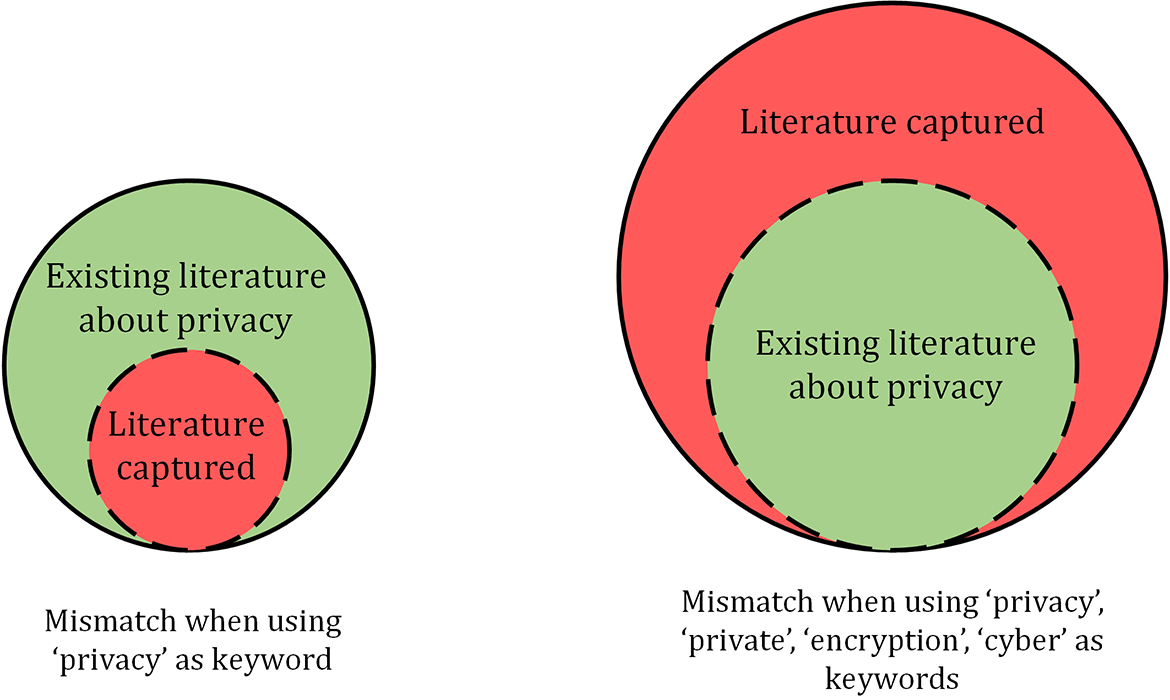
Mismatch between the existing literature about a value and the literature captured when using key words.
Coping with latent topics is described in the literature on text-mining as coping with word synonymy (multiple words having the same meaning) and polysemy (words having multiple meanings; Deerwester et al. 1990). If the goal of the analysis is getting a quick grasp of how values have changed over time, the use of key words might be sufficient. Indeed, tools already exist to perform such a key word–based analysis, such as the Google Books Ngram Viewer (Michel et al. 2011). If the goal of the analysis is a more accurate analysis of value change, the challenge caused by word synonymy and polysemy introduces a bias in the analysis of which the size is not easily verifiable.
Probabilistic Topic Models
Probabilistic topic models (Blei 2012) originate from the field of text-mining. They are used to autonomously discover which topics are addressed in a text corpus. In a probabilistic topic model, topics are defined as distributions over a fixed vocabulary. For example, a topic about wind energy could be a distribution with high probabilities on words such as “wind,” “turbine,” and “farm.” The algorithm used in probabilistic topic modeling finds topics by passing through words in each document. If some words often appear together in one document, there are higher chances that they refer to the same topic. The outcome of a topic model is a set of distributions of words. The labeling of each distribution of words (i.e., deducing to which “real-world” topic each distribution refers) is done by the modeler.
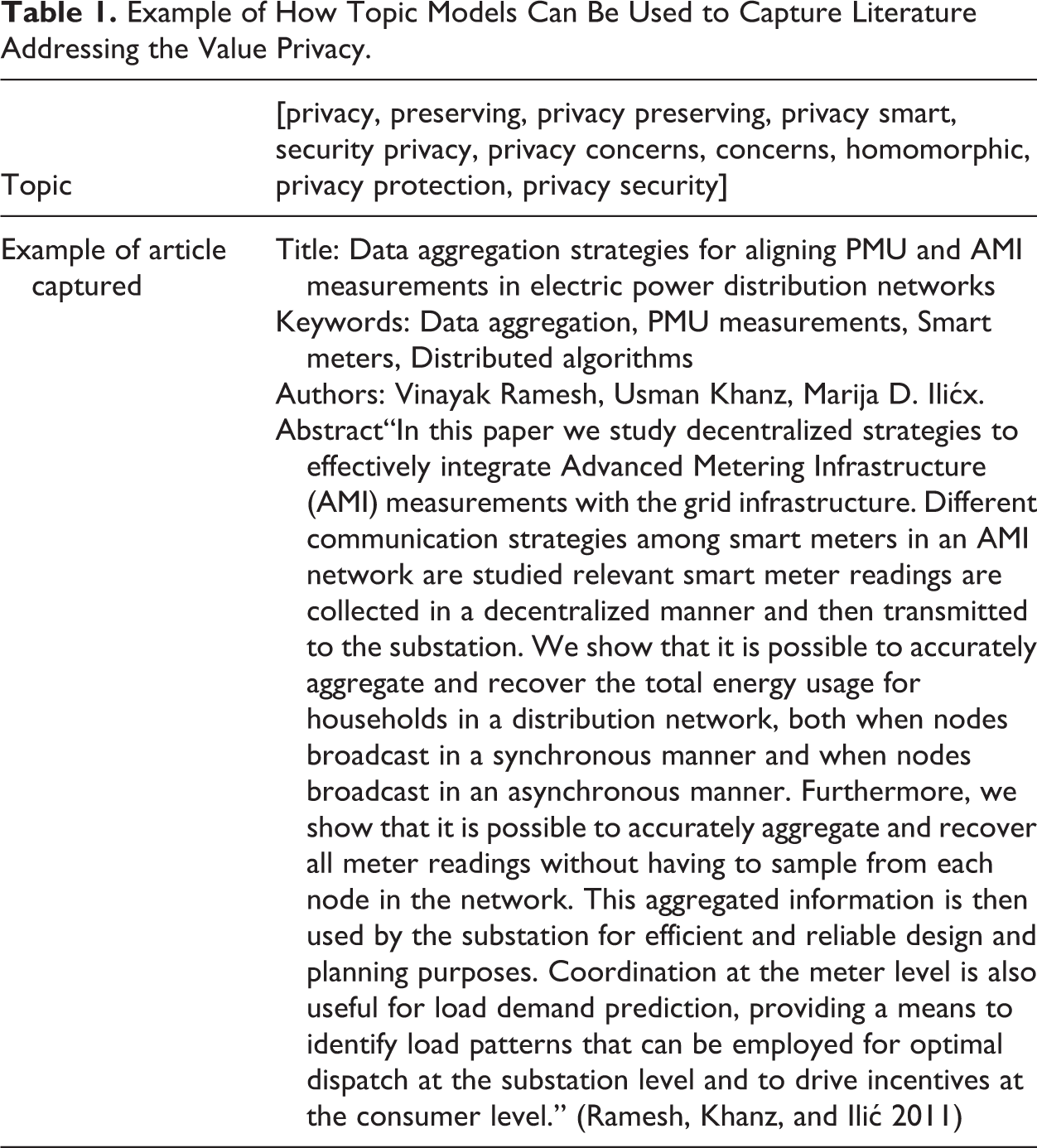
Probabilistic topic models are particularly useful for identifying latent values in texts. They allow us to identify values even if they are not explicitly named. An example is provided in Table 1. A topic model has been created to analyze scientific articles on the smart meter addressing the value privacy. The first row in the table shows the topic that we created for the value privacy. The ten most probable words for this topic are shown. The second row shows one article that was captured by the topic model and was associated with the value privacy. It is noticeable that the word “privacy” is not mentioned in either the title, the key words or the abstract, which are used to flag values addressed in the literature. This article is nevertheless about privacy, as data aggregation is a recognized approach to address privacy issues (Erkin et al. 2013). This example shows that probabilistic topic models are able to capture latent values.
Example of How Topic Models Can Be Used to Capture Literature Addressing the Value Privacy.
Probabilistic topic models may be unsupervised or supervised (Blei and McAuliffe 2007). In the first case, the creation of topics by the model is fully automated. Topics created are typically the most prominent ones in the set of literature investigated. In the second case, the creation of topics is supervised. The topic model is trained by the modeler by progressively feeding words into the algorithm to ensure that the identified topics match better than the set of topics of interest. For example, if wind energy is a topic of interest, input words such as “wind,” “turbine,” and “farm” could be fed into the algorithm to ensure that one topic in the final model is about wind energy. Supervised topics models are useful when the topics of interest are not necessarily the most prominent ones in the set of literature investigated.
Multiple applications of topic models can be found in the literature, analyzing a wide range of documents such as scientific articles and newspaper articles (Griffiths and Steyvers 2004; Blei and Lafferty 2009). de Wildt et al. (2018) uses unsupervised probabilistic topic models to capture latent values. However, some values of interest are not reflected in the topics obtained in this approach. They suggest using additional key words that relate to semantics fields of values to further capture the literature of interest. The limitation of this approach is that it does not avoid the use of key words and therefore only partially overcomes the problems of word synonymy and polysemy. Here, we use supervised topic models to overcome this limitation.
How to Create Topics Representing Values
In this section, we explain how to build a probabilistic topic model in which some of the topics represent values. We give an example for values in scientific articles on nuclear energy. We use a data set of 21,731 scientific articles selected from Scopus in March 2020 using the query KEY(“Nuclear energy”). Building the model comprised three steps: selecting the data set, evaluating the number of topics to be identified, and creating topics that represent values. We use the topic modeling package CorEx (Gallagher et al. 2017) written in the Python programming language to build supervised topic models. Topics are identified by passing through the title, key words, and the abstract of each article. The notebook used to build the topic models presented in this paper can be found online. 1 This notebook is generally available and describes how to build topic models step by step. A summary of these steps can be found in Appendix A, accessible as Online supplementary file.
Selecting the Data Set
The first step is selecting the data set. Three considerations are relevant. The first is the choice of the text corpus, which largely depends on the research question we want to answer. If we want to analyze value changes in energy policy, we need to select another text corpus (e.g., policy documents), and may find different values, than if want to analyze value change in the design of a technology or in public discussions. The second consideration is the number of documents in the data set. As the algorithm forms topics by observing which words frequently occur in the same documents, a large number of documents increases the quality of topics, and consequently the reliability of the analysis. The third consideration is a sufficient representation of the literature addressing the value in the overall data set. The use of supervised topic models can help to find (smaller) topics. However, there is a limit to the ability of supervised topic models to find very small topics, for example, if a topic is only addressed in just a few documents.
Choosing the Number of Topics to Search
The second step is to choose the number of topics that the supervised model needs to search for. This choice depends on the research goal and the level of abstraction of the topics. A large number of topics will tend to split a topic about a technology into particular components or applications of that technology. For example, a large number of topics on a data set on renewable energy technology may split “solar energy” into in multiple topics, including “solar heating,” “photovoltaics,” “concentrated solar power,” and “semiconducting materials,” and could also split a topic about a value (e.g., safety) into multiple conceptualizations of this value.
The CorEx package provides a measure of the quality of a topic model, named “total correlation.” This measure refers to the extent to which the ensemble of topics found matches the actual number of topics addressed by authors in the data set (Gallagher et al. 2017). A higher “total correlation” points to a higher quality topic. Figure 2 shows the “total correlation” for different number of topics for the data set on nuclear energy. The topic model with 275 topics could be selected for further analysis.
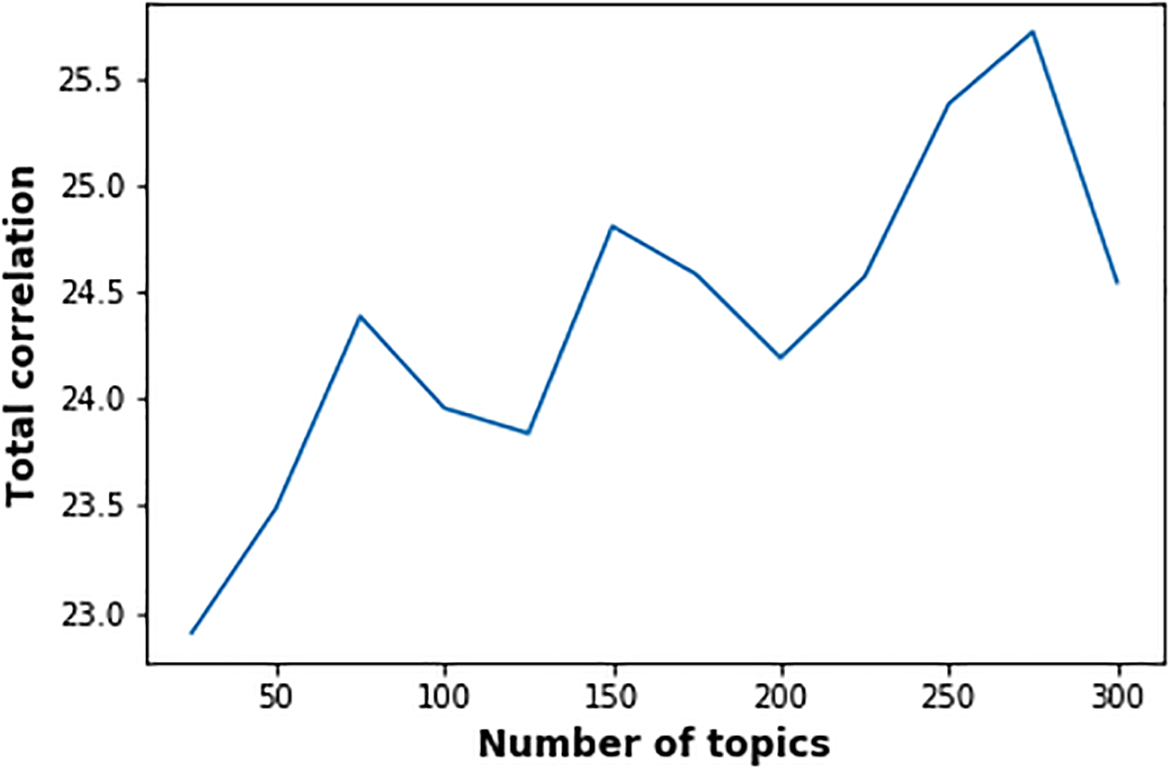
“Total correlation” obtained with different number of topics for a data set of articles on nuclear energy.
Creating Topics That Represent Values
The third step is to build the supervised topic model and create topics that represent values. Anchor words are used as input to the model to supervise the creation of topics and ensure that they represent the values adequately. For example, words such as “sustainability” and “renewable energy” could be used to create a topic representing the value sustainability.
The process of building topics representing values by means of anchor words is iterative and there is trade-off between ensuring that the topic only represents the value of interest, while making sure that it does not focus on solely one specification of this value (e.g., a specific technology). Technologies tend to “attract” topics since they are often semantically more well-defined than values. We illustrate this trade-off for the value sustainability. This example can best be followed with Table 2, accessible as supplementary file online.
To create a topic on sustainability, using only “sustainability” as an anchor word may not be sufficient. This can be seen in Table 2. The topic contains predominant words such as “economics,” “proliferation,” which are not necessarily related to sustainability. Additional anchor words are therefore required.
Using “renewable energy” as an anchor word may seem to be a good choice to further supervise the creation of a topic representing the value sustainability. We expect it is used in a large number of articles and might therefore have a strong impact on the guidance of the topic. Table 2 shows that the newly created topic seems to reflect the value sustainability better than the initial one.
The problem with using “renewable energy” is that it relates to one specification of sustainability, that is, achieving sustainability by means of green electricity production. The risk is that using it as an anchor word might exclude other specifications of sustainability, for example, the responsible usage of resources. This bias can be verified by searching for documents that contain words that strictly refer to sustainability (e.g., sustainability, sustainable, renewable) but have not been assigned to the topic. We found 293 of such articles. An example can be found in Table 3 as online supplementary file. Here, the word “sustainability” refers to resource management.
Two strategies can be used to integrate other specifications of a value. The first and preferable strategy is to only use synonyms of the value. For sustainability, we used the words “sustainability,” “sustainable,” “renewable,” “durability,” and “durable” (see Table 2). The topic created indeed represents sustainability. An analysis of documents that were not assigned to this topic shows that none mentioned the words “sustainability,” “sustainable,” or “renewable.” The second strategy can be used when synonyms of the value are not used frequently in the data set and do not sufficiently help to supervise the topic. In this case, we use anchor words that relate to each of the different specifications of the value. However, this strategy requires the analyst to have sufficient domain-specific knowledge about the possible specifications of the relevant values.
Exploring Value Change in Technology
In this section, we demonstrate how the approach presented in the third section can be used to explore the five types of value change introduced in Value Change subsection. This demonstration concentrates of value change in energy technologies. We first identify an existing (or assumed) case of value change, for example, the emergence of sustainability in the 1980s. Next, we formulate a hypothesis, for example, “Sustainability emerged as a new value in the 80s in energy policy.” Finally, we choose a data set to test our hypothesis by topic modeling. Table 4, accessible as online supplementary file, presents the five types of value change, our cases, hypotheses and data sets.
Subsections “The Emergence of New Values” through “Changes in How Values Are Specified and Translated into Norms and Design Requirements” describes the analyses performed for the five types of value change. We discuss the results of our topic modeling approach and examine its limitations with regard to accepting or rejecting our hypotheses.
The Emergence of New Values
Hypothesis
We hypothesize that sustainability emerged as a new value in energy policy in the 1980s. The advantage of using topic modeling to test this hypothesis is that values are not represented as key words but as distributions of words. As a result, we can determine whether sustainability is addressed even if the word “sustainability” is not (yet) mentioned.
We use a data set of articles captured from Scopus using the search query TITLE-ABS-KEY (“energy policy”) and explore how many articles in the data set have addressed the value sustainability over time. Anchor words and the topic created for sustainability are presented in Appendix B, Table B1, accessible as online supplementary file.
Results
Figure 3 shows the percentage of articles in the data set that address the value sustainability over time. The curves have been smoothened using a Gaussian filter to improve readability. The bars show the number of articles in the data set per year. This number is important since it indicates the reliability of the measurements of the percentage of articles addressing a value at different points in time.
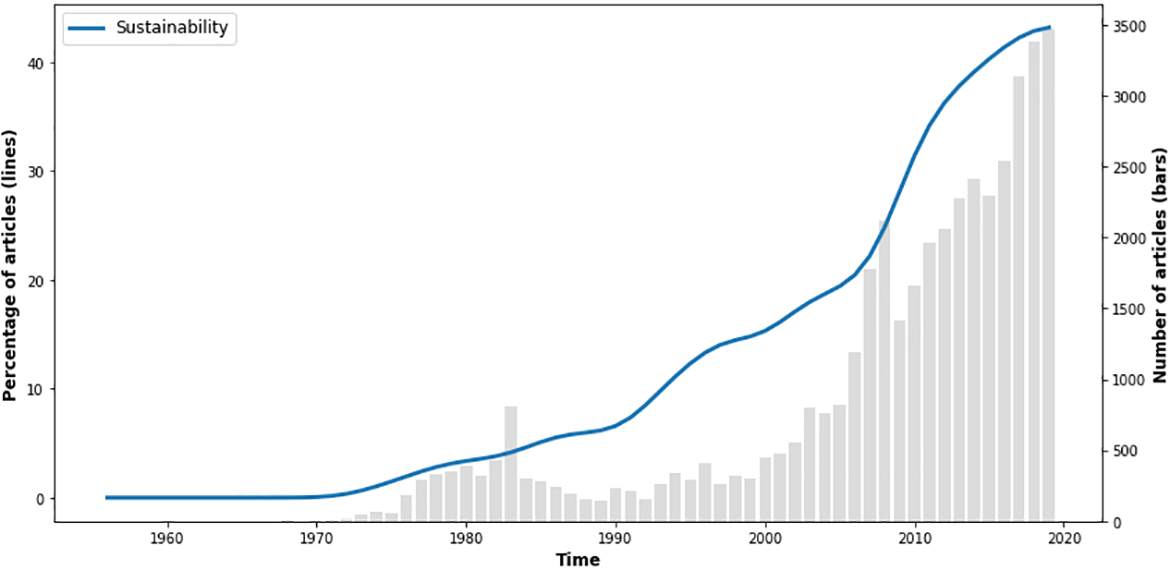
Percentage of articles addressing the value sustainability between 1960 and 2020.
Figure 3 confirms that sustainability is indeed a recent value in energy policy. The value has continuously gained importance and is now addressed in more than 40 percent of the energy policy literature. However, the value seems to have emerged in the 1970s. Our results also show that the value sustainability emerged before the word “sustainability.” Figure 4 shows the words authors used over time to discuss sustainability. Although sustainability was already (latently) discussed by authors in the 1970s, the word “sustainability” was not used until the late1980s.
This analysis suggests that sustainability emerged as a new value even before it was mentioned in the WCED report (WCED 1987). There also seems to be a differentiation between the emergence of a value (as a concept) and the moment it is named by a new term or word like, in this case, the word “sustainability.” It is well possible that the new value concept of sustainability initially was captured by value terms like “renewable” (see Figure 4). However, it should be stressed that the topic we created for sustainability tries to capture the value concept, rather than specific value terms or words, and Figures 3 and 4 suggest that sustainability as a value concept started to emerge even before the term “sustainability” become in common use for referring to this value.
Another important consideration in interpreting our results is that we have used academic literature as an input for the analysis. One might claim that the extent to which sustainability is discussed in this literature indicates the way and the extent to which it is addressed in policy science, rather than an indication of whether this value was already used in energy policy or existed in society. Future research could conduct a similar analysis using policy documents or newspaper articles.
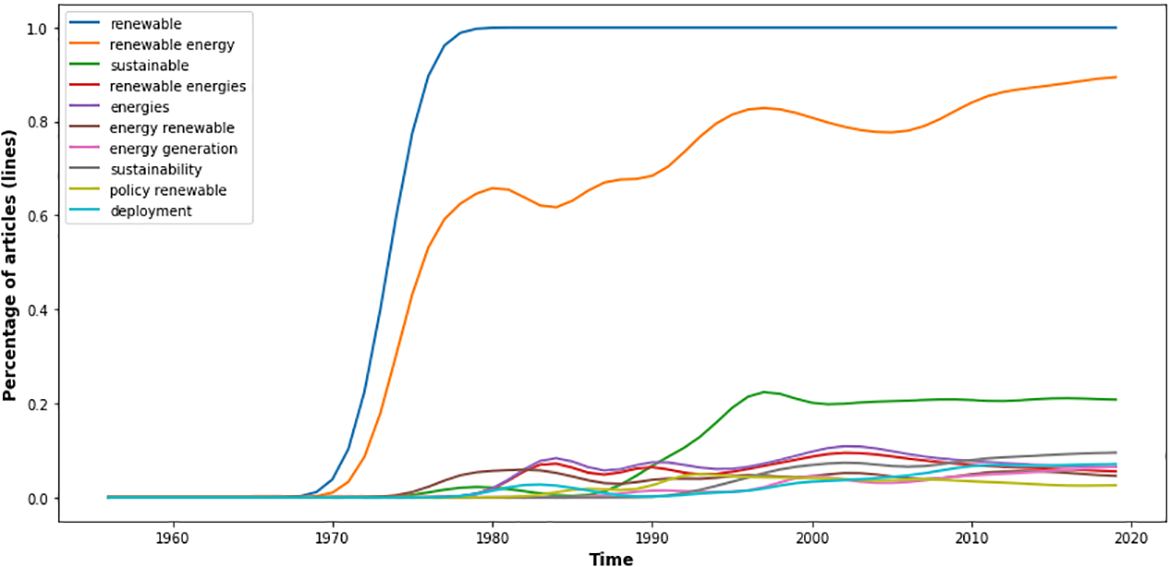
Percentage of articles mentioning words attributed to the value sustainability between 1960 and 2020.
Changes in What Values Are Considered Relevant for the Design of a Technology
Hypothesis
We hypothesize that functional and economic values (e.g., efficiency and economic viability) are initially more important in the development of new energy technologies. After some time, moral and societal values (e.g., safety, justice, and security) become (more) relevant, for example, because such technologies are increasingly employed in society, and moral problems may increasingly arise or become clear.
We use a data set of articles captured from Scopus using the search query TITLE-ABS-KEY (“energy policy”). This search query allows us to capture literature on various energy technologies simultaneously. We study the value change of five values: efficiency, safety, security, economic viability, and justice. The anchor words and topics created for each value are presented in Appendix B, Table B2, accessible as Online supplementary file. We also select topics in the topic model that refer to energy systems. We discuss outcomes for four energy systems: coal power, wind power, smart grids, and electric vehicles. Outcomes for other systems can be found in Appendix C, accessible as online supplementary file.
Results
Figure 5 seems to confirm our hypothesis. Efficiency and economic viability are almost always discussed first in the literature. Safety and security become more relevant at a later point in time, although there were already relevant earlier in the case of coal power. 2 This could be explained by the fact that this technology is older. Justice only seems to have become relevant in the last decade and is still rarely addressed.
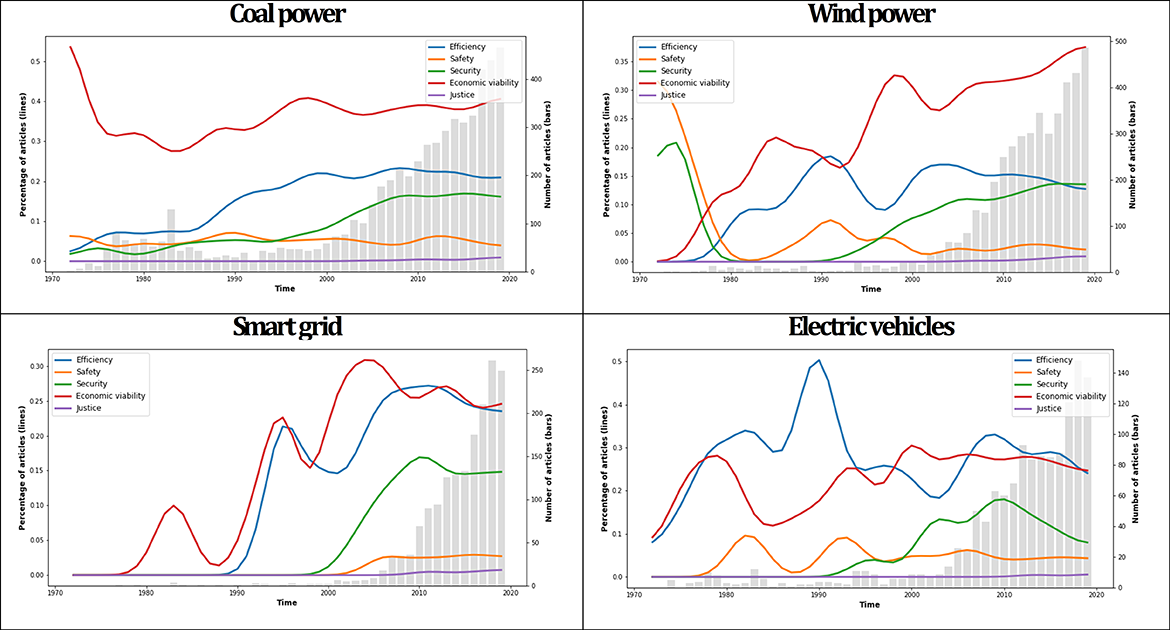
Percentage of articles addressing values for coal power, wind power, solar power, and electric vehicles between 1970 and 2020.
Two considerations are important in interpreting our results. First, the availability of the data is limited. Coal power has been around for a long time, but the number of scientific articles on coal power only started increasing in the 1970s. Data before the 2000s are also scarce for wind power, smart grids, and electric vehicles. This could have implications for the observed pattern in which values become relevant over time. Second, we chose a data set on energy policy. The observed pattern of sequences of values may reflect energy policies with respect to these technologies rather than the technological development of these technologies.
Future research could explore a series of further questions (and hypotheses) about the observed patterns of value change. For example, does a value become relevant over time (only) by the impact of the technology or can it (also) become relevant by broader societal changes? The value justice only seems to have been addressed in the literature in the 2010s for most technologies, but it is unlikely that these technologies all led to justice issues at the same point in time. So perhaps, this particular value change was the result of broader societal developments. More research is needed to examine why societal and moral values are often only addressed once a technology has matured. Perhaps, this is because the initial focus is getting the technology to function and making it economically viable. However, addressing societal and moral values during the early phases could reduce adverse consequences and acceptance issues and secure the commercial success of the technology. Discussions with experts on values and technologies could help to address these questions.
Changes in the Priority or Relative Importance of Values
Hypothesis
We hypothesize that changes in the priority or relative importance of values affect the deployment rate of a technology. This is because innovations are required to better address the values that have become more important. For example, if sustainability is a value that drives the deployment of a technology, and privacy is a value that is negatively affected by it, the increase of the importance of privacy may decrease the deployment rate of this technology.
To test this hypothesis, we focus on changes in the priority or relative importance of nuclear energy values. The five values selected are those identified by Taebi and Kloosterman (2015). Safety refers to the protection of humans against unintentional harm. Security is the protection of people from “malicious intentional harmful effects” (Taebi and Kloosterman 2015). Sustainability relates to the protection of the environment and the responsible use of resources. Economic viability refers to financial durability of technologies, their competitiveness on markets, and their attractiveness for consumers. Finally, intergenerational justice is the “equitable sharing of goods over the course of generations” (Taebi and Kloosterman 2015). Anchor words used to supervise the creation of topics that represent values as well as the topics themselves are provided in Appendix B, Table B3, accessible as online supplementary file. We consider the percentage of scientific articles that address a value over one year as a proxy for the importance of this value.
Results
Figure 6 shows that economic viability was the most important value for nuclear energy until the late 1980s. Safety seems to have become more important afterward. This is likely due to successive nuclear energy accidents: the Three Mile Island accident in 1979, the Chernobyl accident in 1986, and the Fukushima Daiichi accident in 2011. The increase of the importance of safety seems to coincide with a decrease in the number of new nuclear reactor installations starting from the 1990s (see Figure 7). This suggests that the increase of safety importance indeed led to a decrease in nuclear energy. Such a causal relation cannot be shown by our data and would require additional evidence. Some studies suggest that the commissioning of new nuclear reactors had already come to a halt in the United States before safety concerns became paramount (Bupp and Derian 1978). Nevertheless, the increasing emphasis on safety may still explain why it has been so difficult to revive nuclear energy since the 1990s.
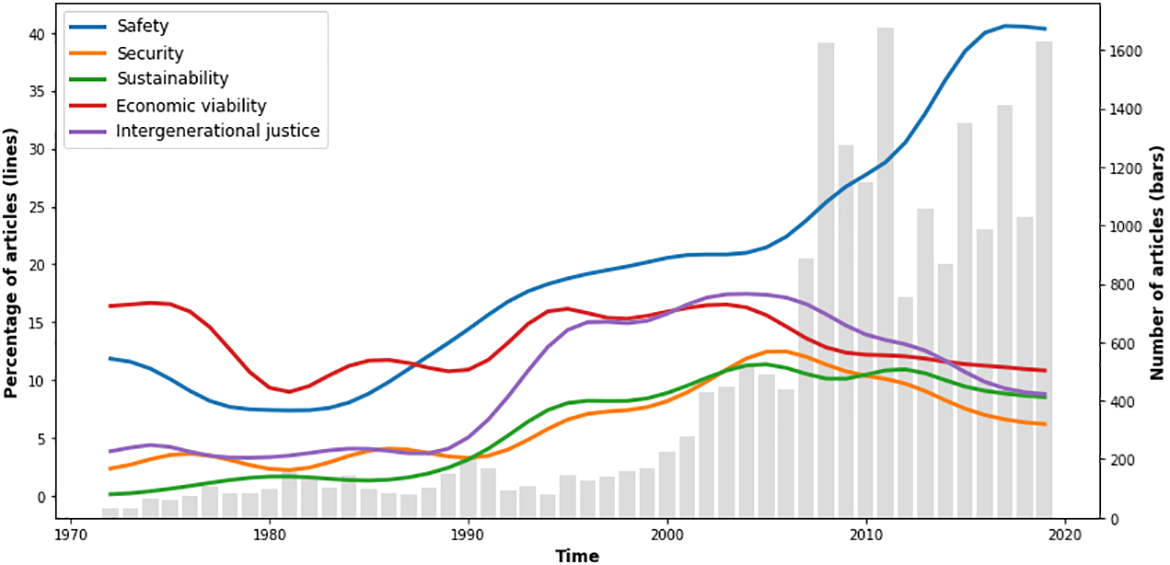
Percentage of articles addressing values for nuclear energy between 1970 and 2020.
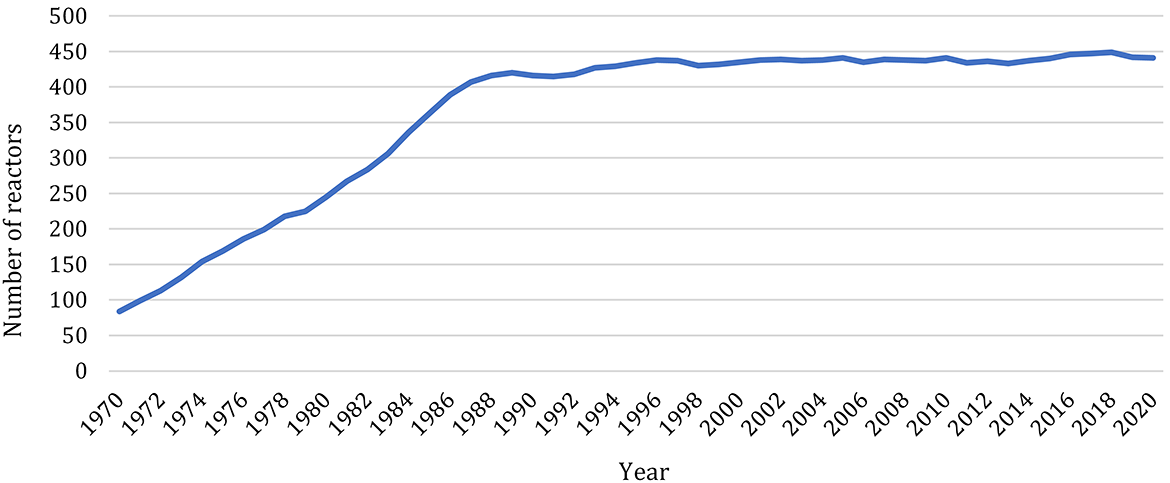
Number of operable reactors worldwide per year. Source: Data from World Nuclear Association (2020).
Before we can accept or reject the hypothesis, we must consider whether we can use the percentage of articles addressing a value as a proxy for its importance. The fact that a value is addressed more frequently in the literature may not always mean that it is more important. It could also mean that more scientific articles propose innovations to address this value better. Multiple innovations have increased the safety of nuclear power plants (cf. Nuclear Energy Agency (NEA) 2007). Related to this is the issue, that while values should be conceptually distinguished from goals (see Value Change subsection), they often suggest goals (as well as norms). This also means that a topic we find in a text corpus might represent a value as well as goals associated with that value. This means that an increase in the frequency of the topic of “safety” may signal that the value of safety has become more important, but it may also signal that this value has increasingly been translated into a goal for innovation. To determine which of the two interpretations is right will often require additional qualitative analysis. More generally, future research could use the same approach for newspaper articles and evaluate how safety and security have evolved over time in the literature.
Changes in How Values Are Conceptualized
Hypothesis
We hypothesize that privacy is increasingly conceptualized in informational terms due to technological developments. Understanding (i.e., conceptualization) what a specific value entails may change over time.
To test this hypothesis, we analyze how the conceptualization of privacy has changed over time. We create eight supervised topics that relate to the typology of privacy proposed by (Koops et al. 2017). Bodily privacy refers to the freedom of movement and touch of human body by others. Spatial privacy is the restriction of control and access to individual space. Similarly, communicational privacy is about transmitted information. Proprietary privacy refers to the use of property to hide aspects of individual lives. Intellectual privacy relates to thoughts, beliefs, and opinions. Decisional privacy relates to the intimacy of decisions in human relationships. Associational privacy refers to freedom of interaction in social networks. Behavioral privacy relates to publicly visible activities. The anchor words and resulting topics are presented in Appendix B, Table B4, accessible as online supplementary file. We consider the percentage of articles that address each of the eight conceptualizations per year as a proxy for changes in the conceptualizations of privacy.
Results
Figure 8 shows the percentage of articles in the data set that address each conceptualization of privacy over time. The figure shows that there is a growing emphasis on communicational privacy, possibly due to the rise of the information age. The increasing popularity of social media could explain the rise in associational privacy in the late 2000s. Overall, there does not seem to be a succession of conceptualizations of privacy that have emerged or disappeared over time. Rather, the conceptualizations seem to be coexistent.
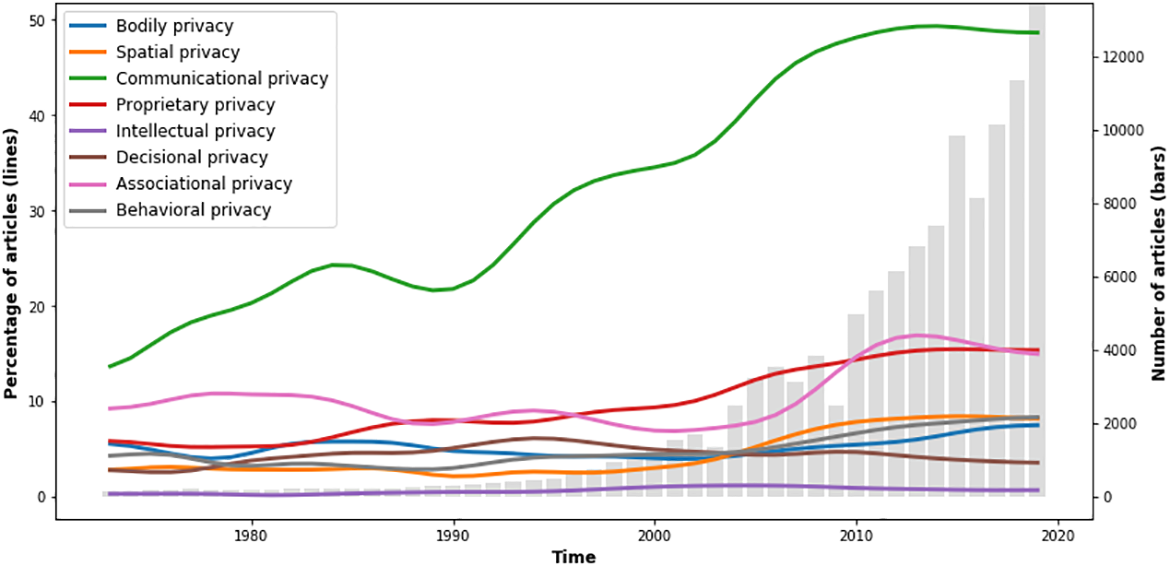
Percentage of articles addressing conceptualizations of privacy between 1980 and 2020.
Do these observations confirm our hypothesis? The analysis does not clearly prove whether or which technology drives these conceptualizations of privacy. The relationship is plausible, but still unproven with this analysis. Future research could compare the evolution of technologies with the evolution of these conceptualizations by identifying terms and topics related to technologies that have evolved similarly over time. Another point for research is interpreting the fact that various value conceptualizations coexist. Do different types of conceptualizations answer different morally problematic situations or do they relate to different opinions from societal groups about how this value should be addressed? A better understanding of the coexistence of these eight types of conceptualizations could help to further analyze how values change over time.
Changes in How Values Are Specified and Translated into Norms and Design Requirements
Hypothesis
We hypothesize that values for a technology can be respecified over time. For example, safety for refrigerators has successively been specified as the absence of flammable coolants and later as a low explosion risk (van de Poel 2013).
We take the example of safety in the design of nuclear power plants. Traditionally, nuclear power plants tended to rely on active safety systems. These systems require the intervention of an operator or an electrical feedback system for reactor shutdown (International Atomic Energy Agency 1991). However, these systems are vulnerable to human error and backup failure, as was the case for the Fukushima Daiichi accident (Kang, Lee, and Kang 2019). Active safety systems can be completed or partially replaced by passive safety systems that rely on natural forces (e.g., gravity, convection, and conduction) for reactor shutdown (International Atomic Energy Agency 2009). Another concept is inherent safety, which involves using nonconfigurable materials (e.g., no combustible materials; Mårtensson 1992). In this analysis, we evaluate how safety has been specified as active safety, passive safety, and inherent safety differently over time. We use the data set on nuclear energy presented in the third section to build the topic model. Anchor words and topics created can be found in Appendix B, Table B5, accessible as online supplementary file. We consider the percentage of scientific articles addressing each specification of safety over one year as a proxy of the way it is specified.
Results
Figure 9 shows the percentage of articles in the data set that address each specification of safety over time. This figure shows that passive safety progressively emerged as a specification of safety starting in the late 1980s. However, it does not seem to have replaced the other specifications of safety. Active and inherent safety still seems to be largely addressed by the literature. Figure 9 thus indicates that there was no respecification of safety per se and that a diversity of specifications of safety for nuclear energy has emerged over time.
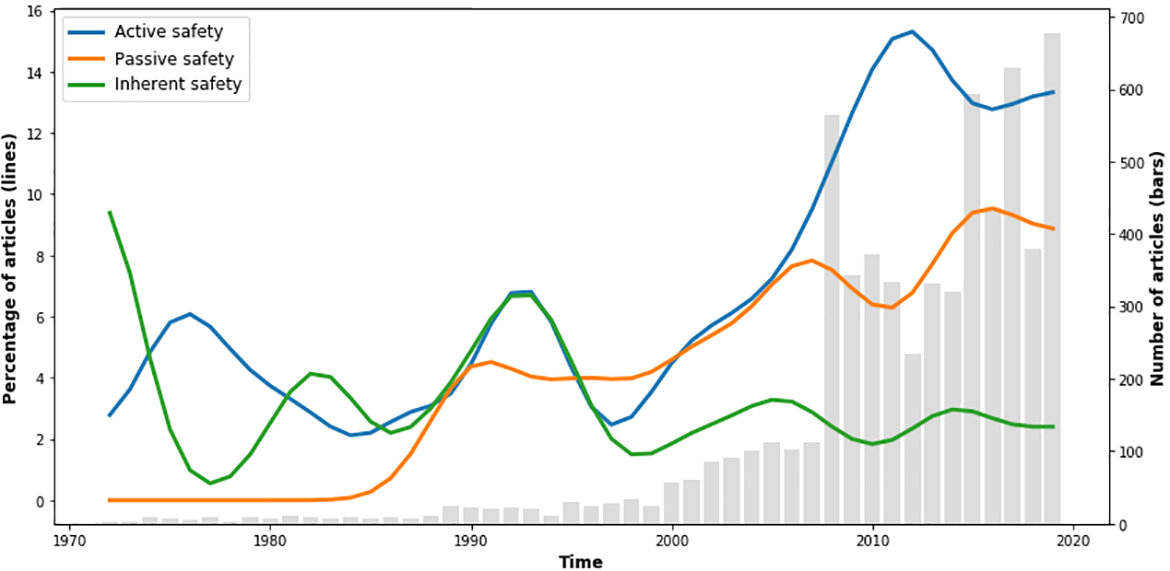
Percentage of articles addressing specifications of safety between 1970 and 2020.
Two considerations need to be made before conclusions about the hypothesis can be drawn. First, the topic of active safety is less clearly defined than the other two topics. Technologies used for active safety (e.g., control rooms, machine interface) are also used for other purposes, such as the daily operation of the nuclear power plant. Second, multiple articles mention both active and passive safety. However, they do not explicitly address active safety but mention it to argue for the need for passive safety systems. Future research could apply the approach to different technologies and values to classify other patterns of value respecifications.
Conclusions and Discussion
Conclusions
We have proposed an approach based on probabilistic topic models to trace value change in text corpora. We have shown that this approach can be used (a) to study value change for both technologies (i.e., nuclear energy) and technological domains (i.e., energy policy), (b) to test various hypotheses about value change, (c) to evaluate whether new values have emerged, (d) to identify factors that have influenced value change, (e) to identify patterns of value change, and (f) to explore how value change affects technological development.
Contributions and Limitations
We have made a methodological contribution by proposing a new approach for tracing and exploring value change. This approach allows us to trace different types of value change in technologies using text corpora and to trace latent values and latent value change, as we have seen in the case of the emergence of sustainability. This is important as it will help us to better anticipate value change.
As for any empirical method, researchers need to be aware of a range of potential biases when using probabilistic topic models to study value change. We identify four potential biases. First is the origin of the texts used for the analysis. Most text sources may not be value free and concentrate on a limited number of values or discuss these values in a certain manner. For example, an analysis of newspaper articles may point to values that the media considers to be important. This might exclude other important societal values. A second bias is the time length of the data set chosen and the type of value change found. Value change observed in shorter data sets (timewise) may reflect more the dynamics of societal groups competing for their values. Value change observed in longer data sets (timewise) might refer to more structural economic, social, and technical changes. A third bias is the researchers’ understanding of what a value entails. This might play a role when words are used as “anchors” to supervise the creation of topics. A fourth bias is the operationalization of value change in the analysis. For example, the fact that a value is more frequently discussed in the academic literature does not necessarily mean it is more important. It could mean that addressing this value through innovation is easier or that the value has increasingly become a goal for technological innovation.
In addition to these biases, the reliability of our results may be an issue if the data set is small and/or a value occurs only (very) infrequently in texts. In our analyses, this seems particularly the case for the early years of the development or deployment of a new technology such as wind power. Reliability does not seem to be an issue for later years when more texts per year are available.
Betti and van den Berg (2016) argue that attempts to analyze the history of ideas computationally may well suffer from “unorganized data” and “faulty methods.” In particular, such attempts may overlook the fact that the meaning of ideas, or in our case values, is context-dependent (e.g., dependent on other items in the data set) and in flux. Moreover, an uncritical bottom-up analysis of large amounts of data may fail to uncover important notions and trends. The authors recommend that the analyst build interpretative models upfront to address these pitfalls and collect and organize data accordingly.
The approach proposed in this article largely follows these recommendations. Topic modeling allows us to capture the context-sensitivity of values, whereas key words do not. Using supervised rather than unsupervised topic models also allows building interpretative models upfront. However, we think that unsupervised topic models could still be useful to detect unexpected values in text corpora if the size of the related literature is somehow substantial and therefore help to anticipate possible value changes.
In applying the approach, it is crucial to start with a clear research goal or research question, as these will determine what values, what possible value changes to look for, and what text corpora to analyze. Therefore, we have formulated explicit and specific hypotheses that can be tested with our approach. Formulating such hypotheses helps us to focus on specific value changes and gives more meaningful results than uncritical bottom-up analyses.
Our results should be interpreted carefully. Our approach can only show correlations, not causal relations. More generally, proper interpretation of the results will usually require analyzing additional, qualitative sources, and, ideally, value change theory. Such a theory does not exist yet. Nevertheless, we believe that our approach could contribute to developing such a theory.
Additionally, applying our approach requires data analytics skills, an understanding of how topic modeling works, and domain-specific knowledge. Moreover, we would recommend that our method be used in combination with more qualitative methods, which are both useful for formulating relevant hypotheses and for deciding between alternative explanations that are often left open by the type of quantitative analyses that our method allows.
Future Work
We identify four strands for future research. A first strand of research is methodological. Using the approach proposed in this paper requires some basic python programming skills, which are needed to prepare the data set and to build visualizations to answer more specific research questions. As this requirement may be a barrier to using the approach, the current code should be developed into a more accessible tool. This tool could include features to verify the quality of topics, evaluate the occurrence of biases, and visualize terms and topics that correlate with changing values over time. The latter would be useful to understand factors driving value change. Additionally, this tool could include the possibility to analyze and compare value change in different types of literature.
A second strand of research may contribute to testing theories about how value change (may) occur. There are various relevant theories in the literature, such as “technomoral change” (Swierstra, Stemerding, and Boenink 2009) and “moral revolutions” (Baker 2019). One may also build on Dewey’s (1939) idea that values are helpful in responding to morally problematic situations (van de Poel and Kudina n.d.). These theoretical ideas could be translated into hypotheses that can be empirically tested with the approach proposed here.
A third strand of research is to explore and categorize mechanisms of value change. As explained in the Contributions and Limitations subsection, some forms of value change may be accidental and happen over short periods of time (e.g., value change resulting from nuclear energy incidents). Others are more profound and happen over longer time periods (e.g., the emergence of environmental sustainability in the 1980s). The literature on simulation models, such as system dynamics (Forrester 1958) and agent-based modeling (Epstein and Axtell 1996), could be helpful to recreate and explore such mechanisms. Combined with exploratory tools (Bankes 1993), experiments can be performed to categorize mechanisms of value change.
A fourth strand of research could investigate the relation between value change in different parts of society or social domains or communities. For example, when it comes to concrete technologies, like nuclear energy, a distinction can be made between the engineering community researching and designing nuclear reactors, the policy community around the technology, societal debates about these technologies, and general societal debates and developments (van de Poel, Taebi, and de Wildt 2020). The dominant values may likely differ in these different parts of the society. Still, it is also likely that certain connections exist between them and that value change in one domain will affect other domains. For example, societal debates about nuclear energy after a nuclear disaster like Fukushima may affect values in policy making, which in turn may affect the values in the engineering community around nuclear energy. A better understanding of such relations can help to anticipate value change and draft design or policy recommendations. For example, we found that in the early phases, the development of energy technologies was largely dominated by functional and economic values at the demise of social and moral values. But if these value priorities conflict with those more broadly held in society, this may be problematic.
Supplemental Material
Supplemental Material, sj-docx-1-sth-10.1177_01622439211054439 - Tracing Long-term Value Change in (Energy) Technologies: Opportunities of Probabilistic Topic Models Using Large Data Sets
Supplemental Material, sj-docx-1-sth-10.1177_01622439211054439 for Tracing Long-term Value Change in (Energy) Technologies: Opportunities of Probabilistic Topic Models Using Large Data Sets by T. E. de Wildt, I. R. van de Poel and E. J. L. Chappin in Science, Technology, & Human Values
Supplemental Material
Supplemental Material, sj-xlsx-1-sth-10.1177_01622439211054439 - Tracing Long-term Value Change in (Energy) Technologies: Opportunities of Probabilistic Topic Models Using Large Data Sets
Supplemental Material, sj-xlsx-1-sth-10.1177_01622439211054439 for Tracing Long-term Value Change in (Energy) Technologies: Opportunities of Probabilistic Topic Models Using Large Data Sets by T. E. de Wildt, I. R. van de Poel and E. J. L. Chappin in Science, Technology, & Human Values
Supplemental Material
Supplemental Material, sj-xlsx-2-sth-10.1177_01622439211054439 - Tracing Long-term Value Change in (Energy) Technologies: Opportunities of Probabilistic Topic Models Using Large Data Sets
Supplemental Material, sj-xlsx-2-sth-10.1177_01622439211054439 for Tracing Long-term Value Change in (Energy) Technologies: Opportunities of Probabilistic Topic Models Using Large Data Sets by T. E. de Wildt, I. R. van de Poel and E. J. L. Chappin in Science, Technology, & Human Values
Supplemental Material
Supplemental Material, sj-xlsx-3-sth-10.1177_01622439211054439 - Tracing Long-term Value Change in (Energy) Technologies: Opportunities of Probabilistic Topic Models Using Large Data Sets
Supplemental Material, sj-xlsx-3-sth-10.1177_01622439211054439 for Tracing Long-term Value Change in (Energy) Technologies: Opportunities of Probabilistic Topic Models Using Large Data Sets by T. E. de Wildt, I. R. van de Poel and E. J. L. Chappin in Science, Technology, & Human Values
Supplemental Material
Supplemental Material, sj-xlsx-4-sth-10.1177_01622439211054439 - Tracing Long-term Value Change in (Energy) Technologies: Opportunities of Probabilistic Topic Models Using Large Data Sets
Supplemental Material, sj-xlsx-4-sth-10.1177_01622439211054439 for Tracing Long-term Value Change in (Energy) Technologies: Opportunities of Probabilistic Topic Models Using Large Data Sets by T. E. de Wildt, I. R. van de Poel and E. J. L. Chappin in Science, Technology, & Human Values
Supplemental Material
Supplemental Material, sj-xlsx-5-sth-10.1177_01622439211054439 - Tracing Long-term Value Change in (Energy) Technologies: Opportunities of Probabilistic Topic Models Using Large Data Sets
Supplemental Material, sj-xlsx-5-sth-10.1177_01622439211054439 for Tracing Long-term Value Change in (Energy) Technologies: Opportunities of Probabilistic Topic Models Using Large Data Sets by T. E. de Wildt, I. R. van de Poel and E. J. L. Chappin in Science, Technology, & Human Values
Supplemental Material
Supplemental Material, sj-xlsx-6-sth-10.1177_01622439211054439 - Tracing Long-term Value Change in (Energy) Technologies: Opportunities of Probabilistic Topic Models Using Large Data Sets
Supplemental Material, sj-xlsx-6-sth-10.1177_01622439211054439 for Tracing Long-term Value Change in (Energy) Technologies: Opportunities of Probabilistic Topic Models Using Large Data Sets by T. E. de Wildt, I. R. van de Poel and E. J. L. Chappin in Science, Technology, & Human Values
Supplemental Material
Supplemental Material, sj-xlsx-7-sth-10.1177_01622439211054439 - Tracing Long-term Value Change in (Energy) Technologies: Opportunities of Probabilistic Topic Models Using Large Data Sets
Supplemental Material, sj-xlsx-7-sth-10.1177_01622439211054439 for Tracing Long-term Value Change in (Energy) Technologies: Opportunities of Probabilistic Topic Models Using Large Data Sets by T. E. de Wildt, I. R. van de Poel and E. J. L. Chappin in Science, Technology, & Human Values
Supplemental Material
Supplemental Material, sj-xlsx-8-sth-10.1177_01622439211054439 - Tracing Long-term Value Change in (Energy) Technologies: Opportunities of Probabilistic Topic Models Using Large Data Sets
Supplemental Material, sj-xlsx-8-sth-10.1177_01622439211054439 for Tracing Long-term Value Change in (Energy) Technologies: Opportunities of Probabilistic Topic Models Using Large Data Sets by T. E. de Wildt, I. R. van de Poel and E. J. L. Chappin in Science, Technology, & Human Values
Footnotes
Declaration of Conflicting Interests
The author(s) declared no potential conflicts of interest with respect to the research, authorship, and/or publication of this article.
Funding
The author(s) disclosed receipt of the following financial support for the research, authorship, and/or publication of this article: This publication is part of the project ValueChange that has received funding from the European Research Council (ERC) under the European Union’s Horizon 2020 Research and Innovation Programme under grant agreement no. 788321.

Supplemental Material
The supplemental material for this article is available online.
Notes
References
Supplementary Material
Please find the following supplemental material available below.
For Open Access articles published under a Creative Commons License, all supplemental material carries the same license as the article it is associated with.
For non-Open Access articles published, all supplemental material carries a non-exclusive license, and permission requests for re-use of supplemental material or any part of supplemental material shall be sent directly to the copyright owner as specified in the copyright notice associated with the article.
