



Abstract
Digital energy platforms play a central role in the transition toward a more sustainable energy system. This research explores the (potential) effect of digital energy platforms on public values. We developed and tested a novel public value framework, combining values already embedded in energy and digitalization regulations and emerging values that have become more relevant in recent debates. We analyzed value changes and potential value tensions. We found that sustainability is prioritized, security is broadened to include cybersecurity, and values relevant for digital technologies, such as control over technology, have also become relevant for the energy system. This has resulted in three value tensions: preserving a well-functioning energy system, self-determination, and ensuring a level playing field and public control. A sustainable energy system requires governments to address these value changes, value tensions, and connected societal and political challenges related to the implementation of digital energy platforms.
In recent years, we have seen increasing attempts to apply the economic, social, and technological model of the digital platform to energy provisioning (Duch-Brown and Rossetti 2020; Kloppenburg and Boekelo 2019; Küfeoğlu et al. 2019; Terroso-Saenz et al. 2019). “Platformization” of the electricity system is one of the outcomes of the digitalization of the energy system (Dekker and Van Est 2020; International Energy Agency 2017). Digital energy platforms promise to solve emerging problems of the energy transition, such as unpredictability of renewable electricity generation and variations in electricity demand, both leading to problems with grid capacity and grid balance (Terroso-Saenz et al. 2019; Xu et al. 2019).
A variety of digital energy platforms is emerging. Their common denominator is that they digitally connect users to “communicate and interact with each other and get (temporary or permanent) access to products, services or more broadly ‘resources’ provided by peers or organisations [sic]” (Kloppenburg and Boekelo 2019, 68). The platforms differ in the aspect of the electricity system on which they focus, for example, supporting the transmission system operator (TSO) or distribution system operator (DSO) in preventing congestion in the network or using aggregation to offer flexibility services and optimize energy generation and demand within a community or household (Jabłońska 2014; Kloppenburg and Boekelo 2019; Smale and Kloppenburg 2020). As a result, an ecosystem of platforms 1 is developing, with new interdependencies, roles, actors, and business models (Van Dijck, Poell, and de Waal 2016; Poplavskaya and De Vries 2020).
The emergence of digital energy platforms is driven by and results in changes in public values. Digital platforms introduce a data-driven way of working and organizing in the energy sector, causing other values to become relevant in the energy system (Van den Hoven, Lokhorst, and van de Poel 2012). For example, recent history has shown that platformization in other sectors raises many ethical and political issues, as it can lead to concentration of (market) power and challenge human rights, such as privacy and autonomy (Van Dijck, Nieborg, and Poell 2019; Frenken et al. 2019; Véliz and Grunewald 2018). It is plausible that this also applies to the energy sector; however, research on this is limited.
Therefore, this research explores public values that could be affected by increased digitization, including platformization, in the electricity sector. Whereas other research focuses on public values related to either energy systems or digital technologies, we combine the two fields of research in a newly developed public value framework. With this framework, we aim to gain a better understanding of how digital energy platforms support or pressure various public values. After developing our framework of relevant public values in the second section, we briefly elaborate on our method and data in the third section. In the fourth section, we analyze how and to what extent the three digital energy platforms under analysis in this research––(1) Equigy, (2) Tesla’s Virtual Power Plant (VPP), and (3) Gridflex Heeten (hereafter Gridflex)––support or pressure public values, using the framework of the second section. Based thereon, we discuss in the fifth section various value changes and value tensions that arise due to the platformization in the electricity sector. The sixth section closes with several suggestions on how to deal with these value changes and value tensions.
Public Value Framework
Public values refer to the collective societal aspirations regarding what is right and wrong and what are appropriate courses of action. Milchram, van de Kaa, et al. (2018, 2) define public values as “abstract principles and general convictions that people should hold paramount if society is to be good.” They are shaped, constructed, and defined in democratic processes (Dahl 2015; Moore 1995; Susskind 2020) and are embedded in institutions, such as laws, standards, and regulations (Dekker and Van Est 2020; Royakkers et al. 2018; Werff and Steg 2016). What we understand by a certain public value can change in these democratic processes. We see this “change of interpretation” as one of the ways in which value change can take place.
Technological developments also affect public values and vice versa. These values, and the institutions in which they are embedded, set directions and boundaries for technological developments (Van de Poel 2020; Schmidt et al. 2012; De Wildt et al. 2019). At the same time, technological innovations, such as digital energy platforms, can support or pressure certain public values and also result in “new” values to become relevant in the public debate (Van den Hoven, Lokhorst, and van de Poel 2012; Larson 1997; Van de Poel 2020). The latter is another example of value change.
Value changes can contribute to (new) value tensions. Democratic processes can “solve” value tensions and value incommensurability (temporarily) by prioritizing particular public values over other public values (Van den Hoven, Lokhorst, and van de Poel 2012; Umbrello 2020). Understanding what it encompasses when values change allows stakeholders such as technology developers and policymakers to anticipate on potential value tensions, which can provide the basis for improved democratic decision-making and a more just (energy) system (Correljé et al. 2015; Demski et al. 2015; Guston 2014; Kooiman and Jentoft 2009; Moore 1995).
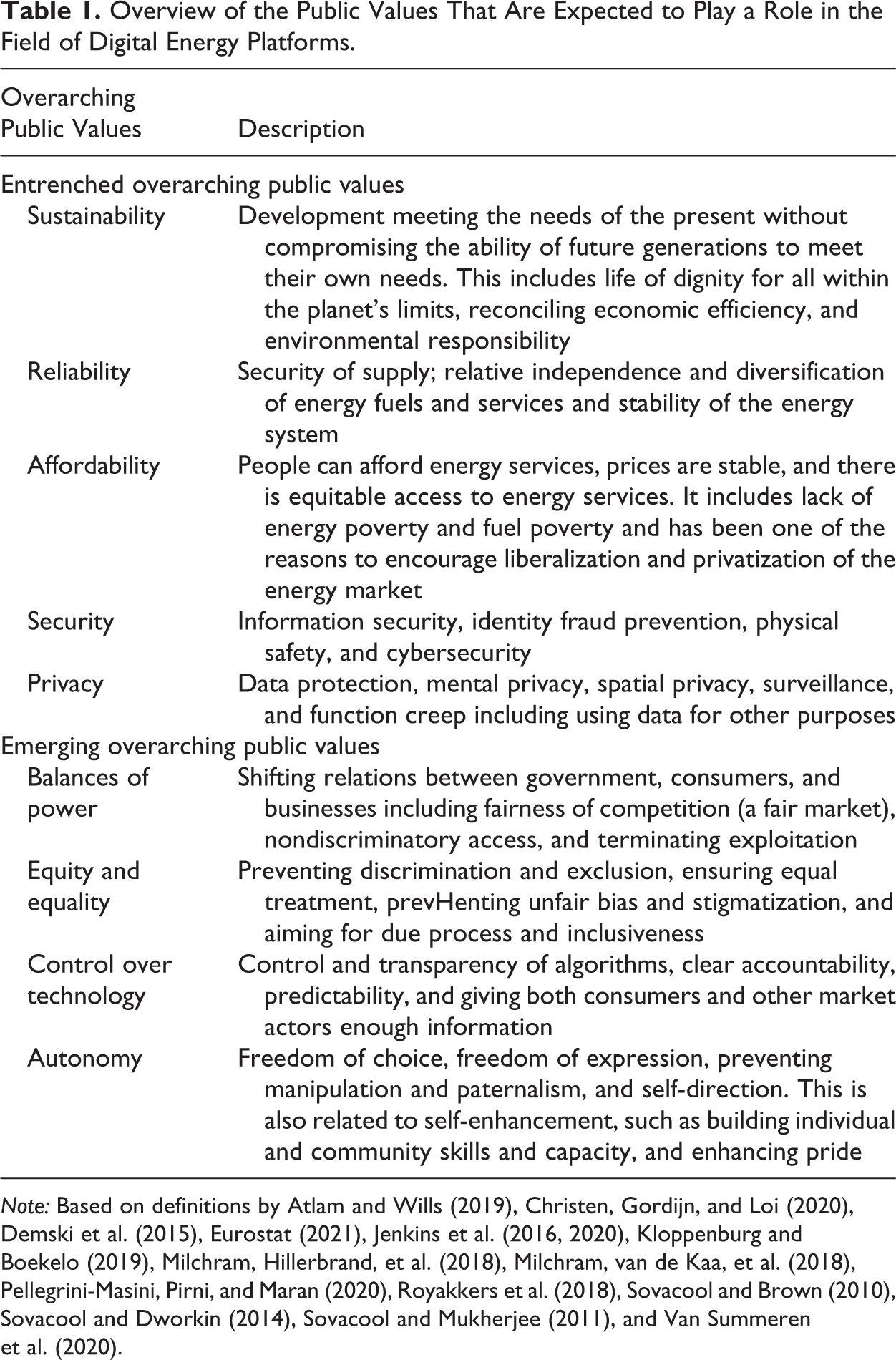
Digital energy platforms exemplify the convergence of the digital technologies sector and the energy sector; two sociotechnical systems with their own specific set of actors, technologies, interests, institutions, and thus public values (Dekker and Van Est 2020; Grin, Rotmans, and Schot 2010; May and Jochim 2013). To understand how digital energy platforms support or pressure public values and what value changes and value tensions are arising, we developed a framework using overarching public values, based on energy system, energy transition, energy justice, and digital technologies theories. An overview of these overarching values and their interpretation can be found in Table 1. In total, we have identified nine overarching values that can be divided into two types: entrenched and emerging.
Overview of the Public Values That Are Expected to Play a Role in the Field of Digital Energy Platforms.
Note: Based on definitions by Atlam and Wills (2019), Christen, Gordijn, and Loi (2020), Demski et al. (2015), Eurostat (2021), Jenkins et al. (2016, 2020), Kloppenburg and Boekelo (2019), Milchram, Hillerbrand, et al. (2018), Milchram, van de Kaa, et al. (2018), Pellegrini-Masini, Pirni, and Maran (2020), Royakkers et al. (2018), Sovacool and Brown (2010), Sovacool and Dworkin (2014), Sovacool and Mukherjee (2011), and Van Summeren et al. (2020).
The first type applies to public values that are already anchored, often for a long period, in energy or digitalization regulation, and are thus “institutionalized.” These entrenched values have consistently given direction to institutions, but they are not static and their interpretation is subject to change. These are the values: (1) sustainability (Eurostat 2021; Milchram, Hillerbrand, et al. 2018; Sovacool and Brown 2010), (2) reliability (Demski et al. 2015; Eurostat 2021; Milchram, Hillerbrand, et al. 2018), (3) affordability (Demski et al. 2015; Eurostat 2021; Sovacool and Mukherjee 2011), (4) privacy (Atlam and Wills 2019; Royakkers et al. 2018), and (5) (cyber)security (Christen, Gordijn, and Loi 2020; Royakkers et al. 2018).
In contrast, the emerging values are public values that have become more relevant in recent debates related to the convergence of the energy sector and the digital technologies sector, such as energy democracy, value sensitive design, energy communities, control over technology (individual) autonomy, 2 and equity and equality. Although they are sometimes institutionalized, this is often to a lesser extent than entrenched values. Based on an analysis of the public values put forward in the recent scientific literature, we identified four overarching (clusters of) emerging public values: (1) balances of power (Kloppenburg and Boekelo 2019; Milchram, Hillerbrand, et al. 2018), (2) equity and equality (Jenkins et al. 2016, 2020; Pellegrini-Masini, Pirni, and Maran 2020; Sovacool and Dworkin 2014), (3) control over technology (Milchram et al. 2020; Royakkers et al. 2018), and (4) autonomy (Demski et al. 2015; Royakkers et al. 2018; Van Summeren et al. 2020).
Our assumption in this paper is that digital energy platforms relate to all these identified values. We are aware that we may not do justice to all values we have encountered in the literature, but this framework is used to identify and analyze the most relevant public values in public and political discussions about digital energy platforms.
Methods
To understand the effect of the rise of digital energy platforms, we use a qualitative multiple-case study approach. We apply Table 1 as a framework to analyze how public values play a role in and are supported or pressured by the developments of three digital energy platforms, using plans and policies by the platforms and in-depth interviews with administrators of the platforms. In addition, we reflect on the relationship between public values and future platform developments, using literature on the social impact of digital platforms and digitalization of the energy sector in recent history. Here, we follow Moore (1995, 21) who claims that society needs “value-seeking imaginations” to set the tone for future developments as to what is and is not legitimate, and weigh the costs and benefits of innovations, in order to provide a basis for improved democratic decision-making (Guston 2014).
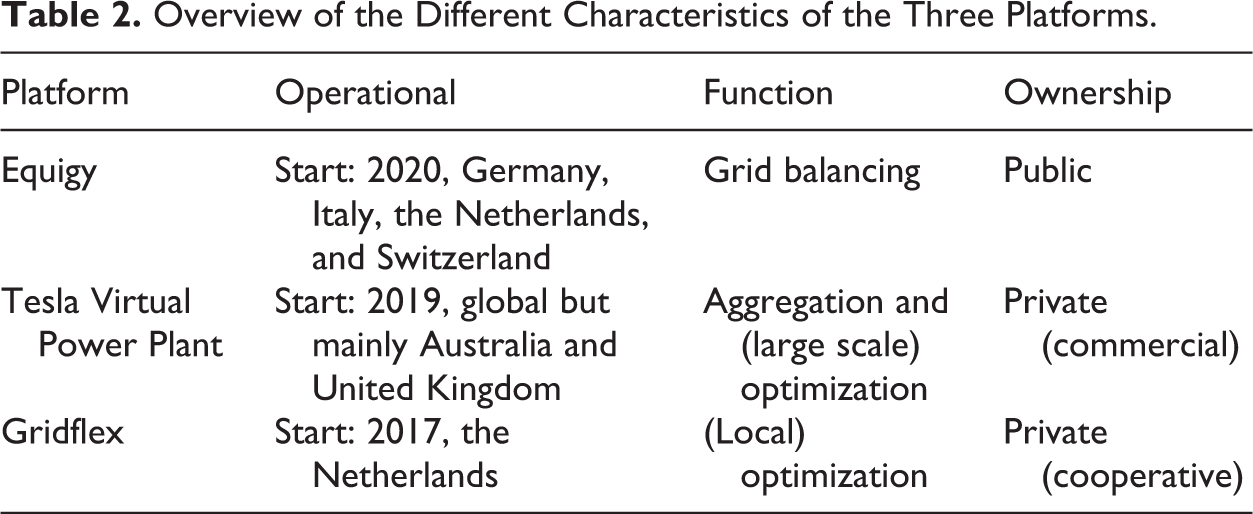
The three platforms we analyze, Equigy, Tesla’s VPP, and Gridflex, differ in their function and place in the energy system (see Figure 1, Table 2, and Three Energy Platforms section). Given the diversity of these three platforms, we assume they provide a complete picture of the public values that are being supported or pressured by the rise of digital energy platforms (Jabłońska 2014). At the same time, we acknowledge that not all public values identified in Table 1 will apply to all three platforms equally.
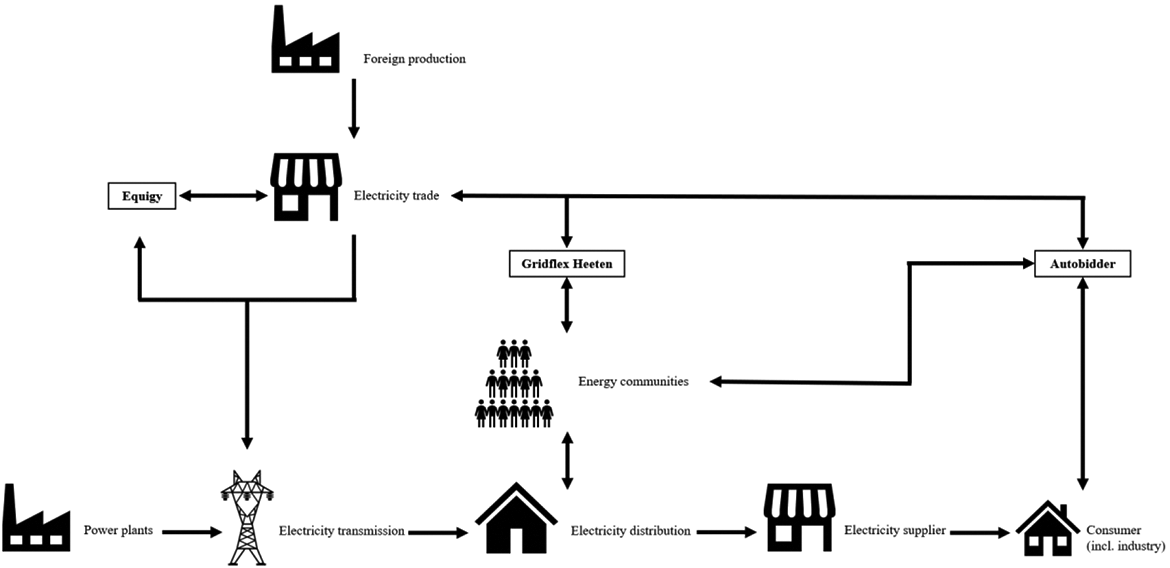
The three platforms illustrated in the Dutch electricity system. Source: Authors, based on Edens (2017).
Overview of the Different Characteristics of the Three Platforms.
Results
Three Energy Platforms
The three energy platforms studied in this paper operate within different parts of the electricity system, as shown in Figure 1, and have different functions and methods of operating, as described in Table 2. First, Equigy was launched by the publicly owned TSOs of the Netherlands, Switzerland, and Italy. Its main goal is to support TSOs with balancing supply and demand through the integration of small-scale flexibility (Equigy 2020a). The blockchain platform registers and validates the flexibility services provided to the electricity grid by aggregators through different consumer-based devices (such as batteries and heat pumps; Equigy 2020b). Albeit with different goals, TSOs, DSOs, and via aggregators, small-scale prosumers can make use of this platform.
Second, Tesla’s VPP projects, such as the Tesla Energy Plan in the United Kingdom, use multiple software systems to create a network of distributed energy resources, such as solar panels and batteries (Breck and Link 2020; Lambert 2021). The real-time energy trading and control platform uses algorithms to optimize the generation and use of renewable energy and to offer flexibility services by steering the charging and discharging of Tesla batteries (Tesla 2019). Operating at what Jabłońska (2014) termed the aggregation layer, the software continuously retrieves data, predicts prices, and decides and acts on optimal electricity bids (Breck and Link 2020).
Third, the consortium of Gridflex Heeten developed an algorithm-based microgrid to optimize local production, storage, and consumption. This pilot in the neighborhood Veldegge (in the village Heeten) consists of several rooftop solar panels, batteries, and an app that allowed people to monitor their electricity consumption (Nieuwe Energie Overijssel 2018). The project was initiated by a local energy cooperation and an entrepreneurial company that wanted to develop and test a local, sustainable energy market. As such, it is a private, yet cooperative, energy platform, focused on reducing the stress on the local distribution network.
The Role of Public Values
Entrenched values
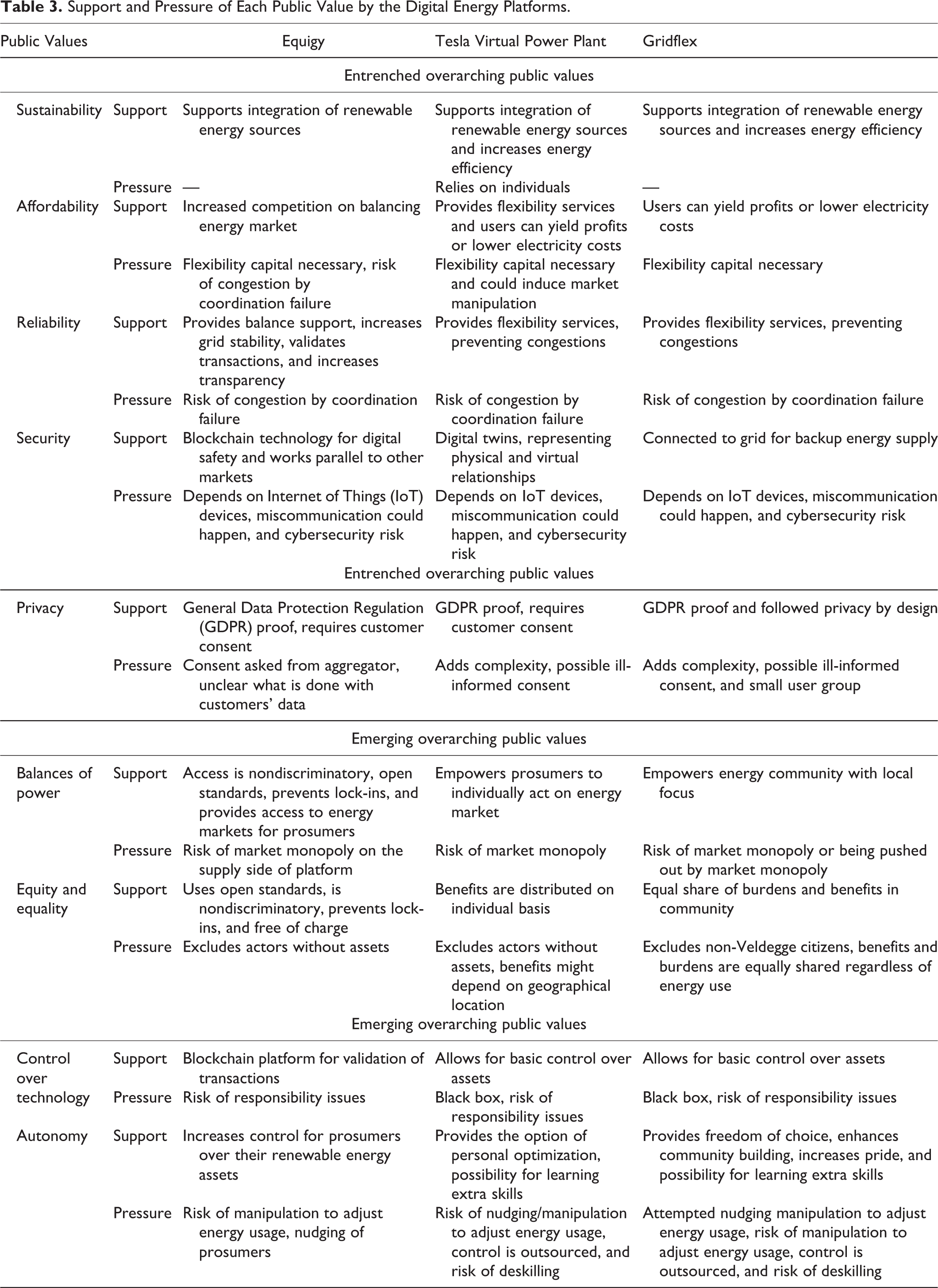
The three digital energy platforms relate in various ways to the five entrenched public values (see Table 3). All functions of these platforms (Table 2) focus on dealing with problems related to the energy transition such as congestion or grid balancing and with energy-use optimization, thus supporting the sustainability, affordability, and reliability of the electricity system. First, regarding sustainability, all platforms support the integration of renewable energy (Gridflex Heeten 2020a; TenneT 2020a; Tesla 2019). Additionally, Tesla’s VPPs and Gridflex can increase energy efficiency by offering flexibility services (Gridflex Heeten 2020b; Tesla 2019).
Support and Pressure of Each Public Value by the Digital Energy Platforms.
Second, all platforms have the potential to increase the reliability and affordability of the electricity system, by helping to enable and integrate more flexibility in supply, storage, and demand. Equigy, for example, is focused on making grid balancing more affordable and reliable by lowering the threshold for small-scale flexibility assets 3 (TenneT 2020a). While on the market side, a Tesla VPP can decide to store electricity during peaks of renewable energy generation and sell electricity during peaks of electricity demand (Nhede 2021; Tesla 2019).
It is not self-evident, however, that platforms act in the public interest and thus support public values. Aggregators, for example, can potentially manipulate the energy market, pressuring the affordability of the energy system (Poplavskaya and De Vries 2020; De Vries 2019). Furthermore, any miscommunication or malfunctioning can lead to congestion, imbalance, and even outages. This forms a new pressure on the reliability of the energy system and a potential safety risk. This leads to the first public value also entrenched in the digital technologies sector: security. Although this value is not new for the energy sector, digital energy platforms bring a new set of (cyber)security risks, broadening the scope of security and making it a more pressing issue.
Some of the new (cyber)security risks have been incorporated in the designs of the platforms. Equigy has chosen to develop a platform that can coexist with the current markets in case the platform malfunctions (TenneT 2020a). Alternatively, Tesla is continuously working with digital twins and edge computing to deal with uncertainties and test the results of decisions before they are made (Breck and Link 2020). Still, all three platforms rely on a multitude of connected devices, gathering and sharing data (Hossein Motlagh et al. 2020; Jabłońska 2014; Royakkers et al. 2018). This effectively poses three security risk: (1) unauthorized access to the data, (2) malfunctioning devices, and (3) miscommunications between different devices (Lin and Bergmann 2016). The scope of security is thus broadened to also include cybersecurity and a well-functioning ecosystem of platforms. 1
The value of privacy is another important entrenched public value because digital energy platforms gather, share, and analyze personalized data (Kalogirou 2007; Kloppenburg and Boekelo 2019). This type of data collection already raised concerns before the introduction of energy platforms, for example, with the implementation of smart meters (Cuijpers and Koops 2012). In order to be allowed to be implemented, digital energy platforms need to adhere to the EU General Data Protection Regulation (GDPR; Van Aubel et al. 2018; TenneT 2020a). It is in general, however, not always clear how well-informed the consent is that users are giving for this data gathering, which puts privacy under pressure. Contracts, including the consent forms, are often lengthy, complex, and contain much jargon, resulting in many users giving ill-informed consent (Böhme and Köpsell 2010; Nissenbaum 2011).
Emerging values
The emergent public values derived from current debates also seem to have become more relevant with regard to the rise of energy platforms. First, regarding the value of balances of power, it is unclear how it will be influenced by digital energy platforms. Consumers and small-scale digital energy platforms often do not have the technical expertise and business acumen to manage their assets or show an interest in doing this (Poplavskaya and De Vries 2020). Commercial digital energy platforms often do have the technical expertise, business acumen, and interest to manage their assets, thus having a competitive advantage on energy markets. Furthermore, digital platforms in general are associated with unequal power relations and following a winner takes all principle, where larger platforms outprice smaller platforms. 4 So even though energy platforms stimulate the emergence of prosumers, 5 it has not automatically led to their empowerment (Endona and Escozon 2020; Reijnders, van der Laan, and Dijkstra 2020).
Second, all energy platforms also relate to the public value of equity and equality. This value has two components: (1) inclusiveness and (2) an equal distribution of benefits and burdens. Starting with inclusiveness, typically, platforms, excludes nonmembers from reaping its benefits. Sometimes, this exclusion has practical reasons: for example, Gridflex is a local experiment, and thus only the community of Veldegge joined (Gridflex Heeten 2020b; Verkade and Höffken 2019). Most digital energy platforms, such as Tesla’s VPP and Equigy, however, have another requirement for inclusion: the possession of flexibility assets (Powells and Fell 2019). Exclusion is thus based on social and financial capital. Added to this is the inequality in the distribution of benefits and burdens. The costs incurred by grid operators for grid expansion to integrate renewables and flexibility assets, necessities for digital energy platforms, are relayed on all users of the electricity grid, including those not benefiting from the platforms (Smale and Kloppenburg 2020; Enexis 2020). On the other hand, the benefits that digital energy platforms bring to the public energy system sometimes benefit everyone––for example, a more efficient electricity grid resulting in lower grid costs.
Third, whether the public value of control over technology is supported or pressured depends on multiple facets, such as the ownership of the platform, the technological design, and the capabilities of users. For example, Equigy uses open source blockchain technology allowing users to understand the platform and validate transactions (TenneT 2020b). Tesla and Gridflex are, however, less transparent regarding the algorithms used for the platforms but do offer users basic control over self-owned assets (Tesla 2019; Endona and Escozon 2020). Users often lack skills and knowledge to fully understand how the digital platforms work, although the question is whether that is necessary (Milchram et al. 2020; Lyytinen, Nickerson, and King 2020).
This leads to the fourth and closely related public value: autonomy. All three platforms support users with the generation, gathering, and analysis of energy data (Reijnders, van der Laan, and Dijkstra 2020; TenneT 2020a; Verkade and Höffken 2019). As such, users could gain new insights and skills and be empowered to play a more active role in the energy transition (Cossy and Goodson 2020). In practice, however, it is mainly platforms that use insights from energy data. A growing number of examples, such as Gridflex, show that consumers rarely act on the insights generated from energy data (Gridflex 2020c; Smale and Kloppenburg 2020). What local digital energy platforms as Gridflex do entice is community building and pride. Members are often proud of working together on sustainability and feel more connected (Endona and Escozon 2020; Gridflex Heeten 2020b; Van Summeren et al. 2020). This increases their community autonomy.
Discussion
As explained in the second section, the results indicate several, potential value changes. Values that were previously less relevant have become highly debated with the growing implementation of energy platforms. In the second section, we also hinted that value changes can result in new value tensions, as different values become prioritized or pressured. Based on our findings, we can identify three overarching, interrelated value tensions (see Figure 2), which relate to (1) preserving a well-functioning energy system, (2) ensuring a level playing field and public control, and (3) stimulating self-determination.
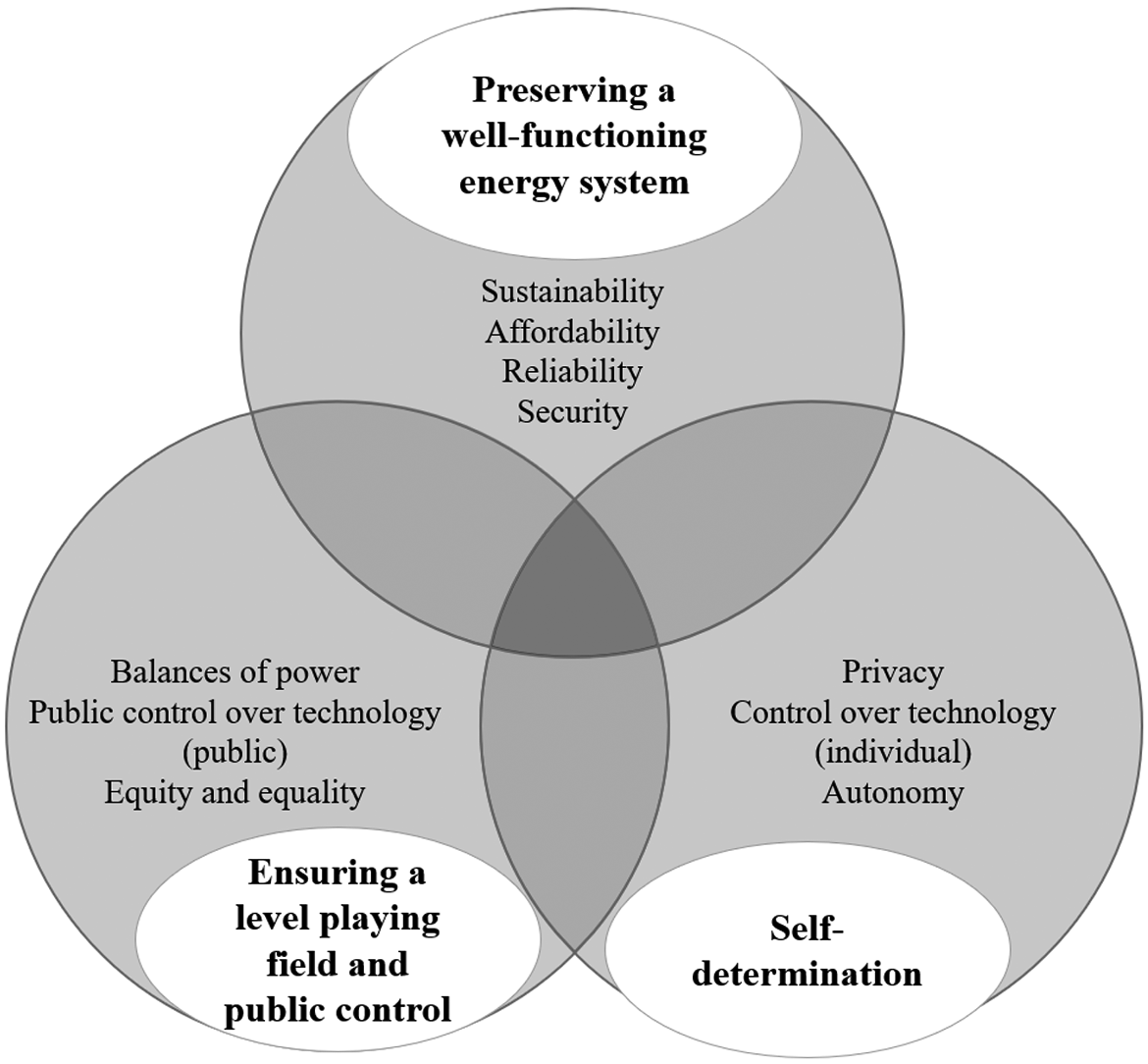
The three value tensions occurring with the emerging digital energy platforms. Source: Authors.
The first value tension we identified concerns preserving a well-functioning energy system. The entrenched public values have been reprioritized: sustainability has risen in priority, and consequently, reliability and affordability have come under pressure. This led to the emergence of digital energy platforms that try to solve the problems that arise because of the prioritization of sustainability. Additionally, the value of security has broadened in scope to include cybersecurity. Together, the values of sustainability, affordability, reliability, and security form the basis of preserving a well-functioning energy system. Regulations could guide both public and private companies to prioritize sustainability without taking too many risks in terms of affordability, reliability, or security.
The second value tension concerns self-determination. Most digital energy platforms promise “optimization” of the energy system; users of the platform are often unaware this optimization could have an impact on their privacy, autonomy, and control over technology, as explained in The Role of Public Values section. Control over their data is for users not self-evident but important, also from the point of view of acceptability. However, privacy consent forms are often difficult to understand for nonexperts.
The third value tension relates to a level playing field and public control. With the emergence of new actors and activities in the energy system, issues emerge regarding the (shifts in) balances of power on the energy market. For their success on the energy markets, digital energy platforms are dependent on knowledge of digital technologies, business acumen, and scale (Van Dijck, Nieborg, and Poell 2019; Langley and Leyshon 2017; Poplavskaya and De Vries 2020). These capacities are often unequally distributed; digital corporations, in contrast to small, local energy communities, often possess these competitive advantages allowing for faster scale-up, taking in a large market share and benefiting from the network effects of their platform. This conflicts with ensuring a level playing field on the electricity market. This could also lead to a less affordable energy system. Publicly owned platforms such as Equigy play an essential role in the energy platform ecosystem because of their ability to help safeguard a well-functioning energy system and facilitate the market and thereby ensuring public control. It is advisable to establish energy policies supporting grid operators in their innovation and investment activities, to ensure a good knowledge and skills base for digital technologies.
Conclusion
This paper analyzed the rise of platforms in the energy sector to see to what extent this platformization supports or pressures relevant public values. Insight into important public values at stake enables us to consider to what extent entrenched and emerging values raise new social issues and how these issues are addressed in the design of various platforms and public policies. For this analysis, we first developed a framework (Table 1) including five entrenched overarching public values and four emerging overarching public values. Next, using this framework, we analyzed how three types of digital energy platforms, each with a different role in the energy system (Table 2), pressure or support public values (Table 3).
The rise of digital energy platforms relates to various value changes. First, it is stimulated by the prioritization of sustainability as a core driver of the energy transition. Secondly, since digital platforms illustrate the ongoing convergence of the energy and digital technologies sector, public values that have been central to digital technologies policy for years, such as privacy and (cyber)security, will play a stronger role in energy policy. Thirdly, more recent discussions about the convergence of the digital technologies sector and the energy sector also bring to the fore emerging public values and related societal and political challenges.
These value changes can be characterized by three value tensions related to (1) preserving a well-functioning energy system, (2) ensuring a level playing field and public control, and (3) stimulating self-determination. It was outside of the scope of this research to analyze in-depth how current regulations address these three tensions; further research is needed for this. Without adequate regulation and steering of the development, the potential of digital platforms for the energy transition cannot be exploited in a manner beneficial to society.
Footnotes
Acknowledgments
The authors would like to give special thanks to the TU Delft Design for Changing Values team, who organized the workshop “Energy Systems and Changing Values,” where an earlier version of this paper was presented, and who made this Thematic Collection possible. They also thank all participants of this workshop and the reviewers for their constructive feedback.
Declaration of Conflicting Interests
The author(s) declared no potential conflicts of interest with respect to the research, authorship, and/or publication of this article.
Funding
The author(s) disclosed receipt of the following financial support for the research, authorship, and/or publication of this article: This research is part the project Governance van artificiële intelligentie in de energietransitie (Governance of Artificial Intelligence in the Energy Transition) funded by the Eindhoven University Fund (Stichting Universiteitsfonds Eindhoven). This research is also supported by the Rathenau Instituut.
