



Abstract
The roles digital media-technologies play in raising public issues relating to emerging technologies and their potential for engaging publics with science and policy assessments is a lively field of inquiry in Science and Technology Studies (STS). This paper presents an analysis of controversies over proposals for the large-scale removal of atmospheric carbon dioxide (CDR). The study combines a digital method (web-querying) with document analysis to map debates about two CDR approaches: bioenergy with carbon capture and storage (BECCS) and afforestation. In the first step, we locate actors using the web to engage with BECCS and afforestation and map their alignments in relation to competing framings of CDR. In a second step, we examine the devices deployed by UK-based actors to evidence and contest the feasibility of BECCS and afforestation. Our analysis shows that policy distinctions between “natural” and “engineered” CDR are used flexibly in practice and do not map neatly onto actor engagement with BECCS and afforestation. We highlight the predominance of cross-cutting techno-economic expertise and argue that framings of CDR as a solution to governing climate change may contribute to public disengagement from climate policy processes. The paper reflects on methods for studying controversies, publics, and issues emerging around processes of technoscientific assessment.
Introduction
In the wake of the Intergovernmental Panel on Climate Change’s (IPCC 2014) 1 Fifth Assessment Report, and the Paris Agreement of the following year, a series of controversies erupted over levels of atmospheric carbon dioxide removal (CDR) required to keep global temperature rise “well below” 2°C. The reliance by IPCC integrated assessment models on speculative “negative emissions technologies”—chiefly, bioenergy with carbon capture and storage (BECCS)—to remove atmospheric carbon and achieve politically desirable emissions scenarios proved controversial among climate scientists (Fuss et al. 2014). Moreover, the unproven status of most CDR technologies has led to claims that the IPCC is providing cover for political leaders’ failures to mitigate climate change risks (Anderson and Peters 2016; Geden 2016). Some activists have argued that the scientific integrity of the IPCC has been compromised, describing technologies like BECCS as a gift to the fossil fuel lobby (Geoengineering Monitor 2018).
One prominent attempt to reframe debates about CDR, away from a focus on technological innovation, has focused on the development of so-called natural climate solutions (NCS). The NCS concept was prominently articulated in a paper published by conservation NGO The Nature Conservancy in collaboration with environmental and climate scientists (Griscom et al. 2017) which proposed that a third of emissions reductions required by 2030 could be achieved through land stewardship practices. In international climate politics, NCS are associated with the activities of the UN Convention on Biodiversity and attempts to connect climate and biodiversity issues (Buck 2019). A campaign to promote NCS, fronted by prominent environmentalists George Monbiot and Greta Thunberg, was launched in 2019 in a letter to the UK’s Guardian newspaper, denouncing projections for the deployment of BECCS as “likely to trigger either an ecological or humanitarian disaster (Monbiot 2019).” A key focus of the NCS campaign, excluded from most CDR assessments, is on the land rights of indigenous peoples and communities potentially at risk from forms of land grabbing associated with land-use change (Climate Land Ambition and Rights Alliance [CLARA] 2018). However, others (Bellamy and Osaka 2020) argue that framing of climate solutions as “natural” is also highly normative, and carries its own risks, including that the range of options for removing atmospheric carbon is constrained on the basis of their perceived desirability.
This paper examines debates about the role of CDR in climate futures, the ways different actors are engaging in them, and the issues they raise. Our study combines a digital method (web-querying) with document analysis to map issues emerging around the two CDR approaches most prominently featured in the IPCC scenarios (Vaughan and Gough 2016): BECCS and afforestation. 2 In some climate policy analyses, controversies over BECCS and afforestation are treated principally as disagreements about the role technological innovation should play in government responses to climate change risks (Nemet et al. 2018). In contrast, this paper argues that competing framings of CDR represent not only disagreements over policy options but also over the issues that should be taken into account when assessing the “realism” or “feasibility” of future climate scenarios. Our analysis therefore contributes to a growing body of studies showing how contestations over the framing of CDR raise questions about the kinds of knowledge and practices that can authoritatively devise climate futures (Beck and Mahony 2018; Bellamy and Lezaun 2017; McLaren et al. 2019).
The first section of this paper discusses controversies over CDR and the problem of public engagement with assessments of the feasibility of BECCS and afforestation in climate policy. We show why “issue publics” take on particular significance in the context of CDR debates which, on one hand, propose rapid and sweeping technological and environmental changes while, on the other, often center on assessment processes undertaken by small groups of scientific and policy elites. The methodology discussion outlines the issue mapping approach, combining web-querying with document analysis. The empirical analysis is divided into two subsections. The digital methods component maps alignments of different actors around framings of CDR as a natural or engineered process. In the second stage, we conduct an interpretative analysis of policy and civil society literatures addressing CDR in the UK, examining the devices politically situated actors deploy to evidence and contest the feasibility of BECCS and afforestation. In concluding, we argue that controversy over CDR is unlikely to be containable within science-policy institutions and governance frameworks and offer some reflections on the method for mapping issues developed in this study and its relation to other approaches to locating publics in climate policy.
Controversies over CDR and Public (Dis)Engagement
Questions about how, and in what ways, “issue publics” emerge in sociotechnical controversies and the problems they pose to the epistemic and political legitimacy of institutions organizing scientific assessments and policy evaluation around emerging technologies currently constitute a lively field of inquiry (Madsen and Munk 2019; Marres 2015; Chilvers, Pallett, and Hargreaves 2018; Rogers, Sánchez-Querubín, and Kil 2015; Venturini 2010). This has not always been the case in controversy analysis. As Marres (2007) argues, the resolution of disputes and the public legitimation of technical decisions have often taken precedence over the engagement of assessment processes with the public issues that emerge in controversies. Experiments with participation have been widely undertaken in the fields of science policy, technology, and environmental assessment, but as Chilvers and Kearnes (2016) argue, many are plagued by a “residual realism”: institutional framings of publics and participation procedures are often privileged or taken for granted as political realities. Innovating procedures to expand participation in technical decision-making and technology assessment processes can therefore (potentially) also obscure the issues that give substance to controversies and, paradoxically, contribute to public disengagement from policy processes (Irwin and Michael 2003; Lezaun and Soneryd 2007; Pallett and Chilvers 2013).
Questions of public engagement are arguably highly pertinent to controversies over CDR, which to date have taken place mostly within the fields of climate science and policy with only limited empirical social science analysis (Buck 2016; Markusson et al. 2020; Waller et al. 2020). Research on perceptions of different CDR approaches has highlighted the importance of perceived “naturalness” to public acceptance (see discussion in Thomas, Pidgeon, and Roberts 2018). More recent mixed-methods perceptions research (Cox, Spence, and Pidgeon 2020) suggests that public acceptance may be conditioned by “temporal dilemmas” between the urgency to mitigate climate risks and the prospect that relying on future CDR deployment may delay transitions to a sustainable society. These public perceptions studies all found very low levels of preexisting knowledge and awareness about CDR and the researchers’ methods required information provision prior to participation (see discussion in Waller et al. 2020). By highlighting low levels of public awareness, the perceptions literature importantly suggests disconnects between controversies over CDR in climate science and policy, on the one hand, and debates about climate change as a popular concern in politics and news media. While contemporary perceptions studies are often explicitly critical of “deficit” models of the public (e.g., Cox, Spence, and Pidgeon 2020), the focus of much perceptions research on the public “acceptability” of policy options and the communication of climate science typically implies that controversy of the kind generated by CDR proposals is, at least in principle, resolvable within science and policy communities prior to public engagement (see discussions in Irwin and Michael 2003; Chilvers and Kearnes 2016). In order to elaborate the value of an issue-focused approach to studying CDR, it is therefore first necessary to briefly examine in more detail the ways in which such controversies problematize institutional settlements between climate science and politics.
The aftermath of the IPCC’s Fifth Assessment generated much controversy within the integrated assessment modeling community over CDR in general, but specifically over BECCS, which is relied on to provide large quantities of “negative emissions” (Fuss et al. 2014). This is even more obviously the case in the IPCC’s recent special report on the impacts of 1.5°C warming (IPCC 2018) which requires CDR in all scenarios, only one of which doesn’t rely on BECCS.
In practice, the concept of BECCS is far from straightforward to define and only a handful of demonstration projects have so far been undertaken, none of which represent the primary modeling imaginary of BECCS as a technology for generating bioelectricity (Kemper 2015; McLaren et al. 2019). A report on the website Carbon Brief (Hickman 2016) describes BECCS as an invention of energy systems modelers and climate policy researchers in the early 2000s. Such accounts present BECCS as first of all an invention that enabled energy systems models (and relatedly, the IAMs used for IPCC assessments) to solve problems relating to emissions limits and energy use (Vaughan et al. 2018). Such genealogies of BECCS are significant in that they are mobilized both by climate policy analysts attempting to assess the feasibility of IPCC projections and critics who argue that BECCS is a “technological fix” (Low and Schäfer 2020; Markusson et al. 2017). Indeed, even energy system modelers question whether BECCS can really be understood as a single “technology,” rather than a combination of energy pathways (electricity, heat, and biofuels) and technologies (combustion, gasification fermentation; Kemper 2015).
As reviews of the literature on CDR (Minx et al. 2018; Waller et al. 2020) highlight, there are significant asymmetries between the high volumes of papers published on BECCS compared with other CDR approaches like afforestation. By contrast, literatures on afforestation broadly conceived (i.e., not specifically concerned with net CO2 removal) are long-standing (Minx et al. 2018). Viewing all CDR approaches as “technologies” therefore requires adopting a highly instrumental stance toward land and ecosystems, valuing them principally in terms of their capacity for carbon sequestration (McLaren et al. 2019). Moreover, strong distinctions between BECCS and afforestation as different technologies would overlook some obvious interconnections in the large-scale land-use change required for planting trees and growing biomass.
Attending to the ways in which publics engage with the controversies over climate assessments offers occasions for examining social and political issues that may not be accounted for in assessment processes (Markusson, McLaren, and Tyfield 2018). Such issues are likely to both shape how the findings of assessments are interpreted and translated into practice (Bellamy, Chilvers, and Vaughan 2016). Beck and Mahony (2018) show how controversy over CDR has drawn attention to the role of the IPCC as an organization that performs “boundary work” between climate science and politics. They demonstrate that contestations over whether CDR projections are realistic cannot be easily separated from competing epistemologies of “integrated assessment,” and the roles that assessment devices like “scenarios” and “pathways” play in constructing what is technologically or politically feasible (or infeasible) in climate futures. Elsewhere, McLaren et al. (2019) argue that assessing the feasibility of CDR approaches has potential to deter mitigation efforts and therefore that CDR should be treated as a “systemic issue” in climate politics, rather than merely a set of policy options and alternatives. As Bellamy and Lezaun (2017) argue, CDR is already so widely publicized as an engineering solution to climate change that public engagement beyond the procedural legitimation of policy options requires experiments in “unframing” the issue of climate engineering. Attending to the issues that animate controversies over CDR can therefore establish not simply the policy trade-offs between different “technologies” but also concerns about the social and political futures that CDR may bring forward (or foreclose).
Issue Mapping Methods
The issue mapping approach taken in this paper combines a digital method, web-querying, with a qualitative analysis of gray literatures on CDR. The digital methods component locates actors that appear on the web when querying for BECCS and afforestation and uses keywords queries to map their alignment (and misalignment) with framings of CDR as a natural or engineered process. 3 In a second step, we examine policy and civil society literatures about CDR among UK-based actors. Our analysis identifies three key “devices” that UK-based actors deploy to engage with CDR and shows how these devices complicate simplistic oppositions between natural and engineered CDR. 4
Digital methods—that is, methods involving digital media entities, for example, hyperlinks, hashtags, time stamps (Rogers 2013)—are central to issue mapping research and have been widely used to map debates about climate change on the web (for instance, Pearce et al. 2019; Rogers and Marres 2000; Venturini et al. 2014). Many recent studies have repurposed search engines as devices for locating gray literatures and studying how actors use the web to engage with controversial topics (Pallett, Chilvers, and Hargreaves 2019; Rogers, Sánchez-Querubín, and Kil 2015). Our approach in this paper uses search engines to construct “actor lists”—that is, lists of websites that may be engaging the topic of study—that can subsequently be queried (as domains) to explore how they engage with issues (Rogers, Sánchez-Querubín, and Kil 2015). Such an approach can generate “coarse signs,” showing rough partisanship and “alignment” of different actor positions (see theoretical discussion in Marres 2007; Rogers 2018). Central to this method is the use of “keywords” (or phrases) as signifiers of engagement. We applied this digital method to explore how web actors returned in search queries for BECCS and afforestation position themselves in relation to framings of CDR as natural or engineered.
All search queries to compile the actor lists were undertaken using a clean research browser (i.e., clear of cookies, site data, and browser history). We first queried Bing and Google search engines for BECCS and afforestation-related terms, triangulating results returned (i.e., keeping domains occurring in both results lists). The following keywords were queried on each search engine and up to 1,000 results were collected from each using a tool called the Search Engine Scraper. 5
BECCS (n = 2,336 results collected): [bioenergy AND “carbon capture and storage”] [bioenergy] [“carbon capture and storage”] [“afforestation”] [“reforestation”] [“forest restoration”] [“tree planting”]
afforestation (n = 2,980 results collected):
The results lists returned from the search engines were screened to exclude intermediary websites that are principally hosts or publishers of information. 6 Many results returned were links to scientific papers, published and syndicated on various websites, and to university websites. 7 Such results highlighted the centrality of scientific research in debates about CDR. But they also illustrate a limitation of our method when applied to websites, such as those of publishers and universities, that primarily host information but which are occasionally used to engage the CDR debate, for example, on blogs of research institutes.
The screened list of domains was then queried for the following keywords 8 : [“negative emissions”], [“carbon sequestration”], 9 [“nature-based solutions”/“natural climate solutions”] 10 with a cap at one hundred results. Domains with no results for any of these keywords were removed on the assumption that, while the websites may represent actors engaging with aspects of BECCS and afforestation, they are not engaging with broader CDR debates. To visualize the distribution of results between the actors on each list, we constructed word clouds using the wordcloud library available for R (Fellows, 2018). The resulting actor lists—BECCS (n = 114) and afforestation (n = 153)—were then coded using an actor typology adapted from climate policy analysis literature to test the extent to which web actors could be classified by off-the-shelf political categories (see, e.g., Huitema et al. 2011).
In the second stage of research, we collected a corpus of policy and civil society literatures produced by UK-based actors addressing CDR. UK-focused literature provides a pertinent case through which to explore more debates surrounding CDR. The UK government has long represented itself in international negotiations as a “climate leader” having passed its Climate Change Act in 2008 (Rayner and Jordan 2016) and in 2019 adopting a legally binding “net zero” emissions target for 2050 (set against 1990s levels). The UK has also provided the stage for recent “populist” strands of climate politics to emerge, centered on calls for a declaration of “climate emergency” (Hulme 2019).
To collect the literature, we compiled actor lists from relevant membership organizations, non-governmental organization (NGO) networks, and trade and industry groups (list in Appendix B). We then undertook a broad search of their websites to identify 2015-20 publications (i.e., following the Paris Agreement), including any that held direct or indirect relevance to the topic of CDR. Alongside this, we performed a range of structured queries on gov.uk (the UK government’s publication database) and conducted a search of Parliamentary select committee reports. In addition, we included relevant documents that we came across ad hoc (e.g., via colleagues or from news reports). We then screened this document list to select for documents providing substantive evidence of the “real-world” feasibility of BECCS and afforestation, and documents that address aspects of BECCS or afforestation that have consequences for the net removal of atmospheric CO2 (e.g., the development of CCS infrastructure). The documents were then subjected to qualitative coding analysis according to a set of themes and questions developed to compare how they construct the “real-world feasibility” of BECCS and afforestation. 11
Based on our analysis of the coded corpus, we identified three key “devices” that actors use in these reports in different ways to engage with debates about CDR. We conceptualize devices as material-semiotic entities (Law 2008) that are deployed in processes of evidencing and contesting claims about the feasibility of BECCS and afforestation (on devices and public engagement, see Marres and Lezaun 2011). Three key engagement devices we identify are (1) carbon accounting techniques, (2) scenarios and counter-scenarios, and (3) demonstration projects.
Mapping the CDR Debate with Search Engines
The “coarse signs” generated by our use of search engines, which we present here, invite some broad contrasts between both the kinds of actors that are returned when querying for BECCS and afforestation and the ways these actors engage with debates about CDR. We caution against interpreting these maps as representations of public debate in general. Instead, we propose that they are read as indicative of how different kinds of organizational actors use the web to engage the CDR debate and publicize their particular causes.
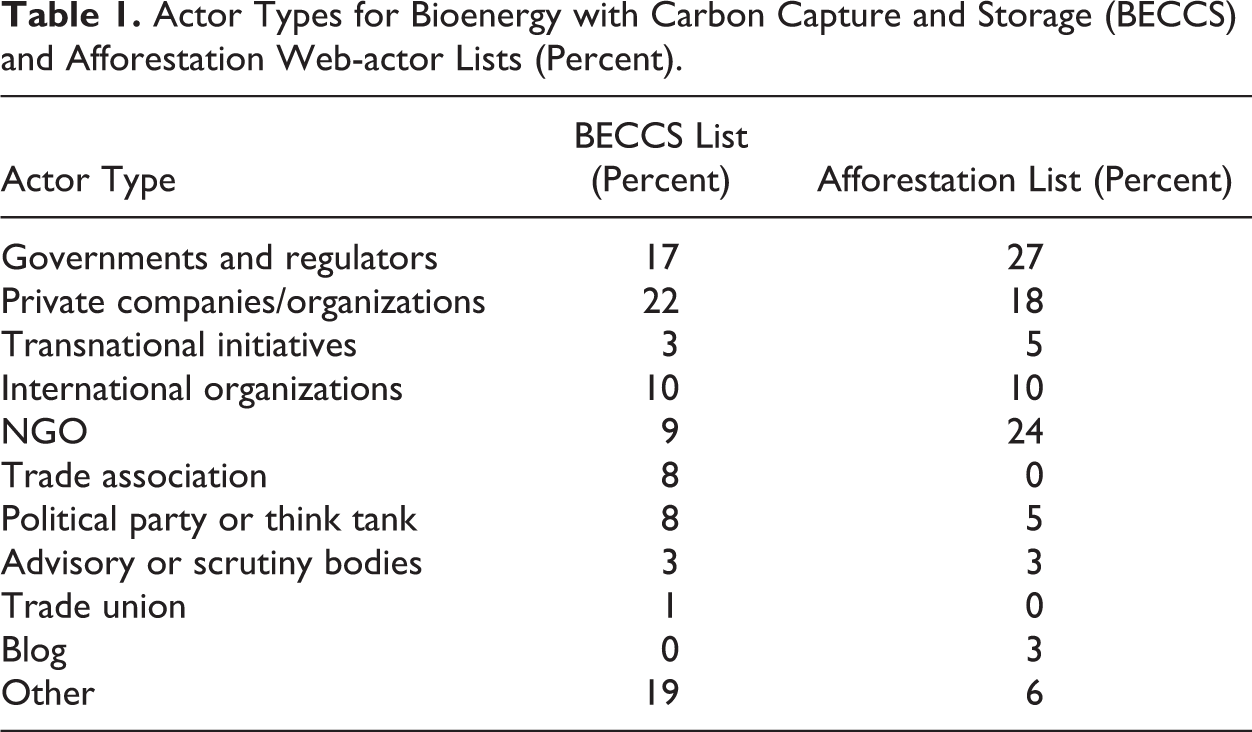
Government and industry groups are well represented in actor lists returned by both BECCS and afforestation queries (see Table 1 for breakdown). Clear differences emerge around NGOs, which feature far more prominently in the afforestation list. The BECCS list contains a large number of organizations that we coded “other,” all of which could be said to be mediators between science and society, and include research institutes and organizations (e.g., Centre for International Forestry Research or the UK Energy Research Centre), learned societies (e.g., the Royal Society), and science and technology assessment agencies (e.g., the UK’s Energy Technologies Institute). A smaller proportion of sites on the afforestation list were classified as “other,” which (like “other” actors in the BECCS list) largely comprise organizations mediating between science and society, including independent research centers (e.g., Centre for International Forestry Research), science-led climate activism (e.g., Ocean Foresters), and learned societies (e.g., Federation of American Scientists). Notably, for a digital methods study, very few blogs were returned (none from BECCS queries) and the three blogs returned from afforestation queries all belong to organizations.
Actor Types for Bioenergy with Carbon Capture and Storage (BECCS) and Afforestation Web-actor Lists (Percent).
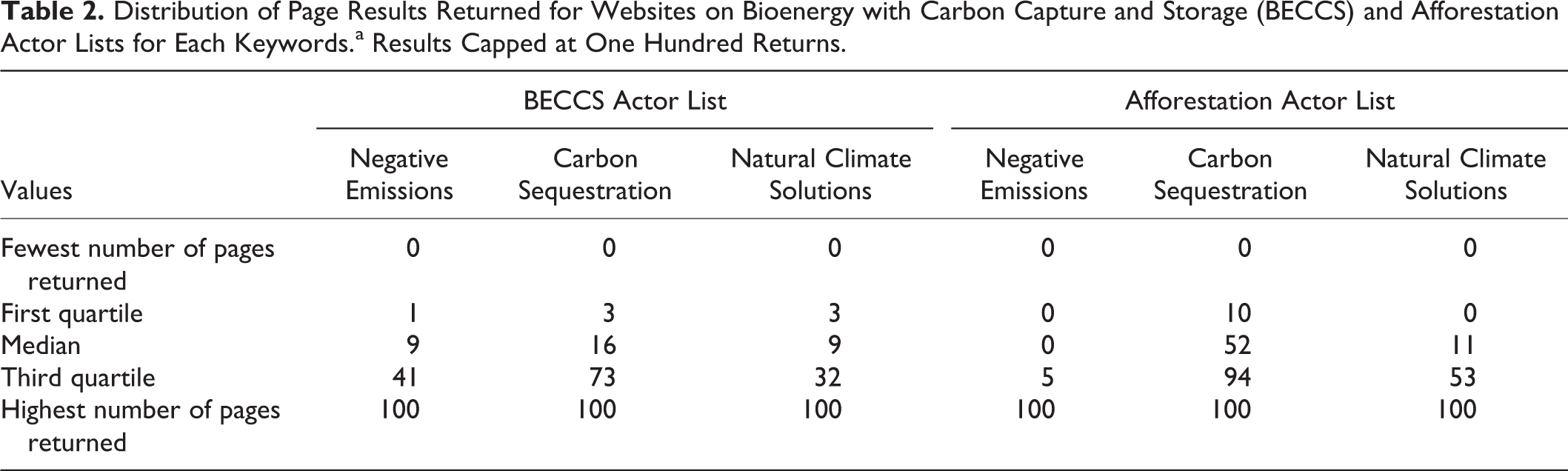
When these lists are queried for the [“negative emissions”] and [“nature-based solutions”/“natural climate solutions”] (herein NCS) keywords, we can detect patterns of alignment between different actors. Table 2 shows the distribution of results returned for each keywords when applied to the domains on BECCS and afforestation actor lists (capped at 100 results). The keywords “carbon sequestration,” a term that does not map neatly onto oppositions between natural/engineered CDR, resonates with more actors in each list than either of the more partisan keywords. Both “negative emissions” and NCS keywords appear somewhat resonant with the BECCS actor list. By contrast, the keywords “negative emissions” hardly resonates at all with afforestation actors.
Distribution of Page Results Returned for Websites on Bioenergy with Carbon Capture and Storage (BECCS) and Afforestation Actor Lists for Each Keywords.a Results Capped at One Hundred Returns.
We visualized this data using word clouds to show the relative visibility of individual actors on each list (Figures 1 –4).
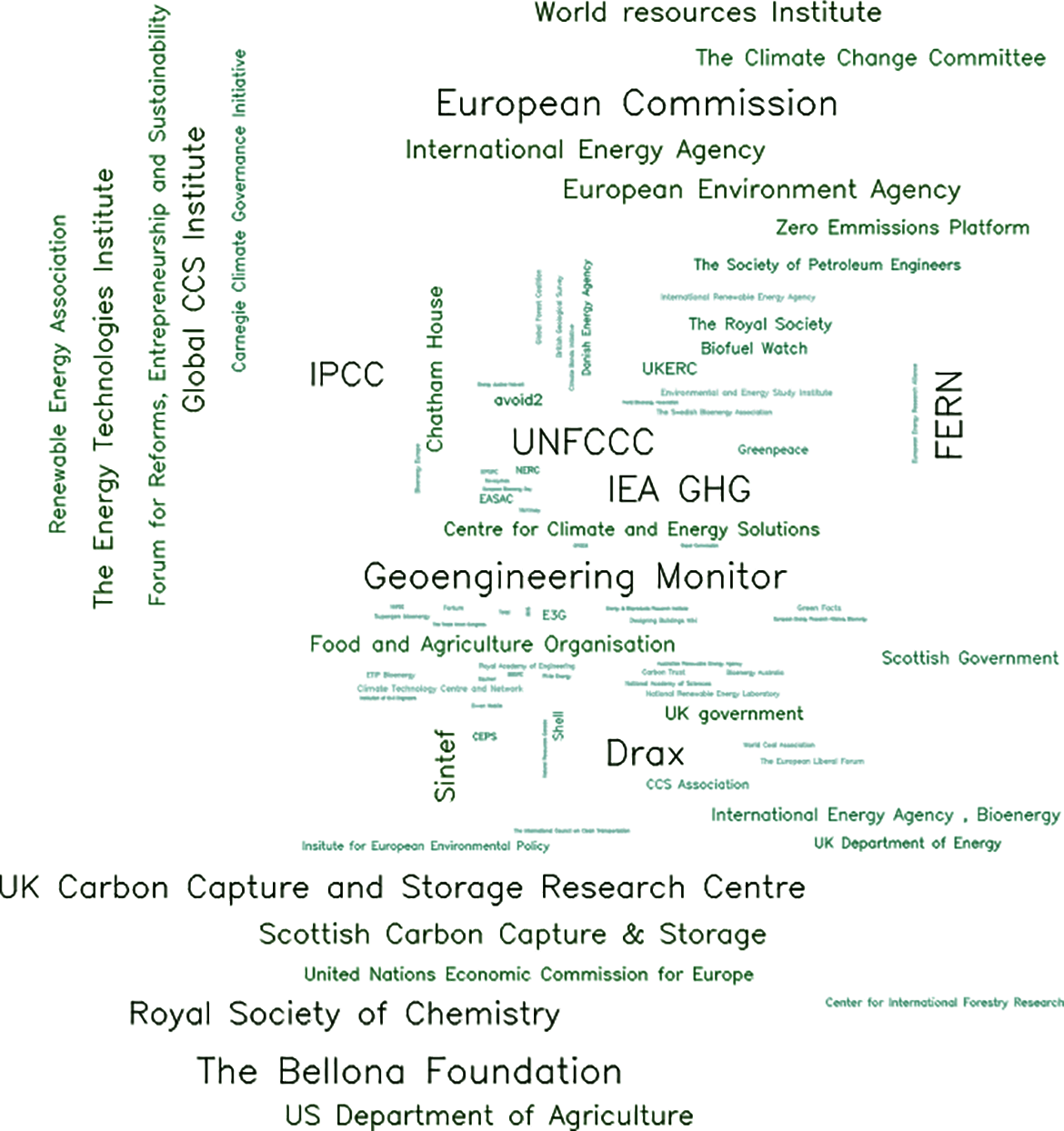
Word cloud showing resonance of keywords [“negative emissions”] on bioenergy with carbon capture and storage actor list. Random layout. Names sized by web pages returned for keywords (0–100), visual scale of 10-1. High-resolution image available on request.
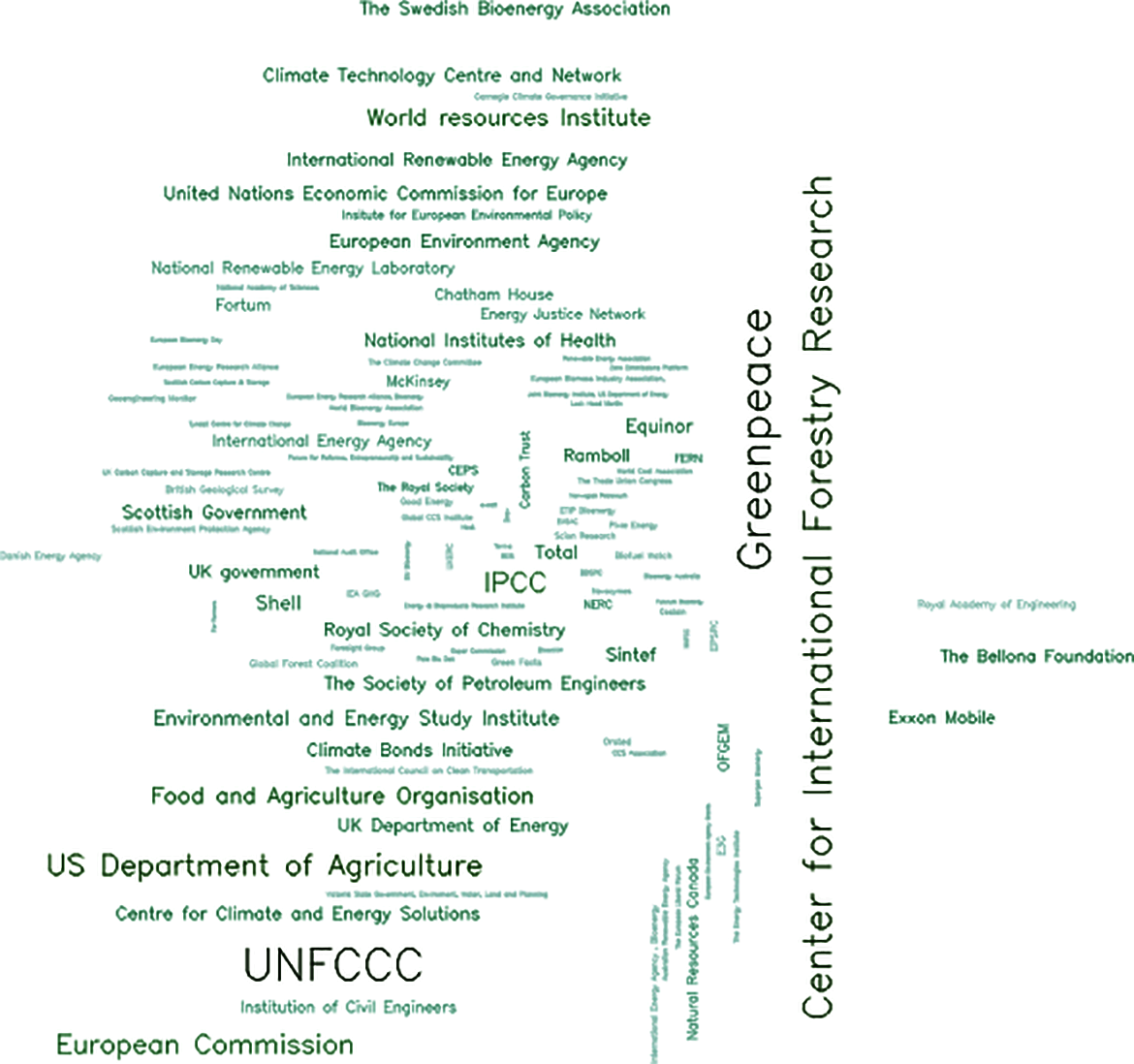
Word cloud showing resonance of keywords [“natural climate solutions”] on bioenergy with carbon capture and storage actor list. Random layout. Names sized by web pages returned for keywords (0–100), visual scale of 10-1. High-resolution image available on request.
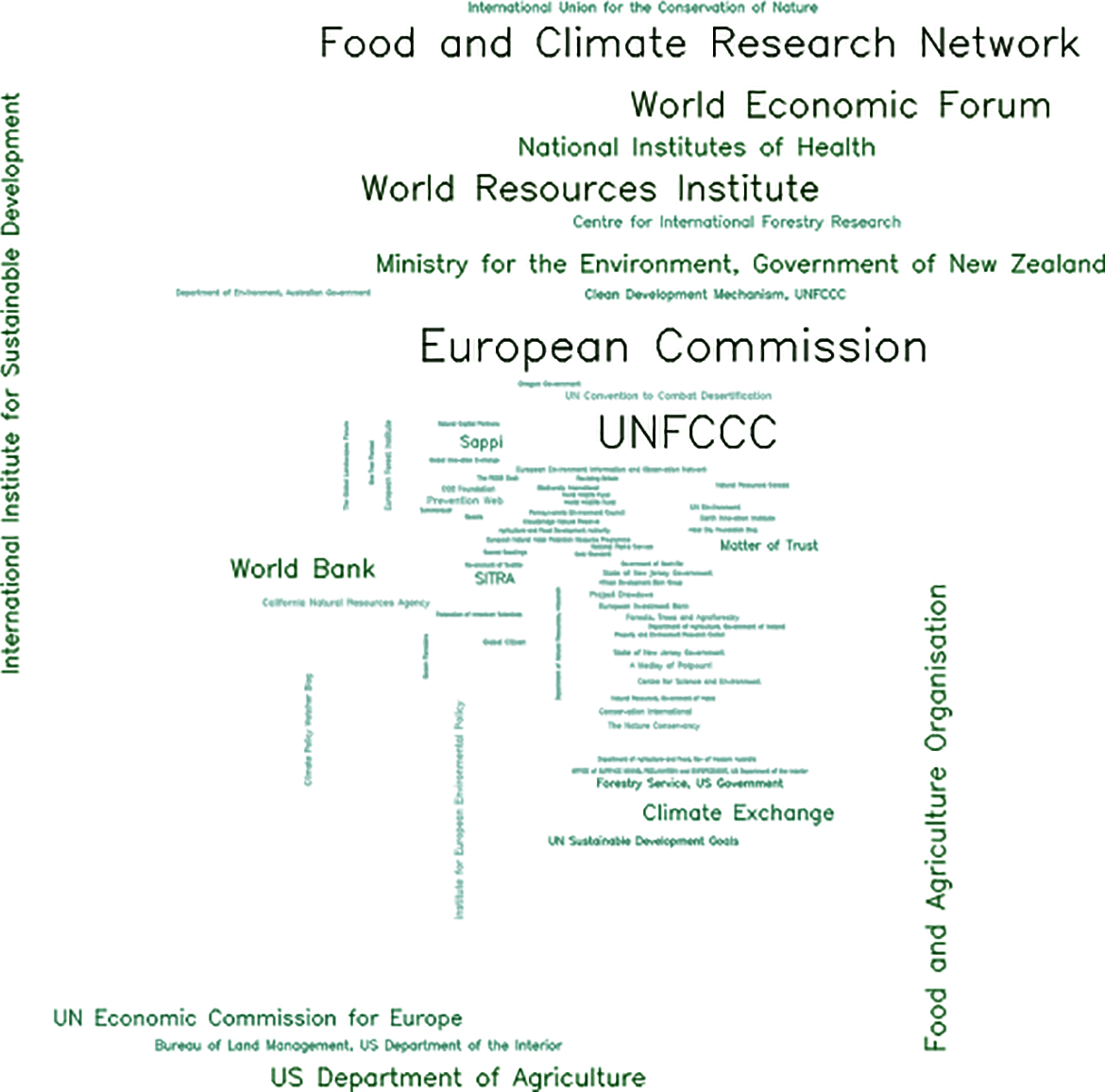
Word cloud showing resonance of keywords [“negative emissions”] on afforestation actor list. Random layout. Names sized by web pages returned for keywords (0–100), visual scale of 10-1. High-resolution image available on request.
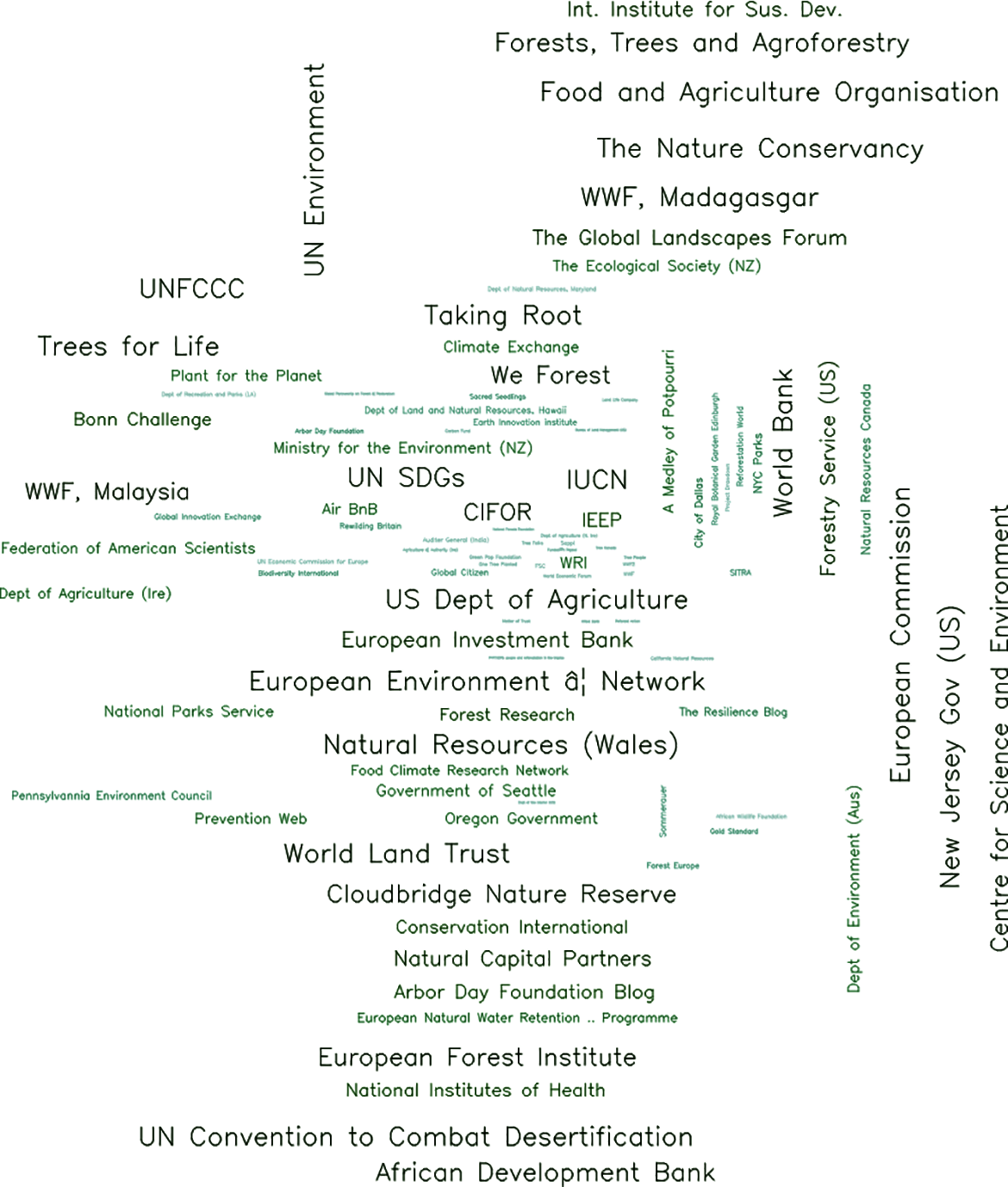
Word cloud showing resonance of keywords [“natural climate solutions”] on afforestation actor list. Random layout. Names sized by web pages returned for keywords (0–100), visual scale of 10-1. High-resolution image available on request.
The word clouds constructed from the BECCS actor list suggest some distinct alignments of actors that loosely correspond to climate policy differentiations between energy (“negative emissions” word cloud) and land sectors (NCS word cloud). Visible in the former word cloud are the International Energy Agency, power company Drax, the UK Carbon Capture and Storage Association, and other CCS-related organizations. Visible in the NCS word cloud are the Food and Agriculture Organization, the Centre for International Forestry Research, the US Department of Agriculture, and the European Environment Agency. Some actors, however, appear conspicuously out of place in relation to such thematic groupings: Fern, the forestry NGO, appears prominent in the “negative emissions” word cloud while Shell appears prominent in the NCS word cloud. The latter examples suggest that actors may use “negative emissions” and NCS keywords for a variety of reasons, for example, for commercial publicity 12 or policy critique. 13
Such thematic distinctions appear much harder to draw for the word clouds constructed from the afforestation actor list. Of the few actors on the afforestation list using the keywords “negative emissions” most also appear in the BECCS list, for example, the UN Framework Convention on Climate Change (UNFCCC), the European Commission, and the World Resources Institute. In contrast, the NCS keywords returns a multitude of actors from the afforestation list, across actor categories. This illustrates two key points: first, that while “negative emissions” is a keywords that is central to CDR policy debates, it does not appear to resonate with afforestation actors, suggesting that the latter are disconnected from (or at least do not engage with) a key discourse in contemporary climate policy. Second, that the NCS keywords resonates with heterogeneous actors suggests that this keywords is used flexibly and may have multiple associations, likely owing to the fact that afforestation is a long-standing object of climate science and politics (even if in the context of CDR debates it is primarily deployed for offsetting, rather than for net removals of, atmospheric CO2).
From the “coarse signs” generated by search engines, we can draw out some key points that problematize the simple oppositional framing of CDR debates. While we can draw contrasts between the actor types that populate BECCS and afforestation actor lists, many actors can be classified according to off-the-shelf categories of policy analysis. Actors that do not fit within policy analysis typologies appear primarily to be organizations mediating between science and society. The latter are particularly conspicuous on the BECCS actor list and may reflect asymmetries in science-policy dynamics relating to CDR research, for example, economic incentives to stimulate research and development of BECCS but not afforestation (see Nemet et al. 2018). The resulting view of the searchable-web is one dominated by organizational publicity. This is in part an artifact of our method, which screened out many sites of online social interaction such as wikis or social media platforms. Yet, the relative comprehensiveness of climate policy analysis categories suggests a view of the debate centered on institutional problem definitions of CDR and governance-related topics. Nonetheless, the keywords “carbon sequestration” appears more resonant with both BECCS and afforestation actors than either “negative emissions” or NCS keywords. This finding raises questions about the extent to which oppositional framings of CDR might overstate the differences between natural and engineered CO2 removals. Moreover, it suggests that interpretations associating “negative emissions” and NCS keywords with strongly partisan positions toward CDR might obscure other dynamics of engagement between actors in these debates.
Devices of Engagement: How UK-based Actors Evidence and Contest CDR Futures
The web publicity analyzed above affirms the visibility of natural and engineered framings of CDR. But our analysis also suggests that these framings do not account entirely for the ways in which BECCS and afforestation actors engage with CDR. The following analysis of literature published by UK-based actors focuses on how oppositional framings of CDR (described above) are complicated by the devices that actors use to evidence and contest claims about the feasibility of BECCS and afforestation.
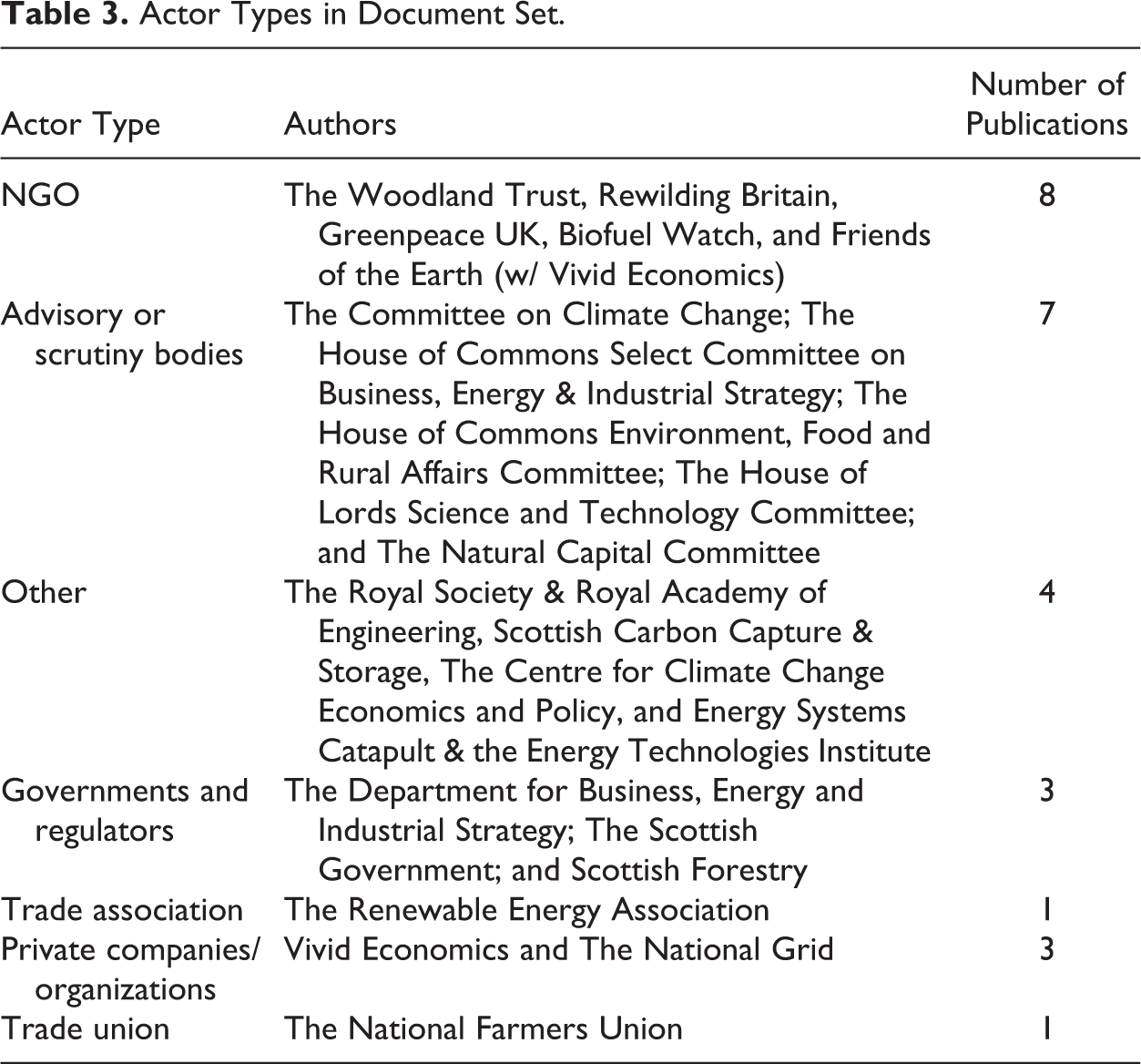
The lists used to search for documents comprised very varied kinds of actors, including, for example, local conservation groups and community organizations. However, our search only returned documents from organizations that could easily be described as policy elites and groups typically engaging with established policy processes. NGOs are the largest actor type in the corpus (see Table 3). Several reports (by NGOs, government and advisory bodies) are produced in collaboration with consultancies, Vivid Economics is one such consultancy involved in three reports. This fact highlights both the prominence of particular economic expertise and its deployment by diverse actors. Of the UK-based actors we find online, 14 ten are authors in this document corpus. These actors feature principally in the BECCS online actor list, with only the Rewilding Britain and Climate Exchange featuring in the afforestation actor list. Most documents in the corpus address both BECCS and afforestation together rather than in isolation: of twenty-eight documents, BECCS features in twenty-one and afforestation in twenty.
Actor Types in Document Set.
Reports by the UK’s Committee on Climate Change (CCC), a statutory government advisory body created under the Climate Change Act, were cited in almost all documents. Both the CCC (2019) and the Royal Society (Royal Society and Royal Academy of Engineering 2018) reports present comprehensive assessments of the UK’s total CDR potential and the feasibility of BECCS and afforestation alongside a range of other CDR approaches. Both reports offer assessments of quantities of CDR from BECCS and afforestation specified in terms of Mt CO2 pa (millions of tons of CO2 per year) by 2050. The CCC project CDR removals from BECCS of between 20 and 51 Mt CO2 pa and up to 22 Mt CO2 pa afforestation from afforestation (between 15 percent and 17 percent increase in forest cover). The Royal Society specifies total feasible CDR removals from the UK at 130 Mt CO2 pa, with removals from BECCS ranging from 20 to 70 Mt CO2 pa and afforestation removing 15 Mt CO2 pa. Given the authoritative status of these targets amongst UK-based actors, it is notable that the CCC’s Net Zero report explicitly distances itself from the assumptions about BECCS made in the scenarios of the IPCC’s Fifth Assessment (pp. 26, 98). This distancing move highlights the epistemic ambiguity of global climate assessments, long discussed by STS researchers (Jasanoff et al. 1998), and suggests that disputes over CDR targets may have as much to do with the contested political authority of assessment regimes as their scientific legitimacy.
In analyzing how the feasibility of BECCS and afforestation is evidenced and contested, we identified three “devices” widely used to engage debates about CDR. These devices appear central to the capacity of actors to engage with debates about CDR and also highlight the particular kinds of techno-economic expertise required to participate.
Carbon Accounting Techniques
The majority of documents in the corpus either utilize or contest the CDR projections of the CCC and Royal Society reports as the basis for their claims about BECCS and afforestation. Those adopting the CCC’s CDR targets include the Renewable Energy Association (2019), the Woodland Trust (2020), and the Business, Energy and Industrial Strategy Committee (2019). In contrast, WWF (2019) contest the CCC’s targets for CDR, projecting a net-zero target for 2045 that could involve far lower rates of removal from BECCS (as low as 15 Mt CO2 pa) and more radical “behavior change” in society. Another approach is taken by Rewilding Britain (2019) who draws on the CCC’s analysis but focuses only on removals from natural climate solutions (total 47 Mt CO2 pa), arguing that BECCS risks creating land-use conflicts. Elsewhere, the National Farmers’ Union (2019) makes clear its support for the government target and includes CDR targets—BECCS 22 Mt CO2 pa, afforestation 0.7 Mt CO2 pa—though the report neither references any external sources nor clarifies how these targets are calculated.
The accounting concept of “net zero” is also used more discursively. Greenpeace’s (2019) Climate Manifesto, an intervention in the UK’s general election of that year, uses the term “net zero” throughout but cites neither the CCC’s nor the Royal Society’s CDR assessments and makes no claims about absolute (or relative) quantities of CO2 removals. Greenpeace’s conspicuously discursive use of the concept might appear disengaged from carbon accounting perspectives on CDR. However, it is notable that complexities of carbon accounting are not discussed in depth by any report in the corpus with the exception of the CCC’s Net Zero report which dedicates several chapters to the contingencies involved in calculating UK CDR targets, including the role international negotiations play in emissions reduction commitments, radiative forcing associated with different greenhouse gases, and the problem of not counting “consumption emissions.” Discursive uses of the term “net zero” may not engage with carbon accounting techniques but arguably also highlight how positivist approaches to CDR accounting can obscure the ways these measures are shaped in interactions between climate science and politics.
Scenarios and Counter-scenarios
Scenarios are a key device through which reports in the core corpus assess the feasibility of BECCS and afforestation to achieve CDR. The CCC’s (2019) Net Zero scenarios are described as Core, Further Ambition Options and Speculative Options, calculating the potential for emissions reductions in different economic sectors and the related quantities of “engineered” CO2 removals from BECCS. In the CCC’s scenarios, removals relating to afforestation are treated as part of the “land sector” rather than as “engineered.” The Royal Society’s scenarios, by contrast, simply comprise one Global and one UK focused which are nevertheless treated by some actors as authoritative assessments of overall technical potentials (e.g., Centre for Climate Change Economics and Policy 2019). Both of these approaches to scenario construction privilege quantitative comparison between different CDR approaches.
In contrast, the corpus also contains what we describe as “counter-scenarios” insofar as they reject simple quantitative comparison (e.g., a scale of ambition) and foreground social distinctions between different approaches to carbon sequestration. Two scenarios in WWF’s (2019) report, for instance, are titled “UK action” and “Collaborative action,” highlighting challenges of considering the UK’s CO2 emissions in isolation. Similarly, scenarios developed by the Woodland Trust (2020) describe two different approaches to afforestation: “Dash for Carbon” and “Nature@Work.” Counter-scenarios can also be found in a National Grid (2019) report that develops two primary energy transition scenarios, titled “Community Renewables” and “2 Degrees”—describing localized and centralized approaches, respectively—and a “Net Zero” scenario, a composite of the two that includes CDR from BECCS (from bioelectricity) and “natural climate solutions,” principally reforestation. These counter-scenarios challenge the notion that CDR via BECCS and afforestation is fungible in the way assumed in techno-economic analysis (McLaren et al. 2019) and therefore draw attention to the artifice involved in making these two approaches commensurable.
Demonstration Projects
Demonstration projects have been widely seen as critical to the innovation of CDR approaches (Nemet et al. 2018), and in 2019, UK funding councils announced a joint call for demonstrator projects (UK Research and Innovation 2019). Within the corpus of literature two demonstration projects relating to BECCS and afforestation stand out as a focus of debate about the feasibility of CDR: (1) a BECCS demonstration by power company Drax (an actor that is visible in the web publicity maps, see Figure 1) and (2) the New Northern Forest project backed by the UK government. We briefly describe here how these demonstration projects are addressed in the corpus to evidence and contest CDR projections.
In December 2018, the UK power company Drax launched what it claimed was the first demonstration of BECCS in Europe (Drax 2019). The demonstration is based at its former coal power station, currently, the largest electricity-producing power station in the UK, and involves capturing, but not storing, CO2 produced from bioenergy production (Drax 2019). In the last decade, Drax has converted four of its six units to burn biomass, making it the largest biomass energy producer in the world, relying primarily on imports in pellet form from the Southern United States. Drax was also a leading actor in the ill-fated 2012 White Rose demonstration project that applied for funding under the UK government’s abortive 2012-16 £1 billion competition for CCS demonstration projects (National Audit Office 2017). Drax pulled out of the White Rose project citing reasons relating to business models that did not allow the capture of CO2 to be treated separately from its transport and storage (Business, Energy & Industrial Strategy Committee 2019). These demonstration projects have provided a focus for political contestation around BECCS in the UK on two principle fronts: first, the sustainability of imported biomass (i.e., its classification as a “carbon neutral” energy source; Biofuel Watch 2015; CCC 2018a) and, second, the failure of government programs to stimulate the development of CCS infrastructure (Business, Energy & Industrial Strategy Committee 2019; National Audit Office 2017). While several documents in the corpus oppose the large-scale importing of biomass for BECCS (Greenpeace 2019; Rewilding Britain 2019), none challenge the perceived need to rapidly develop CCS technologies.
A flagship project of proposed afforestation in the UK is the so-called Northern Forest (Woodland Trust 2018). The project is treated by a range of documents in the corpus as demonstrating the potential for afforestation in the UK to contribute to CDR (CCC 2018b; Royal Society and Royal Academy of Engineering 2018). Despite this, the announcement of the project in 2018 by the then Prime Minister Theresa May did not proclaim it as a CDR demonstration but principally as a boost for economic prospects in northern England (UK Government 2018). A key feature of the project is its governance which is not centralized in a single institution: the “forest” is not conceptualized as a single continuous entity but rather as multiple tree planting efforts distributed across a geographic region that may include urban tree planting (Woodland Trust 2018). In broader policy debate, the issue of land-use change for tree planting is highlighted as critical in determining the capacity of forests to perform CDR (CCC 2018b; Natural Capital Committee 2020). However, despite all major political parties making explicit promises relating to planting trees in the UK’s 2019 general election, there has so far been very limited engagement with questions of how the land required will be identified (Friends of the Earth 2020).
The analysis presented here highlights that UK-based actors appearing on opposing sides of online maps (e.g., Rewilding Britain and Drax) deploy common devices such as carbon accounting techniques and scenarios (although not necessarily their own) to evidence and contest claims about the feasibility of CDR. These devices illustrate that much engagement with BECCS and afforestation does not neatly fit into oppositional framings of CDR debates. Both BECCS and afforestation require large-scale land-use change and it is notable that virtually all actors, even those promoting rewilding, justify land use principally in economic terms. The devices of engagement identified therefore typically imply techno-economic expertise. This fact is also apparent, as noted, by the conspicuous presence of the consultancy Vivid Economics, as an author of several documents in the corpus. While these devices of the engagement construct the basis for organizing science-policy interactions, they also empower certain kinds of expertise. As Greenpeace’s more discursive use of the term “net zero” highlights, overly reductive techno-economic approaches have the potential to contribute to perceived trade-offs between CDR and ongoing climate mitigation (see also Cox, Spence, and Pidgeon 2020; Markusson, McLaren, and Tyfield 2018).
Discussion and Conclusions
Attempts to locate publics concerned with CDR developments, and articulate their views, have been undertaken by a variety of social scientists—as well as government agencies, industry, and civil society groups—often through invited public engagement formats and perceptions studies (see Waller et al. 2020). In this paper, we have moved beyond such accounts by searching for issue publics emerging from interactions between actors already engaging with CDR and related topics, deploying emerging STS approaches to mapping controversies and engagement. Our analysis finds traces of issue publics that suggest controversies over CDR, which currently center on actors with techno-economic expertise, are unlikely to be containable within science-policy institutions and governance frameworks; not least because organizing categories distinguishing natural from engineered CDR appear both politicized and flexibly used practice. We now discuss three main insights from our analysis in terms of the dynamics of emerging controversies around BECCS and afforestation, the question of public involvement with these controversies, and implications for digital methods as approaches for mapping controversies, publics and public issues in emerging areas of technoscience.
Controversies over CDR have been widely framed as contestations over the role of technological solutions in addressing future climate change. In techno-economic assessments, which predominate in climate policy analysis (Waller et al. 2020), the problem of public engagement is externalized as one of legitimating policy options and constructing the social basis for acceptance of technological and environmental change. Our findings suggest that such externalization may contribute to further antagonisms over the scientific credibility of CDR, working against the aims of involving publics in climate policy processes. Distinctions between natural and engineered CDR are, as our analysis shows, invoked in different ways by a variety of actors engaged with the two CDR approaches studied here, BECCS and afforestation. In many policy-focused accounts, such as the assessments of the UK’s CCC, these distinctions simply map onto different sectors in carbon accounting frameworks. In more partisan accounts, such as those of actors promoting NCS approaches as normatively desirable, they represent a critique of the notion that CO2 removals are fungible, counting equally regardless of the removal method. In both policy-focused and more partisan accounts, BECCS has provided the primary object of controversy and often a metonym for engineered CDR. Afforestation is typically evaluated as having a higher “technology readiness level” or is treated as a long-standing “natural solution” and therefore a CDR method that is proven rather than speculative (i.e., unlike BECCS).
A key finding of our analysis, however, is that in practice much actor engagement does not map neatly onto oppositions between natural and engineered CDR. Controversies over CDR, we suggest, are neither easily reducible to disagreements over policy options nor explained away by reference to “irrational” social forces (e.g., nefarious motivations of actors promoting climate engineering). Rather, we suggest that CDR controversies amplify epistemic ambiguities around knowledge of climate change and challenge tendencies in both climate policy and activism to impose strict demarcations between scientific problems and public issues (Jasanoff et al. 1998; Geden 2016; Pallett and Chilvers 2013). Our findings therefore provide empirical support for arguments that the problem of constructing politically independent assessments of climate change is not only a matter of governance but inseparably a social and epistemological concern about the ways in which topics like CDR become defined as issues for scientific assessment (Beck and Mahony 2018).
Controversies over CDR thus raise questions about the issues that should be taken into account when assessing the role of CDR in climate futures. Our analysis maps a fractured picture of engagement with CDR. Afforestation and BECCS actors share an interest in carbon sequestration, but in their self-publicity on the web, they appear to align quite differently in relation to competing keywords. In both online and off-line analysis, we found evidence of substantive engagement with CDR amongst elite actors across policy, industry, and civil society. However, such engagement is both highly organized and reliant on devices that privilege techno-economic expertise. From this, it appears that widespread public involvement is not yet evident around CDR, despite our analysis coinciding with a period of heighted popular public debate and engagement in climate politics more broadly (e.g., Hulme 2019).
Limited public engagement with CDR is not necessarily simply explained by a lack of awareness, as often highlighted by perceptions studies (Thomas, Pidgeon, and Roberts 2018). Our analysis has shown how it may also plausibly reflect a decision to disengage (e.g., in the case of afforestation actors or Greenpeace) from framings of CDR as a climate solution, or key forms of publicity (e.g., carbon accounting, scenarios, and demonstrators) acting as devices of disengagement. In addition to feasibility issues identified in public and stakeholder perception studies of CDR (e.g., themes like equity and justice, land-use conflicts, naturalness: Cox, Spence, and Pidgeon 2020; Forster et al. 2020; see also Waller et al. 2020), through opening up to the ways in which actors are already engaging, our analysis has traced issues that arguably more closely emphasize the situated politics of CDR. Issues raised in our analysis of documents include contestation over how climate futures involving BECCS/afforestation are socially organized (whether centralized or distributed, involving more or less social change, and so on), what gets excluded from assessments (e.g., “hidden” supply chain and overseas emissions), the hybridity of BECCS and afforestation including complexities of land use, through to questioning the assumed techno-economic basis of CDR itself. Our study thus emphasizes how all attempts to search for a public are partial, format participation and public issues in different ways, and should be viewed as part of wider ecologies of public engagement and publicity dynamics, in this case, around CDR and wider climate politics (Chilvers, Pallett, and Hargreaves 2018).
The web has often been described as an “anticipatory medium” (see discussion in Rogers 2013) and the issue mapping approach developed in this study aimed, in part, to anticipate issues likely to shape future developments in CDR. By mixing web-querying with document analysis, our mixed-methods approach compared the “coarse signs” generated by web-queries against a politically situated debate. In contrast to the findings of many digital methods studies, particularly on climate-related issues (Chilvers, Pallett, and Hargreaves 2018; Pearce et al. 2019; Rogers and Marres 2000; Venturinni et al. 2014), we identified few actors that could not be easily classified within an “off-the-shelf” typology of policy actor-types. The exceptions were predominantly science-society intermediary organizations, highlighting that even web-based material on afforestation and BECCS is highly science-centric. In part, these results likely reflect ongoing changes in web design toward platform architectures and away from websites as the primary mediators of online social interaction (Rogers 2013, 2018). But they also highlight the challenge of repurposing digital media-technologies to map issues where the objects of controversy, in our case BECCS and afforestation, are conspicuously artifacts of an assessment regime. That our search for documents returned items predominantly published by policy elites arguably reveals much about the ways in which BECCS and afforestation currently both perform as technologies that enable policy actors to (all too easily) “solve” the problem of governing the changing climate. To a certain extent, the maps presented here could be read as tracing the contours of an emerging field of climate policy. But, as the results of an issue mapping study, we argue that our findings can also be read more critically as illustrating the provincial character of much current debate about CDR and evidencing the tendencies of policy elites to prioritize problem-framings amenable to techno-economic reduction over engaging with the complexity of public issues relating to the changing climate.
Footnotes
Appendix A
Appendix B
Authors’ Note
An early version of this paper was presented at the workshop “Climate Engineering: Opportunities and Challenges for Responsible Research and Anticipatory Governance” on May 14–16, 2019, organized by Silke Beck.
Acknowledgments
The authors gratefully acknowledge discussions with colleagues involved on the project “Feasibility of Afforestation and Bioenergy with Carbon Capture and Storage for Greenhouse Gas Removal,” Nem Vaughan, Andy Jordan, Irene Lorenzoni, and Clair Gough. We also thank the two anonymous referees.
Declaration of Conflicting Interests
The author(s) declared no potential conflicts of interest with respect to the research, authorship, and/or publication of this article.
Funding
The author(s) disclosed receipt of the following financial support for the research, authorship, and/or publication of this article: The Natural Environment Research Council funded the research reported on in this paper (grant number: NE/P019951/1). The research also benefited from UKERC Phase 4 funding (EPSRC grant reference EP/S029575/1).
