



Abstract
Documents, in particular identity cards, mediate relationships between individuals and institutions. Their materiality matters and actively impacts how states govern populations and their movements. In this paper, I examine one such object, the Romanian identity card. Focusing on its temporality and agency, I explore how objects and technological procedures enact race. In Romania, people without an address or proof of residence—many of them members of segregated Roma communities living in deep poverty—can only receive a temporary identity card, the Carte de Idenititate Provizorie (CIP). CIP holders do not enjoy full citizenship and are deprived of various rights, such as the right to travel without a passport within the European Union. They are also exposed to heightened surveillance as they must apply annually for a new CIP. Starting from the material object of the CIP, I explore how race comes into being as a relation at the intersection of various temporalities that are folded into the rules and bureaucratic practice entailed in its issue. I offer the concept of “permanent temporality” to analyze how racialization occurs in practices of governing people and their movement in Europe.
Introduction
In the past decade, science and technology studies (STS) scholars have developed a vibrant body of research on race (see, e.g., Koening, Lee, and Richardson 2008; Whitmarsh and Jones 2010). Analyzed primarily in relation to (the histories of) genetics and biomedical and forensic technologies (Montoya 2007; Wade 2010; M’charek 2014), race has emerged in these studies as an unruly and “slippery object.” It has also been described as an “absent presence” enacted by situated technologies of belonging (M’charek, Schramm, and Skinner 2014a). In this paper, I add to this scholarship by focusing on a rather unassuming technology, identity (ID) cards in Romania, a European Union member state. In particular, I examine the discriminatory effects of this sociotechnical system of governance and how it contributes to the enactment of race and racialization (Schinkel 2009; M’charek, Schramm, and Skinner 2014b; De Genova 2017; van Baar 2018). “Racialization” here refers to the cementing of deterministic and essentialist attributes to certain groups by means of discriminatory (state) practices as well as the effects of such practices (M’charek, Schramm, and Skinner 2014b). While these state practices may be presented as neutral bureaucratic procedures, objects such as ID cards are far from being neutral or transparent tools of governance. They are actively involved and complicit in racializing particular populations. To attend to the politics of such objects, in this paper, I turn toward their materiality and the heterogeneous temporalities they articulate.
Social scientists generally study race in relation to space (Douglas 1966; Picker 2017). However, a handful of prominent scholars argue that time is equally important. Fabian (2014) has famously argued that spatial distancing goes hand in hand with a temporal othering as well. Providing a spatial understanding of cultural distance, Bhabha (1991) uses the notion of “race” time. Drawing on the work of Fanon ([1967] 1970), he argues that spatial distance enacts an interruptive time lag in the “progressive myth of modernity” (Bhabha 1991, 209). Those who are far from the center, for instance, on the periphery of Europe, are also considered to lag behind temporally, as if they were living in earlier times. While these perspectives offer an important critique of modernistic, developmental time, they still imagine time as linear, with the past behind and the future ahead.
STS discussions about techno-scientific advancements have long been concerned with time and temporality (Bowker 1995; Adams, Murphy, and Clarke 2009; Kowal, Radin, and Reardon 2013; M’charek 2014). Turning either toward the future (Adams, Murphy, and Clarke 2009) or the past (Kowal, Radin, and Reardon 2013; Bauer 2015), these articles examine time as part of analyzing certain kinds of normativities. However, time itself is rarely questioned. One notable exception is the work of M’charek (2014, 31) who, discussing the history of a DNA sequence, argues that time is “gathered together and folded in objects.” And it is precisely through this folding of time, she explains, that the history of race can be recalled in objects. In her approach, time ceases to be linear or singular; instead, it brings about different ways of delineating racial others in Europe, with various effects (M’charek, Schramm, and Skinner 2014a).
Race is thus a “topological concept, an object that is spatially and temporally folded in distributed technologies of governance” (M’charek, Schramm, and Skinner 2014b, 468; emphasis added). Serres and Latour (1995, 60) use the metaphor of a crumpled handkerchief to explain the topological notion of time: “If you take a handkerchief and spread it out in order to iron it, you can see in it certain fixed distances and proximities.…Then take the same handkerchief and crumple it, by putting it in your pocket. Two distant points are suddenly close, even superimposed.” Time thus surpasses past, present, and future to entail more complex entanglements of different temporalities. With this framework, we see race as a “relational object” (M’charek 2013) arising precisely through the temporal and spatial relations articulated in objects like ID cards. This approach also sensitizes us to attend carefully to objects and their temporal agency to understand how they contribute to the production of racialized identities.
Identity documents have been widely analyzed as a means of surveying and governing populations (see, e.g., Torpey 2000; Lyon 2009). However, the specific material dimension of these documents has attracted less attention (but see Hull 2012; Kafka 2009). Bureaucratic artifacts not only solidify the relation between people and authorities (Torpey 2000) but also co-constitute social order. As STS scholarship shows, objects are not neutral; they participate in sociality (Winner 1980; De Laet and Mol 2000). The materiality of identity cards impacts governance, the law, and citizenship (Kafka 2009). Furthermore, recognizing objects’ history and temporality is crucial for understanding the politics of race they articulate (M’charek 2014). Inspired by Hull (2012) and Kafka’s (2009) work, and drawing on STS and material semiotics (Mol 2002; Law 2009), I scrutinize the issuance and materiality of ID cards to analyze how race is enacted in documenting citizens in Romania.
The Romanian identity card may seem a neutral document, but analyzing its issuance and the versions of times it enacts illuminates its politics. I commence by discussing three aspects of this process: the documents’ material affordances, the ID photo, and the database. Based on these cases, I identify three distinct temporalities: the linear temporality of the materials, the circular temporality of citizenship, and, finally, the knotted temporality of databases. Relating these to the group of Romanian citizens who only possess a temporary ID card, I conclude with a discussion of the time of the racial other, arguing that permanent temporality arises at the intersection of these three overlapping temporalities.
Empirically, I ground my analysis in field observations that I carried out in November and December 2016 at two local departments where Romanian ID cards are issued. Granted an official research permit, I was allowed to observe the daily routine of these departments for six weeks. The city where I conducted my fieldwork is a medium-sized town in Romania (with a population of about 300,000 inhabitants) and has a level of ethnic diversity that more or less reflects the national average of the country. 1
Racialized Minorities in Romania
Distinct population groups brought under the umbrella term “Roma” 2 live scattered across European countries, often suffering state oppression, exclusion, and human rights abuses. Social scientists have studied the securitization of “the Roma” and the irregularization of their citizenship, and how such processes depend on ethnic and racial profiles (see, e.g., van Baar 2018). These profiles are produced by everyday bureaucratic practices involved in governing populations. Assembling these profiles, however, is not an unproblematic process. In Romania, for example, to avoid accusations of discrimination against minorities, state institutions do not register ethnic, religious, or other identity markers in the national citizen registry. Therefore, “the Roma” does not exist as a separate category in this registry. However, in everyday bureaucratic practices, certain people are still identified as “Roma,” which rather than marking an ethnic category, refers to a marginalized and racialized group of people (Plájás, M’charek, and van Baar 2019). In practices of identifying and registering citizens for state records, “the Roma” is configured through a set of differences, such as territorial segregation, phenotypic appearance, smell, and dialect, as demonstrated below.
In scholarship on Roma communities in Romania, ghettoization and the formation of Gypsy camps have been analyzed in terms of spatial segregation. In Racial Cities, for example, Picker (2017) discusses the emergence and maintenance of “Gypsy urban areas” (shantytowns primarily inhabited by Roma) throughout Europe to argue that it is the logic of race that delineates these deprived and segregated spaces from their surroundings. In their recent volume, Vincze and colleagues (2019) offer many examples of how the emergence and maintenance of impoverished, marginal, urban spaces—among them Roma ghettoes—are linked to social class formation and racialization, encouraging us to understand this as a particular political economy of space.
Spatial segregation also impacts how people are registered in state records and their legibility to welfare. Vrăbiescu (2015, 2017) reports on the nondocumentation of citizens and the revocation of documents in Romania, affecting mainly those belonging to marginalized and impoverished Roma minorities. These practices allow Romanian authorities to deny citizens access to healthcare or social benefits, and to withdraw from taking responsibility for them. Furthermore, they also permit the state to increase surveillance of such groups through targeted policing (Töpfer 2019) and to enforce restrictions on movement (van Baar, Ivasiuc, and Kreide 2019).
Mobility is contingent upon identity, as exemplified in the case of the Roma, who are imagined as itinerant. 3 Suspicion about their mobility and heightened surveillance by means of recurrent identification contribute to turning them into a (racial) other. It is precisely through the practices of spatial segregation and marginalization, argues Picker (2017), that “the Roma” as a racial category comes into being. This spatial delineation converges with discursive and pictorial representations (van Baar and Kóczé 2020), scientific accounts, and political actions that intensify the securitization and racialization of “the Roma” (van Baar, Ivasiuc, and Kreide 2019). In this paper, I add the dimension of time and temporal othering that occurs at the level of the materials and technologies involved in registering citizens and issuing identity documents.
The CIP
It is noon, the time for a shift change in the Romanian office for population management called “Evidenţa Persoanelor şi Administrarea Bazelor de Date.” 4 An administrative official, 5 who has been taking ID photos since 8:30 a.m., starts to gather her stuff from the table. Her colleague, who will work through the afternoon, enters the office and comes behind the counter. “Pretty relaxed day so far, isn’t it?” she says. “Did many CIPs come in this morning?” Her colleague, now finished packing her bag, nods while putting on her dark-gray woolen coat: “Indeed, very relaxed. And only one CIP so far.” As I am not allowed to take photos, I quickly draw a sketch of the room, depicting three tables in a row, placed next to each other, with an administrative official sitting behind each of them. The first two officials are checking and approving (or rejecting) documents brought in by citizens, while the third takes ID photos (see Figure 1). But why do these officials refer to the number of CIPs, when they assess how quiet or busy the day was? And what exactly is a CIP?
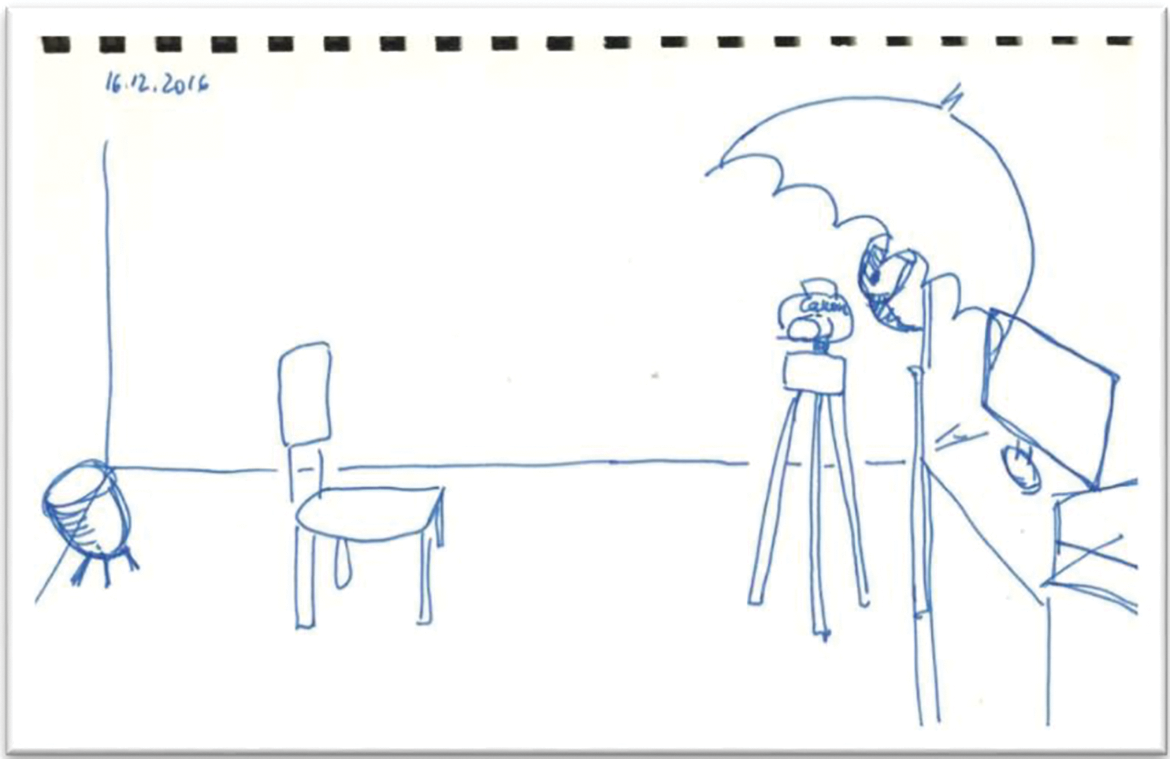
The space where I conducted my fieldwork (scanned from field notes).
There are two types of identity cards in Romania. One is a regular card, a so-called electronic identity card. The other is temporary, called “Carte de Indentitate Provizorie,” abbreviated as CIP. The CIP is issued when the documents necessary for a regular identity card, in particular those proving an address, are not “in order.” The inability to document residence is common among impoverished groups residing in marginal areas where dwellings are either not registered at the cadaster office or are not officially acknowledged as housing (Vincze 2019, 64). Mireanu (2019, 116) calls this phenomenon “the housing paradox,” referring to the “shrinking societal space in which the Roma are allowed to live caused by proliferating gentrification of old city centers on the one hand and growing racism on the other.” In cities where Roma communities have been relocated to the outskirts and do not possess proper documents, they are given CIPs, or rather they “are CIPs,” an expression that administrative officials frequently used. “A CIP” is thus synonymous with being one of “those,” “the Gypsy,” or “the Roma.” “Those,” to be sure, does not refer to the identity of an individual but rather produces a collective, one that is identifiable (and defined) in terms of poverty, number of children, occupation, and racial otherness (see also Plájás, M’charek, and van Baar 2019).
Although its name contains the word “provisional,” the CIP is the only kind of identity document that many people trapped in poverty will get in their lifetime (Vrăbiescu 2017). These documents are valid for one year at most, which means that CIP holders must return to the office to renew them annually. Their frequent office visits have several implications. First, state institutions can keep an eye on these residents by tracking their current address and civil status. Second, this process leads to the accumulation of a large amount of data, piled up in digital registers that are then used by other state institutions such as the Passport Department or the Directorate for Driving Licenses and Car Registration. Third, and most importantly, people who do not possess a regular ID cannot freely travel within the European Union, which curtails their right to free movement as citizens of an EU member country. 6
There is an uneasy reconciliation of identity and mobility: “This is the deal that is struck in contemporary modes of identification: verify a credible and secure identity and trade this for mobility” (Amoore 2008, 28). Those who have proper housing and whose papers are “in order” are entitled to regular ID cards that serve as a legitimate travel document within the European Union. But what happens to those whose identity is already precarious due to insecure or semi-illegal housing? The Romanian national registry also serves as the database for the Romanian Police and other state organizations, such as Social Services and National Health Insurance. In assembling the database, the directorate is also involved in surveilling Romanian citizens and providing data to law enforcement to assemble risk profiles. This includes obstructing the mobility of citizens whose required documents are deemed inadequate or ineligible by administrative officials. The lack of “proper” housing is followed by increased surveillance through the CIP issuance process, as well as restricted transnational mobility for CIP holders.
In what follows, I explore how, in the everyday practice of issuing identity cards in Romania, “traces of life” can be located precisely in the material of the document contributing to the racialization of certain bodies. Let us then take the documents in our hands and see what we can learn by looking at their materials, technologies, and bureaucratic procedures.
The Linear Temporality of ID Materials
As soon as the official working the afternoon shift sits down behind the computer, a young woman enters the room. She moves around with a certain familiarity. She drops her papers on the counter where the documents and databases are being checked and walks straight to the counter where the ID photo is taken. She unzips her colorful hoodie but does not take it off. She quickly tidies her hair, tucks it behind the hood of her jacket, and sits down in front of the camera. The official checks her documents and walks to the counter where the photo is being taken, waving the old ID card of the young woman. “Another one. Look at the state of this!” She holds up the dirty-looking, worn, yellowish piece of paper. The official taking the ID photos nods her head. “What to do, that’s how they are. We know their kind.” 7 Soon enough it becomes clear to me that the young woman has come to renew her CIP.
The CIP is a paper document, filled in by hand and formalized by a stamp and the signature of the official who issues it. Unlike the plastic ID card, the CIP still follows the template of the old Romanian buletin, used before 1989, with an ID photo glued onto the paper (see Figure 2). The new electronic ID card, introduced in the late 1990s as a replacement for the old buletin, is now printed on plastic. This shift from paper to plastic expresses a modernist idea of development, a linear temporality. The old, weaker materials—paper, pen, glue, photo—are substituted by more durable ones, a digital photo printed on a securitized document made of plastic. While the regular ID document has changed with the times, the CIP is stuck in the past. The temporary ID card is designed to be a provisional document and is therefore not durable. But, in practice, it is not temporary for those who never qualify for a permanent document. The fragility of the old-fashioned paper documents, coupled with their increased use due to persistent surveillance, affects the ways in which the passing of linear time gets inscribed into the document. However, officials’ qualification of the CIP’s state refers not only to the wear and tear of the document but also to its standardization (or the lack thereof).
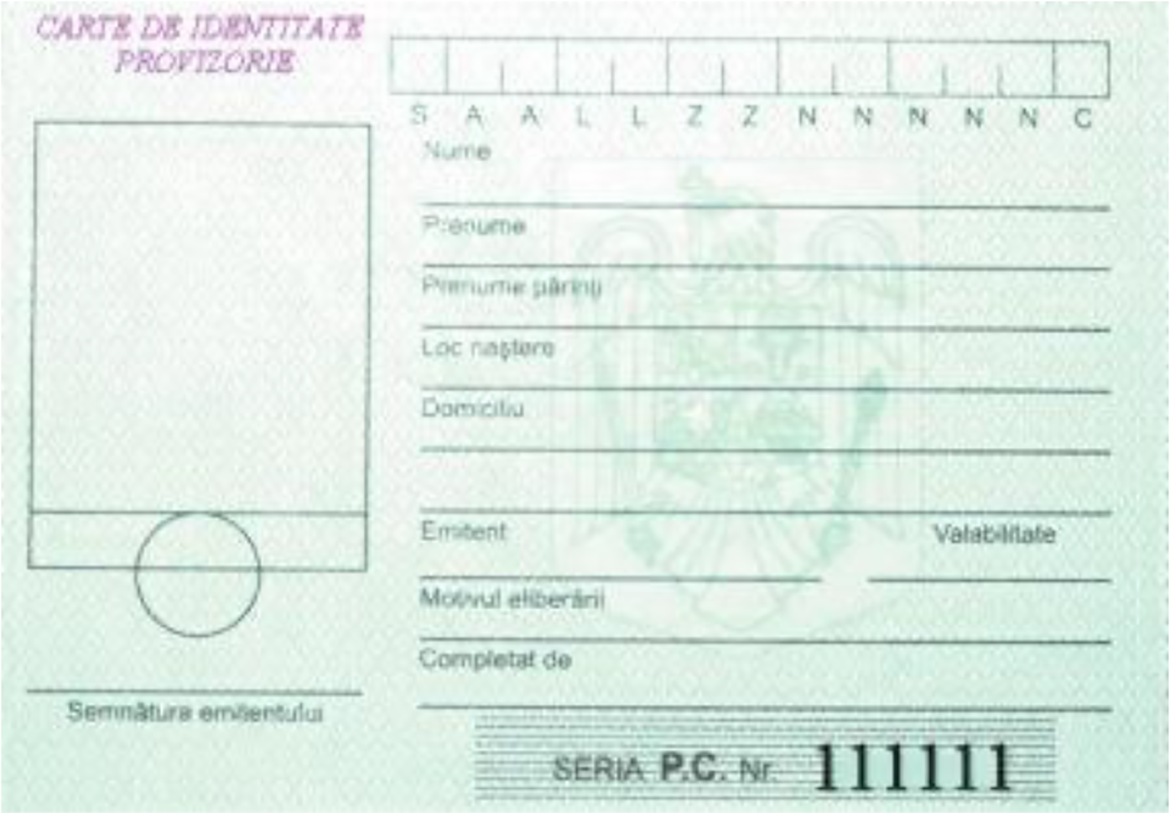
The template of the temporary identity card.
The official taking the ID photo of the young woman with the CIP is the one who, when not sitting at the counter but working in the back office, is writing these documents. She has beautiful handwriting; I can see the orderly letters on the deteriorated document. “Isn’t it tiring to write all these documents by hand?” I ask. “Well, it’s not easy. After all, this is an official document. So, you cannot make mistakes. It must be clean,” 8 she explains. “But look at this. Look at the state in which it gets back to us,” and she waves the deteriorated document indignantly. The word “clean” is in sharp contrast with the “dirtiness” of the paper. Perhaps this document has been washed in a pocket with the laundry, that is why it turned brownish and the letters faded. But instead of thinking about washing as an act of cleaning, the official perceives the used document as dirty due to negligence.
Here, the term clean is being used in at least three different ways with different effects. First, when referring to the attentive manual labor of producing the document, clean means made with care and without mistakes. Second, when holding the same document faded by a year’s worth of wear and tear, clean refers to an absence of marks of usage. And third, when the document is held up as material proof of the “kind” of people who do not properly care for their documents, the act of noting its “state”—unclean—invokes the stigma attributed not only to the individual standing in the office but also to the collective group to which they belong. The material wear and tear of these paper documents thus not only contributes to the racialization of the CIP holder but also is caused by racialization itself, creating a vicious circle: stigmatized groups are seen as suspicious and have to prove their identity more often than regular citizens, causing their CIPs to become worn and dirty, which, in the eyes of officials, happens not because they are frequently handled, but because they are being carried by dirty bodies who belong to dirty places.
While we seldom think of an ID document as a consumable item, CIP holders must use their provisional documents much more often than those with plastic ID cards. Most of the CIP holders live in segregated areas of the city, often situated next to a waste field or garbage dump, and they earn a living as sanitation workers, from casual work or from social benefits (Mireanu 2019; Vincze 2019). To take a job or receive benefits, which are most often handed out in cash, they have to show identification. According to city hall, the community living next to the garbage dump—in addition to suffering from territorial segregation, economic deprivation, and civic isolation (Vrăbiescu 2017)—suffers from the highest rates of criminality in the city. Given their subjection to heightened surveillance and authorities’ demands for identification, the CIPs are overused. The glue fails, the letters smudge, and the paper yellows. The documents become worn and dirty not because of the inherent nature of certain ethnic minorities, as implied by the official’s words (“We know their kind),” but because of daily use due to heightened surveillance related to structural, institutional, and economic deprivations.
The materiality of such documents has important consequences. Cabot (2012) argues that the “brutal materiality” of bureaucratic objects, their complex lives, and indissoluble materialities play an important role in governing people and their mobility. In Romania, when those seen as “the Roma” by local authorities are stopped and identified, they better have their ID cards with them, because suspicion is cumulative. The constant carrying of documents by those deemed suspicious by authorities and their frequent handling contribute to their deterioration. The poor quality of the material affects the process of wear of the document, making it “dirty”. The accumulation of dirt on the CIP here appears to be a consequence of both spatial and temporal displacements. The spatial displacement occurs in the ways the semi-illegal and polluted places (Vincze et al. 2019) where, according to officials, “Roma people” tend to be found, materialize on ID cards as dirt. However, as indicated, dirt “sticks” to the CIP due to its fragile materials and to the fact that it is not made of plastic, like regular ID cards. This is where the temporal displacement happens, when the paper document, compared to the plastic version, is taken as a sign of backwardness, of being stuck in an underdeveloped past.
Perceptions about cleanliness and dirtiness as they appear in the vignettes above enact both a spatial and temporal othering. Temporality here, as ruled by the ethos of technological development, appears to be linear: CIP holders are stuck in the past. However, the appearance of temporal backwardness alone does not racialize, as in the case of old people who might still have a paper buletin. The fact that the CIP, due to its outdated format, is stuck in the past does not necessarily turn those who carry it into racial subjects. It is, rather, the combination of temporal backwardness with spatial marginalization that marks the paper documents and the people holding them. CIP owners become not only trapped in an underdeveloped past but are simultaneously racialized, perceived by the officials as indolent and dirty. Whereas the contrast between paper and plastic ID cards produces a linear temporality, from backward to modern, the procedures for issuing the documents introduce a circular one.
The Circular Temporality of Citizenship
ID documents, like passports and driving licenses, have an expiration date, forcing citizens to return to the office to renew their papers periodically. But while the digital, plastic ID cards for adults above the age of twenty-five are valid for ten years, 9 the CIP is only valid for at most one. Therefore, CIP holders must endlessly return to the office, even after having reached the age of fifty-five, which is not required for electronic ID cardholders. Here, the circularity of bureaucratic time produces larger and smaller loops. Larger loops when the encounters happen once every ten years, smaller ones in cases of more frequent visits. Because CIP holders are required to renew their ID annually, their time loops with state institutions are smaller. CIP holders are trapped in a short-loop cycle, in which they rarely attain the status of a citizen with a plastic ID or receive the entitlements that accompany citizenship. This registration system contributes to population management by allowing state agents to classify citizens into two groups: the deserving, entitled citizens and the undeserving, racialized CIP holders.
Ideas about the (non)deserving citizen resonate not only with how officials talk about cleanliness and dirtiness, where a new document is by definition clean, but also with the degree of standardization and, as a consequence, the degree of citizenship. This becomes clear when I observe another citizen, an older man, getting ready to have his ID photo taken, this time for a regular (plastic) ID card.
The man steps in front of the mirror to arrange his hair. He pulls out a flat comb from his pocket and straightens his grayish hair. “Please take a seat and look into the camera,” the official instructs him. “Tilt your head to the left and please turn towards the door. That’s too much. Back. And still, tilt your head a bit to the left. Good. And now, please, don’t move. Ok. You are ready.” The serious face of the citizen appears on the screen. The official hits the “enter” key again, and the gray background is cropped and the contrast of the photo is automatically adjusted. The official saves the photo in the database. To check if the framing of the photo is good, she opens the last-taken photo, something she performs every time she takes a new photo. This time, it is the photo of the young woman with the colorful hoodie, her face slightly tilted to the right. “This [pointing at the photo of the man] is much better, you see?” the official explains to me. “I also like the photo to be clean.” “And how do you make it clean?” I ask. “Well, you see here: if the face is exactly in the middle, the chin is not too high, both ear lobes are visible, and there is no hair tuft covering the elements of the face, meaning the eyebrows, the eyes, nose, and mouth. But some people don’t even know what is left or right, or the difference between tilting and turning. Well, you cannot make it nicer than it is,” she explains. “No matter how well you frame the photo, you cannot ask the people to arrange their hair or to take their jackets off, if it doesn’t cross their mind.”
A “clean” picture here means a correctly standardized image that meets the technical requirements for a biometric photo. In the eyes of the official, successful standardization is contingent on the willingness and efforts of the citizen who prepares, combs their hair, makes sure that their shirt is straight, and follows instructions to turn or tilt their head. In the case of the young woman renewing her CIP, the official took only one photo and that was good enough, but during my fieldwork I noticed that wealthy or self-confident citizens often got special treatment. From time to time, officials even invited such people to approve the photo and allowed another to be taken. Teenagers who came for their very first ID cards often also received such treatment, creating brief moments of shared excitement in the department—moments that those having only a CIP would never share with officials.
Being enrolled in the ID system not only depends on standardized procedures but also on citizens’ willingness: their voluntary presence, preparation, and cooperation (Amoore 2008). When taking the ID photo, for instance, the citizen stands fixed, immortalized in front of the state. A “good citizen” prepares for this moment. Whereas “good” here alludes to citizens’ willingness to facilitate bureaucratic procedures, when officials refer to “those” with temporary documents, citizenship is instead configured in terms of (un)deservingness and (not fully) belonging. In another moment, the official explained to me that “the minimum they can do is to look into the mirror and arrange their hair, but some of these people are not even capable of that,” again using the collective (and dismissive) term “these people.” The official’s disdain makes clear that primping for an ID photo is seen as some kind of civic responsibility that some people deliberately reject, just as they neglect to keep the document clean. Further, the words “not even capable” signal that failing to be a deserving citizen is understood in terms of essentialized (racial) difference. Similar to the expression “we know their kind,” not being “capable” also implies an inherent, essentialized otherness that sticks to one’s body and cannot be left behind.
Citizens are thus produced through recurrent encounters with state institutions. The circularity of this bureaucratic time enacts larger and smaller loops. CIP holders are trapped in small, frequently recurring loops, however, their encounters never lead to becoming a full or regular citizen. This indicates that it is not only the raggedness of the paper document that enacts racial otherness but also the short-loop circularity of CIP holders’ visits to the bureaucratic office. Moreover, while a CIP holder must continue to renew this document without ever achieving full citizenship, their digital file continuously grows with more and more data, photos, and other materials. While this short-loop circularity results in the repetitive issuing of the worn paper documents, it simultaneously contributes to the racialization of their holders due to increased surveillance and excessive data collection.
Temporality of the Database: A Knot as Reminder
While we might imagine state practices of surveilling citizens as highly technological, surveillance has also long been enacted via rudimentary practices, such as registering citizens for state records and issuing documents made out of paper. But the profile does not stop at the surface of the paper, as Amoore (2008, 23) explains: “While the card is one interface with a picture of a person, the screen offers a different visuality––a projection of a person built from fragments, bits and bytes of data, suspicions and prejudices.” Behind the dirty paper document of the CIP is a large digital database, one that is, given its accumulation via renewal, much bigger than the electronic file of a regular citizen. The circular bureaucratic work of annually checking the documents of CIP holders, inquiring about their whereabouts, and photographing them results in a new entry every time CIP holders come to renew their documents. This creates an excess of data that spill over the digital database of a CIP holder (Plájás, M’charek, and van Baar 2019). Gates (2008, 222) draws attention to the fact that it is fundamentally problematic to create stable citizen identities, because “official identification…involves verifying an object that does not exist a priori, but that is constituted in the act of verification.” The CIP holders are thus continuously (re)created as racial others. Having a CIP instead of a regular ID card is not only a consequence of the spatial and temporal segregation of the unwanted, but it also forces CIP holders to dutifully report each year, contributing to the accumulation of data.
The digital database folds within the CIP-holders’ files the past encounters they have had with state institutions (such as the ID or passport department) and carries the potential of being mobilized in the future (for instance, by the Romanian Police). Therefore, the database can be seen as enacting a topological, folded time (Serres and Latour 1995, 60). As M’charek writes, “an effect of folding time is that history can be recalled in objects. History is never left behind” (M’charek 2014, 31). The database of the national registry of citizens might well be seen as documenting the past racialization of certain groups of people. This history can be understood in at least two ways. First, the history of irregularizing and securitizing “the Roma” in Europe (van Baar, Ivasiuc, and Kreide 2019) dates back to the emergence of identity documents (Torpey 2000). Second, the accumulation of large amount of data in the digital databases also acts as a reminder of an individual history of once being a CIP holder. Even if someone eventually manages to move out of a segregated ghetto, gets access to housing with proper papers, and obtains a regular (plastic) ID card, the database “does not forget.” The excess of data that comes with once having had a CIP enacts racial otherness even after this is not visible anymore on the ID document itself.
Inspired by the metaphor of the folded handkerchief (Serres and Latour 1995), I suggest yet another spatial form to think about the temporal agency of databases: the knotted handkerchief. For centuries, tying a knot in the corner of a handkerchief has been used as a reminder of something that should not be forgotten. A knot is difficult to untie. It might also stand for a node where relations have become hardened. The metaphor of the knot adds to the node its memory work. We can imagine the circular temporal loops of the bureaucratic practice of issuing ID cards as tying a knot each time a citizen renews their documents. As each encounter results in a new entry in the digital database, a CIP holder will have much more accumulated data, or many more knots, than a regular citizen. These knots upon knots create one big temporal knot. This temporal knot can be imagined as the result of an endless pile of data that continuously accumulates in the digital database. Its size reminds administrative officials (or other state institutions accessing the database) of the CIP status of certain citizens while preempting future risk profiles (Amoore 2008) when, due to the interoperability of the systems, these data are accessed and used by other state institutions, for instance, for law enforcement.
David Lyon (2010, 618-19) writes that “in the name of security, today’s ID schemes go well beyond conventional registries of personal information, where past records provide the main evidence, toward trying to incorporate what is as yet unknown into the calculus. The idea is not just to verify identity, but also to pre-empt particular outcomes and prevent certain risky bodies from entering certain spaces.” In the case of Romania’s temporary ID cards, we have seen how spatially and temporally segregated groups of people are not only irregularized as Romanian citizens and hence exposed to heightened surveillance—but are also deprived of the right to leave the country without a passport. Irregularization and criminalization happen precisely through the excessive accumulation of data. Databases thus act as temporal knots where past, present, and future come together to order and border irregularized citizens. In the case of impoverished and marginalized communities in Romania, it is through the material affordances of the temporary ID card and the rules around its issuance that the temporariness of “not quite citizen” (Vrăbiescu 2015, 97) becomes permanent.
Permanent Temporality: The Time of the Racial Other
In the bureaucratic office of issuing identity cards, the day passes quietly. It is almost five o’clock when the last CIP holders arrive. A young couple comes into the office and hastily gets prepared for the photo. “Please look at the camera. Head straight. Lean a bit back. Tilt your head to the right. That’s not right, that’s left! And by the way, I said ‘Tilt!’ not ‘Turn!’ More to the left. No! That’s too much. Back.” The official slowly loses her patience. “Hold on like that, don’t blink!” The head is not exactly in the middle, but the official does not take another photo. “Anyway, it’s only for the database,” 10 she explains, while she attaches the two photos brought by the couple to the file with a paper clip.
If citizens are constantly produced and reproduced by various identification processes, there is a certain amount of bureaucratic labor involved in creating them. The recurrent labor of registering CIP holders and issuing their temporary ID cards is considerably more than required to create regular ID cards. This labor, however, reifies existing power relations while enacting (and hence producing) the state as well. State institutions are heavily invested in guarding the boundaries of citizenship and, therefore, in constantly differentiating those who belong from those who do not, or do not fully, belong to the nation. Through the institutions of the temporary ID card, we witness the creation of a liminal space-time reserved for those who are perceived as a threat to social order. Below, I introduce the term “permanent temporality” to describe how this time of “not belonging” comes into being within the very institution of citizenship, and how it contributes to the racialization of certain groups. The permanent temporality that comes about at the intersection of the various, heterogeneous temporalities is of a meta-order that can be understood as the time of the racial other.
In the bureaucratic procedures of registering citizens and issuing identity cards, different temporal configurations are at stake. The material affordances of the different types of ID cards currently used in Romania enact a linear time that runs from the old, outdated material toward a digital ID card printed on securitized plastic. In this linear time, the racial other appears as the one left behind, outdated. However, as we saw, it is not only the temporal displacement that racializes but the spatialization of this temporal backwardness. This happens through the material affordances of the paper that tends to get dirty due to spatial marginalization or the technical failure of producing a standardized ID photo. The recurrent bureaucratic process of issuing ID documents can be thought of as circular time, in which people must endlessly return to the office. This circularity also produces an accumulation of a large amount of digital data. Databases thus enact knotted time, reminding state institutions that certain individuals are or once were a CIP holder. The linear time of technological development still holds the promise of catching up. Similarly, those who manage to escape poverty, move out of racialized areas, and get their papers in order might be able to obtain a regular identity card. However, their digital file will still carry the material residue of their many renewals, where the sheer amount of data reveals the history of once being a CIP holder. This is where race sticks (Plájás, M’charek, and van Baar 2019) not only to the physical body but also to the digital, pixelated one, fixing “the Roma” in the time of the racial other. The temporal state signaled by the very name of the temporary ID card becomes permanent precisely due to the knotted time of the database. As these three temporalities overlap, the time of the racial other emerges as permanent temporality. This temporality of race has essentializing effects, as race tends to stick to bodies, marking for a lifetime those who are not (fully) citizens.
Techniques of tracking and targeting which classify and categorize people are crucial for governing citizens. Contemporary ID systems, while presenting themselves as neutral and objective tools for registering citizens for the purpose of governance, “tend to maintain existing marginalities and to reinforce cumulative disadvantage” (Lyon 2010, 621). Moreover, there is a stigmatized relationship between mobility and security that, in the case of Roma minorities, builds on centuries-long prejudices about their alleged nomadism and free-spiritedness, often depicting them as outlaws who resist efforts to make them comply with social norms. Through the institution of the temporary ID card, state apparatuses not only exclude some citizens from the community of the deserving but also heighten their surveillance. These groups of people are stuck in a permanent temporality while simultaneously being racialized.
Conclusion
In this paper, I have argued that bureaucratic artifacts, such as ID cards, photos, and databases, are not neutral tools but, rather, are actively involved in the production of racialized identities. Examining the materials and technologies involved in issuing Romanian ID cards, I have analyzed both the kinds of temporality they articulate and the ways these temporalities contribute to processes of racializing Romanian Roma. The temporary ID card, compared to the regular plastic one, is not only outdated because it is a handwritten paper, but it also tends to get overused and thus dirty, reinforcing the stigmatization of their holders. This stigma, through circular bureaucratic loops, also gets inscribed into the digital database that acts as a reminder of one’s past encounters with state institutions, and can be used to create risk profiles. Through the specific ordering of time that these objects entail, they actively affect the governance of people and their mobility. Race here emerges not as biological difference but as “an irreducible, spatio-temporal thing, one that moves and changes shape depending on the times and spaces drawn together” (M’charek 2014, 48).
Investigating mechanisms of racialization through the analytical lens of temporality teaches us several lessons that go beyond the paradox of permanent temporality. It opens up new ways of understanding processes of racialization. It is through the overlapping temporalities configured by ideas of dirtiness, cleanliness, and the good citizen that the racial other emerges as an obsolete, uncivilized citizen, whose mobility, for these reasons, is obstructed within the European Union. Racialization, therefore, happens not only at the level of discriminatory laws, racial categorization by experts, or stereotyping by both professionals and society more broadly, but also at the level of materials, technologies, institutions, and the body.
Finally, this case also highlights that objects are not only contemporary actors, they carry specific histories and future possibilities within them (M’charek 2014). The temporal agency of ID documents goes beyond a linear past, present, and future; it elicits more complex entanglements in which racial imaginations surface among bureaucratic practices, technologies, materials, and bodies. Race in this case emerges in the nodes of various spatial and temporal relations, configured by material objects and inscribed onto bodies—both physical, and digital, pixelated ones—by bureaucratic practices. The CIP, an unassuming technology, does precisely that. Folding past, present, and future, it produces a racial other.
Footnotes
Author’s Note
A previous version of the article was presented at the “Race and the Roma” workshop held at the University of Amsterdam in 2017.
Acknowledgments
I would like to thank the Romanian Ministry of Administration and Interior for granting me a research permit, and the employees of the Department for Persons, Record, and Administration of Databases for hosting me during fieldwork. In developing the argument, I received invaluable support and advice from Amade M’charek and Huub van Baar. I am grateful to the two anonymous reviewers for their insightful comments and to Katie Vann for her editorial support. I thank the workshop participants for their generous comments, especially Mihai Surdu, Enikő Vincze and Ioana Vrăbiescu. The article has further benefited from the valuable comments from the RaceFaceID team, László Fosztó, Atsuro Morita, Wakana Suzuki, and from the Writing Care group led by Kristine Krause.
Declaration of Conflicting Interests
The author(s) declared no potential conflicts of interest with respect to the research, authorship, and/or publication of this article.
Funding
The author(s) disclosed receipt of the following financial support for the research, authorship, and/or publication of this article: The research leading to this paper was supported by the ERC Consolidator Grant (FP7-617451-RaceFaceID-Race Matter: On the Absent Presence of Race in Forensic Identification), led by Amade M’charek.
