




Abstract
Mobile devices were key drivers for recent Internet expansion in lower-income countries, democratizing access. Nonetheless, concerns arose regarding their role in the creation of new digital underclass related to the capital-enhancing consequences of Internet use. Among these, e-government engagement allows individuals to reduce the administrative burdens of governmental interactions. Nonetheless, its uptake has been proven to be highly stratified in Latin American countries where most services are not digital-by-default. The article argues that disparities in digital access play a role in this e-government divides. It examines the antecedents and determinants of household computer access and mobile-only Internet use, and e-government engagement in Brazil. Based on “TIC Domicilios 2019” survey, using logistic regressions to predict household access to computers, mobile-only Internet access, and e-government engagement. Mediation analyses of the latter models are conducted, testing the sequential nature of socio-digital inequalities based on the DiSTO framework. Findings show that living in a household with computers reduces the chances of being a mobile-only user and increases the odds of e-government engagement. Mobile-only access reduces e-government engagement. The effects of socioeconomic status and digital inequalities are mediated by household access to computers and mobile-only use. Implications for digital inclusion policies are discussed.
Introduction
Internet access has been increasing swiftly since the beginning of the twenty-first century. In 2019, 53.6% of the world population were Internet users, 3.2 times more than in 2005 (ITU, 2019). Whereas initially considered the luxury of a few, several technological innovations paved the way for more equal access to the Internet (Dodel, 2021; Helsper, 2021).
Among these innovations, Internet-connected mobile devices are probably the key drivers of the recent expansion of Internet access in lower-income countries and households (de Araujo and Reinhard, 2019). Whereas the democratization of Internet access is unanimously positive, there have been concerns that mobile-only modes of access—a process sometimes referred as “mobile leapfrogging”—could also be increasing new types of digital inequalities (de Araujo and Reinhard, 2019; Pavez & Correa, 2020; van Deursen & van Dijk, 2019).
Scholars caution against the creation of class-tiered Internet experiences, where device dependencies condition the types of activities, development of digital skills, and potential tangible outcomes of Internet use (Correa et al., 2018; Newlands & Lutz, 2021; van Deursen et al., 2017). Governmental electronic interactions are one of such activities where device dependencies could condition digital engagement and outcomes (Gerpott & Ahmadi, 2016).
Also referred to in the literature as the “mobile underclass,” the phenomenon has attracted little scholarly attention in very unequal contexts such as Latin America (i.e., see de Araujo and Reinhard, 2019, or Pavez & Correa, 2020 for some exceptions).
Within developing economies, lower-income households’ Internet uptake seems to have been driven considerably by mobile-only Internet access. These are the cases of several Latin American nations such as Uruguay, Chile, Costa Rica, and Brazil (de Araujo and Reinhard, 2019, or Pavez & Correa, 2020; AGESIC-INE, 2020; CETIC, 2019b, 2019a; Trucco and Palma, 2020); the latter being the context of this study.
Additionally, device dependencies and their links with capital-enhancing types of Internet use became more salient during COVID-19 lockdowns, where mobile-only devices and Internet access proved to be substantially less suited for school and work during lockdowns compared to computer access and fixed broadband connectivity (Robinson et al., 2020). E-governmental interactions, this article argues, have similar attributes and computers are also better suited for a high share of the tasks citizens are require to conduct online in order to successfully interact with the government online. Moreover, being able to use e-government services instead of their non-digital counterparts derives into new disparities in terms of positive outcomes of Internet use (Dodel & Aguirre, 2018). Compared to non-digital governmental interactions, digital ones reduce some of the administrative burdens with which governments load citizens who aim to access public services, obtain certificates, and/or schedule appointments (Madsen et al., 2022).
This article, thus, explores the effects of device and connectivity dependency on e-government engagement in Brazil: diverse types of activities online related to public services such as requesting identification documents, scheduling public health services, reporting police-related incidents, or paying taxes online, to name a few examples (NIC.br, 2020). Two different access determinant levels are assessed as the key independent variables: household-level access and individual level ones (mode of access). Whereas focused on e-government outcomes, the article also delves into the sequential digital inequalities literature, proposing that contrary to the popular belief that access divides are disappearing or losing their relevance for public policies and services, household access and modes of access are still theoretical and statistical significant antecedents of key digital engagements. In other words, that access-related inequalities stratify the positive outcomes of Internet use in everyday life in the lines of traditional socioeconomic disparities (Helsper, 2021; van Deursen et al., 2017).
E-Government, Disparities, and Outcomes
Scholars and practitioners agree on the capital-enhancing consequences of electronic interaction with the government compared to exchanges that occur only face-to-face (Botrić & Božić, 2020; Gerpott & Ahmadi, 2016).
Larsson (2021) and Madsen et al. (2022) operationalize the notion of administrative burden to discuss how disparities in digitalization and automation stratify the non-monetary costs placed on citizens when they acquire government services.
Whereas there is some evidence that digital interactions could imply a different set of more cognitive-focused administrative burdens (Christensen et al., 2020), and that digital by default governmental services entail a new difficulties for already-at-risk populations (Larsson, 2021), the development of digital-by-default governmental services is extremely uncommon in developing economies such as the one in which this study. Moreover, when referring to e-government services (at least in Latin America), the term tends to signal the creation of digital governmental services as alternatives to previously face-to-face exclusive ones. In general, face-to-face and digital channel choices coexist as alternatives in a multi-channel service approaches (Dodel & Aguirre, 2018; Madsen & Kræmmergaard, 2016; Robinson et al., 2020). This scenario provides clearer pathways towards the “traditional” advantages of e-government associated with the reduction of citizens’ administrative burdens (Dodel & Aguirre, 2018).
In other words, the disparities of administrative burdens between digital and non-digital citizens’ interactions with governmental services are expected to be substantially higher than the ones between automated and digital self-service interactions (Larsson, 2021; Madsen et al., 2022). For example, Digital interactions can provide several advantages related to issues such as time spent in offices, travel expenses, and loss of work time (Dodel & Aguirre, 2018; Ebbers et al., 2016; Robles et al., 2021; Rosenberg, 2021).
In this sense, as the uptake of e-governmental services by the citizenship is far slower than what theory predicted, both among developed and developing economies, e-government engagement disparities also increase digital inequalities (Botrić & Božić, 2020; Dodel & Aguirre, 2018; Gerpott & Ahmadi, 2016; Robles et al., 2021).
There are far fewer studies on the subject than what one may expect concerning the antecedents of e-government engagement based on nationally representative samples; particularly for Latin America.
Among these studies, most focus on channel choices. Their findings show that digital inequalities play a critical role in predicting e-government engagement. For example, Ebbers et al. (2016) studied people’s preferences for the channels they use for e-government interactions in the Netherlands. They reported that digital inequalities affect satisfaction with e-government but not channel preferences. Botrić & Božić (2020) used Eurostat’s Community Statistics on Information Society (CSIS) microdata from 2016 to study differences in motivations not to adopt e-government services across the European Union between the young and old. They found that factors such as gender and population density had different effects for young and old, but others such as education (both formal education and digital skills) were strongly related to non-use in both groups.
Gerpott and Ahmadi (2016) used a nationally representative sample of German citizens to analyze household and individual level predictors of e-government engagement. They found that the young, less educated, migrants, individuals with less frequent access to Internet, and with lower levels of digital skills less prone to use the e-government services. Digital skills, the frequency of Internet use and education were the strongest predictors (Gerpott & Ahmadi, 2016).
Dodel and Aguirre (2018) found that socioeconomic and digital attributes affect governmental electronic interactions for three different stages of e-government development in Uruguay. Rossember (2019) examined the interactive effects of ethnicity and trust in government on e-government engagement in Israel, documenting that using the Internet daily increases e-government use. Martins and Al-Shekaili (2021) studied the disparities of e-government engagement in Oman. Based on a nationally representative sample of users and households, they found that factors such as education, employment status, age, and digital skills (the stronger predictor) increase the chances to the use of online governmental services.
Finally, Robles et al. (2021) investigated the rejection of e-government services in Spain, showing that age, gender, and education condition digital skills, and digital skills and online trust predict the rejection of engaging with the government online.
Devices’ Differences and Their Consequences for Well-Being
van Deursen and van Dijk (2019) argue that, contrary to the idea that first-level digital divides have closed and should not be a key component of contemporary digital inequality research or policy, device-related disparities remain critical in terms of their consequences for digital skills, uses, and outcomes.
In this sense, not every device provides equal benefits when it comes to using the Internet. Even considering the rapid increase in their functionality and advantages in terms of mobility, mobile devices are not equal to laptops or computers (de Araujo and Reinhard, 2019; van Deursen & van Dijk, 2019). Computers have key advantages over mobile phones when it comes to using the Internet for study or work. They have more computing memory and faster processing speed, a larger screen size, better work and study-related software, and better typing capabilities (de Araujo and Reinhard, 2019; Pavez & Correa, 2020). While it is true that mobile modes of access have an edge in terms of ubiquitousness and lower costs of entry for new users (de Araujo and Reinhard, 2019), mobile Internet use has been characterized as “extractive” or “skimming” in comparison to more “immersive” computer experiences, which reduces the benefits of Internet use (Newlands & Lutz, 2021).
For example, Newlands and Lutz (2021) noted that crowdworkers are rarely mobile-only or mobile-first Internet users. Furthermore, having a computer improves workers’ efficiency and speed in human intelligence tasks, thus increasing their potential for generating income. de Araujo and Reinheard (2019) in Brazil in 2016, and Correa et al. (2018) in Chile in 2014, found that those who were mobile-only Internet users had statistically significant poorer digital skills compared to multi-device users, even after controlling for other sociodemographic variables. Moreover, Correa et al. (2018) for Chileans and Reisdorf et al. (2020) for Detroit inhabitants established that mobile-only modes of access also promoted less diverse types of Internet use.
There is evidence documenting that mobile-only access is quite common in several Latin American countries (i.e., AGESIC-INE, 2020; Trucco & Palma, 2020), and is a growing trend particularly in Brazil and Chile. For example, whereas in 2014, 56% of Brazilian Internet users connected through both a computer and mobile devices and just 20% only through mobile devices, in 2018, the former plummeted to 40% and the latter climbed to 56% (CETIC, 2019b). In Chile, the mobile-only mode of access rose from 9% of Internet users in 2013 to 21% in 2015 (Correa et al., 2018).
Additionally, there is compelling evidence about the stratification of the mobile-only mode of access both in developed and developing economies. In 2021, the share of North Americans from lower-income households who had smartphones but no broadband Internet connection at home doubled since 2013 (from 12% to 27%), whereas this share did not change substantially for middle- and high-income households (Vogels, 2021). In Brazil, among Internet users between 9 and 17 years old in 2018, only 26% of those from higher socioeconomic households were mobile-only Internet users, whereas these percentages raises to 52% in middle class homes, and up to 71% in lower class households (CETIC, 2019a).
The Sequential Nature of Digital Inequalities: Why Device Access is Still Relevant for e-Government Engagement?
According to the DiSTO framework of van Deursen et al. (2017) and Helsper (2021), digital inequalities are a sequential process. They begin with socioeconomic stratification, leading to a chain of first-level (access), second-level (use and skills), and third-level (tangible outcomes) divides. Digital disparities and outcomes can be understood as a pyramid in which both advantages and disadvantages accumulate sequentially: the wider the base levels, the greater the potential for the next ones (Dodel, 2021).
This conceptualization has key theoretical and empirical consequences for this study. With regard to theory, it implies that the lower-level divides have not been closed. Variations in the quality of access can have a lasting impact on higher levels of the divide, as it is not just a binary or dichotomous division between the haves and have nots (van Deursen & van Dijk, 2019). The works of de Araujo and Reinhard (2019) for Brazil, Pavez and Correa (2020) for Chile, and Reisdorf et al. (2020) for Detroit indicate how mobile-only modes of access have negative effects, directly and indirectly, on higher levels of digital inequalities.
A more empirical but equally relevant implication is that while access may not be a direct statistically significant predictor for certain outcomes, it can still have a critical indirect impact on the capital-enhancing consequences of Internet use. For example, there is evidence that the mode of access has statistically significant indirect effects on children’s online risks in Brazil (Cabello-Hut et al., 2018) and cyber-safety practices in Uruguay (Dodel et al., 2020). Reisdorf et al.’s (2020) results are even more relevant for this study. They found that socioeconomic antecedents predict modes of access, which in turn predict people’s level of digital skills, diversity of use, and social capital resources.
Household Device Availability and Mode of Access
Whereas the aforementioned studies attest to the sequential nature of the divide (Van Deurse et al., 2017), when dealing with access-related disparities, the research tends to focus on modes of access and device preferences at the individual level rather than household ones (Cabello-Hutt et al., 2018). In other words, these studies do not assess the potential impact of the availability of devices and connectivity in the household.
These design choices are more than justified. On one hand, households are not the only locations in which Internet users may have digital devices available for their use. For example, schools were critical for digital inclusion policies in the US and several Latin American countries (Reisdorf et al., 2020; Robinson et al., 2020), and non-manual occupations have been strongly intertwined with computer use in offices since the last decade of the twentieth century (Dodel & Mesch, 2020). On the other hand, some scholars have indicated the need to distinguish formal or theoretical access from actual access (Selwyn, 2010). In this sense, the availability of digital devices in-house, particularly non-mobile ones, reduces the barriers to their use compared to access that is limited by time and the day of the week such as the workplace, libraries or community centers, and schools (i.e., see Eynon and Genients, 2016). COVID-19-related lockdowns provided explicit evidence of this in the form of barriers to mobility imposed by national emergencies.
In sum, the article argues that the availability of in-house alternatives to mobile devices needs to be considered as a potential deterrent for mobile-only Internet use. Having a computer at home makes multi-device usage easier in terms of convenience and accessibility to various devices, some better suited for study, work, or office-related tasks. E-government engagement, the dependent variable and topic of this study, tends to fall within these last two categories.
Thus, this article aims to improve our understanding of digital inequalities affecting e-government engagement by presenting further evidence of their complex and sequential nature.
Hypotheses
Figure 1 presents our adaptation of the sequential socio-digital inequalities model from which the hypotheses on e-government engagement’s antecedents are derived. Model of sequential socio-digital inequalities with regard to e-government engagement. Source: the author’s, adapted from van Deursen et al. (2017).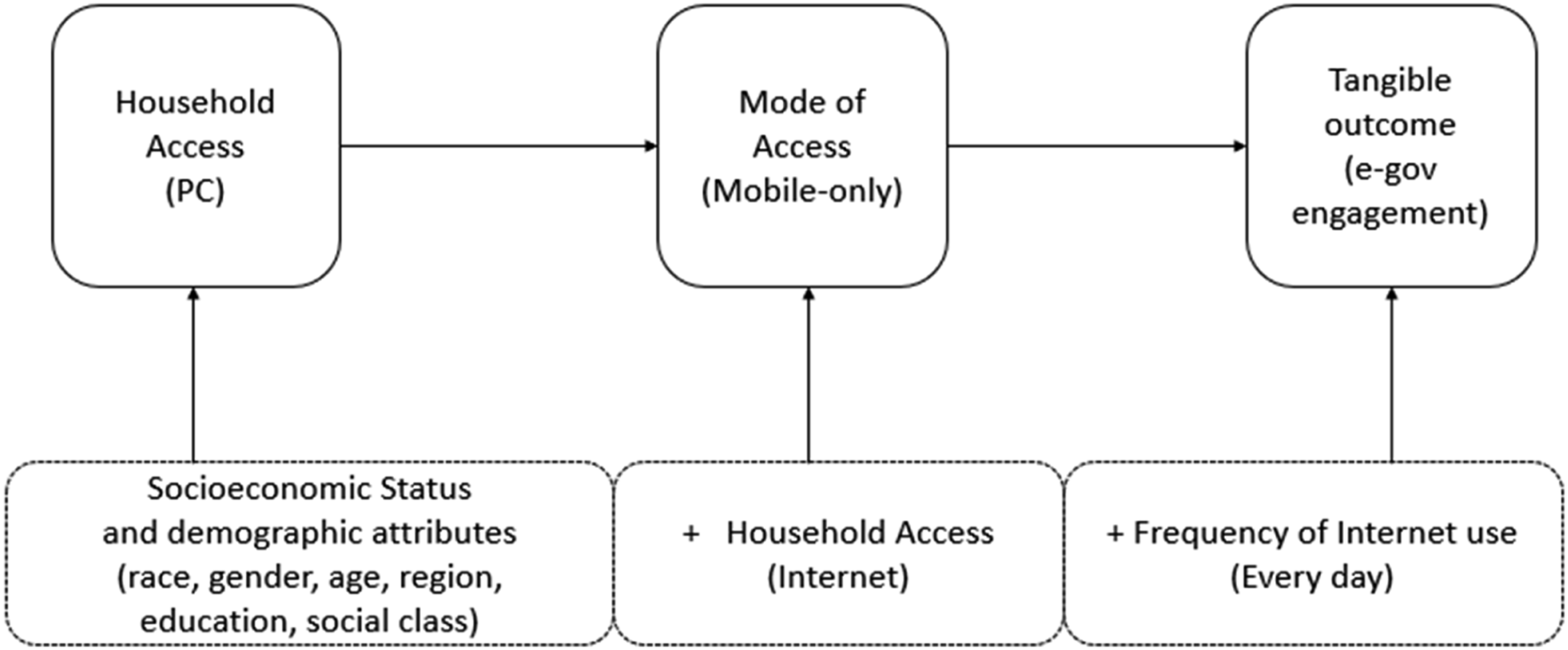
As the model involves an important number of relationships, both in direct and indirect form, hypotheses are presented clustered in blocks. They are grouped by similar level of socio-digital divides, along the lines of the DiSTO framework. The three first hypotheses blocks are presented separately, to stress their potential contribution to gaps in the literature.
Hypotheses block 1- Device availability: Having a computer in the household reduces the chances of being a mobile-only Internet user and increases the chances of e-government engagement.
Hypothesis block 2- Mobile underclass: Being a mobile-only Internet user reduces the chances of engaging with the government through the Internet.
Hypothesis block 3 - The sequential nature of digital inequalities: The effects of socioeconomic status (SES) and demographic attributes are mediated by household access to the Internet via a computer. Additionally, household access to the Internet via a computer and mode of access mediate the effect of SES and demographic attributes on e-government engagement. Finally, the effect of household access to computer on e-government engagement is partly mediated through mode of access.
The article also proposed three secondary hypotheses blocks.
Hypothesis block 4 - Socioeconomic status: In line with the digital inequality literature, individuals from less privileged social groups such as ethnic or racial minorities, women, the elderly, rural inhabitants, the less educated, and those in lower social classes are less likely to live in households with access to a computer, more likely to be mobile-only Internet users, and less likely to engage with the government online than those from traditionally privileged social groups.
Hypothesis block 5 - Internet access in the household and familiarity with technology: In line with the digital inequality literature, frequent Internet users and individuals living in households with an Internet connection are more likely to engage with the government through the Internet than less frequent Internet users and individuals living without connectivity in their household.
Hypotheses block 6 - The null effect of household connectivity on mode of access: I also use connectivity in the household as a control variable in the model predicting mode of access. There are no theoretical nor empirical reasons to suspect that it will affect the chances of being a mobile-only user because connectivity in the household can be useful for both mobile-only and multi-devices. I posit that connectivity will have no statistically significant effect on mode of access.
Material and Methods
Data and Sample
The study is based on “TIC Domicilios 2019” a computer assisted personal interview survey collected between October 2019 and March 2020 in Brazil (NIC.br, 2020a). The survey is representative of Brazil’s urban and rural population living in private households (for more details on the sample and methodology see NIC.br, 2020a). However, a sub-sample of those 18 years old and older was selected for the analyses to avoid age or life cycle-based biases related to government interactions. The sample was based on Brazil’s census and consisted of a stratified sampling of clusters in multiple stages (NIC.br, 2020a). Our analyses used the weighting schemes provided by NIC.br (2020a).
The original microdata from “TIC Domicilios 2019” can be retrieved from [dataset] Nic.br (2020b).
Measures
Dependent Variables
Household access to computer: Respondents were asked if they had a computer or laptop at home (coded “1” for yes and “0” for no).
Mode of access: Initially, respondents were classified as Internet users or non-users. NIC.br’s (2020a) criterion follows the International Telecommunication Union’s definition of an Internet user, meaning someone who had used the Web at least once in the three months prior to the interview.
Then, only the Internet users were asked if they used the Internet via a computer or laptop only, mobile devices only, or multi-devices. As computer or laptop-only Internet users were almost non-existent, the variables were recoded into “1” for mobile-only and “0” for multi-device or computer-only users.
E-government engagement: A broad operationalization of e-government engagement was preferred due to low levels of adoption. All Internet users 16 years old and older were asked if they had engaged in any of these seven activities online related to public services at least once in the last 12 months: requesting identification documents; scheduling public health services; reporting police-related incidents; searching for information about or enrolling in public education institutes; searching for information or using services related to workers’ right and social security; searching information regarding public services such as transportation or cleaning and maintenance of roads; paying taxes online; (NIC.br, 2020). Those who answered “yes” to any of these seven activities were categorized as having engaged with the government though the Internet (coded “1” for yes, “0” for no).
Independent Variables
Race: The respondents were asked “What is your color or race?” and were provided a multiple response set. The artciles used the categories from the Brazilian National Statistical Office (IBGE): White, Black, Brown (Parda), Asian or Indigenous. Due to their limited number, in this study Asian and Indigenous were recoded as “other.”
Gender: Respondents were categorized as male or female, with 1 signifying the former and 0 the latter.
Age: Respondents were asked their exact age in years.
Education: Whereas the original variable included 12 categories, in line with NIC.br (2020a), it was recoded into three levels indicating the highest level of education the respondents had completed: elementary education or less (low), secondary education (middle), and tertiary education (high). The first category was selected as the reference category.
Region: This was a dichotomous variable that was coded “1” for individuals living in rural households and “0” for those living in urban areas.
Social class (SES): Responses were classified based on the 2015 Brazilian Criteria for Economic Classification (CCEB) defined by the Brazilian Association of Research Companies (Abep). Respondents were asked about their ownership of several types of durable goods for household consumption and combined their answers with the educational level of the household’s head. Whereas the original index includes seven socioeconomic classes (A1,A2,B1,B2,C,D,E from highest to lowest) the variable provided in TIC Hogares 2019 was recoded into three categories: AB (reference category), C, and DE (NIC.br, 2020a).
Household access to the Internet: Respondents were asked if they had Internet access at home (coded “1” for yes and “0” for no).
Additionally, it is important to note that TIC Hogares 2019 only inquired digital skills for computer users (as a set of nine dichotomic variables inquiring different digital skills; see NIC.br, 2020a for more detail). In other words, mobile-only Internet users appear as missing cases on digital skills. As the one of the key determinants of e-government engagement in this study is related to this mode of access, it was impossible to include digital skills (the key mediator of socioeconomic and lower-level digital divides; Helsper 2020; Van Deursen et al., 2017) in the core analyses.
Analysis Strategy
To test this framework and hypotheses three nested logistic binary regressions were fitted, one for having a computer at home, one for mobile-only Internet access, and one for e-government engagement. All three models assessed the socio-digital determinants based on the DiSTO framework (see Figure 1).
Of course, not all Brazilian adults are Internet users. Therefore, the second two dependent variables were truncated variables. Without proper correction, the models assessing mode of access and e-government engagement might be biased. To deal with this potential bias, Bucheli and Porzecanski (2011)’s approach was followed, which operationalized Buchinsky’s correction based on Heckman’s original proposal. The correction consists of estimating a probit selection model for the variable involving the potential bias (being an Internet user) and then using the probit’s predicted probability to estimate the Inverse Mills Ratio to compute a selectivity correction term. This term was included as an additional predictor in the second and third models.
Then, mediation analysis for logit models were used (i.e., Imai et al., 2010) to link the three dependent variables to assess the sequential nature of the socio-digital inequalities proposed by van Deursen et al. (2017). Whereas the data on which the study is based are cross sectional, this sequential nature of digital inequalities allows to work under the theoretical assumption that divides in household access temporally precede divides in modes of access, and that both also precede e-government engagement.
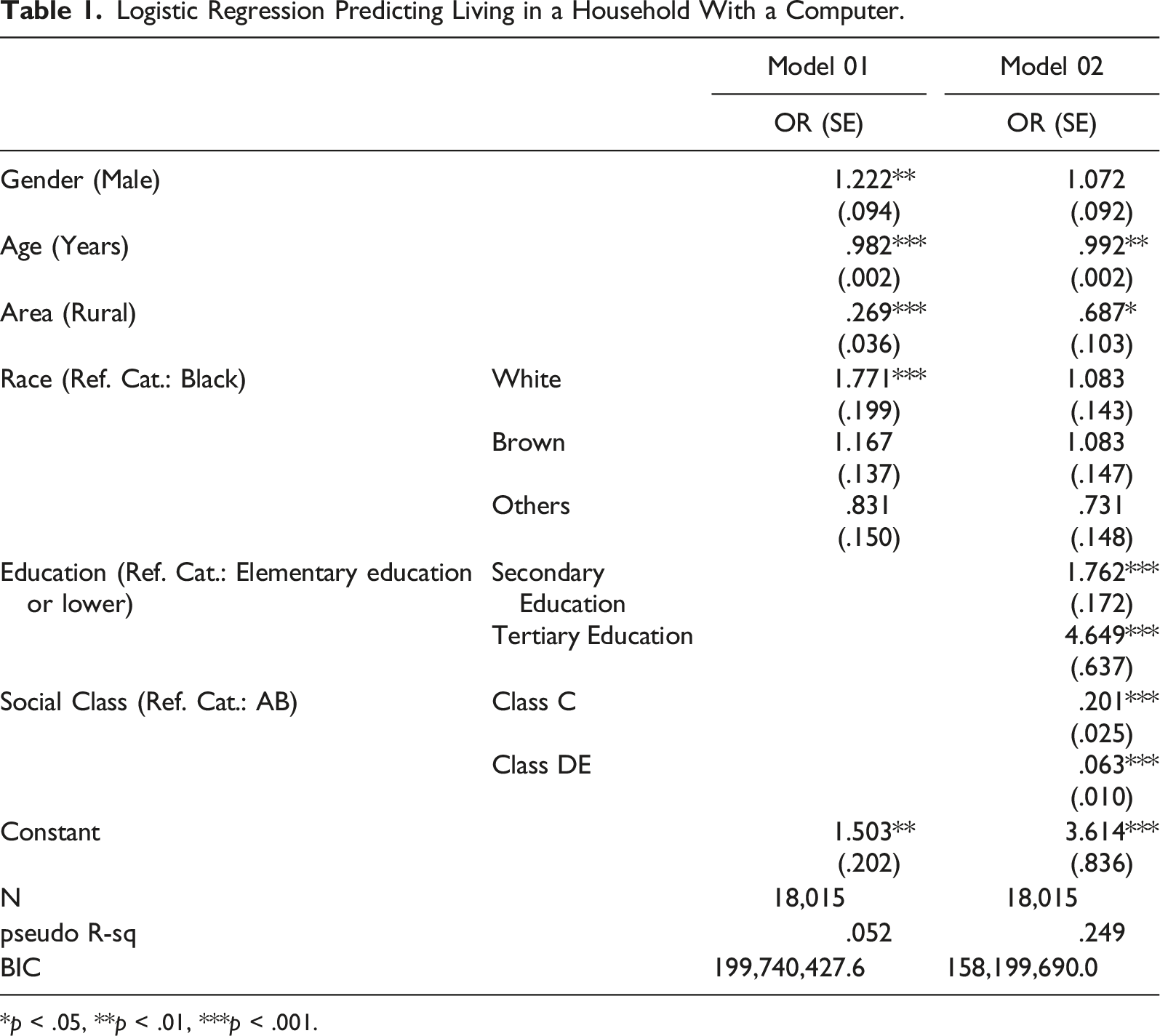
Logistic Regression Predicting Living in a Household With a Computer.
*p < .05, **p < .01, ***p < .001.
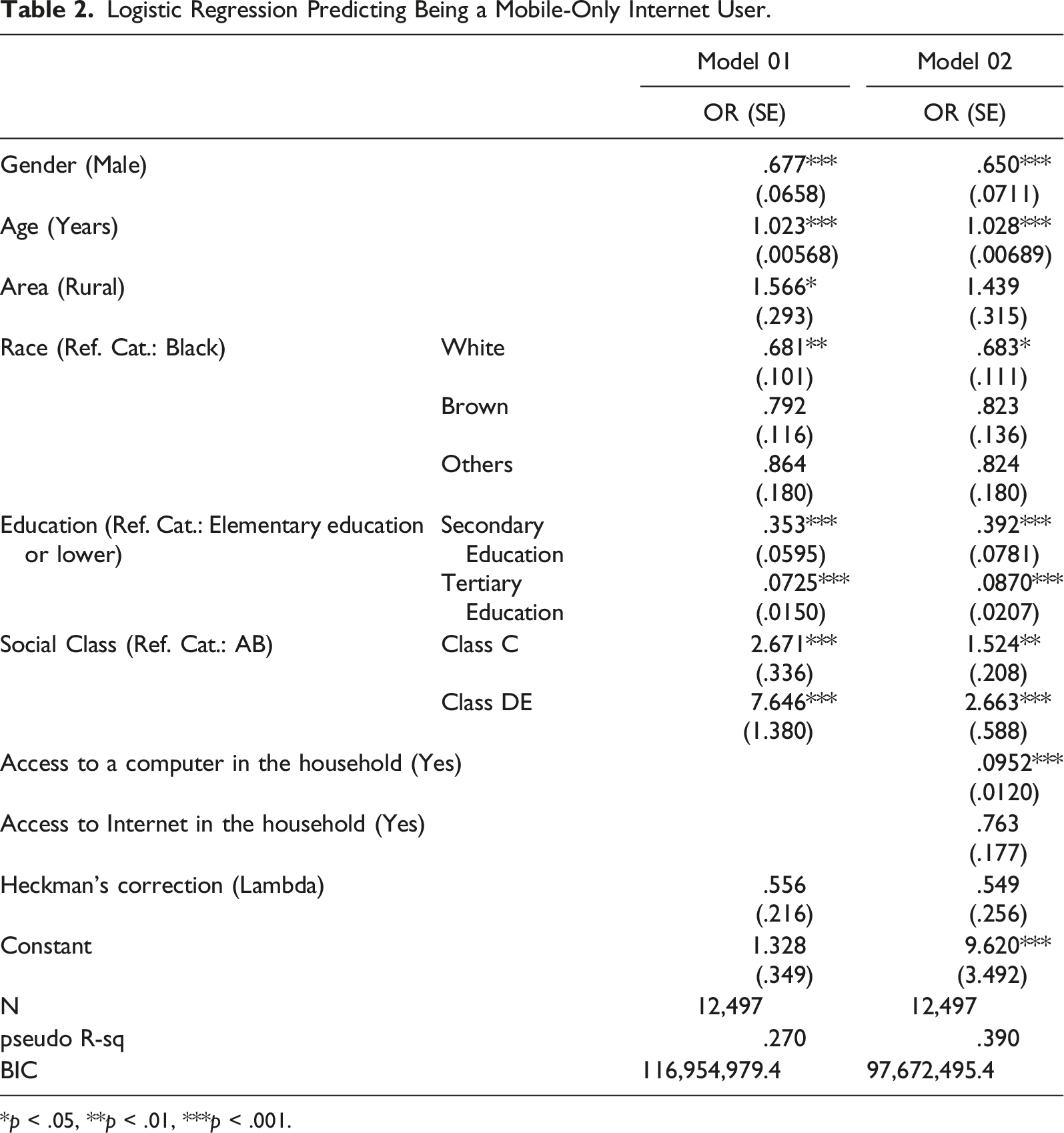
Logistic Regression Predicting Being a Mobile-Only Internet User.
*p < .05, **p < .01, ***p < .001.
Results
Descriptive Statistics
The sample of adult respondents contained 18,684 individuals. Nonetheless, as 669 respondents had missing responses for race, these cases were discarded, leaving a final sample of 18,015 individuals. Among these adults, the average age was 43.8 (SD 17.1), 46.9% were male, and 13.1% resided in rural localities. Regarding race, 38.4% identified as White, 13.5% as Black, 44.5% as Brown, and 3.7% as other (Indigenous or Asian). Regarding education, 5.5% of the sample was illiterate or had completed only pre-school, 38.1% had a primary education, 35.2% a secondary education and 21.1% a tertiary education. Regarding the socioeconomic class of the household, 2.1% were part of the highest class (A) and 19.4% of the second highest one (B), 47.2% were part of the C class (the second lowest), and 31.2% of the lowest D class.
More than two thirds of the sample lived in households with some type of Internet connection (76.4%) but less than half of the households had computers (46.5%). Most were frequent Internet users, as 69.5% used the Internet daily or almost all days, and 8.4% used it less frequently. Almost a fourth had not accessed the Internet in the last three months (22.1%) and thus, were not considered active Internet users. Less than 1% connected to the Internet exclusively through a computer (.5%), 46.2% exclusively from a mobile phone, and 31.0% via a computer and mobile devices. About one half of the respondents—50.9%—had engaged with the government online in the last 12 months for at least one of the seven tasks.
Predicting Living in a Household with a Computer
Two logistic hierarchical nested models were developed to predict Brazilians’ odds of living in a household with a computer. The first model, which had lower pseudo R2 and higher BIC values, included only the more structural or invariable sociodemographic attributes such as gender, age, area of residency, and race. Consequently, analyses will focus on model 2.
The introduction of education and social class in the second model improved its fit substantially. Both gender and race lost the statistical significance present in model 1, and age (OR = 0.992, p < .01) and location of residence (OR = 0.687, p < .05) weakened their effect substantially. Education and social class washed some or all the significance of the other variables, and became, by far, the strongest predictors. Compared to those with an elementary education or less, those with a tertiary education had an odds ratio of 4.649 (p < .001) of having a computer in their households. Similarly, compared to the highest social class (AB), being part of the lowest one (DE) greatly reduced the chances of living in a household with a computer (OR = 0.063; p < .001). These results partially validate hypothesis 4 with regard to the effect of all of the socioeconomic and demographic attributes besides gender and race on the likelihood of having a computer in one’s home.
Predicting Being a Mobile-Only Internet User
Given that our next two logistic regressions dealt with Internet users only, they contained a smaller number of respondents. Consequently, these two models included a selectivity correction term as described in the methods section. A probit selection model predicting being an Internet user was estimated. The model included the same predictors as in the logistic regression for living in a household with a computer. The selectivity correction term was introduced in both of the Internet-user related behavior models. As the results of the analyses show, it does not signal statistically significant selection biases. However, the selectivity correction term was retained nonetheless for control purposes.
Two nested logistic models were created predicting being a mobile-only user. The first model replicated all the hypotheses concerning the predictors of living in a household with a computer plus the selectivity correction term, whereas the second one added access to a computer and access to the Internet at the household level.
As with the previous models, the second regression had a substantially better fit (1.44 times higher pseudo R2 and lower BIC) with the introduction of just two variables, one of which was not even statistically significant. All analyses focus on model 2.
Model 2’s main finding relates to the deterrent effect of living in a household with a computer for being a mobile-only user (OR = 0.095; p < .001), as well as the non-statistically significant effect of living in a household with connectivity. These results validate hypotheses 1, 5 and 6. Moreover, after the introduction of access to a computer and the Internet at the household level, living in a rural area lost its statistical significance, and the effect of social class weakened significantly, signaling potential cases for full and partial mediation, respectively.
The mediation analysis focused on the indirect effects of a selection of variables and categories on mobile-only access, mediated through living in a household with a computer. The selection criterion was based on the variables’ role as statistically significant direct predictors of the mediator in the first model (Table 1): social class (DE), race (White), living in a rural area, and education (tertiary).
The findings detailed in Appendix 1 do not support an indirect effect of race. On the other hand, all four mediation methods point towards an indirect effect of social class (DE compared to AB; p < .001). In other words, being in the lowest socioeconomic class increases the chances of being a mobile-only Internet user in two ways: directly, and indirectly by reducing the odds of living in a household with a computer.
In line with the loss of the statistical significance of living in a rural area after the introduction of the mediator variable, there is reasonable evidence for full mediation in this scenario. Three out of the four methods indicated that living in a rural area reduces the chances of having a computer at home, thus increasing the chances of being a mobile-only Internet user mediated by the latter (see Appendix 1).
Regarding tertiary education, all methods provide evidence for partial mediation of the negative sign (p < .001). Higher education reduces the chances of being a mobile-only user both directly (Table 1) and indirectly, through its effect on increasing the odds of living in a household with a computer (Appendix 1). In sum, results partially validate the sequential nature of digital inequalities proposed in hypothesis 3.
Predicting E-Government Engagement
Three logistic hierarchical nested models were fitted to predict e-government engagement. The first model replicated all the hypotheses concerning the predictors of living in a household with a computer plus the selectivity correction term. The second replicated all the predictors of mobile-only Internet use. The last model added mobile-only access and daily Internet use as additional predictors.
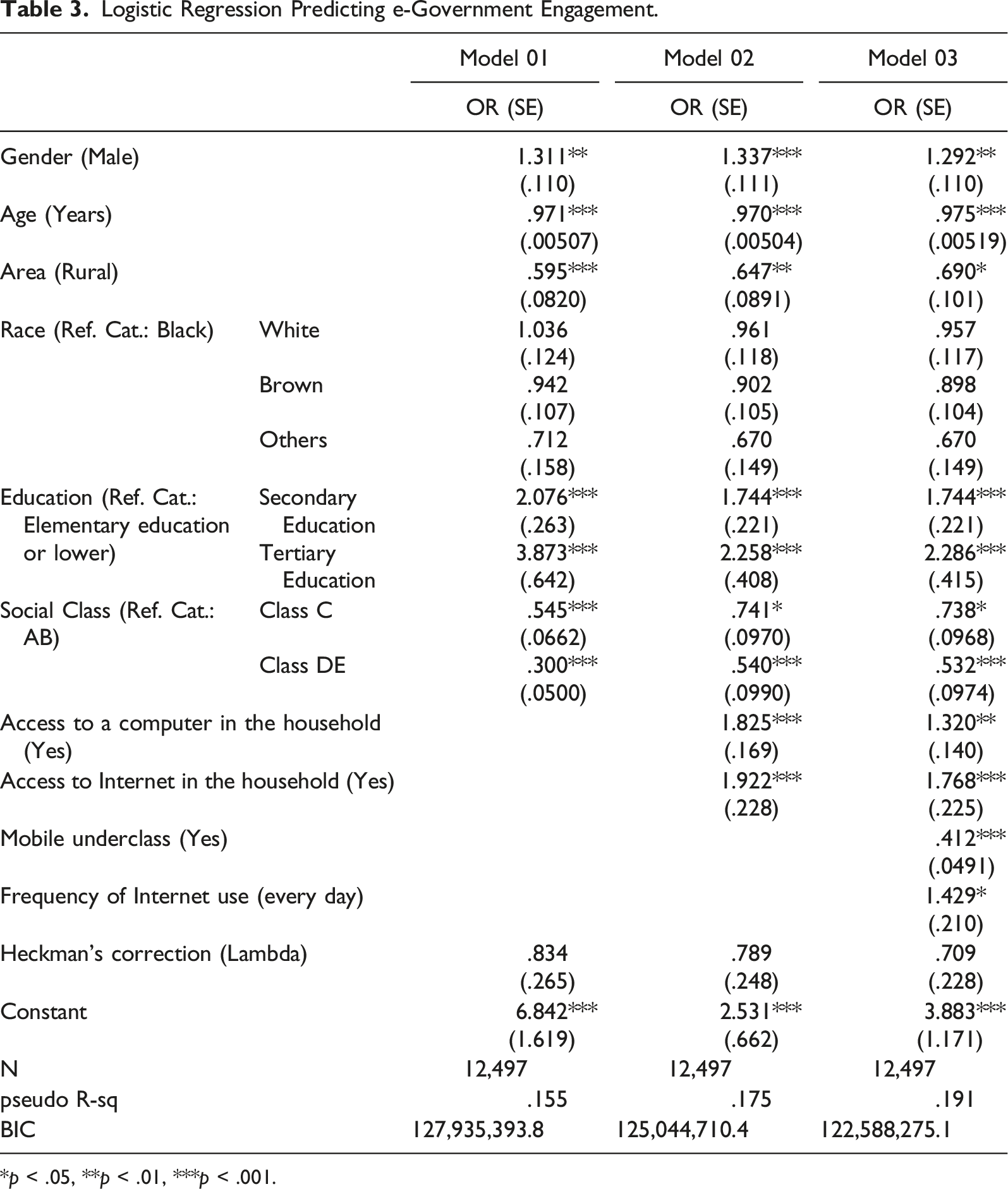
Logistic Regression Predicting e-Government Engagement.
*p < .05, **p < .01, ***p < .001.
Contrary to previous findings in the literature on e-government engagement, for the Brazilian case there was a gender bias in favor of men (OR = 1.292, p < .01). In line with previous findings, being older reduced the chances of such engagement (OR = 0.975, p < .001), as did living in rural areas (OR = 0.690, p < .05). Race had no statistically significant direct effect on e-government engagement.
Here again, education was a major predictor. Compared to those with an elementary education or less, those with a tertiary education were more than twice as likely to engage in e-government activities (OR = 2.258, p < .001); the effect of having a secondary education was in the same direction (OR = 1.744, p < .001). Similarly, compared to the highest social class (AB), being part of the middle or lower one significantly reduced the odds of e-government engagement (OR = 0.741, p < .05, and OR = 0.540, p < .001, respectively). These findings also validate hypothesis 4.
All digital access and use variables were statistically significant with the expected sign, validating hypotheses 1, 2 and 5. Access to a computer in the household (OR = 1.320, p < .01) had a slightly less direct impact than the frequency of Internet use on a daily basis (OR = 1.429, p < .05). In addition, these two factors had less of an impact than access to the Internet at home (OR = 1.768, p < .001). Finally, being a mobile-only Internet user had one of the strongest effects, the highest in terms of its negative impact (OR = 0.412, p < .001).
The results of mediation analyses considering living in a household with a computer as the mediator (Appendix 2) and another set of analyses using mobile-only Internet use as the mediator (Appendix 3) provided similar results that partially validated hypothesis 3.
Regarding the indirect effects mediated by living in a household with a computer, the results indicated that only social class had a statistically significant effect at p < .01 or p < .001. The effect of social class was also mediated by mobile-only use (p < .001). In other words, the effects of social class on e-government engagement are three-fold: direct, indirect mediated by household access, and indirect mediated by mode of access (see Appendixes 2 and 3).
No statistically significant indirect effect of race mediated by household access was found. However, race did have a statistically significant indirect effect on mode of access (White compared to non-white; see Appendix 3). In three out of four methods, living in a rural area had an indirect effect on e-government engagement mediated by mode of access (p < .001).
Finally, there is substantial evidence that mode of access partially mediates the effect of education (p < .001) as well as that of household access (p < .001), validating hypothesis 3.
Conclusion
E-government deployment across nations showed uptake of digital services seriously lagged behind the investment and development of these e-services. There is substantial evidence that socioeconomic and digital inequalities are part of the reasons behind these. Nonetheless, with the massification of smartphones and, thus, mobile access to the Internet, some of these disparities appeared to lessen.
Connected mobile devices are some of the key drivers of recent Internet expansion in lower-income countries and households. Whereas researchers have documented their impact on democratizing access to the Internet, there have been concerns that “mobile leapfrogging,” particularly mobile-only Internet access, could also be creating a new type of digital stratification: the mobile underclass. These class-tiered Internet experiences produced by mode of access or device dependencies condition the potential outcomes of Internet use. One of such outcomes is e-government engagement: in a multi-channel environment, compared to face-to-face governmental exchanges, digital ones can lessen the administrative burdens, or the non-monetary costs placed on citizens, during these interactions. As computers provide certain advantage for digital governmental interactions compared to mobile devices, this study aimed to fill a gap in the literature on how household access is related to mode of access, and both to e-government engagement.
Based on a 2019 nationally representative survey of the Brazilian population, I created three nested logistic binary regressions: one predicting whether a household had a computer device, one predicting a mobile-only mode of access, and one predicting e-government engagement. Then, mediation analyses were conducted for the two latter models to test the sequential nature of socio-digital inequalities, and how antecedent-levels of digital disparities such as household access affect the chances of a higher-level digital outcome: e-government engagement.
Findings provide substantial support for H4 concerning the effects of socioeconomic status on access divides as well as e-government engagement. They show that being younger, more educated, and part of the upper socioeconomic class have a statistically significant direct effect on increasing the chances of living in a household with a computer, not being a mobile-only Internet user, and engaging with the government online. These three sociodemographic attributes directly affect digital disparities across three levels of divides, a finding that accords with most of the results in the literature on sequential digital inequalities (i.e., Helsper, 2021; van Deursen et al., 2017). Gender (being a women) and geographical region (living in rural localities), on the other hand, directly predicted mode of access and e-government engagement but not household access to a computer.
Findings provide substantial support for Helsper’s (2021) and van Deursen et al.’s (2017) notion of the sequential nature of digital inequalities (H3), as digital attributes mediate part of the effect of sociodemographic ones over e-government engagement.
In accordance with H1 and H6, results also indicate that household access to a computer—but not to connectivity—directly impact mode of access to the Internet. Nonetheless, ICT access at household to computer (H1) and to the Internet (H5), as well as mobile-only mode of access (H2), directly affect e-government engagement. Finally, in line with H1, findings show that more complex digital disparities such as mode of access also partially mediate the effect of more basic level divides such as household access.
Discussion
In this sense, these results provide critical information for digital inclusion and e-government engagement policies. They caution against overly simplistic conceptualizations of disparities in digital access. Indeed, negative externalities in terms of digital exclusion can occur if mobile leapfrogging-like policies are regarded as adequate solutions for divides in access. Even considering their benefits in terms of expanding access to the Internet, mobile leapfrogging creates true mobile underclasses, reducing their chances of engaging in several capital-enhancing activities such as e-government engagement.
Results also caution against focusing on the digital and forgetting that traditional sources of inequalities such as socioeconomic status, gender, age, and human capital are generally behind most of these disparities (Helsper, 2021). Whereas far off the scope of this article, poverty alleviation and redistributive policies are the first necessary—but not sufficient-conditions for citizens’ e-government engagement and should be prioritized. As Christensen et al. (2020) argue, experiences of scarcity—among a plethora of negative outcomes—can also increase the experienced costs of governmental interactions.
Similarly, whereas the role of gender in digital disparities tends to be more nuanced in developed economies, and ideally governmental electronic services tend to leapfrog geographical barriers, this was not the case for Brazil in this study. There is some evidence that the effects of these variables on e-government might be mediated by the development of digital skills. However, gender and locality-based disparities still prevail in developing economies. For example, Robles et al. (2021) documented that gender is an indirect predictor of lack of trust in e-government but is mediated by digital skills. Nonetheless, more general biased gender norms cannot be discarded as a potential mechanism. The effect of living in a rural area, on the other side, might be more of a question of service provision than people’s use of the Internet. There is compelling evidence that smaller governmental levels invest less in technology and develop fewer services online in Brazil (i.e., Przeybilovicz et al., 2018).
This article also contributes to the literature by providing evidence that a mobile-only mode of access is detrimental to e-government engagement, and both depends heavily on the availability of non-mobile devices in people’s households. Whereas policies such as One Laptop Per Child that promised one-to-one computers for all have not been realized, the relevance of in-household access to a computer remains an important but unfulfilled goal. Indeed, the ability to study and work from home during COVID-19 lockdowns has proven the continued importance of this goal. The article’s findings also point out that the centrality of access to a computer for digital equity is not limited to emergency scenarios.
In non-pandemic scenarios, it is also important to consider alternative venues to access computer-like devices. Nemer (2018), for example, studies the Brazilian favela (urban slum) of Vitótia and argues that community telecenters can complement mobile-only accesses for meeting the needs of marginalized citizens in their daily life. Moreover, if telecenters play such a critical role in marginalized communities, strengthening them and ensuring strong presence of governmental officials in these venues could provide an interesting channel marketing strategy to influence digital governmental channel choice in Brazilian favelas (Madsen & Kræmmergaard, 2016).
Limitations and Future Research
Finally, the study has certain limitations that need to be addressed. As described in the methods section, NIC.br (2020a) asked questions about digital skills only to computer users in their survey. Consequently, as mobile-only user was a critical determinant in the proposed theoretical model, it was unfeasible to include digital skills in the analyses. Nonetheless, ex-post and secondary exploratory analyses conducted only to computer users showed that, as expected by the DiSTO model (Helsper, 2021; van Deursen et al., 2017), digital skills are the strongest predictor of e-government engagement. Moreover, digital skills ended up as the only statistically significant predictor in this model, “washing out” all other variables’ previous effects. As these other predictors (the same as in the mobile-only models) also predict digital skills, a fully mediation hypothesis could be behind this behavior. More detailed analyses, incorporating both mode of access and digital skills are required to further advance in this issue in future studies.
Christensen et al. (2020) also signals the need to consider alternative types of skills or literacies seldom assessed in e-government channel choice-like studies such as administrative competence, or the skills and knowledge required to interact with governmental administrations or bureaucracy.
Additionally, while this study focusses on the demand side of governmental engagement, supply-side attributes could be also partly behind lower levels of e-government engagement in a mobile-only or mobile underclass scenario. Developing mobile friendly or mobile-by-design governmental services could reduce the effects of mode of access-based digital inequalities, at least for certain services which allow for it.
Finally, some methods limitations should also be signaled. Conducting more complex analyses such as structural equation models would have allowed to assess more paths or levels of the divide at the same time. Future research should also broaden the scope of the outcomes to other capital-enhancing consequences of Internet use such as e-commerce, e-learning, or job seeking.
Footnotes
Declaration of Conflicting Interests
The author(s) declared no potential conflicts of interest with respect to the research, authorship, and/or publication of this article.
Funding
The author(s) received no financial support for the research, authorship, and/or publication of this article.

Appendix
Mediation analysis. Indirect effect of selected variables on mobile-only Internet use mediated by living in a household with a computer.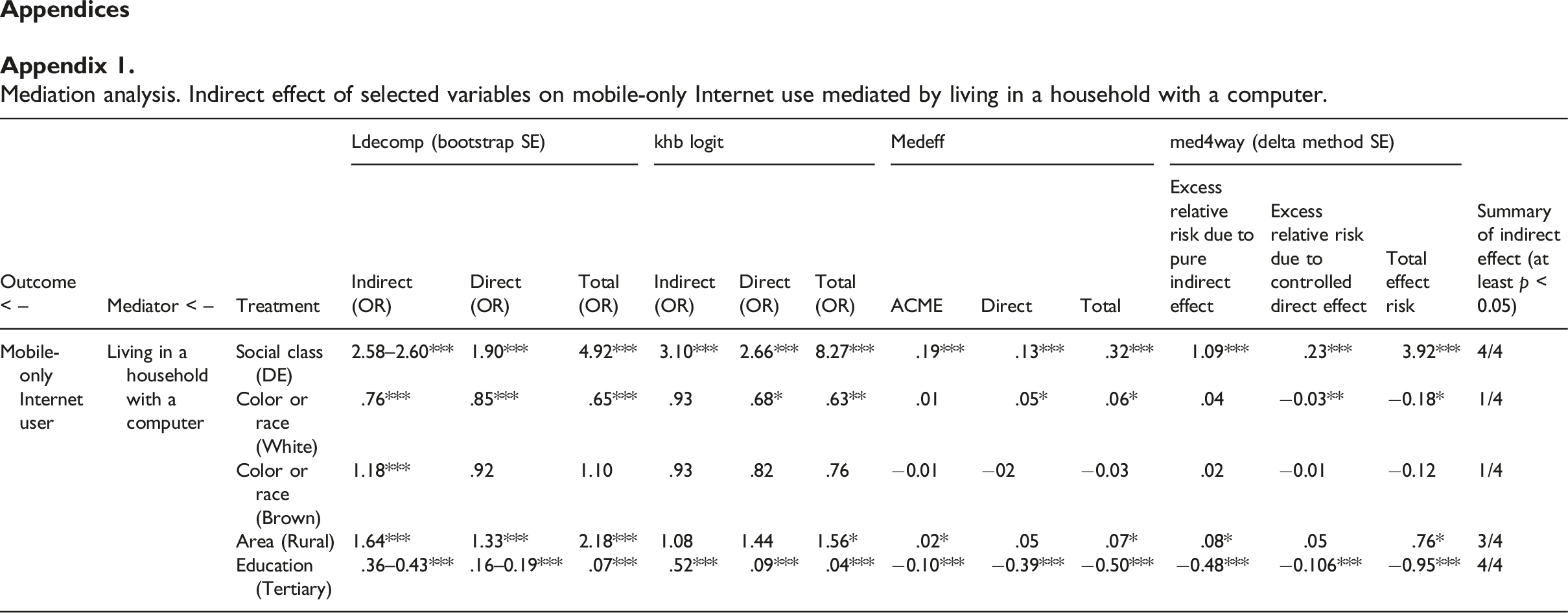
Ldecomp (bootstrap SE)
khb logit
Medeff
med4way (delta method SE)
Summary of indirect effect (at least p < 0.05)
Outcome < --
Mediator < --
Treatment
Indirect (OR)
Direct (OR)
Total (OR)
Indirect (OR)
Direct (OR)
Total (OR)
ACME
Direct
Total
Excess relative risk due to pure indirect effect
Excess relative risk due to controlled direct effect
Total effect risk
Mobile-only Internet user
Living in a household with a computer
Social class (DE)
2.58–2.60***
1.90***
4.92***
3.10***
2.66***
8.27***
.19***
.13***
.32***
1.09***
.23***
3.92***
4/4
Color or race (White)
.76***
.85***
.65***
.93
.68*
.63**
.01
.05*
.06*
.04
−0.03**
−0.18*
1/4
Color or race (Brown)
1.18***
.92
1.10
.93
.82
.76
−0.01
−02
−0.03
.02
−0.01
−0.12
1/4
Area (Rural)
1.64***
1.33***
2.18***
1.08
1.44
1.56*
.02*
.05
.07*
.08*
.05
.76*
3/4
Education (Tertiary)
.36–0.43***
.16–0.19***
.07***
.52***
.09***
.04***
−0.10***
−0.39***
−0.50***
−0.48***
−0.106***
−0.95***
4/4
Mediation analysis. Indirect effect of selected variables on e-government engagement mediated by living in a household with a computer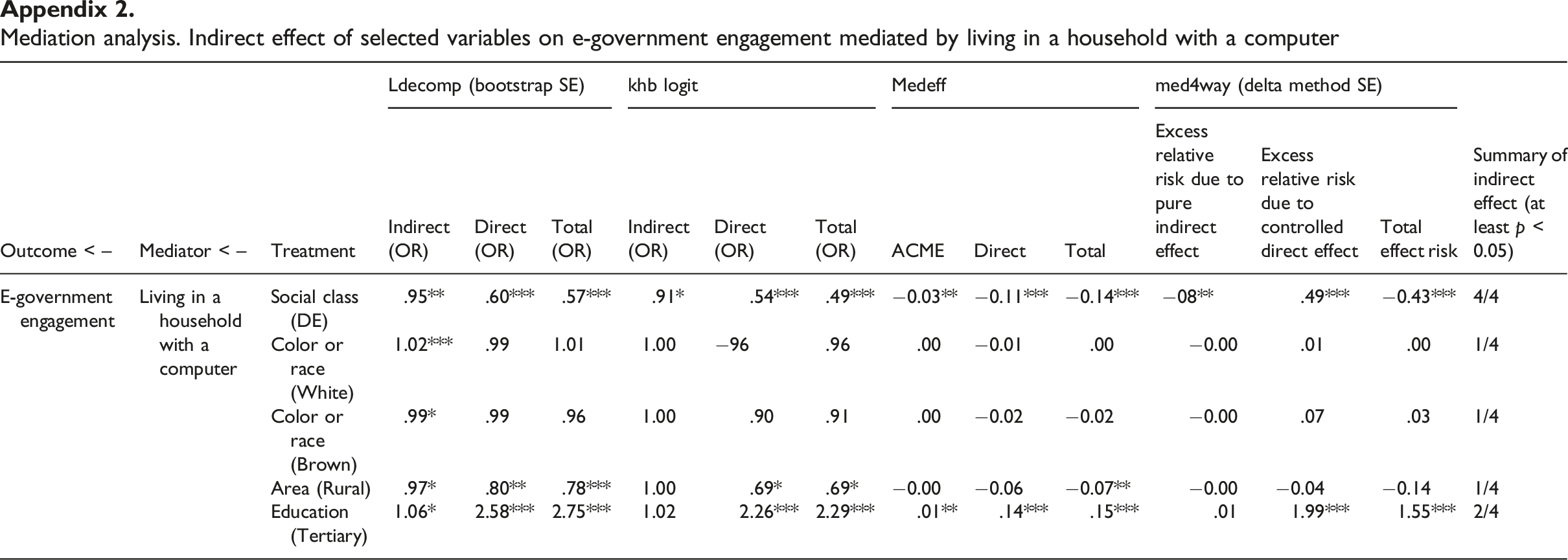
Ldecomp (bootstrap SE)
khb logit
Medeff
med4way (delta method SE)
Summary of indirect effect (at least p < 0.05)
Outcome < --
Mediator < --
Treatment
Indirect (OR)
Direct (OR)
Total (OR)
Indirect (OR)
Direct (OR)
Total (OR)
ACME
Direct
Total
Excess relative risk due to pure indirect effect
Excess relative risk due to controlled direct effect
Total effect risk
E-government engagement
Living in a household with a computer
Social class (DE)
.95**
.60***
.57***
.91*
.54***
.49***
−0.03**
−0.11***
−0.14***
−08**
.49***
−0.43***
4/4
Color or race (White)
1.02***
.99
1.01
1.00
−96
.96
.00
−0.01
.00
−0.00
.01
.00
1/4
Color or race (Brown)
.99*
.99
.96
1.00
.90
.91
.00
−0.02
−0.02
−0.00
.07
.03
1/4
Area (Rural)
.97*
.80**
.78***
1.00
.69*
.69*
−0.00
−0.06
−0.07**
−0.00
−0.04
−0.14
1/4
Education (Tertiary)
1.06*
2.58***
2.75***
1.02
2.26***
2.29***
.01**
.14***
.15***
.01
1.99***
1.55***
2/4
Mediation analysis. Indirect effect of selected variables on e-government engagement mediated by mobile-only Internet use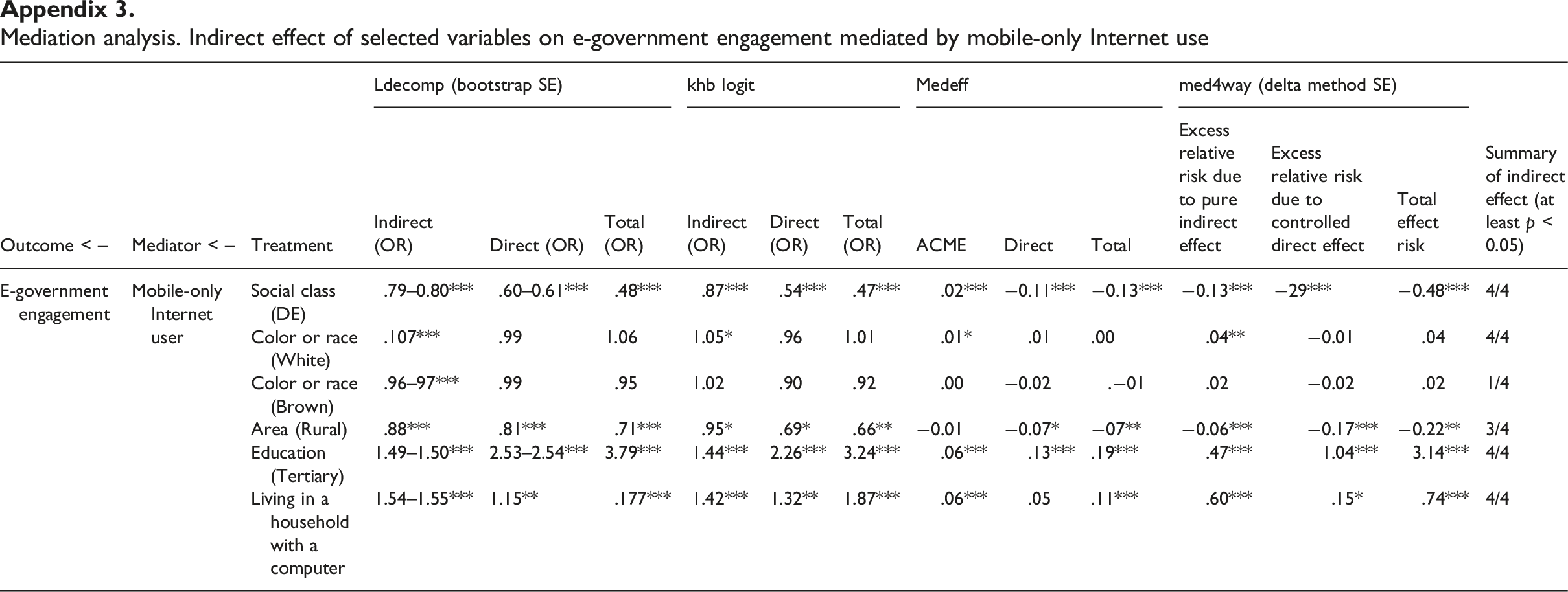
Ldecomp (bootstrap SE)
khb logit
Medeff
med4way (delta method SE)
Summary of indirect effect (at least p < 0.05)
Outcome < --
Mediator < --
Treatment
Indirect (OR)
Direct (OR)
Total (OR)
Indirect (OR)
Direct (OR)
Total (OR)
ACME
Direct
Total
Excess relative risk due to pure indirect effect
Excess relative risk due to controlled direct effect
Total effect risk
E-government engagement
Mobile-only Internet user
Social class (DE)
.79–0.80***
.60–0.61***
.48***
.87***
.54***
.47***
.02***
−0.11***
−0.13***
−0.13***
−29***
−0.48***
4/4
Color or race (White)
.107***
.99
1.06
1.05*
.96
1.01
.01*
.01
.00
.04**
−0.01
.04
4/4
Color or race (Brown)
.96–97***
.99
.95
1.02
.90
.92
.00
−0.02
.−01
.02
−0.02
.02
1/4
Area (Rural)
.88***
.81***
.71***
.95*
.69*
.66**
−0.01
−0.07*
−07**
−0.06***
−0.17***
−0.22**
3/4
Education (Tertiary)
1.49–1.50***
2.53–2.54***
3.79***
1.44***
2.26***
3.24***
.06***
.13***
.19***
.47***
1.04***
3.14***
4/4
Living in a household with a computer
1.54–1.55***
1.15**
.177***
1.42***
1.32**
1.87***
.06***
.05
.11***
.60***
.15*
.74***
4/4