



Abstract
Context:
School-based student protests have received little scholarly attention, yet they have the potential to impact the school community, students’ civic development, and larger social movements. Principals are key actors in responding to school-based student protests. As school leaders, principals’ actions affect the outcome of student protests and shape many students’ first experiences as activists.
Purpose:
This study examines U.S. public high school principals’ responses to school-based student protests in 2018, a year of heightened protest activity in response to gun violence in schools. The purpose of our study is to understand how a national sample of principals responded to student protests and to quantify general trends in their responses.
Research Design:
Using a mixed methods approach, we surveyed 491 principals during the summer of 2018; follow-up interviews were conducted with 38 principals. Analyses are grounded in the Deter-Manage-Educate framework, a new conceptual framework that we develop in this paper, organized around the three broad goals principals pursue when responding to student protests. Using this framework, we determined how and how many principals deterred, managed, and educated.
Results:
Findings show that very few principals outright deterred student protests. Nearly all principals managed by setting parameters around protests in an effort to balance students’ right to free speech with concerns for order and safety. A majority of principals also educated, using student protest as an opportunity to encourage civic development. Our findings suggest that an important distinction exists between principals who channel students toward (or away from) a particular manner of protest and principals who facilitate reflection to help students realize their own vision of civic engagement.
Implications:
This study has implications not only for principals, but also for district leaders and educational leadership organizations: Although many principals receive support for managing the logistical (and legal) challenges of responding to student protests, more attention needs to be directed toward helping principals leverage the educative opportunities that student protest can provide.
Keywords
Introduction
We’re in a rural part of [the state]. It’s a gun-heavy area. There were several meetings with our school board prior [to the walkout] because they were concerned what might happen with it.. . . One of the directives I got from the school board is the school will take no position. We will simply make time and space available for students who want to be politically active. But the school board was very clear that I, personally, and the school, was not to have any position one way or the other on this.. . . I had parents threatening on both sides, “If you don’t let my kids walk out we’ll sue you,” “If you let the kids walk out we’ll sue you.” . . . We had prepped the students beforehand, said, “Hey, we’ll support your civic right to gather and protest and whatnot, but make sure that your parents call you in and excuse you for that time, and then be peaceably in this area that we set aside outside.”. . . We had some parents show up in the parking lot with signs wanting to protest each side of it. Some wanted gun control, some wanted to tell us that they have a Second Amendment right. Blah, blah, blah. So we had to remove those parents from the school property because it wasn’t appropriate for them to be here.. . . We had TV stations and the newspapers calling from [the capitol]. Obviously we had two local newspapers that called us, and again, we said the same thing to them, “We’ll take no position. We’ll support the students’ right to peaceably gather.” And that’s kind of where we left it.. . . But more than anything, again, it’s the students’ comments to each other. If somebody wears a tee shirt that says, “You can have my guns when you pry them from my cold, dead hands,” or someone wearing a tee shirt that has a gun with a line drawn through it, protesting, it’ll turn into verbal disagreements, which we try to prevent from escalating any further. But that’s always somewhere in the background. —Principal “Ryan”
Protests play an important role in democratic society (Meyer, 2007) and can contribute to students’ civic education (Westheimer & Kahne, 2004). Yet school-based protests pose a plethora of challenges for educators and, especially, school principals. As head administrators and educational leaders, principals must negotiate the divergent interests of students, parents, district officials, school board members, local community residents, and representatives of the state and federal government. The decisions principals make in response to protests may influence students’ safety and learning, community dynamics, and broader social movements, as well as principals’ continued employment (e.g. Chapman, 2022). Principals may model democratic leadership amidst protests by making space for diverse voices and by acknowledging that there are many legitimate and often competing views on contentious issues in a democracy (Gutmann, 1999). This study addresses the question of how principals responded to school-based student protests of gun violence in 2018, when students at many schools suddenly became civically engaged.
Galvanized by the 2018 mass shooting at Marjory Stoneman Douglas High School in Parkland, Florida, students across the United States organized protests against gun violence in schools (Binkley, 2018). Many of these protests were school-based; that is, they occurred at school sites during school hours. Although this particular movement emerged out of a single tragic event, such activity is consistent with a broader pattern of heightened youth activism and student protest in recent years. In addition to gun violence, high school students have recently organized school-based protests addressing climate change (Pyper, 2019), anti-Black racism (Rim, 2020), immigration reform (Resto-Montero, 2019), mask mandates (Rahman, 2022), and reproductive rights (Wilkins, 2022). In 2020, 27% of young people aged 18–24 years old reported having participated in at least one protest—a dramatic increase from 16% in 2018 and 5% in 2016 (Center for Information and Research on Civic Learning and Engagement, 2020). In a 2017 national survey of high school teachers, 24.5% reported that the number of students participating in civic and political protest had increased compared with previous years, whereas only 10.4% said it had decreased (Rogers et al., 2017).
Scholarship has not kept pace with the increase in youth protest, and very little attention has been directed toward principals’ responses to student protests and how principals’ responses affect student activism. The only wide-scale study of principals’ responses to youth protest is now more than 50 years old, and it focused more on the frequency with which students protested various social issues than on principals’ responses to student protest (Trump & Hunt, 1969). With respect to qualitative studies, Graham (2006) provides historical accounts of several principals’ divergent responses to student protests in the 1960s and 1970s, and Locke and Broadhurst (2019) interviewed one principal whose students organized a protest against gun violence in 2018. Neither of these qualitative studies, however, was designed to identify patterns of responses or to determine the prevalence of certain types of responses.
There is a substantial body of literature on youth activism that bears indirectly on our inquiry. Youth activism generally refers to efforts of young people to prompt social change. Often such activism occurs in organized youth groups that employ a wide array of tactics aimed at changing rules and practices of local institutions, effecting broader changes in public policy, and transforming common sense understandings of what is normal and what is possible (Kirshner, 2008). Through this participation, young people build power and develop a broad set of civic capacities (Ginwright & Cammarota, 2007; Rogers, Mediratta, & Shah, 2012). Youth activists investigate social issues, communicate insights and interests, map power relationships, build networks with other youth and organizations, and press institutional representatives and policymakers to effect change. Youth activism can include protest activity and, at times, such protests may occur in schools (Conner & Rosen, 2016).
Our study focuses on how principals respond to student-initiated protests that occur in high schools. Such protests are related to youth activism, but they almost invariably draw upon a broader group of youth participants who have not previously been involved in organized youth civic groups. In contrast to carefully scaffolded civic learning opportunities such as Youth Participatory Action Research (Cammarota & Fine, 2008), protests offer short-term civic engagements that, for many students, constitute their first personal experiences with activism (Conner, 2020). Our study focuses on principals who, although not directly involved in the civic instruction of their students, exert their authority in ways that can shape, and sometimes repress, youth activism (Earl, 2004). The complex dynamic between student protestors and school authorities may impact students’ civic development, how they learn to (dis)engage with those in power, and their future (un)involvement in democratic systems (Erikson, 1968).
Given that little is known about how education officials respond to student protest, we developed the Deter-Manage-Educate framework in order to make sense of our research findings. The Deter-Manage-Educate framework is rooted (in part) in social movement repression literature (Earl, 2003), wherein government authorities are viewed predominantly as control agents who are constrained to meet certain institutional goals. In this role, principals’ priorities to keep students safe and to keep the school out of legal trouble conflict with the goals of student protestors and opportunities for students’ civic growth. Educative goals are secondary.
Legally, high school students’ right to political expression is partially protected by the Supreme Court’s 1969 decision, Tinker v. Des Moines Independent Community School District, which states that students do not “shed their constitutional rights to freedom of speech or expression at the schoolhouse gate” (p. 506). Yet Tinker permits school officials a range of admissible responses to student protest. Indeed, the Supreme Court often has sided with school officials on subsequent cases (Driver, 2018). Additionally, although Tinker affirms the importance of political expression in schools, it provides little guidance for education officials on how to support student engagement in contentious issues while also minimizing the chance of hostile exchange. Given the practical limitations of Tinker, how school officials should respond to protest remains an open question. Beyond legal precedent, there is an important difference between “law on the books” and “law in action,” suggesting that the intentions of Tinker may diverge from how principals lawfully behave (Sutton, 2001).
We address these critical gaps by examining how U.S. public high school principals responded to gun violence protests in spring 2018. We anchor our analyses in literatures on social movement repression (e.g., Earl, 2004), school administration (e.g., Cuban, 1988), and democratic leadership in education (e.g., Woods, 2021). Bridging these bodies of research helps us to consider whether principals’ responses to protest are similar to those of law enforcement, and whether and how principals foster civic development in the spontaneous and contentious context of student protests. Using a mixed methods approach, we analyze a national survey of principals alongside interviews with a subset of survey respondents to identify and explore the three broad goals that principals pursue when faced with student protest: deterrence, management, and education. Our dataset enables us to understand how principals act in relation to these goals and to excavate the kinds of dilemmas that principals encounter in trying to realize them.
Conceptualizing the Role of Principals Around Protest
In addition to the need for more empirical research on how principals respond to school-based student protests, there is also a need for conceptual and theoretical synthesis to make sense of these underexplored social dynamics. For our conceptual framework, we draw on three existing but disconnected literatures. Together, these bodies of literature help to clarify the challenges that protests pose for principals and to synthesize those challenges into expectations about competing goals. First, with research on protest control, we consider how principals are similar to other governmental authorities insofar as they act as control agents, that is, authorities who seek to constrain the actions of protestors. Second, we review research on school administration in order to better understand the administrative responsibilities of the high school principals. Lastly, invoking research on democratic leadership and education for democracy, we suggest how principals can lead in moments of extreme tension and how principals might cultivate civic learning in a way that supports student voice, even in spite of their role as control agents. In the following sections, we illuminate each aspect of the Deter-Manage-Educate framework by discussing how research on protest control informs thinking on deterrence, how research on principal administration speaks to the managerial concerns of principals, and how education for democracy provides insight into how principals might take an educative approach to school-based student protest.
Research on Protest Control
Scholarship on protest control (or what social movement scholars refer to as “social movement repression”) examines how authorities seek to prevent, constrain, or control protest (Davenport, 2007; Earl, 2011). This robust literature shows how institutions, especially law enforcement, choose from among multiple possible goals when responding to protests. Little research, however, has investigated how educational authorities respond to student protests in secondary schools. In postsecondary education, Lammers (1977) and Cho (2018) have shown how university officials adopt various strategies in response to student protest. These strategies align with Earl’s (2004) overarching typology of protest control, which we employ to help examine student protest at the high school level.
One of the most prominent goals of protest control is deterrence (Earl, 2003). A common way to deter protest is to threaten sanctions or, failing that, to impose them. In contrast to more explicit modes of deterrence, authorities may channel activists into adopting “acceptable” forms of political expression by employing soft sanctions or incentivizing less contentious activities.
Authorities may also work to comply with legal obligations to protect some forms of speech and assembly. For instance, in the United States it has been recognized since the late 1960s and early 1970s that law enforcement has an obligation to protect both public order and protesters’ First Amendment rights (McCarthy & McPhail, 1998). Police create and often enforce time, place, and manner restrictions to constrain when protests occur, the locations available to protesters, and the tactics that protesters may lawfully use. The creation and enforcement of time, place, and manner restrictions are justified by claims that these restrictions balance First Amendment rights with an upholding of public order. So long as these restrictions are applied to all protests, regardless of their substantive focus (referred to as content neutrality), the courts have viewed such restrictions as an acceptable balance of rights and order, rather than an undue deterrent against protest.
Through the lens of protest control, we view school principals as analogous to law enforcement officers in that they may try to limit or stop protest, whether through threats or actual imposition of discipline (Earl, 2004). Principals may be interested in preventing protests because they are worried about their schools becoming targets for politicization. Principals may also worry that their schools will be seen as favoring one side over the other, which could have legal ramifications (see discussion of Hazelwood School District v. Kuhlmeier in Yudof, 1995) or could negatively impact public support and funding (Superville, 2019). Principals may also want to deter protests when existing school policies and practices are the direct targets of protest (e.g., protests against sexist dress codes). Alternatively, principals may not seek to deter protests, but may feel obligated to balance students’ free speech rights with upholding school order and safety, not unlike police balancing free speech with public safety.
Yet for all of these similarities, there are important differences between law enforcement agents and school principals. Notably, principals are responsible for managing the overall operations of the school and for supporting the educational and civic development of students. As educational leaders, principals may see their schools as laboratories for civic engagement and could thereby feel compelled to facilitate student participation in protests and/or civic learning during and after protests. In contrast, police have neither an obligation to act in a manner that advances civic and political expression nor an interest in facilitating participants’ civic development. Principals’ responsibility to promote students’ civic development may come into conflict with their other responsibilities for efficiently managing the school. For instance, when the schools they serve become the targets of protest, principals may be less inclined to prioritize students’ civic and political development.
This balancing act between order and free speech took center stage in Tinker v. Des Moines Independent School District (1969), in which a school district called for the suspension of students who wore black armbands to protest the war in Vietnam. Siding with the students, the U.S. Supreme Court rejected the claim of the Des Moines director of secondary education that “schools are no place for demonstrations” (p. 509). The majority opinion held that students do not forsake their First Amendment rights when they enter school and that education officials “must be able to show that [their] action was caused by something more than a mere desire to avoid the discomfort and unpleasantness that always accompany an unpopular viewpoint” (p. 509). The court also reasoned that imposing restrictions is appropriate, however, when protest activities “materially and substantially interfere with the requirements of appropriate discipline in the operation of the school” (p. 509).
Although Tinker prohibits school officials from denying students the opportunity to engage in specific kinds of political speech (e.g., wearing a tee shirt or chanting a slogan), the ruling does allow for the direct deterrence of protest for the purpose of facilitating school safety and order, much as police are permitted to create time, place, and manner restrictions for protesters. Such restrictions, however, must be content neutral. For example, if students organize a walkout during school hours to protest a school policy, the principal may not discipline students beyond the punishment they would receive for walking out of school for any other reason (Eidelman, 2018; Yudof, 1995). Decisions to discipline students for walking out during school hours may only be based on district or state policies around preventing disruptions or unexcused absences. Yet even in the face of such policies, principals’ and school districts’ disciplinary decisions vary, from sending foreboding communications about how protest participation can affect students’ grades to refraining from discipline entirely (Heim & St. George, 2018).
Research on School Administration
Separate and aside from protest and the political development of students, principals are expected to secure their students’ safety and academic advancement, and this requires that schools maintain a certain degree of order (Rousmaniere, 2013). In consultation with district leaders, principals establish and implement rules and work with staff to ensure safety and to perform other school operations. Additionally, principals are called on to manage multiple and complex tasks by federal and state accountability systems, bureaucratic directives from district offices, and pressure from parents and local constituencies (Marks & Nance, 2007). Many researchers have pointed out that principals’ managerial duties frequently eclipse other aspects of school leadership, leaving little time for instructional leadership focused on student learning and development (Cuban, 1988; Lugg & Shoho, 2006; Trujillo et al., 2021).
Concerning student protest, principals are charged with following legal mandates and administering district policies. Although it is not clear how many school districts in the United States have established clear expectations for principals regarding student protest activity, in the weeks leading up to the protests against gun violence in spring 2018, the National Association of Secondary School Principals (2018), the National School Boards Association (2018), the American Association of School Administrators (2018), and various states’ departments of education (e.g., McCarter, 2018) all issued guidance on how districts and schools should prepare for and respond to protest. Generally, these guidelines focused on how educators should manage the protests, with particular emphasis on legal implications.
Principals share with other state authorities a general concern for ensuring orderly and safe administration as well as protecting First Amendment rights. At the same time, principals must balance these obligations with ambitious social goals such as supporting the development of student voice and furthering the school’s democratic commitments. School leaders have the unique responsibility of treating protests not merely as challenging events to be managed, but also as opportunities for young people’s growth. High school students’ experiences with protest are especially consequential because they occur during a key phase of individuals’ civic and political development (Conner, 2020; Youniss & Yates, 1997).
Balancing these dual responsibilities (i.e., administrative and educational) represents a high-stakes dilemma for principals. Their actions are scrutinized not only by district officials, but also by school staff, parents, the media, the courts, and other stakeholders (e.g., Jensen, 2018). Perhaps most importantly, their responses hold implications for young people’s safety, rights, and civic development, as well as for the type of governance promoted for society as a whole. Put differently, principals confronted by student protest must attend to both the institutional exigencies of the current moment and the democratic demands of an imagined civic future.
Research on Education for Democracy and Democratic Leadership
Since the early days of the common school movement, public schools have been expected to promote civic education (Mann, 1849). This ideal emerged alongside decidedly antidemocratic structures and practices, such as racial exclusion, class-based inequality, elite interests, didactic instruction, and authoritarian approaches to discipline and administration (Moran & Vinovskis, 2008). Nevertheless, the role of public schools in supporting civic development is reflected in many state constitutions and, since the mid-19th century, many school leaders have understood it to be a core part of their educational mission (Tyack & Hansot, 1982).
In recent decades, the economic purposes of education have garnered more attention, and federal and state accountability systems have increasingly framed principals’ work in relation to improving student performance on standardized assessments (Knapp & Feldman, 2012). Yet there remains today an expectation that public schools will promote civic education and that principals bear responsibility for advancing this goal. Indeed, the national professional standards for school leaders directly reference the need for principals to “[s]afeguard and promote the values of democracy” (National Policy Board for Educational Administration, 2015, p. 10).
Much of the literature on democratic leadership explores whether and how principals share power and invite staff, parents, and (less commonly) students to participate in decision making (Rogers, Freelon, & Terriquez, 2012; Woods & Gronn, 2009). Some scholars frame democratic leadership more expansively, to include the role of the principal in supporting students to become informed and participatory civic agents (e.g., Dewey, 1937). Woods (2021) reasons that this broader view of leadership “seeks to enhance the involvement and influence of others in decisions, encourage discussion and debate, and create a sense of identity as co-creators of a community” (p. 5).
Together, educating for democracy and democratic leadership embrace civic education and young people’s agency to voice their concerns (e.g., through protest) as goals of public schooling. These values are consistent with other approaches to civic education, such as Youth Participatory Politics (Kahne et al., 2016), Youth Participatory Action Research (Cammarota & Fine, 2008; Mirra et al., 2015), Critically Relevant Civics (Clay & Rubin, 2020), Livid Civics (Cohen at al., 2018; Sinclaire et al., 2022), and social justice approaches to school administration (e.g., Lugg & Shoho, 2006). Although distinct, all of these approaches share a common goal of promoting participatory youth engagement, wherein students’ concerns and the challenges they face serve as guides for action and education. Through a student-centric lens, student protests offer authentic (albeit contentious and challenging), “bottom-up” opportunities for civic learning (Mirra et al., 2013). Although no civic education framework discusses the role(s) principals should play in the specific context of student protests, one would expect principals interested in democratic leadership (or any of the other aforementioned approaches) to support the development of student voice and expression.
The Deter-Manage-Educate Framework
It is clear that principals face complex challenges when handling student protest. These challenges manifest in relation to three broad goals: deterrence, management, and education. Although we introduce these as distinct goals, principals may pursue one or more of these goals to varying degrees, or they may explicitly reject one or more of them. For some principals, these goals may overlap or even conflict with each other. Furthermore, principals may use the same tactics to achieve different goals.
The decision to respond to protest through deterrence, management, and/or education reflects principals’ understanding of the law and of their role as school leaders. As seen in the broader literature on protest control, deterrence highlights the role of principals as agents of control. By contrast, management illuminates the administrative pressures that are placed upon principals, and certain educative approaches embody the ideals of education for democracy and democratic leadership.
Deter
Deterrent responses discourage students from protesting and may even prevent protest from occurring at all. Deterrence can be accomplished by disincentivizing or dissuading students from protesting, enacting or enforcing repressive policies, or disciplining (or threatening to discipline) students for engaging in protest. More subtly, deterrence can also be achieved through what appear to be managerial tactics. For example, students and/or parents may be notified of rules students are expected to follow for the ulterior purpose of dampening student interest, decreasing protest participation, or otherwise undercutting student activism. The protest control literature includes examples of law enforcement agents who, acting in anticipation of protest, implement time, place, and manner restrictions in an effort not to improve safety but to reduce participation (e.g., Mitchell, 2016).
A deterrent approach may issue from principals’ beliefs and/or perceived community attitudes around protest (as a mode of political expression) or around the specific social issue(s) being contested. Some principals may be interested in deterring protest to maintain the school’s reputation and standing with political forces in the broader community. To the extent that deterrence directs students toward institutionally acceptable modes of expression, it may be compatible with educative goals that advance nondisruptive tactics for political expression.
Manage
Managerial concerns are heavily focused on fulfilling bureaucratic responsibilities. Common managerial priorities include ensuring student safety, continuing the school’s normal daily operations (e.g., students are present and in class), and maintaining compliance with district, state, and federal laws. Tension may exist between (1) the idea of protest as challenging and disrupting the status quo in order to draw attention to and create pressure for social change and (2) the principal’s desire to manage protest so as to maintain order and safety. Principals can ease this contradiction by focusing management narrowly on time, place, and manner restrictions and by remaining neutral as to the protest’s message.
Educate
Educative responses focus on opportunities for students to learn and to develop civically and politically in the context of protest. Principals may embrace civic learning as a goal even as they object to a particular protest strategy or topic. Democratic education aims to provide students with the chance to determine when, how, and why they exercise civic agency. Yet, as an educational process, it is accompanied by a presumption that educators have a role in guiding what students say and do. Some principals committed to democratic education may desire to give students space to forge their own agency, whereas others may seek to guide students toward “appropriate,” “more strategic,” or “more informed” ways of exercising civic agency.
We use the term educative facilitation to describe the educative approach of principals who help students realize their (students’) own vision of civic engagement. Through questions or dialogue, whether preceding or following protest events, educative facilitation provides students with the tools and opportunities to grow in their chosen direction. We emphasize educative facilitation over principals’ advancing their own activist efforts (e.g., Ryan & Tuters, 2017), because we sense that these latter forms of engagement hold certain educative risks. In particular, the principal-as-activist framing tends to be less sensitive to principals’ influence as educational authorities and how their influence shapes their interactions with students and represents the position of the institution at large. Even when principals’ activity is aimed at supporting the efforts of youth activists, principals’ actions may eclipse the involvement of youth activists and inadvertently silence student voices.
In contrast to educative facilitation, educative channeling occurs when principals seek to shape students’ civic engagement in accordance with their (principals’) own views. Principals may impose their own beliefs on student activists (e.g., regarding what activism should look like) in the name of education. In the social movement repression literature, this is a form of repression known as channeling. Because this channeling occurs in the context of student protests, and takes on an educative purpose, we refer to it as educative channeling. Educative channeling is distinct from (albeit related to) other common pitfalls, such as excluding students or other stakeholders from decision processes and altogether losing sight of educational opportunities (e.g., in the face of competing managerial concerns).
Protests Against Gun Violence in 2018
Although the Deter-Manage-Educate framework is intended to be applicable to school-based student protests more broadly, the 2018 nationwide protests against gun violence are an important context for our study. In this section, we describe salient aspects of the social movement and comment on how specific aspects of the movement relate to the Deter-Manage-Educate framework.
Following the mass shooting at Marjory Stoneman Douglas High School (MSDHS) on February 14, 2018, students and social movement organizations led protests across the United States. Included among them were three major national protests: the National School Walkout organized by Women’s March Youth Empower, which occurred on March 14, the one-month anniversary of the shooting (Binkley, 2018); March for Our Lives, organized by students from MSDHS, on March 24 (Hogg & Hogg, 2018; New York Times, 2018); and the National School Walkout, which started as a Change.org petition, that took place on April 20, the 19th anniversary of the mass shooting at Columbine (Nir, 2018). Protest actions varied across schools, but many student protesters opted to walk out of class for 17 minutes to commemorate the 17 victims of the mass shooting at MSDHS. According to our estimates, gun violence protests involving at least 25 students occurred at 60.4% of U.S. public high schools (Appendix A).
The protests following the mass shooting at MSDHS were not surprise events; rather, the dates and intentions of the protests were publicized nationally, especially on social media. As a result, many principals were prepared for the possibility of protest activities at their schools, and many spoke with students about such plans ahead of time. In a number of instances, school district officials provided guidance to principals about how to handle the upcoming protests.
It is important to note that students who protested gun violence did not target their own schools; rather, students’ actions intended to draw attention to the issue of gun violence at a national level, a form of activism known as “indirect civil disobedience” (Cavallaro, 1993). In addition to protesting, many students and social movement organizations also called on state representatives to pass gun control legislation and campaigned to replace representatives who were resistant to stricter gun control (Spitzer, 2021). In some cities and at some schools, counterprotests (e.g., “Stand for the Second”) were organized in reaction to the gun control movement (Hayes, 2018).
Depending on the issue under protest, we might expect to see differences in how (and how many) principals deter, manage, and educate. For example, in the context of gun violence protests, students’ and principals’ ideological interests largely converged around wanting to keep schools safe. In contrast, principals may be less amenable to making space for student voice when students directly protest decisions made by school administrations. Another important aspect of gun violence protests in 2018 is that they were highly publicized and widespread. With so much public scrutiny, principals may have been extra cautious about protecting students’ First Amendment rights, and perhaps more diligent in managing legal aspects of the protests. Finally, student safety was at the forefront of public awareness in the wake of the mass shooting at MSDHS; this likely shaped the extent and types of precautions taken by principals in responding to student protests. In particular, principals may have paid more attention to safety concerns as they managed the protests, or they may have discouraged students from protesting to avoid the danger associated with such activity.
Methods
Study Design
This study employed an embedded mixed methods design (Creswell & Clark, 2018), in which 38 interviews were conducted with a subsample of a survey of 491 U.S. public high school principals. The quantitative (survey) data analyzed in this study consisted of yes/no items and were used to quantify national trends. By contrast, qualitative (interview) data were open-ended and emic (Maxwell, 2013). Qualitative data enhanced the quantitative data, particularly by illuminating the thought processes behind principals’ survey responses. Additionally, thematic analysis of interview data was used to triangulate types of responses to student protest (Teddlie & Tashakkori, 2006). This analysis informed the final selection of survey items used in quantitative analyses and determined how items were grouped into the three categories: Deter, Manage, and Educate.
Our analyses focus exclusively on protests of gun violence in schools. Although survey responses indicated that students protested a range of issues during the 2017–2018 academic year, gun violence protests eclipsed in magnitude all other topics of protest. According to our survey, among all schools that organized a protest, 95.1% organized a protest against gun violence. The prevalence of gun violence protests was also reflected in our interview data: When asked about school protests, principals spoke exclusively about gun violence protests. Sources outside of our own also confirmed the overwhelming prevalence of gun violence protests in 2018 (Leung & Perkins, 2021). Given the ubiquity of gun violence protests, and our inability to generalize trends with respect to other issues of protest, we focused our analyses on protests of gun violence.
Survey Sample Design and Administration
We surveyed a nationally representative sample of U.S. public high school principals during the summer of 2018. Our sampling frame (or population) was derived from the 2015–16 National Center for Education Statistics’ (NCES) Common Core of Data (NCES, 2016), excluding full virtual schools, special education schools, schools without addresses, schools with fewer than 100 students overall, and schools with fewer than 25 students enrolled in grades 10–12. In total, the population consisted of 18,689 public U.S. high schools that satisfied the stated inclusion/exclusion criteria.
We used publicly available information to identify the names and email addresses of principals in our sampling frame. Invitations to participate in the survey were sent via Constant Contact. We sent the first email invitation on June 21, 2018; recipients who did not respond to the initial email (or who began the survey but did not complete it) received follow-up reminders. We stopped collecting surveys on August 15, 2018.
Due to inherent limitations of online surveys, invitations did not reach an indeterminate number of schools. From the 18,689 schools in our population, invitations were sent to 6,935 email addresses; 682 principals started the survey, and 491 completed the survey, up to and including the section on protests. This yielded an overall response rate of 7.1%, which may be viewed as a lower bound because it is impossible to determine how many of the 6,935 principals did not receive the invitation to participate. Although our sample (of 491 principals) may have data missing not at random, it was well-represented across all background characteristics, and we employed a weighting scheme to bring it into closer alignment with the population (of 18,689 schools), described in greater detail in the section on Survey Weights.
Among the 491 principals who completed the section on protests, 368 (74.9%) indicated that “a large group of students (more than 25) [participated] in a protest or demonstration that originated on [their] campus.” Of these 368 principals, 350 (95.1%) indicated that a specific topic of protest was “reducing gun violence in schools.” Among the 350, a subset of 347 principals answered the set of questions about their responses to gun violence. Survey analyses focused on the subset of 347 principals whose students organized a protest against gun violence and who shared their responses to the protest(s). Because only a subset (of 347 principals) of the sample answered questions related to principals’ responses to protests, we used an additional set of weights to adjust for principals’ responses, described in greater detail in the Survey Weights section.
Interview Invitations and Protocol
Upon completing the survey, respondents were invited to participate in a follow-up interview. A total of 298 (61.1%) of our survey respondents expressed a willingness to be interviewed; we invited 40 to participate in follow-up interviews. Interviewees were selected to be representative of the larger pool of schools according to region, school size, student race, family income, and community-wide partisan political leaning. Of the 40 principals interviewed, 38 discussed student protests at their school and were included in analyses. All discussions of student protests focused on protests of gun violence in schools. Among the 38 principals included in analyses, three reported that there were no protests involving a large group of students (more than 25) on their campus. Of these three principals, two discussed a smaller protest (with fewer than 25 students), and one principal discussed why a protest did not occur.
Interviews were conducted in July and August of 2018, over the phone or via video chat, and lasted 30–45 minutes. Interviews were recorded and transcribed by members of the research team. With respect to student protests, our interview protocol included the following prompt: “In our survey, you noted that some students in your school initiated a protest about a social issue this past year. Can you describe what the students did and how you responded?” Interviewers asked follow-up questions for further clarification as appropriate.
Survey Sample Characteristics and Representativeness
Table 1 shows that the survey sample (of 491 principals) and interview sample (of 38 principals) were well-represented across nearly all background characteristics, as compared to the population of 18,689 public U.S. high schools that satisfied our inclusion/exclusion criteria. Population-level characteristics included U.S. region, urbanicity, total student enrollment, percentage of students eligible to receive free or reduced-price lunch (FRPL), and percentage of White students, which were derived from the Common Core of Data made available by the NCES (2018) and Education Demographics and Geographic Estimates (2018). The percentage of people in the school’s congressional district who voted for Donald Trump in 2016 (Percentage 2016 vote for Trump in Table 1) was aggregated by Daily Kos (2018).
Comparison of Population of U.S. Public High Schools to Survey and Interview Samples.
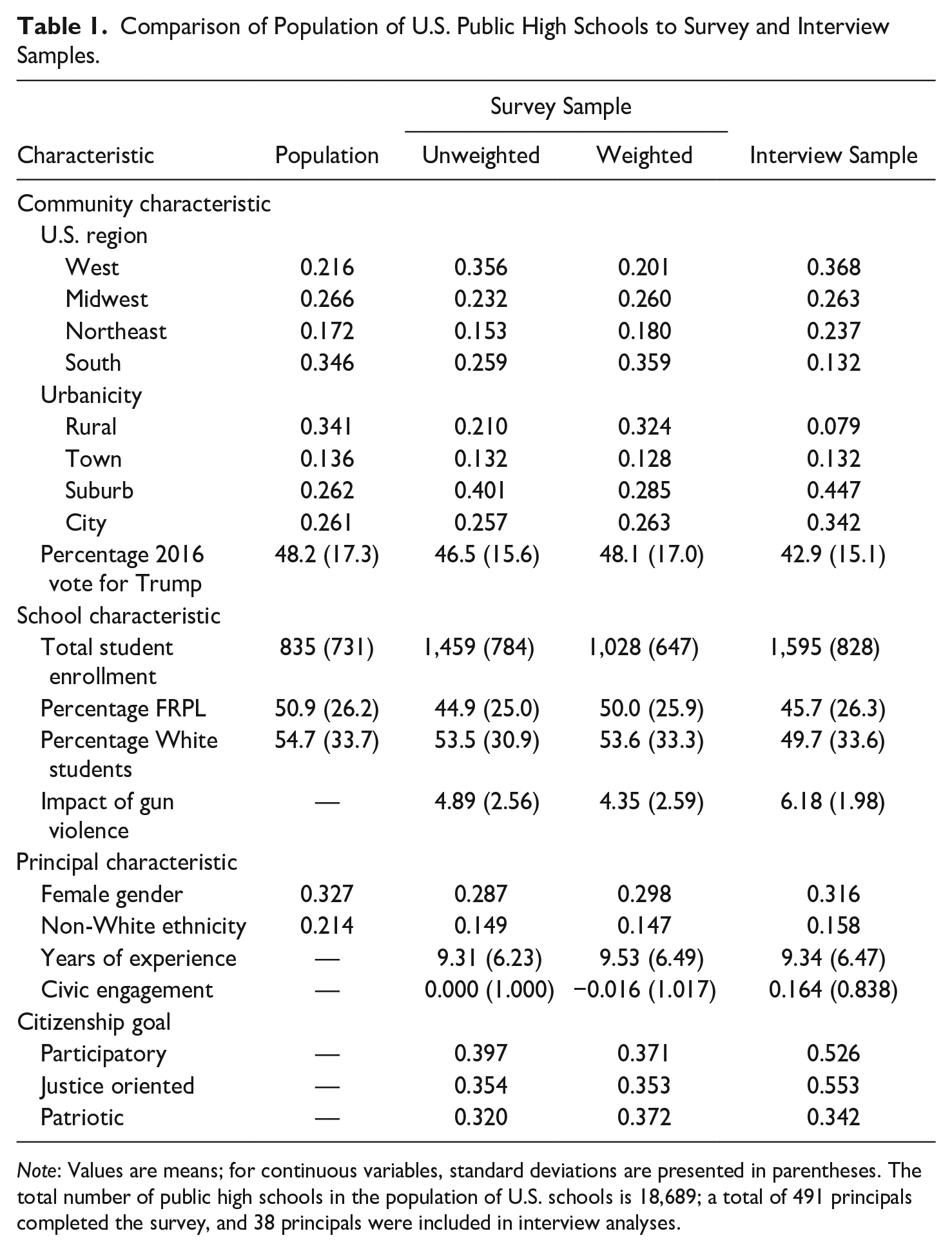
Note: Values are means; for continuous variables, standard deviations are presented in parentheses. The total number of public high schools in the population of U.S. schools is 18,689; a total of 491 principals completed the survey, and 38 principals were included in interview analyses.
Population estimates for female gender and non-White ethnicity were derived from tables provided by the National Teacher and Principal Survey (Taie & Goldring, 2017), whereas estimates of these characteristics for the survey sample and interview sample were derived from our survey. Principals’ ethnicity was coded as White/non-White due to the relatively small number of principals of color. The lack of ethnic representation among U.S. public high school principals, however, is not peculiar to our sample: 14.9% of our sample were principals of color, compared with 21.4% in the population of U.S. public high schools (Taie & Goldring, 2017).
The survey also contained items regarding the impact of the threat of gun violence at school, principals’ beliefs about civic education, principals’ level of civic engagement outside of school, and principals’ years of experience—characteristics that were not available for the population of U.S. public high schools. To assess the degree to which schools were impacted by the threat of gun violence at their schools, we asked principals four questions; each item was converted into a numeric scale and summed together to create a single composite score. With respect to principals’ beliefs about civic education, principals were asked how much they prioritized three different citizenship goals, based on prior theories of democratic education (Westheimer & Kahne, 2004). Principals’ level of civic engagement outside of school was operationalized from their responses to three civics-related questions: How often they regularly followed the news, talked with friends and family about social issues, and participated in civic organizations. All items were converted into a numeric scale, summed together, and transformed into z scores. These analytic decisions follow the convention of a prior study that used the same scale for teachers’ civic engagement (Rogers et al., 2017). Also based on the prior study, the third question was found to be more discriminating, and thus doubly weighted. Details regarding the wording of survey items may be found in Appendix B.
Survey Weights
For survey response estimation and regression analyses, we employed two distinct sets of weights. The first set of weights, which we refer to as survey sample weights, were employed to make our sample more representative of the population of U.S. public high schools. In survey research methodology, these are referred to as “calibration weights,” and the characteristics are referred to as “auxiliary variables” (Särndal & Lundström, 2005). Assuming the auxiliary variables adequately account for patterns of missing data, calibration weights eliminate nonresponse bias. The second set of weights, which we refer to as subset weights, were used to adjust for survey logic—that is, the fact that the survey was designed so that only a subset (of 353 principals) was asked about their responses to student protests. Without subset weights, we might underestimate the percentage of principals who deterred student protest, because principals who successfully deterred would not have reported their response. In the remainder of this section, we explain how these two sets of weights were constructed and used in analyses.
We used survey sample weights to bring our survey sample into closer alignment with the population of U.S. public high schools. Because NCES provides a list of all schools in the United States along with their demographic characteristics, we were able to use a statistical model to adjust for the differences between our sample and the population. The particular procedure used was logistic regression weighting (Kalton & Flores-Cervantes, 2003), where inclusion in the survey sample was regressed on background characteristics provided by NCES (including region, urbanicity, school size, and racial demographics). In terms of representativeness, Table 1 compares the background characteristics of the population to both the weighted and unweighted survey sample. With respect to the two largest discrepancies, survey sample weighting decreased the mean student enrollment from 1,461 to 1,030, much closer to the population mean of 812, and the proportion of schools in rural areas and towns increased from 0.340 to 0.453, much closer to the population proportion of 0.483.
Because analyses focused on a subset of 353 principals who both (1) indicated that protests against gun violence occurred at their schools and (2) answered all protest-response survey items, we used an additional set of weights to adjust for inclusion in this subset of survey respondents. Subset weights served to mitigate potential nonresponse bias introduced by survey logic. For instance, principals who deterred may have been underrepresented in the subset, whereas principals who supported student protests may have been overrepresented. Subset weights were intended to correct for these potential biases. Subset weights were generated using the same procedure as survey sample weights, with the addition of a weight-trimming step. To curtail extreme weights, we arranged schools into five strata and assigned respondents the average within-stratum weight (Cochran, 1968). The combination of survey sample weights and subset weights was employed in bootstrap estimation and regression analyses, described in the following sections.
Survey Items Regarding Student Protests
A section of the survey asked about student protest and principals’ responses to protest. Principals were first asked whether a protest occurred at their school; only if the answer was in the affirmative were survey participants asked how they responded. Regarding whether a protest occurred, the survey asked, “In this past year, did a large group of students (more than 25) participate in a protest or demonstration that originated on your campus?” Principals who responded “Yes” were asked to indicate which of nine potential topics student protesters had addressed; “reducing gun violence in schools” was among these nine topics. Regarding principals’ responses to student protests, principals were asked, “Did you engage in any of the following actions in relation to the protest/demonstration, and/or did you ask your staff to take any of the following actions?” Table 2 lists the specific actions that principals were asked about in our survey.
Principals’ Responses to Student Protests Against Gun Violence.
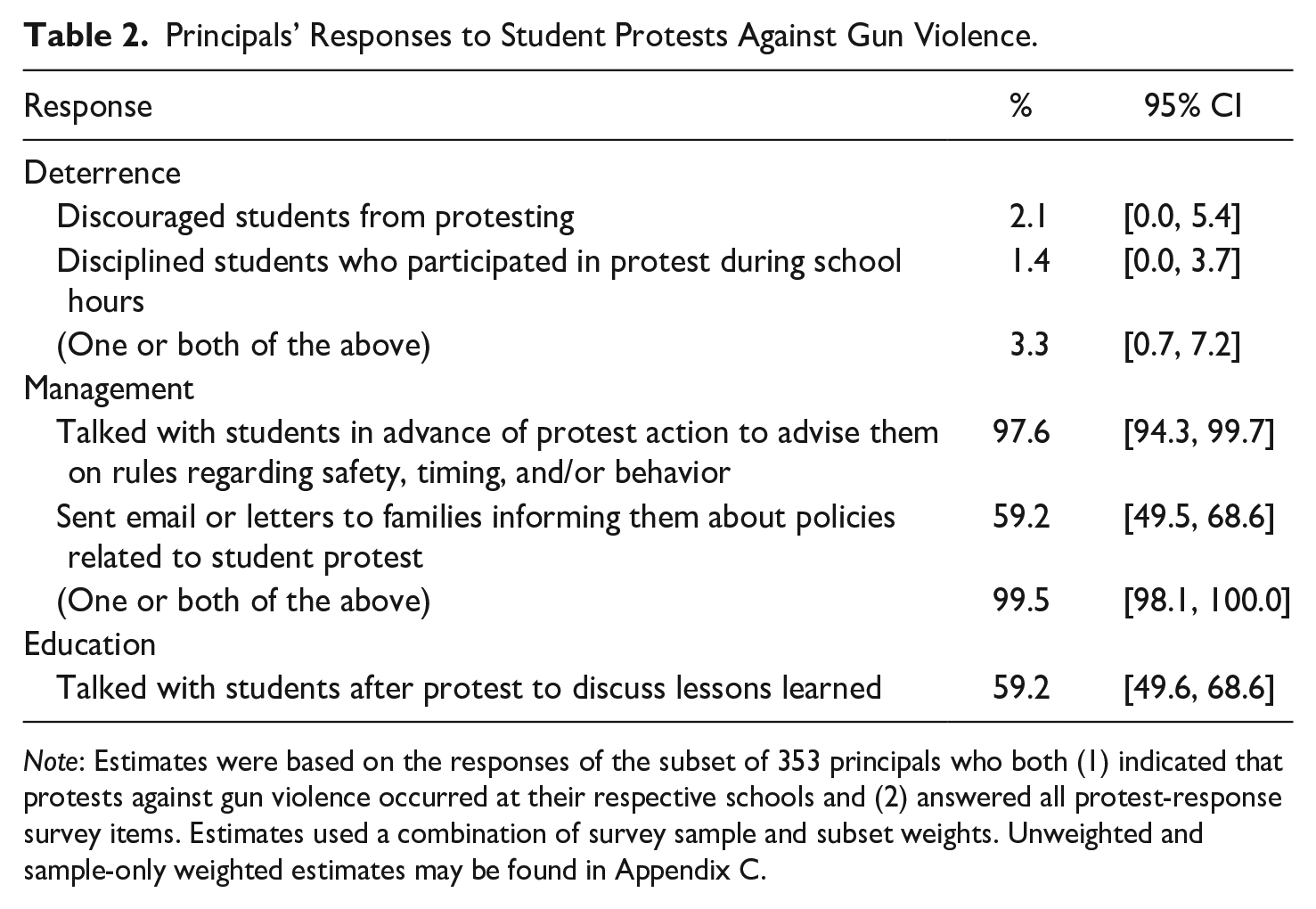
Note: Estimates were based on the responses of the subset of 353 principals who both (1) indicated that protests against gun violence occurred at their respective schools and (2) answered all protest-response survey items. Estimates used a combination of survey sample and subset weights. Unweighted and sample-only weighted estimates may be found in Appendix C.
Bootstrap Estimation of Survey Responses
We used bootstrap methods to estimate principals’ responses to student protests (Efron & Tibshirani, 1993). The advantages of using bootstrap methods include (1) not having to make distributional assumptions about the data, and (2) reducing the difficulty of quantifying the statistical uncertainty associated with our complex survey design. Bootstrap methods avoid making distributional assumptions by resampling from the observed data over a large number of iterations (10,000 iterations in our case); from the resampled distribution, nearly any statistic (means and quantiles in our case) can be subsequently computed. Our bootstrap estimation procedure first used model-based resampling (Fox, 2002) to take into account uncertainty associated with survey sample weights. Next, respondents were selected into the bootstrapped survey sample with probability equal to their respective survey sample weights. For each bootstrapped survey sample, we generated subset weights that were used to select respondents into the bootstrapped subset sample. We calculated mean response rates from the bootstrapped subset sample. After repeating this procedure 10,000 times, we had a distribution of 10,000 bootstrapped “estimates,” from which we calculated the mean and 95% confidence intervals. Although we believe our bootstrap method to have produced more accurate estimates and margins of error, we have also provided unweighted and sample only–weighted estimates in Appendix C. Survey estimates and regression analyses were conducted using R 4.0.2 (R Core Team, 2020).
Regression Analyses
We used linear regression to explore predictors of taking an educative approach to student protests. Although it may have been possible with a larger sample, we were unable to explore predictors of deterrence (because cases were too rare) or predictors of management (because nearly every principal managed). Our procedure for calculating regression coefficients followed a nearly identical procedure as our estimation of survey responses: We employed two sets of weights (survey sample and subset weights) and used bootstrap sampling to produce more accurate estimates of regression coefficients and margins of error. We have also provided unweighted and sample only–weighted estimates in Appendices D and E. Appendix D presents coefficients of linear probability models, whereas Appendix E presents coefficients of logit models.
Interview Analysis
Thematic analyses of interview data were conducted independently and over multiple waves by two members of the research team. The initial round of coding focused on emic categories (Maxwell, 2013) tied to the challenges that principals described and how they addressed those challenges. Both coders employed in-vivo codes (Saldaña, 2016), based on principals’ own language (e.g., “Disruption” and “Rights”), and procedural codes, based on specific research goals (e.g., “Educative” and “Disciplining”). Emerging themes and codes were discussed with the full team during research meetings. All codes are listed in Appendix F.
Once the final framework was developed, coders independently determined which principals had deterred, managed, and educated. As with survey responses, categorizations were not mutually exclusive; for example, an individual could both manage and educate. Subsequent to their initial review, coders discussed discrepancies and agreed on final categorizations. Because of inherent differences between survey and interview data and the methods used to analyze these data, we viewed interview categorizations as distinct from survey responses: Survey data revealed principals’ self-evaluations along select aspects of protest response, whereas interviews provided an external—and potentially more holistic and nuanced—view of the nature of principals’ responses.
Findings
The results of our survey suggest that principals rarely deterred protestors, almost invariably managed the protests, and often managed with an educative purpose. Only 3.3% of principals reported that they deterred student protestors (i.e., they reported having discouraged students from protesting or having disciplined students for participating in a protest during school hours; see Table 2). By contrast, 99.5% of principals indicated that they managed the protest—by communicating in advance with students (to inform them about rules regarding safety, timing, and student behavior) or with families (to inform them about school policies related to the protest). A majority of principals (59.2%) who employed a management response also reported taking an educative approach, by talking with students after the protests to discuss lessons learned.
Interview data offered a complementary approach to determining the number of principals who deterred, managed, and educated. Figures from interview data were not identical to survey results, but they were close. According to data from our 38 interviews, three principals (7.9%) deterred, 37 (97.4%) managed, and 21 (55.3%) educated. All 21 principals who educated also managed.
Deterrence Responses to Student Protest
Three of the principals we interviewed deterred students from protesting. Principal “Jerry” removed a student banner that had been hung from a fence in front of the school to advertise the protest. The other two principals deterred students in a manner that avoided direct confrontation: They presented their actions as affording choice to their students, even as they sought to dampen interest in the protest or directed students toward other (less contentious) action. As “Fred” stated, “I came on the intercom and I reminded students that while they have the right to express their point of view and freedom of speech, they do not have the right to interrupt or disrupt the education process, which could lead to consequences.” “Clay” described how he and his teachers talked with students “about why we wouldn’t protest.” He suggested that “kids were allowed to [protest] if they wanted,” but he emphasized that “if everybody is protesting at the same time and people know about it, you're setting yourself up as a target.” He then advised students, “Let’s find different ways to demonstrate or talk about gun violence.”
The principals who engaged in deterrence viewed protest as either unproductive or an inappropriate form of civic participation. “Jerry,” the principal of a school in a politically conservative community, told us he tried to “steer” students away from protest “simply because we didn’t feel that in our particular [geographical] area, that that was a useful exercise of their speech.” Similarly, Fred described protestors as “disruptive-type activists” and contrasted them to those who participate within civic institutions in ways that are “channeled and focused.”
It is important to note that 27.5% of the principals who responded to our survey reported that students did not hold a protest involving at least 25 students in response to gun violence. Our survey data do not allow us to consider whether these principals took action to prevent a protest from occurring. From news reports, we know that there were isolated incidents of district officials prohibiting students from protesting (e.g., Bergen & Cronkleton, 2019; Rosenberg, 2018). The principals we interviewed did not volunteer that they had silenced free expression or censored students for contrary opinions. Yet this fact might speak to our limited sample or to the recognition that such behavior violates social norms. Thus, although we cannot negate the possibility that a nontrivial minority of principals engaged in some deterrent practices that prevented protest altogether, our evidence indicates that the large majority of U.S. high school principals appear to recognize that deterrence is anathema to what they are supposed to do.
Management Responses to Student Protest
Consistent with survey results, nearly all principals interviewed (35 of 38) tried to manage, rather than prevent, student protest. Two principals reasoned that prohibiting protest was not a practical solution; as “Steve” explained: If we push back real hard, we’re going to be outmanned here. . .. As a principal or as an administrative team or even as a staff, you’re outnumbered. You’re not going to stop 700 kids from doing something like that.
A few other principals noted that protest was a legitimate form of civic participation and that young people should be supported in expressing deeply held beliefs. “Jeff” framed participation in protest as “part of growing up, part of life.”
A common rationale for allowing protests to occur was upholding students’ legal rights. Without invoking Tinker by name, several principals explained that students had constitutionally protected rights to express their opinions on campus. “Madeline,” for instance, reported that her approach to the protest was largely shaped by guidance from her school district’s attorneys, who told her, “Don’t stop the kids if they want to exert their civic right. You don’t need to get involved in it and support it, but don’t stop them.” In keeping with Tinker, the lawyers also advised Madeline to “walk this delicate line between [students’] rights and our responsibilities” to ensure safety and order.
For most principals, managing this balance entailed establishing time, place, and manner restrictions for the protests. As Jeff explained, “We met with the organizers of the event. We set up a timeline, we set up a location, and we set up kind of some parameters around what they could be protesting, and where that would be taking place.” In many cases, principals negotiated these rules with students whom they had identified as leaders. Madeline told students, “Talk to me and I will tell you places on campus that you’re going to walk out, which is a good place to walk out to where you will not affect the smooth running of the school.”
As they established time, place, and manner restrictions, most principals tried to follow Tinker’s commitment to content neutrality. For instance, “Simon” reported: The question I got was, “Well, if I want to march in support of gun rights, do I have that same right?” And the answer was, “Yes, we’re going to be supporting all viewpoints, and we don’t just take one side.”
Others stated, “We couldn’t support [the protest], we had to be neutral” (“Camilla”) and, “We didn’t encourage the protest, we didn’t discourage” (“Trevor”). Nearly all principals—those who disagreed with student protestors as well as those who were sympathetic to students’ cause—noted that educators should not impose their views on students. “Ibrahim” told us, “You’re supposed to shape the direction of the school, but you’re not actually supposed to hold your own values, right? I believe in that.” Similarly, “Cecil” stated, “We didn’t do anything to promote, we didn’t do anything to dissuade. Our role there was just making sure that they were kept safe.”
Ensuring student safety was the primary focus for many principals. The mass murder of students at MSDHS heightened preexisting anxieties about the difficulty of protecting students. Some principals discussed the vulnerability of students amassed together in an open space. In developing plans for the protest, principals tried to account for the unique layout of their schools and the availability of adult supervision. Many principals expressed fear that protests would bring harm to their students, particularly from adults outside the school. Some made contingency plans with local police to maintain order and to avoid any kind of incident. Such considerations shaped the time, place, and manner restrictions that principals negotiated with students.
Whereas principals generally described their rationales for establishing protest rules as a means to ensure student safety or to avoid disrupting the school’s learning environment, it was also common for them to acknowledge an interest in maintaining control. A number of principals echoed the sentiment of “Rita,” who explained that she developed parameters for the protest alongside student leaders because “it’s better for us to be proactive in working with students than reactive.” For Rita, it was important that her students “understand there are boundaries, there are parameters—they’re not just free to run rampant and do their own thing.” Similarly, “Theodore” met with students to lay out where and when they could protest because he wanted to get “ahead of it pretty early.”
Protest control literature made us attentive to the possibility of principals using time, place, and manner restrictions to deter protestors, but under the façade of maintaining school safety and order. Our data provided little evidence of this; however, some principals adopted stances that might be characterized as cooling out the protestors—figuratively and, in some instances, literally: Several principals noted that they had been relieved when their student protestors were met with inclement weather outside on the day of the protest, and grateful that the weather appeared to have sapped students’ enthusiasm.
Educative Responses to Student Protest
Even as they viewed protests as challenges to be managed, many principals also understood the events as teachable moments. The majority of principals (59.2%) in our survey reported that, following the protest, they discussed lessons learned with their students.
Regression analyses support the notion that principals’ perceptions of protests as civic learning opportunities were nonpartisan. Given the Republican Party’s rejection of gun control, we might have expected that principals of schools in politically conservative communities would have been less likely to talk about lessons learned; however, we found no such relationship. Table 3 presents the results of a linear probability model in which lessons learned was regressed on partisan leaning, before and after adjusting for multiple covariates. In neither case was partisan leaning found to be a strong predictor of talking about lessons learned (in the full model: b = 0.001, SE = 0.004, p > 0.05). These findings were robust across multiple weighting schemes (Appendix D) and alternative specifications of the model (Appendix E).
Linear Probability Model of Lessons Learned Regressed on Independent Variables.
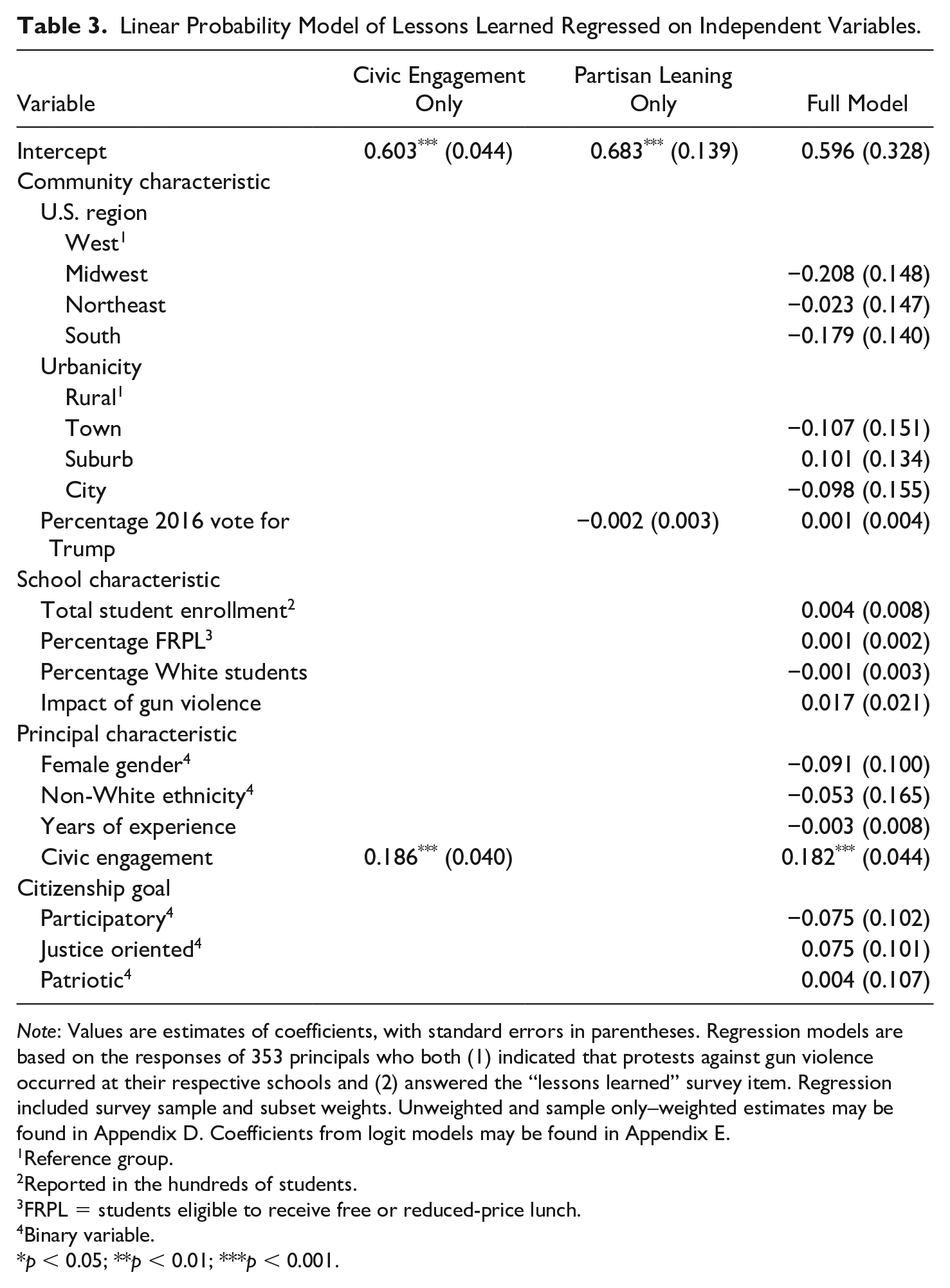
Note: Values are estimates of coefficients, with standard errors in parentheses. Regression models are based on the responses of 353 principals who both (1) indicated that protests against gun violence occurred at their respective schools and (2) answered the “lessons learned” survey item. Regression included survey sample and subset weights. Unweighted and sample only–weighted estimates may be found in Appendix D. Coefficients from logit models may be found in Appendix E.
Reference group.
Reported in the hundreds of students.
FRPL = students eligible to receive free or reduced-price lunch.
Binary variable.
p < 0.05; **p < 0.01; ***p < 0.001.
When controlling for community, school, and principal characteristics, we found only one significant predictor of discussing lessons learned: Principals were much more likely to discuss lessons learned if they themselves were civically engaged—that is, if they regularly followed the news, talked with friends and family about social issues, and participated in civic organizations (in the full model: b = 0.182, SE = 0.044, p < 0.001). All else being equal, principals who were more civically engaged by 1 standard deviation had an additional probability of 0.182 to discuss lessons learned.
From interview analyses, we noted an important distinction in how principals approached student protests as educational opportunities. Some principals emphasized the importance of imparting particular lessons or socializing students into specific norms of civic engagement—an educative approach that we refer to as educative channeling. By contrast, other principals saw their role as pedagogically facilitative, primarily helping students to realize their own vision of civic engagement and giving them the tools and opportunities to grow in that direction—which we refer to as educative facilitation. Although it is useful here to draw a dichotomous distinction between channeling and reflection, it is more accurate to represent principals’ educative approaches as falling on a continuum. In the following paragraphs, we consider educative channeling and educative facilitation in turn.
In the literature on social movements, channeling is viewed as a form of repression, because it actively aims to influence how protest participants engage in politics. Interview analyses suggested that principals who engaged in educative channeling were not necessarily focused on preventing protest so much as on educating students about what the principal saw as appropriate ways to be politically active. For instance, rather than allowing his student body to protest for gun control, Fred arranged for a few of his students to pursue what he referred to as “proper channels” and to meet with their local state legislator. Fred reported he was “very proud of the students” who came to understand that the issue was more complex than “us against them” after the state legislator explained to the students that he was both an advocate of the right to carry and himself a victim of gun violence. In Fred’s view, the students “did learn a great deal” about civic participation from their dialogue with the legislator. For Fred, the exchange imparted to students that working “within the system” is more important than “being a disruption.”
In contrast to Fred, “Edgar” was not opposed to protest outright; he believed that “[students’] opinions are valid, and, as young people, their opinions do matter.” Nevertheless, Edgar sought to “channel [student] willingness to be involved” by encouraging his students to embrace what he viewed as a suitable mode of civic participation. As an educator, Edgar believed that “part of teaching them how to function in a democracy” was pointing students toward forms of expression that eschew violence and are not too loud or rancorous. Edgar told his students, “If you are interested in organizing something for that day, we would like to support you,” but only if students participated in what he called a “positive way.”
In both examples of educative channeling, principals exhorted student activists to put their efforts toward institutionally sanctioned forms of civic engagement. These principals may not have been aware that such an approach does not reflect key insights of social movement scholarship. There is significant research on what makes for effective protest, and that literature does not support the view that activists should be “not too loud” (Bosi et al., 2016; Taylor & Van Dyke, 2004).
Educative channeling tended to comport with principals’ managerial goals, such as avoiding contentious politics and taking actions that would be well-received by district officials and members of the broader community. It is notable that “Terra” shared how pleased she was to receive “lots of kudos from [the] district about how respectful the kids were,” or that “Matthew” reported that the protest at his school was a “really nice event” in which his superintendent was able to observe students being “extremely well-behaved.” Both of these principals expressed a desire for students to exercise voice and “be heard.” The fact that they were attentive to students’ civic development, however, does not exclude the possibility that they also shaped the experience to meet narrower institutional or professional goals in ways that run counter to research on effective political engagement.
Whereas many principals sought to channel young people toward particular civic practices and identities, others supported students’ reflection about what they hoped to achieve through the protests and how they could best advance these goals. Ibrahim, for example, described how he engaged student activists in a dialogic planning process: His students developed a presentation about their protest plans in response to his “guiding questions.” Similarly, “Mitch” asked his students, “What do you want to see get done? What message do you wanna send?. . . How do you want to be heard? What’s the best way to go about doing that?” Through extensive dialogue, his students “came to their own conclusions.”
A few principals used difficulties that emerged during the protests as a springboard for student reflection. At Cecil’s school, located in a politically divided community, the impact of the protest against gun violence was blunted by a counterprotest organized by another group of students, who began to chant, “Don’t take our guns!” Cecil met with students from the original protest group and asked them what issue they had been advocating for. The students offered a variety of responses: some focused on gun control, others on school safety. Cecil talked with these students about how difficult it is to plan for counterprotests if you are not clear about your own goals; he encouraged the students to think about “whatever you’re doing . . . that people know why.”
At another school, the protests against gun violence prompted vitriolic responses on social media from strongly conservative members of the community. The students who had organized the protest were upset that their actions were both misrepresented and dismissed. Matthew encouraged them to view the difficult incident as a “great experience for you to understand what you are going to have to deal with” when you “try and do something.” He told them, “There’s always going to be naysayers even if you’re trying to just do something positive and provide an outlet for people to express themselves. People will get upset about that and you’ve got to be prepared for it.”
Principals rarely reflected on how their own views on gun politics shaped their interactions with student protestors. “Michael,” however, was one notable exception. As someone whose family had been a victim of gun violence, Michael was deeply sympathetic with the cause of gun control. Yet despite his strong feelings about the issue, he did not get involved in the planning of the protest: “We did not lead anything whatsoever,” he told us. Michael spoke of placing students “in the driver’s seat with regard to decisions,” and only stepped in when students might place “themselves in any sort of hot water.” As an administrator, Michael ensured that students could exercise their own voice; for example, he helped to establish a district policy that protected student protestors from retaliatory punishment, and he allowed students to use the intercom system to share information with the rest of the school. Also of importance, Michael attended to students who did not share the same view as the protestors. When a mother confided in him that her son was “having a hard time” with the upcoming protest because his father worked in the gun industry, Michael told the young man, “I want you to know that whatever your perspective is, your perspective is legal, your perspective is respected, your perspective has a place here.” Many principals we interviewed shared Michael’s disposition toward fairness and inclusivity, but it was uncommon for principals to display such introspection about their own political views relative to the protests or their positional power.
Discussion
As student protest becomes more commonplace, high school principals will need greater clarity about their own role—how they should engage student activism and with what purposes. Principals’ responses to student protests highlight complex dynamics associated with negotiating power amid multiple and sometimes contradictory goals of safety, control, freedom of expression, and civic development. Further complicating matters is the often fraught nature of school–community politics and the sometimes tenuous status of principals. Student protest illustrates the diverse range of challenges that school leadership faces in a contentious democracy.
Our central findings suggest that the vast majority of U.S. public high school principals seem to recognize a core message of Tinker: Students do not “shed their constitutional rights to freedom of speech or expression at the schoolhouse gate” (Tinker v. Des Moines Independent School District, 1969, p. 506). Indeed, very few principals in our survey reported having discouraged students from protesting or having disciplined students for protesting. These findings were corroborated by interview data, which revealed that no principal shut down student protests with impunity; rather, deterrence looked more like channeling (Earl, 2004). In those few instances of deterrence that we identified, principals framed their actions as providing students choice, thereby implicitly acknowledging that students maintain (at least) a modicum of First Amendment protections in school. Principals did not seem to deter on the basis of their own personal beliefs regarding gun control, but rather on their own personal mistrust of protest as a productive form of civic engagement. Thus, although principals may have remained “content neutral” in a manner legally consistent with Tinker, they were not neutral with respect to the form of civic engagement that their students had adopted.
Furthermore, we found principals’ responses to align in some important ways with those of police in protest control literature. Almost all principals managed the protests that occurred at their schools, often in ways that balanced an interest in maintaining safety and order with the obligation to protect students’ legal rights of free expression. Principals also established time, place, and manner restrictions for protests and sought to position themselves as neutral in regard to the content of students’ messages. Interestingly, this is one area where “law on the books” has translated into “law in action” by principals. Whether this occurred because principals were concerned about lawsuits, because protest has become a more legitimated form of political participation over time, or for some other reason, it is notable that principals were largely complying with legal expectations.
Although similar to tactics used by police, principals’ managerial practices were shaped in distinctive ways by a sense of responsibility for ensuring the well-being of both student protestors and fellow students. It is clear from interview data that principals’ highest priorities were keeping students safe. Whereas some police may engage protestors in a manner that reflects a generalized commitment to protecting public safety, police do not share the same level of concern as principals, who treat student protestors as minors under their charge. Often, principals enacted this authority through soft power, conferring with students rather than heedlessly imposing time, place, and manner restrictions. And although their approaches were generally supportive rather than conflictual, principals were sometimes motivated by personal or institutional interests, which were obscured during negotiations with students over the terms of protest activity.
Finally, our findings showed that many school leaders, particularly those who in their own lives were civically and politically engaged, framed protest as an opportunity to educate students about democratic participation. This approach differs markedly from the way that police or other state authorities engage with protesters. Principals with more experience in civil society may be more attentive to the value of civic engagement generally, and hence more likely to see it as an educational goal. Engagement in civic life perhaps afforded these principals greater comfort in talking about contentious societal issues, or it may have offered them a deeper appreciation of civic development, even if it emerged from their personal experiences instead of from research.
In examining principals’ educative approaches, we noted an important difference between principals who aimed to foster their own vision of “good” or “appropriate” civic engagement and principals who saw their roles as supporting student activists by helping them to reflect on their own civic beliefs and ways of being. We referred to the former approach as educative channeling and the latter as educative facilitation. Principals who participated in educative channeling sought to mold their students into particular sorts of political subjects. By contrast, principals who advanced educative facilitation interacted with their students as political subjects who stood to benefit from further learning.
Although principals who adopt educative channeling may believe they are supporting democratic development and pursuing students’ best interests, they are imposing power in ways that are both open to coercion and contrary to the ideals of free expression. Institutional and political pressures influence principals, whether consciously or not, as they seek to shape students’ substantive claims or modes of expression. For example, principals who encourage student protestors to highlight consensus messaging (e.g., “school safety” rather than “gun control”) may view this to be a wiser or more effective path to follow; yet these principals also have a vested interest in avoiding political conflict in their communities.
Protest offers students the opportunity to express their own deeply held beliefs and commitments. When principals instruct students to adopt particular forms of speech, they undercut student agency. This is particularly true when principals impose guidance rather than engage students through open dialogue. Educative channeling may dampen the very civic energy that protest aims to foster (Earl et al., 2017). The drawbacks of educative channeling are further compounded when the guidance imposed by principals is not based on recommendations in social movement literature about what makes for effective political engagement.
In contrast to educative channeling, educative facilitation affirms the centrality of student agency and voice. It does not assume that adult authorities know what should be done, nor does it presume that students know the best course of action. Rather, educative facilitation offers a structured way for principals to support young people to examine the efficacy and wisdom of their beliefs and actions. When they enact this approach skillfully, principals provide students with a model for how transparency, inquiry, and dialogic engagement play a vital role in public deliberation and action.
It is important to note that when principals engage young people in reflection and dialogue, they inevitably encourage certain ways of thinking and acting. For example, principals’ questions may prompt students to consider alternative strategies. Certainly, principals who foreground dialogue and questioning aim to foster an appreciation for reflexive praxis that is open to ongoing revision. To some extent, this dynamic is inherent to the process of democratic education more generally. There is no completely neutral standpoint from which educators may support student civic learning. Yet it seems critically important, especially in the context of student protest, for principals to be aware of their own authority, power, and interests as they seek to both center and deepen student voice and agency.
Implications
One of the most important findings from our study is that principals rarely deter protestors, often out of deference to the courts or fear of legal repercussions. The Tinker decision is now more than half a century old, and some legal scholars worry that its First Amendment protections have been weakened by subsequent court decisions (e.g., Chemerinsky, 2000). Our study, however, situated in the context of protests against gun violence in 2018, affirms the continuing influence of Tinker. Indeed, many principals reported having received a statement from school district officials about their legal responsibilities. Principals, it would seem, have gotten the Tinker memo, both literally and figuratively.
Despite evidence that educators uphold Tinker in practice, we sympathize with the notion that Tinker is legally fragile. In the wake of environmental and Black Lives Matter protests, many states have passed legislation that increases the authority of law enforcement and the extent to which punitive action can be taken against protesters (Halliday & Hanna, 2021). Such a shift toward authoritarian policy could reposition Tinker as the standard for protest response.
Our study suggests that, moving forward, it will be important to clarify how principals should understand and act on the Tinker memo. One possible path would be to adhere to the narrow legal implications laid out in the decision: that principals refrain from limiting expression without reasonable concerns regarding the safe and orderly operation of the school. A second path calls for principals to embrace the spirit of Tinker: that public schools have an obligation to support, and to sustain into the future, a robust exchange of ideas. Whereas the first path is bounded by what principals should not do, the second path is framed as a proactive stance toward voice, engagement, and agency.
To follow this second path, state departments of education and local school districts will need to do more than merely create crisis management plans and distribute legal guidance around handling student protest. They also will need to develop plans for how public schools can support young people in expressing their interests and concerns before, during, and after protests. These plans should address the democratic development of student protesters as well as the broader student body, and this means creating opportunities for all students to reflect on the efficacy and purpose of activism.
It is not easy for principals to lead schools that support the robust exchange of ideas. To do this, principals will need to balance three distinct concerns: protecting students’ First Amendment rights, ensuring the safe and orderly operation of the school, and educating for democracy. To promote the final concern, principals will require assurances from district leaders that student voices will be respected, even when their positions are unpopular or are critical of official district positions. Principals must also receive support to develop the reflective questioning and inquiry skills with which to engage their students. Finally, principals will need help in examining whether and how their interactions with student protestors are shaped by institutional interests, power, and authority.
Footnotes
Appendix A
Appendix B
Appendix C
Appendix D
Appendix E
Appendix F
Declaration of Conflicting Interests
The author(s) declared no potential conflicts of interest with respect to the research, authorship, and/or publication of this article.
Funding
The author(s) received no financial support for the research, authorship, and/or publication of this article.