




Abstract
Background/Context:
Social scientists, policymakers, and commentators have long assumed that Western democracies enjoy relative stability because of deep commitments to a culture of democratic governance. But those commitments are quickly fading in almost every developed and developing democracy around the globe. In the same period in which support for democracy has declined, schools and teacher education programs have been pressured by “accountability” measures and economic austerity to focus on math and literacy achievement to the exclusion of nearly every other educational goal. These challenges to social cohesion and democratic governance highlight the need for young people to be exposed early on and throughout their educational pathways to the knowledge, skills, and dispositions consistent with democratic life. The narrowing of curricular goals, therefore, is a threat to the stability of democratic institutions.
Purpose:
This essay examines the potential of teacher education as a lever for change. How might teacher educators ensure that teachers are prepared to foster education that will sustain and strengthen democratic norms? If schools have an essential role to play in preparing students for informed engagement in civic and political life, how can we best prepare teachers to advance those goals?
Research Design:
This is an analytical essay drawing on recent empirical research on declining support for democratic values and on teachers’ civic engagement as well as conceptual work on democratic education goals. To illustrate the potential for teacher education to prepare teachers to engage students in political issues discussions, I draw on data from the first large-scale empirical study of what U.S. high school teachers currently do to prepare youth to understand economic inequality and its causes, effects, and possible remedies. The study included a teacher survey and follow-up interviews concerning teachers’ political ideology and civic and political engagement as well as classroom practice. The 2,750 teachers who participated in the survey are representative of U.S. public schools (and an additional segment of U.S. elite independent schools) in terms of student demographics and geographic location. We also conducted 150 follow-up interviews.
Conclusions/Recommendations:
I suggest that teacher education must move from reactive technocratic concerns for accountability and standardization to broader civic and civil commitments to the foundations of democratic community, pluralism, and relationship. Teacher education programs should consider ways to encourage new and experienced teachers to follow the news, engage in civil discourse with one another about topics of public concern, and participate in civic and political life. Moreover, teacher educators could work toward teaching the knowledge, skills, and dispositions associated with political and civic engagement.
“Democracy has to be born anew every generation, and education is its midwife.”
On January 6, 2021, thousands of Americans gathered in Washington, D.C., at the Ellipse, just south of the White House, to hear the President of the United States call his election defeat an “egregious assault on our democracy.” He told the crowd that it was statistically impossible for him to have lost the election and that to save democracy, protect the country, and protect the constitution, the election results had to be overturned. Those gathered will “never take back our country with weakness,” he said, and “if you don’t fight like hell, you’re not going to have a country anymore.” Then he invited them to walk down Pennsylvania Avenue to the Capitol building to give legislators, “the weak ones . . . the kind of pride and boldness that they need to take back our country” (Trump, 2021). Two hours later, an armed throng of Americans stormed the U.S. Capitol building, shattering glass, vandalizing offices, and breaking into the congressional debating chambers where members of the Senate and the House were in the process of certifying the electoral college vote. At least five people were killed in the mayhem including a 42-year-old Capitol police officer (Rucker, 2021). One week later, for the first time in history, the House of Representatives charged a U.S. president with “incitement of insurrection” (Fandos, 2021).
Social scientists, policymakers, and commentators have long assumed that Western democracies enjoy relative stability because of deep commitments to a culture of democratic governance. But those commitments are quickly fading in almost every developed and developing democracy around the globe. The number of people worldwide who strongly support democratic institutions is diminishing fast and, most alarming, these declines are sharpest among young people. In 1995, just one in 16 Americans agreed with the idea that it would be “good” or “very good” for the military to run the country rather than elected democratic officials. Today, one in 5 agree (World Values Survey, 2020). Nearly a quarter of U.S. youth ages 16 to 24 believe that democracy is a “bad” or “very bad” way of governing. Self-serving political leaders, exploiting this declining public support for democracy, now openly express disdain for hallmarks of democratic society, including the free press, civil liberties, and the courts. They stoke resentment against immigrants, people of color, and people with differing political views that, in turn, leads to increased alienation and radicalization among those already on the margins. Coupled with news media outlets—an alarming number of which not only polarize but also now fictionalize the news—these trends make possible the once-unthinkable attack on American democracy as described (Bright Line Watch, 2020; Dasandi, 2018; Levitsky & Ziblatt, 2018; Runciman, 2018).
These challenges to social cohesion and democratic governance highlight the need for young people to be exposed early on and throughout their educational pathways to the knowledge, skills, and dispositions consistent with democratic life. The good news is that schools are well-positioned for this task. Across more than a century of school reform, and through pendulum swings from a focus on equity to a preoccupation with excellence and back again, the idea that young people must learn to be good citizens has always been central to the ideals of public education. But in the same period that support for democracy has declined, schools and teacher education programs have been pressured by “accountability” measures and economic austerity to focus on math and literacy achievement to the exclusion of nearly every other educational goal.
This essay examines the potential of teacher education as a lever for change. How might teacher educators ensure that teachers are prepared to foster education that will sustain and strengthen democratic norms? What would teacher preparation that seeks to strengthen support for democratic institutions look like? If schools have an essential role to play in preparing students for informed engagement in civic and political life, how can we best prepare teachers to advance those goals? Using recent empirical research on declining support for democratic values and on teachers’ civic engagement as well as conceptual work on democratic education goals, I suggest that teacher education must move from reactive technocratic concerns for accountability and standardization to broader civic and civil commitments to the foundations of democratic community, pluralism, and relationship.
Democratic Deconsolidation
Political scientists use the term democratic consolidation to describe a largely irreversible process by which democracy becomes “the only game in town” and where “none of the major political actors consider that there is any alternative to democratic processes to gain power” (Linz, 1990, p. 156). For at least the last half century, for relatively wealthy and stable democracies, that assumption seemed about right to scholars and commentators alike. But that irreversibility is now in question, raising the concern that a process of democratic deconsolidation may be taking place in which previously stable democracies unravel (Foa & Mounk, 2017; Inglehart, 2016; Levitsky & Ziblatt, 2018).
In a widely circulated 2017 report, the Pew Research Center raised considerable alarm among those who have generally assumed that Western democracies enjoy relative stability amid an entrenched culture of democratic governance (Wike et al., 2017). Although the report was titled “Globally, Broad Support for Representative and Direct Democracy,” commentators, civic educators, and political scientists highlighted a number of findings that challenged the rosier title. In the United States, for example, 22% of respondents thought that it would be a “good” or “very good” idea to have a political system in which a leader had power unchecked by legislators or courts. Close to one in three respondents who identified as Republican and almost half of U.S. millennials thought the same (globally, that figure was 26%).
In another study released a few months earlier, Harvard lecturer Yascha Mounk and Australian political scientist Roberto Stefan Foa examined longitudinal data from the World Values Survey and found considerable cause for concern. Between 1995 and 2014, the number of citizens who reported a preference for a government leader who was “strong” and who did not need to bother with elections increased in almost every developed and developing democracy and, again, the growth was greatest among youth and young adults (Foa & Mounk, 2016). Similarly, the more recent 2017–2020 World Values Survey (WVS) reports that more than two-fifths (42%) of America millennials (currently ages 25–39) would like to live under a political system in which a “strong leader” could make decisions without being bothered with elections or interference from congress (World Values Survey, 2020). I mentioned earlier that one in five Americans would prefer that the military rather than elected government officials run the country, but for millennials, that number increases to nearly one in three. 1 Democracy, it seems, is not self-winding.
The 2016 election of Donald Trump as President of the United States and the Brexit movement votes in the United Kingdom served to deepen fears that populist nationalism—the rallying in the service of right wing nationalism of “the people” against the common enemies of both “foreigners” and a constructed “elite”—was gaining ground in the United States and globally. Although the January 6, 2021, storming of the U.S. Capitol was perhaps the most striking example of a growing willingness to discard democratic commitments to pluralism, the signposts came earlier. The 2016–2020 Trump presidency was replete with openly expressed disdain for hallmarks of democratic society, including racial equality, the free press, civil liberties, and the courts. The executive and much of the legislative branches of government embraced discourse, policy, and legislation that sought to severely restrict both immigration (Vidal, 2018) and global trade (Lester & Manak, 2018) while fostering resentment against ethnic “others” among supporters (Bonikowski, 2017). White supremacists, always present in the American social and political landscape, became newly emboldened by a President and his Republican sycophants who shamelessly stoked racial divisions to their advantage. (It was not accidental that many of those who rallied outside the Capitol and those who used violent means to gain entry and threaten legislators carried with them confederate flags.)
The stunning mainstreaming of QAnon conspiracy theories further illustrates the power of antidemocratic rhetoric and policy to drive individuals and groups to withdraw from mainstream civil representation altogether, preferring subgroup identity over attachments to the broader civil society—what James Banks (2017) aptly calls “failed citizenship.” This climate enables racist extremist movements and facts-be-damned conspiracy theories to metastasize.
Moreover, the legitimation of racism and xenophobia and a global revival of jingoistic nationalism fuels increases in incidents of hate speech, antagonism, and assaults on both newly arrived immigrants and native-born visible minorities in not only the United States but also a growing number of Western democracies (United Nations, 2016). In the United States, the Southern Poverty Law Center (SPLC) documented a precipitous rise in hatred, fear, and alienation among students (Costello, 2016). Teachers similarly reported a dramatic increase in hate speech (Au, 2017; Rogers et al., 2017, 2019; Vara-Orta, 2018). Social media echo chambers further entrench antidemocratic tendencies and pollute genuine social and political discourse (Kahne & Bowyer, 2017; Middaugh, 2019). Yoichi Funabashi, chairman of the Rebuild Japan Initiative, which is dedicated to strengthening democratic ideals in Japan, summarizes the risks of these divisions succinctly: If society becomes characterized by intolerant divisions, in which people immediately select their allies and dismiss others as foes based on such criteria as race, ethnicity, religion or lifestyle, then democracy’s foundational principles, rooted in careful deliberation and compromise, will be rendered inoperable. (Funabashi, 2017)
Ultimately, as witnessed in the murder of 32-year-old Heather Heyer during a neo-Nazi rally in Charlottesville, the Pittsburgh synagogue shooting that killed 11 people, the attempted pipe bomb murders of prominent political and philanthropic leaders throughout the United States, the deaths of (at least) five people in the Capitol attack, and hundreds of other incidents, the result is a threat not only to democracy but also to life and liberty. (See Hasan, 2018 for a disturbing review of deaths directly linked to political hate speech.)
Against this sociopolitical backdrop, we might expect that education policymakers across the globe (including those responsible for teacher education) would respond with urgency and clarity of purpose. Schools, after all, are the one institution that commands the attention of nearly the entire population for at least 10 formative years. But if shoring up democracy requires teaching young people democratic habits of participation, critical thinking, dialogue, and understanding, then those foundations of democratic life are at odds with education policy.
Schooling in the Age of Standards and Accountability
The challenges to social cohesion and democratic community just described have prompted commentators and educators to highlight the need for schools to teach desirable norms of civic, civil, and political engagement (and these calls have only been amplified in the days following the early 2021 Capitol attack). Yet, over the last two decades, the goals of K–12 education have shifted steadily away from preparing active and engaged public citizens and toward more narrow goals of career preparation and individual economic gain (Giroux, 2017; Hursh, 2007, 2016; Westheimer, 2015). Pressures from policymakers, business groups, philanthropic foundations, and parents, and a broad cultural shift in educational priorities have resulted in U.S. public schools being seen primarily as conduits for individual success; increasingly, lessons aimed at exploring democratic responsibilities have been crowded out (Kempf, 2016; Rogers et al., 2020; Stitzlein, 2017). Much of current education reform limits the kinds of teaching and learning that can develop the attitudes, skills, knowledge, and habits necessary for a democratic society to flourish (Berliner, 2011; Kohn, 2004).
A perusal of school mission statements could be momentarily reassuring. Almost all boast broad goals related to critical thinking, citizenship, multicultural understanding, freedom of ideas, and moral character. Yet mission statements and school policy and practice do not always align (Bebell et al., 2020; Rogers et al., 2020; Schafft & Biddle, 2013; Stemler & Bebell, 2012). In most school districts, ever more narrow curriculum frameworks emphasize preparing students for standardized assessments in math and literacy at the same time that they shortchange the social studies, history, and even the most basic forms of citizenship education (Au, 2007; Koretz, 2017). Finnish educator Pasi Sahlberg calls the kind of school reform that elevates testing and standardization above all other educational considerations GERM (for Global Education Reform Movement). He describes GERM as follows: It is like an epidemic that spreads and infects education systems through a virus. It travels with pundits, media and politicians. Education systems borrow policies from others and get infected. As a consequence, schools get ill, teachers don’t feel well, and kids learn less. (Sahlberg, 2012)
Not only do kids learn less but also what they learn tends to follow prescriptive formulas that match the standardized tests. In the process, more complex and difficult-to-measure learning outcomes get left behind. These include creativity and emotional and social development as well as the kinds of thinking skills associated with robust civic engagement. Teachers’ ability to teach critical thinking and students’ ability to think and act critically are, in turn, diminished.
In the two decades since the No Child Left Behind (NCLB) Act ushered in an era of standards, accountability, and assessment, schools have become obsessively focused on technocratic solutions to both real and imagined educational problems. The 2009 Race to the Top initiative continued the emphasis on math and literacy and on standardized assessments in those subjects as the only legitimate lever for school improvement. The arguably more well-intentioned but still problematic Common Core State Standards Initiative, although aimed at increasing critical thinking, nonetheless continued the myopic focus on testing (Karp, 2013/2014). Developed in 2009 and 2010 under the auspices of the National Governors Association and the Council of Chief State School Officers, the Common Core State Standards (CCSS) have been adopted by 45 states and the District of Columbia. (The widespread participation is due, in part, to the earlier stipulation that to be eligible for Race to the Top funding, states had to first adopt the new standards.) Although many educators agree that the content of the newer standards has more depth than previous attempts at standardized rubrics, the uniformity they demand continues to inhibit the possibilities of using localized knowledge and experiences (Blankstein & Noguera, 2016; Meier & Gasoi, 2018). Localized knowledge and experiences, in turn, are important ingredients in developing commitments to democratic principles (see, e.g., Schultz, 2017).
Moreover, these new standards, much like the old ones, are inextricably linked to the larger political project to remake (some would say destroy) public education—a package of reforms that include high stakes testing, teacher evaluations, “value-added” measures, and privatization. As David Greene argued in U.S. News and World Report (Greene, 2014), we must always evaluate standards in the framework of a larger policy context that stifles teachers. Uniformity, Greene notes, means that teachers’ practical wisdom and spontaneity are devalued. Curricular approaches that spoon-feed students to succeed on narrow academic tests teach students that broader critical thinking is optional (Brezicha & Mitra, 2019). But what might be good schooling for increasing scores on standardized tests (this, too, is questionable) is not necessarily good schooling for building and sustaining democratic communities. The hidden curriculum of too many post-NCLB classrooms is how to please authority and pass the tests, not how to engage in reasoned dialogue, recognize assumptions and evidence, distinguish fact from fiction on the internet, or develop convictions and stand up for them.
The policies and practices of the standards and accountability movements, moreover, are themselves applied undemocratically. As Domingo Morel demonstrates in great detail in his 2018 book, Takeover: Race, Education, and American Democracy, state takeovers of schools and school boards (almost always a result of poor results on standardized tests) occur disproportionally in communities of color and result not only in the same or worse educational outcomes for students but also in the systematic dismantling of democratic political engagement in those communities. Rather than empowering future generations, he argues, a focus on accountability and standards disempowers the current one. Similarly, Noliwe Rooks (2017) documents the damage these reform movements bring to equality of educational and political opportunity by funneling millions of dollars away from Black and Hispanic communities and into the pockets of almost exclusively White entrepreneur “robber barons.” 2 Philanthropy, too, ostensibly directed at improving educational outcomes in underserved schools, is just as likely to end up reinforcing rather than ameliorating inequality and weakening rather than strengthening democratic participation and engagement (Lipman, 2015). 3
It is worth noting that, although the overall reform context may limit in-depth, critical analysis and exposure to democratic habits of heart and mind, a significant number of teachers continue to teach those skills. As the important work of Kahne and Middaugh (2008) has demonstrated, however, it tends to be higher-achieving students, often from wealthier neighborhoods, who are receiving a disproportionate share of the kinds of civic education opportunities that sharpen students’ thinking about issues of public debate and concern. This demographic divide or “civic opportunity gap” results in unequal distribution of opportunities to practice democratic engagement (see also, Kahne et al., 2013; Rubin et al., 2016). Because economic inequality (and inequitable school funding) has also increased dramatically over the past two decades, these effects are likely to get worse before they get better (Barshay, 2015; Saez, 2016).
The increasingly narrow curriculum goals, accountability measures, and standardized testing regimens have reduced too many classroom lessons to the cold, stark pursuit of information and facts without context and social meaning. Like most educators, I have nothing against facts. However, democratic societies require more than citizens who are fact-full. They require citizens who can think and act in ethically thoughtful ways. A well-functioning democracy benefits from classroom practices that teach students to recognize ambiguity and conflict in factual content, to see human conditions and aspirations as complex and contested, and to embrace debate and deliberation as a cornerstone of democratic societies.
Teacher Education in the AGE of Standards and Accountability
Teacher education has followed a similar trajectory. The last two decades of reform in teacher education have elevated outcomes-driven accountability measures at the same time that they have discouraged an emphasis on the civic role of education in democratic societies. Much as K–12 reforms became dominated by value-added measures of success and failure, graduate schools of education allowed the same to happen in their teacher education programs—often over vociferous objection from the professors within. Although universities often operate with substantial independence for what and how they teach, a shift in control of teacher preparation from local to state and federal agencies ushered in a flood of regulatory provisions (Cochran-Smith et al., 2017, 2018a; Sleeter & Banks, 2007; Zeichner, 2018).
In the United States, a messy, bureaucratic patchwork of accrediting and teacher performance assessment systems have put further pressure on teacher education programs to adhere to an accountability-driven curriculum that eliminates opportunities for engaging civic and political issues and practices. The Council for the Accreditation of Educator Preparation (CAEP), the National Council on Teacher Quality (NCTQ), and the Educative Teacher Performance Assessment (edTPA) are three examples. This alphabet soup of organizational oversight, usually hailed as a way to professionalize teaching, more often has the opposite effect, leaving teachers vulnerable to the bureaucratic and political whims of those outside the field of education. As Cochran-Smith and colleagues (2018a) argue, the variety of organizations and policies that end up driving teacher education policies may differ in approach, ideology, and motivation, but share a “dominant accountability paradigm . . . that has generally reified test scores as the primary measure of students’ learning and has had a subtractive impact on the work of teacher education” (p. 13).
One such negative outcome is the tendency for the teacher education curriculum to focus exhaustively on technocratic competence at the expense of the “big ideas” that are essential for democratic renewal (Hooley, 2018; Noddings, 2013). In teacher education, as in schools, basic knowledge and skills are important but insufficient. Prospective teachers can learn to teach mathematics and science, history and the arts, social sciences and literature. But for teacher education to be in the service of a robust democracy, teachers need to connect knowledge and skills to matters of social concern—that is to their roles and their students’ roles as members of a democratic society. This requires curricular experiences that defy standardization and regimentation of practice. It requires tying classroom learning to civic engagement and “the social spirit” (Dewey, 1972, p. 225).
Another problem with accountability mandates for teacher education is the accompanying standardization and homogeneity that preclude local engagement. It is not possible to teach democratic forms of thinking without providing a local environment to think about. For that reason, among many others, accountability standards are difficult to reconcile with issues that matter to students and teachers in a particular time and place. This phenomenon is particularly evident in the challenges teacher education programs face in preparing a primarily White teaching force for work in urban schools with racially diverse student populations. Accountability and accreditation mandates narrow the possibilities for teacher education programs to focus on local needs and concerns related to diversity and equity (see Milner, 2010). This is an especially egregious affront to teacher education in the service of robust democracy, which requires inclusive participation and diverse experiences in community life.
On a practical level, myopic accountability measures in teacher education force a preoccupation with technocratic competence and diminish the likelihood that prospective teachers will gain experiences that link disciplinary knowledge to the kinds of social meaning that democracy requires. This may be especially true if those entering teacher education programs are already wanting in positive experiences in and commitments to democratic community life. After all, when young adults tally what an allegedly democratic system of governance has delivered for them, their commitments to the system that previous generations took for granted may be shaky. Consider that although many students now entering teacher education were coming of age as observers of the political scene, democratic governance did not seem to be working very well: In 2013 and 2018, an increasingly partisan and dysfunctional Congress, unable to compromise or pass legislation, led to government shutdowns of 16 and 35 days, respectively. Three years after the 2018 Stoneman Douglas school shootings—when 97% of Americans supported universal background checks for gun purchasers (Quinnipiac University, 2018)—the federal government still does not require it. Climate change threatens to make the planet virtually uninhabitable, and government action to mitigate the threat has been mostly dysfunctional. And most notably, from 2016 to 2020, the world’s supposed model democracy was led by a President with little respect for the principles and practices of democracy. The project of education for robust democracy, then, might need to begin explicitly with teacher education.
In his classic 1971 text, The Culture of the School and the Problem of Change, Seymour Sarason wrote that teachers cannot possibly create and sustain productive learning environments for students when no such conditions exist for teachers. He was suggesting that schools must be places of intellectual growth for teachers as well as students. Similarly, if teachers are to create learning environments that strengthen democratic dispositions for students, then teachers should be afforded opportunities in teacher education for experiences that bring those dispositions to life. In the next section, I summarize findings from a study I conducted with John Rogers (UCLA) and The Inequality Project 4 that provides additional evidence that such an approach could be fruitful.
The Need for Experience in Civic and Political Engagement
There is considerable consensus among political philosophers—from Jean-Jacques Rousseau and John Rawls to Michael Sandel, Charles Taylor, and Sheldon Wolin—about the ties between robust democracy and issues of equity and justice. Recently, economic inequality, in particular, has garnered a great deal of attention from scholars of multiple disciplines concerned about the corrosive effects of economic inequality on democracy (e.g., Bartels, 2018; Gilens, 2014; Schlozman et al., 2020; Stiglitz, 2015; Wilkinson & Pickett, 2010). At the same time, research on education practices that serve as prerequisites for robust democratic engagement highlight the importance of classroom discussions around issues of contemporary concern (e.g., Banks, 2008; Hess & McAvoy, 2014; Journell, 2017; Noddings, 2013; Parker, 2003, 2014). If young people’s civic and political engagement requires experiences investigating and exploring contemporary issues in school, how might teacher education programs prepare teachers to provide those experiences?
In spring and summer of 2015, John Rogers (UCLA) and I, along with an exceptional team of graduate students from UCLA and the University of Ottawa, conducted a large-scale teacher survey and follow-up set of interviews that examined how often U.S. and Canadian high school social studies, math, and English teachers address issues of economic inequality, what they teach about this topic, and why. The survey included items on teachers’ political ideology and civic and political engagement as well as their classroom practice. The 2,300 public school teachers who participated in the survey formed two statistically representative samples of public schools (one in the United States and one in Canada) in terms of student demographics and geographic location. (See Rogers & Westheimer, 2017 for a detailed methodology.) We also surveyed an additional 450 teachers from elite independent schools. Two waves of follow-up interviews with 150 teachers followed in the summers of 2015 and 2016. Although the study focused on the issue of economic inequality (and as stated previously, a growing body of work highlights the impact of inequality on diminishing democratic norms and institutions), our data indicated that this topic tended to dovetail strongly with other socioeconomic and political issues as well.
We found, to our surprise, that many teachers across all three subjects report that they address issues of economic inequality quite frequently. For example, almost half of social studies teachers report addressing issues of economic inequality at least once a week and talking with students about the distribution of income or wealth. A similar proportion of English teachers reported the same. And nearly one in three math teachers reported discussing economic inequality in class at least once a month (Raygoza, 2017).
Table 1 presents a logistic regression model designed to predict factors associated with teaching about economic inequality at least once a week. The model includes teachers’ self-reported political ideology (liberal, moderate, conservative) as well as a composite variable of civic and political engagement based on teachers’ responses to questions about how frequently they follow the news, talk about politics with friends and family, and participate in organizations that seek to make a difference in their community or broader society. It also includes control variables associated with teacher background (race, gender, socioeconomic status [SES]), the class teachers reported on (subject matter and ability level), school demographics (school size, race, student SES), and community characteristics (region and the political leaning of the local congressional district).
Logit Model—Regularly Teaching About Political Issues (Economic Inequality).
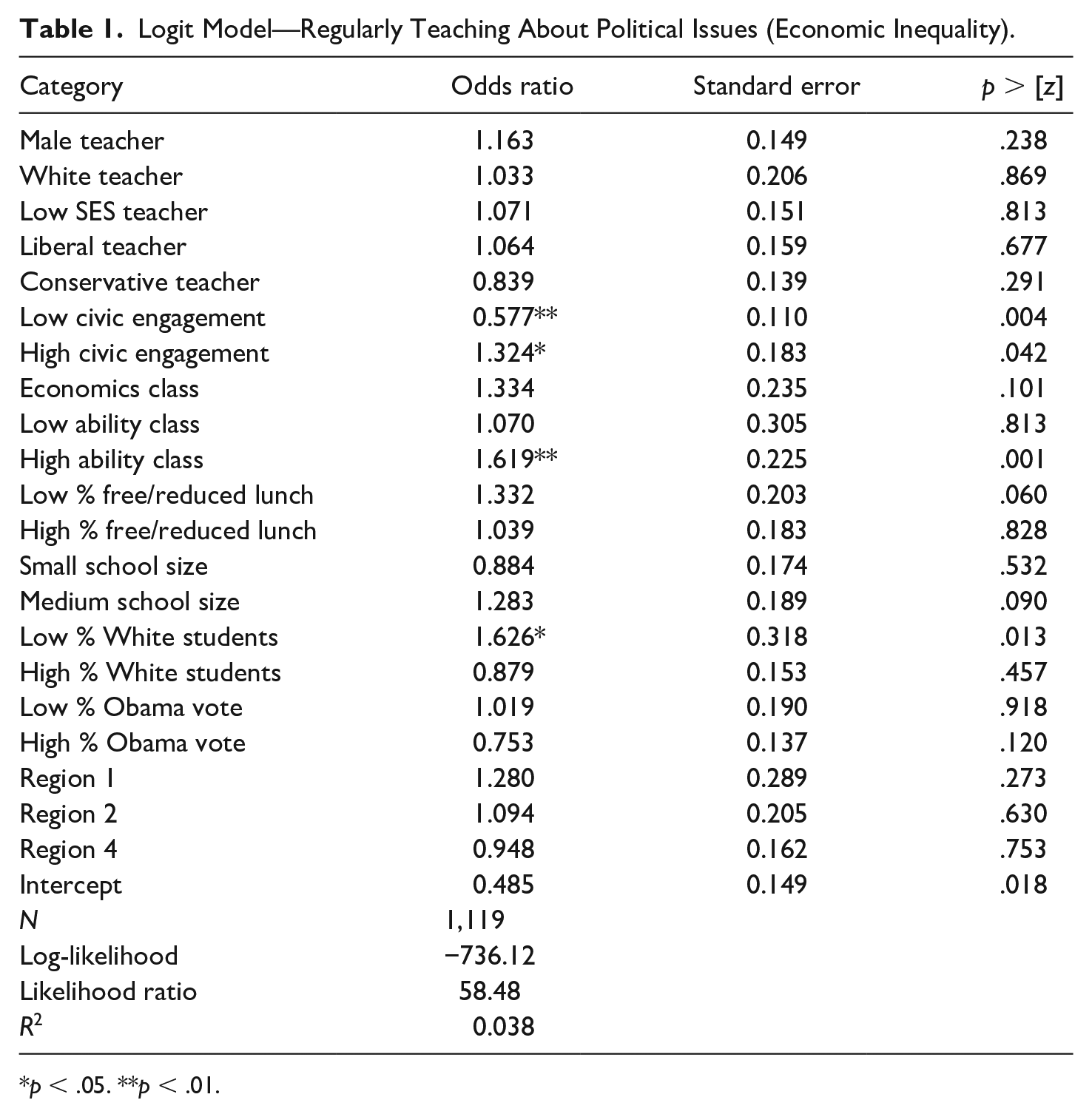
p < .05. **p < .01.
Our most striking finding with regard to teaching and learning about economic inequality is that a teacher’s political ideology does not predict the frequency with which he or she teaches lessons about inequality. Although liberal teachers are more likely than conservative teachers to report that economic inequality is a topic of particular concern to them personally, both liberal and conservative teachers more or less equally believe it should be part of the curriculum and classroom discussion. However, the degree to which a teacher is politically engaged outside of the classroom is a strong predictor of how often they engage their students with issues such as economic inequality. Our study suggests that politically and civically engaged teachers are more likely to engage students more frequently and in more sophisticated ways with the economic, political, and social implications of increasing inequality in both American society and the world. In turn, these teachers are more likely to ask students to imagine solutions—offering meaning, relevance, and agency to lessons in math, literature, and social studies.
Our measures of civic and political engagement included not only deep involvement such as working for community organizations or political campaigns but also following the news and having political discussions with friends, so the implications for teacher education are promising. Teacher education programs should consider ways to encourage new and experienced teachers to follow the news, engage in civil 5 discourse with one another about topics of public concern, and participate in civic and political life. Moreover, teacher educators could work toward teaching the knowledge, skills, and dispositions associated with political and civic engagement. Finally, teacher education programs could put social issues at the core of the curriculum, regardless of subject areas. For example, UCLA’s Center X already aims to prepare teachers to identify and challenge inequities in both schools and the broader society (Cochran-Smith et al., 2018a; UCLA Center X, 2020). Other programs seek to engage teacher education students in current debates about democracy itself, exploring the educational implications of different pedagogies and different school organizations and commitments (Cochran-Smith et al., 2018b; Edling & Simmie, 2020; Westheimer, 2015). There are many other approaches that enable teacher educators to provide for prospective teachers the kind of rich engagement with democratic community life we hope they will later create for their students.
Students in democratic societies need practice in entertaining multiple viewpoints on issues that affect their lives and the lives of others (Bruen et al., 2016; Campbell, 2008; Lin et al., 2015; Sleeter, 2017). Yet choosing to engage controversy in the classroom can cause friction for teachers—with students, parents, and administrators. Teachers have been disciplined, suspended, and fired for engaging students in discussions on controversial issues (Journell, 2017; Stitzlein, 2013; Westheimer, 2007). Even when teachers avoid expressing their own political views, encouraging discussion, controversy, and action in the classroom can be daunting (see also Gibbs, 2019). Students may express views that make classmates uncomfortable, they may engage in political acts that concern their parents, or they may choose to challenge their own school’s policies. Democracy can be messy.
The idea that schools should be “above politics” has historically served to curb political discussions in classrooms. Politics, in this view, is something to be avoided. But a more noble conception of politics is possible. Politics is the way in which people with different values from a variety of backgrounds and interests can come together to negotiate their differences and clarify places where values conflict. Politics is, as Bernard Crick observed in his classic work, In Defense of Politics, “a great and civilizing activity” (Crick, 1962/2005, p. 9). To accept the importance of politics is to strive for a plurality of views rather than a unified perspective. This kind of engagement in teacher education programs described here would serve to mitigate the fear that often accompanies teachers’ efforts to engage their students in contentious topics. In this reclaimed vision, being political means embracing the kind of controversy and ideological sparring that is the engine of progress. It is also the kind of teaching that restores democratic purpose to education.
Conclusion
Although most social scientists and the public have viewed American democracy as relatively stable, if imperfect (at least up until January 6, 2021), this view is by no means the historical norm. For most of human history, democracy has been seen as inherently fragile and susceptible to collapse. Saving democracy is, to state the obvious, a multidimensional undertaking, only part of which can be realized in schools. But when some of the world’s oldest democracies are threatened by vast economic inequality, fear, xenophobia, attacks on a free press, and a potentially dangerous form of populism, teaching, and learning that helps young people understand and respond to these phenomena can help. It is incumbent on teachers and school leaders as well as policymakers and teacher educators to reassert a role in fostering schools that reclaims the importance of democratic values and the common good and that strengthens the bonds between us.
Although some policymakers have been myopically preoccupied with standardized testing in only two subject areas (math and literacy), and others have passed laws effectively outlawing critical thinking (see Strauss, 2012; Westheimer, 2015), many educators have created their own lessons in civic engagement. In every school district, there are examples of individual teachers and schools that work creatively and diligently to engage their students in thinking about the ways their education connects to broader democratic goals. Curriculum that teaches critical analysis of multiple perspectives on a huge variety of topics is available from a variety of organizations (e.g., Rethinking Schools, Teaching for Change, the Southern Poverty Law Center’s Teaching for Tolerance, and the Zinn Education Project), and a significant number of teachers are using these resources with their students.
But for these experiences to become commonplace, teacher education programs must provide these kinds of opportunities for teachers. All teachers, then, and not just civics or social studies teachers, should experience teacher education consistent with democratic community life. In order for this to happen, graduate schools of education will have to free themselves from the accountability, technocratic competence framework, or, as Cochran-Smith and her colleagues (2018a) argue, redefine that framework. But understanding the obstacles young adults face as they enter the profession is also important. Prospective teachers need experiences in democratic community with all its messiness and contention and opportunities for civic and political engagement that focus on imagining a better world. Teacher education that fosters the kind of engagement a well-functioning democracy requires can help to ensure that teachers gain the knowledge, capacities, and dispositions associated with a robust democratic life.
I am suggesting that, yes, at least part of the solution to our democratic ills lies with teacher educators. Teacher education alone cannot save democracy, but it can prepare teachers to bring meaning and complexity to classroom life and to teach students that they have choices about how we should live and that those choices are the building blocks of democratic engagement.
Footnotes
Declaration of Conflicting Interests
The author(s) declared no potential conflicts of interest with respect to the research, authorship, and/or publication of this article.
Funding
The author disclosed receipt of the following financial support for the research, authorship, and/or publication of this article: The author thanks the Social Sciences and Humanities Research Council of Canada and the University of Ottawa Research Chairs Program for support.
Notes
Author Biography
 .
.