



Abstract
Background/Context:
Kindergarten mathematics instruction is critical for students’ future academic success. The nature and quality of this instruction may vary depending on classroom characteristics. However, little empirical work has examined how mathematics instruction in kindergarten might differ based on classroom performance levels.
Purpose, Objective, Research Question, or Focus of Study:
This study focuses on whether kindergarten teachers’ mathematics instructional practices differ based on reported performance levels of students in the classroom. In particular, we focused on whether mathematics instructional time, as well as the extent to which teachers use traditional versus ambitious mathematics practices, differed based on teaching a higher proportion of children performing below grade level.
Research Design:
This study used a nationally representative dataset of approximately 2,900 kindergarten teachers from the Early Childhood Longitudinal Study, Kindergarten Class of 2010–11. With these data, the study utilized a model that compared teachers to each other within the same school (i.e., school fixed effects).
Conclusions or Recommendations:
This study found that mathematics instructional time did not differ based on the proportion of children reported to be below grade level in the classroom. However, how teachers taught mathematics differed: teachers who reported having a greater percentage of students performing below grade level used ambitious practices less frequently. These findings were not moderated by measures of teacher background or teachers’ reported expectations of their students.
Introduction
The impact of high-quality early mathematics instruction on student success is cumulative (Sanders & Rivers, 1996; Wright et al., 1997). In other words, high-quality mathematics instruction in the earliest grades of education is known to be essential for success throughout school (Barnett, 1995; Chetty et al., 2010; Currie & Thomas, 2000; Kilpatrick et al., 2001). To ensure students have appropriate opportunity to learn mathematics, they must have both the time to engage in mathematical concepts and high-quality mathematics instruction (Tate, 1995, 2001). The mathematics education field conceptualizes high-quality mathematics instruction—often referred to as ambitious mathematics teaching—as practices that address conceptual rigor as well as procedural fluency and that incorporate strategies such as facilitation of mathematical discourse, collaborative learning, and cognitively challenging tasks (Choppin et al., 2020; Hill et al., 2018; Lampert, 1992; Munter, 2014; National Mathematics Advisory Panel, 2008; Smith et al., 2005). As such, increased calls for ambitious mathematics instruction represent a shift from traditional math instructional practices that rely on direct instruction and rote computation (National Council of Teachers of Mathematics [NCTM], 2014b; Smith et al., 2005; Stigler & Hiebert, 2009) to a more conceptually driven approach to teaching math that includes discourse-rich, collaborative, and student-focused learning experiences.
Although the most appropriate and effective balance of traditional and ambitious mathematics practices is unknown and debated, the mathematics education field calls for greater amounts of ambitious mathematics instruction across K–12 (e.g., NCTM, 2014b; National Governors Association Center for Best Practices, Council of Chief State School Officers (NGA/CCSSO), 2010; National Mathematics Advisory Panel, 2008), and research finds an incorporation of ambitious mathematical practices into teachers’ practice is necessary for student improvement, especially during the earlier years of schooling (Barnett, 1995; Chetty et al., 2010; Currie & Thomas, 2000; Kilpatrick et al., 2001). Nonetheless, take-up of ambitious mathematical practices has been modest (e.g., Hiebert et al., 2005; Hill et al., 2018; Kane & Staiger, 2012; Weiss et al., 2003). Though limited in scope, the research base suggests that this take-up may differ based on classroom or school characteristics, such as performance levels of students and demographics of the student population (Boston & Wilhelm, 2017; Desimone & Long, 2010; Smith et al., 2001; Stipek, 2004). These studies suggest that teachers may adjust the types of mathematics practices they use based on aspects of their classroom and school environment and the students they serve.
Our study continues this line of research by examining how classroom characteristics might influence teachers’ mathematics instruction. Specifically, in this study, we examine whether kindergarten teachers’ mathematics instructional time and their use of ambitious versus more traditional mathematics practices differ based on one key characteristic of classroom setting—the percentage of students who are reported as below grade level in mathematics. Further, we examine potential mechanisms for why teachers’ practices may vary based on perceived class performance levels—namely, differences in teachers’ expectations of students and differences in teachers’ backgrounds. Specifically, we addressed the following research questions:
Do kindergarten teachers’ reported total mathematics instructional times differ based on the percentage of students that teachers report to be performing below grade level in the classroom?
Do kindergarten teachers’ reported pedagogical practices in mathematics differ based on the percentage of students that teachers report to be performing below grade level in the classroom?
Do these relationships differ based on other classroom characteristics or on teacher background and teacher expectations?
Understanding these relationships will help the field understand whether specific populations of students—particularly, those most marginalized in the education system—are receiving differing amounts and types of mathematics instruction, shedding light on potential inequities in the system.
Conceptual Framework
Our study is grounded in a conceptual framework that bridges theory on students’ opportunity to learn with scholarship examining teachers’ instruction for different populations of students. Specifically, we theorize that students’ opportunity to learn depends on both the time and quality of learning experiences (Tate, 1995, 2001)—that is, the time students are afforded to engage with mathematical concepts and the nature of those experiences. We operationalize time as differences in the time teachers report allotting to mathematics instruction. We draw on literature on mathematical practices to operationalize quality as the extent to which teachers report using ambitious mathematics practices, such as problem solving, application of mathematical concepts to authentic questions, and collaborative learning experiences, versus more traditional practices such as rote learning through worksheets and textbooks (Berry, 2019; Choppin et al., 2020; Hill et al., 2018; NCTM, 2014b; National Mathematics Advisory Panel, 2008). Building on prior work on differences in mathematics instruction based on student composition (Carpenter & Lehrer, 1999; Desimone & Long, 2010; Lubienski, 2001), we hypothesize that teachers’ instructional time and quality differs based on the characteristics of the student populations teachers serve—in particular, perceived classroom performance levels.
We also theorize that the teacher background characteristics (e.g., years of teaching experience) and teachers’ expectations for students may help explain the relationship between perceived classroom performance levels and teachers’ instructional approaches. Decades of scholarship suggest that teachers adjust their expectations for students based on student characteristics, such as socioeconomic status, race, and perceptions of students’ performance and ability levels (see Wang et al., 2018, for a review). Furthermore, certain students—particularly low-income students, students of color, and students in need of remediation—are more likely to be taught by less-experienced teachers (Adamson & Darling-Hammond, 2012; Clotfelter et al., 2005; Goldhaber et al., 2015), suggesting that aspects of teacher background could explain why certain instructional practices are more or less common in different classroom settings.
Importantly, most quantitative mathematics scholarship focuses on the link between mathematics instruction (in particular, mathematics content rather than pedagogy) and achievement (e.g., Engel et al., 2013), or between school or classroom characteristics and student outcomes (e.g., Benner & Crosnoe, 2011; Hoxby, 2000; Link & Mulligan, 1991; Whitmore, 2005), rather than exploring in which classroom settings and for which student populations different pedagogical practices are most likely to emerge and why. Yet, examining how different practices are employed in different settings and for different student groups, such as by grade-level performance, is important for understanding whether certain students may be systematically receiving less rigorous mathematics instruction and for understanding whether policy efforts to increase the rigor of mathematics instruction have influenced instruction for all students. Furthermore, little scholarship has examined these questions in kindergarten specifically—a critical point of study, given that teachers’ practices, such as emphasis on problem solving, can be especially key for boosting kindergartners’ mathematics success (Bodovski & Farkas, 2007) as well as socioemotional development (Bargagliotti et al., 2017). Specifically, development can be bolstered through instruction that fosters pro-social behaviors and collaboration as well as experimentation and trial and error (Dunn & Kontos, 1997; Stipek et al., 1995).
Thus, we ground our investigation in an opportunity to learn framework and offer a contemporary analysis of opportunity to learn patterns in kindergarten in light of efforts to advance the nature of mathematics education in the United States (NCTM, 2014b; NGA/CCSSO, 2010) and dramatic changes to the nature of kindergarten instruction over the last two decades (Bassok et al., 2016; Engel et al., 2016). We contend that understanding differences in kindergarten instruction based on perceptions of classroom performance is particularly critical, because such findings could signal systematic differences in the quality of instruction from the very start of a student’s academic trajectory and provide valuable insight for early childhood policy, such as teacher assignment and classroom interventions.
Background
In this section, we summarize the field’s current understanding of the relationships outlined in our conceptual framework and identify key gaps in the literature that our study fills.
Mathematics Instructional Time
Recent scholarship indicates increases in kindergarten mathematics instructional time in the last several decades, and some differences in amount of mathematics instructional time based on school and classroom characteristics. Using the nationally representative Early Childhood Longitudinal Study—Kindergarten (ECLS-K) datasets from 1998 and 2010, Bassok and colleagues (2016) found that kindergarten is becoming increasingly academic in nature, exemplified in increases in total time spent on mathematics instruction, and that teachers serving students of color and low-income students spend more time on academics than teachers serving White and affluent students. Other work corroborates these patterns: Drawing on 82 classroom observations in one large urban school district, Engel and colleagues (2021) found that kindergarteners in schools serving predominantly low-income students received more mathematics instructional time and less noninstructional time overall than their peers in more affluent schools. In an older study, using the ECLS-K 1998 dataset, Wang (2009) found that Black low-income students received greater amounts of mathematics instructional time than White low-income students.
Collectively, these studies suggest that schools serving student populations who are deemed in need of improvement—such as racially minoritized and low-income students—may be prioritizing academic instructional time (especially in mathematics) in service of achievement, at the expense of other instructional areas. Yet, less scholarship has addressed the relationship between classroom performance levels and mathematics instructional time—that is, do teachers spend more or less time on mathematics when they perceive their students to be behind grade level? Although performance levels are likely highly correlated with race and income, addressing this question directly bolsters this scholarship on the relationship between classroom characteristics and mathematics instruction in kindergarten.
Mathematics Instruction: Ambitious and Traditional Practices
For the last several decades, the K–12 mathematics education field has called for shifts in the nature of mathematics instruction from an emphasis on traditional mathematical instruction practices to ambitious practices (Choppin et al., 2020; Hill et al., 2018; Lampert, 1992; National Mathematics Advisory Panel, 2008; NGA/CCSSO, 2010; Smith et al., 2005; Stigler & Hiebert, 2009). Traditional practices are those that emphasize rote computation, direct instruction, and independent student activities, rather than active or collaborative learning. In contrast, ambitious mathematics balance procedural fluency and conceptual rigor through instructional practices that emphasize problem solving, application of mathematical concepts to authentic questions, and collaborative learning experiences (Boston & Wilhelm, 2017; National Mathematics Advisory Panel, 2008; Smith et al., 2005; Stigler & Hiebert, 2009). In contrast to traditional instruction, we adopt the term “ambitious mathematics” to mean student-centered instruction focused on developing conceptual understanding through collaborative, discourse-rich student experiences and opportunities for cognitively demanding problem solving (e.g., Boston & Wilhelm, 2017; Munter, 2014; Wilhelm, 2014). Our definition reflects the synergies between the scholarship on ambitious mathematics specifically (e.g., Boston & Wilhelm, 2017) and scholarship that focuses on “high-quality mathematics instruction,” which outlines the teachers’ role, collaborative discourse, and cognitively challenging tasks as key dimensions of high-quality mathematics (e.g., Munter, 2014).
Despite calls in the mathematics education field for increases in ambitious mathematical practices (e.g., National Mathematics Advisory Panel, 2008; NCTM, 2014b; NGA/CCSSO, 2010), descriptive studies documenting the nature of mathematics teaching in elementary and middle schools suggest that teachers still tend to emphasize routinized mathematical computation, rather than conceptually rigorous activities using ambitious teaching practices (e.g., Boston & Wilhelm, 2017; Desimone & Long, 2010; Hiebert et al., 2005; Hill et al., 2018; Litke, 2020; Smith et al., 2005). This is particularly true for students of color and low-income students, who tend to receive less rigorous mathematics instruction (e.g., Celedón-Pattichis & Turner, 2012; Stipek, 2004; Turner & Celedón-Pattichis, 2011; Turner et al., 2008, 2009).
Less well studied, however, is how the nature of ambitious or traditional practices varies based on perceived or actual performance level of students, though a few studies signal that this is an important area for study. For instance, in their study of Chicago elementary schools using teacher survey and student achievement data, Smith and colleagues (2001) found that instructional practices that emphasize discussion, groupwork, and hands-on activities were more common in classrooms with high percentages of students with strong prior performance. In contrast, didactic instruction (aligned with our conception of traditional instruction) was more common in classrooms serving students with lower levels of prior performance, irregular attendance, high levels of behavioral concerns, and majority Black students. In a similar line of questioning, Desimone and Long (2010) used the first four waves of ECLS-K data, including student achievement data, and found that teachers of higher-achieving kindergarteners engaged in more advanced practices and more instructional time overall than teachers of lower-achieving kindergarteners. Notably, the most recent data from this study was the ECLS-K administration in 2000. Since then, the Common Core State Standards for Mathematics (CCSS-M) were adopted, and the nature of kindergarten instruction shifted to a greater academic focus on reading and mathematics (Bassok et al., 2016; Engel et al., 2016), and leading mathematics education organizations have emphasized the importance of ambitious and equitable mathematics practices in K–12 (Bartell et al., 2017; NCTM, 2014a, 2014b). In a more recent study of middle school mathematics classrooms, Boston and Wilhelm (2017) conducted observations in four urban districts and found that teachers serving predominantly students of color and low-income students planned to teach cognitively challenging tasks, but rigor declined in implementation.
Notably, few studies examine the relationships highlighted in our conceptual framework for kindergarten mathematics specifically (with Desimone & Long, 2010, a key exception)—an important area for study given the connection between kindergarten mathematical instruction and future academic success (Aubrey et al., 2006; Claessens et al., 2009; Duncan et al., 2007; Jordan et al., 2009; Siegler et al., 2012). Also using ECLS-K data, our study builds on Desimone and Long’s (2010) findings by examining whether patterns between classroom composition (in our case, teachers’ perceptions of student performance) and instructional practices maintain in later years when new instructional policy efforts have been underway to elevate the emphasis on ambitious mathematical practices across all classrooms (Desimone & Long, 2010). An updated examination of these patterns is critical given the increase in focus on academics in kindergarten since Desimone and Long’s study (Bassok et al., 2016; Engel et al., 2016).
Operationalization of Mathematics Instructional Practices
In this study, we focus on teachers’ use of three categories of instructional practices. Aligned with ambitious instructional practices, our first two categories focus on problem solving and the nature of groupwork (e.g., mixed achievement groupings, pair groupings). Aligned with more traditional instructional practices, our third category is practices that utilize traditional tools in the classroom that promote independent student work and computation—namely worksheets, books, and the chalkboard. Importantly, these constructs are not comprehensive of ambitious and traditional practices (which we discuss in the Limitations section), but capture important dimensions of mathematics instructional practice from the scholarship.
Problem Solving
Because new mathematics standards focus more on in-depth understanding of fundamental mathematics concepts, student development of strong mathematical problem-solving skills is a key goal of current teacher practice (Berry, 2019; NCTM, 2014b). Problem solving represents the higher cognitive demands present in today’s standards compared to previous state standards in mathematics (Porter et al., 2011) and leads to increases in student achievement (Guarino et al., 2013). In the early grades and in elementary school, problem-solving practices in mathematics have largely gained traction through student inquiry approaches such as Cognitively Guided Instruction (CGI) (Carpenter et al., 2000). CGI encourages students to work problems that have multiple solutions or problems that are open ended, thus honing their problem-solving skills. Recent studies have noted that incorporating problem solving in mathematics is associated with higher achievement for kindergarteners (Bargagliotti et al., 2017), suggesting such practices should be promoted in early childhood.
Working Together
Instruction that emphasizes collaboration and active learning is a key component of ambitious mathematics instruction. Collaborative learning in mathematics can increase student engagement and achievement, including among students typically performing at lower levels (Boaler & Sengupta-Irving, 2016; Boaler & Staples, 2008). Research has shown that placing students in heterogeneous achievement groupings and other types of peer groups to work on mathematics problems can be beneficial in creating high-achieving classrooms and closing the achievement gap (Boaler, 2002, 2006; Boaler & Staples, 2008; Cobb et al., 1992). Furthermore, the CCSS-M Mathematical Practices highlight the importance of having students work together to discuss problems and their solutions with their peers (NGA/CCSSO, 2010).
Traditional Teaching Practices
Although an increase in the use of more ambitious mathematical practices is the goal, mathematics instruction is often dominated by practices that utilize more traditional classroom and school resources such as independent work on worksheets, in textbooks, or at the chalkboard. These practices have consistently been used within early childhood classrooms. Although scholars in the K–12 mathematics education field more broadly have suggested a move away from these practices in favor of ambitious practices—active learning that engages students in conceptual rigor (e.g., cognitively demanding tasks and student mathematical discussion), procedural fluency, and real-world application (Choppin et al., 2020; Hill et al., 2018; Lampert, 1992; National Mathematics Advisory Panel, 2008; Smith et al., 2005), it is important to note that some studies have found some traditional mathematical teaching practices are associated with increases in students’ achievement (Guarino et al., 2013; Wang, 2009). Thus, a mix of both traditional and ambitious traditional teaching practices could be a first best step in the direction toward more ambitious teaching practices.
Teacher Background and Expectations
Finally, we review the literature on what we conceptualize as two possible mechanisms that may account for why teachers’ instructional practices may differ based on classroom characteristics: teacher background and teacher expectations.
Teacher Background
Defining teacher qualifications has been a contentious debate in education research. Many scholars argue that teacher background can be defined broadly by years of experience, preparation and degrees, and coursework (Darling-Hammond, 2000; King Rice, 2003). Others focus on teachers’ effects on student performance, rather than teacher characteristics (Hanushek, 1992). Nonetheless, researchers, albeit not all, tend to agree the most powerful indicator of student outcomes is some sort of measure of teacher qualifications (Sanders & Horn, 1998) and that students suffer without higher-qualified teachers (Palardy, 2015). Ample studies have documented that students of color, low-income students, and students considered low-performing tend to be taught by less experienced teachers (Kalogrides et al., 2013; Lankford et al., 2002) who may have less facility with using high-quality mathematics instructional practices (Flores, 2007; Oakes, 1990). Thus, in this study, we attend to how aspects of teacher background (measured by more years of teaching experience, advanced degrees, teacher preparation, coursework or certification, etc.) are related to the relationship between classroom characteristics and teachers’ mathematical practices.
Teacher Expectations
A long line of scholarship suggests that teachers’ beliefs about and expectations of students vary based on specific student characteristics, and these expectations often shape instruction (Good & Brophy, 1997; NCTM, 2014a, 2014b; West & Anderson, 1976). Research indicates teachers have lower expectations for students based on characteristics like socioeconomic status, race, and their own perceptions of student ability or prior performance (Wang et al., 2018). And teachers’ low expectations are linked to lower performance of low-income children (Benner & Mistry, 2007) and minoritized students (Anyon, 2017; Diamond et al., 2004; Glock, 2016; Oakes, 1985). Moreover, teacher expectations can impact entire school communities (Kitchen et al., 2006). Diamond and colleagues (2004), for example, found that teachers had low expectations of their students in a school with a high concentration of low-income Black elementary students, resulting in a decline in school-wide responsibility for student learning. Based on this body of research, we explore whether teachers’ expectations of their students’ mathematical performance levels influence the relationship between reported classroom characteristics and instructional practices.
Method
Data
This study relied on teacher-reported survey responses from a nationally representative dataset, the ECLS-K Class of 2010–2011. The collection of these data was spearheaded by the National Center for Education Statistics (NCES) at the U.S. Department of Education. Data were collected about children and their families, teachers, and schools in both the fall and spring of the 2010–2011 kindergarten year. A three-stage stratified sampling design was employed by NCES to ensure national representation. Geographic region was the first sampling unit, public and private school was the second sampling unit, and students stratified by race/ethnicity was the final sampling unit.
Our study relied on teacher survey responses. Teachers were asked to report information about their classrooms, own characteristics, and teaching practices. Our sample consisted of N = 2,920 teachers. We arrived at this final sample size after using chained multiple imputation (Royston, 2004) to fill in missing values pertaining to classroom and teacher characteristics as well as instructional practices. Variables in this study that had missing values were imputed back to sample observations for which there were nonzero weights, to create a total of 10 imputed datasets. In imputation and analyses, we utilized the kindergarten sample weights supplied in the data set.
Mathematics Instructional Time
To address our first research question, we relied on two measures, which were both reported in the spring by the teacher. The two were based on time spent on mathematics instruction in our models: how many days per week the teacher reported teaching mathematics (0–5 days were answer choice selections) and how much time per day was spent on mathematics instruction (never, less than 30 minutes, 30–60 minutes, 60–90 minutes, 90–120 minutes, 120–150 minutes, 150–180 minutes, more than 180 minutes).
Instructional Practices
In the survey, teachers were asked to respond to questions pertaining to the frequency with which they engaged in different mathematics practices. The question stem was: How often do children in the class do each of the following mathematics activities? The response set was also identical for each of the activities asked about: never, once a month or less, two or three times per month, once or twice a week, three or four times a week, or daily. Per Bargagliotti, Gottfried, and Guarino (2017), these responses were recoded as days per month: Never = 0 times per month; once a month or less = 1; two or three times per month = 2.5; once or twice a week = 6 (average of once a week [4 times] and twice a week [8 times]); three or four times a week = 14 (average of three times a week [12 times] and four times a week [16 times]); and daily = 20.
In this study, we relied on three core instructional practice scales, which were derived directly from these individual question items and previously created in Bargagliotti, Gottfried, and Guarino (2017). Our three core scales are problem solving (α = 0.69), working together (α = 0.75), and traditional (α = 0.69). The problem-solving scale focused on mathematical applications and asked teachers to respond to how frequently children did the following in mathematics: “explain how a math problem is solved” and “work on math problems that reflect real-life situations.” The working together scale was composed of instructional practices that relied on group activities. In the survey, teachers were asked to respond to how frequently children did the following in mathematics: “solve math problems in small groups or with a partner,” “work in mixed achievement groups on math activities,” and “peer tutoring.” For the traditional scale, teachers were asked to respond to how frequently children did the following in mathematics: “do math problems from their textbooks,” “do math worksheets,” and “complete math problems on the chalkboard.”
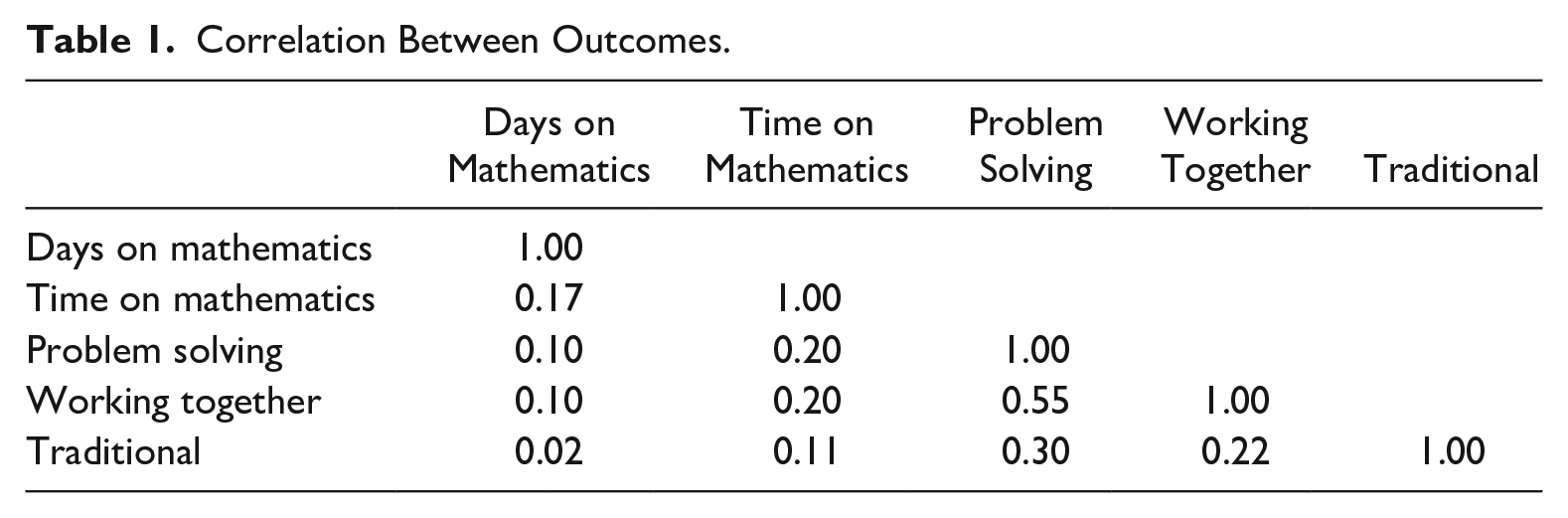
Table 1 shows correlations between these measures. The correlations suggest that these constructs were relatively distinct from one another. Looking at these correlations, we see that the highest correlation between practices was between working together and problem solving at approximately 0.55. Overall, these correlations indicate that teaching practices have weak linear relationships with other measures in the table. This is not surprising because teachers can also promote all of these practices independently from one another.
Correlation Between Outcomes.
Independent Variables
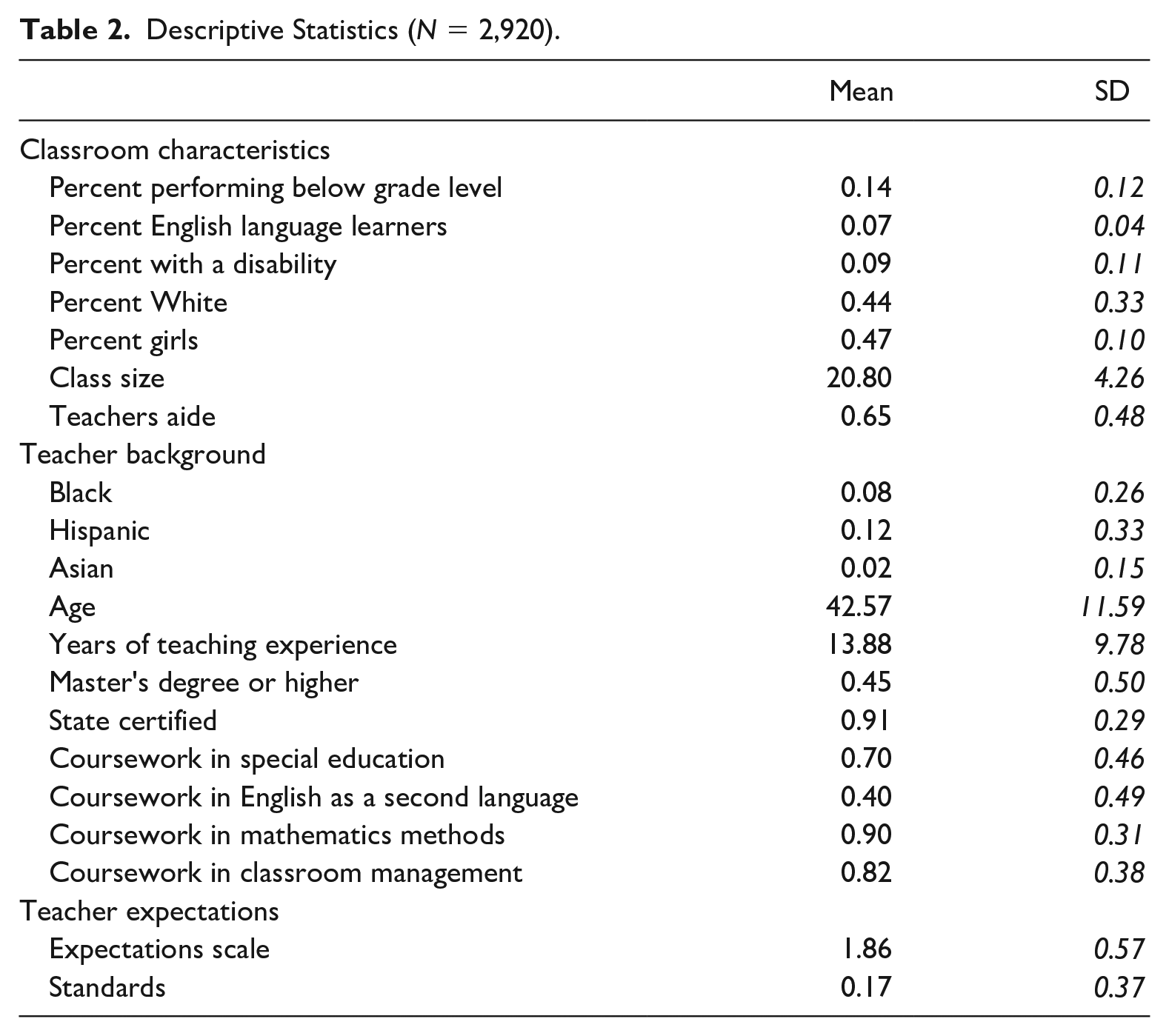
Table 2 presents all of the independent variables utilized in this study.
Descriptive Statistics (N = 2,920).
Key Measures
Teachers were asked to report on a series of classroom characteristics. Specifically, teachers were asked to report how many students in their classrooms fell into a list of certain categories (e.g., number of students with disabilities). One of the items in this list asked teachers to report the total number of students “below grade level in their mathematics skills.” Although it is intended that teachers count the number of students at grade level based on school administrative data, the survey documentation does not ask teachers to make clear how they arrived at their count of children, so we acknowledge that it is possible that teachers reported total below-grade-level students based on their perceptions or their own measures of student performance. For all items in this section where teachers were asked to report the counts of children in their classroom by grouping, teachers provided a raw continuous number. To arrive at the percentage of the classroom below grade level, we divided this number by total classroom size. On average, approximately 14% of classes were performing below grade level in mathematics. The median value was 12.5%.
Other Classroom Characteristics
Teachers also reported on the numbers of English language learners, students receiving individualized education programs, students of different racial/ethnic groups, and students of each gender in their classrooms. We also transformed these into percentages and included them in our analyses, along with overall class size. Finally, we included an indicator for whether the classroom had a teacher’s aide.
Teacher Background
Based on teacher self-report, we included several teacher characteristics in our models. First, teachers reported demographic characteristics, including race and age. Second was a set of teaching qualifications, including teachers reporting on the number of years of teaching experience as well as indicators for whether teachers had a graduate degree and/or state certification. Third were the following training-related measures: the number of courses the teacher had taken in special education, teaching English language learners, methods of teaching mathematics, and classroom management.
Teacher Expectations
The final grouping of the table presents our teacher perceptions measures. For this study, we created two measures of teacher perceptions of students. The first is an “expectations” scale that measures teachers’ expectations of students. This is a three-item scale (α = 0.63) based on questions that assessed how much teachers agree (five responses from strongly disagree to strongly agree) about whether teachers hold different expectations for children in the classroom. The items were as follows: (1) “Many of the children I teach are not capable of learning the material I am supposed to teach them”; (2) “There is really very little I can do to ensure that most of my students achieve at a high level”; and (3) “The amount a student can learn is primarily related to family background.”
Second, we included a binary “standards” measure (yes/no) as to whether teachers indicated in the spring of kindergarten that they held different standards for different children based on what they are capable of doing. The item in the survey was written as: “I hold different standards for different children based on what I think they are capable of.”
Analysis
We addressed our research questions by starting with the following baseline model, which compares teachers between schools:

where Y represents one of our frequency of mathematics instruction measures or mathematics instructional scales used by teacher i in classroom j in school k. PCT represents the percentage of students in the classroom performing below grade level in mathematics. C represents classroom characteristics, T represents teacher characteristics, and X represents time spent on mathematics instruction, as described above.
One concern with the baseline model is that teachers in the same school could share unobserved characteristics, attitudes, or experiences that cause them to emphasize certain teaching practices, and this might bias the estimates. For instance, highly effective teachers might be attracted to a school where there is a good chance of having lower percentages of children performing below grade level in mathematics. Or, it might be the case that certain schools (or districts in which schools are located) set curriculum and rubrics, and this would impact how much time would be spent on teaching mathematics in specific ways. If this were the case, then the relationship between PCT and Y would not be estimated correctly. To address this concern regarding across-school differences in the sample, we modified the model to look at teachers within the same school where these differences would disappear, and we do so by using a school fixed effects model:

The model is nearly identical to equation (1), with the exception of the term δ k , which represents school fixed effects. This term represents a series of binary indicators for school, leaving one out as the reference group. Thus, school fixed effects compare teachers (and their classrooms) within school rather than between schools. In this way, this model controls for unobserved between-school variation, such as aggregate school-level teacher background that is not measured in the dataset. All that remains is variation between classrooms within a school. Note that in our sample, 87% of schools have more than one kindergarten classroom, hence providing variation between classrooms and within schools.
An additional concern might be the way that teachers sort within schools. If, within a single school, certain types of teachers were more or less likely to have students performing below grade level in their classrooms, then the estimates of PCT would still be biased. This is not a concern with these data, however. First, a large number of prior studies using ECLS-K data have tested for and shown no evidence of within-school sorting of children to teachers in the kindergarten school year (Aizer, 2008; Bargagliotti et al., 2017; Cho, 2012; Fletcher, 2010; Neidell & Waldfogel, 2010). Hence, the field has established a lack of evidence of children sorting into particular classrooms in the ECLS-K data in kindergarten.
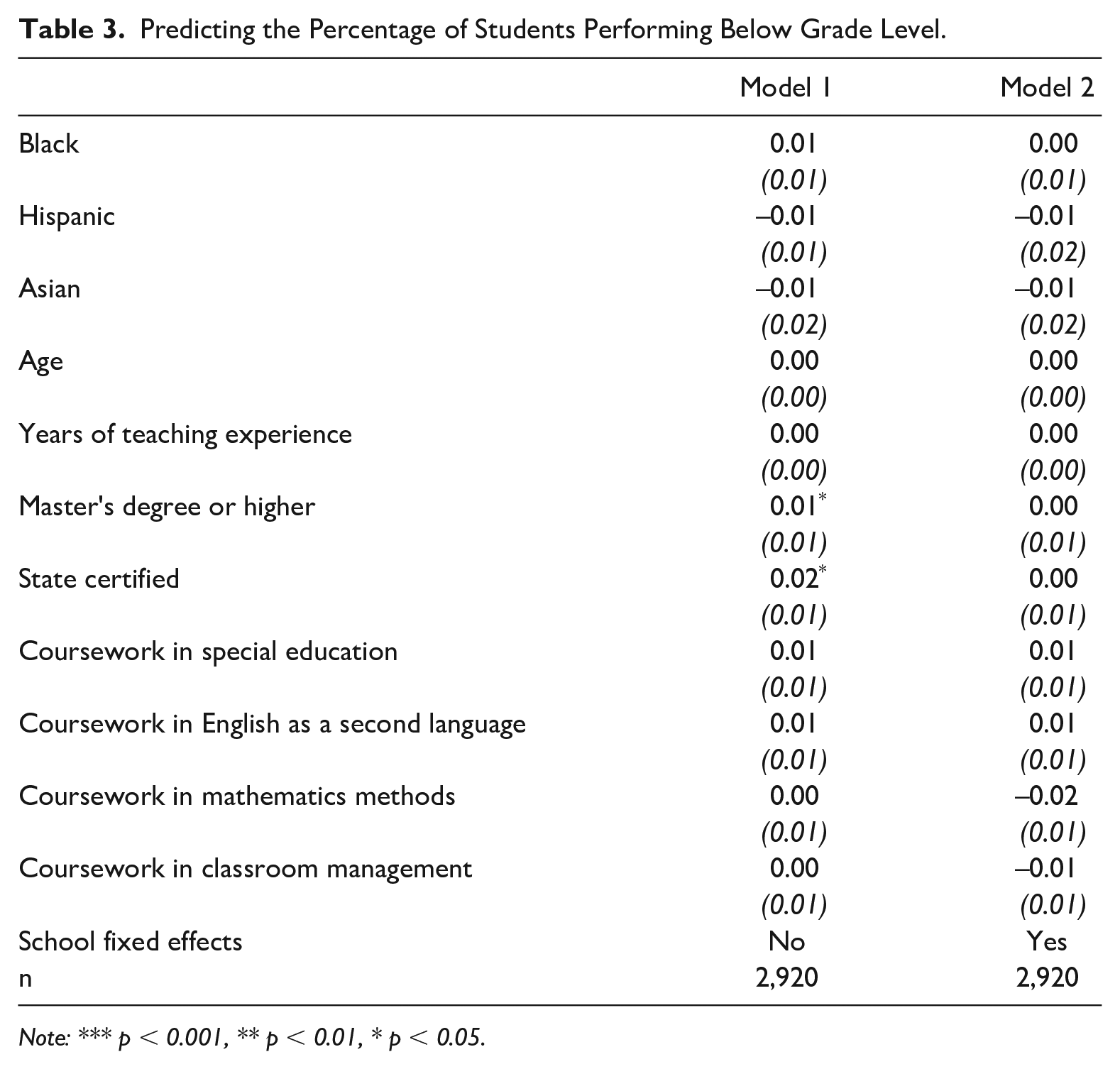
In addition to this prior evidence, we tested in our own analytic sample whether it appeared that teachers were sorting within schools to different classrooms based on percentages of students performing below grade level. To do so, we ran two models. In the first, the outcome was the percentage of students in the classroom performing below grade level. The independent measures were teacher characteristics and the presence of a teacher’s aide. This first model, analogous to our first equation above, compares all classrooms across the sample. Our second model includes school fixed effects, thereby examining whether teacher characteristics are associated with the percentage of students performing below grade level. Table 3 presents these results.
Predicting the Percentage of Students Performing Below Grade Level.
Note: *** p < 0.001, ** p < 0.01, * p < 0.05.
In Table 3, regression coefficients present the association between teacher characteristics and the percentage of students performing below grade level in mathematics. When looking in the first column where we compare teachers and classrooms across the entire dataset, we see a few significant findings—meaning that some teacher characteristics are systematically linked to the percentage of students performing below grade level. This finding is logical given that we are examining all teachers between schools in the ECLS-K dataset. When we look at the second column—where we only compare teachers within schools—there are no statistically significant findings. For instance, teacher experience was not related to the percentage of students performing below grade level; in other words, in our dataset of kindergarten classrooms, novice teachers were not any more or less likely compared to other teachers to have students at lower performance levels. Thus, when making a more robust comparison between teachers (i.e., within schools), there is no evidence that certain types of teachers are being assigned to certain percentages of students performing below grade level within schools, based on the observable characteristics that we have. This is consistent with the aforementioned research that also finds no evidence of within-school teacher-to-classroom sorting. Hence, our preferred model—and the one used to present all findings below—is the school fixed effects model.
Results
Research Question 1
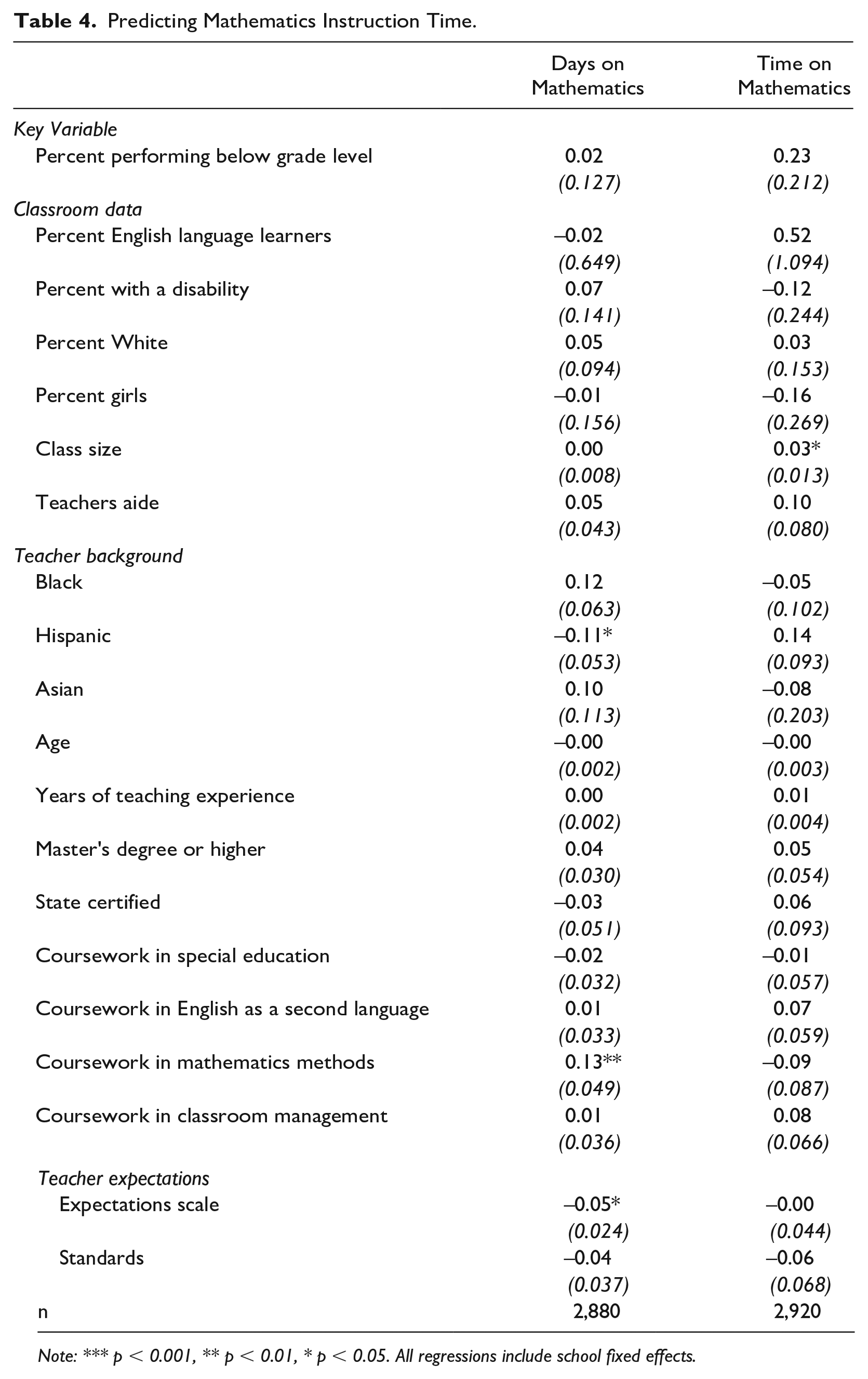
Our first research question examined whether there were differences in mathematics instructional time based on the percentage of students performing below grade level in mathematics. Table 4 presents these findings; regression coefficients are presented with standard errors in parentheses. Our key variable is located in the first row—the percentage of students performing below grade level in mathematics. The number of days spent on mathematics and the number of minutes per day were not associated with the percentage of students performing below grade level in mathematics. In other words, teachers were using similar amounts of time on mathematics, regardless of the percentage of the class performing below grade level in mathematics.
Predicting Mathematics Instruction Time.
Note: *** p < 0.001, ** p < 0.01, * p < 0.05. All regressions include school fixed effects.
Research Question 2
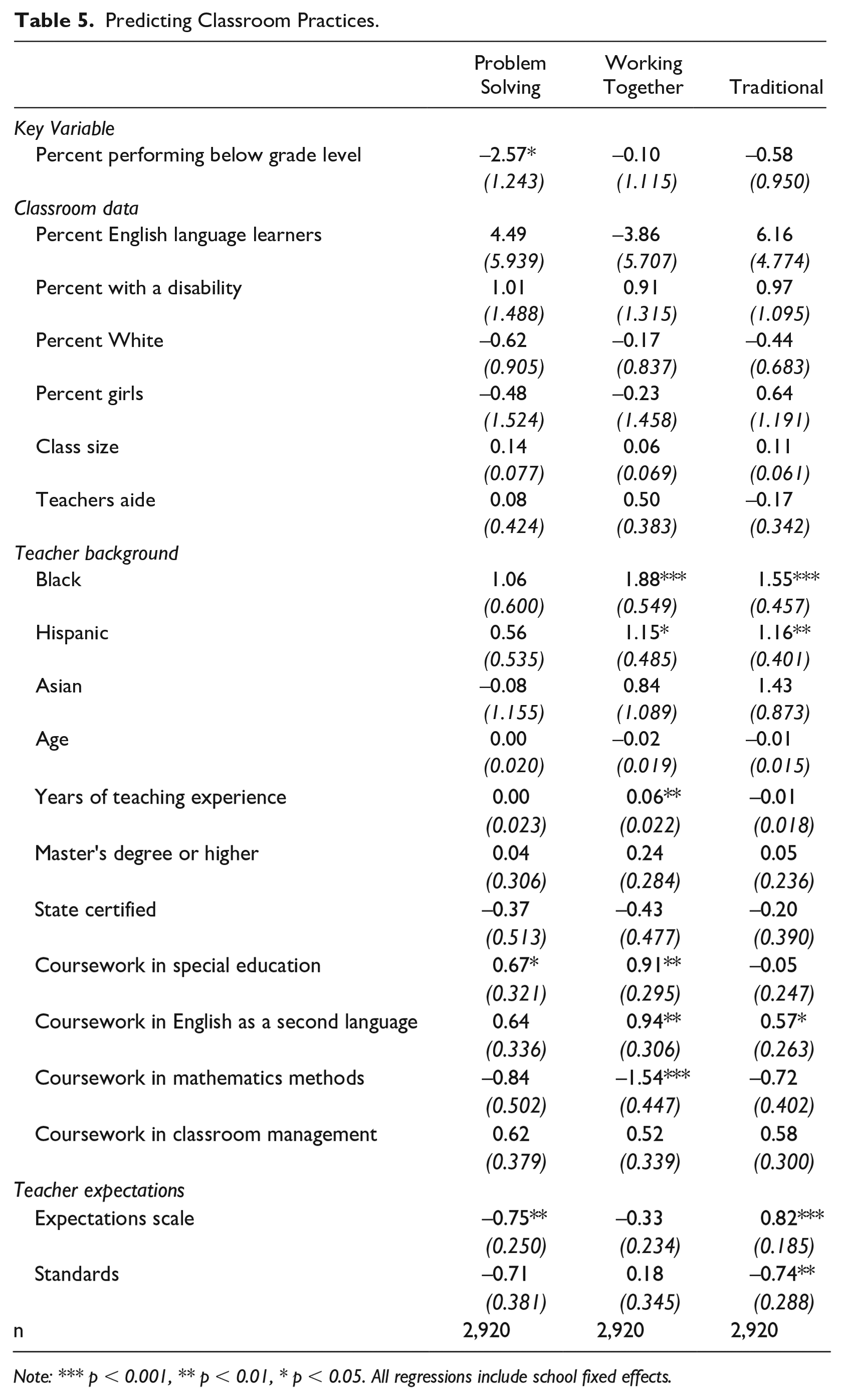
Our second research question asked whether there was an association between the percentage of students in the classroom performing below grade level in mathematics and the frequencies of ambitious and traditional mathematics pedagogical practices used by teachers. Table 5 presents these main findings. Our three practice scales are labeled in each column heading. Again, the variable of most interest is found in the first row—the percentage of students performing below grade level in mathematics. Looking across all practices, we can see that only one of our practice scales was linked to the percentage of students performing below grade level in mathematics. Specifically, teachers used a lower frequency of problem-solving instruction as the percentage of students performing below grade level increased. To provide some additional context, if 100% of the classroom were performing below grade level, the teacher would have 2.5 fewer days per month of problem-solving instruction—a number that adds up to a large number of school days when considering the entire academic year. Given that Desimone and Long (2010) found that four additional days of advanced mathematics instruction per month can reduce Black–White achievement gaps by 20%, our estimate helps to clarify how gaps might be sustained.
Predicting Classroom Practices.
Note: *** p < 0.001, ** p < 0.01, * p < 0.05. All regressions include school fixed effects.
Working together and traditional scales were not significant. Both of these practices were not associated with the amount of students in the class performing below grade level. Although not significant, as reported above, these practices were widely used—working together and traditional were each used approximately eight times per month. These nonsignificant findings are also not surprising, because a large overall focus of kindergarten includes promoting students working together to begin with. Yet the findings suggest that, to some degree, teachers with higher percentages of students below grade level used fewer ambitious instructional practices, namely, that they are using problem solving less frequently.
Research Question 3
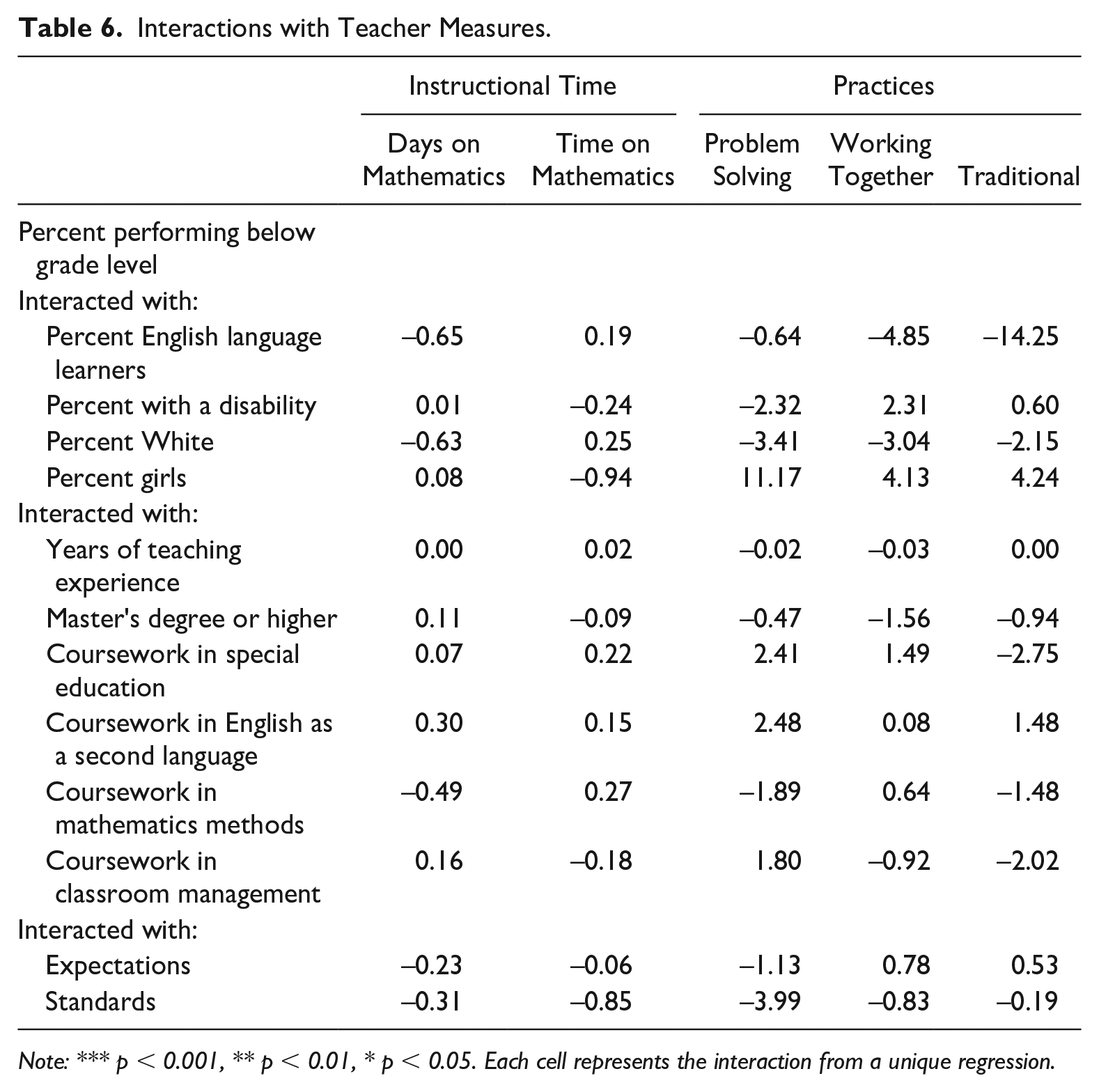
Our third question asked whether there were differences in outcomes based on specific measures of other classroom characteristics or measures of teacher background or teacher expectations—for example, perhaps teachers with more years of experience would use more ambitious mathematics practices when teaching a greater percentage of students performing below grade level in mathematics than teachers with fewer years of experience. To test this, we ran our school fixed effects model with an interaction between classroom or teacher measures and the percentage of students performing below grade level in mathematics. Table 6 presents these findings.
Interactions with Teacher Measures.
Note: *** p < 0.001, ** p < 0.01, * p < 0.05. Each cell represents the interaction from a unique regression.
In the table, the interaction terms are presented. Each coefficient represents the finding from a unique regression model, where the outcome is delineated by the top row. All models are analogous to those in Tables 3 and 4, though the full set of coefficients is not presented for the sake of brevity. As evident in the table, there were no significant interactions. In other words, there were no detectable differences in the way teachers with different classroom characteristics, individual characteristics, or expectations adjusted their classrooms or practices to the percentage of students performing below grade level in mathematics.
Sensitivity Analyses
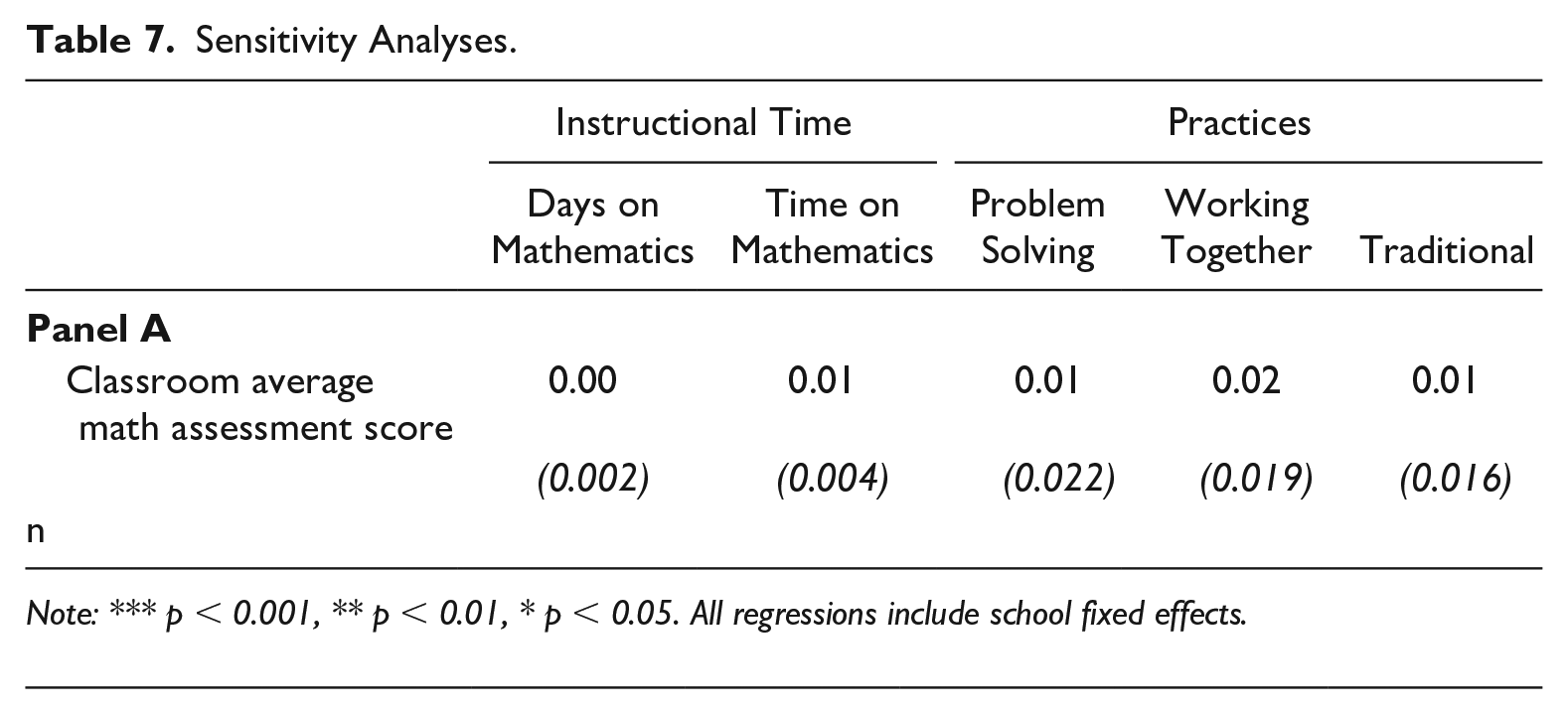
To test our findings, we performed two robustness checks. First, for each outcome, we replaced our percentage below grade level variable in our models in Tables 3 and 4 with the average classroom performance in ability (based on mathematics assessment scores given to students just at the start of the kindergarten school year) rather than the percentage of students performing below grade level. This way, we could test whether it was the average classroom performance that was driving our results as opposed to below-grade-level mathematics performance. As seen in Table 7, the coefficients on average performance measure were not statistically significant in any model.
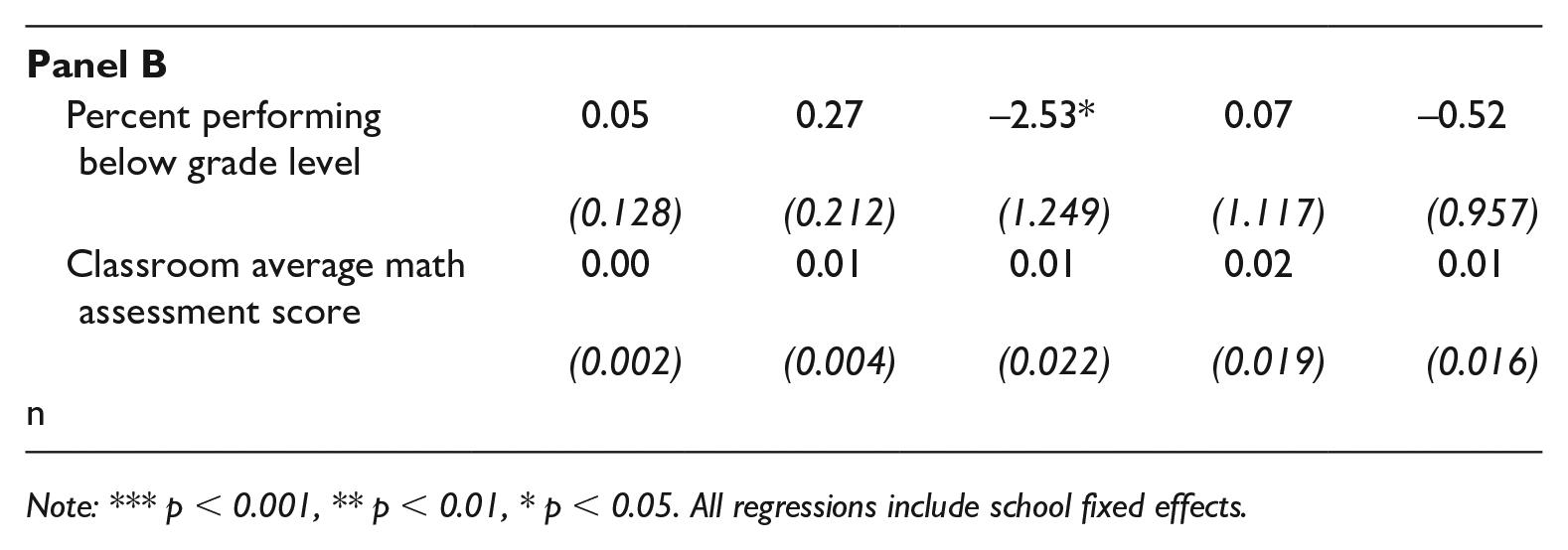
Sensitivity Analyses.
Note: *** p < 0.001, ** p < 0.01, * p < 0.05. All regressions include school fixed effects.
Note: *** p < 0.001, ** p < 0.01, * p < 0.05. All regressions include school fixed effects.
In panel B of Table 7, we included both the percentage of students performing below grade level and the average mathematics testing performance measure that was used in Panel A. As evidenced from the table, only the percentage variable was statistically significant. Notably, including the mean performance does not reduce statistical significance on our key variable—percentage of classmates performing below grade level.
Discussion
Summary of Key Findings
In our study, we found that teachers used problem solving less frequently as the percentage of students performing below grade level increased. This finding is concerning given that problem solving is highly emphasized in current mathematics standards and is one aspect of ambitious mathematics instruction called for in the mathematics education field more broadly. Our findings also indicate that the frequency of teachers using working together and traditional practices was not associated with the percentage of students deemed low performing within their classrooms. These nonsignificant findings are not surprising because a large overall focus of kindergarten includes promoting students working together. Thus, regardless of the grade-level performance of students in the class, teachers are likely to emphasize this practice just the same.
In addition, despite calls for more ambitious mathematics instructional practices, traditional practices are widespread. For instance, these practices are often embedded in mathematics curricula. Mathematics instruction typically uses worksheets to guide discovery and problems given to the students. It is perhaps unsurprising, then, that we found no association between the frequency of use of this practice and classroom performance levels. Regardless of the type of classroom characteristics present, teachers are all frequently using traditional practices anyway. Overall, however, because the practices affected by classroom performance levels—that is, problem solving—are among those given the most emphasis in the CCSS-M throughout all grades, there is a concern that students in classrooms with many low-performing students may leave kindergarten with a less solid basis for understanding mathematics and may continue to fall behind in their mathematics skills as they progress into first grade and beyond. This finding suggests that being deemed below grade level in kindergarten actually does relate to the types of instruction those students receive, which, given the association between kindergarten mathematics and future success, may set students on a trajectory of less rigorous mathematics experiences and lower academic success. Although assessments of student performance in kindergarten may be intended to identify areas for additional support for these students, a negative ramification may be that such assessments may actually result in these students receiving fewer high-quality mathematics experiences.
Notably, we did not find that this relationship between percentage of below-grade-level students and instructional practices differed based on teacher background or teacher expectations. However, given prior research on the importance of these two factors on the types of educational experiences that low-income and racially/ethnically minoritized students receive (e.g., Kalogrides et al., 2013; Wang et al., 2018), future research should continue to examine these mechanisms closely using alternative designs and measures.
Limitations
Our findings should be interpreted with some limitations. First, we rely on the self-reports of teachers for both our measures of teaching practice and our measure of student performance in mathematics. Although prior research has validated these types of survey responses with observed classroom practices (Mayer, 1999; Stipek & Byler, 2004), it is possible that some recall bias, socially desirable responses, and measurement error were present in these measures. If this measurement error is randomly distributed, it could attenuate our estimated effects, thereby underestimating them. Therefore, our results might be viewed as conservative.
Second, our measures of teaching practice capture time and frequency of different instructional practices. It may be more important how a teacher uses a practice than how much. It is also important to understand why teachers use certain practices more than others, though a quantitative survey dataset such as this would not be able to address this. However, the findings we present here do not extend to motivation or effectiveness of practice—we focus on the presence of the practice and how that varies with classroom characteristics. Future work—notably qualitative work—might delve into motivation for the time spent on these practices. Furthermore, although our measures of teaching practice capture some important elements of ambitious and traditional mathematics instruction, they are not comprehensive of all aspects of ambitious and equitable mathematics instruction. For instance, a key element of ambitious and high-quality mathematics is mathematical discourse—opportunities for students to engage in conversations about mathematical concepts, including in whole-class settings (Bartell et al., 2017; Munter, 2014; NCTM, 2014b). We were limited to the constructs included in the ECLS-K dataset. Future work that draws on expanded measures of ambitious mathematics would be a useful extension to the findings we present here.
Third, although it is important to focus on early education like kindergarten, high stakes testing does not come into play for several more years. Thus, teaching practices may be less sensitive to classroom characteristics when teachers’ students are being tested for accountability purposes—particularly with CCSS-M–aligned tests like the Smarter Balanced Assessment Consortium (SBAC) and Partnership for Assessment of Readiness for College and Careers (PARCC). In future research, we plan to investigate these same research questions in other elementary grades. This study indicates that kindergarten teachers vary the way they teach mathematics in relation to the percentage of students performing below grade level. The implications are that classroom characteristics can influence and, in some cases, thwart instruction that cultivates the kinds of mathematical skills deemed necessary in today’s world. It is possible that more professional learning sessions aimed at teaching these key mathematical skills to students who struggle more with them is needed.
Conclusion: Implications for Research, Policy, and Practice
Research
On the whole, we conclude from these analyses that our conceptual framework, which hypothesizes that teachers may use different instructional practices in kindergarten depending on perceived student performance, is a useful one for investigating potential disparities in students’ early educational experiences and contributes to existing scholarship that focuses on differences in instruction based on racial/ethnic and socioeconomic demographics. Given that our measures were based on teacher self-reports, future work might build on this study by using alternative measures, such as classroom observation data and student performance data, to determine the robustness of the relationships reported here. Furthermore, future work might further interrogate teachers’ perceptions of their students’ performance—in particular, how teachers’ perceptions of student performance are related to actual student performance (e.g., as measured by standardized assessments), as well as student race/ethnicity and socioeconomic status, and how those perceptions ultimately relate to teachers’ instructional decisions.
Policy
Given the growing calls for more ambitious mathematics instructional practices in K–12 classrooms, the value of strong, intentional teacher preparation aimed at both developing teacher skill and producing unbiased and forward-thinking educators is immeasurable. Thus, it is critical that policymakers and teacher educators aim to develop a framework for adequately preparing future educators to deliver high-quality mathematics instruction while also being cognizant of the bias they may bring to their practice. Specifically, ensuring policies include attention to teacher assumptions and perceptions of students—through, for instance, coursework requirements in teacher preparation programs—prior to entering the classroom will provide diverse learners a fair chance at thriving academically postkindergarten rather than being hindered later in their schooling due to the intentional (or unintentional) implementation of less rigorous mathematics instructional practices.
Practice
This study has perhaps the greatest implications for practice. The utilization of ambitious mathematical instruction is vital to overall student growth and development during their early childhood and elementary schooling years. Given that our findings suggest that teachers may—intentionally or not—prioritize different instructional practices based on characteristics of their student population, both preservice and practicing teachers should have ongoing opportunities to reflect on their instructional practices and on how to make ambitious practices, such as problem solving, accessible to all students, regardless of perceived performance levels. Schools and districts might consider making such conversations a core feature of preexisting coaching and professional learning opportunities to ensure students of all backgrounds have the opportunity to engage in ambitious mathematics.
Footnotes
Declaration of Conflicting Interests
The author(s) declared no potential conflicts of interest with respect to the research, authorship, and/or publication of this article.
Funding
The author(s) received no financial support for the research, authorship, and/or publication of this article.