




Abstract
We use an original survey of frontline U.S. workers in five low-wage industries to investigate the prevalence of perceived wage theft and the effectiveness of messages aimed at mobilizing in response. We find that over 14% of workers report recent incidents of late- or underpayment. These workers are both more supportive of union representation and more willing to search for a new job. Using an embedded survey experiment, we study workers’ willingness to respond to a “call to action” on behalf of coworkers experiencing wage theft. Whether the call to action comes from a hypothetical neighbor or a coworker, mobilizing messages are equally effective at increasing a willingness to take a variety of actions. We also uncover important gender differences; our treatment effects are detectable only among female respondents. The findings are consistent with a “whole worker” approach to organizing while also highlighting wage theft as a salient issue, especially among women.
The workplace is a common site for perceived injustice as well as a frequent arena for collective action and contestation (Iyer and Ryan 2009; Okechukwu et al. 2013). Among their many activities, workplace organizers help provoke and structure collective action to improve this situation. But how best to do this? Over 40 years ago, Ira Katznelson argued that there are distinct spheres of politics, with “Americans acting on the basis of shared solidarities of class at work but on that of ethnic and territorial affinities in their residential communities. The links between work and community-based conflicts have been unusually tenuous” (Katznelson 1981, 19). If Katznelson's thesis still holds then workers’ organizations such as labor unions will need to mobilize through the workplace.
But the structure of the workplace and the economy have changed since Katznelson wrote those words. Importantly, women are a much larger fraction of the labor force. A variety of factors—fissuring workplaces, unstable scheduling practices, rapidly changing technology, long supply chains, and uncertainty about everything from worker rights to immigration status—make organizing around workplace relationships more challenging (Ahlquist 2018, 2023; Naidu 2022, 2023; Weil 2014). There are suggestions that organizers should target other social contexts—neighborhoods, religious communities, racial or ethnic affinity groups, etc.—when trying to build worker power and voice (Naidu 2022). Jane McAlvey famously argues for “whole worker” organizing in the CIO mold: “unions will have to practice the best organizing methods both inside and outside the workplace, simultaneously, in a seamless, unified approach” (2016, 3). In this paper, we use an original survey to study workers’ stated willingness to take various actions—collective and individual, workplace-based and civic—in support of co-workers and in response to calls to action from different sources.
We focus on the experience of wage theft. Wage theft is a catch-all term that covers a variety of ways in which workers’ fail to receive the wages they are due by contract or law. It can take many forms, such as receiving less than statutory minimum wage, failure to pay overtime, failure to provide meal breaks, failure to pay workers on time, requesting employees work before or after paid shift hours, illegal paycheck deductions, taking tips from workers, and misclassifying workers as independent contractors to avoid a variety of wage, benefit, and safety requirements. Wage theft is a serious problem in the United States (Bobo 2011; Hallett 2018). According to the Economic Policy Institute, there was approximately US$3 billion in wage theft over the 2017–2020 period (Mangundayao et al. 2021). However, we know little about how wage theft relates to attitudes about the workplace, unionization, and collective action among workers.
In responding to wage theft, workers can agitate for redress and better treatment (“voice”) or leave to find a new, hopefully better job (“exit”). Since the COVID-19 pandemic, we have seen an increase in both worker activism on the job and an increase in worker churn, especially in low-wage industries and among younger workers (Ahlquist, Grumbach, and Thai 2023; Greenhouse 2022; Meister 2023; Rhinehart and Hertel-Fernandez 2022).
When it comes to “voice,” there are a variety of actions workers can take. Most notably, they can file complaints with government agencies. Existing evidence suggests that the underlying prevalence of overtime violations fails to predict whether workers file formal complaints (Weil and Pyles 2006). Stricter enforcement and increased penalties may help catch offenders and reduce some forms of wage theft (Galvin 2016). But filing complaints is a largely individual action, with uncertain prospects and a long time to resolution. And workplaces that have problems with wage theft tend to have higher rates of other problems that would not necessarily be remedied by any wage theft enforcement. For these reasons, along with the recent uptick in interest in unionization, we focus on worker willingness to engage in collective voice through labor unions.
We provide new empirical evidence that speaks to wage-theft and the terrain of worker organizing in the US. To do this, we fielded a national survey of U.S. frontline workers in five industries under the auspices of the Workers Empowerment Research Network. Along with measures of wage theft, union support, and job attachment, the survey included an embedded experiment. In the experiment, we present respondents with a situation of wage theft among their co-workers and ask them how likely they would be to take a series of actions in response. We randomly vary whether the person making a call to action is a co-worker, a neighbor, or left unspecified (control). The actions we ask about vary in both their salience to the workplace and the level of risk and involvement they entail (walk out on strike versus contact an elected official), echoing McAlevey's “structure tests” of escalating commitment.
We find that about 14% of workers in our sample reported experiencing wage theft in the past six months. This estimate in broadly in line with other recent large-scale estimates of wage theft (Cooper and Kroeger 2017), but our survey likely undercounts immigrant and undocumented workers. In the experiment, our respondents reported significantly greater willingness to take action under both the “neighbor” treatment and the “coworker” treatment, relative to the control. When we examine possible heterogeneity in treatment effects, we find important gender differences. Our reported treatment effects are detectable only among female respondents. Neither of our treatments produces a significant treatment effect among men for any outcome. Furthermore, secondary analysis turns up variation across combinations of treatments and outcome variables. Calls to workplace-related actions (such as contacting a union) generated larger point estimates for treatment effects in the co-worker than in the neighbor treatment whereas the neighbor treatment produced larger estimated effects for community-related actions (such as posting on social media). We view these differences as suggestive; none of these comparisons between effect sizes crosses traditional significance thresholds.
Our findings provide a mixed picture of Katznelson's thesis. There is some suggestive evidence that the neighborhood and workplace remain different spheres of political action in the U.S. today but, even this is more around the types of political action contemplated, not the salience of a workplace problem in different contexts as Katznelson suggested. Averaged across all the outcome actions, respondents were equally responsive to the hypothetical neighbor and co-worker mobilization messages. The strong gender differences we uncovered were somewhat surprising, provoking a series of important questions for future research as well as foregrounding gender in today's American workplace.
The next section describes the survey and documents the prevalence of wage theft and its connection to union support and quit intentions. Given the link between wage theft and voice, we develop a series of hypotheses linking calls to action with the willingness to exercise voice. Then, we describe the survey experiment and present the results. In the final section, we summarize conclusions and describe future extensions.
Wage Theft in Five Low-Wage Industries
Recent survey evidence has shown a marked uptick in Americans’ frustration with their jobs as well as support for labor unions (Ahlquist, Grumbach, and Thai 2023; Hertel-Fernandez 2020b, 2020a; Macdonald 2023; McCarthy 2022). But many of these surveys use broad national samples and relatively coarse measures of union support. 1 Under the auspices of the Worker Empowerment Research Network (WERN) 2 , we fielded an original survey explicitly focusing on workers in five select industries known for low wages, scheduling instability, worker churn, and intense recent union activity: healthcare, hospitality, retail, telecommunications, and warehousing. Survey respondents were recruited from the Qualtrics online panel with quotas for each of the targeted industries, as well as age, race, and gender, ensuring broad representation for workers of color as well as younger workers across these industries. We also calculated survey weights based on gender, age, and race to reweight the sample to match the national demographics of employed workers in the five industries. The survey was in the field from June 21 to 22 August 2022, and received 2561 completed responses. A detailed breakdown of the sample appears in the Appendix.
Wage theft is a notoriously slippery concept to measure. 3 The most common approach uses census data to identify the extent of sub-minimum wage earnings at a state or industry level (Clemens and Strain 2022; Cooper and Kroeger 2017; Galvin 2016). Others have used Department of Labor enforcement data or survey data to estimate the incidence of minimum wage violations in particular industry locations (Minkler et al. 2014; Weil 2005). Bernhardt, Spiller, and Theodore (2013) provide one of the few survey-based investigations of wage theft, focusing on three large American counties in 2008 and going to great lengths to ensure that immigrant and undocumented workers are well-represented in their survey sample.
Our interest is in how experiences of wage theft connect with voice and exit, so perception of wage theft is the key item to measure (see also Clemens and Strain 2022). We therefore rely on survey-based self-reports focusing on two specific forms of wage theft most salient to workers: late payment and underpayment. As such, our estimates do not fully capture all forms of wage theft, especially those that may be difficult for individual workers to identify. But they do tap into the key perceptions of interest, even if the exact source of this perception (e.g. failure to pay overtime) is outside the scope of this survey. Specifically, we asked respondents about a variety of problems they might experience at work as part of a question battery that followed this format: “in the past 6 months, have you experienced any of the following at work?” The two wage theft items were “Didn't get paid on time” and “Didn’t get paid what you were owed.” Respondents could respond that either, both, or neither of these applied to them.
Figure 1 displays our headline results. Over 14% (95% CI: [13.1, 15.8]) of our sample reported at least one form of wage theft in the last 6 months. Underpayment was more common than late payment. Of those reporting some form of recent wage theft, only one-sixth report both late and under-payment. Our estimate is broadly comparable to the most recent large-scale estimates. Cooper and Kroeger (2017) look at the 10 largest states and estimate that 4% of all eligible workers and 17% of “low wage” workers received less than the minimum wage. 4 Fine et al. (2020) show that the minimum wage underpayment is counter-cyclical, hovering between 10% and 16% of low-wage workers at the state level, 2007–2013.
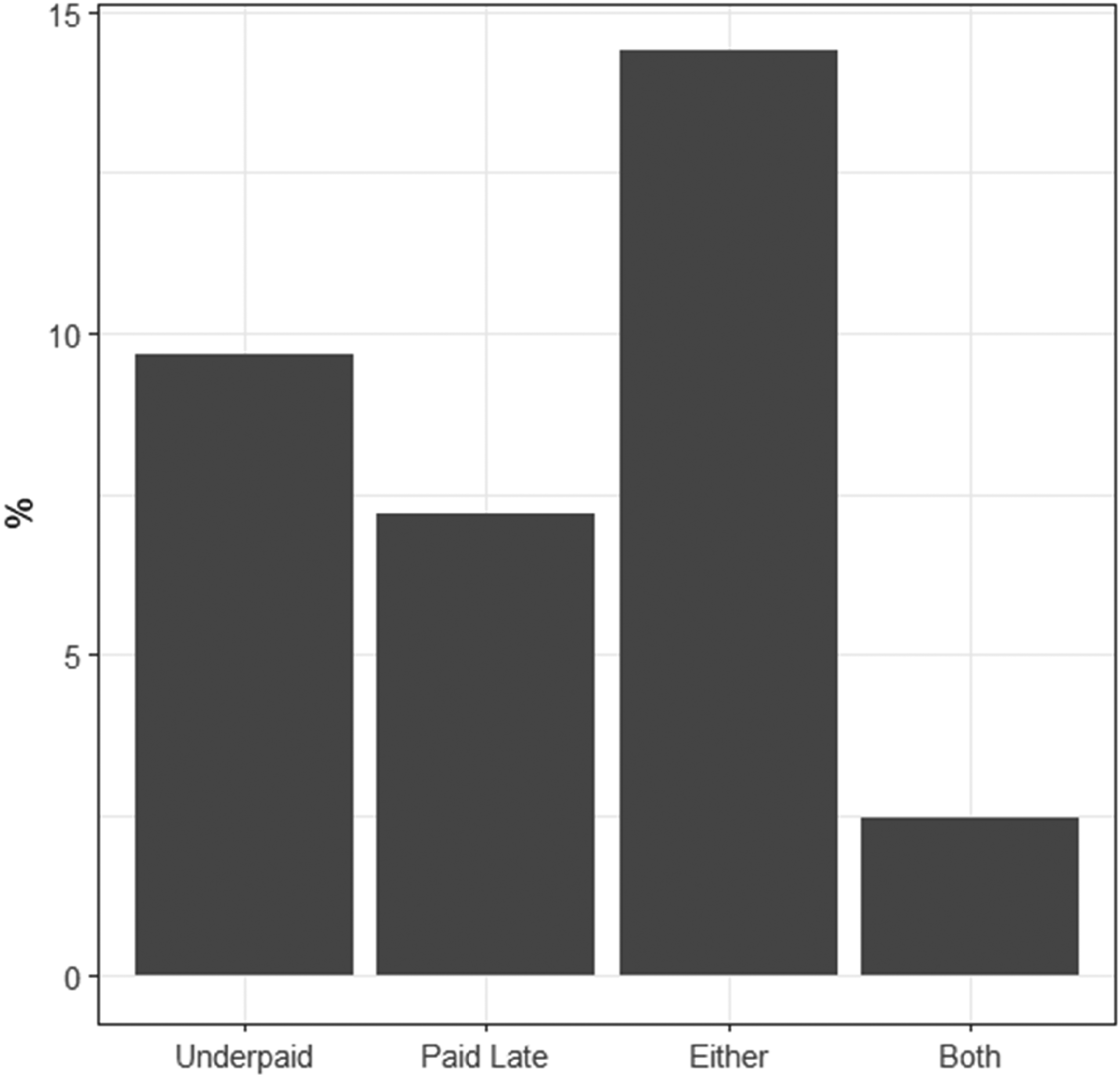
Prevalence of recent late- and under-payment.
In our survey, it also appears that problems on the job seem to occur together. There are better and worse employers, consistent with findings in Bernhardt, Spiller, and Theodore (2013). For example, in the overall sample, 18% of respondents reported an incident of scheduling instability in the last six months. But among those reporting wage theft, 29% reported scheduling instability, a rate 60% higher than in the overall sample. Among those reporting scheduling instability, 23% reported problems with wage theft, again an elevated rate compared to the sample average.
In Figure 2, we display how the incidence of wage theft varies across age, gender, industry, and race. 5 The clearest point to emerge is the problem facing younger workers: those under 35 years of age report both forms of wage theft at double the rates of workers over 55. This echoes the findings in Clemens and Strain (2022) and resonates with the higher rates of union support and workplace activism among younger workers (Ahlquist, Grumbach, and Thai 2023). Across all groups, underpayment is the more prevalent of the two problems, with the exception of Black workers, who report similarly high levels of both under- and late-payment. Women are more likely to report underpayment than men, but workers of both genders report late payment at similar rates. Workers in telecom have the highest reported rates of both under- and late-payment while workers in healthcare have lower rates of both.
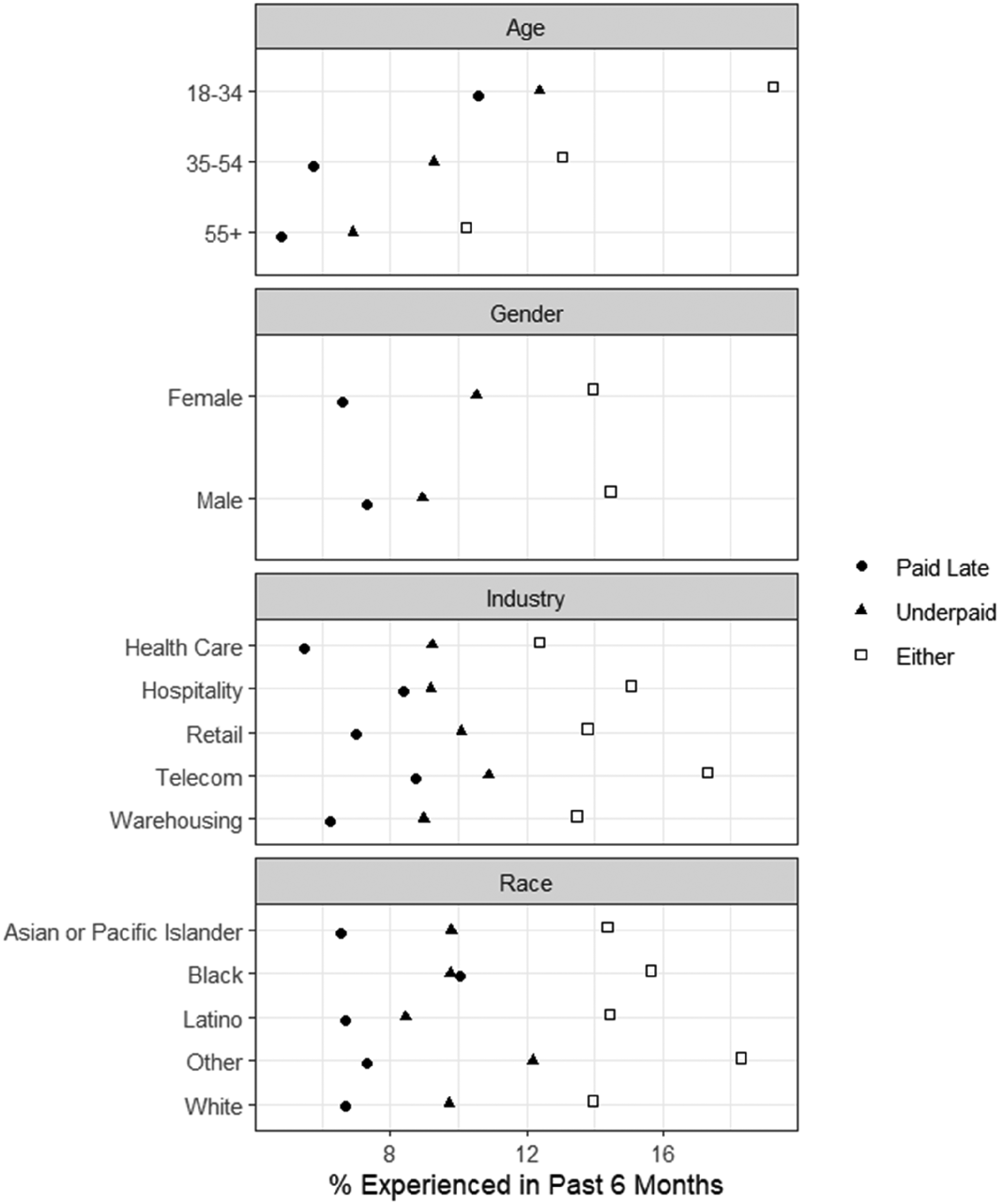
Wage theft by worker demographics.
In Appendix Table A11, we additionally show the results of regressions between demographic variables and wage theft. Unlike Figure 2, the regression shows the relationship between a given demographic variable and wage theft while holding constant the other demographic variables. With that said, the results are substantively similar to those in Figure 2. Telecom workers and younger workers report higher rates of late payment and/or under payment. 6
The lack of strong differences in the incidence of wage theft across race, ethnicity, and gender may seem surprising, but it is consistent with both Cooper and Kroeger (2017) and Bernhardt, Spiller, and Theodore (2013). Both studies find that race and gender gaps in wage theft are significantly attenuated after accounting for industry of employment and “low wage” status. Petrescu-Prahova and Spiller (2016) find that large gender differences in wage theft are driven by nativity status and selection into occupations. In other words, race, ethnicity, nativity, and gender are predictive of whether people end up in front-line jobs in low-paying industries, but, conditional on working in those jobs, the incidence of perceived wage theft does not differ radically across demographic groups. 7 The WERN survey sample is restricted intentionally to frontline workers in five of those industries.
Bernhardt, Spiller, and Theodore (2013) estimate a much higher prevalence of wage theft in their Unregulated Work Survey (UWS) than we do in the WERN survey sample. 8 There are multiple differences in the survey sampling frame, sampling procedure, and surveys themselves that could account for this. First, UWS focused on three counties in 2008, whereas the 2021 WERN survey was national. Moreover, WERN relied on the Qualtrics panel and administered the survey online in English whereas UWS went to great pains to recruit informal and undocumented workers and administered the survey in person in multiple languages at considerable expense. The WERN sample does not include construction or agricultural workers, two industries that have high levels of minority and undocumented workers as well as wage-and-hours violations (United States Department of Labor 2024). Consequently, the racial, ethnic, and industry compositions of the samples diverge. The WERN survey appears nationally representative within the industries it samples, but the format is less likely to pick up the experiences of undocumented and non-English speaking workers, who are at higher risk for wage theft. 9 In subsequent analysis of the UWS data, Petrescu-Prahova and Spiller (2016) report that, regardless of gender, 18% of native-born workers reported minimum wage violations—a level similar to both the our estimates and Cooper and Kroeger (2017)—whereas the rate was much higher among non-native and especially undocumented workers. It appears that the WERN estimates are broadly in-line with the most recent large-scale wage theft estimates for low-wage workers, but that the Qualtrics panel likely misses immigrant and undocumented workers. The UWS, in its effort to describe exactly those workers in a few cities, may be less accurate when extrapolated nationwide.
Exit, Voice, and Wage Theft
Does wage theft relate to “exit” and “voice”? To answer this question, we look at quit intentions 10 and whether the respondent would vote for union representation if given the opportunity.
Turning first to quit intentions, we find that 42% of workers who experienced either late or underpayment report being “somewhat” or “very likely” to look for a new job in the next three months, compared to only 20% of workers who did not experience wage theft. In Figure 3, we present the results of simple bivariate regressions of the relationship between the wage theft indicators and intention to quit. We also present the results of a model that includes a slate of demographic and geographic covariates. 11 Figure 3 displays coefficient estimates and 95% confidence intervals for the wage theft variables on the quit intention question. We see a strong, positive connection between wage theft and quit intentions.
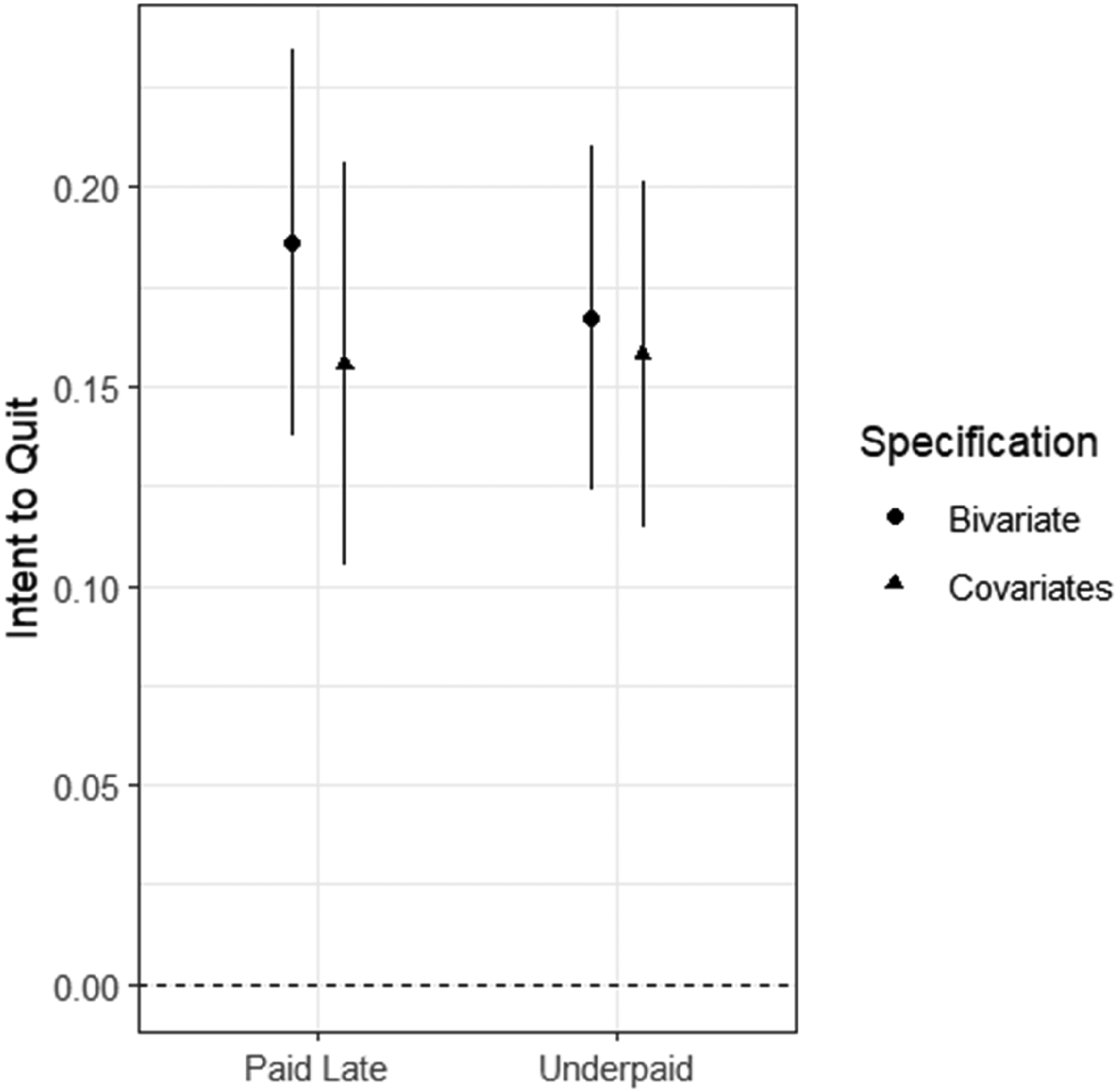
Workers who experience wage theft report greater intent to quit.
Turning to “voice,” in the form of willingness to support unionization, we find that 54% of workers who experienced at least one form of wage theft in the past six months would vote for union representation at their workplace (with “Don’t Know” responses counted as non-support), whereas only 39% of workers who didn’t experience wage theft would support a union. 12 Figure 4 displays corresponding regression results. Workers who report experiencing late payment in the past six months are 0.06 to 0.09 points more likely (on a [0,1] scale) to support unionization. Workers who experienced underpayment are 0.08 to 0.10 points more likely to support unionization. 13 In other words, workers experiencing wage theft are more likely to vote for union representation by about 8 percent of the range between opposition and support.
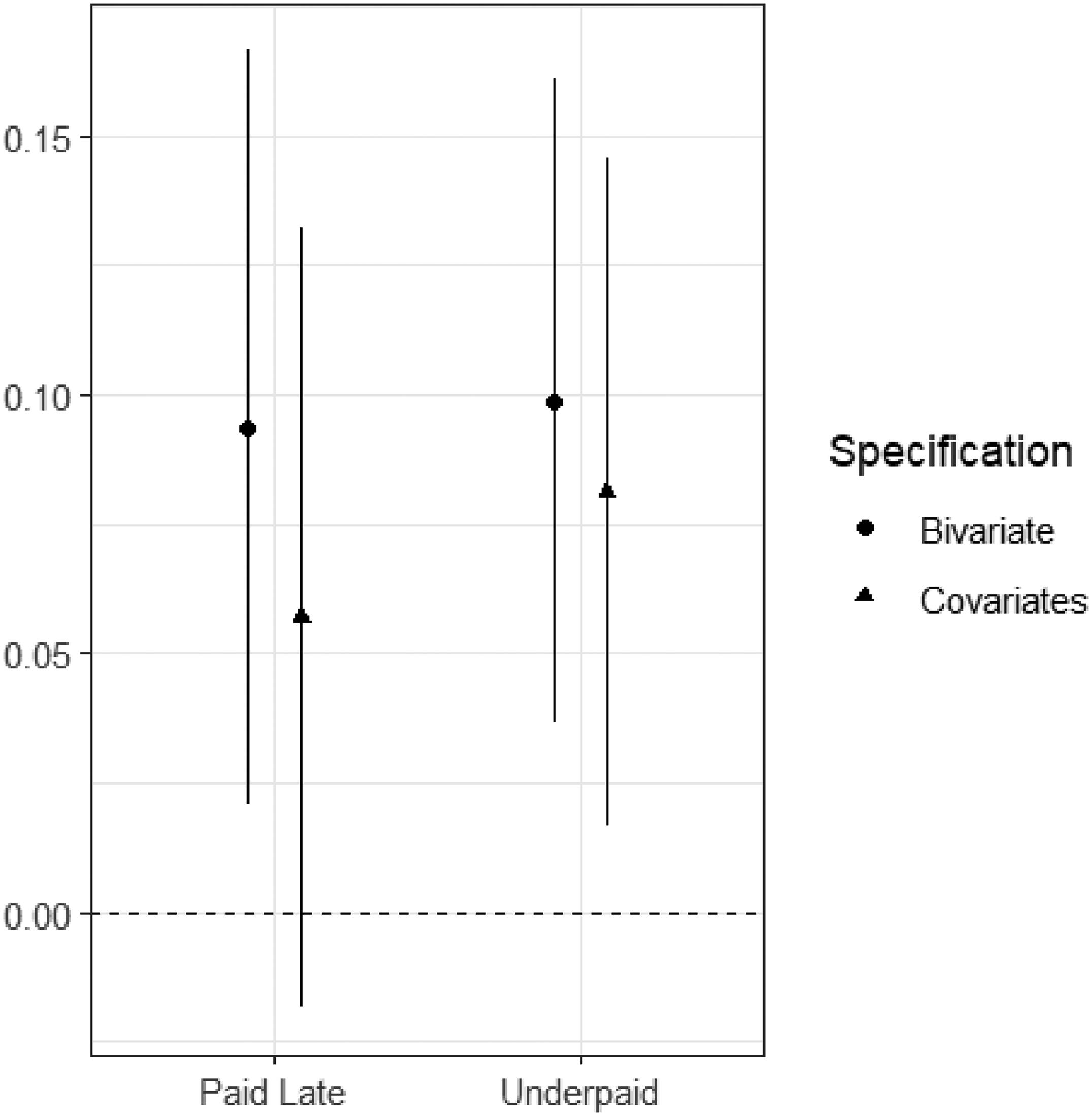
Workers who experience wage theft are more supportive of unions.
Workers in our sample who report wage theft are willing to entertain both exit and collective voice at higher rates. In a simple interaction model, union supporters are 6.7 percentage-points more likely to have experienced wage theft, those with high quit intention are 9.5 percentage-points more likely to have experienced wage theft—and those who both support union representation and have high quit intention are an additional 5.2 percentage-points more likely to have experienced wage theft. 14 What pushes someone into exercising voice? We study whether a call to action—and from whom—might help.
Collective Action and the Workplace
People endure petty (and not-so-petty) injustices on a regular basis. How and when to respond is often uncertain. Any effective group response requires effort, risk, and concerted action. Individuals may be unwilling to take action, in spite of grievances, unless they believe a sufficient number of others will go along (Granovetter 1973, 1983). And even if someone is willing to act, they may be skeptical that their actions would make a difference. This observation led to Olson's (1965) famous pessimism about collective action in “large” groups. 15 But there are ways around this problem. One is simply asking. Providing people with a direct, individual request for a specific action can induce higher rates of costly participation and charitable giving (Andreoni and Rao 2010; Andreoni, Rao, and Trachtman 2017). In the context of worker activism, labor organizers are those who help to “make the ask.”
But simply “making the ask” would only tend to recruit those already disposed to act. In contrast, organizers can jump-start collective action through inspiration and persuasion, solving information and coordination problems, and connecting local groups with funding and other sources of support (Ahlquist and Levi 2013; Bronfenbrenner 1996; D'Exelle, Coleman, and Lopez 2018; Dawes et al. 1986; Ganesh and Stohl 2014; Knoke 1990). Decades of labor organizing have produced a variety of strategies and many tactical innovations. These have now been boiled down to two broad paradigms, commonly referred to as the “mobilizing” and “whole worker” approaches to labor organizing (Han 2014; McAlevey 2016). In the mobilizing approach, professional organizers tend to focus on short-term, issue-specific campaigns (like wage theft), turning out large numbers of individuals in support of an immediate goals through boycotts, marches, etc.
Under the “whole worker” and related community organizing approaches, the broader community is critical in both recruiting frontline leaders and in supporting collective action once it gets off the ground (Black 2005; Brown 2018; Cordero-Guzmán 2015; Fine 1997, 2007, 2011). Fine (1997) argues that the labor market is “overwhelmingly unorganized” and “firm to firm organizing is inadequate.” Thus, she argues that the future of organizing is a strong community-based approach which supports the traditional workplace-focused organizing. McAlvey explicitly links the “whole worker” approach with the transformed gender composition of the American workplace: “The large numbers of women in today's workforce—saddled with wage work and endless nonwage work—don’t separate their lives in the way industrial-era, mostly male workers could, entering one life when they arrived at work and punched in, and another when they punched out” (McAlevey 2016, 29).
Mobilizing and “whole worker” organizing may be complementary, but limited time and resources can produce tension. Whole worker organizing can be slow, painstaking, and difficult to scale. Cross-cutting identities like race and religion, coupled with residential segregation and increasingly long commute times can make community-based worker appeals even more daunting. Katznelson was already writing about this strategy in the early 1980s, cautioning that “community-based strategies for social change in the United States cannot succeed unless they pay attention to the country's special pattern of class formation” (194). Mobilizing, on the other hand, may be fast, flashy, and, under the right conditions, capable of high-profile wins. But rapid worker turnover and a reliance on paid organizers and legal teams can make even the biggest victories brittle.
Regardless of the organizing paradigm, coordinating larger groups of workers matters. We use the situation of wage theft and a survey experiment to explore messaging relevant to both mobilizing and whole worker organizing. Specifically, we directly manipulate whether a worker receives a hypothetical mobilization “ask” from a coworker or a member of the broader community. We also contemplate multiple different actions a worker could take in response. The experimental treatment provides evidence about which messengers are most effective at eliciting a response and which activities are most immediately actionable versus those that require deeper organizing effort. This experiment is admittedly stylized. But it offers a first cut at quantitatively comparing the causal effect of calls to action from different sources on engaging in action on behalf of workers experiencing wage theft—contrasting the effect of the two different messaging approaches with no call to action at all.
Research Hypotheses
The literature on collective action reviewed above suggests that changes in the workplace (and workforce) will make mobilizing around workplace connections and identities less effective. Would organizations based in local communities (as opposed to workplaces) be better at channeling worker grievances into action? Would calls-to-action from sources outside the workplace— neighborhood or religious leaders, for example—be more effective at evoking worker engagement? We designed an experiment to examine whether calls-to-action from different sources matter for workers’ willingness to respond to wage theft in various ways.
In the experiment—detailed in the next section—we randomly vary who makes a call-to-action. We focus on the two sources of identity that arise most commonly in the context of labor organizing: the workplace and what we call “community.” “Community” refers to roles and relationships evoked in neighborhood and other non-workplace settings. This is clearly a simplification, but one that we view as necessary when exploiting a broad national sample. In making this initial workplace/community distinction, we in no way mean to elide the myriad other important social roles and identities people may take on. This is simply a first step in a deeper exploration of how messages, identities, and types of actions interact. We also note that our experimental manipulation is highly stylized. Nevertheless, we view the experiment as a test of whether Katznelson's view of the organizing landscape still holds, a view that is in tension with the contemporary “whole worker” approach.
We ask subjects whether they would be willing to take certain actions in support of others (as opposed to themselves) who experience wage theft. We are exploring not just the individual willingness to exercise voice, but rather the willingness to take actions in ways that would support others—a form of collective voice and one way in which workers might build an expanded community of fate (Ahlquist and Levi 2013; Levi and Ugolnik 2023). In this section, we develop concrete research hypotheses that the experiment can falsify.
As a benchmark, we can imagine a purely self-interested homo economicus. Such an individual would not only fail to respond to either of our experimental treatments (much less respond differently across the two), but that person would also exhibit an extremely low willingness to take any of the actions whatsoever. Although we view this as an unlikely outcome based on decades of experimental evidence, this perspective constitutes a form of null hypothesis for the experiment.
As we reviewed above, asking people directly to take a costly action may increase a willingness to contribute. In other words, “organizers matter.” On this basis, we would expect both of our treatments, which ask respondents to consider requests from specific others, to increase the willingness to engage in various costly actions around wage theft, relative to the control condition. This perspective has no predictions about which of our treatments should be stronger or whether there should be any difference in treatment effects across the different actions. This is the primary hypothesis that we pre-registered.
Katznelson articulated an additional perspective when he argued that “most members of the working class thought of themselves as workers at work but ethnics (and residents of this or that residential community) at home” when pondering politics (Katznelson 1981, 18). People may link many of their social connections to roles or places; workplace connections are relevant to workplace activities whereas neighborhood or community connections might be more easily connected to civic or political action. People may be more willing to take action in the workplace when asked by a coworker, compared to when asked by someone unconnected with their job. This perspective produces the following hypotheses
16
:
The Coworker Treatment will produce larger, positive treatment effects compared to the Neighbor Treatment, but only for actions that connect with the workplace (reach out to a labor union, striking). The Neighbor Treatment will produce larger, positive treatment effects compared to the Coworker Treatment, but only for actions that are relevant outside of work contexts (sign a petition, post on social media, call your elected official). Both treatments will have similar and positive effects for actions that are ambiguous in their connection to the workplace or the community at large.
Failure to detect any differences in treatment effects between the two treatment arms suggests that, among frontline workers today, Katznelson's claim of a strong separation between workplace and neighborhood is less relevant.
Survey Experiment
The survey experiment is designed to discover whether varying the relationship of the organizer to the worker affects reported willingness to take different actions on behalf of others around wage theft. The experimental vignette (shown to all respondents) is as follows: “Suppose some of the workers at your company recently noticed that they are not getting paid for all the time they are working on the job. They are thinking about taking some action to try to fix this problem.” We then randomized—at the individual level with equal probability—how we posed the question:
Outcome Variables
Immediately after the treatment, respondents reported how likely they would be to take each of six potential actions, measured with a Likert scale taking the following values: {extremely unlikely, somewhat unlikely, somewhat likely, extremely likely, don't know}. As outcomes, we chose a variety of plausible actions a worker could be asked to take. We selected items that represent either a community or workplace orientation as well as differences in risk or costliness. We also include one action (donating money to help coworkers) that is ambiguous in whether it evokes a workplace or community frame. The six potential activities offered to respondents are collected in Table 1.
Outcome Actions for the Survey Experiment Based on Whether They are “Workplace-Focused,” “Community-Focused” or Ambiguous.
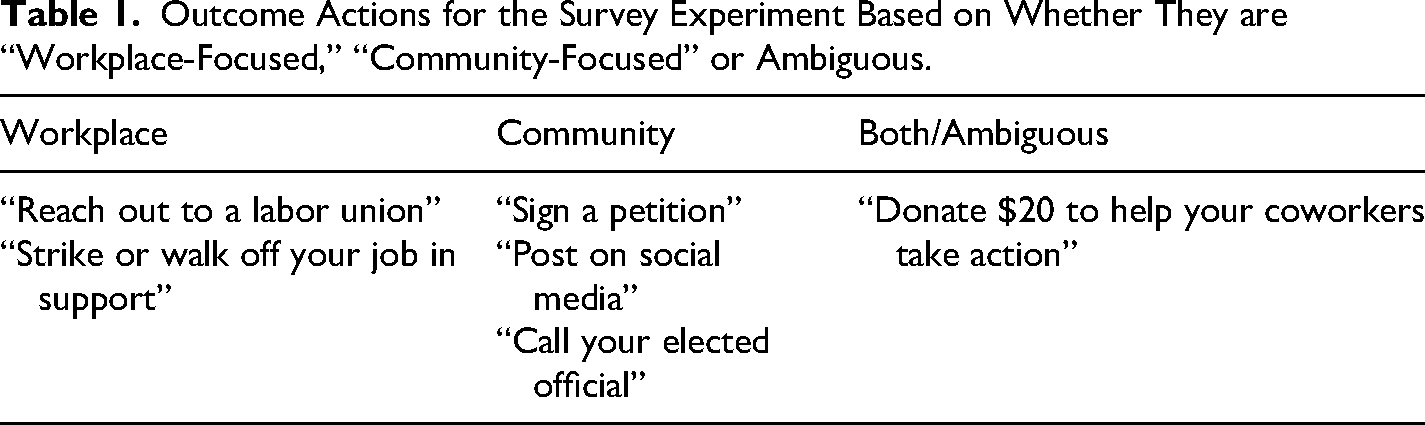
The outcomes of interest are the respondents’ ratings for each of the six behaviors as well as a summary scale. Figure 5 displays the distribution of responses for the various outcome variables among the control group. Low-cost/low risk options like petitioning and donating $20 showed the highest interest, with pluralities “likely” to take those actions. Other possible actions, such as striking and contacting politicians, showed clear majorities in the “unlikely” bin. Surprisingly, social media posting was not a likely action, perhaps due to its public nature and perceived permanence.
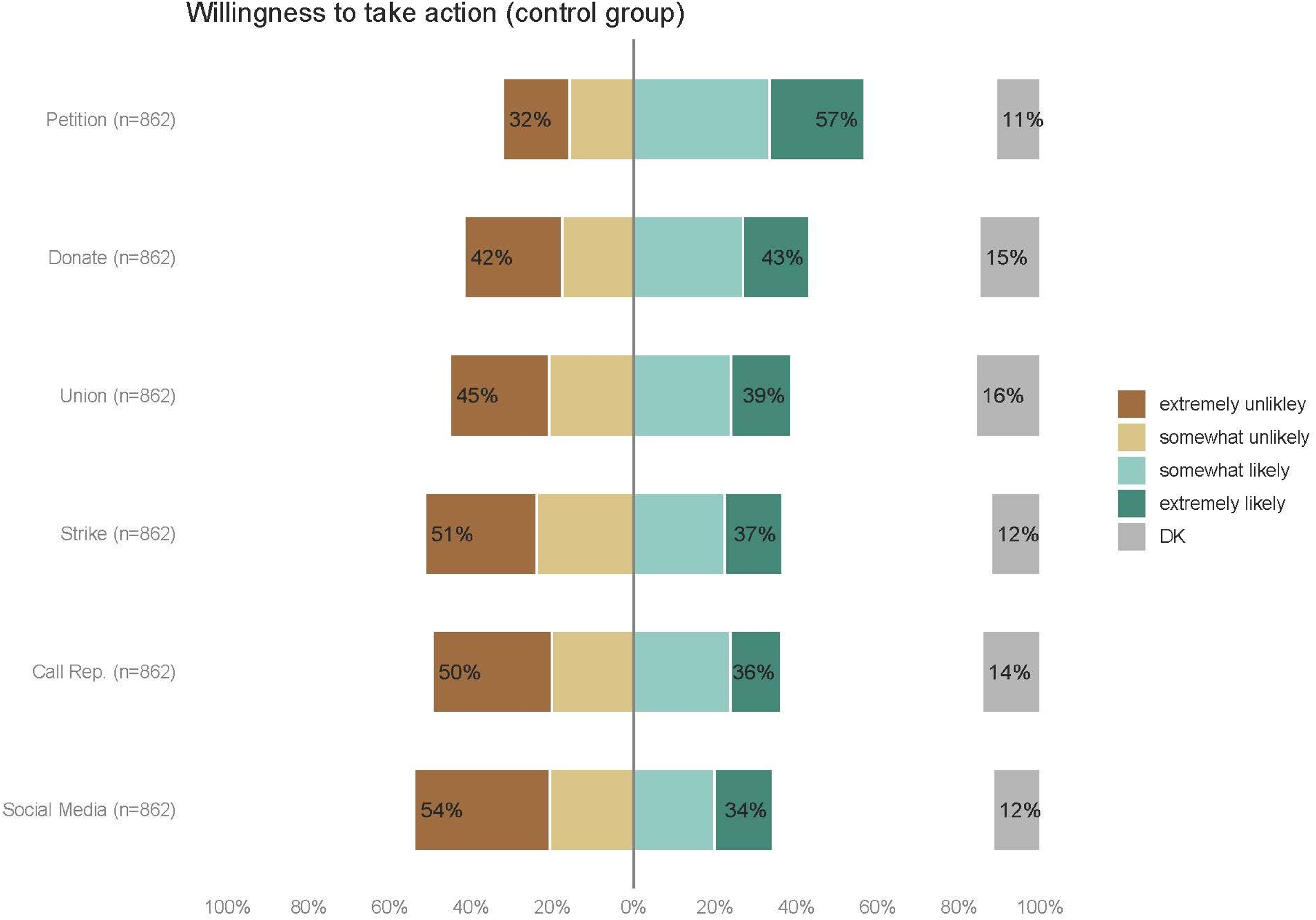
Baseline responses on outcome variables.
In analyzing these outcomes, we will encode each using the integers from 1–4, with 1 = “extremely unlikely,” and then rescale each of these outcome variables to the [0,1] scale. We will then construct a summary index from the sum of these six outcome variables, also rescaled to the [0,1] interval. Figure A3a in the Appendix displays the mean and median responses for these rescaled variables.
Results
We present the main results in Figure 6 (with and without controls), with full model results shown in Tables A1 and A2 in the Appendix. 17 As a reminder, the outcome measures are four-point Likert variables rescaled to the [0,1] interval. As a summary estimate, we construct an index that averages respondents’ willingness to take these six actions (with this index variable again rescaled to [0,1]). We find that the Neighbor and Coworker treatments both have significant positive effects on this index variable of between 0.030 and 0.037, or 30 to 37% of the range of this index.
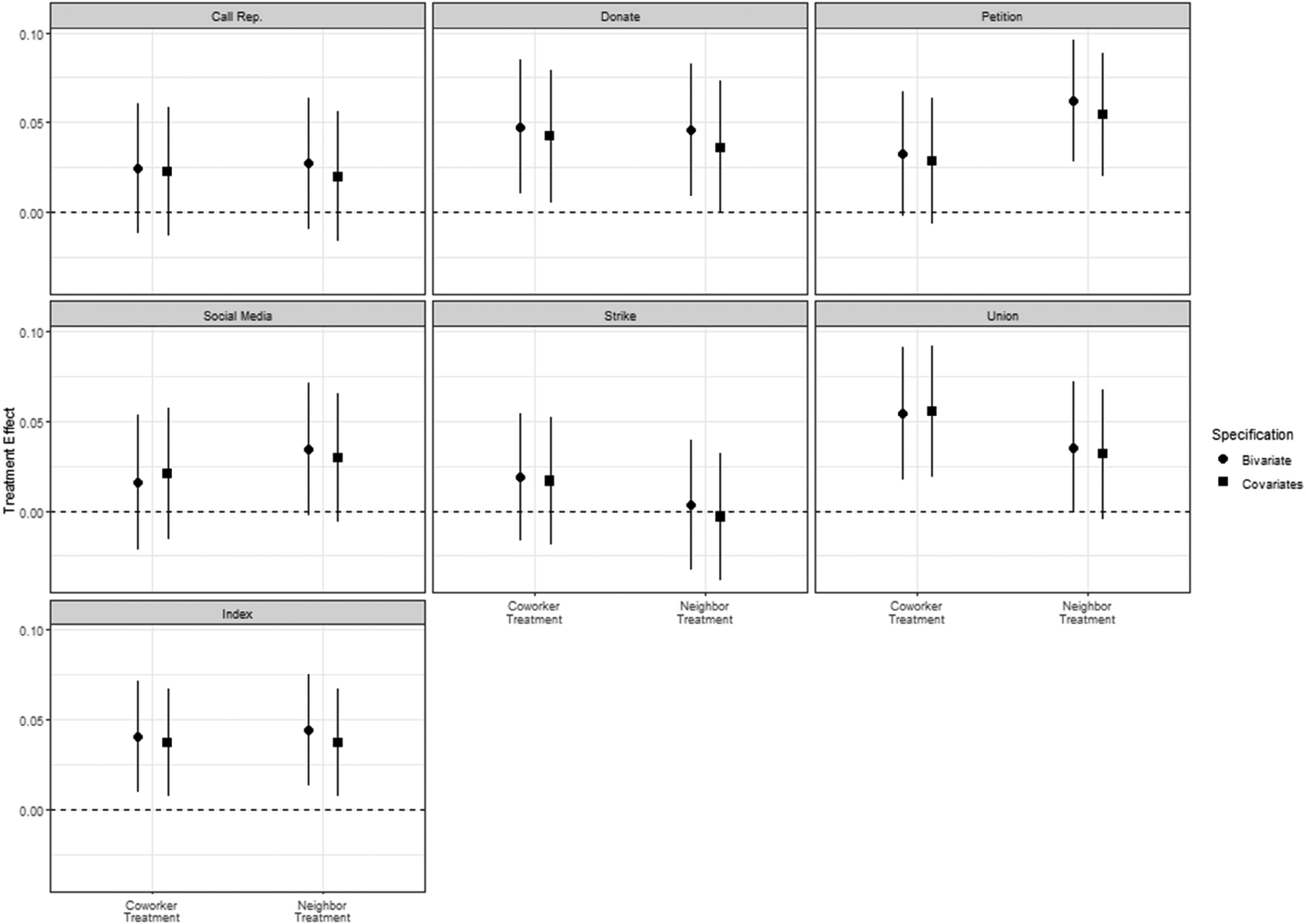
Main treatment effect results.
Figure 6 also displays treatment effect estimates for each of the six actions. Consistent with the findings for the summary index, point estimates of treatment effects are consistently positive for all treatment-action cases except for the Neighbor Treatment on willingness to go on strike in the specification with controls (with a coefficient of −0.003). 18 We are unable to reject the null of no treatment effect for both treatments when looking at “calling a political representative,” “going on strike,” and “post on social media.”
While each treatment has a positive effect on average, there is suggestive heterogeneity across treatment conditions and outcomes. For example, the point estimates for the Coworker Treatment are larger than that for the Neighbor Treatment for the two activities most associated with the workplace: reaching out to a union and going on strike. For the union outcome, the Neighbor Treatment effect is not distinguishable from zero at conventional levels. In contrast, we recover larger estimated treatment effects for the Neighbor treatment for signing a petition and posting on social media, activities that are not associated with the workplace. Calling a political representative showed comparable (null) effects for both treatments. We are quick to note that none of the differences in treatment effects between the two treatment conditions cannot be distinguished from zero at conventional thresholds. Of the six collective actions, willingness to go on strike is least affected by the treatments, perhaps because striking is arguably the costliest of the actions presented to respondents. 19 In any event, this suggestive heterogeneity is directionally consistent with hypotheses about domain specificity of different action types (see Table 1), but further research will be needed.
Potential Differences in Treatment Effects Across Sub-Populations
In our pre-analysis plan, we specified several possible ways in which treatment effects could vary across subgroups of workers: gender, race, and whether the respondent lives in a “right to work” state in which unions are weaker and especially rare in the private sector. 20 Here we highlight the theoretical rationale justifying why we look for these heterogeneous effects.
For race and gender, there are plausible reasons to expect that women and workers of color would be both more and less responsive to appeals from coworkers and neighbors, compared to men and white workers. Women and workers of color are generally underrepresented in many areas of American political and economic life. There are long and well-documented histories of workplace marginalization and discrimination. Black workers, especially women, are disproportionately willing to turn to unions for workplace protection and voice (Rosenfeld and Kleykamp 2012). This shared experience and potential for “linked fate” could make these workers more solidaristic toward coworkers experiencing injustice, implying stronger treatment effects among women and workers of color compared to male and white workers. To the extent that our “neighbors” treatment (see below) connects with racial or gender identities, we may also see a stronger “neighbor” treatment effect than for white or male workers.
But there are also reasons we might expect women and workers of color to be less responsive to appeals from coworkers and neighbors. An experience of marginalization, a more precarious economic situation, or a belief that their voices are less likely to be heard may make these workers less willing to take the risk of exercising their voice in and around the workplace. Treatment effects among these workers would then be attenuated. Furthermore, in laboratory games around pro-social activities, there are generally found to be gender differences, but they are not always clear-cut (Andreoni and Vesterlund 2001). Women in the US (and Western European democracies) tend to be more supportive of fairness norms and more supportive of social insurance and redistributive policies and less supportive of free trade (Ahlquist, Hamman, and Jones 2015; Buser et al. 2020; Mansfield, Mutz, and Silver 2015). But women also demonstrate higher average levels of risk aversion than men in behavioral experiments and insurance markets. As such, we view the existence of these “heterogeneous effects” as empirical questions.
We also proposed looking for heterogeneous effects based on whether a respondent is in a “right-to-work” (RtW) state. 21 Workers in RtW states will generally have fewer labor protections and less exposure to unionized workplaces. Workers from RtW states labor in worse conditions and may hold deeper or longer-lasting workplace grievances. For example, in our sample, workers in RtW states have a 1.6 percentage-point higher rate of reported wage theft. They may be more responsive to calls to action, producing a larger treatment effect. On the other hand, workers in RtW states have less experience with unions or they may be accustomed to the traditionally anti-union culture of RtW states. They may therefore be less willing to strike or reach out to unions, regardless of the call-to-action. We again view this as an empirical question to be explored below.
Effects Mostly Driven by Women
We examined possible heterogeneous effects across several demographic (pre-treatment) variables, consistent with our pre-analysis plan. We collect all our findings in the Appendix and focus on the most remarkable finding in the main text. Specifically, we find important variation around gender. Our treatment effects are detectable only among women in our sample. We uncovered no evidence for differing treatment effects by race and age. 22
Figure 7 displays treatment effects broken out by self-identified men and women. For each dependent variable and model specification, the treatment effect point estimate for women is larger than that for men. Looking at the summary index outcome, the effect of the co-worker treatment for women is significantly greater than that for men (p < .05); the effect of the neighbor treatment is larger for women but not statistically distinguishable from that of men at the p < .05 level. However, the interaction of any treatment (either co-worker or neighbor) and female is significant (p < .05) for the index outcome variable, meaning that, on average, calls to action had a significantly greater effect on women in our sample. Among men, there is not a single combination of treatment and outcome that crosses standard significance thresholds. And among women we continue to see that suggestive pattern of treatment effects described above: the co-worker treatment produces bigger point estimates of the treatment effect for the union and strike outcomes whereas the neighbor treatment produces bigger estimates for the petition outcome.
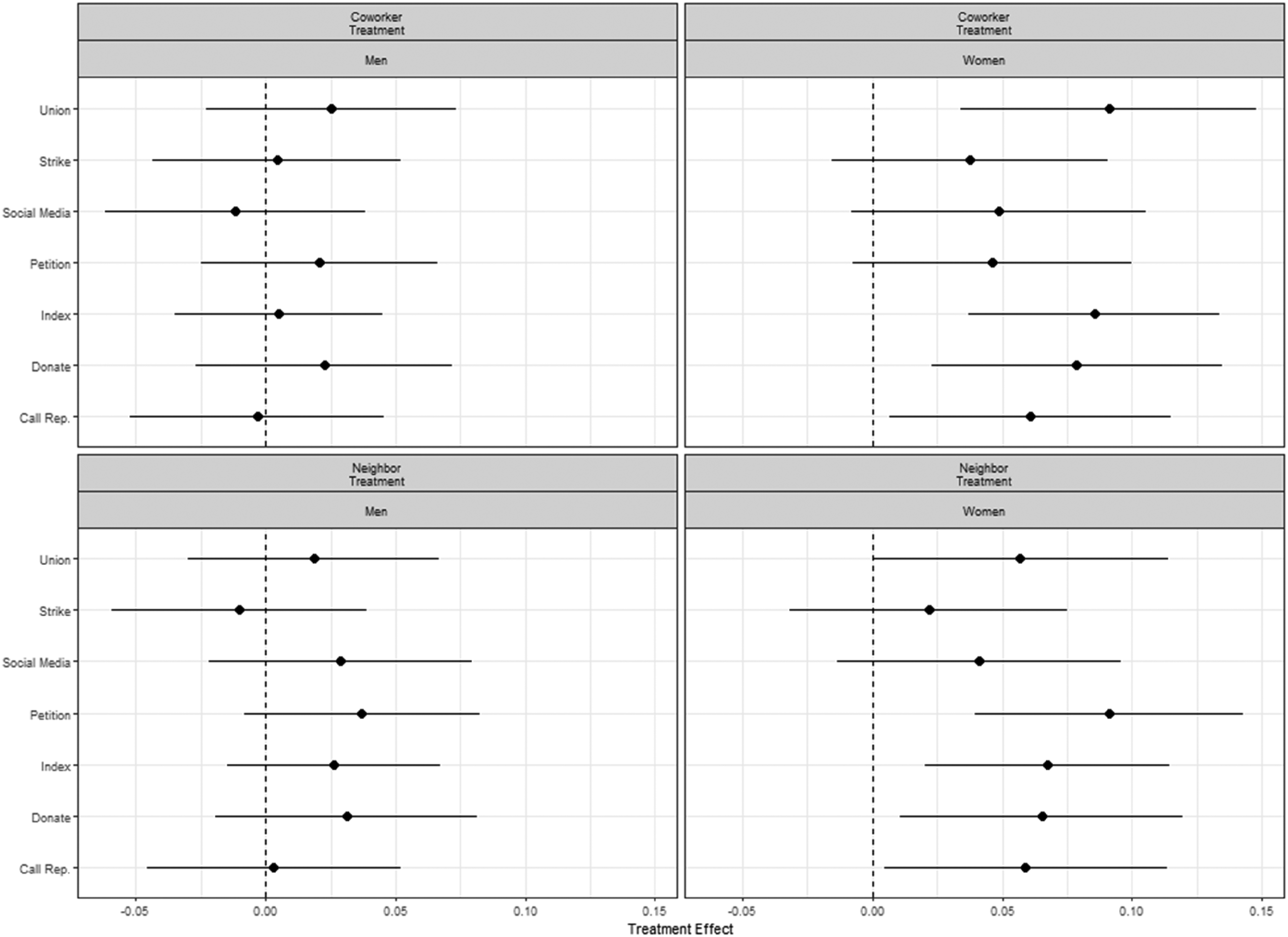
Treatment effects by gender.
Can we explain these gender differences with other items? We explored whether gender differences in workplace relationships or differences in the rate of wage theft might account for our findings. In our sample, women and men report similar values on our quality of interpersonal relationships (QIR) index 23 and report wage theft at similar rates (14.0% of women and 14.5% of men reported experiencing either late or underpayment). The heterogeneous treatment effects by gender are not influenced by gender differences in personally experiencing wage theft or differences in quality of interpersonal relationships at work, or by any other demographic variable in our battery of controls or preregistered analyses (see Appendix tables A2, A4, A5, A6, A7). Although we cannot rule out the possibility that some other, unmeasured variable can account for these gender differences, 24 the finding here is striking. It does suggest that there are distinctly gendered reactions to our calls-to-action around wage theft.
We further investigate gender-related mechanisms with an analysis of treatment effects by caretaking responsibilities. In this setup, we designate a respondent as a “caretaker” if they have any children under 18 in their household or live with a spouse who is not currently employed. In our sample, 50.3% of men and 53.0% of women are caretakers under this definition—a relatively modest gender gap. Furthermore, when interacting the neighbor or coworker treatments with caretaking responsibilities, we find null results (with, if anything, treatment effects being larger among non-caretakers). We show these results in Appendix Figure A5. Taken together, these results suggest that the gender differences in treatment effects we uncover in this paper are not directly explained by differences in caretaking responsibilities.
Finally, we check if, conditional on experiencing problems at work, there are gender differences in how often respondents turn to others for help with problems at work. We find very modest correlations suggesting that women are more likely to turn to friends and family, whereas men are more likely to turn to work-related channels (such as HR and unions) when facing problems at work. As with caretaking responsibilities, it does not appear that our heterogeneous treatment effects by gender are explained by who respondents turn to when facing workplace problems.
Effects by Right to Work State
We also proposed to look for subgroup differences based on local labor market institutions, specifically the presence of “Right to Work” (Rtw) laws. RtW laws increase workers’ ability to free ride by receiving the benefits of collectively bargained contracts while avoiding paying union dues. As a consequence, RtW laws decrease union density and reduce wages (Fortin, Lemieux, and Lloyd 2023). Under these distinct labor laws and, by extension, different norms, workers in RtW states and non-RtW states might respond differently to calls to collective action. Figure 8 presents treatment effects by whether the respondent lives in a RtW state.
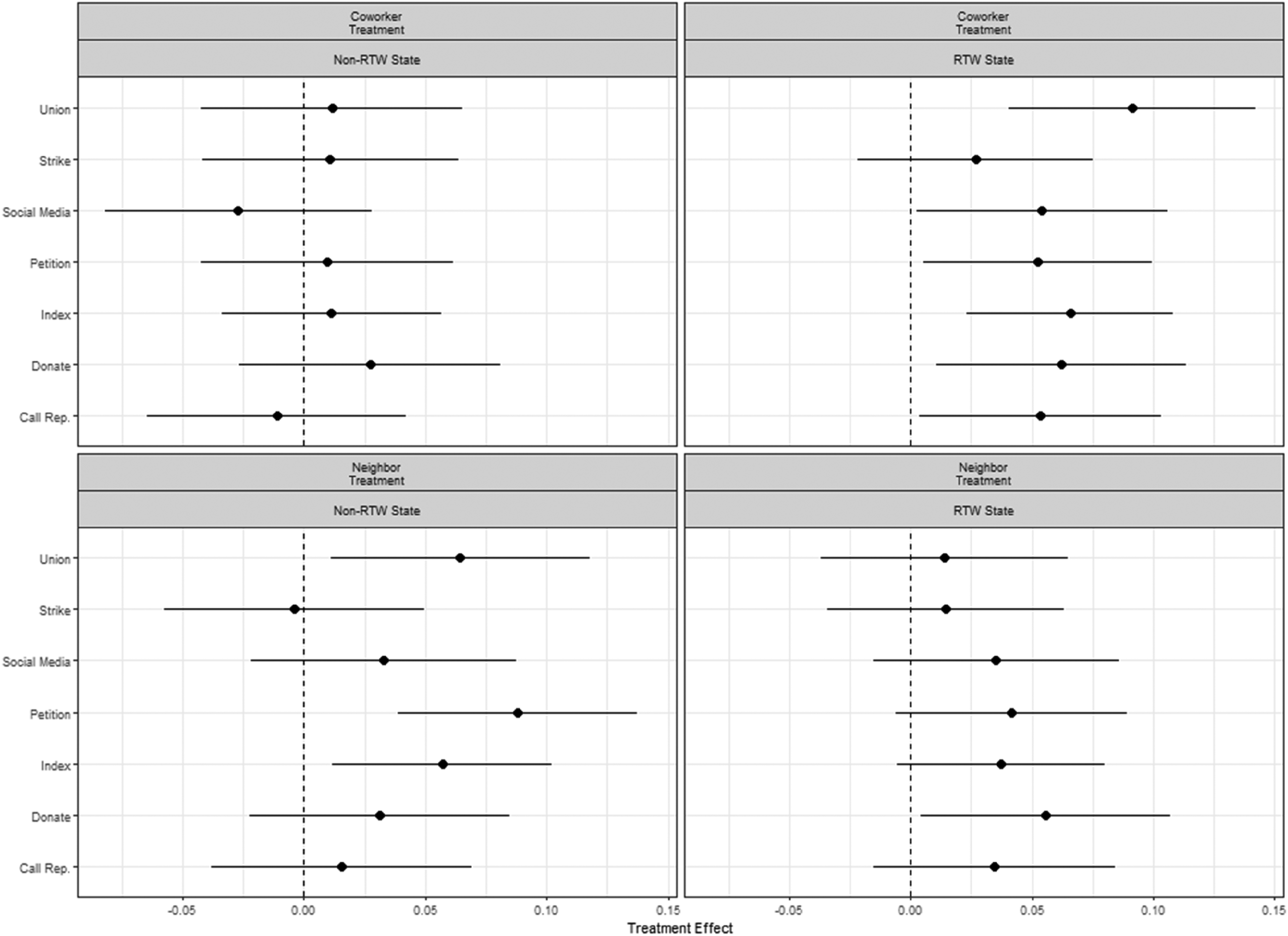
Treatment effects by right to work state.
We have unexpected findings here: in RtW states, where unions are rarer, we detect a treatment effect from the co-worker treatment but not from the neighbor treatment. The co-worker treatment generates a particularly large effect on the union contact outcome. In contrast, in non-RtW states, the neighbor treatment produces discernable treatment effects whereas the co-worker treatment does not. It could be the case that workers in non-RtW states regularly experience calls to collective action from coworkers (but not neighbors), whereas workers in RtW states have latent demand for collective action with coworkers. For the index outcome variable, the point estimate of the co-worker treatment is larger in RtW states than non-RtW states, but the difference does not cross traditional thresholds (p = .09); the neighbor treatment is smaller in RtW than non-RtW states, but the difference is not significantly different from zero. Further work remains to see whether these differences are systematic, and, if they are, what explains them.
Discussion & Conclusion
Wage theft is an all-too-common injustice that is easily understood across workplaces and industries. In our survey data, we found that over 14% of frontline workers reported wage theft in the prior 6 months, although our survey sample likely undercounts immigrant and undocumented workers. Wage theft is thus a potentially powerful issue around which to mobilize different constituencies or anchor a “whole worker” organizing approach. In this paper, we sought to document perceptions of wage theft while also speaking to whether and how messaging about wage theft can mobilize workers.
Does messaging about wage theft elicit a reaction from workers? Does the framing of this message speak to whether workplace-specific mobilizing messages or a broader “whole worker” approach more likely to contribute to workers joining collective action in response to wage theft? We observe a demand for collective action from those who experience wage theft, themselves: wage theft is strongly predictive of both support for unionization and increased likelihood of quitting. We conjectured that a call to action—being asked to take a specific action in support of other workers—could influence the extent to which respondents are willing to engage in various forms of “voice.”
In our survey, respondents were presented with a call to take various actions in support of co-workers experiencing wage theft. We randomized whether the call came from an identified co-worker, a neighbor, or an unspecified person. We found that receiving a call to take a concrete action from either a coworker or a neighbor significantly increased the stated willingness to take actions, especially signing petitions, donating money, and contacting a union. We found limited evidence that the type of relationship matters. A request for support coming from a co-worker elicited larger responses for actions more closely connected to the workplace (contacting a union) whereas mobilizing requests coming from “a neighbor” elicited bigger responses for civic actions like petitions, but these differences did not cross standard significance thresholds. Subgroup analysis showed that detectable treatment effects were concentrated entirely among the women in our sample. Women have, of course, been central to collective action throughout US labor history (Helmbold and Schofield 1989), but our findings point to a potentially substantial gender gap in responsiveness to mobilizing messages around wage theft in the contemporary U.S. Questions of gender and collective action among workers are also increasingly important as women have come to comprise nearly half of union members in the U.S. Journalists and labor activists have taken note of women's central role in collective action among workers, with a recent headline reading: “How Women Are Taking Over the Labor Movement.” 25
More broadly, our findings are consistent with arguments that engaging across social networks. Further research in less stylized settings will be crucial in determining how this functions. Our findings also highlight the crucial role of women in sustaining collective action on the job among frontline workers. More research will be needed to better understand the mechanisms involved.
Future research can replicate and extend the findings here. There are three areas of immediate interest. First, do the findings reported here extend to other domains beyond wage theft? Given the gender differences we observe, comparing worker reactions to calls to action around grievances with a stronger (sexual harassment) and weaker (work speed) gender component would be illuminating. Second, for reasons of tractability and cost, the survey here focused on workers’ self-reported willingness to take various actions in response to a stylized, hypothetical call to action. Our findings provide some reason for optimism as well as guidance on which workers are most responsive. But clearly the rubber hits the road in actual field settings, where specific social networks matter and the actions contemplated have real costs. Third, our sample likely misses undocumented workers and non-English speakers, who face particularly daunting barriers to collective action on the job. Additional work focusing on these populations will be needed to determine whether similar calls-to-action evoke comparable patterns of engagement.
Finally, our study suggests that the split between the politics of work and politics of community that Katznelson (1981) described is not as stark as he feared, at least not among frontline service sector workers in the U.S. today. Mobilizing from the workplace and the neighborhood directions can be effective, although perhaps differentially so, depending on the actions contemplated. This also suggests that arguments around workplace or community organizing should be reframed as arguments for workplace and community. This is certainly not a new or original insight, but, with the fissuring of employment relations alongside residential segregation and high housing costs in urban areas, the lesson bears reinforcing for our contemporary challenges.
Supplemental Material
sj-pdf-1-lsj-10.1177_0160449X241313255 - Supplemental material for Mobilizing Frontline Workers Against Wage Theft
Supplemental material, sj-pdf-1-lsj-10.1177_0160449X241313255 for Mobilizing Frontline Workers Against Wage Theft by Terri Adams-Fuller, John Ahlquist, Jacob Grumbach and Tess Starman in Labor Studies Journal
Supplemental Material
sj-docx-2-lsj-10.1177_0160449X241313255 - Supplemental material for Mobilizing Frontline Workers Against Wage Theft
Supplemental material, sj-docx-2-lsj-10.1177_0160449X241313255 for Mobilizing Frontline Workers Against Wage Theft by Terri Adams-Fuller, John Ahlquist, Jacob Grumbach and Tess Starman in Labor Studies Journal
Footnotes
Declaration of Conflicting Interests
The authors declared no potential conflicts of interest with respect to the research, authorship, and/or publication of this article.
Funding
The authors disclosed receipt of the following financial support for the research, authorship, and/or publication of this article: This work was supported by the Annie E. Casey Foundation.
Supplemental Material
Supplemental material for this article is available online.
Notes
Author Biographies
References
Supplementary Material
Please find the following supplemental material available below.
For Open Access articles published under a Creative Commons License, all supplemental material carries the same license as the article it is associated with.
For non-Open Access articles published, all supplemental material carries a non-exclusive license, and permission requests for re-use of supplemental material or any part of supplemental material shall be sent directly to the copyright owner as specified in the copyright notice associated with the article.
