




Abstract
Understanding why cities are leaders in data-driven local government can help diffuse best practices to support better decision-making and improve government services. This study surveyed US local government professionals and generated a new practitioner-led definition of data-driven local government and it identified the opinion leader cities viewed as exemplars in their use of data. To our knowledge, this study is the first practitioner-generated definition of data-driven local government and the first depiction of a local government network of data-driven efforts.
Introduction
Governments are increasingly utilizing data (Luthfi and Janssen 2019; Matheus and Maheshwari 2020). The use of data involves opening data to increase resident engagement in the decision-making process and leveraging data and evidence to solve problems. The expectation is that data utilization will result in better and more trusted government decisions (Luthfi and Janssen 2019), helping improve efficiency, safety, wealth generation, and resource management (Castelnovo and Sorrentino 2021).
A recent report published by the Monitor Institute by Deloitte found more than 250 municipal governments across the United States are using data to tackle local challenges, they are putting in place a data infrastructure, and improving data skills. The Deloitte research found the use of data is present in cities across all United States regions, across all types of government, and in the largest cities, as well as those cities with fewer than 100,000 residents (Deloitte 2021, 2–4).
Numerous organizations have emerged to support data efforts in government. Some of these initiatives are philanthropically funded and led, such as Bloomberg Philanthropies’ What Works Cities program, whilst others are in academic institutions, such as The Governance Lab at New York University.
Despite this activity, there is both a lack of definition for data-driven local government and research that examines how municipalities and cities learn about innovative data techniques from each other. Drawing on a survey that explores data-driven practices of US cities, this study complements existing knowledge to develop a new definition of data-driven local government. We discuss the diversity of ideas that local governments put forth to define data-driven local government and identify the common elements to show how the conceptualization of data-driven local government amongst government officials differs from the existing academic research.
We have found that there is a divergence between local government practitioners’ conceptualization of data-driven local government and academic debates. Rather than contextualizing data-driven local government within the sphere of computing, algorithms, and machine learning, local government officials take a broader perspective of what data is and how it can be applied to achieve meaningful outcomes. This means that data can be both qualitative and quantitative and encompass a range of research methods. Rather than being the domain of specific government departments, such as analytical or IT units, practitioners state that the application of data is relevant to all levels and areas of government. The stated outcome of these efforts is to create a better, more effective, and equitable, form of local government.
Drawing upon the local practitioner definitions provided in the survey, we define data-driven local government as: The administration of a city, town or other municipal government that provides effective and impactful services that better serves residents by strengthening transparency and engaging residents to collect, analyze, and use qualitative and quantitative data to define goals, track and evaluate performance, identify and solve problems, and support decision-making.
Furthermore, we identify a group of cities – the opinion leaders - across the U.S. that have emerged as trusted sources of best practice and ideas, helping other local governments to emulate and adopt data-driven methods and approaches.
Creating a shared definition, establishing interconnections between actors in municipal governments, and distinguishing the role of opinion leaders, will help to increase understanding of data-driven local government. Furthermore, identifying the local opinion leaders contributes to the diffusion of innovation (DOI) literature, and helps to understand how data-driven practices spread. This study makes an important contribution to public sector innovation and management debates and will aid future scholarly work in the field to understand the influence and impacts of new data-driven technologies and approaches in both city and municipal governments. In addition, this research is relevant to non-municipal organizations across academic, philanthropy, and elsewhere, that seek to support government innovation and reform, and who could leverage the opinion leaders to help accelerate the spread of effective data-driven practices across the United States.
This study begins by reviewing the theoretical and empirical research, with a particular focus on the academic discussion about data-driven local government, including the current lack of a concrete definition. It also explores the diffusion of innovation theory literature to explain adoption and the role of opinion leaders. We describe our methodological approach and detail our survey with cities. We then discuss our findings, propose a definition for the phrase data-driven local government, and explore why the opinion leading cities are looked to as exemplars in their use of data. The paper ends by discussing the implications for the diffusion of innovative data-driven practice across cities and municipalities.
Literature Review: Innovation Diffusion of Data Practices in Municipal Government
This section starts by describing the evolution of data in city and municipal government, and how “data-driven local government” is often used to denote the municipalities using data to inform decision making. It then goes on to discuss existing conceptualizations of data-driven local government but how these studies do not define data-driven local government, and how this is problematic for identifying best practices and advancing a research agenda in this space. Finally, it draws upon the diffusion of innovation literature to show how studying city government networks is vital in understanding the spread of data-driven tools and methods.
The Evolution of Data in Municipal Governments
The collection and use of data have changed rapidly over the past few decades; from censuses and surveys being one of the few available options to the ubiquity of geographic information systems in the 1990s, such as COMPSTAT (Willis, Mastrofski, and Weisburd 2007).
More recently there has been a paradigm shift that involves municipalities collecting real-time data from cameras, smart meters, social media, and a vast range of other sources (Currie 2020). Tenney and Sieber (2016, p. 104) claim that the growth of data is driven in part by the ubiquity of computing, increased functionality through automation and algorithmic process, and a rise in data collection, and processing tools and methods.
The shift towards data-driven methods has been termed “the fourth paradigm in science” (Esty 2007), with technologists collaborating to advance new methods and computing capabilities that enable the capture, curation, analysis, and sharing of massive datasets (Hey 2012).
Advances in technology are impacting how cities operate. By providing a new operating system, modern technologies can help governments to act in real-time (Goldsmith and Kleiman 2017). As an example, Boston's 311 reporting system enables residents to communicate issues, such as vandalism or graffiti to local governments, demonstrating how new technology coupled with civic engagement can greatly improve city services (O'Brien 2019).
Conceptualization of Data-Driven Local Government
The term “data-driven local government” is often used to describe the ways cities and municipalities are becoming increasingly sophisticated about how to generate and use data (Gottesman, Kleine, and Kendra 2018).
Despite scholarly exploration of data activities in governments, there is a lack of definition for what constitutes “data-driven local government”. We searched for academic sources containing the terms "data-driven" and "local government" 1 and found 17 studies, but only one of the studies defined data-driven local government. However, the definition provided was limited and described “data-driven participation” of residents, rather than describing data-driven local government.
Despite not providing a concrete definition, scholars contextualize data-driven local government in a variety of ways. These conceptualizations include harnessing technical and skills development, such as artificial intelligence (AI) and predictive analytics, and making adjustments to the organizational culture (Fruchterman 2016; Castelnovo and Sorrentino 2021). Others emphasize that government data scientists require knowledge of statistics and data analytics for analyzing data, as well as knowledge on the use of techniques and instruments for predictive purposes and to visualize the results (Matheus and Maheshwari 2018, p. 1).
These different conceptualizations of data-driven local government provide a broad range of ideas as to what constitutes data-driven local government. However, a concrete definition of data-driven local government is needed to anchor the debate about data-driven local government amongst both practitioners and academics, to help advance it as an area for future research, and to enable sharing of resources and ideas between city governments.
City Networks Sharing Data-Driven Practices
The lack of a common definition of data-driven local government makes it hard to ascertain the role of cities in spreading best practices, hindering understanding of how innovative approaches are disseminated and adopted.
Although researchers have focused on the adoption of certain data tools and techniques, such as dashboards (Matheus and Maheshwari 2020), open data (Luthfi and Janssen 2019), open-source software (van Loon and Toshkov 2015), and big data (Fruchterman 2016), we are not aware of any research that has examined how cities learn about innovative data techniques from each other, or studies that identify the cities they view as opinion leading within the field of data-driven government, and the reasons why.
Previous research has drawn upon different theoretical approaches to study networks and the diffusion of ideas and practices. One theoretical approach is the technology acceptance model, derived from the field of information systems, which analyzes innovative adoption by individuals through a psychological lens (Bagozzi 2007; Jun and Weare 2011; Venkatesh, Thong, and Xu 2016). The policy diffusion literature focuses on the political and organizational drivers of innovation (Jun and Weare 2011).
For this study, the diffusion of innovation theory is used to help understand the role of social networks in sharing ideas and information (Rogers 2003). The Diffusions of Innovation theory (DOI) is useful in understanding the spread of knowledge and best practice, by describing the process that an innovative concept diffuses through a system (Rogers 2003).
According to Dearing (2009, p. 506) diffusion occurs through a combination of several factors: the need for individuals to reduce personal uncertainty when presented with new information, the need for individuals to respond to what their peers are doing or thinking, in response to social pressure, and finally, the desire to emulate what others have done.
Scholarship on policy diffusion and innovation at the local and municipal levels is limited (Fowler 2016). However, previous research indicates that local governments can feel competitive pressure from surrounding areas and innovate to compete with efforts in neighboring cities or to imitate larger cities (Shipan and Volden 2005; Walker 2007; Fowler 2016). In this way, the potential adopter will seek an innovation that they believe is interesting and with the potential for benefits (Rogers 2003; Dearing 2009).
The Role of Local Government Opinion-Leaders in Spreading Data-Driven Methods
The spread of ideas and the diffusion of innovation across a network is driven by local government searching for ideas, and the availability of external sources of knowledge (Rogers 1995; Torfing 2016).
Diffusion of Innovation (DOI) theory shows that networks and relationships aid diffusion (Dearing et al. 2017), and that the adoption of innovations is predicated by the identification and engagement of influential actors and organizations (Dearing et al. 2013). As well as believing an innovation will have benefit, the potential adopter will draw upon the evaluative judgments of trusted and respected individuals, categorized by Dearing as “informal opinion leaders” (Dearing 2009, p. 506). Diffusion of Innovation theory identifies the role that opinion leaders perform in spreading innovative ideas.
The trust fostered by opinion leaders improves confidence in the innovation to aid diffusion and adoption elsewhere (Bandura 2006). Rogers (2003) states that the process of diffusion is based on imitating and modeling the innovations of peers. The trust fostered by opinion leaders improves confidence in the innovation to aid diffusion and adoption elsewhere (Bandura 2006). As a result, within a diffusion network model, opinion leaders help initiate the diffusion of a new idea or practice (Valente and Davis 1999).
Previous studies have explored the role of opinion leaders in public sector organizations and local government agencies, and how these individuals can spread methods and ways of working. For example, Chung et al. (2021) explored the diffusion of health innovations at the local level during the Covid-19 pandemic. It found that in response to central government policy or based on social influence because of perceived social norms, local health organizations look to similar organizations and leaders for “cues and insights about innovations and for appropriate responses to external opportunities and threats” (Chung et al. 2021, p. 17). Godwin (2015) explored the spread of civic participatory innovations at the local level and found opinion leaders often had strong academic links and were supported by research and evaluation. These studies usefully show how opinion leaders can spread innovative practice, but none have analyzed the opinion leaders in data-driven government.
Aims of the Study
This study surveyed US local government professionals working in data-related roles. Our study-specific aims are first to explore how cities define data-driven local government. Second, the study draws upon Dearing (2009) to identify the opinion leaders - both cities and individual officials - who are looked to as trusted sources of information and leaders in their use of data for decision-making. The third aim is to understand what the potential innovation adopter looks for in an opinion leader. The next section discusses our methodological approach, and we then present our findings.
Methodology
In March 2021, a survey was conducted electronically. The survey was in the field for four weeks from March 1st, 2021, to March 26th, 2021 2 , and we sent two reminder emails (at the start of weeks three and four). No incentives for participation were offered.
Survey Development
Before dissemination, the survey was piloted with three professionals who were formerly employed in municipal government. These individuals provided feedback about the survey design, readability, and content. We ultimately refined the wording of some questions based on their feedback to provide more clarity, and context, on what we were asking.
Survey Participants
We drew upon the US Census to set the sampling parameters. The US Census states that it only provides data for “incorporated places” with populations of 50,000 or more. Therefore, we focused on towns and cities with populations of 50,000 or more, of which there are 788 municipalities in the US (The United States Census Bureau 2019).
The study population consisted of 2155 individuals representing 678 municipal governments. Contacts were sourced from the Results for America database of local government staff and elected officials, and we also searched online for publicly available email addresses. Job title search terms used in both the database and the online search were Mayor, City Manager (Assistant and Deputy included), Chief Information Officer, Chief Data/Innovation Officer, Director of Communications, Director of Finance, Analysts at various levels and domains, including managerial, policy, data, and GIS. To encourage survey completion, we sent two separate email reminders to prompt participants to finish the survey, totaling three rounds of outreach.
We ran into two challenges when administering the survey. The first challenge was finding email addresses for specific individuals, as often we were only able to find generic email addresses for the local government. The second challenge was the high number of automated ‘bounce back’ emails we received, which was due to a combination of email addresses being outdated as the individual had since moved on from their position, as well as city government email spam blockers barring the delivery of emails from non-city government email addresses. We estimate that roughly 1,671 of the surveys made it into potential respondents’ inboxes. We had a total response rate of 404 surveys, with 12 disqualifications, and 105 complete responses, providing a response completion rate of 6.28 percent.
The survey response rate is lower than we had hoped, which means we cannot claim to engage the whole network of US municipalities. Despite data collected in a network normally only confined to “partial information” about the wider network (Frank 2014, p. 389), we are aware that further research is needed to engage a wider sample of cities and municipalities to test and refine the definition of data-driven local government and to further explore the network. Despite the low response rate, our sample has good representation across different personnel roles, and good geographic spread, with responses from cities with populations over 50,000 across 37 states, and the dispersal of these mirrors the spread of cities in the United States Census Bureau.
The 105 respondents represented 74 unique municipalities (city, town, or county), with an average population size of 327,288 residents. The survey respondents had been in their current post for on average 4.7 years, worked in their respective field for an average of 12.7 years, and had worked in municipal government for an average of 12.9 years. Our respondents worked in a range of departments and service areas. The majority (36 out of 104) were in the mayor, city manager, or administrator office, a further thirteen were in the finance/budget department, thirteen were in IT departments, nine respondents worked in departments specifically focused on data, analytics, and innovation, six were in communications, six in strategy performance, four in innovation, four in planning, three in community/economic development, and two in policing. The remaining sectors had one respondent in each, and these were: 311, engineering, environmental services, equity and inclusion, human resources, natural resources, and resilience.
There was a tremendous variety in respondent job titles, with 91 unique titles provided. This finding suggests our responding population is a good representation of personnel across the city governments. Furthermore, we had good geographic representation with survey responses from 37 states, and in terms of the United States Census Bureau, there were 39 from the South, 31 from the West, 24 from the Midwest, and 11 from the Northeast.
Question Formulation
The survey asked respondents to state how their municipality defines data-driven local government as we sought to identify whether a shared definition already existed. We did not provide a definition as we did not wish to exclude respondents if we provided a definition that did not resonate with them.
The survey also asked respondents to identify the person (or people) in the city or municipal governments who they look to for best practice, how they were connected to them, and what they have learned. We also asked respondents to identify the municipalities that they viewed as exemplars in how they utilized data and to describe why. These are similar but slightly different questions since respondents might look to a city, town, or county and be familiar with its work but not know anyone there. In other words, we wanted both to understand where people look for best practices, and the connections they have with specific individuals. Additionally, we asked respondents to identify the role played by non-municipal organizations in helping identify and adopt data-driven practices. For all three of these questions, we limited respondents to identify up to three municipalities, three individuals, and three non-municipal organizations, to prevent respondents from feeling overwhelmed, and to ensure respondents identified their top people, municipalities, and non-municipal organizations.
Network Analysis
Only data provided by respondents who completed the full survey were included in the network analysis. Additionally, the respondent had to nominate at least one local government or individual outside of the respondent's city to be part of the network. All responses were then geo-coded to match the respondent's workplace. The network was analyzed using Gephi (0.9.2): free, open-source software for analyzing and visualizing social networks.
Network-Level Measures
At the whole network level, we calculated the number of nodes. In this study, nodes are unique municipal governments. There are 114 nodes in the network referenced as either a local government survey responder or a local government nominated in the survey. The next step in our network analysis was to identify the relationships between nodes, and these are called edges or links. To create a robust pool of edges, we combined responses from two separate questions in the survey. The first question asked respondents to identify municipalities they view as exemplars in how they utilize data and it is intended to directly illuminate cities of best practice. The second question asked respondents to identify three local government employees that they are connected to and learn from, which was designed to reveal direct connections between local governments. Ultimately, the aims of these questions are similar in the sense that both seek to identify connections between respondents and a city or between respondents and an individual in a city that they view as an exemplar in their use of data. As a result, we identified 207 relations, or edges, in our network, creating a detailed and robust diffusion network.
Nodal-Level Measures
Once the diffusion network was created, we sought to identify the local governments, or nodes, that are seen as exemplars - known in network analysis as the opinion leaders - in the field of data-driven local government. To identify the opinion leading cities, we ran in-degree centrality to reveal the number of times a node (a municipal government) was nominated by another node in the network. Like other network analysis procedures (Dearing et al. 2017; LaJeunesse et al. 2018), we used two standard deviations above the mean in-degree score as indicating opinion leading significance.
Open Text Analysis
To supplement our understanding of opinion leaders in the realm of data-driven local government, we invited survey respondents to fill in an open text box and explain how their nominated city or public official is a leader in data-driven local government. We received 63 open text responses. We analyzed these responses to identify salient words and short phrases and used these to generate summative codes (Saldaña 2009). Example codes include “makes data public-facing”, “effective data infrastructure”, and “applies new methods”. Using the codes, we analyzed the responses and ascribed the number 1 to those open text responses that contained a code, and a 0 for when the code was absent. This coding process enabled us to condense and synthesize the data and enabled us to identify the frequency of key themes and concepts. To ensure consistency across the coding, two team members coded the text, and their analysis was checked to ensure harmonization in how data was categorized and coded.
Results
In this study, we aimed to understand how local government practitioners define data-driven local government and to identify the municipalities and cities viewed as opinion leaders in the realm of data-driven local government. This section is structured around the study's objectives: defining data-driven local government and identifying the opinion leaders.
Defining Data-Driven Local Government
Our data shows that most respondents (65 percent) could define their municipality's data-driven local government efforts. Whereas 17 percent simply described their municipality's data-driven work, in terms of individual projects or initiatives, but did not provide any definition for it, 10 percent said that their municipality is currently developing a definition, and 4 percent admitted that they do not know how to define data-driven local government.
We looked across all the definitions we received and identified 14 different keywords and phrases being used. Figure 1 below shows the frequency of these.
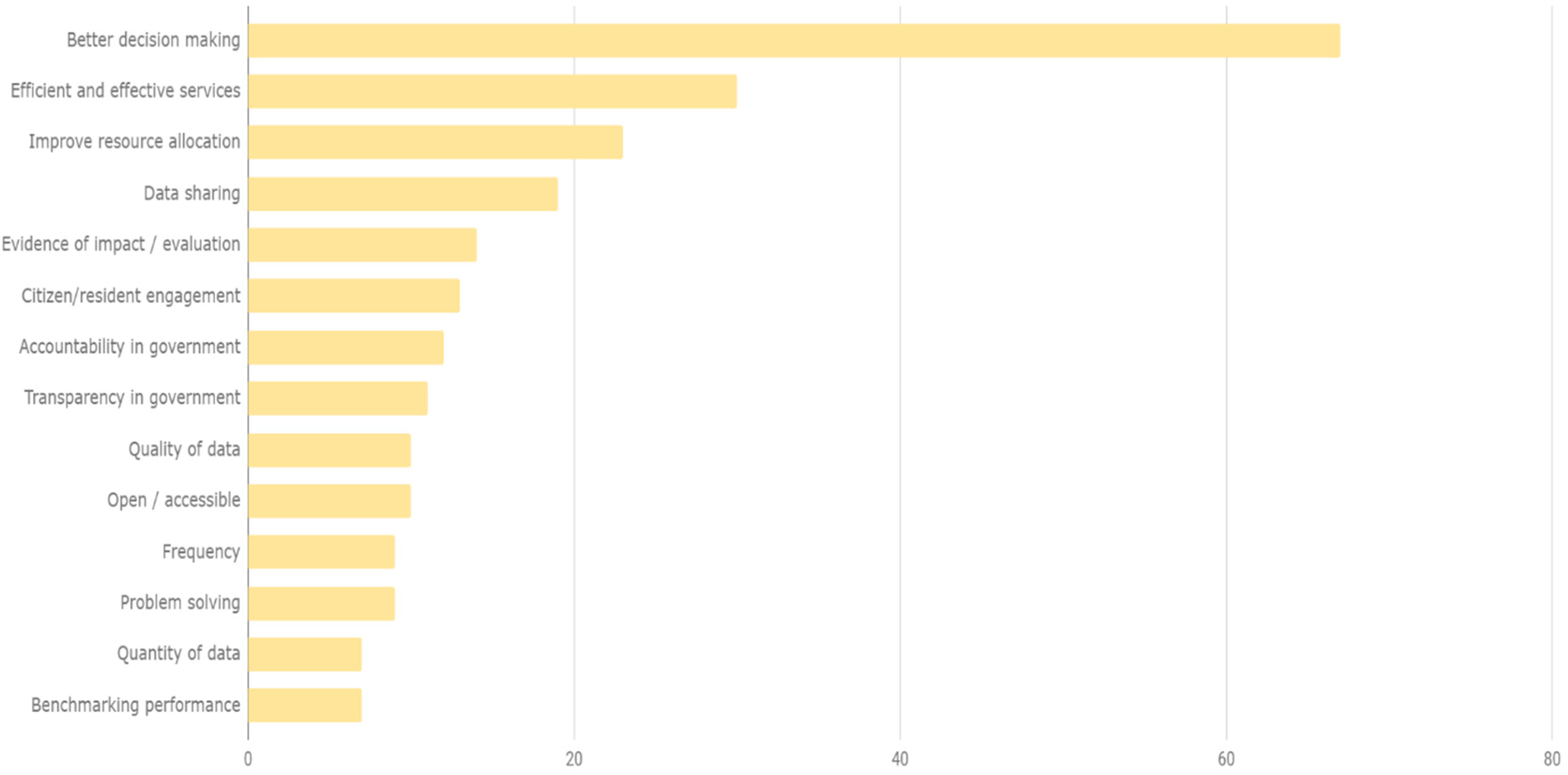
Keywords used to define data-driven local government.
By far the most used phrase was “better decision making”. This was followed by “efficient and effective services’', and “improved resource allocation”. In contrast, to the academic literature, there is no mention of algorithms, data science, or statistics.
The Geographic Spread of Opinion Leaders
In the network, we identified six pinion leading cities. In order of in-degree centrality these were: Kansas City, MO; Los Angeles, CA; Seattle, WA; Boston, MA; New York, NY; San Francisco, CA; Austin, TX; and Denver, CO. The opinion leaders are across all the United States’ major census regions, with a concentration of opinion leaders in the West, with four opinion leaders in this region, two in the Northeast, one in the Midwest, and one in the South.
The map (Figure 2) summarizes the geographic spread of the opinion leaders. A full table of our findings is available in Appendix 1.
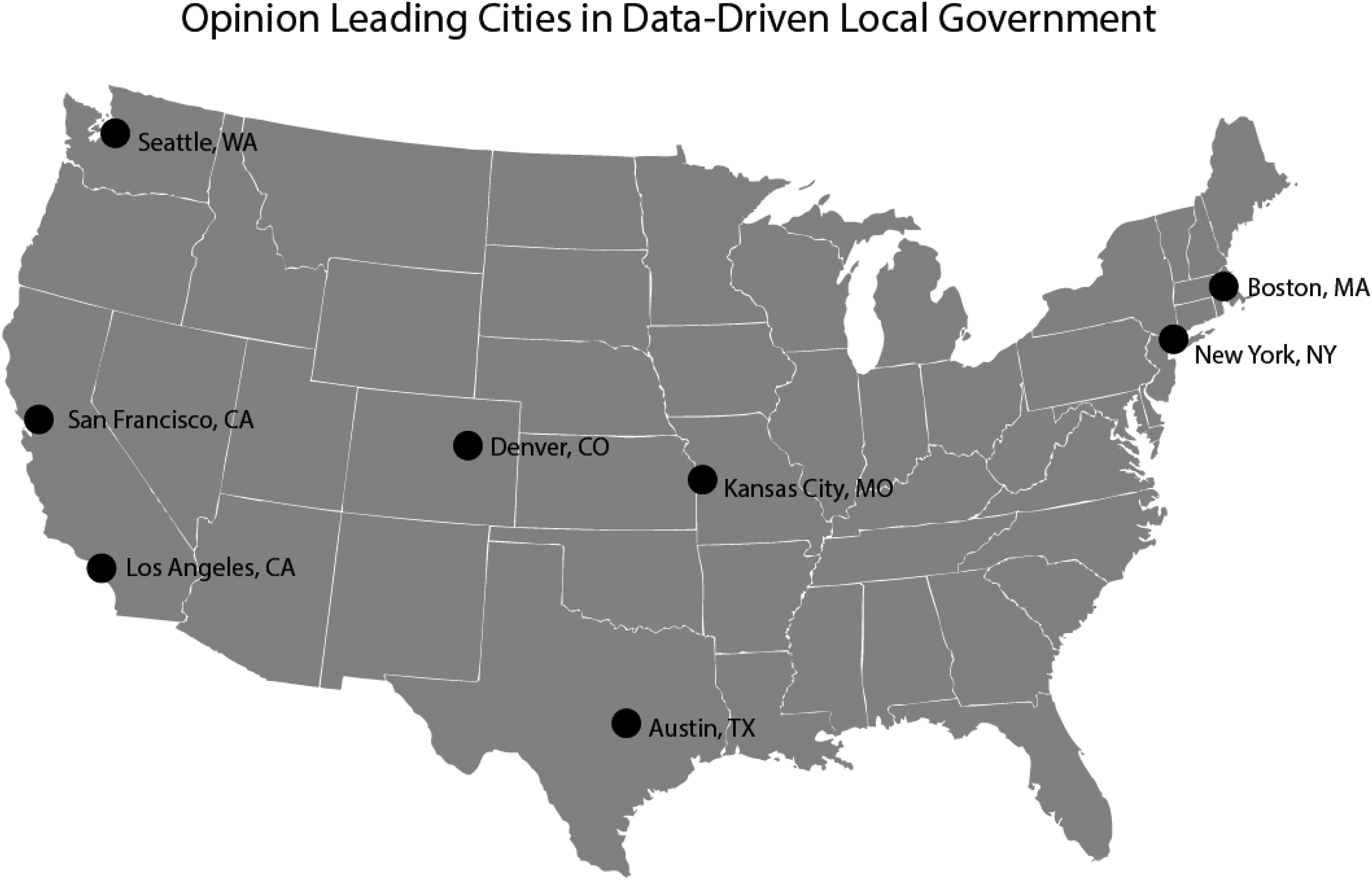
Geographic spread of opinion leaders.
As shown in Table 1, the opinion leading cities are classified as large cities, with populations over 500,000, except for Kansas City, MO, which just falls short of this category with a population of 495,327 (U.S. Census Bureau 2019). This gives an average city size for the opinion leading cities of over 2.1 million residents.
The size of opinion leading cities.

The Reasons why Cities are Identified as Leaders in Data-Driven Local Government
Survey respondents stated why certain cities are viewed as leaders in data-driven local government. We identified twelve codes, with the most common code being the city having a dedicated team and dedicated capacity for data. The second most cited reason is the city's effort to make the data public. The third most frequent reason was the city government possessing an effective data infrastructure. Furthermore, opinion leaders are more likely to be recognized for having dedicated staff and for making data public-facing.
It should be noted that the diversity of jobs represented in the sample provides an important cross-section of perspectives on what constitutes data-driven local government. To ensure that the range of jobs, from mayors to front-line analysts, did not introduce structural bias, we considered respondent job roles when analyzing responses. We found that there was heterogeneity in responses across domain specialism, with officials identifying officials from across municipal government, rather than nominating cities and officials that are working in the same policy area.
Discussion
Officials in local government are positive about data-driven efforts, and most officials can describe and define their municipality's data-driven efforts. But our research also shows that over a third of respondents were unable to define their municipality's data efforts. Looking across all the definitions provided, a variety of keywords and phrases are used. Interestingly, most keywords and phrases summarized outcomes of data-driven local government, not the activities involved to become data-driven. In other words, when asked to define data-driven local government, employees can describe what they hope to achieve, but not how they will get there.
A more nuanced view of what constitutes data-driven local government was provided when municipalities nominated exemplars - the opinion leaders - in data-driven local government. In this question, respondents moved beyond discussing objectives and outcomes to identify the activities and the outputs required, including the need for a dedicated team and dedicated capacity for data, the need for data to be made public, and the municipality government possessing an effective data infrastructure. Respondents also identified the need for data-driven local government to engage all tiers of staff within government and for there to be a sustained focus on innovation and service improvement.
We have found that there is a divergence between local government practitioners’ conceptualization of data-driven local government and academic debates. Rather than contextualizing data-driven local government within the sphere of computing, algorithms, and machine learning, local government officials take a broader perspective of what data is and how it can be applied to achieve meaningful outcomes. This means that data can be both qualitative and quantitative and encompass a range of research methods. Rather than being the domain of specific government departments, such as analytical or IT units, practitioners state that the application of data is relevant to all levels and areas of government. The stated outcome of these efforts is to create a better, more effective, and equitable, form of local government.
Drawing upon local practitioner definitions, we define data-driven local government as: The administration of a city, town or other municipal government that provides effective and impactful services that better serves residents by strengthening transparency and engaging residents to collect, analyze, and use qualitative and quantitative data to define goals, track and evaluate performance, identify and solve problems, and support decision-making.
Why Certain Cities are Opinion Leaders
Another important element in promoting the spread of effective data-driven methods and approaches is the identification of the eight opinion leading cities. Our results suggest that the opinion leading cities have emerged as trusted sources of best practices and ideas, helping other local governments to emulate and adopt data-driven methods and approaches.
The cities identified as opinion leaders are diverse. While they tend to have larger populations, they are not all “large” cities, and they are geographically diverse and spread across the U.S. census regions. Additionally, the connections between opinion leaders spanned the nation and were not limited by geographic boundaries or size.
Opinion leaders play distinct roles in a network: opinion leaders, who build their credibility through expertise, set the bar with innovative practices that lead to results. These opinion leading cities are recognized as leaders in their use of data because of how they generate, apply, and use data to problem solve and drive results in specific policy areas. Furthermore, there is recognition of the role of the mayor and senior leadership in promoting these efforts. This reflects the existing literature that found opinion leaders often have strong communication and coordination skills, and entrepreneurial flair (Williams 2013).
The Value of Opinion Leaders
The value of opinion leaders is evidenced by what municipalities have learned from them. The most frequently identified lessons learned were municipalities learning how to create or improve data infrastructure and governance arrangements. This was followed by municipalities learning how to engage residents in problem-solving, data collection, and storytelling. Municipalities learned how to manage data, including tackling issues of privacy, and also learned how to use and apply data, such as through dashboards, to aid decision-making and improve services for residents. The quest for new ideas and methods reflects the existing literature that found cities and municipalities seek to imitate their peers (Shipan and Volden 2005; Walker 2007; Fowler 2016), and look for innovation in response to local opportunities and challenges (Chung et al. 2017).
Areas for Future Research
This paper proposes a definition for data-driven local government. To our knowledge, this study is the first time that “data-driven local government” has been defined. Our practitioner-generated definition differs from the current academic debates surrounding the use of data in local government, and these differences will need to be reconciled. An immediate next step would be to test the application and relevance of the definition in further academic research with a larger sample of municipal governments. Furthermore, as this study focused on municipalities with populations greater than 50,000 residents, further testing is needed with the city, town, county, and other forms of municipal governments of differing sizes.
The practitioner-generated definition underpins the importance of leveraging data to improve effective, equitable, and impactful services for residents. Further research is recommended in testing how local government investments in data-driven methods and approaches correlate to more equitable, resident-centered outcomes. As more municipal governments continue to build data-driven practices to support better decision-making, the results of these decisions and how they improve wellbeing for residents and communities, especially those most marginalized, will need to be tested and analyzed.
Although our definition has been developed in consultation with officials in municipal governments across the United States, the definition could have applicability beyond municipalities in the U.S, including other levels of government - state, regional, and federal governments - as well as other countries and jurisdictions. The relevance and applicability of the definition to these other contexts would require further consultation and testing with relevant officials.
As noted in the methods section, the survey response rate was relatively low, although we did engage a wide range of city and municipal governments. As a result, our network analysis does not claim to represent all city and municipal governments in our target population.
As our study identified opinion leading cities through social network analysis, as opposed to self-identification methods, the opinion leaders may not be aware of their role as leaders and models for data-driven practices. Academics, researchers, and other practitioners could play a useful role in partnering with these leaders and brokers and harnessing their position to help further connect cities and aid the spread of effective data-driven practices.
Furthermore, scholars could usefully explore the characteristics of both individual and organizational opinion leaders to identify the skills, knowledge, and abilities required. There is also value in building on the literature that explores the specific roles that opinion leaders perform in a network, to identify the distinct commonalities and points of divergence (Williams 2013). Underpinning it is the need to understand the public sector context and the forms of governance that enable – or potentially hinder – opinion leaders. This research would have multiple benefits: helping to identify why certain individuals and municipal governments are trusted and valued sources of information, to better understand – and tap into - their motivations, and to support the necessary skills and capabilities development to enable more opinion leaders to emerge.
As well as harnessing the opinion leading capabilities of certain cities, practitioners could also design interventions to aid their diffusion. Thus, data-driven approaches could be tailored to enhance practitioner awareness and help foster widespread implementation and adoption. The opinion leaders could also be used as testbeds for experimentation. Furthermore, the opinion leaders could help seed evidence-based, but not commonly used, data-driven ideas and methods to help inspire other local governments to adopt and emulate these practices.
At the outset of this study, we identified some of the non-municipal organizations, such as philanthropic foundations and academic units, that are supporting data-driven efforts in local government. The role of these organizations in spreading practice warrants further analysis to understand their impact on local government capability and capacity to use data. Further research would build upon existing studies that show how interest groups and non-profit organizations can perform an entrepreneurial role and provide resources to organizations receptive to innovative ideas (Godwin and Schroedel 2000; Godwin 2015).
Conclusion
Our results show that a group of cities across the U.S. have emerged as opinion leaders, trusted sources of best practices and ideas, helping other local governments to emulate and adopt data-driven methods and approaches. This study has proposed a practitioner-led definition of “data-driven local government”. To our knowledge, this study offers the first definition of data-driven local government and the first depiction of a local government network of data-driven efforts.
The network analysis reveals the critical role certain cities play in spreading data-driven practices. All the cities in the network present a unique opportunity to understand the roles, motivations, and governance arrangements that enable municipal governments to act as conduits in the spread and diffusion of innovative data-driven ideas and practices, presenting a learning opportunity for other cities. It could also be leveraged by academics, and practitioners working in the field, such as philanthropic foundations, that seek to understand and promote data-driven practices in local government.
We have set out a comprehensive suite of further analytical activities that would help deepen scholarly knowledge on data-driven local government, the roles and motivations of opinion leaders, the connection between data-driven approaches and resident-centered outcomes, and to understand how and why non-municipal organizations are supporting these efforts. By leveraging the relationship between local government officials, those looking to support data-driven efforts from across academia, philanthropy, and elsewhere, could help accelerate the spread of effective data-driven practices across the United States, and beyond.
Footnotes
Declaration of Conflicting Interests
The authors declared no potential conflicts of interest with respect to the research, authorship, and/or publication of this article.
Funding
The authors received no financial support for the research, authorship, and/or publication of this article.

Notes
Author Biographies
Results for America is helping decision-makers at all levels of government harness evidence and data to make progress on our greatest challenges. Our mission is to make investing in what works the “new normal,” so that when policymakers make decisions, they start by seeking the best evidence and data available, then use what they find to get better results. For more information, visit results4america.org.
Previously, Jenn managed the expansion of Echoing Green's Work on Purpose program, an award-winning curriculum designed to help young professionals identify their purpose and put it into action by creating a career with impact. Her early experience was in political and advocacy organizing with Mayors Against Illegal Guns (now Everytown for Gun Safety), the 57th Presidential Inaugural Committee, and President Barack Obama's reelection campaign. She started her career in clinical research at the Children's Hospital of Los Angeles.
Appendix 1. Table of results
Table of results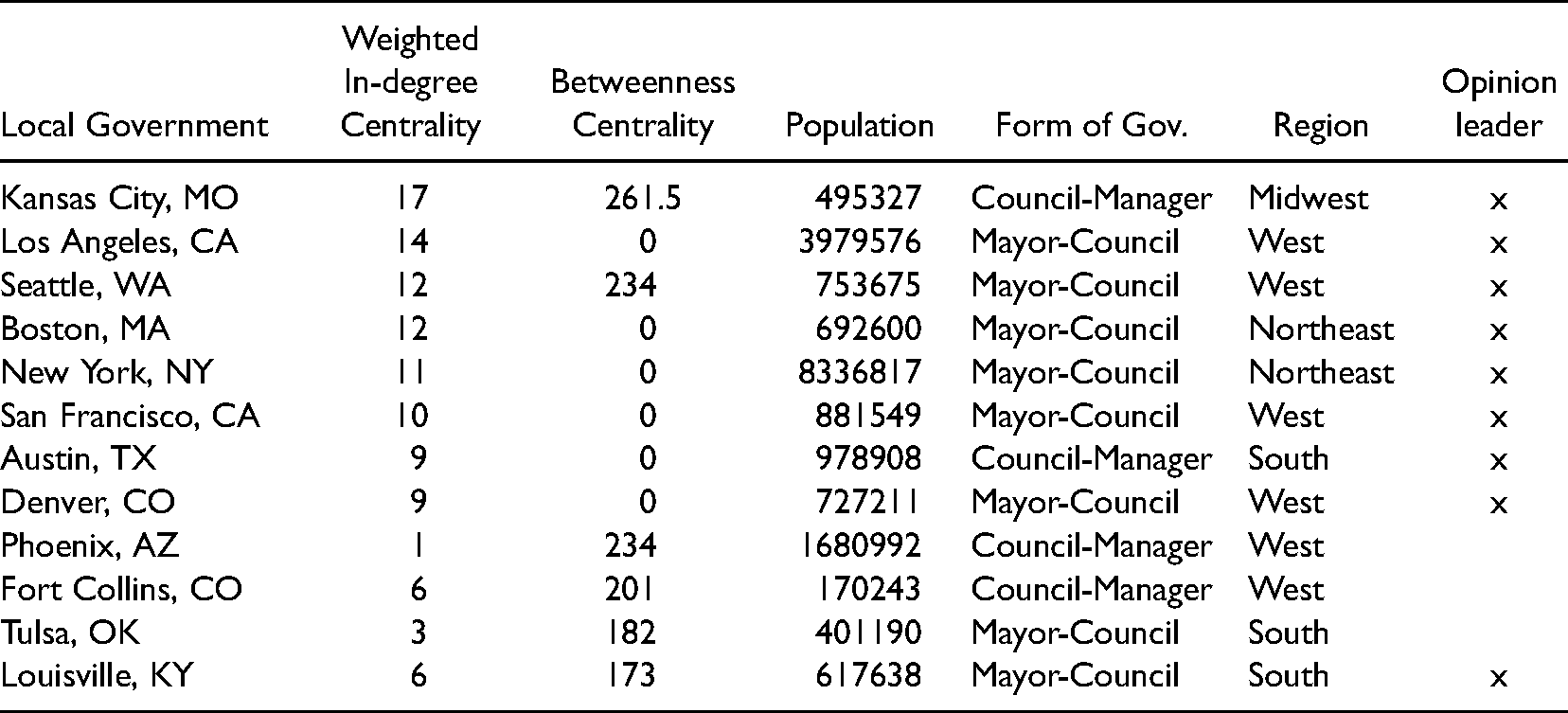
Local Government
Weighted In-degree Centrality
Betweenness Centrality
Population
Form of Gov.
Region
Opinion leader
Kansas City, MO
17
261.5
495327
Council-Manager
Midwest
x
Los Angeles, CA
14
0
3979576
Mayor-Council
West
x
Seattle, WA
12
234
753675
Mayor-Council
West
x
Boston, MA
12
0
692600
Mayor-Council
Northeast
x
New York, NY
11
0
8336817
Mayor-Council
Northeast
x
San Francisco, CA
10
0
881549
Mayor-Council
West
x
Austin, TX
9
0
978908
Council-Manager
South
x
Denver, CO
9
0
727211
Mayor-Council
West
x
Phoenix, AZ
1
234
1680992
Council-Manager
West
Fort Collins, CO
6
201
170243
Council-Manager
West
Tulsa, OK
3
182
401190
Mayor-Council
South
Louisville, KY
6
173
617638
Mayor-Council
South
x