




Abstract
The literature in public administration has advanced various propositions to promote ethical behavior. Local governments have undertaken various efforts in that direction. Those efforts are considered critical for building ethical leadership and culture in the long run. Based on a literature review and use of Social Learning Theory, we identify four building blocks of an ethics infrastructure for public organizations. Employing a comprehensive survey of local governments, this paper shows that displaying awareness and knowledge of ethics, enforcing rules and norms, demonstrating policy support for ethical behavior, and incentivizing the right behaviors are key building blocks of ethics infrastructure that still need improvement in local governments. The reality of ethics infrastructure revealed by the survey is far from the idealism promoted in the literature. We discuss the results and offer several insights and remedies.
Introduction
Contrary to what may be thought, the U.S. public sector still suffers from a high risk of misbehavior and corruption by officials in public agencies. For example, the national Department of Justice’s (DOJ) Public Integrity section compiles data regarding public corruption convictions in each state, and its report shows that high rates of misconduct continue to be an issue in government that needs to be addressed. Despite increasing awareness and targeted efforts such as comprehensive ethics legislation and training at all levels of government, researchers still note that problems such as reactive approaches, an overly legalistic focus on ethics training and programs, and a lack of consistency across governments continue to plague the effectiveness of these initiatives (Bowman & Knox, 2008).
Our study analyzes a comprehensive dataset of local governments’ ethics initiatives in the United States. Our review of the literature suggests four building blocks that make up an ethics infrastructure. We explore survey data to see how the reality of an ethics infrastructure corresponds to the ideal prescriptions promoted in the literature.
The paper is organized into five main sections. The first section is a brief introduction to the notion of organizational infrastructure. The second section is a review of literature that presents and clarifies the key concepts of ethics culture, ethical leadership, ethical programs, and social learning theory on which our model is based. In the third section, we articulate and derive the four building blocks of ethics infrastructure tested in our survey. In section four, we present our data analysis to compare the ideal of an ethics infrastructure from the literature with the reality of local governments as reported in the survey. In the fifth section, we discuss the findings from our analysis and offer additional insights and suggestions.
An Ethics Infrastructure for Local Government?
An organization’s infrastructure is the structure and systems – such as finance, compensation, measurement, reporting, and knowledge creation and accumulation–that enable it to carry out its initiatives (Dixon & Lokus, 2013). It has been suggested that organizational infrastructure is the foundation for organizational effectiveness and adaptation (Lev, 2002). Some organizational capabilities (for example, continuous improvement) have been empirically linked to aspects of organizational infrastructure (Galeazzo et al., 2017; Kraft et al., 2017).
Yet the role that organizational infrastructure plays in developing the capacity for ethical conduct in public organizations has not been studied. Like all public organizations, local governments have a prescribed organizational infrastructure that must operate within a legal and policy framework that includes promoting ethical conduct. As public organizations, do local governments have an ethics infrastructure that (1) creates awareness and knowledge, (2) reinforces right behaviors, (3) enforces ethical rules and standards, and (4) lays out explicit policies that strengthen ethical behavior? Moreover, what does an answer to these questions say about ethics infrastructure in public organizations in general?
Review of Literature: Ethics Culture, Leadership, and Programs from Theory to Practice
In the aftermath of World War II, a new focus on ethics and responsibility emerged, but research on ethics in public organizations has continued to suffer from limitations. Difficulties such as overestimating the role of individual factors (versus contextual factors) in unethical behavior, reactive approaches, a lack of consistency, and an overly legalistic focus mitigated against the full realization of the potential organizational benefits of ethics undertakings (Bowman & Knox, 2008; Treviño & Weaver, 2001). While there has been substantial conceptual and some empirical research in the field of ethics, prior studies have relied on narrowly framed hypotheses testing the associations between ethics policies and practices and have explored attitudes and perceptions about ethics, often employing relatively small samples (D. Menzel, 1995).
The literature does provide foundational concepts for analyzing and establishing organizational ethics. These comprise broad notions such as organizational culture and climate, leadership, and ethics programs. They also include social learning theory, a way of thinking about how these concepts interact to produce ethical behavior. Nonetheless, two significant issues are raised but not sufficiently addressed by the ethics literature and warrant more research. The literature says the building blocks should be for ethics programs in theory. Is there a consistent theoretical framework that fits together foundational concepts to give a coherent picture of ethical decisions and behavior in public organizations? A second question focuses on what empirical research tells us is effective in practice to promote ethical decisions and conduct. What does and does not work is valuable knowledge for the public service in guiding future efforts in fruitful directions.
Organizational Culture
Although the terms culture and climate are often used interchangeably, they differ. Culture is a reasonably stable, value-based, and often profession- or sector-specific outcome of symbolic interaction between individuals and environments that marks an organization and parts of its environment. Climate is a more temporary, better defined, easier to measure, more controllable, and often organization-specific quality (Raile, 2013, p. 254).
Influenced by the politics-administration dichotomy, earlier research on ethical culture in public administration focused on promoting a relatively narrow set of values such as efficiency, accountability, loyalty, and expertise, the so-called bureaucratic ethos (Goss, 1996). Later research has looked at fostering individual principles and traits. For example, Macaulay and Lawton (2006) studied U.K. Monitoring Officers in the public service and their effect on an organizational culture that supports the inculcation of values. This research concluded that competence in Monitoring Officer judgment about legal and other compliance is similar to the organizational cultivation of virtues of character.
Organizational Leadership
Other research has highlighted the necessity of ethical leadership to support ethical behavior in public sector institutions. For example, Pelletier and Bligh (2006) found ethical leadership crucial for employee perceptions in organizations recovering from corruption. Maesschalck’s (2004) research also highlights its importance as a critical factor in public servant buy-in to ethical standards and behavior. In their study of managers and employees at a large state agency in the midwestern U.S., Hassan et al. (2014) showed that ethical leadership positively influenced the willingness to report ethical problems and enhanced compliance with rules for absenteeism.
In a similar vein, Downe et al. (2016) found that leaders who model ethical behavior reduced the necessity to invoke sanctions. Leaders changed their ethical behavior, and followers learned. Leaders can reinforce and maintain high standards and foster ethical behavior at the same time. Likewise, in their study of U.S. military leaders Asencio et al. (2017) argued that leaders must foster individual commitment if organizational ethics efforts are to be effective. Although presenting a bit of a chicken-and-egg problem, their findings indicate that a bottom-up, individualistic, values-inculcation approach, supported by appropriate leadership behavior, may be necessary if organizational support is to work.
Organizational Ethics Programs
Organizational investments in building ethics compliance programs reflect Jones’s (1991) well-known four-stage model to promote ethical behavior, beginning with awareness (recognition of a problem), then moving to judgment (ruling an action ethical or unethical), intention (commitment to a particular course of action), and finally, ethical behavior. Research has lent support to these efforts, finding that strong ethics programs and a supportive culture produce substantially better employee ethical outcomes, such as less pressure for unethical behavior, higher reporting of misbehavior, less retaliation for infractions, and ultimately less misconduct than weaker ethical environments (Martin & Cullen, 2006; D. Menzel, 1995; Raile, 2013).
In ethics training and compliance programs, public sector organizations increasingly make an effort to create strong cultures that promote values such as integrity, transparency, democracy, public interest, social equity, professional excellence, virtue, and accountability (Svara, 2014). Evidence shows that strong and well-implemented programs, combined with the critical support of organizational leaders as role models and enforcers (Bowman & Knox, 2008; Hassan et al., 2014), can drive strong ethics cultures in organizations.
Social Learning Theory
Social learning theory (SLT) explains behavior in terms of learning. Psychological functioning is described in terms of a continuous reciprocal interaction of personal and environmental determinants (Bandura, 1977). According to SLT, people are neither driven by inner forces nor buffeted by environmental stimuli (Wren, 1982). According to this theory, individuals are under social influence, and this social influence affects the operation of the self-system and provides collective support for adherence to standards.
A major assumption of SLT is that adults are not ethically self-sufficient (Brown & Trevino, 2014). They look outside themselves to peers and significant others for ethical guidance. Agents learn ethical behaviors by imitating others within a social context such as an organization. From the SLT perspective, organizational ethics is a socially endorsed pattern of behaviors. Organizations provide these endorsements through enforcement and reinforcements, member knowledge and awareness, and role modeling. They adopt policies that state and clarify appropriate models of ethical behavior. Leaders influence employee ethical conduct through exemplary behavior and by creating an environment suitable for ethical behavior. For example, leaders can create an open, safe, and transparent culture in which discussing and reporting ethical issues is rewarded or even demanded (Hannah et al., 2011).
The Four Building Blocks of Organizational Ethics Infrastructure
The literature on organizational ethics can be easily categorized into the three broad conceptual notions discussed earlier under the headings of organizational culture, organizational leadership, and organizational ethics programs. Moreover, these ideas fit into and are explained by the SLT framework. Taken together, they comprise a prescriptive, theoretical model for the most effective way to think about building an ethical organizational culture and having ethical employees.
Based on this theoretical model we have developed and propose the following ethics framework for public organizations that we call an ethics infrastructure. Undergirding it are four readily identifiable parts that we call building blocks, which supply the base upon which ethical processes occur in the organization: Awareness and Knowledge, Enforcement, Incentives, and Policy Support. Taken together, these building blocks and the processes that support them make up the ethics infrastructure of an organization. The four building blocks were chosen as they represent the best practices of ethics management noted in the literature.
Building Block 1: Awareness and Knowledge—Understanding Ethics Statements and Goals
With the encouragement and support of leading institutions such as the International City/County Management Association (ICMA) and the American Society for Public Administration (ASPA), there has been a trend in the public sector to develop greater awareness and knowledge of ethics. As a result, many organizations write ethics statements and promulgate the knowledge codified in those statements to their employees through various training activities and workshops to enhance awareness and knowledge.
Of course, the statement of ethical ends and rules for a public organization, the knowledge that these have been codified and published, and the understanding and capacity of employees to act on them are all distinct, both conceptually and practically. In practice, the development of ethical codes does not stand alone; employees must be introduced to and made aware of them. Sometimes, this is done through simple mechanisms such as signing for their receipt or new employee orientation; other times, it is done in more elaborate ways, like specific ethics training.
Awareness and knowledge of ethical content are consistent with SLT. When subordinates are equipped with knowledge, skills, and the ability to make ethical decisions, their self-efficacy will increase. Perceived knowledge about ethics topics influences perceptions of ethical climate as well as advice-seeking behavior in a positive way (Raile, 2013). Empirical research shows that employees become more ethically sensitive when they are introduced to ethics knowledge (D. C. Menzel, 1997).
A study of the ethical values and training needs of state government employees suggests that awareness of ethics codes and their frequent use might lead to fewer unethical actions (Blake et al., 1998). Although there are critics of ethics codes in the literature, a broad consensus emphasizes their utility for being inspirational, instructive, and regulatory (Bowman, 1990). The educational function of ethics codes brings awareness to employees about what is right, acceptable, and sanctioned. Ethics codes usually clarify “unstated” precepts that guide ethical conduct. Frequent use of an ethical code, or at least knowledge of its existence and content, might be expected to be associated with ethical conduct (Blake et al., 1998).
Ethics codes enhance ethical decision-making, productivity, and employee morale and provide principles and standards of expected behavior about what is right and what is fair, therefore indirectly ensuring accountability. Employees can be held accountable against those standards (Dean, 1992). Codes of ethics guide appropriate behavior. As instruments to enhance social responsibility, codes clarify the norms and values (Stevens, 2008). Beyond identifying aspects of unacceptable behavior, codes express the expectations of positive ethical behavior by people at all levels of administration (Chandler, 1983).
After establishing a code of ethics, ethics training is the second strategy organizations employ to enhance awareness and knowledge to make ethical analysis an integral part of an organization’s decision-making process (Warren et al., 2014). In a comprehensive study of U.S. cities, West and Berman (2004, 193) found that it is mandatory in one-third of cities for all employees and voluntary in 43.5%. Knowledge of what is right and fair helps employees make ethical decisions when they face situations with trade-offs and dilemmas (Dean, 1992). Training and workshops help identify, evaluate, and propose solutions to ethical issues. Independent thinking and critical reasoning are essential goals to achieve in training programs. Codes of ethics and training, when used together, increase awareness and help employees explore how to think and act ethically and how to make ethical decisions when facing ethical dilemmas (Lewis, 1990).
Evidence of their effectiveness, however, is mixed. Singh (2011) found that having codes of ethics alone is not sufficient to promote ethical behavior but must be supported by training and enforcement, communicated to all employees and outsiders; everyone should know the consequences for violation. In the public administration ethics literature, some scholars argue for a somewhat different approach. For example, Rohr (1998) contends that because public administrators face a wide range of policy issues and use discretion, specific training is not possible.
Building Block 2: Enforcement—Monitoring, Reporting, and Adjudicating Unethical Behavior
SLT suggests ethical actions depend on reinforcement schedules. Ethics codes and training of employees transfer critical knowledge about expected behaviors, but enforcement of rules and sanctions are critical for an ethics infrastructure that promotes ethical behavior organization-wide. Cooper (2004) argues that public organizations must be designed in a way that allows ethical concerns to be heard and supported by organizations. O’Leary (2010), in her study of guerilla employees, suggests nurturing those employees who act against the wishes of their superiors when the ethics of the situation calls for it. Organizations may even have tendencies for facilitating unethical behavior; employees who can think independently and critically can be an asset for ethical choices (Adams & Balfour, 1998).
Sanctions may be severe or light depending on the type and frequency of violations (e.g., they may range from violating the dress code to sexual harassment to theft and bribery). Organizations need clear, comprehensive, and strict rules as well as an accessible and well-functioning reporting mechanism, resources, and ethics boards and commissions to investigate and adjudicate ethics-related violations (Bowman & Knox, 2008). Creating more ethical public service requires, Cohen and Eimicke (1995) argued, enforcement and reinforcement of values. Formal action that signals ethical violations will have serious consequences influences employee behavior in the long run and helps build an ethical culture in an organization. Disciplinary processes are an integral component of ethics programs for punishing unethical behaviors (Kaptein, 2015).
The most notable goal of an internal reporting mechanism is to identify organizational issues that require investigation and resolution. The procedures that organizations have in place to follow up on concerns also are critical for ensuring that employees trust that something will be done, their anonymity will be protected, and they will not be subjected to retaliation (Weber & Wasieleski, 2013, p. 617). Internal reporting mechanisms further contribute to organizational learning, ethical awareness and knowledge, and they can serve an educational role as they show how broad rules and principles stated in ethics codes apply to real-life cases.
In their efforts to increase ethical behavior, many state and local governments established commissions and boards to guide enforcement processes. They administer ethics laws and codes, collect financial disclosure forms, enforce conflict of interest provisions, issue advisory opinions, adjudicate ethics cases, conduct training, and maintain the integrity of government in general. The methods to control corruption include internal surveillance, investigative auditing, and performance auditing (Anechiarico & Jacobs, 1994). Ethics officers’ roles have become increasingly prominent. Their duties have expanded to include enforcing compliance with organizations’ rules and fiduciary duties, helping managers avoid inappropriate conduct, coaching employees, developing and implementing tools for measuring the success of ethics programs, and communicating an organization’s ethics program to the public (Beeri et al., 2013).
Building Block 3: Incentives—Reinforcing Behavioral Change
As SLT suggests, witnessing peers being rewarded by ethical leaders for desirable conduct helps ensure employees’ firm faith in the positive consequences of their performance, thus heightening their self-efficacy (Tu & Lu, 2016). Behavior is strengthened through reward (positive reinforcement) and avoidance of punishment (negative reinforcement). SLT notes that whether deviant or conforming behavior persists depends on past and present rewards or punishments for the behavior (Akers et al., 1979). Moreover, individuals’ voluntary compliance with norms and rules reduces the cost of monitoring and prevents irreversible costs in tarnished reputation, litigation expenses, and wasted time, serving as a more efficient method for creating ethical behavior in organizations.
Bedi et al. (2015) emphasize the transactional dimension of being an ethical manager, embracing either active management (based on monitoring conduct and issuing rewards) or passive management (taking action after a problem). Passive transactional approaches rely on regulation and are unlikely to be effective (Downe et al., 2016; Eisenbeiss, 2012). Many organizations incorporated ethical decisions into their performance evaluations, offering recognition and awards for those employees whose behaviors fall in line with the ethical standards promoted by the formal organization. Employees who internalize an organization’s rules and values are more likely to engage in whistle-blowing and organizational citizenship behavior and report problems to their leaders (Treviño & Weaver, 2001).
While there is less research on incentives and reinforcement in government, a study by Bowman and Knox (2008) used data from a national survey to explore views toward ethics in society and integrity in public agencies, with an emphasis on the code of ethics of the American Society for Public Administration. The evidence shows that one-fifth of respondents believed that agencies are reactive, negative, and primarily follow ethics by enforcement. Essentially, respondents’ views indicated that public servants do not encourage good ethical behavior and deter unethical behavior.
Building Block 4: Policy Support—Rules and Statements
The adoption of standards on ethical conduct is important for influencing employee behavior. From the SLT perspective, employees are more likely to adopt ethical standards if they are easily available for reference in day-to-day organizational life (Fritz et al., 1999). Among the problems that need to be addressed most commonly in public sector organizations are bribery, nepotism, theft, conflict of interests, use of insider knowledge or confidential information for personal purposes, and public accountability for actions (D. C. Menzel & Benton, 1991).
In addition to addressing ethical problems with targeted regulations, organizations provide a nexus of concepts, codes, and rules that, taken together, can be called organizational policy support for ethical behavior. Policy support for ethical conduct in organizations is the formal specification or statement of norms governing the acts that constitute ethical and unethical behavior in codes of conduct, published rules, values statements, or other organizational policies. In effect, it involves the promulgation, communication, and oversight of these in sustained programmatic initiatives in an organization.
As a review of the research in public administration points out, in organizational practice, policy support for ethical behavior confronts a sort of duality: the causes of unethical behavior and the encouragement of ethical behavior are related but separate phenomena (Belle & Cantarelli, 2017). On the one hand, some organizational policy support is goal or value-oriented, such as statements about how organizational members are to behave – for example, guidelines that exhort organizational members to make decisions for specific sorts of outcomes (e.g., Google’s well-known dictum, “Do not be evil”) or numerous public sector organizational goals and values statements to “serve the public interest.” On the other hand, some organizational policy support is rule-oriented and specifies the bright lines that cannot be crossed without engaging in unethical behavior; examples include limitations on nepotism, conflicts of interest, or holding outside employment without approval.
In their research, Anechiarico and Segal (2020) find that well-known rules-based and violation-oriented organizational policy supports have been instituted to prevent the use of public office for personal benefit, or what is called official corruption. Illustrations of this sort of organizational policy support are rules against nepotism, accepting gifts or favors, and conflicts of interest. As Anechiarico and Segal point out, such limits provide rule-oriented ways to determine ethical infractions, but they do little to instill values or affect ethical development. The underlying message of such rules-based and violation-oriented policy support is clear according to Anechiarico and Segal: “Do not get caught,” rather than “Act ethically.”
Testing the Four-Building Blocks Infrastructure Model: Constructs and Survey Data
In looking at local government this study aims to compare the reality of local government ethics with the literature’s idealism. We have advanced the notion of an organizational ethics infrastructure that consists of four building blocks comprising the principal factors running through the literature. In this section, we use data from a survey of municipal government organizations to empirically examine the four-building-blocks model. We construct variables for each of the four building blocks from appropriate survey items and determine to what degree they are both valid and reliable. We check to see if the constructs reflect actual practice as reported and thus have content validity.
Constructs Tested: Four Building Blocks of Ethics Infrastructure
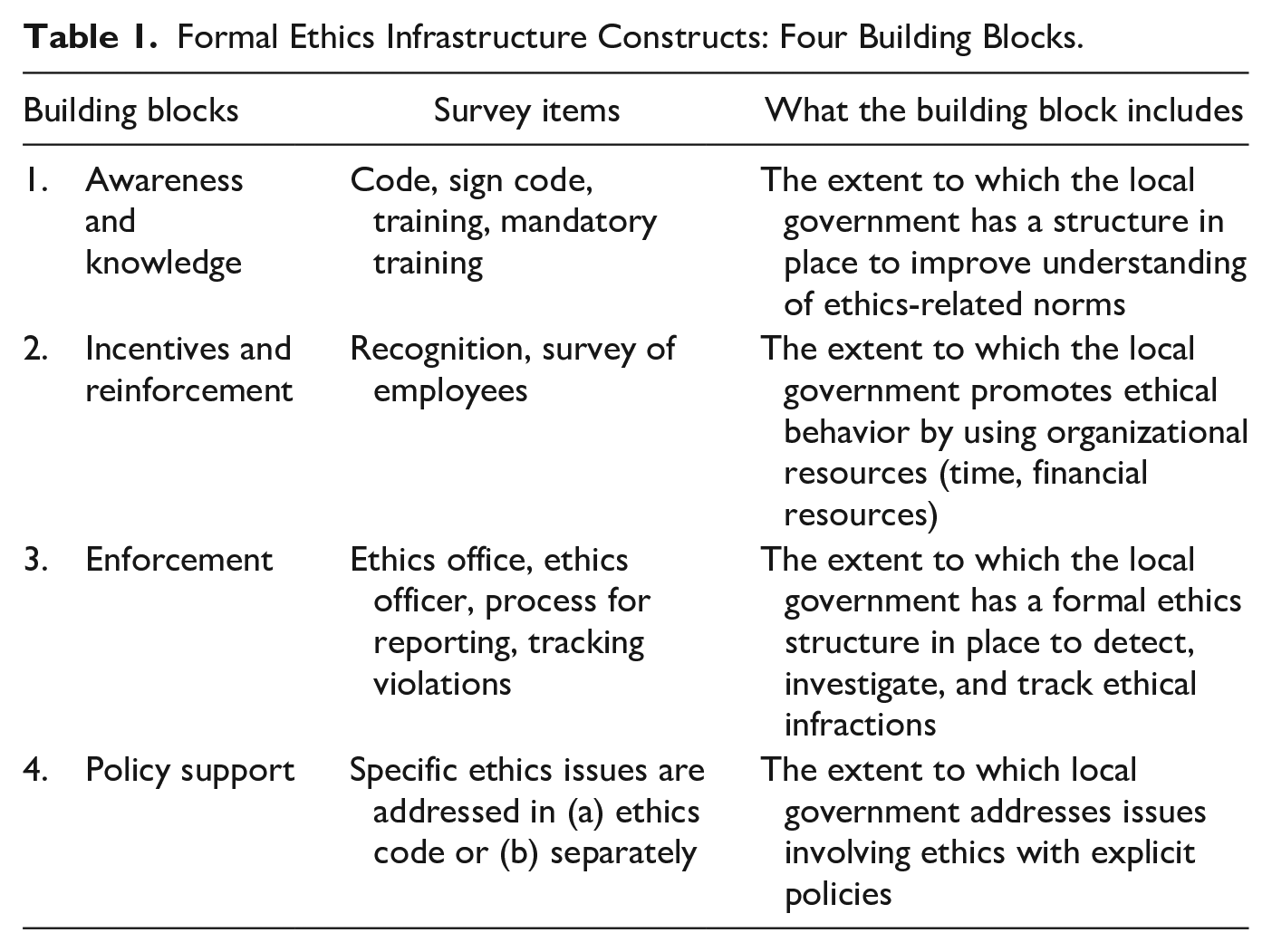
Table 1 shows the constructs tested in our research for the four building blocks presented above. These are the organizational processes that result in the four building blocks of organizational enforcement of ethics: awareness and knowledge of ethics, incentives and reinforcement of good ethical behavior, enforcement of ethics, and policy support initiatives for ethics. Each of the four is tapped by items in the local government survey. Table 1 lists the survey items that correspond to each building block. In the Appendix, we have placed the corresponding questions identified with each construct and its coding.
Formal Ethics Infrastructure Constructs: Four Building Blocks.
Survey Procedures and Sample
The ethics in local government survey questions were developed to identify specific local government practices that represent a commitment to ethics and the ethical competence of employees and elected officials. At the time of the survey, the ICMA’s full database included email addresses covering approximately 5,000 unique local governments, including non-members. A target sample of approximately 3,000 local governments led to distribution to ICMA members only. The ICMA sent emails and reminders and provided the electronic survey platform. The nationwide survey was distributed to 3093 local governments. In total, 838 members completed and returned the survey, a 27.1% response rate.
Table 2 presents the characteristics of the respondents by jurisdictional location, governance type, and number of inhabitants. More respondents were from the Midwest than from other regions, but nearly all regions responded nearly at or above the 25% level. Although the highest response rate for Form of Government was 54 of 163 Mayor/Council respondents (33.3%), the greatest number of respondents overall was the City/Co. Mgr. (581 of 2,195; 26.5%). Overall, respondents from smaller jurisdictions were slightly more likely to return surveys than those in medium and large cities (28.3, 26.8, and 25%, respectively).
Respondent Survey Characteristics.
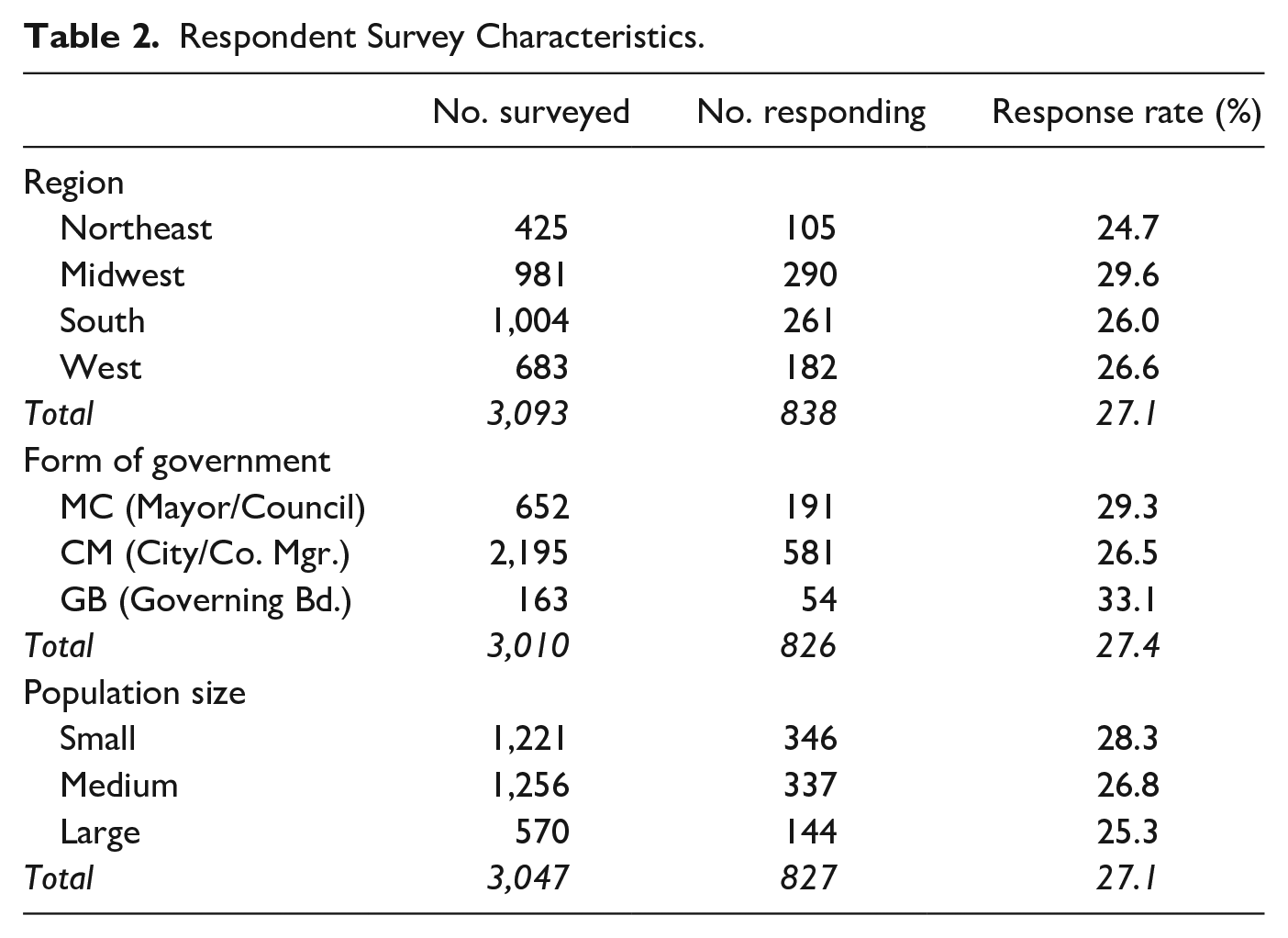
As Table 2 shows, the sample is weighted somewhat more heavily toward respondents from the Midwest and South; the number of respondents from Small (346) and Medium (337) size jurisdictions is similar, while respondents from Large cities (144) constitute about half of each. As might be expected from the membership of the ICMA, the bulk of the respondents, about 70%, were from jurisdictions with the City/County Manager form of government. Thus, findings may be more easily generalized across jurisdiction Size, a less among Regions, and least to non-City/County Manager forms of government.
Results
Descriptive Statistics
Table 3 shows the variables used to tap the building block constructs and the associated descriptive statistics. Each survey item appears with the question number and a brief label. (See Appendix for question wording and coding.)
Descriptive Statistics of Variables for Building Block Constructs.
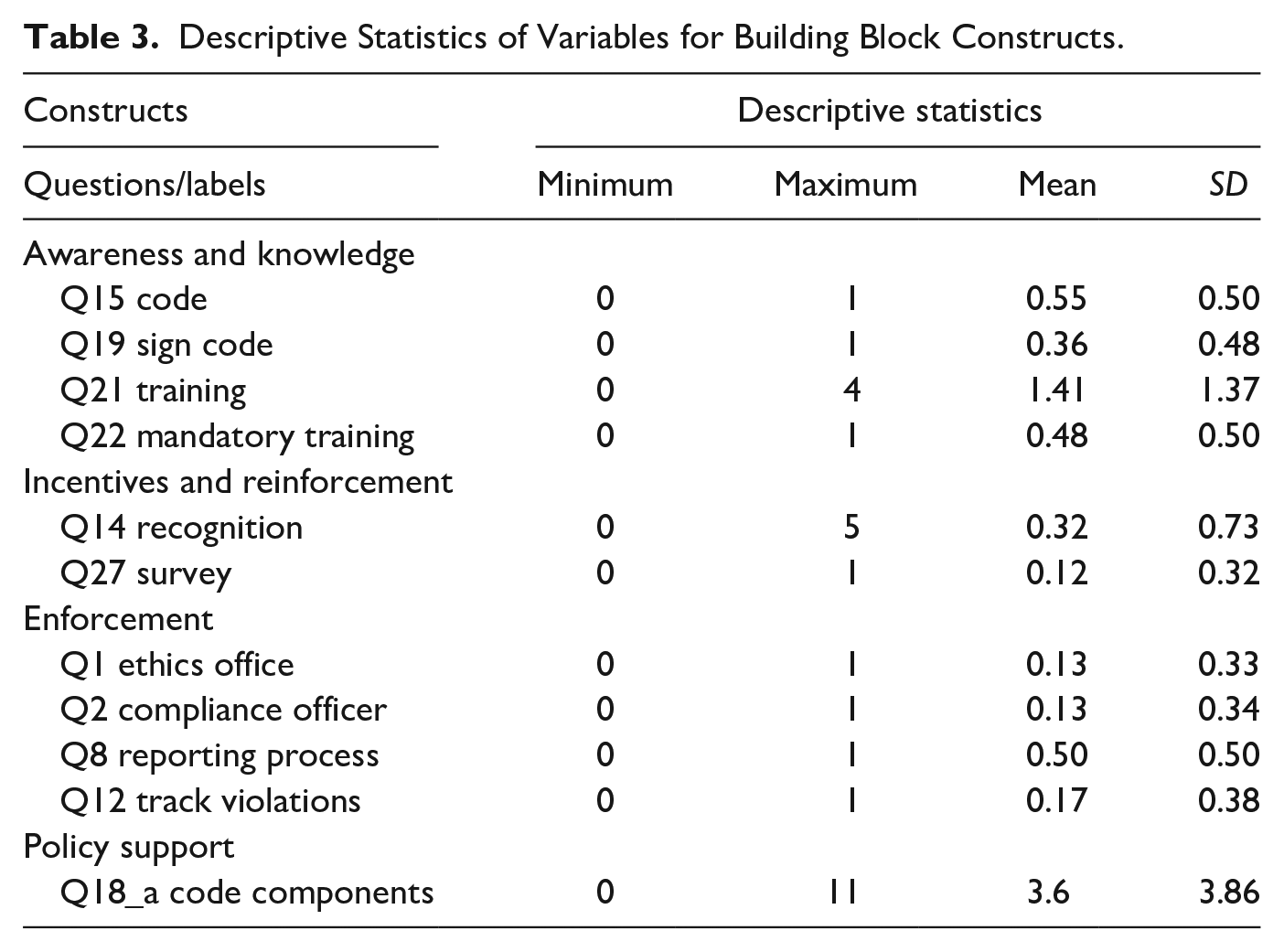
Building Block 1, Awareness and Knowledge, covers questions 15, 19, 21, and 22. This construct deals with the code of conduct and ethics training. The mean score was 0.55 (out of 1). About half of the local governments responding have an ethics code and little over a third (0.36 of 1) required their employees to sign the code. The summary score of those who received ethics training such as staff, managers, boards, and elected officials show that over a third (35%) were trained and around half had mandatory training.
Building Block 2, Incentives and Reinforcement, consists of two questions on additional employee compensation or awards for promoting more ethical local government. As Table 3 indicates, compensation and awards were not very common, with only about 6% of governments offering such incentives. Only about 8% of local governments have conducted a survey to track ethics attitudes.
Building Block 3 uses questions 1, 2, 8, and 12 as measures of the enforcement of the ethics construct in local government—having an ethics commission or board or ethics compliance office; reporting or tracking ethical violations. Again, mean scores are relatively low, with scores below 0.20 (out of 1) for three of the four enforcement variables. Nevertheless, around half of responding local governments report having an ethics process for violations.
Building Block 4, Policy Support, looks at issues either contained in an ethics code or addressed separately. These range from social media policy to public interest. There were 11 possible policy support options asked of these local governments. The mean score was 3.6 (out of 11), suggesting that these local governments placed some critical policy support matters in their codes.
Distribution of Responses on Variables
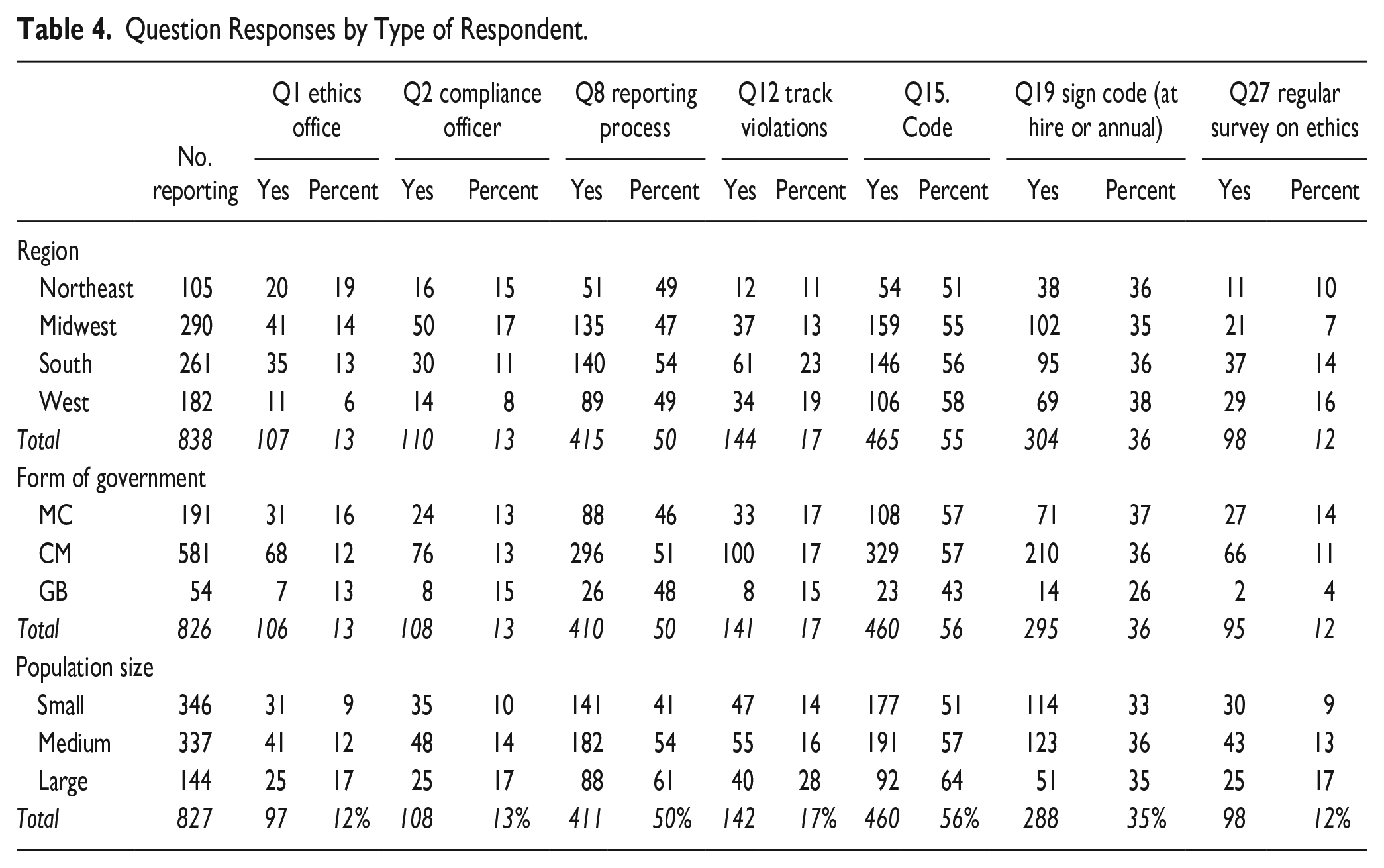
Tables 4 and 5 report the distribution of local governments’ responses to the ethics infrastructure items. Examining the responses the tables summarize gives an idea of how local governments responded by category, for example, population size or region. In addition, the distribution of responses across the 11 items in the Policy Support construct is broken out for a better idea of how local governments handle these important factors.
Question Responses by Type of Respondent.
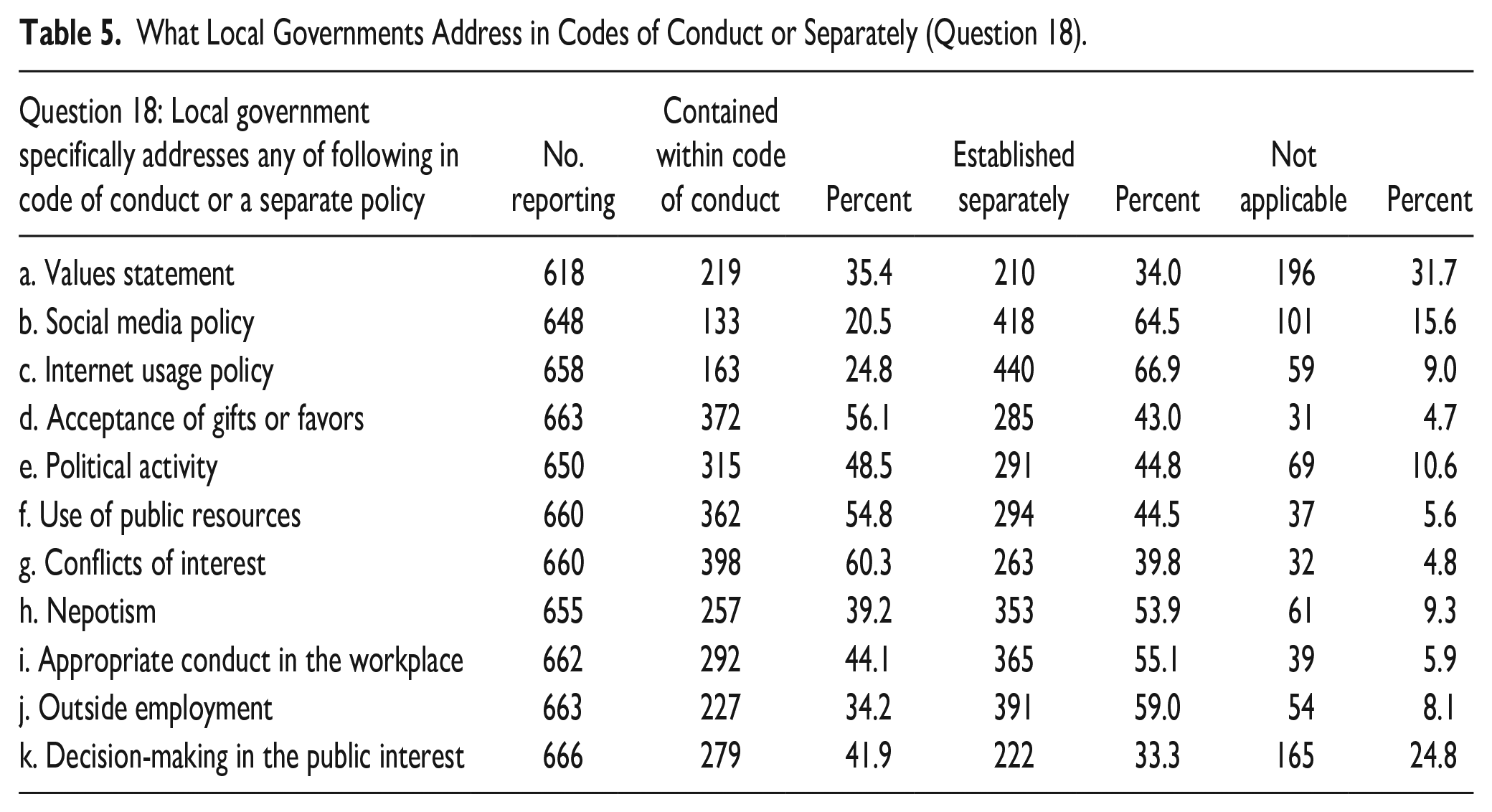
What Local Governments Address in Codes of Conduct or Separately (Question 18).
Responses by Respondent Characteristics
Table 4 shows, local governments in large cities figure more prominently in ethics infrastructure than those in less populous jurisdictions. For example, 64% of local governments in large cities have codes of ethics compared to 51% of respondents in small cities. In addition, 61% of the larger population jurisdictions have a reporting process while only 41% of the small ones do. Similarly, the large jurisdictions are more likely to report having an ethics office or compliance officer than smaller ones.
Form of government appears less likely to be associated with differences in the ethics infrastructure construct building blocks. An exception is that governing boards lag behind mayor-council and council-manager governments in conducting regular surveys on ethics, with only two (4%) reporting doing so.
Because of its relationship with political culture, the region of the respondent’s jurisdiction may be an essential characteristic. Respondents from most regions responded similarly that they had reporting processes, tracked violations, and ethics codes signed by employees. However, the Western region lagged behind the others in two categories: having ethics offices and compliance officers. While 19% of respondents from Northeast local governments reported they had the former and 17% of those representing Midwest governments the latter, those from the West 6 and 8%, respectively. Meanwhile, 16% of western local government respondents reported that they had regular ethics surveys, only 7% of those in the Midwest region relied on such instruments.
Ethics Expectations
Table 5 unpacks the elements the responding local governments actually placed into their ethics codes. It shows whether the local government addresses an ethical concern in the ethics code, in another venue, or in neither. About half of all respondents address compliance-based ethics issues such as partisan activity (48.5%), use of public resources (54.8%), acceptance of gifts (56.1%), and conflict of interest (60.3%) in their codes of ethics. Conversely, it is important to note that ethics policies that target human development such as values statements (35.4%) and decision-making in the public interest (41.9%) are less common. About 32% of local governments do not have values statements, and almost 25% of them do not explicitly expect decision-making in the public interest. Most jurisdictions address workplace issues such as nepotism (53.9%), appropriate conduct (55.1%), outside employment (59%), and the use of information technology in social media (64.5%) and the internet (66.9%) outside of ethics codes.
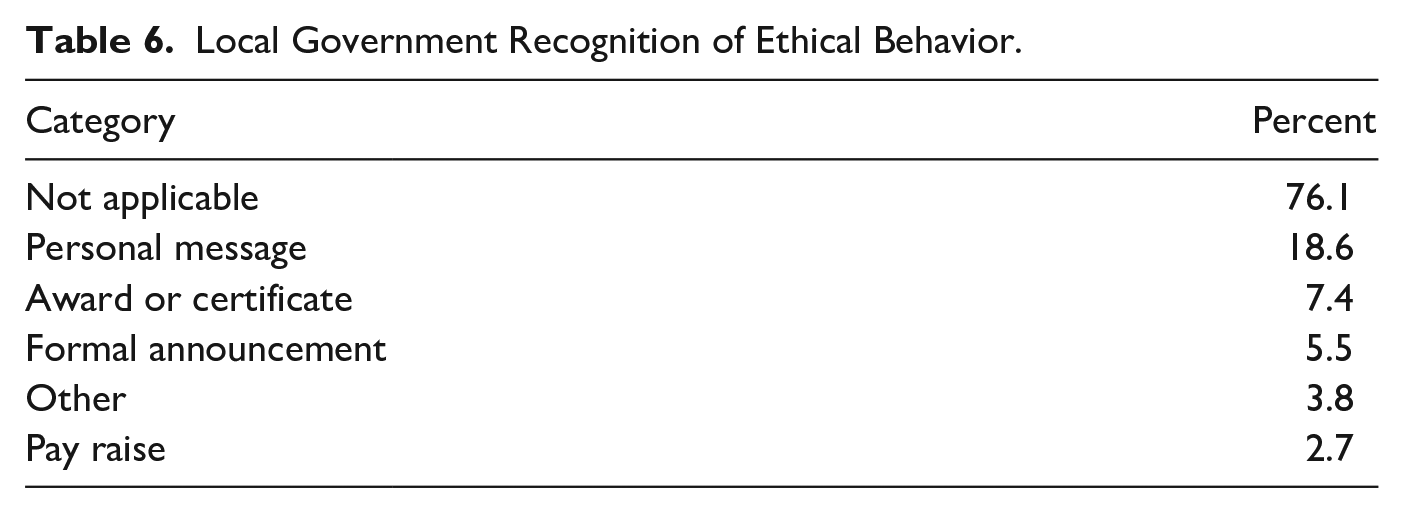
An in-depth look at the use of additional workplace incentives for ethical behavior in the responding local governments appears in Table 6. The preponderance of local governments did nothing in this area, with over 75% of respondents reporting no use of incentives. Fewer than 20% used a personal message to motivate ethical conduct, while 7.4% employed the presentation of awards or certificates, and 5.4% made formal announcements for this purpose. Only 2.7% of responding governments gave monetary rewards (increased pay).
Local Government Recognition of Ethical Behavior.
Polychoric Correlations
Table 7 reports correlations among the variables in the study. The reported correlations are polychoric, not Pearson. Pearson correlations are not suitable for this type of analysis in which most variables were ordinal. When response categories are limited, this produces underestimation of associations between observed variables. Polychoric correlations are the most consistent and robust estimators (Holgado-Tello, 2008). The interpretation of polychoric correlations is identical to that of Pearson. Correlation coefficients range between + 1 and −1. The closer the coefficient to +/-1, the stronger the relationship between any two variables in the dataset. In general, the inter-item correlations are of moderate strength; all are positive.
Polychoric Correlation Matrix.
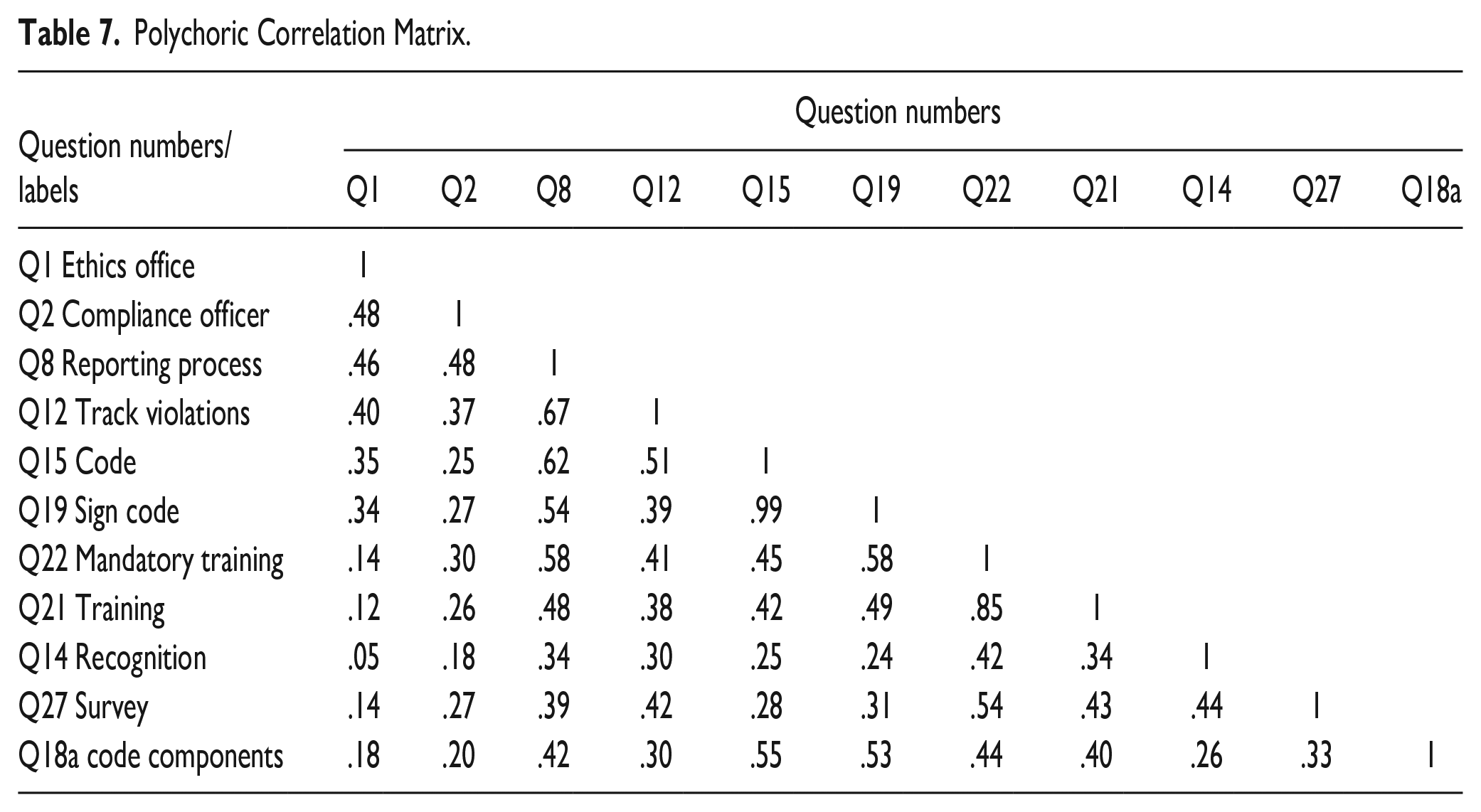
Table 7 also suggests a lack of consistency in the ethics infrastructure of local governments. Stronger correlations would show that local governments that have one component in place would have others in place because they complement each other. For example, items related to training (Q21 and Q22) are only moderately correlated with enforcement items. Likewise, having an ethics office and compliance officer (Q1 and Q2) are not correlated strongly with enforcement (Q8 and Q12). This is consistent with the literature’s criticism that government ethics efforts suffer from a lack of consistency.
Conclusion
We started our analysis with a review of literature that identified four building blocks for ethics infrastructure. We examined the authenticity of these building blocks using constructed variables that we compared to survey responses from local government managers. Our findings showed that local governments do not use the building blocks as a solid foundation for an ethics infrastructure. Only a minority of local governments use more than the basic blocks of an ethics code and training. This is evident in the analysis of polychoric correlations: most items that tap the building blocks are not strongly correlated with each other. This indicates that there is not much of a relationship between the building blocks and overall ethics activities in the local governments making up our sample. In addition to the lack of evidence in the survey data for the use of all four ethics building blocks, differences in practice appeared across region, form of government, and population size.
The results have interesting implications. Although the literature advances ideas and frameworks that could help local governments establish ethics infrastructures, findings from our national survey suggest a general interest in them. Even though some local governments employ all four building blocks of ethics infrastructure, they are a minority. Our results suggest that most ethics activities in local governments consist of a limited set of simple practices: creating a code, training employees on it, and enforcing ethics rules. A few local governments incentivize and survey employees or even proactively track ethics violations, but not much else is done by the local governments in our sample.
Some ethics infrastructure components are laborious to create and operate, such as organization-wide ethics training, employee incentive programs, and ethics boards or counselors. Yet, even relatively feasible initiatives are not widely practiced in local governments. For example, only about half of the local governments responding to the survey have adopted a written code. This may show a lack of knowledge about the importance of ethics codes, a lack of interest, or a lack of agreement among local government leaders on the specifics of a formal code.
The literature mentions the organizational tendency to focus on compliance as the low-hanging fruit of ethics development. Another important finding from the survey is that local governments focus most on the compliance aspects of ethics infrastructure. It is time-consuming and expensive to affect organizational culture and processes or to design and achieve wider-ranging change in institutions. For example, only about 41% of local governments in the sample mention “decision-making in the public interest” in their codes and 33% in separate policy statements. Similarly, about 35% of the respondents reference values in their code and 34% in other statements. It is instructive to compare this level of emphasis on ethical principles for employees with that of compliance-oriented ethics policy initiatives: almost 65% of local governments have a social media policy, 66% have an internet usage policy, and almost 60% address outside employment in a separate policy. This is somewhat puzzling, as public administration scholarship repeatedly calls for a human development approach in ethics training, going beyond a narrow focus on compliance.
Fragmentation in U.S. government may help to explain this apparent lack of attention to ethics infrastructure. As seen in Table 5, large local governments report better ethics infrastructure. Smaller local governments with limited resources may not be able to devote sufficient time and funding to the development of ethics codes, the provision of training, or the establishment of ethics boards. In the literature, consolidation of small municipalities into larger entities to benefit from economies of scale has been offered as a remedy for such challenges. That seems like a long-term solution. In the shorter run, collaboration with other local governments to provide ethics training or seeking assistance from local government associations such as ICMA might be a reasonable strategy for smaller municipalities.
Awareness should be the first building block that local governments aim to address. A 1992 study of government employees by Menzel showed that many employees did not even know that their behavior was subject to state ethics laws, and very few employees attended ethics training. Requiring mandatory training programs and yearly refreshers is a start in building and sustaining a culture of ethics in local governments. Employees may be unaware of what they can do ethically if local governments do not invest enough resources in ethics programs. Complicating the problem of ethical awareness is that employees have conflicting conceptions of appropriate behavior.
We employed social learning theory to better understand how the building blocks of ethics infrastructure fit together. Essentially, this theory argues that creating an environment where organizational community members learn from each other can support the creation of an ethical workplace. Positive ethical behavior will flow from leaders to followers. The four building blocks support the best social learning practices for public sector organizations. Public sector managers can use the building blocks to improve ethics in their organizations.
Next on our research agenda is to test the relationship of each building block with actual ethical outcomes and individual behavior in organizations. Such research will promote a better understanding of effective ethics efforts and may yield practical advice for local government managers.
Footnotes
Appendix: Survey Questions and Coding
Declaration of Conflicting Interests
The author(s) declared no potential conflicts of interest with respect to the research, authorship, and/or publication of this article.
Funding
The author(s) received no financial support for the research, authorship, and/or publication of this article.
