




Abstract
The study is a systematic literature review that assembles scientific knowledge in local government transparency in the twenty-first Century. The study finds a remarkable growth in research on local government transparency in the first nineteen years, particularly in Europe and North America. Social, economic, political and institutional factors are found to account for this trend. In vogue among local governments is the use of information technology to enhance transparency. The pressure to become transparent largely comes from the passage of Freedom of Information Laws and open data initiatives of governments.
In democratic governance, premium is placed on transparency in good governance as a boost to public trust and participation of the citizens. Recently, the notion of secrecy in public administration is given way to the culture of free unlimited access to information (Grimmelikhuijsen et al. 2013). Transparency has become a virtue in public management and public policy making and according to Kim and Lee (2012) transparency is an important democratic value which a trustworthy, high-performing and responsible government pursues. Transparent conduct of government reduces the information gaps between government and the citizens (Kim and Lee 2012) and enhances the perception of institutions “responsiveness to citizens” actions. Its absence diminishes citizens’ trust in administrative processes and actions as citizens feel distant and often excluded from the governance process (da Cruz et al. 2016).
Transparency is a “nebulous concept” (Grimmelikhuijsen 2010, 9) that lacks generally accepted definition due to its increasing popularity and varied usage among politicians, academic and practitioners in diverse fields (Meijer 2014; Oztoprak and Ruijer 2016). Generally, transparency connotes openness, absence of opacity, and lifting of the veil of secrecy (Piotrowski and Ryzin 2007; Grimmelikhuijsen 2010; Hood 2010; Kim and Lee 2017). Grimmelikhuijsen (2010) describes transparency as the active disclosure of information by an organization with the intent of allowing external actors to monitor and assess the internal workings or performance of that organization. The intent of providing information is an important attribute as the mere act of publishing information about an organization does not necessarily translate into transparency if the available information is not comprehensible to the users.
Undoubtedly, transparency has become an international norm with renewed attention of governments to enact laws and policies that promote information access about government operations to citizens (Fung, Graham, and Weil 2007). Increasing transparency of the government functions and processes is a mainstay of the governance practices in liberal democracies (Cook 2018). Thus, governments have initiated policies to promote transparency in the public sector by ensuring the right to and rapid dissemination of information to the citizens. One such initiative is the passage of freedom of information (FOI) laws to make access to public information a citizens’ right (Piotrowski and Ryzin 2007; Worthy 2013; Oztoprak and Ruijer 2016). E-governance and internet publication policies of governments across the globe is another initiative that aims at ensuring rapid dissemination and access to information (Piotrowski and Ryzin 2007; Grimmelikhuijsen 2010; da Cruz et al. 2016; Kim and Lee 2017). Further, open government data initiatives push for the establishment of series of conceptual and technical principles to guide the opening up of public records through the internet Corrêa et al. 2017. The paradigm shift from secrecy in public management to transparent public management has received endorsement in the literature.
In spite of the fact that transparency is overwhelmingly endorsed in public management, the focus has been on the federal and state governments neglecting the local government (Grimmelikhuijsen and Welch 2012). Meanwhile, availability and accessibility of public information at local level is critical in the overall perception of transparent government (Armstrong 2011). Local governments are conceived to bring people closer to their government through increased participation in the policy making and evaluation space (Dowley 2006). Unarguably, local government is an important government body with the highest administrative, legislative and deliberative authority in their respective jurisdictions (Grimmelikhuijsen 2010). This suggests that transparency initiatives at the local level begs the attention of researchers and practitioners, however it has been an understudied phenomenon until the twenty-first century, a turning point of renewed scholarly interest (Tejedo-Romero and Araujo 2018).
Given the renewed research interest in local government transparency, it has become necessary to carry out a systematic review of the transparency literature to explore and understand the dynamic transparency practices of the local government (Sáez-Martín, Lopez-Hernandez, and Caba-Perez 2017). Porumbescu (2015) observes that local government is particularly interesting context to interrogate transparency because citizens have close proximity to these governments with growing demand for improved transparency. Both Sáez-Martín, Lopez-Hernandez, and Caba-Perez (2017) and Cucciniello, Porumbescu, and Grimmelikhuijsen (2017) provide systematic literature reviews on transparency in the public sector. However, these two studies lump up local government together with other public sector entities therefore failing to provide insight into the local government. This study aims at supplementing and extending these studies by systematically reviewing and exploring the pattern and practices of transparency in local governments across the world from 2000 to 2018. Specifically, the study investigates the extent of research interest in local government transparency and examines the current themes to identify research gaps that require future attention. The review therefore addresses four research questions: What is the trend of transparency research in the local governments of the world? Why are some local governments more transparent than others? What are the effects of information technology and freedom of information initiatives on local government transparency? What research gaps exist to warrant future research attention?
The remaining part of the paper is organized into four sections. The next section describes the data, methods, and procedures used in this review. This is followed by analysis and discussion of the results. The final section provides direction for future research and conclusions.
Study Design
The study employed systematic literature review, which involves a survey of the literature with overarching objective of synthesizing extant studies on a phenomenon of interest over a period of time (Bishu and Alkadry 2017). Systematic literature as a method of enquiry follows established procedures for investigation (Waltman et al. 2011). The procedure as shown in Figure 1 involved locating the studies, selecting and evaluating the studies against the review questions, analyzing, synthesizing and reporting. In locating the relevant studies, consideration was given to academic discipline domain in which the subject matter falls. Local government transparency is a subject matter of many disciplines including public administration and policy, political science, information and library science, public financial management (Sol 2013; Saez-Martin, Lopez-Hernandez, and Caba-Perez 2017; Cucciniello, Porumbescu, and Grimmelikhuijsen 2017).
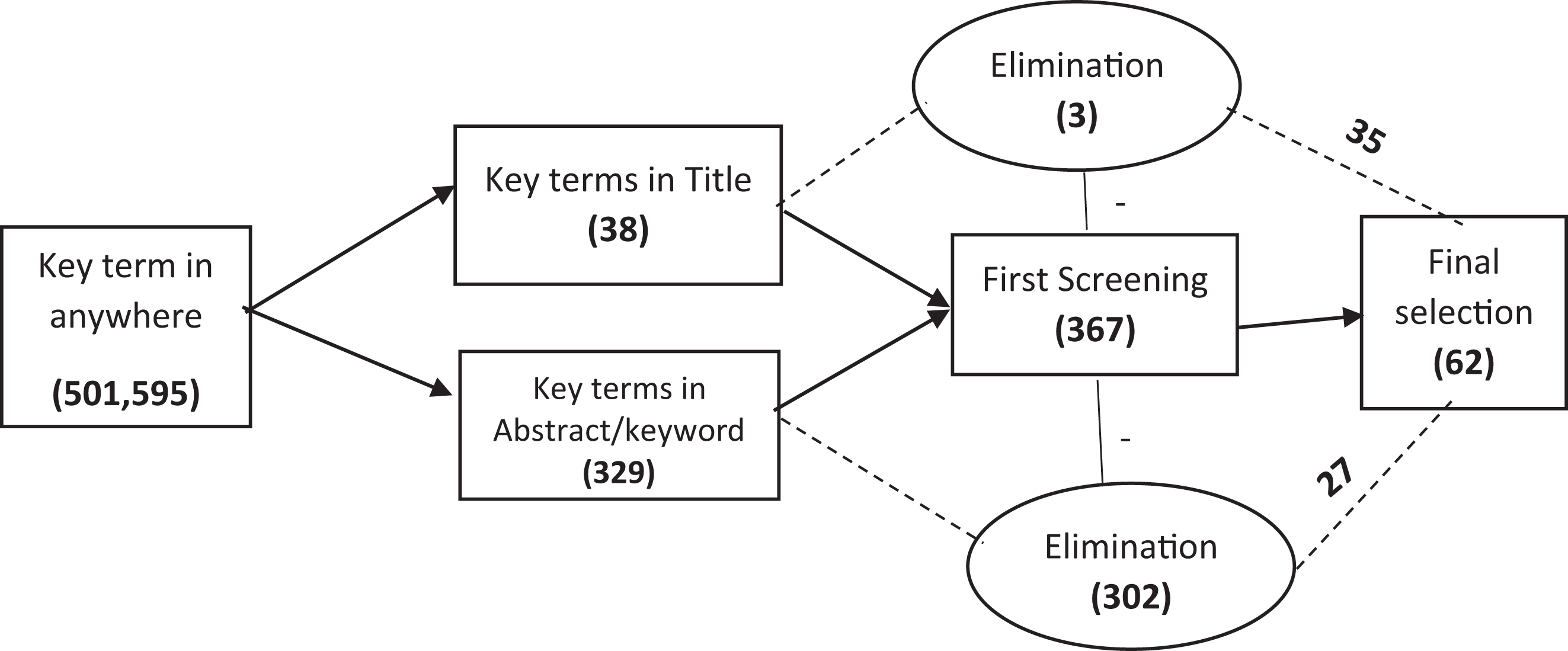
Study selection procedure. Source: Authors’ formulation 2018.
Consistent with Ashby, Leat, and Hudson-Smith (2012), the study focused attention on publishers of high-quality journals in these disciplines. Following Bishul and Alkadry (2017), we narrowed the search to Sage, Taylor and Francis, Wiley, Emerald, Elsevier/Science Direct, Springer and EBSCO. Subsequently we searched online journal database of these publishers from the period of 2000 and 2018 using the advanced search engines with Boolean function which allows for selective search for key words (Denyer and Tranfield 2009). The key term “local government” AND “transparency” or “open data” were searched within titles, abstracts and key word. The initial search produced a hit of 501,595 studies, which was further reduced to final 62 studies using high order screening procedures at the evaluation stage.
At the selection and evaluation stage, the initial downsizing focused on studies that focused on transparency in the local government. The search was further narrowed down to only studies that conspicuously have the word “transparency” or “open government” on the title, abstract or keywords of the article and this pooled out 367 articles. Further screening considerations to ensure that only peer reviewed article in English language is included in the review. This resulted in the selection of 62 articles published in 35 journals for the review. Finally, the selected articles were thoroughly read, analyzed and summarized using excel spreadsheet. Detail information on the 62 articles included in the study is shown in Table 1.
Information on Articles Reviewed for the Study.
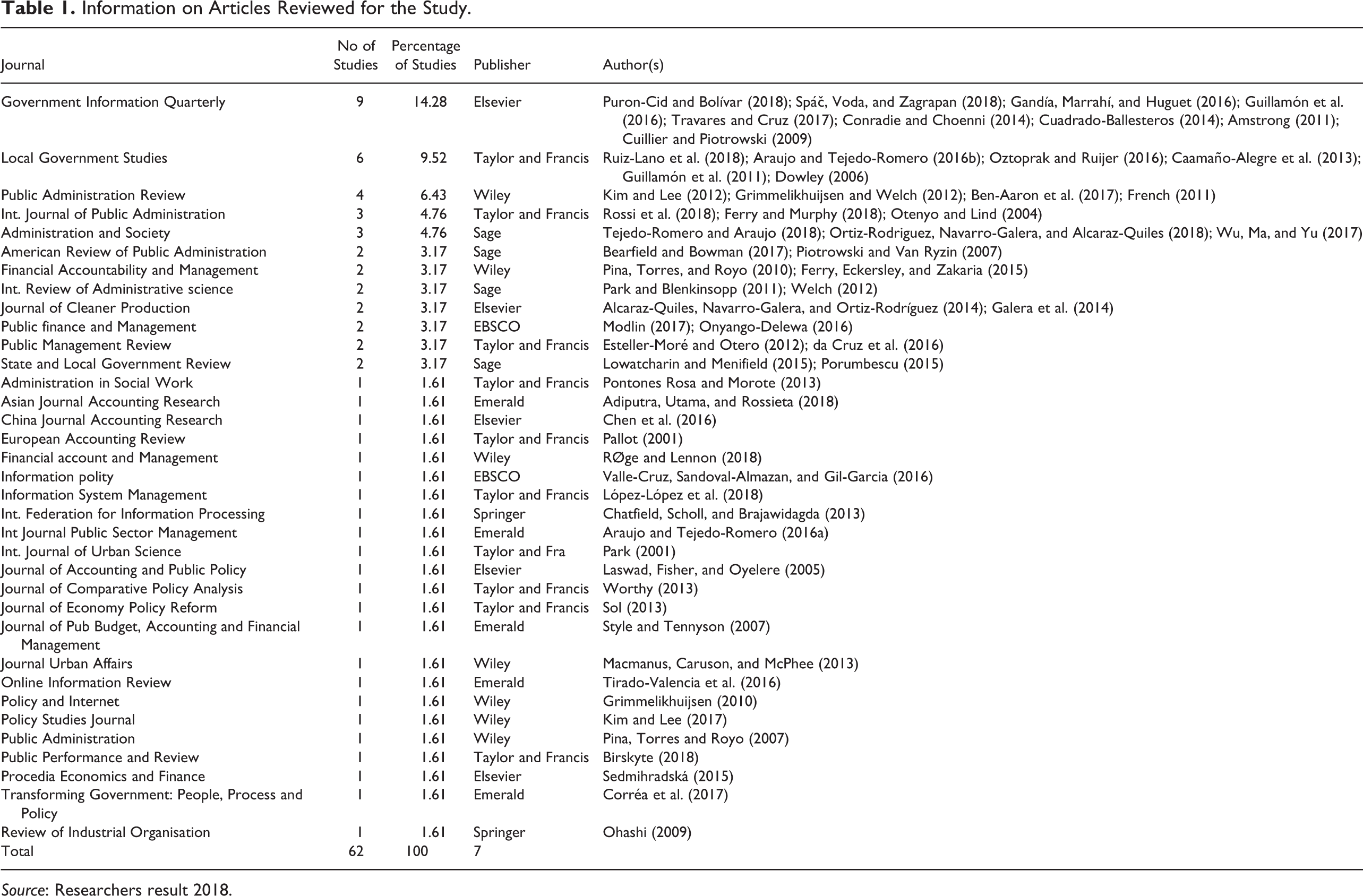
Source: Researchers result 2018.
Results and Discussions
Descriptive Analysis
An examination of 62 studies reveals a remarkable growth in research output in the twenty-first century. While research output was as low as 16 percent in the first decade of the century, the second decade has seen an upsurge to 84 percent. This trend is consistent with the finding of Cucciniello, Porumbescu, and Grimmelikhuijsen (2017) in the public sector as a whole. This implies that transparency in public administration has gain increased acceptance in the twenty-first century. The increasing research output may be attributed partly to Barrack Obama’s transparency initiatives in 2009 (Meijer 2012) and the subsequent conferences on government transparency across Europe (Meijer 2012; Cucciniello, Porumbescu, and Grimmelikhuijsen 2017). The data in Figure 2 shows the trend of research output in local government transparency.
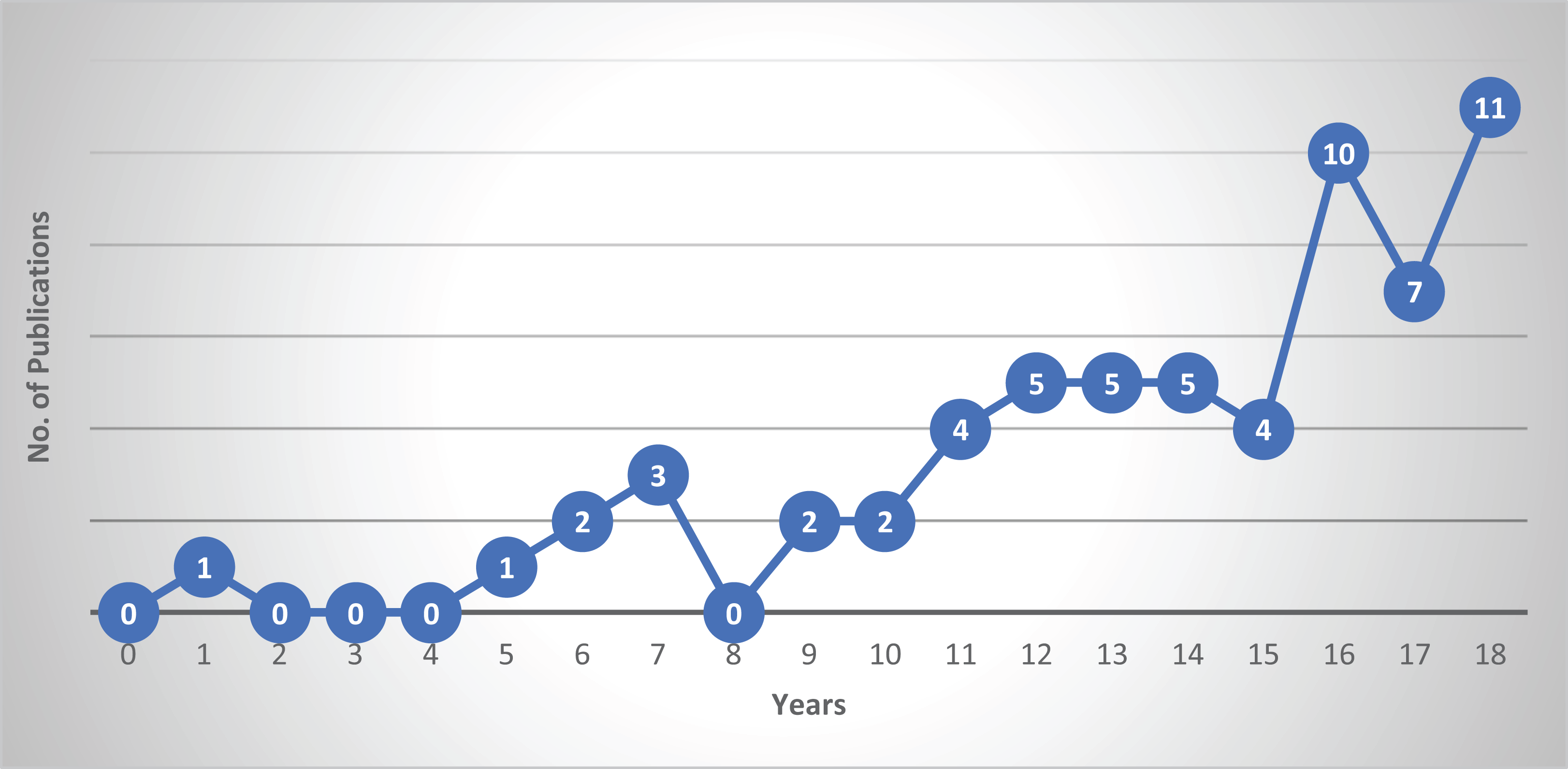
Trend of local government transparency research 2000–2018. Source: Research result 2018.
To appreciate the geographical spread of local government transparency, we analyzed the regional distribution of the research output and the result is displayed in Table 2. The study found a significant variation in research output across the continents. Even though the world is witnessing rapid research growth in local government transparency, the growth is skewed toward Europe and North America which collectively turned out 78 percent. A country specific analysis indicates that Spain, the Netherlands, United Kingdom and the United States of America are the major hub of these publications. Perhaps, this pattern is influenced by Obama’s transparency initiative in 2009 and the series of conferences on government transparency organized in Europe over the period. On the other hand, the research output in local government transparency is low particularly in Africa, South America and Oceania, perhaps for the reason that transparency has not “become hot” (Meijer 2012, 3) yet in these continents because of their state of development and the associated idiosyncrasies of administrative structures.
Research Output by Continent and Country.
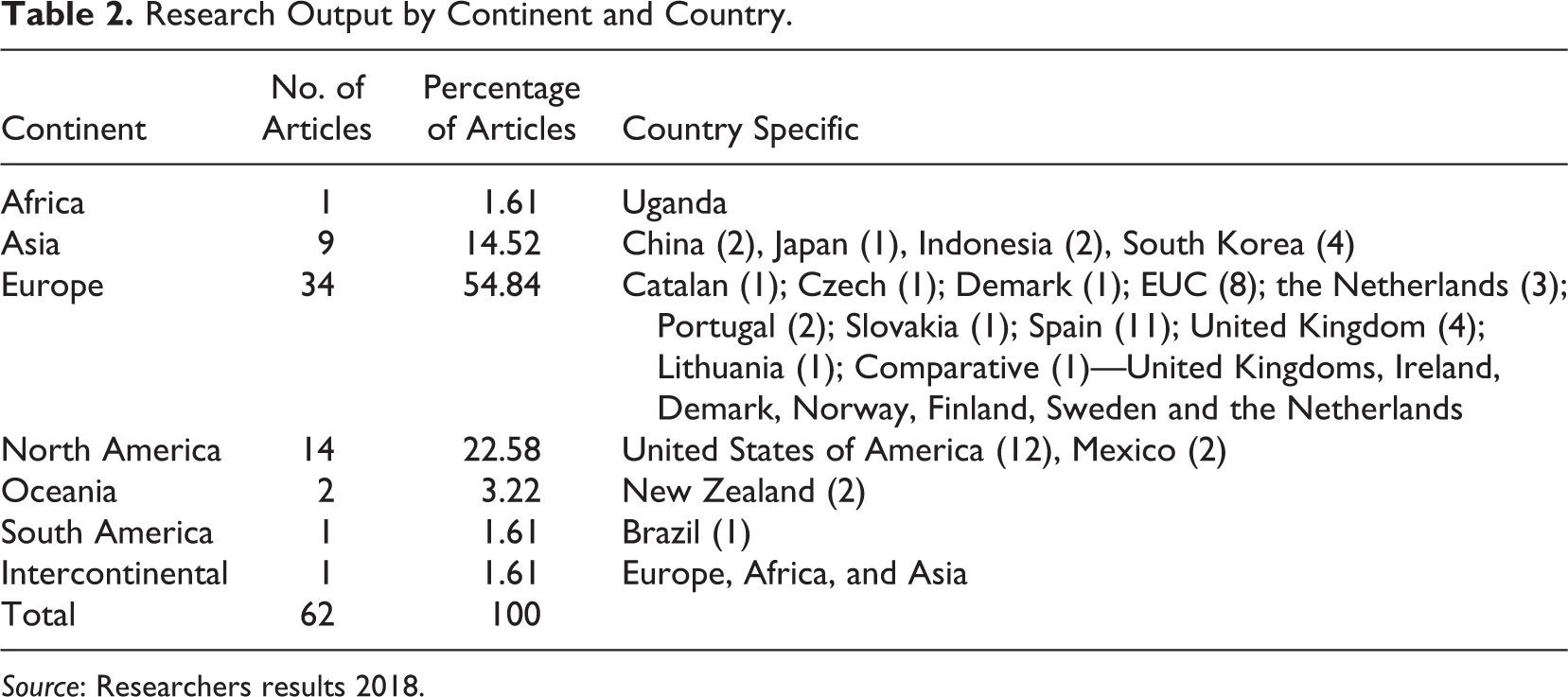
Source: Researchers results 2018.
Why Some Local Governments Are More Transparent?
The study finds that social, economic, political and institutional factors account for transparency in the local governments. The social factors studied in the literature include population size, gender of the mayor of the municipality and gender of councillors. There is consistent evidence of a positive relationship between population size and the level of transparency of the local government. Large municipals are found to be more transparent than the smaller ones for the reason that large municipals mobilize a lot of resources which propels them to disclose more information to the citizens (Guillamón et al. 2011; Sol 2013; Araujo and Tejero-Romero 2016a; Spáč, Voda, and Zagrapan 2018). Some studies also conclude that the gender of the mayor has a significant effect on transparency in the local government. Female mayors are found to regress positively with transparency of the municipals (Araujo and Tejedo-Romero 2016b; Spáč, Voda, and Zagrapan 2018). Further, studies confirm that the number of female councillors is positively related to transparency of the local government (Araujo and Tejedo-Romero 2016b; Tejedo-Romero and Araujo 2018). Economic factors examined in the selected studies include tax per capital, transfers, and unemployment. Evidence unanimously show that tax per capita has a positive impact on transparency of the local government, for the reason that a local government under fiscal pressure has to provide more information to the citizens to persuade them to honor their tax obligations (Guillamón et al. 2011; Araujo and Tejedo-Romero 2016b). Similarly, the more transfers a local government received the more information it discloses to the citizens, all other things being equal (Guillamón et al. 2011). The debate on the effect of unemployment on transparency remained unsettled. However, most studies support the claim that unemployment has a negative relationship with transparency of municipals (Araujo and Tejedo-Romero 2016b; Tejedo-Romero and Araujo 2018).
Political drivers investigated in the selected studies are electoral turnout, political competition, and political ideology. Election turnout is a major political variable that explains transparency. A low election turnout leads to high level of transparency in the local government for the reason that government has to conduct much more education to increase the subsequent turnouts (Araujo and Tejedo-Romero 2016a, 2016b; Tejedo-Romero and Araujo 2018). In relation to political competition, increase political competition increases transparency in the local government. In other ways, political strength (absolute majority) decreases transparency since the government in power may become complacent due to absence of political competition (Dowley 2006; Sol 2013; Araujo and Tejedo-Romero 2016b; Tejedo-Romero and Araujo 2018). The relationship between political ideology and transparency has been inconsistent as some reported positive relationship (Guillamón et al. 2011; Sol 2013), negative relationship (Araujo and Tejedo-Romero 2016a) and no relationship (Araujo and Tejedo-Romero 2016b). Institutional factors considered the selected studies are location of the municipal and civil society activism. Municipals located in the capital are found to be less transparency than those outside the capital (Sol 2013) for the reason that those municipals may be affected by the heavy presence of the central government in public administration in the capital. Dowley (2006) also found that involvement of civil society organizations and the media improves transparency of municipals. Thus, political and institutional factors are significant determinants of transparency of the local government. Ruiz-Lozano et al. (2018) found that administrative culture context affects transparency practices on sustainability in the local government.
Information Technology and Transparency
The use of internet to provide information to the public have been found to improve transparency for the reason that internet makes it easier and convenient for citizens to locate and access official information and to conduct transactions (Pina, Torres, and Royo 2007; Cuillier and Piotrowski 2009; Pina, Torres, and Royo 2010; Rodríguez Bolívar, del Carmen Caba Pérez, and López-Hernández 2015; Bearfield and Bowman 2017). It is largely agreed in the selected studies that the mere provision of information on the internet or website does not improve transparency unless the technology is interactive (Valle-Cruz, Sandoval-Almazan, and Gil-Garcia 2016; Song and Lee 2016). Studies concerned with the transparency enabling power of the internet in the local government investigated the information technology tools employed, motivation for use of the information technology and citizen’s reactions.
Information technology tools often employed in discharging transparency comprise the website and social media such as Twitter, Facebook and You Tube (Cuillier and Piotrowski 2009; Chatfield, Scholl, and Brajawidagda 2013; Song and Lee 2016; Valle-Cruz, Sandoval-Almazan, and Gil-Garcia 2016; Guillamón et al. 2016). The use of website is the most popular technology among the local governments (Cuillier and Piotrowski 2009; Valle-Cruz, Sandoval-Almazan, and Gil-Garcia 2016; Tavares and da Cruz 2017). Transparency through the website is the means by which an organization makes information about its affairs available via timely publication on the official website (Pina, Torres, and Royo 2010). Social media including Twitter, Facebook and You Tube have also been used to promote transparency (Chatfield, Scholl, and Brajawidagda 2013; Valle-Cruz, Sandoval-Almazan, and Gil-Garcia 2016). Social media is found to be an effective tool for improving citizens’ trust in government through transparency. Transparency mediates the relationship between use of social media and citizens trust in local government (Grimmelikhuijsen and Welch 2012; Song and Lee 2016; Valle-Cruz, Sandoval-Almazan, and Gil-Garcia 2016). Chatfield, Scholl, and Brajawidagda (2013) examine the use of You Tube in promoting transparency and argue that social media tools lack the potency to evoke local government transparency. The effectiveness of social media, particularly You Tube, to improve transparency in local government is enabled by transformational leadership’s strong political will and strategic deployment of social media (Kim and Lee 2017).
Studies concerned with the kind of information disclosed on websites and social media found that local governments are developing increasing interest in using the websites to discharge fiscal and financial transparency and sustainability transparency. Some studies focused on fiscal and financial transparency, to explain why some local governments are more transparent in fiscal and financial matters than others (Laswad, Fisher, and Oyelere 2005; Style and Tennyson 2007; Puron-Cid and Bolívar 2018). These studies have underscored the importance of disclosure of historical financial information online. The decision of a local government to disclose financial information using information technology is associated with several factors including include leverage, municipal wealth (higher income per capita), press visibility, local government type, the number of residents and budget transparency (Esteller-Moré and Otero 2012; Caamańo-Alegre et al. 2013; Onyango-Delewa 2016).
Again, disclosure of information on local government sustainability on website is receiving increasing attention in the literature (Alcaraz-Quiles, Navarro-Galera, and Ortiz-Rodríguez 2014; Ferry and Murphy 2018; Rossi, Brusca, and Aversano 2018; Tirado-Valencia et al. 2016; Galera et al. 2014; Ortiz-Rodriguez, Navarro-Galera, and Alcaraz-Quiles 2018; Vicente-López-López et al. 2018). The aim of these studies is to provide understanding on sustainable practices and information technology in the local government. The need for local governments to use the website and other information technologies to render transparency on sustainability matters to the citizens have been emphasized. Disclosure of information on sustainability on local governments’ website depends on socio-economic factors (education, population density and access to internet) and e-governance factors such as level of online services provided and broadband availability (Alcaraz-Quiles, Navarro-Galera, and Ortiz-Rodríguez 2014; Tirado-Valencia et al. 2016). In general, the employment of information technology in providing transparency is a function of geographic, demographic, socioeconomic, institutional and political factors.
How citizens react to the rise of technology in the discharge of transparency in the local government was a theme is selected studies. Citizens expect information technology to improve transparency and empower them to monitor and evaluate government performance and foster a broader interaction between them and the government (Pina, Torres, and Royo 2010). The use of website and social media improve citizens’ perception of transparency but relationship gets better when the website or social media is interactive to permit electronic-participation in decision making (Valle-Cruz, Sandoval-Almazan, and Gil-Garcia 2016; Guillamón et al. 2016).
Freedom of Information and Transparency
The waves of freedom of information have swept through out the globe in the twenty-first century, to the extent that by 2017 over 115 countries have passed a Freedom of Information (FOI) laws (Spáč, Voda, and Zagrapan 2018). The generic objective of FOI laws is to provide access to information to the public as a matter of right (Worthy 2013; Spáč, Voda, and Zagrapan 2018). Worthy (2013) and Spáč, Voda, and Zagrapan (2018) prove that FOI has improved transparency in the local government. Using documentary analysis, Worthy (2013) revealed that FOI has made local government proactively transparent even for those municipalities that were practicing openness prior to the passage of the FOI Act in the UK in 2000. In support, Spáč, Voda, and Zagrapan (2018) perform an experiment on the extent to which Slovak local government responds to public requests for information under the FOI Act and conclude that the FOI requests led to high level of responsiveness of the local authorities, thereby increasing transparency of the local authority. Generally, the passage and implementation of FOI laws has increased transparency of the local government
Relationship between Transparency, Accountability, Trust, and Corruption
Some claims have been made in the literature about transparency in government including improving accountability, boosting government trustworthiness, reducing corruption and improving government responsiveness. Stream of empirical studies therefore set out to test these claims in the real world (Pina, Torres, and Royo 2010; Ferry, Eckersley, and Zakaria 2015; Grimmelikhuijsen 2010; Park and Blenkinsopp 2011; Grimmelikhuijsen and Meijer 2014). Ferry, Eckersley, and Zakaria (2015) examine how various reforms in the English local government influence the relationship between transparency and accountability in the local public services. They show that the relationship between transparency and accountability is not consistent. In the specific case, it was concluded that transparency reforms in the UK local government has reduced accountability. The claim that transparency improves accountability of local governments lacks conclusive empirical support.
Further, the evidence that transparency boosts trustworthiness of government is inconsistent. That is, transparency was either found to reduce trust in government or serve as a mediating factor in trust building. Grimmelikhuijsen (2010), in an experiment, suggests that citizens exposed to more information were more negative in perceived competence of decision makers than those with little or no information. Moreover, Grimmelikhuijsen and Meijer (2014) buttress that the relationship between transparency and trust is partly influenced by the perceived credibility of the information provided, prior knowledge and general predisposition. Therefore, there is lack of support to the claim that transparent government is a trustworthy government, except that transparency acts as a mediating variable.
Corruption reduction through transparency is a common claim in the theoretical literature. Valle-Cruz, Sandoval-Almazan, and Gil-Garcia (2016) investigates how citizens’ use of information technology impact on their perceived transparency, efficiency and corruption in local government. They show a moderate relationship between transparency and corruption, however could not establish a causal relationship between them. It implies that transparency has no direct influence on corruption and rehashes the mediating effect of transparency on citizens’ satisfaction and corruption found in Park and Blenkinsopp (2011). The evidence available points toward the conclusion that transparency by itself cannot eradicate corruption in local governments but should be backed by concrete policy actions.
Future Research Implication
Generally, knowledge on transparency in the local government is in the increase, however the growth seems to be skewed to Europe and North America. This implies that there is a knowledge gap of other jurisdictions particularly in Africa, Asia and South America. This calls for research focus on these continents and countries so as to provide a broader understanding of transparency within diverse administrative settings across the globe. With increasing democratization of these neglected areas, transparency initiatives are becoming prominent in the local governments which implores research efforts. It is anticipated that research interest will improve in these neglected continents due to global efforts to promote good governance in these parts of the world.
The potential of information technology to improve transparency in the local government have been demonstrated in the literature (Pina, Torres, and Royo 2010; Bearfield and Bowman 2017). The fast-changing state of information technology should be met with equal pace of research on local government transparency to understand the potency of the tools available to the local governments to improve transparency. Therefore, more research is necessary to unravel creativities and innovations in the employment of information technology to advance transparency in the local government. In addition, the impact of transparency initiatives such as the promulgation of FOI laws on information disclosure via internet and other information technologies merits investigation.
Much research attention has been given to the drivers of local government transparency. The influence of social, economic, political and institutional factors on transparency in local government setting have been well acknowledged. However, the results of the various studies are largely inconsistent and inconclusive. Therefore, further study is needed to provide a conclusive evidence on the social, economic, political and institutional factors that determine local government transparency.
The result of the review suggests that researches on local government transparency are executed on the assumption that citizens of local governments have demand for information about the internal operations of the local government. However, the work of Piotrowski and Ryzin (2007) shows that the characteristics of the citizens affect the demand for transparency supply in the local government. Citizens were found to have different degrees of interest in demanding transparency. This contrast the assumption that citizens would always be interested in receiving more information from the local government. Currently, less attention has been given to the demand side of the transparency chain in the literature. Future research should be directed to better understanding of the attitude and characteristics of citizens in relation to transparency in local government. If not so, local governments’ effort to provide more useful information would not achieve the expected results. Again, the capability of the citizens to use the information provided by local government to monitor and evaluate performance may be overestimated. Transparency chain is incomplete until the information provided is received and used appropriately citizens. Meanwhile, the capacity of citizens to engage the information rightly is critical but our review found no study that examines the effect of citizen’s capacity on local government transparency. Thus, future studies should focus on understanding and assessing the capacity of citizens to engage with the information provided to complete transparency loop.
Conclusions and Implications
The importance of transparency in local government is underscored in the study, particularly because of the closer link between the local government and the citizens. The study aims at providing a synthesis of existing literature on local government transparency to describe the current state and themes of research in the twenty-first century. The study found increasing research output on local government transparency in the twenty-first century with Europe and North America being the major contributors. There is a low research interest in local government transparency in Africa and South America, probable due to administrative cultures and other governance factors. In the review social, economic, political and institutional factors are found to account for transparency in the local government, however the findings are inconclusive. In addition, the review result showed that transparency mediates trustworthiness of government and eradicates corruption. So, the mere provision of information about local government does not translate into increase accountability, trust and reduction in corruption.
It was also found that information technology and FOI laws are critical in improving transparency among the local governments as they ensure easy and free access to information. Taken together, transparency in local government has become a norm rather than exception across the globe. Local governments are increasingly employing information technologies including the websites and social media platforms to meet the demand for transparency by posting their information on these platforms and in some cases interacting with the citizens. The use of information technology to advance transparency is found to be positively correlated to citizens participation and trust in local government. Many local governments are investing in information technology to meet the information pressure associated with FOI laws thereby making information truly available and accessible.
The study results present some implication for local governments. It does not only implore local governments to be transparent but also to invest resources in information technology infrastructure to promote transparency. This may place a financial burden on some small local governments, especially those in developing countries that lack resources. State or central governments are encouraged to provide financial and other support to such local governments to promote transparent local governance for the betterment of the citizens.
Footnotes
Declaration of Conflicting Interests
The authors declared no potential conflicts of interest with respect to the research, authorship, and/or publication of this article.
Funding
The authors disclosed receipt of the following financial support for the research, authorship, and/or publication of this article: Funding has been received from Ghana Education Trust Fund.
