




Abstract
Scholars and policymakers claim open government offers a panoply of good governance benefits, but it also risks political abuse as window dressing or a smokescreen. To address this risk, this article builds on the meaning of openness through an examination of closed and open society in Karl Popper’s theory. Four historic trends in open government reform are analyzed. The findings suggest a need for new attention to Popperian notions of the social technologist’s piecemeal change and mechanical engineering aimed at serious policy problems. Without appreciation of these open society linkages, open governments will continue to paradoxically co-exist alongside closed societies.
Introduction
The early part of the 21st century witnessed the growth of an administrative reform movement called open government (Catlaw & Sandberg, 2014; Grimmelikhuijsen & Feeney, 2017; Pyrozhenko, 2017). The movement took on a variety of organizational initiatives such as industry-specific anti-corruption compacts (e.g., the Extractive Industries Transparency Initiative [EITI]), data science coalitions (e.g., the Open Data Institute [ODI]), and multi-country agreements on openness in government (e.g., The Open Government Partnership [OGP]). While the methods among these organizations differ, what unites them is their quest to instill “openness” into government either through the medium of the organization’s own operations or by encouraging other entities to do the same.
According to scholarly formulations, openness in government involves relationships of at least two parties where a party in government provides information or decision-making channels for influence or debate of that information to another entity with legal rights. These two channels are transparency and participation (Meijer, Curtin, & Hillebrandt, 2012). Transparency gives “vision” to citizens and government actors through proactive publishing of information about government affairs such as websites, open data, or traditional methods such as radio or television broadcasts. Transparency is thus the public’s resulting ability to see and comprehend information. On the contrary, participation concerns the provision of public decision-making opportunities such as service reporting and crowdsourcing platforms or traditional methods such as political elections and referenda. Participation is the public’s ability to express their “voice” on how activities should be undertaken (Meijer et al., 2012).
In open government reforms, various public organizations or initiatives have tried to achieve greater openness by focusing policy efforts on specific benefits in terms of transparency and participation (Grimmelikhuijsen & Feeney, 2017; Lathrop & Ruma, 2010). For example, to take the above-mentioned cases, the EITI aims to use open data to make raw minerals companies more responsible. Thus, the primary components explicitly emphasized by the EITI is transparency. The OGP, in contrast, has a civil society-with-government model of co-governance and emphasizes both participation and transparency, in addition to transparency. All of these initiatives also have a strong technology flavor emphasizing websites and apps that can deliver information to digital devices.
While the conceptual contours of open government are still being shaped and defined, scholars have suggested there may be inherent difficulties with this endeavor because attempts to equate abstract ideals such as transparency and technology (Yu & Robinson, 2012), openness and democracy (Pyrozhenko, 2017), or transparency and efficiency (Lourenço, Piotrowski, & Ingrams, 2017) that are related although not necessarily commensurable may lead to ambiguity that erodes their individual significance rather than uniting them conceptually. The trouble of reconcilability becomes clearest when public organizations try to turn open government rhetoric on ideals into concrete policy reforms that try to do multiple things at once. Not only does this give the movement an impression of being quite vague in its conceptual boundaries as well as the specificity of its goals but the deeper danger is that open government might function as a “magic concept” (Pollitt & Hupe, 2011), or become a label that can be used as easily while actual government activities or reforms may possibly take on more harmful effects behind the windows such as manipulation (Lodge & Wegrich, 2015; Worthy, 2015) or reinforcement of private interests (Catlaw & Sandberg, 2014). Open government reforms thus may not only be quite ambiguous but they may result in closed kinds government behavior.
The goal of this article is to add to the stream of literature (e.g., Catlaw & Sandberg, 2014; Pyrozhenko, 2017; Worthy, 2015) that questions these simplistic assumptions about open government and good governance outcomes. However, the article furthers earlier approaches first by exploring more systematically the concept of openness’s opposite: closedness. Second, it develops the theory of open government and puts forward some practical suggestions about how open government policies can reduce these risks in the future. To meet these goals, the research applies Karl Popper’s theories from his magnum opus, The Open Society and Its Enemies. The claim made in Popper’s book is that democratic government needs to be based on an “open society.” Popper was aware that openness is an inherently malleable idea that is vulnerable to exploitation, but that did not detract from the fact that it is an invaluable principle that costs society dearly when it is not protected. However, it is important to understand what exactly Popper meant by openness and how this meaning differs from current versions of open government. Popper’s political vision is not an administrative one in the way that open government is. But political systems are essential for developing our administrative systems. In democratic theory, the political will of the “demos” is enacted through public administrators, so it is vital to connect administrative reform approaches such as open government with democratic theory (Box, 2015; Mosher, 1982; Pyrozhenko, 2017). Popper’s open society is well placed to do this; to refresh and strengthen our ideas about open government before they become dismissed as empty promises and political spin.
Accordingly, the present article will start with a discussion of the theory of open society focusing on its key contributions to the meaning of openness and closedness. The article then involves an evaluation of four different trends in open government reform using a Popperian framework. Finally, the evidence from the analysis will be used to develop the framework and outline the basic principles of an open society–based perspective of open government.
Open or Closed: The Theory of the Open Society
This section explores the work of Popper and other open society theorists using the lens of open and closed forms of society, which was the dichotomy adopted by Popper and his intellectual predecessors and successors for understanding central choices available to governmental decision makers. At the end of the section, the key characteristics of closed and open society form the basis of a theoretical framework that can be used to analyze existing open government reforms from a Popperian perspective.
Popper’s idea of the open society was borrowed and adapted from one of his intellectual predecessors, the French philosopher and scientist Henri Bergson. Bergson’s (1977) The Two Sources of Morality and Religion (first published in 1935) is widely cited in Popper’s The Open Society and Its Enemies (first published in 1945). Bergson believed that human society has two inseparable elements: closed society that is shaped by an instinctive, conformist nature and open society that is shaped by mystical human creativity. Open societies are able to take conflicting elements in tension—such as freedom and fairness—and use human genius to find a solution or balance between them; the open society, according to Bergson, draws together conflicts or tensions between different values, qualities, or ideas. Popper similarly believed that open society was the most conducive environment for human flourishing, but he saw its genius as a rational expression of ideal human relations rather than a mystically inspired state as Bergson did.
Popper also had an explanation of how open societies emerge from closed ones. He characterized the shift to the open society as a recognition of a “critical dualism” where decisions about government and authority begin to distinguish between natural laws and normative laws; facts and decisions. In the open society, public administrators and decision makers (Popper calls these the “social technologists”) are involved in a dynamic, creative process of critiquing (rather than accepting) the old (facts) and developing the new (decisions), which allows a rational, open approach to decision making and design.
Four key characteristics of openness flow from the idea of critical dualism. First, Popper put forward the idea (analogous to his theory of falsification in philosophy of science) that it is the responsibility of government not to find the best or perfect models of organization, but to negate the harmful (closed) models. Rather than Plato’s original question of political science, which is “who should rule?” Popper (1977) asks, “how can we so organize political institutions that bad or incompetent rulers can be prevented from doing too much damage?” (p. 121). This approach does not proceed, as it were, from a doctrine of the intrinsic goodness or righteousness of majority rule, but rather from the baseness of tyranny; or, more precisely, it rests upon the decision, or upon the adoption of the proposal, to avoid and to resist tyranny. (p. 124)
Popper’s second tenant is that closed society forms are built by utopian engineers while the open society is best served by the mechanical engineer. The third tenant is that open and closed society are characterized by piecemeal versus utopian styles of decision making, respectively. In deciding how to design an institution, the closed or “utopian” social engineer sees the value of experimentation through social experiments that require sweeping changes and the perfection of end states or systems. By contrast, the mechanical engineer carries out projects in a piecemeal way “under realistic conditions, in the midst of society in spite of being on a ‘small scale’, that is to say, without revolutionizing the whole of society” (p. 162). Unlike the utopian who tries to understand the origins and essence of something in a perfect state, the mechanical engineer or technologist asks the question, “if such and such were our aims, is this institution well designed and organized to serve them?” (p. 22).
Popper is worried here not about social engineering per se but the style of decision making that it can represent: an attempt to change institutional conditions and models once and for all for the good of all times and situations. In both approaches, designers seek to change institutions in some form, but the utopian social engineer wants to do so on a large scale and has authoritarian ideas about the goals in question being self-evident or beyond the need for verification. The mechanical social engineer, on the contrary, sees resources and technologies as an interconnected whole that requires attention to be focused on the smallest parts first and to move forward in a piecemeal, goal-oriented way. The utopian claims to have the answers and mobilizes evidence to find verification, while the mechanical engineer is an instinctive skeptic and probes the smallest steps of a plan, seeking to mobilize evidence toward falsification. Fourth, the mechanical engineer has a universalist view of change where, theoretically, every person can potentially benefit, and creativity and freedom are valued. As such, goals do not seek end states where political and social arrangements of relationships are final but seeks to mobilize efforts around the problem of clear and insidious “evils.”
Table 1 presents these four main characteristics of the theory of the open society in a conceptual framework. The table also introduces the dimensions of transparency and participation from open government. Each are described in relation to the open and closed society characteristics to show how we might hypothetically expect transparency and participation to function under an open society approach to open government.
Characteristics of the Open Society and Hypothetical Functions of Transparency and Participation.
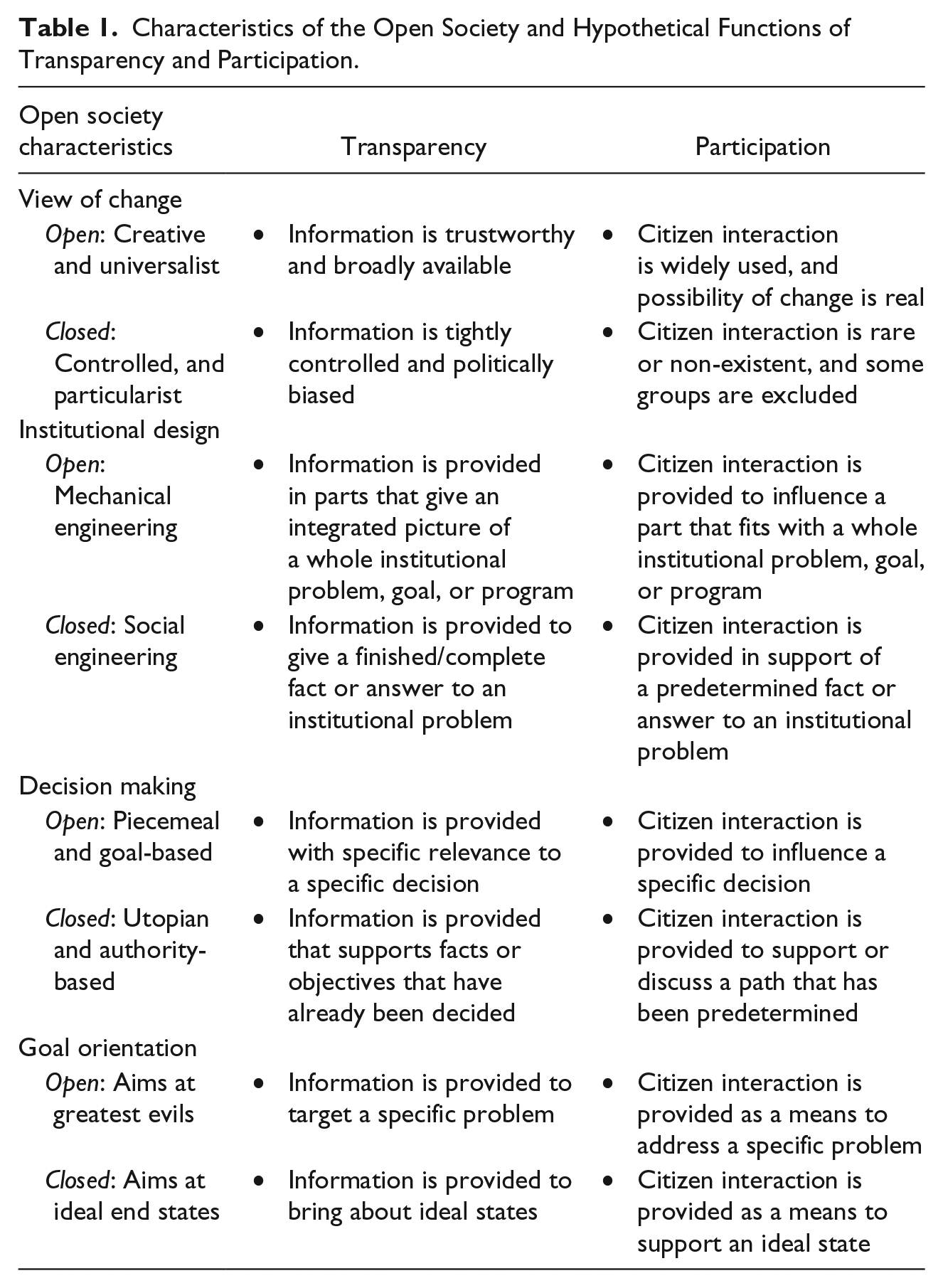
In Table 1, in the open view of change where reforms support creativity with everyone equally free to influence change (universalist, not particularist), transparency means that information would be widely available for everyone and would be trustworthy and reliable. Similarly, participation opportunities would be widely available to everyone and policy consequences of participation would be real and practical. In the institutional design dimension, reforms proceed by mechanical engineering. Transparency would provide decision-makers with reliable information that gives an integrated picture of institutions and how they work. Correspondingly, participation would be integrated into the full processes and workings of institutions. In the decision-making dimension, open government reforms would operate in a piecemeal way. Both transparency and participation would therefore be well matched to specific step-by-step decision-making agendas and opportunities. Finally, in relation to the dimension of goal orientation, which aims at specific problems or “evils,” transparency and participation opportunities are provided to address specifically defined problems that need to be fixed.
Trends in Open Government Reform
This article now seeks to further develop the open society perspective of open government begun in Table 1. To do this, the article reviews scholarly knowledge of four historic trends in open government reform and then evaluates them in terms of open society’s four characteristics: view of change, institutional design approaches, decision-making modes, and goal orientations. While not every instance of open government reform can possibly be discussed here, four major cases are presented under four historical phases in open government. These phases were identified through a systematic review of scholarly literature found using the Web of Science electronic library and Google Scholar. Earlier efforts to review open government literature such as by Meijer et al. (2012) have focused on developing understanding of the open government concepts of transparency and participation. But the goal in this instance is more narrowly to locate types of policies, initiatives, and laws in the history of public administration reforms that are explicitly identified in scholarship with the “open government” label. Thus, titles, abstracts, and keywords of political science and public administration journals, conference proceedings, and books were searched using open government search terms (“openness,” “open government,” and “open governance”).
This search resulted in 830 texts. The abstracts of the texts were read to eliminate texts unrelated to open government for reasons such as that the concept of “openness” was being discussed in personality, trade, or economic terms or that openness was being ascribed to a private or non-governmental organization. This reduced the sample to 178 texts. To build a broad historical picture of this corpus of literature, the main policies, initiatives, and laws in terms of the open government policies or initiatives addressed and their dates—or date ranges (e.g., “1990s”) if the text was not specific—were listed. In all, 127 texts were ultimately used for this historical survey as the other 51 of the texts were purely conceptual or theoretical in nature and used no empirical case or historical context for open government.
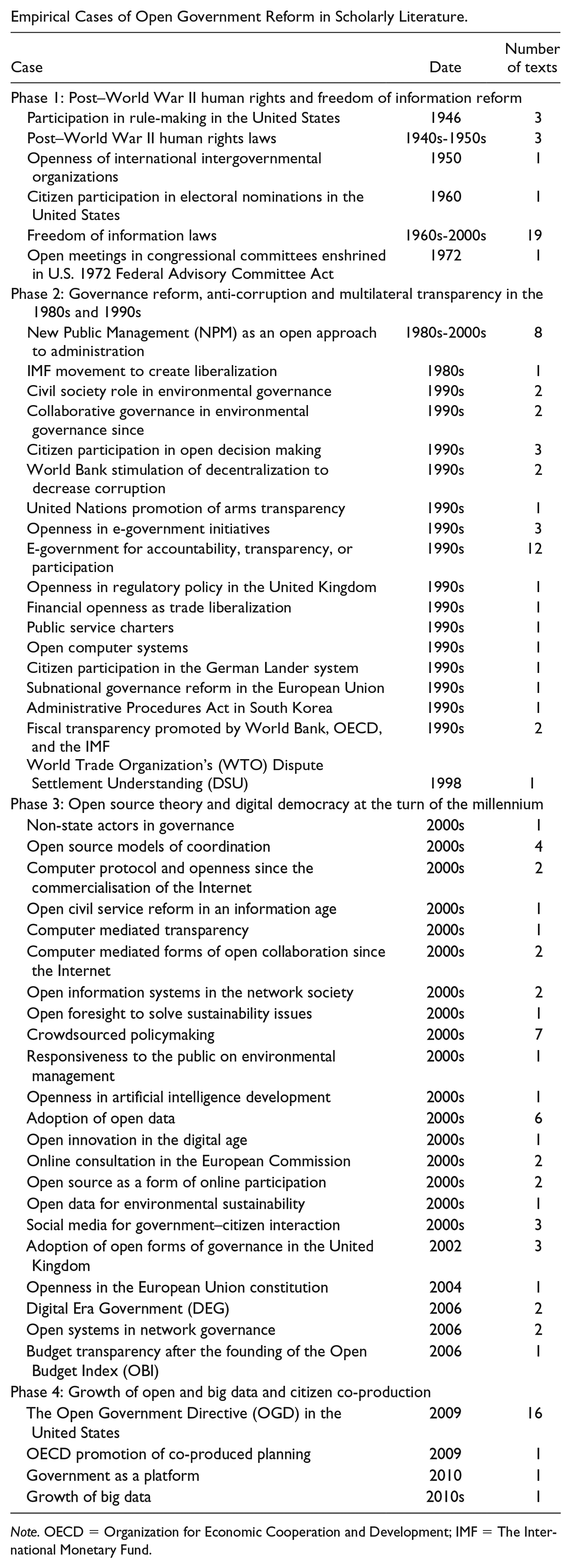
The review focused on recognizing variety rather than amalgamating the literature into common themes. There are 50 types of initiatives in total, with most featuring just once, although others are much more prevalent such as Freedom of Information (FOI) laws (N = 19) and the Open Government Directive (OGD) in the United States (N = 16). These trends have a certain amount of chronological order but they each continue into the present in such a way that they should not be seen in a linear fashion with one after the other. Many of these initiatives overlap or are recycled both conceptually and temporally, so rather than attempting to synthesize or discuss every case, four of the most prevalent types are selected: (a) FOI reform, (b) Anti-corruption governance reform, (c) Open source and digital democracy, and (d) Open data and citizen co-production. The full list of 50 types of initiatives is shown in the appendix.
FOI Laws
FOI laws are also sometimes called access to information (ATI) laws or rights. After World War II, information availability became enshrined in the Universal Declaration of Human Rights around the rights of citizens to have equal opportunities and access to public goods. Efforts to legislate gathered pace (Leitner, 1995). While the earliest known FOI law came from Sweden in 1766, the biggest push for ATI rights came in the second half of the 20th century beginning with Finland and then the United States in 1951 and 1966, respectively. FOI laws are primarily focused on addressing the problem of unaccountable or corrupt government actions. They have been adopted by governments with the idea that a government that operates in the open is more likely to foster honest behavior by policymakers, politicians, and citizens. Or, in the famous words of Judge Louis Brandeis, “sunlight is the best disinfectant.”
Performance Metrics and Reporting Requirements
Governance reform emerged in the 1980s as governments promoted transparency and performance measurement to counteract the supposed ineffectiveness of bureaucratic institutions and encourage behavioral correction aimed at public officials. According to Clark (1996), such reforms emphasized tough reporting requirements and benchmarking according to external standards. Globally, international multilateral organizations (IMOs), notably the Bretton Woods institutions of the World Bank and the International Monetary Fund (IMF), also tried to leverage greater financial openness (Stiglitz, 2002). IMOs conditioned foreign direct investment on the adoption of new governance instruments such as budget and contracting transparency to curb the practice of businesses buying public offices or directing cash into private accounts (Grindle, 2004). The role of businesses was also recognized in programs such as participatory anti-corruption initiatives that addressed corruption in society by including citizens and businesses in advisor forums (Velarde, Lafuente, & Sanginés, 2014). Reformers argued that when government actions are in the open, the market mechanisms of competition can generate positive effects for how effectively states govern (Johnsen, 2005).
Open Source and Digital Democracy
Open source computing, beginning in the 1990s, aimed to enable innovative software development and commercialization of software by making source code free to copy, use, and develop under non-proprietary copyright licenses. By the turn of the millennium, it provided an organizational model in Raymond’s (1999) influential paper on “The Cathedral and the Bazaar” arguing the hacktivist concept that free software enabled better organizational collaboration and problem solving than traditional, closed, elite models with privileged rights and top-down forms of control.
Open source theories then branched out to the digital democracy theories of Beth Noveck’s (2009) writing on “Wikigovernment” and the virtual state and Clay Shirky’s (2008) concept of “crowd power.” The notion of commons-based peer review from open source theory was extended to the sphere of politics to argue for decentralized models of network collaboration and public goods allocation (Benkler, 2013), while crowdsourcing to improve the quality of policies and imbue them with greater legitimacy also featured more frequently among the repertoire of new public participation initiatives (Mergel & Desouza, 2013).
Open Data and Citizen Co-Production
By the end of the first decade of the 21st century, government transparency had already moved away from the one-way platforms of websites and service transactions of the 1990s to more flexible models of organization. The goal of this digitization of information was to tailor services to citizen needs in a more responsive way through open data and co-production (Dunleavy, Margetts, Bastow, & Tinkler, 2006; Fishenden & Thompson, 2012). Citizen knowledge could also be harnessed and applied to policymaking in an automated way through regulation with big data algorithms (Driscoll & Walker, 2014; Yeung, 2017).
In the United States, Barack Obama’s first policy statement when he became president in 2009 was executive order (M-10-06) to the U.S. federal agencies, the OGD. This approach, which was replicated in many other countries, mandated publication of open datasets and called on heads of public agencies to promote the principle of transparency, participation, and collaboration within government and between government and private institutions (McDermott, 2010). The OGD also envisaged a more tech-savvy government that could develop new information and communications technology (ICT) projects in the open with the help of citizens through open data (Lee & Kwak, 2012). O’Reilly (2011) coined the expression “government as a platform” to describe this style of open government, harkening to the digital hosting and sharing qualities of software developers.
Open Government Through the Lens of the Open Society
It still remains to synthesize these discussions into some final principles concerning the open society perspective of open government. To what extent do we already see an open society approach in the four historic trends of open government? Table 2 summarizes the four open government trends according to the four open society characteristics. Each cell builds on Table 1 by describing how the reform trends operate in terms of their view of change, institutional design approach, decision-making approach, and goal-orientation approach. The open society characteristics of the reforms are evaluated below by assessing the degree to which they each adhere to an open society approach to open government. Specific strengths and shortcomings are emphasized and possible areas for future improvement in open government reforms are proposed.
Open Society Characteristics of Four Open Government Reform Trends.
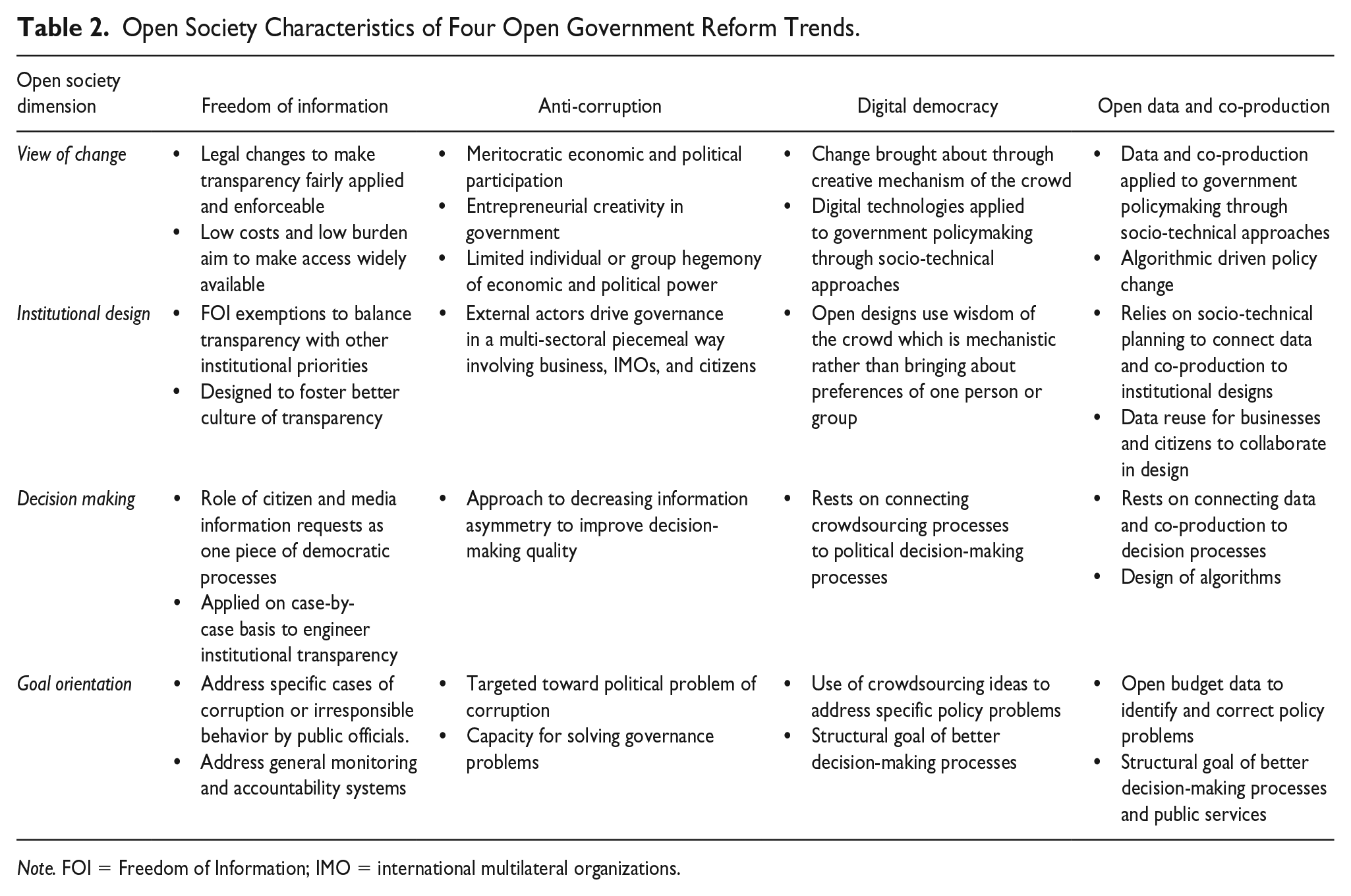
Note. FOI = Freedom of Information; IMO = international multilateral organizations.
View of Change: Open Creativity and Universalism
Hypothetically, an open society approach to governmental change would provide as wide as possible access to both information (transparency) and decision-making arenas (participation). These conditions enable citizens with different interests to freely pursue individual ends. Information provided publicly is reliable and shared in institutional context such as a context of what policies and laws pertain, and what scope or importance the information has for users of the information.
The four historic open government reform trends show several ways that access in both the sense of transparency and participation can be widened in a way that would in principle broaden access and participation without favoring specific individuals or groups, and thus support more open approaches to change. As detailed in Table 2, these reforms include laws that can be applied equally and fairly, use of technologies and open data to increase opportunities for access, opening up opportunities for creative or entrepreneurial reuse of data in open data programs using crowdsourcing, or fostering better market competition and entrepreneurialism in governance reforms. Consistently with a Popperian view of change, these initiatives often claim to make transparency and participation opportunities regularly and universally available to citizens. However, in contrast to Popper, digital democracy initiatives sometimes envisage a kind of political utopia (Hindman, 2008). Recent research has shown that, as the use of digital platforms in government grows, decision makers can better apply knowledge of socio-technical systems (linking human needs and technological processes) that enable wider political participation and attention to problem solving or public service provision (Desouza & Jacob, 2017; Janssen, Charalabidis, & Zuiderwijk, 2012).
Institutional Design: Mechanical Social Engineering
In the dimension of institutional design, transparency and participation support what Popper called a “mechanical engineering” approach to open government. To the extent that open government reform can be a platform for mechanical change, while also aiming at fundamental structural change to government–citizen relations, open government actually seems to stand ambiguously at the intersection of mechanical and utopian engineering approaches. Popper may not have foreseen the extent to which technological change would alter political structures, and perhaps it is inevitable today that mechanical designs are intertwined with large structural shifts in systems. However, if we follow Popper’s view that, in general, institutional design in a closed system adopts the mode of the utopian engineer, while the open society uses mechanical engineering, then institutional antecedents must become supportive of mechanical approaches. This can be seen in some aspects of open government trends, but not others. For example, beliefs that government may obtain an interlinked platform of electronic services (e.g., O’Reilly, 2011) or a permanent feedback loop for citizen preferences (e.g., Noveck, 2009) sometimes imply that there is some ideal end state for open government reform. However, digital democracy’s use of the wisdom of the crowd mechanism is a possible form of mechanical design. FOI laws also see openness not as an absolute system but rather prioritize certain forms of transparency over others that may require a case-by-case consideration of secrecy or information privacy. Furthermore, research on open data also increasingly shows that designing knowledge management ecosystems are important for learning how to apply open data insights for social value (Dawes, Cresswell, & Pardo, 2009).
Decision Making: Piecemeal Steps in the Policymaking Processes
Decision making, according to the Popperian notions of closed and open, can be utopian or piecemeal. In Table 1, it was stated that the piecemeal approach to decision making with open government transparency would hypothetically involve information being provided in a way that is clearly connected to a complete decision-making process with designated steps. In terms of public participation, decision-making opportunities would similarly be tied to specific decisions that complete a whole policymaking process. Popper’s view of this matter is to use piecemeal decision making in the sense of decision making that originates from a democratic process rather than from the institutional legitimacy of power or authority.
Evidence suggests that open government performance may go up when the reasons for and processes for achieving reforms are clearly and transparently stated (De Fine Licht, Naurin, Esaiasson, & Gilljam, 2014; Fung, Graham, & Weil, 2007; Ingrams, 2017b). In these cases of open government reform, policymakers devise a decision-making process and identify the precise intervention that transparent information or public participation will have on the process. Piecemeal approaches in any of the four reform trends—FOI, anti-corruption, digital democracy, or open data and co-production—could break a transparency or participation process into its component administrative decisions to see how they fit together as a whole. This would even include very new phenomena in government such as algorithmic regulation where algorithms automate policy decision processes through a set of steps leading to a policy intervention.
In practice, many cases of open government initiatives are often evaluated instead around the ideal concepts of accountability, transparency, or participation. This applies to the older trends such as FOI and anti-corruption but has been especially noted by scholars with regard to more recent techno-transparency trends such as open performance reporting (Niemann & Hoppe, 2018). As such, they run a risk of focusing only on large-scale magic concepts, without being tied to tangible institutional processes in digital reform that are derived directly from a slow, piecemeal, strategic adoption of new technologies. The policymaking processes supporting decision-making approaches are missing or not clearly laid out. Some scholars recognize that digital democracy success largely rests on a piecemeal decision-making approach where decision makers design the program implementation policy and consequences from an early stage (Folz & Hazlett, 1991; Knox, 2016; Miller, Hildreth, & Stewart, 2017). For example, forms of public participation such as participatory budgeting where citizens can vote on a portion of central budget allocations (He, 2011) and open source models of direct citizen participation (Chun, Shulman, Sandoval, & Hovy, 2010; Lodge & Wegrich, 2015) rely on these designs that connect participative initiative to specific goals. The goal of such platforms is to digitally design government services in a piecemeal fashion, relying on technology experts both inside and outside of government to be the institutional designers. Change is thus creatively driven by social technologists in what Popper would call a mechanical approach to institutional design. But, like earlier governance reforms, these reforms are also a fundamental structural change, and the problems or “evils” being targeted such as corruption or political inequalities are often eclipsed by bigger goals of the structural change.
Goal Orientation: Attention to Serious Policy Problems
Finally, goal orientation in the open society is focused on addressing greatest evils. Designers of open government, following an open society approach, should create transparency and participation opportunities that enable society to harness public information or public decision making toward those problem-solving ends. Scholars question whether open government can possibly deliver on the grand promises of more effective government (e.g., Wirtz & Birkmeyer, 2015) or better democracy (e.g., Catlaw & Sandberg, 2014). It is not difficult to see how public organizations struggle with these goals of open government in practice (Grimmelikhuijsen & Feeney, 2017). An open society approach to open government would see a refocused approach to digital democracy and open data initiatives being designed around addressing specific public policy challenges (e.g., Lodge & Wegrich, 2015). Such examples of these are currently hard to find. FOI reforms and anti-corruption initiatives of course already do this well as they have the goal of addressing corruption and better governance, and legislation-based approaches generally are more likely to be more geared toward addressing a tangible problem. Another good example of goal-oriented open government proposals is Fung et al.’s (2007) “targeted transparency,” which calls for using transparency and participation while also addressing the goal of solving public policy problems of closed government in areas such as health, crime, or education.
Discussion and Conclusion
Open government has quite a long history of administrative reforms going back at least as far as the post–World War II growth of public information rights and FOI laws. The theory of the open society was articulated by Bergson and Popper shortly before this time and yet, despite their common focus on openness, open government theory has not yet been developed along the lines of an open society approach. The approach developed in this article is based on a framework of four key characteristics of the open society—view of change, institutional design, decision making, and goal orientation. Specifically, it is a view of change that focuses on universalist and creative approaches to technology use, institutional design that focuses on mechanical design, decision making that focuses on piecemeal steps integrated with policymaking processes, and, finally, a goal orientation that focuses on specific, serious policy challenges. In addition to these practical advantages, the open society approach can strengthen research on open government by complementing the conceptual components approach with a more grounded perspective of what open government means in terms of organizational decision-making processes and design.
The open society approach to open government is important because it addresses scholars’ increasing recognition of the possible negative effects of open government (Grimmelikhuijsen and Feeney, 2017; Pyrozhenko, 2017; Yu & Robinson, 2012). Currently, many of the initiatives of open government from crowdsourcing to online deliberative forums and open data and open innovation are seen as initiatives that deliver benefits in the form of magic concepts such as accountability, innovation, efficiency, and economic growth (Lourenço et al., 2017; Yu & Robinson, 2012). The risk of magic concepts is that when scholars and policymakers talk about open government, openness reforms become vulnerable to the communication problems connected to political blame games and citizen satisfaction (Hood, 2007; Oztoprak & Ruijer, 2016; Piotrowski & Van Ryzin, 2007). Scholars such as Pyrozhenko (2017) have raised serious questions about facile correspondence between practices of open government and democracy. Furthermore, there is also evidence suggesting that the rhetorical value of open government in political discourse can be manipulated in ways that makes it usable in non-democratic contexts of political decision making (Ingrams, 2017c; Piotrowski, Zhang, Lin, & Yu, 2009c).
The findings in this article connect with several other recent fields of scholarship that look at societal and political contexts to explain the effectiveness of digital government reforms. Prior work on open data shows that we need to understand open data ecosystems to connect open data to political processes and environments (Dawes et al., 2009; Ingrams, 2017a). An important Popperian question raised here is whether public participation initiatives and open data ecosystems have the capacity to manage, interpret, and use data for specific public policy ends. These challenges of organizational complexity are particularly salient for the finding in the Popperian review above showing more problematic cases in later, technology-inspired phases of open government reform such as digital democracy.
A risk of some technology-driven open government initiatives, as Richards and Smith (2015) have said, is that technology change leads to more openness but also negative learning spirals as previously secretive and opaque government institutions are opened up. Technology itself is not to blame; rather openness has been limited in its ability to open up institutions for good: we can see that the openness leads to disillusionment, but the failure comes from a world of closed decision-making and institutions’ lack of adaptation to an open world. The disillusionment occurs because the political processes have not caught up with the informational challenges of the digital age. (Richards & Smith, 2015, p. 48)
Too much focus on technology may also lead to over-reliance on technology experts in government, a problem that Popper’s “social technologists” may also risk succumbing to. However, an open society approach is not just about technocrats because it suggests a need for greater attention to the creative, innovative use of technologies by encouraging wide and reliable access to public information and decision-making arenas through technology. Furthermore, prior research shows that when open government reforms do not intentionally focus on addressing problems in society, political attention can become focused on less important issues (Coglianese, 2009; Fung et al., 2007).
Such an approach may require, as Fung et al. (2007) have argued, more attention to the difference between closed and open society rather than simply on government information and decision making. The latter leads to a negative fixation with the failures of government and a “gotcha” game rather than a focus on using new methods to tackle major problems, wicked problems, (i.e., “evils”). While, to an extent, this type of blame game satisfies Popper’ method of learning through trial and error, according to Fung et al., the “errors” are too exclusively focused on specific politicians rather than an institutional understanding of how governmental decisions are shaped. Thus, another contribution of this article is to set a different tone to some administrative reform efforts that are more concerned with bringing about ideal states. Instead, a Popperian approach focuses on the role of creative social technologists addressing specific problems using the approach of the mechanical engineer and appreciation for the value of piecemeal solutions.
Footnotes
Appendix
Empirical Cases of Open Government Reform in Scholarly Literature.
| Case | Date | Number of texts |
|---|---|---|
| Phase 1: Post–World War II human rights and freedom of information reform | ||
| Participation in rule-making in the United States | 1946 | 3 |
| Post–World War II human rights laws | 1940s-1950s | 3 |
| Openness of international intergovernmental organizations | 1950 | 1 |
| Citizen participation in electoral nominations in the United States | 1960 | 1 |
| Freedom of information laws | 1960s-2000s | 19 |
| Open meetings in congressional committees enshrined in U.S. 1972 Federal Advisory Committee Act | 1972 | 1 |
| Phase 2: Governance reform, anti-corruption and multilateral transparency in the 1980s and 1990s | ||
| New Public Management (NPM) as an open approach to administration | 1980s-2000s | 8 |
| IMF movement to create liberalization | 1980s | 1 |
| Civil society role in environmental governance | 1990s | 2 |
| Collaborative governance in environmental governance since | 1990s | 2 |
| Citizen participation in open decision making | 1990s | 3 |
| World Bank stimulation of decentralization to decrease corruption | 1990s | 2 |
| United Nations promotion of arms transparency | 1990s | 1 |
| Openness in e-government initiatives | 1990s | 3 |
| E-government for accountability, transparency, or participation | 1990s | 12 |
| Openness in regulatory policy in the United Kingdom | 1990s | 1 |
| Financial openness as trade liberalization | 1990s | 1 |
| Public service charters | 1990s | 1 |
| Open computer systems | 1990s | 1 |
| Citizen participation in the German Lander system | 1990s | 1 |
| Subnational governance reform in the European Union | 1990s | 1 |
| Administrative Procedures Act in South Korea | 1990s | 1 |
| Fiscal transparency promoted by World Bank, OECD, and the IMF | 1990s | 2 |
| World Trade Organization’s (WTO) Dispute Settlement Understanding (DSU) | 1998 | 1 |
| Phase 3: Open source theory and digital democracy at the turn of the millennium | ||
| Non-state actors in governance | 2000s | 1 |
| Open source models of coordination | 2000s | 4 |
| Computer protocol and openness since the commercialisation of the Internet | 2000s | 2 |
| Open civil service reform in an information age | 2000s | 1 |
| Computer mediated transparency | 2000s | 1 |
| Computer mediated forms of open collaboration since the Internet | 2000s | 2 |
| Open information systems in the network society | 2000s | 2 |
| Open foresight to solve sustainability issues | 2000s | 1 |
| Crowdsourced policymaking | 2000s | 7 |
| Responsiveness to the public on environmental management | 2000s | 1 |
| Openness in artificial intelligence development | 2000s | 1 |
| Adoption of open data | 2000s | 6 |
| Open innovation in the digital age | 2000s | 1 |
| Online consultation in the European Commission | 2000s | 2 |
| Open source as a form of online participation | 2000s | 2 |
| Open data for environmental sustainability | 2000s | 1 |
| Social media for government–citizen interaction | 2000s | 3 |
| Adoption of open forms of governance in the United Kingdom | 2002 | 3 |
| Openness in the European Union constitution | 2004 | 1 |
| Digital Era Government (DEG) | 2006 | 2 |
| Open systems in network governance | 2006 | 2 |
| Budget transparency after the founding of the Open Budget Index (OBI) | 2006 | 1 |
| Phase 4: Growth of open and big data and citizen co-production | ||
| The Open Government Directive (OGD) in the United States | 2009 | 16 |
| OECD promotion of co-produced planning | 2009 | 1 |
| Government as a platform | 2010 | 1 |
| Growth of big data | 2010s | 1 |
Note. OECD = Organization for Economic Cooperation and Development; IMF = The International Monetary Fund.
Acknowledgements
The author would like to thank Gijs van Maanen and Marian Ingrams for their helpful comments. I was initially inspired to write about Popper’s ideas by a talk given by Professor Albert J. Meijer at the 2017 Global Conference on Transparency Research in Limerick, Ireland. I would also like to thank the Administration & Society anonymous reviewers for their multiple readings and constructive feedback.
Declaration of Conflicting Interests
The author(s) declared no potential conflicts of interest with respect to the research, authorship, and/or publication of this article.
Funding
The author(s) received no financial support for the research, authorship, and/or publication of this article.
