



Abstract
Managerial dismissal decisions are a common yet challenging task for CEOs, particularly those joining as new CEOs in organizations characterized by strong values. The purpose of this research is to shift the perspective on such decisions from being a quick rational cost–benefit analysis to being value-based and relational, thus creating an ambiguous and often time-consuming decision situation. We take a sensemaking perspective to understand how new CEOs make sense of potential managerial dismissals and how such sensemaking affects their ultimate dismissal decisions. We investigate this question through a multi-case approach, drawing on evidence from six family firms, which represent an extreme context of value-based organizations. We present a model of how dyadic and prospective sensemaking mechanisms shape whether CEOs are able to overcome their hesitancy to engage in managerial dismissals and, thus, engage in reasoned or rejected dismissals. Our findings extend knowledge on managerial dismissals, provide new insights into how new CEOs build their managerial teams, and explain how CEOs of family firms and other value-based organizations balance non-financial goals in difficult decisions.
Keywords
Introduction
Changes in the top management team are a regular occurrence in organizations, yet they represent a challenge for chief executive officers (CEOs) who often are responsible for taking and communicating these decisions (Denis & Denis, 1995; Ma & Seidl, 2018). Especially new CEOs, defined as those recently appointed to the role (Minichilli, Nordqvist, Corbetta, & Amore, 2014), face the challenge to evaluate who is an asset and who is a liability on their desired business journey (Andrus et al., 2025; Ma & Seidl, 2018). As managers often do not leave of their own volition, new CEOs must take dismissal decisions to form their management team (Bilgili, Calderon, Allen, & Kedia, 2017; Callahan, 2024; Klotz, Swider, Shao, & Prengler, 2021), and these decisions require careful consideration. Dismissals might rejuvenate the organization and foster strategic change (Hilger, Mankel, & Richter, 2013; Klotz et al., 2021), yet they may also harm team functioning (Kacmar, Andrews, Van Rooy, Steilberg, & Cerrone, 2006; Messersmith, Lee, Guthrie, & Ji, 2014) and might result in uncertainty or grief among remaining employees and managers (Andrus, Withers, Courtright, & Boivie, 2019; Laulié & Morgeson, 2021). 1 Accordingly, decisions surrounding managerial dismissals often require new CEOs to take into account a broad range of factors, as such dismissals might create “dysfunctional holes in the social structure of the organization” (Messersmith et al., 2014: 778).
Despite the relevance of managerial dismissals for new CEOs, we so far lack knowledge on the process of how new CEOs come to the decision to dismiss managers, particularly those deeply entrenched within the organization (Boeker, 1992). With few exceptions (e.g., Keum & Meier, 2024; Lämsä & Takala, 2000), research has depicted managerial dismissal decisions as localized, rationalistic, and impersonal (Bilgili et al., 2017; Haleblian & Rajagopalan, 2006). In such a perspective, CEOs dismiss managers as scapegoats to protect themselves (Boeker, 1992), take dismissal decisions purely based on managerial performance (Haleblian & Rajagopalan, 2006), or utilize dismissals to “optimize” their top-management team (Georgakakis & Buyl, 2020). Yet, there is ample evidence highlighting that such a perspective explains only certain managerial dismissal decisions. When German first-league football club Union Berlin, known for its community-based values, experienced its longest streak of losses under long-term coach Urs Fischer, the club’s president faced a conundrum: How could he dismiss the beloved coach, a personal friend with whom he had experienced ups and downs, without going against the club’s key value of unity and being “shoulder to shoulder,” and the stakeholders’ expectations that the club would not follow common market dynamics of hiring and firing? As the example indicates, deciding on managerial dismissals might be particularly challenging for CEOs working in value-based organizations. These organizations build on a deeply embedded framework of non-financial goals and relational concerns (Astrachan, Binz Astrachan, Campopiano, & Baù, 2020; Dieleman & Koning, 2020; Gehman, Treviño, & Garud, 2013) and emphasize stability and cohesion in employment relations. The eventual dismissal reportedly left staff in tears, and even the president responsible for the decision noted that the dismissal had been “for me personally and certainly for the entire Union family . . . a very sad moment” (James, 2023). Understanding how new CEOs of value-based organizations take such decisions thus requires recognizing that managerial dismissal processes are likely value-based, carry broad implications for the organization, represent a personal challenge for CEOs, and are embedded in, and disruptive to, relational structures.
Given the relational and value-based dimensions of dismissal decisions, we propose sensemaking as a particularly fitting lens to study how new CEOs navigate ambiguity about managerial dismissal decisions (Maitlis & Christianson, 2014; Weick, 1995), which affects and is affected by the wider organization (Wang, Zhu, Avolio, Shen, & Waldman, 2023). Sensemaking is the process by which individuals try to understand an ambiguous situation, such as whether to dismiss a manager, in an iterative process of creating, revising, and enacting meaning (Maitlis & Christianson, 2014; Thomas, Clark, & Gioia, 1993). To develop new insights into how CEOs contemplate dismissal decisions, we ask the following research question: How do new CEOs in value-based organizations make sense of potential managerial dismissals, and how does this process shape their eventual decision?
We investigate this question in a particularly telling context for managerial dismissals: new family CEOs (Daspit, Holt, Chrisman, & Long, 2016; Minichilli et al., 2014). Family firms represent both an extreme and common context of value-based organizations, in which financial and non-financial considerations often co-exist and in which managerial dismissals likely require intense sensemaking. First, sensemaking processes for new family CEOs are likely multifaceted as they take into account both financial and non-financial considerations in their decision-making (Gómez-Mejía, Haynes, Núñez-Nickel, Jacobson, & Moyano-Fuentes, 2007; Lefebvre, 2024). Second, managers in family firms are often long-tenured and show low career mobility (Hauswald, Hack, Kellermanns, & Patzelt, 2016). As family firms are commonly relational and value-based organizations (Long & Mathews, 2011), managers are often deeply embedded within the organization, making their dismissals likely more contentious and disruptive (Klotz et al., 2021; Waldkirch, 2020). Third, the concentration of ownership and control gives family CEOs the de facto authority to decide on dismissals alone, thereby placing the full responsibility for this decision on them (Carney, 2005).
We conduct an inductive multi-case study of six family firms (Yin, 2014) in which a family-internal successor has recently taken over the CEO role (Minichilli et al., 2014). Our primary source of data is 20 in-depth interviews with the new family CEOs and 49 podcasts featuring (the same) CEOs, complemented by 48 further interviews as well as archival data. Our analysis reveals a process by which new CEOs engage in and revise their sensemaking around managerial dismissals after detecting a perceived mismatch between the manager and the firm. In all our cases, the new CEOs initially refrain from dismissing managers due to personal concerns (dyadic sensemaking) and concerns related to organizational values (prospective sensemaking). Our analysis shows how the new CEOs revise their sensemaking through up to five mechanisms: inflating, separating, reinterpreting, redefining, and rationalizing. In four case firms, the extensive use of these mechanisms allows them to overcome their initial hesitancy and engage in reasoned dismissals. In two cases, the new CEOs, likely due to turmoil associated with their succession process, only partially engage in the mechanisms and ultimately decide against dismissals.
Our study makes several contributions to existing literature. First, we extend the conversation on managerial dismissals (Bilgili et al., 2017; Keum & Meier, 2024; Lämsä & Takala, 2000) by revealing how CEOs deal with difficult dismissal situations and by studying the decision process behind as relational and value-based. In so doing, we build new theory on managerial dismissals as a case of sensemaking (Christianson, 2019; Maitlis & Christianson, 2014). Second, our emergent theorizing provides insights into how CEOs, particularly those new to their organization (Andrus et al., 2025; Ma & Seidl, 2018), revise their sensemaking to make necessary changes in their organization (Klotz et al., 2021). Last, our findings provide new insights into family firm employment practices (Gómez-Mejía et al., 2024; Lefebvre, 2024; Neckebrouck, Schulze, & Zellweger, 2018; Neubaum, 2018) by expanding our understanding of how family CEOs manage difficult dismissal decisions and reconcile partially conflicting demands (Gómez-Mejía, Cruz, Berrone, & De Castro, 2011). While our findings are situated in the context of family firms, they likely carry implications for other value-based organizations, such as social ventures or hospitals (Bacq, Janssen, & Noël, 2019; Denis, Langley, & Pineault, 2000).
Theoretical Background
Dismissing Managers in Value-Based Organizations
Over the past decades, the topic of managerial dismissals has attracted broad interest (Andrus et al., 2019; Bilgili et al., 2017; Boeker, 1992; Callahan, 2024). Respective research has paid particular attention to why managers are being dismissed and what the implications of such dismissals are. Prevalent reasons for managerial dismissals can be summarized as existing or perceived mismatches with the organization and its needs. Managers might be dismissed due to non-compliant behavior, such as financial misconduct (Hersel, Gangloff, & Shropshire, 2023) or poor individual performance (Boeker, 1992). However, organizational and individual contingencies also facilitate dismissals; research shows that CEO successions often result in managerial dismissals (Andrus et al., 2019) and that dismissals are more common in times of turnaround (Barker, Patterson, & Mueller, 2001). Further, research has drawn out a broad range of implications that managerial dismissals entail. Dismissals might improve firm performance (Tsao, Le Breton-Miller, Miller, & Chen, 2021) and facilitate strategic change (Hilger et al., 2013). However, dismissals might also carry negative implications, such as having to pay severance packages (Callahan, 2024), an increase in uncertainty among remaining employees and managers (Andrus et al., 2019; Laulié & Morgeson, 2021), or a power shift among top managers (Georgakakis & Buyl, 2020). Further, dismissals often create turbulence in organizations and might lead to collective voluntary turnover when, for instance, close friends leave the firm (Krackhardt & Porter, 1985) or when groups spread negative perceptions after dismissals (Bartunek, Huang, & Walsh, 2008). Thus, there is a robust body of knowledge surrounding the antecedents and consequences of managerial dismissals.
However, there are surprisingly few insights into how CEOs arrive at managerial dismissal decisions and how the decision-making process of such dismissals unfolds. In the past, only a few articles have addressed the process of dismissals (Fredrickson, Hambrick, & Baumrin, 1988; Haleblian & Rajagopalan, 2006), and these articles tend to build on a rationalistic paradigm that focuses on cost–benefit analyses, casting CEOs as “utility maximizers who are driven primarily by concerns about productivity and profit” (Rivera, 2020: 216). While such a perspective can explain some instances of managerial dismissals (e.g., in performance-focused “up-or-out” organizations, such as management consultancy firms), it leaves little space for considering the role of the “soft side” of dismissal decisions and their meaning, particularly from the perspective of those who must take them. Keum and Meier (2024) find evidence in a large-scale field study that dismissal decisions carry high moral costs for CEOs, and are hence avoided by decision-makers with prosocial preferences. Further, extant research pays little attention to both social dynamics within the organization (Andrus et al., 2019) as well as the role of close personal ties and friendships among managers (Ingram & Zou, 2008), which might further complicate dismissal considerations. Last, an overly rationalistic perspective often does not take into account the role of non-financial considerations and cultural values that inform many business decisions (Gehman et al., 2013; Gómez-Mejía et al., 2011).
While dismissing managers is a task that any CEO likely encounters during their tenure (Finkelstein, Hambrick, & Cannella, 2009), it is a significant challenge for CEOs who have just moved into this position and thus face a “sharp increase in task-oriented responsibilities [and] expectations” (Andrus et al., 2025: 2). New CEOs commonly aim to bring change into the firm and its culture (Andrus et al., 2025; Ma, Seidl, & Guérard, 2015), which regularly entails evaluating the existing management team and making adjustments to it (Ma & Seidl, 2018). Thus, they are often seen as the “architects” of the management team (Georgakakis & Buyl, 2020). However, as extant research highlights, initial personnel decisions send signals to the organization (Laulié & Morgeson, 2021; Wang et al., 2023). Such considerations around the meanings of dismissals for the organization and its stakeholders become all the more important in value-based organizations.
We understand value-based organizations as those building on a deeply embedded framework of non-financial goals (Astrachan et al., 2020; Dieleman & Koning, 2020; Gehman et al., 2013) that result in a strong relational foundation and in which career stability and strong identification with the organization lead to an inherent embeddedness of actors in the organization. In such organizations, CEOs may consider dismissals as “dirty work” (Carollo, Guerci, Della Torre, & Previtali, 2024) or, due to organizational culture and values, might be reluctant to dismiss managers even when under pressure (Block, 2010; Lefebvre, 2024). Thus, they might be particularly aware of the signals dismissals might send to the organization (Laulié & Morgeson, 2021; Wang et al., 2023). Especially organizations like social ventures, cooperatives, and hospitals—but also NGOs, universities, or sports clubs—often build upon a powerful and deeply rooted set of values (Dowling, Edwards, & Washington, 2014; Gehman et al., 2013). These characteristics may stem, for instance, from a social mission (Ashforth & Reingen, 2014; Bacq et al., 2019) or a specific professional logic (Denis et al., 2000; Konlechner, Latzke, Güttel, & Höfferer, 2019), and are commonly passed on to new CEOs. Such organizations typically eschew purely transactional exchanges, instead valuing a strong culture and long-term relations with their people (De Massis, Audretsch, Uhlaner, & Kammerlander, 2018). Thus, while all types of organizations might perceive managerial dismissals as “disturbing idiosyncratic events” (Simón, Avgerinos, & Revilla, 2023: 2672), this disturbance is likely particularly strong in value-based organizations that, as a result, desire to refrain from dismissals (Keum & Meier, 2024).
One form of organization that can be seen as an extreme case of value-based organizations is family firms, which are the most prevalent type of firm around the globe (La Porta, Lopez-De-Silanes, & Shleifer, 1999). Owned and often also managed by one or a few families (Chua, Chrisman, & Sharma, 1999), the overlap of business and family shapes family firm behavior because their CEOs must balance partially conflicting demands and deal with the resulting tensions (Minichilli et al., 2014). Consequently, non-financial considerations, such as preserving family reputation, long-term control over the firm, or good employee relations (Neckebrouck et al., 2018; Palm, Kraft, & Kammerlander, 2024), play an important role in family firms and often take priority over financial, business-related concerns (Gómez-Mejía et al., 2007; Palm et al., 2024). Such non-financial considerations influence the employee-organization relationship (Coyle-Shapiro & Shore, 2007; Gottschalck, Guenther, & Kellermanns, 2020; Neckebrouck et al., 2018), leading, for instance, to distinct employment practices that can range from deeper care for employees to nepotism (Gómez-Mejía et al., 2011; Gómez-Mejía, Núñez-Nickel, & Gutierrez, 2001). The care for employees often extends to non-family managers (Gómez-Mejía et al., 2001) and thus might make new family CEOs particularly reluctant to dismiss organizational members (Block, 2010; Keum & Meier, 2024; Lefebvre, 2024). Providing empirical evidence for such claims, Belling et al. (2022) show that family firms dismiss fewer top managers, irrespective of the business situation. Thus, while we know that dismissal decisions are always challenging (Hiekkataipale & Lämsä, 2017; Keum & Meier, 2024; Stybel, Cooper, & Peabody, 1982), they might be particularly hard for new CEOs in value-based organizations, such as family firms (Keum & Meier, 2024; Lefebvre, 2024) and might trigger processes of sensemaking in how to proceed.
Managerial Dismissal Decisions as Sensemaking
At its core, sensemaking refers to a process of social construction in which actors create meaning regarding ambiguous, surprising, or confusing situations, which, ultimately, enables them to take action, such as taking important organizational decisions (Maitlis, 2005; Maitlis & Christianson, 2014; Weick, 1995). Commonly, sensemaking is seen as episodic; in periods when the regular flow of activity is interrupted either through unforeseen events (e.g., the explosion of the Columbia Shuttle (Dunbar & Garud, 2009) or foreseeable events (e.g., strategic change (Balogun, Bartunek, & Do, 2015; Gioia & Chittipeddi, 1991), actors need to “make sense of the disrupted activity in order to restore it” (Sandberg & Tsoukas, 2015: 12). To create such sense, individuals extract and interpret cues from their social environment to create ordered accounts of the world that enable them to take further activity (Weiser, 2021). As such, while rooted in individuals’ minds, sensemaking represents an inherently social activity that draws on interactions and implicitly presumes an (imagined) audience to whom actors justify themselves. As Weick (1995: 40) highlights: “Sensemaking is never solitary because what a person does internally is contingent on others. Even monologues and one-way communications presume an audience.”
Going beyond the rationalistic cost–benefit analysis inherent in extant research on managerial dismissals, we conceptualize deliberations about managerial dismissal decisions as a case of sensemaking that enables new CEOs to take action. While sensemaking has previously been utilized to understand the perspective of those leaving, being dismissed, or experiencing dismissals of co-workers (Bartunek et al., 2008; Rothausen, Henderson, Arnold, & Malshe, 2017), it also provides a fitting frame to understand how new CEOs cope with such situations. First, managerial dismissal decisions are inherently episodic. The process begins when new CEOs interpret cues to determine whether the person remains a good fit for the organization, and it concludes with the decision to dismiss or retain the manager. Similar to the study on the Bhopal disaster in which employees encountered cues such as unusual smells that preceded the explosion of the plant (Weick, 2010), managerial dismissal decisions likely start with similar discrepant cues that new CEOs encounter. While individual cues might be either overlooked or ignored, as in the case of lapses of medical personnel (Blatt, Christianson, Sutcliffe, & Rosenthal, 2006), an “accumulation of strange cues,” (Maitlis & Christianson, 2014: 72), like co-workers’ complaints or persisting low performance, likely result in a process of sensemaking for new CEOs.
Second, particularly in value-based organizations, these episodes of considering dismissals are likely ripe with tensions, uncertainty, and doubt. Particularly due to strong values common in many family firms, dismissals have been historically seen as “taboo” (Keum & Meier, 2024) or might be seen as unthinkable by organizational actors. For instance, Salvato and colleagues (2010) show how, despite clear performance indications and market deterioration, members of an owner family went through prolonged sensemaking over several years to let go of their heritage business due to ingrained values and a feeling of personal responsibility. Thus, episodes of managerial dismissal considerations might require deep sensemaking to answer “what’s the story?” and “now what?” (Weick, Sutcliffe, & Obstfeld, 2005).
Third, managerial dismissals are inherently social processes in which new CEOs must not only consider the individual manager and their performance, but also the broader implications of such decisions on close co-workers (Krackhardt & Porter, 1985) and the organization and its values (Keum & Meier, 2024). Emphasizing the role of the broader organization, Diaz-Moriana, Clinton, and Kammerlander (2024) show how family CEOs align tensions between economic and non-economic goals through sensemaking, and how this process allows them to take strategic change-related decisions and communicate them to stakeholders. Taken together, sensemaking thus provides a compelling perspective to study how new CEOs decide on managerial dismissals.
Based on an inductive analysis of our data, we focus on two types of sensemaking that have already been mentioned by prior research: dyadic sensemaking and prospective sensemaking (Gioia & Mehra, 1996; Sandberg & Tsoukas, 2015; Wrzesniewski, Dutton, & Debebe, 2003). Dyadic sensemaking processes (Crawford, Thompson, & Ashforth, 2019) cast light on how individuals see themselves vis-à-vis relevant others (and vice versa), such as close friends making sense of each other leaving the organization (Bartunek et al., 2008; Krackhardt & Porter, 1985). Research on workplace behavior reveals that individuals engaging in dyadic sensemaking are attentive to interpersonal cues, defined as “noticing some kind of action or behavior of another person” (Wrzesniewski et al., 2003: 103). Prospective sensemaking refers to “an attempt to make sense for the future . . . an attempt to structure the future by imagining some desirable (albeit ill-defined) state” (Gioia & Mehra, 1996: 1229). It induces thinking in scenarios, building a sense of how situations might unfold (Sandberg & Tsoukas, 2015). For instance, Konlechner and colleagues (2019) apply prospective sensemaking to investigate how staff members in a hospital setting develop early and sticky expectations in a change context. Such prospective sensemaking provides an anchor for later re-evaluation and, hence, affects the change processes over time. Drawing on both perspectives, we investigate how new CEOs make sense of potential managerial dismissals.
Methods
We conducted an inductive multi-case study of six family firms. Given the dearth of insights into how new CEOs make sense of potential managerial dismissals, an inductive approach is appropriate (Corbin & Strauss, 2008; Yin, 2014). The comparative multi-case method, meanwhile, allows us to look across multiple firms to better grasp heterogeneity among the sensemaking processes of the new CEOs and the respective outcomes, thus enhancing our understanding by combining in-depth case knowledge with comparison across cases (Eisenhardt, 1989; McDonald & Eisenhardt, 2020). In particular, we opted for a multi-case study to understand in which cases the sensemaking process induces new CEOs to realize (vs. reject) the potential dismissals, and how their sensemaking processes differ among our cases.
Research Context
The research context is family firms with new family CEOs, who were all members of the owning family. Each CEO conducted, or seriously considered, dismissals of one or more long-term (middle- or top-level) managers who were not members of the owning family. In this study, the term “dismissal” refers to the involuntary discontinuation of a manager’s employment, irrespective of the actual legal technicalities of the separation (Batt & Colvin, 2011; Haleblian & Rajagopalan, 2006). We focus on cases of (potential) dismissals triggered by new CEOs recognizing an existing or anticipated mismatch between a manager and the organization. That is, we examine situations in which new CEOs determine that a manager is, or will not be (any longer), a good fit for the organization, either concerning culture (i.e., inappropriate behavior or leadership style) or work performance (i.e., poor results or inadequate skills; Berns, Gupta, Schnatterly, & Steele, 2021; Simón et al., 2023). We do not include cases in which dismissal considerations are based on reasons like the CEO’s antipathy, nor do we include cases where multiple people are dismissed for a common reason (e.g., cost-cutting) as part of downsizing (Batt & Colvin, 2011).
What is more, we concentrate on targeted dismissals of managers who have worked for the respective family businesses for an extended period (the average tenure of those managers dismissed in our sample is 15 years). Even if the new CEOs might not have a personal relationship with the managers when entering their role, they are knowledgeable about the work history of the managers, their embeddedness in the organization, as well as potential ties to the predecessor or other organizational members, which complicates the dismissal decisions.
Sample
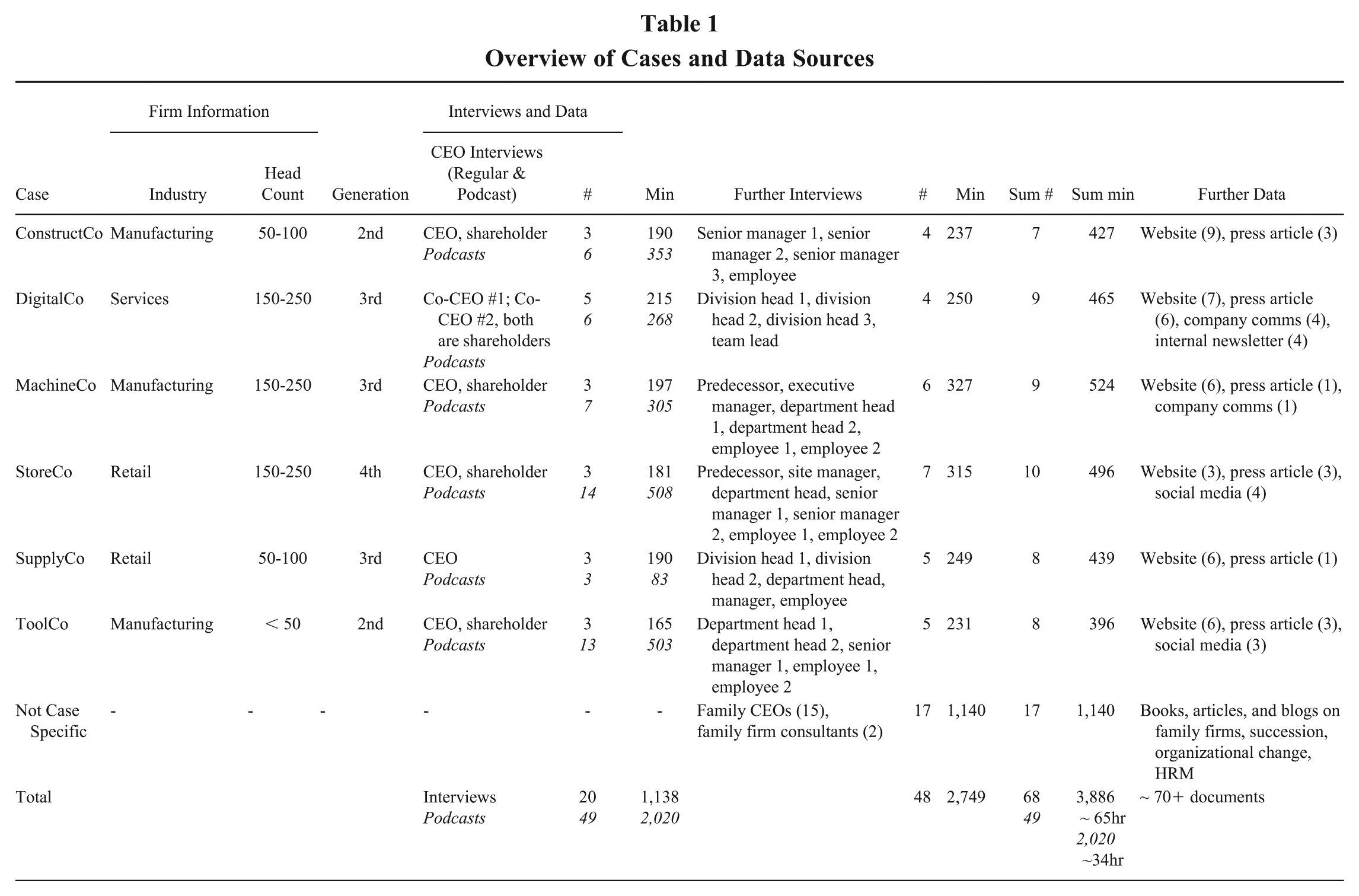
Our sample encompasses six family firms led by new family CEOs (see Table 1). The case firms had to fulfill three sampling criteria (Eisenhardt & Graebner, 2007). First, they had to be owned and managed by a family (Chrisman et al., 2005; Chua et al., 1999), which provides a rich context in which values play a key role in decision-making. Second, all firms had recently undergone an intra-family succession, meaning that the management of the firm passed from one generation to the next within the family (Daspit et al., 2016). As noted above, this particular point in the life cycle of a family firm is interesting as new CEOs often evaluate and make adjustments to their team of managers (Andrus et al., 2025; Georgakakis & Buyl, 2020). The six cases were similar in that they all followed an intrafamily succession with the parents of the successors handing over ownership and management responsibilities of a well-running firm to their offspring (for more details, see Table 2). Moreover, all new CEOs had high levels of discretion due to their family membership and concentrated ownership, that is, they had the de facto power to dismiss managers. The case firms differed, however, concerning the CEOs’ previous work experience within and outside the family firm (see Table 2). Last, all firms were headquartered in Germany to limit variation on dimensions such as labor law and cultural norms regulating dismissals (Eisenhardt & Graebner, 2007). Germany is well suited for such a study for three reasons: (a) long-term, loyal employer-employee relationships are particularly highly valued in German work culture and enshrined in the (West) German concept of the Social Market Economy (De Massis et al., 2018); (b) labor laws make it hard to dismiss individual employees, hence rendering targeted dismissals an “unusual” situation; and (c) dismissals are often viewed as immoral by society at large, thus enhancing ambiguity and equivocality of the dismissal (Keum & Meier, 2024).
Overview of Cases and Data Sources
Variance Across Cases
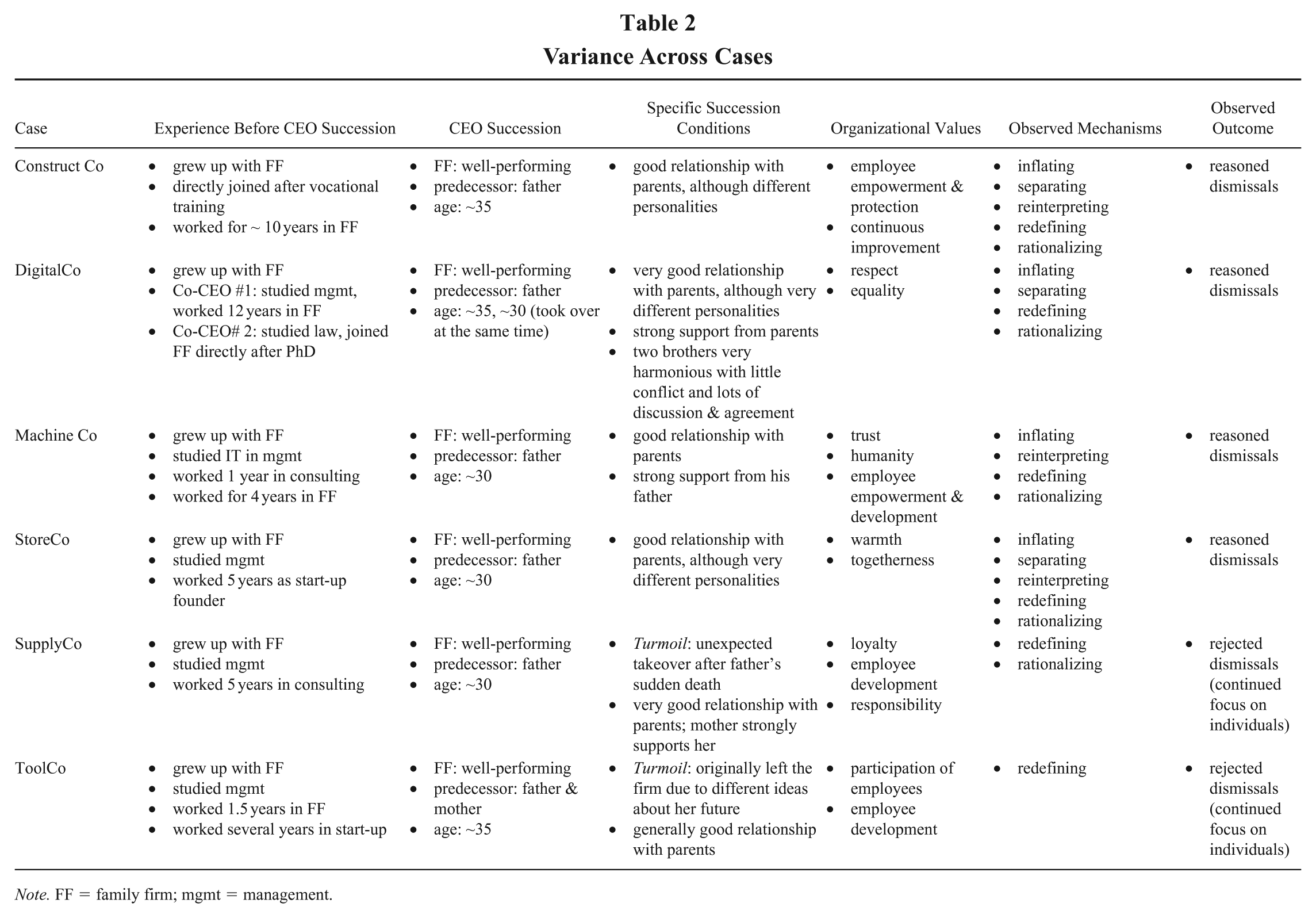
Note. FF = family firm; mgmt = management.
Based on our initial desk research, we contacted, by email, 54 new family CEOs who we thought might meet our sampling criteria. This resulted in brief calls with 23 new CEOs, in which we confirmed or disconfirmed the sample fit—in particular, their experience with considering dismissals of well-embedded managers. We agreed with seven new CEOs from six family firms to proceed with the research, including multiple rounds of data collection.
Data Collection
To gather insights into the new CEOs’ sensemaking, we collected data from the six family firms over more than 30 months. Our primary source of data is in-depth, semi-structured interviews and podcasts. First, we interviewed the new CEOs (20 interviews), inquiring about their dismissal decisions, and searched for podcasts with these CEOs (49 podcasts) in which they talked about their organization, their experiences as new CEOs, their values, and how they treated employees. In addition to such CEO-centric data, we collected interviews with other organizational members (31 interviews). 2 These interviews focused on the family firm (e.g., values) in general, and dismissals in particular. The non-CEO interviews served three purposes. First, they provided insights into sensemaking as a social process (Weick, 1995), helping us understand whether, for instance, the values outlined by the new CEOs were actually lived in the companies. Second, the interviewees recounted dismissals (including reasons for dismissals) and shared memories of (actual) organizational reactions to dismissals, providing insights into how such dismissals were perceived over time. Such insights allowed us to understand better and contextualize the cues sent by organizational members that had informed the new CEO’s sensemaking. Third, the non-CEO interviews helped us triangulate our emerging theory about managerial dismissals by adding to, and challenging, what was shared with us by the new CEOs.
Interviews lasted on average 57 minutes (CEOs) and 52 minutes (non-CEOs), respectively, and contained open-ended questions that encouraged interviewees to speak openly and recall specific situations, feelings, and thoughts. Individuals typically recall such particularities more precisely than broad memories, hence reducing post-hoc rationalization (McDonald & Eisenhardt, 2020). We used several commonly applied practices, such as granting anonymity and building trust, to get truthful accounts on sensitive topics (Vuori & Huy, 2022). Further, we recorded and transcribed the interviews verbatim. We conducted the interviews in four phases. The first round of interviews with new CEOs took place in 2021. In these interviews, we focused on instances where there was a perceived mismatch between managers and the organization, and we examined how the new CEOs thought about it. In the second round, which took place in 2022, we conducted 31 interviews with various organizational members of the six case firms in order to capture the social nature of the sensemaking process. We took care to select interviewees from different hierarchical levels (i.e., managers, non-managers, predecessors), different backgrounds, and with different levels of tenure (see Table 1), applying a “snowballing” technique based on referrals from the new CEO or other organizational members. This diversity of perspectives reduces bias that would come from interviewing only one individual, that is, the new CEO, or various like-minded individuals (Vuori & Huy, 2022; Yin, 1994). We chose interviewees who had in-depth knowledge of the (potential) dismissals and were intimately involved with either the dismissed manager or the new CEO. We also included employees who observed the dismissals from a relatively “distant” perspective and provided cues to the new CEOs on how the organization as a whole would react to the dismissals.
In the third round, following initial data analysis, we conducted follow-up interviews with the new CEOs in late 2022 to ask further in-depth questions, such as how they changed their thoughts about potential dismissals and the organization’s reaction in the process, and what finally enabled the dismissal decision. We focused on the specific dismissal examples that we had learned about in the previous interviews and for which we had obtained additional information from interviews with other organizational members. A fourth and last round of interviews with the new CEOs (April to June 2025) allowed us to dig deeper into the value-based nature of dismissals—a topic that emerged as relevant throughout the analysis process. Moreover, in this round, we engaged in member checks (Crosina, 2024) where we shared and discussed our initial findings.
To complement our data and deepen our understanding, we collected additional information on the firms and their new CEOs, including website information, press releases, newspaper articles, and other material like press interviews. This information gave us a better understanding of instances of turnover in management and contextual factors, provided information on company values, and allowed us to lead informed interviews and triangulate our findings (McDonald & Eisenhardt, 2020; Smith, Rondi, De Massis, & Nordqvist, 2024). Last, we conducted interviews with additional case-external informants (N = 17; 67 min average interview length), focusing specifically on new family CEOs from other, comparable, firms (which did not provide us sufficient access to further organizational members to count as full cases) and family firm consultants. They helped us scrutinize our emerging theory from a knowledgeable third-party perspective, particularly in terms of initial hesitancy and the use of various mechanisms.
We concluded collecting (and analyzing) data at the point of theoretical saturation, understood as a state in which we had “reached a confident grasp on the phenomenon” (Howard-Grenville, Nelson, Vough, & Zilber, 2021: 1319). In other words, we stopped when the “concepts were sufficiently well developed and we believed we had achieved considerable depth in our theorizing through the data we had collected” (Komba, Shepherd, & Wincent, 2025: 3109). At this stage, we felt that adding more data would not yield any further insights as new information started to confirm our initial model, without yielding any novel, relevant codes (Glaser & Strauss, 1967). Moreover, the additional interviews with 17 further CEOs, as well as the member checks, conducted in the third round of new CEO interviews, contributed to our confidence in having reached theoretical saturation as they confirmed the relevance and comprehensiveness of our concepts and model (Crosina, 2024; Malhotra et al., 2021).
Data Analysis
In our analysis, we integrated an inductive approach that allowed us to examine the depth and richness of our data (Corbin & Strauss, 2008; Yin, 2014) with a multi-case design that enabled us to recognize emergent themes within each case and compare patterns across cases (Eisenhardt, 1989; Smith et al., 2024). Our interpretative stance focused on unpacking how the new CEOs arrived at the decision to dismiss (or retain) someone. Although the analysis was iterative, and some steps occurred in parallel, we delineate three main steps for better clarity (Pratt, Kaplan, & Whittington, 2020; Smith et al., 2024). After each step, and partly within the analysis steps, we discussed the (preliminary) results regarding patterns as well as similarities and dissimilarities across cases among the authors.
First, we created case descriptions for each of the six cases based on the supplementary data, the interviews, and the podcasts. These descriptions (30-35 single-spaced pages each) built a chronological narrative of the case firm, focusing on how the discussed dismissals evolved in each case firm (Eisenhardt & Graebner, 2007). We refined these case descriptions with every new piece of information (Strike & Rerup, 2016). Through writing and discussing these descriptions, we became increasingly familiar with the cases and could already identify initial patterns (Smith et al., 2024). We realized, for instance, that every new CEO perceived the dismissal decisions under investigation as difficult due to personal concerns and the feeling that such decisions were going against family firm values. Moreover, while we observed that all new CEOs initially concluded that they would not engage in a dismissal (unless managers “stole the silverware,”—a rapid dismissal decision that was only peripheral to our study), the new CEOs of four firms decided on dismissals after many months of contemplation (an outcome we later labeled as “reasoned dismissals”), while two new CEOs, despite such long deliberation, decided against dismissals (“rejected dismissals”). This variation in outcomes became central for our cross-case comparison in subsequent steps and guided our search for shared and divergent sensemaking processes.
Second, once we felt sufficiently familiar with our cases, we started to code the data using MaxQDA software. We began with open coding, which means we coded the texts for all elements that seemed relevant to understanding how new CEOs thought about potential dismissals (Miles, Huberman, & Saldaña, 2014). In this initial coding step, we coded, for instance, reasons why new CEOs considered dismissals, perceived constraints, justifications of dismissals, and outcomes. The temporal sequences identified in our case narratives, combined with the initial codes, revealed the prolonged and complex deliberation processes that all new CEOs underwent. This prompted us to engage with the literature on sensemaking to identify concepts that could help explain these patterns (Miles et al., 2014). We further realized that many of the arguments mentioned by the new CEOs related to work or personal relationships between the new CEO and manager (e.g., “dismissing friends from school”), which we classified as “dyadic sensemaking” in line with extant sensemaking literature (Wrzesniewski et al., 2003). We also came across several codes that indicated how new CEOs made sense of how the organization might react to dismissals (e.g., “fear of creating upheaval”), which we classified as "prospective sensemaking” (Sandberg & Tsoukas, 2015; Stigliani & Ravasi, 2012). In this step, our coding was broad, comprising a relatively large number of initial codes that also mirrored the variety observed in our sample.
Third, and partly in parallel to the second step, we aimed to theoretically interpret our data and started to more systematically compare the narratives and initial codes across cases (Eisenhardt, 1989). We started to visualize the sensemaking process of dismissal decisions (using a physical flipchart) for each case, and we also began to categorize and label our codes. Most importantly, our coding indicated five relevant mechanisms through which new CEOs revised their initial hesitancy, each of which could be linked to the above-introduced two forms of sensemaking; for instance, through separating, new CEOs split their personal concerns from their role (dyadic sensemaking), while through redefining, new CEOs shift their sensemaking of managers’ responsibility and hence expected reactions to dismissals (prospective sensemaking). Contrasting the sensemaking processes and initial codes from the six cases also allowed us to map both similarities and differences (Corbin & Strauss, 2008) across cases. For instance, when we systematically compared our codes, we realized that not all new CEOs applied all mechanisms to revise their sensemaking, leading to different outcomes.
In this third and last analysis step, we continuously refined our codes and also discarded several initially developed codes as non-relevant. For instance, when comparing the cases, we realized that it was irrelevant whether the trigger of a dismissal was related to individual performance or cultural fit. To challenge our emergent theorizing, we shared drafts with other researchers to receive feedback about our initial findings (e.g., in research seminars). These discussions supported us in assessing the relevance of specific codes and refining the classification and labeling of codes. As a result of our data-driven and theory-informed iterations, we were able to trace the differences regarding rejected versus reasoned dismissals (see Step 1) back to the mechanisms used in the revised sensemaking process. Here, our cross-case analysis helped us understand how “rejected dismissals” originated in only partially revised sensemaking.
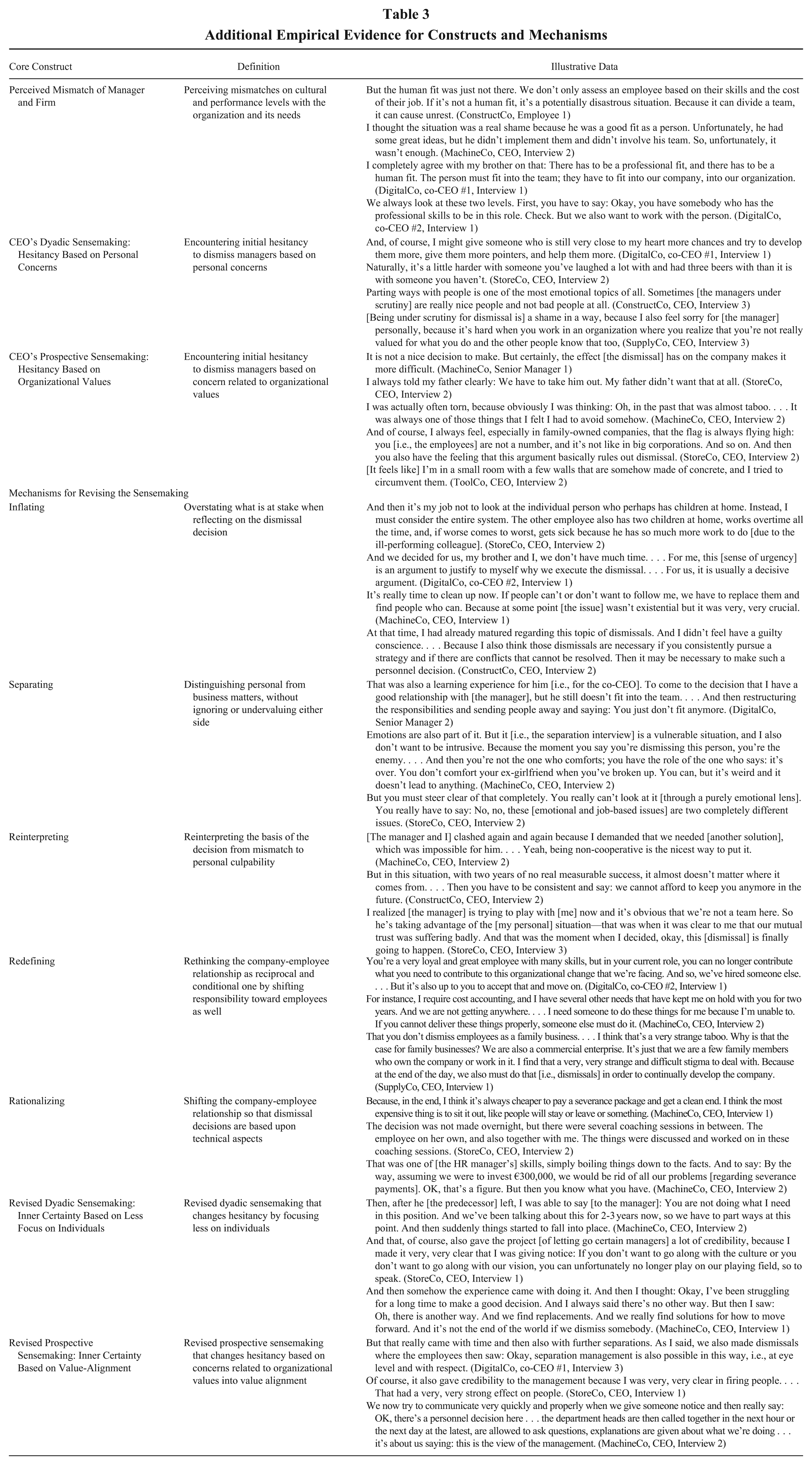
The outcome of this third step of data analysis was two-fold: First, we narrowed the large number of initial codes identified in Step 2 to the core constructs that were empirically grounded and theoretically meaningful in addressing our research question. This reduction was informed by relevance and conceptual clarity. Table 3 summarizes the key constructs, defines them, and provides illustrative quotes (Pratt et al., 2020; Smith et al., 2024). Second, we synthesized the patterns observed across the cases into a conceptual model that captures new CEOs’ dismissal-related sensemaking (see Figure 1). This model was based on the abstraction of the visual maps created in Step 2 and our knowledge gained in Step 3. To finalize our model, we iterated again between data and theory to further sharpen our coding and model (Miles et al., 2014; Smith et al., 2024). This final iteration also ensured that the model accounted for the observed variation in outcomes—specifically, by mapping how different use of mechanisms led to either reasoned or rejected dismissals. In sum, the iterative nature of our data analysis ensure our findings have rigor and are well supported by evidence (Miles et al., 2014; Pratt et al., 2020). We elaborate on these findings in the following sections.
Additional Empirical Evidence for Constructs and Mechanisms
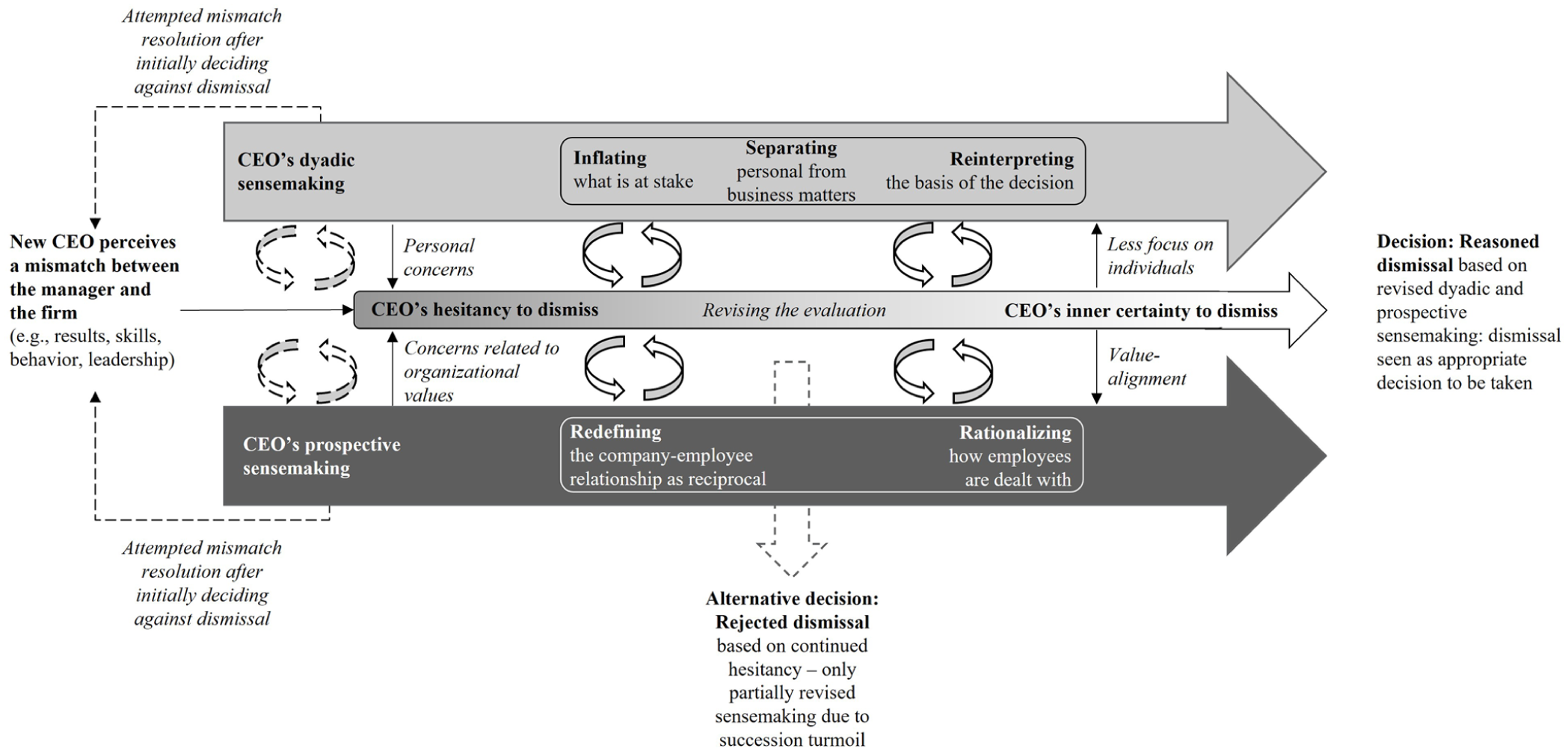
A Sensemaking Model of Managerial Dismissal Decisions
Findings
Our findings draw out the process of how new CEOs in family firms make sense of potential managerial dismissals and revise their sensemaking; we also explain how this process affects managerial dismissal outcomes. While employing an inductive approach to our theorizing, we follow best recent qualitative practice (Claus, Greenwood, & Mgoo, 2021) and first introduce our model to give a “preview” of our theorizing and to structure our findings.
The model (summarized in Figure 1) illustrates our theorizing of new CEOs’ sensemaking in the context of managerial dismissals. First, the model starts with the new CEOs evaluating their teams and perceiving a mismatch between a manager and the firm. Here, the new CEO notes that the manager may not currently, or in the future, align with the organizational culture or achieve the desired performance within the organization. This perceived mismatch leads to an initial sensemaking process: On the one hand, the new CEOs make sense of their personal and role-based connection to the manager (so-called dyadic sensemaking). On the other hand, the new CEOs also anticipate reactions by organizational members in case of a dismissal, and ponder how such dismissals might align with organizational values (so-called prospective sensemaking). In all observed cases, the new CEOs face hesitancy due to personal concerns and concerns related to organizational values, which leads them to initially conclude that managers should not be dismissed except in extreme cases. However, when attempted mismatch resolutions do not work, the new CEOs engage in prolonged sensemaking to reevaluate the dismissal decision. Our findings show that new CEOs subsequently make use of up to three mechanisms to revise their dyadic sensemaking: inflating, separating, and reinterpreting. Moreover, new CEOs make use of up to two mechanisms to revise their prospective sensemaking: redefining and rationalizing. New CEOs who only make use of the mechanisms targeted at prospective sensemaking are not able to revise their dyadic sensemaking, thus remaining hesitant and engaging in rejected dismissals. However, when applying the mechanisms more comprehensively, new CEOs can revise their sensemaking on the potential managerial dismissals and develop an inner certainty to dismiss; such certainty entails both a personal ease with the decision (through less focus on individuals) and a perceived alignment of the dismissal decision with the organizational values, enabling new CEOs to engage in reasoned dismissals.
Recognizing a Mismatch and Encountering Hesitancy to Dismiss Managers
Our findings show that sensemaking of managerial dismissals first began when the new CEOs perceived an existing or anticipated manager-firm mismatch. As is common, the new CEOs used their initial time in office to determine who would best support them in steering the company forward. Across all six cases, the new CEOs encountered at least one perceived manager-firm mismatch due to various reasons, including a lack of individual performance or adequate skills, or behavior of managers that is considered inappropriate; one new CEO described such mismatches: For me, there are only two categories. One is a question of personal character and the way we work together. That is, does he or she fit into the team structure, and is the chemistry right, so to speak? And the other is performance. (ConstructCo, CEO, Interview 2)
The realization that dismissal considerations were part of their role came as a surprise to most new CEOs—for five of them, it had been the first CEO role, and the other two (StoreCo and ToolCo) had previously led smaller startups. The new CEO at StoreCo recalled that she had “honestly not seen [the situation of thinking about firing someone] coming. I hadn’t thought about it before” (StoreCo CEO, Interview 2). The realization of this mismatch triggered an initial sensemaking process among all new CEOs; this process encompassed both a dyadic sensemaking process focused on the new CEO’s personal and role-based perspective on the manager and a prospective sensemaking process focused on anticipated reactions by organizational members to a potential dismissal and its fit with organizational values.
Dyadic sensemaking: Hesitancy based on personal concerns
When the new CEOs engaged in dyadic sensemaking, they encountered hesitancy to dismiss the manager based on personal concerns, as they took their connection to and knowledge about the manager as a vantage point for sensemaking. Thus, they weighed advantages of dismissals, such as performance benefits or more straightforward implementation of strategic change, against perceived obstacles stemming from the respective manager’s personal situation and his or her connection to the new CEO and the firm. When considering their own role and their relation to the manager, several constraints emerged for the new CEOs of our case firms: (a) new CEOs’ internalized beliefs stemming from the familial firm culture, in which relationships among organizational members were often characterized by friendship (“These are friends, real friends. We went on vacation with our families because I grew up with them and was socialized with them,” DigitalCo, CEO, Interview 1, or “I have a good relationship with many colleagues here, because I had already . . . played on the premises as a child,” MachineCo, CEO, Podcast Interview, or “I grew up really closely with my family business” StoreCo, CEO, Podcast Interview); (b) personal concerns arising from in-depth knowledge about managers’ previous important contributions to the firm (“[the manager] also shaped the company and made it successful,” StoreCo, CEO, Interview 1); (c) intimate knowledge about the personal situation of the manager, referring for instance to their financial situation (“You simply get to know [your staff ] better. . . . But then you also learn a lot about their circumstances. . . . So now all these things influence me,” SupplyCo, CEO, Interview 2) or personal difficulties (“[the manager] couldn’t come [to work] because he was taking care of his sick father,” MachineCo, CEO, Podcast Interview); and also (d) moral concerns: There are certain values and moral obligations that I feel very strongly . . . I couldn’t just go over a list of people and see who I could get rid of as quickly as possible. . . . I’d feel guilty, just like if I went into Lidl and stole stuff. (ConstructCo, CEO, Interview 3)
Weighing such concerns against the perceived manager-firm misfit often made the potential managerial dismissals ambiguous, and all new CEOs noted a feeling of hesitancy to dismiss the managers in question. The new CEO at ConstructCo highlighted the difficulties in evaluating poor individual performance of a manager who lived up to the company values otherwise: [The manager] is one of the most correct people. . . . He’s going around, getting good feedback from our customers and so on. However, the performance is just not there . . . those tend to be the toughest emotional discussions, exactly this weighing up. (ConstructCo, CEO, Interview 2)
The new CEO at MachineCo referenced a similar managerial dismissal consideration (“nice guy. But the performance was not there!” Interview 2). At the same time, the new CEOs also noted cases of well-performing managers with problematic behaviors. The new CEO of MachineCo described a micro-controlling manager who had “set up his office in such a way that he could watch over the backs of all the employees” (Interview 1). Given the rather relational orientation of the six family firms, such weighing up decisions provided a strong source of tensions for new CEOs and initially implied hesitancy to take action. Based on his gut feeling, the new CEO at MachineCo would have discontinued the contracts of multiple managers. However, considering the adverse impact dismissals could have on managers personally, he initially ruled out dismissing anyone, as “it is tough for people when they are thrown out of their most or second most important social environment” (Interview 2). Moreover, he emphasized his responsibility for the employees (“I want . . . that the people have a good place to work,” Podcast Interview).
The case of DigitalCo illustrates the personal stakes in making sense of managerial dismissal decisions. Given the local embeddedness of the business, the co-CEO #1’s children went to school with those of some managers, and they shared memberships in local clubs and associations. When he became the new co-CEO, he suddenly had to take decisions on people that he considered friends but that did not perform well: “[The manager] had been with the company for a long time, I grew up with him—a very, very loyal colleague. We always had a beer after the [local] soccer cup” (co-CEO #1, Interview 1). All interviewed new CEOs reported that personal attachments made them hesitant to dismiss managers.
Prospective sensemaking: Hesitancy based on concerns related to organizational values
In parallel to the dyadic sensemaking, the new CEOs also engaged in prospective sensemaking where they encountered hesitancy based on concerns related to organizational values. Here, new CEOs tried to make sense of how the organization and its members would react to a dismissal decision; that is, they both evaluated implications that a dismissal might have on organizational members due to friendships in the firm as well as concerns regarding how organizational members (including their family members that often tended to comment on family firm decisions) might react. This sensemaking often focused on the anticipation of an adverse reaction to the dismissal by the organizational members, particularly given the value-based cultures in the family firms. Considering organizational values frequently passed down over generations created further ambiguity and made the new CEOs hesitant to dismiss managers, as they felt that dismissals went against the firm’s history and prevalent cultural imperative. As the new CEO of MachineCo recalled, “it nearly was a taboo [to fire someone]” (Interview 2). He further explained in a podcast interview: “The company is not a machine. . . . It’s a collaboration of many people, of many individuals. And it’s highly complex—you have to involve everyone. Everything is interconnected, so to speak” (MachineCo, CEO, Podcast Interview).
On the one hand, the new CEOs saw the need to act swiftly to pursue their strategic plans further. The new CEO of SupplyCo explained: “I think [the fact that we do not have any routine with dismissals] is a little annoying, because for me a little ‘come and go’ is good, because it does invigorate a firm’s culture” (Interview 2). On the other hand, they were hesitant to act against the values of the company, which prevented a quick, rational cost–benefit dismissal decision as the new CEO of ToolCo described: “[Our employer-employee relationship] is almost like a marriage” (Interview 2). The values that contradicted dismissals were described as stability (MachineCo, Website), loyalty (StoreCo, Podcast Interview & Website), harmony (ToolCo, Podcast Interview), religious values (ConstructCo, Podcast Interview), closeness (DigitalCo, Website & Podcast Interview), or care for workers (“My parents would never have kicked out [even] an apprentice during their probationary period,” SupplyCo, CEO, Interview 3). The new CEO of ToolCo reflected how anticipated reactions of organizational members informed her initial sensemaking: Of course, I must consider . . . what kind of signals are we sending to others? . . . Because dismissals can always create fear in the ones remaining. They think: Maybe it’s me next. Because we’ve been putting up with these employees for so long, and now, we’re suddenly dismissing them. Then it can happen to anyone. And that possible reaction is what you always must think about. (ToolCo, CEO, Interview 2)
The hesitancy to go against organizational values became even stronger as the new CEOs were often comparing themselves, and indeed were compared, to their predecessors. Several employees at StoreCo remarked that under the reign of the predecessor, “there were hardly any new hires or people leaving” (StoreCo, Manager 1); employees would, as the new CEO noted, commonly mention this to her as well, which reinforced her hesitancy to go against such organizational values: “My feeling is, like, I am somewhat not allowed to fire anyone” (StoreCo, CEO, Interview 2). Also, at DigitalCo, the parents’ values “were still present and provided some continuity” (co-CEO #2, Podcast Interview). The new CEO at SupplyCo put it compellingly: In the past, [dismissals] were a taboo topic in a family business like ours. . . . And of course, you are a family business, and you have a certain social responsibility, and you just don’t do that. . . . So, it’s basically like this: You hire the people and then you are kind of stuck with them. I feel that I am not allowed to dismiss anyone. . . . If someone has been here for 25 years, then you just don’t terminate their work contract, that’s just not right, you just don’t do that. (SupplyCo, CEO, Interview 2)
Broader relational considerations and the embeddedness of managers also played a key role in the new CEO’s initial prospective sensemaking, as managers’ ties to the predecessor CEOs often constituted “an extreme constraint against which you could do nothing at all” (MachineCo, CEO, Interview 2). Hence, even though the new CEOs did not have any specific personal relationship with the long-term managers when they took over, the new CEOs at MachineCo, StoreCo, and SupplyCo all anticipated that their predecessors would speak up on behalf of managers to prevent their dismissal—even though they had no formal power to decide on dismissing or retaining managers. In all cases, such “interferences” occurred informally. For instance, the new CEO at SupplyCo quickly realized that her grandmother was in favor of keeping the respective managers: “[Grandmother] has given her comments to the effect of: You must do it this way and that way regarding the managers” (SupplyCo, CEO, Interview 2). At MachineCo, the predecessor reflected on his efforts to informally influence the new CEO (i.e., his son): “And I always told my son back then which people I particularly value and where I also see a danger for the company if they are replaced” (MachineCo, Predecessor).
Initial decision against managerial dismissals
After a short period of dyadic and prospective sensemaking, all new CEOs concluded that managerial dismissals were undesirable due to the strong hesitancy they encountered, stemming from personal concerns and concerns related to organizational values; consequently, they mostly did not dismiss the managers in question. For example, the new CEO at MachineCo was unhappy with several managers. Still, he initially announced during a speech that he aimed to bring everyone along on the path forward. In a podcast interview, he explained: “For me, it was never really an option . . . to let people go.”
An employee at MachineCo recalled the new CEO mentioning that “we only fire those who steal the silverware” (MachineCo, Employee 3). Our analysis shows that incidents of managerial dismissals after initial sensemaking only occurred when the new CEOs determined a “breach of basic principles,” referring to the manager’s violation of fundamental organizational rules, values, or ethical guidelines. Due to their strong dismay regarding such managerial behavior, the initial hesitancy was quickly overcome in these rare cases (which we observed for certain managers in DigitalCo, MachineCo, and ConstructCo). For instance, the new co-CEO #2 at DigitalCo dismissed a manager despite her excellent performance and indispensable skills because she mistreated her subordinates, which went against the core principles of the new CEOs: “Yes, you’re good at your job, but you’re a jerk. People don’t really want to work with you. You cause discord, and that’s why you don’t fit in with us. . . . You don’t fit in with our culture” (DigitalCo, co-CEO #2, Interview 1).
Accordingly, in such cases, the new CEOs did not have to reconcile a dismissal decision with feelings of attachment to the manager or hesitancy regarding how the organization would react to such a decision (“I think, for me, it’s relatively easy when I notice that there’s a certain arrogance at play. . . . I’m pretty disconnected when someone feels like they’re better than others” ConstructCo, CEO, Interview 2).
However, such cases were the exception, as in most cases, managers had not “stolen the silverware,” therefore making the firm-manager mismatch difficult to resolve. Hence, the new CEOs commonly tried to resolve the manager-firm mismatch while retaining the manager. For instance, they offered coaching programs or changed job responsibilities. The new CEO of MachineCo reflected on how he initially tried to resolve the mismatch: “I really tried a lot—lots of support, coaching, leadership training. And I still think that’s the right way. But you just cannot force someone to learn something.” (MachineCo, CEO, Interview 1). The new CEO of SupplyCo also explained that she always aimed to “go ahead with much hard work and try to take people with me” (Podcast Interview). Despite these efforts, all new CEOs realized after some time that the initial mismatch remained unresolved and, thus, reengaged in sensemaking.
Dyadic and Prospective Sensemaking in Revising Managerial Dismissal Decisions
As the mismatch persisted, the new CEOs deliberately searched for different perspectives to resolve the situation. In the interviews, the new CEOs shared the process of how they, despite their initial concerns, aimed to change their thinking about potential managerial dismissals. We identified five mechanisms that supported a revised sensemaking process, enabling CEOs to reconcile tensions and overcome their hesitancy to dismiss managers. These mechanisms included inflating what is at stake, separating personal from business matters, reinterpreting the decision’s basis, redefining the employer–employee relationship, and rationalizing how employees are dealt with. Our findings highlight that inflating, separating, and reinterpreting predominantly supported new CEOs to change the dyadic sensemaking, while redefining and rationalizing predominantly related to revised prospective sensemaking.
Inflating (dyadic sensemaking)
The mechanism (observed in ConstructCo, DigitalCo, MachineCo, and StoreCo) describes that new CEOs began to overstate what was at stake when reflecting on the potential dismissal. They inflated an individual dismissal consideration into a make-or-break situation for the company as a whole. The new CEO of MachineCo had to justify potential dismissals (to himself and others) in a firm that had never seen any dismissals before. Building on inflating, he increasingly came to see himself as the guarantor of the company’s continued success, which he saw as requiring him to make personnel changes:
“If neither your father nor your grandfather engaged in [dismissals], how do you reconcile the fact that you’re going to make those changes and dismiss those [managers]?”
“The most important thought for me here is that it is my job to take care of the overall system. And if someone harms the overall system—that sounds radical—but if there is no other way to fix it, then personnel changes have to be made to protect the overall system.” (MachineCo, CEO, Interview 2)
A key part of inflating is that the new CEOs frame the dismissal decision not as a decision about individuals (as in their initial sensemaking round, where they often referred to “case-by-case” decisions), but as one fostering the greater good of the organization, hence making it less of a person-based decision. The new MachineCo CEO drew on this “for the greater good” logic when he explained the dismissal decision to a manager: I said to him: “My problem is that the company is not running and everyone else depends on it. And for that reason, you can no longer take over the management of the department.” . . . A reference that I like to make is that someone may have to go for the benefit of the whole. (MachineCo, CEO, Interview 2)
The new CEO of StoreCo described the same mechanism in different words, arguing that “I’m primarily responsible for the company and the total number of jobs. I have no responsibility for you as an individual” (Interview 3).
However, our analysis shows that the new CEOs of both SupplyCo and ToolCo struggled to shift their perspective from viewing dismissals as predominantly person-focused decisions to considering the firm’s needs, often reiterating personal concerns and fears linked to losing the managers. As the new CEO of SupplyCo recalled, she was more “panicking” about losing individual managers than about the firm’s direction: “I really thought that it would be the end of the world if I lost [the managers]” (Interview 3). Similarly, the new CEO of ToolCo reiterated several times that dismissals “are always personal, because you know these guys, and all people always have a good side . . . it’s always about the personal things,” (Interview 3). Thus, neither of the two CEOs managed to inflate dismissals beyond the individual case.
In sum, the inflating mechanism enables new CEOs to view their responsibility to protect the firm as a duty to safeguard all organizational members—a duty that outweighs their obligations to individual managers and overrides personal constraints that previously shaped their dyadic sensemaking.
Separating (dyadic sensemaking)
The second mechanism (observed in ConstructCo, DigitalCo, MachineCo, and StoreCo) supports new CEOs in separating personal matters from business-related ones. Where this mechanism was at work, the new CEOs decided to accept, rather than deny, their own emotions related to the potential dismissal. This revised sensemaking allowed them to acknowledge, process, and overcome personal ties, which initially had led to hesitancy based on personal concerns.
One new co-CEO of DigitalCo had to deal with the potential dismissal of a (poorly performing) top manager who was a long-term employee and dear friend. By drawing on separating as a mechanism for sensemaking, the new CEO was able to separate the difficult professional situation and the emotional upheaval of it (“The argumentation was on a factual level. . . . But the decision to send a friend into the unknown affected me emotionally,” co-CEO #1, Interview 1). A fellow manager reiterated how the new CEO had approached the topic in a balanced manner: “[the guy he fired] was his buddy. . . . To come to the decision that you have a good relationship with [the manager] and say: ‘You just don’t fit the change anymore’—that’s also a challenge” (DigitalCo, Senior Manager 1, Interview). Despite knowing about the implications of the dismissal (“sending a friend into the unknown”), separating allowed him to revise his initial dyadic sensemaking and to move forward with the dismissal. In the termination interview, the new CEO did not hide his emotional struggle from the manager, as he recounted: “When I must cry during a termination interview because I’m sorry, then I cry. When I’m really sorry and it touches my heart, then I’m also emotionally affected” (co-CEO #1, Interview 1). He also did not distance himself from his friend or their relationship. Instead, the new CEO prioritized the family firm over the personal relationship, thus allowing him to change his dyadic sensemaking of the dismissal: It was hard because he had accompanied me for so many years and also played a part in my own development. However, I can put my heart “on hold” in such situations. Or maybe my heart has a second chamber that beats for the company and for its advancement. And I value that above everything else. . . . And at that point it was clear to me: The company always comes first. The continued existence and further development of the company always go beyond personal relationships.” (DigitalCo, co-CEO #1, Interview 1)
The new CEO of MachineCo, on the other hand, distanced himself structurally from such decisions: “Today, I delegate 90% of the work [around dismissals]” (Interview 3). However, not all of the new CEOs were able to rely on this mechanism. While the new CEOs of ToolCo and SupplyCo were aware of the importance of creating more personal distance, both were struggling to find a better balance. As the new CEO of ToolCo argued, her general motivation was to “create a good workplace for people . . . where they are seen as human beings. And [where] the challenges in their private lives, such as with children or elderly care [are seen]” (ToolCo, CEO, Podcast Interview). Similarly, the new CEO of SupplyCo lamented that she had “become friends with some [managers], making it super difficult” (Interview 3) to dismiss them. The continued emphasis on personal aspects of work made it challenging for the new CEO to engage in separating.
In sum, the separating mechanism enables new CEOs to identify and make sense of the nature of their personal connection to the affected managers. This sensibility allows them to both embrace and ultimately separate personal ties from professional concerns, and manage the dismissal-related tensions accordingly.
Reinterpreting (dyadic sensemaking)
In three cases, the new CEOs (ConstructCo, MachineCo, and StoreCo) further strengthened the revised dyadic sensemaking by reinterpreting the basis on which they evaluated the potential dismissals. This mechanism refers to new CEOs reinterpreting a performance-based mismatch into a severe personal shortcoming, such as a flaw of character. In the case of ConstructCo, a long-term manager who was liked by colleagues and by the new CEO (“because I appreciate this manager as a person as well,” CEO, Interview 2) did not perform well in his professional tasks. The new CEO was initially willing to provide this manager with extra chances to improve. However, with the manager missing all the opportunities he was given to demonstrate progress, the new CEO began to reinterpret the mismatch, which derived initially from poor performance, as stemming from a flaw of character and not from a lack of skill. Thus, he reinterpreted the initial operational mismatch as a lack of willingness. Through this reinterpretation, the new CEO was able to overcome his initial hesitancy and resolve personal concerns: “Nothing works without putting pressure on him, and then it’s actually rather a flaw in character than a lack of competence, if you will” (ConstructCo, CEO, Interview 2).
Another example of such reinterpreting is the case of MachineCo, a company that had seen zero employee fluctuation in the past and where dismissals were considered taboo, especially when justified by references to inadequate skills or unreliable performance. The new CEO eventually started to see the lack of soft skills as an unwillingness to follow the firm’s vision, reinterpreting the basis of the dismissal decision: If you are asked to build up a trusting relationship with your subordinates, but you just can’t understand that, then there’s not the slightest match anymore. Very different ideologies clash here and can’t be reconciled. I think the term “fixed belief system” describes that well. This is one of the biggest problems.” (MachineCo, CEO, Interview 1)
However, in several of the other cases, new CEOs did not utilize this mechanism. While the new CEO at ToolCo complained about a manager who constantly made costly mistakes for the company, she was quick to add that “he is not an unpleasant character, and yes, he also does the work. But everything must always be carefully checked” (Interview 3). As such, she did not reinterpret the manager’s poor performance.
In sum, the reinterpreting mechanism enables new CEOs to reinterpret a performance-based mismatch as a personal failure that makes personal concerns less salient. As such, this mechanism alters the basis on which a dismissal decision is taken.
Redefining (prospective sensemaking)
In parallel to the revised dyadic sensemaking, the new CEOs also engaged in revised prospective sensemaking to align the dismissal decision with organizational values. One respective mechanism that we observed was redefining, which allows new CEOs to challenge and rethink the company-employee relationship (observed in all six family firms). Instead of emphasizing the owning family’s responsibility for the workforce (as is typical in paternalistic family firms), the new CEOs began to emphasize the managers’ responsibility for their own employment. The new CEO of ConstructCo, for instance, asked his employees “to let go of their cherished comforts for the benefit of the firm” (Podcast Interview), while the new CEO of StoreCo explained how she changed her perspective by shifting responsibility from the employer to the employee: Everyone is responsible for their own lives. And of course, I bear responsibility for the professional lives of my colleagues—and to a certain extent beyond that. But they are at least as responsible as I am. It’s not a one-way street. . . . If [keeping the job] was so important, he would have done a better job by now. It [i.e., keeping the job] certainly couldn’t be that important [for him]. Because someone who really says: I must feed my children and so on. . . . This person will do a good job and doesn’t just sit on his or her hands, shrugging off all feedback. (StoreCo, CEO, Interview 2)
By redefining the relationship, the new CEOs were able to change their view on how employees might react to dismissals. Thus, the new CEOs started to see employment as “conditional,” emphasizing the managers’ duty to earn their right to be part of the company (e.g., through good performance, adequate skills, and appropriate behavior). As the new CEO of ToolCo reflected, such redefining allowed her also to be more prepared for adverse reactions: “There are enough jobs. And if our approach doesn’t suit you, then you don’t have to work here” (Podcast Interview). Summarizing her changed view on potential dismissals, the new CEO of StoreCo said: This is not an intact family. Everyone must contribute something. . . . You can’t just think that you belong but only take something out and give nothing back. It’s always a give and take. And if someone only takes, then it is difficult. . . . You also must contribute something to be allowed to be part of the family. (StoreCo, CEO, Interview 2)
As part of this mechanism, the new CEOs, as some employees recalled, would ‘test’ their revised sensemaking with selected organizational members. A senior manager at DigitalCo described such “testing”: [Both CEOs] are the type of people who like to test [whether they think about dismissal in the right manner]. And they don’t do that in large groups, they do it in one-to-one meetings and say: What do you think? (DigitalCo, Senior Manager 2).
In sum, redefining, which we observed in all cases, enables new CEOs to realign their view on employment relationships, thus anticipating and mentally accounting for disgruntled reactions by organizational members. Hence, new CEOs begin to understand managerial dismissal decisions not as a failure of their paternalistic responsibility but rather as a regular aspect of organizational life. Thus, they can align dismissals with the organizational values of their firms.
Rationalizing (prospective sensemaking)
The last mechanism we identified allows new CEOs to rationalize managerial dismissal decisions. We identified this mechanism in five cases (ConstructCo, DigitalCo, MachineCo, StoreCo, and SupplyCo). Some of the new CEOs used this mechanism in a literal sense, starting to see managers as mere “numbers,” which transformed the dismissal decision into a numerical, organizational problem. This was the case for the new CEO of MachineCo: his revised prospective sensemaking profited from conversations with a newly hired head of division, who had presented him with a list of long-term managers that might be dismissal candidates: That was one of [the division head’s] skills, to boil things down to the facts. . . . It was shocking because I said to myself: We’re writing a list of who needs to be removed from the company. But it was a relief because we went from an unknown to a known problem size, even though it was a large one. . . . After we had this clarity, I felt this relief! I then realized the full extent of the problem. The response then was: We address the problem and work through it in a structured manner. (MachineCo, CEO, Interview 1)
The new CEOs further made use of rationalization to justify dismissals as “business as usual.” They stressed that they had realized that dismissals were part of a longer development process of managers. For instance, the SupplyCo CEO highlighted the importance of not just establishing performance as an important aspect, but also communicating it in the firm, arguing that “it doesn’t help just to establish this performance culture. . . . It has to be somehow clear that people will leave if they don’t perform” (Interview 3).
The new CEOs began to see and accept these measures not just as unavoidable actions that CEOs commonly have to deal with, but as valuable for the organization and aligned with organizational values. The new co-CEO of DigitalCo came to depict dismissals as part of a ‘normal,’ necessary renewal process: “[I realized that] this is a necessity . . . when it comes to implementing change. It is essential to have the right people to drive the transformation forward. So, actually, it’s a completely normal process” (DigitalCo, co-CEO #2, Interview 1).
Similar to the redefining mechanism, the new CEOs often relied on feedback they received from organizational members to support this mechanism. At ConstructCo and MachineCo, particularly newer employees were accustomed to managerial turnover in their previous firms. Thus, they were used to rationalizing dismissals, as an employee recalled: “At some point, you have to switch off your emotions and become clear. . . . In your mind, you have to make a pro and con list” (ConstructCo, Senior Manager 1). At DigitalCo, employees also signaled an understanding for a more rational treatment of dismissals, yet they were glad about the new CEOs finding a good balance: “We do have a really strong performance orientation. We really do care about achievement. . . . But that does not mean that there isn’t an atmosphere of familiarity [among us]” (DigitalCo, Senior Manager 1).
Such statements expressed by organizational members, for example, in various meetings, supported new CEOs in rationalizing decisions without overlooking the human side. The dismissal evaluation thus became a more multifaceted decision in which rational, performance-based elements became increasingly relevant. At the same time, rationalizing did not come easily to the new CEO at ToolCo. While she understood the importance of approaching dismissals through a more rational sense and employed more KPIs to measure performance than her father, she highlighted her problems in viewing such issues through a rational lens: “I believe that if I were so rational with a company of our size, we would hardly have any employees left because, as I said, word gets around in the region. . . . It’s always about personal matters” (Interview 3).
In sum, the rationalizing mechanism enables new CEOs to view the dismissal of managers as a pragmatic business decision that is part of everyday organizational life and can, thus, be in line with organizational values.
Revised Sensemaking and Managerial Dismissal Decisions
Our analysis reveals that all new CEOs underwent prolonged sensemaking processes, often lasting over a year, highlighting the deep-seated reluctance to dismiss managers. Underlying this revised sensemaking process were five mechanisms that supported new CEOs in overcoming their initial hesitancy. However, our analysis indicates that these mechanisms only result in revised evaluations when they combine mechanisms that target both dyadic and prospective sensemaking.
Rejected dismissal due to partially revised sensemaking
While our findings show that all interviewed new CEOs made use of some of the identified mechanisms to revise their view on dismissals, in two of the six cases, the new CEOs only made partial use of the mechanisms (ToolCo: redefining; SupplyCo: redefining and rationalizing) and were not able to revise the initial dismissal decision, still emphasizing the personal concerns. These two family firms differed from the other four cases concerning the specific succession conditions. All six cases showed a pattern of classic parents-to-kids succession; yet, while in four cases (ConstructCo, DigitalCo, MachineCo, StoreCo), there was no notable disruption or conflict throughout succession, the two cases whose new CEOs were unable to use the mechanisms comprehensively had experienced substantial succession turmoil (Table 2). In one of the cases (SupplyCo), the daughter had to take over the firm rather unexpectedly when her father died—a situation that often puts enormous pressure on the offspring and often entails less focus on the business as compared to individuals (Eddleston et al. 2024). In the other rejecting case, ToolCo, the succession was an on-off journey with the successor joining (due to interest), leaving (due to the desire to pursue a different career), and re-entering the family firm. One might assume that such uncommon ways of assuming family CEO roles imbued the successors with certain feelings of pressure, commitment, or even some level of guilt that increased their initial hesitancy and made them particularly attentive and sensitive to the “human side” of the organization. Thus, decisions about dismissals were often accompanied by anxiety; the new CEO at ToolCo noted that “running the company . . . feels like a Damocles sword hanging over me” (ToolCo, CEO, Podcast Interview).
As a result, at ToolCo, the new CEO neither engaged in separating nor rationalizing, which meant that she was not able to normalize the process of managerial dismissal and continued to view it as an extraordinary event that induced substantial personal concerns. In our interviews, she would frequently bring up the disruptive nature of dismissals, such as the implication for the immediate colleagues: “when we fire [a manager], everyone is like a flock of birds and is all excited and thinks ‘oh God, will it hit me next’?” (Interview 3). Similarly, while she was able to redefine the responsibility of the firm vis-à-vis managers, the lack of revised dyadic sensemaking entailed that she was not able to separate the dismissal decision from the individual entirely. When asked about her view on change associated with succession, she argued that “succession is more about modernizing existing structures and getting along well with the existing people” (Podcast Interview), and at several points would highlight that she “has friendship ties with many [managers] in the firm” (Interview 3). Thus, she, for instance, decided that a low-performing manager should remain in the company, even though he had to be degraded to a lower position in the organization. While the new CEO at SupplyCo was able to rationalize dismissals and foster a performance culture in the firm, she still found it challenging to translate this rationalization into dyadic interactions, acknowledging that she often was “very, very close” (Interview 3) to the managers. She further reflected that while she had rationalized the dismissals, in the end, “I don’t think [the revised perspective] has many implications for how we treat our employees” (Interview 3). While the new CEO was able to redefine the relationships between her firm and the individual managers, she herself was not able to see dismissals in an impersonal manner, often softening stories of managerial mismatches by referring to the managers’ good sides. Thus, instead of inflating the mismatch, the new CEO downplayed it: “I think this guy is just like super taxing. But I’ve picked myself up. . . . He was a key salesperson who had generated significant revenue. . . . But just from a cultural perspective, this guy really is a muppet” (SupplyCo, CEO, Interview 1).
Taken together, while both new CEOs of SupplyCo and ToolCo engaged in revised prospective sensemaking, their selective use of mechanisms meant that they were not able to revise their dyadic sensemaking. As such, both ended up rejecting managerial dismissal, instead keeping managers within the firm.
Inner certainty and reasoned dismissal as an outcome
In the other four cases that applied mechanisms targeted at both dyadic and prospective sensemaking, the revised sensemaking helped the new CEOs to overcome their initial hesitancy about the dismissal and transform it into an inner certainty that they were doing the right thing for the right reasons. Our analysis indicated that the new CEOs felt empowered after the revised sensemaking, realizing that they were acting in the best interest of the organization and in accordance with their role, which necessitated uncomfortable decisions, in which individual fates played a subordinate role. Further, the revised sensemaking enabled the new CEOs to realign the decision to dismiss even long-standing managers with organizational values by depicting such decisions as beneficial for the firm’s development and, in some cases, even beneficial for the manager: The new CEO of ConstructCo began to see it as his “duty, task and responsibility to transfer such an [underperforming] person into a new working life” (Interview 3). Also, the new co-CEO #2 at DigitalCo started to emphasize the importance of engaging in dismissals “on an equal footing, so that no one leaves here as a winner or loser, but we leave with a clean cut” (Interview 3). For the new CEO of StoreCo, the question of whether dismissals were appropriate became part of a broader change process for her and the firm. She highlighted how she took a “look at who you are . . . look at what my authentic management style is and how the company must and may change so that it really suits me” (Podcast Interview). As a result, she was able to align dismissal decisions with the values of her organization; for instance, she reflected on how “solidarity” as a key value nowadays informs managerial dismissal decisions: I look at the wall, because [our values] hang in every room. . . . I always ask myself, does this fit in with our values? Now you could always say “yes, it’s not solidarity if you dismiss someone.” . . . but solidarity doesn’t mean for one person, it means for the entire company. And now I can decide: do I decide for the person, or do I decide for solidarity with the company, which ultimately represents all of us? (StoreCo, CEO, Interview 3)
Given the long time that had often passed between recognizing the initial mismatch and taking the dismissal decisions, and given the thorough reasoning provided by the new CEOs and the achieved alignment with organizational values, such decisions often came across as reasoned and were well-received by the organization. At ConstructCo, employees became closely involved in the decision-making processes, which further reinforced the perception that managerial dismissals were well-reasoned. As a senior manager remarked, the organization had, over time, adopted a different approach to dismissals: “Because we really are a team here now and everyone has to work together with the others and deliver the numbers—not just for the boss, but we work for ourselves. . . . That’s when you notice how everyone works” (ConstructCo, Senior Manager 2).
Thus, through revised sensemaking, the new CEOs of four family firms were able to challenge their initial dyadic and prospective sensemaking and overcome their hesitancy, enabling them to take reasoned dismissal decisions.
Discussion
Dismissing employees, especially managers who are deeply embedded in the organization, is a difficult and unpleasant yet common task for new CEOs (Boeker, 1992; Klotz et al., 2021). Drawing on an inductive multi-case study and sensemaking as a theoretical perspective (Maitlis & Christianson, 2014), our study portrays managerial dismissal considerations as a sensemaking process and shows how new CEOs revise such sensemaking. In so doing, our study contributes to research on managerial dismissal decisions, particularly among new CEOs. It also advances knowledge on how CEOs balance financial and non-financial dismissal considerations in the context of family firms and potentially other value-based organizations.
Understanding Managerial Dismissal Decisions Through a Sensemaking Perspective
While extant research presents managerial dismissals as a relatively rational and straightforward cost–benefit decision in which CEOs analyze whether a dismissal is beneficial or detrimental for the firm (Bilgili et al., 2017; Georgakakis & Buyl, 2020), we portray dismissal decisions as an outcome of a prolonged sensemaking process. Our study thus carries relevant implications for how researchers understand managerial dismissal decisions. First, our study shows that CEOs do not only take “facts” and “costs” into account. Instead, they reflect extensively about values and dyadic relations to the managers in question, encompassing both role-related considerations as well as deeply personal considerations. Over the past years, an increasing number of studies have highlighted the importance of personal stakes and potential moral obligations when CEOs take dismissal decisions (Hiekkataipale & Lämsä, 2017; Keum & Meier, 2024; Rivera, 2020). While Keum and Meier (2024) provide large-scale empirical evidence that “moral costs” affect decision-makers’ dismissal decisions, our study zooms in on the black box of the decision-making process. It explains how precisely new CEOs take personal considerations and moral costs into account—and how they can overcome them in revised sensemaking. These insights provide new impetus for research on managerial dismissals by shifting from an antecedent-based perspective on dismissals (Andrus et al., 2019; Boeker, 1992) toward a processual understanding of how and under which conditions CEOs in value-based organizations actually “pull the trigger” and decide on often unpopular dismissals. Our findings also show how hesitancy to dismiss is often rooted in interpersonal relations, encouraging future research to pay more attention to relational dynamics among the upper echelon (Ingram & Zou, 2008). So far, extant research has related friendship ties among managers mostly to positive individual and firm outcomes, such as friendships helping to manage resource dependence among firms (Westphal, Boivie, & Ming Chng, 2006), or allowing executives to gain higher bonus payments (Rose, Rose, Norman, & Mazza, 2014). Our findings shift the focus to dilemmas that emerge from such relations. While Boeker (1992) proposes that managers directly reporting to the CEO are likely scapegoats in times of poor firm performance (thereby neglecting potential friendship-based relations), our findings indicate that, particularly for such close managers, CEOs might find dismissal decisions challenging—even if such dismissal would be beneficial for the firm. In sum, our findings aim to shift the focus of managerial dismissal research from rational, cost-based analyses to a complex process that includes value-based and relational considerations.
Further, our findings highlight the role of organizational members and prevailing organizational values for managerial dismissal decisions. Thus, our study challenges prior research that has mostly depicted dismissals as localized events that solely affect the dismissed individual (Boeker, 1992; Haleblian & Rajagopalan, 2006). Our findings add to the research on dismissals as signals (Bartunek et al., 2008; Krackhardt & Porter, 1985) by showing how CEOs extensively make prospective sense to anticipate how organizational members likely react to managerial dismissal decisions in light of the existing organizational values. Our findings demonstrate that the CEOs are well aware of the signals they might send to the organization. Particularly in value-based organizations, dismissals might indicate a shift toward more formalized employee relations (Coyle-Shapiro & Shore, 2007), provide an updated indication for organizational members of which behaviors are expected (Wrzesniewski et al., 2003), or indicate a shift in leadership style from predecessor to new CEO (Ma et al., 2015; Mitchell, Hart, Valcea, & Townsend, 2009). Thus, dismissals might be perceived as disruptive events (Laulié & Morgeson, 2021; Simón et al., 2023) that can create intra-organizational shocks, which may lead to further turnover among managers and employees (Andrus et al., 2019), or, alternatively, might serve as a starting point for desired culture change in an organization (Andrus et al., 2025). These insights provide ample opportunities for future research into how CEOs use dismissals as a strategic tool and under which conditions employees understand dismissals as conducive or disruptive. Such questions are particularly relevant when investigating fraught processes such as strategic change, restructurings, or cultural shifts (Belling et al., 2022; Li, Chen, & Shen, 2024; Weiser, 2021). Future research could investigate how the context (e.g., timing, communication, existing organizational value set, etc.) affects organization members’ interpretation of dismissals, and how CEOs strategically choose when and whom to dismiss to facilitate change.
Second, our study provides insights into dismissals during new CEOs’ early tenures. For new CEOs, the initial period is often difficult (Andrus et al., 2025) as they need to understand the organization as well as the existing team (Denis et al., 2000; Ma et al., 2015; Wang et al., 2023). Past research on dismissals in post-succession contexts has demonstrated that new CEOs face various structural obstacles when changing the management team (Georgakakis & Buyl, 2020; Ma & Seidl, 2018), such as a lack of board support or predecessor influence that new CEOs find hard to overcome without a strong power base (Boeker, 1992; Querbach, Bird, Kraft, & Kammerlander, 2020). The case of new family CEOs presents an intriguing setup, as they face only few formal obstacles due to the overlap of management and ownership, which grants them de facto power to engage in dismissals. Our study highlights that even if structural obstacles are largely absent and new CEOs possess near-complete discretion, they “are . . . constrained in their ability” to dismiss managers (Ma & Seidl, 2018: 608). By building theory on how personal concerns and concerns related to organizational values affect the early post-succession experience of CEOs, we provide novel insights into how new CEOs learn to deal with difficult decisions. We encourage future research to pay particular attention to such “informal” constraints and study when and how they emerge—and how they might affect various decisions taken by new CEOs. Moreover, our insights on the importance of revised prospective sensemaking invite future research to study how new CEOs craft scenarios about their organization during their initial tenure. How, for instance, do new CEOs craft futures that align the considerations of different stakeholders and the existing organizational values? How do close allies and opponents influence this sensemaking process? Such insights might create a new understanding of why some new CEOs manage to change their organizations while others find it impossible to do so (Li et al., 2024; Weiser, 2021).
Making Sense of Dismissals in Family Firms and Other Value-Based Organizations
Our study also extends insights into how family CEOs address non-financial concerns in dismissal decisions, thus adding to research on employment practices in family firms (Gómez-Mejía et al., 2024; Lefebvre, 2024; Neubaum, 2018; Tsao et al., 2021) and drawing out implications for other value-based organizations.
In the past, research has shown that family firms tend to execute fewer dismissals than non-family firms and explained this finding with the importance of non-financial considerations, such as strong interpersonal ties or focus on employee wellbeing that impede dismissals (Belling et al., 2022; Gottschalck et al., 2020; Lefebvre, 2024). However, researchers have, to date, been unable to explain why and under which conditions some family CEOs are ultimately able to overcome their initial hesitancy and engage in dismissals (Block, 2010; Keum & Meier, 2024; Lefebvre, 2024). Our research provides much-needed insights into this heterogeneity, showing that the family firm–related constraints do not necessarily paralyze the family CEOs, as predicted previously (Rondi et al., 2022; Tsao et al., 2021). In a few rather extreme situations (related to e.g., theft, discrimination, etc.), family CEOs in our sample immediately manage to overcome constraints and dismiss the manager as they perceive that “basic principles” have been breached. Otherwise, the family CEOs engage in prolonged sensemaking processes and actively search for ways to overcome their initial hesitancy to dismiss. While all CEOs in our sample initially experience personal concerns and concerns related to organizational values, our analysis shows differences among family CEOs in how well they can engage in the mechanisms to revise their sensemaking. In some cases, despite lengthy deliberations, the family CEOs ultimately reject dismissals. In particular, the new CEOs of two case firms were unable to “de-personalize” dismissal considerations and hence continued to feel constrained by personal concerns. In both cases, while ownership and leadership were transferred from parents to children as is common in intra-family successions, the new CEOs had experienced some succession turmoil (i.e., death; career instability). This observation has important implications for further research on family firm successors’ decision-making, as it shows that specific succession conditions, which go beyond the variables typically captured in succession studies (such as education or prior work experience; de Massis et al, 2008), might influence the successors’ decision-making behavior.
For most cases, however, our model shows that the family CEOs can ultimately find ways to overcome the perceived dilemma and align dismissal justifications with the existing value set. Engagement in the five identified mechanisms (inflating, separating, reinterpreting, redefining, and rationalizing) allows them to “normalize” dismissal decisions; that is, they start to see them as an unpleasant yet necessary task in their role as CEO. The mechanisms allow the family CEOs to shift the focus of their sensemaking away from the individual person, centering on the organization and its future instead. This finding is relevant for research on family firm dismissals as it emphasizes the necessity to treat dismissal decisions as malleable and dynamic processes rather than static events. Given the observed variance in our sample, our research raises important questions around how, for instance, advisors (Strike & Rerup, 2016) or non-family executives might support family CEOs in revising their sense about contentious issues (Diaz-Moriana et al., 2024; Salvato et al., 2010).
The context of family firms represents a case in which values are particularly salient and relevant to organizational decision-making (Astrachan et al., 2020; Gómez-Mejía et al., 2007). As such, it provides implications and potentially transferable insights into other value-based organizations that are similarly characterized by strong relational foundations, stable careers, and pervasive non-financial concerns (Bacq et al., 2019; Denis et al., 2000). Similar to family firms, in social ventures, cooperatives, universities, sports clubs, or hospitals, financial and non-financial considerations commonly clash during decision-making (Denis et al., 2000; Dowling et al., 2014), and CEOs in these organizations often need to find ways to align their decisions with seemingly clashing organizational values (Bacq et al., 2019; Mitchell et al., 2009). Our findings provide insights into the mechanisms through which CEOs can reframe personal and organizational value-based concerns, allowing them to engage in action. We encourage future research to investigate more deeply the origins of such organizational values and how they necessitate potentially diverging responses from new CEOs. For instance, would CEOs in hospital settings, characterized by strong patient-case-oriented values (Blatt et al., 2006; Denis et al., 2000), engage in similar forms of sensemaking around contentious decisions as a social entrepreneur (Bacq et al., 2019) or, in our case, a family CEO? Our findings thus provide an invitation to investigate how various types of non-financial goals affect sensemaking and, ultimately, the decision-making of new CEOs.
Last, our findings open interesting questions regarding how value-based organizations deal with high moral costs of dismissals (Keum & Meier, 2024), particularly when considering the implications of retaining unwanted managers to “keep the peace.” At ToolCo, the new CEO did not fire but degrade a manager to a lower position as a way to avoid the moral costs of dismissals. We believe it is worthwhile investigating such alternative paths for value-based organizations to circumvent moral costs and their consequences. For instance, organizational members, particularly new CEOs, might engage in ostracizing unwanted managers (Dash, Ranjan, Bhardwaj, & Rastogi, 2024) whom they cannot directly dismiss, thus bullying them out of the organization. Such paths might be even more “immoral,” yet are also less visible, and provide new insights into how value-based organizations and their CEOs deal with tensions both openly and hidden.
Practical Implications
Our findings also have practical implications for decision-makers in family firms, as well as potentially other value-based organizations. Decision-makers should be aware of the firm-specific constraints that make it challenging to dismiss employees, especially deeply embedded managers (Keum & Meier, 2024; Tsao et al., 2021). Prevailing values, personal constraints, perceived taboos, as well as concerns relating to the managers’ embeddedness in the organization are specifically powerful—in particular, when it comes to removing a “loveable fool,” that is, someone who culturally fits but has become operationally obsolete (Casciaro & Lobo, 2005). Our findings provide evidence of how such constraints can be overcome in a revised sensemaking process. Such insights are vital for new CEOs who run with the mandate to prepare their firms for the future and, hence, need to make changes to their managerial team. Our insights encourage such new CEOs to understand the organizational culture early on, to find “allies” within the organization that support their sensemaking, and to assess the existing organizational values critically.
Limitations and Future Research Directions
Despite our study’s contributions, our research has limitations that provide future research opportunities. First, we chose an extreme context, that is, family firms. In these value-based organizations, the family CEO’s non-financial goals and the specific organizational culture pose important constraints that impede dismissals of managers. While some of these constraints are similar to those emerging in other value-based organizations, others stem from the overlap of the family and business system and, hence, might be idiosyncratic to the family firm context. As such, we encourage future research to study sensemaking of managerial dismissals in other value-based organizations to scrutinize the transferability of our findings to other organizational forms. Moreover, our findings rely on high CEO power. In cases of less powerful CEOs leading value-based organizations, further processes, such as negotiations, political maneuvering, or power plays among managers, warrant further investigation (Boeker, 1992; Ma & Seidl, 2018).
Second, our study focuses on dismissals in Germany. Again, these are rather extreme cases, because keeping employees, especially long-term ones, lies at the core of German businesses (Berlemann, Jahn, & Lehmann, 2022). In other countries, however, dismissals may not be perceived as such a profound dilemma by new CEOs. Future research could investigate dismissals in other geographic and cultural contexts (Bornhausen, 2022) and, in particular, pay attention to their potential (mis-)alignment with prevalent organizational values. Relatedly, our study specifically targeted new CEOs’ sensemaking of dismissals, assuming that they (a) are in particular need to adapt the managerial team to achieve their goals and (b) face particular challenges due to the difficulty of predicting the organization’s reaction to potential dismissal decisions. In future research, it would be interesting to learn how sensemaking is similar or differs for CEOs with varying levels of age and tenure. Moreover, while we could not identify any differences in whether the new CEO had previously worked in the family firm before assuming the CEO role, we still encourage future research to scrutinize the specific succession conditions and their influence on new CEOs’ hesitance to engage in dismissals and their ability to revise their sensemaking. In particular, our analysis reveals that two new CEOs whose succession was characterized by turmoil were unable to normalize dismissal decisions. Such cases deserve further investigation.
Third, we focus on targeted dismissals of deeply embedded managers and excluded, for instance, mass layoffs through downsizing (e.g., for performance enhancement or due to distress), as such targeted dismissals may present new CEOs with a stronger dilemma situation (Hiekkataipale & Lämsä, 2017; Keum & Meier, 2024). Future research could, however, build on our findings and study how (new) CEOs deal with mass layoffs. Are the mechanisms similar, weakened, or pronounced in their expression, or are there even different mechanisms at play?
Last, while our qualitative approach provides rich insights into the sensemaking processes of new CEOs, it cannot rule out alternative explanations for how the process is understood. Hence, we encourage an in-depth study of further perspectives, such as those of the dismissed or those of other long-term involved stakeholders (e.g., predecessors, business partners, organizational members), which might lead to alternative, insightful explanations. Here, alternative methodologies might further shed light on this situation, and we encourage future research to be creative in utilizing new approaches, such as ethnographic work or configurational approaches (Ashforth & Reingen, 2014; Waldkirch, Kammerlander, & Wiedeler, 2021).
Conclusion
The research presented here provides a sensemaking perspective on managerial dismissal decisions in value-based organizations, such as family firms. Instead of treating managerial dismissals as mainly rational and calculative decisions, we show that the respective decision-makers consider relationships and organizational values as focal points of their decision. We provide a sensemaking model with five mechanisms; depending on the thoroughness with which the new CEOs use these mechanisms, they are either able to revise their sensemaking and engage in reasoned dismissals or, if unable to revise the initial sensemaking, they refrain from dismissals (“rejected dismissals”). Our study thus invites future research to delve into the relational and organizational value-based concerns that new CEOs face when making dismissal decisions.
Footnotes
Acknowledgements
We are grateful to the editor Cynthia Devers and the two anonymous reviewers for the highly constructive review process. We would also like to thank Alina Heurich, Julia de Groote, Lutz Kaufmann, Claus Rerup, Tim Risse, David Sauer, Miriam Simon, and Lajos Szabo, as well as participants of the research seminar at WHU, for their feedback on earlier versions of our manuscript.
