




Abstract
An increasing number of family firms choose to select a nonfamily CEO for the highest executive office. However, appointing a nonfamily CEO in a family firm tends to give rise to tensions that need to be managed for effective work relationships between the nonfamily CEO and the family owners. We draw on insights from the paradox literature to better understand these tensions and how they are managed. We performed real-time, in-depth longitudinal research into one family firm, which appointed a nonfamily CEO, and studied tensions in the work relationships between the nonfamily CEO and the family owners for a period of three years. We identified tensions arising in four specific areas after the transition from a family to a nonfamily CEO: professionalisation, collaboration, resource allocation and role transition. We found new insights regarding how an advisory board can provide support for the family owners in building work relationships with the nonfamily CEO, which makes the tensions salient and possible to manage through a paradox approach. These results inform a perspective of paradox management that shows by whom and how the different tensions are managed, that is, through changes in behaviour and/or through changes in the underlying subsystems of the family firm.
Introduction
CEO succession and the choice to appoint a nonfamily CEO is one of the most critical decisions in family firms. Family firms appoint nonfamily CEOs when there is no suitable family member available (Blumentritt et al., 2007). Today, owner-family members from the next generation have more career opportunities outside the family business because of their increasing education levels, and a greater freedom in choosing their own career outside the family business (Zellweger et al., 2011). Many family firms are already managed by nonfamily CEOs (e.g. Bennedsen et al., 2007; Miller et al., 2014) and more will be in the future (PwC, 2014). So far, research on the transition from a family to a nonfamily CEO has primarily focused on what effects this event has on the performance and entrepreneurial behaviour of the nonfamily CEO and the firm (Bennedsen et al., 2007; Huybrechts et al., 2013; Kelleci et al., 2019), on the factors that promote the success and retention of nonfamily CEOs (Blumentritt et al., 2007; Mehrotra et al., 2011, 2013; Miller et al., 2014; Waldkirch et al., 2018) and on the involvement of nonfamily CEOs in strategic decisions (Salvato et al., 2010).
However, little is known about the process that commences after a member of the owner family hands over the management to a nonfamily CEO, while she or he remains in an ownership position and continues to control the firm. Whilst we know that this work relationship is challenging for the stakeholders involved (Blumentritt et al., 2007; Hall and Nordqvist, 2008; Waldkirch et al., 2018), there is a gap in our knowledge regarding the first phases of these work relationships in which research has indicated that tensions arise. We do not yet know what these tensions specifically involve, how they emerge and are managed to support an effective work relationship after a transition from a family CEO to a nonfamily CEO (Daspit et al., 2016; Hall and Nordqvist, 2008). In this article, we address this gap by focusing on the following research questions: (1) What tensions arise after the transition from a family to a nonfamily CEO in a family firm? and (2) How are these tensions managed to support an effective work relationship after the transition? Seeking answers to these research questions is important because at the same time as transitions from family to nonfamily CEOs are becoming increasingly common among family firms, we know that many such transitions fail as a result of poor work relationships between the new CEO and the incumbent and/or other owner-family members (Blumentritt et al., 2007; Hall and Nordqvist, 2008; Minichilli et al., 2014). Thus, it is justified to increase our understanding of how tensions arising in these work relationships between the nonfamily members and family owners are managed effectively in order to establish long-term continuity and positive development of family firms.
Conceptually, we draw on a paradox perspective introduced by Schad and Bansal (2018) that applies a systems lens, which we link to the idea of the family firm as an organisational form where the systems of family, business and ownership overlap (Pieper and Klein, 2007; Tagiuri and Davis, 1996). This view means that we see paradox management as an approach through which ‘persistent contradictions between interdependent elements’ (Schad et al., 2016: 10) arising as a result of tensions in complex organisational situations (Schad and Bansal, 2018), characterised by, for instance, resource constraints (Miron-Spektor et al., 2018), conflicting goals and unclear expectations (Raisch et al., 2018; Schad and Bansal, 2018) are dealt with.
Empirically, we rely on in-depth, longitudinal case-study research over a period of three years into one family firm that underwent a transition from a family to a nonfamily CEO. The findings of the study indicate four areas in which tensions arise in the work relationship between the nonfamily CEO and the owner family: professionalisation, collaboration, resource allocation and role transition. We uncover how the tensions emerge, the ‘ownership’ of the tensions, the ways in which the tensions are managed as paradoxes and how an advisory board plays an important role in supporting the family owners in managing the tensions as paradoxes.
The article offers contributions to the literature on tensions and paradoxes in management studies and to family business research. In keeping with the conceptual work on paradoxes of Schad and Bansal (2018), we show that a system lens can help in understanding the underlying sources of the tensions arising in newly formed work relationships. We extend this work by increasing our understanding of what type of tensions may emerge as a result of a significant change in an organisation, in our case CEO succession. We also add new knowledge regarding how these tensions can be managed as paradoxes to build effective work relationship between a new CEO and other key actors in the organisations.
We contribute to paradox theory in management with new theoretical understandings of the emergence and management of tensions by identifying changes in the organisation as a system and the resulting alterations in central work relationships (Schad and Bansal, 2018). Our main contribution to the family business research is that we expand our knowledge with regard to the often challenging process of building effective work relationships after a nonfamily CEO takes over from a family CEO. Identifying four main areas where tensions arise in this process and showing how these tensions emerge, who experiences the tensions as problematic, and who manages the tensions, we specifically offer new insights regarding the role of the advisory board in managing the tensions as paradoxes in the family firm setting. This expands our current knowledge on CEO succession in family businesses with a perspective that considers how the involvement of external advisors can ease the tensions that emerge after a CEO transition.
Furthermore, we contribute to the literature on advising in family firms by showing how an advisory board, as a team of advisors (Su and Dou, 2013), over a period of time can help to make tensions explicit and to support the family owners in integrating competing choices into a final solution.
Guiding theory
Paradox theory in management studies
Paradox theory offers perspectives to study the management of persistent and seemingly contradictory demands, goals, interests or perspectives locked in a relationship with each other (Farjoun, 2016; Schad et al., 2016). It focuses on how decision makers attempt to embrace and synthesise these competing demands. Lewis and Smith (2014) argue that a paradox perspective shifts the fundamental assumption in management from rational, logical and linear approaches to those that are surprising, counterintuitive and tense. Scholars have drawn on paradox perspectives to understand tensions in organisations and work relationships. The main type of tensions addressed in paradox studies include belonging (i.e. individual vs collective), organising (i.e. control vs flexibility), performing (i.e. social vs financial) and learning (i.e. change vs stability; Lewis, 2000; Lüscher and Lewis, 2008; Smith and Lewis, 2011). Tensions at the team and individual level have also been studied, but to a lesser extent (Schad et al., 2016). Examples here include novelty versus usefulness, learning versus performance and self-focus versus other focus.
Paradox researchers seek insights into how decision makers can develop a paradox mind-set and support opposing demands by embracing multiple, opposing forces, simultaneously (Lewis and Smith, 2014; Miron-Spektor et al., 2018). The general premise underlying the paradox perspective is that managers are most effective when they accept contradictory elements as simultaneously valid and manage them through a combination of differentiation and synergy (Hargrave and Van de Ven, 2017) or through separating the contradictory elements either temporally or in space (Poole and Van de Ven, 1989). Managing tensions emerging in organisations and work relationships as paradoxes enables actors to tap the positive potential of the contradictory elements (Ingram et al., 2016; Lewis, 2000; Smith and Lewis, 2011) and to increase their complex thinking and cognitive flexibility. It also contributes to continuous double-loop learning by questioning underlying assumptions and exploring more effective responses (Lüscher and Lewis, 2008).
To further develop the paradox perspective, studies called for an understanding that involves the interrelationships between one set of tensions and those around it, whether they are nested or interwoven (Fairhurst et al., 2016; Putnam et al., 2016; Schad et al., 2016). Paradox studies would benefit from a longitudinal approach to understand how tensions emerge, change and dissolve or reproduce over time, as well as giving attention to contextual and situational factors (Fairhurst et al., 2016).
Thus, Schad and Bansal (2018) propose a systems lens on contradictory demands that discriminates between the perceived tensions and their underlying complexity. They build on Lewis and Smith (2014) and Smith and Lewis (2011), who have suggested that tensions are both system-inherent and socially constructed. Schad and Bansal (2018) criticise current studies for solely focusing on the perceived tensions and approaches to deal with them. They argue that instead of studying tensions at the surface, one should try to uncover what their underlying features are, how the perceived tensions are grounded in the underlying system, how and why the tensions emerge, and which behavioural changes are needed to deal with the tensions (Schad and Bansal, 2018). This systems lens on paradoxes fits our focus on tensions that arise after a transition from a family CEO to a nonfamily CEO. It can offer a useful integrative both/and approach to the contradictory elements (tensions) that may arise in the new work relationships that need to be developed after the transition (Hargrave and Van de Ven, 2017; Raisch et al., 2018; Schad et al., 2016).
Paradox theory in family business studies
The systems lens on paradoxes is appropriate to study change in family businesses (Moores and Barrett, 2002; Schuman et al., 2010; Zellweger, 2014). Family business research has for long acknowledged the coexistence of family and firm logics and goals that can result in tensions (Distelberg and Sorenson, 2009; Gómez-Mejía et al., 2007; Schuman et al., 2010). A paradox perspective is relevant for studying tensions in family firms because ‘while certain social rules and norms, such as support, commitment, cohesiveness, and interdependence, are particularly pronounced in the family context, they are neither absent nor incompatible with the efficient functioning of the business sphere’ (Zellweger, 2014: 650). A paradox perspective implies that the systems of the family and the business are not opposites of each other, but rather compatible and even synergistic (Habbershon et al., 2003).
A paradox perspective has been used to discuss typical family firm tensions such as unconditional (family) versus conditional acceptance (nonfamily), business-first versus family-first objectives, emotionality versus rationality, and equality versus merit (Zellweger, 2014). Ingram et al. (2016) suggest that family firms generally deal with the following three contradictory demands: (1) tradition and change, (2) control and autonomy and (3) liquidity and growth. The tension between tradition and change is related to the need to adapt to a dynamic and changing environment, while simultaneously wanting to hold on to embedded values, routines and norms. The simultaneous demand for control and autonomy is about the tensions between the control of family and the autonomy of individual in the situation of succession within or outside the family (De Massis et al., 2008). The demand for liquidity and growth involves the tensions between family shareholders, often involving multiple generations, and the desire for dividends versus the search to leverage innovation opportunities. Furthermore, Chrisman et al. (2015) employ a paradox perspective to study family influence on innovation and the simultaneous existence of two drivers: ability and willingness. While family firms may have superior ability to engage in technological innovation compared to nonfamily firms, they tend to show lower willingness.
Even though research on nonfamily CEOs in family firms shows that the work relationships between the members of owner family and the nonfamily CEO after management succession is challenging (Blumentritt et al., 2007; Hall and Nordqvist, 2008; Waldkirch et al., 2018), existing research is still in an early phase to uncover which specific tensions emerge, how these tensions emerge or how they are managed to support effective work relationships after the transition (Daspit et al., 2016; Hall and Nordqvist, 2008). The next section elaborates on what is known about nonfamily CEO involvement in family firms and how this study complements these existing insights.
Nonfamily CEOs in family firms
Owner-family members may work at various positions and levels in the firm and via their ownership role they direct and control the nonfamily CEO (Waldkirch, 2019). The nonfamily CEO is expected to lead the business, safeguard the family capital and, sometimes, function as a mentor for the next generation (Blumentritt et al., 2007). Often, the owner family is inclined to pursue socioemotional goals in addition to financial goals for the family (Martin et al., 2013), which influences the nonfamily work of the CEO. However, the nonfamily CEO may have divergent interests from those of the family and lack the shared history of the family members in business, which creates an information gap (Chang and Shim, 2015). The nonfamily CEO needs time to develop ‘cultural competence’, that is, build an in-depth understanding of the dominant goals of owner family and meanings of being in business (Hall and Nordqvist, 2008). Hall and Nordqvist (2008) argue that reciprocal role taking is crucial for the nonfamily CEO to develop cultural competence; through socialisation the nonfamily CEO develops an ability to consider situations from the perspective of the family owners. Moreover, these authors propose that interaction and communication in both formal and informal arenas are needed to create such cultural competence. As such, nonfamily CEO involvement has important implications for the family and the firm (Blumentritt et al., 2007). If these divergent interests or a lack of cultural competence result in tensions or conflict, they may cause difficult work relationships within the family firm.
Current research on nonfamily CEOs in family firms highlights the importance of the work relationships between the nonfamily CEO and the owner family (Chua et al., 2003; Waldkirch, 2019). Blumentritt et al. (2007) found that when a nonfamily CEO shows high business competence and acts in accordance with the values of family, the family tends to be more relaxed about the presence of the nonfamily CEO. Moreover, Blumentritt et al. (2007) found that the support of a strong board of directors (a board that consists, at least in part, of independent, nonfamily members) is important in managing issues between the family and the nonfamily CEO. Waldkirch (2019) suggests that nonfamily CEOs need to be able to collaborate and build a work relationship with the family owners that is characterised by transparency and trust to avoid conflicts.
Thus, we may conclude from existing research that the quality of the work relationship between the new nonfamily CEO and the representatives from the owner family involved in the family firm is important for an effective transition to a nonfamily CEO. We may also conclude that it is likely that tensions occur in the work relationships as a result of the change that including a new nonfamily CEO entails in a family firm. Thus, in this study, we set out to identify the specific tensions that arise and adopt a paradox perspective to explore how these tensions are managed after the completion of a transition from a family to a nonfamily CEO.
In this pursuit, we use the systems perspective on paradoxes of Schad and Bansal (2018) for two reasons. First, systems thinking shifts the focus from the individual to the system, with patterns of relationships involving the roles, responsibilities and goals (Distelberg and Sorenson, 2009). As such, a systems perspective assumes that problems usually exist between people, not within them. Second, researchers have previously often used a systems lens to understand the dynamics that are present in family firms (Distelberg and Sorenson, 2009; Pieper and Klein, 2007; Tagiuri and Davis, 1996). Because family firms comprised overlapping systems (family, firm and ownership), there are often conflicting goals and values that give rise to tensions (Pieper and Klein, 2007; Tagiuri and Davis, 1996).
Methodology
Case research strategy
This study seeks to build an understanding of a complex social phenomenon over time by focusing on the collaboration between the owner family and the nonfamily CEO after a CEO succession. It attends to how this transition gives rise to tensions and how these tensions are managed. We adopted a single, longitudinal in-depth case research strategy, primarily using observations and interviews to collect the data. This is a suitable approach when the case has revelatory potential and provides richness of data (Langley and Abdallah, 2011). A single case is useful to describe and understand a setting, and to develop conceptual insights in the relationship to that context (Dyer and Wilkins, 1991). The aim of such research is not statistical generalisation but to contribute to theory through ‘the force of example’ (Flyvbjerg, 2006: 12) and to generalise to theory (Yin, 2017). From this single case, we make a conceptual leap to understand the tensions that arise during the collaboration between the owner family and the nonfamily CEO after the transition and how these tensions are managed, thereby addressing a gap in the literature.
Because of the focus on a transition process, the case research must involve a temporal component. A longitudinal approach responds to the call for more longitudinal studies in family firms as well as in the paradox research domain (Fairhurst et al., 2016; Sharma et al., 2014). Longitudinal in-depth case research enables scholars to develop insights regarding relationships, activities and views over time, as the process uncovers and provide new insights from structured data collection methods and naturally occurring data.
Given the complexity of the phenomenon of interest, the limited extant knowledge, and the nature of the study, which is geared towards discovery, we used an abductive research approach (Dubois and Gadde, 2002, 2014; Van Maanen et al., 2007). Following a critical realist ontology, we maintained theoretical flexibility when interpreting the data and we were as open as possible to building an understanding of the topic. As such, we used the systematic combining approach (a continuous, nonlinear, path-dependent process that combines empirics and theory) as a basis for our study (Dubois and Gadde, 2002). Two of the authors have been in close contact with the focal family firm. One author collected data and another author served on the advisory board of the family firm. The close involvement of the authors allowed a continuous back and forth process between the findings and the guiding theory. This approach enabled us to modify our tentative framework iteratively with the empirical data and theoretical insights gained in the research process. One author kept an outside perspective during the iterative data collection and analysis of the data. This approach is in line with ensuring relevant results, that is, practical solutions to practical problems that are useful to a study’s subjects and valued by social science (Lüscher and Lewis, 2008).
Research setting
A purposeful sampling technique was used to select a case that exhibited the theoretical characteristics of the phenomenon of interest (Emmel, 2013). The case selected is an information-rich, unique and revelatory research site (Langley and Abdallah, 2011) to study work relationships after the transition to a nonfamily CEO for three reasons. First, it is rare to gain full access to follow the transition process to a nonfamily CEO in real-time. The study started when the owner family handed over the management of the family firm to the nonfamily CEO in July 2016 and the study ended in May 2019. Second, the case represents a 100% family-owned, first generation family firm. Third, the selected family firm went through the ownership succession process from the first to the second generation in 2015, a process that reinforced the dynamics at play in the collaboration with the nonfamily CEO.
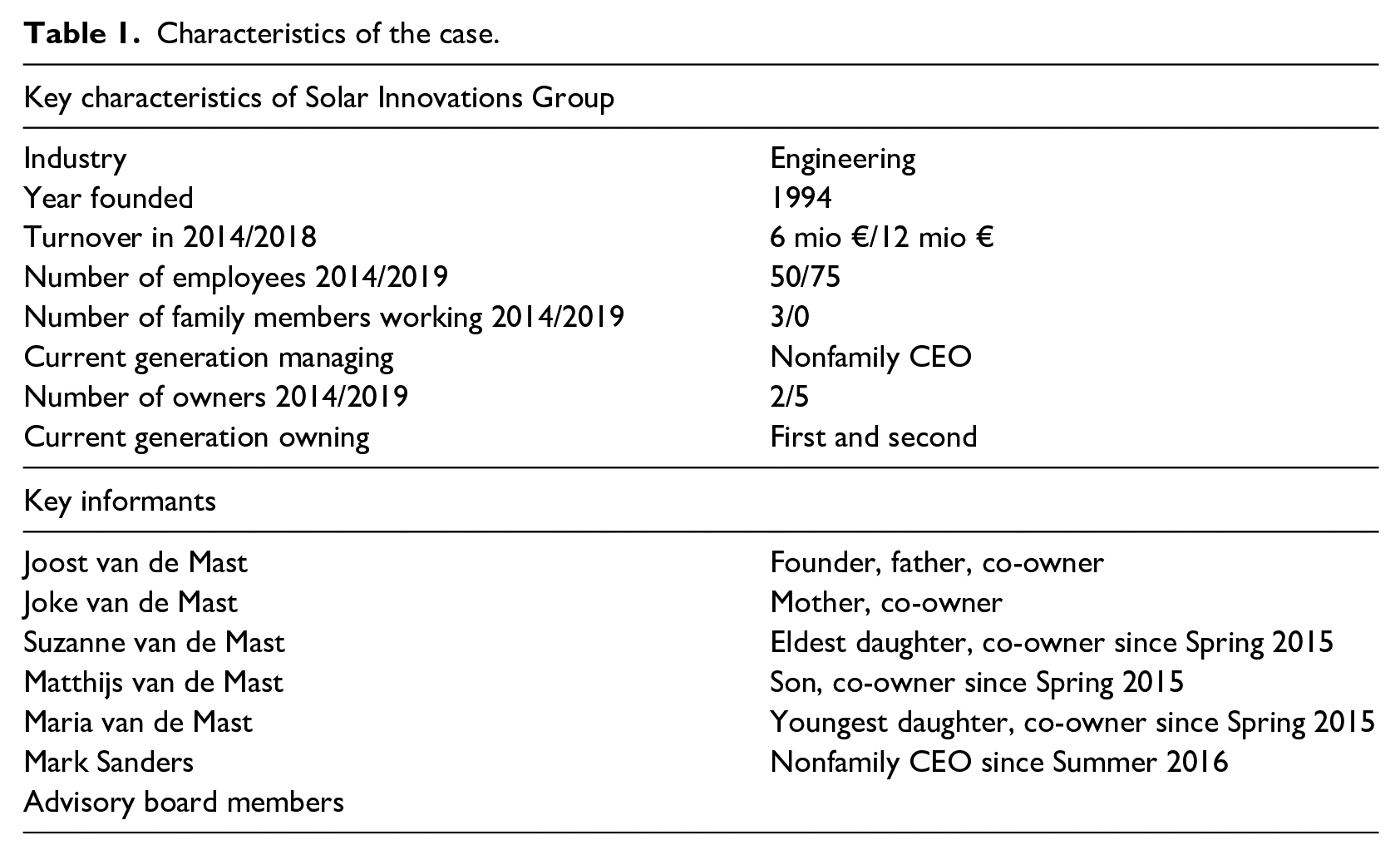
The research setting is an innovative and successful medium-sized engineering family firm, in which the first and second generations of the family are involved and in which the family handed over the leadership of the firm to a nonfamily CEO in July 2016. For reasons of confidentiality, the identification details of the family, the firm, and their members have been changed. We use the ‘Van de Mast family’ and ‘Solar Innovations Group (SIG)’ as pseudonyms for the family name and the family firm name, respectively. The family members include Joost (aged 67) and Joke (aged 62), and their three children Suzanne (aged 33), Matthijs (aged 31) and Maria (aged 29). SIG is in Hellevoetsluis, a village in the western part of the Netherlands.
The firm was founded in 1996 by Joost and his wife, Joke. Joost has a technical background and a passion for innovation. Since the start, the firm has expanded quickly, and it was split into different units and located in different buildings over the years. The family is closely involved in the firm. At the start of the study, two family members were working in the firm: Matthijs in the engineering department and Maria as a human resources manager. Both Matthijs and Maria might be interested in leading the firm in the future. However, in 2016 they felt they were too young to make that decision and they still needed to discover and show whether they would be competent to do so. The eldest daughter did not work in the firm, but she felt emotionally involved. The ownership of the firm was shared by the five family members.
Before the arrival of the nonfamily CEO, the firm was loosely organised, lacking formal communication structures and planning and control mechanisms. Joost felt that he was no longer able to manage his highly educated workforce and further grow the firm because he lacked adequate skills and competences. In addition, he did not like to manage. Instead, Joost wanted to spend more time in the R&D department to work on product innovations. Joost discussed his wish to step down as the CEO of the firm with his family, and together, they decided that it was a good idea to hire a nonfamily CEO for the next few years. This choice would also allow Matthijs and/or Maria to work elsewhere and to decide if they were willing and capable to take over the firm later. Joost and his family believed that an advisory board could provide support in going through these developments. As such, an advisory board was set up during the summer of 2014, and this board consisted of three persons who covered the following areas of expertise: sales and coaching (Yvonne), family firm management (Martijn) and accountancy and governance (Ed). 1 Three-hour meetings were held five times a year at the office of Joost, and the five family owners plus the external advisory board members joined the meetings. Occasionally, a member of the management team was invited to attend a part of the meeting. With the help and support of the advisory board, the ownership of the firm was largely transferred from Joost and Joke to their three children in the spring of 2015, just 1 year before the arrival of the nonfamily CEO. The basic characteristics of the family firm are shown in Table 1. The genogram and organogram can be found in Figure 1.
Characteristics of the case.
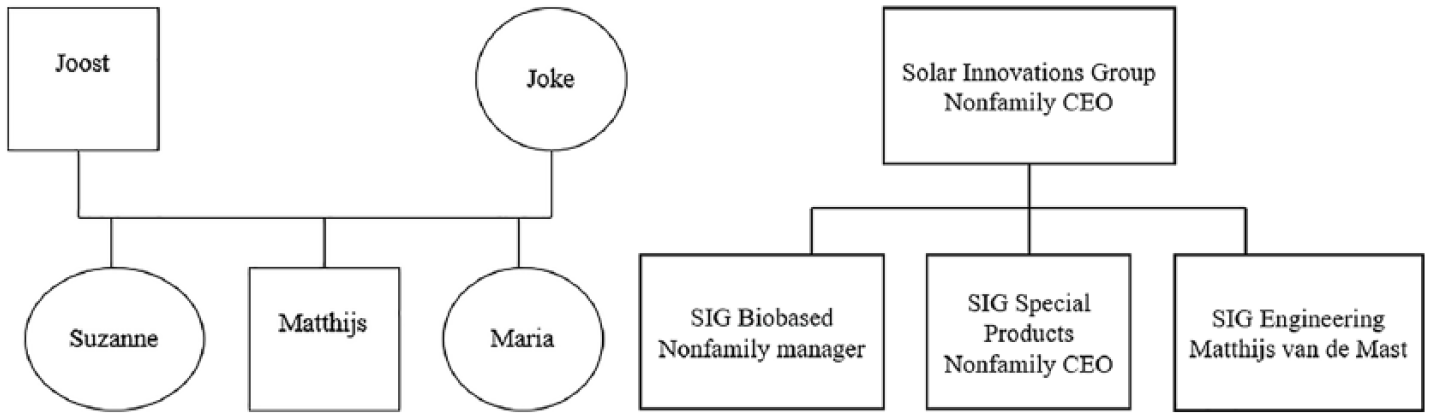
Genogram and organogram (situation before the arrival of nonfamily CEO).
Data collection
Our complete data set includes mainly primary data (observations of the advisory board meetings, interviews and casual conversations) and secondary data. The family members provided full access to observing the advisory board meetings over a period of almost three years (July 2016 to May 2019) and all actors involved (family members, nonfamily CEO and advisory board members) were willing to share their individual reflections on the evolving collaboration between the owner family and the nonfamily CEO on multiple occasions. The observations during the advisory board meetings and the interviews with the individuals involved at different stages of the transition process are the primary units of observation. Table 2 summarises the data collected.
Data collected at Solar Innovations Group from September 2016 to May 2019.
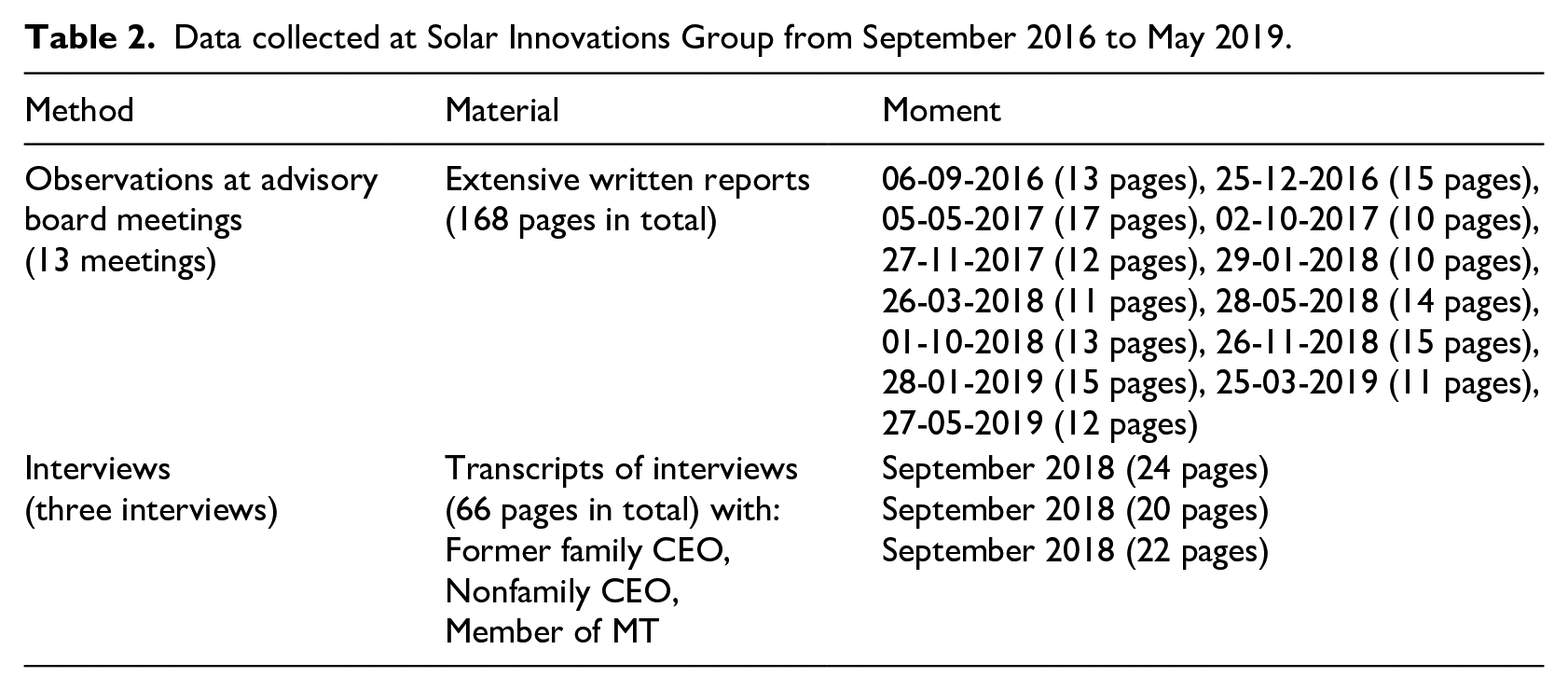
The first author observed all advisory board meetings, developed detailed meeting reports and shared them with the individuals involved in the meetings. These observations allowed us to observe firsthand the experiences and behaviour of the family members, the nonfamily CEO and advisory board members in their own context (Waddington, 2004). The first author developed relationships and participated in activities, but with the clear and explicit notion that the intention was to observe events. One of the family members together with one of the external advisory board members (the chairperson) checked whether the content of the detailed meeting reports realistically represented what was discussed. Another author is one of the external members (not the chairperson) serving on the advisory board. It is, therefore, fair to conclude that subjectivity plays a role in this study because of the close involvement of two of the authors. Instead of trying to reduce the impact of this subjectivity to zero, we argue that this involvement adds relevance to our study since we engaged in practice (Lewin, 1946; Van de Ven, 2007) and that it is essential for our process of understanding (Maxwell, 2012). The detailed notes of the first author were also used by the family owners and advisory board members as the meeting reports. Notes on who said what and the order in which the discussion occurred (who reacted to whom and how this was done) were taken as detailed and literally as possible. These notes contributed to a considerable amount of empirical material, as shown in Table 2.
The second source of primary data was in-depth interviews (Appendix). The purpose of the interviews was to create a more complete and accurate account of the phenomenon of interest (Maxwell, 2012). We had the following three reasons for interviewing the former family CEO, the nonfamily CEO and a member of the management team: (1) to include additional information that was missed in the observations, (2) to include the perspectives and experiences of the nonfamily CEO and a representative of the family firm on the developments taking place and (3) to check the accuracy of our observations. Casual conversations and secondary data were used to contribute to our understanding of the collaboration between the owner family and the nonfamily CEO and the tensions involved. Only selected parts from the observations and interviews are reported in the text because of space limitations. Quotations, illustrations and descriptions are used to provide a representation of the case, of our interpretations and extended concepts.
Data analysis
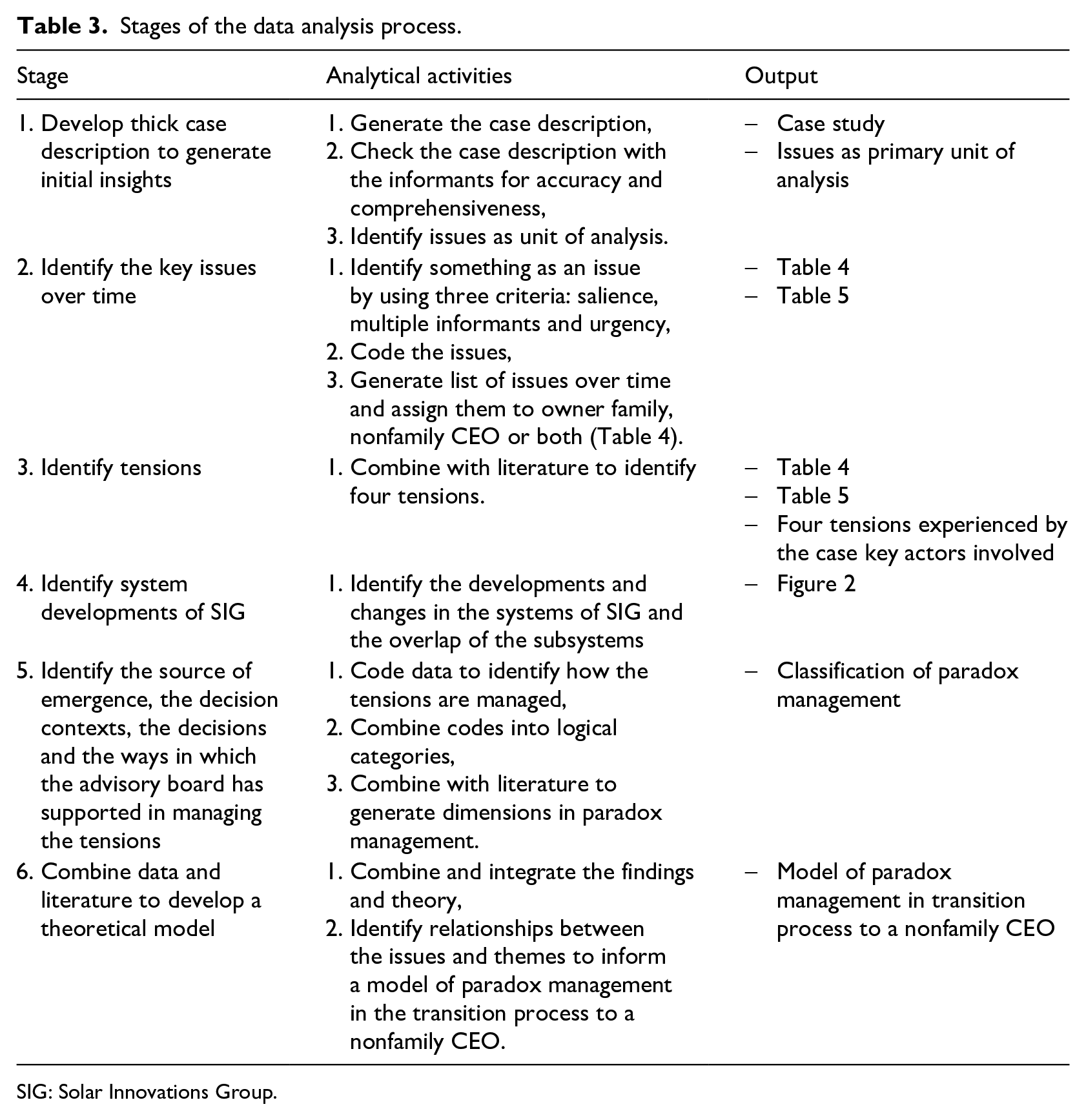
We moved systematically from raw data to theoretical interpretations (Gioia et al., 2013; Smith, 2014) following delineated analytical stages but also allowing the data analysis to be iterative to generate insights and improve the analytical generalisability (Langley, 1999; Locke et al., 2008). Table 3 summarises the stages of the analytical process.
Stages of the data analysis process.
SIG: Solar Innovations Group.
In the first stage, we developed an extensive description of the case, which incorporated the various types of data (Langley, 1999) to describe the family and organisational context, the chronology of the evolving collaboration and the challenges and responses of the stakeholders involved. Consequently, this description was checked by the family owners, the nonfamily CEO and the advisory board members for accuracy. From this description, three insights emerged that guided the subsequent analyses. First, the family members as well as the nonfamily CEO mentioned issues during the meetings regarding the new work relationship with the nonfamily CEO. The individuals described these issues as challenging and problematic. Second, these issues persisted over time and involved matters that were urgent and important to the individuals involved on a personal level, so beyond the organisational implications, and decision-making regarding these issues was often extended. Third, some of the issues were mentioned by the nonfamily CEO, some by the owner family, and some by both the nonfamily CEO and the owner-family members. These insights led us to focus on issues as a primary unit of analysis (Maitlis, 2005; Smith, 2014).
In the second phase, we further identified these issues by using three criteria. The first criterion is that the issue was salient and challenging, following the descriptions of the stakeholders involved. They would use words such as ‘difficult’, ‘very hard’, ‘uncertain’, ‘unclear’, ‘challenging’, ‘tensions’ or ‘problem’. Second, the issue was raised by multiple stakeholders, further ensuring the first criterion. Third, the issue had to involve a certain level of urgency to show the development of the tension and the way it was managed. These issues were coded using QDA Miner 5.0.19, a widely accepted tool for performing qualitative research (Lewis and Maas, 2007). Consequently, we generated a list of the issues over time and we indicated whether they were mentioned by the nonfamily CEO, by the family owners or by both (Table 4). The nonfamily CEO and the family members initiated the meeting agendas. The nonfamily CEO prepared the agenda for the meetings with the advisory board members. The family members held family meetings prior to the meetings with the advisory board and from these family meetings the agenda for the meetings with the advisory board members was deduced. The issues are illustrated by quotes, shown in Table 5, which served as basis to identify the tensions in the next stage of the analysis process.
Issues arise and evolve in advisory/supervisory meetings.
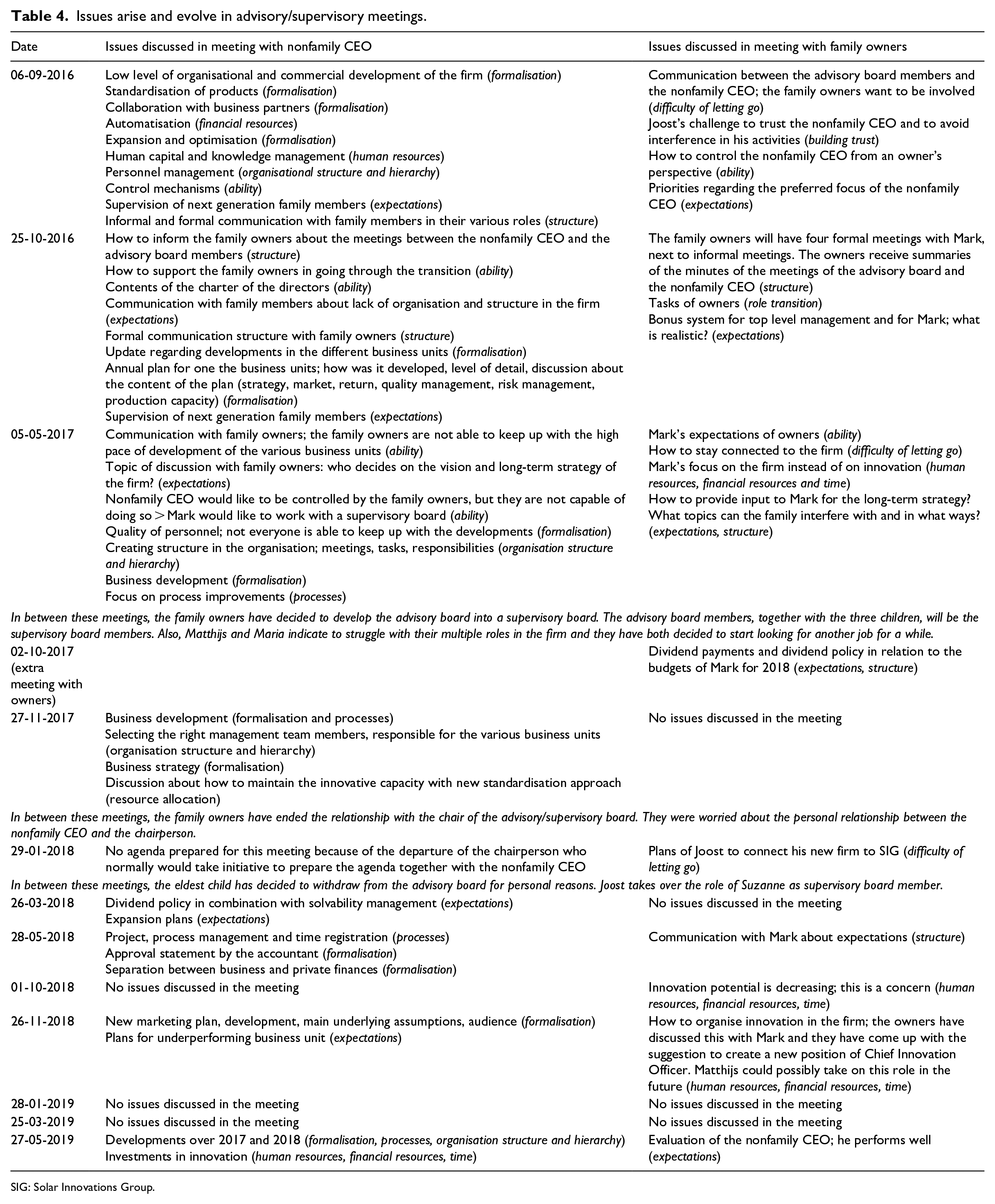
SIG: Solar Innovations Group.
Illustrative quotes from advisory/supervisory board meetings from which we interpreted tensions.
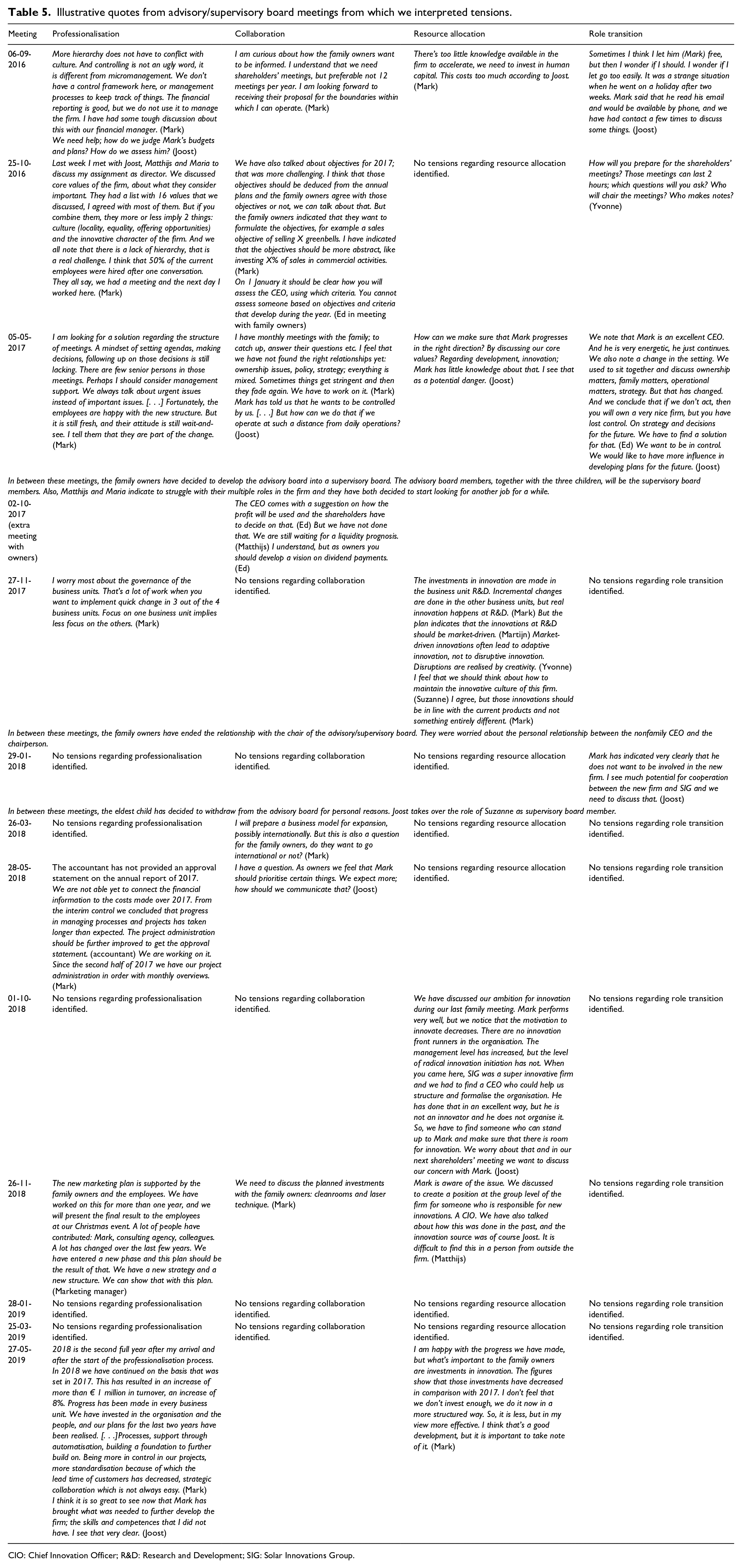
CIO: Chief Innovation Officer; R&D: Research and Development; SIG: Solar Innovations Group.
In the third phase, we incorporated literature and compared the literature with the issues identified. Consequently, the issues were thematically combined into the following four categories, which we identified as the tensions (Figure 2):
Professionalisation, including issues around (a) formalisation, (b) processes, and (c) organisational structure and hierarchy;
Collaboration, including issues of (a) expectations, (b) structure, and (c) ability. These issue all related to a search and discovering ways to balance between the autonomy provided to the nonfamily CEO and the influence of the family members on strategy;
Resource allocation, including issues of allocating resources (financial resources, human resources and time) to the organisation and commercial activities versus allocating resources to innovation;
Role transition of the family owners, including issues related to (a) the difficulty of letting go and (b) building trust.
These categories were shared with the second and third author to clarify and distinguish the emergent tensions.
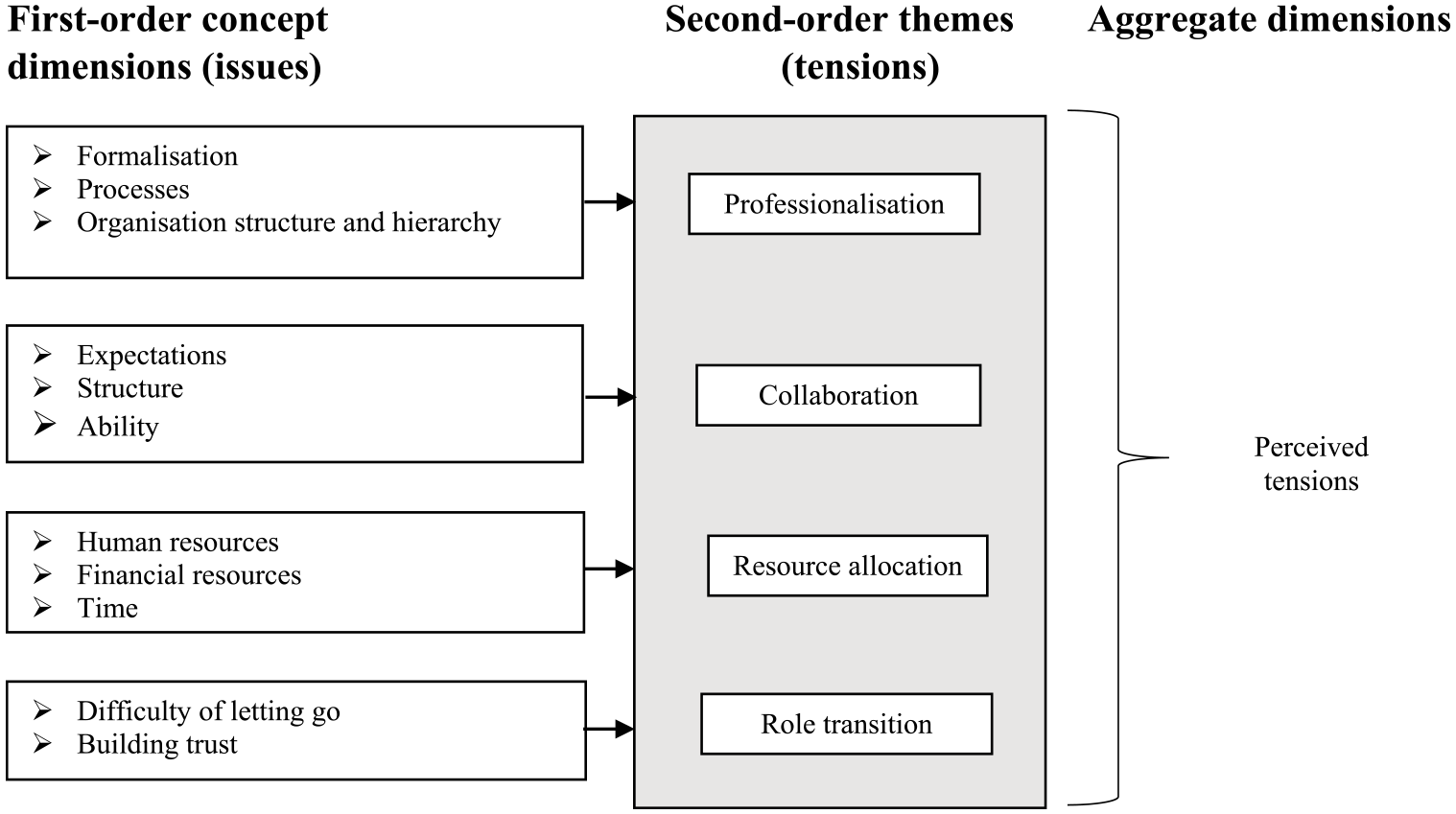
Data structure.
In the fourth phase, we identified the changes and developments in the subsystems of SIG and the overlap between these subsystems over time. Among these changes are the development of the advisory board into a supervisory board and the extension of the supervisory board with three family members, who have become formal supervisory board members. We identified four phases, developing from the situation before the arrival of the nonfamily CEO until the phase in which the advisory board has developed into a formal supervisory board.
In the fifth phase of the data analysis process, we identified patterns of emergence of the tensions, their ownership and management. Addressing our research questions, we read through the raw data, asking how the family members and the nonfamily CEO responded to the issues identified. The following four types of code emerged: (1) the emergence of the tensions (source), (2) the decision contexts describing who owned the tension and who came up with ideas to manage the tension, (3) decisions and (4) the ways in which the advisory board supported in managing the tension. Again, the themes that emerged in the management of the tensions were shared with the second and third authors for further clarification. The overview of the sources of the tensions, their ownership, management and role of the advisory board are presented in Table 6.
Paradox management.
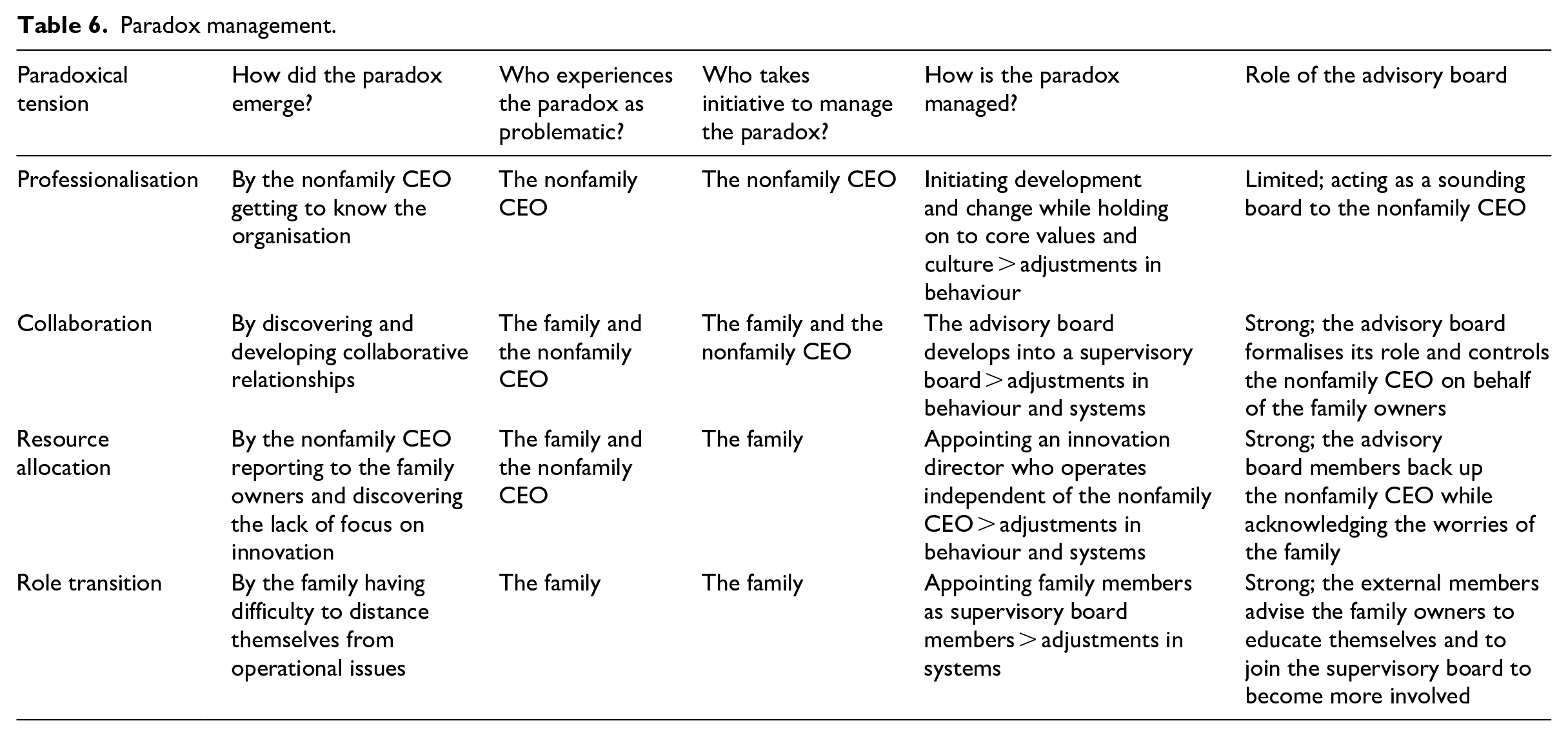
In the sixth and last stage of the data analysis process, we integrated and combined the findings to build a model by embedding the existing theory that helped to inform relationships between the identified issues and the themes that emerged in ways in which the paradoxical tensions are managed.
Emergence of the tensions: from latent to salient
An understanding of paradox management in CEO succession in family firms suggests that latent tensions must become salient before they can be managed. Although we know that tensions in family firms can arise and evolve from the overlap of the three subsystems of family firms (Tagiuri and Davis, 1996), the findings from our study show that the transition from a family to a nonfamily CEO involved a significant change that the actors needed to prepare and adapt to (Blumentritt et al., 2007; Kets de Vries, 1993). The nonfamily CEO (Mark) was appointed and began to work at SIG in July 2016. He was selected because of his strong formal qualifications and he seemed to be a ‘nice’ person. Because Mark had already planned his holiday, he began working for 2 weeks and then left for a period of 3 weeks. This leave was challenging for Joost, the former family CEO. Joost had already given his office to Mark, and it was ‘tempting’ for Joost to take both the position of CEO and the office back during this period. However, instead, he regularly contacted Mark through telephone and email.
No one foresaw the tensions that would emerge in the work relationship between the nonfamily CEO and the family owners over time. However, upon Mark’s return, when the collaborations between the family owners and Mark and between Mark and the employees began to evolve, various issues slowly emerged. Smith and Lewis (2011) suggest that three environmental factors, that is, plurality, change and scarcity, can cause tensions to surface. The findings in this study indeed show that in the context of a transition process from a family to a nonfamily CEO in a family firm; plurality, change and scarcity are factors that render tensions salient. Plurality implies a multiplicity of views in contexts of diffuse power (Smith and Lewis, 2011), which is the case in a situation where a nonfamily CEO is appointed and the nonfamily CEO and the family owners still have to discover how they will play their roles in the new work relationships. The transition implies a significant change in itself. The scarcity (Miron-Spektor et al., 2018) involves the limited resources of the family firm and the choices of the new nonfamily CEO about how to allocate them. In addition to these three factors, this study identifies the advisory board as a fourth factor that can render latent tensions salient. The views of the advisory board members helped to identify latent competing goals and inconsistencies in perspectives of the nonfamily CEO and the family owners. By talking separately to the nonfamily CEO and the family owners, they stimulated opportunities for sensemaking of those competing goals (Maitlis, 2005) and provided support in making the competing yet coexisting role perspectives (firm, family and ownership) explicit when discussing the cooperation between the family owners and the nonfamily CEO and its implications. These factors of change, plurality, resource scarcity and the existence of the advisory board, served as boundary conditions that intensified the salience and engagement with the tensions (Schad et al., 2016) and challenged the bounded rationality and stress systems, which tend to limit individuals to either/or decisions and understandings (Smith and Lewis, 2011).
The findings of this study revealed four different areas of tensions. These are explained in the following subsections.
Professionalisation (tension experienced by the nonfamily CEO)
The professionalisation tension implies the challenge of balancing between organising (creating an organisational structure and working with processes and budgets) versus not organising. This tension was deduced from the issues relating to formalisation, processes and the organisation structure and hierarchy. This tension is closely related to the general paradox of organising (Lewis, 2000; Lüscher and Lewis, 2008; Smith and Lewis, 2011).
Even though Mark indicated that he was very positive and happy about his first weeks at SIG and about his collaboration with the family, he was also amazed by the informal organisation at SIG: I am surprised by the total lack of organisation and of hierarchy. People just go and work and I wonder, why does this person perform this task and why am I not informed about it? Things have not been organised. I find that remarkable. Changes are possible without detracting from the culture and the core values of this family firm. (Mark)
The employees had a great deal of freedom in the past, and Mark felt that structure and control were needed to improve the effectiveness and the efficiency of the work being done. After some months at SIG, Mark felt an increased urgency to organise: I have noticed that there is so much potential in the various products that growth happens very fast, which we also need to organise. It is not that it’s an obligation to grow so quickly, but it just happens because of these great products and it is a shame not to utilise that potential. (Mark)
As such, the organisation needed to formalise and become more ‘professional’. Mark had to start from scratch and convince the employees as well as the members of the management team that things needed to change to prepare the firm for the future: In the past, we worked on innovation based on intuition, without thinking about a business plan. Ideas and products would also develop over time. It is very hard to convince Mark to work on good ideas. He wants to know why we spend resources on that idea. What does it involve exactly? Mark sees that, in the past, there was much more freedom in that sense. He tries to be a bit flexible. First, he wanted to have a business plan for every idea. Now, he is already less rigid. (Member of the management team)
Collaboration (tension between the nonfamily CEO and the family owners)
The collaboration tension implies a tension between the autonomy of the nonfamily CEO versus influence on strategy by the family owners. Issues from which this tension was deduced included expectations, structure and ability. The collaboration tension relates to the paradox between control and autonomy, which is specifically relevant in the family firm context (Ingram et al., 2016).
Tensions between Mark and the family owners started to develop when they discovered that their collaboration was less evident and straightforward than they had thought. These tensions involved a lack of clarity regarding the autonomy of the nonfamily CEO versus the continued influence of the family owners on strategy and a discrepancy between the competences of the family owners to assess the performance of Mark and the competences required. Mark believed that he should develop annual plans and a long-term strategy that the family owners would reflect on during the meeting of shareholders, and the family owners believed that they should provide input for the annual plans and the long-term strategy and that the nonfamily CEO would have to consider their input: I would like to work with a formal document that stipulates the freedom I have in terms of strategic decisions. (Mark)
Regarding the competences, both the family owners and Mark had noticed that Mark was able to realise successful developments within a short time frame. The family owners were impressed by the achievements of Mark but worried that they would not be able to keep up with him. They did not know how to control Mark: He moves so fast; we can’t keep track of him. (Maria). We talked about it, we have to catch up with him, something needs to be done. He (Mark) thinks that we, as the family owners, should perform better and be stronger. He wants to be able to talk to us, we need to be able to perform in our role as owner. (Joost)
The family owners worried that in a time of few years, they might end up with a successful firm but that they would no longer recognise it as their firm, which had never been their intention when deciding to start working with a nonfamily CEO.
Resource allocation (tension between the nonfamily CEO and the family owners)
The resource allocation tension refers to the tension between the focus on commerce and the organisation of the nonfamily CEO versus the focus on innovation of the family owners. Issues from which this tension emerged relate to the allocation of human resources, financial resources and time (Miron-Spektor et al., 2018). This finding confirms earlier research that R&D productivity decays during the tenure of outside CEOs, especially in firms with high R&D intensity (Cummings and Knott, 2018).
Following the lack of formal organisation and a clear hierarchy, Mark felt that more resources should be allocated to organisational support: We lack the knowledge needed to accelerate; we need to invest in activities that support sales. But Joost feels that these activities’ costs are too high. (Mark)
This new focus on organisational support was indeed not what the family owners had expected. They were afraid that with the arrival of Mark and Joost a more distant role in the firm, the natural inclination to work on innovations was lost: He (Mark) does not initiate innovation. To me that is a potential danger. (Joost)
The family owners were not sure how to solve this issue. They had tried to prevent it by preparing a declaration of the core values of the family firm, which was used to find a CEO who would fit the family firm culture. Moreover, they had assumed that the innovative capacity would be sustained by the employees working in the R&D department and by Matthijs, who had become the R&D manager. Even though Mark appeared to be very effective in his role as CEO, he had little affiliation with the heart and soul of the firm, namely, the R&D department. Whereas, Mark appeared to be proud of the innovative products that were invented, produced and sold by SIG, he was not the driving force of the innovative capacity of the firm. The family owners felt that the decisions made by Mark were not necessarily beneficial for the innovative capacity and, therefore, were not in line with the family culture.
Role transition (tension experienced by the family owners)
The role transition tension refers to the tension experienced by the family owners between taking distance versus wanting to stay involved in the daily activities of the firm. Issues from which this tension seemed associated with the difficulty of letting go and the time needed to build trust in the competences and mind-set of the nonfamily CEO. Even though this tension is related a bit to the contradictory demands of control and autonomy (Ingram et al., 2016), it is different because none of the family owners wanted the role of CEO. Instead, they wanted to take distance to pursue their own paths.
Since the summer of 2016, with the arrival of Mark as nonfamily CEO, separate meetings were held between the advisory board members and Mark and the advisory board members and the family owners. The advisory board members commenced with a two hour meeting with Mark in the former office of Joost, followed by a joint lunch, during which the advisory board members, Mark and the five family owners all sat together, and ended with a two hour meeting with the family owners. Even though this separation was beneficial to Mark, as he was able to speak freely with the advisory board members, the family owners were less happy about the newly created situation. They were very curious about what the advisory board members discussed with Mark and wondered how they would be informed about the things that were happening. It was difficult, especially for those family members who worked in the firm, to become more distanced from the operational issues, to distinguish between their different roles of family owners and family employees and to separate formal from informal meetings with Mark: Is it not so that you would like to sit in during the meeting with Mark and the advisory board? (Suzanne) Well, I could learn a lot from the discussions in that meeting. (Matthijs)
From a development perspective, Matthijs would have liked to informally attend the meetings between Mark and the advisory board member but was afraid that this attendance would conflict with his formal role as family owner. Not only partly because of this complexity of working with the nonfamily CEO, but also partly because they had had the idea before Mark came to work at SIG, Matthijs and Maria decided to work elsewhere for a few years and to free themselves from their double roles as owners and employees in communicating with the nonfamily CEO.
These four tensions emerged after the transition to the nonfamily CEO and were perceived by the nonfamily CEO, the family owners or both. The tensions relate to the notion that nonfamily CEOs in family firms have a hard time effectuating their change ambitions because they have fewer explicit and implicit control right (Mullins and Schoar, 2016). Whereas, the nonfamily CEO was directly confronted with the lack of organisation at SIG after his arrival and therefore, from meeting one onwards showed to perceive a tension regarding professionalisation, the family owners were directly confronted with their role transition. Both parties also were confronted with another tension: the tension regarding collaboration. Only at a later stage, they discover tension regarding the allocation of resources. Depending on how the tensions emerged, the actor(s) who perceived them, as well as other elements influencing the decision context, the tensions were managed in different ways. In the next section, we elaborate further on the management of the four tensions we observed from the perspective of paradox.
Paradox management
To manage these tensions of professionalisation, collaboration, resource allocation and role transition, the nonfamily CEO and the family owners drew on various practices, that is, adjustment of systems and/or adjustment of behaviour (Hargrave and Van de Ven, 2017; Pieper and Klein, 2007; Schad and Bansal, 2018). Whereas, the nonfamily CEO was capable of managing the tensions that he came across while beginning to work as the first nonfamily CEO at SIG in an integrative manner himself by adjusting his behaviour, the family owners needed the help of the advisory board to deal with the tensions that emerged. The advisory board members engaged in embracing the tensions and managing them accordingly in an integrative manner as paradoxes (Andriopoulos and Lewis, 2009; Smith, 2014). By making the tensions explicit and discussing them during the advisory board meetings, the family owners started to embrace the tensions, as they realised that they could not choose between the competing sides of the paradoxes (Lüscher and Lewis, 2008). It is important to note that, whereas the family owners were capable of adjusting the subsystems of the family business, the nonfamily CEO did not have a similar authority. The advisory board guided the family owners throughout these different subsystem changes during the transition process (see Figure 3). The advisory board members supported in explicating the implications of changes in roles and in guiding the communication between the individuals involved. The nonfamily CEO turned out to be a driving force in making the transition from an advisory to a supervisory board, after which the advisory board members actively encouraged the family owners to participate in the supervisory board and thereby to deal with the information gap.
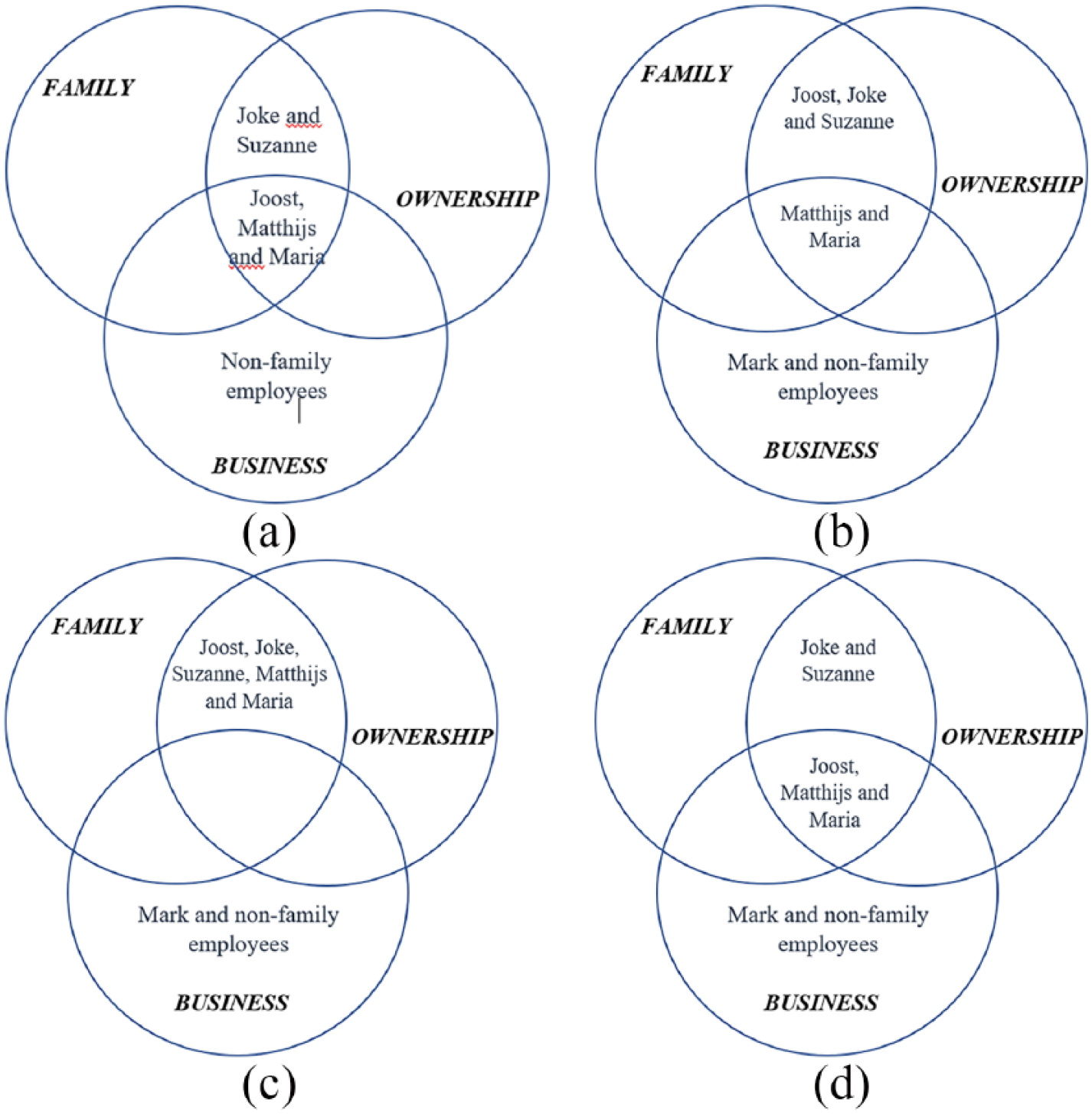
Changes in systems over time. (a) Situation before the arrival of nonfamily CEO. (b) Situation after the arrival of nonfamily CEO. (c) Situation after the arrival of nonfamily CEO and next generation members decide to work elsewhere. (d) Situation with supervisory board.
An overview of the tensions and how they were managed as paradoxes is provided in Table 6.
Professionalisation (paradox management by adjustments in behaviour)
This tension was perceived as problematic primarily by the nonfamily CEO. Mark discussed the issues with the advisory board but came up with an approach to manage the paradox by himself. He tried to solve the tensions of holding on to things as they were versus realising change to develop and organise the business by initiating changes while holding on to the firm’s culture and core values using integrative management techniques. He reformed the management team and appointed business unit managers who would be responsible for their own business units, which implied that they would develop annual plans and budgets and report to Mark. Moreover, an organisation structure was put in place, with clear employee job descriptions, communication structures, information processes and budgets. He closely involved the members of his management team in developing his plans, stressing the goals and overarching strategy of SIG. For example, Mark initiated a project to develop a new marketing strategy. Under the supervision of a consultancy firm, a team was composed with employees from various departments and levels to launch the new strategy by the end of 2018: We have worked on this marketing project for more than a year. At the Christmas gathering, we will present it to all our employees. Many people have cooperated on this plan: Mark, colleagues, the consultancy firm. We have made great progress over the last years and this plan should be evidence of that. (Member of the management team)
Collaboration (paradox management by adjustments in behaviour and systems)
The tension regarding collaboration was perceived by both the family owners and Mark. To manage the paradox, Mark suggested developing the advisory board into a supervisory board
2
(regular and formal board of directors) at an early stage because he preferred a formal controlling governance mechanism. Whereas at first, the advisory board members felt that a supervisory board would be too formal for a family firm with 70 employees and limited family complexity, over time they adjusted their opinion: We have noted that Mark is an excellent CEO. He is very energetic. We have also noted a change of this setting. We used to discuss shareholders’ issues, family issues, management, employees, all at once in the same meeting. That has changed now. The conclusion is: if we do not change things, then the family will own a great firm, but they have lost connection to it. They won’t have an influence on strategy or other decisions regarding the future. We must find a solution for that. (Advisory board member)
As the family owners were neither capable of keeping up with the pace of the nonfamily CEO nor assessing his tasks and performance, they wondered whether the advisory board could perform this role on their behalf. As such, following the advice of the advisory board and the request of Mark, the family owners decided to develop the advisory board into a supervisory board. Through this development, the family owners delegated their task of controlling the nonfamily CEO to the supervisory board. Simultaneously, the family owners were challenged by the advisory board members to determine priorities regarding the tasks of Mark and to provide clarity on how Mark would be assessed: At a shareholders’ meeting, you can comment on his plans, or ask him questions regarding the future, but it is Mark’s job to plan. You must decide the boundaries within which he can act. (Advisory board member)
They helped the family members consider – from an ownership perspective – how they should direct, reward and control Mark.
Resource allocation (paradox management by adjustments in behaviour and systems)
The resource allocation tension was perceived not only as problematic primarily by the family owners, but also by the nonfamily CEO, because it affected how his performance was perceived by the family owners. Moreover, Mark saw the importance of innovation but did not consider it as a priority. The advisory board members provided support regarding the resource allocation paradox by explaining the need for innovation and the concerns of family owners regarding the nonfamily CEO, while explaining the need for organisational structure and support to the family owners: Mark focuses on the right issues; those that add value to the firm. (Advisory board member)
A decision regarding this aspect of resource allocation was made at a rather late stage. By the end of 2018, the family owners indicated that during the last meeting of shareholders, they had discussed the topic of innovation with Mark. Together, they decided to initiate the new role of CIO, which was a new position at the firm group level. Matthijs could potentially perform this role because of his experience with innovating at SIG and because of his family role and potential as future CEO: The innovation focus has come from the family and is the connection between the family and the firm. This is also important regarding the future. We could hire someone for this position, but I am afraid that this person might choose a route I don’t like. I want to be involved in the innovation at Solar Innovations Group. (Matthijs)
Role transition (paradox management by adjustments in systems)
The role transition tension is perceived as problematic by the family owners. On the one hand, the family owners know that the transition to a nonfamily CEO is necessary for the firm to grow and develop; on the other hand, they would prefer to remain involved in all the issues that are dealt with by the nonfamily CEO. The family owners feel that they have become too distant from the firm. The advisory board members have provided support by educating the family owners regarding the shift in their roles, and they discussed with the family owners how to distance themselves from the daily decision-making processes while staying connected. They explained the various roles and relationships involved (1) between Mark and the owners, (2) between Mark and Joost, who might sometimes be contacted for advice or information and (3) between Mark and the second-generation family members who will be coached by Mark. When deciding to develop the advisory board to a supervisory board, the advisory board members encouraged the three children to take on supervisory board member roles. Eventually, Joost, Matthijs and Maria became supervisory board members and began attending the meetings between the external supervisory board members and Mark. This attendance has resulted in satisfaction and peace on behalf of the family owners, as they no longer perceive an information gap.
Earlier, we described how the family owners and the nonfamily CEO experienced and dealt with tensions arising as a result of the transition from a family to a nonfamily CEO. Also, we saw how the advisory board provided support in making these tensions salient and in managing them as paradoxes. We combine these findings with insights from our guiding theory and suggest an understanding of paradox management in CEO succession in family firms. In Figure 4, we combine the findings from the data with the literature and suggest a model of paradox management in CEO succession in family firms.
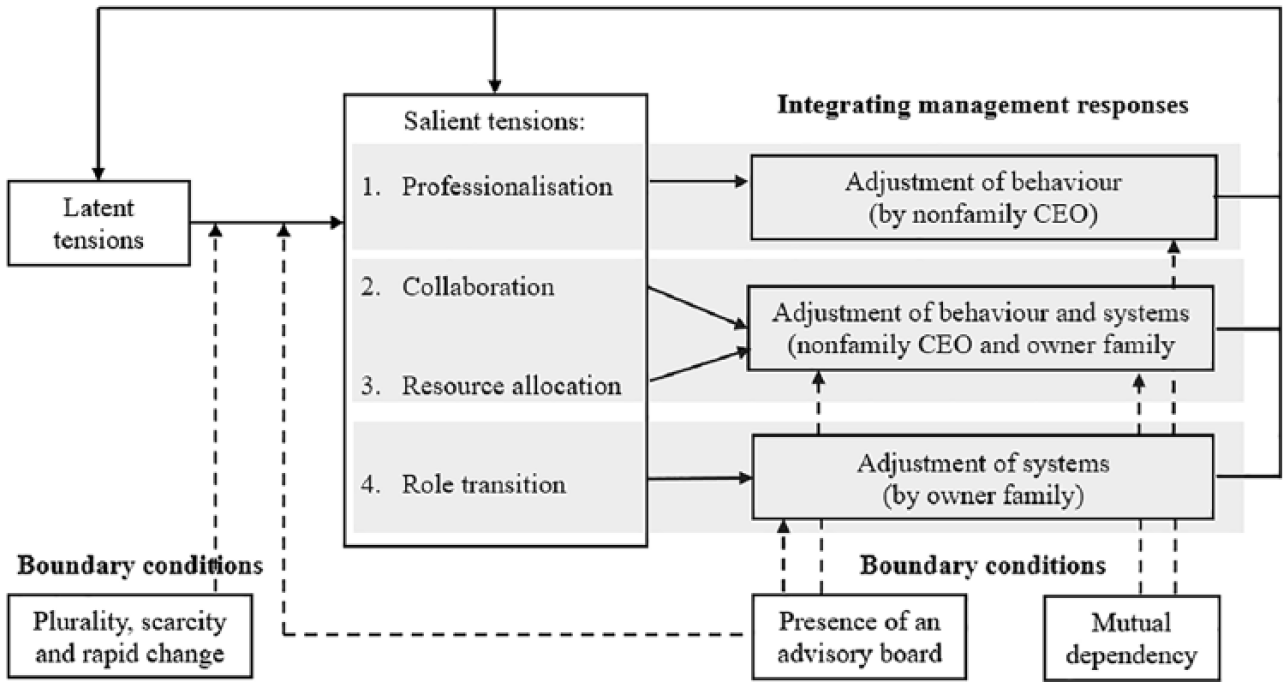
Paradox management after transitioning from a family CEO to a nonfamily CEO.
Figure 4 depicts how latent tensions must become salient before they can be managed. In addition to the three boundary conditions identified by Smith and Lewis (2011), we have suggested that the existence of an advisory board represents a fourth boundary condition in the specific situation in which a family hands over the management of the firm to a nonfamily CEO. A fifth boundary condition identified in this study is the mutual dependence of the nonfamily CEO and the family owners and between the nonfamily CEO and the organisation to make the cooperation work. These boundary conditions intensified the salience and engagement with the tensions by paradox management (Schad et al., 2016). This study, therefore, offers the insight that managing tensions in the context of a transition to a nonfamily CEO, in which different individuals are highly dependent on each other to make this transition successful, is handled by either adjustments in behaviour or changes in the subsystems of the family firm, or by a combination of these approaches. It remains undetermined to what extent the tensions are ‘solved’ by these adjustments. As we know from prior research, tensions persist over time and adjusting in response to these tensions may spur new issues (Jarzabkowski et al., 2013; Smith, 2014). This persistence means that we can expect a feedback loop between the management responses to the tensions and the creation of new ones.
Discussion
This article focuses on the tensions that arise in the work relationships between a nonfamily CEO and the family owners after a CEO succession and how these tensions are managed as paradoxes. This topic is important because the involvement of a nonfamily CEO is already common place in many family firms and will become even more important in the future (Bennedsen et al., 2007; PwC, 2014; Waldkirch, 2019).
Our study contributes to paradox theory in management studies. Specifically, we extend the paradox perspective proposed by Schad and Bansal (2018), who suggested that by addressing the underlying complexity of tensions, organisations and decision makers can more effectively manage them. In keeping with the work of Schad and Bansal (2018), we drew on a systems perspective in family business research (Pieper and Klein, 2007; Tagiuri and Davis, 1996) to uncover the underlying features of the tensions to understand how the tensions are grounded in the system, how and why the tensions have emerged, and which changes are needed to deal with them. We add to the work of Schad and Bansal (2018) by showing that in addition to the behavioural adjustments resulting from understanding the underlying systems, there are also changes that take place within the system of the family firm and between the subsystems of the family, ownership and business that involve a form of paradox management in the context of a transition to a nonfamily CEO. This means that tensions are not only managed by behavioural changes but also by structural changes of the systems.
Furthermore, our study contributes to family business research. First, we have identified four areas where tensions arise during the transition from a family to a nonfamily CEO in a family firm. These are the tensions related to professionalisation, collaboration, resource allocation and role transition. We show in detail how these tensions emerge, who experiences the tensions as problematic, who manages the tensions as paradoxes and what the paradox management response involves (adjustments in behaviour and/or adjustments in structure). This offers new insights to the literature on CEO succession in family firms.
This study also reveals how external advisors can ease the tensions that emerge after a CEO transition. Thus, our study contributes to recent research on advisors and advisory boards in family firms as well (Strike, 2013; Strike et al., 2018). While advising in family firms is a phenomenon that we still know rather little about (Su and Dou, 2013; Van Helvert-Beugels, 2018), our findings mean that that an advisory board can play a role in rendering tensions explicit and in integrating the competing choices and directions into a new and creative solution. As such, we may say that the advisory board moves beyond searching for a compromise. By adding new perspectives, searching for and stressing opportunities after the CEO transition and guaranteeing additional resources, the advisory board members can synthesise the competing forces and support the owner family to reach solutions to complex decisions.
Limitations and future research
Our study is based on qualitative research on what happens after the transition from a family to a nonfamily CEO in a family firm. A natural limitation is the lack of statistical generalisability of the findings. The findings of the study could be extended by including more cases and observations using both qualitative and quantitative research designs. For instance, in order to investigate how different family and ownership structures may influence how tensions arise and are managed when a nonfamily CEO takes over a multiple case study design would be appropriate. Another limitation of the study is the geographical scope, which is constrained to the Netherlands. The role of the advisory board in managing the tensions at play as paradoxes emerged as important in the studied case.
Future research could focus on CEO succession without the help of an advisory board, or with the help of other type of external advisors, such as consultants or non-executive directors of the board. We also encourage researchers to apply complementary theoretical perspectives on how to deal with the tensions and changes that emerge in CEO succession processes, such as conflict theory and organisational design theory. Another interesting opportunity for future research is to study tensions and their management in the situation of a transition from a family to a nonfamily CEO in different ownership constellations. In addition, scholars could focus more specifically on the tensions that emerge when ownership is transferred from the older to the next generation.
Footnotes
Appendix
Acknowledgements
We would like to thank the Special Issue Editors and two anonymous reviewers for their very thoughtful and constructive suggestions on how to improve the manuscript
Funding
The author(s) disclosed receipt of the following financial support for the research, authorship, and/or publication of this article: This research was partly funded by a research grant provided by The Taskforce for Applied Research, which is part of the Netherlands Organisation for Scientific Research (NWO) and is financed by the Ministry of Education, Culture and Science.
