




Abstract
Despite the recognition that newcomers’ ego networks facilitate their adjustment, little is known about changes in their ego-network structures over time and potential drivers for the network changes. Drawing on coevolutionary theory of network dynamics and integrating insights from research on socialization dynamics, we examine the change-related, reciprocal relationships between perceived supervisor behaviors—specifically support and undermining—and structural holes in newcomers’ ego networks (i.e., the extent to which newcomers connect otherwise disconnected individuals). Using latent change score (LCS) modeling in a longitudinal study of new employees, we found evidence of coevolution: perceived supervisor undermining hindered their development of ego networks with increasingly more structural holes; in turn, newcomers who spanned structural holes in their ego networks experienced increasingly more supervisor undermining. Additionally, those whose networks are rich in structural holes perceived increasingly less supervisor support over time. These findings have implications for research on socialization and structural holes.
Keywords
A growing body of research has adopted the social network perspective to examine newcomer socialization, focusing on how newcomers’ ego networks—composed of informal ties with individuals of their new organization—influence their adjustment (Fang, McAllister, & Duffy, 2017; Jokisaari, 2013; Morrison, 2002; Zhou, Park, Kammeyer-Mueller, Shah, & Campbell, 2022). Newcomers with friendship and informational networks including contacts from different organizational units are found to acquire more organizational knowledge and exhibit stronger organizational commitment (Morrison, 2002). Theoretical work also suggests that newcomers who have communication networks rich in structural holes—defined as the extent to which a focal actor connects individuals who are disconnected (Burt, 1992)—are more likely to adjust effectively and perform well (Fang, Duffy, & Shaw, 2011; Jokisaari & Nurmi, 2012). This coherent body of work has offered valuable insights into newcomers’ ego-network structures that are conducive to their adjustment. While informative, research to date has predominantly treated newcomer networks as static and purely focused on the network effects on socialization outcomes at the between-person level (Morrison, 2002). There is limited understanding of newcomer network structures that may change during organizational socialization and potential drivers for the network changes.
A focal actor’s (i.e., ego’s) network structure is inherently dynamic, evolving over time (Chen, Mehra, Tasselli, & Borgatti, 2022; Jacobsen, Stea, & Soda, 2022; Tasselli et al., 2015). For instance, a new hire’s friendship network may contain structural holes as the new hire builds friendship ties with disconnected individuals from different workgroups. Socialization researchers highlight that “one critical aspect in organizational socialization is how newcomers’ networks develop over time in the workplace and which antecedents contribute to that development” (Jokisaari & Nurmi, 2012: 87). Consistently, network scholars argue that “an understanding of network outcomes is incomplete and potentially flawed without an appreciation of the genesis and evolution of the underlying network structures” (Ahuja, Soda, & Zaheer, 2012: 434). These statements demonstrate the importance of investigating both changes in newcomers’ ego-network structures and drivers for the network changes, which is needed for a more granular understanding of the effects of newcomer networks on socialization outcomes. Given that the way an ego network evolves over time has implications for the advantage it provides (Burt & Merluzzi, 2016), such a dynamic lens enriches our understanding of how the network changes influence the accrual of advantage for newcomers over time, which is crucial for their adjustment and subsequent performance.
This study focuses on structural holes and examines factors that influence the extent to which newcomers span structural holes in their ego networks over time. Although this structural configuration has been associated with numerous benefits for individuals, its evolution and dynamics remain largely understudied (Burt & Merluzzi, 2016; Kwon, Rondi, Levin, Massis, & Brass, 2020). Organizational actors regulate and shape other people’s interactions and relationships through engaging in helpful or harmful behaviors (Halevy, Halali, & Zlatev, 2019). Supervisors, as the most functional constituencies in the immediate circumstances for most employees, serve as key representatives of an organization and play a critical role in newcomer socialization. New hires often rely on their interactions with supervisors to assess their places, their identity, and their professional relationships within the organization (Sluss & Ashforth, 2007). Socialization research has shown the evolving nature of supervisor support—offering employees resources, caring about their well-being, and valuing their contributions (Vinokur & van Ryn, 1993)—and supervisor undermining—hindering employees’ efforts to build positive relationships, achieve work-related success, and maintain a favorable reputation at work (Duffy, Ganster, & Pagon, 2002)—which, as perceived by newcomers, significantly affect their adjustment (Jokisaari & Nurmi, 2009; Kammeyer-Mueller, Wanberg, Rubenstein, & Song, 2013; Manville, Bentein, & Abid-Dupont, 2023).
We propose that perceived supervisor support and undermining 1 influence the extent to which newcomers span structural holes in their ego networks over time. Our core argument is that supervisors may not intend to directly support or undermine newcomers’ spanning structural holes or holding brokerage roles; instead, it is those newcomers’ perceptions of supervisor support or undermining that shape their interactions and engagement with diverse organizational members who are likely disconnected, leading to rich structural holes in their ego networks. Furthermore, network structures, once formed, enhance or constrain interactions and actions (McEvily, Soda, & Tortoriello, 2014), and individuals often rely on perceptions of others’ brokerage roles to guide their behavior toward those others (Parkinson, Kleinbaum, & Wheatley, 2017). We argue that supervisors may respond to newcomers’ occupancy of structural holes positions with support or undermining. However, the more intriguing question lies in the bidirectional nature of the relationship: how the supervisor behaviors affect structural holes in newcomer networks, and conversely, how this structural configuration influences the supervisor behaviors. Integrating these reciprocal dynamics into a unified theoretical framework remains a key challenge.
Coevolutionary theory of network dynamics, which is characterized by bidirectional theorizing on coevolution, posits that network changes and their correlates—whether antecedents or outcomes—reciprocally influence each other (Jacobsen et al., 2022). Building on this theory and integrating insights from research on socialization dynamics, we examine supervisor support and undermining as key correlates of structural holes in newcomer networks and propose a change-related, reciprocal model of their coevolution. Specifically, we argue that the supervisor behaviors perceived by newcomers drive changes in structural holes in their newcomers, which in turn propels subsequent changes in their perceived supervisor behaviors. In line with the theory’s focus on “changes” (Chen et al., 2022; Jacobsen et al., 2022), we employ latent change score (LCS) modeling (Ferrer & McArdle, 2010; McArdle, 2001, 2009), which is particularly well suited for examining the change-related, reciprocal relationships over time. As illustrated in Figure 1, our model simultaneously estimates the lagged effects of supervisor support (or undermining) on changes in structural holes in newcomer networks and the lagged effects of this structural configuration on changes in supervisor support (or undermining).
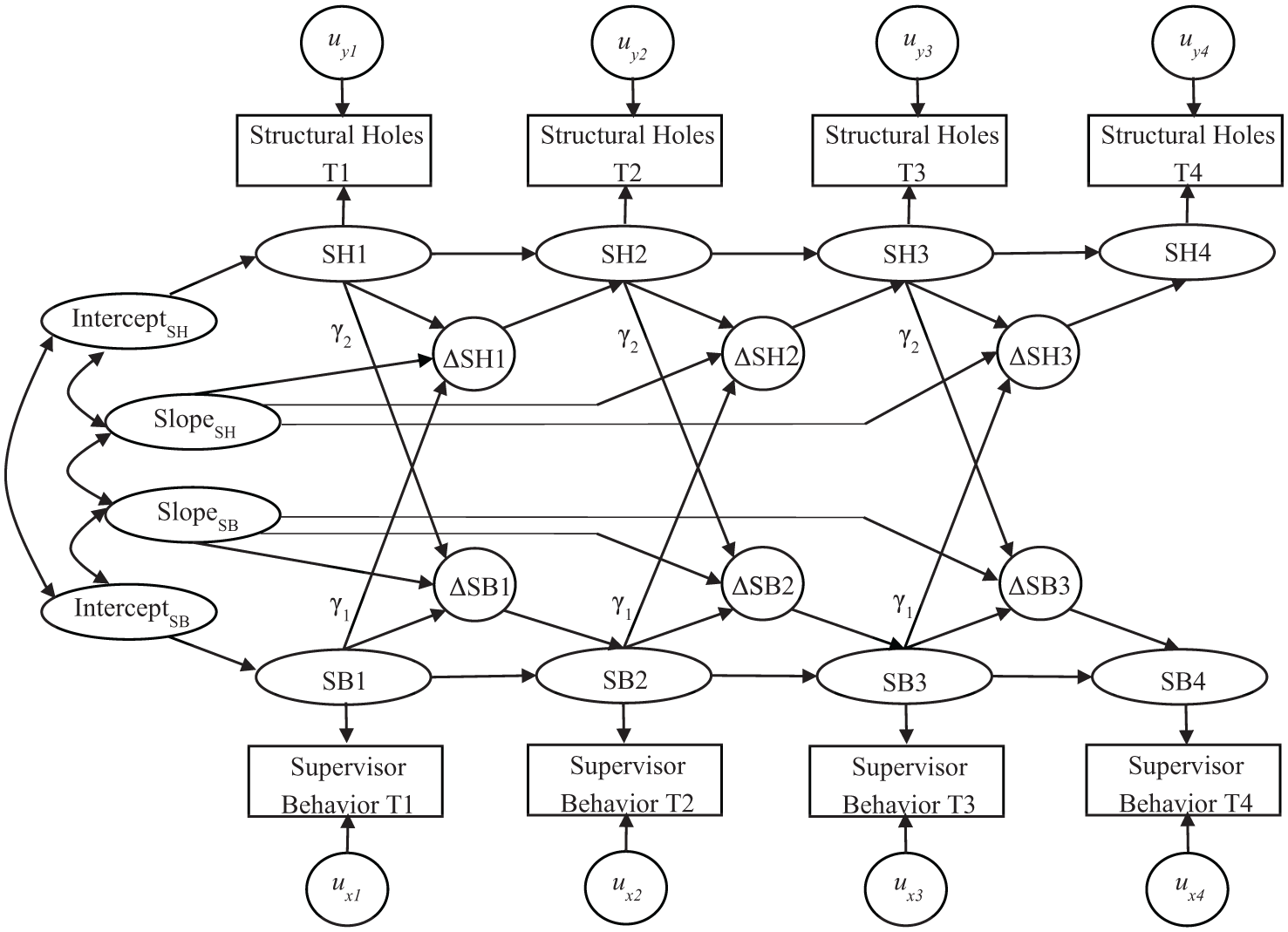
Bivariate Latent Change Score (LCS) Model on Supervisor Behavior and Structural Holes
This study makes several contributions to the socialization literature. First, it offers a unique glimpse into the dynamic nature of newcomers’ ego-network structures. By examining how structural holes in their networks evolve in response to their perceived supervisor support and undermining, we provide theoretical and empirical insights into individuals’ perceptions of others’ actions as driving forces for the network changes—an area that remains underexplored in research on both socialization and organizational networks. Responding to the calls for deeper understanding of how newcomer networks change over time and what factors shape the network change (Jokisaari & Nurmi, 2012; Morrison, 2002; Zhou et al., 2022), our research highlights that a dynamic lens has yet to be fully integrated into socialization studies and extends prior focus on static, one-time observation of newcomer network structures and their effects (e.g., Fang et al., 2017; Jokisaari, 2013; Morrison, 2002; Zhou et al., 2022). Second, our findings shed new light on the pivotal role of supervisors in shaping newcomers’ spanning structural holes. While prior research has shown the importance of supervisors in socializing newcomers, their influence on driving changes in ego-network structures for newcomers remains unknown. Our study reveals that their behavior perceived by newcomers affects newcomers’ development of ego networks rich in structural holes over time. Practically, these insights are crucial for organizations aiming to foster inclusive and supportive onboarding environments and enhance actionable managerial practices to facilitate newcomer adjustment. Third, by focusing on supervisor undermining, we bring further attention to insiders’ negative behaviors toward newcomers, a topic that has received limited attention in the socialization context (for exception, see Kammeyer-Mueller et al., 2013; Manville et al., 2023; Nifadkar, Tsui, & Ashforth, 2012). In doing so, we echo the calls to investigate under-addressed psychosocial dynamics that hinder newcomer adjustment (Ashforth, Sluss, & Harrison, 2007), thereby enriching the understanding of dysfunctional aspects of organizational socialization.
Our research also contributes to research on the origins, dynamics, and potential downsides of structural holes. First, we advance understanding of their origins by demonstrating that the behavior of supervisors, as perceived by newcomers, can significantly influence the extent to which the newcomers bridge disconnected individuals in their ego networks over time. While prior research has emphasized the role of individuals’ own actions in their occupancy of structural hole positions (Kwon et al., 2020), the influence of others’ behavior has been sometimes assumed but rarely empirically substantiated (Halevy et al., 2019). Our findings suggest that the behavior of supervisors as key organizational figures plays a critical role in regulating new employees’ access to structural holes. Second, we enrich the study of network dynamics by formulating and testing a theory of change-related, reciprocal relationships between newcomers’ perceptions of supervisor behavior and their ego-network structures. Extending previous research that has primarily focused on the formation and dissolution of single network ties over time (e.g., Kalish, Luria, Toker, & Westman, 2015; Schulte, Cohen, & Klein, 2012; Tröster, Parker, Van Knippenberg, & Sahlmüller, 2019), our study shows that broader structural configurations, such as structural holes, coevolve with one’s perceptions of the behavior of significant others in the organizational context. Third, our research sheds light on potential liabilities of structural holes, which have traditionally been associated with individual advantages (Fang, Landis, Zhang, Anderson, Shaw, & Kilduff, 2015). We found that when newcomers’ ego networks are rich in structural holes, they experience increasingly more supervisor undermining and increasingly less supervisor support during their socialization. These findings underscore the complex and sometimes adverse consequences of occupying structural hole positions, particularly in early organizational stages.
Theory and Hypotheses
Coevolutionary theory of network dynamics (Jacobsen et al., 2022) offers a valuable lens for examining the dynamic and evolving nature of newcomers’ networks, and supports bidirectional theorizing on the change-related, reciprocal relationships between their access to structural holes and their perceptions of supervisor support and undermining. In the sections that follow, we first explore how the supervisor behaviors each drive changes in structural holes in newcomer networks. Next, we examine how this structural configuration, in turn, propels changes in each of the supervisor behaviors. Finally, we propose the dynamic and mutual influences between these two forces.
Supervisor Behavior and Change in Structural Holes
Upon entering an organization, newcomers face considerable uncertainties about their work and social environment, including whom to approach for information, what to expect from colleagues, and how to initiate interactions with different people (Cable & Parsons, 2001; Fang et al., 2011; Kim, Cable, & Kim, 2005). These uncertainties obstruct their network formation as they endeavor to familiarize themselves with the new environment and attain a sense of mastery. We argue that supervisors, as key socialization agents who significantly shape the immediate environment for newcomers, can influence newcomers’ interactions, relationships, and network development in their organization. As noted previously, we do not suggest that supervisors intentionally support or undermine newcomers’ spanning structural holes. Rather, we contend that supervisor support and undermining perceived by newcomers affect their interactions and engagements with diverse organizational members and further their development of ego networks rich in structural holes.
Supervisor support
Supervisor support, defined as provision of assistance and resources to employees, concern for their well-being and general satisfaction at work, and recognition of their contributions (Eisenberger, Stinglhamber, Vandenberghe, Sucharski, & Rhoades, 2002; Vinokur & van Ryn, 1993), has been shown to foster positive affect, proactive socialization, and effective adjustment among newcomers (Jokisaari & Nurmi, 2009; Kammeyer-Mueller et al., 2013; Nifadkar et al., 2012). We propose that perceived supervisor support, as a signal of a high-quality exchange relationship, encourage newcomers to interact and engage more broadly across organizational boundaries, thereby facilitating them to build networks that are increasingly rich in structural holes over time.
First, supervisor support sends a strong signal to newcomers that they are welcomed, accepted, and valued within their workgroup and organization, creating a safe and supportive environment that is conducive for them to overcome initial hesitations in approaching others (May, Gilson, & Harter, 2004), engage in proactive networking behaviors (Wickramaratne, 2020), and cultivate positive workplace relationships (Kahn, 1990). By offering resources care for newcomers’ well-being, supervisors help new hires make sense of their unfamiliar work and social environment (Kammeyer-Mueller et al., 2013), clarify who knows what, and understand formal and informal power dynamics within the organization (Rollag, Parise, & Cross, 2005). Equipped with these organizational insights, newcomers can construct a mental “map” essential for navigating the workplace and developing both friendships and informational ties across different groups. A supportive environment energizes and thrives employees (Kleine, Rudolph, & Zacher, 2019). Similarly, newcomers who perceive strong supervisor support tend to feel self-assured, positive, and psychologically safe in the face of uncertainty (Kammeyer-Mueller et al., 2013; Nifadkar et al., 2012) and to gain a sense of belonging and attachment (Baumeister & Leary, 1995). These powerful psychological forces motivate them to proactively approach, interact, and develop positive network ties (e.g., friendship and advice) with different organizational members (Schulte et al., 2012).
Second, supervisor support, as perceived by newcomers, directly facilitates their interactions across organizational boundaries, enabling them to build ego networks rich in structural holes. By providing critical resources for socializing and helping orient new hires, supervisors often introduce newcomers to peers, superiors, and managers from various departments—whether through formal meetings, informal gatherings, or cross-functional project assignments (Rollag et al., 2005). Such supervisor support serves as an organizational “permission slip” for newcomers’ future interactions (Rollag et al., 2005), signaling legitimacy and affirming their membership in broader organizational circles (Marrone, Quigley, Prussia, & Dienhart, 2022). As a result, newcomers gain increased access to diverse insiders and opportunities to engage in boundary-spanning activities (Marrone et al., 2022). Consistently, research found that newcomers who perceive greater networking opportunities are more likely to build ego networks rich in structural holes (Fang, Zhang, & Shaw, 2021). Supervisors can enable such network outcomes for employees by encouraging and supporting boundary-spanning activities (Marrone et al., 2022), which positions the employees to access structural holes. Moreover, supportive supervisors who value newcomers’ well-being and contributions may actively integrate the newcomers into their own networks in the organization (Zhou & Wang, 2015). Given that supervisors typically maintain broad and diverse network ties (Carroll & Teo, 1996; Cross & Cummings, 2004), newcomers who perceive strong supervisor support are more likely to interact and connect with their supervisors’ contacts from different workgroups and hierarchical levels. Overall, perceived supervisor support fosters proactive networking behavior (Wang, 2022; Wickramaratne, 2020) and newcomers who engage in such behavior are found to span structural holes in their ego networks (Fang et al., 2021).
Taken together, we argue that supervisor support not only creates a conducive environment in which newcomers gain positive emotions and psychological forces necessary for proactive networking and building network ties with different organizational members, but also directly facilitates them to build ego networks spanning across diverse organizational segments. This dual influence ultimately contributes to increases in structural holes in newcomer networks over time. Therefore, we hypothesize:
Hypothesis 1a: Supervisor support is positively related to increases in structural holes in newcomer networks over time.
Supervisor undermining
Supervisor undermining, defined as behaviors that hinder employees’ efforts to build positive relationships, achieve work-related success, and maintain a favorable reputation at work (Duffy et al., 2002), remains relatively understudied in the context of organizational socialization. Yet newcomers are not immune to such mistreatment (see Kammeyer-Mueller et al., 2013; Manville et al., 2023; Nifadkar et al., 2012). Supervisor undermining “may be directed at a newcomer for myriad reasons, including jealousy, lack of trust, fear that the newcomer’s actions will result in unwanted changes at work, or simply a bad start” (Kammeyer-Mueller et al., 2013: 1108). The undermining behaviors perceived by newcomers can significantly harm their well-being (Manville et al., 2023). We argue that supervisor undermining, as a form of interpersonal stressor, impedes newcomers’ ability to build ego networks with increasingly more structural holes over time.
First, supervisor undermining fosters a hostile and stressful environment dysfunctional for newcomers to establish positive informal network ties. Supervisor undermining, such as rejecting newcomers, withholding needed information, or belittling their ideas, signals that newcomers are unfit, unwelcomed, and undervalued and can be especially damaging during the early stages of organizational entry (Kammeyer-Mueller et al., 2013; Manville et al., 2023). For instance, newcomers who experience supervisor verbal aggression reported heightened negative affect (Nifadkar et al., 2012), and those who receive abusive supervision over time experience emotional exhaustion and struggle to develop the “insider” feelings over time (Manville et al., 2023). We argue that perceived supervisor undermining overwhelms newcomers, making it difficult for them to approach and interact with different organizational members. It may also erode their confidence in their ability to meet workplace demands and build meaningful relationships. Over time, it dampens newcomers’ psychological safety—a critical psychological state for increasing positive network ties over time (Schulte et al., 2012)—and depletes their motivation and energy for engaging in boundary spanning activities, such as seeking information beyond their immediate workgroup and connecting otherwise disconnected individuals. Newcomers are therefore less likely to develop ego networks rich in structural holes.
Second, supervisor undermining, as perceived by newcomers, directly impedes their development of ego networks rich in structural holes by limiting their opportunities for broad connections and diminishing their proactive networking behaviors. Newcomers who perceive greater networking opportunities and engage in more proactive networking are more likely to span structural holes in their networks (Fang et al., 2021). However, supervisor undermining, such as delivering derogatory feedback to newcomers, questioning their competence in public settings, or withholding support, greatly constrains newcomers from networking broadly. These behaviors ultimately result in the loss of face and respect for the new hires and harm their efforts to make good impressions and establish positive reputation (Duffy et al., 2002), making it difficult for them to establish positive network ties across organizational boundaries. Research has documented the negative effects of supervisor mistreatment on employees’ psychological states, attitudes, and behaviors (Hershcovis & Barling, 2010). For newcomers, perceived supervisor undermining leads to withdrawal from their workgroup and organization (Kammeyer-Mueller et al., 2013) as well as a diminished sense of insider status (Manville et al., 2023). Furthermore, abusive supervision harms employees’ ability to thrive and build positive relationships (Kim, Chen, & Kong, 2020; Lu, Wang, Ni, Shapiro, & Zheng, 2023). Accordingly, we argue that newcomers who perceive supervisor undermining are discouraged from initiating interactions, reaching out to others, and forming network ties with members from different organizational segments. They are thus less likely to develop ego networks with increasingly more structural holes over time.
In summary, supervisor undermining not only fosters a dysfunctional environment in which newcomers feel negative about themselves and are discouraged from forming network ties with different organizational members, but also directly obstructs their efforts to build cross-boundary relationships, thereby diminishing their likelihood of spanning structural holes in their ego networks. We hypothesize:
Hypothesis 1b: Supervisor undermining is negatively related to increases in structural holes in newcomer networks over time.
Structural Holes and Change in Supervisor Behavior
As previously noted, theoretical work has suggested that newcomers whose ego networks are rich in structural holes tend to adjust and perform more effectively (Fang et al., 2011; Jokisaari & Nurmi, 2012). However, little is known about whether this structural configuration influences their experience of supervisor support and undermining over time. While spanning structural holes grants access to non-redundant information, a hallmark of occupying brokerage positions (Burt, 1992), it may not necessarily lead to increased supervisor support or reduced supervisor undermining. Emerging research indicates that individuals can imagine the extent to which others hold network brokerage roles and use that imagination spontaneously to guide their behavior toward those others (Kleinbaum, 2018; Parkinson et al., 2017). As the key socialization agents, supervisors often monitor newcomers’ interactions and activities within and across group boundaries. Consequently, they are likely to form impressions of the extent to which newcomers span structural holes and respond with support or undermining.
We argue that newcomers with ego networks rich in structural holes may experience increasingly less supervisor support over time. Building, maintaining, and expanding network ties—particularly those that span disconnected social circles—requires frequent interactions and substantial investment of limited personal resources such as time, energy, and attention (Podolny & Baron, 1997; van Duijn, Zeggelink, Huisman, Stokman, & Wasseur, 2003; Zeggelink, 1995). Following their organizational entry, newcomers are typically focused on mastering new roles, acquiring task-related skills, and integrating into their immediate workgroup. These demands often leave them with limited capacity to cultivate informal ties across organizational boundaries (Fang et al., 2011) and to span structural holes. Nevertheless, an ego network rich in structural holes reflects a wide range of connections beyond a newcomer’s immediate group. This creates a paradox: in striving to build network ties with cross-boundary members, newcomers may inadvertently divert their limited resources away from meeting expectations of their supervisors and workgroup. Correspondingly, supervisors may perceive these newcomers as less engaged or committed to their workgroup, thus reducing their support to the newcomers over time.
Furthermore, an actor’s ego-network structure operates as a salient social cue that observers use to evaluate that actor and his or her output (Podolny, 2001) and determine whether to offer support (Iorio, 2022). While spanning structural holes facilitates access to diverse information, it may also entail social costs. As Xiao and Tsui (2007: 5) describe, it is “like standing on two boats, which is one of the most socially disparaged behaviors and subject to heavy social sanctions.” Network brokers who bridge disconnected others may be perceived as lacking loyalty to any single group and thus viewed as more prone to act idiosyncratically or in their own self-interest (Stovel & Shaw, 2012). Empirical evidence supports this notion—being perceived as occupying structural hole positions often elicits others’ skepticism of one’s motivation and commitment to their relationship, and negatively impacts one’s trustworthiness, thereby lowering others’ support and cooperation critical for one’s performance (Evans, Hendron, & Oldroyd, 2015; Iorio, 2022). These findings suggest that newcomers with ego networks rich in structural holes may inadvertently activate supervisors’ negative perceptual processes and trigger supervisors to negatively attribute their cooperativeness and commitment, ultimately leading to reduced supervisor support over time. We hypothesize:
Hypothesis 2a: Structural holes in newcomer networks are negatively related to increases in supervisor support over time.
Conversely, we propose that newcomers who span structural holes may experience increasingly more supervisor undermining over time. The essence of structural holes suggests that those newcomers can engage in across-boundary activities—for instance, seeking advice and information beyond their immediate workgroup—and by bridging disconnected individuals, filter and maneuver information (Burt, 1992). Network scholars argue that the benefits of spanning structural holes are rooted in self-serving behaviors, such as manipulating others for personal gain or playing people against each other (Burt, 2000; Obstfeld, 2005). Briefly, they “can have access to superior information and exercise a form of control over the behaviors of these alters” (Bizzi, 2013: 1555). Consequently, being seen as bridging different groups dampens brokers’ reputation and provokes others’ negative responses, such as ostracism from coworkers (Evans et al., 2015). A research study has shown that supervisors are more likely to undermine employees who engage in informational boundary spanning—namely, seeking information and knowledge from others outside of their group (Mell, Quintane, Hirst, & Carnegie, 2022).
We argue that supervisors are likely to undermine newcomers occupying structural hole positions mainly because such positions afford those newcomers great access to non-redundant information and opportunities to broker information flows across the group boundaries, which can be perceived by supervisors as a threat to their own influence or authority. Specifically, organizational life is inherently territorial, with individuals often engaging in territorial defense behaviors to protect or secure control over valued organizational domains (Brown, Lawrence, & Robinson, 2005; Brown & Robinson, 2010). Supervisors, in particular, tend to develop a strong sense of psychological ownership over their group (Pierce, Kostova, & Dirks, 2001), that is, “conceive their group of direct subordinates as a territory over which they develop a sense of control” (Mell et al., 2022: 1009). Spanning structural holes facilitates newcomers to seek information outside of their workgroup, participate in cross-boundary activities, and control information flows across the group boundaries. These engagements contest and weaken supervisors’ territorial control over their group, including its information flows, external representations, and boundaries (Mell et al., 2022). In response, supervisors may resort to undermining behaviors as a form of territorial defense (Brown & Robinson, 2010; Brown et al., 2005; Gardner, Munyon, Hom, & Griffeth, 2018; Mell et al., 2022). Based on this reasoning, we expect that newcomers whose ego networks are rich in structural holes will perceive increasingly more supervisor undermining over time. Accordingly, we hypothesize:
Hypothesis 2b: Structural holes in newcomer networks are positively related to increases in supervisor undermining over time.
Change-Related Reciprocal Relationship of Supervisor Behavior and Structural Holes
Coevolutionary theory of network dynamics highlights the dynamic, reciprocal relationships between network structures and their correlates (Chen et al., 2022; Jacobsen et al., 2022; Tasselli et al., 2015). Applied to our study, this theory suggests that supervisor support and undermining, as perceived by newcomers, coevolve with structural holes in their ego networks over time. Network scholars have recognized that individuals, as manifested through their actions and interactions, coevolve with social network structures (Ahuja et al., 2012; Borgatti, Brass, & Halgin, 2014; Gulati & Srivastava, 2014; Tasselli et al., 2015). Building on these theoretical insights, we propose that perceived supervisor support (or undermining) drives changes in structural holes in newcomer networks; in turn, the altered structural holes propel further changes in perceived supervisor support (or undermining). Therefore, we integrate Hypotheses 1a through 2b to hypothesize their change-related, reciprocal relationships.
Hypothesis 3a: Over time, there are change-related, reciprocal relationships between supervisor support and structural holes in newcomer networks. Supervisor support is positively related to increases in structural holes; in turn, changed structural holes are negatively related to increases in supervisor support.
Hypothesis 3b: Over time, there are change-related, reciprocal relationships between supervisor undermining and structural holes in newcomer networks. Supervisor undermining is negatively related to increases in structural holes; in turn, changed structural holes are positively related to increases in supervisor undermining.
Method
Participants and Procedure
The data used in this study are part of a five-wave data collection from a sample of new employees. We invited 350 graduating undergraduates from a business school in Asia to participate in the online baseline survey (Time 0) approximately one month before graduation, capturing stable demographics and personality traits. After graduation, those participants who completed the Time 0 survey were contacted to report their employment start date and participate in four follow-up online surveys (Time 1 to Time 4), administered at three-month intervals during their first year of full-time employment. These follow-ups measured newcomers’ ego networks and their perceived supervisor support and undermining. Only participants who completed a given wave were invited to the next. Participation was voluntary and confidential, and respondents received approximately US $10 per completed survey to reduce attrition in this longitudinal data collection. The number of participants who provided completed information on the variables used in this study is 327 at Time 0, 322 at Time 1, 263 at Time 2, 215 at Time 3, and 187 at Time 4, respectively. Participants averaged 23.40 years old and 64.4% were women. This sample allowed us to control for confounding factors, such as prior working experience and organizational tenure, which could influence the network development for newcomers.
Socialization researchers have considered the first year of employment as appropriate for studying newcomer socialization (Bauer, Bodner, Erdogan, Truxillo, & Tucker, 2007). Our use of three-month intervals aligns with prior research that examined socialization during the first year of employment (Bauer et al., 2007) and changes in newcomer adjustment outcomes (e.g., Boswell, Shipp, Payne, & Culbertson, 2009). Newcomers are unlikely to develop network ties with their organizational members immediately following their entry (Fang et al., 2017). Our use of the three-month intervals within the twelve months allows newcomers’ perceptions of supervisor behaviors and their ego-network structures to unfold over time.
Measures
Supervisor support (Time 1 to Time 4)
Supervisor support was measured using five items adapted from the perceived organizational support scale (Eisenberger, Huntington, Hutchison, & Sowa, 1986). Following prior studies (e.g., Mossholder, Settoon, & Henagan, 2005; Settoon & Mossholder, 2002), we selected five items with high loadings and reworded them to refer to supervisors. Participants rated how frequently their supervisors had, over the past 3 months, “shown very little concern for you [R],” “cared about your general satisfaction at work,” “cared about your opinions,” “failed to notice even if you did the best job possible [R],” and “been willing to help you perform your job to the best of your ability” (α = .83, .84, .85, and .86 for the four times of measurements respectively). Responses ranged from 1 (never) to 5 (almost always).
Supervisor undermining (Time 1 to Time 4)
We assessed supervisor undermining using the 13-item scale developed by Duffy et al. (2002). Participants reported how frequently their supervisors had engaged in behaviors such as “made you feel incompetent” and “put you down when you questioned work procedures” over the past 3 months (α = .95, .96, .97, and .97 for the four times of measurements respectively). Responses ranged from 1 (never) to 5 (almost always).
Structural holes (Time 1 to Time 4)
To assess the extent to which newcomers span structural holes in their ego networks, we focused on their friendship and informational networks that have been commonly examined in socialization research (e.g., Fang et al., 2017; Jokisaari, 2013; Morrison, 2002; Zhou et al., 2022). This focus is also aligned with the meta-analytic study on social networks, showing that individuals occupying structural hole positions in expressive (e.g., friendship) and instrumental (e.g., informational) networks perform well and achieve career success (Fang et al., 2015). We used Marsden’s (1990) egocentric network approach to assess newcomers’ ego networks, which are not constrained by predefined boundaries and are particularly appropriate and useful for understanding their unique set of relations in an organization (Fang et al., 2017; Morrison, 2002). For friendship networks, participants were asked to identify up to twelve people “in your company whom you consider to be friends; that is, people whom you might choose to see socially outside work or you might like to spend free time with” (Morrison, 2002). Participants then indicated whether friendship ties existed among the listed individuals. For informational networks, participants identified up to twelve people “in your company who have been regular and valuable sources of job-related or firm-related information for you” (Morrison, 2002) and similarly reported the presence or absence of informational ties among those listed individuals.
Structural holes in newcomers’ friendship (or informational) networks were assessed with Burt’s (1992) ego-network constraint measure, which reflects the extent to which a focal actor’s direct-tie contacts (alters) are interconnected, with higher constraint indicating fewer structural holes. We reversed the constraint scores (i.e., 1 – constraint) so that higher values represent more structural holes (Burt, 1992). Network scholars have widely adopted this transformation to measure structural holes (see Kwon et al., 2020).
Controls (Time 0 and Time 1)
We controlled for newcomers’ gender (0 = male, 1 = female), age (in years), self-monitoring, and proactive personality, all measured at Time 0, due to their potential influences on newcomers’ network development and perceptions of the supervisor behaviors. Unless noted otherwise, the controls were measured using a 5-point Likert scale (1 = strongly agree to 5 = strongly disagree). Women are less likely than men to occupy brokerage positions (Fang et al., 2021) and age influences one’s ability to manage social networks (Bruine de Bruin, Parker, & Strough, 2020). Also, women and younger employees experience more workplace aggression (Aquino & Thau, 2009). Self-monitoring, defined as the ability to regulate self-presentations in social and interpersonal contexts (Snyder, Gangestad, & Simpson, 1983), is a potent predictor of structural holes (Fang et al., 2015). It was measured with Lennox and Wolfe’s (1984) 13-item scale (α = .82). Proactive personality, reflecting a dispositional tendency to take initiative (Crant, 2000), has been linked to newcomer proactive socialization (Kammeyer-Mueller & Wanberg, 2003) and network building (Cable & Parsons, 2001; Thompson, 2005). We assessed this trait using Seibert, Crant, and Kraimer’s (1999) 10-item scale (α = .87).
We also controlled for the social aspects of socialization tactics (Jones, 1986) that were measured at Time 1, which capture the extent to which experienced insiders (e.g., supervisors) act as role models and provide newcomers positive feedback and support during organizational socialization (Allen, 2006; Ashforth & Saks, 1996), have been proposed to influence newcomer networks (Fang et al., 2011). We used Jones’ (1986) 8-item scale (α = .72). Additionally, we controlled for supervisor support (undermining) measured at Time 1 to account for their likely coexistence in the supervisor-subordinate relationships (Duffy et al., 2002; Nahum-Shani, Henderson, Lim, & Vinokur, 2014).
Network scholars have highlighted the practice of not controlling for network size when regressing an outcome on Burt’s (1992) constraint measure for capturing structural holes (Everett & Borgatti, 2020). Network size is a fundamental component of this measure and “controlling for size eviscerates constraint, leaving the variable labeled constraint in the regression a measure of something other than structural holes as Burt conceived them” (Everett & Borgatti, 2020: 50). This may explain that many studies using the constraint measure to examine the effects of structural holes on individual outcomes do not control for network size (e.g., Burt & Wang, 2022; Brands & Mehra, 2019; Gargiulo & Benassi, 2000; Xiao & Tsui, 2007; Zaheer & Soda, 2009). Following this precedent, we did not control for network size in the hypothesis testing.
Analytical Strategy
To test our hypotheses, we adopted the latent change score (LCS) approach that explicitly models change as a latent variable that is generated from a construct measured at two adjacent occasions (Ferrer & McArdle, 2010; McArdle, 2001, 2009). Given that our variables were assessed across four waves, three latent change variables were modeled for each construct of interest. The LCS approach models change more flexibly than the latent growth curve modeling (Liu, Mo, Song, & Wang, 2016; Preacher, Briggs, Wichman, & MacCallum, 2008). Notably, in modeling a change variable for a construct captured at two adjacent time points, the LCS approach does not assume a linear form of change (Ferrer & McArdle, 2010; McArdle, 2001, 2009). For example, the change of a construct from Time N to Time (N + 1) does not have to be linearly related to the change of the same construct from Time (N + 1) to Time (N + 2). This means that the LCS approach allows us to model non-linear changes in both the supervisor behaviors and newcomer network structures in this study.
Importantly, the LCS modeling enables the examination of change-related, reciprocal relationships with a longitudinal design, offering stronger causal inference, and has been recognized as more advantageous than both latent growth curve modeling and cross-lagged analyses (Ferrer & McArdle, 2010; McArdle, 2001, 2009). It has been increasingly used in research on a number of topics, including personality development (Li, Fay, Frese, Harms, & Gao, 2014; Li et al., 2024) and job stress (Toker & Biron, 2012). In contrast, latent growth curve modeling often models changes as the slope or high-order terms across at least three time points but typically does not model reciprocal relationships (Liu et al., 2016; Preacher et al., 2008). Although cross-lagged analyses are commonly used to assess reciprocal relationships, they do not explicitly address change-related issues (Liu et al., 2016; McArdle, 2009).
As depicted in Figure 1, we followed prior research (Ferrer & McArdle, 2010; McArdle, 2001, 2009) and utilized the classic bivariate latent change score model to examine a change-related, reciprocal relationship between structural holes and supervisor support (or undermining). A latent change variable for structural holes (ΔSH1) is modeled as the change of the variable captured between Time N and Time (N + 1). Structural holes were assessed four times, generating three latent change variables (ΔSH1, ΔSH2, and ΔSH3). The same approach is applied for each supervisor behavior variable. As in latent growth curve modeling, the model also includes two change parameters for each construct: an intercept and a slope. The intercept (e.g., Intercept SH for structural holes) is specified to affect the starting point of the construct (e.g., SH1). The slope (e.g., Slope SH for structural holes) is specified to influence the three latent change variables (e.g., ΔSH1 to ΔSH3). Coefficient γ1 was adopted to test Hypothesis 1a (or 1b), which predicted the lagged effect of supervisor support (or undermining) on changes in structural holes. Similarly, coefficient γ2 was utilized to test Hypothesis 2a (or 2b), which predicted the lagged effect of structural holes on changes in supervisor support (or undermining). When both γ1 and γ2 are significant, Hypothesis 3a (or 3b), which predicted a change-related reciprocal relationship of supervisor support (or undermining) and structural holes, is supported (Ferrer & McArdle, 2010; McArdle, 2001, 2009). In evaluating model fit, we relied on the following indicators previously suggested (e.g., Lang, Bliese, Lang, & Adler, 2011; Meier & Spector, 2013): chi-square, comparative fit index (CFI), root mean square error of approximation (RMSEA), and standardized root-mean-square residual (SRMR). All analyses were performed with Mplus 8.0 (Muthen & Muthen, 1998-2017).
We followed the suggestion by Newman (2014) in dealing with missing data and adopted the maximum likelihood (ML, also referred to as full information maximum likelihood, FIML) estimator in Mplus because of its advantages compared to the listwise or pairwise deletion. We further conducted attrition analyses using control variables (gender, age, self-monitoring, proactive personality, and socialization tactics) and key study variables measured at Time 1 (supervisor support, supervisor undermining, and structural holes) to predict whether participants dropped out of participation at Time 2, Time 3, and Time 4 surveys. Table S1 of the Online Supplement showed that none of the variables, except for structural holes in informational networks, was associated with data missingness. We thus concluded that the data attrition appears to fall into the category of missing at random (MAR) and does not affect our findings systematically (Newman, 2014).
Results
Measurement Invariance and Scale Validation
Following previous recommendations (McArdle, 2009; Ployhart & Vandenberg, 2010; Preacher et al., 2008), we first tested measurement equivalence of each study variable across the four waves using item level data for the measures of supervisor support and undermining. To demonstrate measurement invariance across time, we compared configural (i.e., form) and metric (i.e., factor loading) invariance for each construct (Vandenberg & Lance, 2000). The results reported in Table 1 showed that there were no significant differences in model fit indices between configural and metric invariance (Chen, 2007; Cheung & Rensvold, 2002), supporting measurement invariance. To examine the independence of the study variables across time and measurement invariance, we further tested one single unified model specifying the measurement invariance of the two supervisor behavior variables simultaneously across time and with confirmatory factor analyses. The results showed a satisfactory model fit to the data. The evidence demonstrated sufficient construct independence and measurement invariance for supervisor support and undermining.
Model Fit Indices for Testing Measurement Invariance
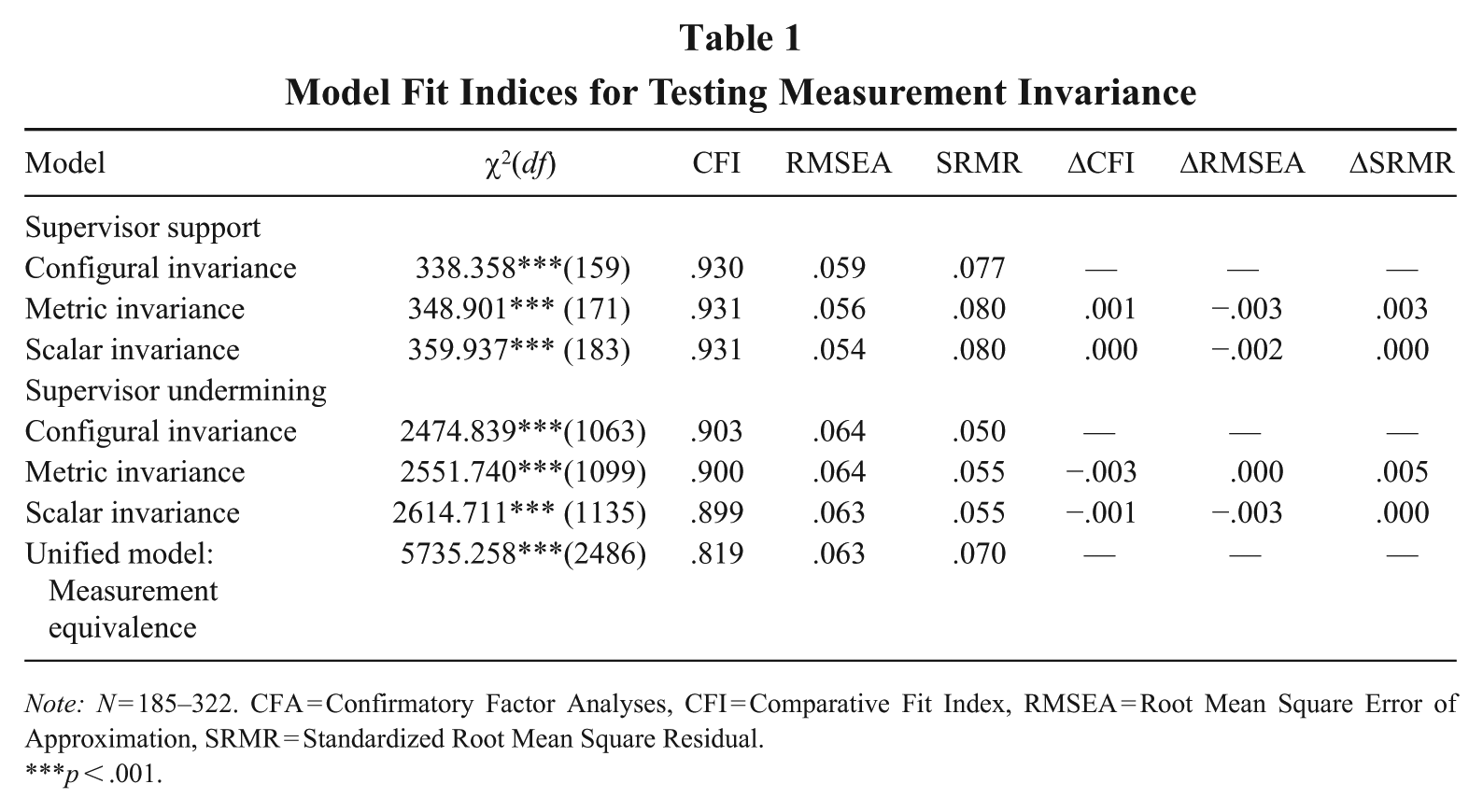
Note: N = 185–322. CFA = Confirmatory Factor Analyses, CFI = Comparative Fit Index, RMSEA = Root Mean Square Error of Approximation, SRMR = Standardized Root Mean Square Residual.
p < .001.
Hypothesis Testing Results
Table 2 reports the descriptive statistics and correlations among our study variables. Table 3 reports the results of the bivariate LCS models for testing our hypotheses.
Means, Standard Deviations, and Correlations
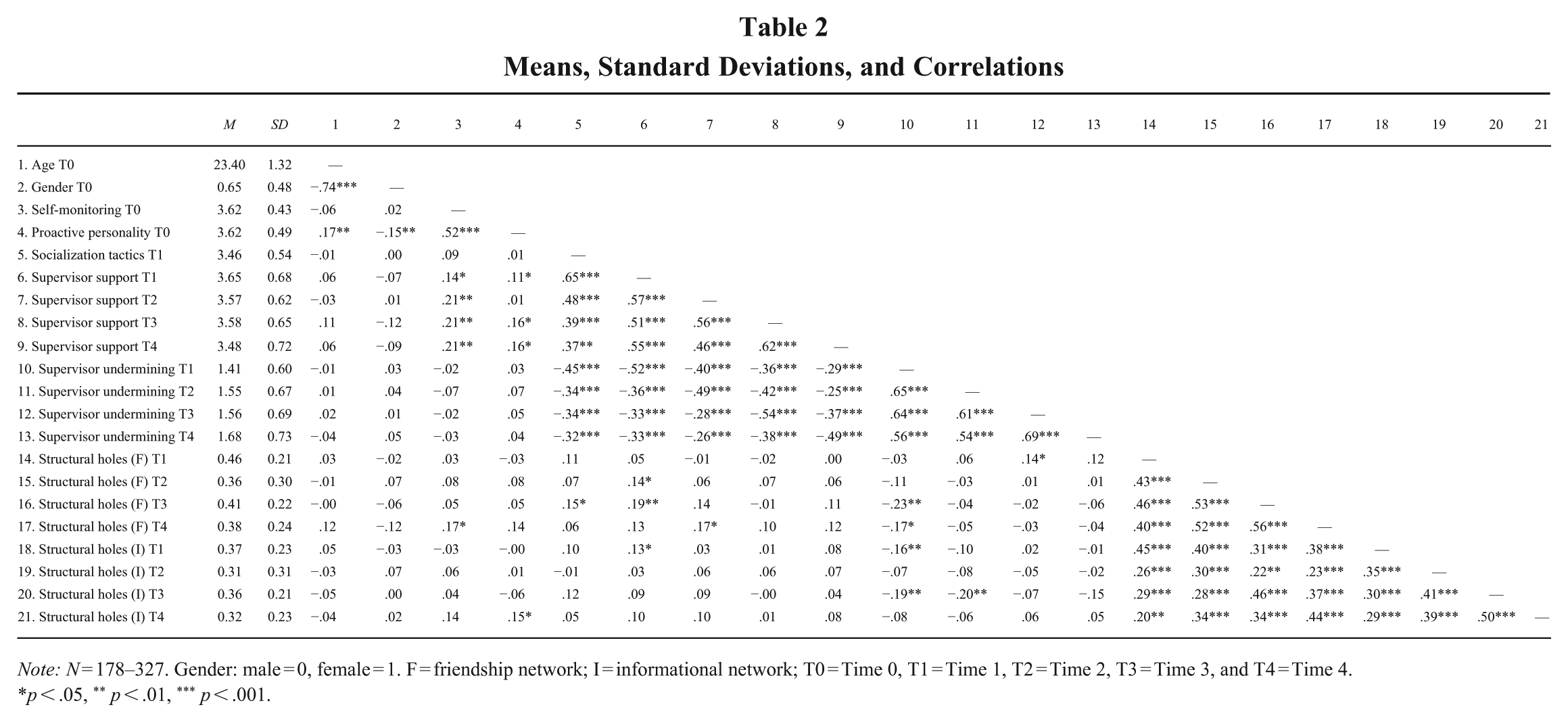
Note: N = 178–327. Gender: male = 0, female = 1. F = friendship network; I = informational network; T0 = Time 0, T1 = Time 1, T2 = Time 2, T3 = Time 3, and T4 = Time 4.
p < .05, ** p < .01, *** p < .001.
Fitness and Parameter Estimates for Bivariate Latent Change Score (LCS) Models on Supervisor Behavior and Structural Holes
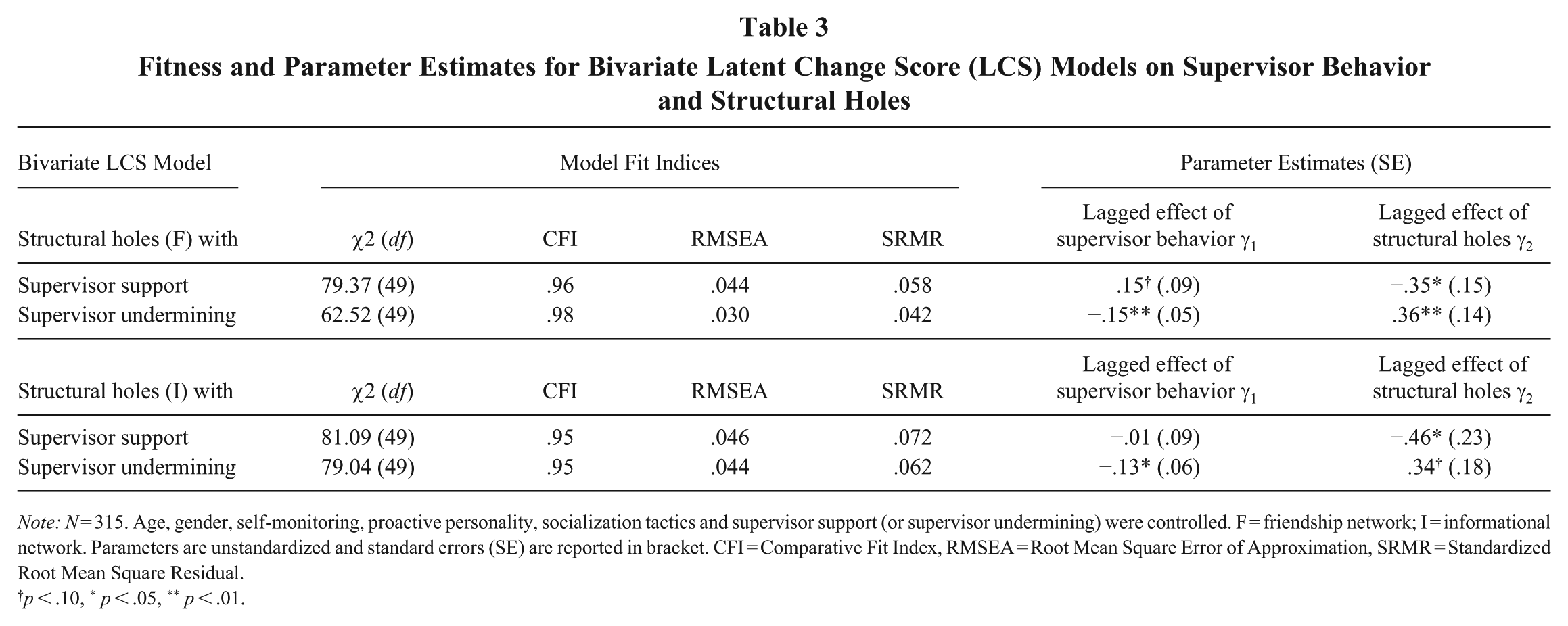
Note: N = 315. Age, gender, self-monitoring, proactive personality, socialization tactics and supervisor support (or supervisor undermining) were controlled. F = friendship network; I = informational network. Parameters are unstandardized and standard errors (SE) are reported in bracket. CFI = Comparative Fit Index, RMSEA = Root Mean Square Error of Approximation, SRMR = Standardized Root Mean Square Residual.
p < .10, * p < .05, ** p < .01.
Lagged effect of supervisor behavior on changes in structural holes (γ1)
Hypothesis 1a predicted that supervisor support would be positively related to increases in structural holes in their networks over time. In Table 3, the results on the lagged effect of supervisor behavior showed that supervisor support had a marginal and positive association with increases in structural holes in friendship networks (γ1 = .15, p = .097) and was not related to increases in structural holes in informational networks (γ1 = −.01, p = .901). Hypothesis 1a was not supported.
Hypothesis 1b predicted that supervisor undermining would be negatively related to increases in structural holes in newcomer networks over time. The results showed that supervisor undermining was negatively and significantly related to increases in structural holes in friendship (γ1 = −.15, p = .004) and informational (γ1 = −.13, p = .042) networks. Hypothesis 1b was fully supported, showing that supervisor undermining, as perceived by newcomers, is dysfunctional for them to build ego networks with increasingly more structural holes over time.
Lagged effect of structural holes on changes in supervisor behavior (γ2)
Hypothesis 2a predicted that structural holes in newcomer networks would be negatively related to increases in supervisor support. In Table 3, the results on the lagged effect of structural holes showed that this structural configuration in friendship (γ2 = −.35, p = .018) and informational (γ2 = −.46, p = .040) networks were negatively and significantly related to increases in supervisor support. Hypothesis 2a was fully supported, suggesting that newcomers who span structural holes in their networks experience increasingly less supervisor support over time.
Hypothesis 2b predicted that structural holes in newcomer networks would be positively related to increases in supervisor undermining. In Table 3, the results showed that structural holes in friendship networks were positively and significantly related to increases in perceived supervisor undermining (γ2 = .36, p = .007), and structural holes in informational networks had a marginal and positive association with increases in this supervisor behavior (γ2 = .34, p = .066). Hypothesis 2b was supported only for friendship networks—when newcomers connect their disconnected friends, they experience increasingly more supervisor undermining over time.
Change-related reciprocal relationships (both γ1 and γ2)
We predicted that there would be change-related, reciprocal relationships of structural holes with supervisor support (Hypothesis 3a) and supervisor undermining (Hypothesis 3b), respectively. As explained previously, such a relationship is established when both (a) the lagged effect of supervisor behavior on changes in structural holes (γ1) and (b) the lagged effect of structural holes on changes in supervisor behavior (γ2) are significant. In Table 3, the results based on the simultaneous examination of γ1 and γ2 showed that, although structural holes in friendship and informational networks predicted subsequent changes in supervisor support, supervisor support did not predict subsequent changes in structural holes in both ego networks. Hypothesis 3a was not supported. In contrast, we did observe a change-related, reciprocal relationship between supervisor undermining and structural holes in friendship networks: supervisor undermining led to subsequent decreases in structural holes; in turn, the altered structural holes promoted increases in supervisor undermining later on. Hypothesis 3b was supported, suggesting that supervisor undermining and structural holes in newcomer friendship networks coevolve, mutually influencing each other over time.
We also tested all the hypotheses without including all the control variables. Table S2 of the Online Supplement showed that excluding the control variables did not change the significant findings we reported above. Instead, the two marginal and non-significant lagged effects that we reported above became significant without all the controls—namely, supervisor support had a positive and significant lagged effect on structural holes in friendship networks (γ1 = .15, p = .008) and structural holes in informational networks had a positive and significant lagged effect on supervisor undermining (γ2 = .52, p = .03).
Supplementary Analyses
To further understand the inherently dynamic nature of newcomers’ ego-network structures and their perceived supervisor behaviors, we performed supplementary analyses to examine the role of time in shaping the magnitudes of the lagged effects. Socialization scholars have been calling for empirical insights into the role of time and temporality (Ashforth, 2012; Ashforth et al., 2007; Klein & Heuser, 2008). One important temporal consideration is “potential time lags before the socialization effects are evident and the possibility that those effects may dissipate” (Klein & Heuser, 2008: 312). We have conceptualized the lag process and the time lags in testing the change-related, reciprocal relationships (see Figure 1). What remains to be determined is whether the lagged effects of (a) supervisor support (or undermining) on changes in structural holes and (b) structural holes on changes in supervisor support (or undermining) fluctuate over time (cf. George & Jones, 2000; Mitchell & James, 2001).
As depicted in Figure S1 of the Online Supplement, we extended classical LCS models (Grimm, An, McArdle, Zonderman, & Resnick, 2012) to include (a) two more paths from a supervisor behavior variable at Time 1 (SB1) to change of structural holes from Time 2 to Time 3 (ΔSH2) and from Time 3 to Time 4 (ΔSH3), (b) one more path from a supervisor variable at Time 2 (SB2) to change of structure holes from Time 3 to Time 4 (ΔSH3), (c) two more paths from structural holes at Time 1 (SH1) to change of a supervisor behavior variable from Time 2 to Time 3 (ΔSB2) and from Time 3 to Time 4 (ΔSB3), and (d) one more path from structural holes at Time 2 (SH2) to change of a supervisor behavior variable from Time 3 to Time 4 (ΔSB3). Doing so allows us to examine whether (a) the influences of a supervisor behavior variable on changes of structural holes and (b) the influences of structural holes on changes of a supervisor behavior variable differ across time.
As shown in Table 4, the lagged effect of supervisor undermining at Time 1 on changes in structural holes in friendship networks from Time 1 to Time 2 (γS1 = −.20) was significantly more pronounced in magnitude than its lagged effect on changes in structural holes from Time 2 to Time 3 [γS2 = .01; difference (γ S1 –γ S2 ) = −.21, p = .001] and from Time 3 to Time 4 [γS3 = −.01; difference (γS1–γS3) = −.19, p = .001]. Similarly, the lagged effect of supervisor undermining at Time 1 on changes in structural holes in informational networks from Time 1 to Time 2 (γS1 = −.17) was significantly more pronounced in magnitude than its lagged effect on changes in the structural holes from Time 2 to Time 3 [γS2 = .02; difference (γ S1 –γ S2 ) = −.19, p = .005] and from Time 3 to Time 4 [γS3 = −.01; difference (γS1–γS3) = −.17, p = .009]. Taken together, these findings provide preliminary evidence that the influences of supervisor undermining on changes in structural holes in newcomer networks declined over time, perhaps not in a linear fashion. We did not find that the lagged effects of supervisor support on changes in structural holes in newcomer networks fluctuated over time.
Fitness and Parameter Estimates for Extended Latent Change Score Models Testing How Effects Unfold Over Time
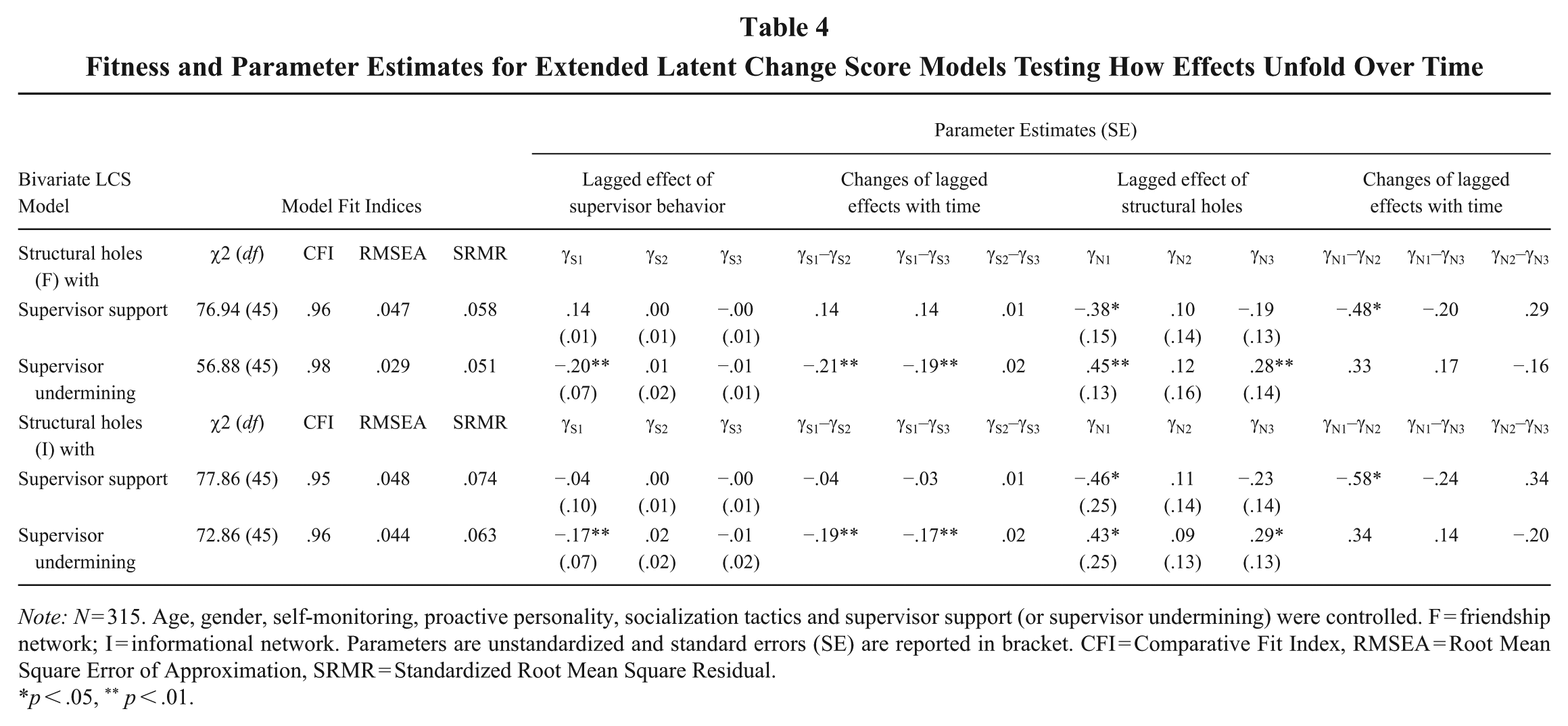
Note: N = 315. Age, gender, self-monitoring, proactive personality, socialization tactics and supervisor support (or supervisor undermining) were controlled. F = friendship network; I = informational network. Parameters are unstandardized and standard errors (SE) are reported in bracket. CFI = Comparative Fit Index, RMSEA = Root Mean Square Error of Approximation, SRMR = Standardized Root Mean Square Residual.
p < .05, ** p < .01.
Furthermore, the results showed that the lagged effect of structural holes in friendship networks at Time 1 on changes in supervisor support from Time 1 to Time 2 (γN1 = −.38) was significantly more pronounced in magnitude than its lagged effect on changes in supervisor support from Time 2 to Time 3 [γN2 = .10; difference (γ N1 –γ N2 ) = −.48, p = .025]. Similarly, the lagged effect of structural holes in informational networks at Time 1 on changes in supervisor support from Time 1 to Time 2 (γN1 = −.46) was significantly more pronounced in magnitude than its lagged effect on changes in supervisor support from Time 2 to Time 3 [γN2 = .11; difference (γ N1 –γ N2 ) = −.58, p = .022]. These findings provide preliminary evidence that the influences of structural holes in newcomer networks on changes in supervisor support faded over time, perhaps not in a linear fashion. We did not find that the lagged effects of structural holes in newcomer networks on changes in supervisor undermining fluctuated over time.
Discussion
This study integrates coevolutionary theory of network dynamics with insights from research on socialization dynamics to examine how supervisor support and undermining, as perceived by newcomers, coevolve with structural holes in their networks over time. Using latent change score (LCS) modeling in a longitudinal study of newcomers, we found that perceived supervisor undermining hinders their development of ego networks with increasingly more structural holes for newcomers; in turn, newcomers who span structural holes in their networks experience increasingly more supervisor undermining and increasingly less supervisor support.
Theoretical Implications
This study contributes to the socialization literature in three ways. First, it offers both theoretical and empirical insights into the dynamic nature of newcomer networks, demonstrating that the extent to which newcomers span structural holes in their networks evolves in response to their perceptions of supervisor behavior. Prior research has largely focused on static snapshots of newcomer ego-network structures and the network effects on adjustment outcomes (e.g., Fang et al., 2017; Jokisaari, 2013; Morrison, 2002; Zhou et al., 2022), and overlooked the dynamics of newcomer networks, an essential aspect of newcomer socialization. Research is needed to study changes in newcomer ego-network structures and how the network changes and their driving forces unfold in relation to each other over time. Our study addresses this gap by drawing on coevolutionary theory of network dynamics to model how structural holes in newcomer networks coevolve with perceived supervisor support and undermining. The findings underscore the importance of tracking changes in newcomer networks over time, which has implications for understanding how the evolving networks can offer structural advantages that are crucial for newcomer adjustment and performance (Fang et al., 2011; Jokisaari & Nurmi, 2012).
Second, this study highlights the pivotal role of supervisors in shaping the network dynamics for newcomers over time. Prior socialization research has established supervisors as key socialization agents, providing newcomers general support (Kammeyer-Mueller et al., 2013), assistance (Rubenstein, Kammeyer-Mueller, & Thundiyil, 2020), information, and feedback (Ellis, Nifadkar, Bauer, & Erdogan, 2017). Our study further reinforces their importance by showing that supervisor undermining, as perceived by newcomers, can inhibit them from developing ego networks with rich structural holes, a structural configuration associated with positive performance outcomes for individuals (Fang et al., 2015). Importantly, by examining supervisor support and undermining simultaneously, our study captures the complex, multifaceted supervisor-newcomer relationships. This dual focus responds to recent calls for insights into positive and negative interpersonal dynamics that coexist and influence newcomer adjustment (Kammeyer-Mueller et al., 2013; Manville et al., 2023). Overall, our findings support the idea that how supervisors interact with or behave toward newcomers is crucial for a more well-rounded understanding of how newcomer socialization is negotiated and implemented (Jokisaari & Nurmi, 2009; Kammeyer-Mueller et al., 2013).
Third, our work advances the limited understanding of negative psychosocial dynamics that hinder newcomer adjustment, an area that has received insufficient attention despite calls from socialization scholars to explore it more deeply (Ashforth et al., 2007). While the role of supportive supervisor behaviors has been well documented, supervisor mistreatment of newcomers is under-addressed. Yet, newcomers are not immune to such experiences. For instance, those who are exposed to supervisor verbal aggression report high negative affect in their first month of employment (Nifadkar et al., 2012) and those who perceive abusive supervision over time feel emotionally exhausted and fail to develop the insider feelings in the first year of their employment (Manville et al., 2023). Our findings that perceived supervisor undermining deters newcomers’ access to structural holes demonstrate the importance of examining negative psychosocial dynamics in newcomer socialization. Moreover, in contrast to Kammeyer-Mueller et al.’s (2013) study, which found no significant effects of perceived supervisor undermining within the 90 days of employment, our work based on the first year of employment suggests that a longer observation period may be necessary to capture the unfolding, dysfunctional impacts of negative supervisor behaviors.
This study also contributes to research on structural holes, deepening our understanding of their origins, dynamics, and downsides. First, our findings offer new insights into their origins by showing that individuals’ perceptions of behavior of significant others influence the extent to which the individuals span structural holes in their networks over time. The extant literature has emphasized one’s dispositions and agentic behavior as key determinants of one’s occupancy of structural hole positions (Fang et al., 2015; Kwon et al., 2020). In contrast, the question of whether behavior of other people affects one’s network structures has been assumed but rarely empirically tested (Halevy et al., 2019). Although network studies in management often suggest that managers provide opportunities for employees to build network ties, little is known about the dynamics of such “interventions.” Our study addresses this issue by showing that supervisor undermining perceived by newcomers can significantly impede their building ego networks rich in structural holes. This effect persists even after accounting for individual agency (e.g., self-monitoring and proactive personality) and available networking opportunities (e.g., socialization tactics). Therefore, our findings highlight the critical role of interpersonal dynamics in shaping network structures and underscore the need to consider how influential organizational actors can actively shape, constrain, or enable employees’ network structuring and positioning.
Second, we contribute to emerging research on network dynamics by developing and testing a theory of change-related, reciprocal relationships between supervisor behavior and newcomer network structures. While studies have explored how individuals drop old ties and create new ties over time (e.g., Kalish et al., 2015; Schulte et al., 2012; Tröster et al., 2019), our work offers novel insights into how structural configurations (i.e., structural holes) coevolve with behavior of others in the organizational context. We are by no means the first to suggest that individual behavior shapes network structures, which in turn influence future behavior (Wasserman & Faust, 1994). What is rare is longitudinal research examining dynamic, reciprocal relationship between others’ action and one’s network structure. Moreover, a particularly fruitful avenue for future research on network dynamics is to incorporate the role of time into explanations of network change processes (Jacobsen et al., 2022). Our supplementary analyses found that both the lagged effects of supervisor undermining on changes in structural holes in newcomer networks and the lagged effects of structural holes on changes in supervisor support fluctuate over time. Future studies should continue to explicitly model the role of time in theorizing network dynamics, for example, how time shapes the interplay between interpersonal behavior and network structures, both of which are evolving.
Third, this study enhances our understanding of potential liabilities of spanning structural holes in a social network. Individuals with ego networks rich in structural holes benefit from access to diverse and timely information, which leads to better performance and greater career success (Fang et al., 2015). However, such structural advantages are not universally beneficial. A network structure that is enabling for some actors may be disabling for others (Ahuja, 2000). For example, women do not appear to benefit from spanning structural holes in the same way as men (Brands & Mehra, 2019; Fang et al., 2021). When groups have more members occupying structural hole positions in the group-based networks, this group-level network configuration negatively affects individual members’ perceptions of autonomy, job satisfaction, and performance (Bizz, 2013). Despite these findings, the downsides of individuals’ occupancy of structural hole positions remain underexplored. Given the important role of supervisors in shaping employees’ work experiences, our study identifies a new downside: when newcomers span structural holes in their ego networks, they experience increasingly more supervisor undermining and increasingly less supervisor support during their socialization.
Practical Implications
The findings of this study have practical implications for both newcomers and their supervisors. Upon entering an organization, newcomers start developing ego networks of informal relationships—like friendships and informational connections—that support their adjustment (e.g., Fang et al., 2017; Morrison, 2002). However, those newcomers whose ego networks are rich in structural holes tend to experience increasingly more supervisor undermining and increasingly less supervisor support over time. This suggests that while spanning structural holes can be beneficial to the newcomer adjustment, it may also lead to unintended, negative consequences. Therefore, newcomers should be mindful that the same network structures that generate social capital can also carry social liabilities. To adjust effectively, they should aim to leverage the benefits of their ego networks while actively managing potential downsides.
Supervisors are key organizational representatives and socialization agents who can significantly shape newcomers’ experiences, adjustment, and performance. Our findings reinforce their importance by showing that supervisor undermining perceived by newcomers hinders their ability to develop ego networks rich in structural holes. After entering their new organization, newcomers may receive more support than undermining from their supervisors; yet even infrequent undermining can be highly salient and elicit strong negative responses (Duffy et al., 2002). Therefore, it is essential to train supervisors to recognize their influential impacts on newcomer adjustment and to create a welcoming, inclusive onboarding environment through supporting newcomers rather than a stressful, dysfunctional one through undermining.
Future Research Directions
Our study suggests several avenues for future research. First, drawing on coevolution theory of network dynamics, we modeled how perceived supervisor support and undermining coevolve with structural holes in newcomer networks. We proposed that the supervisor behaviors promote changes in this structural configuration by shaping how newcomers feel about their new environment and how proactive they are in forming diverse network ties (e.g., Kammeyer-Mueller et al., 2013; Nifadkar et al., 2012). Conversely, we argued that newcomers spanning structural holes may receive increasingly less supervisor support due to supervisors’ negative attributions of newcomers’ motivation and commitment (e.g., Iorio, 2022) and receive increasingly more supervisor undermining due to perceived threats to the group territory control for supervisors (Mell et al., 2022). But we did not test these underlying mechanisms. Future research can examine these pathways to better understand why supervisor behaviors can shape changes in employee networks and why employees’ network structures can in turn affect the supervisor responses. Additionally, other potential mechanisms could be explored. For instance, perceived supervisor support may enhance newcomers’ self-efficacy or directly connect them with diverse insiders, increasing their chances of spanning structural holes. In turn, newcomers who span structural holes may become more integrated into their organization, and supervisors may perceive less need for extending support to them as a result.
Second, we used the egocentric network approach (Marsden, 1990) to assess newcomers’ friendship and informational networks. This method is widely used to study how individuals’ social networks relate to their performance outcomes (Burt, 1992; Lin, 1999; Pil & Leana, 2009), mainly because their self-reported direct ties are more motivationally important than others’ perceptions (Lin, 2002; Morrison, 2002). However, one limitation of the egocentric network approach is its inability to capture indirect ties—that is, those connections formed through one’s direct ties. Future research could address this by adopting a full network approach, which involves collecting data from all members within a defined organizational unit (Marsden, 1990). This method allows researchers to identify specific network ties for both supervisors and newcomers and examine whether and how a supervisor’s support and undermining influence a newcomer’s ability to form ties with that supervisor’s network members.
Third, we focus on structural holes for understanding network dynamics. Network scholars have called for empirical insights into changes in other ego-network structural features, for example, ego-network density (Jacobsen et al., 2022). Ego-network density, defined as the extent to which a focal actor’s contacts are connected to each other (Marsden, 1990), plays a critical role in fostering trust and cooperation (Coleman, 1988). Newcomers with denser informational networks are found to have greater task mastery and role clarity (Morrison, 2002). Despite its theoretical significance, the dynamics of ego-network density remain understudied, and a recent review identified only one study that investigates the drivers of change in an individual’s network density (Jacobsen et al., 2022). Although structural holes and ego-network density may be empirically correlated—a focal actor embedded in a denser network is less likely to span structural holes in that network (Burt, 1992)—they represent conceptually distinct structural configurations. Accordingly, future research can examine how newcomers’ ego-network density evolves in tandem with their perceptions of supervisor support and undermining, thereby enriching our understanding of dynamics of newcomer networks over time.
Fourth, our five-wave data were collectedly solely from newcomers, raising concerns that common method variance may account for our observed relationships (Podsakoff, MacKenzie, Lee, & Podsakoff, 2003). But several design features of this study mitigate this possibility. We repeatedly measured the key study variables for four times based on the three-month intervals, focusing on the dynamic, reciprocal relationships. The latent change score (LCS) modeling defines a change score as “the part of the score of Y[2] that is not identical to Y[1]” (McArdle, 2009: 583). If common method bias was presented at Time 1, it would likely persist at Time 2, meaning that a variable’s change score between the two consecutive times should be unaffected. In other words, if common method bias was a serious issue in our study, we would expect all of the studied relationships to be significant. Yet, we did not observe, for example, significant lagged effects of supervisor support on changes in structural holes, suggesting that common method bias is unlikely to account for our findings.
Particularly, our reliance on newcomer self-reports to assess supervisor support and undermining is consistent with the common practice of measuring support and undermining from a recipient’s perspective (Duffy et al., 2002; Mossholder et al., 2005) and with socialization research that generally used newcomers’ self-reports to measure supervisor support, undermining, and other behaviors toward them (e.g., Ellis et al., 2017; Jokisaari & Nurmi, 2009; Kammeyer-Mueller et al., 2013; Nifadkar et al., 2012; Rubenstein et al., 2020). Newcomers’ perceptions of the supervisor behaviors are motivationally salient in influencing their networking behaviors—potentially more so than supervisor- or peer-reported assessments. Nonetheless, future research would benefit from incorporating multi-source ratings to compare how different perspectives on the supervisor behaviors relate to network outcomes. Furthermore, newcomers’ perceptions of supervisor behaviors are fundamentally subjective and could shift as their organizational experiences, especially those associated with their ego-network structures, evolve. For example, as newcomers span more structural holes in their networks and gain greater structural autonomy and access to diverse information, they may become more sensitive to ambiguity in behaviors of their supervisors, potentially interpreting those actions with unclear or neutral intent as undermining behaviors. Recognizing such complexity of perceptual data offers a valuable foundation for future research to explore the interplays among individuals’ network structures, their attribution processes, and their perceptions of supervisor behaviors. For instance, changes in newcomers’ ego-network structures may shape changes in their organizational experiences and patterns of interpersonal interactions, which in turn affect their subsequent attributions, interpretations, and perceptions of supervisor support and undermining.
Fifth, we simultaneously examined the independent effects of perceived supervisor support and undermining on changes in structural holes in newcomer networks over time. These two behaviors toward an employee are independent—the occurrence of one behavior toward an employee does not depend on the occurrence of the other toward the same employee (Duffy et al., 2002; Vinokur & van Ryn, 1993). Empirical findings on their interactive effects on employee health, well-being, and attitudes (e.g., Duffy et al., 2002; Nahum-Shani et al., 2014) suggest their likely coexistence in the supervisor-employee relationships. Future studies can examine their combined or interactive impacts on newcomers’ network structures, as well as specific conditions under which supervisors simultaneously support and undermine newcomers in building networks. Such exploration would enrich our understanding of the complex and multifaced interactional dynamics between supervisors and newcomers as organizational socialization unfolds over time (Kammeyer-Mueller et al., 2013).
Conclusion
Our research proposes and tests coevolution of supervisor support and undermining that are perceived by newcomers with the structural holes in their ego networks. Our findings reveal that perceived supervisor undermining significantly diminishes the extent to which newcomers span structural holes in their ego networks over time. Conversely, newcomers with ego networks rich in structural holes experience increasingly more supervisor undermining. Although perceived supervisor support does not affect changes in structural holes in newcomer networks, newcomers whose ego networks are rich in structural holes experience increasingly less supervisor support. We hope that this study stimulates further exploration into the dynamic, reciprocal relationships between ego-network structures and behavior of others within organizational settings.
Supplemental Material
sj-docx-1-jom-10.1177_01492063251368810 – Supplemental material for Coevolution of Newcomer Network Structures and Supervisor Support and Undermining: A Latent Change Score Approach
Supplemental material, sj-docx-1-jom-10.1177_01492063251368810 for Coevolution of Newcomer Network Structures and Supervisor Support and Undermining: A Latent Change Score Approach by Ruolian Fang, Wen-Dong Li and Daniel J. Brass in Journal of Management
Footnotes

References
Supplementary Material
Please find the following supplemental material available below.
For Open Access articles published under a Creative Commons License, all supplemental material carries the same license as the article it is associated with.
For non-Open Access articles published, all supplemental material carries a non-exclusive license, and permission requests for re-use of supplemental material or any part of supplemental material shall be sent directly to the copyright owner as specified in the copyright notice associated with the article.
