




Abstract
Crowdfunding is a relatively nascent, rapidly growing phenomenon whereby individuals or ventures pursue funding from a potentially large number of backers via the Internet. This rapidly emerging literature invites a variety of conceptual lenses and offers significant potential to advance theoretical understanding of important organizational activities, such as how entrepreneurs and organizations are evaluated by external stakeholders or how the crowdfunding process shapes the strategic decisions of emerging organizations. Our integrative review seeks to discover how the extant body of crowdfunding research challenges, extends, and contributes to the theoretical understanding of management and organizational phenomena and how these insights might drive further theoretical advancement. To do so, we inductively identify ten dominant topics that span the crowdfunding landscape across disciplines (268 articles) and synthesize the major findings within each topic based on relevant theoretical concepts. In doing so, we highlight how each topic area has applied and advanced various organizational theories. We then leverage the ten topics to articulate opportunities for future research uncovered by our review that provide potential contributions to theories germane to the management literature and to guide the next decade of crowdfunding research.
Introduction
Crowdfunding involves financing a project, social cause, or venture—typically via an online platform—with the combined contributions of several individual financial backers (i.e., “the crowd”). Since crowdfunding’s emergence in the 1990s, it has become a prominent means to launch and grow new ventures, channel resources to impoverished business owners around the world, test product viability, and fund the arts—often benefiting numerous individuals or organizations that might not otherwise have access to funding (Anglin, Courtney, & Allison, 2022a; Colombo, 2021; Greenberg & Mollick, 2017). For scholars, the public accessibility of crowdfunding platforms grants visibility into facets of venture formation including resource acquisition, product creation, and strategy formation that are often hidden from view. Such accessibility has enabled crowdfunding research to flourish. Indeed, our search of premier business outlets revealed 268 crowdfunding articles, generating over 49,000 Google Scholar citations, with 201 of these articles published within the last five years. This rapidly emerging literature invites a variety of conceptual lenses and offers significant potential to advance theoretical understanding of important organizational activities, such as how entrepreneurs and organizations are evaluated by external stakeholders or how the crowdfunding process shapes the strategic decisions of emerging organizations.
Because of its versatility in addressing a variety of research questions, crowdfunding has become a focus of inquiry across a range of research traditions including entrepreneurship (e.g., Anglin, Short, Drover, Stevenson, McKenny, & Allison, 2018a), strategic management (e.g., Schweisfurth, Schöttl, Raasch, & Zaggl, 2023), organizational behavior (e.g., Li, Chen, Kotha, & Fisher, 2017), information systems (e.g., Burtch & Chan, 2019), marketing (e.g., Xiang, Zhang, Tao, Wang, & Ma, 2019), among other disciplines. For example, in the entrepreneurship and innovation literature, signaling theory has been pivotal in exploring how crowdfunding campaigners convey trustworthiness and signal potential success to backers (Scheaf, Davis, Webb, Coombs, Borns, & Holloway, 2018). In contrast, scholars in other management sub-disciplines often adopt an institutional perspective (DiMaggio & Powell, 1983), examining how campaigner behaviors are shaped by the norms and expectations unique to the crowdfunding environment (e.g., Taeuscher, Bouncken, & Pesch, 2021). This work reveals how crowdfunding challenges traditional notions of legitimacy (e.g., Soublière & Gehman, 2020) and regulatory requirements (e.g., Berkowitz & Souchaud, 2019). Meanwhile, marketing scholars take a consumer-focused lens, framing crowdfunding as a marketplace that offers insights into consumer behavior, rather than merely a tool for fundraising (Maciel & Weinberger, 2024). Different still, operations and information systems scholars focus on the risks embedded in crowdfunding’s design, such as moral hazards (Belavina, Marinesi, & Tsoukalas, 2020), fraud (Siering, Koch, & Deokar, 2016), project failure (Yang, Wang, & Hahn, 2020), and regulatory uncertainty (Kim, Park, Pan, Zhang, & Zhang, 2022).
For a phenomena as multidisciplinary as crowdfunding, an integrative literature review is valuable to identify how crowdfunding intersects with and contributes to theoretical frameworks commonly used in organizational research, ensuring that scientific knowledge advances in well-thought-out directions. This sort of review effort serves as both a complement and a contrast to prior research in two key ways. First, prior crowdfunding reviews often adopt relatively narrow perspectives, precluding them from providing a holistic understanding of the crowdfunding phenomenon. For example, prior reviews have examined questions surrounding success factors for a particular crowdfunding model (e.g., rewards-based, Alhammad, Tan, Alsarhani, & Zolkepli, 2022; equity-based, Mazzocchini & Lucarelli, 2022; debt-based, Martínez-Climent, Zorio-Grima, & Ribeiro-Soriano, 2018) or crowdfunding for a specific purpose such as sustainable development (Böckel, Hörisch, & Tenner, 2021) or cultural heritage (Jelinčić & Šveb, 2021). Others have addressed crowdfunding to a limited extent as one of many early-stage funding options (e.g., Colombo, 2021; Drover, Busenitz, Matusik, Townsend, Anglin, & Dushnitsky, 2017). Second, there has been limited effort to evaluate the implications of crowdfunding research for broader organizational theory. Only one review has focused on crowdfunding’s reinforcement of and contribution to organizational theory; however, because it took place shortly after the literature’s inception, it missed the massive surge of crowdfunding studies in the last 5 years (Alegre & Moleskis, 2016). (For a discussion of prior reviews please see Appendix A and Table 1a.) In contrast, our review is both comprehensive and theory driven. Specifically, we ask the questions: 1) How does the extant body of crowdfunding research challenge, extend, and contribute to the theoretical understanding of management and organizational phenomena? and 2) How can crowdfunding spur further advancement to the theoretical understanding of management and organizational phenomena? By synthesizing research across diverse dimensions of crowdfunding—spanning business disciplines and crowdfunding models—we provide a broad perspective that integrates findings. Additionally, our review emphasizes the applications and extensions of organizational theory within the crowdfunding context. This approach not only situates crowdfunding research within established theoretical frameworks but also identifies opportunities for advancing these frameworks in light of crowdfunding phenomena.
Our review is also motivated by crowdfunding’s growing societal and scholarly relevance, which underscores the timeliness of this review. Crowdfunding gained substantial traction during the 2008–2010 recession, providing a vital lifeline for entrepreneurs and small businesses when traditional funding sources were constrained (InfraShares, 2020). This period set the stage for initial crowdfunding research. Since then, several converging factors have propelled and enhanced academic engagement with crowdfunding research. Technological advancements, such as blockchain and AI, have improved the efficiency and security of crowdfunding platforms, making them more attractive to users and researchers alike (e.g., Gan, Tsoukalas, & Netessine, 2021). Additionally, regulatory changes, notably the JOBS Act in the United States (McKenny, Allison, Ketchen, Short, & Ireland, 2017; Short, Ketchen, McKenny, Allison, & Ireland, 2017), have expanded the opportunities for equity crowdfunding, driving scholarly exploration of its impacts and mechanisms (e.g., Wang, Mahmood, Sismeiro, & Vulkan, 2019). Moreover, the global expansion of crowdfunding platforms has opened new markets, prompting studies on cultural and regulatory differences in crowdfunding practices (e.g., Lewis, Cordero, & Xiong, 2021). These developments have enhanced academic engagement, creating an increasingly rich environment for theoretical exploration (Pollack, Maula, Allison, Renko, & Günther, 2021).
Our review provides three major contributions. First, we offer a comprehensive overview of the crowdfunding literature focusing on the theoretical advancement of organizational knowledge provided by crowdfunding research. We examine research published in premier business outlets from the inception of this research area. Through an inductive process (detailed below), we conduct a qualitative thematic analysis (e.g., Anglin, Kincaid, Short, & Allen, 2022b; Rietveld & Schilling, 2021; Shepherd, Souitaris, & Gruber, 2021), identifying and summarizing ten dominant topics prevalent throughout our sample. These topics are organized within four overarching domains reflective of the crowdfunding landscape: (1) campaign, (2) campaigner, (3) backer, and (4) environment. This organizational framework provides a structured, useful way to understand the literature, consistent with how crowdfunding operates in practice while highlighting how different topics and domains interconnect and where they sit in relation to each other. Second, we evaluate how each topic identified in our review engages with and progresses theoretical perspectives in organizational research, highlighting crowdfunding’s diverse theoretical contributions as well as inconclusive findings and emerging areas of opportunity. Third, we present a forward-looking research agenda. We identify pathways for future studies to deepen our understanding of the crowdfunding phenomenon and its theoretical implications. For instance, we highlight opportunities to expand on theories such as institutional theory, signaling theory, and theories of persuasion. In sum, given the trajectory of crowdfunding research in recent years, our review is an important benchmark for the continued growth of the field.
Review Process
To provide structure to the crowdfunding literature and explore our guiding research question, “How does the extant body of crowdfunding research challenge, extend, and contribute to the theoretical understanding of management and organizational phenomena?”, we conducted a topic-based integrative review (Cronin & George, 2023). An integrative review distinguishes itself from a traditional narrative review by compiling knowledge from a variety of communities of practice and uses these perspectives to generate new research avenues (Torraco, 2005). As such, an integrative review is particularly well-suited for our question as it synthesizes knowledge across diverse disciplines and theoretical perspectives to provide a comprehensive understanding of complex phenomena (Torraco, 2005). Crowdfunding is an inherently multidisciplinary domain, attracting attention from fields including entrepreneurship, finance, marketing, and information systems, each with distinct research paradigms and objectives. By adopting an integrative review methodology, we aim to span these distinct conversations in order to evaluate how crowdfunding research has informed and reshaped an array of organizational theories, ultimately fostering new opportunities for theoretical advancement.
Study Selection
To select our sample of studies, we first conducted a keyword search using the Boolean phrase “crowdfund*” in the title, abstract, and keywords of academic articles to identify the crowdfunding literature published or in-press as of December 31, 2023. We used Web of Science because it is the oldest and most widely used authoritative database for research publications and citations worldwide (Birkle, Pendlebury, Schnell, & Adams, 2020). The aim of study selection for an integrative review is to include a complete and balanced representation of findings across communities of practice (Cronin & George, 2023). To do this, we followed the approach of other integrative reviews (e.g., D’Oria, Crook, Ketchen, Sirmon, & Wright, 2021; Krause, Roh, & Whitler, 2022) by beginning our search with Financial Times 50 journals, a list of the highest impact journals across business disciplines. Then, since crowdfunding is distinctly important to the innovation literature, we expanded our search to include a broader range of innovation journals—namely, Journal of Product Innovation Management, Journal of Innovation and Knowledge, Journal of Knowledge Management, Technovation, Journal of Small Business Management, and Small Business Economics. Our initial search uncovered 305 articles. We supplemented our Web of Science search by conducting a Google Scholar search, uncovering three additional articles to enhance the sample (n = 307). We then excluded commentaries, introductions to special issues, reviews, replications, and retractions (n = 25). These types of publications were omitted because they typically lack original empirical findings, may introduce redundancy or bias, and, in the case of retractions, reflect invalidated research. We also excluded five articles that mention crowdfunding in their abstracts but do not meaningfully contribute to the crowdfunding literature (e.g., Hashim, Kannan, & Maximiano, 2017, is a lab experiment about digitization that presents crowdfunding as a future research direction). Furthermore, since our review aims to examine crowdfunding as a mechanism for key business activities, we also excluded articles that focused exclusively on charitable donations (n = 9). Our final sample includes 268 articles.
Topic Abstraction
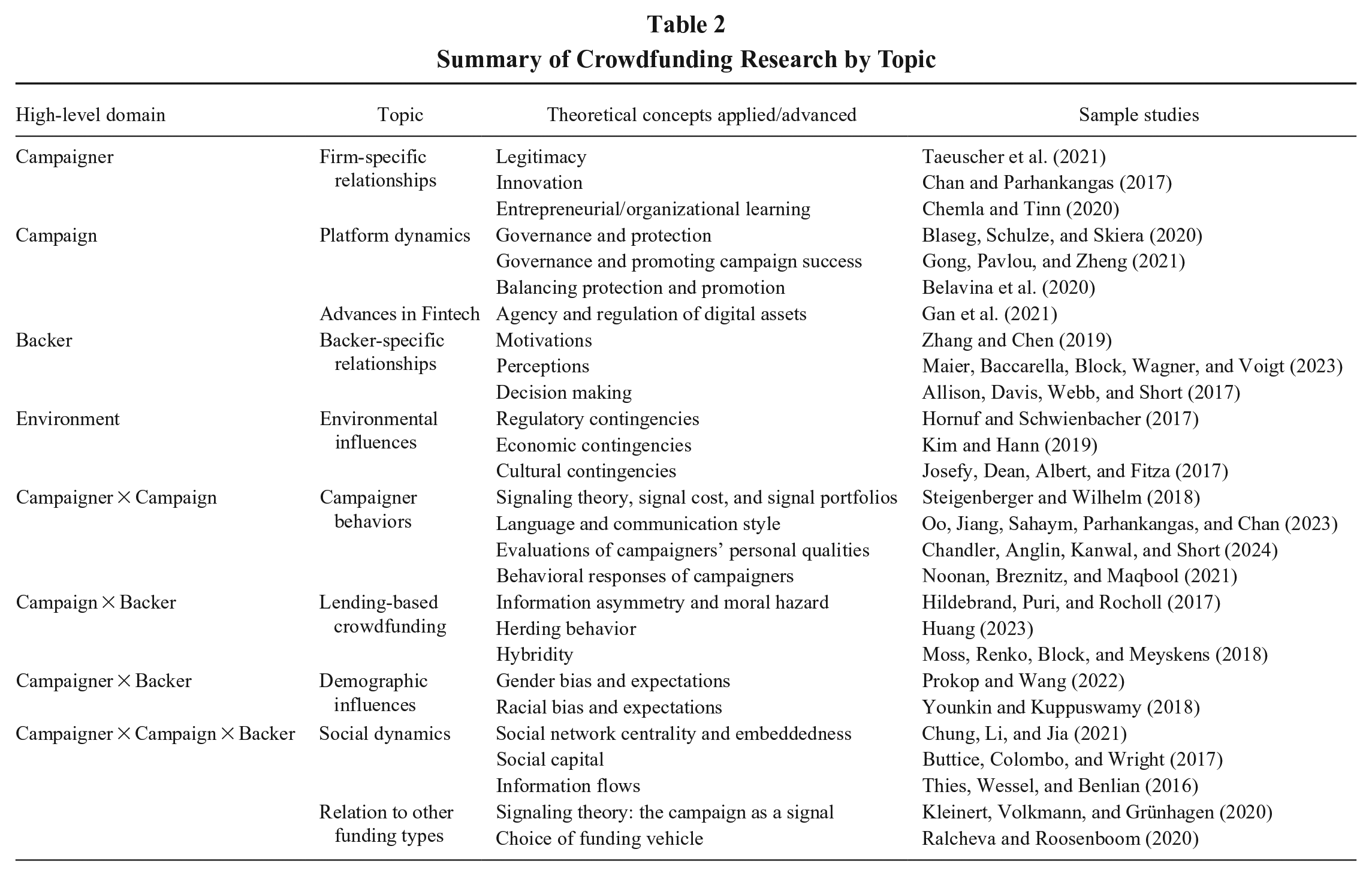
A fundamental aspect of the integrative review process involves abstraction, which entails identifying higher-order themes that link individual studies together (Cronin & George, 2023). We linked articles together by topic. To achieve this, we undertook an inductive, manual coding process, starting without any preconceived topics. One author began by thoroughly reading the abstracts of all articles and identifying emergent central topics for each (e.g., Anglin et al., 2022b). In cases where articles addressed multiple topics, the predominant topic was determined based on its emphasis, aligning with previous review methodologies (Porter, Outlaw, Gale, & Cho, 2019). Through this inductive approach, similar topics were consolidated into a parsimonious set of 10 topics that comprehensively account for all 268 articles: (1) campaigner behaviors, (2) demographic influences, (3) backer-specific relationships, (4) lending-based crowdfunding, (5) platform dynamics, (6) advances in Fintech, (7) environmental influences, (8) relation to other funding types, (9) social dynamics, and (10) firm-specific relationships. Following established protocols (e.g., Whittle, Vaara, & Maitlis, 2023), the author team discussed and agreed upon these 10 topics based on their domain expertise, ensuring they accurately captured the diverse landscape of crowdfunding research. Subsequently, two researchers independently coded all articles according to these topics. The agreement between the coders was 85%, with all disagreements resolved through discussion until 100% consensus was reached. A senior author then evaluated and spot checked the coding of the articles (approximately 40 articles) and agreed with coders in all cases, providing further confidence in the coding process. In addition to topic coding, we coded each article for its theoretical foundation, which guided our synthesis of articles within each topic. Because our review centers on crowdfunding’s contributions to organizational theory, each topic’s findings were grouped by their usage of key theoretical concepts, providing a structured framework for integrating diverse insights. These groupings are reflected in the subheadings of each topic section reviewed below as well as in Table 2, which illustrates how individual crowdfunding studies collectively advance theoretical understanding of management and organizational phenomena.
Topic Juxtaposition
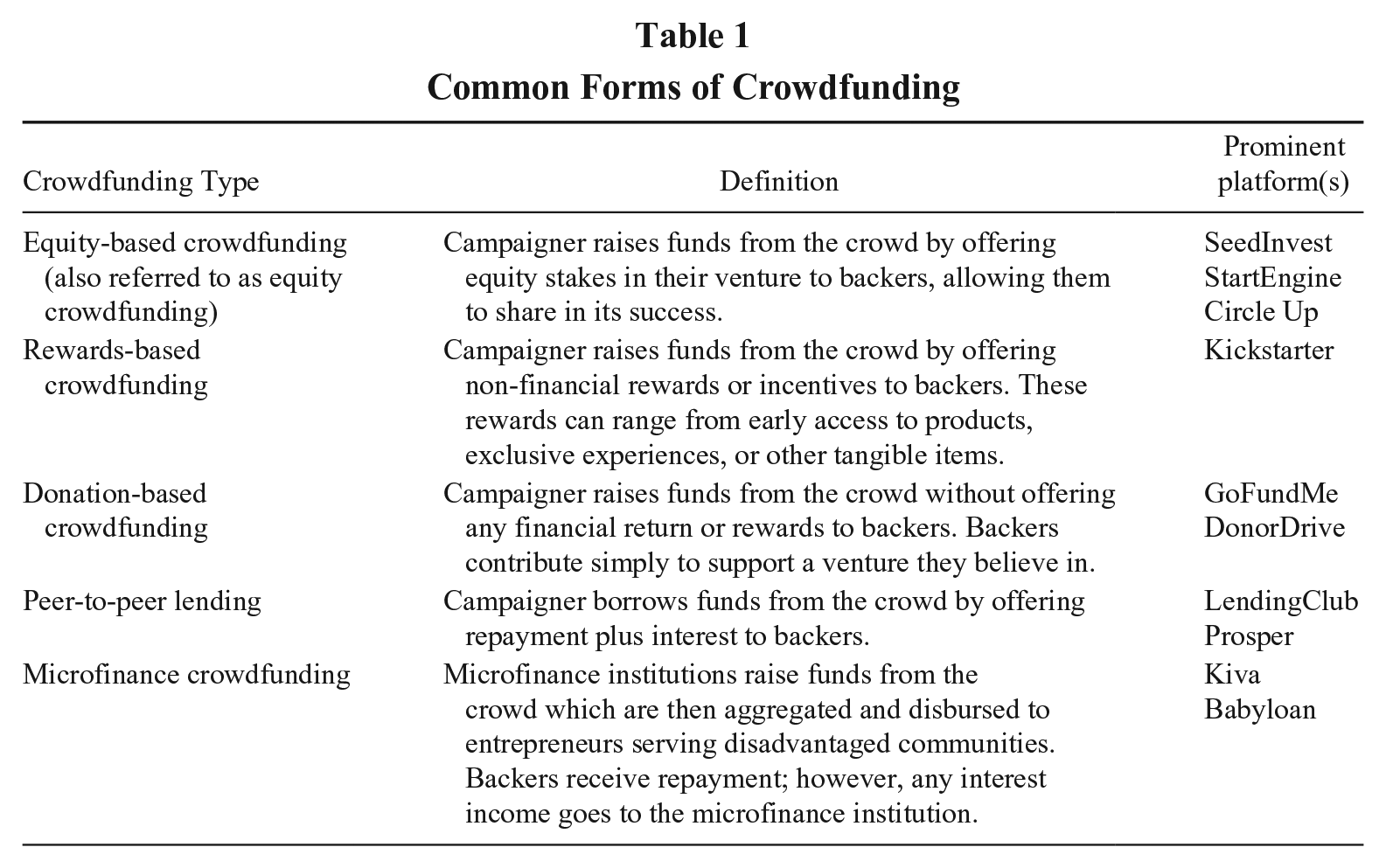
After abstracting higher-order themes (in our case, topics), integrative reviews must juxtapose the abstractions to highlight their interconnections (Paré, Trudel, Jaana, & Kitsiou, 2015). This involves taking a broader perspective to identify commonalities among the topics, while still maintaining the nuanced details and critical distinctions within the diverse body of literature (Cronin & George, 2023). We grouped our 10 topics into four overarching and overlapping crowdfunding domains—the campaigner, the campaign, the backer, and the environment—which mirror the crowdfunding landscape in practice. The campaigner is the individual, group, or organization who initiates and manages a crowdfunding campaign. They are responsible for creating the campaign, setting goals, describing the project or cause they are seeking funds for, and promoting it to potential backers. Campaigners can include entrepreneurs, artists, non-profit organizations, inventors, and anyone seeking financial support for a specific project or cause. The campaign is a specific fundraising effort created on a crowdfunding platform with a defined goal, timeframe, and presentation of a project as crafted by the campaigner, inviting contributions from backers. The backer is an individual or entity that supports a crowdfunding campaign by contributing money in exchange for consideration, which may be rewards, repayment, financial return, equity, or other perks offered by the campaign creator. These different forms of consideration offered to backers inform the short-hand labels for crowdfunding types, such as rewards- and equity-based crowdfunding. (Please see Table 1 for a review of crowdfunding types.) Backers may be drawn from users of the platform or from the external environment, which is the final of our four domains. Campaigner, campaign, and backer domains all exist within, and are therefore influenced by, the external environment. Our categorization allowed for topics to span more than one domain, which gives a clear idea of where topics sit in reference to each other. Our organizing framework can be seen in Figure 1 (also see Table 2).
Common Forms of Crowdfunding
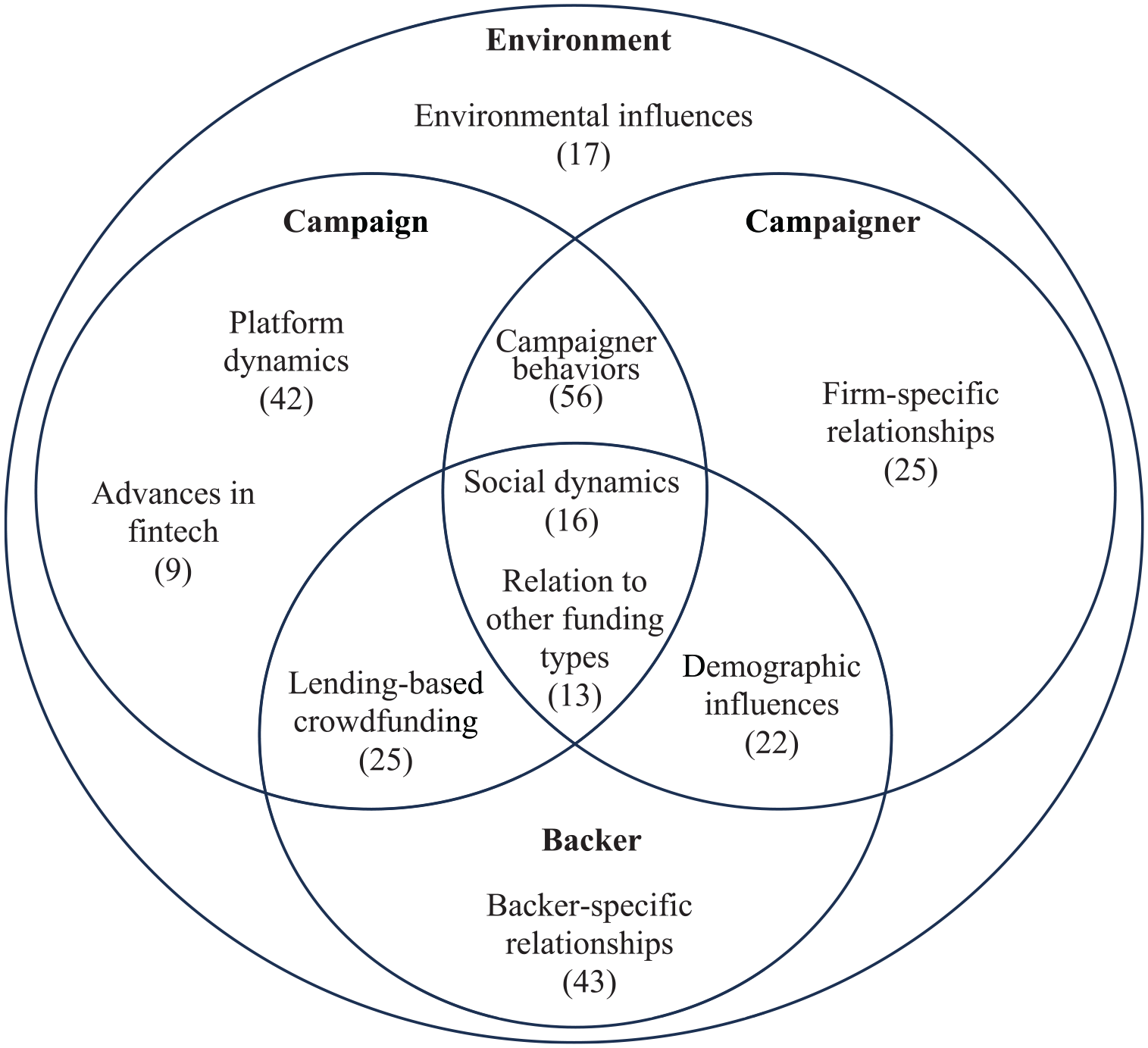
Conceptual Domain of Crowdfunding Researcha
Summary of Crowdfunding Research by Topic
Crowdfunding Review
Our review of the literature proceeds as follows: first, we will review each of the topics that exist solely in one of our four overarching domains (campaigner, campaign, backer, environment). Then we will examine topics that operate across domains. Each topic section will synthesize the major findings within that topic based on relevant theoretical concepts. In doing so, we highlight how each topic area has applied and advanced various organizational theories and concepts. After reviewing all ten topics, we will present a theory-driven roadmap for future research, highlighting the potential cross-disciplinary impact of our recommended avenues.
Campaigner
Firm-Specific Relationships
Crowdfunding campaigns can be initiated by a wide range of actors, from individual artists to well-established corporations, which fosters research from both micro-level and macro-level perspectives. Our review of the literature revealed twenty-four articles that adopt a macro, firm-oriented view of the campaigner and that focus on firm-specific phenomena. These articles draw inspiration from firm-level theoretical frameworks, management concepts, and strategic paradigms. This stream of crowdfunding research is primarily focused on the question “Why do some ventures persistently outperform others?” Accordingly, the majority of firm-centric work considers how ventures achieve performance advantages in and through crowdfunding. More specifically, firm-specific crowdfunding research provides theoretical insights into how ventures establish and leverage legitimacy, manage innovation, and facilitate organizational learning in the context of crowdfunding.
Legitimacy
The concept of legitimacy within crowdfunding emerges as multifaceted and context-dependent, revealing that uniqueness can serve as a distinct path to legitimacy. Unlike traditional contexts, where alignment with established norms is essential (Singh, Tucker, & House, 1986; Suchman, 1995), crowdfunding research suggests that a backer population generally values novelty, allowing distinctiveness to enhance legitimacy. This insight challenges conventional legitimacy theory, which typically downplays the role of novelty, and highlights the need for a contextual understanding of legitimation strategies in non-traditional financing environments. For example, where institutional theory assumes that distinctiveness counteracts legitimacy, Taeuscher et al. (2021) find that distinctiveness can become the basis for legitimacy in crowdfunding due to atypical novelty expectations held by potential backers. Furthermore, Chen (2023) finds that while most types of legitimacy are beneficial for fundraising performance (i.e., pragmatic, associational, and consequential legitimacy), moral legitimacy can have a negative impact on fundraising in rewards-based crowdfunding, indicating that in such contexts, ventures offering their backers dominantly pragmatic gains may outperform those ventures offering more social incentives. Notably, legitimacy is not only something ventures benefit from when crowdfunding (Maurer, Creek, Allison, Bendickson, & Sahaym, 2023) but also something they can acquire through crowdfunding. Acar, Dahl, Fuchs, and Schreier (2021) find that people respond positively to products that are known to be crowdfunded above and beyond the characteristics of the product itself, indicating that knowledge of crowdfunding success may have a legitimizing effect. The legitimating effect of being crowdfunded on market performance also improves crowdfunding performance even in the presence of negative appraisals from experts (Roma, Natalicchio, Panniello, Vasi, & Messeni Petruzzelli, 2023). Thus, being crowdfunded represents a strategy by which ventures can acquire and display legitimacy (cf. Zimmerman & Zeitz, 2002).
Innovation
The role of innovation in crowdfunding extends the theoretical understanding of innovation management by showing that the success of innovation is contingent upon its presentation (e.g., Oo, Sahaym, Hmieleski, Chan, & Parhankangas, 2025). This focus on how innovation is communicated is a departure from the bulk of innovation research, which examines the innovation process or the innovation itself (e.g., Genin, Ma, Bhagwat, & Bernile, 2023; Leiponen & Helfat, 2010). Broadly, findings suggest that ventures need to strategically present their innovations to maximize appeal without overwhelming potential backers. Because radical innovations may be harder for backers to understand and appreciate, incremental innovativeness typically outperforms radical innovativeness in crowdfunding. Such findings appear to depart from much of the innovation literature, which celebrates radical novelty and high-fidelity prototypes as drivers of appeal (e.g., Tushman & Anderson, 1986). Conversely, crowdfunding highlights the value of tempered innovation—where campaigners convey a balance between ambition and reliability to secure backer confidence. The literature does show, however, that radical innovativeness can perform well when the campaign incorporates and emphasizes incrementally innovative elements, reducing uncertainty associated with the radical innovation (Chan & Parhankangas, 2017). Moreover, the more radical the innovation, the more necessary and beneficial information on future plans becomes, and the less valuable information on past achievements and capabilities becomes (Di Pietro, Grilli, & Masciarelli, 2023). Thus, these findings reveal that campaigner characteristics in terms of communicated innovation influence crowdfunding success, and that this also shapes the interpretation of different kinds of information (cf. Plummer, Allison, & Connelly, 2016) and the degree to which this information is successful in reducing information asymmetry between campaigner and potential backers of their campaign. In sum, such findings show that the success of innovative ventures is shaped by strategic information sharing.
Crowdfunding research provides a new window for examining co-creation in new ventures. Given the potential benefits of leveraging customers as co-creators for new product development within established organizations (Lilien, Morrison, Searls, Sonnack, & Hippel, 2002), the literature reveals that crowdfunding can facilitate the involvement of customers as co-creators to the benefit of campaign founders. Here, crowdfunding performance is influenced by strategic decisions regarding innovation including product design and information sharing. For instance, ventures seeking external capital for a new product line based on novel technology may improve their campaign’s fundraising performance through optimal prototype fidelity (how closely the final product matches its prototype in appearance, functionality, and features). Relevant to organizations seeking to engage their customers in product development, crowdfunding research found that moderate prototype fidelity, rather than high prototype fidelity, is ideal. Here, such prototypes demonstrate viability while creating an opportunity for co-creation, which motivates backers to invest in contributing to further product development (Wessel, Thies, & Benlian, 2022). This reveals backers’ expectation of consultation—that they will provide not just funding but also developmental feedback on the understanding that this will be acted upon and be reflected in the final product. These findings also serve to address previous questions as to whether customers prefer to participate as co-creators for more radical or incremental innovations (Bogers, Afuah, & Bastian, 2010).
Entrepreneurial/organizational learning
Crowdfunding offers a unique theoretical perspective on organizational learning (Levitt & March, 1988), highlighting how direct engagement with backers serves as a real-time feedback mechanism that influences venture adaptability. Crowdfunding presents ventures with an opportunity to quickly gather large amounts of data from potential consumers. These can be leveraged to make important strategic choices (Cappa, 2022). This process departs from organizational learning models that often rely on slower, more formalized feedback channels (Argote, Lee, & Park, 2021; Huber, 1991). Information obtained through crowdfunding is particularly valuable for highly innovative ventures who are entering new markets, as there is significant uncertainty about consumer preferences. In this way, crowdfunding is a chance to obtain proof of concept and gauge demand (Chemla & Tinn, 2020). For example, Da Cruz (2018) found that the level of support shown for unsuccessfully funded campaigns influences ventures’ decision to proceed and bring their product to market. For every 10% increase in the number of supporters, the probability of the venture proceeding to release the product increased by 1.4 percentage points. Additionally, learning through crowdfunding can inform decisions regarding optimal product lines and pricing. Hu, Li, and Shi (2015) highlight the value of crowdfunding for recognizing heterogeneity in consumers’ product valuations, enabling ventures to adjust to include products of varying quality and price points, capturing more of the market. Finally, the dynamic feedback loop in crowdfunding may mitigate moral hazard by heightening ventures’ accountability to a wider audience. Thus, the theory of organizational learning can be expanded to include crowdfunding as a mechanism that not only enhances adaptability but also integrates reputation management as a core component of the learning process in high-transparency, high-accountability environments. As more backers contribute, the stakes are raised for the venture in terms of their reputation (e.g., Chandler, Wolfe, & Oo, 2025) and expectations from their supporters, reducing incentives to engage in morally hazardous behavior such as diverting funds (Chemla & Tinn, 2020). In sum, crowdfunding provides a means to both accelerate and open new avenues into organizational learning which influence creators’ persistence and reputation.
Campaign
Platform Dynamics
Forty-two articles in our review examine the role of the hosting platform in crowdfunding. This includes studies on how platform dynamics protect (or fail to protect) their backers and aid (or hinder) the success of their campaigners. Scholars also present solutions for platforms to improve the support they provide for backers and campaigners. Platform reputation, sustainability, and performance depend on their ability to provide support to campaigners and backers. These imperatives serve as the basis for many solution-oriented articles, which seek to maintain a level of due diligence (which protects the backers) without stifling innovation and the entrepreneurial spirit that makes crowdfunding unique and beneficial to campaigners. As can be seen below, our review identifies a theoretical divide within platform dynamics research: while studies focused on backer protection emphasize the importance of regulation and transparent information disclosures to reduce moral hazards and information asymmetry, research on funding success reveals that transparency can sometimes inhibit funding outcomes, depending on the type and timing of disclosures. This divergence suggests a gap in our understanding of how platform governance can harmonize these conflicting objectives.
Governance and protection
One of the most important functions of the crowdfunding platform is to provide backers with a positive experience, which necessitates some level of protection against fraudulent campaigns. Because most crowdfunding platforms do not deter or thoroughly vet campaigners, there is significant potential for moral hazards to go undetected. While much of the governance literature focuses on formal structures, such as board composition or ownership (Daily & Dalton, 1994; Joseph, Ocasio, & McDonnell, 2014), the regulatory regime for most crowdfunding platforms is self-regulation. Here, users—backers and campaigners—serve as a “neighborhood watch” to inform other users and the platform when fraud or unethical behavior is suspected. This regime offers some protection but is insufficient to detect many unethical behaviors or frauds in time. For example, Blaseg et al. (2020) highlights how crowdfunding campaigns that make claims about price and value (i.e., advertising current discounted price in reference to a suggested market price) tend to charge backers more, not less, than the eventual retail price. Thus, a key theoretical insight of this literature is that community governance should be paired with more formal governance structures. More formal platform regulation is associated with enhanced consumer protection. This can be seen with another frequently cited problem for backers: campaigners’ failure to deliver promised products after successfully raising funds (Mollick, 2014). Xu and Ni (2022) find that campaigns with fewer pre-sales, despite meeting their funding goal, are less likely to deliver promised products to backers. Furthermore, raising too much money can incentivize campaigners to take the money and run, as the authors also find a negative relationship between the amount of funds raised beyond the funding goal and product follow-through. However, the authors find that platforms reduce product launch failures by 13% when they have policies to regulate overfunded campaigns. Additionally, platform regulated risk disclosures are effective protection for backers. To that end, Kim et al. (2022) reveal that such disclosures have positive effects by reducing information asymmetry, which helps backers avoid overly risky campaigns or support such campaigns with a better understanding of the risks.
Governance and promoting campaign success
Another major role played by crowdfunding platforms is ensuring that campaigns succeed, which benefits the platform itself and platform users (campaigners and backers). The platform’s long-term viability depends on its ability to generate revenue, which is typically a percentage of the funds raised in successful campaigns. Because platform financial health is reliant on successful projects, there are many scholars who research funding outcomes, exploring the platform dynamics that support or impede campaign success. Transparency is the first platform dynamic related to campaign success. Scholars find that different information disclosures can have both positive and negative effects on crowdfunding performance. On the one hand, requisite identity disclosures have a net positive effect on fundraising success (Burtch, Ghose, & Wattal, 2015). On the other hand, earnings visibility reduces backer base and engagement (Lin, Rai, & Yang, 2021). Further, risk disclosures give backers the opportunity to opt out of risky investments, reducing overall funding success rates (Kim et al., 2022). The timing of information sharing also matters. Platforms can improve campaign funding success by permitting campaigners to pre-fundraise (i.e., share campaign information with backers before the funding window opens; Wei, Fan, You, & Tan, 2021) and by permitting backers to pre-fund (i.e., make non-binding commitments before the funding window opens; Cumming, Hervé, Manthé, & Schwienbacher, 2022). Additionally, the funding scheme used by a platform affects the overall success rate of the campaigns it hosts. Chan, Huang, Liu and Cai (2024) found that introducing a donation scheme to rewards-based crowdfunding increased overall funding success by 19% whereas Gong et al. (2021) found that a lottery scheme in rewards-based crowdfunding attracted more backers but reduced contribution size and success. Overall, the governance literature offers significant ability to explain and predict crowdfunding outcomes. Moreover, these findings extend traditional perspectives on the relationship between governance and firm performance (Coles, McWilliams, & Sen, 2001; Gai, Cheng, & Wu, 2021) by broadening our understanding of how non-shareholder stakeholders react to information disclosures.
Balancing protection and promotion
In light of apparent concerns regarding backer protection and campaigner performance, a final subsection of articles focuses on developing solutions that platforms might implement to address problems for backers and campaigners. For example, in order to better protect backers from making poor investments in equity crowdfunding, Aggarwal, Lee, Osting, and Singh (2021) developed a model that assesses backers’ skills, distinguishing lead backers from lay backers in order to help platforms connect lay backers with leaders to improve funding operations. In another response to backer protection issues, Fu, Huang, and Singh (2021) designed a machine learning model that predicts post-campaign failure better than the crowd. By using such a prediction model, backers could make more secure contributions. Siering et al. (2016) also design a solution for backers by identifying deceptive language cues in campaign content, which can be used to aid in detecting fraud. One study proposed a solution that both protects backers and improves campaign funding. Namely, in response to the problem of excess funding creating an incentive for fraud (Xu & Ni, 2022), Belavina et al. (2020) find that two mechanisms help mitigate this moral hazard while simultaneously boosting platform revenue: (1) short-stopping the campaign once the goal is reached and (2) escrowing excess funds as a form of backers’ insurance. There are also solutions for funding performance that can recover campaigns with poor performance early on. For example, Du, Hu, and Wu (2022) find that when contributions are lagging, making certain mid-campaign pivots like upgrading a product feature or adding a limited-time offer can improve campaigns’ success rate by double digits.
The literature on platform dynamics has thus laid a foundation for future theoretical exploration of the interdependence between protection and promotional functions, encouraging the integration of these perspectives to develop balanced governance frameworks. Theoretical advances might come from exploring how platforms can apply technological solutions—such as machine learning models for fraud detection and models assessing backer expertise—to simultaneously address security and performance. Such technologies, although underutilized in practice, present promising avenues for governance theories that account for both trust and risk mitigation within online platforms. Ultimately, the platform’s dual role as protector and promoter emphasizes the need for adaptive governance theories, where regulatory measures and strategic innovations work in tandem to balance user trust, transparency, and sustainable growth within the crowdfunding ecosystem.
Advances in Fintech
Under the umbrella of crowdfunding, one unique funding model has emerged to leverage the growing importance of blockchain technologies. Cryptocurrency crowdfunding in the form of initial coin offerings (ICOs) is a crowdfunding method that allows campaigners to raise capital from backers in the form of cryptocurrencies like Bitcoin or Ethereum in exchange for digital tokens or coins. Nine articles in our sample center on ICOs, and these articles highlight the potential for the innovative capabilities of fintech to create new opportunities for ventures and backers alike while also exploring how these technologies reshape the crowdfunding ecosystem. ICO research advances agency and governance theories by demonstrating how digital token structures and regulatory frameworks uniquely influence risk, investor protection, and long-term project viability.
Agency and regulation of digital assets
Initial coin offerings (ICOs) contribute valuable theoretical insights into crowdfunding and Fintech by highlighting the nuanced governance and regulatory challenges unique to digital assets. Digital coins are the funding currency in ICOs. These coins are hoped to increase in value as the project develops and gains adoption and are catered to blockchain-based projects. ICOs are generally less regulated than many other forms of crowdfunding, and this can create risks for backers. In unregulated environments, ICO backers risk high agency costs, underproduction of goods and services, and decreases in company value (Gan et al., 2021). It is thus unsurprising that ICOs are far more common in countries with ICO-friendly regulations and more advanced financial systems and digital technologies (Huang, Meoli, & Vismara, 2020). Such work suggests that formal regulatory environments play a vital role in reducing agency costs, mitigating risk, and reinforcing the credibility of digital assets.
However, Gan et al. (2021) find that agency risks depend on the type of tokens. Utility tokens—tokens used to consume the venture’s goods/services when they become available—present the greatest agency risk whereas security tokens—tokens that become shares of future profit—are advantageous because they naturally align the interests of everyone involved, an advantage that persists even without regulatory oversight. Thus, security tokens appear to be a fundamental mechanism to reduce agency concerns between buyers and sellers of digital tokens. Although security tokens aid in mitigating some risk to backers, they do present a major risk to the company. Security tokens invite a wide range of shareholders into the company, risking inflation of the capitalization table. Moedl (2021) finds that this inflation creates obstacles to raising subsequent rounds of investment. This insight extends agency theory to illustrate how financial instruments shape risk dynamics, governance, and stakeholder behavior within a digital funding environment.
Token liquidity, another key feature of ICOs, also plays a critical role in shaping stakeholder incentives and outcomes. Similar to traditional forms of crowdfunding, successful fundraising via ICO can predict important outcomes for the company, such as avoiding failure and enhancing growth. However, to achieve these outcomes, companies must ensure token liquidity, meaning that their tokens are actively traded on exchanges and accessible to the public (Howell, Niessner, & Yermack, 2020; Lee & Parlour, 2022). From an agency perspective, token liquidity incentivizes investor confidence and participation by creating opportunities for immediate and tangible returns, while simultaneously introducing governance challenges as companies balance the competing interests of liquid token markets and long-term growth aims.
Backer
Backer-Specific Relationships
Prior to the proliferation of crowdfunding, research examining non-professional, lay investor involvement with startups and creative projects was exceedingly rare (see Drover et al., 2017). Crowdfunding introduced the study of “backers,” opening the door for examination of how lay individuals respond to entrepreneurial and creative opportunities. There are forty articles in our sample that exclusively focus on backers in crowdfunding. Because there are a large number of crowdfunding backers relative to other types of investors (sometimes thousands of backers for a single project), there is significant variance in their motivations and attributes. Unlike institutional or professional investors, evaluating the viability of early-stage ventures or projects is not the full-time job nor chief expertise of most backers (Anglin et al., 2018a). As such, their motivations for making financial contributions likely differ from those of professional investors. Furthermore, given the elevated level of information asymmetry that is often present in crowdfunding contexts (Cason, Tabarrok, & Zubrickas, in press), backers are less likely to base their decisions upon objective data. Backer-specific research in crowdfunding highlights important theoretical insights into the complexity and plurality of backer motivations, challenging assumptions about the role of altruism versus financial gain in alternative investment contexts. Other articles in this category explore the ways that backers perceive entrepreneurs and the decision-making processes used to inform whether backers contribute, which project they will contribute to, and how much they will contribute. Backers are not merely passive participants but actively evaluate project viability, a process influenced by factors such as product creativity, perceived entrepreneur passion, and campaigner track record. Theories of perception and decision-making drawn from psychology are thus expanded by this active evaluation, as backer perceptions mediate the effects of campaign information on funding decisions—an often-overlooked dynamic in campaigner-focused research on signaling.
Motivations
Much of the research examining backer motivations focuses on the distinction between commercial and prosocial motivations. Commercial motivations revolve around personal interests, financial returns, and access to unique products (Civardi, Moro, & Winborg, 2023). In contrast, prosocial motivations are rooted in supporting causes, philanthropy, and contributing to social impact (Dai & Zhang, 2019). While some venture finance research has begun to explore the role of socially oriented motivations compared to financial motivations outside of crowdfunding (Lall & Park, 2022) and the finance literature has investigated social impact funds (e.g., Barber, Morse, & Yasuda, 2021), the targeted comparison of such competing motivations in individual funding decisions arguably remains a distinct domain of the crowdfunding literature.
Early work suggested that non-financial motives played essentially no role in backers’ crowdfunding behavior (Cholakova & Clarysse, 2015); however, most subsequent work has shown evidence for prosocial motivations supplementing or at times substituting for commercial motivations (e.g., Jiang, Wang, Yang, Shen, & Hahn, 2021). One common phenomenon that is frequently cited as an indicator of prosocial funding motivations is that projects tend to accumulate funding in larger amounts and at an accelerated rate just before they reach their funding target compared to right after. Scholars contend that this effect stems from backers’ prosocial motivation to make an impact with their contribution and help ventures realize their goals (Dai & Zhang, 2019; Kuppuswamy & Buyus, 2017). This effect is more pronounced in public good projects compared to private good projects, further supporting the prosocial motives explanation (Li & Wang, 2019). It is important to note, however, that commercial motivations are just as, if not more, impactful than prosocial motivations in crowdfunding. For example, when comparing the backers of commercial versus cultural campaigns, Bürger and Kleinert (2021) found that backers of cultural projects are no more altruistic than their commercial counterparts, and they are not inclined to support campaigns solely in exchange for symbolic rewards that have no utilitarian value. Similarly, Zhang and Chen (2019) show that funding decisions are more positively influenced by self-orientation than by other-orientation.
Perceptions
Crowdfunding provides a domain to extend knowledge concerning how individuals form perceptions and act upon them under high uncertainty (cf. Gifford, Bobbitt, & Slocum, 1979). Models such as the Elaboration Likelihood Model (ELM) (Petty & Briñol, 2011) and the Heuristic Systematic Model (HSM) (Chaiken & Ledgerwood, 2012) posit that different forms of information will have varying influence on how individuals form key perceptions. Such models are often called upon to examine backer perceptions. Here, crowdfunding research extends these theoretical perspectives and provides insight into the unique process of perception formation within crowdfunding contexts.
Backer perceptions that influence crowdfunding performance encompass a wide range of factors, including their assessment of product qualities, campaigner credibility, and the overall appeal of the project. This begins with perceptions about the product or reward offerings. Jiang, Zhang, and Jiao (2024) find that backers rely heavily on their perceptions of reward usefulness (whether the reward is catered to their needs) and complexity (whether they can understand and make sense of the reward) when making funding decisions. Similarly, Davis, Hmieleski, Webb, and Coombs (2017) find that backers’ perceptions about product creativity have a significant effect on funding behavior, both directly and indirectly through positive affect. Furthermore, the indirect effect is moderated by perceptions of the entrepreneur’s passion such that higher perceived entrepreneurial passion enhances the positive effect of creativity perceptions. Additionally, backers form perceptions about a campaign based on the track record of the campaigner, past projects, and the campaigner’s ability to communicate effectively. Maier et al. (2023) reveal that prior success of a startup in crowdfunding positively influences backer perceptions of legitimacy, which increases their willingness to buy products or services from the startup, improves attitudes towards the startup’s brand, and increases the likelihood that they recommend the startup to others. Conversely, when backers perceive a high level of uncertainty regarding the state of product development, they are less likely to evaluate the product positively and less likely to contribute (Kaminski & Hopp, 2020). Finally, perceptions often mediate the impact of campaigner actions on backers’ responses. Cornelis, Baker, and Ahsan (2022) found that when consumers publicly criticized a venture in the comments section of the crowdfunding campaign, affective and cognitive perceptions of the campaigner and product fully mediated the effect of campaigner’s responses on backers’ subsequent funding intentions. In sum, these findings extend seminal work from cognitive psychology regarding the formation of perceptions, and how specific information and experiences can play a role in this process.
Decision-making
Backers’ crowdfunding decisions encompass a myriad of other factors beyond their perceptions. Accordingly, several studies delve into the interplay of the various decision factors, shedding light on how they are taken into account by diverse groups of backers, compared, and balanced against one another. The main area of theoretical advancement is furthering understanding of how lay backers make decisions differently than expert backers. Novices tend to like new and creative ideas when they are presented in broad and imaginative ways; meanwhile, experts prefer new ideas when they are described in detailed and practical terms (Falchettie, Cattani, & Ferriani, 2022). Furthermore, novices are more inclined to support campaigns that convey group identity, whereas sophisticated backers care more about issue-relevant information like the education of entrepreneurs (Allison et al., 2017). Lay backers also recognize and leverage variations in the expertise of early backers to make investment decisions. Specifically, when lay backers detect early backer expertise in terms of industry experience or investment experience, they are more influenced by them than by other lay backers (Kim & Viswanathan, 2019). Similarly, inferences drawn from early backers’ relationships to the campaigner can factor into investment decisions. When early contributions are large, backers may infer that they were made by family or friends, which reduces their willingness to contribute. The weight of fellow-crowd members’ funding decisions also varies based on the self-efficacy of the individual: Stevenson, Ciuchta, Letwin, Dinger, and Vancouver (2019) find that individuals with high (compared to low) self-efficacy place relatively large weight on the opinions of the crowd. Lastly, in terms of campaign information, Shafi (2021) finds that characteristics of the product or service are the most significant factors in funding decisions. Meanwhile, campaigners’ level of motivation and commitment have a smaller but significant influence while financial disclosures appear to bear no weight in the funding decisions of backers.
Environment
Environmental Influences
Every crowdfunding campaign takes place within a greater external context that bears influence on the outcomes for campaigners, backers, and crowdfunding in general. Indeed, although crowdfunding has a global presence, it is evident that geography plays a role in crowdfunding (e.g., Guenther, Johan, & Schweizer, 2018). Seventeen articles in our review center on the environmental context surrounding crowdfunding. Although much of this literature avoids adopting a specific theory, this work is best viewed through the lens of contingency theory. A key proposition of contingency theory is that ongoing environmental interaction leads organizations to adapt to a variety of external influences, which provide a company with information on how it should organize (Boyd, Takacs Haynes, Hitt, Bergh, & Ketchen, 2012). From this perspective, the literature on environmental influences can be organized into subtopics on regulatory contingencies, economic contingencies, and cultural contingencies. These contingencies then inform how platforms choose to organize and interact with their environment providing insight into why and how crowdfunding markets evolve as they do. Broadly, examining these three contingencies reveals that regulatory contingencies shape markets at the country level; however, economic and cultural contingencies shape markets at more localized, regional levels.
Regulatory contingencies
The first prominent environmental influence in crowdfunding research is policy. Crowdfunding and government policy are in constant conversation, each affecting each other. Naturally, policy affects crowdfunding on the most basic level by determining its legality, particularly for equity crowdfunding. For instance, equity crowdfunding became legal in the US in 2012 with the passage of the Jumpstart Our Business Startups Act, which required the SEC to devise regulations to allow ventures to solicit backers through online platforms (Fricke, Fung, & Goktan, 2021). Likewise, crowdfunding also has major influences on policy because it represents a fundamental shift in the way people raise money. Before crowdfunding, government regulations were premised on the participation of accredited investors and traditional financial intermediaries (like banks). Crowdfunding’s peer-to-peer structure bypasses such intermediaries, which creates the need to rethink the regulatory framework (Berkowitz & Souchaud, 2019). For instance, the JOBS Act allowed for reduced regulatory requirements, enabling crowdfunding platforms to largely self-regulate in the US (Fricke et al., 2021). In the rest of the world, crowdfunding policy varies. While crowdfunding is legal and regulated in many countries, the specific rules, limits, and requirements can differ significantly. Variations in regional policy have prompted scholars to examine the impact of government involvement on the performance of crowdfunding markets in these specific regions. Research suggests that crowdfunding is best poised to succeed in regions characterized by hybrid regulation, where governance is the shared responsibility of the government and crowdfunding platforms (Berkowitz & Souchaud, 2019; Iurchenko, Petty, & Jain, 2023). The optimal balance of government- and self-regulation for a region depends on that region’s access to traditional venture financing alternatives. Hornuf and Schwienbacher (2017) find that more regulation is harmful to crowdfunding markets in areas with ample access to venture capital and angel capital compared to those with scarce funding alternatives. These findings underscore a key tenet of contingency theory: that organizational and institutional effectiveness are context-dependent, with the ideal regulatory approach varying across regions.
Economic contingencies
Although crowdfunding is a global phenomenon with a substantial reach, a key takeaway from the environment literature is that the success and development of crowdfunding markets depends heavily on local economies. When the local economy is thriving, individuals may have more disposable income to contribute to crowdfunding campaigns. Additionally, a strong economy might lead to increased entrepreneurial activity (cf. Casson & Wadeson, 2007), as people feel more confident in launching new ventures (Anglin, McKenny, & Short, 2018c). This, in turn, could result in more crowdfunding campaigns seeking financial support. Of the macroeconomic influences on crowdfunding which have been examined, housing prices appear highly influential. For example, Kim and Hann (2019) suggest that entrepreneurs in areas that have declining house prices find it harder to get collateral-based loans, prompting them to use crowdfunding. They find that decreasing housing prices in a region does indeed lead to increased creation of crowdfunding campaigns in that region; however, housing price changes have no effect on the success of the projects. Cumming and Reardon (2022) suggest that the relationship between housing prices and crowdfunding was altered during and since the 2019–2022 pandemic. Specifically, because of the large volume of pandemic-induced migrations in the US, housing prices now indicate not only the demand and supply for capital in each region, but also the attitudes and risk tolerance of backers toward long-term, illiquid investments in those regions. Thus, in contrast to Kim and Hann’s (2019) study, Cumming and Reardon find that regions with higher housing prices post-COVID saw major increases in the number of crowdfunding campaigns and the success of those campaigns. It is also recognized by scholars that crowdfunding has a reciprocal influence on the local economy, playing an important role in economic development and vitality. Yu and Fleming (2022) find that higher levels of crowdfunding lead to the creation of more tech firms and fewer conventional and local business registrations. Notably, while the economy’s effect on crowdfunding is more pronounced in prosperous regions (Cumming & Reardon, 2022), crowdfunding’s effect on the economy is stronger in poor regions (Yu & Fleming, 2022).
Cultural contingencies
Regional culture significantly shapes crowdfunding activity by influencing the types of projects that succeed, the level of trust and cooperation among backers, and the overall attitudes towards the adoption of crowdfunding. The influence of regional culture on the success of a particular campaign has to do with the alignment of campaign characteristics with cultural values. For example, Josefy et al. (2017) found that communities that place cultural emphasis on creativity, artistry, and a commitment to preserving historical values are more inclined to back crowdfunding initiatives for independent theaters that uphold those values. Further, certain regions may be more culturally inclined toward crowdfunding in general. For instance, there is evidence to support the notion that the altruism of people in a region (local altruism) enhances crowdfunding success, especially when people in that region share strong social connections (Giudici, Guerini, & Rossi-Lamastra, 2018). Similarly, the political culture of a region can affect the acceptance and adoption of crowdfunding in that region. Lewis et al. (2021) show that in the US crowdfunding tends to be less favored and takes longer to gain legitimacy in conservative-leaning regions. However, they also note that the legitimacy of crowdfunding plays a more crucial role in conservative areas such that when a threshold of legitimacy is attained, adoption in conservative areas outpaces that in liberal regions.
Thematic Intersections
Campaigner Behaviors
The largest topic in our sample, comprising fifty-four articles, centers on the behavior of crowdfunding campaigners, both within and beyond their campaigns. While the former section on firm-specific relationships focused on the firm-level strategies and actions when campaigning, this section focuses on individual campaigners and pays greater attention to their shaping of, interaction with, and responses to the campaign. As such, this topic sits at the intersection of the campaigner and the campaign on our conceptual map. Broadly, this literature has advanced theoretical insights concerning signaling, pitch language and communication, how the implied personal qualities of creators are evaluated, and the behavioral responses of campaigners to their crowdfunding experience.
Signaling theory, signal cost, and signal portfolios
Signaling theory (Spence, 1973) occupies a substantial role in crowdfunding research on campaigner behaviors. Signaling theory explains how one party (the signaler) communicates certain attributes or intentions to another party (the receiver) to reduce information asymmetry (Connelly, Certo, Ireland, & Reutzel, 2011; Connelly, Certo, Reutzel, DesJardine, & Zhou, in press). In crowdfunding, campaigners (signalers) use various types of signals to convey the credibility and potential success of their projects to backers (receivers; Ahlers, Cumming, Günther, & Schweizer, 2015). There are two primary types of signals: costly and costless. Costly signals require significant resources or effort to convey, demonstrating commitment and reducing uncertainty for backers (Block, Hornuf, & Moritz, 2018). Costless signals, on the other hand, involve language-based information that, while less resource-intensive, can still effectively capture backers’ attention and provide valuable insights (e.g., Patel, Wolfe, & Manikas, 2021b). Much of the findings leveraging signaling theory are consistent with broader signaling research illustrating the primary importance of costly signals. Specifically, campaigners can improve their fundraising performance by including costly information signals such as mid-campaign updates (Block et al., 2018) or information about the expected future retail price to signal product quality and pre-order value (Sewaid, Garcia-Cestona, & Silaghi, 2021). Prior experience and endorsements also significantly boost funding prospects (Courtney, Dutta, & Li, 2017).
Crowdfunding scholarship departs from traditional signaling theory by emphasizing the value of costless signals. Specifically, this work demonstrates that when used together as part of a signaling portfolio, costly (e.g., Spence, 1973) and costless signals (e.g., Farrell, 1987; Farrell & Gibbons, 1989; Farrell & Rabin, 1996) can significantly enhance campaigner outcomes. Costless signals, such as language-based information, enrich communication by capturing attention and providing relevant insights into the campaigner and venture attributes (Steigenberger & Wilhelm, 2018). As such, research suggests that signaling portfolios made up of both rhetorical and costly signals are particularly influential in high-noise environments like crowdfunding (Steigenberger & Wilhelm, 2018). For example, positive psychological capital language used alongside human capital signals enhances funding performance (Anglin et al., 2018a). Indeed, the concept of signal or information portfolios offers a particularly promising framework for exploring the interplay between different types of information. Although such work has begun both within and outside of crowdfunding research (e.g., Anglin et al., 2018a; Plummer et al., 2016), crowdfunding offers a particularly intriguing domain in which to explore such portfolios given the elevated importance of costless information compared to traditional funding mechanisms. Furthermore, examining the role that signaling portfolios might play within crowdfunding can provide additional insight into how such forms of communication might influence attitudes and behaviors within the greater social media context in general (Cheung, Xiao, & Liu, 2014; Saxton, Gomez, Ngoh, Lin, & Dietrich, 2019).
Language and communication style
The role of communication style and narrative in campaign crafting is underpinned by theories of rhetoric and narrative persuasion (e.g., Downing, 2005; Gartner, 2007; Martens, Jennings, & Jennings, 2007). These theories, such as narrative theory and language expectancy theory, emphasize how emotional displays, storytelling techniques, and language choices influence backer support. Such research has produced theory on how language and communication styles used in crowdfunding pitches affects funding performance (Allison, McKenny, & Short, 2013). For instance, scholars have shown that campaigners can use a variety of communication techniques that win backer support such as displays of emotion (e.g., Oo et al., 2023; Warnick, Davis, Allison, & Anglin, 2021), use of dynamic speech in the campaign video (Allison, Warnick, Davis, & Cardon, 2022), using image-based rather than concept-based rhetoric (Patel, Wolfe, & Manikas, 2021a), and framing their narrative prosocially (Defazio, Franzoni, & Rossi-Lamastra, 2021; Nielsen & Binder, 2021). Although language is important across pitching contexts (Clarke, Cornelissen, & Healey, 2019), crowdfunding research illustrates the elevated significance of language choice in high noise environments. Indeed, compared to more professionalized contexts that involve extensive due diligence and large funding amounts, the lack of such processes on most crowdfunding platforms leaves backers to rely considerably on linguistic cues provided by campaigners in their decision-making. Further, venture type serves as a boundary condition that shapes the effectiveness of communication techniques. Here, crowdfunding research enables a broader accounting of venture type than prior work examining venture capital, where companies tend to be more similar (i.e., high growth, technology-oriented). For example, social ventures benefit more than commercial ventures from a concrete writing style because backers, as lay people, may find social ventures harder to make sense of (Parhankangas & Renko, 2017).
Crowdfunding has extended knowledge of the role of storytelling in the fundraising process. Research on storytelling in crowdfunding adopts a more holistic approach to examining communication. This research tradition looks for overall narrative themes that influence fundraising prospects (Martens et al., 2007). For instance, communicating a “results in progress” narrative is more effective than an “ongoing journey” narrative (Cappa, Pinelli, Maiolini, & Leone, 2021) although both can be effective. Anglin, Reid, and Short (2023b) use qualitative comparative analysis to uncover five storytelling configurations (entrepreneur bettering society, traditional entrepreneur pitch, customer adventure, customer adventure and product origin story, and entrepreneurial discovery enhances customer focus) that each enable better fundraising outcomes. However, some of these (e.g., customer adventure) challenge the traditional problem-solution approach to pitching a new venture commonly taught in business schools. Thus, crowdfunding research has been able to reveal new pathways to pitching a new venture.
Evaluations of campaigners’ personal qualities
Embedded in the communication aspects of the campaign are displays of campaigner personal characteristics, which have shown to be pivotal in influencing campaign performance. This literature underscores that “who the entrepreneur is” is a fundamental question asked by potential backers. Indeed, campaigns in which campaigners extensively mention themselves outperform those that focus on the venture (Gafni, Marom, & Sade, 2019), which indicates that backers place their trust in campaigners over and above ideas alone. Whereas the first two topics involve intentional alterations made by campaigners to convey specific information, the characteristic displays research revolves around the natural or incidental communication that arises from campaigners displaying their personal attributes. Here, the study of characteristic displays are rooted in psychology and communications research on inherent traits (Allison et al., 2022, 2024; Maurer, Creek, Allison, Bendickson, & Sahaym, 2024, 2025) and malleable personal qualities (e.g., positive psychological capital: Anglin et al., 2018a).
A key insight from this literature is that the characteristics themselves are not inherently beneficial or damaging, with research suggesting that most characteristic displays have both positive and negative pathways often based on the extent to which the characteristic is displayed, the context in which it is displayed, and who displays the characteristics. As such, scholars have found many counterintuitive effects of characteristic displays. For example, displays of negative affect, Machiavellianism, and narcissism—conventionally negative characteristics—can have positive performance effects when displayed to optimal extents (Anglin, Wolfe, Short, McKenny, & Pidduck, 2018b; Calic, Arseneault, & Ghasemaghaei, 2023; Huang, Uy, Liu, Foo, & Li, 2023). Likewise, enthusiasm and smiles—conventionally positive characteristics—can have negative performance effects under certain conditions, such as when campaigners are perceived to have low domain expertise (Jiang, Yin, Liu, & Johnson, 2023) or when consumers are prevention-focused in high-risk situations (Wang, Mao, Li, & Liu, 2017). Thus, researchers must consider more than just the presumed valence of a particular characteristic when theorizing about how displayed characteristics shape funding outcomes.
While the literature has uncovered a variety of personal quality displays that can influence crowdfunding, another critical takeaway from this work is that such qualities are not interpreted in isolation. Their influence is a function of the extent to which a quality is displayed, other personal qualities of the campaigner (e.g., experience, gender), its perceived authenticity (e.g., Oo & Allison, 2024), and the context of the display. For instance, more experienced campaigners have greater latitude to discuss their political views (Chandler et al., 2024), while campaign category and gender shape the effectiveness of assertiveness (McSweeney, McSweeney, Webb, & Devers, 2022). Thus, exploration of a particular characteristic needs to include an accounting of its boundary conditions to make a meaningful contribution to this literature. To that end, crowdfunding offers an ideal context within which to further our understanding of perspectives such as social role theory (Eagly & Wood, 2012), which centers on how displays that either conform to or defy commonly prescribed social categorizations can result in beneficial or detrimental outcomes for the individuals who engage in such displays. By examining how campaigners’ personal qualities can be interpreted by potential backers, and the ultimate outcomes of such interactions, we gain insight into the nuances of how social perceptions and norms influence individual outcomes.
Behavioral responses of campaigners
Another area of research examines the behavioral responses of campaigners to crowdfunding experiences. This line of research emphasizes how crowdfunding can affect campaigners by evoking responses to success, failure, or feedback. This literature provides a much needed look at post-campaign consequences, which remains an understudied outcome in the crowdfunding literature and provides deeper insight into how campaigners use their experience during the campaign to shape their strategic response. For example, Noonan et al. (2021) found that fundraising success can prompt ventures to relocate, shaping their decisions about where to relocate by providing insight into local market sizes. Naturally, crowdfunding success also affects entrepreneurs’ subsequent actions regarding the fulfillment of obligations to their backers. In rewards-based crowdfunding in particular, higher levels of success require greater action to follow-through with manufacturing and delivering rewards. Murray and Fisher (2022) find that when crowdfunders use rhetoric to craft their campaigns effectively, driving contributions up, the success that follows often proves to be unmanageable in terms of rewards-delivery obligations. Meanwhile, campaigners with more moderate success are better able to respond appropriately and manage reward delivery. In this way, the success of a campaign necessitates a behavioral response, but also dictates the efficacy of that response. Thus, both the decision to use crowdfunding and its consequences should be incorporated into the venture’s broader strategy, although it remains unclear as to the level of consideration crowdfunding is given as a part of venture strategy.
Understanding how people respond to failure in organizational settings has received substantial attention in the psychology, organizational behavior, and entrepreneurship literatures (Dahlin, Chuang, & Roulet, 2018). The crowdfunding literature has enriched this discussion within the entrepreneurial finance literature, which has largely focused on prior venture success or failure, but not the outcomes or learning that comes from the funding process (Drover et al., 2017). Here, crowdfunding has extended the study of failure to the fundamental task of acquiring financial resources. For instance, the severity of the failure and the personality qualities of the campaigner affect their responses to failure. Piening, Thies, Wessel, and Benlian (2021) found that there is a positive (though nonlinear) relationship between the extent and duration of negative performance feedback and search distance (i.e., the figurative distance ventures go in their search for solutions). Furthermore, Allen, Stevenson, and Wang (2021) find that the intangible knowledge, skills, and abilities that a campaigner possesses increase the probability and pace of transition after failure.
Beyond funding success or failure, campaigners’ experiences in crowdfunding may evoke cognitive and behavioral responses that enable (or impede) learning. For instance, when campaigners obtain market validation through crowdfunding, they become more persistent and perform better commercially due to learning that occurred during the fundraising process. (Stevenson, Allen, & Wang, 2022a). However, crowdfunding experience can also take a toll on campaigners’ strategic foresight. Peterson and Wu (2021) find that what a campaigner learns in one campaign negatively affects their predictive accuracy such that they exceed their projected product launch timelines by approximately six additional weeks with each subsequent project. As such, while learning is typically regarded as a positive consequence, such research illustrates that crowdfunding success may lead to limited and myopic thinking that ultimately harms funding performance. It is unclear how such myopic thinking cultivated during the funding process may shape future firm performance, suggesting that progress still needs to be made to connect learning through crowdfunding to future venture outcomes.
Lending-Based Crowdfunding
Our review identified twenty-five articles focused on lending-based crowdfunding, which includes two distinct approaches: Peer-to-Peer (P2P) lending and microfinance crowdfunding (sometimes referred to as prosocial lending or crowdfunded microfinance). P2P lending platforms like Prosper enable backers to lend money directly to campaigners in exchange for interest returns. In contrast, microfinance crowdfunding platforms like Kiva serve as an intermediary between backers and microfinance institutions, who use the funds pooled by backers to provide small, low-interest loans to entrepreneurs and individuals who may not have access to traditional financial services (Anglin, Short, Ketchen, Allison, & McKenny, 2020). Lending-based crowdfunding research is at the intersection of campaign and backer on our conceptual map because scholars largely focus on backer outcomes and campaign nuances unique to lending-based models. By examining P2P lending and microfinance crowdfunding, this literature contributes to the theoretical understanding of information asymmetry and moral hazard, herding, and hybridity.
Information asymmetry and moral hazard
Part of what distinguishes P2P lending research is its attention to outcomes for backers. Whereas most rewards- and equity-based crowdfunding research concentrates on the campaigners’ success in raising funds, many P2P lending articles consider loan repayment (or default) as the focal outcome, building our understanding of how backers can make well-informed and secure investments. A critical theme in this literature is information asymmetry, which manifests in two key relationships: between backers themselves and between campaigners and backers. First, information asymmetry between backers arises when sophisticated backers exploit their informational advantage over less-experienced backers. For instance, Hildebrand et al. (2017) highlight this dynamic, showing that group leader fees—typically perceived as signals of loan quality—can mislead amateur backers. Sophisticated backers, incentivized by these fees, promote numerous loans, many of which frequently default, thereby driving down interest rates and harming uninformed investors. Removing such fees, however, curtails this moral hazard, as sophisticated backers then promote fewer but better-performing loans. This underscores the need for platform interventions to curb harmful practices that disproportionately disadvantage less-informed participants. The issues of information asymmetry and moral hazard are further compounded by the mechanisms through which platforms present and price loans. Loans priced by platforms—without input from backers—are more likely to default than those determined by crowd auctions, illustrating how pricing systems can either exacerbate or alleviate asymmetries between informed and uninformed participants (Wei & Lin, 2017).
Second, information asymmetry between campaigners and backers complicates backers’ ability to assess loan quality. Campaign information, such as the language used in loan descriptions, affects backers’ decision-making. Readable, positive, and deception-free language signals trustworthiness and is associated with lower default rates, while emotional appeals that mention family, religion, hardship, or pleading increase the likelihood of default (Gao, Lin, & Sias, 2023; Netzer, Lemaire, & Herzenstein, 2019). More so than any other topic in the literature, this work illustrates the adverse impact of misinterpreting campaign information. While much of the campaigner behaviors literature takes a positivist view of campaign information—trying to determine which and how such information enhances funding outcomes—the lending literature illustrates how campaign information that increases funding performance can nevertheless harm backers. Thus, it provides a sobering look at the role of campaign information. To that end, lending-based crowdfunding affords scholars the ability to further extend their understanding of the potential moral hazards related to lending across environments (Corsetti, Guimaraes, & Roubini, 2006; Hébert, 2018).
Herding behavior
Next, P2P lending research expands the literature on herding in financial domains. Herding occurs when potential backers make contribution decisions based on the actions of others, rather than based on independent assessments of campaigners. It has shown to be a common phenomenon in large public financial markets (Zhang & Liu, 2012), such as the New York Stock Exchange. In crowdfunding, herding behavior often leads backers to mimic the investment choices of others, rather than making decisions based on independent analysis. Thus, this literature illustrates that evolving forms of finance are subject to similar herding behavior as public markets (see Chan, Parhankangas, Sahaym, & Oo, 2020, for a non-P2P [rewards-based] study of herding in crowdfunding). Such behavior is usually associated with social pressure, fear of missing out, or a desire to conform (Banerjee, 1992). For example, Hildebrand et al.’s (2017) study, discussed above, is an example of herding whereby the promotion of a loan by a sophisticated backer causes many other backers to herd towards that loan, conforming to the choices of others to the neglect of their own due diligence. Moderators of herding include platform characteristics: the cumulative amount funded on the platform and the platform’s share of the market, both of which increase herding while the platform’s time in operation and government regulation both reduce herding (Jiang, Ho, Yan, & Tan, 2018). Huang (2023) also finds that platform regulations also reduce herding. Specifically, platform-set loan prices lead to less herding (relative to auction-determined loan prices). Taken together, these findings suggest that when there is more information disclosure and stricter operational standards due to regulation, backers are less inclined to herd. Even the simple disclosure of an early backer’s name can reduce herding behavior. For example, Jiang, Ho, Yan, and Tan (2022) found that backers are more likely to herd toward loans with prior investments made by anonymous backers compared to those with prior investments by known backers. Interestingly, herding in this case challenges the effectiveness of endorsements in lending-based crowdfunding and their role in herding behavior. Signaling logic would suggest that typically well-known backers would have a positive influence on herding behavior as they provide an indication of quality, yet this work shows the opposite.
Hybridity
The final subtopic in lending-based research focuses on the concept of hybridity in microfinance crowdfunding. In this case, hybridity refers to an organizational structure or business model that combines social objectives with commercial, for-profit activities (Moss et al., 2018). This hybrid approach allows organizations to pursue a social or environmental mission while also generating revenue and sustainability through commercial endeavors. A central theoretical question concerning research on hybridity is how organizations with hybrid motives can balance the tension between social and financial objectives (Battilana & Lee, 2014). The crowdfunding literature extends this debate to fundraising concerns and investigates how potential backers respond to hybrid motives. More specifically, hybridity is central to microfinance crowdfunding because the largest microfinance crowdfunding platform, Kiva, focuses exclusively on loans with hybrid aspects. Hybridity results in backers responding more positively to social indicators relative to commercial ones (e.g., Allison, Davis, Short, & Webb, 2015; Anglin et al., 2020; Gafni, Hudon, & Périlleux, 2021a). In fact, Moss et al. (2018) found that backers prefer loans that singularly emphasize social impact rather than balancing communication of their hybrid objectives. This dominance of social indicators is not absolute, however. Notably, one study by Berns, Figueroa-Armijos, da Motta Veiga, and Dunne (2020) found that social signals can deter backers in the absence of commercial signals and that loan quality signals are the most influential in securing loans. Further, when examining campaign narratives, research finds backers favor learning about campaigner entrepreneurial characteristics over their virtuous or religious motivations for seeking funds (e.g., Anglin, Milanov, & Short, 2023a; Moss, Neubaum, & Meyskens, 2015). This reveals a theoretical tension between prosocial motivations and practical financial concerns: Backers are often drawn to the idea of social impact but ultimately prioritize signals of loan quality and campaigner capability when making individual lending decisions. As such, hybrid crowdfunding can assist in furthering ongoing conversations related to ventures pursuing so-called “double-bottom line” performance outcomes (Wesemann & Antretter, 2023; Zahra, Gedajlovic, Neubaum, & Shulman, 2009).
Demographic Influences
The topic of demographics in crowdfunding is situated at the intersection of the backer and campaigner on our conceptual map, as research on this topic is dedicated to the influence of population-level attributes belonging to both categories of crowdfunding participants (i.e., backers and campaigners). Examination of demographic influences in crowdfunding yields insights on how social norms and stereotypes shape funding decisions in low information environments, particularly through the lenses of role theory and expectancy violations theory. There are a total of twenty-two articles that center on demographics, and while some individual articles explore the effects of demographics like religion (Anglin et al., 2023a), immigration status (Butticè & Useche, 2022), and indigenous heritage (Parhankangas & Colbourne, 2023), the overwhelming majority (14 articles) focus on gender and a smaller subset focus on race. Scholars seek to answer questions such as how bias affects performance, whether shared demographics between campaigner and backer matter, and how demographic-associated role expectations help or hinder campaigners.
Gender bias and expectations
Gender is the most studied demographic variable in crowdfunding research, undoubtedly due to the contrasting gender effects seen in crowdfunding relative to most other fundraising contexts. Women entrepreneurs have been shown to face substantial disadvantages to raising funds from angel investors, venture capitalists, and other financial institutions, yet crowdfunding scholars consistently find that women are more likely to succeed in fundraising, particularly in industries where they are least represented (e.g., Johnson, Stevenson, & Letwin, 2018; Seigner, Milanov, & McKenny, 2022). Thus, crowdfunding appears to challenge the status quo of the broader venture finance literature. Accordingly, several articles seek to explain and theorize about the nature of these atypical gender effects in crowdfunding. For example, Prokop and Wang (2022) find that crowdfunding successfully closes the fundraising gender gap for first time crowdfunders, but women are less successful than men in subsequent crowdfunding campaigns. Further, Liao (2021) suggests gender influences performance via an effect on quality signals in crowdfunding. She found that women campaigners benefit from signals of social ties but less from signals of competence and qualification. Some scholars consider the gender preferences of backers and the gender of backers themselves, finding that women’s fundraising advantage is largely among women backers (Bapna & Ganco, 2021; Gafni, Marom, Robb, & Sade, 2021b). Greenberg and Mollick (2017) theorize that women backers’ preference for women campaigners may not solely stem from homophily based on gender similarity, but also homophily based on perceptions of shared societal barriers as women. Additionally, because gender comes with expectations for human behavior and interaction, many articles draw from role theories to explain women’s superior performance in crowdfunding, yet findings in such studies are inconsistent and even contradictory. For instance, Cowden, Creek, and Maurer (2021) suggest that role congruity may explain gender effects on performance in rewards-based crowdfunding, finding that women are rewarded for projecting feminine qualities and men are rewarded for projecting masculine qualities. However, Wang, Li, Wu, Ling, and Long (2023) find that woman entrepreneurs’ masculinity has an inverted U-shaped relationship with rewards-based crowdfunding performance. Thus, some indication of masculine characteristics could be beneficial for women. Indeed, Davis, Warnick, Anglin, and Allison (2021) show that gender role expectancy violation leads to superior performance in the context of microlending crowdfunding such that women benefit from making stereotypically masculine facial expressions while men benefit from making stereotypically feminine facial expressions.
Despite some inconsistencies, the research on gender generally suggests that crowdfunding is effective in leveling the playing field for women entrepreneurs, who may otherwise struggle to raise funds. This challenges conventional gender roles, as women’s increased presence and mutual support suggest a shifting normative framework. However, in light of the findings that women may lose their advantage in subsequent crowdfunding rounds and be punished for departing too heavily or not enough from gender role expectations, this “woman advantage” appears somewhat fragile.
Racial bias and expectations
The second most researched demographic variable in the crowdfunding literature is race. Because crowdfunding is more accessible than traditional venture finance channels, it has the potential to reduce racial disparities in entrepreneurship and society. In some ways it has succeeded in doing so; for instance, crowdfunding has been used to fund racial equality initiatives (e.g., Agarwal & Sen, 2022). However, where crowdfunding research shows a reduction and even reversal of common gender dynamics seen in traditional venture finance, the racial dynamics in crowdfunding mirror those seen in other forms of funding. People of color are less successful in raising funds than their white counterparts (Younkin & Kuppuswamy, 2018). This happens across different minority racial groups (Black and Asian), categories of racial cues (campaigner- and product-based), and mediums (photo and text) with the result that racial anonymity is more successful than any form of minority racial cue (Rhue & Clark, 2022). Anglin et al. (2022a) was the only study in our sample that showed a positive racial effect for people of color, and the effect was only beneficial for women campaigners funding social (versus commercial) ventures, as their race and gender are perceived as congruent with the role expectations of social entrepreneurs.
Relative to gender, the role of race and its contingencies are far less understood, creating substantial potential for further research on race in crowdfunding. Understanding the nuanced ways in which race influences crowdfunding success could uncover strategies for mitigating biases and enhancing support for campaigners of color. Furthermore, despite the focus on gender, and increasing emphasis on race, studies adopting an intersectional view—where both factors are simultaneously considered—remain exceedingly rare. We consider this a fundamental misstep by this literature that should be corrected. Indeed, work across social science has argued that intersectional approaches are imperative to better understanding how gender and race jointly influence outcomes for individuals (Rosette & Livingston, 2012; Smith, Watkins, Ladge, & Carlton, 2019). We return to this point in our Future Research.
Social Dynamics
At the intersection of campaign, campaigner, and backers, social dynamics encompass the human connection element of crowdfunding. Crowdfunding platforms are inherently social and community-driven, more so than traditional venture finance, which typically involves formal, institution-driven interactions (e.g., meetings with venture capitalists or banks). Crowdfunding campaigns rely heavily on the collective action and support of a large number of backers, making the study of social networks in crowdfunding helpful in understanding collective behavior, trust, and influence. Fourteen articles in our sample study social dynamics in crowdfunding: the interactions and relationships of various participants within the crowdfunding ecosystem, often through the campaign itself. Articles on crowdfunding’s social dynamics use theories of social networks, social capital, and information flow.
Social network centrality and embeddedness
A social network refers to a structured representation of social entities (such as individuals, organizations, or nodes) and the various social ties or relationships that exist among them (Granovetter, 1973; Knoke & Yang, 2008). These relationships encompass communication patterns, collaborations, friendships, and other forms of interaction. Two elements of networks have been shown to impact crowdfunding outcomes: centrality and embeddedness. Centrality refers to the prominence or importance of a specific individual (node) within the network, describing how well-connected and influential an individual is in relation to that network (Lawyer, 2015). Embeddedness focuses on the relationships between individuals (edges) and their connections with others, describing how tightly integrated or connected someone is within the social fabric of the network (Aral & Walker, 2014). For instance, scholars find that when a crowdfunding campaign is shared on social media, the poster’s network centrality has more impact on technology-oriented campaigns (Chung et al., 2021) whereas their network embeddedness exerts a more pronounced impact on socially-oriented campaigns (Chung et al., 2021; Hong, Hu, & Burtch, 2018). This implies that being highly connected is what matters in technology-oriented campaigns while the strength and quality of connections matters more for social causes; thus, crowdfunding campaign type serves as a boundary condition to the effectiveness of centrality versus embeddedness.
Crowdfunding platforms have also created a new type of financing network allowing researchers to expand the boundaries of research examining social networks. Here, even without the use of external social media, crowdfunding platforms foster an environment where information is collectively pooled. Thus, campaigners may benefit from the positive effects of larger on-platform networks. For example, Estrin, Khavul, and Wright (2022) find that the size of the backer network on a crowdfunding platform can amplify the success of a campaign that communicates effectively. Campaigners can also leverage the network of other campaigners on crowdfunding platforms to improve project execution. Kao, Hsiao, Su, and Ku (2022) show that reciprocity and accessibility between campaigners improves the project execution of the entire network and that campaigners who attain influential positions in the network reap personal benefits in terms of campaign success. Thus, from a social network theory perspective (see Brass, 2022), campaigners can become “brokers” of information to benefit themselves and others on crowdfunding platforms.
Social capital
Social capital is the intangible collective value that arises from relationships and interactions within a community or among individuals (Eiteneyer, Bendig, & Brettel, 2019). It influences how individuals and groups can benefit from their connections. While related to social network formation, whereas networks provide structure, social capital is the result of the trust, shared values, and reciprocity within those networks (e.g., Walker, Kogut, & Shan, 1997). There are two primary forms of social capital: external and internal. In crowdfunding, external capital is the social capital a campaigner has outside the crowdfunding platform with individuals, groups, or organizations in broader online or offline communities. Conversely, internal social capital is the social capital specific to the relationships formed within a particular context—in this case, the crowdfunding platform (Colombo, Franzoni, & Rossi–Lamastra, 2015).
Crowdfunding research focuses primarily on internal social capital, as internal social capital is regarded to be unique to crowdfunding (not present in other venture funding methods; Buttice et al., 2017); thus, crowdfunding enables researchers to expand their knowledge concerning types of social capital and how internal social capital is built. Here, internal social capital has a strong influence on crowdfunding performance while external social capital is less crowdfunding-specific and shows no direct effect on performance (Colombo et al., 2015). One way campaigners can build and leverage internal social capital is through serial crowdfunding. Serial crowdfunders can take advantage of their social connections with backers of their earlier campaigns. Doing this helps them perform better in subsequent campaigns compared to first-time crowdfunders (Buttice et al., 2017). However, serial crowdfunding may not improve performance if prior campaigns failed to build backer trust. Skirnevskiy, Bendig, and Brettel (2017) find that when a campaigner has a good track record (i.e., they have consistently met their backers’ expectations in prior campaigns), they can tap into their social capital for improved fundraising performance. Another way campaigners can build and leverage internal social capital is through strategic partnerships. A partner’s track record can have a similar performance effect to a campaigner’s own track record such that partnering with a campaigner who has prior success can help establish a connection with backers and improve fundraising performance (Theokary, Sarangee, & Karniouchina, 2023). It is worth noting, however, that while some work has been done to understand how campaigners can build social capital with backers (transparent communication and consistent delivery on promises), there is still a paucity of work seeking to understand how trust and reciprocity are built and maintained between various parties within these digital communities.
Information flows
The final stream of research under the social dynamics topic focuses on information flows or the transmission and exchange of information between individuals in crowdfunding, specifically, information cascades. With information cascades, each decision-maker in the sequence tends to rely on the information and actions of those who came before, often without giving significant weight to their own private information (Bikhchandani, Hirshleifer, & Welch, 1992). This is similar to herding behavior (discussed under the lending-based crowdfunding topic), but information cascades emphasize sequential decision-making with the main source of information coming from prior actors rather than simultaneous conformity to the crowd. Studying information cascades provides insights into the broader field of behavioral economics, furthering knowledge of how individuals make decisions in environments with high uncertainty and limited information. Traditionally, information cascades are believed to be a feature of public financial markets (Cong & Xiao, 2024), but less of a feature of entrepreneurial capital markets. Thus, crowdfunding provides a new domain to probe the development and impact of such cascades.
Specifically, the literature focuses on the flow of information from early backers to later backers in the form of information cascades (Parker, 2014). Vismara (2018) highlights an example of information cascades in crowdfunding: Backers with public investment profiles attract additional backers who follow their decisions based on the information (i.e., curriculum vitae and track record) transmitted from their profiles. Indeed, action-based information like prior investment performance is conducive to cascades. This is further supported by Thies et al. (2016) who show that popularity information—the measurable popularity of a campaign—bears more weight on the investment decisions of subsequent backers than electronic word of mouth (opinion-based information from online discussions). Furthermore, the expertise of early backers can be a significant factor in whether or not information cascades occur. For example, when professional angel investors invest through equity crowdfunding platforms, they often make early investments that are larger than the typical, non-professional backer can afford to make. Indeed, Wang et al. (2019) find that backers rely heavily on these large angel contributions to inform their investment decisions. In sum, this research suggests that the timing and order of backer participation are critical where campaign strategies should aim to create a strong initial push to set off positive cascades.
Relation to Other Funding Types
Ventures continually face choices about which funding method to adopt, whether crowdfunding or more traditional avenues like angel investments or venture capital. The decisions they make in this regard impact not only the success of their current funding efforts but also their prospects for subsequent rounds of fundraising. This topic examines the interplay between crowdfunding and other funding methods. It is one of the smallest topics in our sample with only twelve articles, but it sits at the center of our conceptual map, tying together elements of each domain (campaign, campaigner, and backer all embedded in the environment). It explores the factors influencing the choices made by ventures and backers when considering crowdfunding in comparison to alternative sources of capital as well as the spill-over effects, synergies, and conflicts arising from sequential fundraising activities across different channels.
Signaling theory: The campaign as a signal
While other studies focus on how signals are transmitted and interpreted within the crowdfunding ecosystem itself (e.g., Block et al., 2018), this topic examines how crowdfunding acts as a signal to others, particularly to traditional investors like venture capitalists (Kleinert et al., 2020). Successful crowdfunding campaigns have the potential to send strong positive signals about a venture’s viability, market potential, and entrepreneurial competence (Oo, Creek, & Sheppard, 2022), which can enhance prospects for subsequent rounds of traditional funding (Roma, Vasi, & Kolympiris, 2021; Thies, Huber, Bock, Benlian, & Kraus, 2019). For example, crowdfunding success leads to a higher likelihood of success raising funds via venture capital (e.g., Thies et al., 2019). However, even more important than funds raised by the crowd is the crowd’s sentiment towards the campaign’s product. Venture capitalists place more weight on the market validation provided by campaigns (i.e., feedback, number of backers, comments) than the amount of money raised when making their own funding decisions (Colombo & Shafi, 2021). When successful, crowdfunding can have a stronger certification effect than prior venture capital backing if the crowd’s certification is coupled with patents and a historically successful founding team (Roma et al., 2021). Conversely, failed campaigns can signal potential weaknesses, adversely affecting future funding opportunities. For instance, Roma, Gal-Or, and Chen (2018) find that venture capitalists are very unlikely to fund ventures with failed crowdfunding campaigns, so ventures who know in advance that they will need venture capital subsequent to their campaign might consider setting low goals to ensure success, as the risks of failure and sending negative signals to venture capital investors may outweigh market validation benefits. In sum, the dual role of crowdfunding as both a fundraising mechanism and as a costly signal itself underscores its strategic importance for entrepreneurs seeking to navigate the broader financial landscape.
Choice of funding vehicle
For decades, the new venture finance literature arguably operated under the implicit assumption that entrepreneurs would simply accept the money they were offered by investors. In short, the agency of those seeking funding was downplayed or ignored. However, more recent work has challenged this notion and emphasized the entrepreneur’s choice in what type of funding to seek and who it should be sought from (e.g., Drover, Wood, & Fassin, 2014; Schückes & Gutmann, 2021). The crowdfunding literature has been the key contributor to this conversation.
Early scholarship cast crowdfunding as a last resort for ventures unable to obtain institutional capital, but recent work (Stevenson, McMahon, Letwin, & Ciuchta, 2022b) reveals that many ventures strategically select crowdfunding because of its unique nonfinancial advantages (e.g., market validation, feedback, connection with customers) and alignment with their venture (e.g., stakeholder values, corporate structure). For instance, Miglo and Miglo (2019) find that ventures choose crowdfunding over bank loans when the demand for their product is either exceptionally low or exceedingly high. In contrast, ventures prefer bank loans over crowdfunding when the quality of their venture (probability of bankruptcy) is either very low or very high. Venture characteristics influence the choice between different forms of crowdfunding (i.e., rewards- versus equity-based). In fact, Ralcheva and Roosenboom (2020) reveal that when dealing with significant asymmetric information, high-quality ventures favor reward-based crowdfunding over equity-based crowdfunding because it is less likely that low-quality ventures will copy them. This is because the all-or-nothing funding model common to rewards-based platforms is riskier for low-quality ventures, as they are at greater risk of receiving nothing. Inversely, crowdfunding has also given individual backers a choice of whether to provide capital to ventures indirectly through financial intermediaries or more directly via equity crowdfunding. The central trade-off between these approaches is that crowdfunding is presumed to have lower costs, but higher risk compared to traditional financial intermediaries. As such, evidence suggests that when an investment carries intermediate levels of risk, backers opt for a combination of equity crowdfunding and financial intermediation as the equilibrium choice; however, in markets where transaction costs are high due to investment opacity, backers prefer equity crowdfunding over financial intermediation (Van Tassel, 2023).
In sum, crowdfunding has meaningfully evolved within the broader entrepreneurial ecosystem. With a variety of funding models to choose from, crowdfunding is no longer seen as a last resort for entrepreneurs, but as a strategic choice, offering unique advantages (beyond immediate capital) such as market validation, customer feedback, and alignment with stakeholder values. It also gives individual backers more control over their risk portfolio by allowing them the flexibility to calibrate the proportion of their investments between crowdfunding and traditional intermediation according to their risk tolerance and cost preferences.
Future Research Directions
In this section, we outline several promising directions for future inquiry, building on the insights gained from our integrative review. Each recommendation is framed within one of the ten key topics that emerged from our analysis and is associated with theoretical perspectives most likely to be advanced by further study. In some cases, we also identify the specific business disciplines whose readership is likely to benefit from a recommendation, highlighting the potential cross-disciplinary impact of these research avenues. However, our primary goal is to provide theoretically driven questions that can best extend the extant body of knowledge on crowdfunding. Table 3 provides a summary of the presented research ideas. To provide further context, we offer an overview of each discipline’s main contributions to crowdfunding research in Appendix B and Table 1b, helping to situate these future directions within the broader academic landscape. Before moving forward, we offer a note of caution concerning knowledge silos and redundancy of work across disciplines.
Future Research Opportunities
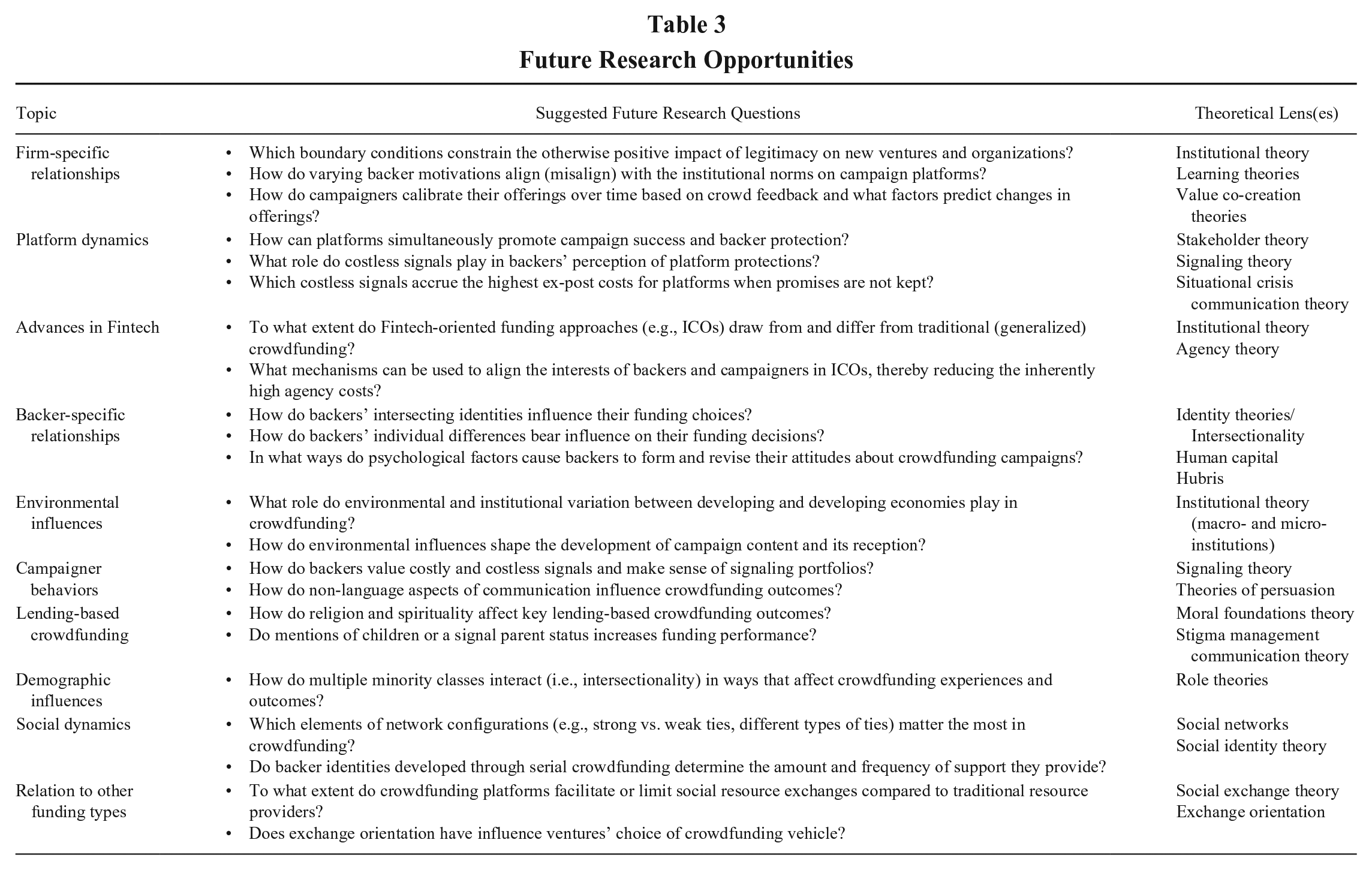
A Note of Caution Concerning Future Research
The multidisciplinary efforts of crowdfunding researchers have enabled the rapid advancement of knowledge concerning a disruptive phenomenon that embraces a wide variety of theoretical lenses and research designs. We consider such efforts to be largely positive for the understanding of crowdfunding as a phenomenon and for the advancement of organizational theory. However, such rapid growth across distinct disciplines creates the threat of knowledge silos and redundancy. We see evidence of such occurrences. For instance, entrepreneurship scholars discovered that backers increase contributions as the campaign nears its goal and significantly decrease afterwards, suggesting backers are more motivated when they believe their contribution will make a difference (Kuppuswamy & Bayus, 2017). Two years later, marketing scholars observe the same phenomenon with similar empirical context, theory, and findings (Dai & Zhang, 2019). As another example, both Anglin et al. (2020) and Berns et al. (2020)—the first published in entrepreneurship and the latter published in finance—show that the financial and social aspects of partnering microfinance institutions (MFIs) influence crowdfunding performance in crowdfunded microlending with very similar research designs and findings. Likewise, entrepreneurship (e.g., Warnick et al., 2021) and information systems (e.g., Raab, Schlauderer, Overhage, & Friedrich, 2020) have shown similar effects of facial expressions of emotion on crowdfunding outcomes. While we do not contend that studies examining the same phenomena are exactly the same, and we do believe that each can add its own value, the increasing overlap among studies merits attention.
Accordingly, we offer some thoughts on areas that research should avoid (and embrace) to reduce such redundancy. First, while we provide ideas to advance signaling research below, we believe that simple applications of signaling theory (e.g., X signal leads to more funding) should be avoided. The crowdfunding literature clearly shows that the traditional tenets of signaling theory hold and that well-worn signals, such as experience or prototypes, are influential. Thus, similar examinations are unlikely to yield additional knowledge, regardless of the field in which they are conducted. As such, we recommend an emphasis on signaling portfolios below.
Second, we encourage scholars to think more deeply about the relationship between emotional (and similar) expressions and funding. Indeed, the study of emotions in crowdfunding pitches is a lively topic across disciplines (e.g., Davis et al., 2021, entrepreneurship; Hou, Zhang, & Zhang, 2023, information systems; Li et al., 2017, organizational behavior; Xiang et al., 2019, marketing). This body of literature has established that emotions matter with most common expressions of emotions having positive and negative pathways to funding performance. As such, does simply assessing the effect of another emotion truly expand our understanding of crowdfunding? We suggest that it does not. Below, we recommend scholars focus on the intersection of emotions with other understudied factors (e.g., race) as well as focusing on the emotions of backers, which have received less attention.
Third, we also caution against the simple examination of a specific type of language or characteristic display and its direct effects on funding. For instance, several studies show the varied effects of narcissistic expressions on crowdfunding outcomes (Anglin et al., 2018b; Bollaert, Leboeuf, & Schwienbacher, 2020; Buttice & Rovelli, 2020). Would a study examining expressions of hubris add much beyond these works? We believe future research should be both judicious in its selection of characteristics as well as be willing to probe the nuances of linguistic expressions. These choices should be made such that the research advances organizational theories and literatures.
Fourth, we caution against treating backers as a monolith. Although the marketing and entrepreneurship literatures provide insight into backer differences, the literature as a whole tends to make simplifying assumptions concerning backer composition. This is valuable in establishing baseline effects. However, given the substantial knowledge produced in recent years, many baseline effects have been established. As such, we strongly believe that all disciplines can benefit from a more nuanced examination of backer variation.
Finally, we encourage research to consider new dependent variables. It is perhaps unsurprising that the bulk of the crowdfunding literature assesses funding performance, regardless of discipline, as this is the most obvious and immediately salient dependent variable. However, crowdfunding also shapes learning outcomes, evaluation by professional investors, and future venture performance, among other potential outcomes. By doing this, researchers can provide a more varied and potentially impactful understanding of how crowdfunding relates to the broader business environment.
Firm-Specific Relationships
Legitimacy and Institutional Theory
The firm-specific relationships topic highlighted the effects of legitimacy in crowdfunding. A major contribution from this body of work, which is largely rooted in the strategic management tradition, is the recognition of crowdfunding as a distinct institution with its own norms, structures, and regulatory frameworks. In doing so, this work reveals that crowdfunding challenges traditional notions of legitimacy (e.g., Soublière & Gehman, 2020) by highlighting novelty as an “institutional norm” important to gaining backer support, while also building knowledge about the various types of legitimacy that shape campaign effectiveness. To push this stream forward, we identified two key areas for future research. First, given the wide array of crowdfunding types and variety of firms seeking crowdfunding, refining institutional theory by adding boundary conditions that constrain the positive impact of legitimacy on campaigns is essential. Notably, crowdfunding has become an important resource for social ventures. However, previous research (Chen, 2023) established that moral legitimacy, often important for social ventures, can harm rewards-based crowdfunding campaigns. Future studies should explore the potential risks of different forms of legitimacy (pragmatic, associational, consequential) in socially-oriented crowdfunding, as these may not align with the core social concerns of such ventures and could disappoint backers focused on social legitimacy (Chen, 2023; Garud, Schildt, & Lant, 2014). Indeed, as socially-oriented crowdfunding continues to grow, research finds that backers have different expectations regarding these campaigns compared to those that are more commercially-oriented (Anglin et al., 2022a), suggesting that how socially-oriented campaigns gain legitimacy and leverage legitimacy may vary. For example, further examination might reveal that while moral legitimacy hinders rewards-based performance, it could be valuable for campaigns with a social imperative.
Second, recent work reveals differences in how backers respond to institutional norms on the basis of gender. For instance, Waddingham, Chandler, Alexander, Zafar, and Anglin (2025) show that women backers are much less punitive of nonconformity to “greedy institutions” such as workaholism. However, the firm-specific relationships literature has largely ignored individual backer variation in response to institutions. We suggest that such research could look to the marketing literature, which has a distinct focus on the backer, for inspiration on how to assess individual backer differences in response to institutional norms. This literature highlights how individual motivations tie to individual backer willingness to fund a campaign (e.g., Simpson, Schreier, Bitterl, & White, 2021; Zhang & Chen, 2019). As such, future research could examine how varying backer motivations align with the institutional norms on crowdfunding platforms. Such investigations could reveal which backers react more strongly—whether positively or negatively—to emerging norms in crowdfunding, providing insight into how both campaigners and platforms might strategically cultivate norms consistent with backers’ expectations.
Innovation and Organizational Learning
We believe there is considerable potential for research on innovativeness and learning through crowdfunding to work together as both are tied to future firm performance and because learning should improve innovativeness. As noted in our review, crowdfunding can enhance the link between venture innovativeness and performance by enabling market insights from backers. Given the role of customer stakeholders in value co-creation theories (Fernandes & Remelhe, 2016), it would seem that crowdfunding offers an ideal mechanism for learning customers’ perspectives on proposed innovative products and using those insights in strategic decision-making. For instance, using the game, design, and technology categories in Kickstarter—categories that often have serial campaigners, innovative products, and crowd interaction—future research could examine how campaigners calibrate their offerings over time based on crowd feedback and what factors predict changes in offerings. These factors could then be compared against company performance to determine the influence of the crowd on venture performance.
At the same time, we believe that more work is needed concerning whether what is “learned” during a campaign is necessarily valuable or aids the venture. Indeed, limited work suggests that co-creation can go awry if the advice from the crowd is not managed judiciously (e.g., Murray & Fisher, 2022). Here, we suggest that future work begin by separating learning processes and outcomes (Dahlin et al., 2018) to better disentangle how learning processes involved in co-creation enable better or worse outcomes. This could lead to more refined theory surrounding crowdfunding as a mechanism for learning and how learning leads to beneficial outcomes for campaigners.
Platform Dynamics
Stakeholder Theory
The literature on platform dynamics examines governance mechanisms that protect backers from unscrupulous behavior from campaigners and factors that contribute to campaign success. This body of work spans the disciplinary domains of operations, information systems, finance, and strategic management. Here, the literature sheds light on the balance platforms must strike between protecting backers and fostering campaign success. Notably, however, most work focuses on one of these objectives without considering consequences for the other. A natural next step for future research is to develop integrated frameworks that balance backer protection and campaign success. For instance, studies could investigate how platforms can use phased information disclosures to maintain transparency without jeopardizing campaign success. This would involve determining the most effective types and timing of information shared to maximize trust while still promoting successful funding outcomes. Such an approach could also contribute to advancing stakeholder theory (Freeman, 2008) by offering new insights into how platforms, as intermediaries, balance competing stakeholder interests. Indeed, a core question sought by stakeholder theory research is who the firm serves and how firms can manage competing stakeholder expectations (Parmar, Freeman, Harrison, Wicks, Purnell, & De Colle, 2010). By studying mechanisms that simultaneously protect backers and support campaigners, researchers could deepen our understanding of how organizations manage tensions between stakeholder groups, addressing trade-offs in a way that maximizes value creation for all parties.
Signaling and Situational Crisis Communication Theory
Another potential avenue for future research involves borrowing from signaling theory, which is widely applied in other crowdfunding topic areas, such as campaigner behaviors, but less so in the platform dynamics topic area. Specifically, we call for future studies to bring a costless signaling framework to bear on how backers perceive platform protections for backers. Costless signaling, despite the name, may involve costs (penalties) after the signal is sent. These ex-post costs are suffered by signalers if and when they are perceived to have lied (e.g., Patel et al., 2021b). This provides an opportunity for future research to leverage a complementary theory alongside signaling to explain these ex-post costs. For example, given the self-regulation of crowdfunding platforms, backers rely on platform honesty and, crucially, that platforms should suffer negative costs if and when they are discovered to have failed in claims about backer protection. Thus, research could investigate which costless signals are both highly influential among backers and highly detrimental when promises are not kept. Further, it remains unclear as to how crowdfunding platforms can best restore confidence among potential backers. Situational crisis communication theory (Coombs, 2007; McKenny, Fisher, Short, Ketchen, & Allison, 2024) is a potential complementary theory that could be used to examine the effectiveness of different communication strategies (e.g., apologies, corrective actions, transparency) in moderating the negative impacts of failed signals and restoring trust among backers.
Advances in Fintech
Institutional Theory
Research related to the emerging area of Fintech centered on cryptocurrency in the form of initial coin offerings (ICOs) and focused on identifying and managing agency concerns. The emphasis on agency is likely driven by such work being largely conducted by finance and accounting scholars, with the entrepreneurship literature contributing relatively few studies. What is curious is that this research is so far removed from the study of traditional crowdfunding. We suggest that future research focus on to what extent do Fintech-oriented funding approaches (e.g., ICOs) draw from and differ from traditional (generalized) crowdfunding. Our concern is that without first appraising the differences, particularly from equity crowdfunding which has similar financial motives, that ICO research could produce redundant insights. To do so, Fintech work will need to more readily engage with the governance literature addressing platform dynamics. Here, research might employ an institutional theory approach to examine whether Fintech platforms borrow the legitimacy earned from crowdfunding by isomorphic design choices, adopting the terminology of crowdfunding and mirroring some of the funding schemes employed.
Agency Theory
We believe that a significant opportunity for future research comes from the principal-agent problem prevalent in ICOs due to relative anonymity, lack of regulation, and the global reach of cryptocurrency markets, which contribute to high agency costs such that backers bear significant risks related to mismanagement, fraud, and project failure (Gan et al., 2021). Recent work has shown that some equity crowdfunding platforms may suffer from “hidden” agency problems, where platform management may contribute funds to campaigns to spark investment by others and later pull such funds (Mataigne, Meoli, Vanacker, & Vismara, 2025). The lack of regulation in crypto markets could suggest similar hidden agency problems yet to be uncovered. In addition, future research might work toward developing mechanisms to better align the interests of campaigners and backers, thereby reducing agency costs in ICOs. Specifically, scholars could investigate new incentive structures that enhance transparency and accountability. One potential Fintech advancement that could contribute to addressing agency problems in ICOs and build out this relatively small stream of literature is the implementation of smart contracts that automatically enforce terms agreed upon by backers and campaigners. Smart contracts can release funds incrementally based on the achievement of predefined milestones, ensuring that campaigners remain committed to delivering on their promises (Kher, Terjesen, & Liu, 2021). However, it remains to be seen whether this simply shifts the agency problem to the determiner of whether given milestones have been met or, for milestones which are algorithmically monitored, whether this creates market manipulation incentives for management. Furthermore, the users of cryptocurrency crowdfunding platforms are likely more technologically adept compared to the average crowdfunding user, making them an ideal audience for early adoption of advanced features like smart contracts. This could establish legitimacy for such features, paving the way for broader adoption in traditional crowdfunding, boosting trust and efficiency across platforms.
Backer-Specific Relationships
Intersectionality
The backer-specific topic of our review consisted of research related to attributes and motivations of backers, backers’ perceptions of campaigns, and backers’ decision-making processes. Broadly, this topic received substantial attention from the marketing and entrepreneurship literatures. This body of literature seeks to move away from the simplifying assumptions made by other areas of research that treat the crowd as a monolith of laypersons and recognize the individual differences inherent in a pool of backers. However, as research continues to advance there is still much to learn about the ways in which backers differ from one another. As noted in our review, apart from a few studies recognizing that race and gender can influence backers’ perceptions and motivations (e.g., Greenberg & Mollick, 2017), little is known about how backers’ diverse identities affect their reasons for contributing, how they interpret campaign information, and why they choose to fund certain campaigns. The intersectionality literature examines how the intersection of identities influences both the motivations and actions of individuals (Thatcher, Hymer, & Arwine, 2023); thus, providing a foundation for examining how backers’ intersecting identities influence their funding choices. For instance, we know that women tend to support women creators due to beliefs that women creators are at a disadvantage compared to men (Greenberg & Mollick, 2017). By this logic, Black women—due to possessing two subordinate role identities—could be viewed by backers as being at an exceptional disadvantage. Yet, we do not know if a creator’s race alters how backers view men versus women. Likewise, we know virtually nothing about how backer age, career choices, social status, disability status, or other identities relate to their involvement and decision making when funding campaigns.
Human Capital and Backer Cognitions
Although research is beginning to understand how certain backer attributes contribute to funding choices, there are several areas that future research can pursue. For example, the potential influence of backer human capital is unknown, as is whether backers themselves consider their own education and experience when evaluating whether to fund campaigns. This is surprising as backers surely bring varying levels of general and specific human capital with them as they make decisions. In addition, while research has shown how positively valanced characteristics, such as prosocial motivation (e.g., Dai & Zhang, 2019; Kuppuswamy & Buyus, 2017), influence backer decision-making, there is room to better understand the role of negatively valanced characteristics. Because some backers may frequently fund campaigns, hubris could significantly impact backer decision-making processes as they gain experience. This could lead to an overestimation of their ability to pick successful campaigns, potentially resulting in riskier investment behaviors. Indeed, the entrepreneurship literature has frequently investigated the hubris of entrepreneurs (e.g., Sundermeier, Gersch, & Freiling, 2020), but rarely investigated the influence of the hubris of resource providers. Exploring these unexamined backer-specific aspects of crowdfunding may lead to advancing theory on individual decision making which underlies contribution decisions. Here, we expect that experimental designs will be an important method for conducting such research as backer information is difficult to obtain on crowdfunding platforms.
Environmental Influences
Institutions and Environments
Our review of environmental influences uncovered that research on this topic centered on the reciprocal influence of crowdfunding and local policy, economic conditions and crowdfunding activity, and the role that culture plays in crowdfunding. Such findings are consistent with contingency theory. While contingency theory provides a useful way to organize this literature, we believe that other theories should be brought to bear when examining the broader crowdfunding environment. For instance, environments shape institutions and institutions shape environments (Manolova, Eunni, & Gyoshev, 2008), making institutional theory a valuable framework to extend knowledge concerning crowdfunding environments. To potentially advance institutional theory, further research should examine the differences in antecedents, processes, and outcomes of crowdfunding in developing versus developed economies. With few exceptions, there is a lack of research on how environmental and institutional differences among economies impact the use and the performance of crowdfunding (cf. Di Pietro & Butticè, 2020). While substantial research has been conducted in developed economies, studies on crowdfunding in developing economies have mainly focused on prosocial lending activities (Berns et al., 2020; Figueroa-Armijos & Berns, 2022). This research shows that backers from developed “Western” nations may impose their “Westernized” expectations on campaigners (e.g., Anglin et al., 2023a; Moss et al., 2015). As such, some crowdfunding domains provide a situation in which layperson backers from one institutional regime may interact with campaigners from a different institutional regime. This presents questions about how the institutional pressures faced by ventures within developing contexts shape how campaigners communicate and are perceived. Such research is valuable as crowdfunding continues to emerge as a viable funding source for those who live in less-developed economies.
Contingencies Across Levels of Analysis
While much of the environmental influences examined how policy, economic, and cultural conditions shaped the use and adoption of crowdfunding, there remains little work on how the environment influences the actions of individual campaigners. For instance, we know virtually nothing about how environmental factors shape the development of content for the campaign, such as image choice, video content, linguistic style, or choice to highlight particular causes. Work has also not addressed how the external environment influences how such content is received by backers. In both cases, researchers might leverage micro-institutional research which specifically examines how macro-oriented factors influence individual decisions and actions (e.g., Schilke, 2018). Thus, opportunities exist for research examining the interplay between environmental factors and campaigner behaviors as well as backer-specific relationships.
Campaigner Behaviors
Signal Cost and Signal Portfolios
The campaigner behaviors topic of our review unveiled research centered on campaign signals and signaling portfolios, language and communication styles, evaluation of campaigner characteristics, and campaigners’ behavioral responses to crowdfunding experiences. This topic was the central focus of the entrepreneurship literature examining crowdfunding. However, virtually all disciplines exhibit some interest in campaigner behaviors. Here, we believe that this literature has the opportunity to provide a more nuanced look at signaling and to further knowledge on nonverbal communication.
Signaling theory has served as a key lens for understanding campaigner behavior, with opportunities for additional extensions of this literature. Much of the current literature focuses on the signaler and the signal itself. There is little emphasis on the signal receiver. Thus, we call upon future work to look at the crowdfunding literature in marketing as well as consumer response to signals for inspiration (e.g., Berger, 2019). By placing the emphasis on the receiver (i.e., backer), researchers can develop a more refined understanding of how backers value costly and costless signals and make sense of signaling portfolios (e.g., Steigenberger & Wilhelm, 2018). Doing so would answer the recent call by Connelly et al. (in press) to investigate how different receivers observe and react to the same signal as well as how they weigh signals when examining multiple signals at once. Further, while traditional signals are assumed to have a cost, such work could uncover how individual receivers view the cost of signals, as well as how variation in perceptions of signal costs shapes funding outcomes. For instance, do men and women backers view the cost of signaling differently? At the same time, researchers could employ qualitative comparative analysis (QCA) to uncover unique signaling portfolios that either aid or inhibit funding.
Nonverbal Communication
Although considerable research has examined the importance of language and rhetoric in crowdfunding, only recently has scholarly attention shifted to examine how non-language aspects of communication can play a role in campaign success. Recent research demonstrates that factors such as vocal tone (Allison et al., 2022) and facial expressions (Davis et al., 2021) can impact potential backers’ intentions and behaviors. In line with such findings, a key opportunity for future research is to probe deeper into how non-language aspects of communication can influence crowdfunding outcomes, which is particularly important as many crowdfunding platforms encourage campaigners to make video pitches of their ideas. To that end, researchers can leverage work regarding nonverbal aspects of persuasion (Cesario & Higgins, 2008; Guyer, Briñol, Petty, & Horcajo, 2019) for insights into nonverbal factors that influence the persuasiveness of crowdfunding campaigns. As cognitive theories have shown promise in understanding crowdfunding (Chan, Parhankangas, Hsu and Oo, 2024), we suggest that several social cognitive models including the Social Accuracy Model, the Social Relations Model, the Truth and Bias model of human judgment, as well as the Brunswik lens model could be employed to extend understanding of non-verbal communication in crowdfunding. Likewise, artificial intelligence programs—commercial examples of such programs include Empathic and Amazon Rekognition—can serve as tools to capture aspects of non-verbal communication in campaign videos.
Lending-Based Crowdfunding
Moral Foundations Theory
For the lending-based crowdfunding topic, we found that research primarily focuses on loan default and repayment in peer-to-peer lending, backers’ herding behavior in peer-to-peer lending, and the paradox of prosocial loans in microfinance crowdfunding. Future research on microfinance crowdfunding could benefit significantly from exploring intersections with other topic areas, such as demographic influences. For instance, religion, a key demographic factor, has scarcely been studied in crowdfunding (Anglin et al., 2023a). Given the inherently prosocial nature of many lending-based crowdfunding platforms, there is a growing need to understand how religion and spirituality might influence key outcomes in this domain. Religion profoundly shapes morality, ethics, and decisions about acting for the benefit of others. Moral foundations theory (Haidt & Graham, 2007), which explores the psychological underpinnings of ethical decision-making, offers a valuable framework for examining how religious beliefs shape backers’ motivations and behaviors in lending-based crowdfunding. Investigating how religious beliefs impact lending-based crowdfunding can enhance our understanding of prosocial motivation and behavior, both within entrepreneurship and in other literatures. The complexity of these relationships is underscored by recent findings that potential backers prefer to hear about the entrepreneurial characteristics of the campaigner rather than their virtuous or religious motivations for seeking funds (e.g., Anglin et al., 2023a; Moss et al., 2015). However, some backers on platforms like Kiva cite religious reasons for wanting to help others. Thus, future research needs to delve deeper into the role of religion in crowdfunding contexts to elucidate how it shapes crowdfunding processes. For example, religion scholars have long been interested in how specific religious tenets shape greater societal attitudes and behaviors (Luckmann, Kaden, & Schnettler, 2022). To that end, considerable attention has been given to the Islamic concept of mudharabah, a form of contract that details a profit-sharing partnership between an investor (i.e., rab al maal) and a borrower (i.e., mudarib). Previous studies detail the potential benefits that these agreements can have in terms of fueling entrepreneurial activity (Suhendri, Triyuwono, Mulawarman, & Baridwan, 2017), with recent investigations specifically focusing on how these relationships factor into the crowdfunding context (Ishak, Kamaruddin, & Aderemi, 2022). However, the application of these forms of contracts remains relatively limited and have been primarily seen as a mechanism to transform conventional financial products to be Sharia-compliant. As such, future research will be needed to develop a better understanding of how such religious factors can be leveraged to maximize the benefits they pose for crowdfunding efforts.
Stigma Management Communication Theory
In addition to religion, campaigner profiles tend to reveal personal information such as parental status, mentions of family, references to neighbors and community, and campaigner age. In some cases, platforms will tag such information, making it highly salient (e.g., Kiva has created a category for single parents). However, it remains unclear as to whether providing such information is helpful or harmful to fundraising efforts. For instance, future research could investigate whether mentions of children or a single parent status increases funding performance. Stigma management communication theory (Goffman, 2009) offers insights into the potential risks of disclosing personal information. Campaigners may face challenges if backers stigmatize certain characteristics, such as being a single parent or older in age, particularly if these attributes are associated with stereotypes about financial risk or ability to repay loans. Answering such questions is important given that campaigners in this domain are often encouraged to share this information by the microfinance institutions where the loan originates (Anglin et al., 2020).
Demographic Influences
Intersectionality
While research on individual demographic factors in crowdfunding is growing, there is little investigation into the experiences of individuals with multiple minority classifications (i.e., intersectionality). This gap is important because the dual minority stress model posits that individuals with multiple minority identities face higher stress levels and unique challenges (Meyer, 1995, 2003). These challenges could hinder their crowdfunding success, but intersectionality might also foster resilience and grit (Meyer, 2010, 2015), potentially offering advantages. Recent research underscores the complexity of intersectionality and entrepreneurship (Swab & Wolfe, 2023), highlighting the need for more studies in crowdfunding. In conducting such investigations, researchers should consider minority classifications beyond gender and race, including age, sexual orientation, and disability. To understand how intersectionality impacts crowdfunding outcomes, we can draw from related fields. General management literature shows that multiple minority statuses have a nuanced and complex relationship with organizational outcomes (Salter, Sawyer, & Gebhardt, 2021). It also emphasizes the importance of considering how individual identities are represented and contextualized (Thatcher et al., 2023). Efforts to explore intersectionality in crowdfunding could benefit from using a comprehensive intersectionality framework, as suggested in recent entrepreneurial finance research (Scott & Hussain, 2019). More specifically, crowdfunding research has begun to show that the same characteristics and behaviors of campaigners may have different effects depending on who exhibits them, mostly noting gender differences between men and women. As crowdfunding research embraces intersectionality, we believe that doing so creates opportunities for a more nuanced understanding of campaigner behaviors. For instance, while men and women may be judged differently depending on the emotions expressed during a pitch (e.g., Davis et al., 2021), we know very little of how race, skin tone, age, sexual orientation, gender identity, gender expression, parental status, or other characteristics influence the evaluation of emotions, experience, or stories told by creators.
Social Dynamics
Social Networks
For the social dynamics topic, our review found that research primarily examined social networks of campaigners and backers, social capital within crowdfunding networks, and information cascades in crowdfunding. While substantial work has considered the overall influence of social networks on crowdfunding performance, fewer studies have examined the specific configurations of these networks—such as strong versus weak ties and different types of ties. In order to develop a more comprehensive understanding of social network ties within crowdfunding contexts, future efforts could leverage relevant findings regarding the relationship between specific social ties and innovation. For example, innovation research suggests asymmetry regarding the influence that business versus political ties have on innovation efforts. Specifically, business ties have a positive impact whereas political ties have an inverted U-shaped impact on innovation (Wu, 2011). Moreover, geographical ties have a positive impact on exploitative innovation but a negative impact on exploratory innovation (Ozer & Zhang, 2015). These distinctions imply that campaigners with strong ties of different types may see different benefits. Future research could explore how these different types of ties affect various crowdfunding outcomes such as resource mobilization, product innovation, and campaign legitimacy (e.g., Allison & Anglin, 2025). Such work may be particularly relevant for scholars in operations and information systems, given their interests in the structure and dynamics of digital networks. Understanding how the configuration of social ties shapes campaign outcomes could inform theories of network design and optimization in digital environments. Moreover, insights into the types of ties that foster innovation or legitimacy could guide the development of platform features that facilitate specific social interactions to enhance crowdfunding performance.
Social Identity Theory
There is a need for research on the cognitions and behaviors of serial crowdfunding backers, with a focus on social identity. While some work exists on campaigners’ serial creation of successive crowdfunding campaigns (e.g., Buttice et al., 2017), little work has been done on serial backers’ successive involvement in multiple campaigns. Serial backers may develop a strong social identity associated with their role in the crowdfunding community, which can influence their behaviors and decisions. For instance, backers with a well-established identity as frequent supporters of innovative projects may be more likely to support campaigns that align with their personal values and interests. This social identity can also lead to a form of social capital, where their endorsement of a campaign signals credibility and attracts additional backers. Future research could examine how backer identities developed through serial crowdfunding determine the amount and frequency of support they provide, which campaigns they choose to support, and their influence on other backers. Understanding these identities can provide entrepreneurship scholars with insights into how crowdfunding ecosystems foster loyalty and sustained engagement. Additionally, for organizational behavior scholars and social psychologists, this line of inquiry offers a compelling context for studying identity-based behaviors (e.g., Oo, Allison, Sahaym, & Juasrikul, 2019), social capital formation, and influence mechanisms in novel, computer-mediated settings.
Relation to Other Funding Types
Social Exchange Theory
Synthesizing the work on the topic of crowdfunding’s relations to other funding types revealed that many prior studies have focused on campaigners’ choice between fundraising alternatives. To better understand ventures’ choice of fundraising outlet, future studies should examine the extent to which crowdfunding platforms facilitate or limit social resource exchanges compared to traditional resource providers. Traditional resource providers, such as venture capitalists and angel investors, often provide not only financial support but also valuable social resources, such as mentorship, networking opportunities, and strategic advice (Drover et al., 2017). Crowdfunding platforms, on the other hand, typically focus on financial contributions from a broad base of backers, often with minimal social interactions between the campaigner and backers. Future research could investigate how exchange orientation affects ventures’ choice to pursue crowdfunding versus other forms of venture finance. Ventures might choose traditional funding sources not just for financial reasons but for the social capital they provide (e.g., Alexy, Block, Sandner, & Ter Wal, 2012). Thus, those with a higher exchange orientation may be more apt to seek out traditional funding sources. Meanwhile, ventures that rely on crowdfunding might hold different values or priorities, such as a preference for broad-based community support over specialized mentorship.
Relatedly, scholars should consider the role of exchange orientation within different types of crowdfunding models (e.g., rewards-based, equity-based, donation-based). For example, in equity-based crowdfunding, backers might expect some level of ongoing communication and involvement in the venture, similar to traditional investors, because the value of their equity stakes hinge on the future performance of the venture (Estrin, Gozman, & Khavul, 2018). Conversely, in rewards-based crowdfunding, the primary exchange is usually a one-time transaction where backers receive a product or service in return for their financial contribution. Additionally, donation-based crowdfunding may attract backers who are motivated by altruism rather than financial returns, resulting in different expectations regarding social interactions and exchanges. They may expect ongoing communication regarding the impact of their donations (Boudreau, Jeppesen, Reichstein, & Rullani, 2021). This suggests that exchange orientation likely has implications for the choice of crowdfunding modality, with more highly exchange-oriented ventures prioritizing long-term exchange relationships gravitating towards equity-based or donation-based models, while those focusing on immediate, tangible exchanges might prefer rewards-based models. Examining these dynamics could provide valuable insights into how ventures tailor their crowdfunding strategies to align with their exchange orientations and the specific expectations of their backers.
Both of the above recommendations may be of particular interest to marketing scholars, who are distinct in their study of crowdfunding as a marketplace rather than a fundraising mechanism for growth. Specifically, marketing scholars have focused on backers as consumers (e.g., Maciel & Weinberger, 2024); however, there has not yet been work that examines ventures as consumers, evaluating their decision to select a specific funding vehicle as a form of consumer preference or behavior. Such research could yield valuable insights into marketing opportunities for crowdfunding platforms, particularly in terms of how they position their models to attract ventures with varying exchange orientations and resource needs.
Conclusion
Crowdfunding has been a game-changing innovation for those seeking to fund new and emerging ventures, to test product viability, to provide capital to under-resourced business owners in need of funding, and to quickly learn from a large number of individuals. We offer an integrative review of the multidisciplinary crowdfunding literature organized in terms of ten topics within four high-level domains and focused on how crowdfunding has contributed to the advancement of organizational theory. Our review reveals a vast, diverse, and complex literature that has made great strides in understanding the dynamic nature of crowdfunding. However, substantial gaps in our knowledge remain. As such, we present opportunities to further advance theory across business disciplines and crowdfunding topics to spur the next decade of crowdfunding research.
Supplemental Material
sj-docx-1-jom-10.1177_01492063251328267 – Supplemental material for Crowdfunding: A Theory-Centered Review and Roadmap of the Multidisciplinary Literature
Supplemental material, sj-docx-1-jom-10.1177_01492063251328267 for Crowdfunding: A Theory-Centered Review and Roadmap of the Multidisciplinary Literature by Stephanie B. Escudero, Aaron H. Anglin, Thomas H. Allison and Marcus T. Wolfe in Journal of Management
Footnotes

References
Supplementary Material
Please find the following supplemental material available below.
For Open Access articles published under a Creative Commons License, all supplemental material carries the same license as the article it is associated with.
For non-Open Access articles published, all supplemental material carries a non-exclusive license, and permission requests for re-use of supplemental material or any part of supplemental material shall be sent directly to the copyright owner as specified in the copyright notice associated with the article.
