




Abstract
This review examines the effect of physical work environments—the dedicated, tangible spaces where employees carry out their professional tasks—on organizational processes and outcomes. We synthesize decades of research across various disciplines using a conceptual framework that defines physical work environments along three key dimensions: ambience, spatial configuration, and aesthetics. These dimensions are analyzed for their effects on both internal stakeholders, such as employees, and external stakeholders, including clients, suppliers, and investors. Our analysis reveals two major themes in prior research: (1) task accomplishment, which focuses on how physical work environments influence physical and mental health, motivation and attitudes, as well as work processes; and (2) resource position, which explores how these environments impact a firm’s tangible resource position, its ability to attract and retain human resources, as well as shape intangible assets such as organizational culture and reputation. The study also highlights contradictory findings and methodological limitations in existing research and proposes future research agendas. By providing theoretical insights and practical guidelines, this work seeks to guide both scholars and managers in understanding how physical workspaces can be designed to improve organizational outcomes, particularly as firms adapt to evolving work arrangements following the COVID-19 pandemic.
Keywords
As the COVID-19 pandemic hit in 2020, many companies transitioned to remote and hybrid work models, with the belief that these alternative work arrangements would become the new norm, replacing the traditional “work-at-office” model (Gillet, 2020). Since then, however, a significant portion of companies have rescinded or revised these policies, requiring employees to return to the office at least a few days a week (Korn, 2024; Sahadi, 2023; Sherman, 2024). This reverse trend has renewed attention among scholars and managers on the organizational implications of physical work environments—the dedicated, tangible spaces where employees carry out professional tasks. Against this backdrop, integrating and deepening knowledge on how elements of physical work environments influence various firm processes and outcomes has become more important than ever.
Notably, research on physical work environments has accumulated for decades, and their effects have been studied across various disciplines, levels of analyses, contexts, and dimensions. However, this body of research has remained surprisingly fragmented within each domain and has, at times, revealed diverging and contradictory effects of the same aspects of physical work environments. This fragmentation has limited a comprehensive and balanced understanding of how these environments influence the operations and performance of firms. Therefore, the goal of this review is to conduct an integrative analysis of the literature on physical work environments, organized within an overarching conceptual framework, to summarize existing work and lay the groundwork for a future research agenda in this field.
Our review departs meaningfully from previous ones on physical work environments (e.g., Baron, 1994; Davis, Leach, & Clegg, 2011; Oldham, Cummings, & Zhou, 1995; Sundstrom & Sundstrom, 1986) (see Table A in Online Appendix). First, we take a holistic approach and review the effects of physical work environments’ attributes at all levels of analysis pertinent to a firm’s operations and performance—individual, group, organizational, and external environment (hereafter, external) levels—across multiple academic disciplines, including business, management, accounting, psychology, architecture, social sciences, and environmental science. Second, we categorize physical work environments along three key dimensions—ambience, spatial configuration, and aesthetics—and synthesize how factors within these dimensions, individually or collectively, shape important firm processes and outcomes, providing more structured insights into the impact of physical work environments. Third, in addition to examining the effect of various aspects of physical work environments on internal stakeholders such as the firm’s employees, we also examine external stakeholders such as suppliers, buyers/clients, and investors. Notably, although these external stakeholders can significantly impact a firm’s operations and performance, the impact of a firm’s physical work environment on these stakeholders has received little attention. Finally, we highlight methodological limitations of the studies reviewed and propose alternatives for future studies.
Ultimately, we expect this review to enhance both academic and practical understanding of physical work environments in several key aspects. First, by providing a comprehensive and structured analysis across multiple levels of analysis and stakeholder groups, we aim to offer scholars a clearer perspective on the multifaceted effects of physical work environments, encouraging more integrative and interdisciplinary research in this field. Second, our synthesis of existing findings, along with the conceptual framework we propose, can serve as a valuable guide for managers looking to design or modify their physical work environments to improve organizational processes and, ultimately, performance. Third, the methodological insights we offer will help future researchers address current gaps and limitations in this body of work, promoting the development of more robust and generalizable conclusions. Overall, we hope to foster a deeper, more nuanced understanding of how physical work environments shape critical processes within firms, particularly as managers navigate the evolving demands of modern work arrangements.
Physical Work Environments
Defining Physical Work Environments
A firm’s physical work environment is multifaceted; it is a confluence of ambient conditions, spatial configurational elements, and aesthetic attributes. Sundstrom and Sundstrom (1986) portray this complexity. The study describes physical environments as buildings and their interiors, including the aesthetic and spatial arrangement of rooms, furnishings, and equipment, along with ambient factors such as lighting, sound, temperature, and air quality. This paper adopts a similar perspective. We define physical work environments as tangible, structural enclosures—“establishments of employment”—where the core activities of an organization take place. Virtual work environments, which are web-based settings without tangible physical spaces, and remote work locations where employees are dispersed and not co-located within the same dedicated physical office fall outside the scope of our definition.
Our criterion for what constitutes a physical work environment is derived from the 2021 International Building Codes (IBC), specifically Chapter 3 on “Occupancy Classification and Use.” Section 302 of the IBC categorizes buildings or portions of them based on their primary purpose, taking into account the inherent hazards and risks to occupants that are associated with the building’s intended use. The IBC’s classification includes various groups such as Assembly, Business, Educational, Factory, and Industrial, each defined by distinct characteristics and intended purposes. Our review specifically focuses on physical environments categorized under the “Business” (Group B) occupancy classification. This group includes buildings or portions of them (e.g., administrative and faculty offices in an Education Use building) where services are provided, or transactions of a business nature are conducted. Examples include offices, banks, professional services, faculty offices and other types of commercial spaces where the primary activities are administrative, professional, or service-oriented in nature.
By basing our definition for physical work environments on the “Business” classification of the 2021 IBC, we establish a clear and standardized criterion for identifying and evaluating the physical work environments in our review. It also ensures that our review is grounded in a widely recognized and authoritative set of guidelines, providing a solid foundation for understanding the implications of various aspects of physical work environments in organizational contexts.
Three Dimensions of the Physical Work Environment
To examine how characteristics of physical work environments contribute to organizational outcomes, we use a comprehensive framework from architecture and urban design used to analyze the impact of physical spaces on people (Dursun, 2009; Sundstrom & Sundstrom, 1986). This framework suggests that physical work environments are experienced across three key dimensions: ambience, spatial configuration, and aesthetics (Sundstrom & Sundstrom, 1986; Vischer, 1989, 2007, 2008).
Ambience refers to the atmospheric characteristics that make a space habitable and safe, including temperature, lighting, humidity, sound, air quality, and views. These elements contribute to the overall comfort and well-being of occupants, affecting physiological and cognitive processes (Sundstrom & Sundstrom, 1986; Vischer, 2008). Spatial configuration (also, simply configuration) describes the spatial layout of a workspace, including dimensions such as height, width, length, and the relationships between these dimensions. It also includes the organization of space, such as room adjacencies, wall partitions, circulation patterns, workspace layout, and furniture arrangement, which influence occupants’ movements and interactions. Aesthetics constitutes the sensory (e.g., textures, colors), compositional (e.g., finishes, materials), and design elements (e.g., repetition, focus, and balance) of a physical work environment. It also includes the selection of furniture and furnishings. Aesthetics plays a crucial role in creating an inviting and stimulating environment that impacts affect or psychological states.
It is important to note that these dimensions are not orthogonal, however, as they can influence each other. Nevertheless, for the purpose of this review, we focus on the primary role each dimension plays to better understand their effects on relevant stakeholders.
Focus of Past Research on the Three Dimensions of Physical Work Environments
Since the 1900s, various aspects of the physical work environment have been studied across management sub-disciplines. Taylor (1911) initially focused on the spatial configuration dimension and its impact on operational efficiency. The Hawthorne experiments (1924-1927) then examined the ambience dimension, investigating lighting’s impact on productivity but ultimately revealing the Hawthorne Effect—a phenomenon where observation alters employee behavior (Roethlisberger, 1980). Later in the century, the aesthetic dimension gained attention. Influenced by architecture and environmental psychology, it highlighted aesthetics’ symbolic and emotional effects (Sanders & McCormick, 1976; Sundstrom & Sundstrom, 1986). While different dimensions were emphasized at different times, they were rarely studied in isolation. This tradition of conflating various aspects of the work environment continued even as research on the topic progressed. Our review thus departs from this course and applies a three-dimensional framework—ambience, spatial configuration, and aesthetics—to unpack their effects on stakeholders.
Overview of Past Reviews
Aside from Sundstrom and Sundstrom’s (1986) study, which found that ambient conditions and spatial configurations impact individual satisfaction and performance, group communication, and other organizational outcomes, a recurring theme in previous reviews is the contradictory nature of the findings. Oldham et al. (1995) observed that spatial configuration significantly influences employees’ behaviors and attitudes but identified inconsistencies with the social interference framework (which undergirds most of the review’s sample), suggesting a moderating role for individual differences, job nature, and spatial attributes like proximity, density, openness, and visual privacy.
Similarly, Elsbach and Pratt (2007) examined elements like enclosures, adjustable workspaces, and ambient surroundings but found that they were linked to both positive and negative outcomes. The review highlights necessary trade-offs in understanding the effects of physical work environments. Davis et al. (2011) emphasized the dual effects of open-plan layouts, such as increased communication but also distractions, recommending careful consideration based on organizational needs. Baron (1994) reconciled diverse findings by proposing mediating factors like arousal, information overload, and stress in the link between ambient conditions and work-related behavior.
Our review contributes to this body of work not only by integrating disparate findings across levels of analyses and theoretical perspectives, but by also uncovering the roots of these mixed findings, addressing them and articulating implications across different levels and theoretical foci.
Literature Search and Review Scope
Our systematic review comprised the following steps. First, we identified fields of knowledge with streams that examine the intersection of organizational and physical work environment phenomena. These include business, psychology, architecture, urban studies, sociology, political science, and environmental science (Table B, Online Appendix). Based on SCImago Journal Rankings, we identified 262 journals representing these fields. Second, we employed the EBSCOhost and ProQuest databases to search for pertinent articles within each journal, using a variety of search terms for physical work environments (e.g., workplace design, office layout, office concept; see Figure 1 for a full list of keywords). This search yielded 6,786 articles. Given the large sample size, we limited our scope to 87 journals using their relevance to the research question and the SCImago Journal Rankings as criteria. This third step screening resulted in 1,154 articles. Fourth, we read paper titles, abstracts, and, when necessary, full texts to identify papers that fit within our review scope. After removing duplicates, we used the following inclusion criteria to create the final sample: (1) empirical studies, (2) that assess physical work environments (interior or exterior of buildings or spaces classified as “B” business in section 302 of the 2021 IBC), and (3) examine organizational phenomena. This step yielded 167 studies as summarized in Figure 1. Lastly, we categorized each study and its findings based on the dimension of the physical work environment (ambience, spatial configuration, and aesthetics), research method (e.g., archival, experimental, survey), and theoretical mechanisms, allowing for duplicates.
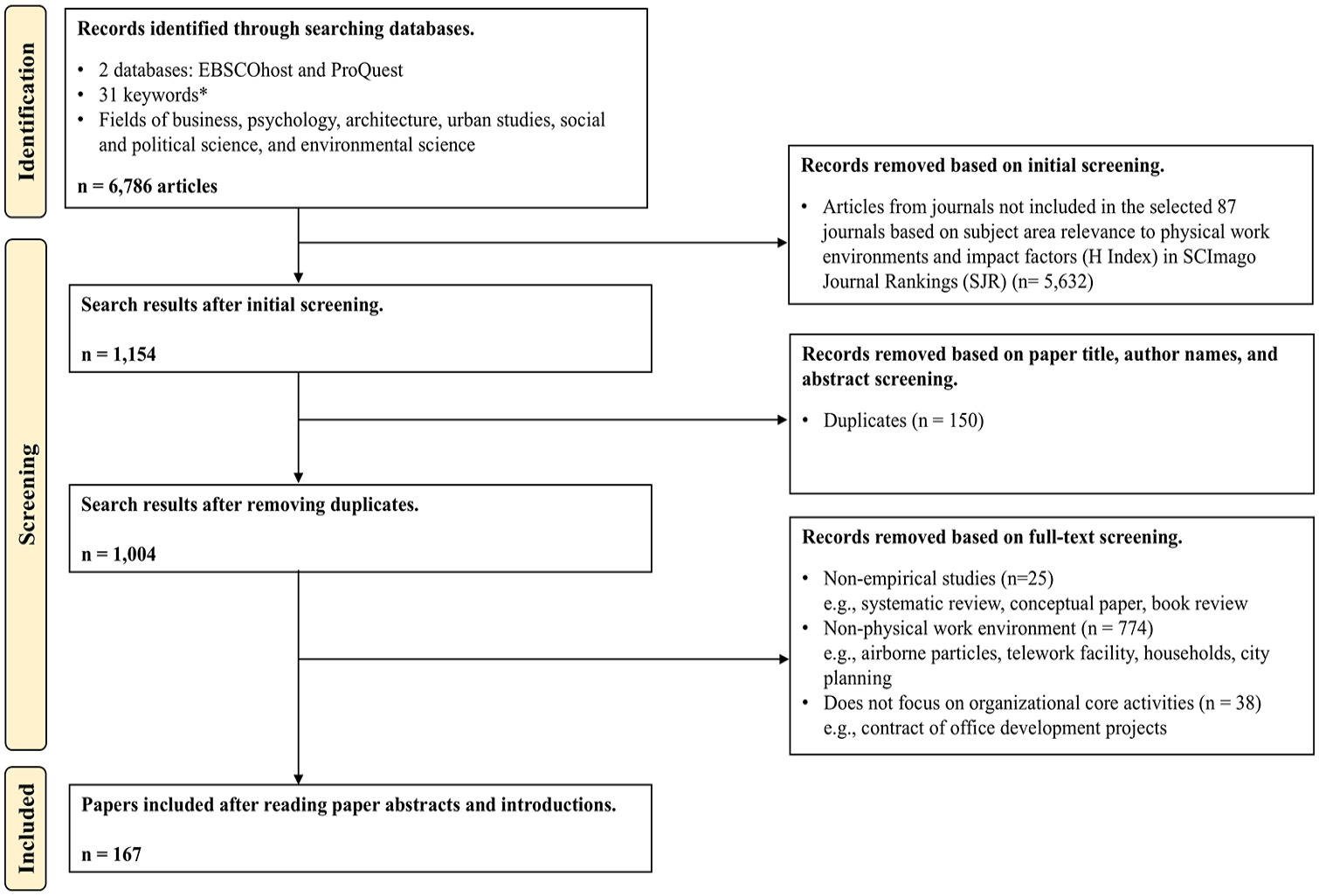
Process of Literature Search and Inclusion
To obtain a holistic understanding of spatial impact on desirable outcomes, we categorized findings by their level of analysis with regard to their impact on organizational stakeholders (Clarkson, 1995). The level of analysis here refers to the focus of the research inquiry. We identify four categories, depending on whether the study examines outcomes for individuals, groups, organizations, or the external environment. This categorization is similar to those adopted in prior research (e.g., Fischer, Dietz, & Antonakis, 2017) and allows for a detailed examination of how aspects of physical work environments affect firm outcomes within a single analytic framework.
Importantly, this categorization encompasses two types of stakeholders: internal and external. Internal stakeholders, analyzed at the individual, group, and organizational levels, include executives, middle managers, and line workers. External stakeholders constitute the external level of analyses and include (a) those within the firm’s core industry: suppliers, buyers, and competitors, and (b) those outside but with direct relationships with the core industry: shareholders, investors, regulators, the government, and the community. While the effects of physical work environments’ attributes are analyzed across levels of analysis, the conceptualization of these attributes themselves are considered holistically.
Summarized in Tables 1 and 2, our systematic review reveals that spatial configuration is the most studied dimension of the physical work environment in our sample (81%). This is followed by ambience at 45% and aesthetics at 25%, as studies often examined (and confounded) multiple dimensions. In terms of level of analysis, 73% were on the individual level, 21% on the group level, 9% on the organization level, and 11% on the external level, with some studies mapping on more than one level. Evidently, there is a disproportionate focus on the individual level of analysis.
Dimensions of Physical Work Environments: Key Examples
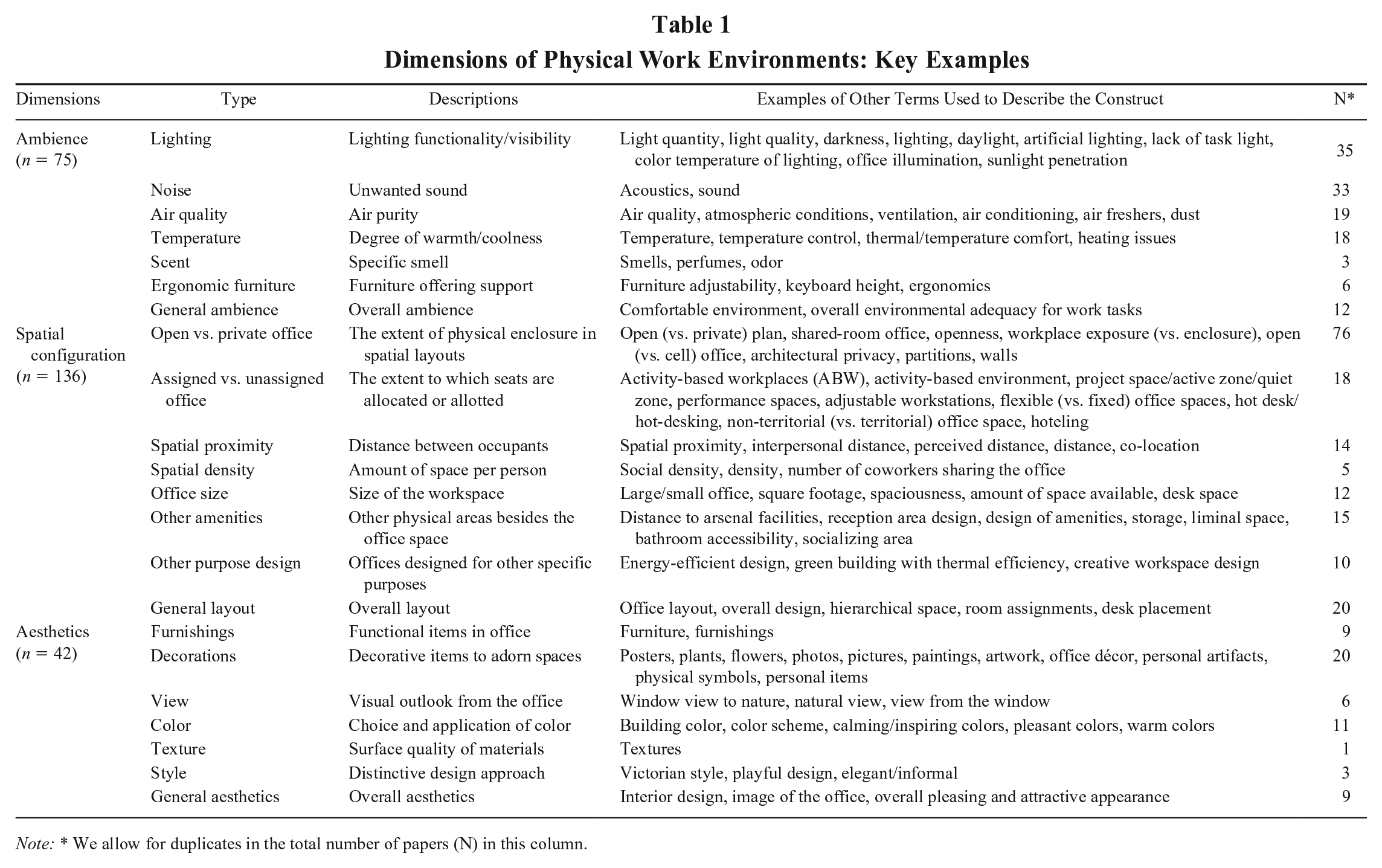
Note: * We allow for duplicates in the total number of papers (N) in this column.
Summary of Reviewed Articles
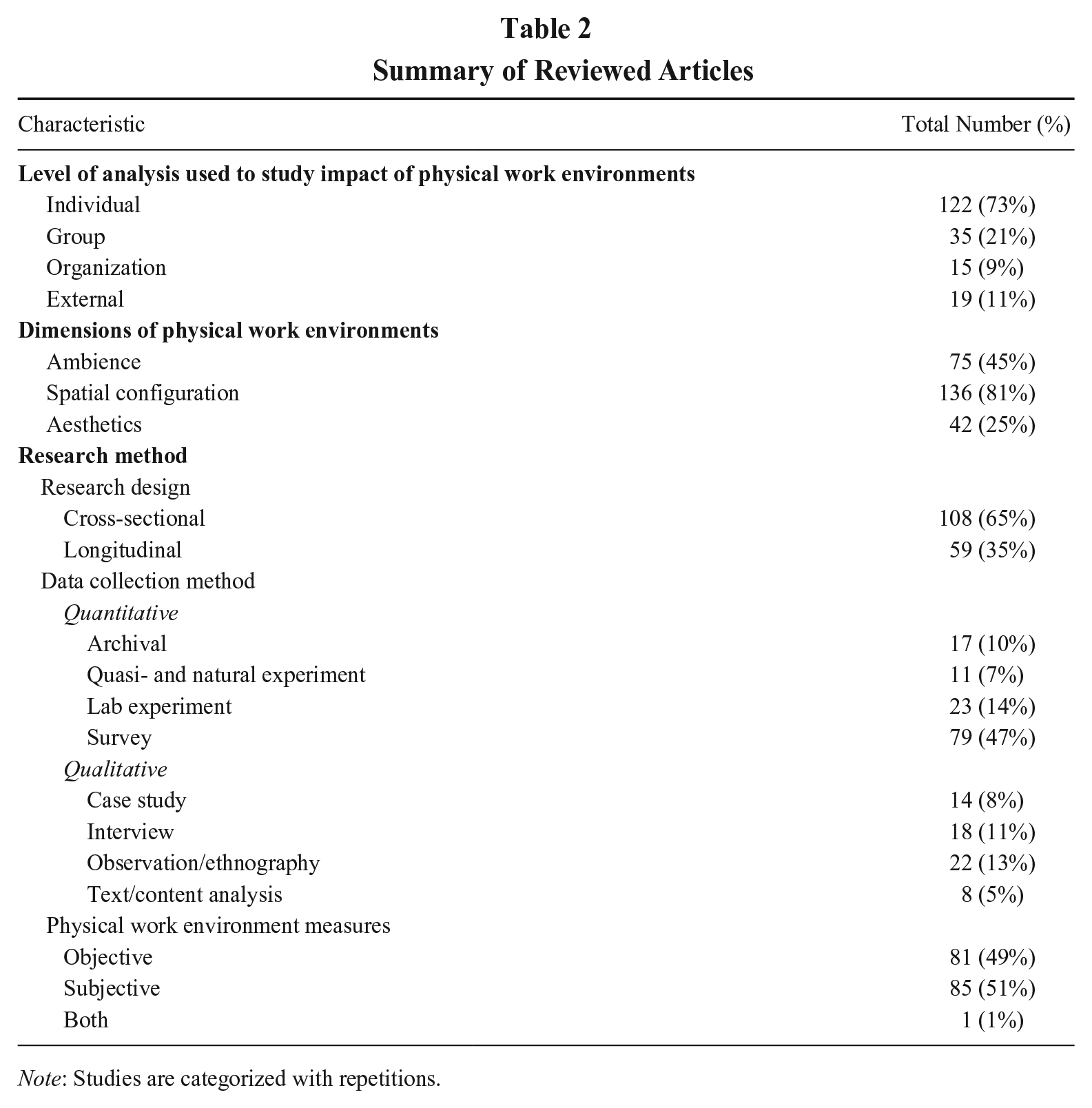
Note: Studies are categorized with repetitions.
With regard to research methods, most studies relied on cross-sectional designs (65%), with less research using longitudinal/time-lagged designs (35%). For data collection, researchers have relied on both quantitative and qualitative data. Quantitative data collection methods were dominated by surveys (47%), followed by lab experiments (14%), archival methods (10%), and quasi- and natural experiments (7%). Qualitative approaches, while less frequent, included observation/ethnography (13%), interview (11%), case study (8%), and text/content analysis (5%). These descriptive statistics suggest an underutilization of field-based approaches that help establish causality in examining impacts of physical work environments’ attributes. This is possibly due to data availability constraints. In measuring physical work environments, studies using subjective measures (51%) slightly exceeded those using objective measures (49%). This aligns with the prevalence of survey-based data collection. Little research utilized both measures, potentially missing insights from their varying impacts on organizations.
Emergent Themes on the Role of Physical Work Environments in Organizations
We begin our literature analysis by integrating the theoretical lenses used to examine research findings. Management studies and related fields, such as social and environmental psychology, often employed theoretical frameworks followed by hypothesis testing. Other studies were phenomenon-driven, seeking to explore, understand, and explain specific real-world occurrences. To better understand the theoretical implications of these phenomenon-driven studies, we reviewed, synthesized, and categorized the dependent variables in our sample and aligned them with relevant theories. These theories were then grouped based on their core arguments for predicting physical work environment outcomes (see Table 3 and Table C, Online Appendix).
Theories Used to Explain the Impacts of Physical Work Environments in Prior Studies
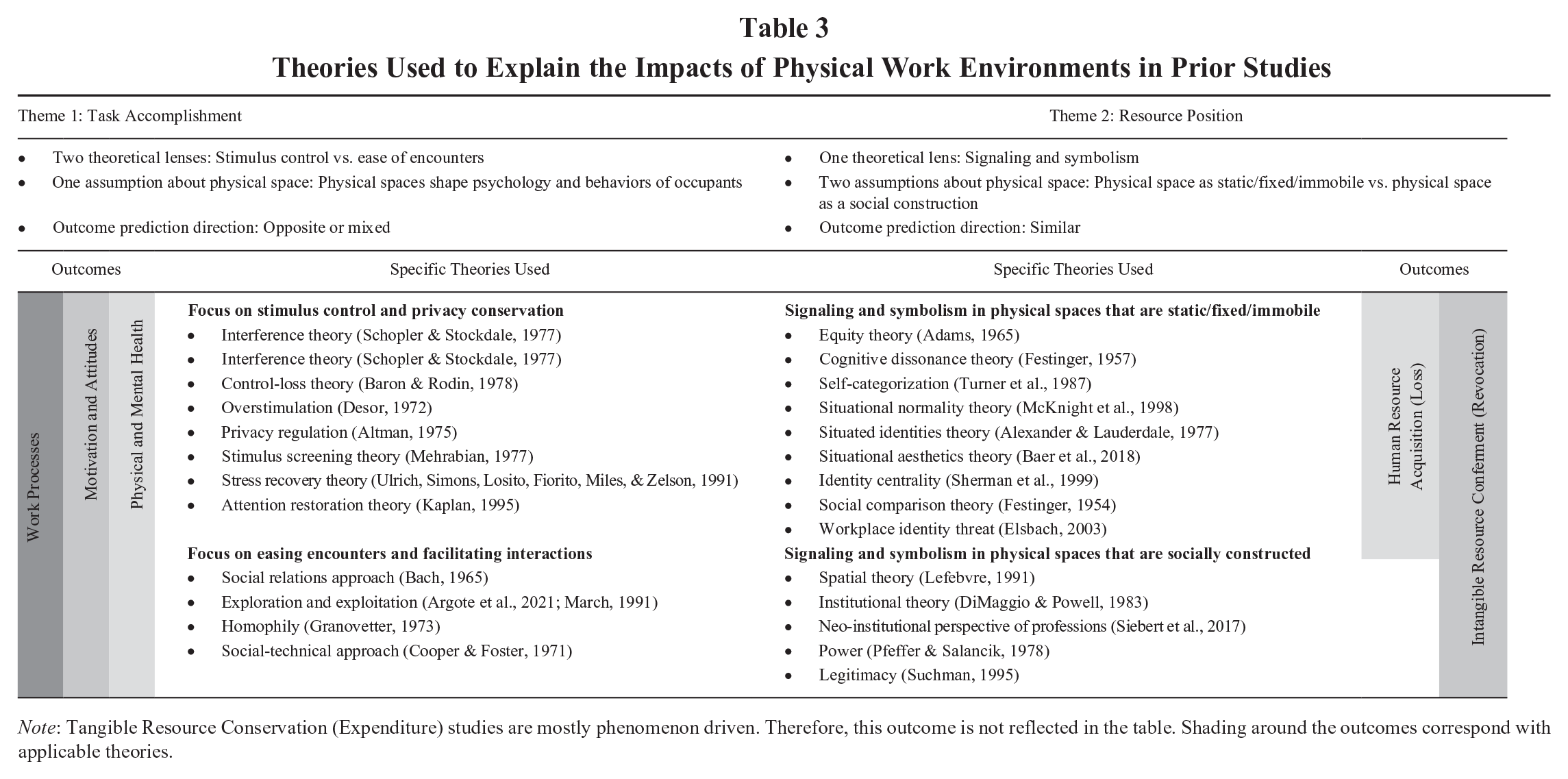
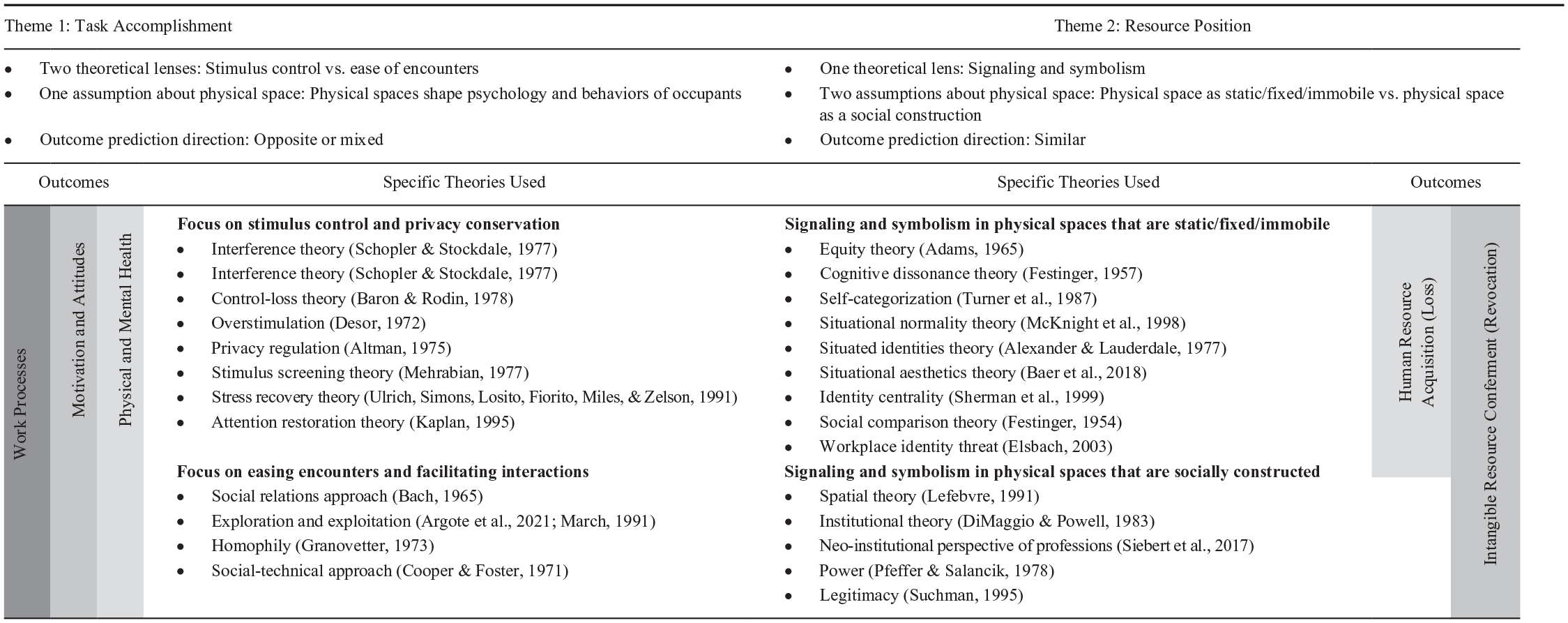
Note: Tangible Resource Conservation (Expenditure) studies are mostly phenomenon driven. Therefore, this outcome is not reflected in the table. Shading around the outcomes correspond with applicable theories.
Our review revealed that physical work environments influence both qualitative (e.g., employee satisfaction, organizational culture, legitimacy) and quantitative outcomes (e.g., profitability, productivity, market share). We organized these outcomes into two themes: task accomplishment and resource position (Table C, Online Appendix). Theories predicting task accomplishment outcomes focus on stimulus control and promoting interactions, while those related to resource position emphasize signaling and symbolism (Table 3).
Findings across levels of analysis (Table D, Online Appendix) indicate that physical work environments significantly impact key outcomes that have organizational implications. We find that workplace ambient conditions, spatial configuration, and aesthetics affect outcomes related to task accomplishment: (a) physical and mental health, (b) motivation and attitudes, and (c) work processes (Figure 2). These factors also influence a firm’s resource position by affecting (a) tangible resource conservation (expenditure), (b) human resource acquisition (loss), and (c) intangible resource conferment (revocation). The two themes and their six associated outcomes are summarized in Figure 2 and discussed in detail across levels of analysis next.
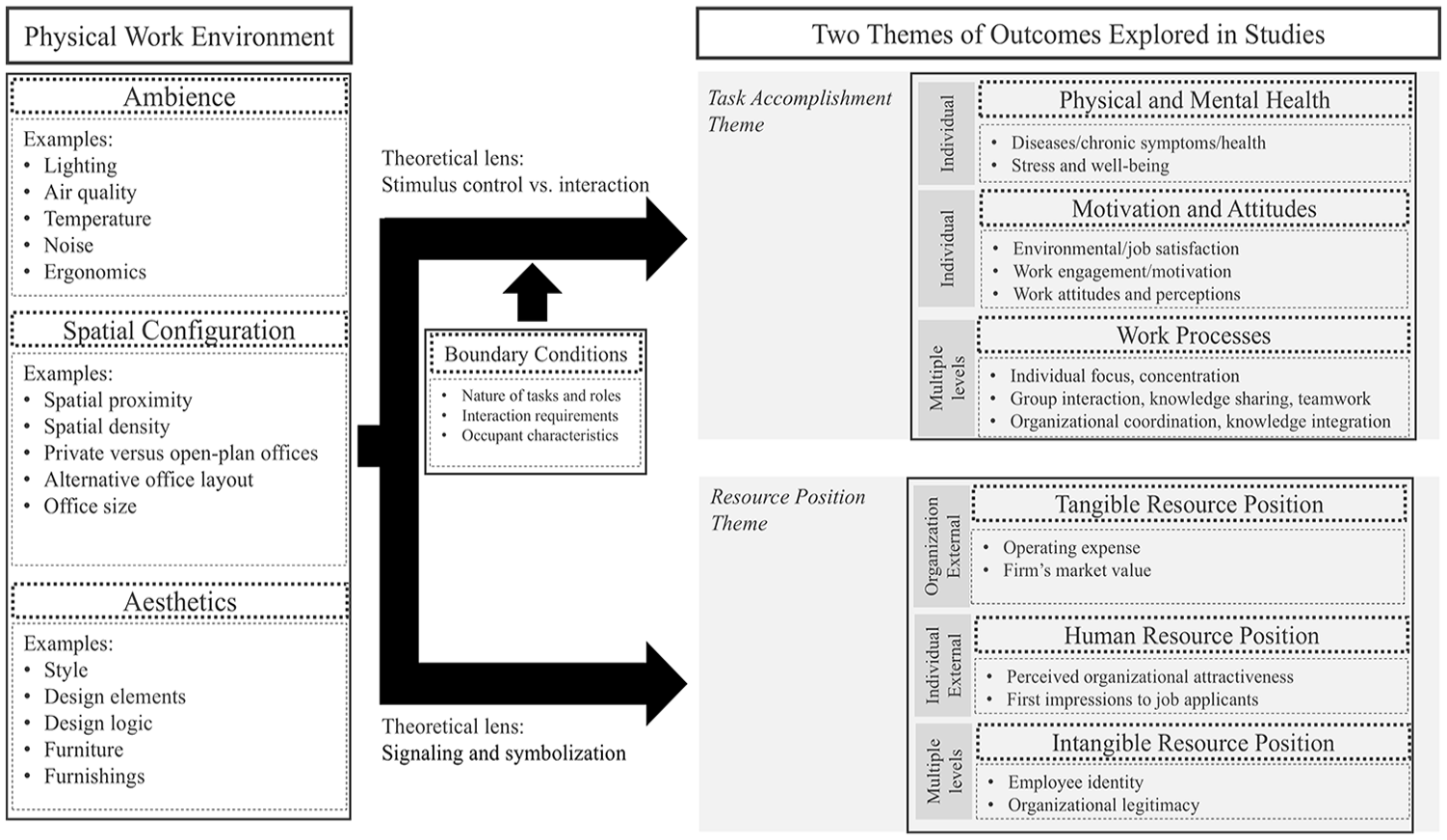
How Physical Work Environments Affect Key Outcomes Related to Task Accomplishment and Resource Position
Theme 1: Task Accomplishment
Research has explored how the ambience, spatial configuration, and aesthetics of physical work environments are related to (a) physical and mental health, (b) motivation and attitudes, and (c) work processes—key factors in an organization’s ability to accomplish tasks. First, the physical work environment supports or interferes with occupants’ physiological needs, safety, and welfare, affecting physical and mental health. Second, it shapes motivation and attitudes essential for task performance. Lastly, it facilitates or hinders work processes critical to task accomplishment.
Studies classified under the task accomplishment theme often adopt one of two theoretical perspectives: controlling stimuli to create a conducive environment or reducing search costs for locating and interacting with others. Stimuli control theories include interference (Schopler & Stockdale, 1977), intensification (Freedman, 1975), overstimulation (Desor, 1972), and privacy regulation (Altman, 1975). Theories focused on search cost reduction include the social relations approach (Bach, 1965), socio-technical systems (Cooper & Foster, 1971), as well as exploration and exploitation (March, 1991) (see Table C, Online Appendix).
Notably, research often emphasizes either stimulus control or search cost reduction based on the specific dimension of the physical work environment, the outcomes of interest, and levels of analysis, leading to varying predictions. The following sections detail these findings.
Physical and Mental Health
Our review highlights a significant body of research on how physical work environments impact physical and mental health. These studies often emphasize that overstimulation acts as a health hazard, underscoring the need for low-stimulus, comfortable environments, with ambience being a primary focus. Additionally, subsets of the research explore the indirect effects of spatial configurations on health outcomes through ambience, as well as the effects of aesthetics on psychological well-being and mental health.
Ambience
Much of the research on physical work environments and health focuses on ambient conditions. Drawing on explanations such as intensification theory (Freedman, 1975) which explicates how concurrence of or cumulative increases in environmental stimuli amplify psychological reactions, and overstimulation theory (Desor, 1972) which similarly shows that excessive stimuli prompts negative psychological responses, they emphasize acceptable ranges for ambient conditions beyond which overstimulation occurs and ambient factors become physical stressors. These stressors include excessive lighting, noise, and air particulates (Evans, Becker, Zahn, Bilotta, & Keesee, 2012; Kożusznik, Peiró, Soriano, & Escudero, 2018). Prolonged exposure to such stressors can result in health issues like eye irritation, headaches, and respiratory problems (Hedge, 1984). For instance, office lighting exceeding 2,000 lux is strongly linked to health risks (Kożusznik et al., 2018). As such, the research focuses on overstimulation to understand how to minimize these risks to occupants’ physical and mental health.
While most studies view ambient conditions as potential hazards, others suggest that favorable conditions can reduce stress and improve health. For example, sunlight penetration has been shown to alleviate seasonal disorder symptoms and reduce job strain, demonstrating positive intensification effects (Leather, Pyrgas, Beale, & Lawrence, 1998). However, determining optimal conditions is complex due to individual differences (Evans & Johnson, 2000; Knez & Enmarker, 1998; Veitch, Stokkermans, & Newsham, 2013). For instance, Knez and Enmarker (1998) found that perceptions of warm lighting vary by gender, highlighting challenges in making prescriptions.
Most research in this stream addresses individual-level health outcomes, leaving gaps in understanding group- and organizational-level impacts, such as sick leave frequency and turnover rates. Nevertheless, a handful of studies at the external level of analysis suggest that favorable ambient conditions also enhance client/buyer moods and comfort, indicating broader organizational benefits beyond employee health (Campbell, 1979; Devlin, 2008).
Spatial configuration
Research on spatial configurations often explores their indirect effects on health through ambient factors, particularly noise. Open-plan offices amplify background noise from conversations and phone calls, which can create overstimulation and act as a significant stressor that interferes with cognitive processes (Brennan, Chugh, & Kline, 2002; Evans & Johnson, 2000). Reflecting insights from interference theory (Schopler & Stockdale, 1977) and privacy regulation theory (Altman, 1975), which together emphasize individuals’ need to moderate their exposure to unwanted interactions and other stimuli, studies have found that open layouts are linked to increased self-reported stress and health issues due to higher noise levels (e.g., Bodin Danielsson & Bodin, 2008; Seddigh, Stenfors, Berntsson, Bååth, Sikström, & Westerlund, 2015). This highlights the interaction between spatial configuration and ambience in shaping health outcomes.
Aesthetics
While studies on ambience and spatial configuration focus on ambient stressors and physical health, research on aesthetics examines their impact on mental health. Studies show that visually appealing environments, such as those with natural views or nature-themed paintings, enhance employee mood and assist in stress management (Kweon, Ulrich, Walker, & Tassinary, 2008; Leather et al., 1998; Stone, 1998), showcasing positive concurrent and restorative effects of appropriate levels of stimuli posited by intensification and overstimulation theories (Desor, 1972; Freedman, 1975). These findings suggest that besides meeting basic physiological needs, organizations can use aesthetic elements in physical work environments as positive stimuli to enhance occupants’ mental health and overall well-being.
Methodological considerations
Most studies rely on self-reported measures of physical and mental health outcomes, such as eyestrain (“my eyes hurt at work”; May, Reed, Schwoerer, & Potter, 2004), using surveys, diaries, and case studies (Hedge, 1984; Kożusznik et al., 2018). While these methods capture a wide range of discomforts, they are not objective metrics. Complementing self-reported data with archival sources, such as sick leave records and turnover rates due to medical conditions, could provide a more comprehensive understanding of how physical work environments impact employee health at an organizational level.
Motivation and Attitudes
Research examining the impact of physical work environments on motivation and attitudes highlights the importance of preserving privacy and controlling stimulus. Theories such as overstimulation theory (Desor, 1972; Saegert, 1978), interference theory (Schopler & Stockdale, 1977), and control-loss theory (Baron & Rodin, 1978) emphasize that individuals value a sense of control over their environment. Physical work environments that expose individuals to uncontrolled stimuli—such as excessive noise, spatial configurations that create visual clutter and unwelcome intrusions, or unappealing aesthetic features—are linked to negative attitudinal responses (Oldham, Kulik, & Stepina, 1991).
These uncontrolled stimuli, arising from ambient conditions, spatial configurations, and aesthetics, negatively affect environmental and job satisfaction, employee motivation, and workplace perceptions (Hongisto, Haapakangas, Varjo, Helenius, & Koskela, 2016; Oldham & Fried, 1987; O’Neill, 1994; Zalesny, Farace, & Kurchner-Hawkins, 1985). Studies in this area particularly focus on spatial configuration and aesthetic features. However, most research centers on individual motivation and attitudes, leaving gaps in understanding how these mechanisms translate to group- and organizational-level outcomes.
Ambience
Research indicates that adequate ambient conditions—free from sensory overload—positively influence employee motivation and attitudes as posited in overstimulation (Desor, 1972; Saegert, 1978), interference (Schopler & Stockdale, 1977), and control loss theories. Specifically, appropriate lighting, good air quality, and thermal comfort are associated with higher employee satisfaction and engagement (Katzev, 1992; Radwan & Issa, 2017; Sutton & Rafaeli, 1987; Veitch et al., 2013). In contrast, inadequate lighting, such as excessive darkness, can cause sensory inundation, diminishing satisfaction and increasing turnover (Oldham & Fried, 1987). These findings underscore the importance of optimizing ambient conditions to minimize overstimulation and discomfort, thereby sustaining motivation and fostering positive attitudes.
Spatial configuration
Spatial configurations that limit employees’ control over their environment can negatively impact motivation and attitudes. Features like high physical density, small offices, and low partitions can lead to excessive sensory arousal and unwanted intrusion, thereby reducing satisfaction and increasing turnover tendencies (Bodin Danielsson & Theorell, 2019; Davis et al., 2011; Haapakangas, Hongisto, Varjo, & Lahtinen, 2018; Oldham & Fried, 1987; Spreckelmeyer, 1993). As posited in control-loss theory (Baron & Rodin, 1978), these undesirable outcomes can stem from a perceived lack of control over the work environment.
Traditionally, research has highlighted employees’ preference for private offices over open-plan layouts, likely due to the greater sense of control they offer (Spreckelmeyer, 1993; Sutton & Rafaeli, 1987). Recent research, however, has moved beyond the simple dichotomy of private versus open-plan offices. Newer studies now explore a broader range of alternative office designs, including activity-based, flexible, and hot-desking setups, which provide diverse workspaces tailored to different task needs (e.g., Gerdenitsch, Korunka, & Hertel, 2018; Haapakangas, Hallman, Mathiassen, & Jahncke, 2019; Wohlers, Hartner-Tiefenthaler, & Hertel, 2019). This work indicates that offering diverse workspace options can enhance employees’ sense of control, even within open-office environments. For example, activity-based offices are often favored over traditional open-plan layouts because of privacy enhancing features such as soundproof booths for focused tasks (Gerdenitsch et al., 2018; Wohlers et al., 2019). Such features improve satisfaction with open-plan offices (Haapakangas et al., 2018), empowering privacy regulation (Altman, 1975). Conversely, open-plan layouts without such options notably undermine satisfaction (Bodin Danielsson & Theorell, 2019).
Beyond immediate workspace configurations, amenities like accessible bathrooms, communication spaces, dining areas, and storage facilities also improve employee attitudes (Fadeyi & Taha, 2013; Hua, Loftness, Kraut, & Powell, 2010; O’Neill, 1994; Shortt, 2015), functioning as non-monetary rewards (Greenberg, 1989). These features support employee satisfaction and underscore the importance of designing spaces that align with user needs.
Aesthetics
While studies on ambience and spatial configuration focus on mitigating negative stimuli, research on aesthetics emphasizes elements that positively influence motivation and attitudes. One such element is workspace personalization, which based on control-loss theory (Baron & Rodin, 1978), enhances employees’ sense of control. For example, decorating workspaces with personal items, such as family photos, can remind employees of their values and redirect their attention toward positive memories (Byron & Laurence, 2015).
Aesthetically pleasing environments also significantly improve employee satisfaction (Hongisto et al., 2016; Leather et al., 1998; Stone, 1998). In particular, views of nature foster motivation and positive attitudes through their restorative effects. Research indicates that individuals in heightened states of arousal prefer simpler, less complex visual scenes, making natural settings really effective in buffering overstimulation, restoring balance and providing a calming influence.
Whether through personalized decorations that evoke positive emotions or aesthetically designed interiors that promote restoration, aesthetic elements play a vital role in enhancing motivation and fostering positive workplace attitudes.
Methodological considerations
Surveys are most commonly used to study how physical work environments impact motivation and attitudes. They allow researchers to directly measure employees’ perceptions and experiences but are typically cross-sectional, limiting causal inferences (e.g., Block & Stokes, 1989; Duvall-Early & Benedict, 1992). Also, these studies often rely on self-reported assessments of workspaces to measure physical work environments (e.g., Bodin Danielsson & Bodin, 2009; Kim & de Dear, 2013; Konar, Sundstrom, Brady, Mandel, & Rice, 1982), which can introduce common method biases. For example, employees with favorable attitudes toward the organization may perceive less noise and report higher job satisfaction.
Some studies address this limitation by incorporating objective measures alongside self-reports. For instance, researchers have asked participants to measure workspace features, such as partition heights (e.g., O’Neill, 1994) and complemented these subjective assessments with spatial analyses of actual floor plans (e.g., Hua et al., 2010). These approaches provide more robust data and help mitigate common method variance.
Work Processes
The final research stream within the task accomplishment theme examines how physical work environments influence work processes, including individual concentration, interpersonal communication, and organizational coordination. This stream is informed by two distinct theoretical perspectives, each offering unique but complementary assumptions about the ideal physical environment for various work processes.
The first perspective emphasizes privacy preservation and stimulus control. Drawing on theories such as interference (Schopler & Stockdale, 1977), intensification (Freedman, 1975), control-loss (Baron & Rodin, 1978), and overstimulation (Desor, 1972; Saegert, 1978), studies from this perspective focus on individual-level work processes requiring concentration and minimal interruption. These studies align with earlier research on physical and mental health, as well as motivation and attitudes, emphasizing how ambience and spatial configuration impact focus—a critical factor in task accomplishment.
The second perspective underscores the importance of reducing interaction search costs to enhance communication and collaboration. This approach draws on theories such as homophily (Granovetter, 1973), learning (Argote et al., 2021; March, 1991), and social relations (Bach, 1965), to highlight the benefits of interpersonal contact and information exchange. The focus here shifts to collective-level work processes, with studies exploring how spatial configuration fosters communication and coordination within teams or across the organization.
The theoretical focus in these studies often depends on the level of analysis (individual vs. group/organization), the physical dimension under study (ambience, spatial configuration, or aesthetics), and the specific outcomes of interest (e.g., individual productivity, collaboration). While ambience and spatial configuration directly affect work processes, aesthetics exert an indirect influence by shaping an atmosphere that supports or hinders these processes. Seeming theoretical tensions and mixed findings within this research require unravelling, along with the identification of boundary conditions. These are explored further below.
Ambience
Research on ambience examines its impact on work processes across individual and group/organizational levels (Leather et al., 1998; Lindberg, Tran, & Banasiak, 2016). Our review highlights that optimal ambient conditions—adequate lighting, temperature, and air quality—consistently benefit work processes at both levels by supporting cognitive processes as indicated by interference (Schopler & Stockdale, 1977), intensification (Freedman, 1975) and overstimulation (Desor, 1972; Saegert, 1978) theories. For individuals, appropriate lighting improves task accuracy and completion rates (Abdou, 1997; Veitch et al., 2013). For groups, inadequate lighting, such as darkness, is linked to increased group-level conflicts (Oldham & Rotchford, 1983). Overall, favorable ambient conditions, including temperature and air quality, enhance both individual’s perceived ability to accomplish tasks and perceptions of teamwork (Lindberg et al., 2016). These findings suggest that environments free from unnecessary stimuli are generally advantageous.
However, some studies show positive outcomes for stimulating environments. Research on acoustic conditions introduces a different perspective, often yielding mixed findings across levels of analysis. At the individual level, background noise is typically detrimental, interfering with cognitive functions and reducing performance (Evans et al., 2012; Seddigh et al., 2015). At the group or organizational level, however, the effects of background noise are more complex and less empirically studied. Some studies suggest that overhearing colleagues can serve as an auditory cue that fosters a sense of connection and organizational belonging as purported in social relations theory (Bach, 1965), rather than acting as disruptive noise (Goodrich, 1982). This perspective emphasizes the benefits of reduced search costs for locating colleagues and maintaining organizational awareness over individual privacy and stimulus control.
In summary, while ambient conditions such as lighting, temperature, and air quality have consistent positive effects across levels, acoustic conditions demonstrate varied impacts. Background sounds can be perceived as either productive or disruptive, depending on the theoretical lens and the nature of the work processes under investigation.
Spatial configuration
Research has extensively studied how spatial configuration—particularly private offices versus open-plan layouts—and spatial proximity (i.e., walking distance between individuals) affect individual and collaborative work processes. Private offices—also known as traditional, enclosed, or cellular offices—typically accommodate one or two individuals in enclosed, separate rooms with walls, while open-plan offices are designed to host more individuals, with few or no interior walls (Davis et al., 2011).
Open-plan layouts are the primary focus when examining the physical work environment’s impact on work processes. This configuration typically enhances unplanned encounters, fostering the development of weak ties among workers (Granovetter, 1973). However, it can also reduce control over interactions. Removing walls and doors introduces second order spatial attributes such as levels of privacy and interaction, territoriality, spatial proximity, and spatial density. The impact of these attributes varies across different work processes and levels of analysis. Thus, disparate findings often attributed to open-plan layouts may result from these secondary attributes, which can differ significantly across various open-plan designs. Furthermore, spatial configurations can shape ambient conditions and have diverse aesthetic expressions, adding to the complexity. We highlight these complexities as we integrate insights at different levels of analysis below.
At the individual level, research often centers on identifying optimal spatial configuration for independent, focused tasks. Findings here largely agree, showing negative effects of open-plan layouts and positive effects of cellular offices that provide privacy as posited by the theories discussed earlier (Baron & Rodin, 1978; Desor, 1972; Freedman, 1975; Saegert, 1978; Schopler & Stockdale, 1977). Commonly defined as control over social contact and exposure to visual or acoustic stimuli (e.g., Ashkanasy, Ayoko, & Jehn, 2014; Sundstrom, Herbert, & Brown, 1982; Wineman, 1982), privacy provided by cellular offices offer significant benefits: managing interactions, controlling information flow, and providing retreat from social interactions. Studies also show that different aspects of privacy, such as task privacy (focusing without interruptions) and communication privacy (having confidential conversations), impact work processes differently (Roberts, Yap, Kwok, Car, Soh, & Christopoulos, 2019). In contrast, disruptive stimuli stemming from open-plan layouts such as noise and visual distractions, adversely affect concentration and productivity, especially for cognitively demanding tasks (Crouch & Nimran, 1989; Oldham, 1988; Oldham & Rotchford, 1983; Roberts et al., 2019). Thus, optimizing individual task performance may require the prioritization of privacy in spatial configurations.
At the group and organizational level, on the other hand, studies emphasize interaction and collaboration as critical work processes. A key concern here is knowing what is more beneficial to a group or organization: having control over interactions or increasing random encounters. Findings are mixed. Some studies leaning on the perspectives of homophily (Granovetter, 1973), learning (Argote et al., 2021; March, 1991), and social relations (Bach, 1965)—all of which espouse interpersonal contact and information exchange—indicate that open-plan layouts enhance within and across team interaction and knowledge sharing through unplanned encounters (Appel-Meulenbroek, de Vries, & Weggeman, 2017; Hatch, 1987; Lee, 2019). Others report no significant (Lansdale, Parkin, Austin, & Baguley, 2011) or negative effects on team’s organic, explorative, and potentially productive interactions due to the discomfort from constant observability (Bernstein, 2012). These discrepancies are likely due to conflation between open-plan layouts and second-order spatial attributes such as territoriality, spatial proximity, and spatial density which also influence interaction.
Distinct from privacy, territoriality refers to the ownership and personalization of workspace. Review findings suggest that appropriate degrees of territoriality ease the tension between privacy and interaction in open-plan layouts. Individual non-territoriality—such as unassigned seating in activity-based open-plan layouts—enhances control over interactions, allowing workers to choose seating based on desired levels of interaction (Gerdenitsch et al., 2018; Wohlers et al., 2019). Group-level territoriality enhances team privacy and cohesion, improving productivity (Bernstein, 2012; Hatch, 1987). Thus, combining individual non-territoriality with group territoriality can optimize the impact of open-plan offices on group work processes, addressing the inherent tension earlier identified.
Spatial proximity—nearness between two occupants—positively affects interaction, knowledge sharing, and team cohesion (Boudreau et al., 2017; Catalini, 2018; Kabo, 2017; Lee, 2019; Nam, 2015; Roche, Oettl, & Catalini, 2024). It also shapes initial networks (Brass, Galaskiewicz, Greve, & Tsai, 2004), which can persist despite later physical separation (Yang et al., 2022). These positive effects are presumably because spatial proximity can be achieved in differing spatial configurations without compromising privacy or feeling crowded. For instance, the strategic use of materials like plants and shelving in open-plan layouts can maintain task, visual, and/or communicative privacy while preserving proximity in open-plan layouts.
In contrast with spatial proximity, spatial density—the amount of space per person in a spatial layout—shows consistently negative impact on work processes (Oldham & Rotchford, 1983), even though both secondary attributes are positively correlated and increase interaction. Evidently, high spatial density generates uncontrollable noise and distraction in open-plan layouts, increasing perceived crowding and privacy loss, which deter work processes (Oldham, 1988) as posited by interference (Schopler & Stockdale, 1977) and overstimulation (Desor, 1972) theories. Clever spatial configuration which achieves proximity but maintains optimal density, however, can address the seeming contradictions between these constructs.
Research at the organizational and external level is scant but focuses on the benefit of spatial configurations that facilitate encounters. At the organizational level, limited studies document the benefits of spatial proximity on decision-making processes, reducing the need for formal meetings and improving organizational performance, as shown in a case study on Capital One (Khanna & New, 2008). However, these changes at the organizational level are often part of broader initiatives, complicating direct attribution to spatial configuration.
At the external level, open-plan spatial configurations help facilitate interactions with external stakeholders. This can be critical to task accomplishment in professional settings. For example, Deloitte reconfigured nine of its U.S. offices to activity-based work settings to enhance service delivery and collaboration with clients, as well as improve internal work processes (Parker & Schmitz, 2022). Similarly, open desk layouts in educational settings positively affect student-faculty interactions and evaluations (Campbell, 1979; Zweigenhaft, 1976).
In sum, this research stream reveals two unique yet complementary work processes affected by spatial configuration. For focused individual tasks, enclosed offices that provide privacy are more beneficial. For collaborative and coordinative tasks, configurations facilitating occupant encounters and interaction are advantageous. Secondary spatial attributes also have impact. Spatial proximity demonstrates consistently positive effects on interactions and knowledge sharing. However, dense spatial layouts, while reducing interaction search costs at the group level, simultaneously increase unwanted interruptions at the individual level, reducing individual and collective performance. These findings showcase that boundary conditions such as the nature of tasks, job roles, and individual differences play a vital role in understanding the effects of spatial configuration on work processes.
Aesthetics
While most research focuses on how ambience and spatial configurations impact work processes, a smaller body of work highlights aesthetics as a crucial factor supporting key task achievement. These studies examine how the visual attributes of workspaces, such as window views, color schemes, and tidiness, collectively influence employees’ perceptions of their surroundings and related outcomes (e.g., Crouch & Nimran, 1989; Lee & Sosa, 2024). Rather than isolating specific aesthetic elements, this research emphasizes the holistic impact of aesthetic features on facilitating work processes.
Notably, recent research suggests that unconventional workspace designs—including vibrant or uniquely colored walls, distinctive lighting fixtures, unusual furniture, and playful atmospheres—enhance divergent creative thinking (Lee & Sosa, 2024). Other studies underscore the role of aesthetic elements like indoor plants and inspiring colors in shaping a supportive work environment (Dul & Ceylan, 2011). These features, alongside compensation and social dynamics, positively influence employees’ perceptions of workplace support for creative work (Dul & Ceylan, 2011; Dul, Ceylan, & Jaspers, 2011).
Although our review identified no studies at the organizational or external level, research at the individual and group levels indicates that aesthetics plays a vital role in aligning the workspace with critical work processes. By creating positive stimuli, aesthetics contributes to an environment that supports creativity and task accomplishment.
Methodological considerations
Studies examining the influence of the physical work environment on work processes employ diverse methodological approaches, each with unique strengths and limitations. Field studies commonly rely on surveys to measure perceived task outcomes, including self-reported performance (Bodin Danielsson & Theorell, 2019; Brennan et al., 2002), supervisor-rated performance (Maher & von Hippel, 2005), and ratings by independent coders (Schippers, West, & Dawson, 2015). The prevalence of self-reported measures is likely due to data constraints, though some studies have used objective metrics directly tied to organizational outcomes (Bernstein, 2012; Lee, 2019; Lee & Sosa, 2024).
Field studies often leverage relocation events, such as changes in seating arrangements (Lee, 2019) or transitions between open-plan and private offices (e.g., Brennan et al., 2002; Gerdenitsch et al., 2018; Sundstrom et al., 1982). These events offer valuable opportunities to compare pre- and post-changes in the physical work environment. However, such changes are frequently non-random, complicating causal inference (with exceptions, e.g., Lee, 2019). Additionally, relocations often involve simultaneous changes in multiple spatial dimensions, such as ambience and aesthetics, making it difficult to uniquely isolate effects.
Lab experiments, by contrast, provide controlled environments where researchers can manipulate specific attributes of interest, such as lighting glare, color rendition, or interior design, and directly measure task performance (Lee & Sosa, 2024; Smith-Jackson & Klein, 2009; Veitch et al., 2013). These experiments are particularly effective for studying individual-level processes (e.g., Knez & Enmarker, 1998) but are limited in their ability to generalize findings to group or organizational levels.
Boundary Conditions
Our review indicates that the ambience, spatial configuration, and aesthetic dimensions of physical work environments influence three key outcomes under the task accomplishment theme: occupants’ physical and mental health, motivation and attitudes, as well as work processes. Regarding physical/mental health as well as attitudes/motivation—mainly individual-level outcomes—findings converge on the need to minimize overstimulation and provide personal control. Conducive environments often feature appropriate lighting, minimal noise, private offices, and natural views that restore balance and reduce stress.
When examining work processes across levels (individual, group, organizational, and external), the findings are more varied. While ambient noise and open spatial configurations may disrupt individual productivity, they can also promote informal interactions that drive innovation. Open layouts and spatial proximity encourage chance encounters, while enclosed spaces support focused work. Our review identifies three key moderating factors that shape these foregoing effects: the nature of tasks and roles, interaction requirements, and occupant characteristics.
Nature of tasks and roles
Creative and collaborative tasks often benefit from environments that encourage unplanned encounters, while routine or independent work requires privacy. For instance, technical roles demand controlled environments, whereas clerical work is better suited to open layouts (Hatch, 1987; McElroy & Morrow, 2010).
Interaction requirements
Roles requiring frequent collaboration thrive in open spaces, while those emphasizing focus benefit from enclosed environments (Soriano, Kożusznik, Peiró, & Mateo, 2020). Tasks with few interactions align with private offices, while those with frequent exchanges favor open plans.
Occupant characteristics
Traits like introversion/extroversion, stimulus screening ability, and neuroticism moderate responses to spatial attributes (Lindberg et al., 2016; Oldham et al., 1991). For instance, individuals with high stimulus screening cope better with intrusions in open layouts, while highly neurotic employees report less perceived control in exposed spaces. Age also influences perceptions, with younger employees perceiving more distractions in open-plan layouts than older cohorts (McElroy & Morrow, 2010).
In conclusion, the impact of physical work environments’ dimensions on task accomplishment is multifaceted and contextual. By tailoring workspaces to the link between task requirements and individual differences, organizations can strike the right balance between privacy and interaction. As work patterns evolve, optimizing this balance will remain critical for organizational success.
Theme 2: Resource Position
Extant literature has also investigated how physical work environments shape a firm’s resource position. The ambience, spatial configuration, and aesthetic dimensions of physical work environments are linked to the conservation (expenditure), acquisition (loss) and conferment (revocation) of tangible, human, and intangible (non-physical assets) resources. First, physical work environments impact a firm’s tangible resource position by conserving (expending) financial resources through direct impact on operating costs and market valuation of its physical facilities. Second, they affect a firm’s human resource position by influencing human capital acquisition (loss). Third, they can shape a firm’s portfolio of intangible assets by conferring (revoking) non-physical resources.
Research examining the effect of physical work environments on a firm’s resource position typically conceptualizes physical space from one of two viewpoints: (a) physical space as static, fixed or immobile, or (b) physical space as a social construction. Studies that view physical space as immobile often focus on how the materiality of physical work environments (i) affects costs and property valuation, and/or (ii) reflects attributes (e.g., hierarchy or status) of the organization and its occupants. Specific theories used to predict outcomes of the physical work environments in this domain include self-categorization (Turner et al., 1987) and situational normality (McKnight et al., 1998) (see Table 3). Those that view physical space as socially constructed emphasize how occupants embody and appropriate physical work environments to accomplish organizational outcomes. Research here relies on theories like spatial theory (Lefebvre, 1991) and institutional theory (DiMaggio & Powell, 1983). Under both assumptions about physical space, however, studies often draw on symbolization (Dandridge, Mitroff, & Joyce, 1980) and signaling (Connelly, Certo, Ireland, & Reutzel, 2011; Spence, 1973) to explain outcomes. As such, the direction of predictions is similar across these conceptualizations. We describe these findings in the following sections.
Tangible Resource Position
The literature has identified that workplace ambience and configuration can impact a firm’s tangible resource position by affecting its facilities’ operating costs and market value. These studies, often phenomenon-driven and atheoretical, emphasize the objective materiality or physicality of work environments and how it impacts financial performance. They examined this effect at the organizational and external levels of analysis.
Ambience
At the organizational level, most studies analyzed ambient conditions for energy efficiency and cost savings that contribute to financial resource conservation. A few highlight the importance of managing lighting and power costs (Parker & Schmitz, 2022), while others such as DeCanio and Watkins (1998) studied investments in energy-saving measures through government programs (e.g., Green Lights). These typically atheoretical studies reveal that despite universal economic benefits, organizational adoption of energy-saving materials and practices—such as the use of electronic ballasts and occupancy sensors—varied by industry and location. For example, the utilities sector was an early adopter, perhaps due to its familiarity with energy-efficient technologies. This indicates that publicly accessible information on physical workplace improvements can lead to performance differences among firms.
At the external level of analysis, some studies also highlight the resource conservation (expenditure) impact of ambient conditions on shareholders, investors, and analysts, showing how energy efficient and cost reduction initiatives lower the costs of raising capital (Eichholtz, Kok, & Quigley, 2010, 2013) relative to those without such initiatives. For example, LEED or Energy Star certified office buildings are valued higher in the real estate market, thereby enhancing borrowing capacity and lowering cost of capital (Eichholtz et al., 2010, 2013). Also, a negative correlation exists between analysts’ earnings forecasts and air pollution during corporate visits, suggesting that external ambient conditions—though not always under a firm’s control—can impact stakeholders’ financial assessment of an organization (Dong, Fisman, Wang, & Xu, 2021).
Spatial configuration
With continued emphasis on materiality and findings only at the organizational level, studies suggest that spatial configurations such as open-plan layouts can be more beneficial for tangible resource conservation than private offices. Prior research found that open-plan offices can reduce space requirements by up to 20% compared to traditional office layouts (Brennan et al., 2002). Indeed, Parker and Schmitz (2022) demonstrate that organizations adopt open-plan layouts to promote efficient utilization of space and reduce real-estate costs.
Overall, we find that ambient conditions and spatial configuration can impact a firm’s tangible resource position by affecting operational costs, market value, and the cost of raising capital at the organizational and external levels of analysis. However, no studies in our sample have assessed these impacts at the individual and group levels, nor have they examined the role of aesthetics. As such, the impact of this theme’s materiality-focused, non-theory-based cost-saving measures on theory-based outcomes related to individual and group task accomplishment remains unclear.
Methodological considerations
Studies investigating the impact of physical work environments on tangible resource positions mostly use archival data. This preference is partly due to disciplinary characteristics, as such studies are primarily conducted in economics, accounting, and finance, where archival data are commonly used (e.g., DeCanio & Watkins, 1998; Eichholtz et al., 2010). These studies utilize detailed stock market data to quantify market reactions to the attributes of physical work environments. Further, they use longitudinal data and employ various approaches such as fixed effects to mitigate endogeneity concerns. However, this research often does not directly compare upfront installation costs of physical work environment features with their ongoing expenses. This oversight, compounded by the fact that these costs occur at different time points, limits our ability to estimate a precise net effect of physical work environments’ attributes on an organization’s tangible resource position.
Human Resource Position
Though surprisingly underexplored, our review indicates that the aesthetic dimension plays a prime role in contributing to the human resource position of a firm, primarily through processes that convey meaning such as symbolization and signaling. Symbolization is a process by which an object, action, or event (e.g., features of a physical work environment) is ascribed a “meaning beyond its inherent essence” (Hambrick & Lovelace, 2018: 111), either intentionally through a sense-giving process or unintentionally through a sense-making process (Gioia & Chittipeddi, 1991). Aspects of physical work environments become symbolized through the imposition of shared meaning at the group, organizational and external level of analysis or through the imbuement of personal meaning at the individual level of analysis.
Signaling—a functional and intentional communication process aimed at reducing information asymmetry between senders and recipients (Connelly et al., 2011; Spence, 1973)—involves deliberately using symbolized observable cues to convey unobservable qualities and attributes to recipients (Connelly et al., 2011). Studies in our sample rely on the signaling process to showcase how the aesthetic dimension contributes to a firm’s human resource position through employee retention (Elsbach, 2003) and the attraction of potential hires (Baer et al., 2018; Ornstein, 1992).
Impact on processes that help worker retention are examined using theories such as self-categorization (Turner et al., 1987), identity centrality (Sherman et al., 1999), and workplace identity threat (Elsbach, 2003), while those that examine the attraction of potential hires employ theories such as situational normality (McKnight et al., 1998), situational aesthetics (Baer et al., 2018), and situated identities (Alexander & Lauderdale, 1977). Altogether, these theories explain that workplace aesthetics reduce information asymmetry—both intentionally and unintentionally—between firms and potential hires who interpret signals, artefacts, and symbols either directly or by imbuing them with meaning. They also explain how outcomes that contribute to human capital retention may be affected when both firms and employees convey professional status, hierarchy and identity through workplace aesthetics (Konar et al., 1982; McElroy & Morrow, 2010; Wells, Thelen, & Ruark, 2007; Zerella, von Treuer, & Albrecht, 2017).
Though the impact of symbolization on human resource position is comparatively less studied in our sample, our review specifically finds that firms can deliberately influence their organizational attractiveness to potential hires by using aesthetic features to signal status and capabilities, and that potential hires interpret signals and symbols in the physical work environment in a way that sways their job choices.
Aesthetics
At the individual level of analysis, studies show that employees use decorative elements to signal their professional status and personal identities, while firms use furniture and furnishings to signal employee rank (Elsbach, 2003; Konar et al., 1982; Wells & Thelen, 2002; Wells et al., 2007). Alignment between the perceived shared meaning of a physical workspace’s aesthetics and an employee’s sense of identity influences organizational outcomes that affect employee retention (Elsbach, 2003; Elsbach & Pratt, 2007; Zerella et al., 2017).
At the external level of analysis, we find that workplace aesthetics influence potential hires’ impressions, affecting job offer acceptance and post-hiring attitudes and behaviors (Baer et al., 2018; Ornstein, 1992) as posited by situational normality (McKnight et al., 1998), and situational aesthetics (Baer et al., 2018) theories. Ornstein (1992) found that a firm’s reception area significantly impacts potential employees’ first impressions, with choices in furnishings and artwork shaping perceptions of the company as either “considerate” or “formal.” Maier, Baccarella, Wagner, Meinel, Eismann, and Voigt (2022) also found that unique physical structures (i.e., external physical configuration) signal a firm’s commitment to creativity and innovation to potential applicants, thereby influencing their job choice intentions and positioning companies as attractive employers.
In sum, studies show that workplace aesthetics impact human resource position through meaning conveyance processes at the individual and external level of analysis. Other levels were not studied as they may not be pertinent. However, none of our sample studies examined this impact in the ambient or spatial configurational dimensions. Given that workplaces are experienced simultaneously across all three dimensions, the absence of findings along these two dimensions limits our understanding of how these effects unfold in the hiring process.
Methodological considerations
Studies investigating potential employees’ reactions to physical work environments primarily employ lab experiments. These experiments employ images of workspaces depicting various layouts or aesthetics to operationalize different features of the physical work environments (e.g., Maier et al., 2022; Ornstein, 1992). While this allows for controlled manipulation of specific physical attributes, it has limitations. Participants can only visually perceive the workspace features through photos, lacking the multisensory experience of being in the office. As such, effects observed in these studies may differ from those experienced by potential employees who visit offices for interviews and can directly interact with space.
Intangible Resource Position
Though the aesthetic dimension is more widely studied, research shows that all three spatial dimensions can confer (revoke) intangible resources on a firm through symbolization (Dandridge et al., 1980) and signaling (Connelly et al., 2011; Spence, 1973). Intangible resources are non-physical assets such as reputation, legitimacy, credibility, status, and organizational culture that contribute to a firm’s performance. Unlike tradable tangible resources (Barney, 1986), intangible resources are difficult to quantify, measure, and acquire, thereby offering a larger potential for competitive advantage (Barney, 1986, 1991).
Some studies that examine how intangible resources are conferred (revoked) on firms conceptualize physical work environments as static, fixed and immobile. Such studies focus on how the materiality of workspaces reflect organizational attributes, relying on theories such as social comparison (Festinger, 1954), equity (Adams, 1965), and cognitive dissonance theories (Festinger, 1957). Admittedly fewer, others view physical work environments as a social construction and as such rely on sociological theories such as Lefebvre’s spatial theory (Lefebvre, 1991), institutional theory (DiMaggio & Powell, 1983), the neo-institutional perspective of professions (Siebert et al., 2017), legitimacy (Suchman, 1995), and power (Pfeffer & Salancik, 1978) to explain how workspace is created socially. These studies emphasize a recursive relationship between physical work environments and their occupants, highlighting a chronological component to the meaning imbued on and conveyed by physical workspaces (McNulty & Stewart, 2015; Panayiotou & Kafiris, 2011; Siebert et al., 2017; Wasserman & Frenkel, 2015).
Irrespective of how physical space is conceptualized across these studies, our review indicates that symbolization plays a crucial role in contributing to a firm’s intangible resource position as it involves both intentional and unintentional attribution of meaning to a firm’s physical work environment (Ornstein, 1992). Studies show that the unintentional attribution of meaning beyond the workplace’s basic function (De Vaujany & Vaast, 2014; McElroy & Morrow, 2010) can significantly impact firm outcomes, particularly when firms are unaware of these effects on intangible assets. Observers use and interpret attributes of physical work environments to reduce information asymmetry and set their expectations, with interpretations varying across gender and age (Kupritz, 2003a, 2003b). Review findings also position physical work environments as vital for deliberate impression management in firms (Gosling, Ko, Mannarelli, & Morris, 2002).
As such, studies show that the physical work environment serves as a communicative tool (De Vaujany & Vaast, 2014; McElroy & Morrow, 2010) that embodies a firm’s social structure (Wasserman & Frenkel, 2015) and influences both external perceptions and employee attitudes (Byron & Laurence, 2015). Our review indicates that it broadcasts messages about a firm’s quality and aspirations, affecting external perceptions (Devlin, 2008) and organizational culture (Goodsell, 1977; Zerella et al., 2017). Therefore, effective alignment between workplace design, the message broadcast and strategic intent is imperative, but it requires collaboration between designers and managers (Wasserman & Frenkel, 2015) whose intentions often diverge.
Ambience
Findings indicate that ambient conditions confer intangible resources through signaling at the external level. Viewing physical space as static and immobile, Eichholtz et al. (2013) and Suh, Pearce, Song, Kwak, Kim, and Zhang (2019) demonstrated that energy-efficient modifications signal a firm’s commitment to environmental sustainability, which can elicit goodwill (or derision) from community members, regulators, and legislators.
Spatial configuration
At the organizational level, studies that conceptualize space as immobile and emphasize its materiality show that firms employ spatial layouts to signal workers’ status. Features like office space size, control over access, number of windows, and quality of views often delineate a clear status order. These workspace elements serve as subtle indicators of rank when traditional markers are absent or understated (Siebert et al., 2017). The extent to which these markers affect perceptions of fairness (Festinger, 1954) and equity (Adams, 1965) can impact social dynamics that underly the emergence of several intangible firm resources. Additionally, generational differences exist in how workers interpret and respond to these features (Kupritz, 2003a, 2003b); for example, older workers may experience environmental deprivation and reduced organizational trust when valued features like privacy or windows are lost due to modifications such as moving to open-plan offices (Mazumdar, 1992).
At the external level, spatial configurational attributes also affect relationships with external stakeholders. For instance, an office’s exterior architectural form can symbolize and convey a firm’s purpose and strategy to the public (Devlin, 2008), becoming integrated into its corporate identity (Berg & Kreiner, 1990; Rosen, Orlikowski, & Schmahmann, 1990). Zweigenhaft (1976) also showed that obstructive spatial arrangements were associated with increased negative views.
Studies that view physical space as a social construction, however, suggest that a firm’s spatial configuration evolves as occupants embody, modify, ritualize, and imbue meanings upon it (Best & Hindmarsh, 2019; Chown & Liu, 2015; De Vaujany & Vaast, 2014; Munro & Jordan, 2013; Siebert et al., 2017). Zhang and Spicer (2014) highlight that physical work environments are subject to multiple interpretations as workers engage with workspaces through the lens of their backgrounds including professional, gender, culture, and life history. De Vaujany and Vaast (2014) showed how the embodiment of a physical space—which includes spatial reconfiguration by occupants—leaves behind spatial legacies that tell the history and function of these spaces.
Aesthetics
At the individual level, studies that view physical space as static reveal that office decorations signal employee status and identity, with items like large desks denoting higher status (Konar et al., 1982) and personal photos or books reflecting educational achievements as well as personal and professional identity (Elsbach, 2003). Incongruence between assigned workspace attributes and employees’ self-perceived status and identity can signal negatively and sway a worker’s affect (Elsbach, 2003). Studies that view physical space as a social construction, however, emphasize how the aesthetic embodiment of a workspace leaves behind behavioral residues that function as reliable clues of the occupants’ attributes (Gosling et al., 2002, Wells & Thelen, 2002). At the group level, décor has nuanced effects. It can serve as a reminder of goals and values, facilitate/deter interactions and role recognition between workers while also revealing personal identities. Where excessive or overly distinctive, such personal décor may be interpreted negatively by other internal stakeholders (Byron & Laurence, 2015) with adverse effects on organizational social dynamics.
At the organizational level, both types of spatial conceptualizations show that aesthetics significantly influences the development of organizational culture and values, though the spatial construction lens emphasizes a recursive relationship. Office design and décor, which may be shaped and perpetuated by individuals seeking to define their place within an organizational structure (Zhang & Spicer, 2014), help construct and reinforce social hierarchies. For example, traditional bureaucratic organizations often favor formal, masculine aesthetics reflecting Western preferences. To assimilate, female employees deliberately adopt these aesthetic norms and choose formal and understated décor, minimal personal items, neutral colors, and symbols of professional status (Wasserman & Frenkel, 2015).
Additionally, physical work environments can transform organizational culture, thereby yielding economic benefits. For example, McElroy and Morrow (2010) found that open, modern office layouts foster perceptions of innovation, collaboration, and informality—cultural traits linked to key firm outcomes (Peters & Waterman Jr, 1982). These environments also embody a firm’s social structure, with spatially encoded power relations evident to first-time observers like new employees. For instance, along with spatial configuration, the aesthetic dimensions of a government’s physical workplace reinforced and symbolized bureaucratic hierarchies as well as reduced conflict (Sommer & Steiner, 1988). As such, physical environments preserve organizational values and legacies by keeping design features from previous eras (De Vaujany & Vaast, 2014), and employees enact organizational core values and hierarchy through daily interactions in these spaces (Zhang & Spicer, 2014).
At the external level, the aesthetics of physical work environments also confer/revoke valuable intangible resources through signaling and symbolization. Intentional signaling by a firm and unintentional symbolization by observers shape impressions of the firm, influence evaluations of its products or services, and impact interactions with external stakeholders. For instance, medical facility appearance affects patients’ judgments of care quality (Devlin, 2008), and office decorations influence students’ assessments of professors (Campbell, 1979). Judgments about an organization’s values were also derived from the design of reception areas (Ornstein, 1992), and positive work environment aesthetics enhance clients’ ease and identification with workers, especially among female clients (Campbell, 1979).
In addition, aligning a work environment’s appearance with its objectives shapes organizational identity, conferring legitimacy and trust (Baer et al., 2018; De Vaujany & Vaast, 2014). For example, police departments use official artifacts to emphasize authority, while health units use home-like décor to attract clients (Goodsell, 1977). By signaling strategic intent using workplace design, firms can bolster shareholder and investor confidence (Berg & Kreiner, 1990).
In sum, the literature indicates that all three dimensions of the physical work environment—ambience, spatial configuration, and aesthetics—affect a firm’s intangible resource position. Our study sample shows significant impacts across all levels of analysis on the aesthetic dimension but not on the ambience and spatial configuration dimensions. How these effects on the aesthetic dimension aggregate across levels, however, is not clear from our sample of studies. Spatial elements can signal and symbolize individual, group and organizational identity, status, capabilities, culture, and values to internal and external stakeholders. Tensions can emerge between signals sent and the meaning conveyed across levels of analysis. They can also emerge when the meanings imbued (intentionally and unintentionally) on symbolized elements of the workspace differ between the firm and observers. Incongruence between employees’ workspace attributes and their self-categorization in terms of status, hierarchy, and identity can also spark tensions (Elsbach, 2003). Thus, understanding how spatial signals and symbols are interpreted and the conditions under which they may be misinterpreted or considered credible is important.
Methodological considerations
Studies that explore intangible resource conferment in relation to physical work environment employ both qualitative and quantitative designs. In qualitative studies, researchers use interviews (Elsbach, 2003) and observations/ethnography (Wasserman & Frenkel, 2015) to investigate how various stakeholders form impressions and derive meaning from the physical work surroundings. These qualitative approaches allow for a deeper explanation of the subjective experiences and interpretations of individuals within their work environment. In quantitative studies, researchers utilize surveys and lab experiments to quantify impressions through observer ratings of individuals or organizations based on their physical attributes (Devlin, 2008; Gosling et al., 2002). In both designs, researchers largely rely on cross-sectional data, limiting the ability to draw strong causal inferences.
Figure 3 below shows the primary dimensions that impact specific outcomes under each theme.
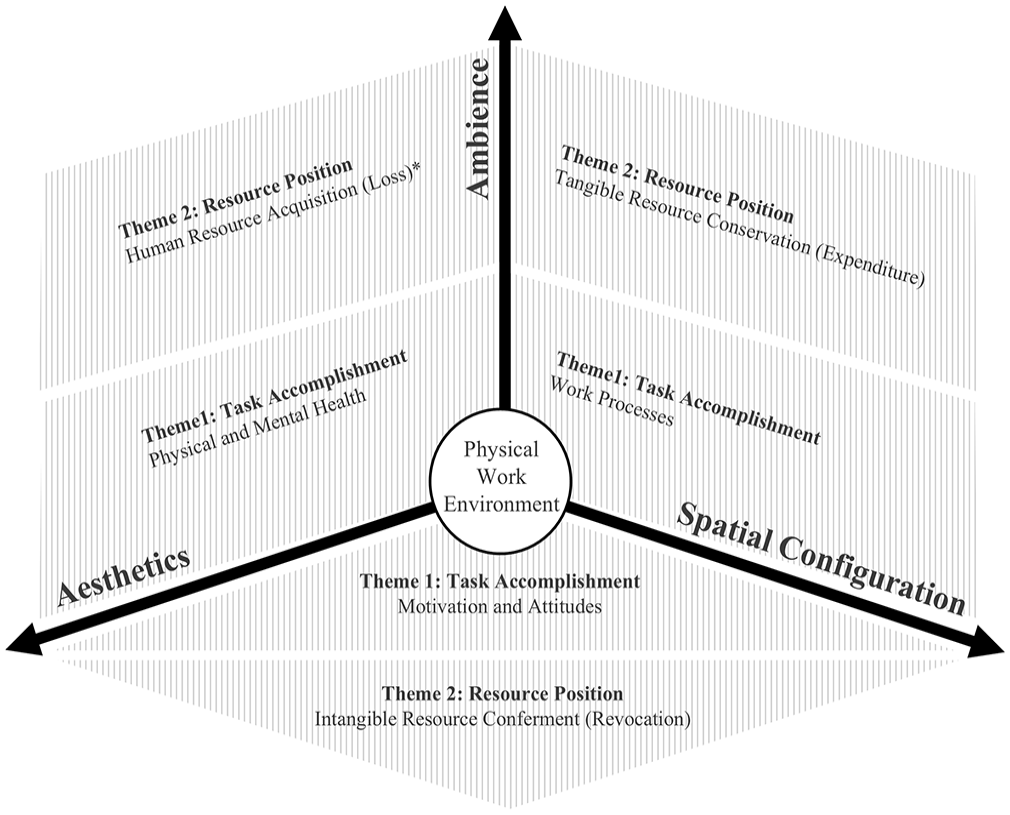
Dimensions of Physical Work Environments, Themes, and Pertinent Outcomes
Future Research
Our review reveals several opportunities to advance both theory and methodology in physical work environment research. Whereas some of the studies were phenomenon driven, others employed very diverse theoretical perspectives. As a result, several reported relationships and their underlying mechanisms lack sufficient theoretical grounding, and a holistic theoretical approach is yet to be developed. Our analysis also suggests the need for more rigorous research design and estimation strategies to precisely measure the effects of physical work environments. We discuss these opportunities below.
Theory Development Opportunities
Integration of Theories, Findings across Levels, and Boundary Conditions
Extant research on physical work environments adopts various theoretical perspectives. In examining task accomplishment outcomes, researchers typically draw upon either stimulus control or social relations/learning perspectives. Stimulus control theories suggest that environmental stimuli (e.g., noise or visual distractions) can impair individual-level outcomes like health, motivation, and focused work, while social relations/learning frameworks highlight how certain exposures (e.g., colleague visibility) can facilitate group- and organizational-level outcomes like knowledge sharing. These perspectives remain largely disconnected because research typically examines outcomes at a single level, with most studies focusing on the individual level. It rarely examines the impact of various aspects of physical work environments from the perspective of how value is created across levels in the firm. Future research can bridge this gap by investigating how individual and collective processes jointly shape organizational-level outcomes, while carefully considering key moderating factors. For example, prior research often refers to “interactions” broadly without distinguishing how workspace attributes affect different aspects of interactions—such as their nature (task-related vs. non-task related), target (within- vs. between-group), and frequency. Delineating these mechanisms would better explicate how specific attributes of physical work environments align with different organizational strategies and needs.
Open-plan office layouts illustrate how physical work environments can affect organizations differently. While these layouts facilitate spontaneous encounters by eliminating physical barriers and improving visibility, their value depends on organizational context. In highly specialized organizations relying on pre-coordinated meetings, such layouts may offer limited benefits and potentially harm productivity through uncontrolled background noise. Conversely, teams focused on organic collaboration and creative ideation may find that open-plan offices foster valuable interactions. These contrasting effects suggest that organizational strategy and desired interaction types serve as important boundary conditions.
Given these contextual dependencies, there remains a critical need to study how various aspects of physical work environments influence firm-level outcomes. Future research can ask: How do different spatial configurations facilitate or inhibit the development of human capital capabilities? How do physical work environments nurture or support different types of organizational culture (e.g., outcome-oriented vs. people-oriented; competitive vs. collaborative)?
In the resource position theme, studies draw upon signaling and symbolism theories to explain how physical work environments communicate meaning across different stakeholder groups and levels of analyses. However, this research typically examines a single stakeholder group or level at a time. Additionally, current studies often blur the distinction between two key processes—how organizations project intended meanings and how stakeholders interpret them. Understanding these separate processes presents promising research directions. For instance, although firms might invest in sophisticated architectural designs like glass-and-steel skyscrapers to signal market leadership and financial strength, the public might criticize these investments as environmentally unsustainable, while employees might perceive them as misallocation of resources that could have been directed toward compensation.
The complexity of signaling also manifests across organizational levels. At the organizational level, firms often strive to project a unified image through aesthetic choices like standardized contemporary design and professional credentials. Yet at the individual level, employees seek to express their identity through workspace personalization. Recognizing this tension, future research can investigate how organizations can balance collective identity with individual expression. For example, future research questions may include: What types of physical work environments help reinforce organizational identity while accommodating individual expression needs? When do aesthetic choices that facilitate organizational identity enhance or impair employee focus and task accomplishment? Understanding these multi-level dynamics and the potential gaps between intended and interpreted meanings offers rich opportunities for future research.
Spatial Constructs, Dimensions, and Their Interrelationships
Our review reveals the need to better understand how different dimensions and attributes of physical work environments interrelate and jointly influence key outcomes. First, our review suggests that the three dimensions of physical work environments—ambience, spatial configuration, and aesthetics—are often interconnected rather than independent. Spatial configurational choices can shape ambient conditions and create different aesthetic expressions. For example, open-plan layouts (spatial configuration) do not only define the spatial arrangement but can also influence ambience by increasing noise levels and visual aesthetics by creating more visual clutter.
Additionally, our analysis indicates common confusion between different spatial constructs, particularly open-plan layouts, spatial proximity, and spatial density. These constructs need careful distinction. Open-plan layouts are primary spatial configurations characterized by few or no physical barriers. When organizations implement open-plan layouts, they create second-order spatial attributes such as changes in privacy levels, interaction patterns, territoriality, proximity between workers, and spatial density. Importantly, while open-plan designs set the primary configuration, it is managerial discretion that shapes how secondary attributes emerge. For instance, managerial decisions about how many employees to place in the shared space, which teams or individuals to locate near each other, or how to establish quiet zones versus collaborative areas can significantly alter the resulting levels of density, proximity, and interaction patterns.
This complexity may explain the mixed findings about how open-plan layouts affect work processes. To advance our understanding, future research should first clearly distinguish between primary spatial configurations (like open-plan layouts) and their resulting secondary attributes (like spatial proximity). Researchers can then explore specific relationships, such as how increased spatial density in open offices affects unit productivity, or how different spatial arrangements create varying ambient conditions that influence work processes. Additionally, studies should examine how these various spatial dimensions interact—identifying when their individual effects might strengthen or weaken each other. Future research may ask: How do various ambient conditions created by open-plan layouts affect individual and group work processes? How does increased spatial density in open-plan layouts impact unit productivity? Are open-plan layouts with low spatial density more effective for unit productivity than small private offices?
Relevance of the Three Dimensions of Physical Work Environment as Remote Work Grows
While the ambience, spatial configuration, and aesthetics framework may be more easily applicable to past research on physical work environments, its application to research on future forms of work environment faces challenges. Widespread adoption of remote and hybrid work policies may change the relevance of certain dimensions to organizational outcomes. For instance, if employees still show up to dedicated physical workspaces for meetings with stakeholders, findings on the spatial configurational and aesthetic dimensions of physical workspaces may remain relevant. However, the ambient dimension and its impact on individual work processes and employee health may matter less if employees spend less time and carry out fewer focused work tasks in those workspaces. Future research should examine the relevance of these dimensions in new and remote work settings, as well as the effects of customizing them. Additionally, studies can explore when remote work environments are inferior, acceptable, or superior to physical work environments based on the highlighted beneficial attributes for individual, group, and organizational tasks, as well as their impact on resource positioning.
Methodological Advancement Opportunities
Operationalizing Physical Work Environment Constructs
Our review shows that studies assessing perceptions of physical work environments (51% of our sample) slightly outnumber those investigating actual attributes of the workplace (49%). Although extant research often uses perceived environment characteristics as proxies for actual workspace attributes, the gap between the two can be significant. Methodologically, measuring perceived physical work environments can introduce measurement error and bias. This is particularly problematic in studies where outcomes (e.g., job satisfaction, impressions) are also measured perceptually (Podsakoff, MacKenzie, Lee, & Podsakoff, 2003). Beyond methodology, to the extent that workspaces are socially constructed, perceptions of physical work environments may differ across individuals, groups, and at firm levels, since they are shaped by collective experiences. For example, a team working in an open office area might develop shared meanings about certain spaces—like viewing a coffee bar as an unofficial “gossip corner” where important informal information flows—that differ from other teams’ interpretation in the same building. Future studies could explore how these social constructions of physical environments vary across different organizational levels.
Field and experimental studies often use objective events, such as office relocations, to measure actual physical work environments. However, these changes typically involve multiple spatial factors like spatial configurations and ambience changing simultaneously (e.g., Brennan et al., 2002). This makes estimating each factor’s unique impact difficult. Nevertheless, some studies have utilized direct measures of specific physical attributes, such as using stereo systems to measure noise (e.g., Smith-Jackson & Klein, 2009) and aerosol detection devices to measure air quality (Kożusznik et al., 2018). Future research can adopt methodologies like space syntax analysis, which quantifies spatial layout attributes from floor plans, such as axial lines which represent lines of sight or movement (e.g., Wineman, Kabo, & Davis, 2009). Such objective, architecture-based approaches can disentangle spatial components, particularly at group and organizational levels, where multiple spatial factors are often conflated (e.g., Lansdale et al., 2011).
Examining Objective Performance Outcomes
Similarly, several studies use self-reported performance outcomes (e.g., Dul & Ceylan, 2011; Hedge, 1982), which are vulnerable to social desirability bias and may not accurately reflect actual productivity (Podsakoff et al., 2003). Objective measures from behavioral work records (e.g., absenteeism, task defect rates) tend to be more reliable. Future studies can use multiple methods (e.g., combining surveys with interviews, observations, and secondary data) to improve the reliability of findings. Our review suggests that few studies have utilized such multi-method approaches (e.g., Baer et al., 2018; Bernstein, 2012).
Furthermore, recent technological advancements (e.g., IoT sensors, Wi-Fi tracking, video surveillance, wearable devices) enable more direct analysis of employees’ movements and interactions, addressing prior reliance on qualitative data (e.g., Lansdale et al., 2011; Nam, 2015) and self-reported interaction quality (e.g., Weijs-Perrée, Appel-Meulenbroek, & Arentze, 2020). The new technologies can shed further light on how physical work environments impact organizational outcomes such as collaboration patterns, knowledge sharing, and innovation.
Endogeneity and Selection Issues
Prior studies largely relied on cross-sectional designs (65%), which are susceptible to endogeneity issues, instead of longitudinal approaches. To establish causality and address these limitations, future research should adopt more rigorous empirical strategies, including quasi-experiments (used in only 7% of studies), instrumental variables, lagged predictors, and difference-in-differences techniques. Robustness checks, such as the impact threshold of a confounding variable (ITCV), can also help mitigate omitted variable bias. Furthermore, given the challenges of randomized control trials in organizational settings and the frequent focus on single firms, quasi-experimental methods like interrupted time series (ITS) provide a promising solution for tackling endogeneity concerns.
Conclusion
The significance of physical work environments has gained heightened attention in academic and managerial circles, especially following the rise and rescission/revision of remote and hybrid work models spurred by the COVID-19 pandemic. This renewed interest in physical work environments calls for a comprehensive assessment of their organizational implications.
Structured around three key dimensions of physical work environments—ambience, spatial configuration, and aesthetics—our analysis reveals that these environments can influence the firm’s internal and external stakeholders at all levels of analysis (individual, group, organizational and external environment). Especially, our review unveils two key themes, task accomplishment and resource position, which underscore six outcomes with important organizational implications.
Specifically, we find that workplace ambience, spatial configuration, and aesthetics impact outcomes related to task accomplishment, including physical and mental health, motivation and attitudes, and work processes. While features that produce excessive stimuli can be detrimental to occupants’ health and motivation, appropriate designs can enhance these factors. Similarly, spatial attributes that foster encounters and access can either facilitate or hinder work processes depending on the task and organizational context. Therefore, consciously aligning the features of the physical work environment with intended outcomes is key to achieving desirable results.
Also, physical work environments can shape a firm’s resource position, including tangible resource conservation (expenditure), human resource acquisition (loss), and intangible resource conferment (revocation). Open-plan layouts, for instance, can conserve resources through efficient space use, while costly or poorly designed features can increase operational and maintenance costs, undermining tangible resources. Firms can also communicate their values and strategies through physical work environments, whether intentionally or not. Effective signaling can attract talent by resolving information asymmetry, whereas mismatches between workspace design and employees’ perceived status may lead to negative outcomes, such as human capital loss. Symbolic features can further influence intangible resources like legitimacy and credibility, which are essential for competitive advantage. Overall, our review highlights the significant impact of various aspects of physical work environments on a firm’s resource position.
Both themes discussed above can have potential positive and negative organizational implications. While investments in physical work environments aimed at enhancing task accomplishment may seem beneficial, they can negatively impact a firm’s resource position if excessively costly, diverting resources from other strategic priorities. For example, the upfront cost of installing a new lighting system may improve employee motivation and attitudes (task accomplishment) but increase operating expenses, weakening tangible resources. Similarly, adopting adjustable standing desks can promote employee health, but may require significant initial investment and ongoing maintenance. Striking the right balance is essential to avoid inadvertently undermining a firm’s overall performance.
A trade-off between these two themes, however, is not always necessary. For example, adopting green or sustainable designs, which demonstrably reduce building life-cycle costs (World Green Building Council, 2013), allows organizations to create workspaces that enhance both task accomplishment and resource position. Green design elements can improve employee physical and mental health, motivation, and attitudes, while also enhancing work processes at both the individual and group levels. They can also enhance human capital acquisition and confer intangible resources such as industry and community goodwill, creating synergies.
In sum, this review addresses a timely issue by providing a comprehensive review of how different features of physical work environments impact organizations. We hope our review can set the stage for further research in this field and effectively guide managers to navigate the evolving demands of modern work arrangements.
Supplemental Material
sj-doc-1-jom-10.1177_01492063251315703 – Supplemental material for Physical Work Environments: An Integrative Review and Agenda for Future Research
Supplemental material, sj-doc-1-jom-10.1177_01492063251315703 for Physical Work Environments: An Integrative Review and Agenda for Future Research by Bukky Akinsanmi Oyedeji, Yea Hee Ko and Sunkee Lee in Journal of Management
Footnotes
Acknowledgements
We acknowledge the helpful guidance and comments offered to us by Editor Hermann Ndofor and two anonymous reviewers. In the development of this paper, we received helpful advice from Isabel Fernandez-Mateo, Olenka Kacperczyk, Michael Jacobides, and Donal Crilly, as well as research assistance from Jong Sig Chung. We appreciate the comments provided by seminar participants in the Strategy and Entrepreneurship Area of the London Business School and the McCombs School of Business at University of Texas at Austin, as well as the organizers and participants of The Wharton School’s People and Organizations Conference (2020) where earlier versions of this paper were presented.

Supplemental material for this article is available with the manuscript on the JOM website.
References
Supplementary Material
Please find the following supplemental material available below.
For Open Access articles published under a Creative Commons License, all supplemental material carries the same license as the article it is associated with.
For non-Open Access articles published, all supplemental material carries a non-exclusive license, and permission requests for re-use of supplemental material or any part of supplemental material shall be sent directly to the copyright owner as specified in the copyright notice associated with the article.
