



Abstract
Research has identified the usefulness of multicultural and multilingual employees in overcoming cultural and language barriers in international work contexts, but still needs to clarify why and how these employees engage in bridging behavior. Based on in-depth analyses of 154 interviews, we inductively develop a comprehensive model of bridging behaviors with novel and counterintuitive insights. We show that bridging behaviors are not only based on individual strengths, which multiculturals and multilinguals possess, but also—paradoxically—on their weaknesses. Multiculturals’ and multilinguals’ strengths and experience with weaknesses result in different determinants and enactments of bridging. Grounded in our inductive theory building, we propose four bridging behaviors: cultural teaching, language teaching, cultural facilitating, and language facilitating. Multiculturals and multilinguals cycle between these bridging behaviors depending on their capabilities and motivations in specific situations. We provide theoretical and practical implications of our findings.
Keywords
Introduction
How employees make use of weaknesses is an important but often overlooked phenomenon in organizations (Dahl & Werr, 2021; Fineman, 2006). Particularly in today’s increasingly global business world, in which employees frequently operate in work environments with a significant degree of cultural and language diversity, cultural and language weaknesses regularly translate into barriers when working on project teams across the world; between headquarters (HQ) and subsidiaries; as expatriates, inpatriates, or third country nationals; or with foreign suppliers and clients (Salk & Brannen, 2000; Tung & Stahl, 2018).
Although the field still lacks a coherent definition of cultural and language barriers, we conceptualize them as obstacles to effective cross-cultural and cross-language communication and cooperation and doing international business (Jonsen, Maznevski, & Schneider, 2011). Barriers based on cultural diversity include, but are not limited to, a lack of common understanding in strategy making among alliance partners (Sirmon & Lane, 2004) and different expectations about how meetings are conducted and participation is valued (Brannen & Petersen, 2009). If not overcome, they can lead, for example, to failures in cross-cultural mergers, acquisitions, and market penetration (House, Dorfman, Javidan, Hanges, & Sully de Luque, 2014: 4), and lower multicultural team performance (Earley & Mosakowski, 2000). Barriers based on language diversity, in turn, can result from erroneous translation or interpretation of meaning and impaired sensemaking (Tenzer, Pudelko, & Zellmer-Bruhn, 2021). If not overcome, they can lead, for example, to lower trust in multilingual teams (Tenzer, Pudelko, & Harzing, 2014), dysfunctional conflict (Harzing & Feely, 2008), or language-induced emotions of team members, like anxiety and resentment (Tenzer & Pudelko, 2015). As a result, a key challenge for both researchers and managers is how to bridge such barriers to avoid negative outcomes.
In this context, we define bridging behavior as the act of using culture- and language-related capabilities to reduce barriers emerging from cultural or language diversity and enable improved collaboration in organizations (Backmann, Kanitz, Tian, Hoffmann, & Hoegl, 2020; Iwashita, 2023; Sekiguchi, 2016). The outcome of effective bridging is a reduced or even removed cultural or language barrier and improved collaboration, whereas ineffective attempts at bridging would leave such barriers in place and hinder collaboration. For example, giving advice on cultural norms has been found to be a bridging behavior to reduce cultural barriers (Backmann et al., 2020). To diminish language barriers, translating has been found to be effective (Vaara, Tienari, Piekkari, & Säntti, 2005). These examples suggest that certain determinants need to be in place to engage in bridging. However, the field is inconclusive about what determinants are needed to engage in bridging behavior. Some studies have conflated cultural and language barriers (Backmann et al., 2020; Iwashita, 2023), obscuring the possibility that the bridging behavior and the determinants needed may differ for cultural versus language barriers.
Further, multiculturals and multilinguals are identified as ideal employees to reduce hurdles in multicultural and multilingual work contexts (Backmann et al., 2020; Harzing, Köster, & Magner, 2011; Kane & Levina, 2017; Marschan-Piekkari, Welch, & Welch, 1999a; Vaara et al., 2005). Multiculturals have knowledge of, internalize, and identify with more than one societal culture (Vora, Martin, Fitzsimmons, Pekerti, Lakshman, & Raheem, 2019). Multilinguals speak more than one language in private and professional contexts, use them regularly, and identify with them (Cheng, Burgess, Vernooij, Solis-Barroso, McDermott, & Namboordiripad, 2021; Cummins, 2021; Luk & Bialystok, 2013; Rampton, 1990). We use the inclusive terms multicultural and multilingual to refer to those with two or more cultures and/or languages, thus including biculturals and bilinguals (Vora et al., 2019). From 2000 to 2020, international migration increased by just under 110 million, reaching 281 million people who were living outside of their country of origin, with most migrating for work (United Nations, 2020). As a result, more and more individuals experience more than one culture and speak more than one language in their daily lives.
Although the literature distinguishes between cultural and language barriers, scholars have explicitly or implicitly assumed multiculturals are also multilingual, even when acknowledging that not every multicultural has to be multilingual (Backmann et al., 2020). This has led to blurred findings in which multiculturals seemingly naturally bridge language barriers as well (e.g., Backmann et al., 2020). Although scholars have named multilinguals as ideal bridges for language barriers (e.g., Harzing et al., 2011), they assume high fluency in the respective languages, and few have investigated their role. This is surprising given the recent but increasing research on how to reduce language barriers (Aichhorn & Puck, 2017a; Tenzer et al., 2021).
There is confusion about cultural and language bridging, and erroneous assumptions about individuals’ culture- and language-related capabilities. We generate a greater understanding of multicultural and multilingual bridging and ask: Why and how do multiculturals and/or multilinguals bridge cultural and language barriers? To systematically answer this question, we investigate both determinants that are needed to bridge, and the subsequent enactment of multiculturals’ and multilinguals’ bridging behavior. We argue that a better understanding of both is necessary to move theorizing about multiculturals’ and multilinguals’ knowledge, skills, abilities, and other characteristics (KSAOs) forward and to help practitioners use them more strategically as human resources (Hong & Minbaeva, 2022). Another objective of our study is to conceptually tease out differences between bridging processes for cultural and language barriers.
We use an inductive approach based on a systematic analysis of 154 semi-structured interviews with multiculturals, multilinguals, or both. We contribute to the literature in several ways. First, we develop a comprehensive model of bridging behaviors to overcome cultural and language barriers and introduce as a key concept the differentiation between what we label strength- and weakness-based bridging. We define strength-based bridging as a cognitive- and behavior-driven act of confidently and authoritatively employing culture- and language-related strengths to directly remove a cultural or language barrier; and weakness-based bridging as an emotion-driven act of using empathy and sensitivity borne of own doubts about multiculturalism/multilingualism to compassionately and collaboratively decrease a cultural or language barrier. Weakness-based bridging is therefore a more emotion-focused (or affective) process, whereas strength-based bridging is a more cognitive and behavioral process. By introducing the differentiation between strength- and weakness-based bridging, we provide a theoretical explanation for the paradoxical phenomenon that multiculturals (multilinguals) bridge a language (cultural) barrier even when the respective cultural (language) skills are low or non-existent.
Second, we move the literature on multiculturals forward in addressing three limitations in the current literature. Namely, we develop a model depicting the entire bridging process, including the determinants and bridging enactment; operationalize multiculturalism on a continuum rather than in a binary fashion by showing that both individuals’ strengths and experience with weaknesses contribute to their unique characteristics and bridging behavior; and show empirically that multilingual fluency is not a necessary condition to be multicultural, but that experience with weaknesses enriches multiculturals’ bridging repertoire. This is theoretically important because we show that multiculturals’ bridging underlies complex processes that cannot be limited to strengths and bridging enactment, as theory so far suggests. In contrast, we show that relevant experience with weaknesses and motivational aspects also need to be considered.
Third, we contribute to the literature on multilingualism by introducing the study of multilinguals at the individual level of analysis to management research. In doing so, we move theory forward in offering a new conceptualization of multilinguals and more specific ways multilingual employees bridge language barriers, which helps to unleash their full potential.
Theoretical Background
Bridging Cultural and Language Barriers
Bridging is a nascent stream in management research and refers to reducing barriers in organizational contexts emerging from cultural or language diversity (Backmann et al., 2020; Iwashita, 2023; Sekiguchi, 2016). It is related to the broader concepts of boundary spanning and transcultural brokerage but focuses on the context of cultural and language barriers (Sekiguchi, 2016). As such, we borrow from all three streams and mainly discuss bridging in our study, but we use the original authors’ terms “boundary spanning” and “brokerage” in the cited literature.
The literature includes several bridging behaviors in international contexts. In a study of boundary spanning of HQ executives in MNCs, Birkinshaw, Ambos, and Bouquet (2017) identify spearheading and facilitating as behaviors making connections to or between previously disconnected actors and reconciling and lubricating to overcome differences in worldviews between previously connected actors. Johnson and Duxbury (2010) identify nine boundary spanning behaviors between HQs and subsidiaries: relationship building, shaping, intelligence gathering, delivering, coordinating, guarding, information gathering, representing, and acting as intermediaries. Such behaviors concern HQ-subsidiary contexts, and thus not all can be applied to general multinational work contexts (e.g., multinational teams, intercultural dyads).
Barner-Rasmussen, Ehrnrooth, Koveshnikov, and Mäkelä (2014) classify four boundary spanning behaviors in order of increasing complexity: exchanging information, which assists in gathering and delivering information across units (Johnson & Duxbury, 2010); linking, which is the act of building bridges between previously disconnected groups and members and often at the core of brokering research (Obstfeld, 2005); facilitating, which anticipates bridge individuals’ function as channels through which information is delivered and interpreted for outgroup members, including translating (Harzing, 2001); and intervening, which relates to clarifying misunderstandings, mediating between conflicting parties and building intergroup trust (Richter, West, van Dick, & Dawson, 2006). In a MNC context, they found that cultural and language skills are independent antecedents for any boundary spanning behavior; language skills are necessary for the demanding boundary spanning behavior facilitating and linking; and cultural and language skills together allow individuals to perform more boundary spanning behaviors. Yet, they do not specify types of cultural (e.g., cultural knowledge, behavioral adaptation) or language (e.g., knowledge of grammar, familiarity with linguistic norms) skills at play. Further, Levy, Lee, Jonsen, and Peiperl (2019) suggest that cosmopolitans use broader, more complex forms of transcultural brokering when they are deeply embedded and engaged in a culture, and simpler forms when they are more lightly embedded and engaged.
Multiculturals have been identified as ideal bridge individuals, as they have knowledge of norms, values, and behaviors of multiple cultures (Backmann et al., 2020; Harzing et al., 2011; Sekiguchi, 2016). Their bridging behavior has mainly been linked to identity-related outcomes, with less emphasis on the behavioral enactment of bridging (Backmann et al., 2020; Fitzsimmons, Liao, & Thomas, 2017). For example, Kane and Levina (2017) show that multicultural immigrant managers act as global boundary spanners by embracing their relevant cultural identity, but they hinder collaboration when distancing themselves from that relevant cultural identity; and, to span cultural boundaries, individuals must not only have capabilities but also a willingness to do so. Yagi and Kleinberg (2011) show how multiculturals negotiate their most important cultural identity against less important cultural identities to span boundaries between those from different cultures. Jang (2017) found that multiculturals who share a culture with all team members broker by integrating information from different cultures into a new whole. Multiculturals who do not share a cultural background with any team member broker by requesting relevant information to make it accessible to other members.
Backmann et al. (2020) developed five cultural gap bridging behaviors of multicultural individuals in multinational teams that result from their identity plurality (i.e., number of cultural identities an individual has). These include facilitating, translating, integrating, mediating, and empathetic comforting. In facilitating, multiculturals give advice to others on culture; in translating, they communicate with others in different languages; in integrating, they proactively integrate others to form part of a team; in mediating, they actively address conflict among others; and in empathetic comforting, they provide empathetic support to others by listening. The authors suggest that cultural intelligence (CQ) is a mechanism between identity plurality and bridging. Issues with an approach based on identity as the only predictor include that it misses other capabilities multiculturals have and disregards their ability to internalize multiple cultural schemas, as well as types and amount of knowledge they may possess (Vora et al., 2019).
Specific to multilinguals’ bridging, the literature lacks depth. For language barriers, multilinguals have been ascribed the roles of bridge individuals (Harzing et al., 2011), language nodes (Marschan-Piekkari et al., 1999a), intermediaries (Marschan-Piekkari, Welch, & Welch, 1999b), or translation machines (Vaara et al., 2005). Multilinguals use bridging to help overcome language barriers, especially between HQ and subsidiaries (Harzing et al., 2011). Iwashita (2023) finds that multilingual parent country nationals in subsidiaries draw on multiple languages and understanding of different cultural contexts to bridge barriers, and sole language bridging keeps cultural fault lines in place. However, no investigation of multilinguals’ bridging behavior exists, other than stating that they translate from one language to another. Because multilinguals’ language proficiency can vary, it is important to investigate in more depth what capabilities they use to bridge, and if they can bridge language barriers in ways other than translating.
In sum, the field has identified many bridging (and related boundary spanning and brokering) behaviors in international contexts more generally, and for multiculturals and multilinguals more specifically (although to a significantly lesser extent for the latter). This has led to inconclusive findings with an unhelpful amount of bridging behaviors for multiculturals, and a narrow view of multilinguals’ ability to bridge. We argue that there are at least three concerns to address: First, we argue that this fragmentation stems from a lack of clarity about the skills and capabilities needed to bridge cultural and language barriers. As many studies took multicultural identity as an antecedent to bridging, capabilities that stem from internalization and knowledge of multiple cultures remain unknown (Vora et al., 2019). Second, studies about bridging cultural barriers have often incorporated the bridging of language barriers as well (Backmann et al., 2020), although multiculturals may not possess the necessary language proficiency to translate (Brannen & Thomas, 2010). We thus consider it theoretically important to carefully distinguish between bridging cultural and language barriers. Third, although some studies conclude that individuals must be willing to engage in bridging behavior (Kane & Levina, 2017), no study has examined the motivation to bridge stemming from multiculturalism or multilingualism. This is theoretically problematic, as it prevents us from understanding why multiculturals/multilinguals put their skills and capabilities into practice to bridge. To address these concerns, we consider it necessary to establish a comprehensive picture of the bridging behavior of multiculturals and multilinguals, including the determinants to bridge, and how these result in bridging enactments.
Multiculturals and Multilinguals
Studies of multiculturals advanced our understanding of their characteristics and abilities. We argue that three conceptual shortcomings limit theorizing about bridging behavior. First, most research has found that multiculturals are valuable human resources in multinational work contexts due to their unique characteristics related to knowledge of, identification with, and internalization of multiple cultures (Hong & Minbaeva, 2022; Vora et al., 2019), but has yet to explain why these characteristics lead to bridging behavior. Research has found that multiculturals have unique cognitive characteristics, such as cultural frame switching (CFS) based on external situational cues (Hong, Morris, Chiu, & Benet-Martínez, 2000) and cognitive complexity (Benet-Martínez, Lee, & Leu, 2006; Lakshman, 2013; Tadmor, & Tetlock, 2016). Others have found that they are more adaptable in intercultural situations (Hanek, Lee, & Brannen, 2014), more flexible and empathetic (Brannen & Thomas, 2010), and have greater communication competence (Lu, Swaab, & Galinsky, 2021). Research has also focused on identity-related processes, such as conflicting or harmonious integration of multiple cultural identities, or bicultural identity integration (BII; Benet-Martínez, Leu, Lee, & Morris, 2002). Although research points to multiculturals’ ability to bridge cultural differences based on their characteristics (Brannen & Thomas, 2010), it is theoretically problematic that we know little about why and how these characteristics result in cultural bridging (Backmann et al., 2020). Addressing this, we focus on causalities and mechanisms of bridging behavior, including determinants and enactment.
A second conceptual shortcoming limiting theorizing about multiculturals’ role in multinational work contexts is that although studies acknowledge that multiculturals are diverse (Fitzsimmons et al., 2017; Lücke, Kostova, & Roth, 2014), most research has adopted a binary conceptualization. This is problematic, as it could obscure effects that multiculturalism has on behavioral outcomes. Deep multicultural experiences can impact cognitive and psychological abilities which, in turn, change how multiculturals respond to the world (Maddux, Lu, Affinito, & Galinsky, 2021). If multiculturals internalize only a small degree of cultural meaning systems from a culture other than their main culture, they could transfer knowledge to their home context (e.g., HQ) but may be limited in bridging cultural barriers (Lücke et al., 2014). We account for such differences by conceptualizing multiculturalism as a continuum going from low to high.
A third related shortcoming is either the explicit or sometimes implicit assumption that multiculturals are automatically multilinguals (e.g., Backmann et al., 2020; Fitzsimmons et al., 2017; Hong & Minbaeva, 2022; Maddux et al., 2021). This leads to a potentially erroneous conclusion that multiculturals can translate for their colleagues (Backmann et al., 2020; Fitzsimmons et al., 2017). Yet, when adopting a continuum approach, multiculturals can possess minimal or even no knowledge in certain languages, even if they identify strongly with the related cultures and have fully internalized their cultural schemas (Vora et al., 2019). Thus, they will not be able to perform language bridging based on translation. Consequently, we also clearly distinguish between multicultural capabilities and cultural bridging on one side, and multilingual capabilities and language bridging on the other. This helps us to understand differences in the bridging process and the determinants needed to bridge cultural versus language barriers.
Regarding multilinguals, no research has investigated differences in the types of capabilities multilinguals have (or lack) and their impact on bridging behavior. Research has examined impacts language barriers have on interpersonal processes in multinational teams, such as trust (Tenzer et al., 2014), or status gains for native speakers (Neeley & Dumas, 2016). However, Tenzer et al. (2021) found that a lack of instrumental skills in grammar and vocabulary, and culture-relevant skills in communication style impact teams’ knowledge processing, suggesting that exploring capability types in the bridging context could uncover other impacts. Like examining multiculturals, research has adopted a binary conceptualization of multilinguals as either fully proficient or monolingual, an assertion we consider equally problematic.
We address this issue by conceptualizing multilingualism on a four-dimensional continuum from low to high, including: private proficiency, professional proficiency, frequency of use, and identification. Private proficiency refers to the degree to which multilinguals speak more than one language in a private context, ranging from low to high. This includes informal and colloquial ways of expressing oneself and day-to-day vocabulary (Cheng et al., 2021; Cummins, 2021). Professional proficiency refers to the degree to which multilinguals speak more than one language in a professional context, ranging from low to high. This includes formal ways of expressing oneself in speaking and/or writing and academic and/or business vocabulary (Cheng et al., 2021; Cummins, 2021). Frequency of use refers to how regular a multilingual uses multiple languages, ranging from rarely to daily (Luk & Bialystok, 2013). Finally, identification refers to the degree to which the languages influence multilinguals’ identity and belonging to social groups, ranging from low to high (Rampton, 1990). This conceptualization allows for a more nuanced investigation of multilinguals as relevant in work contexts and uncovering language-related capabilities and other processes that are necessary to bridge language barriers.
To address these opportunities in the conceptualizations of bridging cultural and language barriers, we conceive of multiculturalism and multilingualism as distinct concepts on continua from low to high. For theory, we need an understanding of the variety of capabilities and why and how they are used to get a comprehensive picture of these two important groups. For practice, managers need a good sense of how multiculturals and multilinguals can support them in making a multinational workforce collaborate effectively, and what, in turn, managers should provide them to do so. Based on these considerations, we ask the following research question: Why and how do multiculturals and/or multilinguals bridge cultural and language barriers?
Methods
Research Design
Given that differentiation between multicultural and multilingual bridging of cultural and language barriers has not been systematically investigated and we target an in-depth understanding of the micro-processes under study, we consider an explorative, inductive approach to be well suited to address our research question (Morgan & Smircich, 1980).
We chose a qualitative, interview-based research design to best investigate our “why” and “how” questions (Pratt, 2017). Specifically, we conducted semi-structured interviews ensuring consistency and comparability between our interviewees and allowing for new issues to emerge (Myers, 2008). For example, we realized that our respondents had difficulty sorting themselves neatly into one of the three categories (i.e., multicultural-multilingual, multicultural-monolingual, and monocultural-multilingual). Hence, we asked deeper questions about various criteria of their multiculturalism and multilingualism. As such, semi-structured interviews gave us the flexibility to tap into the informants’ lived experiences (Gephart, 2004) and provided us with rich, thick descriptions of the meanings behind those experiences (Doz, 2011) and the effects of their bridging activities on cross-cultural and cross-lingual collaborations.
Sample and Data Collection
We sought individuals who identified as being multicultural, multilingual, or both, and who worked in a multicultural and/or multilingual organizational setting. We used a theoretical sampling approach to recruit interviewees based on two criteria (Corbin & Strauss, 2008). First, we sought individuals who had internalized, were identifying with, and had knowledge of two or more cultures (Vora et al., 2019), and/or spoke two or more languages in the private and/or professional context, used them regularly, and identified with them (Chen et al., 2021; Cummins, 2021; Luk & Bialystok, 2013; Rampton, 1990). Second, multiculturals and/or multilinguals had to work in a multicultural and/or multilingual organizational context.
Although we originally sought to categorize our respondents into the three relevant categories of a 2 × 2 matrix of multicultural–multilingual, multicultural–monolingual, and monocultural–multilingual (Barner-Rasmussen et al., 2014; Soffietti, 1955), reality was too complex to simply categorize our respondents into one of these boxes. This was because the first criterion stimulated individuals with varying degrees of multiculturalism or multilingualism to participate. Some were highly proficient in two or more languages, spoke them regularly, and identified with them, and hence were multilingual, but identified as only slightly multicultural. For example, P46 spoke German, Spanish, and business English and had an excellent knowledge of, highly identified with, and had fully internalized the German culture, but only knew and, to a small degree, had internalized the Spanish culture associated with his Spanish language skills. Thus, he identified only marginally with it and did not have any knowledge of, internalization, or identification with any English-speaking culture. Others had knowledge of more than one culture, internalized (some or much of) multiple cultures, and identified with them, while speaking the language corresponding to one of their cultures only at a low level and/or only in the private domain. Consequently, they were unsure if they would consider themselves multilingual. For example, P27 was Canadian-Mexican who had a high level of knowledge of Mexican culture and identified with, and had internalized, it. However, although she spoke Spanish fluently and regularly in private, she felt she was unable to use it in a business context.
Having realized that our respondents defied the simplistic 2 × 2 categorization we initially pursued, we sought more in-depth descriptions about how and why they defined themselves as they did, resulting in the final conceptualizations we use in this study. We probed for these differentiations and degrees regarding culture and language with questions, such as “how do you identify with regards to your cultures?” (i.e., multicultural identification); “what do you know about your cultures?” (i.e., knowledge); “how well can you put your mindset into the respective cultural context?” (i.e., internalization); “how well do you speak each of your languages in the private and in the professional context?” (i.e., private and professional proficiency); “how often do you speak each of your languages?” (i.e., regularity); and “how do your languages influence your identity?” (i.e., multilingual identification). We continued to reach out to potential interviewees based on the same two criteria but focused more on “less than perfect” multiculturals and/or multilinguals at later stages of our data collection (Corbin & Strauss, 2008).
As a result, we collected very rich data using 154 semi-structured interviews with multicultural and/or multilingual individuals, all of whom worked in multicultural and/or multilingual contexts. The first author and 10 of her Master’s students, either in the context of their Master’s thesis or a research class, conducted interviews between 2015 and 2017. The first author conducted 49 interviews, while the 10 Master’s students conducted between eight and 12 interviews each. The first author developed the interview guideline and discussed it intensively with the Master’s students in group and individual sessions. Students had previously reviewed existing literature for a theoretical understanding of the topic under study, listened to interviews that the first author had conducted, and attended qualitative methods sessions held by the first author to ensure an appropriate level of competency in conducting the interviews. We present our sample and interview characteristics in Table 1.
Sample and Interview Data
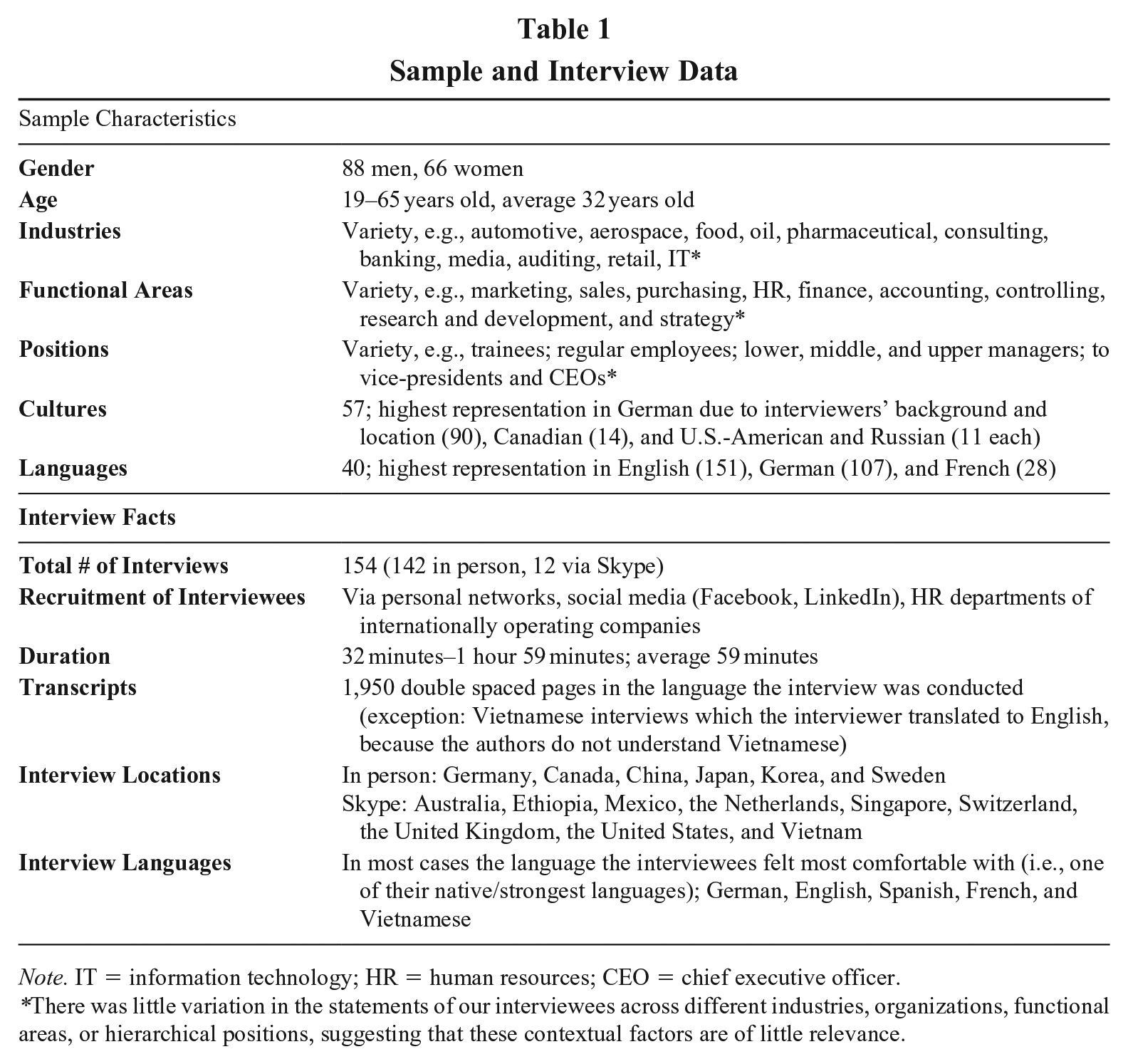
Note. IT = information technology; HR = human resources; CEO = chief executive officer.
There was little variation in the statements of our interviewees across different industries, organizations, functional areas, or hierarchical positions, suggesting that these contextual factors are of little relevance.
The interviews were in two parts. We first asked participants to describe their background, including demographics and general information, such as job responsibilities, firm and position tenure, and cultural and linguistic characteristics of the people with whom they worked. The second part of the interview consisted of questions directly related to the participants’ experience with their multiculturalism and/or multilingualism on different aspects of their organizational life. We specifically asked for the interviewees’ perceptions of how their background and particular skills and abilities helped them to engage in bridging activities resulting in a reduction of cultural and language barriers at work. We encouraged them to illustrate their comments with detailed real-life examples and to reflect upon their actions and others’ reactions in these examples.
Data Analysis
Using the software, Atlas.ti, we started analyzing interviews while the interviewing process was still ongoing, as is recommended for inductive studies (Patton, 2002). When encountering contradictory or unexpected information in the data analysis, we were able to collect additional, more specific information to explain that. The first author and the Master’s students coded the data, and the first author, in collaboration with the second author, developed the resulting coding structure. These discussions formed the basis of our analysis and were instrumental to stay “faithful to the insights provided by informants” (Pratt, Sonenshein, & Feldman, 2022: 220).
We analyzed our data in three stages, drawing on a set of tools in qualitative research that are particularly well suited (DeCelles, Howard-Grenville, & Tihanyi, 2021; Pratt, Kaplan, & Whittington, 2021). Figure 1 summarizes the process, and Table S1 in the online supplementary material has quotes to illustrate our analysis, including links between emerging categories.
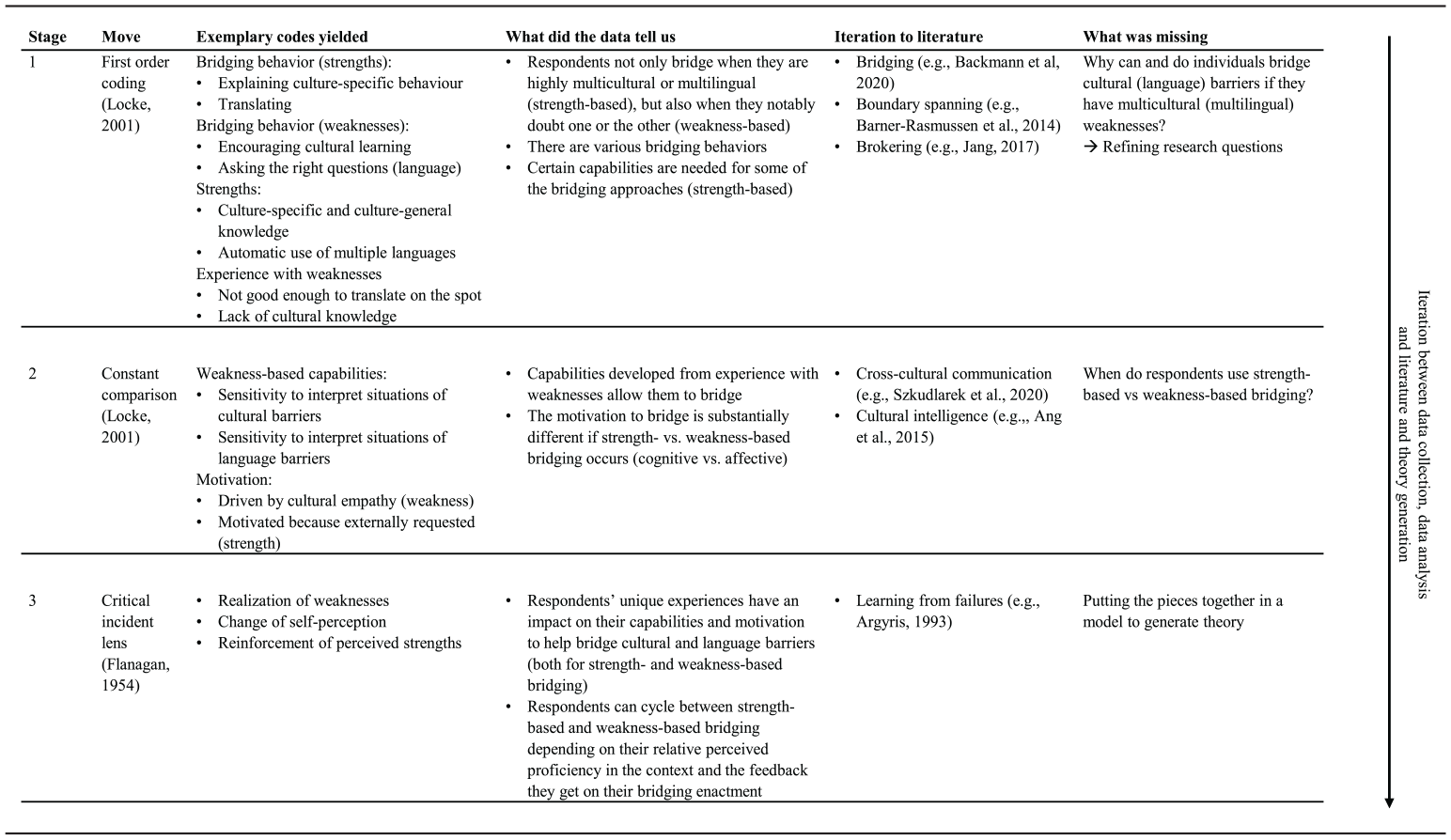
Process of Data Analysis
First, inspired by Locke (2001), we started with detailed line-by-line data analysis to generate initial first-order codes. For dependability, the Master’s students submitted the first-order coded transcripts of interviews to the first author who had independently coded the same transcripts (Lincoln & Guba, 1985). Although there was general agreement on the meaning of similar occurrences, at times there were different codes given for the same phenomena. The first author compared and discussed differences in independent codings with the second author and ultimately integrated similar codes to ensure consistency. For example, the quote, “Of course my bosses [in France] would often turn to me to report in English, to proofread reports, to make presentations, to talk in details to Anglo-Saxon clients” (P 67, British, French; L: English, French), generated the code “requested to help with language differences.” At an early stage of our data collection and analysis, we noted that respondents not only bridged cultural and language barriers when confident about their multicultural or multilingual skills and abilities but also when they explicitly doubted their multiculturalism or multilingualism (see Table S1, Example 1, in the online supplementary material).
We grouped the respective codes under what we called strength-based bridging enactments (i.e., when respondents were confident about their multicultural/multilingual skills) versus weakness-based bridging enactments (i.e., when respondents doubted their multiculturalism/multilingualism). Initial codings became the starting point for refining our research questions, more probing questions about strength-based versus weakness-based bridging in subsequent interviews, and additional reading of research. For example, at this point we returned to the literature about bridging, boundary spanning, and brokering behaviors, as well as social support, and realized that none explained our phenomenon of strength-based and weakness-based bridging. We decided to exclude social support from our framing because the literature largely explains processes and outcomes of social support for the recipient, rather than for the support provider (Jolly, Kong, & Kim, 2020). We found bridging, boundary spanning, and brokering literatures better suited to explore the processes of the bridging person. This exemplifies the iterative process of data collection and analysis and additional literature review.
In the second stage of our data analysis, we compared our data in different ways (Locke, 2001) to help us bring more light to our unexpected finding of multiculturals’ and multilinguals’ bridging barriers, despite their claim not to have the necessary capabilities for it. First, we compared different parts of each interview to ensure consistency. We then juxtaposed interview sections relating specifically to multiculturalism, and interview sections relating specifically to multilingualism, before comparing both among one another. That way, we could compare, for example, codes in interviews of respondents who considered themselves multicultural but doubted that they were multilingual. Similarly, we compared passages indicating cultural bridging and then passages indicating linguistic bridging before also comparing those among one another. This process helped us to better understand that bridging behavior for both strength- and weakness-based bridging requires certain determinants to enact bridging. For example, we learned that in the absence of multicultural and multilingual strengths, individuals were aware of their weaknesses and reflected on them, and that on this basis they developed the capability of being particularly sensitive to cultural or language barriers, showing in addition an empathetic motivation to help, which ultimately resulted in bridging enactment (see Table S1, Example 2).
Iterating back to the literature, we then examined initial findings through the lens of cross-cultural communication, as well as CQ. For cross-cultural communication, we realized that most research takes a static perspective, in which cultural values and beliefs as well as fluent language skills explain communication outcomes. However, we did not find this perspective helpful to clarify how past experiences of our respondents influenced their bridging behavior (Szkudlarek, Osland, Nardon, & Zander, 2020). Regarding CQ, we realized that CQ could not explain what our respondents displayed in the weakness-based bridging behavior. Even in the absence of culture-specific or culture-general knowledge (cognitive CQ) or culturally appropriate language skills (behavioral CQ), they bridged language barriers (Ang et al., 2007; Early & Ang, 2003). As such, we continued our analysis to theorize the phenomenon in a more holistic way that captures the full range of determinants and enactments that, taken together, form the bridging behavior.
As we noticed that respondents could display both strength- and weakness-based bridging behaviors, we decided, as a third stage, to explore how these two bridging processes are interrelated. We used the Critical Incident Technique (CIT) to examine our data (Flanagan, 1954). CIT is often used as an interview technique, whereby informants are asked to describe their or others’ behaviors before, during, and after a critical incident (Durand, 2016). However, it is also an analytical tool to make sense of causes and effects of informants’ lived experiences (Breunig & Christoffersen, 2016). We took two strength-based and five weakness-based bridging enactments that we had identified as critical, and examined respondents’ narratives of reasons leading them to choose a bridging behavior, and how this behavior affected any future bridging (Langley, 1999). This CIT-inspired analysis revealed feedback loops in the bridging process, exposing interrelationships between strength-based and weakness-based bridging (see Table S1, Example 3).
Using comparisons between our codes and subsequent aggregations, we could classify all related accounts into the emergent categories of antecedents (including awareness of weaknesses and reflection on weaknesses), determinants (including weakness-based capabilities, strengths, and motivation), enactments (including strength-based enactments and weakness-based enactments), and feedback loops (including reinforcing and changing feedback), which formed the basis for our modeling efforts. The number of examples per code ranged from six to 58. Ultimately, we came to distinguish and connect two theoretical building blocks: strength-based bridging and weakness-based bridging of cultural and language barriers. We iterated between data, codes, categories, and theoretical building blocks until reaching saturation (Suddaby, 2006).
Findings
Our results revealed an important finding: bridging is not only based on strengths that multiculturals and multilinguals possess, which is perhaps not surprising, but equally emerges out of realizing one’s own weaknesses, which is much less intuitive. As we will show, and as noted, weakness-based bridging is a more emotion-focused (or affective) process, whereas strength-based bridging is a more cognitive and behavioral process. We also found that what we call strength- and weakness-based bridging are not two distinct phenomena, but are, rather, interdependent processes linked by feedback loops. This interdependency results from the fact that the self-perception of strengths and weaknesses in multiculturalism and multilingualism is not necessarily binary and static but could be gradual and subject to change over time.
Reflecting our findings, we structure this section as follows: (1) strength-based bridging, (2) weakness-based bridging, and (3) feedback loops between them. We found many similarities between bridging processes of cultural and language barriers, but also differences. We present similarities of multicultural and multilingual bridging behavior jointly, but show differences between them separately. To substantiate our findings, we provide core quotes throughout the text and present additional quotes from our data in the online supplementary material in Tables S2 to S7.
Strength-Based Bridging
Many respondents displayed specific bridging behaviors based on strengths (i.e., competencies) from their multiculturalism or multilingualism, and that uniquely positioned them to successfully bridge. Strength-based cultural bridging occurs when multiculturals see themselves as competent. Similarly, strength-based language bridging takes place in instances in which a multilingual speaks the specific languages involved on a sufficiently high level.
We also noticed that our multicultural and multilingual respondents developed externally- or internally-driven motivations for engaging in bridging, which they drew from their culture- or language-related strengths. In our findings, it is strengths and motivational disposition that serve as determinants for (multicultural and multilingual) strength-based bridging. In the resulting bridging enactment, multiculturals and multilinguals engaging in strength-based bridging follow a top-down approach, referring to a perceived superior position based on expertise (rather than a functional position) in which the multiculturals/multilinguals communicate their solution to overcoming a cultural/language barrier to the person(s) for which they bridge. Consequently, we label these activities as cultural teaching and language teaching, respectively.
Determinants for strength-based cross-cultural and cross-lingual bridging
Our data reveal that specific strengths and motivations of multiculturals and multilinguals determine strength-based bridging. Although we found no differences regarding the motivation of either group regarding bridging, there are clear differences between the relevant strengths of multiculturals in comparison to those of multilinguals. For multicultural strengths, we distinguish between the comprehension of cultural differences (i.e., a cognitive strength) and ability to switch cultural frames (i.e., a behavioral strength). By contrast, for multilingual strengths, we highlight the ability to use multiple languages automatically (i.e., cognitive and behavioral strengths).
We further found that the cognitive strength comprehension of cultural differences can be split into culture-specific and culture-general expertise. Culture-specific refers to the particular cultures in which the individual is familiar with the norms, values, knowledge, and behaviors. In contrast, culture-general refers to an understanding of broader principles of cultural differences that are applicable to a wide set of cultural contexts (Thomas et al., 2008). Regarding culture-specific expertise, a Belgian-Guinean participant, identifying with both cultures, shared how she deals with her specific knowledge about different cultural habits when scheduling meetings: It is easy for me to project myself in other people’s cultures or minds. I can understand why, I mean I can accept that most African people are always late. And I can accept that German people are always on time (laughs). So, it is the fact of really understanding and accepting other people’s culture. Because I have seen big differences between the Belgian and Guinean one. (P86, Belgian, Guinean; L: French, Dutch, Business-English)
Most multiculturals stated that advanced understanding and acceptance relates to cultures with which they are unfamiliar (culture-general expertise), like a German-Croatian respondent: “I think it is a huge advantage in my international projects, because as I know some cultures, I can accept cultural differences in general better” (P63, German, Croatian, L: German, English, Croatian). This finding confirms prior theoretical assumptions about multiculturals possessing both culture-specific but also culture-general skills (Brannen & Thomas, 2010).
The second relevant strength as a determinant to bridge cultural barriers is behavioral (i.e., ability to switch cultural frames). Multiculturals can automatically move between different cultural meaning systems and change their responses and actions accordingly (Hong et al., 2000). As the following Argentinian-German interviewee described, she makes conscious use at work of her skill to switch between the perspectives of different cultures.
In my daily work I see the advantage [of being multicultural] in that I can often put myself into my clients’ shoes. I can understand a situation better and have a different type of empathy. I can recognize parallels in behavior and can react to this. (P58, Argentinian, German; L: Spanish, German, Business-English)
Throughout the interviews, individuals confirmed how they perceive the ability to switch their cultural frames to be a key strength that helps them navigate cross-cultural situations.
As for multilingual strengths, our respondents often mentioned an ability to use multiple languages without any effort. The following participant speaks English, Japanese, Korean, Mandarin, Spanish, and Portuguese fluently: “For each language I went to school in that country. When I speak the other languages, I don’t really have to think in my mother tongue first. I can just directly speak Mandarin or Spanish. I can do that” (P16, US-American, Japanese, Korean; L: English, Japanese, Korean, Mandarin, Spanish, Portuguese).
Automatic use of various languages was apparent in the ability to code-switch (i.e., to effortlessly follow and engage in a single conversation of multiple languages) when working with people of various linguistic backgrounds. A French-English speaking Canadian explains: It is just a habit I guess, but I have a lot of bilingual friends and we all often switch languages in the middle of the sentence. Because sometimes one language is better suited to communicate an idea than another. (P34, Canadian; L: English, French)
The literature has identified automaticity as the ultimate stage in language learning, describing this as being when language and thought merge and language becomes automatic in most contexts (Gardner, 2007). Less proficient second language speakers often take an extra step and translate from their native language to convey a message (Hinds, Neeley, & Cramton, 2014), which has been found to lead to language barriers (Tenzer et al., 2014). Although research has thus far treated code-switching mostly as a weakness of employees who fall back from the shared language to their mother tongue (Aichhorn & Puck, 2017a), we find that multilinguals perceive their ability to code-switch as a strength because they can quickly adapt to a different environment.
From our data, we understood that strengths are not sufficient to engage in bridging, as multiculturals and multilinguals must also be motivated to do so. We uncovered two kinds of motivation for bridging that multiculturals and multilinguals develop directly out of recognizing their strengths. The first motivation is based on external requests by others who knew about our respondents’ multicultural or multilingual capabilities and who asked them to assist with cultural and language difficulties (“I help because they want me to”). The following multicultural lived in multiple countries in his life and identified mostly with the German and Argentinian culture: “My Indian co-worker approaches me regularly to ask: ‘So what is going on in this and that situation?’ or ‘My team leader said this and that, do I have to be concerned?’ Then I provide my point of view” (P95, German, Argentinian, internaional upbringing; L: English, German, Spanish, Dutch).
Multilinguals were also often asked to join a meeting as an interpreter, to translate an email or to call someone to talk in their language, as one perfectly bilingual respondent shares: Sometimes customers do not know English very well and ask for people who can speak Spanish. Also, if they get concerns in other departments, then they call me and ask me whether I can translate or directly talk to the person. (P61, US-American, Salvadoran, L: English, Spanish)
The second motivation is based on an intrinsic willingness to share expertise without being asked (“I help because I can.”). Although some were proud or satisfied about their willingness, they traced the willingness back to their ability to share expertise (a cognitive strength), which is why we ultimately consider this a more cognitive-driven determinant as well. As the following German-Chilean participant explains, for helping with cultural barriers: I really enjoy being the center point when connecting other people and to be the contact person to answer questions or resolve confusions. It is a role that others are grateful for me taking it, that’s why I feel very comfortable. (P1, German, Chilean; L: German, Spanish, Business-English)
Similarly, a German-Russian speaker jumped in when he noticed a colleague would not understand what others had said: “As soon as I noticed that my [Russian] colleague did not understand what they [Germans] had said, I jumped in and quickly explained it to him in Russian. I mean, why wouldn’t I?” (P130, German, Russian; L: German, Russian)
Overall, the strengths and motivations to engage in bridging underscore the uniqueness of multiculturals and multilinguals compared to their monocultural and monolingual colleagues. We discuss the resulting bridging enactment next.
Enactment of strength-based cross-cultural and cross-lingual bridging
We found that multiculturals and multilinguals engaging in strength-based bridging create a unilateral, top-down relationship with people for whom they bridge, perceiving themselves as superior to the person they bridge for due to their expertise in cultures and languages. We found this top-down relationship in linguistic markers indicating that our respondents mostly speak to them, as opposed to speaking with them, expecting others to learn from them. The linguistic markers are phrases with explicit verbs, such as “I told her” and “I translate,” that are assertive with an immediate effect on the person for whom they bridge (Austin, 1962). We label such bridging cultural teaching. Like the cognitive and behavioral nature of the strengths and motivation, this signifies a cognitive and behavioral approach to enacting the bridging (as opposed to the affective approach as we will show in the weakness-based bridging). For example, one Brazilian-German respondent recalled how she used her culture-specific understanding to help a German colleague in a German-based organization by explaining different behaviors in South America: My colleague was solely German. She had lots of questions: Why do the Brazilians do this? Why are the Argentinians doing that? So, for her it was sometimes a bit confusing. So, I told her, you know, in Brazil this is a bit different, and in Argentina as well . . . and she accepted and considered it. (P105, Brazilian, German; L: Portuguse, German, Business-English)
Similarly, an Indian-German used her culture-general understanding to explain that different perspectives exist: I am a big fan of understanding different points of view and to respect and value these. In my team, there are quite a few who say: “But hey, we are in Germany, and we always do this and that. . .” and so on. Well, I just try to explain what I think I know and, yeah, to open them for new perspectives. (P15, German, Indian; L: German, English)
Our empirical findings correspond to what scholars already have pointed out in conceptual papers (Dau, 2016; Sekiguchi, 2016): multiculturals bridge cultural barriers through their cultural knowledge and by explaining resulting behavioral differences.
We found strength-based enactment to bridge language barriers equally occurring through a top-down approach. Accordingly, we label it language teaching. We found that multilinguals often translated, interpreted, or contacted someone in their language for those with insufficient language skills. For example, “I’ve had the opportunity to use my Turkish skills in meetings with Turkish suppliers when we didn’t get any further with English. Then, I translated into Turkish and back to English or German” (P55, German, Turkish; L: German, Turkish, Business-English). Previous studies have already described this translation function of multilinguals (Harzing et al., 2011; Marschan-Piekkari et al., 1999b; Vaara et al., 2005).
To sum up the cognitive- and behavioral-driven strength-based bridging process, we presented evidence that determinants for multiculturals and multilinguals bridging enactment are strengths (for multiculturals: comprehension of cultural differences; for multilinguals: ability to use multiple languages in an automatic manner) and motivations (for both, multiculturals and multilinguals: external requests or an intrinsic willingness to help) that form the basis for a top-down, teaching-based approach to bridging enactment (for multiculturals: explaining culture-specific and culture-general differences; for multilinguals: translating). Although these findings are relatively intuitive in that multiculturals and multilinguals engage in top-down bridging based on authoritative strengths, paradoxically—and for us unexpectedly—we additionally discovered that our respondents also bridged cultural and language barriers when lacking those strengths.
Weakness-Based Bridging
We found, rather counterintuitively, that multiculturals and multilinguals also bridged when realizing that they have weaknesses (i.e., limitations) in their multiculturalism and multilingualism. To signal this antagonism to strength-based bridging, we label the resulting bridging process as weakness-based. Even in situations in which multiculturals and multilinguals lack relevant strengths, they can still successfully bridge, only in a different, more affective way as opposed to cognitive- and behavior-driven strength-based bridging.
This became especially evident for respondents who perceived themselves as not fully multicultural or multilingual. They shared certain trigger moments from the past making them aware of their weaknesses. Through introspection and self-reflection, however, they developed certain capabilities that are very different from the strengths, namely a sensitivity to identifying and correctly interpreting situations in which there are cultural and language barriers. They also developed an empathetic motivation. On this basis, they were also able to bridge cultural and language barriers, albeit in a more horizontal, as opposed to top-down, way. Horizontal is a more egalitarian hierarchical relationship with respect to expertise between the bridge individual and the person(s) for whom they bridge, in the sense that the former puts themselves onto the same expertise level. Hence, we label it cultural facilitating and language facilitating, respectively.
Antecedent to the determinants for weakness-based bridging
We established that the realization of own weaknesses consisted of awareness of and reflections about these weaknesses. Although our interviewees often felt that others looked at them as “perfect multiculturals” or “perfect multilinguals,” they themselves were significantly more doubtful, noticing their own weaknesses. This awareness often emerged when respondents did not meet others’ expectations about their multiculturalism or multilingualism, or when they themselves experienced cultural or language barriers, suggesting own shortcomings.
For example, the following quote shows how a Spanish-German man, who was raised in Spain but who was perfectly bilingual due to his upbringing with German parents and in a German school, and who was now working in Germany, noticed a reaction from his German supervisor that his behavior was still very much Spanish and that he was apparently not entirely multicultural: After I had been in the team for about a month, my [German] supervisor offered me the “Du” [the informal way to say “you”]. So, the next time I came into a meeting room, I said hello to him and gave him a pat on his back. He seemed taken aback by this informality. In Spain, relationships are more informal, you also talk to your professors on a first name basis. So, I noticed that I had a different upbringing. And you see the cultural difference, even though I speak German like a native speaker. (P65, Spanish, German; L: Spanish, German, Business-English)
These moments of not meeting others’ or their own cultural expectations made multiculturals aware of their weaknesses. Many shared that they had a hard time fully understanding individuals from one of their own cultures. In most cases, these were second generation multiculturals. They had learned from their parents about the cultural traditions from the country their parents immigrated from, but these cultural traditions related mostly to family contexts. Regarding other social contexts, they often lacked exposure to this culture: Sometimes it’s hard for me to fully comprehend my Korean colleagues because I didn’t grow up entirely like them. I grew up in a German school system, with German friends, and the way they work is different, so sometimes it’s difficult to understand where they’re coming from in work situations. (P104, German, Korean; L: German, Korean, Business-English)
Although cultural frame switching suggests that multiculturals can fully switch from one cultural frame to another (Benet-Martínez et al., 2002), our findings suggest that reality is much more nuanced and that multiculturals often do not perceive themselves as entirely culturally fluent in moving between cultures with which they are meant to be fully familiar.
What we described above about not meeting other’s or own expectations regarding multiculturalism also occurred regarding multilingualism. Multiculturals with limited multilingual skills shared how others expect them to be fully multilingual as soon as they learned about our respondents’ multicultural background. One German-Sri Lankan multicultural predominantly spoke German and had learned English only at school. She ranked her English skills as not being superior to other German high school graduates, but her supervisor and colleagues still expected her to speak English on a native level, expectations she could not fulfill: Sometimes, people over-interpret a bicultural background. I often hear something like “Oh, then you speak English perfectly,” or “you must speak Sinhala fluently,” and that is simply not the case. . . . Yesterday, a colleague of mine had the task to translate something into English. Another colleague told her “Just ask [own name], she is fluent,” but she did not even know how my English is. I guess she just assumed that. (P26, German, Sri-Lankan; L: Ger, Business-English)
Other multilinguals, who had a high degree of lexical proficiency (i.e., knowing the words), syntactical proficiency (i.e., knowing the grammar), and phonetic proficiency (i.e., knowing the pronunciation) in a language, still lacked pragmatic language skills, a problem third parties did not grasp. Speech pragmatics is a linguistic concept referring to how speech is used to create specific meaning in various contexts (e.g., how to agree, disagree, criticize, request something, etc.; Pütz & Neff-van Aertselaer, 2008). Speech pragmatics is about culture-specific ways of speaking and can even differ between countries sharing the same language. A Spanish-German participant explained this regarding his Mexican and Spanish colleagues: I have way more misunderstandings with my Mexican project team colleagues than with my Spanish colleagues. The Mexicans use different words and expressions, and they address each other with usted instead of tú [the formal and informal ways to say “you,” respectively]. I have the impression that I often don’t measure up to their expectations as to how I speak to them. (P9, German, Spanish; L: German, Spanish, Business-English)
Language barriers arose frequently for multilinguals, especially when conversing with native speakers of one of their own languages. Although research has pointed out that language barriers can lead to anxiety for individuals having to speak a foreign language (Aichhorn & Puck, 2017b), our findings show that even multiculturals can experience anxiety, if they do not fully master the language that goes along with a culture with which they are familiar. This is illustrated by the following statement of an Irish-German interviewee: I arrived there [England] and I had the feeling I can’t speak English anymore. My own English sounded so German in my ears. I had issues structuring sentences. . . . I felt so stupid. It took quite some time to overcome my anxiety. (P53, German, Irish; L: German, English)
Awareness of their own multicultural and multilingual weaknesses led most of our respondents to reflect on weaknesses accompanying them throughout their lives. During our interviews, they could specify their feelings about their weaknesses in great detail, such as frustration or anxiety; they could explain what those feelings meant for their identification with multiculturalism and multilingualism; and they could recount how they had analyzed what it meant to them to be different, as this German-Indian respondent living in Germany shares: You are permanently trying to justify or understand yourself. Why can’t I relate to this or that, what do they want now? You want to know more; hence, self-reflection is as a matter of course, necessary for a bicultural person to find your way in life and to build your identity. It is a strong identity-building momentum. (P15, German, Indian; L: German, English)
Often this reflection included self-criticism, especially for language proficiency. Our participants often felt shameful or thought the reason for a barrier was entirely on their side. The following interviewee was Indian, spoke English, Hindi, and Telugu, and worked in Germany: I tend to speak [English] the Indian way and my colleagues have difficulties understanding me, because they ask me over and over again “Excuse me?”, “Could you repeat, please?” When people don’t understand me, I tend to think that there is something wrong with me. (P59, Indian; L: English, Hindi, Telugu)
Although multicultural and multilingual strengths such as cultural frame switching, or code-switching are characterized by high levels of automaticity (Benet-Martínez et al., 2002; Gardner, 2007), our respondents, who struggled with their weaknesses, questioned their automatic reactions to cultural and linguistic cues. However, our findings suggest that most respondents could transform their reflections about their own weaknesses into valuable learning and coping experiences. This aligns with previous research, which suggests that individuals perceiving a disconfirmation of expectations create an opportunity to learn and further develop cross-cultural capabilities (Rosenblatt, Worthley, & Macnab, 2013). We next elaborate on the capabilities and motivation that our respondents developed from the realization of weaknesses.
Determinants for weakness-based cross-cultural and cross-lingual bridging
We understood from our interviewees that realizing their own multicultural or multilingual weaknesses led them, somewhat paradoxically, to develop affective capabilities and motivations to engage in bridging behavior. We found similarities between determinants related to multicultural and multilingual weakness-based bridging. As a key capability, we found that our respondents developed a sensitivity for cultural or language barriers, which we consider an affective capability. The motivation to bridge lies in having empathy for the person who is facing a barrier based on multiculturals’/multilinguals’ own experience with weaknesses. These determinants are very different from the strengths-based ones because they were developed based on experience with their own weaknesses and employed in situations in which they lack strengths (i.e., comprehension of cultural differences, cultural frame switching, effortless communication in multiple languages, and code-switching) and therefore also strength-based motivations. As such, weakness-based capabilities and motivation are the mechanisms to make use of weaknesses for positive outcomes, such as bridging, as indicated in our opening paragraph.
The sensitivity for cultural or language barriers enabled them to take the perspective of those people around them who were confronted with a cultural or language barrier. The following Senegalese participant who had worked in the United States and was then working in Canada explains how she relates to others in situations of cultural barriers based on her own experiences: When you’re so used to being in a new environment and having to pick up what’s going on, you develop this capability of standing back and seeing what’s going on. . . . So, when you are in a setting where, yes, you’re part of the majority and then there comes a new team member who not only is new but he’s also from another country, then I’m more sensitive to what they might be going through. I think it has to do with having lived the discomfort or the unsettling experience of not being part of the majority. (P17, Senegalese; L: Wolof, French, English)
Similarly, an Australian-German respondent with low German language skills working in Germany describes how she was sensitive to someone having a language barrier, as she had previously encountered similar incidents: I think, having my experience, learning another language, not always understanding what people say, and being on the receiving end of that communication, sometimes gives you the feeling like you’re lost in a conversation or you kind of are a bit frustrated because you don’t know what’s happening. And I can really put myself in the other person’s situation and think, okay, how would this be making me feel right now if I, you know, could not be speaking my native language. (P2, Australian, German; L: English, German)
Although strength-based bridging is centered on the cognitive and behavioral abilities of understanding, frame switching, and automatic use of multiple languages, respondents’ sensitivity about weaknesses revolves around an affective predisposition to detect cultural and/or language barriers based on remembering similar situations of cultural or language barriers.
Regarding multiculturals’ and multilinguals’ motivation to engage in bridging activities, we found that their main drive is empathy for difficult situations of others whom they wish to assist. This empathy-based motivation is different from strength-based intrinsic willingness to help because the latter does not involve compassion due to similar experiences, but instead confidence in their own multicultural/multilingual strengths. This empathy is also distinct from weakness-based capability to detect cultural and/or language barriers (i.e., sensitivity) because sensitivity revolves around remembering a situation and associating it with the current situation, whereas empathy centers around sharing the feelings in the situation, such as anxiety, frustration, or confusion, and the resulting desire to act upon it. One respondent shared her motivation that came from her own experiences with cultural barriers when she moved to Germany from Russia: I have an understanding for that person. When I meet someone who is new to our culture and struggling, I have the desire to take their hand and walk with them. I can relate to them, because I know how difficult it is, because I was that person once. (P85, Russian, German; L: Russian, German, Business-English)
Similarly, a French-Canadian respondent explained how he was reminded of situations when he was still learning Spanish.
My feeling is that everybody who has learned another language knows the feeling, how shy someone can be. So, you can understand that. When I arrived in Chile, I had a hard time understanding them. I liked when someone spoke a bit slower to me [laughs], so that’s what I’m doing now as well. (P32, Canadian; L: French, English, Spanish)
Empathetic interest to help others could be interpreted as a sign of motivational CQ. According to the definition of motivational CQ, actors demonstrate confidence to behave effectively in multicultural situations (Ang et al., 2007; Chen, Kirkman, Kim, Farh, & Tangirala, 2010), an attribute our respondents did not display. In our study, motivation could be attributed to the opposite: the experience of not being able to behave effectively in multicultural or multilingual situations. This leads us to the last step, the actual enactment of bridging.
Enactment of weakness-based cross-cultural and cross-lingual bridging
Compared to the top-down approach of strength-based bridging, bridging activities grounded in experiences with respondents’ own weaknesses are characterized much more by egalitarian processes between bridging agents and those whom they assist. This is mainly because in the specific situation, respondents do not have the cultural or linguistic knowledge-based and understanding-based strengths to teach others in a top-down fashion, but rather enact the bridging in a more collaborative and compassionate way based on their sensitivity and empathy. Hence, we speak in this case of facilitating instead of teaching. As we found the ultimate bridging approach to differ for cross-cultural and cross-lingual bridging, we present them consecutively in the following.
Our data show that our respondents used their realization of multicultural weaknesses and resulting capabilities and motivations to bridge cultural barriers through two mechanisms: (a) encouraging cultural learning and (b) posing reflection questions. When encouraging others to learn about cultures and gain knowledge and a deeper understanding to overcome cultural barriers, our interviewees often related their encouragement to their own learning experiences from the past. The following participant encouraged others to learn about culture-specific norms, following her interest in learning about her own Greek culture: Some monoculturals I worked with did not understand why our South Korean colleague would make a savory meal for breakfast. So, I told them, just be open or ask her, what are common practices in Korea, and so on. I think I have a higher awareness and interest, because I still get surprised by my own [Greek] culture. (P77, German, Greek; L: German, Business-English, Greek)
Our respondents also used a more inquisitive method and thoughtfully posed reflection questions. Given that they thought a lot about their own multicultural weaknesses, they wanted others to reflect on their problems as a starting point to learn. By asking reflection questions, they encouraged others to learn about themselves (and not so much about other cultures they were facing barriers with). One German-Japanese respondent, who had shared many weaknesses of her own with regard to her Japanese culture and language in the interview, told us how she helped a German colleague overcome her problems in working with a Japanese colleague: I asked her why she had a problem with our colleague and where her reluctance came from. And I dug deeper, asked more questions. Apparently, there was once a problem with a Japanese client, and sometimes people then lump everyone together. Luckily, we could clarify everything. (P103, German, Japanese; L: German, Business-English, Japanese)
Regarding the weakness-based bridging enactment of language barriers, we distinguish between investigating meaning, encouraging language choice, and demonstrating tolerance.
First, when our respondents sensed a language barrier between speakers and listeners, for example in a team meeting, they used a technique of investigating meaning to help speakers rephrase and express their thoughts and ensure listeners understood what was said. Typically, our interviewees mentioned how this created a collaborative and pleasant atmosphere, like this Canadian-Mexican who struggled with her Spanish skills in the professional context: I think because I also had issues in the past of being understood, I try and see where they are going with what they are saying. When she is explaining something and I do not understand, I kind of know what questions to ask or what I think she says and I try to understand it in a different way. But she does not get frustrated with me because I do not get frustrated with her. (P27, Canadian, Mexican; L: English, Spanish)
Second, our respondents encouraged others who experienced language problems to speak in the language they felt most comfortable, even if this meant that our respondents could not understand everything (or anything) in that particular language. This could happen in a meeting in which most (or all) colleagues other than our respondent spoke one language different from the shared working language. When participants struggled to express themselves in the working language, respondents helped eliminate language barriers for them, although it meant an extra step for them to find out the exact meaning of what had been discussed: If I see there are problems [in meetings] I just ask them to communicate in German—putting the burden on my side—and try to understand what they say. Because most of the time I do understand what they say. Or if it’s with email contacts then I really don’t mind because then I have time to look up words for example, that’s fine. (P11, Iranian, British, L: Farsi, English, Dutch, German)
Third, multilinguals demonstrated tolerance towards others’ language mistakes. They related this to their language mistakes, which made them aware of problems that not fully proficient speakers of a language face. By being tolerant, multilinguals relieved pressure for the person facing a language barrier. The following German-Bosnian respondent shared how she faced painful situations when speaking Serbo-Croatian on her visits to Bosnia and Herzegovina. This made her tolerant of people who struggle speaking languages in which she is fluent: I’m gentle on people who don’t speak German or English very well, because I know how uncomfortable or painful it can be when someone is making fun of you, because your pronunciation is not how it’s supposed to be or so. (P109, German, Bosnian; L: German, Serbo-Croatian, Business-English)
Like the case of weakness-based bridging of cultural barriers, these mechanisms show that language proficiency is not necessarily required for the bridging of language barriers. Rather, being sensitive to language barriers combined with an empathy-based motivation to help others can also lead to the successful bridging of language barriers.
These types of cultural and language bridging enactments are less authoritative and knowledge-based and more emotion-focused than strength-based ones. Others are not taught top-down about cultures or languages; instead, parallels to their own problems are drawn upon and shared with those facing barriers, relieving pressure, and creating collaboration. We see horizontal enactment in linguistic markers including implicit verbs requiring collaboration among actors and indirect solutions, as opposed to explicit verbs in strength-based enactment (Austin, 1962). When individuals use enactment in weakness-based bridging, including “I asked her,” a response from another person is required before the barrier can be solved. This requires the other person’s participation and is a step more than cultural and language teaching that immediately removes the barrier in one step, via explaining cultural differences or translating.
Feedback Loops Between Strength-Based and Weakness-Based Bridging
For clarity, we presented strength-based and weakness-based bridging behavior consecutively. However, our data indicated that both forms of bridging behavior are frequently interlinked. We noticed that the same individual could exhibit both strength-based and weakness-based bridging behavior (see Table S1, Example 4). We also noticed that some respondents reflected on their impact of bridging, which seemed to either confirm or disconfirm them in their self-perception of having strengths versus having weaknesses (see Table S1, Example 5). Upon investigating these interconnections, we found that they stem from feedback multiculturals/multilinguals receive after their bridging enactments, either from others or through introspection of their own experiences. This feedback can either change or reinforce their perception of own strengths or weaknesses, respectively. We describe these phenomena along different kinds of feedback loops.
First, we noticed that feedback from weakness-based enactment had at times changed the self-perception of multiculturals/multilinguals who first thought they had weaknesses but then felt more able than they originally thought. On this basis, they understood that their bridging enactment could have been too defensive. The following respondent evaluated her familiarity with the French culture as low. This changed in meetings in which she seemingly bridged cultural barriers because her German colleagues felt more comfortable with her being present: You know, I don’t know much about the French culture, I just speak the language fairly well. But there are still Germans who like to have me in their meetings with the French clients, so that I can calm things down or help to notice misunderstandings. So, then I’m a bit like an interface between the Germans and the French. I don’t just translate, I also help with the cultural understanding. (P96, German; L: German, French, English)
Second, we observed that negative feedback from strength-based enactment sometimes served as a reality check and initiated a change in the self-perception of multiculturals/multilinguals who started to view their proficiency much less confidently than before. For example, the following respondent at times realized that she translated inaccurately from French to German (strength-based enactment), basically causing a language problem for the person for whom she translated. She then searched for other, more prudent ways to assure the accurate transfer by investigating the meaning through discussions (weakness-based enactment): Usually, when I receive a text in French and have to translate it to German, I understand it perfectly and know exactly how to translate it, so it is okay. But sometimes, it is so specific, so when I try to translate, I might tell the person something completely different from the original version. And what I am doing now in this case is that I am looking for help from my colleagues who are, for example, much better in English than me. Before translating to German, we discuss it in English, which is a common language we use, and then it’s easier for me to translate the text into German. (P45, French; L: French, German, Business-English)
These changes in perceiving strengths or weaknesses highlight that multicultural/multilingual proficiency cannot be viewed as static but can change over time, depending on the situation. The feedback connects strength-based and weakness-based bridging in that multiculturals/multilinguals may move back and forth between them depending on the situation and the perceived effectiveness of their bridging.
Third, feedback from strength-based enactment can also reinforce multiculturals/multilinguals in their confidence in their capabilities. In the following example, the respondent explained potential problems in an advertising campaign due to cultural differences (strength-based enactment) and received the feedback that she would be an excellent asset for the German advertising agency to improve the work with the Chinese client: When they interviewed me, they told me about an advertising campaign a German company had developed for [a client] in China, and I told the project lead that [the client] will probably not like it. And the project lead saw this as an advantage because I would know what would work and what would not work. So, I was considered to be a good resource for them, as I can work well with their Chinese clients. (P42, Singaporean; L: English, Mandarin)
Fourth, feedback from weakness-based enactment can reinforce multiculturals’/multilinguals’ realization of their own weaknesses. For example, in the following case, a Russian-German respondent with limited Russian skills shared that he and another Russian-German colleague at times switched from English to Russian in meetings with their Russian supplier to make it easier for him (i.e., encouraging language choice). Our participant said that his Russian was better than that of his colleague; however, sometimes neither could understand what the supplier said. To the interview question of what the respondent did when he noticed that neither could understand their Russian supplier, he responded: I’m quite bold and just ask 10 more times until I understand. Sometimes it’s frustrating that I have to ask so many times to finally understand, but I don’t want to assume things and reinforce misunderstandings. (P116, Russian, German; L: Russian, German, Business-English)
As the two latter cases show, feedback respondents received either from third parties or via introspection reinforced the realization of their strengths or weaknesses, respectively. The reinforcement of perceived strengths confirms much research about multiculturals/multilinguals, which largely depicts them as organizational assets (Hong & Minbaeva, 2022; Iwashita, 2023). In contrast, reinforcement of the realization of weaknesses highlights that multiculturalism/multilingualism is not a binary concept that is either present or not, but should rather be understood as a continuum because respondents may have low (rather than zero) degrees that, however, still allow them to engage in weakness-based bridging. In addition, the last feedback loop confirmed our previous finding that even imperfections can still lead to successful bridging.
In sum, our data showed that the feedback multiculturals/multilinguals obtain from their bridging enactment can change or reinforce their perception of own strengths or weaknesses. When changed, multiculturals/multilinguals perceive their multiculturalism/multilingualism as either better or worse than before. As a result of this change in perception, they replace one type of bridging behavior with the other. When reinforced, multiculturals/multilinguals keep their perception of either their strengths or weaknesses, retaining the original bridging behavior.
Discussion
We developed a model, depicted in Figure 2, that answers our research question: Why and how do multiculturals and/or multilinguals bridge cultural and language barriers? It shows that the bridging of cultural and language barriers is not only based on strengths but also on weaknesses; it depicts the determinants multiculturals and/or multilinguals need to bridge, and the different forms of enacting bridging; and it illustrates the interconnectedness of strength-based and weakness-based bridging via feedback loops. Our major contribution to theory is the discovery of weakness-based bridging. Whereas research highlights multiculturals’/multilinguals’ unique strengths to bridge cultural and language barriers, our inductively generated findings show that they also use capabilities and motivation they develop from realizing their weaknesses.
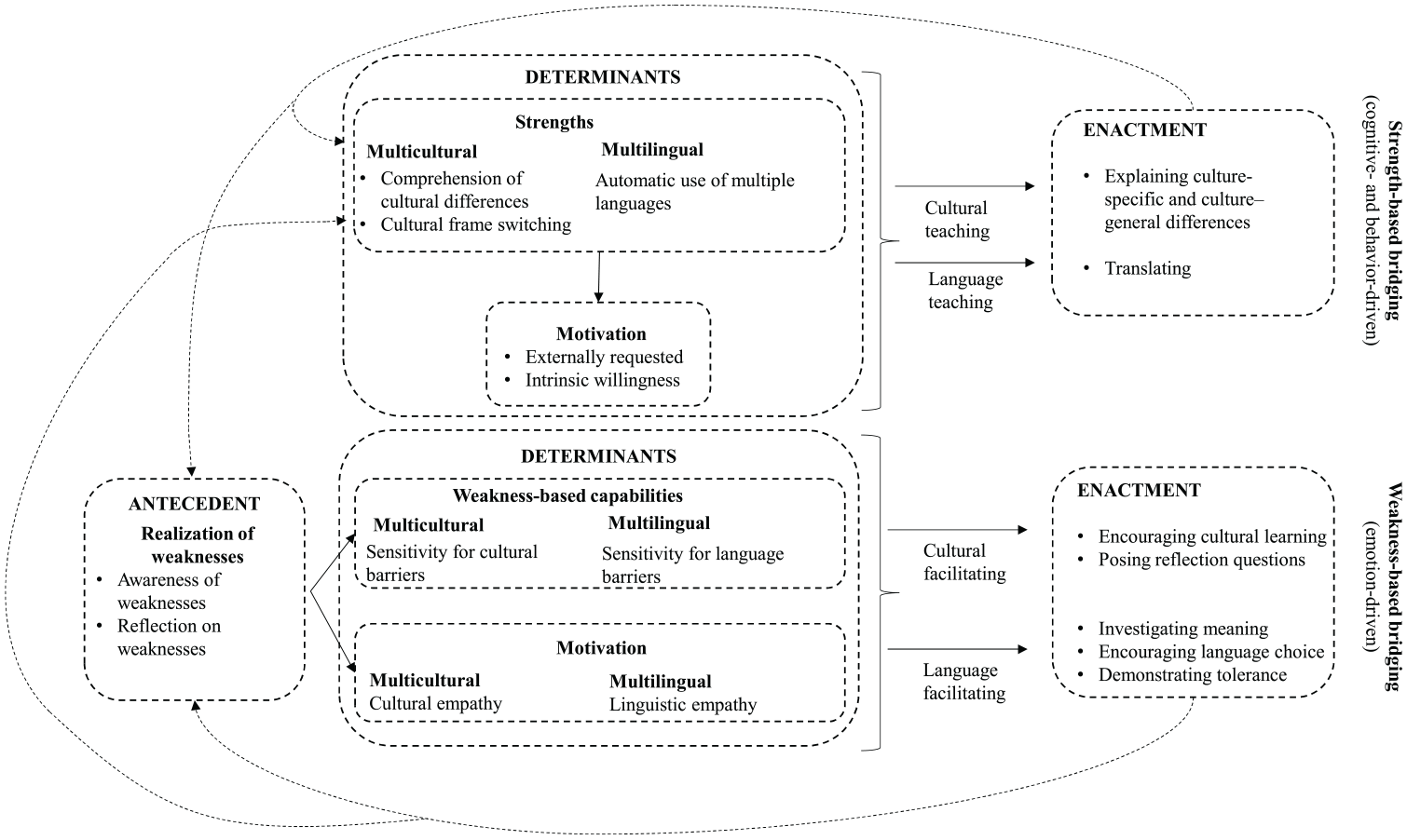
Multiculturals’ and Multilinguals’ Strength-Based and Weakness-Based Bridging Behavior
Theoretical Implications
Contributions to the literature on bridging
Our study contributes to the bridging literature and the related boundary spanning and transcultural brokering literatures by offering a holistic understanding of multiculturals and multilinguals assisting in overcoming cultural and language barriers. In doing so, we solve the three fundamental puzzles in the literature.
First, we conceptually differentiate between bridging cultural barriers and bridging language barriers—which, to date, has not been done empirically—by showing different types of determinants and bridging enactments for both kinds of barriers. Iwashita (2023) found that multilingual bridge individuals also mediate cultural differences, and Backmann et al. (2020) suggested that multiculturals also bridge language barriers. However, these authors did not theorize about the determinants of bridging, leaving a gap in understanding as to why and under what conditions multiculturals can bridge language barriers, and multilinguals can bridge cultural barriers. Our study closes this gap and provides a theoretical explanation for this important and paradoxical phenomenon. Bridging occurs based on both multicultural and multilingual strengths and weaknesses. For example, when multiculturals (multilinguals) have coexisting multilingual (multicultural) strengths, they can translate (explain culture-specific or culture-general differences). However, when they do not have the necessary multilingual (multicultural) capabilities to translate (explain culture-specific or culture-general differences), they use their capabilities and motivation based on the realization of weaknesses to perform different kinds of bridging enactments, ultimately still reducing language (cultural) barriers. This discovery moves the field forward in that we can conceptually distinguish between cultural and language barriers, while operationalizing them in ways that explain possible interdependences in bridging them.
Our conceptualization also extends Kane and Levina’s (2017) boundary spanning work. The authors found that multicultural project managers spanned boundaries between HQ and members of project teams at foreign production plants through teaching business knowledge to project team members and soliciting ideas from them when multicultural project managers lacked knowledge. Although their enactment refers to broader knowledge domains beyond culture, it resembles our concepts of strength-based top-down teaching and weakness-based horizontal facilitating. We argue that the many bridging behaviors the literature discusses come down to top-down teaching or horizontal facilitating. We therefore move the field forward in decluttering the many bridging behaviors and establishing their determinants.
Second, we introduce additional determinants that multiculturals and multilinguals need to bridge barriers. For multicultural bridging, research has regarded identity as a determinant. Backmann et al. (2020) suggest that identity plurality is positively related to cultural gap bridging, in that a stronger identification with more cultures results in more cultural gap bridging behaviors. For multilingual bridging, research has only considered high language proficiency as a mechanism to translate to reduce language barriers (e.g., Harzing et al., 2011). We are the first to theorize bridging of language barriers considering a language with which the bridge individual is not fully fluent, and which includes activities beyond translating. More broadly, we extend these limited perspectives by considering a broader range of multicultural and multilingual strengths, motivations, and weakness-based capabilities that enable them to bridge. Our findings also extend Barner-Rasmussen and colleagues’ (2014) proposal that cultural and language skills are important antecedents for boundary spanning by specifying what skills must be considered.
We establish that the strengths are cognitive and behavioral, and weakness-based capabilities are affective. This finding has broader implications that go beyond multiculturals’ and multilinguals’ bridging, as individuals who are not multiculturals or multilinguals may also have some of these capabilities. For example, our findings suggest that cosmopolitans who are lightly embedded in a culture face more situations realizing their cultural weaknesses, thus using other types of brokerage than cosmopolitans who are deeply embedded in a culture (Levy et al., 2019). Expatriates familiar with both the culture and language of their country of assignment may have acquired some of the multicultural and multilingual capabilities, making them effective bridge individuals (Furusawa & Brewster, 2019).
For simplicity, we presented strength-based and weakness-based bridging consecutively. We did this to describe in detail the spectrum of relevant determinants and enactments of bridging behavior and to highlight the more cognitive- and behavioral-driven approach in strength-based bridging as opposed to the more affective approach in weakness-based bridging. Nevertheless, we also showed the interconnectedness between these bridging behaviors through feedback loops. Ultimately, depending on the situation, the same person can bridge based on both strengths and weaknesses. However, it is important to note that not every individual will be able to use both strength-based and weakness-based behaviors, underlining the importance of conceptually distinguishing them. For example, a multicultural may have low language skills in one of the languages pertaining to their cultures, prohibiting them from translating. As such, they will only be able to bridge language barriers with weakness-based bridging behavior. Thus, our model depicts the entire bridging repertoire available for individuals with varying degrees (from low to high) of multiculturalism and multilingualism. We are the first to provide this comprehensive understanding of multiculturals’ and multilinguals’ bridging behavior.
Third, we substantiate the importance that motivation plays in bridging behavior, which has received little scholarly attention. Kane and Levina (2017) suggest that a motivation to span boundaries is a necessary condition and found that the motivation arises from negotiating the social identity threat that multiculturals experience when they are placed between groups belonging to their different cultures. Importantly, we offer other types of motivation beyond identity as a source, including strength-based external requests and intrinsic willingness, as well as weakness-based empathy for cultural and language barriers. Although Kane and Levina’s (2017) motivation counts for culture- and language-specific bridging, our motivations extend to culture- and language-general bridging as well. Overall, our study answers scholarly calls for more nuanced frameworks accounting for the complexity of the bridging process and giving insight into lived experiences of those who bridge (Yagi & Kleinberg, 2011).
Contributions to the literature on multiculturals in management
Our findings address the three conceptual shortcomings regarding the literature on multiculturals, substantively extending this stream of research. First, research has yet to explain why and how multicultural resources result in bridging cultural (and by implication of many, language) barriers. Although some relevant competencies (Hong & Minbaeva, 2022) or the enactment of bridging (Backmann et al., 2020) have already been described, our inductive theory making goes beyond these. We contribute by developing a comprehensive model of bridging cultural and language barriers, including bridging mechanisms, elucidating which multicultural and multilingual strengths and capabilities are crucial to bridge, the motivation to bridge, and how bridging is enacted. Further, it was only due to our inductive theorizing that we found interdependencies within this process, as well as between strength-based and weakness-based bridging. All this led to the depiction of a dynamic and situation-dependent process in which the determinants to and enactments of bridging should not be regarded as static as multiculturals/multilinguals negotiate their self-perception of strengths and weaknesses to help others overcome cultural and language barriers.
Additionally, although our findings confirm, to a point, that multiculturalism is potentially sufficient to bridge language barriers, as research has suggested (Backmann et al., 2020), we theorize the “why” of the phenomenon. Although we found that multiculturals can have sufficient degrees of multilingualism to translate for others, as we show in the strength-based bridging, they can also bridge language barriers when such strengths are absent, as we show in the weakness-based bridging. In the latter, they use a capability and motivation that stem from their experience with weaknesses (e.g., a sensitivity for language barriers, empathy) and bridge through investigating meaning, encouraging language choice, and demonstrating tolerance.
We extend Backmann and colleagues’ (2020) findings and offer explanations for why each of their cultural gap bridging behaviors (i.e., facilitating, translating, integrating, mediating, and empathetic comforting) are only predicted by certain CQ dimensions. One interpretation is that mechanisms to multiculturals’ bridging go beyond CQ. Some of our strength-based bridging can be explained by CQ, in that multiculturals perceiving strengths are confident in their ability to be effective across cultures (motivational CQ); can switch cultural frames and have the capability to take appropriate actions when interacting with people from other cultures (behavioral CQ); have cultural knowledge (cognitive CQ); and monitor and revise their cultural knowledge when learning from feedback on their bridging enactment (metacognitive CQ; Ang et al., 2007).
Although we agree that the effects of the feedback multiculturals receive on their weakness-based bridging enactment can also be viewed as metacognitive CQ, neither of the CQ dimensions comprehensively explains why weakness-based bridging occurs. On the contrary, the sensitivity and empathy for barriers arise from an experience with weaknesses, which includes not having the confidence to be effective across cultures (motivational), from not being able to act appropriately (behavioral), and not having the necessary cultural knowledge (cognitive). This could explain why Backmann et al. (2020) found metacognitive CQ to be the only predictor for empathetic comforting. We therefore argue that CQ may explain a small portion of bridging behavior of multiculturals but is not sufficient to theorize multicultural and multilingual bridging of cultural and language barriers comprehensively because the crucial aspects of sensitivity and empathy, and the resulting bridging enactments, go beyond CQ.
The second conceptual limitation we identified in the literature on multiculturals was a binary conceptualization of multiculturals as either multicultural or not. We move the literature forward by being the first to operationalize multiculturalism on a continuum. We also show that it is both multicultural strengths and experience with weaknesses that form multiculturals’ unique capabilities. Vora et al. (2019) suggested that individual-level multiculturalism is a tridimensional continuum from low to high, including knowledge, internalization, and identification. Yet, research has not yet operationalized what constitutes a lower degree.
Our investigation shows that certain strengths, such as culture-specific and culture-general knowledge, and cultural frame switching, make multiculturals perceive their multiculturalism as strong, helping them to bridge cultural barriers. Conversely, realizing weaknesses contributes to multiculturals’ perception of lower degrees. One’s perception of own strengths and weaknesses on the various continua is not static but can change over time or depending on the situation and individual learning processes, which we show via feedback loops. This adds a new perspective to the prevalent strength-based view of multiculturals as being perfectly culturally fluent, by valuing and operationalizing imperfect knowledge, internalization, and/or identification of multiple cultures. Instead of neglecting these imperfections, our model recognizes positive outcomes resulting from ensuing learning processes (Argyris & Schoen, 1978; Fineman, 2006).
The third theoretical limitation we identified in the research on multiculturals was the often-implicit assumption that multiculturals also automatically have a high multilingual proficiency. We show that multilingual fluency is not a necessary condition for multiculturals, but that it is the experience with multilingual weaknesses that enriches multiculturals’ bridging. Hong and Minbaeva (2022) consider cross-cultural communication skills, including language fluency, as one KSAO of multiculturals. Thus, individuals having multicultural strengths could raise expectations for others to be multilingual in respective languages, expectations which—as we have shown empirically—they often cannot meet (see also Brannen & Thomas, 2010).
Our model shows where the differentiation between multilingualism and multiculturalism comes into play. In strength-based bridging, multicultural strengths (comprehension of cultural differences and cultural frame switching) and multilingual strengths (automatic use of multiple languages) clearly differ. The enactment to bridge cultural barriers (explaining culture-specific and culture-general differences) equally differs from the enactment to bridge language barriers (translating). Although we observed similarities in the capabilities and motivation for weakness-based bridging, the enactment to bridge cultural barriers (encouraging cultural learning, posing reflection questions) can be clearly distinguished from enactment to bridge language barriers (investigating meaning, encouraging language choice, demonstrating tolerance). These differences show the conceptual distinctions between both multiculturalism and multilingualism and cultural and language barriers. Bridge individuals must use different forms of enactments to overcome cultural barriers versus language barriers. Further, bridge individuals cannot use multicultural (multilingual) strengths to bridge language (cultural) barriers.
Contributions to the literature on multilinguals in management
Our last contribution is that we are the first to introduce multilingualism on an individual level to management research, differentiating it from both the study of multiculturalism at the individual level and the investigation of native and non-native speakers (Neeley & Dumas, 2016). We introduce conceptualizing individual-level multilingualism on continua of four dimensions, featuring private proficiency, professional proficiency, frequency of use, and multilingual identification. In some ways, our findings reflect research disciplines other than management. For example, linguistics and psychology research assess multilingualism not only based on fluency but on frequency of use and identification (Chen et al., 2021; Luk & Bialystok, 2013). Cummins (2021) differentiates between proficiency in the private and academic/professional context, as it can vary between these contexts and affect the language-based performance of multilinguals.
There has also been an increasing debate in social psychology about the usefulness of using native and non-native speaker concepts, as they are regarded as not sufficiently specific (Chen et al., 2021). This is particularly the case in globalized business contexts with increasing multicultural and multilingual populations. As our findings have shown, some respondents, especially first and second generation multiculturals, may have a significantly lower proficiency in the professional context in their native language than in their second major language. Similarly, multilinguals who have learned another language primarily in an academic or professional context, may have significant limitations in the private context. Our conceptualization and operationalization of multilingualism thus allows us to account for such cases. This adds a new perspective for research on multilinguals, allowing for the paradoxical co-existence of both multilingual strengths and weaknesses as relevant in work contexts.
We also introduce the capabilities multilinguals use to bridge language barriers, which have not been specified. Translating has been defined as a bridging enactment of multilinguals (Harzing et al., 2011). Yet, in weakness-based language bridging, we challenge the view that individuals must possess specific language skills to bridge language barriers (Barner-Rasmussen et al., 2014). We provide empirical evidence and theoretical explanations that individuals can also engage in bridging behavior when language skills are too low to translate precisely, if they have developed high sensitivity toward language barriers and feel empathy with the person who faces a language barrier. In this case, the bridging enactment is more egalitarian, in that multilinguals investigate the meaning, encourage language choice, or demonstrate tolerance.
Neeley and Reiche (2022) found a similar phenomenon to our enactment that we label “encouraging language choice” among global leaders who encourage their subordinates to speak in their native language to gain acceptance and connection, even if it puts them in a disadvantaged position. The authors refer to it as downward deference, in which leaders deemphasize organizational hierarchy, such that subordinates speak up with their expert advice. However, they do not relate it to the determinant of realizing own weaknesses.
We also show, via feedback loops, that multilinguals could shift their perception of having multilingual strengths or weaknesses. For example, multilinguals may translate sometimes, and at other times they realize that they do not have the necessary skills to translate precisely enough, thus realizing weaknesses and finding more creative ways to bridge the language barrier. As such, we disagree with the assumption that multilinguals need to speak multiple languages perfectly to function as natural bridge individuals, language nodes, or translation machines (Harzing et al., 2011; Marschan-Piekkari et al., 1999a; Vaara et al., 2005). We thus provide a more nuanced look at multilingual employees to unleash their full potential and their challenges.
Managerial Implications
Our results indicate that multicultural and multilingual employees come with a broad range of bridging behaviors. These are not limited to strength-based bridging (e.g., explaining culture-specific and culture-general behavior or translating), but—paradoxically—weaknesses can also be a source of activities that can lead to softer bridging enactments, such as encouraging cultural learning, posing reflection questions, investigating meaning, encouraging language choice, and demonstrating tolerance. Managers can help their employees to develop and understand the importance of the four bridging enactments, including cultural teaching (i.e., developing strong cultural knowledge and behavior and effective ways to explain it), language teaching (i.e., developing strong language skills to translate), cultural facilitating (i.e., developing cultural empathy and sensitive approaches to discuss cultural differences), and language facilitating (i.e., developing empathy for language barriers and sensitive approaches to foster understanding). Incentivizing the development of all four should be a key goal for managers.
Even if people consider themselves multicultural and/or multilingual, some may feature many multicultural competencies but have difficulties in a particular language. Others could be fluent in more than one language but have limited multicultural fluency. To develop capabilities based on weaknesses, multiculturals/multilinguals need reflection. To increase the depth and quality of reflection, managers should create enough space and time for their employees. Specifically, managers should communicate realistic expectations as to whether their multicultural/multilingual employees can potentially bridge either cultural barriers, or language barriers, or both; encourage their multicultural/multilingual employees to dedicate time out of their workday to engage in reflection (e.g., via journaling; Cyboran, 2008); and/or foster a culture of learning from weaknesses and failures (Dahl & Werr, 2021).
Limitations and Suggestions for Future Research
Although we provide important insights into the positive but also negative lived experiences of multiculturals and multilinguals and their multicultural and multilingual bridging, as with all research, ours is not without limitations. First, although our respondents worked in a wide variety of industries and functions, representing a range of ages, tenures, and hierarchical levels, our sample consists of a disproportionally high number of individuals who considered German to be one of their cultures and/or languages. Although we cannot exclude the possibility that this overrepresentation influenced the outcomes of our investigation, our interviewees still represented 57 national cultures and 40 languages. Most importantly, we were unable to detect any culture- or language-specific particularities in our findings. On this basis, we assume to have described phenomena of cultural and linguistic bridging activities that are of general relevance. However, future research, possibly in the form of quantitative testing, could focus on micro-level differences in cultural and linguistic bridging activities.
Given our interview-based data collection approach, we were able to cover entire bridging processes, and there could have been many years between different phases. Nevertheless, as with any study based on interviews, we relied on retrospective interpretations of our respondents. Longitudinal data could help to shed further light on real time developments. This may be particularly fruitful for the interwovenness of the development of strength-based and weakness-based bridging behaviors. In addition, through our interviews we uncovered internal processes, such as motivations. Regarding the enactment of bridging, however, observations could provide valuable additional information. Such observations could help investigating the effectiveness of certain bridging activities, a topic we considered outside the scope of our analysis. Observations could also address the potential danger of social desirability in interviews, as respondents may have presented their activities in an overly positive light. However, for our interviews, we have less concern in this direction, as our interviewees were often highly critical of themselves regarding their perceptions about their (low degree of) multiculturalism and multilingualism. Without this self-criticism, we would not have been able to establish the concept of weakness-based bridging.
In terms of future research avenues, it was only our inductive research approach that enabled us to develop the concept of weakness-based bridging based on our interview data. We argue that the concept of weaknesses should influence future research regarding bridging, but also in a wider sense. After all, managers and employees all have weaknesses, and the question of whether they could be exploited in a productive way could provide manyfold research opportunities of conceptual and practical relevance. Furthermore, we offered a highly nuanced picture, showing that being entirely monocultural/monolingual or fully multicultural/multilingual are rare extremes on a wide spectrum, providing much scope for differentiation regarding proficiency levels and related strengths and weaknesses. Hence, future studies should be divorced from the still prevalent binary conception of monoculturals versus multiculturals and multilinguals.
Conclusion
Multiculturals and multilinguals can be highly useful bridge individuals in culturally- and linguistically-diverse contexts, when their proficiency levels are high but, paradoxically, also when they are low. We are confident that our study has helped open the door toward a more holistic, but at the same time also a more differentiated and nuanced, understanding of multiculturalism and multilingualism with respect to antecedents, capabilities, motivations, and enactments. We hope that future research follows the path we have taken with this study, treating multiculturalism and multilingualism as related but distinct concepts that should be understood as lying on a continuum including not only strengths but also weaknesses. In this case, we foresee many conceptually important and managerially relevant insights about this steadily increasing group of people that will surely become ever more important in the future.
Supplemental Material
sj-docx-1-jom-10.1177_01492063241281457 – Supplemental material for Examining Multiculturals’ and Multilinguals’ Paradoxical Bridging Behaviors in Overcoming Cultural and Language Barriers in Organizations
Supplemental material, sj-docx-1-jom-10.1177_01492063241281457 for Examining Multiculturals’ and Multilinguals’ Paradoxical Bridging Behaviors in Overcoming Cultural and Language Barriers in Organizations by Tomke J. Augustin, Markus Pudelko and Bradley Kirkman in Journal of Management
Footnotes
Acknowledgements
We are grateful to Associate Editor Pauline Schilpzand and two anonymous reviewers for their highly constructive feedback. We would also like to thank Stacey Fitzsimmons and Mila Lazarova for their feedback on earlier versions of the manuscript. The author(s) disclosed receipt of the following financial support for the research, authorship, and/or publication of this article: This research was partially funded by the German Academic Exchange Service (DAAD).

Supplemental material for this article is available with the manuscript on the JOM website.
References
Supplementary Material
Please find the following supplemental material available below.
For Open Access articles published under a Creative Commons License, all supplemental material carries the same license as the article it is associated with.
For non-Open Access articles published, all supplemental material carries a non-exclusive license, and permission requests for re-use of supplemental material or any part of supplemental material shall be sent directly to the copyright owner as specified in the copyright notice associated with the article.
