



Abstract
To deal with the omnipresence of otherness in today’s culturally-complex world, Cross-Cultural Management (CCM) investigates the interrelations between culture and management. The most recent research denaturalizes culture to emphasize the construction of otherness as an instrument of power plays. Thus, it refutes the very possibility of vast national cultures, given the cultural diversity found in modern societies. This conceptual article revisits the notion of culture and provides a definition that makes it possible to grasp both what is inherited and what is created in ‘otherness’. It draws upon an interpretive approach to culture which, although still overlooked in English-language research on CCM, has for several decades been developed in France. The socalled Gestion & Société approach posits that the root causes of otherness lie in the diversity of culturally-shared major fears and ideal ways of living together to counteract them. This approach breaks new ground by emphasizing the inherited cultural references underlying the individuals’ sense-making and by acknowledging the individual agency of the stakeholders who use these references to create new intercultural arrangements in cross-cultural encounters at work. A language metaphor is used to show how the inherited part of culture and the part that is created are articulated. Examples of empirical findings illustrate the benefits of this approach to overcome the critical effects of otherness. The value of its contribution to the understanding of otherness is assessed in comparison with other interpretive approaches, and avenues for future research are discussed.
Keywords
Cross-cultural management (CCM) research has been recently mapped and depicted through paradigms (Barmeyer et al., 2019a, 2019b; Grosskopf and Barmeyer 2021; Romani et al., 2018). Each paradigm encompasses a number of distinctive and nuanced theories that can be grouped because of the convergence of their assumptions on what culture is, methodologies of investigation, and the kind of questions that are worth exploring (Szkudlarek et al., 2020). The interpretive paradigm focuses on context-bound meanings constructed through interactions (Gertsen and Zølner 2020). Its focus on interactions leads scholars to favor the terms ‘intercultural management’ over those of cross-cultural management (Primecz et al., 2011). Intercultural management is concerned with the interplay of multiple levels of culture in the construction of ‘otherness’ in intercultural encounters. Some research show how national cultures are used by stakeholders to give meaning to situations of cultural transfer (Brannen, 2004) and produce creative cultural productions in multicultural organizations (Barmeyer and Davoine 2019; Barmeyer et al., 2019a, 2019b). At the same time, other interpretative researchers reject the study of ‘cultural encounters between what are perceived as well-defined and homogeneous entities’ (Søderberg and Holden, 2002: 103). Guttormsen (2018) calls for a shift away from considering the other as different on the basis of objectified categories, and towards the analysis of dynamic constructions of otherness. For these authors, national cultures are constructed by stakeholders who use them in strategies to forge a positive image or identity. Another approach focused on meanings can contribute to the debate by inductively identifying cultural references shared across vast societies and acknowledging the agency of actors in the ways they use them.
This article aims at presenting such an interpretive approach to CCM which is still little known in the English-speaking CCM research community although it has been empirically developed and theoretically refined for several decades in France. It is generally identified as the Gestion & Société approach (Chanlat and Pierre, 2018; Mayrhofer, 2017; Segal, 2014a). As Mahadevan’s (2020) genealogical approach shows, the academic construction of the CCM field through the writing of its history is selective. It omits some significant research while others are promoted as inescapable references, or even as ‘wondrous origins’ (p. 68). The language barrier has certainly contributed to limiting the dissemination of the Gestion & Société approach mostly published in French just as it has hindered, for example, the diffusion of the Kulturstandard Method developed in German by Thomas, (1996). But differences in scientific tradition and rhetoric can also explain why this school of thought has had little resonance in English-speaking journals to date (Chanlat, 2014). This special issue is particularly appropriate to introduce the ‘Gestion & Société’ approach as an original answer to the question ‘which differences should be considered by management studies, and how?’.
The article is structured as follows. In the first part, this article introduces the interpretive paradigm of CCM. In the second part, the theoretical foundations of the Gestion & Société approach as well as the related research method are presented. The level of analysis of cultures is also discussed. In the third part, this approach is applied to the case of France to illustrate what this societal approach enables us to discover that other approaches do not. It also uses the example of a Franco-Malagasy interaction to show how this theoretical framework enabling researchers to characterize societal cultures also helps understanding the social actors’ constructions of ‘otherness’. The fourth part discusses the specific contributions of the Gestion & Société approach to investigating and understanding otherness and positions it in relation to the research streams of the interpretive paradigm to highlight its specificities.
Interpretive approaches to culture
This section describes the interpretive paradigm in CCM thus providing a basis for positioning and discussing the specific contributions of the French Gestion & Société approach presented in this article. Recent reviews of CCM research have argued that the field can be mapped through paradigms (Grosskopf and Barmeyer, 2021; Primecz, 2020; Romani et al., 2018; Szkudlarek et al., 2020). There is no consensus on the names (e.g. positivist vs functionalist paradigm), the number (3 or 4) and the exact delineation of paradigms (see for example the overlaps between the critical, post-modern and constructivist paradigms), however all typologies encompass a paradigm focused on sense-making (Hatch and Yanow, 2003). In this article, we call it the interpretive paradigm but it is also referred to as the interpretative or interpretivist paradigm. Considering the limited space of an article, we will not detail the roots of the interpretive paradigm of CCM; we will rather focus on the conceptualizations of culture within this paradigm.
What interpretive approaches have in common is their focus on the production of meanings (Romani et al., 2011). They are especially concerned with ‘meaninglessness’ and ‘illegitimacy’ (Romani et al., 2018: 248). Interpretive CCM defines cultures as “frames of intersubjective meaning structures” (Gertsen and Zølner, 2020: 34). The aim is to discover the interpretations of social situations from the point of view of those concerned thus adopting an emic perspective. (e.g. Gertsen and Zølner 2014). These approaches are rooted in ontological perspectives which postulate that people are embedded in socio-cultural reality (Primecz et al., 2011).
Language constitutes the primary symbolic material through which actors construct social realities (Grace, 2017). Therefore, interpretive CCM studies favor qualitative methods, mostly interviews and sometimes ethnography, which enable researchers to intersubjectively access the social reality of actors (Romani et al., 2018). They use open-ended questions to capture the actors’ own words and phrases and decipher their sense-making processes.
However, social reality being co-constructed, interpretive researchers are themselves part of the data production; they shape answers not only through their questions but also through their own social identity. For example, Zhang and Guttormsen (2016) showed how they used their multicultural identity and their multilingualism to reduce the power imbalance between the interviewer and the respondent. Because the position of the researchers plays a critical role in data production through the interactions, interpretive approaches emphasize reflexivity implying that they take this role into account in the analysis. In addition to the role of the researcher, the historical, societal and institutional context of the research matters and it should be introduced in the reflexive process (Primecz et al., 2009). Interpretive researchers “critically and consciously reflect on every aspect that is part of their research, which influences their analyses and the conclusion they reach” (Primecz et al., 2011: 8). Reporting this reflection is required to ensure validity and reliability of the research.
Interpretive approaches share the common ground we have examined, but they comprise a constellation of research with different premises that are classified into different streams. Romani et al. (2018) distinguish approaches according to their level of analysis: national, organizational, interpersonal or individual. Gertsen and Zølner (2020) identify four main theoretical conceptualizations: (1) recontextualization, (2) negotiated cultures, (3) discourses and narratives and (4) identities. For the rest of the presentation of the interpretive approach, we refer to their typology.
For Gertsen and Zølner (2020) research on recontextualization focuses on the way values and management practices are given new meanings when implemented in places from which they do not originate. The research conducted by Brannen (2004) is an emblematic work of this stream. She analyzes the experiences of the Disney company when establishing theme parks in Japan and France and illustrates how the originally American products, practices and ideologies are interpreted in the respective Japanese and French social contexts. She advocates paying attention to ‘semantic fit’ when companies export their corporate model in another cultural context. This approach shows how corporate cultures make sense in national semantic contexts conveying specific myths and social representations.
Research on negotiated cultures, inspired by interactionism (Blumer, 1969) and the concept of negotiated order (Strauss, 1978), postulates that ‘patterns of meanings and agency in the organization arise from the interactions of members’ (Brannen and Salk, 2000). Negotiated cultures emerge through social interactions between diverse cultural groups in situation-specific settings. Most often, empirical studies (Azevedo, 2011; Barmeyer and Davoine, 2019; Brannen and Salk, 2000) refer to national cultures (e.g. German and Japanese, Brazilian and Chinese, German and US, etc.) in their analysis of negotiations. Brannen and Salk (2000) provide a typology of the negotiated outcomes: adjustment from one part to the other, finding a middle ground, invention of new ways and finally, accepting the coexistence of approaches with a separation of contributions. A few studies analyze the various levels of cultures which influence the interaction process and participate in the emergence of contingent practices (see for example Clausen, 2011). They can include occupational, corporate and regional cultures. In this research stream, ‘negotiated cultures’ refer to meanings. For example, in the case of adjustment from one of the parts, what initially appeared to be unacceptable and meaningless becomes legitimate and intelligible during interactions. They also refer to concrete social and work practices: for example, the work life balance management (Brannen and Salk, 2000), the formalization of processes (Azevedo, 2011) and the ways to address customers (Barmeyer and Davoine, 2019).
Research focusing on discourses and narratives study how actors make sense of particular intercultural situations by using linguistic approaches. Gertsen and Zølner, (2020) refer to Alvesson and Karreman (2000) who distinguish, on the one hand, the micro and meso level of discourse, i.e. the way social actors talk and, on the other hand, the macro level of discourse, i.e. societal narratives resulting from historical, political, social and economic power structure. The macro level influences individual discourses and reciprocally, social actors contribute to disseminate or transform macro discourses. The ‘discourses and narratives’ research stream examines the interplay and the plurality of discourses that are in competition in social settings (Primecz et al., 2011). In CCM, this approach studies how actors talk about cultures and mobilize them to make sense of challenging intercultural settings and interactions (see for example Vaara and Tienari, 2011). The focus on the construction of social reality through narratives leads to a fragmented representation of reality in which rival constructions emerge and compete. Cultures are fluid and constantly redefined by social actors in interactions.
Finally, CCM research on identities explores how individuals draw upon multiple resources to build contextual cultural identities in multicultural organizational settings (Gertsen and Zølner, 2020). It is inspired by social identity theories including the work by Tajfel and Turner (2001). These authors define social identity as those aspects of individuals’ self-image that derive from the social categories to which they feel they belong. Tajfel and Turner (2001) posit three theoretical principles: individuals seek to maintain or acquire a positive social identity; a positive social identity is determined to a large extent by social comparisons favoring the ingroup over an outgroup; when their social identity is judged unsatisfying, individuals will either seek to leave their group to join a more prestigious one, or strive to make their own group more prestigious. In CCM research, identities are constructed through setting or eliminating boundaries between cultural groups. The delineation between the groups is not a given, continuous identification and dis-identification emerge through interactions. Gertsen and Zølner (2014) conducted research in an Indian-Danish setting which is emblematic of this stream. They highlight the strategies of Indian actors for self-enhancement, mainly based on claimed identification with the corporate culture of the MNC they work for. Interestingly, despite emphasizing the deliberate and conscious identity construction, the analysis also refers to ‘pre-existing identities that employees carry’ (p. 172) suggesting the existence of cultural references prior to the experience of professional interactions.
Overall, with the exception of ‘recontextualization’ focusing primarily on the national level, the other three approaches claim to use a multilevel approach that does not equate culture with country but emphasize multiple bounded cultures (professional, organizational, ethnic, etc.). Most of interpretive CCM streams adopt a dynamic interactionist theoretical stance and study interactions in culturally diverse contexts. They consider culture as a social construct in constant redefinition with actors engaged in a continuous construction and reconstruction of multiple realities. The interpretive approaches claim to examine how local meanings associated with practices are produced, shared or negotiated in particular organizational settings or at interfaces between organizations. However, the review of empirical studies shows that most of them maintain the reference to national cultures as meaningful for the actors since they use them in their discourse or identity construction or even as a starting point, a necessary component of the analysis as in the case of negotiated cultures. Moreover, when they do not theoretically reject the very existence of broad cultures that would be shared by different social groups in one society, authors rarely provide a clear definition of such cultures. The emphasis on narratives, identities, power dynamics and the levels of interaction between individuals runs the risk of making interculturality a discipline without culture, if we define culture as a common base shared by a community (Chanlat and Pierre, 2018). In the following part, we present an approach to culture that fills this gap.
A distinctive path in interpretive approaches: what we inherit and what we co-create
This part will first present a theoretical definition of culture that aims at conciliating the social heritage and the agency of individuals. The second section will offer a pedagogical comparison between the proposed definition of culture (D’Iribarne, 2014b) and language to illustrate the articulation of cultural heritages and cultural co-creations. Finally, the third section discusses the appropriate perimeters for delineating shared cultural frames of meaning.
The theoretical foundations
The following interpretive approach to culture has been developed in a seminal work by D’Iribarne (1989) and refined over the years as the empirical studies were extended to other organizations and places until they covered some 50 countries on all five continents (D’Iribarne, 2014b; D’Iribarne et al., 1998, 2020; D’Iribarne and Henry, 2007). It originates in a research program launched in the 1980s and aiming at understanding the diversity of societies and organizations, which were much more diverging than they would if the supposed universal rationality of modern societies were at play and translated into reality (D’Iribarne, 2012).
In line with the interpretive perspective, this approach defines culture as a universe of meaning, and further elaborates its components. Universes of meaning are composed of two articulated layers. Describing these two layers in a universal and neutral way is a challenge because they take specific forms in each and every culture and the vocabulary used to describe them necessarily borrows from the references of a particular language and culture. Therefore, examples will be provided to illustrate the tentative general definitions. The upper layer refers to reference images of the ways of living in society including ways of working together. Ways of living in society include all aspects of social regulations such as deliberation for decision-making, coordination and monitoring collective actions, assessing and sanctioning deviant behaviors. Reference images depict desirable attitudes and positive social interactions. They echo a major fear which constitutes the bottom layer. This fear refers to the negative images of a detrimental situation in which protagonists are socially and humanly disqualified. Although people are not aware of this deep-rooted fear, they experience very strong negative feelings if ever they find themselves in such a dreaded situation. The desire to escape from situations where the fear materializes is a fundamental driving force for sense-making and for the collective construction of institutions (D’Iribarne et al., 2020: 61). The proper ways of living are designed to prevent people from falling into the situation they fear most. In other words, each society can be associated with a dominant fear (bottom layer) which fosters various forms of social regulation enabling to ward off this fear (positive references of the top layer). Conversely, when people act in a way that resonates with the most feared social situation (references of the bottom layer), they lose their respectability as social and human beings.
For example, major fears in democratic Western societies are generally related to freedom; losing one’s freedom amounts to being deprived of one’s humanity and the protection of freedom is the foundation on which democratic societies are built. Beyond the common general theme, the precise form of the freedom cherished significantly varies across Western countries (D’Iribarne, 2003). The case of France will be developed in this article but at this stage we provide a few illustrations from previously published work (D’Iribarne et al., 2020). In France, the major fear is to become servile, i.e. having to obey people using force or money to impose themselves. Free individuals obey their own convictions and not external orders. In the USA, the prevailing fear is that of not being in control of one’s destiny. Free individuals must have the possibility to pursue their aspirations without being thwarted by unconsented authority. Outside the Western world, fears are connected to other issues such as social disorder in China or impurity in India.
Moreover, the existential experience of falling into the dreaded situation must also be depicted in culturally specific terms. The ways in which people lose their human integrity and social status vary considerably. In France, falling into servility entails losing one’s dignity. In a French society structured around positions on a vertical scale, indignity occurs when people are not treated with the consideration due to the height or rank of their position, but as if they were in a lower position. In the USA, the existential experience associated with the main fear does not refer so much to social downgrading as to encroachment on one’s sovereignty.
Although deeply buried, this fear strongly influences the interpretation of social situations including interactions at work. Both the negative images of the main fear and the positive images of social arrangements that enable people to be preserved from major disaster are underlying and structuring the appreciation of social experiences. Language, through a large set of words, expressions and proverbs, reflects the sensitivity to the culture-specific main fears. Any situation reminiscent of this peril generates anxiety and strong emotions. They prompt people either to act and avert the dreaded situation or to change their perception and rhetorical wording of the situation to make it more acceptable. Noticeably, these cultural universes of meaning permeate all aspects of social life, from the political sphere and its institutions to family interactions and, at the meso level, the professional interactions at work on which we focus. Understanding in each society the important reference images that are associated with doing one’s job well enables management to act in line with this sense-making, and to design and implement practices that have positive meaning for employees.
The case for an interpretive approach to societal culture
In this section, a didactic comparison illustrates how this interpretive approach to culture can highlight societal –in some cases national– cultures and, at the same time, account for the diversity of meanings within a society. Indeed, the diversity of meanings produced should not lead interpretive researchers to abandon the comprehensive and relatively stable concept of culture. The comparison between language and culture is particularly enlightening to understand how a shared societal frame of meaning is compatible with a multiplicity of constructed meanings.
Linguistics distinguishes between different levels of languages (De Saussure, 2002). First, all human beings share the ability to speak. In that sense, language refers to a universal human characteristic; it is the ability to produce and receive thoughts and to express them through sounds. Ferdinand de Saussure suggests that nature provides the human being with an organization for articulated language but without providing them with such an articulated language. There is no universal language. Interestingly, the attempts to develop one –Esperanto– have proved to be a utopia which, after over a century of existence, still concerns limited groups of speakers estimated at one million people. Although many languages have disappeared and globalization has contributed to the expansion of some lingua franca (Nettle and Romaine, 2000), language diversity remains the rule in our world. This means that the universal ability to speak can only be enacted through particular languages (English, French, Chinese…). ‘It is the social part of language, external to the individual, who alone can neither create nor modify it; it exists only by virtue of a kind of contract between the members of the community […] language, distinct from speech, is an object that can be studied separately’ (De Saussure, 1916). These social languages have a certain structure (grammar rules and lexicon) which slowly changes over time. Over a lifetime, each language is enriched by some words and expressions, sometimes imported from other languages, while others fall into disuse; some rules may change with repeating practices but variations are marginal compared to what remains stable. Finally, the language becomes tangible through specific speeches, discourses and, more generally, the expression of individuals or small groups. ‘Speech is individual; it is the sum of what people say, more or less accidental, it is the result of an act of will’ (Gadet 1996: 77). As sociolinguistics have shown, some social groups develop their specific social dialects or sociolects (Hudson, 1996) including professional jargon that is a specialized distinctive language of specific occupations and interests (Crystal, 1985). Moreover, the same individual uses different language styles depending on the situation and the related ‘background expectations’ (Labov, 1973). However, beyond this infinite number of particular individual and social group utterances, even when a speaker, deliberately or not, breaks its formal rules, a native speaker will recognize the language (English, French, Chinese…). The fact that whenever people speak, they produce unique contextual linguistic creations is not incompatible with the fact that they are using languages that pre-exist these productions and that they have acquired.
Comparison of language and culture defined as universes of meaning.
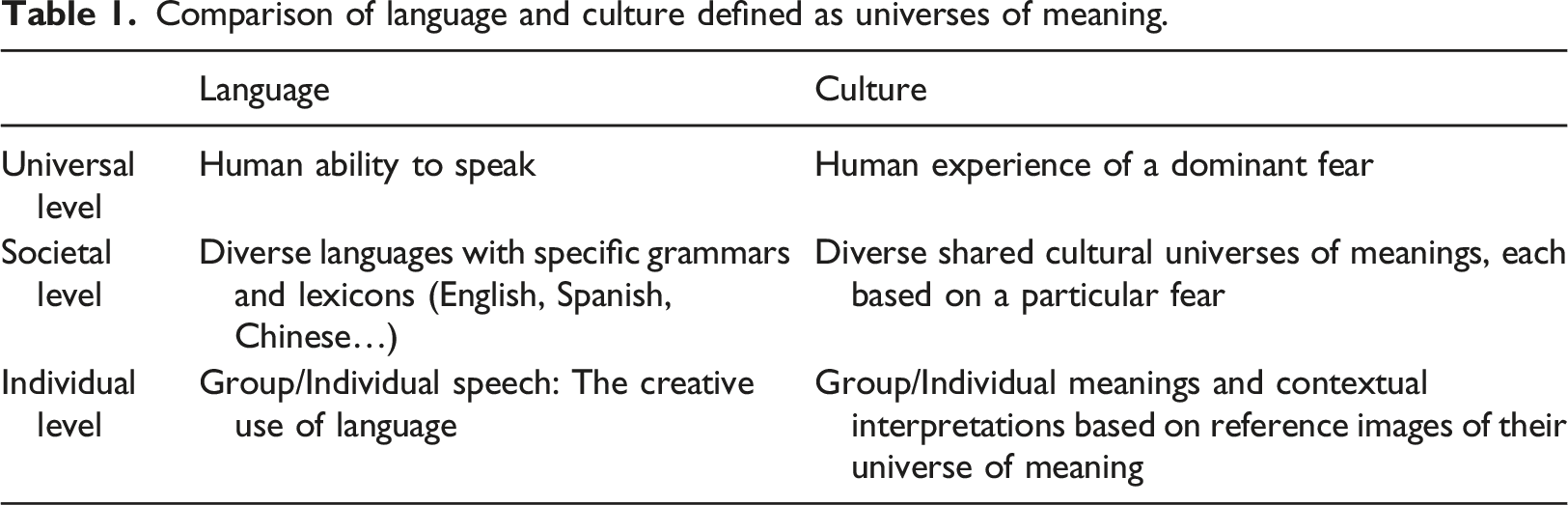
With this comparison, we make the case for the study of cultural universes of meaning pre-existing to individuals and being shared at a larger scale than small communities united by an organization, a profession or a particular social activity. We argue that the daily-constructed, reconstructed and negotiated practices and their associated meanings are the explicit expressions of deep-rooted underlying cultural patterns. These changing manifestations of culture make sense when considering a broader picture of persistent cultural societal references. Culture is both about heritage of shared references to fears and related ways to ward them off and co-creation of contextual transient meanings. It is also the inherited aspects of culture that give meaning to the possibility of mutual learning and innovative combinations in intercultural interactions advocated by interpretive interactionists (Barmeyer and Davoine, 2019; Barmeyer et al., 2019a, 2019b). Employees draw on societal cultures to produce new patterns of action resulting in situated ‘negotiated cultures’.
Relevant areas for cultural universes of meaning
The question of the perimeter of shared universes of meaning is a complex one. The references that underlie the modes of organization of social life that are considered appropriate are widely shared in a highly integrated nation-state such as France. Relatively homogenous institutions across the territory, such as schools, legal and political systems, contribute to the dissemination of a common culture as was defined in section 2.1. Even nation states that proclaim their diversity may have a national culture with regards to the proper ways of living together. For example, despite the visible and salient differences that the Swiss keep pointing out about themselves, the principle of subsidiarity as an ideal form of social organizing is cherished across internal linguistic borders and cantons (Chevrier, 2009). However, this is not necessarily the case in more recent countries and less integrated states counting different societies (Tung, 2008). The degree of cultural integration varies from one country to another; in Canada, for instance, the province of Québec has maintained a specific culture (Dupuis, 2008). We can also wonder to what extent the current fragmentation and polarization of many Western societies (Fourquet, 2019) allow common views of proper ways of living together to persist. In any case, the determination of the scope of cultures as shared frames of meaning cannot be done according to any general rule. It has to be done empirically through a comparative approach that unearths any significant differences in the major fear and ideal forms of living between groups or regions composing the given society. Moreover, the borders between cultural areas are not clear-cut. For example, the French culture defined as the logic of honor (D’Iribarne, 1989) is not sufficient to characterize overseas territories such as New Caledonia (Segal, 2009) or Polynesia (Audras et al., 2009) in which it coexists with the references of the indigenous Kanak, Wallisian and Polynesian communities. Likewise, border regions may also have borrowed from several cultural sources just as they may have developed specific languages or dialects. Therefore, we support Kara et al. (2021) who argue that cultural research can benefit from supplementing and occasionally replacing country boundaries by within-country cultural regions.
Aside from border regions, interpretive and critical researchers emphasize the development of multicultural societies resulting from migrations and the mingling of cultures. According to Maznevski (2020: 538), ‘individuals are increasingly N-cultural’. If the mingling is undeniable, it does not mean that cultures are mixing in a shared cultural magma. The linguistic analogy is insightful in this respect. In societies, sociolinguists have identified four types of language “mixture”: code switching, borrowing, pidgins and creoles (Hudson, 1996). The intermingling of language groups does not lead to the dissolution of languages but rather either to the coexistence of different languages, for example with code switching and borrowing or to the adoption of a lingua franca or a pidgin which is a special code to communicate with other linguistic groups but not used within the linguistic community (DeCamp, 1977). Creolization, that is the creation of a new language, takes several generations for native speakers to emerge and pass it on, it does not emerge in a short period from local interactions. In the same way, the cohabitation of people socialized in different cultures does not lead to the recasting of their original universes of meaning into a mixed universe just as multilingual people speak different languages alternately. Similarly, multicultural people are familiar with several reference systems that do not merge. It means that overarching societal cultural frameworks still matter and apply to ‘N-cultural individuals’, even if they are not their unique references.
From a theoretical point of view, the universes of meaning are ideal-types that are still enlightening to understand a multicultural world, although the interplay of cultural references used in a multicultural society is complex. Drawing upon the comparison with languages, we argue that cultural ideal-types help understand the cultural intermingling of contemporary societies. Plurilingualism and linguistic code switching which have been observed in organizations (Ahmad and Rasmussen, 2019) cannot be understood without any knowledge of the specific languages at play. The four types of language “mixture” aforementioned —code switching, borrowing, pidgins and creoles (Hudson, 1996)— are all creative combinations based on pre-existing languages. Likewise, the complexity of the cultural combinations does not exonerate from knowing basic cultural references made of specific universes of meaning. The fact that borders between cultures are blurred or moving does not mean that differences do not exist. Just as the fact that the foreshore is alternately sea and sand making the frontier between them hard to define does not mean there is no major difference between water and earth.
This theoretical strand enables researchers to approach culture at a societal level, in an inductive manner, and develop for each context an understanding of the particular logic and specific terms used to give meaning to situations. Simultaneously, it provides concepts broad enough to support a comparative approach. In other words, major fears and ideal images of living together can be identified to characterize any culture but each culture corresponds to a specific universe. Through examples, the next part will illustrate how using universes of meaning is valuable to address intercultural organizational situations.
Applying the Gestion & Société approach to the French culture
This part illustrates how this interpretive approach can be applied and what it reveals that other approaches do not. First, we give some general insights about the methodology. How can researchers decipher societal cultures? Second, we describe in detail the French cultural universe of meanings by focusing on the relations that employees have with their work. We choose the case of France because it is historically in this country that the Gestion & Société approach was developed and that the field studies are the most advanced. Third, we provide some empirical evidence, deliberately taken from very different organizational contexts, that supports the general picture of the French cultural universe of meanings. Fourth, we illustrate with a specific case how deciphering universes of meaning enables us to better understand intercultural interactions.
The methodology to decipher invisible images and unconscious fears
Culture as we have defined it –a universe of meanings composed of a main deep-seated fear coupled with ideal images of social relations– is not readily observed. It is deducted from a large number of quotes from people that differ in terms of social positions, of opinions and of interests. As long as a sample of respondents representing the variety of the hierarchical levels, the departments and the jobs of an organization have been interviewed, data are sufficient (See D’Iribarne et al., 2020 chap. 16). The number of interviews is not as important as the depth of their analysis. The most fruitful quotes for cultural analysis are those in which people express judgments and emotions and show on behalf of what they are enthusiastic, critical, or angry. Their outbursts or their appreciations disclose their underlying fear and their aspirations. However, the analysis does not consist for the researchers to synthetize the surface meanings about the content of their judgments but to infer the deeper references that they are using to formulate their judgments.
A systematic comparative and interpretive approach is carried out until the categories of interpretations in the comments form a coherent system. A long and patient work of cross-checking quotations and observations is necessary to discover the regularities of the system of meaning that underlies them and of which the actors themselves are not clearly aware. Step by step, the researchers identify some ideal images of living together and the associated key cultural concepts as well as the fundamental fear that these ideal forms of regulation are meant to ward off. A number of elements help researchers to focus their attention on critical clues when analyzing the material: redundancy of terms, unexpected formulations, embarrassment of the interviewee, recurring association, or recurring opposition (D’Iribarne et al., 2020, chap. 16). The analysis follows a hermeneutic circle (Gadamer, 1975), which refers to the iterative process through which a new understanding of a whole reality is developed by means of exploring the details of existence. When analyzing a universe of meanings, the clues that have to be assembled can only take on their full meaning when they fall into place in the overall picture, and this big picture is in turn built up from these clues (D’Iribarne, 2011). The first clues enable the researcher to construct provisional images. Starting from these images, the reading can be resumed, while looking back with a sharpened eye, moving along with a series of back-and-forth moves between quotes and images. Ethnographic immersion is welcome to collect materials but not required. The analysis of historical and institutional materials can also provide insights to corroborate the analysis of the interviews as the universes of meaning pervade all spheres of a society. It can be helpful in feeding the hermeneutic circle with different kinds of materials, thus helping to identify regularities and recurring references.
In the case of France, a large number of field studies (D’Iribarne, 1989; D’Iribarne et al., 1998; D’Iribarne, 2006; Chevrier and Segal, 2011; D’Iribarne, 2012; Segal, 2014b) in multinationals or smaller organizations, in public organizations, private companies and NGOs over a period of three decades has revealed stable recurring interpretation patterns despite major changes in managerial practices. While organizations, driven by globalization and digitalization, have dramatically reshaped their governing structures and management processes, the universes of meanings used by actors show remarkable continuity over time and across the country.
Moreover, these universes of meaning echo not only the contemporary institutions (e.g., see Garapon and Papadopoulos, 2003 concerning the French legal system) but also founding political texts of French history (Sieyès, 1789), analyses by medieval historians (Bloch, 1982) and the work of early philosophers (Montesquieu, 1748). These multiple expressions demonstrate the extremely deep roots of the French cultural universe of meaning (D’Iribarne, 1989), which is further detailed in the next section.
Conceptions of work prevailing in the French culture
The major fear that characterizes the French universe of meaning is servility, i.e. having to obey powerful people or authority holders that are considered illegitimate. The ideal image of a society in which each person is in their place and does not obey a person but the duties traditionally attributed to this place addresses this concern. In organizations, the implicit fear of servility generates a great sensitivity to power relations, any authority being perceived as a potential threat to individual autonomy. ‘Subordinates’, and more generally people in lower positions, eager to avoid situations suggestive of servility, find comfort in an ideal model of regulation based on their ‘métiers’ and status. Translating ‘métier’ into English is a difficult task: beside the fact that it is associated with a given status, no English terms has such a broad meaning (‘métier’ can be used to designate any kind of occupation, any trade, any profession, any industry and even professional experience). The profession (‘métier’) defines not only what it is appropriate to do but also the privileges it confers, i.e. a set of duties and rights defined by customs. This allows professionals to work, not for their manager, which would place them in a socially-sensitive relationship of dependence, but according to the requirements of their profession. They are supposed to do a good job because of their sense of duties and responsibilities, not because they are told to do so. The essential place of the ‘métiers’ in French society is attested to by the long history of trade guilds, structured around the statuses of apprentices, companions and masters since the twelfth century. In his history of craft guilds written at the end of the 19th century, Etienne Martin Saint-Léon (1897) already highlighted the ties that bind workers in the same profession and their rights and duties towards the community. He also showed how, despite the formal prohibition of corporations after the French revolution in 1791, their spirit continued to exist until professional unions were again authorized in 1884. These historical references do not mean that professional guilds remained unchanged since the twelfth century, but they do show that the notions of social status and differentiation between professions associated with trades are deeply rooted in French social history.
One could see here a similarity with the professional bureaucracy characterized in Mintzberg's (1979) typology of organizational structures and which emphasizes coordination through professional qualifications. However, there are significant differences. On the one hand, the reference to profession does not only concern professions with regulated access to the corporation (doctors, lawyers and other highly qualified experts). In France, it concerns all levels of the organization, including the least qualified who claim and promote as much as possible their competencies and skills. The scope of ‘métier’ applies to any job beyond professions. On the other hand, the know-how associated to the ‘métier’ goes beyond a list of formal qualifications or official prerogatives of professions, it is implicitly defined by traditions and customs informally transmitted through formal training as well as informal companionship. In particular, traditions and customs instill a sense of what can or should be done and what should not be done because it is does not fit this ‘métier’. This goes beyond a technical question of efficiency, performance or state of the art and concerns the symbolic dimension of work that distinguishes noble and less noble tasks for a given status or rank.
‘Métier’ is distinct from the job description and the employment contract. It includes a broad mission and a set of professional responsibilities that each person gradually takes on. More than rules, procedures, hierarchical instructions or clients’ requests, the informal duties and requirements associated with ‘métier’ are the main guidelines for actions in organizations. The representation that a ‘smart analysis’ of the situation based on the professional state of the art is a better guide for action than a mindless automatic obedience to procedures is widely shared. This does not mean that rules are never respected; they are followed provided they are considered relevant and effective. Otherwise, employees can deliberately take the initiative to do things differently and feel that they are doing a better job. Such a universe of meanings entails significant discrepancies between the formal organization and the actual daily operations.
Obviously, this brief introduction does not cover the whole French universe of meanings especially with regard to the many arrangements that constitute the ideal forms of living together, but lack of space prevents further developments 1 . However, it provides a key reference for understanding interactions in the French context, as the following section shows.
Empirical evidences of the French reference to ‘métier’
In a nutshell, in the French society, ‘métier’ refers to skills and responsibilities, rank or status in the organization and strategies to defend it against other ‘métiers’. Qualitative empirical research in French organizations have provided countless materials that reflect this particular conception of the ‘métier’. This prevalence of the ‘métier’ does not only appear in research conducted by the Gestion & Société team, but can be found whenever researchers ask interviewees about their work regardless of the specific questions. In this section, we provide a selection of quotes from interviewees with varied profiles (employed in public services, private companies and NGOs, highly qualified and less qualified, males and females, seasoned and younger workers). The choice of disparate examples is not random, it aims at showing that the same universe of meanings pervades all kinds of French professional settings and hierarchical levels.
First, ‘métier’ itself is a main reference to give meaning to the work. When asked about their work, French interviewees regularly riddle their answers with a formulation that can be translated by ‘As a [name of the ‘métier’]’ 2 , for example ‘as a foreman’, ‘as an engineer’, ‘as a nurse’, etc., and in a number of cases, this introduction is followed by “I owe to myself to…”. It literally expresses that their work is guided by a personal sense of the professional duties and obligations that stem directly from their vision of their ‘métier’. References to a contractual job description, the request of a manager, or any kind of requirements external to the interviewees are rarely mentioned to explain the nature of their work. Some interviewees even expressly distinguish between their formal assignment and the way they make sense of it. For example, when asked about his job, a program manager of an NGO asked in turn whether he should describe his mission as it is formalized on paper or as he understands it. Because of the professionalization it evokes, ‘métier’ is also used to make low-skilled jobs look more attractive. For example, a home-help provider looking to recruit does not hesitate to emphasize the pride you feel in being a home-help professional 3 . The expertise associated with the notion of ‘métier’ helps to lift its image, turning, for examples, sellers into sales consultants and call-center employees into ‘tele-advisors’.
Second, people are expected to behave in a manner befitting their position. It is especially important for people holding high positions in the social hierarchy since they are under constant scrutiny. Top executives or politicians are relentlessly challenged to live up to their responsibilities. For examples, in October 2020, Le point newspaper headlines 4 ask whether the French President and the Prime Minister are ‘up to their task’ of managing the coronavirus. Status and ranks provide the references according to which one judges whether behaviors are appropriate or not.
Third, the French universe of meaning induces a high sensitivity to social downgrading and to being assimilated to a lower rank. A popular saying asserts that ‘you don’t mix towels and cloths’ meaning that fine distinctions between categories should never be ignored. The preservation of the ‘métier’ plays a major role in power games in French organizations and makes professional identities salient. We provide two examples of this sensitivity in distinct professional contexts.
The first case takes place in the professional world of seamen where a new procedure for staff evaluation is meant to be implemented. The sailors resist this introduction because they fear losing the specific advantages linked to their status but, above all, they put forward their particular ‘métier’ to justify their disagreement with the change as the following three quotes indicate (Honoré 2009: 44): ‘And what do they do with our status? We are not civil servants
5
. The status of the sailor was created by Colbert and, even if it has evolved, the commander is still the one who evaluates the work of the officer at the end of the embarkation, and for promotions, it is the promotion commission’. (an officer) ‘If we have the status of sailors, it’s not for nothing, it’s because we do an officer’s job and an officer is not an engineer, he’s a sailor’. (an officer) ‘They want to break that to make us bus drivers’. (an officer)
The three interviewees do not make the same comparisons, but they all insist that the way they will be treated will not be appropriate to who they are and, worse, it will be downgrading.
The second example was recently reported to the author by the head of a secondary school. To prevent the spreading of the Covid, the management of the school requested that all teachers and students disinfect their desk and tables after each class since the cleaning agents only wash all classrooms once a day. A group of teachers protested and argued that ‘technical gestures cannot be performed by teachers and students” meaning that only specialized professionals can wash the tables properly. It is unlikely that any of these teachers do not know how to clean their desk and never practice it at home. This formal protest is rather prompted by their refusal to be assimilated to professional cleaners. Interestingly, they put forward the professional expertise of cleaning agents to claim that they are not able to perform the task, thus avoiding to show any contempt for that profession. However, this is a symbolic refusal of the downgrading of their work.
In our examples, the cultural universe of meanings explains employees’ resistance to changes that may affect their professional identities and the high expectations towards people in position of power who constantly have to prove that they are worthy of being followed. However, the French cultural frame of meaning can be a useful resource. Indeed, the identification to one’s ‘métier’ is a powerful drive to do a good job and many employees work much beyond formal expectations to live up to their representation of their ‘métier’. For example, driven by the desire to be considered as experts rather than ‘simple executors’ of requests, French suppliers do not hesitate to propose innovative solutions to their customers, which can make the difference with their competitors. In some cases, these kinds of initiative are not welcome and clients will complain about a lack of compliance but in other circumstances, the extra added value will be appreciated. Being aware of the cultural particular frames of meaning can be useful not only to researchers to better understand social situations but also to managers who are better equipped to design organizational practices which take a positive meaning for employees. One brief case will illustrate how this approach improves our understanding of cross-cultural situations and contributes to account for how actors construct their representations of ‘others’.
The cultural construction of ‘others’: The case of empowerment practices of French expatriates in Madagascar
This example is drawn from published research (Chevrier and Viegas Pires, 2013) that we will not develop here. However, we will use some of its findings to illustrate that understanding societal cultures as universes of meaning sheds light on a wide variety of cross-cultural interactions, including the power relationships involved.
The context is a French development aid NGO having an office in Madagascar. This office is managed by a director who is a French expatriate. The main project managers are French, as well as a few young trainees working on the projects. The rest of the staff, in management or employee positions, are Malagasy. The managerial challenge facing the director is to empower the Malagasy team. Ideally, the final objective is to have a fully Malagasy organization.
The French managers of the NGO have called in researchers to help them implement the expected empowerment, which is stalling despite their regular messages and ongoing efforts towards the Malagasy managers. Interviews have been conducted with about 40 respondents including about 30 Malagasies. In this article, we will show how the French cultural universe of meanings helps to make sense of the expatriates’ empowerment practices and to understand their “construction of the others”.
Eager to empower the Malagasy team, the French expatriates implement practices that are in line with their cultural universe of meanings. Knowing that a significant number of Malagasy employees, especially the managers, have a high level of education and qualification (Master’s degree) and a good deal of experience in the organization, the director wishes to encourage them to take more initiatives. Some of them, he believes, have the skills to take on increased responsibilities; he urges them to make more suggestions and decisions. To achieve more empowerment, he is careful to give them room to maneuver and not to infantilize them by ‘taking them by the hand’. This is all the more important that the history of the relations between France and Madagascar could easily prompt a neo-colonial interpretation of any paternalistic behavior. In accordance with his representation of the ‘métier’, he is keen to give the Malagasy managers ample space to develop their professional autonomy. He entrusts the managers concerned with a broad mandate that they are expected to take ownership of.
However, there has not been much progress in this direction. In the interviews, the director reports that he still ‘plays the role of the dad’ too much. Even experienced managers turn to him for what seem minor decisions they could have made on their own. The research showed that the Malagasy managers were reluctant to take on their responsibilities because the empowerment conditions did not correspond to their expectations. These conditions fueled their primary fear of making a mistake that could hurt the group. Moreover, according to their cultural universe of meanings, such a mistake would inevitably result in their suffering dire consequences and being excluded from the community. The fear of encroaching on other people’s prerogatives and the social cost of making mistakes at the expense of the community require a very explicit and shared framework to implement empowerment. A broad ‘mission’ without clear and precise boundaries and without a collective consultation process, as was the case, proved to be particularly anxiogenic, even for highly competent employees.
Before the research, the French managers were unaware of the Malagasy universe of meanings. They had noted a high reluctance to make decisions and a propensity to be risk adverse but they could not really make sense of it. This unawareness made them construct the ‘others’ based on their own universe of meanings. A recurrent word used by the expatriates to describe Malagasy attitudes is ‘lack of courage’. This is how not taking responsibility is seen in the French context. Professionals are expected to stand up and fight for their beliefs and take responsibility for their decisions. This courage is strongly expected from managers and not defending one’s position is likely to be perceived as a sign of weakness and inconsistency. Hence the lively debates in French organizations when it comes to making a decision (D’Iribarne et al., 1998). The calm behavior of the Malagasy during the meetings was again interpreted as a lack of courage, when in fact they were eager not to damage the peaceful course of the meetings.
The light shed by the research on the Malagasy universe of meanings also allowed the expatriates to make sense of their experience, to give new meanings to the behaviors observed and ultimately to change their representation of the Malagasies. The French expatriates could replace their perception of a ‘lack of courage’ with a more positive understanding of the Malagasies’ expectations. Finally, the research enabled the organization to take action to promote the longed-for empowerment. In particular, efforts were made to provide a more detailed and secure framework for entrusting new responsibilities to Malagasy managers. Beyond this specific example, the construction of ‘otherness’ whose major fear is servility is structured by the threat that ‘one’ will lose dignity in the relationship because he or she behaves cowardly in front of the ‘other’ who may abuse his or her power. The context will place the ‘other’ closer to the position of the threat or that of the resisting victim.
Discussion: The contributions of Gestion & Société approach to cross-cultural management interpretive research
Beyond particular examples, this section discusses the actual and potential contributions of the Gestion & Société approach to the investigation of otherness and positions it with regards to the different streams of the interpretive paradigm.
Contribution of the Gestion & Société approach to the investigation of otherness
The contributions of the Gestion & Société approach to CMM rely on the originality of its definition of culture. This approach reframes the conceptualizations of cultural sense-making with a deeper alternative reading that reconciles the inherited aspects of culture with the contingent social constructions of actors and articulates stable cultural categories of interpretation with power structures and dynamics. It also sheds light on interactions in multicultural societies resulting from cross-border movements. Finally, it invites us to question the need for articulation of the construction of otherness with living together in inclusive societies.
The first contribution of Gestion & Société approach lies in its conceptual definition of what constitutes and therefore differentiates cultures. The interpretive approaches define culture as ‘frames of intersubjective meaning structures’ (Gertsen and Zølner, 2020) but rarely specify what these structures are or how they relate to the meanings being produced. The Gestion & Société approach provides a more elaborated conceptual framework articulating a fundamental fear and ideal forms of ‘living together’ that ward off that fear. This theoretical conceptualization enables researchers not only to highlight specific concepts mobilized by certain actors (e.g. métier) to shed light on their sense-making processes, but also to link these concepts together to form a universe of meanings that will make it possible to understand interpretations by other social actors or arising from entirely unrelated circumstances.
In addition, this theoretical approach combines overarching universes of meaning that are inherited (the fundamental fear and ideal forms of living together) as well as agency of actors reflected in the diversity of concrete social arrangements in daily work life (e.g. practical decision making processes) and in the diversity of meanings that social actors produce about these arrangements (e.g. resentment at not being involved despite having relevant expertise). Universes of meanings are symbolic structures that are latent and widely shared and acquired through socialization processes (De Bony, 2018). They provide a framework but do not determine specific interpretations and actions. Personal agenda, organizational position, disciplinary background, gender, social class and other individual and social characteristics also play a role in shaping opinions and behaviors. Similarly, the language metaphor shows that the existence of a primordial language does not prevent speakers from producing personal and contextual speeches (Gumperz, 1982). The ‘Others’ are not just the receptacle of other cultures; they are social actors endowed with the power to act.
The Gestion & Société approach does not compel to choose between analyzing social situations through a power lens or a cultural lens; it demonstrates how power and culture intermingle by showing how the protagonists’ strategies make sense in their specific universes of meanings. If power relations are a universal phenomenon, the concrete experience of power relationships makes sense in particular universes of meaning. For example, while Bourrier (1999), who focused on the analysis of power relations in two American and two French power plants, pointed out the variety of the actors’ strategies in each country, a re-examination of the field data using the Gestion & Société approach (D’Iribarne, 2005) showed the similarity of the references used by employees in each country to express and denounce the social relations at work. The fact that there was a centralized organization with low trust and a decentralized, more cooperative organization in each country clearly shows that a particular societal culture does not determine the degree of centralization and cooperation of all the organizations to be found there. However, the ways in which the employees praised their empowerment or, on the contrary, denounced their lack of autonomy in the French power plants all referred to the same references: their ‘métier’, their status and their professional duties. For their part, the American employees referred to a regulatory system based on rules, procedures, gaps for which workers were held accountable, and meticulously delineated tasks. Whether employees participated in defining these rules, as was the case in one of the plants or were excluded from their definition, as was the case in the other, the rules constituted a major reference point in the daily words and actions in both American organizations. This means that any organization concerned with empowerment should take into account the categories of meaning of the stakeholders in order to define concrete ways of involving them that are in line with their cultural representations.
Another contribution of the Gestion & Société approach is to provide a methodology for accessing specific universes of meaning (D’Iribarne et al., 2020) and for depicting the logics of ‘others’. Acknowledging that ‘others’ think differently enables people to understand that what seems like unexpected awkward behaviors have nothing to do with a ‘purposeful sabotage’ and that making tacit cultural differences explicit helps us ‘to exchange our perceptions of each other’s ways of doing things without making it personal’ (Mahadevan, 2017: 54). To a certain extent, all CCM theories have aimed at better understanding “differences” and/or “otherness”. However, this approach brings a specific contribution by both revealing the point of view of an insider as interpretive research does and providing a broad frame of cultural analysis that enables researchers to compare cultures. Indeed, on the one hand, based on an analysis of the content of the interviews, the method consists in deciphering the categories in which the actors code the situation they are experiencing and relate it to situations they would rather avoid, because they fear them so much (Segal, 2014a). This method makes it possible to describe each culture with its own logics and references and understand how social actors make sense of specific situations. On the other hand, the approach, based on logics founded on a major fear, provides a basis for comparisons between cultures from the point of view of an external observer. As we have discussed, Gestion & Société research showed that the major fears of several democratic Western societies (e.g. France, Germany, USA) concern the loss of freedom. However, the fears diverge when considered in detail: the fear of becoming servile found in France differs from the fear of not being heard in a collective deliberation found in Germany, and differs again from the fear of losing control of one’s destiny that prevails in the USA (D’Iribarne, 2003). The approach paves the way for an inventory of major fears that have yet to be identified for many societies. This inventory is not based on a term-by-term comparison of societal cultures, but on the comparison of their overall logic rooted in a specific fear.
The inventory provides researchers and managers with a basis for dialogue. In interactions, misunderstandings arise from the diverging references about living together. For example, in a Franco-Swedish team in charge of designing a new product, the sincere endeavors of French engineers to convince their counterparts were interpreted in terms of abuse of power. Whereas the French team members conceived of a vivid debate as an exchange between experts that must be settled on the basis of rational technical arguments, their Swedish colleagues saw the vehemence of the discussions as an attempt to impose their point of view (D’Iribarne et al., 1998). Conciliating the views of an insider and of an external observer makes cultural logics not only explicit and legitimate but also understandable. Consequently, this approach does not only prevent escalation of negative emotions linked to the misattributions of bad intentions and sabotage but also provides additional resources for successful actions.
The understanding of universes of meaning is a useful resource to define management practices of multicultural teams that make sense for everyone as well as to accompany the transfer of management practices and ensure effective recontextualizations. The positive references epitomized in ideal forms of living together can inspire innovations. The elaboration of ‘negotiated cultures' which is usually done empirically (see Barmeyer and Davoine, 2019; Brannen and Salk, 2000) can be informed and accelerated by an awareness of the universes of meaning at play. While most interpretive approaches (see e.g. Primecz et al., 2011) describe interactions ex-post and highlight the meanings that the protagonists have constructed or ‘negotiated', this approach can inform action when the universes of meaning are already known or involve researchers to uncover them in contexts where they are not, as was the case of the Franco-Malagasy NGO (Chevrier and Viegas-Pires, 2013).
Lastly, the Gestion & Société approach shed lights on the inclusion of migrants in the countries of destination. The very notion of ‘otherness’ is interpreted in relation to the specific forms of living together prevailing in different societies. These differences have consequences in terms of preferred ways to consider ‘others’, that is migrants, and how they should be included in societies (Thériault, 2003). For example, the same concept of equal rights for migrants can be understood as the undifferentiated treatment of all according to general principles and consequently a call for assimilation of migrants into the majority culture to benefit from the same rights as any citizen, or as allowing each individual or group to live according to their culture and express it, thus fostering a multicultural model (D’Iribarne, 2014a). At a time when inclusion issues are crucial in contemporary societies concerned by migrations, understanding the ideal forms of living together in each culture is critical. Identifying the principles of social integration specific to a society helps us to identify innovative ways to articulate them with other representations stemming from the diversity of the populations. This work remains to be done and the Gestion & Société approach offers references to identify some levers for societal cohesion.
How does the Gestion and Société approach relate to the interpretive cross-cultural management paradigm?
Positioning of the Gestion & Société approach in respect to the interpretive approaches as characterized by Gertsen and Zølner (2020: p. 41).
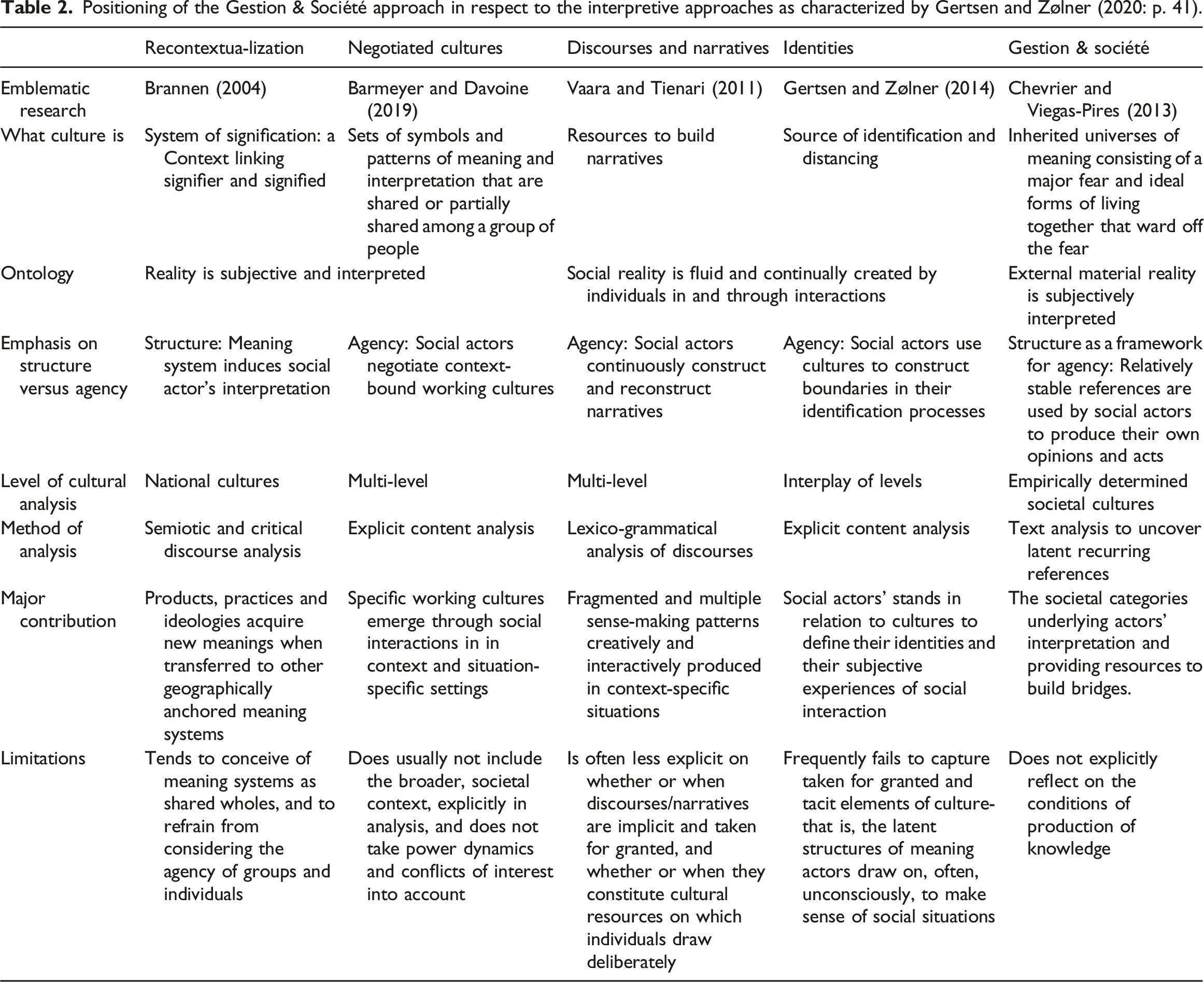
The definition of culture by the Gestion & Société approach focuses on meanings and thus partakes in the interpretative paradigm but it also emphasizes the inheritance and the relative perennity of the culture as does the recontextualization stream (Brannen and Salk, 2000) but in contrast with the three other interpretive streams which conceive cultures through contextual social constructions (see the review of Grosskopf and Barmeyer, 2021). From an ontological point of view, the Gestion & Société approach postulates that culture-bound fundamental fears and references pre-exist the construction of meanings by actors and are independent from their contextual productions, just as linguistic systems (specific languages) exist independently of their use by speakers. However, for the Gestion & Société approach, universes of meanings provide frameworks for making sense of social situations, which individuals can use in their own way to develop singular opinions. In contrast, as we have discussed in part I, interpretive researchers interested in negotiated cultures, narratives, and identities claim an ontological stance that questions the existence of a cultural reality that is independent of situated interactions. They emphasize the production of cultures through interactions and tend to disregard overarching cultural conceptions. In fact, these streams often refer to national or regional cultures as ingredients of idiosyncratic cultural arrangements, narratives and identities but consider them as the construction of social actors and rarely discuss their nature beyond their use by social actors. Even though for interpretive researchers, “human beings interactively reconstruct cultural realities while they are themselves simultaneously being constituted by them” (Gertsen and Zølner, 2020: 34), the framework that precedes human beings is not given a specific content, especially by the narrative and identity approaches which postulates that social reality is fluid and continually created by individuals in and through social interactions.
Focused on uncovering the universes of meaning underlying the actors’ interpretations, the Gestion & Société approach to culture deals with sense-making processes. However, as discussed in part I, it combines both an emic and an etic perspectives. It is an emic approach insofar as it looks at the logics that are specific to cultures and examines the singular terms and constructions of actors’ discourses. It reveals the particular references that give meaning to their opinions and behaviors. However, emic approaches generally rely on rather vague definitions of culture, leaving room for the specific elements that characterize each culture in context to emerge. For example, when Vaara and Tienari (2011) and Gertsen and Zølner (2014) examine how social actors refer to national and regional cultures (e.g. Danish culture, Indian culture, Nordic culture), they do not provide an academic definition of culture and focus on how the terms are respectively used for narrative and identity constructions. In contrast, the Gestion & Société approach provides a systematic conceptual framework for decoding cultures, thus allowing them to be compared and contrasted from an external point of view. The articulation between a major fear and ideal forms of living together makes it possible to approach cultures from an etic perspective even without quantitative measurement. Furthermore, the Gestion & Société research team claims that individuals are largely unaware of their own references exactly as native speakers ‘do not know the language they speak’. They use it ‘naturally’, enacting its rules without necessarily being aware of them. The approach is less interested in specific opinions and views than in the underlying implicit system of sense-making used to produce them. Its focus on universe of meanings rather than meanings themselves contribute to introduce an etic dimension to the approach even if it enables to access interpretations from an emic perspective too.
The interpretive streams which study intercultural interactions, acknowledge multiple layers of culture. In particular, researchers focusing on identities emphasize the dynamic interplay of cultural levels (Gertsen and Zølner, 2020). However, most empirical interpretive studies continue to refer to national cultures, sometimes in combination with other levels like organizations, professions, religions, ethnicity, (for examples, see Barmeyer and Davoine, 2019; Goiseau and Taksa, 2020). The persistence of references to the national level supports the relevance of this level of analysis of culture. From a theoretical point of view, the focus on meaning structures does not put any restriction to the scale of the universes of meaning; it can extend to societal cultures whenever institutions contribute to disseminate them at large scale. However, such a stance is rarely advocated by the researchers claiming to belong to the interpretive paradigm: the Gestion & Société approach stands apart. The empirical studies (D’Iribarne, 1989; Segal, 2014b; D’Iribarne et al., 2020) have provided evidence of the persistence of meaning structures used by members of different social classes across large societies. As demonstrated in part 2, both highly and less qualified professionals use the same references (e.g. métier) to preserve their status and prerogatives and more generally their place in the social hierarchy of their workplace. Cultural references as well as the primary fears can make sense of a wide range of interpretations and contrasting behaviors. It should not be concluded that culture is equated to country but that national cultures can still be useful in understanding the construction of meaning in a wide range of social situations.
The methods of investigation of all streams of interpretive paradigm rely mainly on qualitative methods and interviews. The Gestion & Société approach is no exception and does not stand apart in terms of data collection. However, its emphasis on latent structures behind discourses makes its analysis method more singular since their concern is not so much to give voice to actors in specific context than to reveal their universe of meanings in order to understand them. In addition, compared to other interpretative approaches, the researchers’ reflexivity on the conditions of data production is limited. Researchers acknowledge that data collected, i.e. specific answers of respondents, depend on the profile of the interviewer and the context of the interview. However, the variability of data does not hinder the search for recurrences. On the contrary, the diversity of discourses facilitates the identification of common ground.
A more global reflexive analysis of the processes and outputs of the Gestion & Société research suggests that this approach corresponds to a ‘French intellectual tradition’ (Chanlat and Pierre, 2018: 106). In seeking to identify a persistent meaning structure rather than the contingent production of meaning by social actors, the Gestion & Société approach is in line with a contemporary tradition of French social sciences. Indeed, a number of influential French thinkers across different disciplines of social sciences took a holistic approach focused on latent structures of phenomena. In linguistics, De Saussure (1916) was more interested in studying the structural properties of language than the linguistic productions of individuals. Similarly, in anthropology, Lévi-Strauss (1958) was more interested in the structure of myths than in the myths themselves. He sought to explain the diversity of social facts by the combination of logical possibilities linked to the architecture of the human brain, breaking with the dominant currents at the time in ethno-anthropology (evolutionism, diffusionism, culturalism, functionalism) which emphasized the characterization of each cultural system situated in time and space. He saw society as a complex system with properties that arise from the relationships between the individuals that make it up, without these individuals consciously perceiving them. In sociology, Bourdieu (1989) formulated a theory of action grounded in the notion of ‘habitus’. The habitus is a social conditioning that manifests itself in ways of expressing and being. The habitus is like a matrix that enables individuals to act in the social world and interpret it in a specific way that is shared among the members of the social categories to which they belong. These authors, and many more (Durkheim, Mauss, etc.), have provided various holistic theories that share a similar approach: they highlight some systems from which individuals generate their social conducts and productions without being clearly aware of them. The social sciences are all concerned with different factors that influence behavior but French scientists have put a particular emphasis on comprehensive theories that offer broad overviews of societies.
In a nutshell, the systematic comparison of the principles of the Gestion & Société approach with the four streams of the interpretive paradigm shows that this approach breaks new ground by emphasizing the inherited structures underlying the individuals’ sense-making, by bridging emic and etic perspectives and by highlighting the persistence of societal cultures, which overarch social disparities. In so doing, the approach also addresses some of the critics levelled at interpretive conceptualizations concerning power relations. As Gertsen and Zølner (2020) put it, the approach based on negotiated cultures ‘does not take power dynamics and conflicts of interest into account’ (p. 41). It also overcomes the limitations of two interpretive streams: the ‘recontextualization’ and the ‘cultural identities’ approaches that are respectively criticized for conceiving of ‘meaning systems as shared wholes and to refrain from considering the agency of groups and individuals’ and failing ‘to capture taken-for-granted and tacit elements of culture – that is, the latent structures of meaning actors draw on, often unconsciously, to make sense of social situations’ (Gertsen and Zølner, 2020: 41).
Conclusion
The purpose of this article was to present a conceptual interpretive approach to study cultural ‘otherness’ and situate it in relation to the other streams of interpretive research. The salient characteristic of this ‘Gestion & Société’ approach is to offer a theoretical framework defining cultures as a universe of meaning articulating a deep layer made of a major fear and an upper layer corresponding to ideal ways of living together, in other words forms of social regulation which ward off the major fear. This approach is not a theoretical speculation but is grounded in empirical studies conducted over three decades and of which this article provides only a few extracts. This article especially emphasized the theoretical implications of this research stream. Its definition of culture combines inherited universes of meaning transmitted across generations through socialization and the agency of actors who create specific social practices and meanings, individually or in social interactions, that make sense in their universe of meanings. As defined, culture provides a kind of symbolic raw material to implement these contingent creations. Empirical evidence showed that a universe of meaning can be shared at a large societal scale allowing researchers to refer to national universes of meaning even if other smaller or larger regional perimeters can be more relevant in some countries. Thus, the Gestion and Société approach provides a specific content to societal cultures that make it possible to account for shared frames of sense-making despite a large variety of observable social practices and behaviors.
The practical implications are numerous. This research stream provides companies with culture-specific symbolic resources to engage in constructive intercultural interactions and positive recontextualization when management models are transferred to a different social context. Knowing the major fears and the related ideal forms of living together opens the door for more informed construction of intercultural arrangements. Apart from cross-cultural settings, this approach is useful each time social change is required, even if there is no international transfer involved. Knowledge of societal cultural references enable promoters of social change to identify levers for positive interpretations of the transformation within their society. In contrast, failure to take into account the most dreaded situations is likely to fuel resistance to change.
Moreover, by focusing on the forms of ‘living together’ in organizations and society alike, this approach offsets the emphasis placed by interpretive approaches on the symbolic productions of individuals or restricted communities. Admittedly, the focus on interactions and actor’s strategies can contribute to emancipate individuals and marginalized groups (Crenshaw, 1989). However, the focus on individual needs, fulfillment, self-affirmation and singular identities raises questions of societal integration (Chanlat and Pierre, 2018). Maintaining an interest in culture gives us the opportunity to work on the construction of social communities and social regulation, so that diverse societies don’t dissolve into the coexistence of individualisms or divide along multiple fault lines through which dialogue no longer exists.
As we discussed, this approach has been gradually developed over several decades in French, but has been only partially made available in English, which has limited its diffusion in the English-speaking CCM field. This article aims to contribute to its dissemination and uses an original linguistic metaphor to highlight its structural dimension and unique contributions. Promoting an approach that stems from a French social science tradition contributes to the complementarity of approaches claimed by the CCM authors (Grosskopf and Barmeyer, 2021; Primecz et al., 2009; Romani et al., 2011). The ‘Gestion & Société’ brings specific contributions to the study of cultural otherness, but does claim to account for every aspect of the construction of ‘others’; it should be articulated with the analysis of other contextual elements which play a role in the construction of ‘otherness’ such as power relations.
The format of an article necessarily limits the scope of the overview of the approach and did not have the space to detail the genealogy of the approach and its connections with other disciplines such as sociology, political science and anthropology (see D’Iribarne, 2003, 2012). Nor have we been able to show the abundant empirical work carried out over several decades. Readers will have to refer to cited references to see the contributions of the approach to the specific cultures studied by the team in addition to France. Moreover, not all societies could yet be studied through this approach and future research should focus on deciphering the major fears of these societies, especially in the Global South, where the development of management methods that fit the systems of meaning is much needed to foster sustainable development and fight poverty. A second research avenue is to explore how to create acceptable forms of living together in multicultural societies, based on an understanding of people’s universes of meaning. Can we conceive of more than local, ephemeral social arrangements? Can we build inclusive forms of social regulation informed by knowledge of cultures? This research remains to be done.
Footnotes
Declaration of conflicting interests
The author(s) declared no potential conflicts of interest with respect to the research, authorship, and/or publication of this article.
Funding
The author(s) received no financial support for the research, authorship, and/or publication of this article.
