



Abstract
This article proposes a creative approach to cultural intelligence, as an individual’s capability to function effectively under the condition of cultural diversity. Virtual team collaboration, as stimulated by the COVID-19 pandemic, constitutes a novel, culturally diverse context. We explore how cultural intelligence may shed light onto the requirements of post-COVID virtual and hybrid team collaboration. The contribution of this article to cross-cultural management studies is thus conceptual: by using the concept of cultural intelligence creatively and beyond its classic application, we exemplify a way in which cross-cultural management studies remain relevant, in an increasingly virtual world of work wherein people travel less to other countries, wherein collaboration takes place online and remotely, and wherein national cultural boundaries intersect with other cultural diversity factors.
Keywords
Introduction
Cross-cultural management studies (CCMS) is the discipline that investigates the interrelations between culture, management and organization, and ensuing implications. One aspect is the question when and how a cross-cultural manager performs well, or, what differentiates a ‘high-performing’ individual from a ‘low-performing’ individual. Virtual team-work, which has increased significantly during and after the COVID-19 pandemic, is a novel cross-cultural management (CCM) context for which this question needs to be answered. The current conceptual and exploratory article brings together (1) cultural intelligence as a way of assessing individual performance, and (2) the increasingly important CCM context of COVID-induced virtual teams.
Rationale and contribution
Cultural intelligence, first proposed by Earley and Ang in 2003, has become the most widely used concept for assessing and measuring the skills needed for working in ‘global’, ‘cross-cultural’ or ‘intercultural’ contexts (Matsumoto and Hwang, 2013). A google search (01 November 2022) for the term ‘cultural intelligence’ delivers approximately 401,000,000 immediate results, which is more than for the term ‘cross-cultural management’ itself (approximately 341,000,000 immediate results). Jackson (2022: 209), in his overview on publications in this journal, finds 17 articles with the term in the title, 19 in the abstract, and 107 with an in-text reference to cultural intelligence. Our rationale for focussing on cultural intelligence is thus firstly its omnipresence in CCM studies and practice.
Second, like CCM studies themselves, cultural intelligence has undergone relevant changes and thus reflects the re-conceptualizations posed to CCM theory and practice. First defined as “a person’s capability to adapt effectively to new cultural contexts” (Earley and Ang, 2003: 59), the revised definition now describes cultural intelligence as the ‘capability of an individual to function effectively in situations characterized by cultural diversity’ (Ang and Van Dyne, 2008: 3). This is in line with the disciplinary development that, in a world characterized by mobility, globalization and digitalization, a more contemporary CCM studies has shifted from national cultural comparison and doing business abroad to the investigation of culturally diverse contexts, also ‘at home’ (overview in Mahadevan, 2023, Brannen et al., 2020). Consequently, Maznevski (2020) finds the next frontier of CCM to be ‘inward-bound’. This then implies that cultural intelligence, too, needs to be used more creatively and, as Gelfand et al. (2008) argue, also more ‘intelligently’ in the sense that it needs to be applied to novel CCM contexts such as the ones triggered by globalization, mobility and migration, and digitalization.
Our article is thus not about the measurement and assessment of cultural intelligence in quantitative terms or about the internal validity of the construct itself. Rather, it asks the explorative and conceptual question: which cultural contexts are relevant to CCM studies? or, in quantitative terms: does the concept fit the realities and settings to which it is applied (external validity)? Mees-Buss et al. (2020) refer to this as the difference between ‘templates’ and ‘heuristics’: Whereas templates apply previous research methodologies, heuristics build new research questions by means of active categorization for achieving re-conceptualization (Grodal et al., 2021).
Our active and heuristic engagement with the concept of cultural intelligence, aiming at re-conceptualization, is triggered by the recent COVID-19 experience. The pandemic has not only further accelerated pre-existing trends towards, for example, work-from-home, work-from-anywhere, and virtual, hybrid and remote work. Rather, it may be assumed to have reconfigured these previously existing modes of work (Georgiadou et al., 2022).
As a particular development, the COVID-19 pandemic led to the formation of new types of virtual teams, namely COVID-induced virtual teams. These are teams that were not formed by strategic or operational organizational considerations concerning costs, capabilities, resources and opportunities. Rather, they are existing teams made virtual by external crisis factors, in particular by the strategy of social distancing in order to contain the spread of the pandemic in its early, pre-vaccine stages (WHO, 2020). As most industrialized countries issued such measurements for social distancing at work at some point during 2020 and 2021, a vast number of employees worldwide, in particular white-collar employees and managers, found themselves in COVID-induced virtual work-from-home settings, often unexpectedly and involuntarily (Wiles, 2020). As with any crisis, the challenge was thus to transform immediate reactions and past experiences into managerial and organizational learning (Bhaduri, 2019) for a better navigation of an increasingly hybrid post-pandemic environment in which the boundaries between ‘home’ and ‘work’ are more blurred than they used to be before (Caligiuri et al., 2020, Christianson and Barton, 2021). Specifically, the question emerges how to successfully transform former COVID-induced virtual teams into post-pandemic hybrid teams, alternating between on-site and work-from-home collaboration (Stärkle and Mahadevan, 2022).
Bringing these arguments together for actively re-conceptualizing cultural intelligence, we thus propose that COVID-induced virtual teams are a relevant novel context for answering the question of what differentiates ‘high’ from ‘low’ performance, as related to an individual functioning effectively in situations characterized by cultural diversity. What we try to conceptualize in this article is thus how cultural intelligence is relevant in a COVID-induced virtual team setting, and what this then implies for a post-pandemic (cross-cultural) management of future hybrid teams and ‘new work' in general.
Our question is explorative in nature which is commonly understood across qualitative and quantitative research methodologies (Shah and Corley, 2006) as the first step towards a relevant research design that establishes fit between a novel context and existing knowledge (Flick, 2009). Our contribution is conceptual, shedding new light onto the question: For which contexts other than cross-national settings might cultural intelligence be a useful tool? This way, we provide CCM scholars and practitioners with a relevant tool for transforming COVID-induced crisis experiences into managerial learning.
In order to make our contribution, we proceed as follows: First, we elaborate upon the two main concepts which we bring together in this article, namely COVID-induced virtual teams and cultural intelligence. We draw insights on how cultural intelligence manifests in COVID-induced virtual teams from there. This then leads to recommendations for post-pandemic learning and transformation. Finally, we summarize and conclude.
Background
After having outlined the rationale and contribution of this conceptual article, we now detail the key pillars of our approach, namely the COVID-19 pandemic as serious external crisis and cultural intelligence in relation to virtual teams. We then locate cultural intelligence in the context of COVID-induced virtual teams and elaborate what constitutes cultural diversity in this context.
The COVID-19 crisis and its impact on virtual work
A crisis is “a serious threat to the basic structures or the fundamental values and norms of a system, which under time pressure and highly uncertain circumstances necessitates making vital decisions” (Rosenthal et al., 1989: 10). The three elements of serious crisis are urgency, threat and uncertainty (Boin and t’Hart, 2007), and, in that sense, the COVID-19 pandemic constitutes such a serious external crisis (Bhaduri, 2019). For example, many organizations needed to implement work-from-home solutions without advance experience or even equipment for doing so: an urgent, uncertain and potentially threatening demand.
COVID-induced virtual work refers to those crisis-induced conditions, patterns and practices of work which originated from the COVID-19 pandemic, which are different from ‘normal’ virtual work and which pose novel, crisis-induced challenges. Our focus lies on the sub-category of COVID-induced virtual
With vaccination rates rising – at least in most industrialized countries – former COVID-induced virtual teams often changed to a hybrid mode of collaboration from 2021 onwards, depending on external factors such as infection and vaccination rates, hospitalized COVID-19 cases, virus mutations and infrastructural conditions (e.g. ECDC, 2021): When conditions were unfavourable from a pandemic perspective, teams were confined to a solely virtual mode of collaboration. When circumstances allowed for it, on-site collaboration was permitted as well.
As a result of this shift in workplace arrangements, employees’ preferences concerning work-from-home, remote and virtual work, and work-from-anywhere are reported to have changed in many countries, indicating increased preferences for higher flexibility and autonomy at work, for instance, via being allowed to work from home or from anywhere (Bal and Izak, 2020). This is likely to impact upon management and organizations even in a post-pandemic era and after the COVID-19 virus has become endemic. COVID-induced virtual work, whilst posing a tremendous challenge to management and organization, thus also bears in itself the potential for future learning and change, if – and only if – one manages to capitalize upon the potential opportunities of crisis. It is therefore essential to systematize one’s understanding of what differentiates effective from non-effective action in such a situation.
Types of virtual teams and their specifics
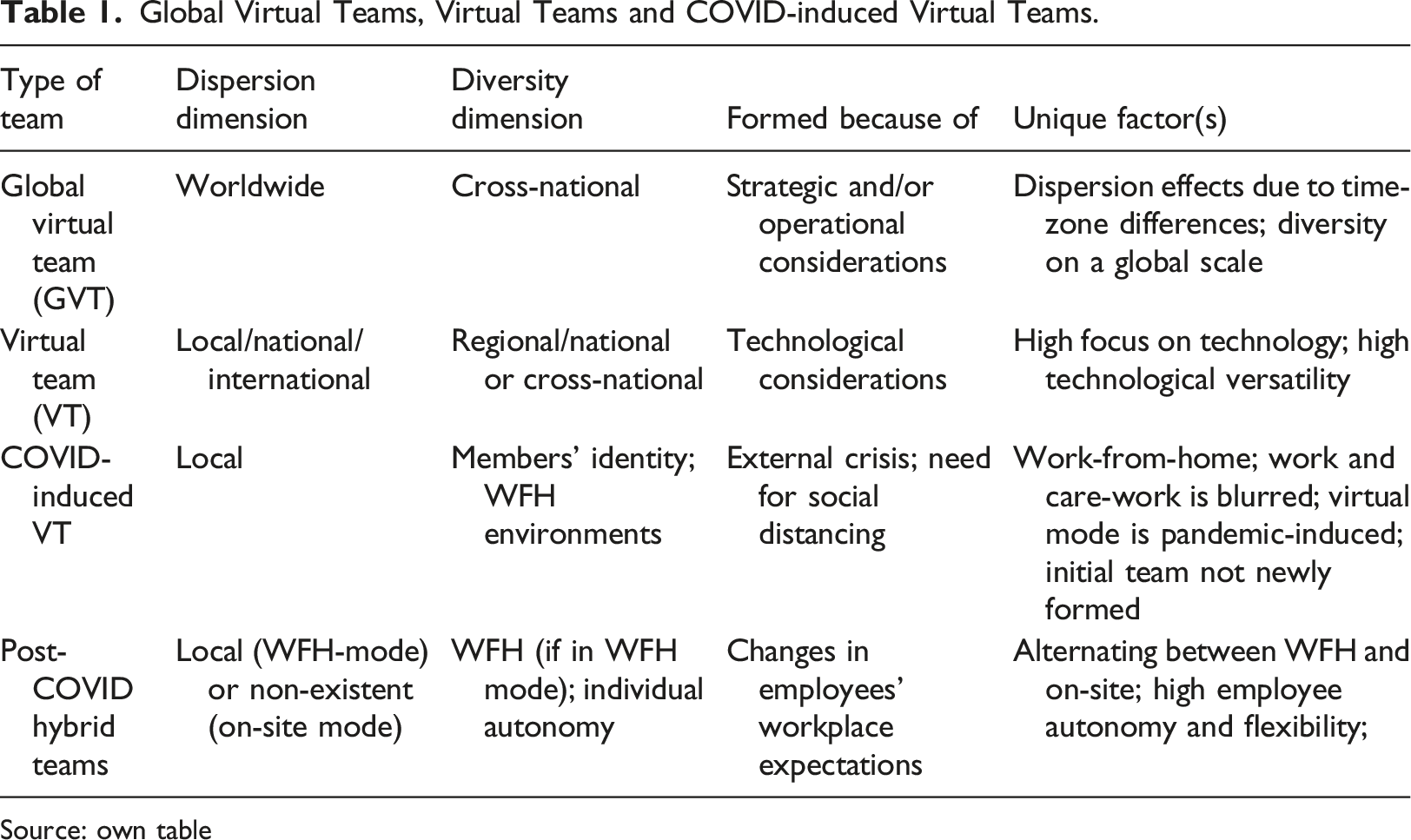
Virtual teams are usually differentiated into global virtual teams and non-global virtual teams (DiStefano and Maznevski, 2000, Liao, 2017, Martins and Schilpzand, 2011, Maznevski, 2012). Non-global virtual teams lack the worldwide dispersion and cross-national cultural diversity of global virtual teams (see Martins and Schilpzand, 2011); they are usually formed if technology is a key element of the team’s operations and goals, and if members’ technological versatility allows for it. Cultural intelligence is assumed to contribute strongly to the performance of both global and non-global virtual teams (Maznevski and Chudoba, 2000, Mangla, 2021, Nemiro et al., 2008, Presbitero, 2016, 2019). As a particularity compared to the existing types of virtual teams, COVID-induced virtual teams constitute of dispersed team members who work in highly diverse work-from-home environments. The team is formed due to external crisis (see before).
Global Virtual Teams, Virtual Teams and COVID-induced Virtual Teams.
Source: own table
Table 1 also depicts the novel conditions of a post-pandemic hybrid mode of work. Post-COVID hybrid teams alternate between a work-from-home and an on-site mode, and the requirements for doing so are also induced by a change in employees’ workplace expectations, in particular as related to a change in work-life-balance requirements and considerations. As work-from-home now becomes part of the ‘regular’ mode of team collaboration, the team is then characterized by a higher degree of flexibility and individual autonomy. Consequently, team-processes and outputs cannot be ‘controlled’ that easily, compared to a scenario where teams are virtual but not working from home (higher integrative impact of organizational culture and system), or a scenario where a local team collaborates on-site (low diversity impact, no dispersion impact).
Cultural intelligence and its relevance for COVID-induced Virtual Teams
The term cultural intelligence, also referred to as Cultural Quotient (often abbreviated to CQ), has been coined by Earley and Ang (2003), based on general research in intelligence (Sternberg, 1986). CQ is differentiated into metacognitive, cognitive, motivational, and behavioural cultural intelligence.
Research suggests that people with a higher CQ tend to expect more misunderstandings during interpersonal exchange and thus postpone their judgment until they have learned more about the situation (Brislin et al., 2006). Based on how they score for the respective CQ dimensions (metacognitive, cognitive, motivational, and behavioural), they generate multiple interpretations and have a wider range and higher versatility of action. A high CQ is thus considered to be essential for team-leaders (Leung et al., 2014).
Cultural intelligence research seeks to gather insights as to when and why individuals display culturally-intelligent behaviour (Brislin et al., 2006). A major focus of cultural intelligence research is on providing the corporate human resource (HR) function with measurable answers (assessment tools) as to “why some leaders easily and effectively adapt their views and behaviours [to a context characterized by cultural diversity] while others don’t” (Van Dyne et al., 2010: 132). For team performance and other outputs, such as learning in COVID-induced virtual teams, this question is relevant as it provides insights into why some people manage the shift between pre-pandemic and pandemic, and between pandemic and post-pandemic, easily and effectively while others do not.
Cultural intelligence is also outcome-oriented, which means that the underlying competencies and skills become visible via a person’s concrete actions in a situation (and potentially also via their reflections on past, current and future situations). Furthermore, cultural intelligence is not a fixed personality trait but acquired via learning, often from experience; it contributes to performance in a situation (Jyoti and Kour, 2015, Van Dyne et al., 2010). Any person may develop their cultural intelligence via reflecting upon their own points of view or via readjusting their own behaviour (Ang et al., 2007, Presbitero, 2019) However, some personality traits like openness, extraversion or conscientiousness were found to be linked to some of cultural intelligence´s dimensions (Ang et al., 2006).
Exposing oneself to unfamiliar contexts and utilizing the experience for further learning is assumed to increase one’s cultural intelligence (Earley and Peterson, 2004). The major cultural shift experienced with regard to COVID-induced virtual teams is the move from a non-virtual to a virtual, coupled with the move from an on-site to a work-from-home mode of collaboration. Post-pandemic, the shift in cultural context involves the move from a virtual work-from-home to a hybrid form with collaboration alternating between work-from-home and on-site. Both shifts thus place individuals in unfamiliar cultural context, a learning setting from which CQ might be further developed.
Cultural diversity in the context of COVID-induced virtual teams
Cultural intelligence is related to an individual’s effective functioning in a context characterised by cultural diversity (Ang and Van Dyne, 2008). In the context of COVID-induced virtual teams, cultural diversity emerges from the following factors:
First, individuals today are increasingly n-cultural (Maznevski, 2020, Mahadevan, 2023), hence, they are members of, and exposed to, multiple overlapping cultures. Due to increased supra-national integration, economic interconnections, inner-societal diversity, individual mobility and migration and the increased relevance of virtual collaboration, this is also the case in the ‘home environment’. Here, cultural intelligence refers to the ability to integrate and switch between multiple cultural identities within and across multiple cultural contexts (Korzilius et al., 2017). This then implies that cultural diversity, in small contexts, manifests inside-out: it refers to the experience of difference in specific work-contexts, such as COVID-induced virtual teams (Brannen, 2020, Maznevski, 2020, Mahadevan, 2023), with team members' identities being central to it.
Second, moving a team from virtual to non-virtual changes its diversity configurations. For example, in a non-virtual environment, team-members’ culturally diverse identities (e.g. originating from ethnicity, or a family or personal history of mobility and migration) are integrated by a shared organizational culture. In a virtual environment, this integrating factor is less impactful, resulting in higher cultural diversity (Maznevski, 2012, Maznevski and Chudoba, 2000).
Third, under pandemic work-from-home conditions, the integrative force which organizational structure and culture has upon virtual teams is weakened even further and team-members’ diversity is further increased by divergent work-from-home social responsibilities (such as the need to home-school kids or not) and conditions (such as access to technology and equipment, as well as configurations of the homeworking space). This diversity then spills over to post-pandemic hybrid teams.
Active conceptualization: how does cultural intelligence manifest in COVID-induced virtual teams?
This section details the components of cultural intelligence, and then links the ensuing insights to the novel context of COVID-induced virtual teams.
The components of cultural intelligence
As discussed above, cultural intelligence is commonly divided into mental and behavioural capabilities (Ang et al., 2007, Ang and Van Dyne, 2008; based on Sternberg, 1986). The cognitive capabilities are: • •
Behavioural capabilities are related to •
Each of these dimensions involve subdimensions (Ang and Van Dyne, 2008, Earley and Ang, 2003, Van Dyne et al., 2012). Figure 1 depicts these dimensions which will be explained in the following. The multidimensionality of the CQ development process. (Source: Own figure, based on Ang and Van Dyne (2008); Earley and Ang (2003); Van Dyne et al., (2012)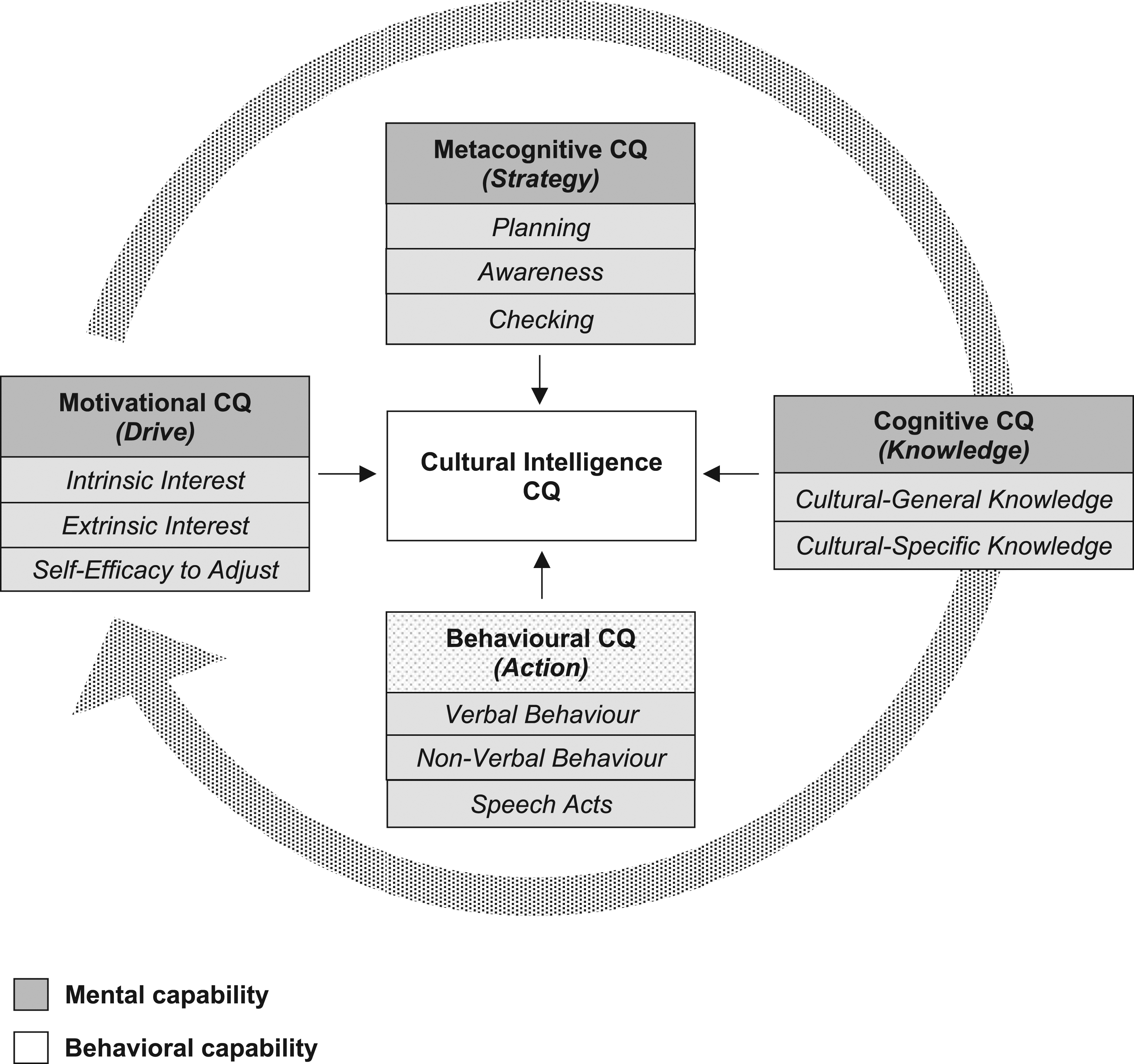
As Figure 1 highlights, the development of cultural intelligence is a constant process, with all dimensions and their sub-dimensions being interrelated. The starting point is the motivation to develop cultural intelligence (see Richter et al., 2021), and, from there, the development of cultural intelligence is ongoing and interrelated with a person’s motivation, experiences, cognition and behavior, within certain boundary conditions, and as related to others and cultural diversity in context.
Motivational cultural intelligence
Cultural intelligence´s motivational dimension (or also named CQ Drive) describes an individual’s skill of building attention and mental resources and of focusing these on a culturally unfamiliar context (Ang and Van Dyne, 2008, Van Dyne et al., 2010). Two aspects come together: (1) the individual desire to overcome discrepancies between an unfamiliar cultural context and familiar social cues, and (2) the motivation emerging from the setting or context, such as workplace atmosphere or team-culture.
Translated to the context of COVID-induced virtual teams, this then implies the following on individual, team-related and organizational levels: At the individual level, team-members' respective work-from-home environments vary considerably. People are on different schedules, depending on what extent and which social responsibilities need to be managed alongside work, and the physical conditions of the respective work-places differ. On team-related levels, leaders configure the virtual context, for instance, by proposing certain collaboration tools for the team to meet and interact and by scheduling the frequency and quantity of team interactions, either for the whole or parts of the team, or for leader-team-member exchange. At the organizational level, companies provide the framework wherein COVID-induced virtual teams act. Externally, the pandemic sets the boundary conditions, such as whether work-from-home is made mandatory or merely encouraged. Together, these factors constitute the ‘setting’ of the situation that can motivate the individual more or less. Additionally, there is the personal motivation to engage with the situation, however unfamiliar and difficult, which is the second, inner-individual component of CQ Drive. Zacher and Rudolph (2020), for example, find that some individuals cope better with pandemic-induced work-from-home and experience higher subjective wellbeing than others. High cultural intelligence drive, despite a non-cultural-intelligence-drive-inducing setting might explain this. If the situation cannot be improved or influenced by the organization, as is the case for COVID-induced virtual teams (pandemic regulations and requirements are an external input factor and can be mediated only partially), then one should seek out those individuals with a high personal cultural intelligence drive, as they experience highest learning as triggered by both shifts in cultural context (from non-virtual to virtual, and from virtual to post-pandemic hybrid). The specific components to be considered are intrinsic interest, extrinsic interest and self-efficacy to work.
Intrinsic interests defined as an individual’s basic joy in encountering unfamiliar situations, do not have to be work related. They are intangible and invisible to outsiders. Being independent from outer influences, they originate from and can only be affected by the individual themselves (Van Dyne et al., 2012). For example, it could well be that individuals with challenging social responsibilities during the pandemic, besides having to adjust to work-from-home, experience these responsibilities as externally rewarding or themselves as highly effective in the situation. This then further increases their intrinsic motivation.
Extrinsic interests provide tangible results by means of which an individual may profit from engaging with cultural diversity (Van Dyne et al., 2010). These could be higher professional status or a higher employability, but also the rewarding experience of one’s own skills having improved (Van Dyne et al., 2012). Companies may use these interests to “incentivize employees to accept and persevere in challenging cross-cultural work engagements” (Kanfer, 2012, cf. Van Dyne et al., 2012: 304), such as working under COVID-19 pandemic conditions.
Self-efficacy to adjust relates to people’s self-confidence when facing an unfamiliar situation, and their ability to challenge themselves when trying to act upon it (Van Dyne et al., 2010, Van Dyne et al., 2012). In relation to the COVID-19 pandemic, this implies that the strain of constant adjustment required in a culturally unfamiliar setting, such as COVID-induced virtual teams, is handled better or worse, depending on a person’s self-efficacy to adjust. For example, an individual or COVID-induced team who struggles with setting up and using the required ICT might experience more intrinsic interest in the situation. They then find this more rewarding, become convinced that they can handle the situation, and will thus develop even higher motivational cultural intelligence. This then implies, rather than taking the objective conditions of COVID-induced work at face value, companies should examine the motivational dimension behind them, as related to diverse individuals, and as differentiated into intrinsic and extrinsic interest, and the self-efficacy to adjust.
Cognitive cultural intelligence (CQ knowledge)
Cognitive cultural intelligence, or CQ Knowledge, firstly refers to how much a person knows about an unfamiliar cultural context (Ang et al., 2011). Second, it covers an individual´s ability to embed themselves into a novel context and to reflect upon cultural diversity and contextual differences in relation to it (Ang and Van Dyne, 2008). For example, a person might be less or more experienced in virtual team work. This is the first component of cognitive cultural intelligence (cultural-specific knowledge). A person might also view the situation as more or less challenging: Consequently, the individual does not experience diversity to be an identity and competency challenge (Dyne et al., 2010). This is the second dimension of accepting diversity as a cultural normality (
For the context of COVID-induced virtual teams, this suggests that organizations should not only focus on training employee’s specific skills and knowledge regarding virtual work or concerning future work in post-COVID hybrid teams (culture-specific knowledge), but also pay attention to people’s general versatility of knowledge when it comes to new and unfamiliar work contexts. This influences how well they manage the two shifts associated with COVID-induced virtual teams: from non-virtual to virtual, and from virtual to hybrid. Furthermore, to achieve the fullest outcome, cognitive cultural intelligence needs to be combined with the other cultural intelligence dimensions (Ang et al., 2011).
Metacognitive cultural intelligence (CQ strategy)
Metacognitive cultural intelligence (CQ Strategy) describes an individual’s ability to adapt their own way of thinking when finding themselves in a culturally unfamiliar situation. It refers to the ability of devising novel strategies, with the aim of constantly improving one’s own practices in relation a novel cultural context. This is achieved via constantly questioning and analysing one’s own and others’ thoughts and behaviour in a situation, a process out of which deeper insights emerge (Ang and Van Dyne, 2008, Van Dyne et al., 2010). Individuals exhibiting high metacognitive cultural intelligence are able to assess their actions and, if required, to revise them (using CQ Knowledge) in order to achieve the desired outcomes (Ang and Van Dyne, 2008).
Specifically, CQ Strategy involves three specific metacognitive self-regulated mental processes. These are planning, awareness and checking (Van Dyne et al., 2012). Figure 2 provides an overview.
Planning
is defined as the ability to plan and prepare oneself prior to a situation; it does not only involve self-reflection, but also the process of ‘thinking ahead’ by considering how oneself and others might behave in the situation and what the resulting effects might be (Van Dyne et al., 2010, Van Dyne et al., 2012). This implies that the more people engage with future work-scenarios, by asking themselves questions such as: ‘what will happen to my present COVID-induced virtual team work-environment post-pandemic?’, the more differentiated and applicable approaches they will find to improve upon the situation.
Awareness
In constrast to planning, which refers primarily to the cognitive work to be done prior to a situation arising, awareness is defined as the ability to be self-aware about one’s own and others' knowledge of the situation, and how it comes into being (Van Dyne et al., 2010). For instance, during the COVID-induced virtual team phase, a leader would first need to assess under which work-from-home conditions individual team-members perform and then assess specific behaviours, such as the degree of availability for virtual exchange or team-internal variations in response time, in light of this information. As Stärkle and Mahadevan (2022) suggest in their empirical study on leadership in COVID-induced virtual teams, team-members – compared to a pre-pandemic setting – require a higher amount of empathy from their leaders, and, if team-members feel ‘seen’ in their individual work-from-home conditions, are more motivated to contribute to the team and also perceive a more trustful relation to their leaders. This then leads to team-members contributing more equally to formal team-interactions, such as virtual meetings, the purpose of which is to install a sense of fairness and task-related trust.
Checking
relates to the practice of evaluating and monitoring deep assumptions based on novel input, and to be able to adapt them, if required (Van Dyne et al., 2010, Van Dyne et al., 2012). Checking thus integrates self-regulation, conscious reflection and learning from experience (Van Dyne et al., 2010, Van Dyne et al., 2012).
Translated to the context of COVID-induced virtual teams, this then implies that the pandemic impacts upon organizations in waves and that teams are required to alternate between virtual, non-virtual and hybrid phases, based on the existing regulations at a certain point in time. For instance, in Germany, work-from-home was recommended on 02 November 2020, made mandatory on 16 December 2021 and step-by-step phased out after 10 May 2021, until it was recommended again in November 2021 (BMfG, 2021). Each shift puts a COVID-induced virtual team and its members into a novel situation, and, for better performance and learning, the degree of planning, awareness and checking associated with each of these shifts needs to be enhanced, both on individual and team levels, preferably also on organizational level.
Behavioural cultural intelligence (CQ action)
Behavioural cultural intelligence, also referred to as CQ Action, covers an individual´s ability to behave appropriately in verbal and non-verbal ways under the conditions of cultural diversity (Ang and Van Dyne, 2008). COVID-induced virtual teams can be assumed to involve a high degree of cultural diversity, as the integrative force of organizational and team culture, processes and practices are less impactful upon the team. In addition, divergent work-from-home environments, and different individual sensemaking with regard to them, further increase diversity.
CQ Action is the dimension which puts the three mental cultural intelligence capabilities into practice and delivers outcome on them; it is thus another critical cultural intelligence component (Ang et al., 2011, Ang and Van Dyne, 2008, Van Dyne et al., 2010). A person displaying high behavioural cultural intelligence succeeds in minimizing misattribution and misperception (Van Dyne et al., 2012) and is able to identify when and how it is (not) appropriate to adapt their own behaviour (Van Dyne et al., 2010). CQ Action is thus underpinned by behavioural flexibility and by taking behavioural risks beyond one’s comfort zone.
For instance, behavioural requirements such as how to interact in a meeting, vary considerably between virtual and non-virtual teams. Virtual communication richness is lower, non-verbal communication clues are often not transmitted, and context is virtually non-existent (Maznevski, 2012). This could inhibit virtual team leaders from constantly interacting with their team members (Saarinen and Piekkari, 2015). Communication richness is further diminished by asynchronous communication, such as e-mails (Jonsen and Gehrke, 2014). Furthermore, social exchange, as a major means of informal task-related and social exchange and trust-building, is severely hampered in a team that only relies on virtual collaboration (Maznevski, 2012, Jarvenpaa and Leidner, 1999). The recommendation for virtual teams is thus to have face-to-face interactions intermittently to refresh both personal- and task-related trust and to benefit from rich communication (Jonsen et al., 2012; Prasad and Akhilesh, 2002). This option does not exist for COVID-induced virtual teams which, at certain points in time, which are not of their own choice (pandemic requirements), are confined to existing purely virtual. For managing this challenge, flexible solutions in action (high behavioural cultural intelligence) are required.
Providing an example of the difference which high cultural intelligence action might make, Bacher and Mahadevan (2022) find in their empirical study on perceived organizational membership in COVID-induced virtual teams that ordering meetings and making meeting contributions in a virtual team and via ICT meeting tools are experienced as radically different compared to non-virtual teamwork by those members and leaders of COVID-induced virtual teams who have no or only limited prior experience with virtual team collaboration. Interviewees report to have tried out a variety of solutions to remedy the shortcomings of communication, within an organizational template or support-system in place. Supporting COVID-induced virtual teams in the process of trying out solutions and providing them with cross-team insights into practice thus capitalizes upon existing behavioural cultural intelligence and further helps develop CQ Action.
Van Dyne et al. (2010, 2012) recommend focussing on three sub-categories of CQ Action for developing this component of cultural intelligence. These are verbal behaviour, non-verbal behaviour and speech acts.
Verbal behaviour
in a cultural intelligence context, refers to speaking faster or slower, or louder or softer, and the variation of tone of voice. Furthermore, it includes the usage of enthusiasm, the warmth of speech and expression-based formality, as well as when to pause and when to speak (overview in Van Dyne et al., 2012). The higher the degree to which individuals can modulate their verbal behaviour, depending on contextual requirements, the higher the behavioural cultural intelligence displayed. For instance, virtual communication requires less overlap, one speaker and one conversation at a time, and higher clarity of content. If one lives up to the challenge (CQ Drive), learns more about meeting tool functionality (CQ Knowledge) and reflects upon how to meet virtually prior, during and after the meeting, and adjusts accordingly (CQ Strategy), one might identify additional opportunities such as using the chat function alongside the ongoing main conversation. Putting these new modes of verbal communication into practice is part of CQ Action.
Non-verbal behaviour
covers versatility concerning types of communication that exclude usage of voice, such as eye contact, distance, touch, gestures, facial expressions, dress code conventions, and formality of attire (Van Dyne et al., 2012). It is the part that makes communication rich. As COVID-induced virtual teams are confined to solely virtual work in many phases of their collaboration, they thus suffer from a lack of richness in communication. In virtual work, non-verbal behaviour involves the ‘image’, also of the workplace, which is projected to others. As people often worked from an inadequate workspace, it is difficult to project an image of ‘professionalism’ in COVID-induced work, and, if not reflected upon, this might impact negatively upon the trust placed in people’s capabilities. It is thus all the more important that team-members reflect upon their work-from-home setting, and on what they project to others, and how they would like to be perceived by them. In a second phase, organizations should support this process, potentially also by means of guidelines.
Speech acts
refer to expressing oneself in ways which are deemed appropriate in a cultural context (Van Dyne et al., 2012). For instance, in their empirical study on leadership in COVID-induced virtual teams in Germany, Stärkle and Mahadevan, (2022) find that team-members have a higher need for empathic, non-confrontational speech acts by their leaders, compared to the non-virtual environment and also in contrast to German business communication norms which tend to focus on clarity, assertiveness and directness. Figure 2 Metacognitive CQ and timeline of learning. Source: own figure, based on Van Dyne et al. (2012).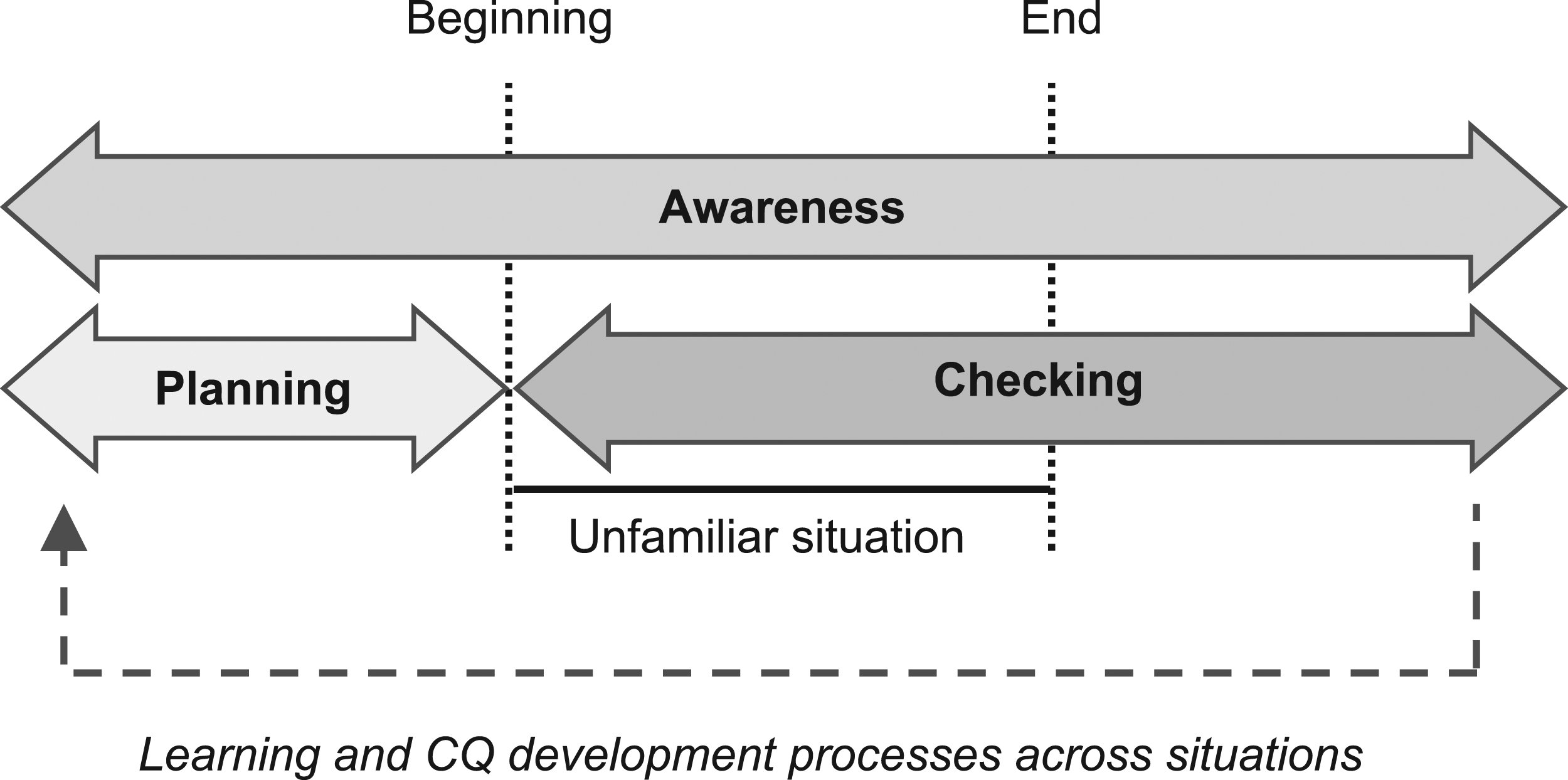
Managerial implications: cultural intelligence development in and beyond COVID-induced Virtual Teams
For cultural intelligence to show and develop, all four CQ components interrelate with context, in this case: COVID-induced virtual teamwork. The previous sections have elaborated upon the purported components of CQ outlined in the literature, also in relation to COVID-induced virtual teams, and have detailed the unique characteristics of COVID-induced virtual teams. This section brings the previous aspects together in a cultural intelligence learning cycle for COVID-induced virtual teams, with ensuing implications for cultural intelligence development in post-COVID hybrid teams.
Represented in Figure 3, The CQ development and learning cycle. Source: own figure.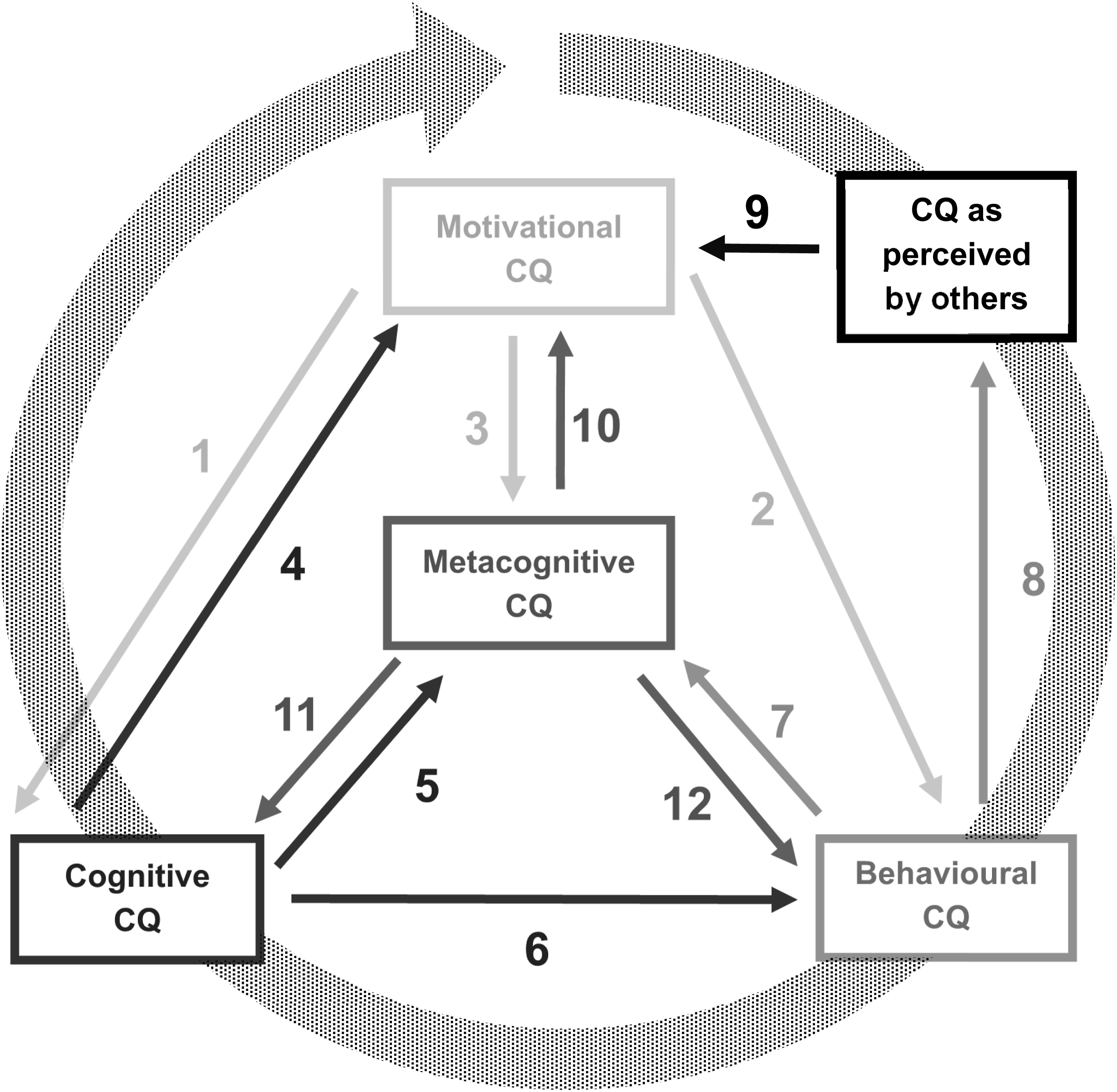
The degree of motivational cultural intelligence in a COVID-induced virtual team is essential for the further dynamics and performance of the team. Individuals exhibiting high motivational cultural intelligence despite crisis should be identified and supported to develop best team practices. Companies should seek to understand why and how some individuals show and maintain high motivational cultural intelligence and support the conducive factors accordingly. As a particular challenge induced by the COVID-pandemic, team members need to manage work and home life in parallel, and companies thus also need to manage the motivational factors associated with people’s non-work-related identities.
Again referring to Figure 3,
The degree of initial cognitive cultural intelligence in COVID-induced virtual teams must be assumed to be low, as both crisis and virtual work are new to most or all team-members. It is thus essential that the team is provided with appropriate learning and development opportunities, for example concerning crisis management, virtual work tools, or virtual team characteristics and dynamics. Individuals with prior knowledge, as related to crisis management and/or virtual work, should be identified and supported to develop team and organizational best practices.
Behavioural CQ
as shown in Figure 3, derives its ‘data' from the cognitive and metacognitive CQ components, while being enhanced or inhibited by the motivational dimension. By actively interacting with others, the behavioural part feeds the metacognitive dimension with information (7) and also creates CQ as perceived by others (8) so that the feedback received can be evaluated sooner or later. It is also the dimension which is most visible to others and which thus also significantly influences the degree of cultural intelligence perceived by others as impacting upon one's own motivation (9). Behavioural cultural intelligence is thus the ‘exhibition window' by means of which an individual showcases their cultural intelligence skills and exemplifies their adaptive capabilities to others. Depending on the feedback received by others, the motivational dimensions can be positively or negatively affected (10). For example, the positive perception of one's own skills by others might enhance future motivation, while a negative one could diminish it.
The degree of initial behavioural cultural intelligence in a COVID-induced virtual team must be assumed to be low, due to the stated lack of experience with crisis and, for many, also with virtual work. It is thus essential that team leaders introduce appropriate behavioural templates to the team (and are coached in how to do so) in order to facilitate a positive perception spiral on individual and team level.
Metacognitive CQ
is the ‘heart' of culturally intelligent thinking and behaviour which keeps the “CQ engine” running, once started. It enables individuals to constantly re-evaluate decisions made, and thus affects all other CQ dimensions directly or indirectly. It permanently ‘updates' the cognitive CQ database after a situation (see 11, in Figure 3), feeding it with new perceptive input. Also, metacognitive cultural intelligence facilitates the planning of present and future behaviour (12, in Figure 3) and fosters awareness regarding it. Without it, all cultural intelligence processes would be decelerated, eventually even shut down. With it, individuals continue to learn and to improve their cultural intelligence constantly from each ‘cycle' to the next.
Metacognition does not emerge automatically in a virtual team, especially if this team is working under the conditions of urgency, uncertainty and threat, as it is the case for COVID-induced virtual teams. Therefore, leaders and team-members should be supported in planning for and implementing appropriate joint and individual ‘reflection points’ in their daily work routines. As learning, potentially even transformation, constitutes a high-potential output factor of COVID-induced virtual teams, it is even more essential than in non-crisis virtual teams that learning effects are transferred across team-phases and contexts (non-virtual, virtual, hybrid). After the immediate threat of crisis has been vanished, as is the case post-pandemic, teams should thus be encouraged to pause and reflect, in order to not lose the learning from the experience.
Summary of implications
As all these CQ dimensions reported in the literature rely on each other up to a certain degree, the process of further developing them is open-ended and ongoing, without an objective maximum outcome. Nonetheless, it is possible for companies to support key processes in order to facilitate the development of cultural intelligence in COVID-induced virtual and post-COVID hybrid teams. In summary, these are: • Identifying the factors contributing to high motivational cultural intelligence and acting upon them.
Wider implications
The COVID-19 pandemic exposed people to a novel cultural context, namely to COVID-induced virtual teams, that – as discussed above – appear qualitatively and dynamically different to the types of cross-cultural virtual teams previously discussed in the extant literature. Generally speaking, high cultural intelligence enables people to make sense out of unfamiliar actions or situations in such a way that they are able to re-adjust their previously held assumptions. For example, an individual might face a novel cultural context, such as COVID-induced, now virtual, team-work, with team-members located in divergent work-from-home environments. Work-from-home increases diversity in the team, because social responsibilities in the work-from-home environment, as well as the technological and physical work-from-home conditions available to an individual differ greatly within the team. This then influences, for instance, time management, scheduling, availability and, generally, behaviour of team-members during formal interactions and over the course of the day. For example, in many countries, schools were closed during the COVID-19 pandemic at the same time when work-from-home was employed in order to contain infection rates. This then implies that some team-members had to manage school and work in parallel whereas others were free of such obligations. Depending on the available equipment and on who (and how many) need network access and for what purposes from home, technological infrastructure might vary greatly across team members. Depending on the physical conditions, some team-members might have access to a separate office room at home, whereas others need to work in the kitchen or elsewhere. As these conditions and social obligations are not visible to other team-members, and due to the lower richness of virtual team communication compared to on-site interactions (see Maznevski, 2012, Jonsen et al., 2012), familiar templates of ‘what the situation means’ and how one should act upon it, fail to prove conclusive.
The need for developing cultural intelligence is triggered by finding oneself in situations which are incongruent to previous experiences and which are related to major shifts in circumstances (Erez et al., 2013). The change from a virtual to a non-virtual mode as induced by the COVID-19 pandemic constitutes such a shift. Cultural intelligence as a multi-dimensional framework integrates individual and context-related factors and thus enables a systematic and patterned analysis of this novel situation. If one considers culture in the sense of a contemporary cross-cultural management studies, namely as related to people’s cultural identities in shifting cultural contexts, also on sub-national, supra-national, global and virtual levels (Bird and Mendenhall, 2016; Brannen, 2020; Mahadevan, 2023; Maznevski, 2020; Szkudlarek et al., 2020), cultural intelligence is also a tool for assessing change and transformation.
Furthermore, the ways in which people’s cultural identities are relevant at work is changed by the increased impact of a variety of work-from-home arrangements (Shaik et al., 2020), such as the ones manifesting in COVID-induced virtual teams and post-COVID hybrid teams. This then underscores the relevance of a creative usage of classic cross-cultural management concepts, such as cultural intelligence, for understanding organizations and people at work.
What is peculiar about COVID-induced virtual teams is that they were not formed out of operational or strategic considerations, and individuals did not choose to engage with this novel context voluntarily. Rather, organizations and employees were thrown into an unfamiliar cultural context involuntarily by external crisis conditions. Cultural intelligence in the context of COVID-induced virtual teams is thus primarily about the degree to which people act easily and effectively upon an unwanted situation and utilize the experience for further learning. Understanding this is highly relevant in a cross-cultural management environment that is characterized by an increasing number of ‘unchosen’ encounters with cultural diversity. For example, expatriates seldom choose their destination freely when being sent abroad by their company – rather, this choice is largely determined by organizational and other requirements. Some migrant groups, such as refugees, are on the move involuntarily and are now asked to embrace the new environment and integrate into it. People who do not travel abroad live in culturally diverse neighbourhoods and – even if they are not motivated to do so – need to face the reality of cultural diversity, and figure out what it means for them. A better understanding of how cultural intelligence develops under the conditions of ‘unwanted cultural diversity’, in an unfamiliar cultural context which is not self-chosen, might enable cross-cultural management studies to provide relevant advice on these matters.
COVID-induced virtual teams are also characterized by specific configurations of diversity and dispersion, in particular as related to divergent work-from-home environments, and the lack of an integrating impact of organizational culture and structure. This poses unexpected challenges for team leaders and members, and it might also change the power-configurations of the team. For example, as Jackson (2022) reflects upon critically, intelligence is a culture-bound and also vague concept which, if tested, tends to favour majority individuals over minority individuals. The more familiar a person is with a cultural context, the more likely they are to score high on intelligence. In light of the discriminatory potential of how cultural intelligence is constructed and measured, and the vagueness of the underlying concept of ‘intelligence’, Jackson (2022) therefore poses the question whether cross-cultural management scholars and practitioners should stop testing for cultural intelligence.
This article proposes another solution, namely to investigate novel contexts that have the potential to ‘level the playing field for all’. The shared experience of the COVID-19 pandemic was that people across the globe were thrown into a new mode of work involuntarily and without preparation. Whilst access to technology and equipment, also to a homeworking space, differed across individuals, teams, organizations and even countries (these being severe inequalities), the novelty of the situation nonetheless enabled individuals, teams, organizations and even countries to act upon the situation as they saw fit and to find their own ‘intelligent’ situations beyond established frames. The experience of working in COVID-induced virtual teams, beyond its specifics, thus bears the wider potential of identifying those elements of cultural intelligence measurement which are biased and to re-design them in a new light, thus moving the discipline towards a fairer and more inclusive assessment of what constitutes high performance in a culturally diverse context. A potential starting point for doing so might lie in assessing how ‘cultural distance’ across individuals has been refigured by a COVID-induced virtual team setting, and to analyse cultural intelligence development from this perspective (e.g. in light of the work of Iskhakova and Ott, 2020).
Summary and conclusion
This article has brought together two previously unrelated concepts, namely cultural intelligence and COVID-induced virtual teams. These teams are characterized by specific diversity and dispersion dimensions which impact upon future workplaces. In particular, the diversity and dispersion effects induced by divergent work-from-home environments, and individuals’ diverse interpretations, motivations and expectations regarding these factors, are going to impact post-COVID hybrid work in the future.
Transferring learning from COVID-induced virtual teams in order to achieve transformation beyond crisis is thus highly relevant to contemporary management and organizations. For this, one needs to employ a structured and systematic approach to who performed well, and why and how exactly, and under which circumstances, during the COVID-19 pandemic. This article proposed the classic concept of cultural intelligence as a suitable tool for doing so.
Understanding the impact of cultural intelligence on COVID-induced virtual teams is highly relevant in order to leverage the potential of the COVID-induced global remote work transformation. In particular, the diversity of people’s experiences and work-from-home conditions in COVID-induced virtual teams bears high potential for learning and transformation. To facilitate the development of cultural intelligence, companies are asked to seek out those individuals and teams who displayed high motivational cultural intelligence despite crisis conditions and to identify the underlying reasons, to support the development of motivational and cognitive cultural intelligence post-pandemic, and to introduce metacognitive reflection points within and across teams and phases, in order to foster transformation. As a next step, these patterned suggestions need to be researched upon empirically. By means of active engagement with the concept of cultural intelligence, aiming at its re-categorization in light of a novel cross-cultural management context, this explorative article has led the conceptual groundwork for doing so. On a meta-theoretical level, the current work has also exemplified the disciplinary benefits of a creative usage and active re-categorization of classic cross-cultural management concepts.
Footnotes
Acknowledgments
Many thanks go to Editor-in-Chief Terence Jackson for his editorial guidance and to the two anonymous reviewers of this article. An earlier version of parts of this argument was presented at the European Academy of Management Annual Conference, June 2022, Winterthur/Switzerland.
Declaration of conflicting interests
The author(s) declared no potential conflicts of interest with respect to the research, authorship, and/or publication of this article.
Funding
The author(s) received no financial support for the research, authorship, and/or publication of this article.
