



Abstract
The formation of boundaries between established and emergent categories is a complex social process. Therein, our understanding of how symbolic boundaries translate into regulatory boundaries is underdeveloped. Extant research either treats laws and regulations for categories as given or assumes a seamless translation of a symbolic into a regulatory boundary. This sidelines that market participants actively contest and shape boundaries between categories. To address this lacuna, we open the black box of how symbolic boundaries are translated into regulatory boundaries. We adopt a discursive perspective and conduct a longitudinal study of the contestation around the categories of home sharing and short-term rental in Europe. Our analysis shows how symbolic and regulatory boundaries are formed in a causal sequential process, driven by shifts in the field positioning of market actors and in the discursive accounts they mobilize. We develop a theoretical model of the discursive foundation of category boundary formation. At the heart of our theorization are discursive accounts and how shifting coalitions of market participants mobilize them to shape the evolving symbolic and regulatory boundaries between an emergent and an established category. We contribute to category research by unearthing the interdependent formation of symbolic and regulatory boundaries and the role of discursive accounts in these processes.
Category boundaries matter, because they shape how producers and their products are interpreted by intermediaries (Rao, Monin, & Durand, 2005), experienced by customers and consumers (Hsu & Grodal, 2021), and valued normatively (Arjaliès & Durand, 2019). While early research on categories was concerned with identifying category boundaries and assessing the implications of not falling neatly within them (Zuckerman, 1999), in recent years scholarship has shifted attention toward problematizing category boundaries (Durand & Paolella, 2013). This shift in attention puts questions of how category boundaries are formed, and how they undergo change over time, to the forefront (Boghossian & David, 2021; Durand & Khaire, 2017; Kodeih, Bouchikhi, & Gauthier, 2019; Lee, Hiatt, & Lounsbury, 2017).
To advance the understanding of how market participants navigate and actively contribute to the formation, contestation, and endurance of category boundaries, research has often focused on symbolic boundaries (Grodal, 2018; Lockwood, Glynn, & Giorgi, 2023). As “socially constructed interpretive distinctions concerning concepts” (Langley, Lindberg, Mørk, Nicolini, Raviola, & Walter, 2019: 705), symbolic boundaries are important for market participants’ access to resources (Lamont & Molnár, 2002). Another stream of research has looked at the role of regulatory boundaries of categories. Referring to demarcations between laws and regulations (see Ruef, 2000), regulatory boundaries set more or less constraining “legal limitations on the production and sales of products [or services]” (Ozcan & Gurses, 2018: 1789). Regulatory boundaries are important, as they affect market participants’ decisions, costs, and benefits (Funk & Hirschman, 2014; Ozcan & Gurses, 2018).
How regulatory boundaries come into being is not well understood. An established body of work has investigated settings where laws and regulations are already in place. This research focuses on questions related to the applicability of existing “legal limitations” (Andersen, Frederiksen, Knudsen, & Krabbe, 2020). For example, Ozcan and Gurses (2018) study how dietary supplement producers fought to avoid their goods becoming legally categorized as drugs because an extra regulatory burden would have stifling implications. Yet, this literature stream provides limited insight into how regulatory boundaries are formed.
We propose that the key to understanding the formation of regulatory boundaries is to study the relationship between symbolic and regulatory boundaries. Prior literature has developed largely independently from each other, looking at the evolution of either a symbolic (e.g., Lockwood et al., 2023) or a regulatory boundary (Funk & Hirschman, 2014). There is an implicit assumption in the literature that symbolic boundaries seamlessly translate into corresponding regulatory boundaries (Lamont & Molnár, 2002). By taking existing laws or regulations as the starting point, or by assuming that regulatory boundaries evolve to mirror symbolic boundaries (Hsu & Grodal, 2021), prior category research misses out on revealing possible interdependencies between boundary formation processes. This lack of attention is surprising, because the literature suggests that boundary formation is a social process (Durand, Granqvist, & Tyllström, 2017) that can be very contested (Jones, Maoret, Massa, & Svejenova, 2012). To open the black box of category boundary formation, we ask, How are symbolic boundaries shaped and translated into regulatory boundaries?
To address our research question, we study the emergent home-sharing category in Europe. As in the sharing economy more generally (Phung, Buchanan, Toubiana, Ruebottom, & Turchick-Hakak, 2021), demarcations between existing and new business models and practices are precarious and subject to contestation. In our case setting, this involved the emergent category of home sharing versus the established category of short-term rental. With regulations being a moving target, providers have to anticipate and/or may actively shape ensuing regulations (Gao & McDonald, 2022).
Leveraging a longitudinal qualitative research design, we zoom in on the contestation between home sharing and short-term rental. We reveal how the symbolic and regulatory boundaries between the two neighboring categories changed over time and eventually became strong. Importantly, this was not an automatic process. Rather, we analytically link the relative strength of symbolic and regulatory boundaries to key dynamics as they emerged from our data: shifts in the field positioning of market participants and shifts in the discursive accounts they mobilized for the purpose of category contestation. On the basis of our empirical findings, we develop a model that explains the formation of symbolic and regulatory boundaries between an emergent and an established category. We theorize how this formation process involves a sequential relationship (a symbolic boundary precedes a regulatory boundary) and how these outcomes result from market participants’ discursive accounts through which they contrast categories (leading to a strong symbolic boundary) and express compromising motions (leading to a strong regulatory boundary).
Our study makes several contributions to category research. First, we complement prior work by looking at the evolution of both symbolic and regulatory boundaries between an emergent and an established category. To date, we have an incomplete understanding of how regulatory boundaries form in relation to symbolic boundaries. Our study fills this important gap in our knowledge by developing theory on the interdependent formation of boundaries. Rather than being a mere translation of a symbolic into a regulatory boundary, our analysis reveals crucial differences in the contestation about these different kinds of boundaries in terms of market actors’ positioning and discursive accounts mobilized. By opening the black box of the social underpinnings of the translation of a symbolic into a regulatory boundary, we identify a strong symbolic boundary as a necessary but not sufficient condition for the formation of a strong regulatory boundary.
A second contribution of our research lies in extending the emerging discursive perspective on categories and categorization by going beyond the identification of isolated discursive activities, such as narratives, metaphors, or stories (Granqvist & Siltaoja, 2020). Complementing this prior work, we identify a set of discursive accounts through which market participants contest the boundaries between an emergent and an established category. Specifically, we show how market participants mobilize discursive accounts in a patterned way, targeting primarily the symbolic or the regulatory boundary, respectively, thereby driving the symbolic and regulatory demarcation between two categories over time.
Finally, we contribute to a more nuanced understanding of market participants in category research. Concretely, we move beyond established distinctions of contesting market participants, namely, challengers and incumbents (Durand & Khaire, 2017; Gurses, Yakis-Douglas, & Ozcan, 2022), core and peripheral stakeholders (Grodal, 2018), or proponents and opponents (Mathias & Fisher, 2022). We unpack substantial dynamics concerning the positioning of providers in shifting coalitions, which add nuance to the assumption that new entrants into a field seek contrast with established actors (Lee et al., 2017), and challenge the prevailing idea in the literature that market participants are part of a relatively clearly defined cohort (Aversa, Huyghe, & Bonadio, 2021; Gurses & Ozcan, 2015).
The Social Underpinnings of Categories
Research on categories has evolved from producing evidence that boundaries are important in affecting the fate of products and producers (Zuckerman, 1999). For example, it emerges that different audiences react differently to the crossing of category boundaries (Paolella & Durand, 2016; Pontikes, 2012). A parallel development in the literature is an increasing focus on how boundaries are formed, maintained, and adapted (Cattani, Porac, & Thomas, 2017; Grodal, 2018). This line of research puts market participants’ activities, as they navigate and influence category boundaries, into focus. For example, Lee et al. (2017) unpack how standard-setting bodies draw boundaries that demarcate who does or does not count as part of a category, in their case, organic farming. In another study, Rao et al. (2005) show how French chefs contributed to a blending of previously competing categories.
These findings are often couched in a discussion of specific types of boundaries. The majority of studies has looked at symbolic boundaries—the meaning and shared understanding of a category (Siltaoja, Lähdesmaki, Granqvist, Kurki, Puska, & Luomala, 2020). Less attention has been paid to the regulatory boundary of a category. The little we know in this space either takes an existing regulatory boundary as the starting point or assumes that a symbolic boundary seamlessly translates into a corresponding regulatory boundary. For example, Hsu and Grodal (2021) show how a weak symbolic boundary between e-cigarettes and combustible cigarettes led regulators to codify e-cigarettes as tobacco products, indicating an alignment of symbolic and regulatory boundaries. However, the process through which such a mirroring or alignment occurs is black boxed. This is surprising because recent advancements in the literature have shifted attention away from categories as cognitions toward conceiving of categories as social phenomena (Durand et al., 2017). This suggests that boundary formation between different types of boundaries should not be automatic, but our understanding of this process is still underdeveloped.
The Relationship Between Symbolic and Regulatory Category Boundaries
Category boundaries have long fascinated scholars in organization theory (Lamont & Molnár, 2002). Fundamentally, boundaries demarcate markets and organizational fields. A predominant focus in the literature has been put on the symbolic boundary (Navis & Glynn, 2010; Weber, Heinze, & DeSoucey, 2008) or questions of how a field acquires its meaning and how field members develop a shared understanding and collective identity. The demarcation of a symbolic boundary is important because it determines access to resources (Grodal, 2018), and it offers a possible reference for new entrants to position against by emphasizing their distinctiveness and moral supremacy (Hsu & Grodal, 2021). Prior work has provided insights into the contestation over symbolic boundaries. For example, Jones et al. (2012) explored how the symbolic boundary of modern architecture has been expanded to cover a more diverse range of buildings, and Grodal (2018) unpacked how core and peripheral communities have struggled over the symbolic boundary of nanotechnology, expanding and contracting its definition over time.
A less dominant parallel stream of research studies the regulatory boundary of categories. Seminal work conceived of a field’s regulatory boundary as the starting point of research (e.g., Anteby, 2010), for example, suggesting that “[l]egal activity is a visible manifestation of the relevant actors in an organizational field” (Hoffman, 1999: 354). Correspondingly, a key focus has been put on answering the question of if an existing law or regulation is applicable to a certain product or service or how a newly introduced regulation or standard reshapes an industry (Dinçkol, Ozcan, & Zachariadis, 2023). While this ex ante view on regulatory boundaries has allowed intriguing insights into positioning tactics of individual producers in the market, like Dr. Pepper; individual providers, like Uber (Vergne & Wry, 2014); or new entrants into a market (Aversa et al., 2021), much less attention has been paid to how regulatory boundaries are formed in the first place.
There is a sometimes implicit assumption that regulatory boundaries evolve in tandem with symbolic boundaries. For example, Vergne and Wry (2014: 68) posit that regulatory recognition is a key condition for the existence of a category, speaking of an interwovenness of “material and symbolic aspects of categories.” Indeed, the symbolic and regulatory boundaries of the nanotechnology field have largely developed in concert (Granqvist & Laurila, 2011). Furthermore, Hsu and Grodal (2021) show how a weak symbolic boundary between e-cigarettes and combustible cigarettes translated rather seamlessly into a regulatory boundary, establishing regulatory equivalence. Along similar lines, Funk and Hirschman (2014) suggest that a fuzzy symbolic boundary translates into an equally fuzzy regulatory boundary. Specifically, their study traces the emergence of swap instruments and how their nature as an ambiguous financial innovation led to a similarly fuzzy regulatory landscape with the demise of Glass-Steagall, which had created strong regulatory boundaries between commercial and investment banks—boundaries that became undermined in the process.
Not knowing how the alignment between two boundaries occurs poses an important research problem: without understanding the relationship between symbolic and regulatory boundary, we are left with a partial view on category boundary formation. Specifically, we miss out on the opportunity to understand how regulatory boundaries are socially constructed and how they result from contested processes among diverse actors (Mathias & Fisher, 2022). To provide insights into the social underpinnings of boundary formation processes, it is critical to understand who engages with boundaries and how.
The Role of Market Participants
Research on categories takes an increasingly nuanced view on the market participants that drive categorization processes and outcomes. This involves different communities (Grodal, 2018), intermediaries (Lee et al., 2017), competitors (Kodeih et al., 2019), professions (Jones et al., 2012), and macrolevel actors, such as governments (Boghossian & David, 2021). A general assumption is that market participants possess stable membership and interests. For example, Ozcan and Gurses (2018) study dietary supplement producers in the United States and how they, as a collective with shared interests, opposed the Food and Drug Administration in its categorization attempt. Prior literature is rather silent on the possibility that actor constellations and associated interests shift over time (Grodal, 2018).
Meanwhile, the literature has started to develop an idea that not all market participants have the same tools at their disposal as they contest over category boundaries. Specifically, while large incumbents in mature markets have ample resources to engage in lobbying and other classic nonmarket strategies, ventures in nascent markets are typically less resourceful (Gao & McDonald, 2022). They will often resort to less costly and more indirect attempts at influencing regulations, such as via consumers (Ozcan & Gurses, 2018). Especially in nascent fields, market participants have been found to engage in more symbolic activities, such as discourse, or the purposeful use of text. Through discourse, normative arguments can be made (Suddaby & Greenwood, 2005) and similarities with existing technologies can be highlighted (Hargadon & Douglas, 2001). The idea that discourse constitutes a key strategic tool also finds support in neighboring disciplines. Work in political science, for example, shows how interest groups use framing strategies to direct attention according to their policy preferences and influence regulation (Klüver, Mahoney, & Opper, 2015). Beyond being tools through which regulatory boundaries can be shaped, discursive strategies can help generate shared meaning and cognitive legitimacy (Thomas & Ritala, 2022), or symbolic boundaries.
A Discursive Lens on Boundary Contestation
A growing body of research looks at the role of discourse for categorization processes. The key tenet of this literature is to “move away from viewing language as a mere representation of a category to understanding how language creates and shapes categories” (Grodal & Kahl, 2017: 152). From this perspective, language emerges as performative, rather than merely describing reality (Taeuscher & Rothe, 2024). Specifically, this emerging research stream explores how market participants leverage texts—written, oral, and visual images (Kahl & Grodal, 2016)—to influence categories. It is increasingly understood that market participants use language to ‘articulate, share, and contest meaning’ (Granqvist & Siltaoja, 2020). As such, a discursive lens can help us to understand the kinds of communicative exchanges market participants engage in as they interact for the purpose of mapping symbolic and regulatory category boundaries (Grodal & Kahl, 2017).
Category scholars frequently leverage a set of language-related concepts and constructs, such as label, narrative, and vocabulary (Granqvist & Siltaoja, 2020). Taeuscher, Zhao, and Lounsbury (2022), for instance, show how narratives can be more or less effective, depending on a category’s distinctiveness. As such, these authors look at the role of discourse after category establishment. Focusing on category formation, Khaire and Wadhwani (2010) show how art historians and auction houses introduced constructs to enable the formation of modern Indian art as a distinct category by offering a set of familiar terms that help compare artworks to “Western” modern art. Similarly, Rosa, Porac, Runser-Spanjol, and Saxon (1999) reveal the role of stories in the co-construction of the minivan category, and Lockwood et al. (2023) identify “discursive mechanisms” through which an elite category endures despite social and contextual changes.
A discourse perspective promises to uncover not only the discursive accounts (Elsbach, 1994) acting as ‘motors’ of categorization processes (Van de Ven & Poole, 1995) but also insights into the interactions of market participants, including regulators, as they co-create a category landscape (Grodal & Kahl, 2017). Discourse is composed of the texts “that market participants use to convey their viewpoint and respond to other texts” (Grodal & Kahl, 2017: 153), and it can be strategically employed to create and sustain a collective identity during category creation (Lee et al., 2017). In their recent work, Granqvist and Siltaoja (2020) define the question about the strategic use of discourse in drawing category boundaries as a key research frontier. We heed their call and focus on the formation of symbolic and regulatory category boundaries.
Method
Research Setting
Category boundaries and their formation can be studied in nascent markets, “where categorical boundaries [are] still up for negotiation” (Lee et al., 2017: 464). The home-sharing market within the wider short-term rental field in Europe constitutes such a nascent market. In this research setting, contestation over category boundaries was “transparently observable” (see Eisenhardt, 1989: 537). Guided by the insight that the “production and consumption of categories happen locally” (Grodal & Kahl, 2017: 165), we initially focused on the city of Vienna, Austria. However, and as we describe later, our data suggested a need to look beyond the city level and include the supranational level in our study. Specifically, we made the observation that the key arena for category contestation changed over time from the city to the European Union level. We thus pivoted our approach toward collecting data at both levels.
In 2018, toward the end of our observation period, according to research by DBS, the wider short-term rental market had a size of about $30 billion in Europe, about one fifth of the European hotel market. A frequent assumption in the category literature is that incumbents will seek to extend category boundaries to secure a share in market growth potentials (Wry, Lounsbury, & Glynn, 2011). Yet, in our setting, being associated with the home-sharing category came with substantial trade-offs, as some major European cities started to limit the ability of home-sharing providers, especially Airbnb, to operate.
Data Collection
Our observation period covers the years from 2010 to 2020. The year 2010 was when the first Airbnb apartments were offered in Vienna. At this time of growing market capture by the new entrant, incumbents started to react, thereby contributing to category contestation. By 2020, the category contestation had resulted in strong symbolic and regulatory boundaries between home sharing and short-term rental. Consistent with the idea that the negotiation over category boundaries is socially constructed (Grodal & Kahl, 2017), we adopted an interpretative approach (Gephart, 2004). To shed light on discursive accounts that lie at the heart of category contestation and drive boundary formation processes, we drew on two main data sources: (a) semistructured interviews and (b) archival data from press releases, newspaper articles, annual reports, Securities and Exchange Commission (SEC) filings, and advertising. This approach enabled us to examine both providers (incumbents and new entrant) and regulators. To assess the relative strength of the symbolic boundary between the two categories, we used newspaper articles; to trace the evolution of the regulatory boundary, we drew on (a) court rulings and regulatory reports and (b) participant observation of a conference (see Table A in the online appendix).
Interviews
We conducted 25 semistructured interviews with key representatives from regulators and providers as well as associations and interest groups that were involved in the category contestation (see Table B, online appendix). The interviews were conducted between December 2016 and August 2020. They capture retrospective accounts, real-time developments, and outlooks to the future.
We used a purposeful sampling strategy with the aim to select respondents from all key actors involved with roles relevant to our research question. We selected representatives from regulators and associations, such as from the City of Vienna, the European Commission, and the European Holiday Home Association (EHHA), to gain insights into regulatory processes and views on evolving regulation. We also interviewed representatives from incumbents, new entrant, and their respective interest groups (e.g., Home Sharing Club, Hotel Association) to understand why and how providers mobilized discursive accounts to shape boundaries.
Provider interview respondents typically involved top-level government relations and communications managers. These individuals were actively navigating their employers in relation to the symbolic and regulatory boundaries as well as in influencing these boundaries through direct means, such as lobbying, and more indirect ones, such as public relations. Respondents from regulators were key individuals at the local (city) level or the supranational (European Union) level, actively involved in conceiving, designing, and implementing regulations. Respondents from associations were in leadership positions, such as secretary general, offering insights into their approach for mapping and representing the field. Interviews lasted between 30 and 100 min, were tape-recorded, and transcribed verbatim for analysis.
In our interviews, we focused broadly on two main aspects. First, how do our interview respondents make sense of the emergence of home sharing and its evolving relationship with the wider short-term rental industry? Second, how do they, as interested market participants, seek to shape this process? For example, we asked our respondents from incumbent providers to describe their offer, not least in relation to Airbnb’s offer, and tell us how they sought to shape the evolution of the field. We asked respondents from regulators how they viewed home sharing and the wider short-term rental field, to what extent they saw a need for regulation, and how they envisioned effective regulation. Our interview data allowed the mapping of market participants’ discursive accounts for category contestation.
Conference observation
In December 2020, the first author took part in a 3-day conference on regulation in the wider short-term rental field. Extensive field notes taken during the conference were added to our comprehensive database. Attending conferences is a useful means of data collection because workshops and conferences “are central sites in which meaning production takes place for many categories” (Granqvist & Siltaoja, 2020: 21).
Archival documents
We collected three kinds of archival data for the time period of 2010 to 2020: (a) press releases, (annual) reports, and other formal communications from key providers (Airbnb, Booking, Expedia, Tripadvisor, and Vrbo/HomeAway); (b) newspaper articles about these providers and the wider fields of home sharing and short-term rental; and (c) policy documents, regulations, and court rulings at local, national, and supranational levels.
Press releases, annual reports, SEC reports, and other reports, such as white papers, give an indication of how market participants associate with categories as well as of their efforts in shaping these (e.g., Pontikes, 2012; Rosa et al., 1999). We collected advertisements as another form of official communication through which providers influence regulators indirectly through consumers (Ozcan & Gurses, 2018). For analyzing advertisements from online archives and the video platform YouTube, we considered texts, including video transcripts. We also used visuals as illustrative examples (Delmestri & Greenwood, 2016).
We used the database Factiva and specified keywords to search for relevant reporting in newspapers with an international (e.g., Financial Times) and national (e.g., Die Presse in Austria) readership. As an important intermediary voice (Boghossian & David, 2021), newspapers provide insights into changes of symbolic boundaries (e.g., Grodal, 2018; Hsu & Grodal, 2021) as well as the points of view of providers and regulators. Prior work has leveraged media data in similar ways to trace claims, tone, and category labels (e.g., Mathias & Fisher, 2022; Phung et al., 2021; Siltaoja et al., 2020). We used keywords to filter the large amount of press releases and newspaper articles. The list of keywords was informed throughout the research process and continuously adapted (see Table C, online appendix).
To create a representative sample of articles for coding accounts, we followed Grodal’s (2018) approach and selected two articles each month: articles that were published on or around the 1st day and the middle of a month. If too few articles appeared in a month, we included more articles in the following month. If fewer than 24 articles existed per year, we included all articles in our analysis, regardless of their publication date. This methodology resulted in a sample of 179 articles. Similarly, we manually screened for and included text from providers’ YouTube videos and advertisements to further enrich our database.
Finally, we retrieved policy documents, regulations, and court rulings from databases of local, national, and supranational regulatory and judicial bodies (see Table D, online appendix). These data helped to create a timeline and to trace the formation of the regulatory boundary.
All in all, these data amounted to (a) formal corporate communications from the new entrant, incumbents, and associations: 10 reports from Airbnb, including three yearly “update” reports and seven position papers; 10 annual reports each from Booking and Expedia, nine from Tripadvisor, and four from Vrbo/HomeAway; 87 press releases from providers; and six position papers from associations and interest groups, yielding about 5,750 pages of data, as well as 31 videos and eight billboards; (b) 1,797 newspaper articles, yielding about 1,450 pages or 850,000 words of text for the symbolic boundary and insights into category contestation, respectively; and (c) 29 policy and regulatory documents of more than 870 pages.
Data Analysis
Our analysis followed iterative and intertwined stages that were repeated several times and prompted additional data collection. For the sake of clarity and simplicity, we present the steps of our data analysis here sequentially.
Step 1: Building an event history
We chronologically mapped the development of the emergent home-sharing market and the wider short-term rental field in Europe from 2010 through 2020. This helped us to identify critical events related to the emergence of the home-sharing category. Figure A (see online appendix) is a tangible outcome of this first analytical step. One critical insight from this step is that regulatory pressure was building up over time. Concretely, at the end of 2015 and the beginning of 2016, the European Union became active and published reports about regulating the emergent home-sharing category as part of the collaborative economy. Our subsequent analysis, described in Step 3, confirmed the time around 2016 as a crucial turning point, when attention shifted increasingly toward the regulatory boundary. Through sequencing (Grodal, Anteby, & Holm, 2021) of our data and the later-identified categories and themes (see Step 3), two distinct phases of category contestation emerged that informed our model development (see Step 4).
Step 2: Mapping the provider landscape
We mapped the landscape of providers as key market participants. Initially we categorized them as new entrant or incumbent based on our interview and provider-level archival data. However, we discovered that incumbents’ positioning toward each other, the new entrant, and the categories changed over time—an important observation, which we further investigated (see Table E, online appendix).
Step 3: Coding of the data
To code our data, we first operationalized and assessed the regulatory and symbolic boundaries (see Step 3.1 for details). Second, we used open coding to unearth underlying process drivers (Corbin & Strauss, 1990) (see Step 3.2).
Step 3.1: Coding of boundaries
A regulatory boundary is defined by the legal terms and conditions under which products are made and distributed (Funk & Hirschman, 2014; Ozcan & Gurses, 2018); a category boundary is strong/weak when it has a high/low contrast and low/high overlap with another category (Kovács & Hannan, 2010). Accordingly, we identified a weak regulatory boundary through a lack of legal status and definitions in regulatory texts as well as the overlapping and ambiguous application of laws and regulations. For assessing the lack of legal status, we searched for instances of an “unclear fit of home sharing regarding existing regulatory categories” and a “void of definitions of (additional) actors and services.” We coded instances as overlapping and ambiguous application of laws and regulations when there was “no agreement on applicability of laws/rules” and “conflicting rules/laws (across jurisdictions)” (see Table F, online appendix).
Conversely, a strong regulatory boundary is indicated by distinct legal definitions and status of home sharing as well as distinct and consistent application of rules and regulations. To identify distinct legal definitions, we looked for instances of a “regulatory classification of home-sharing activities and actors” and “clear thresholds for legal distinction.” To assess distinct and consistent rules and regulations, we looked at if “courts confirm nuances between categories,” the rise of “new laws tailored to home sharing,” and “consistency in application across jurisdictions.” We applied these codes to legal and policy texts to determine the strength/weakness of a regulatory boundary that “sets legal limitations” (Ozcan & Gurses, 2018: 1789). We triangulated this analysis with interviews with market actors and regulators.
Next, we coded our data to assess the symbolic boundary between home sharing and short-term rental. We operationalized the weakness/strength of a symbolic boundary as the degree to which the home-sharing category became symbolically established over time (Grodal, 2018). We used two indicators of a weak/strong symbolic boundary (see Table F, online appendix): The need for explanation of a new category as well as the rare use of a new category label suggest a weak symbolic boundary; in contrast, a taken-for-granted understanding of a new category and the frequent use of a new category label indicate a strong symbolic boundary. To assess the need for explanation of a new category, we manually coded newspaper articles for instances of the “elaboration of the home-sharing category,” “paraphrasing of the term ‘home sharing,’” and “reference to Airbnb as example.” In contrast, the “absence of explanation and elaboration” and the “use of home sharing as stand-alone term” indicated that home sharing had become a “household word” (see Grodal, 2018: 12). For the second indicator of weak/strong symbolic boundary, we quantitatively analyzed newspaper data (Figure 1) by tracking the frequency of use of the label “home sharing” over time. Table G (see online appendix) offers more evidence, illustrating our coding of boundaries.
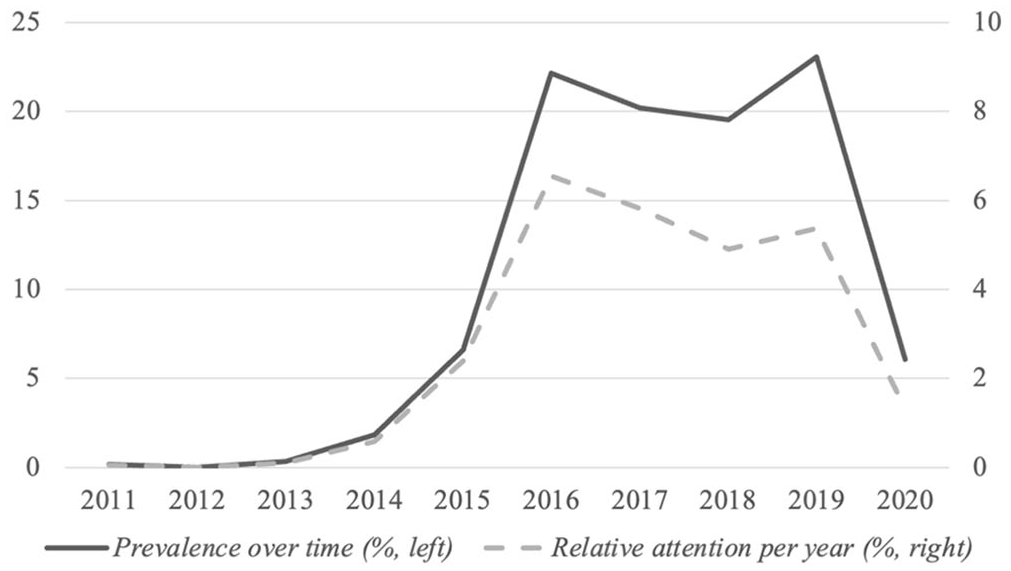
Prevalence of “Home Sharing” Content in Newspaper Articles Over Time and Relative Attention for “Home Sharing” Content in Newspaper Articles per Year
Step 3.2: Inductive coding
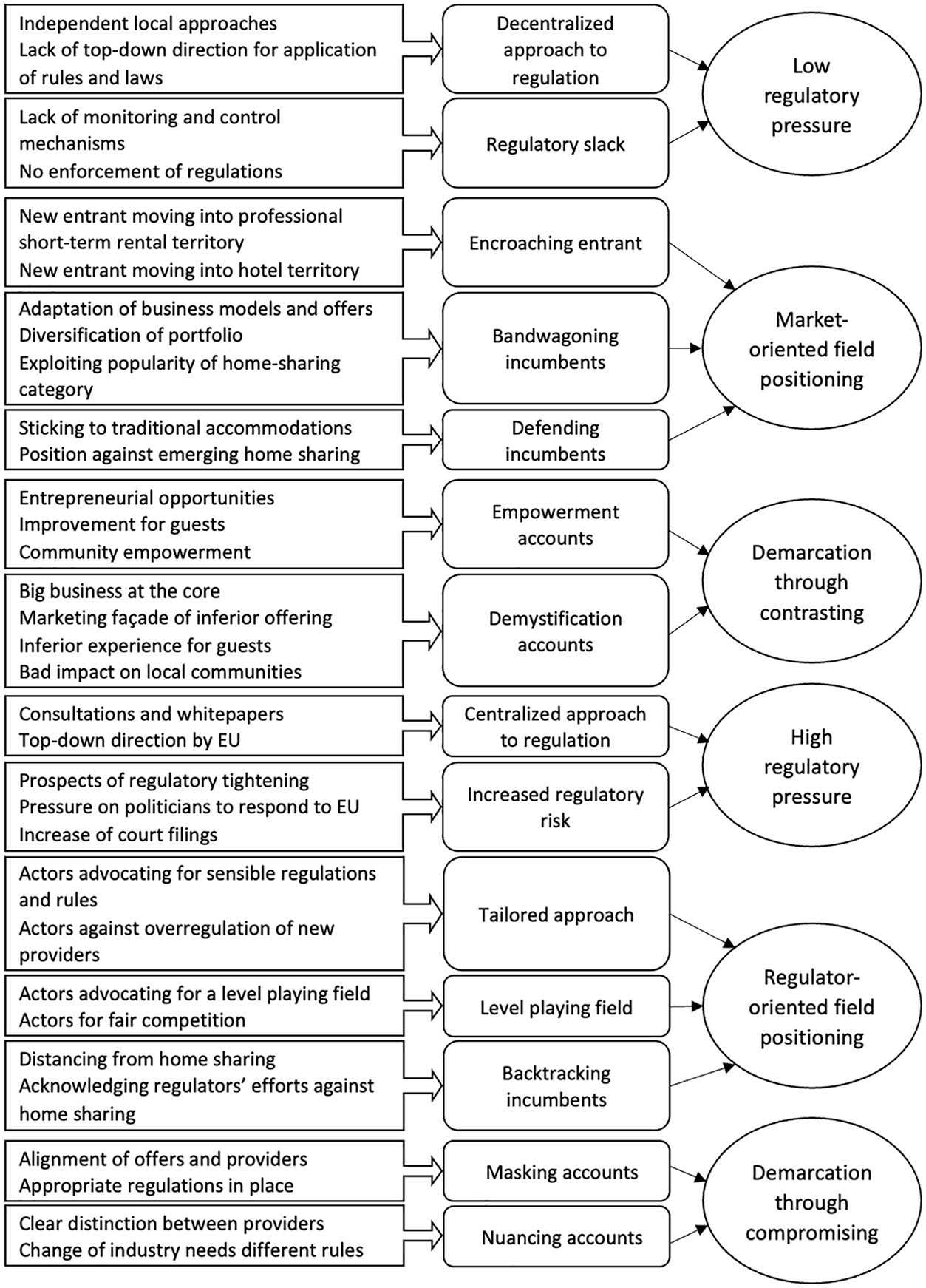
In a next step, we sought to reveal how market participants navigated and contributed to the shaping of symbolic and regulatory boundaries. We approached the data by asking who is doing what, when, why, and with what effect? We generated several dozens of in vivo codes, which we gradually collapsed into first-order categories that are close to the data and original terms used by informants and in documents (Gioia, Corley, & Hamilton, 2013). We aggregated categories into second-order themes that were more abstract and theoretically meaningful. In a last step, we aggregated second-order themes into aggregate dimensions (Gioia et al., 2013), which (together with the boundaries) became the building blocks for our model (Step 4). Figure 2 outlines the data structure.
Data Structure
To identify discursive accounts, we analyzed interviews, formal provider communications, and newspaper articles to analyze the arguments market participants mobilized during category contestation. We coded written and oral discourse (Alvesson & Karreman, 2000) around the emergent home-sharing category, its relationship with short-term rental, and the ensuing boundaries. We identified “entrepreneurial opportunities,” “improvement for guests,” and “community empowerment” as first-order categories, which we then aggregated into the second-order theme “empowerment accounts.” In total, we identified four such accounts: “empowerment,” “demystifying,” “masking,” and “nuancing.” We combined these second-order themes into two aggregate dimensions: “demarcation through contrasting” and “demarcation through compromising.” To assess the relative distribution of these accounts and possible changes over time, we created two additional codes, “Phase 1” (referring to the period 2010–2015) and “Phase 2” (referring to the period 2016–2020). We coded all data related to discursive accounts with these time stamps and then calculated their relative prevalence at the aggregate level of accounts.
Once we had unearthed these discursive accounts, we investigated the context in which they were mobilized. We identified market participants employing these accounts as well as their positioning vis-à-vis other participants and the regulator. For this purpose, we analyzed interviews, annual reports, and press releases, and we identified “new entrant moving into professional short-term rental territory” and “new entrant moving into hotel territory” as first-order concepts, which we collapsed into the second-order theme “encroaching entrant.” Similarly, we identified “bandwagoning incumbents,” “defending incumbents,” “level playing field,” “tailored approach,” and “backtracking incumbents” as second-order themes for how actors positioned themselves. We aggregated these second-order themes into the dimensions of “market-oriented field positioning” and “regulator-oriented field positioning.” Table H (see online appendix) offers additional representative data and illustrates how our coding is grounded in our empirical data.
In sum, the tracing of the evolution of boundaries, discursive accounts, and market participants’ positioning over time became the building blocks for our theoretical model.
Step 4: Model generation
In a last step, we generated our theoretical model, which was informed by two main shifts: Actors’ field positioning shifted from predominantly market- to more regulator-oriented coalitions; accompanying this shift in positioning, we found that discursive accounts shifted during the contestation from mainly shaping the symbolic boundary to increasingly demarcating the regulatory boundary. Our model proposes that the mobilization of different discursive accounts drive a process of category boundary formation, with interdependent roles of symbolic and regulatory category boundaries.
Findings
We first describe the outset and outcome of our process, the weakness/strength of boundaries. Then, we elaborate the mechanisms that explain the formation of a strong symbolic (outcome of Phase 1) and a strong regulatory boundary (outcome of Phase 2).
Evolution of the Boundaries Between Home Sharing and Short-Term Rental
Weak symbolic boundary
At the beginning of Phase 1, the symbolic boundary between short-term rental and the emergent category of home sharing was weak. Our analysis of major newspapers showed that the new category of home sharing was not self-evident and needed explanation. Journalists paraphrased the new term “home sharing” and elaborated on it, for instance, by noting that “homestays are becoming the new hotel stays” (The Times, 2013). Furthermore, newspapers often mentioned Airbnb to exemplify the new category of home sharing: “Airbnb, the site offering rooms in people’s homes” (The Guardian, 2011). Second, the label “home sharing” was used rarely throughout Phase 1. Figure 1 indicates a relatively low frequency, with only 9% of all articles in our longitudinal database (ranging from 2010 to 2020) predating 2015. Moreover, Figure 1 shows that during Phase 1, home sharing received little attention compared with short-term rental. Overall, the need for explanation of a new category and the rare use of a new category label indicate a weak symbolic boundary between the emergent and established category at the beginning of Phase 1 (see Table G, online appendix, for additional evidence).
Weak regulatory boundary
After Airbnb had entered the short-term rental market and introduced the notion of home sharing, the regulatory boundary between short-term rental and home sharing stayed weak throughout Phase 1. Our analysis shows that during Phase 1, a lack of legal status and definitions of the emergent category remained. Rather than providing distinct legal definitions for home sharing, cities across Europe started to highlight existing rules for touristic accommodation (e.g., Vienna’s §13 WTFG in 2013, Barcelona’s LLEI 5 in 2012, Berlin’s ÜnStG in 2013). There was widespread confusion as to whether home sharing would fit into the existing regulatory category or required a new regulatory category. Airbnb’s status was unclear, as this quote about Airbnb suggests: The legal status [of Airbnb] is unclear; are they a travel agency? If they provide apartments, they might need a broker license. (Local Business Development Agency)
There was also a void of definitions of (additional) services and actors. For example, should offering breakfast and room cleaning be considered professional services? What would it legally mean to be a “host” versus a “landlord,” a “guest” versus a “renter”?
Second, and related to the lack of legal status, Phase 1 was characterized by overlapping and ambiguous application of laws and regulations. A range of regulations, such as tenant laws and laws for small businesses or accommodation providers, could have been applied to any short-term-rental-like activity. Yet, there was no agreement about when which laws would be relevant to whom. The following quote reflects the ambiguity: If you rent it out once a year, then it probably doesn’t need to be regulated. But where is the threshold? With three times, with five times, 10 times—I have no idea. (City of Vienna)
The platform-based model of home sharing also turned out to be subject to conflicting laws. For example, travel-sector laws that demanded a registration of accommodation providers conflicted with privacy laws that prohibited platforms from transmitting data. In sum, the lack of legal status and definitions and the overlapping and ambiguous application of laws and regulations indicate a weak regulatory boundary throughout Phase 1.
Strong symbolic boundary
In 2015, at the end of Phase 1, we observe how the symbolic boundary between home sharing and short-term rental had become strong. First, our analysis shows that the term “home sharing” was increasingly taken for granted. Explanations and elaborations were much less frequent in newspaper articles. Rather, home sharing was used as a stand-alone term that, apparently, did not require further explanation. Second, our analysis reveals that the term “home sharing” was used with a substantially higher frequency. Figure 1 shows that the years 2016 up to and including 2019 revealed a persistently large share of articles referring to home sharing (20% of total coverage in 2010 to 2020 per year). It also shows that home sharing (compared to short-term rental) received proportionally higher attention in newspaper articles after 2015. Overall, with the taken-for-granted understanding of the new category and the frequent use of the new category label “home sharing,” our data indicate a strong symbolic boundary between the emergent category of home sharing and the established short-term rental category at the end of Phase 1.
Strong regulatory boundary
During Phase 2, the regulatory boundary between the categories of home sharing and short-term rental became increasingly strong: By 2020, the development of distinct legal definitions and status of home sharing had progressed considerably. The European Union had guided and thus increased the distinctness of definitions, pointing to a need to differentiate private from professional landlords, as an E.U. informant explained: In our recommendations in the documents we always make distinctions between peer-to-peer and business. (European Commission)
The European Union started to make suggestions for distinct definitions for actors and activities, for instance, thresholds for professional short-term rental based on the number of apartments. In line with the European Union’s idea, a trend on the local level, toward more differentiation, followed suit. For example, in Vienna, after a change in the tourism law and building code in 2018, the revised regulatory manifestation suggested a distinct understanding of home sharing: The commercial renting out of residential premises for short-term accommodation purposes is not permitted in residential zones. [However,] . . . home sharing (individuals renting out their private homes or rooms occasionally), does not fall within the scope of the law and is therefore permitted in residential zones. (Vienna Building Code, 2018)
This definition ensured a distinct regulatory understanding of home sharing. Simultaneously, short-term rental was becoming clearer legally. For instance, renting out a secondary or holiday home was not regarded as home sharing: As soon as rentals incurred a charge, they were deemed professional. By treating platforms and their promoted services as businesses, the city’s understanding was suggestive of a “traditional short-term rental.”
The trend toward more differentiation also found its expression in more distinct and consistent rules and regulations, as the examples of Vienna and Barcelona show. Whereas Barcelona imposed fines on all short-term rental providers for illegal accounts in 2014 to 2016, only home-sharing platforms—specifically, Airbnb and HomeAway—were fined in 2018. In 2020, in one of the most defining court rulings in Vienna, the commercial court ordered Airbnb to remove listings in which living spaces were used for unauthorized (touristic) purposes. The European Union’s suggestion for regulatory distinction between home sharing and short-term rental facilitated this creation and execution of increasingly consistent rules and regulations toward the end of 2020. In 2019, the Court of Justice of the European Union ruled that Airbnb as an online platform must be classified as an “information society service,” requiring it to hold an estate agent’s professional license. The court noted further distinctions. Indeed, online intermediation services may be classed otherwise, namely, if the intermediation forms an integral part of an overall service that falls under another legal class. In sum, our data indicate a strong regulatory boundary toward the end of Phase 2, confirmed by distinct legal definitions and status as well as distinct and consistent application of rules and regulations that address the legal distinctness of home sharing and short-term rental.
Next, we explain our finding of a subsequent alignment between symbolic and regulatory boundary. Rather than a seamless mirroring, we find that the formation of strong boundaries is the outcome of different modes of category contestation.
Phase 1: Contestation Around the Symbolic Boundary
At the beginning of Phase 1, market participants first sought to shape the regulatory boundary. However, they soon realized that this was not yet feasible or even needed. Accordingly, they pivoted toward the symbolic boundary. Our findings show that the outset of this contestation around the symbolic boundary was characterized by both weak symbolic and regulatory boundaries and low regulatory pressure as a starting point.
Low regulatory pressure
Low regulatory pressure was manifested, first, by a decentralized approach to regulation. Local regulators that were faced with the new phenomenon tried to initially independently understand and regulate the new business model in their cities. In these approaches, regulators struggled to find appropriate and fitting regulations for the new phenomenon, partly because they lacked top-down direction, which made the local approaches appear as relatively weak. Second, the low regulatory pressure manifested as regulatory slack that was experienced by market participants. Indeed, the new entrant, Airbnb, and the home-sharing notion it introduced, presented local regulators with an additional challenge. Beyond the lack of clear definitions and applicability of laws, it was unclear if and how home sharing may be monitored due to a lack of monitoring and control mechanisms: “Now, you’re talking about 40,000 occasional, casual, typically younger . . . people [renting out a place]” (HomeAway). Even pro-business actors showed understanding for the complexities regulators faced with respect to monitoring and controlling: Control is really difficult! On the website, there is no information. . . . It makes it very hard to control and monitor. (Local Business Development Agency)
The lack of capability to monitor, let alone enforce regulation, was also noted by incumbents, who were denouncing their own tight regulation, while “there are unfortunately not enough resources to monitor it [i.e., Airbnb]” (local hotel association). A local labor union representative emphasized the need to escalate issues to a higher level of regulation: As long as we do not know what we want . . . and there is zero priority [at higher levels of regulation], there will be problems.
Market-oriented field positioning
As market participants found little pressure to engage with regulations at this stage, they gave their attention to positioning themselves within the market. First, the new entrant focused on expanding and gaining market share. Concretely, we observe how Airbnb moved into traditional short-term rental and hotel territory, indicative of an encroaching entrant. Through this, Airbnb could soon reach an impressive scope, as the following excerpt from a newspaper article in 2013 describes: The scope of [Airbnb’s] operation actually dwarfs that of traditional hotel companies. . . . Airbnb far exceeds IHG (InterContinental Hotels Group) with more than 4,600 hotels, and Marriott International, with more than 3,800 hotels, making it the largest lodging company and brand in the world. (New York Times, 2013)
Indeed, Airbnb’s success in significantly growing its market share so quickly was related to its purposeful encroaching, which is described by an Airbnb representative: Brian’s [Chesky]—as a CEO’s—view is that we are in the business of travel and trips, not just the business of homes. Why wouldn’t we try and move into business travel or even longer-term stays?
Second, we found how bandwagoning incumbents, namely, Expedia, Tripadvisor, HomeAway, and Booking, followed in Airbnb’s footsteps into the new market category of home sharing. Having witnessed the rising popularity of the emergent home-sharing category, these incumbents adapted their business models, offers, and marketing toward home sharing. For instance, our informant from Booking explained their bandwagoning: For us it’s demand driven. Although Booking is arguably better known for its hotel rooms offering, our company has its fair share in nonhotel accommodations as well. Responding to a growing trend of consumers looking for stays in places other than traditional hotels, the company launched Villas.com in May 2014 as a testing ground for alternative accommodations. Since then, Booking has always followed the demand of its consumers.
Hence, these bandwagoning incumbents sought to exploit the popularity of the home-sharing category, a subset of the wider sharing economy, as a powerful “cultural theme” (Grodal & Kahl, 2017). In the case of Tripadvisor, bandwagoning found expression in the diversification from being solely focused on restaurant and hotel reviews and listings to listing apartment stays. Correspondingly, in its annual report of 2012, Tripadvisor stated: We diversified our vacation rentals business by purchasing a leading Spanish rental site, Niumba. Consistent with our past transactions, all these acquisitions are tuck-ins that fit nicely with our strategic roadmap bringing a unique traveler value proposition. (Tripadvisor, 2012: 5)
Third, another set of providers, defending incumbents, was sticking exclusively to its focus on traditional offers. These providers were members of the traditional hotel and apartment-rental business, represented mostly by the Austrian Hotel Association but also by the Viennese Apartment Manager Association. The following quote from a newspaper illustrates the antagonistic relationship between these incumbents and Airbnb specifically: “Airbnb has been for some time the favorite hate object of hotels” (Die Presse, 2015).
The defending incumbents—either not able or not willing to engage in the new business model—took a clear stance against the new entrant and bandwagoning incumbents: “It’s us against them” (Local Hotel Association). Table E (see online appendix) maps actors’ positioning.
Demarcation through contrasting
The positions co-occurred with discursive accounts that the market participants mobilized to contest over the symbolic boundary of the emergent category. The mobilization of these accounts drove symbolic demarcation between the categories of home sharing and short-term rental through the mechanism of contrasting.
First, bandwagoning incumbents and the new entrant’s championing of the new category involved empowerment accounts. These accounts revolved around the empowering of consumers and communities. They reflected the coalition’s efforts to position home sharing as an innovation by emphasizing the potentials of the new and distinct offering—often by contrasting it against the established category. Concretely, Airbnb; the bandwagoning incumbents Booking, Tripadvisor, Expedia, and HomeAway; and their interest groups mobilized accounts that highlighted entrepreneurial opportunities for empowered individual providers and positive externalities for communities. They also emphasized consumers’ benefits, such as more and better choice in contrast to established offers.
One of the strongest arguments permeating empowerment accounts was that home sharing equipped people with new entrepreneurial opportunities, helping them earn an (extra) income. A press release draws attention to the scale and number of “hosts” that benefited: The German portal alone facilitated 6.8 million nights and 392 million in US-Dollar for their hosts in 2013. (HomeAway, 2014)
The positive impact also pertained to consumers’ emancipation and increased freedom of choice. Especially bandwagoning incumbents mobilized these notions to stress distinct benefits of the new symbolic category. Our informant from Booking offered: We are strong believers in the freedom of consumer choice. At the end of the day, it is the very consumers who decide where they want to stay. Our job is to make it easier for them to experience the world and make sure they get the best match to their needs.
Similarly, it was argued that increased competition and new providers in the market with a distinct offering could only be of value to customers and improve their experiences. The representative from a local home-sharing club, a grassroots movement catalyzed by Airbnb, presented the emergent category as a refreshing alternative to mass tourism: Consumers don’t want to lie at the beach like sardines, have all-inclusive drinking and eating. There will always be people who want that, but not in masses anymore.
New accommodation options—home sharing—would also allow people who were previously discriminated by the market, such as students, families, or larger groups, to travel: Look at it as a market that was there, where demand existed, but we didn’t deliver on that demand: accommodation for bigger groups . . . on holidays, and who want to cook for themselves and that hate room service. (EHHA)
Improved experiences were also emphasized with respect to distinct authentic insights guests could obtain from staying at others’ homes. In contrast to standardized services of established offers, home sharing was portrayed as a unique experience that gets travelers in “contact with locals” (home-sharing club). This notion was highlighted in advertising by Airbnb and bandwagoning incumbents, such as Booking (see Figure B, online appendix).
Another argument was that the emergent category facilitated community building. In fact, Airbnb catalyzed communities (i.e., home-sharing clubs), nominating “superhosts” to organize them. The emphasis on community was very visible in our interviews with Airbnb: The special thing about us, in comparison to other companies, is that we have a community structure. Airbnb only exists because we have an active and passionate community of guests and hosts; without it we would not exist.
The emphasis on the community of guests, and increasingly hosts, also found its expression in various formal communications. Tripadvisor, for example, in a press release in 2014, claimed “to engage its community—allowing travelers to share their own experiences.”
Bandwagoning incumbents were seeking to be in tune with the new entrant. Through empowerment accounts—comprising claims of entrepreneurial opportunities and experience—they sought to position home sharing as a new category with benefits for everyone.
Yet, these accounts were soon countered, mainly by defending incumbents who questioned the articulated arguments. Defending incumbents talked down the celebrated home sharing, thereby contributing to the symbolic demarcation through demystifying accounts. These accounts sought to paint a seemingly more realistic, less rosy, picture of the emergent category and Airbnb as its poster child. In highlighting negative aspects of the new category, portraying it as an inferior offer, market actors drove the demarcation of home sharing by contrasting it against the arguably superior category of short-term rental. One accusation voiced by defending incumbents in demystifying accounts was that the new businesses had nothing to do with the ideas of sharing and empowering: This is big business. Of course, there are a few small private providers, but mostly . . . there is a big multinational company that makes millions. (Local Hotel Association)
Defending incumbents tried to minimize the genuine authenticity of home sharing. They argued that alleged home sharing was mostly a marketing facade and accused Airbnb of creating “a whole world around it” (local apartment manager association). In demystifying, defending incumbents highlighted how impersonal home-sharing experiences are. They argued that “these platforms were never really intended for sharing” (local labor union). As such, defending incumbents highlighted the inferior experience for guests from the new accommodation providers and contrasted these bad experiences to the superior services of the existing offers. The representative of a local apartment manager association complained, for example, that people renting out their rooms were amateurs. Missing services, such as breakfast and fresh towels, were highlighted, which traditional providers would offer: “We show the guests that they are welcome; it’s like a family, they are spoiled” (Local Hotel Association). The representative of the local hotel association also emphasized that traditional providers would “take guests seriously . . . [and be] there for them.”
The countering coalition drove the symbolic demarcation through demystifying accounts that directly contradicted accounts revolving around community empowerment. For example, it was argued that local communities suffer from a disruption of living because “there is a constant coming and going, with people arriving and leaving, suitcases rolling in the hallway, noise; that’s no fun for local renters” (local business development agency). In agreement with this point, the labor union representative argued that locals would be disrupted. Similarly, our informant from the local tourism association feared that tourism penetrates areas, which it probably shouldn’t. . . . When groups of people rent private apartments, it becomes loud and funny, and then imagine that happens several weekends a year and the neighbors have to endure it. . . . The exponential growth of [home-sharing providers] might be good for shareholders, but not for society.
Opponents of the emergent home-sharing category also mentioned potential economic risks for the hotel industry and beyond: “If the [home-sharing] market becomes bigger and bigger and we have less business for the hotels, then we have a problem with unemployment” (Local Labor Union). It was also argued that housing affordability for locals was undermined.
Overall, the discursive contestation during Phase 1 revolved mainly around the normative dimension of the emergent category of home sharing, which drove its symbolic demarcation from the category of short-term rental through contrasting. Indeed, in 57% of cases, empowerment and demystifying accounts involved explicit contrasting, namely, arguments that put one offer vis-à-vis the competing one. As a result, a strong symbolic boundary was formed at the end of Phase 1. While we also found evidence of empowerment and demystifying accounts in Phase 2, they predominantly appeared in Phase 1 (see Figure 3).
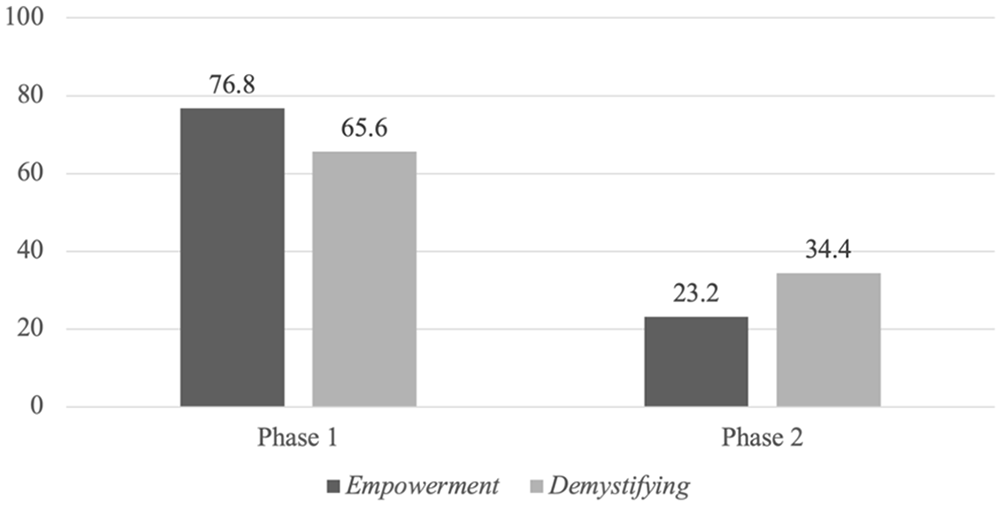
Relative Distribution of Empowerment and Demystifying Accounts Across Phases (in Percentages)
Phase 2: Contestation Around the Regulatory Boundary
At the beginning of Phase 2, around 2016, the regulatory boundary was still weak, as outlined at the beginning of the findings, while the symbolic boundary had become strong. A critical inflection point was when the European Union became actively involved and exerted regulatory pressure—a consequence of the preceding symbolic demarcation, occurring not least with the help of demystifying accounts highlighting (alleged) negative economic and social effects.
High regulatory pressure
First, the European Union started a centralized approach to regulation, which entailed workshops by the commission, wherein providers, regulators, and others look at what can be done as guiding principles . . . [considering] all the issues such as market-access requirements, taxation, liability of platforms, health and safety; they will look at each topic, which impacts the economy. (E.U. Association of the Hospitality Industry)
While increasing the regulatory pressure, this centralized and inclusive approach was welcomed by representatives of the bandwagoning incumbents: They [i.e., the European Union] are setting a good benchmark, I think, to the extent that they can help all of the national and local authorities come up with good ideas and answers that can sort of stop the divergence and create more convergence. (Inline Policy)
Also, Airbnb admitted “the [European Union] stuff is very important. As it connects everything . . . it tries to limit the amount of fragmentation that companies and people face.”
Second, with prospects of European cities tightening regulation under the European Union’s guidance, actors expressed a perception of increased regulatory risk. Our informant from Booking, for instance, offered: “These regulations are coming, they are not going away.” Expedia’s representative referred to rising negative sentiment against home sharing: “[It] has triggered local politicians to respond.” In its annual report of 2016, Expedia stated that it has been and continues to be, subject to regulatory developments that affect the vacation rental industry and the ability of companies like us to list those vacation rentals online. (Expedia, 2016: 16)
Regulatory pressure was also fueled by an increased number of court cases. In Vienna in 2014, for instance, lawsuits were filed against touristic uses of apartments (e.g., OGH, 2014).
Regulator-oriented field positioning
An increased perception of regulatory pressure implied a shift toward a regulator-oriented field positioning, which now centered mainly on regulatory issues. This manifested also in actors’ lobbying efforts, reports, and participation in workshops and were mirrored in discursive accounts.
First, a set of market actors represented the interest of a level playing field, demanding that all market participants would be subject to the same rules to create fair competition. Concretely, it was the defending incumbents and local industry associations that took this approach. They advocated for fair regulation that would ensure competition on equal terms. In the case of local associations, for instance, the position for a level playing field’s interest became clear in this statement by a representative of a local chamber of commerce: “We don’t mind if they rent out apartments, but they have to stick to the same rules and regulations that also exist for hotels.” In taking a position for a level playing field, defending incumbents also proposed a reduction of their regulatory burden: “We have always asked for liberalization; it would provide a minimum of fair play, at least” (Local Hotel Association).
Second, some of the former bandwagoning incumbents that predominantly focused on professional rentals and hotels, namely, Booking and Expedia, also emphasized the need for rules that would apply to everyone. These backtracking incumbents started to distance themselves from Airbnb and the home-sharing category, as this example of Booking shows: We have no intention having Booking on some kind of, you know, letters that we don’t want to be associated with [referring to Airbnb].
This was also reflected in Booking’s 2017 annual report, where it is mentioned that restrictions may provide a competitive advantage to our competitors [referring to Airbnb and HomeAway] unless they are also subject to comparable restrictions. (Booking, 2017: 26)
Furthermore, backtracking incumbents increasingly emphasized their understanding and acknowledgment for the need of regulation of home-sharing offers: Well, there is a requirement to have a registration number and then the e-commerce directive applies and we are informed of all of the illegal properties and we tell the owners that they are illegal, and if they don’t add the correct number, then they will be removed. (Expedia)
In backtracking, these incumbents created a coalition with actors taking a level-playing-field approach, arguing that rules existed and needed to be applied equally.
In contrast to the coalition that called for a level playing field, another coalition took a position for a tailored approach to rules and regulation, namely, the new entrant and the remaining bandwagoning incumbents, Tripadvisor and HomeAway. These providers often cautioned that regulations “should be based on facts” (Airbnb) instead of alarmism. Airbnb, for example, cited a 2016 study by the World Tourism and Travel Council to provide evidence against home sharing’s supposedly negative effects. Also, the representative from HomeAway argued that a lot of myths about adverse effects were simply wrong. Talking about houses that were bought only for investment purposes, for instance, the informant said that empirical evidence would reveal “it really weren’t that many” (HomeAway).
To counter overregulation due to alarmism, this coalition asked that “regulation should acknowledge the actual situation and see how we can create a smart regulation that is tailored to the potential” (Airbnb). Thus, this coalition took a position for new and smart regulations, tailored to the new kinds of offers and providers. The representative from the E.U. association representing the interests of technology and travel service providers elaborated: So, you are going to ask [platforms] to collect the tax on behalf of somebody, who is actually . . . a local tax resident and liable for taxes? You know, there is nothing that prevents the City of Vienna, for instance, to go after somebody who is not paying taxes. . . . It’s the role of [regulators] to enforce the collection of taxes, and we don’t feel comfortable, quite frankly, to be pushed into the role of a tax collector. . . . So, you know, we have said, very clearly, that we believe this goes beyond what you can reasonably ask from a business. (EU Technology and Travel Services Association (ETTSA))
Demarcation through compromising
Market participants’ regulator-oriented field positioning in Phase 2 was accompanied by a new set of accounts—masking and nuancing—underlining increased efforts to shape the ensuing regulatory boundary, as a statement by Airbnb indicates: “We have to find messages that resonate with the European users and European politicians.” The mobilization of these accounts in the context of actors’ reshuffled field positioning drove demarcation through compromising on arguments. Our data show how nuancing and masking accounts were resonating with regulators in their search for synthesis to compromise across actors’ interests. Specifically, informed by nuancing and masking accounts, the regulator envisioned, developed, and implemented the idea that short-term rental and home sharing could be distinguished with the help of thresholds (e.g., number of nights during which a home is rented/shared). Arguments and accounts from the new coalitions resonated with the regulator, informed the regulator discourse, and ultimately found expression in regulation (see Table I, online appendix).
While we find evidence of masking and nuancing accounts also in Phase 1, they became more dominant during Phase 2, as market participants shifted their attention from contesting over the symbolic boundary toward the regulatory boundary (see Figure 4).
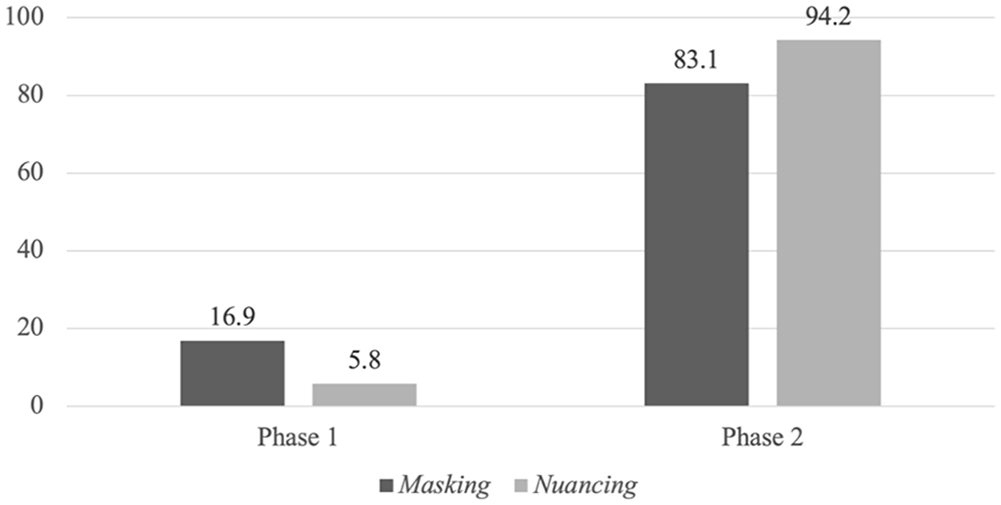
Relative Distribution of Masking and Nuancing Accounts Across Phases (in Percentages)
Masking accounts emphasized that existing regulations for the short-term rental category were applicable to home sharing and related offers. Any differences—perceived or real—were thus masked. The coalition of defending incumbents, local associations, and backtracking incumbents—which were predominantly or exclusively active in the traditional vacation rental and hotel business, namely, Booking and Expedia—mobilized these masking accounts. They did this in their lobbying efforts as well as communications and interactions.
Most defending incumbents portrayed home sharing, from a regulatory perspective, as an extension of traditional short-term rental that was already regulated: “I don’t see the difference” (Expedia). Local actors agreed that “the offers are in principle the same” (local business development agency). Incumbents argued about a convergence between providers as home-sharing offers had become increasingly professionalized. In line with this argument, the representative of the local apartment manager association claimed: There are many private landlords that have 10 beds, and a sauna, and a steam bath. The idea that many have is that it is a small private room, or a little house; but in reality, it’s not like that anymore.
An increasing professionalization was also emphasized in press releases, such as by Booking in 2019: “Booking.com launches new features for professional short-term rental partners.” The convergence of services underlined the existence of appropriate rules. This point was emphasized by the representative from a local tourism association: “Theoretically the laws are there; they just need to be applied.”
Similarly, one of the backtracking incumbents, Expedia, pointed to existing regulations while highlighting the threat of creating more regulation: Everybody says there is no regulation, but that’s simply not true. There is plenty of regulation that is applicable: safety registration, VAT registration, consumer protection.
Overall, the level-playing-field coalition of defending and backtracking incumbents, whose businesses mostly worked with professionalized rental apartments and hotels that were already compliant with existing regulations, mobilized masking accounts. Backtracking incumbents retreated from their previous position and gave defending incumbents additional weight to argue that the existing regulatory category of short-term rentals should be applied to all providers. The actors thus suggested to simply apply the regulatory framework of short-term rentals to what had symbolically been defined as home sharing.
Masking accounts helped to drive the regulatory demarcation. They resonated with the regulator, for example, as evidenced in this statement about the convergence of offers: As we have more professional offers on Airbnb than private ones, here the original idea of peer-to-peer is gone, but it is a professional business and here, of course, we need a level playing field and regulate them as short-term rentals. (European Commission)
As such, the E.U. representative agreed that there were laws that would be applicable for those cases that fall into the regulatory category of short-term rental: We don’t need a whole new regulatory framework. We have existing laws and they are applicable also for the new market participants. (European Commission)
Not only masking accounts were picked up by the regulator but also nuancing ones, leading to demarcation as the regulator compromised between accounts.
The new entrant and some incumbents, namely, HomeAway and Tripadvisor, mobilized nuancing accounts, which emphasized the need to differentiate when regulating the evolving field. These accounts were not limited to lobbying. An Airbnb informant pointed to the use of other communications, such as advertising, to shape the regulatory boundary: Lots of people have skin in this game and have opinions. Therefore that policy foundation is not always that stable, which means that as well as doing kind of the direct lobbying and the conversations directly with governments and regulators and with people like them, we also have to try and shape the public mood and reputation of the company and the idea of home sharing and actually promote it more broadly, which is why we do things like advertising campaigns [and] focus on home sharing as a legitimate thing.
Market participants called for targeted rules: “Airbnb supports specific home-sharing rules and regulations.” Airbnb also acknowledged a need for compromising: “Of course there have to be rules, but the old rules and ways of thinking have to be rethought; we have to think how these rules look in the 21st century.” Both the new entrant and incumbents highlighted the need for legal distinctions, for instance, between private and professional offers: The main point is really to distinguish between professionals and the private people that offer an experience. (E.U. Association of the Hospitality Industry)
This differentiation was also pointed out by bandwagoning incumbents: [For some offers it should be] very clear: They are not home sharing; they are holiday homes, vacation rental properties. (HomeAway)
Another way to argue why existing regulations did not apply to the emergent home-sharing category was to point to broader changes in the economy and/or industry. After all, changing industries called for changing rules and a compromise: “So, the challenge for regulators is definitively to not discriminate against innovative solutions” (Airbnb). It was also argued that changes did not concern accommodation only: Many forms of experiences were offered and shared, and regulations would need to take nuances into account. The remaining bandwagoning incumbents highlighted digital opportunities and regulators’ limited understanding of technologies and that new business models require nuanced regulation: “We need to be careful not to damage these business models” (Airbnb).
In sum, a coalition of the new entrant and remaining bandwagoning incumbents tried to prevent overregulation and a potential stifling of innovation by mobilizing nuancing accounts. Their accounts presented the previously established symbolic category of home sharing as a distinct regulatory category that called for a nuanced understanding. These nuancing accounts resonated with the regulator, as the following example shows: Where it is purely peer-to-peer, we do not need to bring in the heavy machinery [i.e., regulation] that was built at another time. And of course, if it is not peer-to-peer and more professional, then we have some suggestions. (European Commission)
Similarly, the E.U. informant cautioned vilifying the new home-sharing category: “Of course, these are profit-oriented platforms and huge businesses, but we still have to handle this with care, not overregulate, make distinctions and regulate proportionally.”
The regulator developed the idea of thresholds as a workable solution. To compromise the two competing views of masking and nuancing, the European Union highlighted the need to define criteria or thresholds to make distinctions: We have started to try to define applicable criteria to make a distinction. . . . And this has helped us to make better distinctions for the platform business. (European Commission)
Overall, we find evidence for the direct influence of discursive accounts on the ensuing regulatory boundary. Specifically, our analysis shows an increased resonance of arguments voiced in the discursive accounts of Phase 2 with the central regulator, namely, the European Union. Both nuancing and masking accounts influenced the discourse of the regulator and found eventual manifestation in regulations—the expression of a compromise in regulatory terms. On the one hand, we find how nuancing became manifest in the differences made between two regulatory categories: its expression in the regulator’s approach to the regulatory category distinction through threshold criteria. On the other hand, we find how masking became manifest in the application of the existing regulatory category of short-term rental to home-sharing activities. Table I (see online appendix) provides more evidence for this compromising and how arguments from both nuancing and masking became manifest in the discourse of regulators and, subsequently, regulations.
In sum, the discursive contestation in Phase 2 drove regulatory demarcation through compromising, which resulted in a strong regulatory boundary—the outcome of Phase 2.
Discussion
Our longitudinal qualitative study of the emergent home-sharing category vis-à-vis short-term rental in Europe sheds light on the important questions of how regulatory boundaries are formed and how symbolic and regulatory boundaries relate to each other in this process. We have used a field study of a new entrant, Airbnb, that introduces a new category, home sharing. We have studied how the initially weak symbolic and regulatory boundaries between the emergent home-sharing category and the established short-term rental category became stronger in a sequential, causal order: In Phase 1, we observed the strengthening of the symbolic boundary and, in a subsequent Phase 2, of the regulatory boundary. Rather than a seamless mirroring, our study shows how boundary formation is a contested social process, with accounts mobilized by market participants positioned in changing coalitions as key drivers. Based on our findings, we articulate our findings as a theoretical model of the interdependent formation of symbolic and regulatory boundaries.
A Process Model of Discursive Formation of Symbolic and Regulatory Boundaries
The process leading to strong symbolic and regulatory boundaries relied on two interrelated shifts: a shift in the field positioning of providers and another in the discursive accounts that market participants mobilized. We theorize the sequential and causal relation between these shifts, their antecedents, and the interdependent roles of boundaries in this process.
Antecedents of the discursive contestation around category boundaries
The degree of regulatory pressure and the strength of symbolic and regulatory boundaries constitute the antecedents in our model of the discursive contestation around category boundaries. We suggest that these antecedents influence how market participants position themselves in the field and which accounts they mobilize. In Phase 1, a combination of weak boundaries and low regulatory pressure builds the antecedents that trigger market participants to occupy market-oriented field positions and to engage in discursive accounts that lead to the demarcation of the symbolic boundary between established and emergent categories. Concretely, low regulatory pressure leads market participants to position themselves regarding market opportunities and threats from the emergent category. With the symbolic boundary being relatively weak initially, market actors also engage in contestation around the symbolic boundary by mobilizing accounts that serve their market interests.
In Phase 2, a combination of strong symbolic and weak regulatory boundaries and high regulatory pressure constitute the antecedents for actors’ regulator-oriented field positioning and the mobilizing of accounts that lead to the demarcation of the regulatory boundary. Concretely, high regulatory pressure leads market actors to reorient themselves toward the regulator and to engage in discursive accounts that shape the regulatory boundary. Importantly, the outcome of discursive contestation of Phase 1, a strong symbolic boundary, constitutes another important antecedent for the shift of discursive contestation of Phase 2. The symbolic boundary serves as a basis to contest over the regulatory boundary. Next, we theorize the shifts of discursive contestation (i.e., positioning and accounts) and how they contribute to the relative strength of category boundaries.
From market-oriented to regulator-oriented field positioning
The field positioning of how market actors place themselves in relation to each other, as well as the shift in such positioning over time, constitutes an important mechanism for the formation of boundaries. Initially, in response to the antecedents of low regulatory pressure and weak category boundaries, actors take a market-oriented field position. Thereby, the new entrant encroaches onto the existing short-term rental category. Rather than opposing or attacking this encroaching, bandwagoning incumbents capitalize on the popularity of the emergent category and give it additional weight by coalizing with the new entrant. Defending incumbents recognize the emergent category as a threat and position themselves against it.
Later in the process, in response to increased regulatory pressure, market participants change coalitions and take a regulator-oriented position. On the one hand, the new entrant and bandwagoning incumbents, which are substantially invested in the new business model, position themselves with a tailored approach. On the other hand, defending incumbents take a level-playing-field position. They are joined by backtracking incumbents that previously bandwagoned based on the emergent category’s popularity without significantly changing their business models. This backtracking shifts weight back to defending incumbents. Next, we describe how the shift in positioning is accompanied by a shift in discursive accounts.
From symbolic to regulatory demarcation
The divergent market and regulatory interests of the coalitions of market participants culminate in the demarcation through discursive accounts that ultimately result in the strengthening of boundaries. In Phase 1, actors with market-oriented positioning mobilize empowerment and demystifying accounts that drive the demarcation between the emergent and established categories through contrasting them against each other. This demarcation leads to a strong symbolic boundary as the outcome of the contestation in Phase 1. In Phase 2, the discursive accounts shift toward regulatory demarcation through compromising, which reflects actors’ regulator-oriented field positioning and builds on the established symbolic boundary. This discursive contestation that compromises masking and nuancing accounts leads to a strong regulatory boundary.
In sum, our theoretical model (see Figure 5) explains the outcome of interest—increasing strength of interdependent symbolic and regulatory category boundaries over time (what?)—based on two mechanisms that drive the process of boundary formation: the field positioning and shifts therein (who?) and the discursive accounts mobilized (how?).
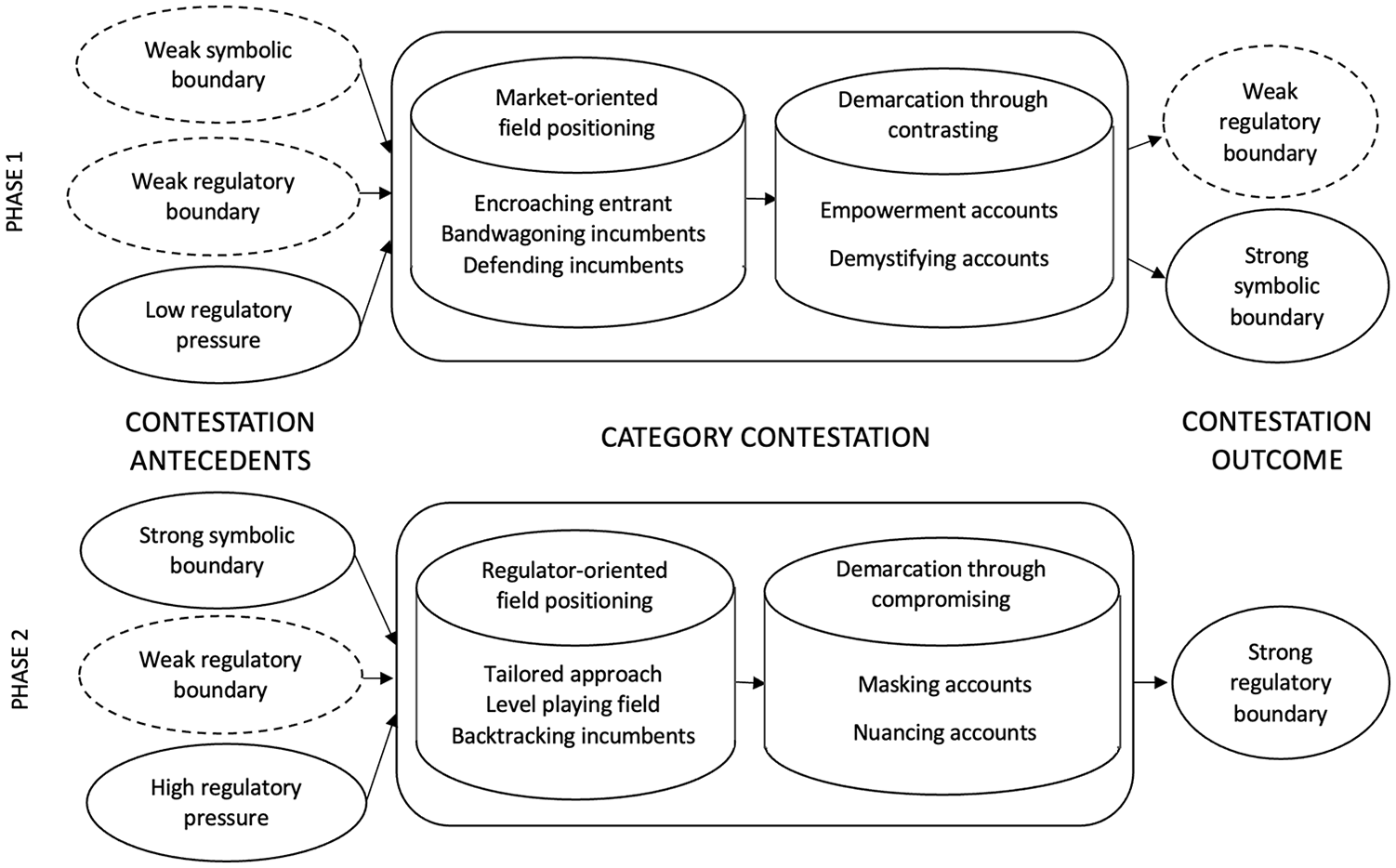
Theoretical Process Model of Contestation over Symbolic and Regulatory Boundaries
We argue that our theorization based on our case study insights has more general theoretical purchase. For example, we would envision a similar process to be observed for lab-grown meat or the cryptocurrency category. For the latter example, our theorization suggests that currency providers would first contest over drawing a boundary between cryptocurrency and fiat currency; once a sufficiently strong symbolic boundary between the two could be drawn and at least temporally settled, as a result of demystifying accounts, the regulator would become alert, increasing the risk of regulation, and the contestation would shift from the symbolic to the regulatory realm. Prior work suggests that a regulator needs to be “forced into a conversation” (see Gao & McDonald, 2022: 954), and we theorize that this happens once the symbolic boundary of an emergent category is sufficiently strong so that the regulator can effectively direct its attention to the nascent market. Overall, our study contributes to existing research on categories and category boundaries in three main ways.
Contribution to Our Understanding of Category Boundary Formation: The Interdependent Nature of Symbolic and Regulatory Boundaries
Our main contribution lies in enhancing our understanding of the formation of category boundaries. The category literature has witnessed a shift toward problematizing category boundaries rather than merely assessing the implications of their existence. Significant attention has been paid to symbolic boundaries (e.g., Siltaoja et al., 2020), while there was still little research on how symbolic boundaries translate into regulatory boundaries. Rather, research has looked into how existing regulations are considered applicable to products or services (Aversa et al., 2021; Ozcan & Gurses, 2018), including the struggles that come with such regulatory categorization. Hence, regulatory boundaries have often been the starting point for prior research (Anteby, 2010; Hoffman, 1999).
We elevate research on category boundaries by theorizing the relationship between symbolic and regulatory boundaries. Prior work has tended to look at either the symbolic (Lockwood et al., 2023) or the regulatory boundary (Funk & Hirschman, 2014), thereby leaving the question unanswered of how their formation and contestation processes may be related. We complement extant work by theorizing an interdependence between the formation of symbolic and regulatory boundaries. Specifically, we theorize how a symbolic boundary needs to achieve strength and settlement before market participants focus their attention toward the regulatory boundary. We propose regulatory pressure as a critical inflection point that links boundaries: Once a threshold of symbolic demarcation is reached, regulatory attention is provoked and market participants shift their contestation toward ensuing regulations. While prior work has established that categories can be more or less salient, receiving varying degrees of attention (Taeuscher & Rothe, 2024), our study shows how regulatory salience is actively brought about through discursive contestation around a new category and its normative dimension (Etter, Fieseler, & Whelan, 2019).
By proposing a theoretical process model that integrates the interdependent relationship between symbolic and regulatory boundaries, our study adds an important piece to the puzzle. Prior work on category boundaries has tended to look at one kind of boundary only, or it assumed a seamless translation and alignment of boundaries. Our theorization puts forward a symbolic boundary as a necessary, but not sufficient, condition for the formation of a regulatory boundary. Rather than conceiving of a regulatory boundary a priori, or assuming that it comes to simply mirror a symbolic boundary, we show that it matters what happens as a process of contestation among shifting coalitions of actors unfolds at the interface of symbolic and regulatory boundaries.
To theorize the contestation around the symbolic and regulatory boundaries between an emergent and established category, we have drawn on the discursive lens in categories research and the role of market participants in social categorization processes. As a result, we open the black box of how a possible alignment of boundaries can be accomplished socially.
Contribution to the Emerging Discursive Perspective on Categories: Patterns of Discursive Accounts
A growing subset of research on categories and category dynamics has identified the important role of discourse (Granqvist & Siltaoja, 2020). Indeed, category scholars have paid considerable attention to stories, metaphors, or individual discursive practices. For example, Khaire and Wadhwani (2010) highlight the importance of narratives in the establishment of Indian modern art as a distinct category, such as presenting an artist as internationally educated; Cutolo and Ferriani (in press) show how crafters can use narratives to prevent the widely documented atypicality penalty; and Rosa et al. (1999) reveal how the minivan category was socially constructed with the help of stories. Yet, what has been missing so far is an appreciation of the underlying intent with which actors employ “narratives” or “stories.” Indeed, research has paid less attention to the wider purpose with which discursive practices are marshaled and how they can be part of an ensemble of discursive practices to pursue strategic objectives. This was an important lacuna because “words function in the service of action” (Lockwood, Giorgi, & Glynn, 2019: 8). Our study addresses this gap by zeroing in on how the discursive accounts that actors intentionally mobilize shape category boundaries.
By shifting attention from isolated instances of specific types of discursive acts to the content and intent behind the “communicative exchanges between the market participants” (Grodal & Kahl, 2017: 156), we elevate the discursive perspective in category research. Specifically, we identify empowerment, demystifying, masking, and nuancing as key discursive accounts that can materialize in narratives, stories, metaphors, and even visuals, like pictures or videos—and become manifest and are disseminated through various communications, such as press releases, (annual) reports, advertisements, and lobbying.
We also show that discursive accounts do not occur randomly or simultaneously; rather, market participants employ them in a patterned way. Specifically, our study shows how different discursive accounts are consequential for the shaping of different kinds of category boundaries. Market participants drive the symbolic demarcation of categories with the help of empowerment and demystifying as they contest over the normative dimension of an emergent category or whether a new category is good or bad for society (Hsu & Grodal, 2021). By making references to the “other side,” or contrasting their category with another, they contribute to the formation of a symbolic boundary (Weber et al., 2008). As such, the evolving symbolic boundary enables communication and contestation about two neighboring categories and builds the foundation for a subsequent contestation over the regulatory boundary. Notably, contrasting is not limited to the new entrant; multiple market participants engage in contrasting through their discursive accounts, driving symbolic demarcation.
Market participants drive regulatory demarcation by using nuancing and masking as they struggle over legal distinctions. In this contestation, the regulatory boundaries are defined through the compromising on actors’ positions and arguments as accounts resonate with the regulator and contribute to regulatory boundary formation. Studying the role of discourse enables us to understand how symbolic and regulatory boundaries are the outcome of social processes involving particular symbolic activities (Suddaby & Greenwood, 2005).
By taking a process view and specifying how discourse matters in categorization processes, specifically the sequence of communicative exchanges (Grodal & Kahl, 2017), our research pushes our understanding of the role of language and discourse for the process of categorization. For example, while earlier work discusses framing contests around new technologies (Gurses et al., 2022; Gurses & Ozcan, 2015), our study goes a step further and unpacks the patterns of discursive accounts that lie beneath such contests. Hence, our study complements prior research on discourse and language that has often looked at discursive material, like specific words and terms, in isolation (Lockwood et al., 2019), as opposed to tracing its patterned interplay over time. The discursive accounts we identify help us heed the call to move beyond tracing the label, toward the content and meaning of a category (Jones et al., 2012), and how the content and meaning are the outcome of category contestation in the strategic interplay of market participants.
Contribution to a More Nuanced View on Market Participants: Shifting Coalitions of Bandwagoning and Backtracking Incumbents
Our study offers a more nuanced view on conventional distinctions and typical coalitions, such as between incumbents and challengers (Durand & Khaire, 2017; Gurses et al., 2022). Specifically, we find that the group coalescing around the new entrant underwent shifts: initially, a set of providers engaged in bandwagoning—rallying behind the new entrant in the promotion of the home-sharing category to benefit from the ensuing hype (Logue & Grimes, 2022). Over time, however, this coalition weakened, with some of the initially bandwagoning incumbents starting to backtrack. At first, bandwagoning propelled forward the establishment of a new category and provided it with weight and legitimacy (Lee et al., 2017). The later weakening of this coalition was consequential for the formation of the regulatory boundary, when regulators started to address the governing of the market: By backtracking, some incumbents gave more balanced weight to arguments from competing accounts, which eventually resonated with the regulator. Whereas an assumption of stable membership and interests would imply that contesting coalitions remain the same over time, our study adds explanatory value to the process of boundary formation.
We leverage our finding to theorize possible shifts in the actor constellation, including interests and identities expressed and manifested in mobilized accounts. We propose that a critical driver behind these possible shifts is the buildup of regulatory pressure, a direct result of demystifying as a discursive account employed by members of a counter-coalition that eventually called for regulators to become active by highlighting the negative normative dimension of the emergent category. While regulatory pressure can diminish over time, not least as a result of the actions of market participants (Lashley & Pollock, 2020), it can also build up, as a result of positioning and framing on the part of market participants (Hsu & Grodal, 2021). Prior work has studied the implications of a buildup of regulatory pressure (Gao & McDonald, 2022), for example, for firm strategies but remained opaque as to why such pressure emerges. Our study contributes to our understanding of this process. It provides empirical evidence for and theorization of the role of accounts for affecting the level of regulatory pressure—and vice versa, namely, how regulatory pressure impacts accounts.
Our longitudinal mapping of actor constellations also contributes to the literature by moving beyond the dominant view that conceives of market participants in the aggregate and offering a nuanced view (Ozcan & Gurses, 2018). Our study goes beyond the assumption that regulators tend to side with incumbents, complicating the market entry for entrepreneurs (Aldrich & Fiol, 1994; Gurses & Ozcan, 2015). Instead, our study zeroes in on the contestation among providers and shifting coalitions within this group, rather than conceiving them as a cohesive group that contests with regulators (Ozcan & Gurses, 2018). Thereby, our perspective, focusing on the contestation among providers, also adds to the existing literature, which tends to study providers in relation to audiences (e.g., Taeuscher & Rothe, 2024).
As such, our perspective reveals new insights regarding shifting interests of market participants. One common assumption in the literature is that different market participants have fairly clear interests and that they craft their attempts at boundary shaping as they engage in various influence and communication tactics, including lobbying, in a relatively stable, predictable way. For example, Mathias and Fisher (2022) show how proponents and opponents of the contentious category “collegiate beer” engaged in specific strategies to advance their interests. Along similar lines, Gurses and Ozcan (2015) depict framing contests between entrepreneurs and incumbents. Our research offers much-needed nuance by unpacking shifts in the actor groups as well as in their tactics. Finally, our study emphasizes the role of regulatory actors, who “can promote or hinder new products and services through the institutional mechanisms they develop,” (Gurses & Ozcan, 2015: 1711). Work that studies the interaction between firms and regulators from a process perspective is still rare (Gao & McDonald, 2022). We address important gaps in our knowledge by providing insights into how regulations are, over time, co-constructed with the help of discursive accounts.
Limitations and Future Research Avenues
Our study has limitations that open up avenues for future research. For one, our study looks at home sharing as one part of the wider sharing economy in Europe. Future work could evaluate the extent to which the findings developed on the basis of our research setting are generalizable to other settings, including North America and emerging markets. For example, the study by Uzunca, Rigtering, and Ozcan (2018) suggests that category emergence processes may differ across institutional contexts. Furthermore, future research could look at the city level to explore variance in the formation of symbolic and regulatory boundaries (Occhiuto, 2022; Vith, Oberg, Höllerer, & Meyer, 2019).
We are cognizant that the sharing economy constitutes a unique research setting, not least because it offers market participants a powerful cultural theme (Grodal & Kahl, 2017) to draw on as they construct and disseminate their discursive accounts. There is evidence that suggests that linking up to a cultural theme influences categorization process, for instance, in the case of functional foods and healthiness (Granqvist & Ritvala, 2016). We encourage future research to interrogate the extent to which the accounts identified in this study—empowerment, demystifying, masking, and nuancing—also occur in other settings and if they exhibit a similar pattern and effect outside of the context of the sharing economy.
We would also encourage future work to critically evaluate and elaborate on our process theory involving two main phases: one in which contestation revolves mainly around the symbolic boundary and one where the focus of contestation shifts toward the regulatory boundary, with growing regulatory pressure brought about by the growing success and effectiveness of the demystifying account, as the key inflection point marking the transition from Phase 1 to Phase 2. While we submit that this evolution can be found in similar ways in a host of nascent markets, like cryptocurrency, lab-grown meat, drones, personal genomics, and autonomous driving, we invite future research to look into other domains to explore the generalizability and potential scope conditions of our theorizing. For example, it is likely that discursive accounts can be more or less resonant with regulators (Lounsbury & Glynn, 2019), perhaps in dependence on the extent to which a particular regulator is open to innovations (Aldrich & Fiol, 1994).
Finally, we would encourage future work to explore the possibility that symbolic and regulatory boundaries may remain misaligned for an extended period of time and how such sustained misalignment may again be rooted in accounts or other symbolic activities. Future research could build on our operationalization of the relative strength of symbolic and regulatory boundaries to trace the evolution of boundaries in a particular field. There is still much to uncover regarding the social foundations of boundary formation, an issue of significant practical and theoretical relevance.
Supplemental Material
sj-docx-1-jom-10.1177_01492063241239897 – Supplemental material for Interdependent Formation of Symbolic and Regulatory Boundaries: The Discursive Contestation Around the Home-Sharing Category
Supplemental material, sj-docx-1-jom-10.1177_01492063241239897 for Interdependent Formation of Symbolic and Regulatory Boundaries: The Discursive Contestation Around the Home-Sharing Category by Patricia Klopf, Johann Fortwengel and Michael Etter in Journal of Management
Footnotes
Acknowledgements
We would like to acknowledge the help and guidance of our editor, April Wright, and the developmental comments of our anonymous reviewers. We would also like to thank Flore Bridoux, Pursey Heugens, Anders Krabbe, Renate Meyer, Manuel Nicklich, Marjo Siltaoja, Sebastian Vith, and Basak Yakis-Douglas for comments on earlier versions of the manuscript as well as assistance from Victor Höck, Moritz Janda, and Bernhard Melmer. We sincerely thank all of our interviewees who shared their invaluable insights to make this study possible.

Supplemental material for this article is available with the manuscript on the JOM website.
References
Supplementary Material
Please find the following supplemental material available below.
For Open Access articles published under a Creative Commons License, all supplemental material carries the same license as the article it is associated with.
For non-Open Access articles published, all supplemental material carries a non-exclusive license, and permission requests for re-use of supplemental material or any part of supplemental material shall be sent directly to the copyright owner as specified in the copyright notice associated with the article.
