




Abstract
This paper explores the cultural dynamics underpinning platformization by unpacking the emergence of the sharing economy—a vital terrain of platformization—as a culturally significant category. Drawing on online archival data, our study reveals the important role of social movement organizations (SMOs) in establishing the sharing economy as a prominent cultural category and infusing it with powerful social meanings. We outline the discursive strategies used by SMOs to articulate this macro-market category, and to frame platform technology as a benevolent enabler of social change. Our study contributes to platformization research by turning attention to how cultural dynamics (i.e., the discursive strategies giving rise to the emergence of sharing economy) shape platformization. In addition, we contribute to market system dynamic research by expanding the focus of investigation from singular industries to the macro economy level, shedding light on new discursive dynamics (e.g., discursive strategies for articulating and technologizing the emergent economy), and by the extending previous work on the role of SMOs and social movements in market shaping.
Keywords
Introduction
This paper helps theorize the cultural dynamics that shape platformization by unpacking the emergence of the sharing economy—an important terrain of platformization—as an influential cultural category. Platformization has been defined as the penetration of economic, governmental, and infrastructural extensions of platforms into digital ecosystems that fundamentally affect the operation of society and culture (Duffy et al., 2019). Extant research on platformization has primarily focused on the political-economic conditions that have facilitated platformization (Srnicek, 2016; van Doorn, 2018), and how platformization has transformed the web (Helmond, 2015) and cultural production more broadly (Duffy et al., 2019).
We contribute to platformization and marketing studies by exploring the formation of the sharing economy as an influential cultural category. The sharing economy is a complex category whose emergence has been closely intertwined with the rise of digital technologies facilitating new or changed forms of connectivity (Harvey et al., 2018; Nieborg and Poell, 2018). The story of the sharing economy is in many ways the story of platforms deployed as infrastructures for interactions among individuals and tools for governing these individuals (Wichmann et al., 2022). The sharing economy discourse has captured the attention of the business community (PwC, 2015), activists and NGOs (Martin, 2016), scholars (for comprehensive reviews, see Belk et al., 2019; Eckhardt et al., 2019; Perren and Kozinets, 2018), policymakers, the media, and the public at large (Schor, 2020), thereby shaping the conditions in which platformization has taken place.
Our aim is not to explore how sharing economy platforms impact society and culture (Duffy et al., 2019), nor to disentangle the “contested nature” (Acquier et al., 2017) of the concept of sharing economy (see also Belk, 2014; Eckhardt et al., 2019; Pedroni, 2019), but rather to investigate how the sharing economy emerged as a prominent cultural category in the first place, and to consider the implications this emergence might have for platformization. That is, we approach the (sharing) economy as “an achievement rather than a starting point or a pre-existing reality that can simply be revealed and acted upon” (Çalışkan and Callon, 2009: 370). We ask: How did the sharing economy category emerge? How was it articulated and propagated? And what implications might the emergence of a cultural category, such as the sharing economy, have for platformization?
We draw on market system dynamics research (Giesler and Fischer, 2017) and sociological research on category formation (Durand et al., 2017) to empirically investigate the category emergence of the sharing economy during its formative years (i.e., 2009–2013). We focus on this period due to its intense nature and formative role in shaping the evolution of the platform economy, and the hopes, dreams, concerns, and controversies that continue to mark it to this day (Schor, 2020).
Our analysis reveals the central role of social movement organizations (SMOs) in establishing the sharing economy as an influential category, thereby contributing to the legitimization and advancement of platformization. By articulating the category of the sharing economy and infusing it with meaning and virtue, SMOs helped legitimize sharing economy platforms and bolster platformization as a benevolent enabler of social change. Hence, our research provides a valuable contribution to the study of the “recursive” relation between cultural dynamics and platformization (Duffy et al., 2019), wherein attention is paid not only to how platformization transforms culture, but also to how cultural dynamics, such as the discursive strategies contributing to the emergence of the sharing economy, shape platformization.
While historical in its nature, our analysis provides relevant insights into the current dynamics and controversies surrounding the sharing economy, platformization, and market formation. Our study enriches the market system dynamics research (Giesler and Fischer, 2017) by expanding the focus of investigation from the discursive formation of singular industries (Humphreys, 2010; Humphreys and Thompson, 2014; Maciel and Fischer, 2020) to the discursive dynamics occurring at the economy level, and the extending previous work on the role of SMOs and social movements in market shaping (Fischer, 2001; Kjeldgaard et al., 2017; Nøjgaard, 2023; Scaraboto and Fischer, 2013).
In the sections that follow, we first outline the paper’s theoretical foundations and inspirations, and then present our empirical study of the category formation of the sharing economy. In the concluding section, we discuss how our findings advance the research on platformization, as well as how they can contribute to theories of market formation.
A social-discursive perspective on market formation
A growing body of literature in CCT and critical market studies points to the important role of discursive dynamics in market formation. This work has explored markets as social systems that result from discursive negotiations and practices of multiple stakeholders (Giesler and Fischer, 2017). These market shaping actors use discursive tools to legitimize emergent markets (Humphreys, 2010) or insulate established markets from critique (Humphreys and Thompson, 2014). Discursive dynamics have been shown to play a particularly crucial role in the early stages of market formation, during which markets gain existence primarily through representations of imagined futures (Geiger and Finch, 2016; Pollock and Williams, 2010; Simakova and Neyland, 2008). For instance, a recent study highlights the visioneering tactics through which imagined markets gain social and moral significance and gel into shared imaginaries of desirable social futures (Bajde et al., 2022b).
While making valuable strides in theorizing market dynamics, this growing stream of work is yet to investigate the emergence of discursive categories that come to serve as fundamental coordinates of meaning in markets (McCracken, 1986). Rather than merely marking pre-existing phenomena, categories performatively contribute to the formation and ordering of markets (Araujo, 2007; Durand et al., 2017). The emergence of categories thus plays a vital role in market formation (Rao et al., 2003; Wheaton and Carroll, 2017). However, research on how categories emerge and are shaped remains scarce, in particular when it comes to “macro-market” categories that extend well beyond individual products, organizations, or market segments. Even marketing research that does look into the more macro-level dynamics has focused on particular industries (Humphreys, 2010; Maciel and Fischer, 2020), rather than on economies that span across multiple industries. Yet, categories, such as the sharing economy, do not designate a single product, company, or industry, but rather pertain to an extensive socio-economic field revolving around platform-supported models of value, sharing, and collaboration (Arcidiacono et al., 2018). To address the gap in our understanding of macro-market category formation, we draw upon theories of categorization from the sociology of organization.
Sociological theorizing on categorization
Categorization pervades economic and social life, selectively shaping how we recognize, interpret, assess, and act on reality (Durand et al., 2017). While research on categorization often focuses on how individuals categorize items (Hannan et al., 2007), a complementary body of work has begun to explore categorization as a social process shaped by cultural meanings, understandings, and expectations (Glynn and Navis, 2013). This stream of research turns attention to how market categories are produced and enacted in specific cultural milieus. That is, how the meanings and boundaries of market categories are collectively negotiated, and how various actors come to shape cultural categories (Durand et al., 2017; Wheaton and Carroll, 2017) through advancement of compelling narratives (Rao et al., 2003), and ongoing clustering of entities based on a set of self-defined characteristics (Hannan et al., 2007).
Category formation can be a complex social process wrought with ambiguity and friction (Rhee et al., 2016). Categories are subject to continuous redefinition, subsumption, or recombination, and the mechanisms involved in category creation can inflect the subsequent evolution of the category (Kennedy et al., 2010). Despite these valuable contributions, the cultural complexities and dynamics of categorization remain underexplored and undertheorized (Durand et al., 2017). Extant work tends to focus on a predefined list of actors (chiefly producers and market intermediaries) and classified entities (chiefly products and organizations), leaving considerable opportunities for theorizing the multifaceted processes and activities of categorization. Moreover, studies of the formation of macro-market categories (i.e., categories that subsume multiple markets or industries) are rare. We found only two studies that systematically investigate the emergence of sharing economy as a discursive category, which we review next, together with sociological research that sheds further light on the formation of this category.
The sharing economy as an evolving discursive category
Cotrim et al. (2020) describe the sharing economy as a “radial category,” comprised of a “conventionalised centre” (e.g., prominent platforms such as Airbnb) and various peripheral entities that are only metaphorically linked to the centre. Based on their historical analysis of texts produced by the scientific community, experts and governmental organizations, Cotrim et al. (2020) break the process of SE category emergence into three phases: (1) the revelation phase (2002–2013) as the period of embryonic conceptualization and enchantment); (2) the clairvoyance phase (2014–2016) as a time of contested consolidation and diffusion into society; and (3) the knowledge proliferation phase (2017–2020), when SE becomes a scientific research object. A similar evolution is proposed by Schor (2020), who marks the transition from the idealistic discourse that dominated the early years of the past decade, to the more critical discourse of the mid- and late 2010s. She notes that although by the middle of the decade the failure of the increasingly corporatized economy to live up to its promises of economic, social, and environmental benefits for workers, consumers, and society became apparent, up until 2014 the visions of political-economic transformation centered around the idea of sharing were still dominating the discourse (see also John, 2017).
Similar conclusions can be drawn from Martin’s (2016) exploration of how key market organizations and associations shaped the sharing economy (SE) discourse between 2007 and 2014. His online-ethnographic study uncovers six discursive frames: (1) SE as an economic opportunity, (2) SE as a more sustainable form of consumption; (3) SE as a pathway to a decentralized, equitable, and sustainable economy; (4) SE as creating unregulated marketplaces; (5) SE as reinforcing the neoliberal paradigm; and, (6) SE as an incoherent field of innovation. Despite the ambivalent framings (e.g., a potential pathway to sustainability vs a nightmarish form of neoliberalism), Martin (2016) finds that the SE discourse tends to be underpinned by a shared vision of the sharing economy as a force that disrupts established socio-economic structures and brings about a more equitable and sustainable future. Similar to Martin, sociological research portrays the early sharing economy discourse as a seductive blend of the “rhetoric of common good” and fascination over new technology (Schor and Vallas, 2021). While critical discourse began to gain momentum in 2013 (Morozov, 2013), the early years have been dominated by celebratory discourse steeped in “the promise of sharing” as a pathway towards positive social change in the aftermath of the financial crises of 2008 and the growing environmental concerns (John, 2017; Schor, 2020).
These studies on the emergence of the sharing economy present a valuable foundation for further research, while leaving considerable room for theorizing the social and cultural dynamics of category emergence and their implications for platformization. While the latter does begin to receive some attention in the work of Schor and colleagues, their focus is primarily on “the problem of work” in the platform economy, rather than on closer examination of how different actors contributed to the discursive shaping of the sharing economy. In sum, studies of category formation remain scarce, and despite the nascent attempts to explore the discursive constitution of the sharing economy, the emergence of the sharing economy as an influential cultural category requires further exploration and theorization.
Research approach
We empirically investigate the emergence of the sharing economy as a cultural category (Durand and Khaire, 2017; McCracken, 1986). The research process included two stages: (1) identification of the formative period and key actors, and (2) examination of how these actors contributed to the emergence of the category. To trace the emergence of the sharing economy, we consulted extant studies (Cotrim et al., 2020; Martin, 2016), and searched for the earliest discourse containing the terms “sharing economy” or “collaborative consumption” in the archival databases Factiva and Lexis, as well as via Google’s search engines and tools for monitoring trends (i.e., Google Trends, Google Books Ngram). To make sure that other relevant early texts were not missed, we also checked for discourse on “share economy,” “shared economy,” “access-based economy,” and “access economy.”
Based on previous historical studies and our empirical data, we find very few traces of the sharing economy category prior to 2009. By 2013, however, the category had already gained notable traction with activists, scholars, business professionals, the media, and general public, with their interest climaxing around 2015 (see Figure 1). We thus delineate the period between 2009 and 2013 as the formative years of category emergence. The analysis of academic and media sources in this period revealed the vital role played by SMOs in the formation of the sharing economy as a prominent cultural category. Due to their leading role in shaping the early discourse surrounding the sharing economy, we focused our analysis on two SMOs: the US-based Shareable movement (USA) and the UK-based Collaborative Consumption movement. These two SMOs, presented below, produced a wealth of text and visual resources to promote the sharing economy as early as 2009 and 2010, respectively, and had, according to the archival databases explored as part of this study, the highest media presence among the relevant SMOs in the category-formative period between 2009 and 2013. Google trends for “sharing economy” web searches.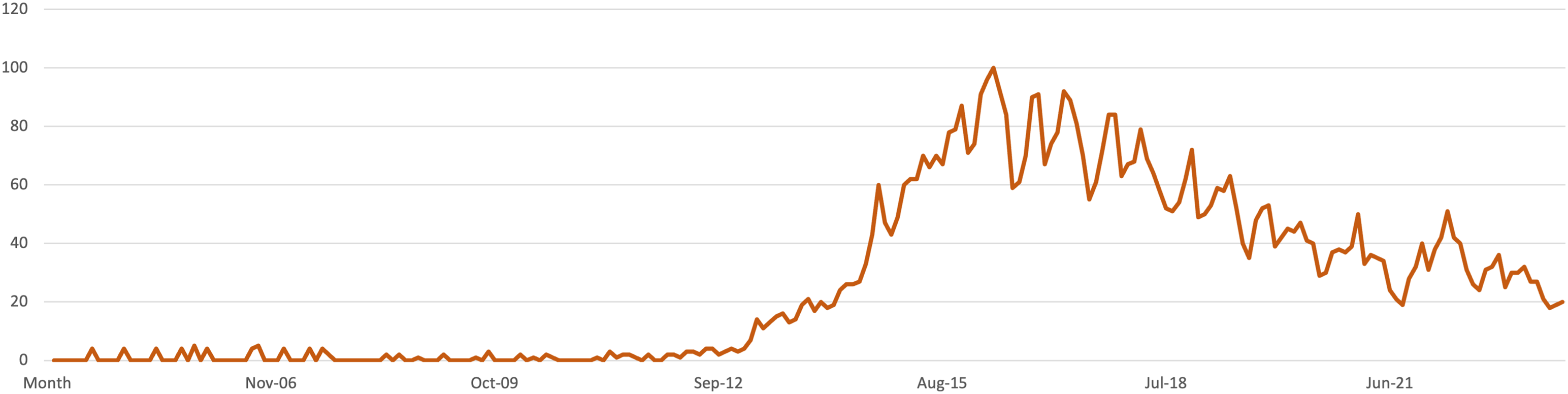
Shareable is “a nonprofit news, action network, and consultancy” (Shareable, 2022) that was founded in 2009 with a mission to “start a sharing movement… (and) to bring the ‘sharing economy’ into the mainstream” (Marsh, 2013). However, what the founders soon discovered was that the sharing movement was already emerging, so what Shareable set out to do instead was “to accelerate the sharing movement… (and to) show that the sharing economy is not a marginal thing, but a significant shift we should pay attention to and engage with” (Marsh, 2013). Shareable played a central role in shaping and propagating the sharing economy category via its online magazine, its landmark study “The New Sharing Economy” conducted with Latitude in 2010, and via its presence in social and news media. For example, one of the earliest, landmark media reports on the budding sharing economy features Neal Gorenflo, founder of Shareable, and his journey from a Fortune 500 business executive to “a leading proselytizer of a global trend to make sharing something far more economically significant than a primitive behavior taught in preschool” (Sacks, 2011). Gorenflo and Shareable also played a central role in “[breaking] the sharing economy story” (Shareable, 2022) via its online magazine shareable.net, via Twitter (@shareable), fiction (Rosenbaum, 2010), and public events, such as the SWSX festival (Davis, 2012) and the Future salon (Mark, 2010). What is more, Sharable was also one of the first institutions to openly question the commercial platforms’ contribution to achieving the goals of the sharing movement.
While the Shareable movement was one of the most visible pioneers in explicitly promoting the term “sharing economy,” the collaborative consumption movement (CCM) played a key role in ushering in the idea of an emergent economy of collaboration and sharing. The founding member of CCM was Rachel Botsman, who in 2010 co-authored a seminal book on sharing and collaborative consumption, articulating the vision and the need for an “economy of what is mine is yours” (Botsman and Rogers, 2010). On CCM’s online hub, collaborative consumption is presented as “the powerful socioeconomic groundswell that is transforming business, consumerism, and the way we live” (Collaborative Consumption, 2010). CCM aimed to “provide [people] with resources, stories, info-graphics and tools to fuel the development of Collaborative Consumption” (Collaborative Consumption, 2010). In the observed period, CCM used a plethora of channels to propagate the sharing economy, including Twitter (#collcon), opinion pieces published in the media (Botsman, 2010), in-person workshops focused on ideation of new products/service offerings based on collaborative consumption, collaboration with other NGOs such as the World Economic Forum (2013), and talks at public events such as TEDx Sydney and the Feast Conference.
Data overview: investigation of SMO’s shaping of the sharing economy category (2009–2013).
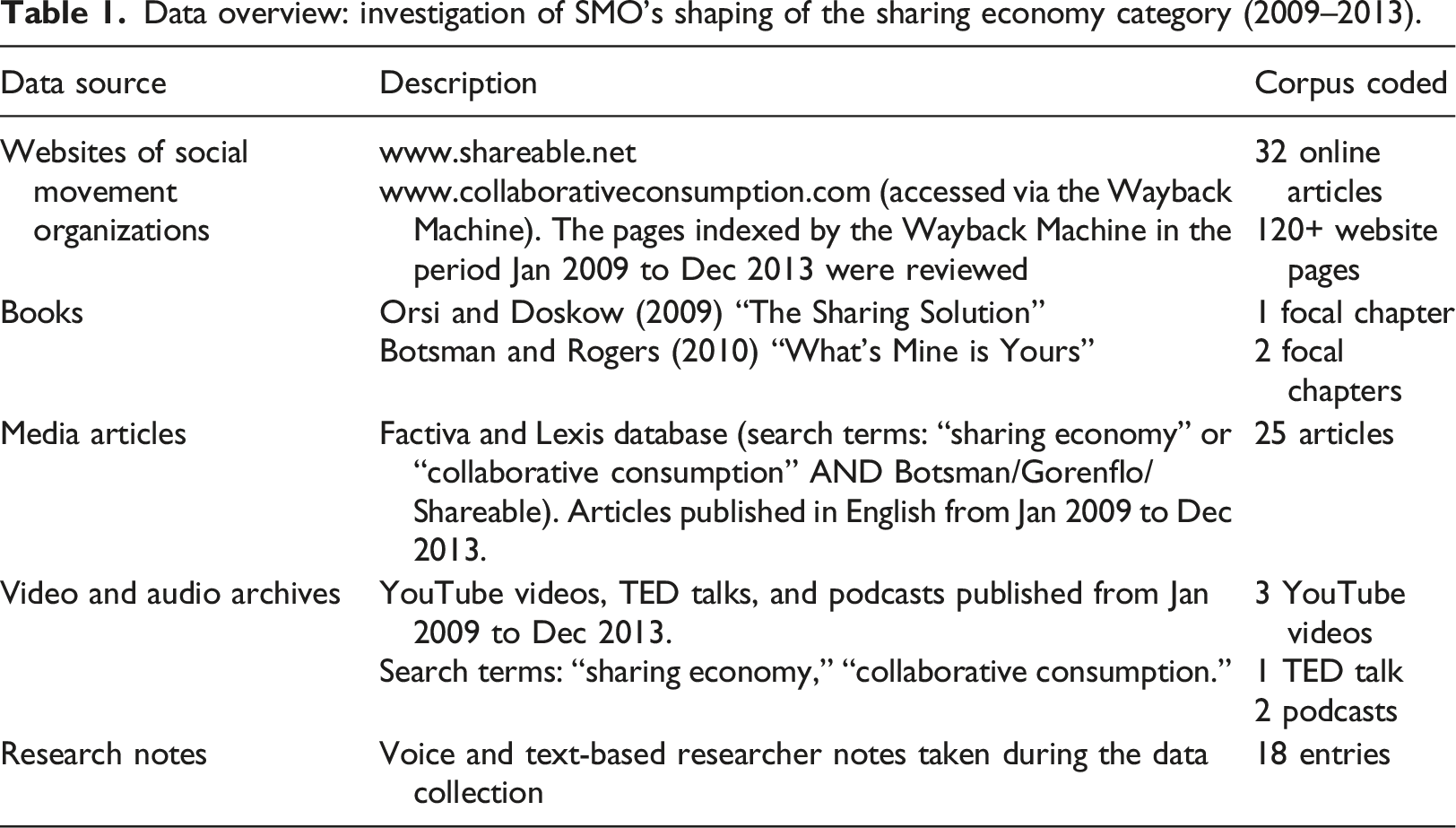
Our qualitative analysis of the texts followed an abductive approach (Timmermans and Tavory, 2012), jointly informed by our extensive interactions with the archival data and theoretical insight into category emergence and market formation. Using NVivo, we first descriptively coded a sample of early SMO and media texts to map out the common discursive patterns. A team of two researchers iteratively moved between the data and theory to translate the fragmented descriptive codes into an asset of analytical codes pertinent to our research questions. The researchers met regularly to discuss the emergent analytical codes, to consider alternative interpretations of the data and resolve potential coding discrepancies. In the final stage of the analysis, the analytical codes were systematically tested across the corpus of SM’s and CCM’s texts to further refine our analytical ideas and eliminate those lacking strong empirical support.
Findings
Our findings uncover the diverse ways in which the SMOs contributed to category formation (i.e., the emergence of the sharing economy as an influential cultural category) and to the propagation of platform technology as a pivotal catalyst and enabler of the sharing movement. We organize our findings into three sections: (1) articulating an emergent economy, (2) the social thickening of the sharing economy, and (3) technologizing the sharing economy. The three sections pertain to conceptually organized sets of discursive strategies which in practice often overlap and should not be mistaken for linear steps or phases of category development. The discursive strategies are outlined below and illustrated with additional examples in Appendix A. In the sections that follow, we link our findings to the data sources which are cited in abbreviated form (e.g., [CCW 2011] stands for the Collaborative Consumption website from 2011; see Appendix B for details).
Articulating an emergent economy
The SMOs played a vital role in articulating the category of the sharing economy. This includes highlighting and clustering dispersed socio-economic initiatives (occurrent or envisioned) as markers of a new economy, indicating the scale and magnitude of this economy, and disseminating knowledge and resources that help others to articulate this emergent category. We label these discursive strategies as: (1) Flagging, (2) Magnifying, and (3) Equipping, as elucidated below
Flagging
One of the most significant ways in which SMOs articulate the economy category is flagging, whereby SMOs draw attention to various examples of platforms and activities and cluster them under the umbrella of the sharing economy. For instance, consider the following text published on the landing page of the Collaborative Consumption movement (CCM): Welcome to the online hub for Collaborative Consumption. . . If you’ve used a car sharing service like Zipcar, experienced peer-to-peer travel on Airbnb, given away or found something on Freecycle or lent money through Zopa, you’re already part of the rise of Collaborative Consumption [CCW1 2010].
The passage indicates the types of activities and platforms that fit under the category of “collaborative consumption” and suggests to visitors that may already be a part of this rising movement. Although the term “sharing economy” does not yet appear in the earliest discourse on collaborative consumption, CCM played a key role in articulating the vision, and the need for an “economy [emphasis added] of what is mine is yours” [CB 2010]. In her seminal book [CB 2010], as well as in her column for CCM [CM 2010], the founder of the CC movement, Rachel Botsman excitedly heralds an “economy emerging” from the collaborative consumption groundswell.
To articulate an emergent economy of sharing and collaboration, SMOs assemble a rich repository of examples. Building on a collection of “over a thousand examples of collaborative consumption from all corners of the world” [CCW2 2011], CCM puts forward an elaborate classification of sharing economy platforms. Like CCM, Shareable invests considerable effort to give voice to lesser-known platforms and share early-stage ideas for the future development of the sharing economy: When acclimating to new concepts in the sharing economy, it’s natural to lump like things together... The first time you learn about a bike sharing program, you might assume that they all work the same way: rent bike, ride bike, return bike … That’s why Social Bicycles, a new project currently raising money on Kickstarter, caught my eye. SoBi, as it's lovingly referred to, aims to change the world of bike changing as we know it by adding a much-needed dose of mobile technology [SW1 2011]. Land is another asset that can and should be shared, one that is in high demand as rising food prices and the desire for healthy food blooms alongside the ‘Grow Your Own’ movement’s current momentum [SW2 2011].
By compiling and clustering the many examples of sharing platforms and initiatives, the SMOs articulate an emergent economy of considerable “scale, impact and diversity” [CCW3 2010; see also SW3 2010].
Magnifying
The more implicit articulation of the scope of the sharing economy that occurs via flagging, is amplified by SMOs’ efforts to explicitly articulate the magnitude of the sharing economy and its “unbounded potential” for growth [SR 2010]. In the so called “Collaborative consumption groundswell video” published in 2010 [CV 2010], CCM presents the promising market potential and market growth data for a rich portfolio of products, services, and sectors, including transportation, accommodation, and peer-to-peer lending. Similarly positive statistics were regularly published on shareable.net: Carsharing might serve 5.5 million people in Europe by 2015. . . French highway companies are even about to launch specific parking spaces to help carpoolers meet up. The main French carpooling service provider, Covoiturage.fr, serves 1 million users, amongst which 600 000 have registered in the last 12 months. For Frédéric Mazzella, Covoiturage.fr’s founder, these numbers are far from the market’s potential. He states in an article of Le Parisien: “I am convinced that in a few years we can serve 5 to 10 million users.” Such optimism is confirmed by a number of studies, including one by TNS Sofres for the Chronos Group. It focuses on user perception of transportation in the future: carpooling took first place, followed by public transportation, carsharing and bikes. Cars came in last. Another interesting aspect of this study is that 51% of the French consider that the essential part of their trips will involve shared cars in 2030 [SW4 2011].
Such discourse articulates the substantial scale and future potential of the emergent economy. As early as 2010, both Shareable and CCM created a wealth of communication ranging from informational videos [CV 2010] to full-blown studies asserting the impressive scope and “unbounded potential” of “The New Sharing Economy” [SR 2010]. The SMO’s discourse often draws on the numbers supplied by the pioneering platforms, who themselves engaged in similar tactics of flagging and magnification (e.g., see Clark’s, 2011, the founder of RelayRides, blogpost for the Harvard Business Review).
Equipping
SMOs have also developed and disseminated communication resources that help others (i.e., consumers, organizations, policymakers, media, and educators) to articulate the concept of the sharing economy, its magnitude, scope, and potential. The websites of both movements represent important hubs for equipping others with communication resources. As observed in one of our research notes, the richness of the information available is truly impressive: The CC website covers a rich depository of topics, including information about the movement, infographics and visuals that can be shared with others, interviews with platform founders, archives of existing events and notifications of future events, blog posts, a selection of news articles on the sharing economy, etc. After reviewing more than 50 past versions of the website with the help of the Wayback Machine, I am blown away by the quality and the quantity of information amassed between 2009 and 2013. The creation of new content and content curation must have taken an enormous amount of time and effort [RN1 2022].
The SMOs mobilized different resources for different target audiences. For instance, CCM created an infographic that helped consumers to visualize “all the assets [inside their homes] that can be shared, rented, and swapped” for profit [CCI 2011] and Shareable’s study “uncovered new opportunities for entrepreneurs, investors, and established companies in the emerging sharing economy” [SW5 2010]. The SMOs have often supported each other by promoting each other’s books, talks, and events, appearing in interviews, writing guest posts, and cross-posting their content. While the work of flagging, magnifying, and equipping can also play a role in the development of more narrow industries, we argue that it is more pivotal and more visible in our specific case of economy formation spanning across diverse and less evidently connected industries and markets.
The social thickening of the sharing economy
The SMOs also played a central role in the “social thickening” (Bajde et al., 2022b) of the emergent category, investing the envisioned economy with social and moral significance. This was achieved by problematizing traditional economic arrangements and the social and environmental problems they give rise to, by presenting the emergent economy as the answer to these problems, and by appealing to various actors (e.g., consumers, managers, and policymakers) as agents of change who can bring about a better future as protagonists and supporters of the emergent economy. We label these activities of social thickening as: (1) Problematizing, (2) Social prospecting, and (3) Social mobilizing, as outlined below.
Problematizing
The SMOs problematize traditional economic arrangements by highlighting the social and environmental problems of capitalism and consumerism. Consider the following excerpt from an article published on shareable.net in May of 2010: Where our future used to be, we now face a massive debt. The debt is national and measurable. We in America spent two decades buying on credit. We made promises we couldn’t keep to buy cars, houses, vacations, and plasma screens we couldn’t afford. When we defaulted, the debt shifted upward to a government that had already been putting its wars and occupations on the global equivalent of plastic. The debt is also environmental and abstract. All this crap we bought on credit had to come out of the Earth. We’ve razed forests and eroded soil, over-fished the oceans and depleted fresh water, and turned our bodies and environment into toxic waste dumps. . . In short, we consumed like there was no tomorrow. And as a result of the economic and environmental crises triggered by our multi-decade spending spree, tomorrow now seems to be shrinking to a little black dot [SW6 2010].
This passage frames mass consumption and its social and environmental impacts as a pressing problem that requires an immediate response. Both Shareable and CCM paint a gloomy picture of society plagued by “hyper-consumerism” [CB 2010] and the self-destructiveness of consumer economy [SW7 2010]. They do not vilify consumption as such, but rather oppose the “consumer mindset” and lifestyles revolving around individualized ownership and the absurdity of happiness “epitomized by [a] lone shopper surrounded by stuff” [CB 2010]. Both SMOs invoke and lament the figure of a “disconnected citizen” whose capacities to share, collaborate and live a meaningful, socially, and environmentally connected existence have been eroded by consumerism [SW6 2010].
Social prospecting
Through social prospecting, SMOs offer the solution to the stated problems in the form of the emergent sharing economy and the sustainable ways of living and doing business it affords: Sharing is the answer to some of today’s biggest questions: How will we meet the needs of the world’s enormous population? How do we reduce our impact on the planet and cope with the destruction already inflicted? How can we each be healthy, enjoy life, and create thriving communities? [SW8 2009]
The new emergent economy of sharing is presented as “a way out” [CBR 2010], showing consumers that “their material wants and needs need not be in conflict with the responsibilities of a connected citizen” [CB 2010]. As proposed on shareable.net in 2009: “[i]n a shareable world, things like car sharing, community gardens, and cohousing can bring us together, make life more fun, and free us for the important things in life. When we share, not only is a better life possible, but so is a better world” [SW9 2009]. The passage serves as a telling illustration of how the sharing economy comes to be framed as portal that leads towards a “better life” and a “better world.” The social prospecting discourse was also reinforced by the platforms, in particular when it comes to touting the economic and environmental benefits of the sharing economy (Martin, 2016). For example, in a 2011 Forbes interview, Airbnb’s Chesky hailed the platform’s potential to help people become “more independent, more liberated, [and] a little more economically empowered,” and car riding platforms such as Zipcars continuously emphasized the environmental benefits of “car sharing.”
Social mobilizing
In addition to problematizing society and promoting the social prospects of the sharing economy, the SMOs avidly mobilize consumer-citizens, managers, and policymakers to play an active role in participating in and supporting the development of the emergent economy. For instance, consider Rachel Botsman’s effort at mobilizing attendees to her famed talk at Creative Sydney: Towards the end of the speech I was telling the audience about how I went to see an exhibition in 2006 called Massive Change. . . As I entered that show, I was confronted with gigantic black and white type with the big question: “Now that we can do anything, what will we do?” The question really hit me at the time, and I sensed it struck a chord with the Creative Sydney audience. It is the challenge entrepreneurs, designers, advertisers, and so on face every single day: What’s our role in the choices consumers make? How can we “culturalize” people to share and behave more collaboratively? How can the latest technologies reinvent industries and challenge old consumer myths we have been told? How can we use our skills help change our world for the better? I invited the audience, mainly composed of people from creative industries, to think about how critical they are in taking the world of Collaborative Consumption out of the world of “what if” and into real workable solutions that help find a healthy balance between the needs of consumers, companies and the greater good of society [SW10 2010].
The passage illustrates how the SMOs actively mobilize managers, policymakers, and consumers as responsible agents of change. Much of the early sharing economy discourse propagated by CCM and SM revolves around “empowering” actors to transform their lives, their cities, and their businesses through participating in, and further developing, the sharing economy. The SMOs provide not only mobilizing manifestos (e.g., Smith’s “Transumer manifesto” published on Shareable in July of 2010—SW11), but also practical guidelines for new ways of living, and how sharing platforms can be used to share clothes, cars, bikes, tools, land, and other assets (e.g., Orsi and Doskow's, 2009 book The Sharing Solution and their subsequent contributions on Shareable—SB). What’s more, the SMOs also share tips on how to effectively mobilize others by avoiding “anti” or “blame” sentiments, making sharing “cool,” stressing positive benefits and appealing to consumers’ “me” needs and citizens’ “we” mindsets (for illustrative examples, see Appendix A). Such mobilization efforts are important not only for their contribution to the popularization of the sharing economy, but also for constituting the sharing economy as a moral authority that interpellates market actors as virtuous agents of change.
In sum, similar to existing studies of single-industry formation (Bajde et al., 2022a; Bajde et al., 2022b; Humphreys, 2010), we find evidence of strategic social problematization and social thickening. We extend this work by showing how SMOs further fuel market formation (and subsequently platformization) by mobilizing consumer-citizens, managers, and policymakers as active participants in the development of the virtuous economy.
Technologizing the sharing economy
In addition to the discursive strategies outlined above, we find the early sharing economy discourse to be replete with references to the power of what we will term as platform technology (i.e., information and communication technologies on which the sharing economy platforms run). Technologizing refers to the discursive strategies through which platform technologies are framed as enabling tools and infrastructures. Shareable’s ground-breaking study “The New Sharing Economy” opens with a proclamation that while sharing is “a simple concept and a fundamental part of everyday life,” thanks to technology it is “now an industry with seemingly unbounded potential” [SR 2010]. Both SMOs credit platform technologies for their vital contribution to creating “a ‘perfect storm’ for sharing” [SW12 2010] across greater geographic and social distances [CB 2010]. To be more specific, the SMOs routinely paint platform technologies as enablers of social connection and trust and enablers of efficiency and scaling, as discussed in more detail below.
Platform technology as enabler of social connection and trust
CCM credits “the latest technologies and peer-to-peer marketplaces” for the reinvention and rapid explosion in sharing [CCW1 2010]. In the same spirit, Shareable frames platform technology as a vital agent of social change: Technology is connecting individuals to information, other people, and physical things in ever-more efficient and intelligent ways. It’s changing how we consume, socialize, mobilise – ultimately, how we live and function together as a society [SR 2010].
Both SMOs grant technology the role of a catalyst and enabler of new forms of sociality, connectedness, belonging, and trust. In her 2010 CNN article, Botsman confidently argues that: The convergence of social networks that make access more convenient and facilitate trust between strangers… are shifting us away from the outdated forms of consumerism. Instead, these trends are moving us toward sharing and cooperation enabled by social technologies of a myriad of assets [CM 2010].
A crucial role of technologies driving sharing economy through enabling strangers to trust each other can be evidenced also from an interview with Botsman published on the Collaborative Consumption website, where she states: I love how Collaborative Consumption is reinventing an old form of trust. Some examples of Collaborative Consumption such as Airbnb or RelayRides would have seemed like crazy ideas even a few years ago, but now we have the technology and reputation systems to make them feel secure and easy-to-use by building trust between strangers. CC enables all kinds of new marketplaces that have a healthy balance of commerce and community to evolve and stick [CCW3 2010].
Platformization thus becomes framed as a process of trust building (among strangers) that simultaneously grows community and commerce. The framing is echoed in recurrent Shareable posts proselytizing the power of technology to connect people, facilitate trust, and supercharge sharing and community.
Platform technology as enabler of efficiency and scaling
By providing effective infrastructures for connectivity, trust, and exchange, the SMOs argue, platform technology reinvents sharing “on a scale never possible before” [CCW1 2010]. Tim Hyer, a writer for Shareable, sums up the transformative powers of platform technology in the following manner: One of the biggest catalysts for this movement has been technology and its ability to enable traditionally offline processes to easily happen online. The web has opened doors to unparalleled resource allocation. Social media helps verify people’s identities and can build trust among users. The rise of smart phones and mobile payments allow transactions to happen anytime, anywhere. And the web creates virtual communities, attracting like-minded individuals to share and exchange [SW13 2011].
Platforms and mobile technologies make sharing easy, convenient, and efficient. Web and platform technology are argued to have opened “the doors to unparalleled resource allocation” [SW13 2011]. To quote Botsman and Rogers [CB 2010], platforms have the potential “to match supply with demand through a nearly instantaneous mass synchronization of wants and needs in which both sides always win.” As technology connects multitudes of people, information, and things “in ever-more efficient and intelligent ways,” sharing becomes “more practical than ownership” [SR 2010]. Or to quote the futurist Pesce’s manifesto published on the Shareable website in October 2009, society can “be remade in the image of a network that enables people to share” [SW14 2009].
The early discourse surrounding the sharing economy is marked by a celebratory view of platform technology largely devoid of substantial doubt or critique of platformization. Both in the early SMO discourse and early popular media discourse, sharing economy platforms were legitimized and normalized as new technologies that “grease the wheels” of ancient, and innately human proclivities for bartering and sharing (Geron, 2013; Gorenflo, 2010). Platformization was legitimized via “prelapsarian” visions (John, 2017) of how new technologies can help individuals and society reclaim the social connections, solidarity, sharing, and sustainability that had been lost to hyper-consumerist capitalism, and help upscale sharing to unprecedented levels.
However, it is important to also point out that as the economy developed, the SMOs began to increasingly question the platforms’ commitment and contribution to a more sharing-oriented society. Sharable, for example, already in 2011 cautioned that “focusing on the profit motive reduces the scope of the sharing economy, from a transformative cultural movement to an easy way to make a quick buck… another form of ‘happy capitalism’.” In 2012 and 2014, critical views of the sharing economy were prominently voiced in academic research (Bardhi and Eckhardt, 2012; Schor, 2014). By the end of the decade, the category of sharing economy was described as an “anti-concept” that might obscure more than it reveals (Pedroni, 2019), as the “sharing economy” platforms and their users tend to be less interested in sharing than they are in maximizing their economic benefits. Such critical scholarship not only provides an important counterbalance to the earlier celebratory discourse, but also reaffirms the importance of exploring the sharing economy as messy cultural category (as opposed to a “neat” scholarly concept). It also shows that while historical in nature, our analysis remains both relevant and timely. As a cultural category, the sharing economy is far from dead. As reflected by the title of Schor’s (2020) recent book, “How The Sharing Economy Got Hijacked and How To Win It Back,” it might even be something worth fighting for. Understanding how this category emerged, can help advance our knowledge of the current and future developments of both “the sharing economy” and platformization more broadly.
Discussion
Our analysis contributes to the theorization of the cultural dynamics that underpin platformization by unpacking the formation of the sharing economy category. In this section, we first consider the implications that the shaping of the sharing economy category carries for platformization. Next, we discuss how our findings advance the study of market and category formation.
Contribution to cultural theorizing of platformization
The cultural emergence of the sharing economy category and its concurrent technologization, carry important implications for the cultural study of platformization. The discursive strategies we outline helped establish the sharing economy as an expansive socio-economic field (Mountford and Geiger, 2021) tethered to relevant social and environmental concerns. By articulating a powerful macro-market category, by infusing it with social meaning and aspiration, and by framing platform technology as an enabler of positive social change, SMOs helped numerous platforms achieve normative and socio-cognitive legitimacy (Humphreys, 2010; Suchman, 1995) as members of the up-and-coming sharing economy.
Moreover, by promoting the sharing economy and its platforms as part of a valuable social movement, and by romanticizing the enabling role of technology, SMOs helped endow platformization with an aura of social and environmental virtue (Bajde et al., 2022a). As shown by Schor (2020), the idealist discourse helped make participation in developing, using, working for, and investing in sharing economy platforms more attractive. It arguably also helped the platforms in fending off social critiques and regulatory interventions.
Our work shows that SMOs played a much larger role in advancing platformization, and in the emergence of the sharing economy, than previously assumed (Schor, 2020). We extend the recently published sharing economy research on idealistic and utopian discourses (Schor and Vallas, 2021), by explicating the discursive strategies through which the sharing economy was articulated, socially thickened and technologized. That is not to overstate the effects of categorization and the SMOs role in it (i.e., the platforms, the media, and sharing economy scholars, etc. also played important roles) or to ignore the SMOs later involvement in critiquing the sharing economy. Already by 2013, the virtuous aura of the sharing economy began to exhibit some serious cracks (Malhotra and Van Alstyne, 2014; Slee, 2017), and SMOs such as Shareable were one of the first critical voices to question the development and impact of the sharing economy. It is likely that the initially celebratory views and imaginaries of platform technology as driver of trust and community have also changed in the subsequent period. Future research is needed to shed light on these techno-discursive dynamics.
While establishing the precise impact of the outlined efforts in advancing platformization is beyond the scope of this paper, we have been able to highlight the significant role that cultural dynamics can assume in shaping platformization. Our work extends nascent efforts that have highlighted the normative and political significance of “platform” discourse (Gillespie, 2010) by systematically examining how platformization is embedded in, and shaped by complex socio-cultural dynamics, such as the formation of sharing economy as a discursive category endowed with powerful social meanings.
Contribution to market categorization and market formation studies
The secondary contribution of our works lies in theorizing the emergence of the sharing economy category as a nexus of overlapping discursive strategies (see Figure 2) through which an economy is articulated (flagging, magnifying), socially thickened (problematizing, prospecting, and mobilizing) and technologized. The uncovered discursive strategies, and the central role played by SMOs in deploying them, provide important contributions to the study of market categorization and market formation. We present one of the first marketing studies investigating the emergence of an economy as a cultural category. Our work highlights the important role categorization plays in market formation, not only at the more commonly explored meso-level of products and organizations (Durand and Khaire, 2017; Rao et al., 2003), but also on the macro-level of an economy. Discursive strategies underpinning the emergence of the sharing economy category.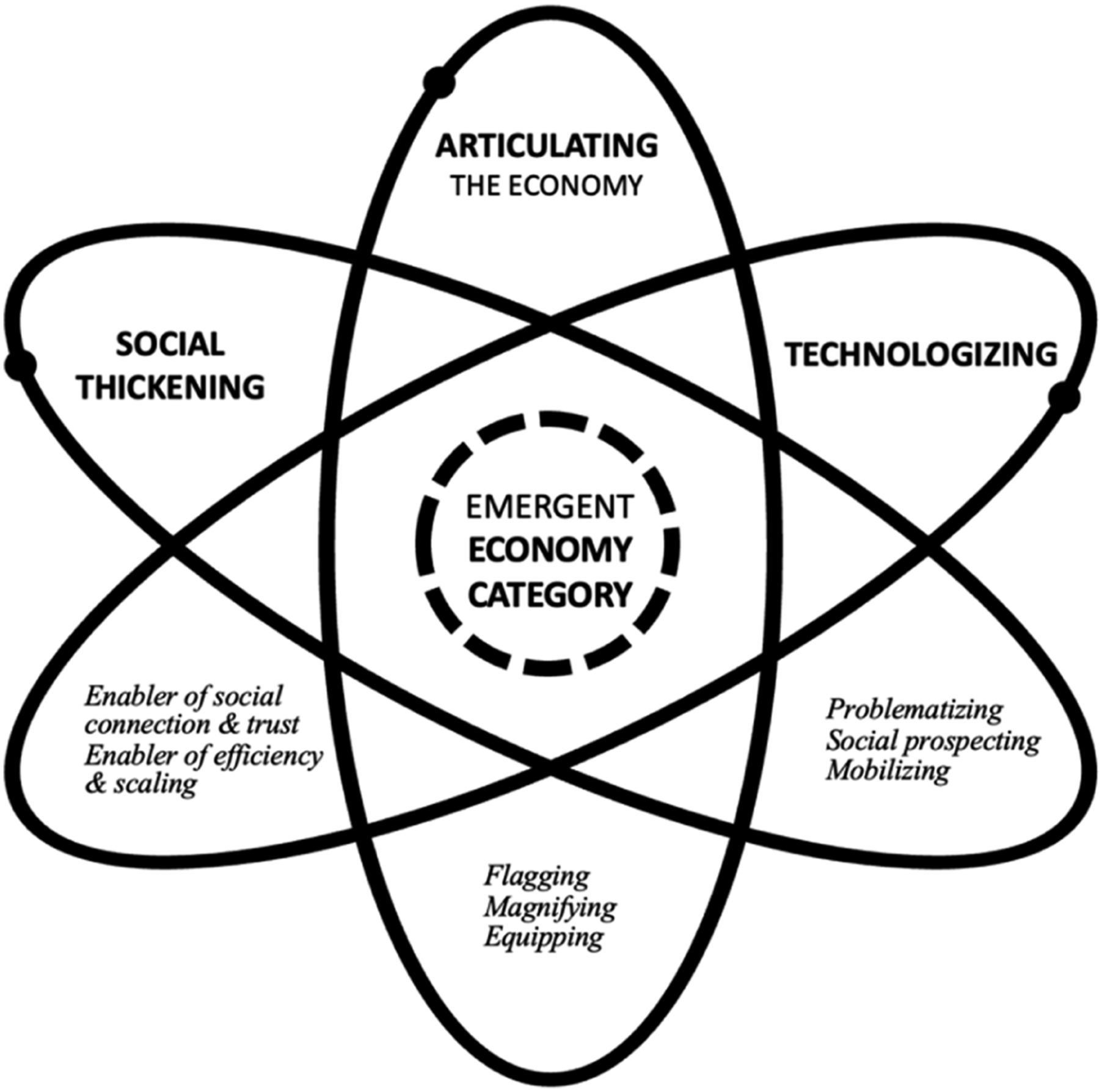
As concluded by Durand et al. (2017), market categorization as a social process remains under-researched, even more so when it comes to the formation of abstract, macro-market categories such as an economy. Our study highlights several dynamics that have not been previously uncovered by studies focusing on the formation of individual markets or industries. For example, a wide-spanning economy is more diverse and difficult to grasp than a single industry, thereby increasing the need for the strategic efforts of flagging, magnifying, and equipping. On the other hand, the expanded scale and weight of an economy afford additional opportunities for social problematization, social thickening, and perhaps most interestingly for mobilizing actors as active supporters of economy/market development. We show how (macro) market formation can be spurred by idealistic discourse that frames the emergent economy as a force for good. In the years to come, the sharing economy has not lived up to its social and environmental promises, and alternative categories such as “the gig economy” have gained more prominence in public discourse and the mounting critiques of the sharing economy and its profit-driven platforms (Schor, 2020).
Past studies tend to assume that producers and market intermediaries (e.g., market analysts) play the decisive role in category formation, but we show that SMOs can play an equally important, or even more central role (e.g., in the case of mobilizing other actors, problematization, and social thickening) in shaping economy categories. While social movements and SMOs do occasionally find their way into marketing research (Fischer, 2001; Kjeldgaard et al., 2017; Mirabito and Berry, 2015; Nardini et al., 2021; Nøjgaard, 2023), the role of social movement organizations in market formation has hitherto received limited attention. We extend previous marketing and consumer research by revealing the pivotal role SMOs can play in shaping of new markets and economies, and by explicating the discursive strategies deployed by SMOs to articulate an emergent economy and establish its social and cultural significance.
Extant research has demonstrated the power of social movements to challenge and transform the institutional logics, collective identities, valorization processes, action frames, and orientations within a certain socio-economic field (Fischer, 2001; Kjeldgaard et al., 2017; Nøjgaard, 2023; Scaraboto and Fischer, 2013). Our study extends this work by showing that SMOs can play a profound role in the very formation of a new socio-economic field (such as the sharing economy), thereby impacting the development of various markets and industries, incumbent as well as emergent. The SMOs examined in this work helped mobilize resistance to established forms of consumption and business, as well as aspirations for change (among consumers, managers, and policymakers) that they then channeled into the formation of emergent economy.
Supplemental Material
Supplemental Material - The cultural underpinnings of platformization: How social movement organizations helped form the category of the sharing economy
Supplemental Material for The cultural underpinnings of platformization: How social movement organizations helped form the category of the sharing economy by Domen Bajde, Maja Golf-Papez and Barbara Culiberg in Marketing Theory
Footnotes
Declaration of conflicting interests
The author(s) declared no potential conflicts of interest with respect to the research, authorship, and/or publication of this article.
Funding
The author(s) disclosed receipt of the following financial support for the research, authorship, and/or publication of this article: This work was supported by the Slovenian Research Agency [project number J5-1782].

Supplemental Material
Supplemental material for this article is available online.
References
Supplementary Material
Please find the following supplemental material available below.
For Open Access articles published under a Creative Commons License, all supplemental material carries the same license as the article it is associated with.
For non-Open Access articles published, all supplemental material carries a non-exclusive license, and permission requests for re-use of supplemental material or any part of supplemental material shall be sent directly to the copyright owner as specified in the copyright notice associated with the article.
