



Abstract
Current models of substantive reputation repair primarily focus on isolated reputation-damaging events (RDEs) and corresponding responses by firms within short time frames. Nevertheless, evidence suggests that firms encounter numerous RDEs over extended periods while only sporadically and intermittently engaging in top-down substantive repair. To investigate this event-response asynchrony, we adopt an event system theory (EST) approach and conduct a qualitative study of a multinational firm. Over a 10-year period, we analyzed 47 RDEs that eventually prompted top management to initiate substantive repair. Our findings reveal that top managers perceive reputation management as a complex system comprising self-correcting subsystems that follow recurring adaptive event cycles. These cycles consist of iterations, transitioning from routine business-as-usual activities managing most RDEs (foreloops) to nonlinear, transformative responses to certain events (backloops). As long as these cycles are deemed effective, top managers refrain from substantive repair, intervening only when they identify a subsystem breakdown. Consequently, our event-system model of substantive reputation repair elucidates event-response asynchrony in two phases: (1) top managers’ confidence in the hierarchy of adaptive event cycles leads them to purposefully avoid most RDEs, and (2) the convergent intersection of three specific event chain patterns gradually establishes a shared narrative among top managers, triggering top-down substantive repair. By employing EST, we not only provide novel insights into how firms manage reputations but also enhance the explanatory power of EST by illuminating event cycle dynamics.
Keywords
Introduction
At the height of the COVID-19 pandemic, the U.S. Centers for Disease Control and Prevention (CDC) was under fire. Mistakes ranging from testing failures to communication mishaps, many of which predated the pandemic, put the CDC’s reputation under severe strain. Rather than responding to a specific incident, the resulting complex web of reputation-damaging events (RDEs) pushed the agency to engage in a major reputation repair journey (Griffin, 2022; Morrison & Inglesby, 2023). To address the root causes of reputation damage, the CDC conducted a top-down overhaul ranging from its overly bureaucratic culture, operations, and data management capabilities to its communication approach and partnerships (Morrison & Inglesby, 2023). More broadly, a PricewaterhouseCoopers (2019) survey of 2,084 corporate leaders found similar trends. While most large firms surveyed experienced a series of RDEs over the previous five years, substantive reputation repair efforts—i.e., top-down organizational changes to address root causes and prevent reoccurrence (Rhee & Kim, 2012)—were intermittent and asynchronous, responding to a configuration of RDEs rather than to a single event.
How can we explain such event-response asynchrony or the tendency for organizations to make only intermittent substantive repair responses to frequently experienced RDEs? Notably, most reputation repair research focuses on responses to individual RDEs or those happening in quick succession (e.g., Pfarrer, DeCelles, Smith, & Taylor, 2008; Rhee & Kim, 2012). We refer to these as discrete-event models, as they follow a linear progression: a single, focal RDE (often a catastrophic event) that triggers a substantive repair response. But as outlined previously, substantive reputation repair often emerges in the wake of a series of events—unfolding chains or cycles without an obvious beginning, middle, and end—rather than just isolated or severe events. We need alternatives to discrete-event models to explain this observation, as presuming a straightforward or linear progression from a significant RDE to a swift corresponding response can lead to misinterpretations. For instance, a seemingly swift, “successful” substantive repair effort could be mistakenly attributed to a discrete “big bang” RDE when it actually may emerge in response to a web of interconnected RDEs. Similarly, a lack of response from top management could be seen as representing organizational “failure” to notice, care, assume responsibility, and respond when their inaction was, in fact, purposeful and perceived as beneficial to the organization.
To shed light on how organizations respond to RDEs, we build on theoretical models about how organizations substantively respond to multiple and diverse sets of events. We refer to these as event-system models, as they adopt a systems perspective to understanding substantive reputation repair in response to a series of RDEs (e.g., Bansal, Kim, & Wood, 2018; Durand, Hawn, & Ioannou, 2019; Roulet & Bothello, 2022). These conceptual models (e.g., Roulet & Bothello, 2022) suggest that transformational change within organizations is seldom the result of singular events but rather a series of smaller, cascading, intermittent events that form systems. However, few, if any, empirical studies around these models examine substantive response dynamics.
To develop an empirically grounded model of how organizations substantively respond to multiple and diverse sets of RDEs, we draw on event system theory (EST), an interdisciplinary framework that seeks to illuminate the dynamic nature of events and their interactions within a system (e.g., Morgeson, Mitchell, & Liu, 2015). EST is well-suited to address our research query because it (1) treats events (and, more broadly, event systems) as the core unit of analysis, providing a framework for examining not only event characteristics (e.g., strength) but also relational characteristics among events, that is, their interconnected temporal and spatial attributes (e.g., the tempo, direction, origin, and spatial range of events) (Morgeson et al., 2015); (2) depicts events as occurring over a range of time horizons and as producing impacts at multiple levels of analysis, including the individual, team, and organization (Liu, Morgeson, Zhu, & Fan, 2023); and (3) facilitates explanations for event-response asynchrony, from microlevel cognitive and behavioral explanations at the individual level to those pertaining to macrolevel organizational processes (Roulet & Bothello, 2022).
The impact of RDEs stems not only from their individual characteristics but also from their interconnectedness within event systems. Thus, rather than using a single explosive RDE as our starting point, we investigate how a multinational corporation in the property services industry responded to 47 well-documented RDEs over a 10-year period. By combining interviews with top management, historical data, and participant observations, we explore how a variety of events—from high-impact RDEs to seemingly minor occurrences—formed chains, cycles, and ultimately recognizable patterns that led to a substantive reputation repair response. Interestingly, our findings reveal that the RDEs with the greatest impact on top management are not always the largest or the most recent. Instead, certain RDEs from long ago gradually amplified in perceived relevance over time, with discernible patterns of events emerging to form an eventual tipping point that triggered a major organizational response.
In this article, we make two key contributions. First, we enhance the explanatory power of EST by introducing “sorely needed” theory and research into event cycles (Laulié & Morgeson, 2021: 398). Although foundational work in EST (e.g., Allport, 1954: 288; Katz & Kahn, 1978: 351) defines systems as “cycles” of events, these cycles have seldom been explored within EST. Instead of viewing the reputation repair process as a linear sequence, we conceptualize it as occurring within a hierarchical network of interconnected adaptive event cycles. Spanning various organizational levels, these cycles operate in repetitive patterns, ranging from routine operations (the “foreloop”) to transformative repair phases (the “backloop”). The consistency of these cycles contributes to system stability, resulting in infrequent top-down substantive reputation repair responses to RDEs. Intermittently, specific event patterns trigger substantive repair when they surpass a critical threshold. By identifying this interplay, we shed light on how substantive responses emerge following a series of RDEs.
Second, we illuminate substantive reputation repair processes beyond conventional discrete-event models. Leveraging EST’s unique strengths, we explore interconnected chains, cycles, and systems formed by RDEs at various time frames and organizational levels. This approach provides an alternative perspective on the phenomenon of event-response asynchrony by challenging the prevailing notion of inaction in response to RDEs being seen as a failure (e.g., Rerup, 2009). By contrast, we identify instances where top management deliberately and strategically refrains from intervening even in the face of highly salient RDEs (e.g., Bundy, Shropshire, & Buchholtz, 2013). Furthermore, unlike existing models that attempt to explain strategic inaction (e.g., Durand et al., 2019), our model accounts for multilevel, within-firm dynamics, revealing how organizations adapt to a broad array of interconnected RDEs—ranging from small to large and from recent to historic—that together form event systems. Thus, we provide a fresh explanation for the asynchronous and intermittent nature of substantive responses to RDEs.
Theory Review
To explain event-response asynchrony, we need to understand how events (and resultant event chains and cycles) occur at micro- and macro-levels, including their temporal relationships. Unlike dominant feature-oriented research that explains the intensity of workplace outcomes given individual, team, or firm-level features, event-oriented research treats events as focal research phenomena (see Liu et al., 2023). Within this realm, EST—drawing from the work of Morgeson et al. (2015), Liu et al. (2023), and Roulet and Bothello (2022)—provides a comprehensive interdisciplinary framework (see Luhmann, 1995). EST originates from Katz and Kahn’s (1978) open system model, which focuses on phenomena that can be decomposed into discrete events that are spatially and temporally interconnected and interact within a system (Allport, 1954). It offers a conceptual framework for examining the dichotomy between stability and change and helps explain how events garner attention and influence organizational behaviors, features, and subsequent events over time (Morgeson et al., 2015). In contrast to other event-oriented approaches that mostly probe the impact of individual events (e.g., Groysberg, Lin, & Serafeim, 2016), EST acknowledges that events rarely occur in isolation. EST is thus concerned with events in relation to each other, including how their patterns and relations across time and space may compel responses or trigger further events (Liu et al., 2023; Morgeson et al., 2015). Therefore, EST has the potential not only to enhance existing discrete-event models but also to provide the theoretical scaffolding for an empirical event-system model, providing deeper insights into event-response asynchrony by considering the systemic interrelations and patterns among events.
EST and Reputation Management
Organizational reputation is a vital intangible resource that influences stakeholders’ willingness to engage in resource exchanges with the organization (Pollock, Lashley, Rindova, & Han, 2019; Rindova & Martins, 2012). Consequently, reputation repair is a strategic imperative, especially after organizations experience RDEs. EST offers a novel perspective on RDEs through its differentiation between entities and events. Entities are identifiable things, including but not limited to individuals, teams, departments, organizations, and environments (Morgeson et al., 2015). Events are specific points in time and space when entities or their actions intersect—“discrete happenings” that deviate from the routine features of the organizational environment and occur externally to the observer (Allport, 1954; Morgeson et al., 2015). One event can trigger another, forming a series called an event chain. When these chains repeat themselves, they can be referred to as event cycles. 1
Using this EST-informed understanding, we modify Deephouse and Suchman’s (2008) conceptualization of reputation to define RDEs as discrete occurrences that come to lower audiences’ generalized expectations about a firm’s future behavior or performance. With this definition, an EST lens addresses two blind spots found in discrete-event models that attempt to explain substantive reputation repair after RDEs, transgressions, and related phenomena (e.g., Pfarrer et al., 2008; Rhee & Kim, 2012; Rhee & Valdez, 2009). First, an EST lens does not define RDEs by their outcomes—for example, as events that “threaten organizational viability” (see Pearson & Clair, 1998: 60), “demand an immediate response” (see Rhee & Kim, 2012: 12), or are “collectively acknowledged” by employees (see Dutton & Dukerich, 1991: 518). Thus, rather than having to surpass a predetermined threshold or be worthy of a response, the flexibility offered by EST allows: (1) the size of reputational damage inflicted by an RDE to vary from minor to severe and (2) the temporal separation of the event component of an RDE from its damage component. This less restrictive approach overcomes the propensity of discrete-event studies to limit their investigations to responses to single, high-impact events (e.g., Rhee & Kim, 2012) or closely linked event chains within a short timeframe (e.g., Elsbach, 2012). Instead, it provides the analytic flexibility to analyze multiple and varied RDEs, accommodating not just the immediate fallout but also more protracted impacts revealed in a sequence of events.
Second, an EST lens does not frame inaction as failure. For example, while Rerup (2009) separates events from their responses to explain why weak cues about RDEs are not always considered problematic, his model posits that not responding to such cues inevitably creates crises. Instead, by factoring in various spatial and temporal considerations associated with events, including the chains and cycles they form, an EST lens allows inaction to be framed as a strategic choice rather than as a failure. This opens the door to alternative explanations in which event-response asynchrony can be viewed as a deliberate, even optimal, strategy.
EST and Event-System Models
Event-system models, including those using EST, generally focus on broader event-response dynamics rather than just singular RDEs. Work by Durand et al. (2019), Bansal et al. (2018), and Roulet and Bothello (2022) shows how organizations navigate the asynchrony between multiple and diverse events and their responses. Despite the rich insights offered, these studies fall short of fully capturing event-response asynchrony, either by overlooking the relational characteristics among events and the heterogeneity of responses to events within the organization or by considering one of these elements but not the other.
Falling into the first category, Durand et al. (2019) develop a conceptual model of substantive repair that allows for an eventual response to multiple events. This model underscores how a cumulative series of events, including highly salient ones, can evoke varying organizational-level responses—from inaction to extensive repair efforts. However, despite providing a theoretical explanation for event-response asynchrony, it does not address the role of relational characteristics among events that arise over time or the within-firm heterogeneity of responses.
Within the second category, Bansal et al. (2018) introduce a systems perspective to explain organizational action or inaction across time and space. The authors contend that decision-makers may only respond to events when their own attentional structures align with the characteristics of their environment related to those events (see Barnett, 2012). While this model adeptly handles multilevel dynamics (and thus within-firm heterogeneity), it does not address interconnected events that form patterns over time and space to initiate substantive change. Conversely, Roulet and Bothello (2022) use EST to theorize that substantive change is not driven by individual event attributes like disruptiveness, novelty, and criticality but rather by the relational characteristics among events. They suggest that characteristics, such as decreasing intervals between increasingly larger events, form event chains that trigger microresponses (e.g., stagnation). These responses then escalate to induce macrolevel change (e.g., new social movements). Nonetheless, their approach does not consider the heterogeneity of responses within an organization.
Taken together, existing event-system models have yielded several useful insights, but by disregarding the relational characteristics of events and within-firm heterogeneity of responses, they do not fully capture how responses to RDEs occur within the organization. To address this issue, we turn to EST’s foundational concepts and the notion of interconnected event cycles.
The Roots of EST and the Significance of Event Cycles
As an integral part of the broader view taken by systems thinking (Grewatsch, Kennedy, & Bansal, 2021), EST shares commonalities with general systems theory (Bertalanffy, 1968), resilience thinking (Holling & Gunderson, 2002), and other approaches that explain systems, from the simplistic to the highly complex. A departure from reductionist thinking, the systems perspective focuses on the embeddedness of parts within the whole rather than examining parts to understand the whole. This perspective takes a relational view of the world as interconnected relationships among entities and events to explain dynamism and stability across time and space. Further, it views systems as open entities that engage with other (sub-)systems with subjectively defined boundaries (see Grewatsch et al., 2021).
The systems perspective typically frames the world as a set of cyclical feedback loops where circular arrangements of events trigger responses that, in turn, influence the propagator and vice versa (Grewatsch et al., 2021; Holling & Gunderson, 2002). This allows for a hierarchical conceptualization of interconnected systems, whereby smaller, faster, lower-order systems enable the emergence of larger, slower, higher-order ones (Holling & Gunderson, 2002). These adaptive cycles of events describe how an entity uses these feedback loops to respond to its changing environment, with these cycles linking to form a hierarchy of adaptive event cycles (or panarchy; see Holling & Gunderson, 2002; Walker & Salt, 2006).
Despite their pivotal role in the EST literature (especially as discussed by EST’s progenitors, e.g., Allport, 1954; Katz & Kahn, 1978), the concepts of adaptive cycles and their hierarchies have been underrepresented. Consider that Katz and Kahn (1978: 351, emphasis added) define systems as “cycles of events that allow entities to transform energy into outputs.” Further, Allport (1954: 288, emphasis added) devotes considerable attention to event cycles, even stating that “all structures of events have a self-closing or cyclical character.” Recognition of this oversight has prompted EST scholars to call for theorizing of, and research into, event cycles (Laulié & Morgeson, 2021: 398).
Including cyclical dynamics can enhance EST’s explanatory power. Leveraging concepts from these systems perspectives, we aim to explore how top management comes to orchestrate substantive reputation repair in response to RDEs.
Research Method
Research Strategy and Setting
We conducted a field study within an organization undergoing significant reputation repair. To better understand event-response asynchrony within a wide and varied array of RDEs, we adopted a theory-elaborating qualitative approach (Vuori & Huy, 2016, 2022). This inductive approach was particularly relevant to the exploratory nature of our research question. It allowed us to capture comprehensive descriptions of the experiences, perspectives, and social processes of the organization’s top managers (TMs), generating fresh insights.
General context
Enigma (pseudonym), a multinational corporation dealing in property services, is our research case. At the time of the study, it had approximately $10 billion in funds under management with a market capitalization of just under $5 billion. Since its founding over half a century ago, it had grown to over 10,000 employees with operations in the Americas, Asia Pacific, Europe, and the Middle East. From November 2009 to June 2011, Enigma engaged in a large-scale transformation program to repair its reputation and regain its “blue-chip status,” according to the CEO. The transformation program, announced in November 2009, initially involved an organization-wide data-gathering phase to identify root causes of reputational decline. The program, introduced by the CEO as “Project Delta,” aimed to rebuild the organization’s reputation with three stakeholder groups: shareholders, clients, and employees. Consisting of three phases—Recover, Create, and Champion—it was an extensive reputation repair effort involving substantive changes across many areas: “marketing communications and positioning, regional strategy development; project risk; retention management; statutory and project accounting; management reporting; talent development; recruitment; contract management and negotiation; resolution of legal disputes; regulatory compliance and the application of sustainability policies” (transformation program report).
For example, as part of the “Recover” phase, Enigma’s Board of Directors introduced a company-wide code of conduct that: supports the Group’s Core Values, especially Integrity (which “is not negotiable”) and links these values to more specific global, regional and local business policies . . . [and that] applies to all officers, employees and contractors of [Enigma] in all jurisdictions where [it] operates. (archival documents)
The Board also established conduct officer positions throughout the organization and set up a company-wide employee conduct hotline for the reporting of code breaches. Enigma’s period of dramatic transformation in organizational behavior and positioning in response to the root causes of multiple RDEs made it an ideal setting in which to study substantive repair.
Reputation-damaging events
Conversations with Enigma executives revealed that the transformation program was created in response to multiple and varied RDEs over the previous ten years or so. Indeed, Enigma had a well-documented history of 47 RDEs over a decade (see Online Appendix for a timeline of events, labeled E1-E47). The events ranged from shareholder protests over executive pay to allegations of bribery, manslaughter, and environmental destruction. We initially set out to understand how executives and other stakeholders interpreted these historical events in relation to Enigma’s reputation and to understand which events, event chains, and associated root causes they believed the transformation program should address. As we progressed, we became increasingly intrigued by how certain RDEs that formed particular event chain patterns were interpreted as triggers for substantive repair while others were largely unmentioned.
Data Collection Procedures
The first author collected most of the data while working as an external consultant for Enigma from November 2009 to June 2011. Data were collected from five sources: (1) semistructured interviews with Enigma’s top management (16 of 20 members of this team); (2) interviews with Enigma’s clients in each geographic region (19 in total); (3) participant observations; (4) Enigma’s archival data from 2000 to 2011, including third-party research and reports on reputation and stakeholder perceptions; and (5) archived communications from each geographic region since 2000. Table 1 summarizes these sources.
Data Inventory
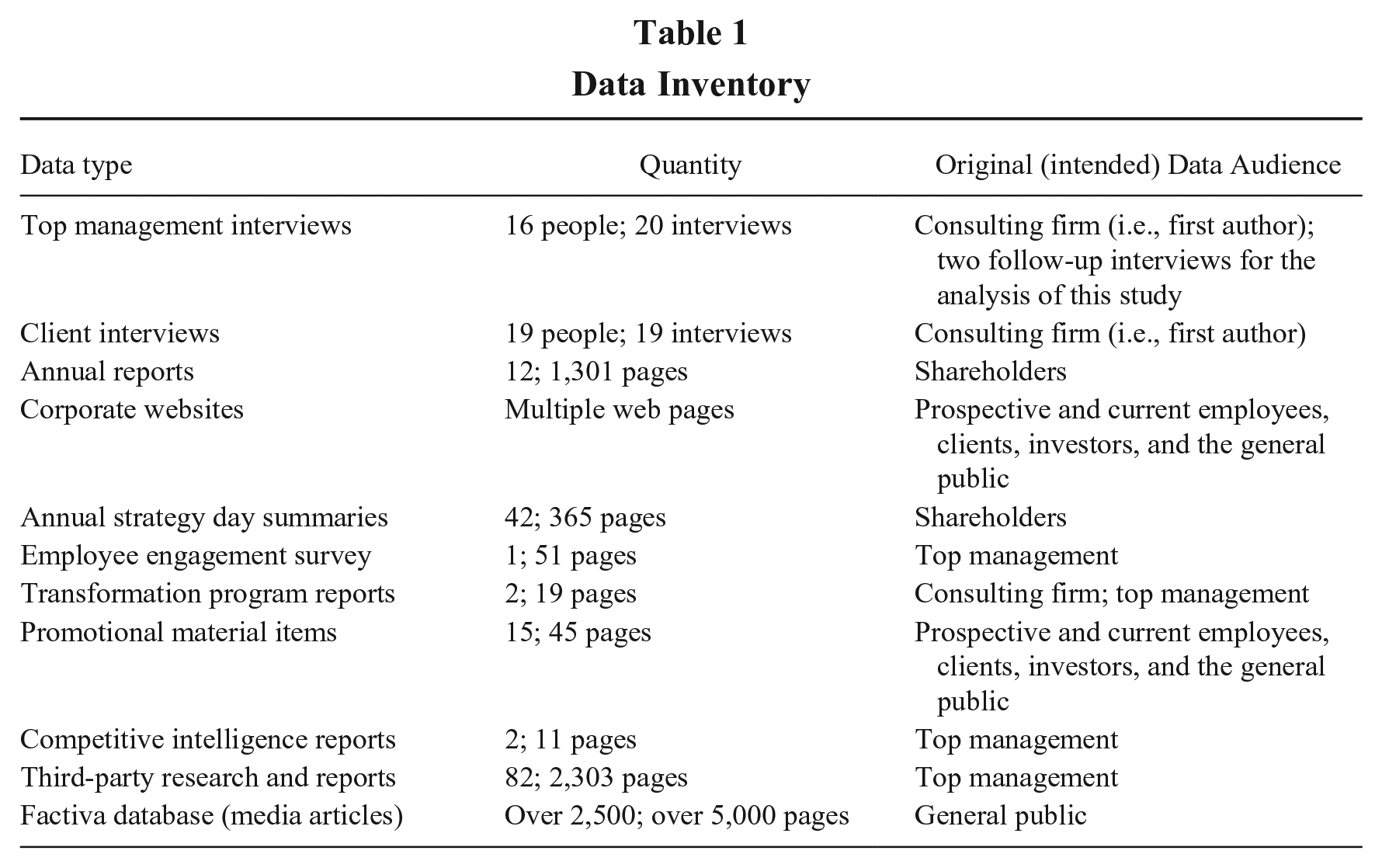
Interviews
The first author was given direct access to interview TMs and other stakeholders. Informants were identified as part of the original consulting engagement using purposive sampling based on their experience working at Enigma, functional expertise, and responsibility for orchestrating the transformation program. On average, each informant had worked at Enigma for 11 years. We conducted 20 semistructured interviews with 16 TMs (labeled TM1-TM16), 2 including two rounds of follow-up interviews, to understand their views on RDEs from an event-system perspective. Each interview lasted 60 to 90 minutes and was audio recorded and transcribed. The first author interviewed all 16 executives during the initial stages of the consulting engagement, including the first round of follow-up interviews with two informants. A second round of follow-up interviews occurred in mid-2011 with two TMs to verify our initial findings. To enhance the reliability and validity of our initial findings and refine interpretations based on archival data (Lincoln & Guba, 1985), the first author also conducted interviews with 19 clients. These client interviews encompassed Enigma’s major geographic regions and product areas, mirroring the scope of interviews with TMs. Conducted in mid-2010 and ranging from 60 to 90 minutes, these interviews were also recorded and transcribed.
Archival data
The first author had access to approximately 10 years’ worth of internal company documents and archival data (2000-2011) from Enigma that proved useful in constructing a chronology of RDEs. We read reports, articles, and other forms of archival data to construct an initial event history database (Garud & Rappa, 1994) that summarized key events, tensions, and Enigma’s responses. Knowledge of these identified RDEs was enriched through insights gained from interviews.
Observation
The first author also engaged in an observational study, participating in 12 hours of workshops conducted by Enigma’s TMs. During this time, he gained valuable insights into the interactions surrounding the proposed transformation program, as well as the organization’s dynamics and structure. He recorded descriptive and reflective accounts of how TMs interpreted events that provided a thorough and nuanced perspective on the organization.
Data Analysis
We interpreted interview statements with the aim of giving voice to informants but used our judgment to structure them in terms of prior theorizing (Glaser & Strauss, 1967; Strauss & Corbin, 1998). We started our data collection aiming to understand the events that led Enigma to engage in substantive repair, cycling iteratively between various data sources and the data and concepts they engendered. However, we soon realized that “purposeful avoidance” (our label) of RDEs among TMs was a significant feature in the enactment of substantive repair. As such, we revised our research question and successive data collection activities. The following stages consisted of simultaneous iterations among data collection, data analysis, and the literature to develop theoretical insights from our emergent themes.
We constructed a database of chronologically ordered RDEs and reputation repair activities between 2000 and 2010 based on multiple archival data sources. To account for the large degree of variance among RDEs, we built the database to include where the RDE was reported, which stakeholder groups were affected, and the extent of the impact on each group, among other attributes. We then conducted interviews with TMs and clients. During these interviews, we noted which RDEs were being discussed by the TMs and which were not. Toward the end of each executive interview, we delved deeper into the RDEs noted on our timeline with additional questions (e.g., “Did this event contribute to the [decision to enact top-down substantive repair]?” “Why or why not?” “What knowledge did you have about this event at the time?” “How did your understanding of this event evolve over time?”). As we progressed, a pattern emerged, demonstrating that TMs placed more importance on the formation of RDE event chains and relational characteristics among RDEs than on individual RDE characteristics. This approach culminated in the development of a more comprehensive database, allowing us to categorize each of the 47 RDEs as they “moved” through four categories within an event space (see Figure 1).
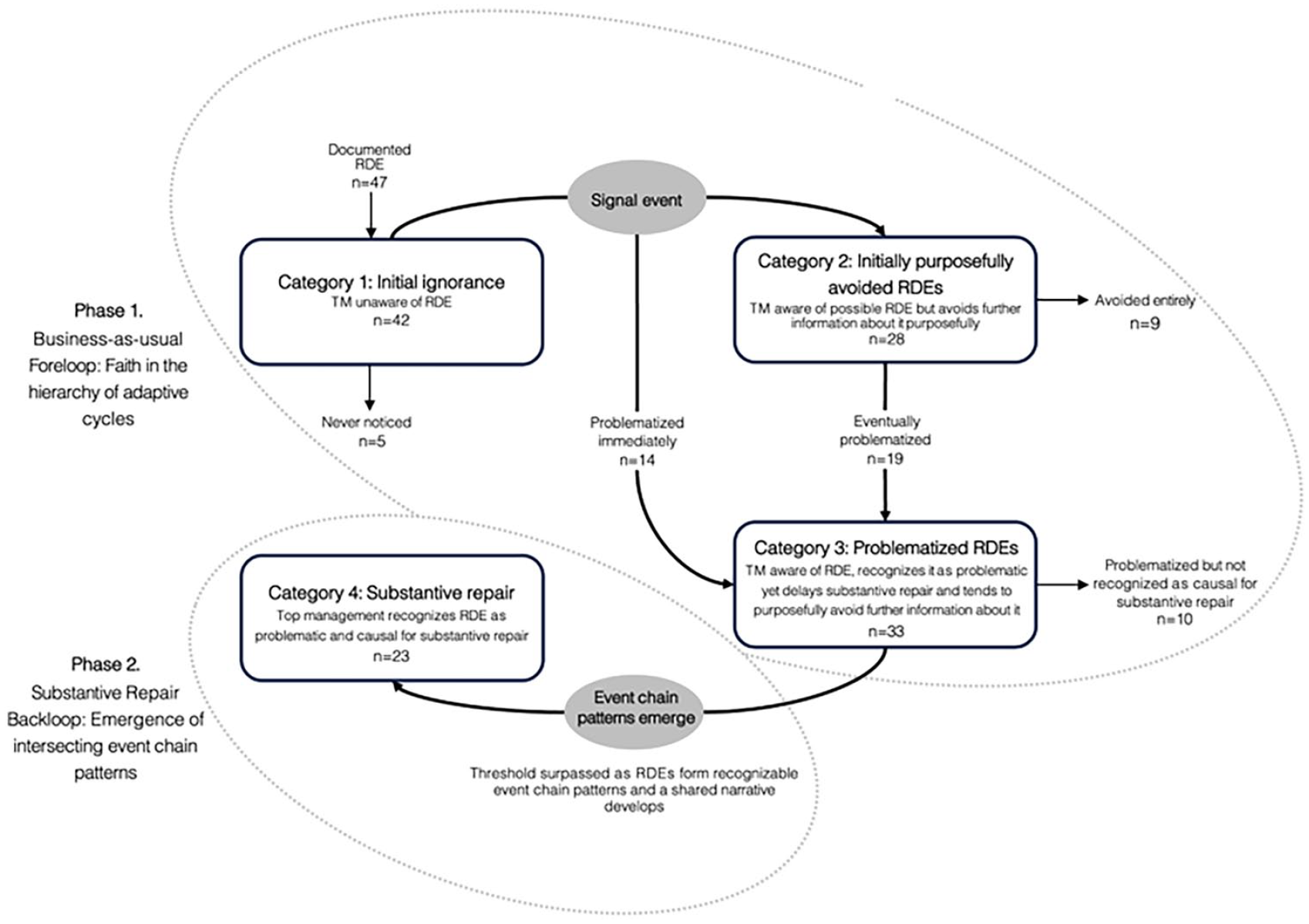
Categorization of Reputation-Damaging Events as the Events Moved Through the Event Space
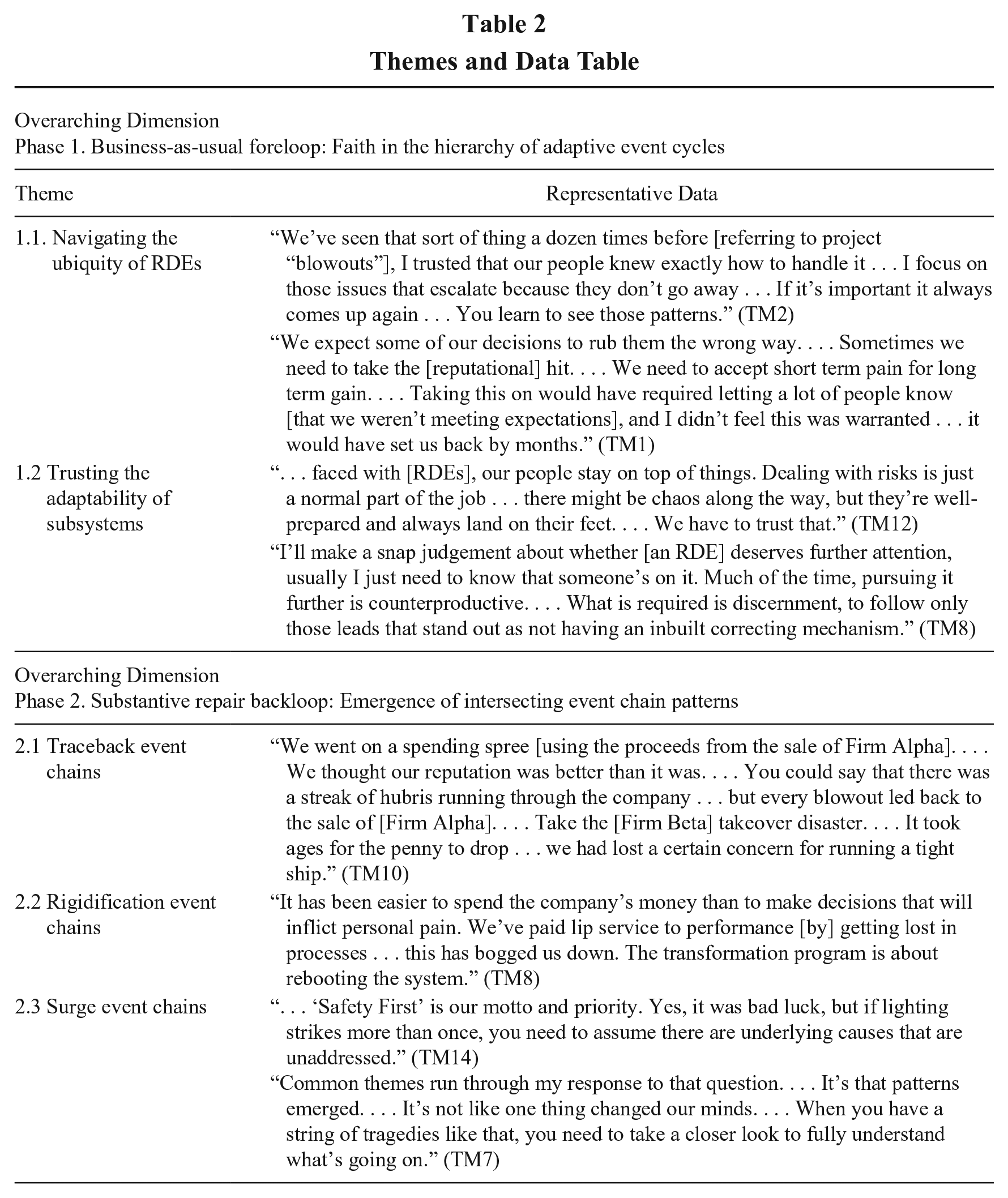
Next, we conducted open coding to identify and group together initial concepts, resulting in 72 in-vivo, first-order codes, which were further consolidated into informant-centric concepts (Strauss & Corbin, 1998). This process continued until we reached theoretical saturation (Glaser & Strauss, 1967). Then, through axial coding, we adopted a more structured, second-order analysis to examine the data at a higher level of theoretical abstraction (Strauss & Corbin, 1998). Finally, we abstracted our second-order themes into two overarching dimensions with five themes. Our coding resulted in the data structure reported in Table 2. In the final phase, we combined our understanding of the results with previous research to develop our ultimate explanation.
Themes and Data Table
We used multiple measures to ensure the validity of our findings—triangulation, member checking, and thick description (Creswell, 2007). We consulted both observational and archival data to search for convergence on the relational characteristics of RDEs. We also later asked our informants to check if our identified themes in the model made sense and resembled their actual experiences, which helped us refine our findings further. Finally, we used thick descriptions of our informants’ knowledge to provide rich and detailed explanations revealing the mechanisms that explained event-response asynchrony.
To ensure the trustworthiness of our data and interpretations, the first author implemented several strategies aimed at building robust relationships with participants and maintaining objectivity. As articulated by Vuori and Huy (2022), these included (1) building rapport through sustained interactions over several years; (2) guaranteeing anonymity to each informant; (3) using validating comments and avoiding judgment to keep informants at ease; (4) using reflective questioning to encourage deeper sharing; and (5) promoting psychological safety by making space for informants to share additional thoughts after recording had stopped. As a participant-observant at Enigma during his consulting engagement, the first author kept detailed field notes to remain cognizant of his own behaviors while collecting or interpreting data. To avoid “going native,” he took regular breaks from the site. To ensure the trustworthiness of coding schemes and processes, we divided the intellectual labor. As the first author was an “academic-practitioner” (Vo & Kelemen, 2017), we were exposed to potential biases but benefited from his practitioner insights. The second author facilitated the analysis process, engaging in a separate coding process from the first author, cross-checking it to ensure intercoder reliability. By intentionally establishing two separate and distinct roles, we further protected the trustworthiness of our data.
Findings
As depicted in Figure 1, we focus on the complex relationship between 47 RDEs over a decade (2000-2010) and how TMs interpreted and responded to these events, culminating in an organization-wide substantive repair program. Almost half of these RDEs (n = 23; 49%) were identified by TMs as causal factors that propelled their decision to enact Enigma’s substantive repair program. However, neither the immediacy nor the sheer size of any given RDE appeared to influence its causal significance. For example, though allegations of corrupt dealings with government officials (E46) surfaced only months prior to initiation, this RDE was not viewed as causative. In contrast, the divestment of a subsidiary nine years earlier (E3), a move initially derided by shareholders but celebrated internally, came to be regarded as a pivotal RDE by all respondents. This seeming inconsistency extended to other RDEs as well. Despite the tragedy of 12 deaths resulting from Enigma’s alleged failure to mitigate the impact of a severe weather event (E2), this RDE was not considered causal. Conversely, an isolated incident at a construction site that led to a single fatality (E29) was perceived as a significant causal factor. Enigma appeared to maintain a business-as-usual approach amid a multitude of RDEs; abrupt and profound organizational change only emerged from the cumulative effect of these events.
To make sense of our findings, we unpacked event-response asynchrony by mapping the shift from Phase 1, a business-as-usual steady state, to Phase 2, transformative, top-down substantive repair. The concept of a hierarchy of adaptive event cycles (see Holling & Gunderson, 2002; Walker & Salt, 2006) was particularly useful in capturing the perspective of TMs as we examined how Enigma maintained organization-level stability amid a flurry of RDEs. Specifically, each adaptive event cycle consists of a foreloop, indicating a stable or routine operational state, punctuated periodically by a backloop, denoting a phase of adaptation and correction. TMs observed these adaptive event cycles at all levels of the organizational hierarchy. Thus, Enigma could maintain relative stability (organizational system level foreloop, representing Phase 1) even when individual RDEs at lower organizational levels (subsystems) triggered recurring adaptive event cycles of repair. This state of relative stability was eventually disrupted by comprehensive, top-down reform (organizational system level backloop, representing Phase 2). Within these two overarching dimensions, we identified five themes. Our reported findings incorporate respondents’ accounts, and we present supporting data in Table 2. 3
Phase 1. Business-as-Usual Foreloop: Faith in the Hierarchy of Adaptive Event Cycles
Examining why Enigma maintained relative stability without engaging in substantive repair, we asked TMs why a significant proportion of RDEs were, as shown in Figure 1, either not deemed problematic or at least not acknowledged as such for some time (n = 28; 60%). Two themes emerged: the importance attributed to (1) navigating the ubiquity of RDEs and (2) trusting the adaptability of subsystems perceived as permeating the organization.
Phase 1.1: Navigating the ubiquity of RDEs
Systems thinking posits that the boundaries within open systems, including those encompassing event spaces, are subjectively determined (Katz & Kahn, 1978). Our respondents corroborated this view, affirming that the 47 RDEs we identified were representative of those impacting Enigma. However, TMs elaborated that while these 47 RDEs were significant, they were just a fraction of the total number. As TM8 put it: Why do you think these [47 RDEs] were all there was? . . . These [RDEs] are always there to be found if we look hard enough. We’re always overshooting or undershooting somebody’s expectations. The [RDEs mentioned] were known to [someone] here before they make the headlines. . . . The project manager knows about a problem with a client before we know. . .and often we’ll never know. (TM8)
TM8 further described the organization as an “ocean,” with RDEs representing the “waves and currents.” Moreover, it was not just significant and disruptive events (cf. Morgeson et al., 2015) or “big waves” (TM8) that were considered problematic or worthy of attention: Each of these events took shape over time . . . Ripples became waves. We’re surfing waves . . . some [waves] are too small, too big, or break too fast. . . . A good surfer doesn’t focus on the small waves . . . doesn’t try to ride every wave . . . even most big waves should be allowed to pass. (TM8)
In contrast to discrete-event models that focus on individual or tightly coupled RDEs (e.g., Pfarrer et al., 2008), the wave-like rhythms of these events—their “relational characteristics” (Roulet & Bothello, 2022)—were clearly more salient to TMs. As TM10 stated: Each of the [47 RDEs] is connected somehow. Connected to every action [we take]. . . . They’re sort of meaningless by themselves. Context matters, it’s the patterns that matter [to us]. (TM10)
This viewpoint, consistent among respondents, signified a difference in top management’s attentional structures (cf. Bansal et al., 2018; Barnett, 2012) versus those of middle and frontline managers. While subordinates were more anomaly seeking—focused on resolving violations of individual stakeholders’ expectations—TMs demonstrated pattern-seeking tendencies, focusing on broader patterns linking multiple RDEs. There were thus diverse attentional structures: We are always seeking to filter out the noise to seek big picture patterns . . . getting caught up in the nitty-gritty is counterproductive. We have excellent systems in place for that. (TM12) [Subordinates] look for and are empowered to resolve any breach in trust. They’re on the lookout for these. (TM14)
Among the vast ocean of RDEs, a small minority initially only affecting a few stakeholders “bubbled up,” “surfaced,” or “escalated” (various interviews) to become newsworthy (e.g., E10, E31, E32, E43, E45). Conversely, other RDEs, directly caused by top management decisions and directives, “cascaded” down through the organization before eventually “ricocheting” back up to the top and “resurfacing” (e.g., E3, E9, E11, E25, E44). As shown in Figure 1, RDEs that entered the event space moved through one or more stages: initially unnoticed (category 1; n = 42; 89%), then purposefully avoided (category 2; n = 28; 60%); recognized as problematic (category 3; n = 33; 70%); and, finally, perceived as a causal factor in substantive repair (category 4; n = 23; 49%).
Counterintuitively, it emerged that RDE scale, origin, proximity, and direction (see Morgeson et al., 2015) did not adequately explain whether top management considered an RDE to be problematic. For example, hundreds of angry tenants protested at Enigma’s annual meeting in late 2007, claiming that a multimillion-dollar redevelopment of a large shopping mall had led them to become financially crippled or bankrupt (E28). Yet, TMs did not discuss this event unless the interviewer directly asked about it (thus remaining in category 2). When asked why this RDE was never problematized, TMs commonly rationalized their avoidance as purposeful. “I had to celebrate our achievements to win more bids,” said TM3. “I didn’t want to get into the nitty-gritty because it would have undermined our momentum.”
Still, other highly damaging RDEs took years to be recognized as problematic (entering category 3) despite TMs noticing multiple event signals. For example, in response to allegations of overbilling, the bribery of union officials, and other improprieties in a variety of large projects (E39) that had led to federal and state investigations, one TM acknowledged hearing “rumors” of wrongdoing for several years prior to these events receiving publicity but only recognized them as “having any validity” once they had been reported through formal internal channels. “Rumors float around all the time,” TM2 said, adding, “sometimes it’s wise to avoid the rumor mill until facts come to the surface . . . doing so prematurely can create unnecessary waves.”
Many RDEs exhibited characteristics that made them potentially problematic, given their significant scale, disruptiveness, and novelty (Morgeson et al., 2015)—including accusations of mafia links (E27) and a botched takeover attempt (E19), among others (e.g., E26, E27, E40)—yet were not deemed problematic for years. Consistent with existing literature discussing purposeful avoidance (e.g., Golman, Hagmann, & Loewenstein, 2017), TMs offered the justification that RDEs were handled as a series of interconnected events within the organization and its subsystems and argued that certain events did not require a response.
Phase 1.2: Trusting the adaptability of subsystems
Top management viewed Enigma not as a single, homogeneous system but as a collection of interrelated subsystems (departments, divisions, projects, etc.) managed by middle managers and staff. These subsystems excelled at managing reputation-related risks and converting them into favorable outcomes. By trusting these efficient subsystems, TMs believed they were spared the need to attend to or engage with most RDEs and thus could purposefully avoid them: We have put in place world-class processes. We’ve spent decades doing this. Development is inherently risky, and we’ve considered these possibilities. . . . At every level of [Enigma] we have systems. . . . So, when these risks [including RDEs] occur, I trust that somebody here is on it 99 percent of the time. . . . It’s the other one percent that I’m concerned about. (TM11)
TMs viewed these subsystems not as static repositories of organizational memory (Walsh & Ungson, 1991) or risk-mitigation templates (Haunschild & Rhee, 2004; Rhee & Kim, 2012) but as “self-correcting,” “adjusting,” and “constantly evolving” (various interviews): Our systems are self-correcting. Risk management is our bread and butter. It’s what we do. (TM2) [Our systems are] not just lists: “if X happens, then do Y.” They adapt, so even if X is unforeseen, our systems will incorporate X and rebuild around it. (TM1)
Our analysis of interviews, observations, and archival data unveiled a recurrent pattern within these self-correcting subsystems. At the most granular level, this pattern was associated with construction project “blowouts”—a term consistently used by respondents. Enigma relied on well-established project management practices, including “mitigation strategies,” “contingency plans,” and “risk management” based on “clear communication,” “meticulous documentation,” and “well-orchestrated processes” (various interviews) to ensure the successful delivery of world-class projects on schedule and within budget. Nonetheless, these subsystems faced frequent turbulence from unexpected events ranging from “scope creep” (changes in project focus and priorities) and governmental “pushback” (political pressures) to sudden hikes in material costs or the imposition of new regulations (various interviews). Other unexpected events involved design errors, structural issues, and adverse site conditions that risked causing budget or timeline blowouts.
Typically, unexpected events—even those that led to some degree of blowout—occurred during what TMs described as each project team’s business-as-usual state. We were struck by similarities between TMs’ accounts and the concept of foreloops within adaptive event cycles (cf. Holling & Gunderson, 2002)—a relatively stable and linear progression of actions and responses that can absorb unexpected shocks. TMs commonly spoke of having “the highest caliber systems of their kind in the world” (TM15) or “Rolls-Royce systems” in place that can “account for and withstand most types of risk” (TM13). TM3 asserted that “clients work with us because they trust our processes; they know if something goes wrong, our systems can adapt better than anyone else’s.” Turning to RDEs, he added: This does not mean that [RDEs] don’t occur. Far from it. It’s not unusual for the unexpected to cause clients to feel that their expectations are not being met at least some of the time. Our established [relationship management] processes acknowledge this and correct for it. . . . It’s built in. (TM3)
Despite believing in the built-in resilience of these subsystems, TMs periodically revealed themselves to be overly “rigid,” “frail,” or “bureaucratic” in response to certain unexpected RDEs. This led to more substantial “blowouts” that called for dramatic “rebaselining” (various interviews), or the process of creating a new budget, schedule, and protocol reflecting the current project status and anticipating further turbulence. This type of reorganizing after a systems failure echoes Holling and Gunderson’s (2002) depiction of backloops within an adaptive event cycle in which, triggered by shock after shock, the increasingly fragile foreloop state gives way to a period of relative chaos characterized by rapid release and reorganization: While the system is resilient to the unexpected, sometimes the nature of the blowout requires us to redesign the system. One time, we had nine weeks of unprecedented extreme wind on a project site. This stopped the cranes and led to some contractors going bankrupt, causing a massive blowout. At about the same time, on another project, we had to grapple with increasing design complexities and more contractor defaults. (TM3)
TMs described how such blowouts led frontline project teams to rebaseline to get projects back on track and repair any reputational damage with clients. In addition to managing communications and releasing statements, this involved launching investigations, establishing new processes, and reorganizing teams as deemed necessary. Expressing the importance of robust backloop rebaselining, TMs affirmed, “you don’t want to enter a phase of constant write-downs and provisioning, so a robust readjustment is needed,” especially when reputation damage is the result of “new, previously unknown” risks (TM13). These backloop processes also made subsequent foreloops more resilient to potential RDEs. For example, according to TM5, “Redesigning the construction process to address these contingencies put us in a better position to handle the unexpected when the global financial crisis [of 2008] rolled around.”
Overall, this recurring pattern at the level of individual construction projects echoes adaptive event cycles that allow entities to maintain system integrity in changing environments. However, it is striking that such adaptive event cycles were not restricted to construction projects run by frontline project managers. Rather, TMs described them as occurring throughout the entire organization, forming an interconnected hierarchy of adaptive event cycles (cf. Holling & Gunderson, 2002): We’re a project management company. The smallest unit is the construction project. At its heart, a project is about achieving an objective despite all sorts of risks. A division is a bunch of projects. The company is a bunch of divisions. (TM2) What we do [as TMs] is the same as what a foreman does. We’re just dealing with risks on a bigger scale . . . [Regarding reputation], it’s not so much client expectations on a project, it’s the markets—shareholder feelings [about Enigma] that we’re managing. (TM12)
Indicating a high level of faith in organizational systems and subsystems, TMs described how, despite seemingly severe and impactful RDEs that sometimes triggered backloops lower in the organization, other higher levels of the organization remained in their foreloop state. For example, in response to accusations of labor law violations and avoidable injury during recovery operations at a major disaster site (E18), one TM explained his response: As unfortunate as any injury is [the recovery operation] was . . . intense. . . . The risk was commensurate with the work. Detailed risk plans are developed at the outset of this and every other project and . . . adhered to at all times. (TM9)
He also mentioned that these “plans were constantly updated to deal with contingencies that fall just outside their scope.” Only years later did it become apparent that this particular RDE (i.e., E18) marked the beginning of a period of turbulence eventually linked to fragility in bureaucratic systems across the organization, leading to underperformance that was eventually addressed by top-down substantive repair (see Phase 2.1).
While some RDEs triggered subsystems to flip from business-as-usual foreloops into their rebaselining backloop states (e.g., E2, E17, E43), other RDEs merely reflected corrective backloops. Examples of the latter included a “revolving door” of senior managers overseeing the U.S. operations over the course of three years (E13), pulling plans to build a large-scale joint-venture project (E21) and cutting thousands of jobs and sidelining multibillion-dollar projects (E36). Whether RDEs were the antecedents or consequence of adaptive event cycles, TMs assumed they could continue business as usual because Enigma was seen to be a well-functioning organizational system with world-class subsystems and processes in place. The need to substantively respond and adapt would “automatically kick in” (TM14) lower down the organizational hierarchy to repair reputation damage.
In light of these organizational subsystems dealing with reputational risk, TMs did not just purposefully avoid RDEs because they expected they would be handled automatically. They also argued that intervening was usually counterproductive because it could create undesired ripple effects that may inhibit operations. TM8 explained the downside of acting “prematurely”: . . . undershooting expectations [and thus RDEs] will always happen in an organization with many moving parts. Early intervention can lead to “muddying the waters” further, creating more damage and more costs . . . It’s important not to undermine the trust we place in managers. [We can maintain this trust] by understanding the risks [of RDEs] occurring. (TM8)
Initially, this seemed to describe how TMs could avoid regression fallacy traps (Kahneman & Tversky, 1973: 251) in which one assumes that something has returned to normal because of (costly) corrective actions taken rather than due to natural fluctuations in underlying risk. However, during a strategy development workshop, discussion between TMs turned to an underperforming regional director (X). TM2 stated that “he made too many changes without understanding the inherent risks,” adding: TM2: “If you don’t understand the risks of [our industry], you will not have confidence in your teams, if you lose their confidence, you’ll lose the Board’s confidence. That’s what happened with X.” TM1: “Yes, it was ‘change for the sake of change’ from the top that caused too much second-guessing [lower down the organizational hierarchy].”
A quote from Meadows (2008: 104-105) seemed to illustrate TMs’ perceptions of Enigma as a complex set of interconnected subsystems that adapted as necessary: “If action is taken too fast, it may nervously amplify short-term variation and create unnecessary instability.”
Phase 2. Substantive Repair Backloop: Emergence of Intersecting Event Chain Patterns
In contrast to Phase 1 findings that revealed how TMs purposefully avoided RDEs based on their confidence in the subsystems, we now turn to how certain relational characteristics among RDEs formed patterns that trickled up to eventually trigger top-down substantive repair. As shown in Figure 1, these findings address how, out of 33 RDEs identified as problematic by TMs (category 3), 23 were ultimately recategorized as worthy of substantive repair by top management (category 4). In particular, three themes emerged that correspond with each event chain pattern and allow us to describe how they unfolded and intersected to eventually trigger top-down substantive repair: (1) traceback event chains, (2) rigidification event chains, and (3) surge event chains.
Phase 2.1: Traceback event chains
Gradually, certain RDEs intermittently revealed causal linkages that could be traced back to a historic originating event (see Online Appendix). Each TM mentioned two such event chains. The first can be traced to Enigma’s sale in August 2000 of its “cash cow” Firm Alpha (pseudonym) for several billion dollars (E3). Following this sale, Enigma implemented a very deliberate international expansion strategy where it expected to “reproduce its business model in the US.” As one external analyst explained: They told journalists and analysts countless times since [the Alpha sale] that they planned to tap the huge demand from retail investors in the US by launching listed real estate trusts, yet the problem was that between 2000 and 2002, [Enigma] pumped $2.7b into the U.S., buying half a dozen businesses that were loosely described as property ‘funds management’ businesses. . . . While [the CEO] told us that this was part of their strategy, we could see that it wasn’t a reproduction of their model. (Analyst)
Subsequent RDEs linked to E3 also did not have enough strength to trigger substantive repair. For example, a steadfast resolve to “carry on” after the “bungled” Firm Beta takeover in 2004 (E17) was expressed in a letter to shareholders in 2005: The last year has been one of challenge for [Enigma]. . . . Yet during this period, the Group stayed focused on driving our existing businesses and securing profit growth. Our vision remains clear—to be a global leader in integrated property services. (Shareholder report, 2005)
By late 2005, the implementation of this strategy had wiped billions of dollars in value from Enigma’s balance sheet and dramatically weakened the company’s reputation among shareholders. However, top management did not implement substantive repair, perceiving reputational damage as a “necessary cost” (TM13) of their strategy. According to TM12, a longstanding member of the team, “Instead of taking [shareholder] signals seriously, the attitude was that we could stick to our guns and continue throwing money after the assets until something would go right.”
However, TMs gradually realized that cashflows from Firm Alpha had “buffeted the ups and downs of the property cycle” (TM5). As a result, they eventually perceived the sale of Firm Alpha (E3) as a significant factor behind subsequent profit downgrades and related events from 2000 to 2009 (see E4, E8, E12, E13, E15, E17, E19, E20, E25, E26, E34, E37, and E47). This series of events led to Enigma losing its blue-chip status among shareholders. Various TMs pointed out that selling Firm Alpha (E3) exposed Enigma’s poor performance as a dealmaker. The acknowledgment of this originating event (E3) unfolded gradually as intermittent additional RDEs occurred (e.g., E17). These subsequent RDEs in the chain made it evident that selling Firm Alpha was the root cause, as highlighted by TM5: Losing [Firm Alpha] was a real blow to us. While the market reacted badly, we thought that [the CEO’s international expansion strategy] was a winner. The sale exposed us to the ups and downs of the property market. Yet over time it revealed that we had lost the financial discipline that was a characteristic of [our founder’s] reign. This became clear when we lost [Firm Beta in 2004]. . . . We had hit rock bottom. . . . I see the transformation program as an attempt to re-instill the discipline we lost at around the time we sold [Firm Alpha] and rebuild shareholder confidence. (TM5)
A second “traceback” event chain was connected to Enigma’s contract to assist with a major disaster site clearance in a major U.S. city, initiated in early 2002. A chain of RDEs could be traced to 2004 allegations (E18) about unsafe work conditions at the site. Additional linked RDEs included the publicized launch of legal action from federal and state agencies for alleged bribery and overbilling practices at multiple project sites (see E30, E39, E40). Initially, faith in the hierarchy of adaptive event cycles (Phase 1) gave TMs confidence that they could purposefully avoid these RDEs, trusting in subsystems to self-correct, repair damage, and prevent reoccurrences. But while these events lacked the individual impact to instigate top-down substantive repair, they gradually formed a chain that was recognized by top management. For instance, TM7 described how this chain of RDEs eventually highlighted the “underperformance” (various interviews) of Enigma’s Americas region, which was linked to an unaddressed root cause: Having purchased very good businesses, there was minimal involvement from corporate, but for various reasons—safety issues—and mainly poor performance, we fired six [senior managers]. . . . We finally realized that the system was broken and wouldn’t repair itself. (TM7)
TM14 added, “We thought that they [i.e., subordinates] had fixed the cause, but issue after issue kept rearing its ugly head.”
In sum, the unfolding of these two traceback patterns initiated a realization that root cause forces (behaviors and features) instigating these chains were not being addressed within subsystems and were perpetuating intermittently occurring RDEs with major consequences.
Phase 2.2: Rigidification event chains
Certain RDEs formed event chains that reflected increased inflexibility or “rigidification” within the organization that undermined adaptation. These patterns gradually revealed that departments and employees were becoming increasingly preoccupied with processes (more rules, more time devoted to sticking to procedures) and had lost touch with principles that facilitated effective responses to RDEs.
Most TMs mentioned the importance of Enigma’s founder (who was heavily involved in the management of the business until his death about 10 years earlier) in establishing the organization’s two “guiding principles,” which were perceived to be “strongly ingrained in our psyches” (various interviews). The first, alluded to by all TMs, was “aspiration” or the desire to “leave a legacy,” while the second, identified by 12 TMs, was “discipline” or “delivering great returns.” TM5 and TM3, who had worked alongside the founder, described how his approach guided employees’ actions: He was a true statesman. On the one hand he would encourage us to be entrepreneurial and to take risks . . . to leave a positive legacy for communities. . . . On the other hand he would enforce strict discipline. Individuals owned decisions and were rewarded or punished accordingly. (TM5) [Founder’s] approach is still strongly ingrained in our psyches. . . . His particular way of doing things is the platform for our actions. (TM3)
At first, the integration of these two guiding principles allowed different departments with distinct goals to work together effectively. For example, the funds-management division focused on delivering strong returns for investors (discipline), while the development division aimed to deliver exceptional projects (aspiration). As TM7 stated: When there’s a major stuff up on one of the sites, they [i.e., the funds management division] will understand the importance of us stepping in to fix it. They’ll understand and be respectful rather than just pushing to “rape and pillage” to make a profit. (TM7)
Over time, this integrated approach created a reputational buffer in which clients also seemed to put faith in the organization’s ability to adapt and recover quickly from highly salient RDEs (e.g., E2). For instance, TM10 noted that: We’ve seen our fair share of unfortunate events. A lot of clients have been with us for decades and trust us to do the right thing. They know our processes are world-class. . . . As long as it doesn’t happen again they trust us to just get back to normal. (TM10)
However, through a series of events, it became evident to TMs that this adaptive ability of the organizational system had deteriorated. In their efforts to become more efficient, each department (and thus, each interconnected subsystem) had become increasingly focused on its own narrow set of goals, losing the importance of respecting both guiding principles at a broader system or organizational level: The funds managers became myopically obsessed with returns, and the developers became increasingly fixated on winning more awards for their six-star projects. (TM15)
In parallel, there was an increased preoccupation with process (e.g., more rules, more time and effort devoted to following procedures). In many cases, employees became more likely to “hide behind processes” (TM16) as an excuse for not adapting or repairing reputational damage. One client described this as follows: We’d tell them [i.e., Enigma] that the project specifications would need to change, but they’d just point to all of this amazing work they’d done and give the impression that it was their way or the highway. . . . Then you’d see this huge blowout, and they couldn’t admit they were wrong. (Client interview)
According to TMs, this came to “a head” when there was a “massive blowout” on a site (see E42) that led to a standoff between the funds-management and development divisions of Enigma, causing “unnecessary” reputation damage among clients and shareholders (various interviews). This led to the realization that Enigma had to return to becoming “one firm” (various interviews) because, as TM8 put it, “It has been easier to spend the company’s money than to make decisions that will inflict personal pain. We’ve paid lip service to performance” (TM8). Recognizing this misalignment, TM1 referred to the importance of “regaining the ‘magic associations’ we had with our partners and shareholders” by “instilling discipline internally” while reinvigorating the “visionary edge that is in our DNA” across all departments.
Phase 2.3: Surge event chains
The third type of event chain we identified consists of rapidly occurring disruptive events that span a broad spatial range. Despite their quick succession and widespread impact, these events had revealed no discernible root cause (in contrast to traceback event chains).
One particular surge pattern discussed as causal (see Online Appendix) can be traced to a crisis in late 2007, when Enigma was accused of wrongdoing following the deaths of two first responders at a construction site (E27). TM6 described this as a “once-off event that should never have happened” and that should have simply led to the sacking of employees who “had done the wrong thing.” However, subsequent events caused further reputational damage for clients and employees (see E29, E31, E32). In early 2008, a string of crane accidents at Enigma worksites in different countries led to further fatalities and resulted in site conditions being condemned by authorities as “unacceptable.” According to a longstanding TM, Enigma had suffered a string of “bad luck” but was the “safest construction operation around.” However, he admitted that the higher-than-expected occurrences of similar RDEs had “forced” Enigma to address safety and client practices to remove any underlying yet “hidden” causes and repair stakeholder relations.
While we could not access a counterfactual case in which a more benign surge pattern occurred during the sample period, it seemed the fast tempo of unexpected events with no obvious root cause had caught top management off guard. These unexpected events signaled to them that a hidden root cause had not been adequately addressed and was continuing to cast its shadow.
Epilogue: Substantive Reputation Repair
The patterns of the three event chains unfolded contemporaneously and were acknowledged by top management as intersecting conditions critical for initiating substantial repair. As such, their interaction merits consideration. Over time, the traceback and rigidification chains, though evolving slowly, gained significant influence. However, the rigidification chain culminated in an otherwise typical RDE, namely E42, acting as a trigger for substantive repair. Combined with the fast-paced surge chain, it created a tipping point that surpassed top management’s threshold for maintaining confidence in the system. In a workshop to discuss what the transformation plan should address, TM7 described recent RDEs as merely the “final straw” in longer event chains and “just symptoms” of deeper root causes. Seeming to capture the mood in the room, as judged by several nods of agreement, he put it this way: Maybe operational excellence was lost, but maybe it never existed outside certain pockets of Enigma. This [i.e., the lack of operational excellence] was not flagged as a critical concern as sub-par decisions were buffeted by the cash flows produced by [Firm Alpha]. Losing [Firm Alpha] has gradually made this clear and the entitlement culture worse . . . and recent [RDEs] are just the latest symptoms of broader, underlying problems. (TM7)
Thus, far from any single event or event chain, it appeared that the confluence of all three event chains indicated that the organizational system that managed the firm’s reputation had become fragile. This undermined top management’s faith in the adaptive and self-corrective ability of the system and allowed even small-scale events to trigger a substantive response.
To repair its reputation, the organizational system flipped from stability to reform, characterized by a major, rapid reorganization via its substantive repair program. Like falling dominoes, event chains set off a series of repair efforts. Since the launch of the transformation program, Enigma’s reputation had improved, evidenced by a 79% increase in the company’s share price from February 2009 to January 2011 and positive feedback from shareholders, clients, and employees. For instance, third-party reporting on changes in external and internal reputational perceptions from 2009 to 2010 revealed: During a period of significant transition and change, [Enigma] has maintained or improved performance in 10 areas [including improvements in] Performance Management, Diversity, and Climate . . . [Compared with peers, Enigma also improved in] areas that are critical for attracting talent, delivering on the brand promise and driving business performance: CSR, Pay and Rewards, and Engagement. (third-party research and reports)
In the 2011 annual report, Enigma’s CEO indicated that the substantive repair phase of the transformation program aimed at repairing reputation damage (Recover) was complete and that the organization had moved onto phase two (Create), indicating the start of a new foreloop.
An Event-System Model of Substantive Reputation Repair
Our findings, summarized in Figure 2, propose an event-system model of substantive reputation repair. This model explains event-response asynchrony by reflecting on how top management frames reputation management within the organization. In this model, the organization is seen as a complex system composed of interconnected subsystems capable of mitigating and repairing reputation damage due to RDEs. We call it a hierarchy of adaptive event cycles. The dynamics of this hierarchy can explain why substantive reputation repair activities may not be conducted at the organizational level, despite adaptive repair responses to RDEs within lower-level subsystems (departments, divisions, and projects). This finding echoes Allport (1954: 288, 298), who posited that seemingly stable structures are actually composed of “[event] cycles of cycles of cycles, and so on.” In this case, each adaptive event cycle is formed by two recurrent, interconnected event chains: a foreloop (depicted by thick arrows facing rightwards) followed by a backloop (depicted by thick arrows facing leftward). The foreloop is characterized by relatively stable, steady, and linear business-as-usual activities that can handle most RDEs that occur. However, over time, these incremental foreloop activities become more bureaucratic, such that the subsystem grows to be rigid and more vulnerable to unforeseen shocks, including certain RDEs. As the system becomes more fragile, the occurrence of even relatively smaller shocks can trigger a backloop event chain that appears chaotic, disjointed, and nonlinear. This second chain is marked by a period of rapid reorganization (Holling & Gunderson, 2002).
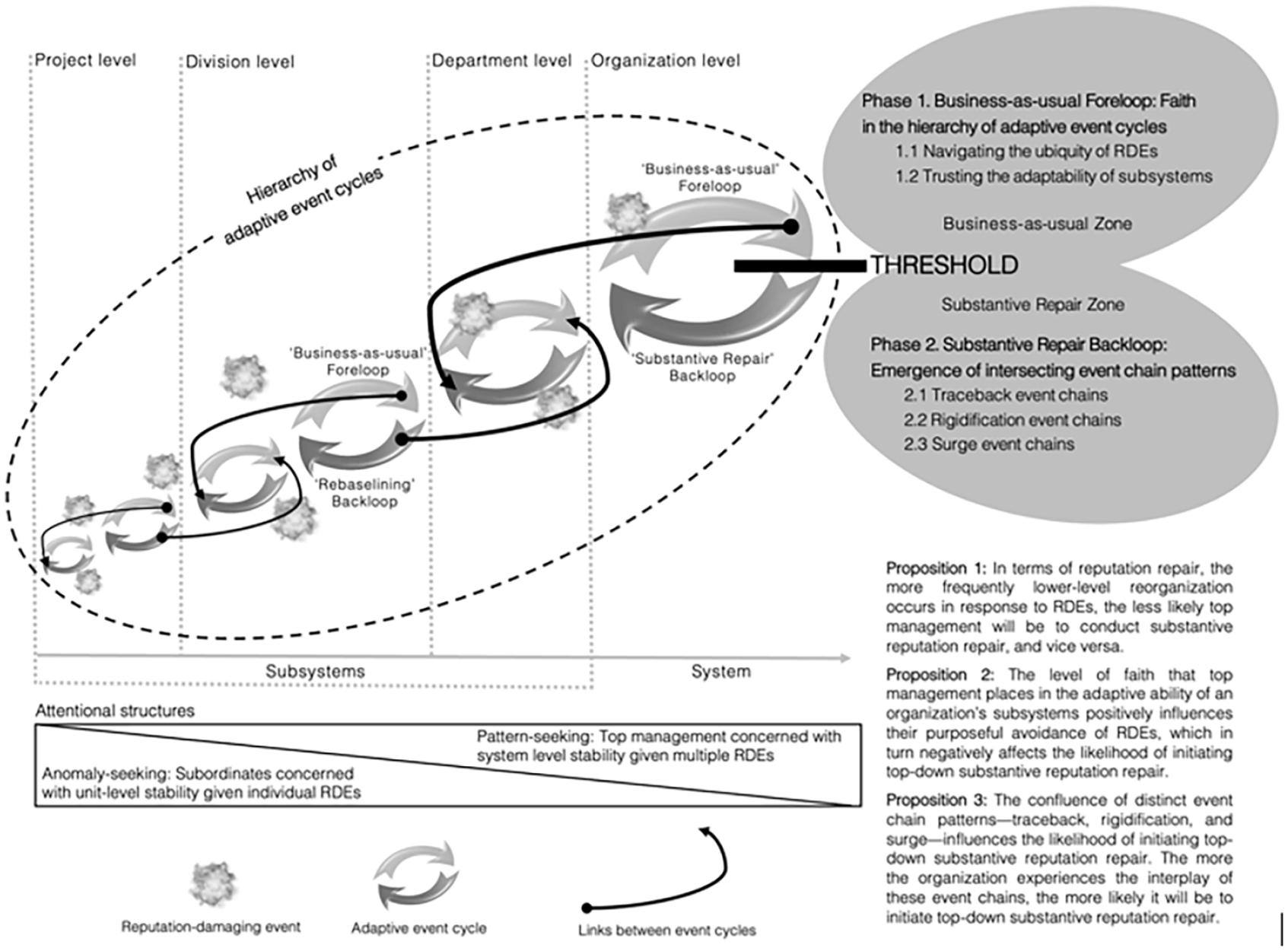
Event-System Model of Substantive Reputation Repair
All these adaptive event cycles come together to create a single, complex system connected hierarchically with both top-down and bottom-up dynamics. At the organizational level, and under the direct control of top management, the foreloop periodically flips into a backloop. Thin black arrows depict linkages between adaptive event cycles at different levels of the organization. On the one hand, the foreloop to backloop flips actioned by top management (e.g., Enigma’s transformation program) cascade downward (see downward-pointing linkages), affecting adaptive event cycles throughout the organization. On the other hand, however, each flip does not occur unless TMs perceive something wrong with how lower-level subsystems function and lose faith in them (see upward-pointing linkages).
We observed that periods of stability or top management inaction in an organization in response to RDEs (i.e., maintaining the foreloop) rely on adaptive responses at lower organizational levels that sustain operations and manage risks from RDEs. Conversely, instances of organization-wide change (i.e., flipping into a backloop) are triggered by top management’s recognition that subsystems’ adaptability is no longer effective or that subsystems are too slow to effectively address RDEs. This interplay of dynamics has parallels in ecological studies examining stability vis-à-vis change in ecosystems. As an example, Walker and Salt (2006: 92) compare a forest ecosystem (the organizational level, in our case), composed of forest patches and individual trees (the division, department or project level, in our case). In its foreloop phase, an individual tree grows steadily upward; when confronted with an event, such as a beetle infestation, it is thrust into the backloop phase, where it must adapt, heal, and regenerate. From a broader perspective, even as individual trees undergo these rapid adaptive cycles, the forest, viewed as the average of all trees, appears stable. However, if many trees synchronously enter or become stuck in the same phase of their adaptive event cycle—perhaps due to intersecting events, like unexpected warm weather and a beetle infestation—the forest can experience widespread transformation. This shift propels the entire forest from a foreloop to a backloop. Based on these observations, we offer the following proposition for further exploration:
Next, we explore how our model explains the business-as-usual zone more specifically, or why top management typically refrain from undertaking substantive repair in the aftermath of an RDE (Phase 1. Business-as-usual foreloop: Faith in the hierarchy of adaptive event cycles). Unlike discrete-event models that consider inaction among TMs as a sign of failure, our observations suggest that top management inaction is often perceived as a testament to the effectiveness of organizational subsystems to adapt and respond. This perceived effectiveness is determined by two key factors. First, TMs often perceive RDEs as ubiquitous occurrences throughout the organization, ranging from individual client interactions to division-wide scandals. They recognize the impossibility of personally addressing each RDE as it occurs (1.1 Navigating the ubiquity of RDEs). Even when an RDE surfaces to their attention, either from lower organizational levels, or resurfaces as a consequence of their previous actions, their default response tends to be purposeful avoidance, a form of information avoidance (Golman et al., 2017); that is, an intentional effort to resist exposure to, comprehension of, or acceptance of information that may incline one to intervene in a system. Second, rather than stemming from negligence or disinterest, as some might imply (e.g., Greve, Palmer, & Pozner, 2010), the avoidance of RDEs is born from an acute awareness and confidence in the adaptive capabilities of subsystems operating within the organization (Phase 1.2. Trusting the adaptability of subsystems). This purposeful avoidance is not largely a coping mechanism to ensure effective day-to-day operations, as posited by Golman et al. (2017). Rather, we observed that TMs actively avoid taking actions that might generate undesired ripple effects or instability that could potentially compromise system operations. Collectively, these factors engender a strong belief among TMs in the robustness of their organization’s ability to respond to most RDEs. This belief allows them to purposefully avoid engaging with every RDE, thereby reducing the propensity for top-down, organization-wide substantive repair. Based on these observations, we offer the following proposition for further exploration:
Finally, to complete our explanation of event-response asynchrony, we explore how our model explains the flip into the substantive repair zone—more specifically, why top management periodically enact top-down substantive reputation repair (Phase 2. Substantive repair backloop: Emergence of intersecting event chain patterns). Notably, TMs’ pattern-seeking attentional structures (cf. Bansal et al., 2018; Barnett, 2012), relative to the more anomaly-seeking structures of their subordinates, introduces heterogeneity in how RDEs are dealt with throughout the organization. In particular, TMs are more concerned with relational characteristics among RDEs. Thus, it was not a single RDE or chain of tightly coupled RDEs that triggered substantive repair. Our findings reveal three event chain patterns that seem to intersect to surpass a critical threshold among TMs: traceback; rigidification; and surge event chains. Traceback event chains (Phase 2.1) comprise sporadically occurring RDEs that reveal causal links to a historical origin event, thereby exposing previously overlooked root causes. Rigidification event chains (Phase 2.2) highlight a systemic inflexibility in various subsystems that cumulatively results in a rigid, less adaptable overall system. Lastly, surge event chains (Phase 2.3) consist of rapidly occurring yet spatially dispersed RDEs that indicate unaddressed yet hidden root causes. The interplay between these three event chain patterns gradually erodes the faith TMs place in the hierarchy of adaptive event cycles within their organization. This erosion does not happen abruptly. Rather, the slowly escalating influence of the traceback and rigidification event chains culminate in a seemingly typical RDE (e.g., E42) serving as a “final straw” alongside the rapid pace of the surge event chain. This signifies a tipping point where a managerial threshold is surpassed, triggering organization-wide substantive repair. Based on these observations, we offer the following proposition to be explored in other contexts:
Discussion
We began with the observation that, by focusing on singular, high-impact RDEs, discrete-event models do not adequately explain event-response asynchrony to RDEs of varying magnitudes over long time horizons. By leveraging a systems perspective, and EST in particular (Morgeson et al., 2015), we provide a novel explanation of event-response asynchrony in which the connection between events and substantive repair efforts involves greater temporal and spatial complexity than previously acknowledged. Our key contribution is the creation of an empirically grounded event system model that explains this process along with three testable propositions (see Figure 2).
Using our model, we organize our discussion around contributions to EST and event-oriented research and reconceptualizing reputation damage and substantive repair.
Contributions to Event System Theory and Event-Oriented Research
EST is concerned with understanding how the structures of events create, sustain, or transform collective structures, such as organizations, that in turn may appear to be in steady states despite constant change and adaptation (Allport, 1954; Katz & Kahn, 1978; Morgeson et al., 2015). Depicting organizations as systems, EST is grounded in work that defines systems as cycles of events (Katz & Kahn, 1978: 351) and posits that all event structures are cyclical in nature (Allport, 1954). Yet, despite its implicit grounding in event cycles, EST theorizing has remained largely focused on linear causality and has almost entirely avoided the topic of event cycles, leading to recent calls to rectify this omission (e.g., Laulié & Morgeson, 2021).
When analyzing our data, we realized that reviving the concept of event cycles and introducing the concept of a hierarchy of adaptive event cycles can give EST more power in explaining the relative stability or dynamism of structures and systems. In other words, it explains why otherwise seemingly disruptive events may not elicit responses above or beyond business-as-usual (Munir, 2005). By adapting the concept of a hierarchy of adaptive event cycles into EST, we can explain the (non-)responsiveness of entities (e.g., top management) by the interconnection among how the event space maps onto these entities’ attentional structures, the adaptiveness of interconnected subsystems at lower levels in the organizational hierarchy (actual adaptiveness), and the perceived adaptiveness of subsystems (faith in the hierarchy of adaptive event cycles).
By adapting the concept of a hierarchy of adaptive event cycles into the EST toolkit, we help to explain how certain event chains can signal a failure to address root causes that eventually requires top-down, system-level change. No single RDE may trigger substantive repair. Rather, traceback event chains gradually uncover historic root causes obscured by faith placed in adaptive event cycles; rigidification event chains indicate general inflexibility in the subsystems that makes the aggregate system brittle; and fast-paced, spatially dispersed surge event chains point to unaddressed yet hidden root causes.
By reviving the centrality of event cycles, EST can uncover novel insights. For example, our findings suggest that faster and smaller event cycles lower in the organizational hierarchy trickle-up—mediated by top management’s attentional structures—to trigger discontinuity in otherwise slow and broad higher-level event cycles (in our case, the organizational-level backloop and the aggregate system). This backloop then cascades downward to further influence faster and smaller event cycles (adaptive repair within subsystems). Although instigated by event chains that trickle up, this change at the top of the hierarchy is likely to occur abruptly, even if it remains largely dormant. This raises the question of what other event cycles may contribute to the relative dynamism or stability of organizational systems.
The concept of a hierarchy of adaptive event cycles reveals promising new avenues of investigation. For example, within ecological sciences, scholars describe at least four dynamics occurring within these hierarchies (see Gunderson, Allen, & Garmestani, 2022; Holling & Gunderson, 2002): revolt (how fast and small events at smaller scales overwhelm slow and large events at larger scales); remember (how capital accumulated from slow and large events and scales influences reorganization of events at smaller scales); crisis (how system instability results from events at much larger spatiotemporal scales); and renewal (how engineered disturbances trickle-up to modify the system). While we did not have the scope to explore this range of cross-scale dynamics, EST scholars can investigate how event cycles that adhere to each of these patterns may sustain or disrupt organizational structures. For example, how do organizations try to balance the dynamics of bottom-up (revolt) event cycles with top-down (remember) event cycles, what causes them to flip, and when are these shifts in dominance favorable versus detrimental? How do each of these event cycles—especially purposefully engineered event disturbances (renewal)—play out and interact within the context of a “polycrisis” or “confluence of calamities” (see Roubini, 2023: 1), including geopolitical conflict, climate emergencies, and economic shocks?
In sum, through our analysis, we have advanced theory that we believe will further enhance the powerful yet underutilized toolkit that EST provides for understanding event-based phenomena.
Reconceptualizing Reputation Damage and Substantive Repair
The EST framework can help researchers avoid common pitfalls when studying the impact of events on organizational responses. By using an EST lens, we were able to overcome three weaknesses with discrete-event models. First, EST encourages analytical flexibility, allowing us to focus on a single substantive repair event and various other events, chains, and cycles over a long time frame and multiple scales. This is opposed to the focus on a single high-impact event or tightly coupled event chain over a short time frame. Second, EST emphasizes the importance of separating events, including disruptive events, from their outcomes, rather than assuming that all disruptive events are inherently problematic (e.g., Rhee & Kim, 2012). Third, EST emphasizes various spatial (e.g., origin, direction, dispersion, proximity) and temporal (e.g., duration, pace, peak, phase) factors associated with events, chains, and cycles. This allows for alternative explanations that do not necessarily characterize inaction as failure (e.g., Rerup, 2009). By leveraging these strengths of EST, we generate novel insights into how actual and perceived event attributes trigger substantive repair to explain event-response asynchrony.
Two findings struck us as offering promising research opportunities. First, purposeful avoidance was common among executives experiencing a signal event about an actual or potential RDE. The managerial cognition literature suggests that ignorance can be strategically pursued for practical benefits in decision-making and daily operations (Golman et al., 2017; Grossman, 2014; McGoey, 2012). We integrate purposeful avoidance into a model of reputation repair, especially as a status quo response that does not signal inaction as failure. While many reasons for purposeful avoidance have been identified, our findings revealed a unique explanation grounded in a systems perspective: faith in the hierarchy of adaptive event cycles that is deemed to enable business-as-usual. In particular, executives rationalized that interfering with nested adaptive systems would create undesired ripple effects that could harm the functioning of the organization. Future research could explore the microprocesses underlying this belief and resultant behaviors within the context of reputation-damaging events, chains, and cycles. Promising avenues include exploring how emotions mediate the link between certain event chain attributes and decisions to purposefully avoid or pursue signals from events (see Healey & Hodgkinson, 2017; Hodgkinson & Healey, 2011; Vuori & Huy, 2022), and how attentional structures and traits affect beneficial versus detrimental forms of purposeful avoidance (see Bansal et al., 2018; Vassallo, Banerjee, Zaman, & Prabhu, 2023). The question is raised: could there be a purposeful avoidance “sweet spot”?
Second, through the event chains they perpetuate, historical RDEs can be major causal factors of substantive repair many years after they occurred. For example, an RDE in 2000 (E3) that formed a long event chain was cited as a highly significant event among TMs interviewed 10 years later. Although other RDEs closer to the initiation of substantive repair were also described as causal (e.g., E42), we reveal that event-response causality is not necessarily simple nor linear. Many reputation repair studies assume that RDEs that occur within a set time period—for example, from one month to a few years (Chakravarthy, DeHaan, & Rajgopal, 2014)—triggered substantive repair actions, when, in fact, the major cause is a particular web of event chain configurations. Have empirical studies inadvertently conflated events that causally flip subsystems into backloop states with those that merely reflect backloop events? Further, to use Roulet and Bothello’s (2022) terminology, have causal tipping-point events been conflated with ripple events that follow in their wake? Accordingly, our study reveals analytical challenges and opportunities to scholars seeking to accurately model event-response asynchrony.
Limitations and Future Research
Our study has the limitations associated with research on a single case study. First, our research setting (e.g., a large, high reputation, for-profit multinational firm in the property sector) may have affected top management’s actions and interpretations. While our study offers rich and detailed descriptions of their struggles to enact substantive repair, we acknowledge that these may be strikingly different in other settings. For example, high-reputation firms like the one studied may believe strongly in their construed image (Brown, Dacin, Pratt, & Whetten, 2006), making these firms less responsive to RDEs than other firms. Similarly, firms with simpler organizational structures might conduct multiple substantive repairs over a shorter period, or those with more complex structures may rely on embedded mechanisms, such as a crisis management team. Moreover, other organizational forms—such as, social enterprises and other hybrids—may exhibit different patterns of event-response asynchrony, given their associated contingencies (see Vassallo, Prabhu, Banerjee, & Voola, 2019). Future research can focus on the process of substantive repair within these contexts. Moreover, researchers can use qualitative comparative analysis (QCA) (e.g., Fiss, 2007) to examine the three event chain patterns that we uncovered and their specific causal dynamics and interaction effects. QCA enables examination of how these and other event chains can be interconnected and interact to trigger change in organizational systems (see Schad & Bansal, 2018). Doing so may help identify new patterns or further corroborate our findings.
Second, a tension exists in this study between providing an “adequate level of detail” with “seamless quality” (Wolcott, 2008: 107). In particular, working with data that spans 10 years in a large multinational company, we found it challenging to provide rich descriptions of our findings while presenting them simply and connecting them to extant research (Wolcott, 2008). To achieve this, we focused on RDEs that led to the substantive repair program. By doing this, we may have missed other repair efforts triggered by a given event in our dataset. Yet, by narrowing the focus and providing detailed descriptions about the interplay among TMs and RDEs that led to the change, our approach has uncovered important insights into reputation repair efforts. Future studies can build a more comprehensive typology of RDE chains by investigating smaller repair efforts in between RDEs and top-down substantive repair.
Finally, while the notion of reputation and reputation repair has attracted much scholarly interest, few studies have addressed the strategic issue of managing different types of reputations and the interactions among them (Boutinot, Ansari, Belkhouja, & Mangematin, 2015). An organization can have several stakeholder-specific reputations, such as among peers, markets, and experts, and it would be important to examine how organizations respond to damage to these various kinds of reputations.
Conclusion
Our investigation of multiple and varied RDEs over a long time horizon to see how particular configurations of events may trigger top-down substantive repair has yielded a novel understanding of event-response asynchrony. To address the shortcomings of existing discrete-event models, we leveraged EST and a systems perspective to provide a novel explanation of event-response asynchrony in which causality between events and substantive responses is complex and adaptive, involving event cycles at multiple levels. Our research offers new insights into the process of reputation damage and substantive repair and contributes to the fields of EST and event-oriented research. We specifically argue that the concept of event cycles that form an interconnected hierarchy can give EST more power in explaining the relative stability or dynamism of structures and systems, including why seemingly disruptive and salient events may not trigger substantive repair efforts. We hope that future research will continue to build on this foundation by exploring other aspects of event cycles.
Supplemental Material
sj-docx-1-jom-10.1177_01492063231224353 – Supplemental material for Reputation-Damaging Events Over a Long Time Horizon: An Event-System Model of Substantive Reputation Repair
Supplemental material, sj-docx-1-jom-10.1177_01492063231224353 for Reputation-Damaging Events Over a Long Time Horizon: An Event-System Model of Substantive Reputation Repair by Jarrod P. Vassallo, Yeonji Seo and Shahzad (Shaz) Ansari in Journal of Management
Footnotes
Acknowledgements
We thank our action editor Albert Cannella for his editorial support and guidance, as well as our anonymous reviewers for their invaluable feedback. The authors are also grateful to Michael Pfarrer, Timothy Pollock, Paul Tracey, Christian Hampel, and Kisha Lashley for their helpful comments, as well as participants at several conferences and seminars. While we are not aware of any conflicts of interest, we acknowledge that the first author acted as a paid external consultant to the focal firm discussed. In addition to disclosing this financial arrangement, we have taken great care to deal with any biases that may have resulted from this relationship. The usual disclaimer applies.

Notes
References
Supplementary Material
Please find the following supplemental material available below.
For Open Access articles published under a Creative Commons License, all supplemental material carries the same license as the article it is associated with.
For non-Open Access articles published, all supplemental material carries a non-exclusive license, and permission requests for re-use of supplemental material or any part of supplemental material shall be sent directly to the copyright owner as specified in the copyright notice associated with the article.
