




Abstract
The success of work teams is often contingent on how they handle disruption. Although research has examined how teams respond to disruptive events, there is surprisingly little clarity about the nature of team disruption as a construct. Through an integration of Event-System Theory (EST) with team-based theories and frameworks, we define team disruption in terms of misalignment of team member coordination relative to task demands due to shifts in coordination, task demands, or both. We describe how event novelty and criticality create team disruption, and explore the temporal and spatial conditions under which team disruption is promoted or mitigated. The proposed conceptualization of team disruption offers a unifying definition of the construct that complements existing research on team adaptability, membership change, team interventions, and related approaches. The framework offers a way to understand past research in new ways, provides specific directions for future research, and contributes actionable guidance for practice.
Introduction
Disruptive events are a common part of modern work and organizational life (Liu et al., 2023a). Disruptive events range from global (e.g., 2008 financial recession) to local (e.g., bad weather), and can be negative (e.g., COVID-19 pandemic) or positive (e.g., creation of COVID vaccine). Disruptive events can be human-made (e.g., introduction of radical new technologies; new regulations that change business practice), and exist outside the organization or within its boundaries (e.g., layoffs; team member turnover). The possibility of events causing disruption is one of the reasons organizations structure themselves using teams (Christian et al., 2017). Teams provide a flexible means of coordinating and integrating members’ unique expertise to enhance performance in complex environments (Mathieu et al., 2017; Rico et al., 2019).
Much is known about how teams adapt to disruptive events (e.g., Burke et al., 2006; LePine, 2003, 2005; Li & Van Knippenberg, 2021; Summers et al., 2012). It is generally understood that events (e.g., changing task; changing environment; changing membership) can disrupt team performance in the short term, but then teams adapt and performance recovers (e.g., Bliese et al., 2017; Li et al., 2023). However, despite these advancements, research needs to better understand specifically what is disrupted in teams when an event is introduced. For example, Event-System Theory (EST; Morgeson et al., 2015) explains how different characteristics of events influence the magnitude of their consequences, but it conceptualizes disruption as a characteristic of the event rather than identifying what is disrupted in team contexts. Similarly, research on team adaptability (Christian et al., 2017; Maynard et al., 2015) or membership change (Li & Van Knippenberg, 2021; Summers et al., 2012) often refers to disruption but emphasizes how the team responds to disruption rather than precisely defining or operationalizing what is disrupted. In these examples, disruption is either left unspecified, or conceptualized as part of a triggering event or response to an event. Thus, the field lacks a clear understanding of team disruption’s nature and structure.
The purpose of this paper is to advance a theoretical understanding of disruption in teams. Our goal is to provide a conceptualization of team disruption that is complete yet generalizable across many research areas, theories, and contexts. We draw from research on EST, team adaptability, team membership change, team interventions, and team coordination, to advance theory and practice in novel ways. First, we integrate several strands of theory to define team disruption as the misalignment of team member coordination relative to task demands due to shifts in coordination, task demands, or both. To date, there is no commonly used or accepted definition of team disruption, despite the fact that disruption is central to many team theories and models. Although the definition we offer may appear simple or obvious, we demonstrate below how it actually integrates a diverse array of perspectives and thus offers a parsimonious means to connect theories and research that appear different. Second, we develop new theoretical insights clarifying how events lead to team disruption. We build from EST (Morgeson et al., 2015) to clarify how different features of events (i.e., criticality; novelty) create misalignment in terms of team tasks and/or coordination. Finally, we extend EST by theorizing how the timing (when), rate (degree of change over time), and origin (where) of events may influence team disruption. Specifically, these temporal and spatial moderators provide important theoretical nuance and specificity that can be used to generate precise hypotheses.
Altogether, the proposed framework adds depth and nuance to team theories that reference disruption, but leave its nature and conceptualization unspecified. Before developing the framework, we first explore the concepts underlying team- and event-based theory.
Team Disruption and Event-System Theory
Teams are a fundamental component of organizations, and can be defined as: “(a) two or more individuals who (b) socially interact (face-to-face or, increasingly, virtually); (c) possess one or more common goals; (d) are brought together to perform organizationally relevant tasks; (e) exhibit interdependencies with respect to workflow, goals, and outcomes; (f) have different roles and responsibilities; and (g) are together embedded in an encompassing organizational system” (Kozlowski & Ilgen, 2006, p. 79). Importantly, such aspects of teams—membership, interaction, goals, tasks, workflow, roles, and structure—exist in highly dynamic environments and are prone to change (Cronin et al., 2011). Such change in teams has been identified as a series of recurring episodes consisting of either active efforts toward goal achievement—the action phase—or efforts towards planning and analysis of goal achievement—the transition phase (Marks et al., 2001). The dynamic and recursive nature of team processes posited by Marks et al. (2001) and others (e.g., Arrow et al., 2000; Ilgen et al., 2005; Mathieu et al., 2019) is grounded in open-systems theory (von Bertalanffy, 1950), which theorizes that patterns of interaction constitute the structure of a system, that system structure is impacted by external inputs, and that a system can influence its future inputs through generating outputs (Katz & Kahn, 1978).
Like team theory, EST is also grounded in the principles of open-systems theory, in that events are considered to be external inputs for organizational systems, which process those events and generate subsequent organizational outcomes (Morgeson et al., 2015). The EST framework provides a logical starting point for discussing the impact of events on team disruption because EST organizes the features of events relative to the systems (i.e., teams) they enact change within. However, it is necessary to unpack the nature of disruption—and to clarify specifically what is disrupted—for the principles of EST to provide an explanation of disruption in teams. Morgeson et al. (2015) posit that significant change within organizations is a function of the strength of events, conditional upon the temporal and spatial aspects of the system. EST establishes disruption, novelty, and criticality as “key event characteristics” that serve as inputs to the overall strength of an event (Morgeson et al., 2015, p. 520). Novelty refers to the lack of precedent for an event, criticality refers to the importance of an event to those perceiving it, and disruption refers to the degree of change in usual routines initiated by an event (Morgeson et al., 2015).
While EST is invaluable for understanding the interaction between events and multilevel systems, specifically applying it to teams leaves open some important questions. Of most relevance for this study is how EST conceptualizes disruption. Disruption is defined in EST as: “the amount or degree of change in usual activities” (Morgeson et al., 2015, p. 521). Such a conceptualization leaves unanswered what exactly “change in usual activities” means for teams. While changes in “usual activities” or “interaction patterns” can often be disruptive to social systems broadly, teams are unique in that they, by definition, involve interdependence around specific tasks carried out by members with various roles and responsibilities (Kozlowski & Ilgen, 2006). Thus, changes in interaction patterns ought to only be disruptive for a team if they interfere with the capacity for a team to interdependently accomplish tasks (Hoogeboom & Wilderom, 2020). It then follows that team coordination—the process that allows teams to orchestrate the interdependent actions of various team members with different roles around task accomplishment (Marks et al., 2001)—is key in developing an understanding of how events specifically create disruption within teams.
Therefore, an opportunity to integrate EST more specifically into team research is to unpack what is meant by event-based disruption in team contexts. Understanding what it means for teams to be disrupted requires a conceptual integration of event-based theory with research on team coordination. To this end, the following section applies the insights of EST to those of team coordination. More specifically, we first explore the nature of team disruption, and then examine the role that events play in creating team disruption. These sections will produce propositions that will then allow an examination of the dynamics and spatial features that influence team disruption.
Conceptualizing Team Disruption
Based on our review of the team literature, integrated with research on EST (Liu et al., 2023a; Morgeson et al., 2015) and theory and methods on event-based transitions and discontinuities (Bliese et al., 2017; Li et al., 2023), we define team disruption as the misalignment of team member coordination relative to task demands due to shifts in coordination, task demands, or both. The greater the misalignment and/or the longer it exists, the greater the magnitude of disruption to the team. In this manner, team disruption falls on a continuum. Furthermore, events are what create misalignment, either through shifting coordination (e.g., Summers et al., 2012), shifting task demands (e.g., Li et al., 2023), or both. This section explains our definition by arguing that team coordination is the heart of what disruption means for teams, and shows how it contributes to a more precise understanding of the impact of events on teams that advances previous conceptualizations.
Perspectives on Team Disruption
Representative Samples of Team Disruption Definitions.
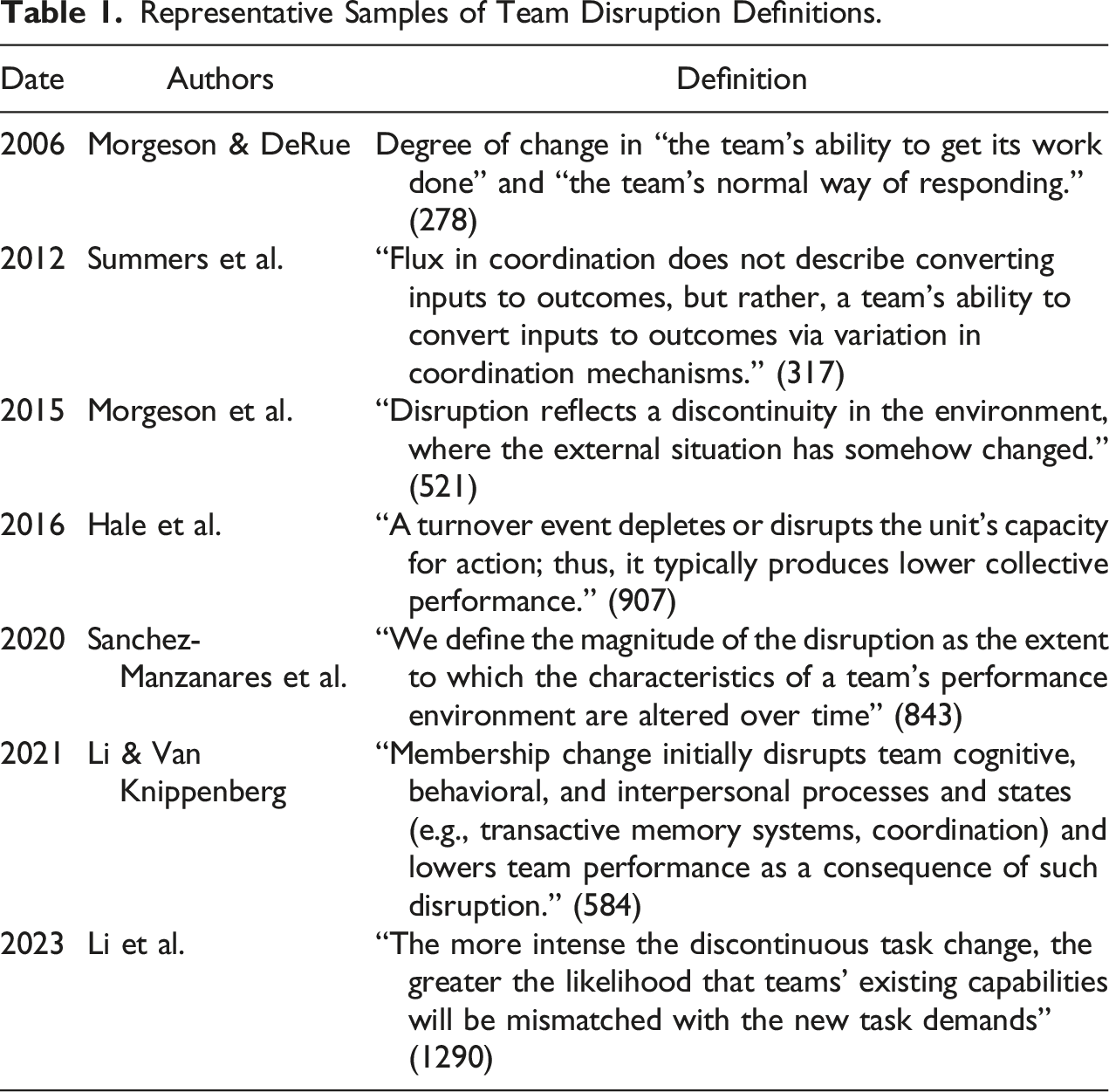
Thus, despite its widespread usage, the literature has yet to provide a clear understanding of what is actually being disrupted in teams. First, many studies do not define what is meant by disruption. Second, many studies do not operationalize precisely what is being disrupted. Third, many studies do not measure disruption, but rather infer disruption took place based on changes (usually reductions) to team performance (e.g., Hale et al., 2016). Overall, as Table 1 illustrates, prior conceptualizations of disruption have frequently invoked the construct of disruption without defining its nature, relationships, or measurement. Development of a consistent yet generalizable understanding of team disruption is important for theory and practice. Theoretically, unspecified use of the term “disruption” contributes to the jingle-jangle fallacy, which means that current conceptualizations of disruption apply different meanings to the construct, and a handful of constructs get at disruption without actually identifying it as such (see Raetze et al., 2022). Practically, unspecified use of the term “disruption” prohibits making clear evidence-based recommendations to best adapt to nonroutine events. In the following section we address these issues by introducing a definition of team disruption.
Defining Team Disruption
Our definition of team disruption—the misalignment of team member coordination relative to task demands due to shifts in coordination, task demands, or both—addresses the above issues by capturing aspects of disruption that are both generalizable and team-specific. First, we emphasize that team disruption is understood in terms of misalignment between team coordination relative to the team’s task. Misalignment implies that the manner in which team members coordinate is a “mismatch” with the team’s task and purpose (Gokpinar et al., 2010; Li et al., 2023, p. 1290). Misalignment is central to the concept of team disruption because the balance and stability of a team’s functioning relies on team processes being coordinated around accurate information about task demands (Arrow et al., 2000; Summers et al., 2012). For instance, shared mental models would cease to be useful towards task accomplishment if they converged around inaccurate depictions of important systems and processes (Mohammed et al., 2010; Santos et al., 2021). Likewise, team communication would lose its usefulness if the information being shared no longer applied to the criteria for accomplishing the team’s goals (Butchibabu et al., 2016; Mesmer-Magnus & DeChurch, 2009; Salas et al., 2005). These instances of misalignment are the direct result of an event-based change—within the team or within the environment around the team—and show that team disruption represents the imprint on team coordination left by that event.
To appreciate the generalizability of the proposed definition of team disruption, it is instructive to consider commonplace definitions. Merriam-Webster define disruption as “the act or process of disrupting something; a break or interruption in the normal course or continuation of some activity, process, etc.” (Disruption, n.d.., Merriam-Webster). Cambridge Dictionary defines disruption as “the action of preventing something, especially a system, process, or event, from continuing as usual or as expected.” (Disruption, n.d., Cambridge Dictionary). A consistent feature of these definitions is that the “normal” process is no longer appropriate due to the introduction of some event. Such an understanding assumes that the process was reasonably aligned beforehand and became misaligned after an event. Likewise, the generation of appropriate team outputs is only possible when team processes stem from an accurate understanding of the team task (Ilgen et al., 2005). This is why aspects of teamwork regarding planning (Fisher, 2014) and charters (Courtright et al., 2017; Mathieu & Rapp, 2009) are critical to a team’s success—aligning the task environment with a team’s actions is a necessity for actualizing team goals.
Second, we identify coordination as the focal within-team construct of team disruption. Coordination is the process of “orchestrating the sequence and timing of interdependent actions” (Marks et al., 2001, p. 367). The role of coordination in teams is to allow different team members’ actions to converge around a common set of goals (Salas et al., 2007). Teams coordinate by synchronizing both their thoughts and actions through tacitly shared experience and purposeful episodes of communication (Rico et al., 2008). The end result of effective coordination is the interconnecting of multiple team processes (Salas et al., 2005). Our explicit emphasis on coordination is perhaps the most powerful insight from the proposed definition. It is well-recognized that teams represent a confluence of different factors, such as composition, emergent states and processes, behavioral routines, subgrouping, diversity, and structural design features (Mathieu et al., 2019). While all of these factors are important, their contributions to task completion all intersect at team coordination (Okhuysen & Bechky, 2009; Salas et al., 2005). Team coordination is what allows the different aspects of teams to operate in tandem at a collective level to produce task-related outcomes that could not have been produced at the individual level. Thus, major theories of teams recognize that coordination is central to team effectiveness and performance (e.g., Arrow et al., 2000; Kozlowski & Chao, 2012; Marks et al., 2001; Mathieu et al., 2008; Salas et al., 2005).
Because coordination involves the interconnectedness of so many processes, when a team faces problems with even a single process (e.g., planning or conflict management; Fisher, 2014), disruption to team coordination is often the immediate consequence (Summers et al., 2012). For instance, when a mission goes terribly wrong in a short span of time, police teams have been shown to swiftly lose their ability to communicate information accurately, causing their coordination to buckle under the immense pressure of the changing situation (Schakel et al., 2016). Similarly, Weick (1988) depicts how crisis situations undermine cognitive processing and subsequently harm the functionality of team coordination mechanisms.
Team coordination is both highly sensitive to change and highly impactful for team outcomes, making disruptions to team coordination a pivotal concept when discussing team performance (LePine et al., 2008). Team coordination often acts as a critical mechanism through which different team inputs (e.g., team structure; Johnson et al., 2006) lead to better team performance (Moon et al., 2004). Coordination also allows for better performance during periods of heightened stress (Entin & Serfaty, 1999), and is the difference between success and failure for teams tasked with utilizing exceptional levels of knowledge (Reagans et al., 2016). Thus, we argue that coordination is the team characteristic needed to conceptualize team disruption.
Third, the definition of team disruption generalizes across many different types of teams and task environments. No matter the differentiation of skills, authority, or temporal stability (Hollenbeck et al., 2012), coordination will be at the heart of orchestrating a team’s interdependent processes. Across different types of structural interdependencies (i.e., task vs. outcome interdependence; Courtright et al., 2015) and different forms of team composition (Mathieu et al., 2014), coordination remains a central mechanism through which teams must function effectively. Therefore, when significant changes occur, no matter the type of team, disruption will consist of misalignment involving coordination relative to the team’s task demands.
Fourth, the definition of team disruption applies regardless of the type of event (novel, critical), the spatial features of the event (i.e., internal, external), or the temporal features of the event (Morgeson et al., 2015). The misalignment inherent to team disruption can emerge when changes to the team are unprecedented, or they can emerge when change is of a high priority (Morgeson & DeRue, 2006). Misalignment can also occur due to change in either the external task environment, the internal facets of the team itself, or both (Christian et al., 2017). Also, even if change occurs over a particularly long or short period of time (Waller, 1999), or happens at a particularly convenient or inconvenient point in time (LePine, 2005), misalignment is still possible. However, while the definition of team disruption stays consistent across different types of events, the magnitude of team disruption varies greatly based on the novelty and criticality of events—topics we consider next.
Team disruption occurs to the extent that an event creates misalignment between team coordination and the team’s task demands.
Events and Misalignment
Team disruption is created when novel and/or critical events cause misalignment between the team’s coordination and task demands. The more critical and/or novel the event, the greater the magnitude of team disruption. Critical and/or novel events create significant changes for teams that alter the information and resources relevant to how teams coordinate around task demands (Li & Van Knippenberg, 2021; Liu et al., 2023a). Highly novel events create change that is unprecedented to team members while critical events create change that induces a sense of priority for team members (Morgeson, 2005; Morgeson & DeRue, 2006; Morgeson et al., 2015). Team coordination is based on mechanisms that are impacted by the effects of novel and critical events. For instance, shared mental models will become outdated due to the unprecedented information introduced into the task environment by novel events (Marks et al., 2000). Alternatively, leader directives that often guide coordination will be potentially ineffective following a change in priorities due to a critical event (Edmondson, 2003). Although novel and critical events influence misalignment through different mechanisms, it will be shown that both event criticality and event novelty increase the magnitude of misalignment, thereby creating team disruption (see Figure 1). In Figure 1, complete alignment between team coordination and task demands is represented by the overlapping circle on the left. To the extent an event creates misalignment, the “team coordination” and “task demands” circles will be less overlapping, as illustrated on the right.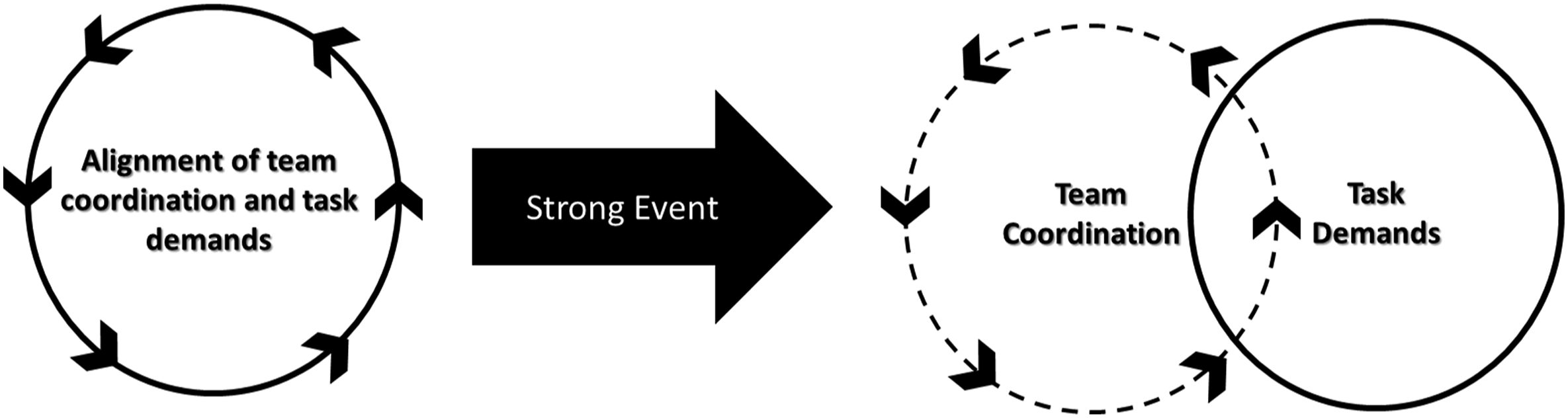
Event Criticality
Critical events create disruption primarily by impacting the task demands of a team. (Morgeson et al., 2015). Teams exist to accomplish goals through completing tasks (Kozlowski & Ilgen, 2006), meaning that events critical to teams must necessarily change their task demands in some significant way. For example, Morgeson and DeRue (2006) find that events of a higher priority to team success led to greater perceived disruption of task accomplishment. Thus, critical events change the team’s task and require teams to subsequently shift the way in which they operate. Even if the event is not novel, a critical event will introduce a change to the team’s task (Li et al., 2023).
Event criticality creates misalignment by impacting the team’s criteria for meeting task demands relative to team coordination. Changes to task demands mean changes to the degree of resources, attention, and effort required by the team (Schmutz et al., 2018). Resources are the “personnel, equipment, and other information that is generated or contained within the team” (Marks et al., 2001, p. 367). Attention and effort are the basic means of directing team resources (Gersick & Hackman, 1990; Waller et al., 2002). When the task suddenly requires different resources, attention, and effort, team processes will have to be modified to continue towards mission completion (Marks et al., 2001). Thus, critical events create misalignment in task demands relative to team coordination by impacting the resources, attention, and effort required for the continuation of team processes.
Events with greater criticality are more disruptive to teams primarily because they change the team’s task.
Event Novelty
Novel events create disruption primarily by impacting the team’s coordination. Event novelty indicates how accurately an event can be anticipated (Morgeson et al., 2015). Novel events contribute to disruption because the change they produce is unprecedented (Liu et al., 2023a). For instance, the completely unprecedented nature of the COVID-19 pandemic contributed to the magnitude with which the event affected employee perceptions of job insecurity (Lin et al., 2021).
Event novelty creates misalignment by impacting the information that allows the execution of team coordination relative to task demands. For example, events that introduce change not accounted for by a team’s collective cognition will cause that team’s coordination to operate on inaccurate information (Cooke et al., 2007; Mohammed et al., 2010). More specifically, cognitive structures such as transactive memory systems will be unable to function accurately if an unprecedented change outpaces a central team member’s relevant knowledge (Mell et al., 2014). When team members have incomplete information, mental energy must be diverted from task accomplishment and focused on restoring their understanding of the team context (Waller, 1999). Thus, novel events can create misalignment in team coordination relative to task demands by altering the information required for further coordination and taking mental energy away from existing coordination processes.
Events with greater novelty are more disruptive to teams primarily because they change the team’s coordination. It should be noted that Propositions 2a and 2b recognize that criticality and novelty are distinct constructs, and thus have distinct consequences. Such theoretical precision is important (and consistent with Morgeson et al., 2015), as there can be instances where event criticality is high and novelty is low (e.g., a medical team conducting a serious but routine procedure), or criticality is low and novelty is high (e.g., a medical team discovers a benign tumor during a routine procedure). However, in practice, event criticality and novelty will often positively covary, and in such instances event criticality and novelty will likely have spillover effects on team coordination and task demands; respectively. Such potential for spillover effects does not lessen the value of keeping event criticality and novelty distinct, since the mechanisms through which they each create disruption are unique. Nonetheless, the relative effects of event criticality and novelty should be examined and we consider these future research needs more fully in the discussion section. While the criticality and novelty of events directly indicate how an event will impact team disruption, events are bounded by the temporal factors surrounding their occurrence (Morgeson et al., 2015). Temporal factors therefore play an important role in shaping the way in which team disruption occurs.
Temporal Conditions of Team Disruption
The temporality of events dictates the way in which they are perceived and how they impact teams (Morgeson et al., 2015). It follows that team disruption is influenced by the temporal conditions of events. We identify two primary ways in which time plays a role in how events create team disruption. First, events can occur during particular time periods of team process—action and transition phases (Marks et al., 2001)—that either promote or mitigate misalignment between team coordination and task demands. Second, the novelty and criticality of an event can have a particular rate of change that either promotes or mitigates misalignment. Therefore, we argue that event timing and an event’s rate of change are key moderators for understanding how events create team disruption.
Event Timing
Teams must be able to take actions toward goals and dynamically change course towards those goals when needed (Burke et al., 2006). As such, the path towards goal achievement consists of recurring episodes aimed at understanding the team context, and then actually performing as a team (LePine et al., 2008; Schmutz et al., 2018). Marks et al. (2001) taxonomize this episodic timeline by dividing it into two distinct phases—action and transition. During the action phase, team members monitor different requirements for task completion, and coordinate their interdependent actions around task demands (Klein et al., 2006). As such, action phases are best fit for handling real-time, anticipated changes involving critical components of the task environment (Ishak & Ballard, 2012). During the transition phase, teams specify goals, analyze their mission, and formulate strategy (Fisher, 2014; Mathieu & Rapp, 2009). Transition phases are thus best fit for acquiring and processing new information about changes that may occur in the team and their task environment (Kennedy & McComb, 2014).
Since different phases of team processes involve distinct foci (i.e., transition phases focus on preparation, while action phases focus on task completion), the way in which events influence a team will depend on the phase that team is in (LePine, 2005). As such, transition and action phases make teams sensitive to different types of events. Thus, the timing of events is central to team disruption because the misalignment between coordination and task demands can be much greater depending on when the event occurs. Coordination is a process that primarily occurs during the action phase, because coordination involves the orchestration of the different team behaviors aimed at task completion (Marks et al., 2001). For example, surgical teams spend an extraordinary amount of time within an action phase, and are able to do so because of their extensive ability to seamlessly coordinate (see Luciano et al., 2018). However, the capacity for coordination is, in part, driven by the information and knowledge gleaned from the transition phase (Okhuysen & Waller, 2002). Thus, when a strong event occurs, team disruption will be dependent on whether coordination is underway during an action phase, or being planned during a transition phase. This means the impact of critical and/or novel events on team disruption will vary based on whether an event occurs during an action or transition phase. These conditional relationships are explained below and illustrated in Figure 2. In Figure 2, disruption is represented by the misalignment between team coordination and task demands. Novel events misalign team coordination and critical events misalign task demands (Propositions 2a and 2b). Greater disruption occurs when novel events are introduced during action phases (Proposition 3), or when critical events are introduced during transition phases (Proposition 4).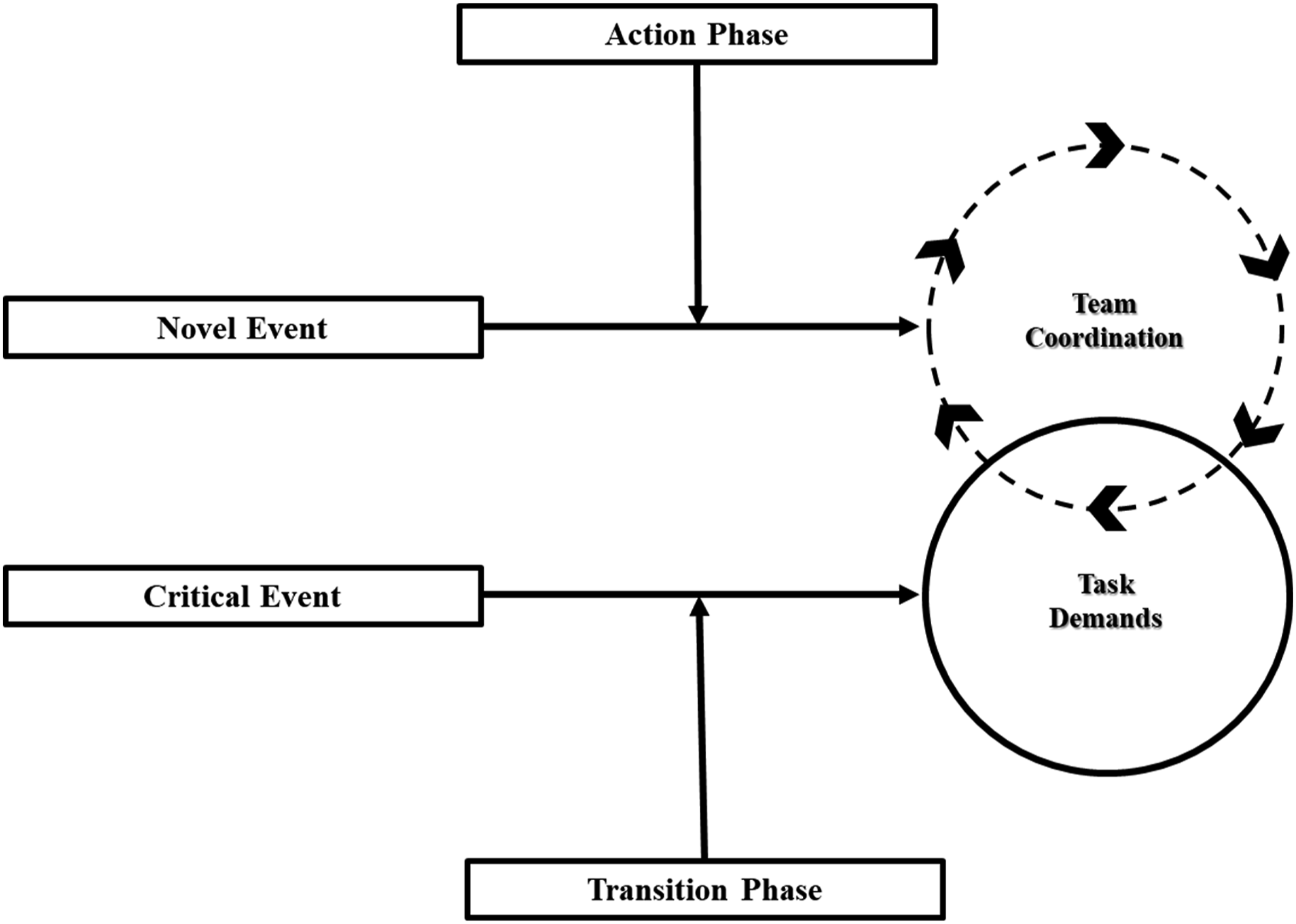
Event Novelty and the Action Phase
When novel events occur during an action phase, the misalignment between team coordination and the task environment should be greater than if a novel event occurred during a transition phase. Because novel events are unprecedented, the change that they introduce will not have been anticipated during prior planning and analysis (Weick, 1993). A primary purpose of transition phases is to allow team members to stop and process new information, collectively make decisions based on that information, and then prepare to redirect their actions accordingly (Rico et al., 2019). In this way, novel events and team transition phases are inextricably tied, as the latter is essentially designed to account for the former. This is made clear by Waller (1999), who found that groups faced with novel events exhibited significantly greater performance when they were able to transition to collect and transfer information.
Event novelty thus poses greater disruption during the action phase because the collective knowledge that drives a team’s coordinative process cannot account for the unprecedented information introduced by the novel event (Uitdewilligen et al., 2013). While shared mental models, transactive memory systems, and entrained rhythms can promote team adaptation and resilience to disruptive events (Stoverink et al., 2020), these emergent states and behaviors are based on information and experiences that novel events, by definition, defy (Morgeson et al., 2015). Mental models and synchronized forms of interaction are learned either purposefully during transition phases or picked up tacitly through multiple episodes of experience (Mohammed et al., 2010). Thus, when novel events introduce information that has not been shared or processed within the team, these mental and behavioral structures will be unable to orchestrate proper coordinative efforts. In other words, novel events occurring during an action phase will create greater misalignment than if they occurred during a transition phase.
Event novelty creates greater team disruption during an action phase compared to a transition phase.
Critical Events and the Transition Phase
When critical events occur during a transition phase, the magnitude of misalignment between team coordination and the task environment should be greater than if a critical event occurred during an action phase. Because critical events are highly relevant to the team’s goals and purpose, the change that they introduce is urgent and a priority to the team (Morgeson & DeRue, 2006). A central purpose of an action phase is to tackle the most pressing issues standing in the way of task completion (Lepine et al., 2008; Marks et al., 2001). Thus, action phases are meant to deal with the change introduced by critical events. For example, teams faced with significant changes to their role structure (i.e., shift from functional to divisional) during command-and-control simulations are more likely to effectively adapt when engaging in active efforts of coordination (Moon et al., 2004).
On the other hand, event criticality poses greater disruption during the transition phase because the processes required for directly addressing critical changes are not currently in motion. Indeed, the changes created by critical events require a shift in resources, attention, and effort that cannot be handled simply through planning and analysis (Schmutz et al., 2018). Actively managing factors relevant to task completion requires the usage of coordinative mechanisms such as information sharing (Mesmer-Magnus & DeChurch, 2009), team cognition (Grand et al., 2016), and leadership directives (Edmondson, 2003; Marks et al., 2000; Sanchez-Manzanares et al., 2020). While the quality and accuracy of these mechanisms are developed through the transition phase, their actual impact on the task is actualized during the action phase (LePine et al., 2008; Marks et al., 2001). Thus, when a critical event demands that a team’s coordinative mechanisms be deployed, teams in a transition phase will face greater disruption than if they were in an action phase.
Event criticality creates greater team disruption during a transition phase compared to an action phase. It’s worth noting that shifts between transition and action phases should occur in response to team disruption. When critical events occur during the transition phase, the misalignment of task demands with coordination will push teams to shift to the action phase. Likewise, when novel events occur during the action phase, the misalignment of coordination with task demands will push teams to shift to the transition phase. While prior research has discussed team phase shifts due to disruption (i.e., flux; Summers et al., 2012), the current conceptualization adds nuance to explain why exactly these shifts occur.
The Rate of Event Change
Although we have discussed the temporal aspect of events in terms of their timing, such an approach does not fully account for the dynamic nature that many events exhibit. Events often create disruption because their impact is not static but, rather, changes rapidly (Liu et al., 2023a). EST accounts for the dynamism of events by describing how “as they unfold upon their inception, events may become more or less novel, disruptive, and critical...their overall strength can change over time” (Morgeson et al., 2015, p. 528).
Although not situated within a team-specific context, one might consider the terrorist attack on September 11th, 2001 to be an event that escalated profoundly within a matter of minutes, as the situation shifted dramatically between the first plane hitting the twin towers and the second. This type of event left U.S. employees in a state of disbelief and panic (Stein & Cropanzano, 2011; Wade-Benzoni, 2002). Two temporal features lie at the core of why an event like the 9/11 terrorist attacks were so disruptive. First, the attack and the subsequent fatalities happened over a relatively short period of time. Second, there was an extremely large degree of change in both novelty and criticality upon the second plane hitting. Combined, large changes to the rapidity and magnitude of novelty and criticality make for an event prone to blindsiding the system and people that it impacts.
Within teams specifically, the rate at which an event changes can increase the misalignment between coordination and task demands. As we have established, misalignment occurs when a novel and/or critical event impacts a team. Since events can be dynamic (Morgeson et al., 2015), we would expect misalignment to be dynamic as well. While we have already posited that event novelty and criticality contribute to misalignment, the rate of change in novelty and criticality contributes in its own unique way, parallel to how the duration of an event has its own separate effect on disruption (Morgeson & DeRue, 2006). For instance, teams in high-stakes environments often deal with events that emerge rapidly and change unpredictably (Klein et al., 2006). Success in these settings is often reliant on whether the team’s coordination can keep up with such dynamic events (Faraj & Xiao, 2006). Indeed, while team effectiveness relies on the capacity for teams to coordinate around critical and novel events, coordinating around dynamism is in and of itself an important indicator of effectiveness (e.g., Grote et al., 2018; Larson et al., 2020; Schecter et al., 2018; Uitdewilligen et al., 2018). In terms of team disruption, this means that not only do criticality and novelty influence misalignment, but the rate of change in those characteristics also influences misalignment.
Perhaps the most seminal example of the influence of the rate of event change comes from Weick (1993), who illustrates for readers the stark change in pace of the Mann Gulch fire disaster. The event—a forest fire—changed so rapidly and unexpectedly for the fire responders that Weick (1993) describes it as a “sudden loss in meaning” (633). Ultimately, the situation progressed at a rate too high for the coordinated efforts of the responders to react properly. Importantly, the misalignment that proved fatal for the team was not a product of simply the criticality of the forest fire or its novelty, but the swiftness in which the situation changed. Thus, the rate of change had a unique effect distinct from simply the magnitude of event novelty and criticality. In this way, it’s entirely possible that events with low magnitudes of criticality or novelty can be disruptive if the magnitudes are changing quickly (cf., Chen et al., 2011, for a similar argument about job attitudes). What matters, as far as the rate of change is concerned, is that the team is unable to keep up with the change in novelty and/or criticality, creating misalignment.
It is also worth noting that rapid change in event criticality or novelty can be increasing or decreasing, and both forms can be disruptive. A critical or novel event may manifest a rapid decline, and such change (while negative) may nevertheless introduce disruptions for the same reasons noted above. Therefore, both positive or negative rapid changes can be disruptive, with the relative importance of increases versus decreases likely dependent on the nature of the phenomenon and event. Thus, we posit the following:
Higher rates of change in event criticality and/or novelty increase team disruption more than lower rates of change. In developing Proposition 5, we focus on change in a singular event. However, events like 9/11 or the Mann-Gulch fire could also be considered a series of events occurring in rapid succession leading up to eventual disruption. Indeed, Morgeson et al. (2015) acknowledge that, although EST treats events as “discrete occurrences,” many events can “occur closely within space and time” (531). Thus, events like 9/11 or the Mann-Gulch disaster can appear as either one continuous event or a swift series of discrete events; the structure of events ultimately relies on the idiosyncratic lens of the people perceiving them (Allport, 1954). In other words, events are defined by the meaning given to them (Morgeson et al., 2015). For instance, while turnover is often considered a single event, the unfolding model of turnover fractalizes the turnover event into many different discrete events (Lee & Mitchell, 1994). However, regardless of whether a single event ebbs and flows or there are a number of interconnected discrete events, the proposed framework and propositions developed above should still hold because in both cases the event(s) are introducing change at a higher rate. No matter how team members view events (a singular event or many events in quick succession), the misalignment remains the same. On the other hand, differences in conceptualizing events across time will indeed impact the statistical modeling of their relationship with disruption and other outcomes—a point we revisit in the discussion section.
Spatial Conditions of Team Disruption
The origin of an event—whether it is internal (within the team) or external (in the team’s environment)—can create substantively different types of team disruption. A basic principle behind EST, and multilevel theory more broadly, is that the spatial location of an event within a system is meaningful and necessary to understand how that event impacts a system (Kozlowski & Klein, 2000). For present purposes, we focus on distinguishing between event origins that are internal or external to the team. Events that originate internal to the team include changes in team composition, structure, and/or emergent states and processes (e.g., Ilgen et al., 2005; Mathieu et al., 2017). Events that originate external to the team include changes in resource munificence, temporal dynamism, and/or spatial variability (Ployhart et al., 2022). Differences in event origin (internal vs. external) are directly linked to team disruption, because misalignment can occur either due to changes within the team (i.e., through team coordination) or due to changes outside of the team (i.e., through the task environment). As we will argue, the origin of the event will determine whether the resulting disruption occurs due to changes in the team task or changes in team coordination. In other words, internal and external events can both be disruptive, but for different reasons.
Team Disruption from Internal Origins
Events that have internal origins occur “within the team.” The internal event creates disruption such that the team’s coordination is misaligned with the team’s task. That is, a hallmark of an event that originates internally is that the team’s task does not change; there is only change to the team’s coordination. 1 The effect on coordination is due to the event’s influence on team composition, structure, and/or emergent states and processes.
First, an internal event may originate due to changes in team composition. For example, the team may experience a turnover event from one of its members. When a team member leaves the team, it can create important gaps in the team’s mental models (Laulié & Morgeson, 2021; Li & Van Knippenberg, 2021). Both team member turnover and leader turnover can disrupt coordination, and the more central the person to the team’s coordination, the greater the disruption (Hale et al., 2016; Hausknecht & Holwerda, 2013; Summers et al., 2012). Alternatively, adding new members can affect coordination even if there is no turnover (Rink et al., 2013; Pinto, 2017). New members require assimilation into the team and must learn existing member roles, KSAOs, and tasks. Simultaneously, incumbent members need to assimilate new members, teach them their tasks, and learn their KSAOs. Li and Van Knippenberg (2021) provide a review and conceptual model of team membership change that clarifies how the loss or acquisition of team members can ultimately influence team coordination.
Second, an internal event may originate due to changes in team structure. For example, a turnover event will often impact the work distribution of those who remain (Reilly et al., 2014), thus requiring the team to coordinate in different ways (DeRue et al., 2008). Alternatively, even in the absence of turnover, acquiring new team members may result in new ways of transferring knowledge and affect the manner in which the team coordinates member inputs (Kane et al., 2005). Thus, structural changes in terms of numbers of team members, or their specific workloads or roles, can affect coordination and hence be disruptive (Humphrey & Aime, 2014). Internal events may also occur in the form of change to a team’s structural interdependence (Courtright et al., 2015). For example, Johnson et al. (2006) show that alterations to a team’s reward structure can impact a team’s capacity to share information. Additionally, Moon et al. (2004) find that changes in the way members are expected to work on tasks impacts team coordination and downstream performance.
Third, an internal event may originate due to changes in team emergent states and processes. For example, team members may engage in episodes of relational conflict that inhibit the coordinative benefits of transactive memory systems (Leenders et al., 2016; Todorova, 2021). Teams may also exhibit affective episodes that have downstream consequences for how the team functions (Liu et al., 2023a). Additionally, deviant actions enacted by members can end up impacting the team’s ability to operate effectively (Baur et al., 2022). Thus, changes in the collective cognition, affect, and behavior of a team (Kozlowski & Ilgen, 2006) can be disruptive via the influence on coordination.
Importantly, all three of these factors—team composition, team structure, and team states and processes—are related to changes in each other, but we theorize that any combination of these factors will ultimately influence team coordination and make it misaligned to the team task. For instance, events that impact employee withdrawal will likely also impact turnover (Hom & Kinicki, 2001). Similarly, membership changes may influence workload for other team members (Armstrong-Stassen et al., 2004) but also influence emergent states and processes. All such mediated relationships are theoretically interesting and worthy of investigation, but beyond the scope of this study. Rather, here we emphasize a broadly important insight: that any such event-based internal influence, no matter its pattern or complexity, will ultimately affect the team’s coordination such that it is misaligned from the team’s task. The team may then revise the task in response to the internal event, but task revisions are a consequence of coordination becoming misaligned.
Events that originate internal to a team create disruption by impacting team composition, structure, or emergent states and processes, such that these factors cause the team’s coordination to change and become misaligned to the team’s task.
Team Disruption From External Event Origins
Events that have external origins are events whose novelty and/or criticality come from “outside the team.” In their ETC model, Ployhart et al. (2022) define the external team context as, “the resources, stimuli, elements, and features that are part of a broader multilevel system but exist outside the team’s boundaries, and that influence (and are influenced by) the team in temporally dynamic ways.” (1052). This external team context consists of resource munificence, temporal dynamism (i.e., how resources are changing), and spatial variability (i.e., where resources are located), which together comprise the complexity of the external task context (Ployhart et al., 2022). In contrast to events that originate internally, external events influence the team’s task. 2
Events in the external team context can change the team’s task and result in it being misaligned to the team’s coordination. In this situation the team’s coordination does not change but the team’s task has changed as a result of the event, thereby contributing to disruption. The team’s task is in large part shaped by the external team context (Mathieu et al., 2017). The task may be defined as a “network of required actions and information cues” (Haerem et al., 2015: 446) and for teams specifically, taskwork is often interdependent, meaning that “members depend upon one another for access to critical resources and to create workflows that require coordinated action” (Courtright et al., 2015, p. 4). Mathieu et al. (2017) emphasize that team tasks are a function of their scope and complexity. Much of the work on team adaptation has taken this perspective. For example, experimental research will often abruptly change the task (or task constraints), which requires the team to learn and respond in new ways (e.g., LePine, 2003, 2005). More generally, it is recognized that the external team context is a strong influence on the nature and complexity of the team task (Kozlowski & Bell, 2003; Mathieu et al., 2017; Ployhart et al., 2022). Drawing from Ployhart et al. (2022), we theorize that any combination of changes in munificence, temporal dynamism, and spatial variability will ultimately misalign the team’s task to the team’s coordination, and thus be disruptive.
Events that originate external to a team create disruption by impacting the munificence, temporal dynamism, or spatial variability of the task environment, such that these factors cause the team’s task(s) to change and become misaligned to the team’s coordination. Note that we have not made predictions about the relative magnitude of disruption created by internal versus external events. We have also not made predictions about the relationships between external and internal factors. We recognize events that originate external to the team can eventually impact internal factors, and vice versa. Additionally, external events and top-down effects are often theorized to be stronger than internal events and bottom-up effects (Kozlowski & Klein, 2000; Morgeson et al., 2015). Indeed, the multilevel influence of events is a primary focus of EST, and it’s widely understood that events can enact influence both bottom-up and top-down (Kozlowski & Klein, 2000). The central point of Propositions 6 and 7, however, is to recognize that where the event originates dictates the process by which misalignment forms and disruption is created. Events that originate internally primarily impact coordination, while events that originate externally primarily impact the team’s task. While it is beyond the scope of this manuscript, there are opportunities in future research to better understand the multilevel process by which disruptive events span across internal and external team factors, and the relative impact of top-down and bottom-up processes.
Discussion
Team disruption is a topic of widespread interest in research and practice. Indeed, it is discussed in a number of different team theories and literatures, and known by a number of different terms (see Table 1). And yet, the field lacks a clear understanding of what team disruption is; including how it is defined, conceptualized, and operationalized. The result is different theories and research tend to assume different forms of team disruption, which can lead to a fragmented and overly complex literature. To address this concern, our study seeks to introduce an understanding of team disruption that is parsimonious yet generalizable. We define team disruption as the misalignment of team coordination relative to task demands due to shifts in coordination, task demands, or both. We integrate this definition with EST, and subsequently introduce temporal and spatial moderators. This approach advances several implications for theory and practice.
Theoretical Implications
The conceptualization of team disruption offers a number of potentially important and broad-ranging theoretical implications. First, it provides focus and clarity around what specifically is meant by disruption in team contexts. While many existing theories and frameworks note that events cause disruption (Liu et al., 2023a), the treatment of disruption differs considerably in terms of content, theoretical development, and specificity. Indeed, Table 1 shows that disruption has been discussed in many different ways while eluding explicit definition within the context of teams. In contrast, by defining team disruption in terms of the misalignment between team coordination and the team’s task, this manuscript provides a means to understand the diverse ways in which prior research conceptualizes team disruption, and integrates the variety of prior terms into a more parsimonious and holistic understanding. Thus, the proposed conceptualization clarifies why and how team disruption differs from events or responses to events. In doing so, the definition offers a means to advance a new understanding of team disruption. For example, research that examines membership change (e.g., Li & Van Knippenberg, 2021) and responses to task changes (e.g., LePine, 2005) now have a common definition and conceptualization to reference each other’s work. Similarly, the concept of misalignment contributes to theories of team resilience by distinguishing what exactly leads to adversity as experienced at the team level (Stoverink et al., 2020). This conceptualization of team disruption therefore enables researchers to integrate and generalize their work to new areas, and may also promote meta-analyses to broaden their inclusion criteria.
Second, the proposed conceptualization asserts that coordination is the central process for understanding team disruption. We take the strong position that nearly all changes in team composition, emergent states and processes, or structure, only “matter” for team disruption to the extent they influence coordination. Such an assertion does not trivialize or diminish research that seeks to understand team composition, emergent states and processes, or structure. Research on these other team characteristics is important, and adds nuance and depth of understanding. For example, the model of team membership change offered by Li and Van Knippenberg (2021) adds nuance in the sense that membership change may create team disruption because of the impact on team cognition, affect, and behavior. Similarly, Summers et al. (2012) emphasize that membership change creates flux in coordination. They note that membership change disrupts team cognition, behavioral routines, and interpersonal processes. These insights are important. However, our broader point is that all such processes impact team coordination, and thus coordination is the means through which team disruption is understood. The benefit of this approach lies in its parsimony and generalizability. Team research will struggle to understand the nature, causes, and consequences of team disruption if one must consider dozens of potential states and processes. In contrast, our approach synthesizes the more distal causes of disruption and thus enables researchers who study different team phenomena to understand each other’s work. Of course, a challenge for future research is to determine whether team coordination is, by itself, a necessary and sufficient condition for understanding team disruption. Addressing this challenge will require both laboratory and field research, and should stimulate an active program of research.
Third, the proposed framework offers precision in terms of understanding how team disruption is affected by the types, timing, rate of change, and origin of events. The Propositions offer specific direction for future research, and the development of the Propositions offers guidance for generating testable hypotheses. Research should compare and contrast the effects of event type and event change. For example, a less novel event could produce greater disruption if it is changing rapidly, compared to a more novel event that is static. Similarly, an event could produce greater disruption if novelty emerges during an action phase versus during a transition phase. The Propositions thus stimulate a number of novel research questions that are united by a common dependent variable: team disruption defined in terms of misalignment between team coordination and the team’s task. Note that such an agenda offers a means to unite theories in new ways, including EST (Morgeson et al., 2015), or team membership (Li & Van Knippenberg, 2021), with the transition-action framework of Marks et al. (2001); as just some examples.
Directions for Future Research
Future Research Directions.
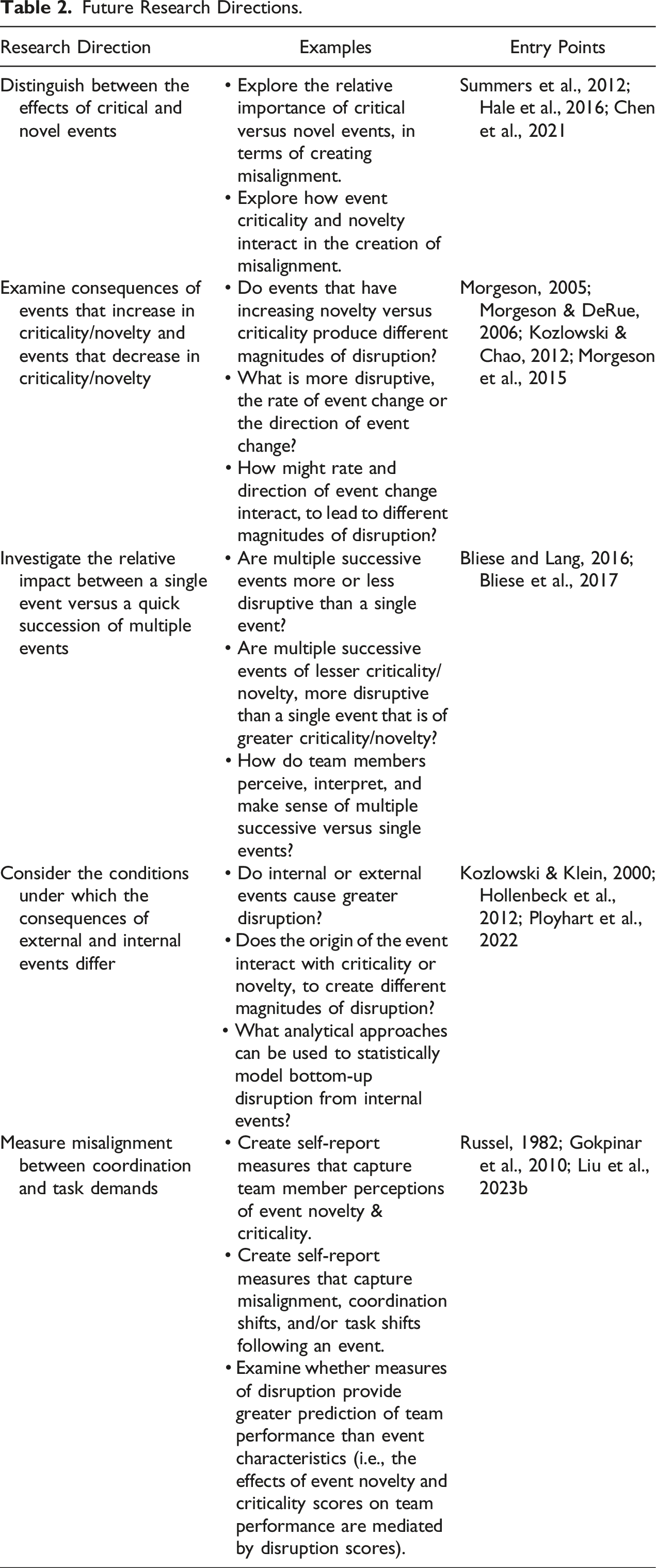
The team disruption framework also suggests new measurement approaches. Rather than relying on changes to task performance, as is typical in team adaptability research (e.g., LePine, 2003), the framework suggests that team disruption can be more directly measured. For example, survey questions can be written to assess the degree to which team members believe (a) the task is changing, (b) team coordination is misaligned to the task, or (c) a combination of the two (i.e., perceived misalignment). Similarly, research on the Causal Dimension Scale (Russell, 1982) that is widely used in attribution research may prove a useful example for measuring events. In such an approach, respondents may be asked to report the event that they feel is causing the disruption, and then rate with Likert items the extent to which the event is perceived as critical and novel (as well as static or changing). With a framework for conceptualizing team disruption, it is possible to create such measures, assess the validity of their scores, and integrate them into existing analytical approaches (e.g., Bliese et al., 2017). In this manner, disruption is a construct that is measured, and the scores can be used to predict performance (rather than equating disruption with declines in performance).
Practical Implications
The team disruption framework we propose has potential implications for practice. First, recognizing what team disruption is enables leaders to better diagnose when it is happening, why, and how to respond. For example, of the wide variety of team composition, state, and process variables, leaders should prioritize the monitoring of team coordination relative to the task. Should team members leave or new members be added, the first priority for the team leader is to understand how coordination is changed. The leader may later consider how KSAOs, cohesion, and related constructs have changed, but the first priority is to understand the impact on coordination. Alternatively, if changes in the environment occur, then the first priority of the leader is to determine whether the team task has changed. Thus, the framework offers a means for leaders to prioritize their attention—specifically, on monitoring and ensuring alignment between task demands and coordination.
Second, the framework contributes to understanding when events are likely to be more disruptive. Novel events are particularly likely to be disruptive when the team is in the action phase, and critical events are particularly likely to be disruptive when the team is in the transition phase. Armed with such knowledge, team members and leaders can anticipate responses to disruption that are tailored to their particular phase.
Limitations and Boundary Conditions
This study has largely considered team disruption with the assumptions that teams are already formed, that team coordination and the task are reasonably aligned, that the team is reasonably well functioning, and that only a single event is disrupting the team. Each of these assumptions may be reconsidered, and to the extent the theorizing is conditional on the assumption, the Propositions may not hold. For example, in newly formed teams that have not yet aligned their coordination with the task, events may disrupt teams in ways different than proposed here. Likewise, a dysfunctional team may be disrupted for other reasons than those we develop. Finally, multiple events may occur at different times and interact with each other, and such interactions could distort the theorizing we present. We see all of these possibilities as interesting and deserving of future research. Therefore, future research should relax the assumptions and boundary conditions we adopt to determine the support and generalizability of the propositions.
Conclusion
Understanding the nature, causes, and consequences of team disruption is critical for research and practice. Prior research has not precisely defined or conceptualized the nature of team disruption, and thus leaves many important questions unaddressed. This study seeks to advance the team literature by proposing a conceptualization of team disruption that is parsimonious, yet reasonably comprehensive and generalizable. Our hope is that this new conceptualization leads to a more integrated understanding of team disruption and sheds light on an experience that so many team members share.
Footnotes
Declaration of Conflicting Interests
The author(s) declared no potential conflicts of interest with respect to the research, authorship, and/or publication of this article.
Funding
The author(s) received no financial support for the research, authorship, and/or publication of this article.
