




Abstract
Collective creativity and innovation are key determinants of various important outcomes ranging from competitiveness of an organization to GDP growth of a country. As a result, this topic has attracted widespread scholarly interest from different disciplines, including strategic management, entrepreneurship, production and operations management, information systems, marketing, organizational behavior, sociology, economics, and psychology. However, this research remained isolated within disciplinary boundaries, which presents a major barrier for knowledge accumulation and cross-disciplinary learning. In this review, building on a new taxonomy of collectivity, we develop an integrative framework that organizes and synthesizes the fragmented research on the topic. The framework shows how antecedents related to the cognitive, social, and organizational architecture of a collective impact innovation depending on the collectivity type: attention-based, divergence-based, and convergence-based collectives. As a whole, our framework builds an integrative understanding of drivers of collective creativity and innovation and sets the stage for further theory development by facilitating communication across different disciplines. We conclude our review with an agenda for future research.
While historical and modern accounts of creativity and innovation frequently put the individual at center stage, creativity and innovation often emerge from collective efforts. Most creative and innovative endeavors take place at the level of collectives—teams, crowds, organizations, or regions—which take different shapes and forms ranging from a collective of people attending to the same innovation problem independently to a collective working together to generate a final solution (e.g., Anderson, Potočnik, & Zhou, 2014; Harryson, 1997; Jeppesen & Lakhani, 2010; Seo, Kang, & Song, 2020; Vakili & Zhang, 2018). Collective innovation is not only ubiquitous but also identified as a key determinant of many important outcomes, including organizational competitive advantage (e.g., Acar, Tarakci, & van Knippenberg, 2019), social prosperity (e.g., Kozinets, Hemetsberger, & Schau, 2008), and human evolution (e.g., Hochberg, Marquet, Boyd, & Wagner, 2017).
Given its importance and ubiquity, it is unsurprising that collective innovation has attracted widespread attention from scholars in various disciplines. However, extant research has remained isolated within disciplinary boundaries, presenting a major impediment to the accumulation of knowledge and cross-disciplinary learning—both of which are essential to generating a comprehensive understanding of collective creativity and innovation (e.g., Fortunato et al., 2018; Porter, Roessner, Cohen, & Perreault, 2006). In addition, the research has reported some conflicting findings on the relationship between collective innovation and its antecedents. For instance, the extent to which the units within a collective are connected was found to have different outcomes. Some studies have found a negative relationship (e.g., Hofstetter, Dahl, Aryobsei, & Herrmann, 2021; Stephen, Zubcsek, & Goldenberg, 2016), while others have reported a positive association (e.g., Bayus, 2013; Yan, Leidner, & Benbya, 2018). Still others have indicated a curvilinear relation (Dong, McCarthy, & Schoenmakers, 2017; Paruchuri, 2010). One reason for the inconsistent findings is that when talking about collectivity, researchers often consider different types of collectives at levels of analysis ranging from teams and crowds to organizations and countries. Our objective in this review is to develop an integrative framework that organizes and synthesizes the fragmented research on collective creativity and innovation.
In the following sections, we conduct a review of past research from different disciplines to develop a novel taxonomy of collectivity types: attention-based, divergence-based, and convergence-based collectives. Building on this, we develop an integrative synthesis of how the cognitive, social, and organizational architecture of a collective can either promote or inhibit creativity and innovation. Our framework suggests that the optimal architecture for innovation depends on the type of a collective and that these differences are explained by the variation and integration mechanisms. This integrative framework also allows us to formulate an agenda for future research that would be valuable in further developing this integrative, cross-disciplinary understanding of collective creativity and innovation.
The integration and conceptualization presented in our framework are important for both management scholars and practitioners. First, our framework allows for better communication across disciplines and provides a foundation for future theory development. Second, it paves the way for a more comprehensive and nuanced understanding of the collective innovation process by establishing a theoretical basis for the conditions under which various cognitive, social, and organizational factors either support or hinder collective creativity and innovation. In so doing, it also takes a step toward reconciling inconsistent findings from previous research. From a practical perspective, managers are interested in how they can effectively utilize the innovation potential of collectives, as creativity and innovation are crucial for an organization's competitive advantage. Our framework offers managerial insights into how internal and external collectives can be effectively organized to tackle innovation challenges and enhance overall organizational innovation.
Key Constructs, Review Scope, and Methodology
Creativity is characterized by the generation of novel outcomes such as ideas and solutions that are valuable to the individual and/or a broader group (Hennessey & Amabile, 2010). Innovation is often defined as the deliberate introduction and implementation of novel outcomes within a group that is designed to significantly benefit the individual, group, or society as a whole (M. A. West & Farr, 1990). These concepts are distinct in that creativity does not require implementation, whereas innovation, by definition, implies that the created novelty is put into action. However, they often overlap in research practice as innovation is most often studied in ways that include creativity and creativity is often operationalized in ways that include or at least imply implementation, and they are frequently used interchangeably in research (for similar arguments, see Acar et al., 2019; van Knippenberg, 2017). We define collectivity broadly; it includes any collective of units (e.g., employees, teams, organizations, or members of a crowd) that are formally or informally acting together regardless of whether they have direct connections or shared goals.
Several excellent reviews have taken stock of the rapidly growing literature on creativity and innovation (e.g., Acar et al., 2019; Amabile & Pratt, 2016; Anderson et al., 2014; Shalley, Zhou, & Oldham, 2004); however, they either did not specifically focus on the collective aspect of innovation or focused narrowly on a single type of collectives at a single level of analysis. For example, van Knippenberg (2017) provided a thorough overview of psychology and organizational behavior research on team creativity and innovation, excluding research on various other types of collectives (e.g., crowds, social networks, organizations, innovation ecosystems, or regions) that have been studied in other disciplines. Likewise, J. West and Bogers (2014) reviewed open innovation research focusing solely on firm-level collaboration. While these efforts are commendable in terms of advancing our knowledge of a particular type of collective within a specific research discipline, a comprehensive understanding and cross-disciplinary integration are missing. Thus, unlike the preceding reviews, which primarily focused on capturing a specific stream of literature about a specific kind of collective, our review provides a more comprehensive overview of the whole collective innovation literature and focuses on cross-disciplinary conceptual synthesis. In so doing, we aim to generate a better understanding of the antecedents of collective innovation, facilitate communication across different disciplines, and set the stage for further theory development.
Our review focuses on studies including a collective of units undertaking a creative activity. It started with performing an electronic database search of the Web of Science database to identify relevant papers. Our keyword search included one creativity and innovation-related word (e.g., creat*, innovat*) combined with a collectivity-related word (e.g., collectiv*, collaborat*, cooperat*, communit*, team*, network*, crowd*, open*) in the title or keywords of articles. This search yielded an initial sample of 12,969 publications.
To keep the scope of our review manageable while at the same time tapping into the state of the science, we limited our focus to studies published in journals listed in the Financial Times top-50 list (i.e., a list of outlets widely regarded as representing high-quality journals in the fields of management and economics). Thus, our selection process focuses on journals that are widely considered as leading academic outlets. This approach aligns with our goal of providing an initial framework for studying collective creativity and innovation rather than attempting to offer the most comprehensive review of all existing studies (for a similar approach, see Acar et al., 2019; Rietveld & Schilling, 2021). Because our goal is to develop an interdisciplinary synthesis, we complemented this list with highly regarded innovation, social sciences, and psychology journals (determined by an ABS journal list score of 4). This filtering reduced the number of articles to 809.
In the next step, we examined each remaining article in detail and eliminated those without a focus on creativity and innovation at the level of collective or empirical evidence, resulting in 243 studies. To ensure comprehensiveness, we also conducted an additional search on Google Scholar and snowball sampling based on the articles identified in the previous step, yielding 51 more articles that satisfied our selection criteria. Our review is based on the 294 studies that resulted from this process. 1 While we do not reference every individual study due to space constraints, our final review is representative of the entire body of literature.
Integrative Review
Our review shows that collective creativity and innovation have been studied extensively in various disciplines, including subdisciplines of management (e.g., strategic management, entrepreneurship, information systems, production and operations management, and organizational behavior) and other relevant social science disciplines (e.g., psychology, sociology, and economics). These disciplines differed in their levels of analysis, which ranged from teams and crowds to organizations, industries, and regions. They also focused on a wide range of constructs as antecedents of collective innovation, such as incentives, diversity, social network structure, and leadership. Importantly, past research yielded conflicting findings on the relationship between these antecedents and collective innovation. This variation suggests that there is a need to synthesize earlier findings. To address this, we developed a novel taxonomy for the different types of collectivity and antecedents of collective creativity and innovation. We discuss these in the following subsections.
Collectivity in Attention, Divergence, and Convergence
In the absence of a unifying theoretical framework, we developed a taxonomy of collectivity as a key step to connect isolated research streams following the categorization approach to integrative reviews recommended by Dwertmann and van Knippenberg (2021). Specifically, we developed our taxonomy in two key steps. First, in an attempt to capture core differences between collective units, we identified and clustered different collectives (e.g., new product development teams, innovation ecosystems, crowdsourcing platforms) in each article. Second, we compared and contrasted each collective unit based on its characteristics and the nature of its activities. This process suggested that these collectives differ along several important dimensions, including formality, duration, boundaries of the collective, collective (vs. individual) ownership of outcomes, shared goals, and dependence of the search process. We then followed with a series of iterations to explore which of these dimensions is best suited to capture similarities and differences in the extant literature. To that end, we used three criteria: parsimony (i.e., the extent to which they minimize unnecessary construct proliferation), clarity (i.e., the extent to which they can be clearly evaluated), and effectiveness (i.e., the extent to which they comprehensively cover studies in our sample). As the outcome of this iterative process, search dependence and shared goals emerged as the primary dimensions for our taxonomy. These dimensions not only address our threefold criteria but also reflect the inherent dynamics and purpose of collective units. Search dependence emphasizes the collaborative aspect of collective work, while shared goals highlight the common direction and vision. Hence, they encapsulate the essential aspects of collectives, making them ideal criteria for our taxonomy. Using these criteria, we distinguished three types of collectives (also referred to as collectivity types hereafter): (a) attention-based, (b) divergence-based, and (c) convergence-based collectives—distinctions we elaborate on next. Overall, our sample consisted of 36 studies that were categorized as attention based, 161 studies as divergence based, and 97 studies as convergence based. Figure 1 illustrates how we classified the collectives.
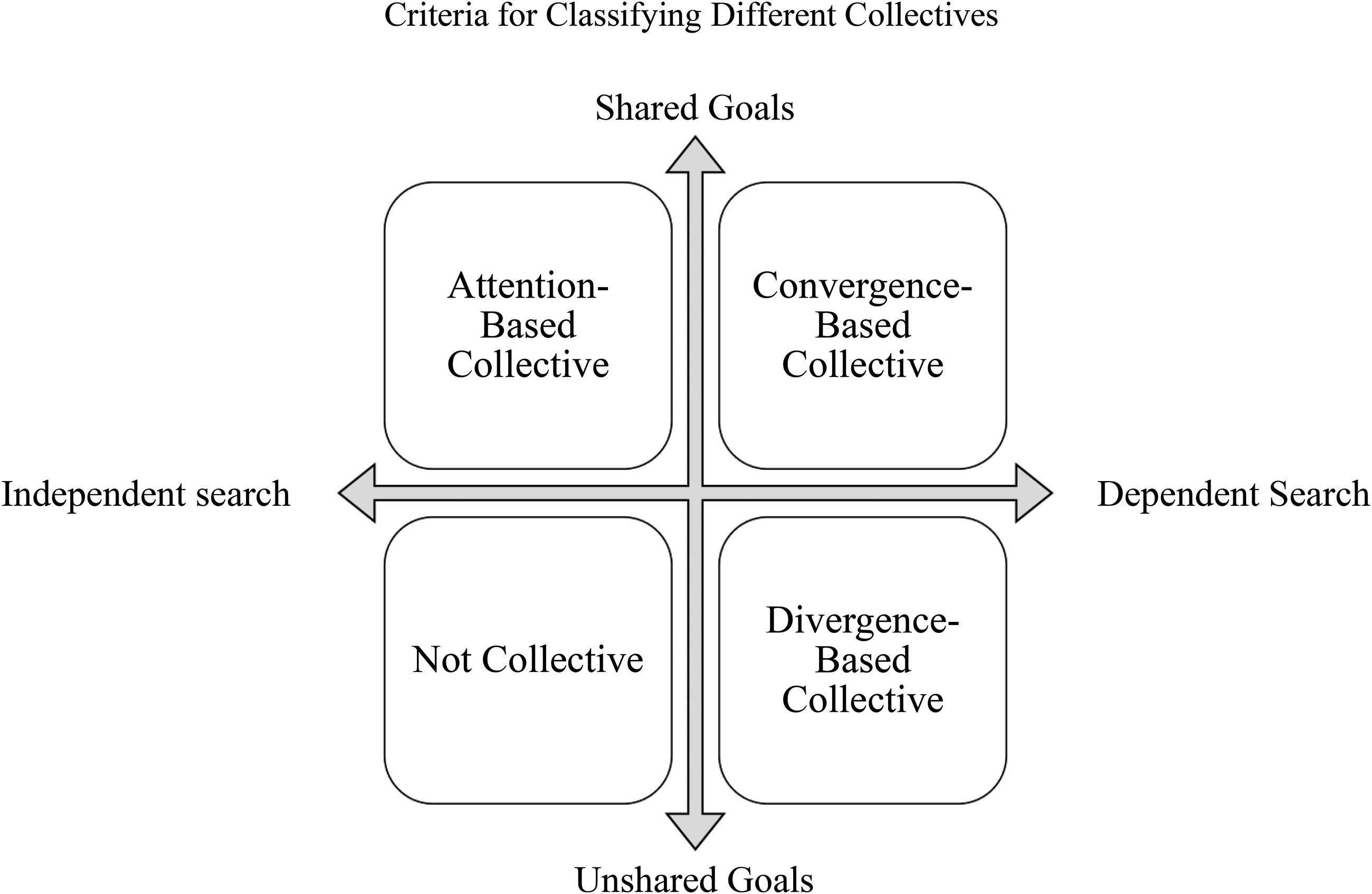
Criteria for Classifying Different Collectives
An attention-based collective concerns a collective of units that aims to solve the same innovation problem and independently explore solutions to that problem. The innovativeness of the collective outcome is determined by the quality of the best independent solution(s) generated for the problem. One prominent example of this is crowdsourcing challenges in open innovation platforms, where a large group of people or organizations compete to generate winning solutions to specific innovation problems. Divergence-based collectives are collectives in which a central unit works toward solving its own innovation problem but does so in a manner that involves interdependent solution development with other units within the collective. The boundaries of the collective are often transient, and the focal units often have full agency over their own innovation processes and full ownership of subsequent innovative outcomes. One example is when firms develop new products or patents based on interactions with other parties in an innovation ecosystem. A convergence-based collective concerns a collective of units that share the same goal and develop a final solution together. These collectives are characterized by mutual dependence (i.e., joint decision-making and development) and collective ownership of the eventual innovation outcome(s). One example is cross-functional new-product-development teams where members of the team generate, select, and develop new product concepts.
Antecedents of Collective Creativity and Innovation
Another important element of our integrative synthesis is identifying the antecedents of collective innovation. Following a similar categorization approach as we did to develop a taxonomy of collectivity, we first identified each antecedent documented in the extant literature (see Table 1). Subsequently, we compared and contrasted these antecedents based on their central themes. This comparison revealed a variation in antecedents centered around three core themes: characteristics of individual units, interactions between units, and overall collective structures. Upon further examination, it became evident that individual characteristics primarily dealt with knowledge elements. In contrast, interunit relations and collective-level mechanisms focused on social dynamics and organizational constructs, respectively. From this analysis, we deduced that the antecedents of collective innovation could be classified under three broad groups, which relate to the cognitive, social, and organizational architecture of a collective.
Architectural Elements Discussed in the Extant Literature
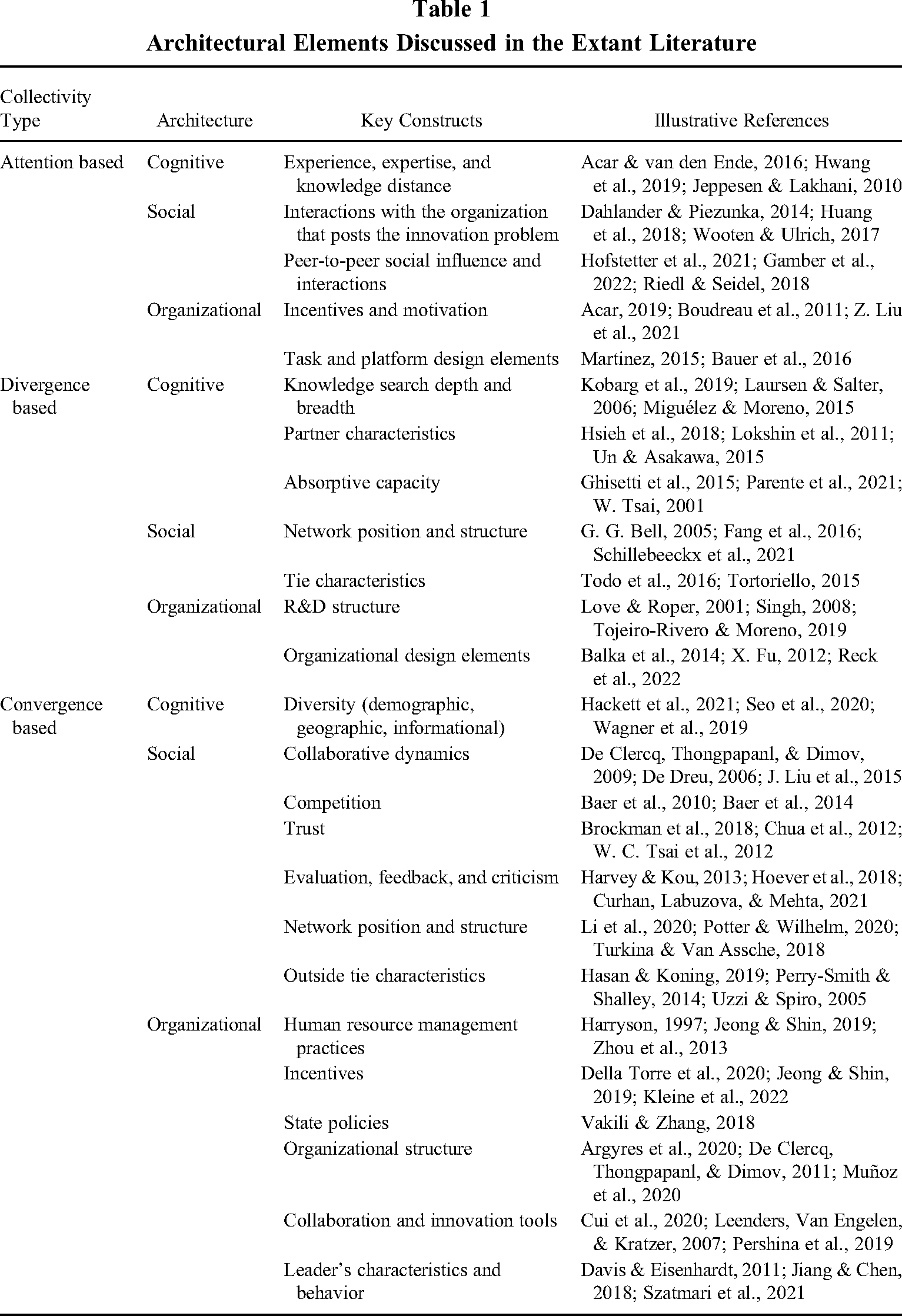
Cognitive architecture concerns the distinct characteristics of units within a collective. These characteristics shape the overall breadth and depth of collective knowledge, forming the foundation for the generation of innovative outcomes. For example, strategic management scholars have focused on the role of the absorptive capacity of firms in open innovation and innovation ecosystems (e.g., Parente, Melo, Andrews, Kumaraswamy, & Vasconcelos, 2021; K. H. Tsai, 2009), while organizational behavior researchers have studied how the demographic and functional diversity of team members affect their creativity (e.g., S. T. Bell, Villado, Lukasik, Belau, & Briggs, 2011; van Dijk, van Engen, & van Knippenberg, 2012). Social architecture focuses on interunit interactions and relationships within a collective. It primarily concerns the nature, extent, and dynamics of social interactions within a collective, which determine collaboration and information sharing within a collective. Sociology researchers, for example, have long been interested in understanding the role network structure plays in innovation (e.g., Chua, 2015; Uzzi & Spiro, 2005). Another example is research in marketing, which has documented the impact of feedback and interactions on innovative results achieved in consumer crowdsourcing initiatives (e.g., Bayus, 2013; Camacho, Nam, Kannan, & Stremersch, 2019). Finally, organizational architecture refers to the collective mechanisms, including rules, governance structures, and reward systems that are specifically designed to organize, coordinate, and promote creativity and innovation within a collective's operational framework. Examples include organizational behavior research on the impact of leadership on the creative performance of a group (e.g., Jiang & Chen, 2018; Stock, Totzauer, & Zacharias, 2014) and information systems research on how financial prizes influence crowds’ innovativeness (e.g., Hofstetter, Zhang, & Herrmann, 2018; Z. Liu, Hatton, Kull, Dooley, & Oke, 2021).
Attention-Based Collectives
Attention-based collectives—wherein different units work individually to discover their own solutions to a shared problem (e.g., units in a crowdsourcing competition)—have gained increasing scholarly interest over the past decade despite receiving less attention overall compared with other collectivity types. This research primarily comes from the fields of information systems (e.g., Hwang, Singh, & Argote, 2019), with some also from marketing (e.g., Hofstetter et al., 2021) and economics (e.g., Boudreau & Lakhani, 2015). These studies often focus on online open innovation platforms, where a large group of people are invited to generate solutions to specific innovation problems and often compete to generate the best solutions (e.g., Acar, 2019; Jeppesen & Lakhani, 2010). The innovation problems tackled have ranged from developing algorithms and prototypes for complex technical challenges to generating ideas and designs for new products. Research in this area has identified several different antecedents of collective innovation that fall under each of the three different components of collectivity architecture.
Cognitive architecture
Regarding cognitive architecture, the most common elements studied were related to the experience and expertise of the units of the collective. One consistent finding is that collective creativity and innovation benefit from including units that are distant from the domain of the innovation problem rather than those with specialist expertise in the problem domain. This is often attributed to the transfer of perspectives from a distant domain to the problem domain, allowing for highly novel associations between these knowledge domains (Acar & van den Ende, 2016; Boons & Stam, 2019; Franke, Poetz, & Schreier, 2014; Hwang et al., 2019; Jeppesen & Lakhani, 2010). For instance, drawing on data from 166 challenges across different disciplines, Jeppesen and Lakhani (2010) found that technical and social distance from the problem domain was associated with a higher likelihood of generating winning solutions in innovation contests. In a similar vein, generalists on a crowdsourcing platform were found to generate more novel ideas than specialists, presumably due to the availability of a wider range of domains that present greater opportunities to transfer knowledge between domains (Hwang et al., 2019). In addition, Pollok, Lüttgens, and Piller (2019) found that organizations that posted problems that were distant from their current knowledge base received more value from innovation crowdsourcing efforts as long as the distance was not too great.
However, recent research has identified an important qualifier for the positive effects of knowledge distance: a good understanding of the problem domain. Researchers have, for example, found that outsiders (i.e., those who are experts in a distant or unrelated knowledge domain) are more creative (i.e., more likely to generate winning solutions in crowdsourcing contests) than domain experts only when they simultaneously engage in a focused search effort or have some experience related to the domain (e.g., Acar & van den Ende, 2016; Boons & Stam, 2019). This effect is attributed to the importance of familiarizing oneself with the problem domain, which facilitates making connections between disparate fields.
Social architecture
Studies on social architecture have emphasized the role of interactions with the organization hosting the innovation challenge. These studies generally suggest that interactions with the organization that broadcasts the problem are crucial to promoting creativity and innovation (e.g., Camacho et al., 2019; Dahlander & Piezunka, 2014; Huang, Tafti, & Mithas, 2018; Lee, Ba, Li, & Stallaert, 2018; Wooten & Ulrich, 2017). For example, Dahlander and Piezunka (2014) found that organizations that demonstrated both proactive attention (presenting their own ideas) and reactive attention (publicly communicating implemented ideas) increased participation in open innovation initiatives. This effect is theorized to stem not only from the motivational effect of sustained contribution but also from serving as guidance on what kind of solutions the organization values. Another possible driver of the positive feedback effect is perceived respect from the organization, which has also been found to promote more engagement with open innovation platforms (Boons, Stam, & Barkema, 2015). However, Koh and Cheung (2022) found that showing specific exemplars to guide the crowd contributed to fewer and lower-quality ideas. Camacho et al. (2019) added to this understanding by distinguishing feedback based on its valence and found that negative feedback in the form of constructive criticism from the organization was more effective in motivating greater effort from participants than positive feedback in the form of compliments in the early stages of a crowdsourcing tournament.
Research on the impact of peer-to-peer social influence and interactions on creativity is limited, as such interactions are rare in attention-based collectives, with a few exceptions (e.g., Gamber, Kruft, & Kock, 2022; Hofstetter et al., 2021; Riedl & Seidel, 2018). For instance, Hofstetter et al. (2021) experimentally manipulated peer-to-peer idea sharing and found that seeing others’ ideas can increase individuals’ perceived constraints in expressing their own ideas, reducing creative performance in innovation contests. However, when interactions happen post hoc to idea generation (i.e., not during the actual creative process), they could serve as a signal of what is valued by the community. For instance, Riedl and Seidel (2018) found positive outcomes for innovation when crowd members were allowed to observe feedback on other members’ designs, from both peers and the organization, suggesting that members can vicariously learn about what is valued by the community and the firm through observing feedback.
Organizational architecture
Finally, studies on organizational architecture have primarily focused on how to design an innovation challenge to attract a larger quantity and higher quality of innovative outputs. The most widely studied organizational components are incentives and the accompanying motivation types (e.g., Acar, 2019; Boudreau, Lacetera, & Lakhani, 2011; Hofstetter et al., 2018; Z. Liu et al., 2021). 2 For example, Hofstetter et al. (2018) compared the outcomes of winner-takes-all versus multiple financial prizes and found that multiple prizes motivated more repeat participation and greater effort from high-performing individuals, which in turn increased creativity in terms of both average creative performance and top performance in subsequent innovation challenges. Likewise, some studies have documented the positive effects of extrinsic motivation (which includes financial rewards as well as other forms of recognition, such as status) on the quality of creative outcomes generated in crowdsourcing platforms (e.g., Acar, 2019; Deodhar & Gupta, 2022), although recent evidence suggests that overly high rewards may discourage crowd participation (Z. Liu et al., 2021), possibly due to the reduced expectancy of winning. Boudreau et al. (2011) also documented a reduction in incentives for participation as a result of increased competition but showed that the “parallel path” effect—increased chances of finding an extreme solution with a greater number of contestants—counteracts this effect, especially when tackling problems with higher uncertainty. In addition, organizational design elements that promote intrinsic motivation have been found to be conducive to collective innovation by promoting more appropriate and creative solutions from the crowd (Acar, 2019; Martinez, 2015). Martinez (2015) showed, for example, that task design components, such as task autonomy and variety as well as problem-solving, can enhance crowd creativity. Moreover, a platform-level design element—legal certainty around intellectual property—was found to promote collective innovation in a crowdsourcing platform (Bauer, Franke, & Tuertscher, 2016), probably by encouraging more people to attempt to tackle innovation problems and subsequently disclose their solutions.
Summary and synthesis
Overall, research on attention-based collectives has gained momentum in recent years, likely due to the growing interest in harnessing the collective innovation potential on a global scale through digital crowdsourcing platforms. Across different levels of analysis, ranging from individuals to challenges and platforms, these studies have identified several drivers of collective creativity and innovation that relate to cognitive, social, and organizational architecture, all of which received a balanced interest. The emphasis on creativity versus innovation as the dependent variable was also fairly balanced, including studies on creative performance behaviors, such as idea submission (e.g., Dahlander & Piezunka, 2014); creative outcomes, 3 such as novelty and usefulness of those submissions (e.g., Hofstetter et al., 2021); and the transformation of creative ideas into practical products, such as algorithms (e.g., Boudreau et al., 2011), sometimes even within the same study (e.g., Koh & Cheung, 2022). The patterns of findings were parallel across these different types of operationalizations.
Although empirical evidence directly investigating the underlying mechanisms and moderators is scarce, we observed that two key theoretical perspectives consistently emerged across various studies: a motivational perspective and a knowledge transfer perspective. That is, most studies tended to focus on a process that primarily relates to either motivations or knowledge transfer. The motivational perspective encompasses studies that have either implicitly or explicitly regarded the effort and engagement of individual units as the primary mechanism linking architectural elements and collective innovation (e.g., Camacho et al., 2019; Hofstetter et al., 2018). These studies have tended to focus on either the breadth of effort or engagement—that is, the number of independent units applying effort—or the depth of effort or engagement—that is, the extent of effort expended by each individual unit. The knowledge transfer perspective, on the other hand, underscores the importance of the utilization of knowledge from disparate domains within the problem domain as a vital catalyst for innovation (e.g., Boudreau et al., 2011; Pollok et al., 2019). According to this perspective, units independently employ their inherent knowledge, acquired through diverse past experiences (e.g., Boons & Stam, 2019), to address the innovation task at hand. The novelty of this inherent knowledge for the problem domain then determines the degree of innovation that arises from the solutions (e.g., Acar & van den Ende, 2016).
Integrating these two dominant perspectives, we contend that collective innovation in attention-based collectives results from the concurrent efforts of individual units to bridge their specialized knowledge to the problem domain, leading to the transfer of unique perspectives and the formation of novel associations between disparate knowledge bases. This suggests that collective innovation in attention-based collectives is driven by the effect of architectural components on units’ independent contributions. Specifically, these components impact collective innovation to the extent that they encourage or discourage (a greater number of) independent transfer attempts (motivational account), particularly from units with expertise in distant knowledge domains (knowledge transfer account), and to the extent that they facilitate or impede these attempts.
As detailed in our review of attention-based collectives, research on cognitive architecture has primarily centered on the knowledge transfer account, providing robust evidence for the creative potential of outsiders (e.g., Jeppesen & Lakhani, 2010) and the value of cognitive elements, such as related domain knowledge and focused search (e.g., Acar & van den Ende, 2016; Boons & Stam, 2019). Conversely, studies on organizational architecture predominantly revolved around the motivational perspective, underscoring the importance of integrating incentives and design elements that encourage multiple independent transfer attempts (e.g., Hofstetter et al., 2018; Z. Liu et al., 2021). Research on social architecture aligns with both of these perspectives by underlining the role of social elements in both motivating enhanced effort (e.g., Camacho et al., 2019) and facilitating the transfer of knowledge to the problem domain (e.g., Hofstetter et al., 2021).
Divergence-Based Collectives
Among the three types of collectives, the divergence-based collective—characterized by a focal unit interacting with other units while concentrating on its own innovation problems (e.g., a firm located at a high-tech industrial park)—has attracted the most research attention, spanning an extensive time frame of two decades. A large portion of this research has been published in the fields of strategy (e.g., Boh, Huang, & Wu, 2020), sociology (e.g., Ahuja, 2000), and economics (e.g., Guan & Chen, 2012), primarily focusing on firm-level studies. Within the strategy area, the bulk of the studies was survey based and typically examined structures within and between organizations or organizational units (e.g., knowledge search/inflows, partner type, and R&D structure) (e.g., Kobarg, Stumpf-Wollersheim, & Welpe, 2019). Sociological studies in this area frequently utilized network analysis, considering the tie structure and network positions of organizations or individuals (e.g., Vasudeva, Zaheer, & Hernandez, 2013). Most studies in economics employed archival data, especially patent data, and provided a bird's-eye view investigating phenomena at higher levels of analysis, such as industry or region (e.g., Graf & Broekel, 2020). Next, we present a comprehensive discussion of different kinds of studies on divergence-based collectives by reviewing them through the lens of the three architectural components of collectivity.
Cognitive architecture
In terms of cognitive architecture, the key theme across all levels of analysis was the acquisition and internalization of new knowledge received from others (e.g., interorganizational learning, knowledge capabilities, and knowledge-based view of the firm). In line with this, knowledge search and partner type (as a primary source of external information) emerged as two important factors driving innovation output. For example, studies documented the positive effects of partnering with other firms, including foreign companies and domestic competitors (e.g., Hsieh, Ganotakis, Kafouros, & Wang, 2018), suppliers (e.g., Karhade & Dong, 2021), extraregional agents (e.g., Fitjar & Rodríguez-Pose, 2013), universities (e.g., Caloghirou, Giotopoulos, Kontolaimou, Korra, & Tsakanikas, 2021), public research institutions (e.g., Robin & Schubert, 2013), knowledge-intensive business services (e.g., De Marchi, 2012), end users (e.g., Chatterji & Fabrizio, 2014), or even backers in a crowdfunding platform (e.g., Eiteneyer, Bendig, & Brettel, 2019). Chatterji and Fabrizio (2014) explained that relying only on the firm's internal knowledge resources inhibits new ideas from forming, and hence, encountering disparate external knowledge is necessary for innovation to emerge—a line of reasoning echoed in other similar studies.
Some other studies, however, have suggested that the size and direction of this relationship depend on the partner type. In particular, because different types of partners introduce different kinds of knowledge, which vary in terms of their novelty to the organization, different types of partners can affect innovation (Lokshin, Hagedoorn, & Letterie, 2011; Un & Asakawa, 2015; Un, Cuervo-Cazurra, & Asakawa, 2010). For example, Un and Asakawa (2015) found that collaboration with partners with different contextual knowledge (customers and universities) had a positive association with innovation, whereas partners with similar contextual knowledge had either no association (collaboration with suppliers) or a negative association (collaboration with competitors). Similarly, Hsieh et al. (2018) found that engaging in collaborations with foreign partners, domestic competitors, domestic suppliers, foreign consultants, and private research institutes significantly relate to innovation outcomes. Likewise, W. Fu, Diez, and Schiller (2013) demonstrated that the scope and intensity of a firm's engagement in interactive learning with customers, parent companies, universities, and research institutions were positively associated with innovation. However, several studies also documented an inverted U-shaped relationship between knowledge search breadth and innovation (e.g., Garriga, Von Krogh, & Spaeth, 2013; Kobarg et al., 2019; Laursen & Salter, 2006). For example, Kobarg et al. (2019) reasoned that, on the one hand, knowledge search breadth provides the benefit of a wider assortment of ideas and solutions but, on the other hand, increased knowledge breadth makes coordinating the absorption of this sizable flow of knowledge and internalizing it more difficult (for a similar line of reasoning, see also Laursen & Salter, 2006).
Moreover, several studies have found that the association between knowledge search activities and innovation output was positively moderated by cognitive capabilities affecting knowledge acquisition and internalization (especially absorptive capacity). For example, Ghisetti, Marzucchi, and Montresor (2015) found that the positive effects of firms’ knowledge search activities on innovation were stronger if the firm had high absorptive capacity because such organizations can more effectively internalize and utilize the information they come across. Similarly, Miguélez and Moreno (2015) showed that the positive effect of the inflow of external knowledge (as measured by inventor mobility) on regional innovation was stronger if the region had high absorptive capacity.
Social architecture
Concerning social architecture, research has primarily focused on variables related to the network structure, as they determine the amount and type of knowledge and information flowing from the network (e.g., Bellamy, Ghosh, & Hora, 2014). One variable that has received substantial research attention is network centrality, which has been found to have positive effects on innovation on various levels of analysis (e.g., G. G. Bell, 2005; W. Tsai, 2001) but generally only to a certain extent (e.g., Björk & Magnusson, 2009; Dong et al., 2017; Fang, Lee, Palmatier, & Han, 2016; Paruchuri, 2010). This is, first, because network centrality—while increasing novel information—also increases the flow of redundant information and, second, because there is a limit to how much information an organization can cope with (organizations that can cope with more information, such as those with higher absorptive capacity, can benefit from higher levels of network centrality; W. Tsai, 2001). For instance, Dong et al. (2017) showed that in alliance networks, a firm's collaborations with central network partners positively influenced its highly novel innovations but only to a certain extent (beyond a certain number of collaborations, the association turned negative). Likewise, Paruchuri (2010) found that an inventor's structural centrality positively affected that inventor's impact on the firm's innovation activities, but this effect turned negative at very high levels. Network centrality has also been found to affect the novelty of innovation. Fang et al. (2016) found that a central position in the global network had a positive association with new product launches unless they were highly novel launches.
There have also been a number of studies that did not focus on the position within the broader network but on the number and characteristics of the individual ties (and thus, the knowledge they bring in). The key theoretical idea in this research stream is that, generally, the flow of novel information boosts innovation, whereas the flow of redundant information inhibits it. For example, Todo, Matous, and Inoue (2016) demonstrated that the number of ties a company had with distant suppliers was associated with an increase in its patent output, whereas the density of its ego network (ties among its supply chain partners) was associated with a decrease. This is “likely because distant firms’ intermediates embody more diversified knowledge than those from neighboring firms” (Todo et al., 2016: 1890). In a similar vein, a large number of direct or indirect ties among an individual's or organization's network neighbors can increase the redundancy of information and, in turn, be harmful to innovation (Guan & Liu, 2016; Stephen et al., 2016). Ascani, Bettarelli, Resmini, and Balland (2020) demonstrated that several other factors affecting the flow of novel information, such as the number of local parent companies, subsidiaries abroad, related global networks, and foreign locations involved in a global network, can increase or decrease the innovative performance of a region. There are several other constructs in this area with effects on the types and amount of information received (and therefore on innovation outcomes), including structural holes (Tortoriello, 2015), embeddedness (Schillebeeckx, Lin, George, & Alnuaimi, 2021), and clusters (Fleming, King, & Juda, 2007; Graf & Broekel, 2020; Kraft & Bausch, 2018). In general, studies have found that having good access to structural holes and being moderately embedded without residing inside a very cohesive cluster (i.e., having a high flow of novel information that is relatively free of redundant information) yields the best results.
Organizational architecture
Research on organizational architecture has mostly focused on the structure of R&D departments. For example, some studies have suggested that the extent to which the R&D function is centralized versus decentralized (e.g., whether there is a formal R&D department, whether it is distributed to different parts of the organization, and whether the R&D is in-house or outsourced) or subsidized can affect organizations’ innovation output (e.g., Graf & Broekel, 2020; Love & Roper, 2001; Singh, 2008; Tojeiro-Rivero & Moreno, 2019). In particular, a moderately centralized R&D function—on the one hand, having a formal R&D department and not distributing R&D to many different locations and, on the other hand, benefiting from some R&D outsourcing—seems to positively affect innovation outcomes. Beyond R&D structure, research has been relatively unfocused, investigating different factors related to organizational architecture. X. Fu (2012) showed that both short-term and long-term incentives can affect the innovation outcomes of an organization, although the latter has a greater effect. Studying user innovation communities, Balka, Raasch, and Herstatt (2014) showed that transparency and accessibility promoted collective creativity. Researchers also found that the portfolio management practices of firms influence the degree of knowledge complementarity they receive from partners and their position within the network, thereby impacting their innovation performance (Reck, Fliaster, & Kolloch, 2022).
Summary and synthesis
Overall, divergence-based collectives have attracted significant research interest and constitute the majority of the studies in our sample. We observed a range of different architectural components that affect innovation outcomes in divergence-based collectives. However, the components related to organizational architecture have received notably less attention compared with the cognitive and social components. In this stream of literature, the firm level is the dominant level of analysis. Accordingly, a large majority of studies focused on innovation, with a mere handful studying creativity. This research also distinguished between the level of novelty of the innovation, 4 although we did not observe any systematic patterns of differences.
Moving forward, with the exception of a few studies (e.g., Stephen et al., 2016), there is a relative scarcity of direct evidence pertaining to the mediating mechanism. Nonetheless, through an in-depth analysis of the theoretical mechanisms specified in research on divergence-based collectives, we identified two theoretical themes that explain the effects of architectural components. The first theme addresses the need to gain access to a diversity of knowledge elements through both knowledge search and network connections (e.g., Un & Asakawa, 2015). The second theme concerns the processing capacity of a focal unit, namely, its ability to assimilate and make use of the information accessed for the purpose of generating innovations (e.g., Miguélez & Moreno, 2015).
Synthesizing these themes, we contend that the process underlying collective innovation in divergence-based collectives can be explained as follows: As units of a collective search for a solution to innovation problems, they are exposed to different knowledge elements. This stimulates the reconfiguration of their original innovation problems and/or solutions in light of the new information, eventually leading to novel associations between different knowledge elements, as long as the information accessed is nonredundant and within a focal unit's processing capacity. Based on this, the link between architecture and collective innovation is explained by how different components impact/reflect the breadth of exposure to new knowledge elements and the extent to which they impact/reflect the focal unit's processing capacity. While research on all architectural types offers evidence for the first point—illustrating the effect of exposure to new knowledge (e.g., Garriga et al., 2013; Singh, 2008)—the second point—processing capacity—is predominantly examined in research on cognitive architecture, which highlighted the importance of absorptive capacity in effectively leveraging novel information obtained through exposure (e.g., Parente et al., 2021). This reasoning also implies an inverted U-shaped relationship between the exposure breadth and innovation, such that architectural elements that provide novel, nonredundant information positively influence innovation only to the point that the focal unit can effectively process it. This is consistent with the direct evidence for the inverted U-shaped relationship between external search breadth and innovation (e.g., Laursen & Salter, 2006) and between network centrality/ties and innovation (e.g., Dong et al., 2017).
Convergence-Based Collectives
Research on convergence-based collectives—where a collective of units collaborates toward devising a solution to a shared innovation problem, like a new-product-development team—has garnered significant multidisciplinary attention across all disciplines covered in this review. The studies were well balanced in terms of the level of analysis—ranging from work teams (e.g., Jiang & Chen, 2018) to regions (e.g., Brockman, Khurana, & Zhong, 2018)—and study type, which included surveys (e.g., Santos-Vijande, López-Sánchez, & Rudd, 2016), experiments (e.g., Goncalo & Duguid, 2012), case studies (e.g., Davis, 2016), archival research (e.g., Harmancioglu & Tellis, 2018), and bibliometric analyses (e.g., Wagner, Whetsell, & Mukherjee, 2019). These studies identified several critical components of the cognitive, social, and organizational architecture that have an impact on collective creativity and innovation.
Cognitive architecture
The majority of studies on cognitive architecture can be grouped under the broad heading of diversity among the units that make up the collective. This research has focused on how the composition of a collective in terms of demography (e.g., gender and nationality), cognitive style, disciplinary background, and organizational function of its members affect their innovative outcomes (e.g., Aggarwal & Woolley, 2019; Baer, Vadera, Leenders, & Oldham, 2014; Lahiri, Pahnke, Howard, & Boeker, 2019; Seibert, Kacmar, Kraimer, Downes, & Noble, 2017; Seo et al., 2020; Shin & Zhou, 2007; Singh & Fleming, 2010). In general, scholars have shown a remarkable theoretical consensus in terms of the innovative value of diversity, which has been mostly supported by empirical evidence. For example, authorship team diversity (e.g., internationality, heterogeneity, and topical diversity) promotes the generation of academic articles with greater novelty, quality, and impact (Bikard, Vakili, & Teodoridis, 2019; Hackett et al., 2021; Seibert et al., 2017; Wagner et al., 2019). A notable strength of this literature stream, relative to others, is its abundance of theory building alongside a considerable body of empirical evidence on mediating mechanisms, suggesting possible driving factors of positive diversity effects. For instance, the study by De Luca and Atuahene-Gima (2007) demonstrated that knowledge integration mechanisms mediate the link between cross-functional collaboration and innovation. Similarly, Hoever, van Knippenberg, Van Ginkel, and Barkema (2012) show that diversity of perspectives affects team creativity both directly and indirectly via information elaboration. Another study by Backmann, Hoegl, and Cordery (2015) shows that the effects of three variables related to diversity (i.e., social category similarity, work style similarity, and knowledge complementarity) on team innovation are mediated by absorptive capacity.
Some research, however, has also reported some potential downsides of different types of diversity (e.g., Cuijpers, Guenter, & Hussinger, 2011; Seo et al., 2020). A series of meta-analytical studies aimed to shed light on this, identifying the kind of diversity within a collective as an important moderator (e.g., S. T. Bell et al., 2011; Hülsheger, Anderson & Salgado, 2009; van Dijk et al., 2012; Wang, Cheng, Chen, & Leung, 2019). In line with this reasoning Hülsheger et al. (2009), for example, have found that job-relevant diversity promoted innovation whereas background diversity (e.g., age, gender, and ethnicity) did not. Likewise, Wang et al. (2019) conducted a meta-analysis of studies on culturally diverse teams and found that surface-level diversity—defined as diversity in terms of “readily detectable demographic attributes that explicitly differentiate social category membership” (Wang et al., 2019: 695)—negatively relates to team creativity and innovation for simple tasks. Conversely, deep-level diversity, referring to diversity in terms of “unobservable attributes, including personalities, values, and attitudes” (Wang et al., 2019: 695), was found to positively affect innovation. Wang et al. argue from a social identity perspective that teams with high levels of surface-level diversity incur higher social costs due to fragmentation due to different social category memberships while yielding limited knowledge diversity. In contrast, deep-level diversity provides a greater extent of knowledge diversity with relatively lower social costs. Task complexity was also identified as a significant moderator; as complexity increases, the innovative benefits of job-related diversity (but not demographic diversity) are heightened (van Dijk et al., 2012). On the whole, a widely shared theoretical conclusion in this research is that diversity bolsters innovation to the extent that it adds to the informational resources within a group; however, it stifles creativity when it prompts social categorization processes (e.g., van Dijk et al., 2012; Wang et al., 2019).
Social architecture
Research on social architecture focused on how various social factors impact the relational dynamics and information diversity within a collective. A group of these studies highlighted the value of collaborative social dynamics as a key driver of collective innovation (e.g., Liu, Chen, & Tao, 2015; De Dreu, 2006; Hofman, Halman, & van Looy, 2016). For example, J. Liu et al. (2015) found that behavioral integration—that is, collaborative behavior, information exchange, and joint decision-making—enhanced the collective efficacy and, as a result, the performance of new-product-development teams. Hofman et al. (2016) found support for the positive impact of organizational coupling, or having close relationships between network members, on the commercial performance of collaborative innovations, although this effect was (contrary to their predictions) reversed for architectural innovations. Baer, Leenders, Oldham, and Vadera (2010, 2014) showed that the effects of intergroup competition on group creativity were driven by within-group collaboration and moderated by group composition in terms of gender and group membership stability. Another factor for developing relationships that foster collective innovation is trust (e.g., Brockman et al., 2018; Chua, Morris, & Mor, 2012; W. C. Tsai, Chi, Grandey, & Fung, 2012). For example, Chua et al. (2012) found that individuals high in cultural metacognition were better at intercultural creative collaboration, as they were able to build higher levels of trust in their intercultural relationships. Furthermore, among the studies within the domain of social architecture that focus on moderators of the link between diversity and creativity/innovation, some examples stand out. For example, Harvey and Kou (2013) provided qualitative evidence to emphasize the importance of evaluation in terms of constructing a problem framework, retaining novel ideas, and elaborating and integrating those ideas. Likewise, the experimental study by Hoever, Zhou, and van Knippenberg (2018) demonstrates that the effect of the feedback valence (i.e., positive vs. negative feedback received by the team) on team creativity is mediated by information elaboration and generative processing, and informational diversity plays a moderator role in the first parts of these mediation mechanisms.
Another group of researchers explored the role of network characteristics, especially how units’ past and ongoing connections outside the boundaries of the convergence-based collective influence collective innovation (e.g., Hasan & Koning, 2019; Li, Li, Li, & Li, 2020; Perry-Smith & Shalley, 2014; Potter & Wilhelm, 2020; Singh & Fleming, 2010; Turkina & Van Assche, 2018; Uzzi & Spiro, 2005). For example, Singh and Fleming (2010) found that the size of team members’ external networks was a key factor in explaining the differences between the innovativeness of teams and individuals. Other studies distinguished between different types of ties. For instance, Perry-Smith and Shalley (2014) showed that weak outside ties (especially those with nationality-heterogeneous individuals) enhanced collective creativity, while Hasan and Koning (2019) found that the quality of product prototypes in an entrepreneurship bootcamp was related to the psychological characteristics of the ties (i.e., extraversion). At the cluster level, Turkina and Van Assche (2018) documented that horizontal and vertical connectedness of a cluster was associated with increased overall innovation output, although the effect sizes varied based on the cluster type. In particular, horizontal connectedness was more beneficial in knowledge-intensive clusters, whereas vertical connectedness was more beneficial in labor-intensive clusters.
Organizational architecture
Studies on organizational architecture addressed how a collective could be organized to effectively interact and integrate its knowledge. In particular, the majority of these studies focused on how to best design and utilize collective incentives, policies, structure, rules, and tools to promote innovation outcomes (e.g., Choi & Chang, 2009; Davis, 2016; Della Torre, Salimi, & Giangreco, 2020; Harryson, 1997; Pershina, Soppe, & Thune, 2019; Zhou, Hong, & Liu, 2013). For example, Jeong and Shin (2019) identified a range of work practices as key to enhancing organizational creativity during change. These included job rotation/cross-functional utilization, rewards for knowledge sharing, creation of temporary and self-managed teams, opportunities for self-initiated projects and participation in problem-solving, and training and coaching programs. The effect was mediated by collective learning resulting from interactions between organizational members. Regarding incentives, scholars highlighted the importance of using collective incentives together with individual ones to drive organizational innovation (Della Torre et al., 2020) as well as subsidizing collaborations at the industry level (Kleine, Heite, & Huber, 2022). Studies also indicated the importance of adopting policies that promote free expression—such as employee voice or liberal policies—as effective ways to facilitate innovation at both organizational and state levels by promoting diversity in social interactions (e.g., Della Torre et al., 2020; Vakili & Zhang, 2018). Moreover, a few studies focused on the role of organizational structure in collective innovation (e.g., Argyres, Rios, & Silverman, 2020; Muñoz, Kimmitt, & Dimov, 2020). For example, Argyres et al. (2020) found that centralizing R&D had a positive relationship with the breadth of technological search and innovation impact, which was due to the increased connectedness of internal inventor networks. In addition, a few studies examined systems and tools that support innovation. For instance, tools such as mock-ups for boundary-spanning collaboration have been found to facilitate knowledge integration (Pershina et al., 2019), while information technology (IT)–enabled collaboration capabilities have been shown to increase project innovativeness and quality (Cui, Tong, Teo, & Li, 2020).
Next, several studies explored the role of leadership in convergence-based collectives (e.g., Hu, Erdogan, Jiang, Bauer, & Liu, 2018; Muñoz et al., 2020; Somech, 2006; Sung & Choi, 2021; Szatmari, Deichmann, van den Ende, & King, 2021; Tang, Chen, van Knippenberg, & Yu, 2020). These studies emphasized the impact of leadership styles and behaviors on cooperative interactions among collective members to facilitate the integration of different knowledge. For instance, Jiang and Chen (2018) found that the positive relationship between transformational leadership and team innovation was due to a knowledge integration mechanism supported by the increase in team knowledge sharing and the reinforcement of team cooperative norms. Likewise, Stock et al. (2014) showed that cross-functional cooperation mediates the positive effect of innovation-oriented leadership on new product innovativeness, while Davis and Eisenhardt (2011) found that rotating leadership drives innovation performance by allowing individuals with diverse knowledge bases to contribute. Moreover, leadership behaviors such as help seeking and avoidance of territorial marking were found to promote collective psychological ownership, which in turn enhanced team performance in an entrepreneurship competition (Gray, Knight, & Baer, 2020). In contrast, power imbalances within a team were found to hinder creative performance by reducing information sharing and integration (Hildreth & Anderson, 2016).
Summary and synthesis
All in all, the literature on convergence-based collectives has been highly diverse. This research has focused on all architectural elements and spanned almost all levels of analysis (e.g., group, firm, and region). While many studies used the “innovation” terminology, a notable number in this area also focused specifically on creativity. The findings of these creativity-focused studies paralleled those of the innovation studies, suggesting similar patterns and results across both domains.
One of the relative strengths of this stream was the presence of empirical evidence on mediating mechanisms (e.g., De Luca & Atuahene-Gima, 2007; Jiang & Chen, 2018), although this kind of evidence is still limited. Upon integrating the available evidence and theoretical development, we discern two principal theoretical processes as the primary mechanisms driving collective innovation in convergence-based collectives. The first pertains to the diversity of knowledge within a collective (e.g., Bikard et al., 2019), and the second revolves around the effective synthesis of this knowledge (e.g., Baer et al., 2014).
Connecting these two perspectives, we contend that innovation in convergence-based collectives emerges from the effective synthesis of diverse knowledge elements brought to the collective by its units to form a new, innovative whole. On the basis of this conclusion, we conclude that the relationship between architectural elements and collective innovation is explained by the extent to which those elements impact the diversity of the knowledge that resides within the collective and collaborative nature of the relationships between the units. Research on cognitive architecture primarily focused on the knowledge diversity mechanism, documenting that innovation generally benefits from functional, disciplinary, cognitive-style, or demographic diversity of units (e.g., Aggarwal & Woolley, 2019). In contrast, studies on organizational architecture have centered on elements that encourage or inhibit close cooperation, open and rich interactions between units, and effective coordination (e.g., Cui et al., 2020). Research on social architecture struck a more balanced approach, examining how network ties provide access to diverse units (knowledge diversity; e.g., Perry-Smith & Shalley, 2014) and how relational and interpersonal factors influence innovation (effective synthesis; e.g., Chua et al., 2012).
Overall, our synthesis suggests that innovation in convergence-based collectives necessitates both diverse knowledge and effective integration of that knowledge. This perspective offers an explanation as to why diverse knowledge sometimes fails to spark innovation (e.g., Wang et al., 2019): It could be due to its varying impacts on knowledge diversity and synthesis (e.g., surface-level diversity could have a relatively smaller impact on knowledge diversity but create challenges in effective synthesis) and the absence of mechanisms to harness this diverse knowledge effectively.
A Comparative Analysis
Our analysis reveals notable parallels as well as differences among the architectural components found in attention-based, divergence-based, and convergence-based collectives. These components perform unique functions that are largely contingent on the specific type of collective.
The components of cognitive architecture vary across collectivity types, but, fundamentally, they revolve around the leveraging and application of novel knowledge. In research on attention-based collectives, cognitive architecture plays a critical role as it facilitates knowledge transfer, emphasizing the distinct contributions of units with expertise in remote knowledge domains (e.g., Jeppesen & Lakhani, 2010). This process engenders collective innovation by bringing in novel insights and associations, aligning with the novelty potential of independent transfer attempts when unit backgrounds substantially differ from the problem domain. Divergence-based collectives, however, pivot on the cognitive characteristics and search process of the focal unit. The breadth of exposure to a plethora of knowledge sources and the ability to process such information become centrally important (e.g., Ghisetti et al., 2015). Convergence-based collectives share a common focus on knowledge diversity, with a particular focus on the role of backgrounds and perspectives of individual units. A difference lies in their perspectives on very high levels of diversity: While research on divergence-based collectives identified very high levels of diversity as a hurdle due to cognitive limitations of a single focal unit (e.g., Laursen & Salter, 2006), this has not been widely studied (see Seo et al., 2020, for an exception) in convergence-based collectives where the burden of synthesizing diverse knowledge is distributed across multiple units, presumably enabling them to better handle and capitalize on high diversity levels to enhance innovation (e.g., Wang et al., 2019). Overall, research in this area emphasizes the role of cognitive architecture in promoting the diversity of collective knowledge and identifies it as a central driver of collective creativity and innovation across all three types of collectives. Moreover, studies on divergence-based collectives also underscore the importance of cognitive architecture in integrating this diverse knowledge.
In terms of social architecture, different collectivity types exhibit a mix of contrasts and commonalities. Connectivity—the extent to which units within a collective are connected with each other (e.g., Shrader, Lincoln, & Hoffman, 1989; Zhang & Centola, 2019)—and social interactions are universally present in all types of collectives. However, their importance and interpretation vary. For divergence- and convergence-based collectives, connectivity and social interaction form fundamental pillars of the overall social architecture (e.g., G. G. Bell, 2005; Potter & Wilhelm, 2020). Attention-based collectives, on the other hand, attribute significant value to connectivity only when interactions involve problem posters (e.g., Wooten & Ulrich, 2017); otherwise, such interactions are generally seen in a negative light (e.g., Hofstetter et al., 2021). Akin to cognitive architecture, divergence-based collectives also impose a limit on the degree of connectivity—recognizing that a focal unit's ability to leverage social connections has its boundaries (e.g., Fang et al., 2016). Beyond a certain point, a profusion of connections could prove obstructive rather than beneficial. A unique aspect of research on convergence-based collectives is its emphasis on nurturing effective relationships between units, which are viewed as a catalyst for collective innovation (e.g., J. Liu et al., 2015), a focus largely absent in research on other collective types likely because this type of collective entails both dependence in search and shared goals—unlike the other two types—thereby enhancing the importance of collaboration. In summary, this research underlines the dual function of social architecture in enhancing the diversity of collective knowledge and fostering its integration. Importantly, significant differences are observed across different collectives, in terms of both which function of social architecture is emphasized and the nature of its specific impact.
Research on organizational architecture exhibits noteworthy differences across the collectives. Studies on attention-based collectives stress the incorporation of incentives and design elements that encourage multiple independent transfer attempts, viewed through a motivational lens (e.g., Hofstetter et al., 2018). In contrast, convergence-based collectives accentuate elements that foster cooperation and deep interactions between units for efficient knowledge synthesis (e.g., Jeong & Shin, 2019). Research on divergence-based collectives, however, has given relatively limited consideration to organizational architecture. One similarity with respect to organizational structure is between attention- and convergence-based collectives, and it lies in their focus on incentives, albeit the types significantly vary: Attention is primarily placed on unit-level efforts in the former (e.g., Acar, 2019), in line with the importance of independent knowledge transfer attempts, while the latter also considers collective incentives (Della Torre et al., 2020), consistent with the emphasis on nurturing effective relationships. Overall, this research has established that organizational architecture plays a dual role in enhancing knowledge diversity within a collective and facilitating its integration. However, the role highlighted varies across different collectives; while the former role is underscored in attention-based collectives, the latter role was more pronounced in other types of collectives.
An Integrative Framework
Our framework offers five key insights. The first insight is that collective creativity and innovation in different types of collectives can be explained by two common underlying processes: (a) variation and (b) integration. Variation refers to the diversity of collective knowledge, while integration indicates the collective’s capacity to absorb and incorporate knowledge residing within its sphere. 5 Research on each type of collective, as revealed by our comparative analysis, highlighted the key role variation and integration play in collective creativity and innovation.
Second, the optimal architectural structure is contingent on the type of collective, as the mechanisms fostering variation and integration vary among different collectivity types. In attention-based collectives, variation arises from cognitive, social, and organizational elements, such as knowledge distance, feedback from the problem host, and incentives, all influencing independent transfer attempts (e.g., Dahlander & Piezunka, 2014; Jeppesen & Lakhani, 2010; Z. Liu et al., 2021). However, in divergence-based collectives, cognitive and social elements, like exposure to diverse knowledge sources and connections, predominantly drive variation (e.g., Fang et al., 2016; Laursen & Salter, 2006). In convergence-based collectives, cognitive elements, like diversity among constituent units, are the primary source of variation (e.g., Hackett et al., 2021), although social elements, such as external ties outside of the collective, also contribute (e.g., Li et al., 2020). Similarly, the mechanisms that drive integration vary among different collectives. In attention-based collectives, integration is mainly influenced by social elements, such as peer-to-peer influence (e.g., Riedl & Seidel, 2018). Meanwhile, in divergence-based collectives, cognitive and organizational factors, such as absorptive capacity and R&D structure, play a key role (e.g., Graf & Broekel, 2020; W. Tsai, 2001). In convergence-based collectives, integration is facilitated or obstructed by a range of social and organizational elements, like trust and leadership (e.g., Jiang & Chen, 2018; W. C. Tsai et al., 2012).
Third, while both variation and integration matter for each type of collective, their relative importance differs depending on the collectivity type. For attention-based collectives, the variation mechanism matters significantly more than the integration mechanism. This is because collective innovation in this context primarily hinges on independent efforts by units to establish connections between their respective knowledge and the problem domain (e.g., Acar & van den Ende, 2016). The scope for integration within this context is limited as it does not necessitate the connection of a multitude of domains; rather, it entails bilateral attempts to bridge two disciplines. In contrast, convergence-based collectives are significantly dependent on integration mechanisms, because innovation necessitates collective endeavors to assemble an innovative whole. As a result, the potential contribution of integration to innovation is substantially broader in scope in convergence-based collectives compared with the other types. Indeed, the value derived from variation is heavily reliant on such integration mechanisms—simply having diversity in the composition of collectives does not automatically result in the utilization of this knowledge potential (e.g., Hoever et al., 2012). While it is more challenging to integrate in convergence-based collectives, given the difficulties of synergizing diverse units for effective coordination and collaboration (e.g., Van Knippenberg, De Dreu, & Homan, 2004), they have the advantage of being able to integrate together. For divergence-based collectives, the importance of knowledge variation and integration is intermediate, falling between that of the other two types. Variation holds importance and serves as a key driver of innovation but only up to a certain point (e.g., Kobarg et al., 2019). Integration is important to utilize the potential of diverse knowledge potential (e.g., Parente et al., 2021), although its scope is constrained by the capabilities of the focal unit and the necessity for this single unit to undertake all integration efforts.
Fourth, while collective innovation benefits from both variation and integration, these two processes also have a unique interplay. Variation catalyzes the benefits of integration, yet integration can conversely curtail variation. This reduction occurs as exposure to differing perspectives incites their imitation, increasing their similarity. Therefore, a collective with a narrow scope for integration, such as an attention-based collective, would be more advantageous in limiting its exposure to others (e.g., Hofstetter et al., 2021). However, for collectives with a broader scope for integration, the benefits accrued from integration outweigh the effect of imitation. This elucidates why innovation in convergence-based collectives thrives in the presence of architectural elements that promote integrative efforts across units, while attention-based collectives may benefit from the absence of such channels.
Fifth, in line with the conclusions of other integrative reviews on creativity and innovation (e.g., Acar et al., 2019; Amabile & Pratt, 2016), our synthesis suggests that the key conclusions presented here are generally consistent, irrespective of the level of analysis (i.e., team, project, organization, or region) and the type (i.e., creativity or innovation) or operationalization (i.e., as behavior or product) of the outcome variable.
Figure 2 presents our integrative framework.
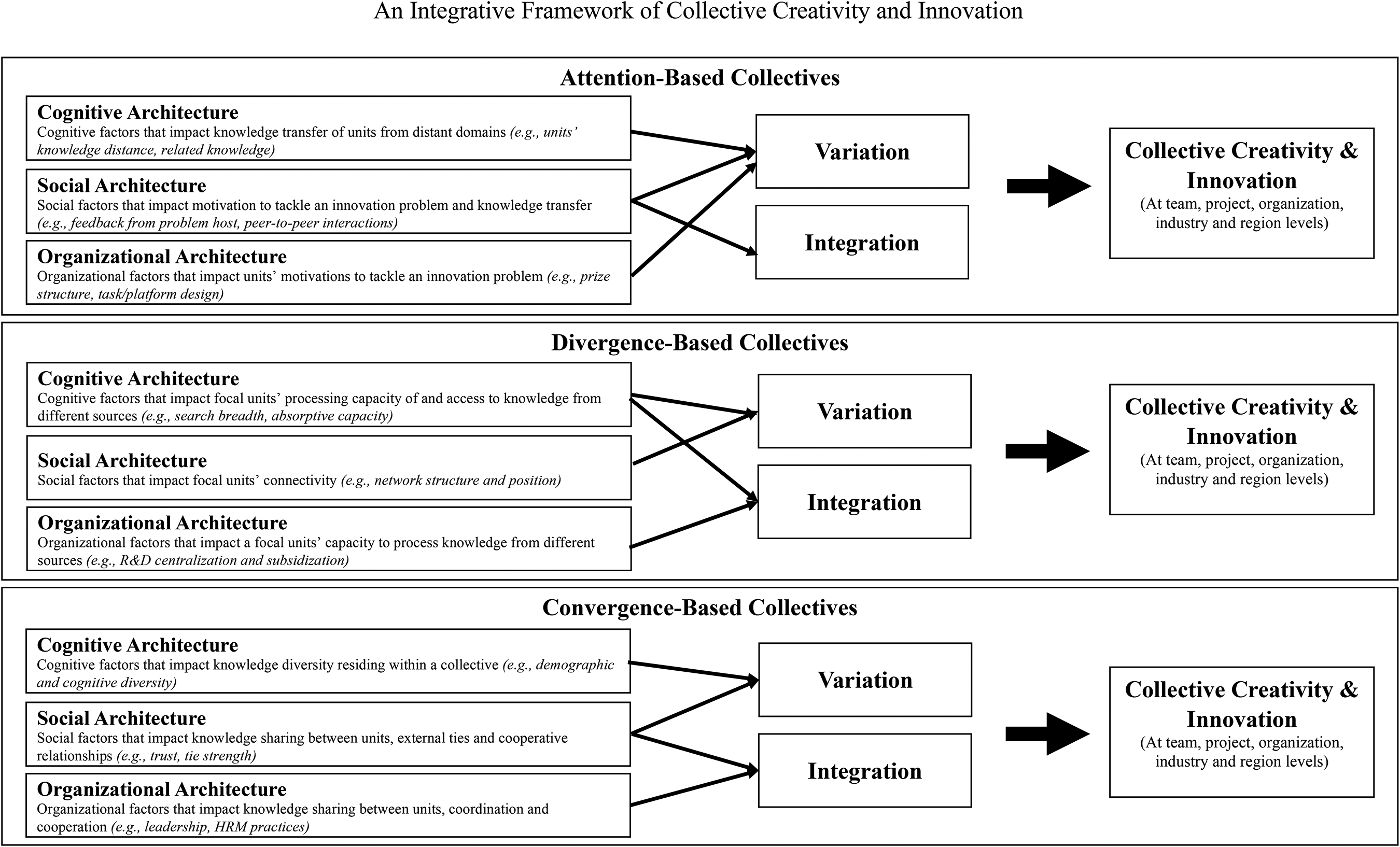
An Integrative Framework of Collective Creativity and Innovation
Moving Collective Creativity and Innovation Theory Forward
The diverse range of fields we reviewed seeks to answer the same question: What factors facilitate or hinder collective creativity and innovation? In this article, through an integrative framework that synthesizes the available empirical evidence across these fields, we provide a comprehensive overview of the current state of knowledge on this topic. Building on this, we identified a number of gaps in current understanding, which constitute promising avenues for future research.
Appropriate Architecture for Different Collectivity Types
Our review reveals that numerous elements have predominantly, or exclusively, been examined in the context of a specific type of collective. As a result, it remains unclear whether and to what extent insights regarding specific architectural components influencing innovation in one type of collective can be extrapolated to others. Our integrative framework provides a theoretical basis for exploring these largely untapped learning opportunities. That is, scholars could unearth underexplored elements within a collectivity type by learning from the research in other types where these elements have received empirical support. For example, some of the organizational components studied for convergence-based collectives—such as various human resource management practices, leadership behaviors, governance mechanisms, or innovation tools—might also promote integration in divergence-based collectives given that there is significant scope for integration in this type of collective. It would, for instance, be interesting to examine the role of innovation tools in facilitating the integration of diverse knowledge components to which a focal unit in divergence-based collectives is exposed. However, these components are likely of limited importance in attention-based collectives because such collectives have a relatively narrow scope for integration.
Another promising avenue for future inquiry is investigating potential substitutive or synergistic effects of the architectural components. For example, social ties could facilitate the utilization of cognitive architecture within a collective. Indeed, several studies have found significant positive interactions between components of social architecture and some components of cognitive architecture, such as absorptive capacity (e.g., Ghisetti et al., 2015) and experience (e.g., Chan, Li, Ni, & Zhu, 2021). Nevertheless, such studies are limited, and there is a need for a better understanding of when components relating to cognitive, social, and organizational architectures enable or inhibit each other across different collectivity types. For example, some evidence suggests that elements of social and cognitive architecture can interact synergistically to promote innovation, in both divergence- and convergence-based collectives (e.g., Hoever et al., 2018; K. H. Tsai, 2009). Yet our understanding of such interactive effects remains limited for the majority of the elements. Our framework provides a foundation for investigating these questions. Specifically, it proposes that these main and interactive effects primarily depend on whether these components exert parallel or countervailing effects on variation and integration processes and the importance of these processes for a specific type of collective.
Simultaneous Presence of Variation and Integration Processes
We observed a notable shortage of empirical evidence on mediating mechanisms, especially for attention- and divergence-based collectives. We call for future research to include the mediating mechanisms we identified to generate evidence based on why certain architectural components affect collective innovation. Undertaking this research could also help to clarify some contradictions that have emerged in the literature as this allows examining whether an architectural element has opposing effects for different types of collectives. For example, studies have demonstrated that exposure to peers’ ideas can have a negative effect in attention-based collectives (e.g., Hofstetter et al., 2021), yet this effect is positive in divergence-based collectives (e.g., Yan et al., 2018). Such discrepancies are explained by connectivity’s detrimental effect on the variation mechanism and the relative insignificance of integration in attention-based collectives, juxtaposed with its positive influence on the variation mechanism in divergence-based collectives, at least up to a certain threshold.
Importantly, we recommend the inclusion of both variation and integration processes in individual studies simultaneously. A fundamental aspect of our framework lies in the fluctuating importance of these processes across different types of collectives and their unique interaction. We have yet to encounter any empirical study adopting this approach, yet it is critical to discern the relative importance and interaction between these two mechanisms in a causal chain across varying collective types. For instance, researchers could incorporate variation and integration concurrently in their models to accurately determine why network connections become counterproductive beyond a certain point in divergence. Therefore, the simultaneous consideration of both mechanisms could yield crucial insights and pave the way for a more nuanced understanding of the collective innovation process.
This approach is particularly important in studies that focus on organizational innovation efforts that comprise multiple stages, with different collective types dominating at various stages. An example of this is an innovation project that starts with an internal crowdsourcing initiative and then moves forward with a new-product-development team working on some of the crowdsourced ideas. In such a scenario, connectivity might promote collective innovation through its effects on integration processes in product development teams while concurrently impeding it in the initial crowdsourcing stage due to its impacts on variation processes. Consequently, the overall impact of connectivity could be negligible, despite the significant influences on individual mechanisms. Including both mediators will allow observation of such nuanced effects, thereby providing an accurate representation of the collective innovation process.
Task Characteristics
Collective creativity and innovation do not occur in a vacuum but are shaped by the context in which they take place. Our review suggests that the innovation projects and creativity tasks vary to a great extent in terms of their characteristics. Perhaps the most promising characteristic that could moderate the link between architectural elements and collective innovation pathways is task complexity. Indeed, complexity levels have varied greatly, and somewhat systematically, across studies focusing on different collectivity types. Specifically, the tasks in attention-based collectives were generally less complex compared with those studied in other collectivity types. Moreover, from a theoretical standpoint, complex tasks are likely to benefit more strongly from the integration mechanism given the increased interdependence of the paths as well as the greater knowledge and skill requirements that come with this greater complexity (Campbell, 1988; Hærem, Pentland, & Miller, 2015). For this reason, gaining further insight into how task/project complexity affects the relative importance of attention-, divergence-, and convergence-based collectives for increasing collective creativity and innovation is a promising future research direction. In addition, scholars should consider examining the potential moderating role of complexity on the relationships between the architectural components and processes behind collective creativity and innovation. Some studies have indeed provided initial support for the moderating role of complexity (e.g., Cheng et al., 2020; Jia, Shaw, Tsui, & Park, 2014; Z. Liu et al., 2021; Wang et al., 2019), indicating the potential promise of this line of research.
Collectivity in the Age of Technological and Social Disruption
Finally, we encourage future researchers to focus on how recent technological and social shifts impact the key relationships presented here. These shifts potentially have far-reaching implications for how innovators interact and collaborate (Weiss, Baer, & Hoegl, 2022). It is important to know whether the architectural components conducive to collective innovation remain the same, for example, in a workplace that is increasingly remote (Bailey, Horton, & Galinsky, 2022; Choudhury, Foroughi, & Larson, 2021). Similarly, it is important to know how collective innovation unfolds in a world with increasingly capable artificial intelligence (AI) algorithms (Garbuio & Lin, 2021; Verganti, Vendraminelli, & Iansiti, 2020), but such variables were mostly missing in the collective innovation literature. For example, future research can examine the role of AI augmentation versus automation (see, e.g., Bouschery, Blazevic, & Piller, 2023; Raisch & Krakowski, 2021) as a key element of organizational architecture and explore its effects on collective innovation as well as on the relationships between other architectural elements and pathways of collective innovation. Relatedly, given the exponentially increasing capability of generative AI systems, it is interesting to consider it as part of the collective in future research. More broadly, research on technology-related variables was limited in prior research. Some variables future researchers could consider examining include IT capabilities (Lioukas, Reuer, & Zollo, 2016), centralization of IT decision-making (C. W. Liu, Huang, & Lucas, 2020), and collaboration technology (Maruping & Magni, 2015). There are also various variables concerning other emerging technologies, such as virtual and augmented reality (Harz, Hohenberg, & Homburg, 2022) and novel communication tools (Weiss et al., 2022), which are important to study in order to better understand how collective innovation unfolds in the age of technological and social disruption.
Conclusion
Collective creativity and innovation have been studied in various disciplines but with limited interdisciplinary connections. Our review provides a framework for understanding these findings by presenting a taxonomy of the different aspects of collectivity and types of antecedents and by linking specific antecedents with mediating mechanisms and collective outcomes. That is, this review informs which mechanisms will be more salient once the collectivity type is known, and this in turn helps predict how different types of antecedents relate to collective innovation at different units of analysis. Our review also highlights important theoretical gaps in the literature and provides a foundation for formulating hypotheses to address these gaps. By doing so, it promotes interdisciplinary communication and sets the stage for further theory development in the field of collective creativity and innovation.
