




Abstract
In this study, geographic distance is an instructional logic that influences the international strategy and structure of professional service firms (PSFs). By drawing on three governance modes—global value chains, virtual teams, and ecosystems—we identify eight governance structures in use by PSFs, resulting from reliance on one of two distance logics: distance-as-enabler and distance-as-barrier. When the logic of distance-as-enabler is prioritized, PSFs choose a structure that is more unified at the global level. When the logic of distance-as-barrier is upheld, PSFs give greater autonomy to local units or establish loosely connected regionally autonomous partnerships. By highlighting the co-evolution between professional governance and professional practice we further show that greater distance necessitates professional work to be more codified and modularized, while proximity preserves professional work's bespoke nature. We apply this framework to demonstrate how external environmental factors trigger firms to shift from one specific governance-practice form to another.
Introduction
Professional service firms (PSFs) have traditionally valued proximity especially to clients. This results from the need to deliver customized (bespoke) service at the point of consumption, and the central importance of trust in professional-client relationships. Thus, medical doctors diagnose and treat patients face-to-face, lawyers represent their clients in person in courts, and auditors and consultants perform much of their work on client premises. However, recent advances in digital technology allow for professional expertise to be delivered from a distance, as was evident during the COVID-19 pandemic lockdown.
Distanced service delivery is particularly challenging for PSFs. This is, in part, because a dominant mode of governance for PSFs remains the partnership, which generally does not scale well compared to other forms of governance. This makes global expansion and maintaining an international presence difficult. It is for this reason that PSFs’ management of distance requires specific attention. Thus, this paper unpacks various aspects of the role of geographic distance on professional service delivery by identifying three modes of governance to analyze the phenomenon, namely global value chains (GVCs), virtual teams, and ecosystems. We demonstrate that combining insights from the three modes adds value to furthering our understanding of the global strategy and structure of PSFs.
GVCs provide a useful lens to examine distance between sequential stages in production and delivery. The disaggregation of value chains ensures that we distinguish, for example, between the distance between the back office and the front office of a firm, and the distance between the firm and its clients. GVCs leverage distance in order to exploit differences between locations, for example, in labor cost. Virtual teams offer a helpful perspective on how to balance the advantage of geographic dispersion, notably access to global talent, and its disadvantage, especially in executing interdependent and complex tasks. Geographic distance creates cognitive and other barriers and is regarded as something to be overcome. Ecosystems focus our attention on the nature of interaction (complementary, modular) among stakeholders to create value. Ecosystems are distance-agnostic when applied to platforms, whereas they treat distance as a barrier when applied to startup ventures.
The key contributions of this paper are as follows. First, we highlight the importance of treating geographic distance, not as objective reality, but as a logic, similar to the use of the term in institutional logic (Thornton et al., 2012). We identify two distance logics, distance-as-enabler and distance-as-barrier, and demonstrate that PSFs’ choice of global strategy and structure is influenced by their choice to privilege one distance logic over another. We identify eight governance structures and associated professional practices in use by PSFs which privilege one of the two distance logics (indicated in brackets), namely “best friends” relationships (barrier), offshore knowledge centers (enabler), virtual teams (enabler), offshore + virtual teams (enabler), online labor platforms (enabler), ecosystems (barrier), decoupled regional PSFs (barrier), and globally integrated PSFs (enabler). We demonstrate that over time, the two logics wax and wane due to factors such as developments in digital technology (including generative AI) and geopolitical trends, leading PSFs to shift their dominant governance structure from one form to another. When the logic of distance-as-enabler is prioritized, PSFs choose governance that is more unified at the global level. By contrast, when the logic of distance-as-barrier is upheld, PSFs give greater autonomy to local units, or else establish regionally autonomous partnerships with loose connections among them.
Second, we highlight the importance of the co-evolution between professional practice (how work is carried out) and on professional governance (how firm-level governance structure is affected). That is, professional practice affects, and is affected by, professional governance. Greater distance necessitates professional work to be more codified and modularized, while proximity preserves the bespoke and craft nature of much of professional work. Without associated changes in professional practice, PSFs face barriers to shifting from one governance type to another. Thus, our main analytical contribution is to further our understanding of how external environmental factors lead PSFs to change its governance from one type to another. In so doing, we highlight the importance of this co-evolution, leading to a degree of stickiness in shifting to a new governance structure. This also implies that the eight governance-practice forms are logically mutually exclusive, though firms may inhabit more than one in periods of transition.
The paper is structured as follows. First, we start with laying out the empirical context of distance in professional service delivery with a timeline and examples. Second, we provide a literature review of the three lenses, with a view to shedding light on how each lens balance the two logics of distance-as-enabler and distance-as-barrier. Third, we combine the three perspectives into a typology of eight governance-practice types each underpinned by different distance logics. The causal chain with how PSFs shift from one governance-practice type to another is explained with two external environmental triggers, namely developments in artificial intelligence (AI) and geopolitics.
Empirical Context
A variety of professional service settings—consulting, audit/accounting, legal, medical/healthcare—have been subjected to distant (geographically dispersed) delivery for at least three or four decades. This section develops a broad timeline to track the rise and fall of distance in professional service delivery. The first period (1990s) is characterized by the offshoring of repetitive tasks in the back office to low-cost locations. The second period (2000s, 2010s) saw the offshoring of higher-end professional support tasks, accompanied by the globalization of providers in offshored locations themselves. The third period (ongoing) involves a relocation and reassembly of professional expertise that do not necessarily rely on labor cost arbitrage, and the decoupling and fragmentation of PSFs due to the need for proximity between final markets and tech/data assets.
In the 1990s, advances in information and communications technology (ICT) led to the development of the Internet and the establishment of call centers in low-cost locations such as India (Batt & Nohara, 2009). While much of the work done was scripted customer support (e.g., changing mailing addresses for banks) and technical support (e.g., solving problems with installing a software on personal computers), the generic label applied to such work was business process outsourcing (BPO) (Kuruvilla & Ranganathan, 2010). For professional services, consulting firms such as McKinsey & Co. and investment banks such as Goldman Sachs set up their offshore “knowledge centers” in India. In a related field, legal support work was considered to be a subset of BPO, and came to be known as legal process outsourcing (LPO) (Lacity & Willcocks, 2013). Engineering services and software development, carried out by India-based companies such as Infosys, TCS, and Wipro, were known as knowledge process outsourcing (KPO). While providers in offshored locations accumulated greater capabilities over time, they were perceived to be delivering primarily low-cost support work for professionals onshore. Labor cost arbitrage was therefore a key rationale for location choice.
Into the 21st century, a few things modified this simple labor cost arbitrage business model. For instance, in order to reduce the cost of legal work, global corporations such as GE created in-house legal teams in India, and law firms such as Baker McKenzie and Clifford Chance created their captive offshore legal centers in Manila (Philippines) and Gurgaon (India), respectively. Other law firms such as Allen & Overy and Herbert Smith Freehills established “nearshore” centers in Belfast within their home legal markets. By the 2010s, the LPO phenomenon morphed into a wider market for alternative legal service providers (ALSPs), which included independent “law companies” such as Elevate and UnitedLex, and the Big Four accountancy firms (Thomson Reuters, 2021). At the same time, India-based providers such as TCS became more internationalized themselves, as they established delivery offices close to existing and new client sites.
Meanwhile, management consultancies, which had been ripe for technological disruption (Christensen et al., 2013), leveraged ICT to build globally distributed client-facing teams (Ribes, 2021), whose members located in India could join meetings via conference call. By the mid-2010s, pairs of junior analysts and consultants, one located onshore and the other offshore, could collaborate during shared business hours, while “owning” project work during the other's off hours. This allowed near continuous 24/7 work, enabling quicker turnarounds, and increasing the scope of work consultancies could take on. Moreover, consultancies not only benefitted from recruiting top offshore performers to transfer to onshore offices; they could also use such transfers to reduce cultural friction between onshore and offshore offices making global firms more coherent and manageable. More recently, with an increase in business opportunities in emerging markets, some of these high performing consultants have relocated back to their home countries, increasing mobility and further strengthening the ties between distant offices, in line with Saxenian's (2006) concept of “brain circulation.”
The COVID-19 pandemic and the resulting lockdown in spring 2020 was a notable shock that brought about a step change in the behavior of professionals. With no possibility of face-to-face meetings with clients and colleagues, video conferencing by Zoom, Microsoft Teams, and Google Meet came to be the norm. Moreover, documents were drafted and transferred electronically, with the diffusion of e-signatures replacing handwritten signatures. Even after the end of lockdown, professionals continue to hold virtual meetings and hybrid meetings with others who may live in the same city, some of whom come into office and others stay at home. Much attention has been paid to the productivity and psychological impact of remote work, or working from home, especially among professional and related occupations whose work can indeed be location-agnostic (Alexander et al., 2021; Brynjolfsson et al., 2020; Yang et al., 2022).
To summarize, the 1990s saw the diffusion of electronically mediated communication with the Internet and emails, when professionals (including lawyers) became gradually more comfortable with using emails to communicate with clients about privileged and confidential information. The first two decades of the 21st century continued this trend with exponential improvements in computing power, cloud storage, and mobile telecommunication. The world-wide lockdown and travel restrictions that resulted from the COVID-19 pandemic led to a step-change in the comfort level with online video meetings and electronic transfer of documents with embedded e-signatures. We are currently in a phase when improvements in computing power and storage could promote remote work in professional services even further.
Modes of Governance and Distance Logics
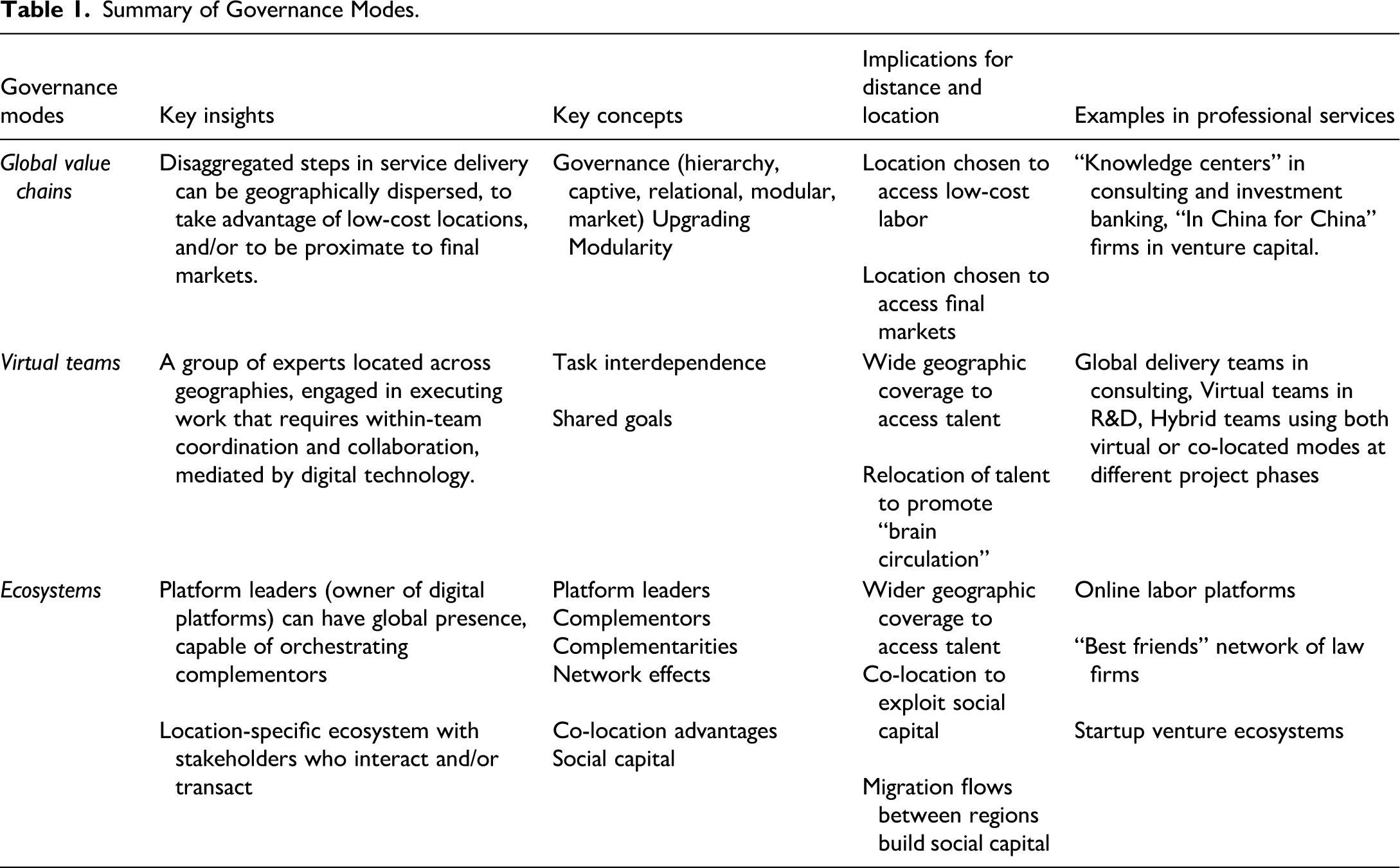
This section reviews three governance modes, namely GVCs, virtual teams, and ecosystems, each with a different take on how distance affects the production and delivery of services. In each, we will review the theory and key concepts (see Table 1 for a summary), with a view to drawing implications for distance logics in professional service delivery.
Summary of Governance Modes.
Global Value Chains
GVCs originated from the idea of commodity chains (Gereffi & Korzeniewicz, 1994), applied to various sectors including agriculture and mining. Its main application was to formulate policies to promote economic development, via the upgrading of suppliers located in less developed countries. More recently, as the empirical context shifted to manufacturing, notably apparel and electronic assembly, Gereffi et al. (2005) devised a formal framework for identifying different governance modes in GVCs. A starting point for applying a GVC perspective is the disaggregation of the value chain from sourcing raw materials to sales of final products and services. This enables the geographic dispersion of different stages in the value chain. In professional services, the notion of value chain disaggregation is of much more recent origin than in manufacturing, which saw the transformation from craft work to mass production in early twentieth century.
Governance is a key concept in GVCs. This is about who has the power to “drive” the value chain. GVC governance is unpacked into five modes (hierarchy, captive, relational, modular, market), ranging from hierarchy, with a lot of power accruing to the lead firm, to market, which implies a more equal power distribution. These modes are influenced by three characteristics of transactions: the complexity of information exchange, the codifiability of knowledge, and the supplier's capabilities. Between the two extremes of market and hierarchy (Williamson, 1975) lie three network forms of coordination ranging from “modular” on the market-like end of the scale, where complex information is codified; to a “relational” form of governance in the center, involving the exchange of tacit knowledge and governance by trust and reputation; to a quasi-hierarchical “captive” form that is more akin to vertical integration. Of these, relational governance (in which the buyer and the supplier are in long-term trusted relationships trading complex products and information) and modular governance (in which the two parties have clear interfaces in their division of labor) are most relevant to professional services.
Modules could contain complex tasks within, but have clearly defined interfaces (Baldwin, 2008; Baldwin & Clark, 2000). Such interfaces define the division of labor and minimize the need for repeated interaction between consecutive stages in a value chain. Packaging tasks into modules enables distanced delivery because it removes the need for back-and-forth coordination to complete work. Put another way, distanced delivery necessitates modularity. For example, in legal services, instead of a senior associate giving tentative instruction to a paralegal down the corridor, the lawyer in London has to give a fully elaborated instruction upfront when the recipient of the instruction is sitting 4500 miles away in Mumbai.
GVC governance changes over time, as the three transactional characteristics of information exchange complexity, knowledge codifiability, and supplier capabilities shift. In particular, upgrading, referring to supplier capability accumulation, enables suppliers to move into higher value activities, sectors, products and processes (Humphrey & Schmitz, 2002). If a supplier develops new capabilities in design, it has a better chance of shifting from captive governance to relational or modular governance, enhancing supplier power to extract greater rent vis-à-vis their client firm (Teece, 1986). In professional services, LPO providers initially provided legal support work (not legal work). But as they accumulated capabilities onshore as well as offshore, some of them began to provide legal advice, locating close to their clients, earning higher profit margins than before (Sako & Zylberberg, 2019).
To summarize, applying the GVC lens to professional services enables us to examine firstly, if professional service work could be disaggregated into stages in the value chain. Next, the GVC lens applies distance (and location choice) between each pair of stages in the value chain. Thus, the distance between a firm's back office and front office via offshoring to exploit labor cost arbitrage is separate from the distance between the firm and its clients. Last and not least, professional service providers may accumulate new capabilities that affect GVC governance, shifting it toward governance modes (e.g., modular or relational) that give greater bargaining power to service providers.
Virtual Teams
Virtual teams developed in parallel with advances in ICT in the 1990s (Maznevski & Chudoba, 2000). These teams allow geographically dispersed individuals to engage in cross-functional work involving interdependent tasks in order to achieve a common goal (Malhotra et al., 2007). Members of virtual teams communicate and coordinate primarily through electronic media, though most virtual teams have at least some face-to-face contact (Hertel et al., 2005). While some virtual teams are assembled to reduce costs by mixing in comparable professionals from lower cost regions, others are constructed in order to access a broad range of expertise by decoupling the expert from the worksite. While many organizations utilized virtual teams in some capacity for some time (Dulebohn & Hoch, 2017), the necessities of lockdowns in the early 2020s accelerated their use (Hill et al., 2024) forcing organizations to rethink how they structure themselves for the future (Malhotra, 2021). Moreover, virtual teams may cross organizational boundaries, with members drawn from different firms, working together to deliver major projects.
Compared to physically co-located teams, virtual teams have advantages and disadvantages (Ebrahim et al., 2012). Among the advantages to the organization are the ability to assemble teams that draw on the expertise of geographically dispersed professionals and leveraging time zone differences to enhance productivity. It may also be possible to form teams beyond the boundaries of the firm, creating an opportunity to move to more connective professions (Pareliussen et al., 2022). If members of the virtual team are strategically located near clients, quicker response times and reduced travel costs may also be possible (Hertel et al., 2005). For employees, a shared professionalism combined with working on a virtual team creates opportunities to form friendly relationships with distant peers that otherwise would be impossible (Zaidman, 2021).
In contrast to advantages that tend to be taken for granted, disadvantages of virtual teams require greater elaboration, and they arise from geographic dispersion rather than use of electronic communication common to both virtual and co-located teams. Specifically, temporal distance can negatively affect workers who have to coordinate both their work and personal lives across many time zones (Hill et al., 2024). Workers from distant geographies may also lack “common ground” socially and culturally, leading to failures to communicate effectively, unevenly distributed information, and differences in interpretations of the salience of information (Cramton, 2001). If workers are utilizing technology to contribute from significantly different environments, they may also begin to develop different forms of professional identities and work practices that may differ from each other (e.g., acceptable dress code, use of personal time) and from the firm's prior office-based collocated traditions (Kronblad & Jensen, 2023), which could strain team function. Furthermore, there is evidence that virtual teams perform less socialization, courtship, and social identification activities that are typically associated with building trust (Jarvenpaa & Leidner, 1999) and that an increased spatial distance inhibits the ability to repair trust once broken (Nohria & Eccles, 1992; O’Hara-Devereaux & Johansen, 1994). Since trust within teams has been shown to have a positive correlation with performance, and even more so in virtual teams (Breuer et al., 2016), such challenges are not trivial and mitigate some of the assumed advantages of the virtual team structure.
Contributing to issues of trust and performance are dynamics that arise from the geographic configuration of the virtual team itself, independent of their spatial, temporal, or socio-demographic distances. O’Leary and Mortensen (2010), for example, find that an imbalance of the number of team members across sites can lead to “competitive coalitional mentalities,” while teams with geographically based subgroups struggle with forming team identity. The complexity of geographic distribution of the team members is further compounded by differences in labor law and intellectual property law across jurisdictions (Roehling, 2017), making resolution of team conflict more difficult. As virtual teams are often constructed around the expertise of specific individuals, agnostic of their location, how team members are geographically distributed is often beyond the firm's control. Finally, at the individual level, team members may feel isolated and undergo conflict escalation that they would not have experienced in face-to-face teams (Hertel et al., 2005).
Some solutions to these challenges have been examined. For example, task structure (interdependence and complexity) is a core moderating factor of virtual team effectiveness. Interdependence implies that the performance of one member strongly affects the work process of other team members (Thompson, 1967). To make tasks as independent as possible, a clear division of labor could be worked out. But the whole point of having a team is that members have complementary capabilities that create synergy when brought together. If one worker hands over a completed task to another, without feedback or interaction, the two are arguably not in a team. Another approach recognizes that managing virtual teams requires leadership skills that are not just different, but often the exact opposite of managing co-located teams (Meyer, 2010). To be effective, virtual team leaders need to ensure that team diversity is understood and appreciated, and that work-life cycles are accounted for, among other tactics (Malhotra et al., 2007; Zigurs, 2003). However, the absence of non-verbal cues and body gestures in electronic communication often makes such awareness difficult (Dulebohn & Hoch, 2017).
The empirical context for virtual teams research range from R&D, training and development, new product development, and science collaboratories within a diverse set of industries such as telecommunication, aerospace design and medical device manufacturing. Yet little work has been done specifically on the effect of virtual teams on distance and service delivery in PSFs (Gibson & Gibbs, 2006 and Levina & Vaast, 2008 both include PSFs, though PSFs are not the focal point of either study). Within the context of a PSF, a likely consequence of virtual teams is an increase in physical, temporal, and cultural differences. Even if experts are sourced from existing offices—and there would be no such requirement to do so—a shift toward virtual teams indicates the prioritization of an individual's capabilities rather than their proximity to the client or other team members. Thus, a potential tradeoff of the virtual team model is less time on site with the client, which may hinder building trusted relationships and sourcing new business opportunities, and less time with each other, which diminishes knowledge transfer and firm identity. In addition, virtual teams require more coordination effort and more attentive leaders, both of which require firms to invest in new capabilities not directly tied to client services.
In summary, virtual teams provide an opportunity for PSFs to bring together geographically dispersed experts to best align with client needs. Depending on the locations of these experts, time zone differences may also create opportunities for around-the-clock productivity. However, significant research highlights the challenges of operating such teams. Despite these challenges, PSFs continue to deploy virtual teams, which, in aggregate, increase the physical, temporal, and cultural distances that need to be managed.
Platform-Based and Venture Ecosystems
Ecosystems are a distinct form of governance that could be applied to a variety of contexts including market transactions, innovation, startup ventures, and ecology (Jacobides et al., 2018). In social sciences, the notion of ecosystems became popular due to a realization that a constellation of actors and stakeholders, rather than just buyers and suppliers, should be taken into account to understand how value is created and sustained. We first discuss a subset of ecosystems, namely platform-based ecosystems (Kretschmer et al., 2022; McIntyre & Srinivasan, 2017), before discussing ecosystems involving venture startups.
In innovation and technology studies, a platform is conceptualized as an interface that can serve to mediate transactions between actors, and/or facilitate innovative activities (Cusumano et al., 2019). These are typically commercial ventures, but there are also instances of public institutions such as court systems being redesigned as platforms (Kronblad & Pregmark, 2024). A platform ecosystem refers to a community with the platform leader and its complementors that produce complements to enhance platform value. Technology firms such as Apple and Google are platform leaders, and app developers are complementors. The platform-based ecosystem is bound together by design rules and an overarching value proposition (Kretschmer et al., 2022), in which complementarities and co-specialization are considered major forms of synergistic value proposition. Complementors that develop products and services using a platform can formulate alternative strategies to capture value for themselves (Gawer, 2009; Gawer & Cusumano, 2002).
While the global presence of platforms may be noted, the platform-based ecosystem literature rarely acknowledges geographic distance or location-specific advantages in their research. This may, in part, be due to the view that digital means virtual. This lack of geographic focus is reflected in generalist online labor platforms, such as Amazon Mechanical Turk, Upwork, and Fivrr. These services boast global talent pools but only make vague reference to the location of service providers. Even platforms for professional work, such as Lawyers on Demand, make little reference to the role of geography for freelancers despite the importance of different regulatory environments across regions. Instead, both industry and literature position online labor platforms as providing more flexibility for the firm and better work-life balance for the freelancer (Smets et al., 2017).
Next, entrepreneurial venture ecosystems, as a second type of ecosystem, are more explicitly embedded in geographic locations, and are compared to industrial clusters (Autio et al., 2018). Aside from historical studies of how and when location-specific entrepreneurial ecosystems emerge (Huggins et al., 2024), our interest is in advantages of co-location once ecosystems become established, even in the age of digital technology. In particular, startup ventures and venture capital can internationalize. But especially at early stages, venture founders and their investors tend to be co-located, in order to exploit social capital necessary to communicate difficult-to-codify private information and know-how before and after making investment decisions. One study found that “spiky globalization,” noted by the intensity of venture capital flows between two regions across countries or within a country is underpinned by migration flows of entrepreneurial talent between those regions, such as Bangalore and San Francisco (Iriyama et al., 2010). Increasingly, startup venture ecosystems are relevant to professionals, not only because they advise venture founders as lawyers and accountants, but also because some professionals become entrepreneurs to exploit opportunities provided by digital technology (Autio et al., 2018; Goto et al., 2024; Murray et al., 2024).
To summarize, the ecosystems lens is not homogenous. What is common between the platform-based and venture ecosystems is the identification of relevant actors who are not necessarily in direct transaction as buyers and suppliers, but also other actors (e.g., platform leaders and complementors, venture capital investors and venture founders). Moreover, ecosystems put an emphasis on ecosystem-wide design rules for interaction among actors (Jacobides et al., 2018). In particular, venture ecosystems rely on social capital that is embedded in a specific location, or bridges two subnational (e.g., city) locations that have human capital flows in the form of migration.
Distance Logics: Enabler or Barrier?
The three governance modes provide different perspectives on distance, which we call “distance logics,” along the same lines in using the term “logic” as for institutional logics (Thornton et al., 2012). A distance logic, just like an institutional logic, refers to the underlying assumptions, beliefs, rules and practices concerning distance between locations, that shape how individuals think, make decisions, and act. We identify two contrasting logics, distance-as-enabler and distance-as-barrier.
Before elaborating on the nature of distance logic in each governance modes, we specify the scoping condition for this study. The first scoping condition is our narrow focus on geographic distance. We acknowledge the existence of associated non-geographic distances (better understood as differences), for example CAGE (cultural, administrative, geographic, economic) distances (Ghemawat, 2007) and “institutional distance” (Kostova & Zaheer, 1999; Kostova et al., 2020). These differences result in adaptation of practices and strategic positioning to host-country jurisdictions (Faulconbridge & Muzio, 2016; Muzio & Faulconbridge, 2013). But our focus is on geographic distance that takes account of travel time and time zones, without giving full regard to non-geographic distances.
A second scoping condition is about making the firm—a PSF—the unit of analysis for decision-making. Any firm has multiple ties with clients, employees, external providers, investors, and other actors, some proximate and some distant. In many professional service settings, the quality of decision and advice depends on highly relational content that is often held as private and privileged. For this reason, it is considered advantageous for consultants to be embedded in client sites, for lawyers to hold face-to-face meetings, and for venture capitalists to invest within their own regions. As PSFs globalize, proximity to clients co-exists with distanced delivery of some services in offshore locations or with virtual teams. Making the firm the unit of analysis necessitates simultaneously considering multiple distances that involve proximity (to the client) and distance (from operations) within one value chain.
Thus, firms operate with a combination of different logics of distance-as-enabler and distance-as-barrier, shifting the balance in response to changes in the external environment. These different logics for relying on or avoiding distances are well articulated in the three governance modes. Distance is something to be leveraged in at least two lenses that adopt the logic of distance-as-enabler. The GVC framework regards distant (offshore) locations as something to be exploited via labor cost arbitrage. The virtual teams lens also recognizes wide geographic dispersion as enhancing access to global talent.
At the same time, geographically dispersed members of virtual teams grapple with barriers to good communication and information sharing. GVCs’ emphasis on proximity to client is a response to distance-as-barrier. The distance-as-barrier perspective is also central in ecosystems, in which distance is avoided via co-location. Distance is also overcome by social capital ties often built due to human capital flows between subnational regions, for instance San Francisco and Bangalore, consistent with the idea of brain circulation (Saxenian, 2006).
To summarize, distance-as-enabler is a logic that exists most strongly in GVCs and in virtual teams, while distance-as-barrier is a logic in use in virtual teams and ecosystems.
Combining Three Lenses Into an Integrative Framework
Having reviewed the three governance modes, we now develop a model of how the two distance logics are affected by the external environment, and how they influence the global strategy and structure of PSFs (see Figure 1). The ultimate outcome that we wish to elaborate in this section is presented as a typology of eight pairs of professional governance (firm-level governance) and professional practice (mode of professional work). The two co-evolve in the sense that a shift in governance necessitates a shift in practice, without which the firm may not be able to shift its governance. In other words, attempts to change PSFs’ governance structure are either facilitated by, or constrained by, professional practice. After the typology is presented, we demonstrate how two external environmental shifts, namely advances in AI and enhanced geopolitical risks, affect PSFs’ distance logics, which in turn affect their governance and practice.
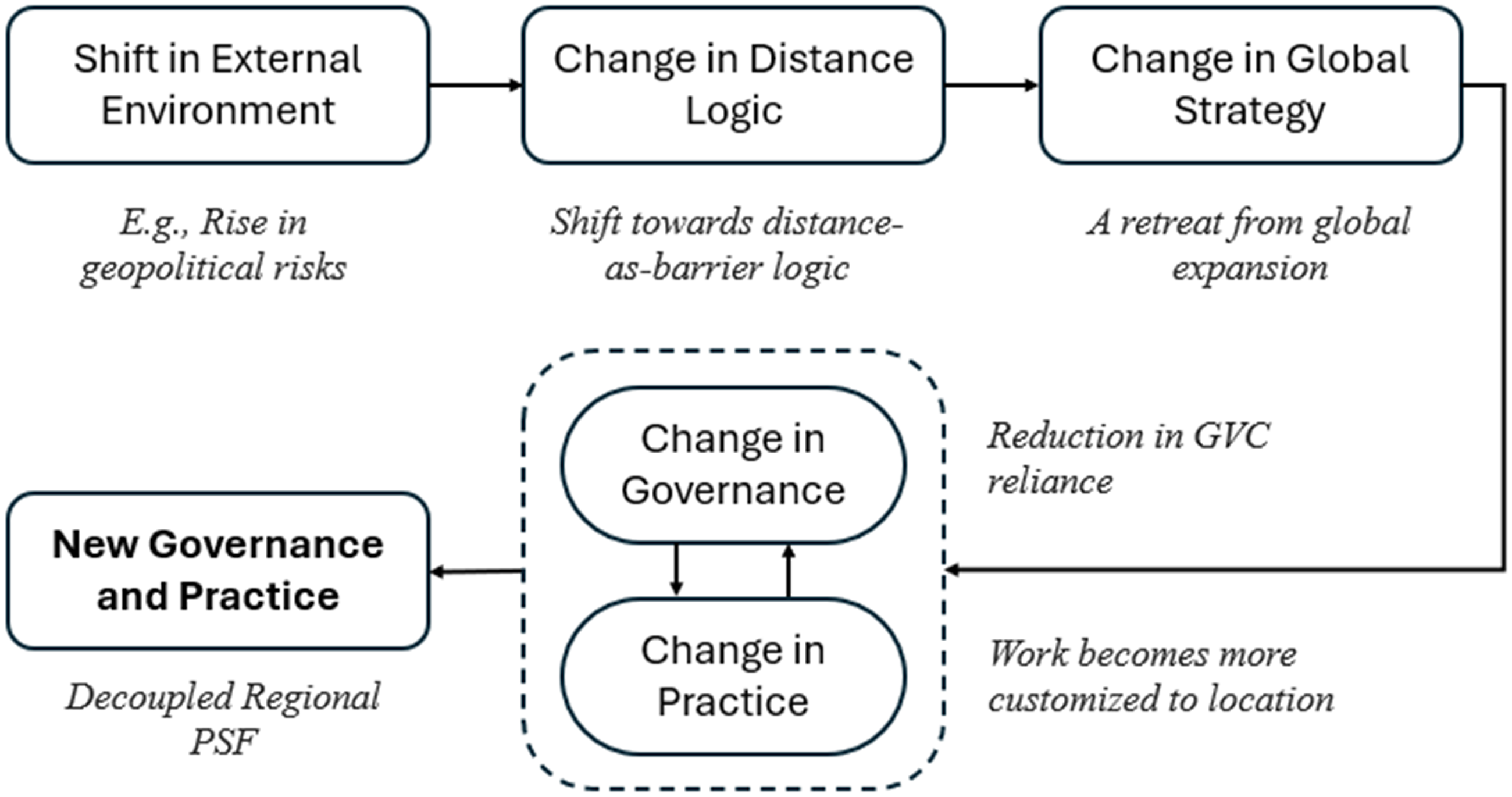
A model of distance logics influencing PSF governance and practice.
Typology of Governance Structure and Professional Practice
PSFs face both constraining and enabling forces from the existence of geographic distance in their operations. The typology with eight pairs of governance and practice presented below is useful in tracking how PSFs consider the co-evolution of governance and practice in response to privileging one distance logic over another when making strategic decisions about enhancing or reducing their international presence. Each of the eight governance-practice types in the typology is explained roughly in the order in which PSFs encountered them over time.
The first type is “best friends” relationship in which PSFs adopt the logic of distance-as-barrier and customized and tacit service delivery. PSFs, such as law firms, audit firms, and architectural firms, came late to internationalization, surviving as regional (subnational) firms that consolidated to become national firms before they crossed national borders. Regional firms served clients, individual and corporate, who were located in the same region. In legal services, large national firms first internationalized by developing “best friends” relationships with other equally ranked law firms in a different jurisdiction, so that existing clients’ cross-order and international matters could be handled by making referrals firms in its network. Thus, a London-based magic circle firm, such as Slaughter & May, has best friends relationships with Cravath or Wachtell in New York City, and with a number of European law firms (Williams, 2019). As depicted in Figure 2a, the PSF-client map can be drawn within a national border, and there are dotted lines that signify informal best friends (i.e., mutual referral) relationships between PSFs in two or more different jurisdictions. In this case, the use of GVCs, virtual teams, and ecosystems are all minimal/low (see Table 2). Social capital ties between a PSF and its clients may exist within a geographic cluster or an ecosystem, but social ties among law firms and other actors may or may not exist.
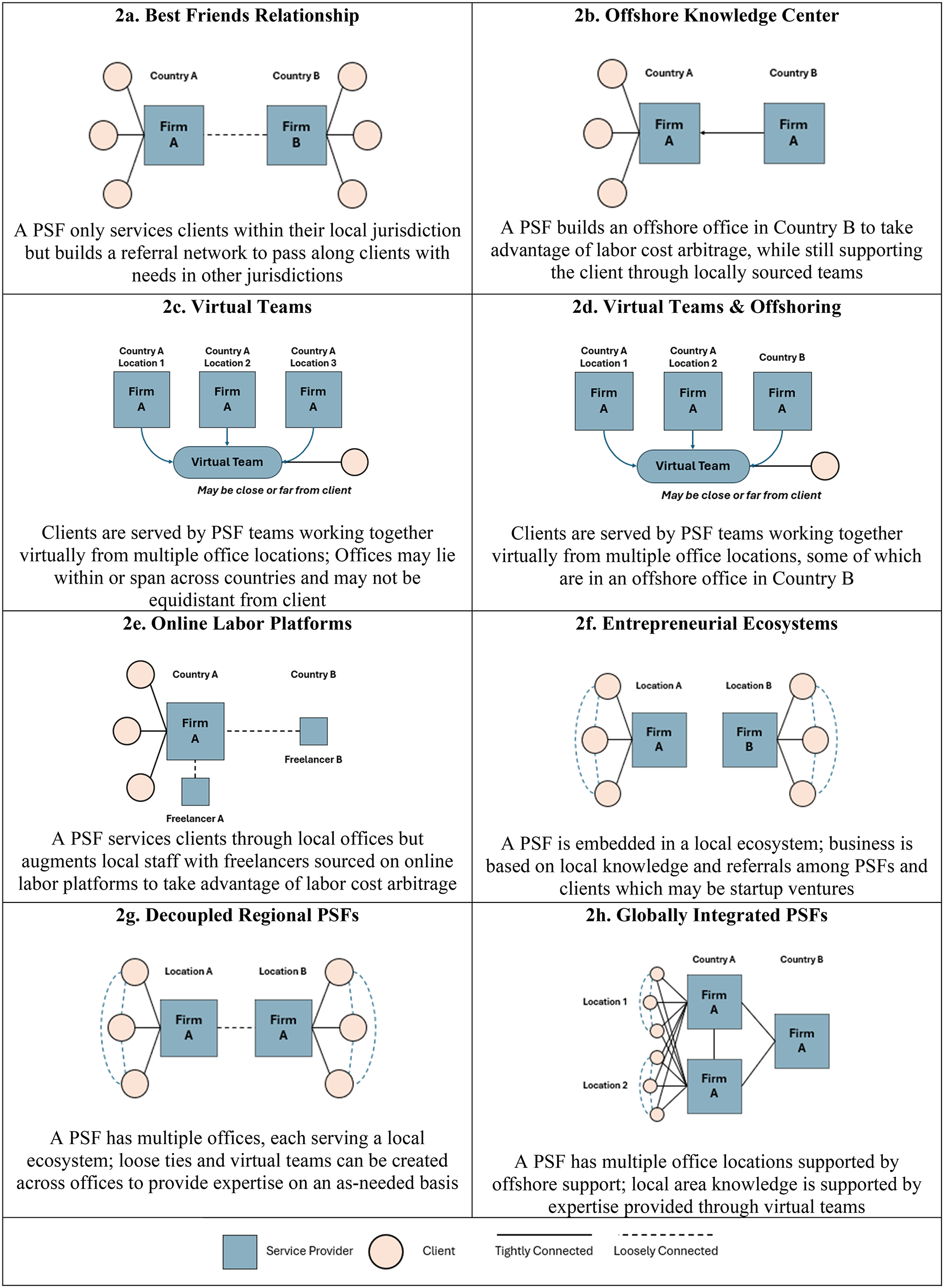
PSF-Client maps of organization and governance structures. (a) Best Friends Relationship. A PSF only services clients within their local jurisdiction but builds a referral network to pass along clients with needs in other jurisdictions. (b) Offshore Knowledge Center. A PSF builds an offshore office in Country B to take advantage of labor cost arbitrage, while still supporting the client through locally sourced teams. (c) Virtual Teams. Clients are served by PSF teams working together virtually from multiple office locations; Offices may lie within or span across countries and may not be equidistant from client. (d) Virtual Teams & Offshoring. Clients are served by PSF teams working together virtually from multiple office locations, some of which are in an offshore office in Country B. (e) Online Labor Platforms. A PSF services clients through local offices but augments local staff with freelancers sourced on online labor platforms to take advantage of labor cost arbitrage. (f) Entrepreneurial Ecosystems. A PSF is embedded in a local ecosystem; business is based on local knowledge and referrals among PSFs and clients which may be startup ventures. (g) Decoupled Regional PSFs. A PSF has multiple offices, each serving a local ecosystem; loose ties and virtual teams can be created across offices to provide expertise on an as-needed basis. (h) Globally Integrated PSFs. A PSF has multiple office locations supported by offshore support; local area knowledge is supported by expertise provided through virtual teams.
Governance Structures and Professional Practices Arising From Use of Different Distance Logics.
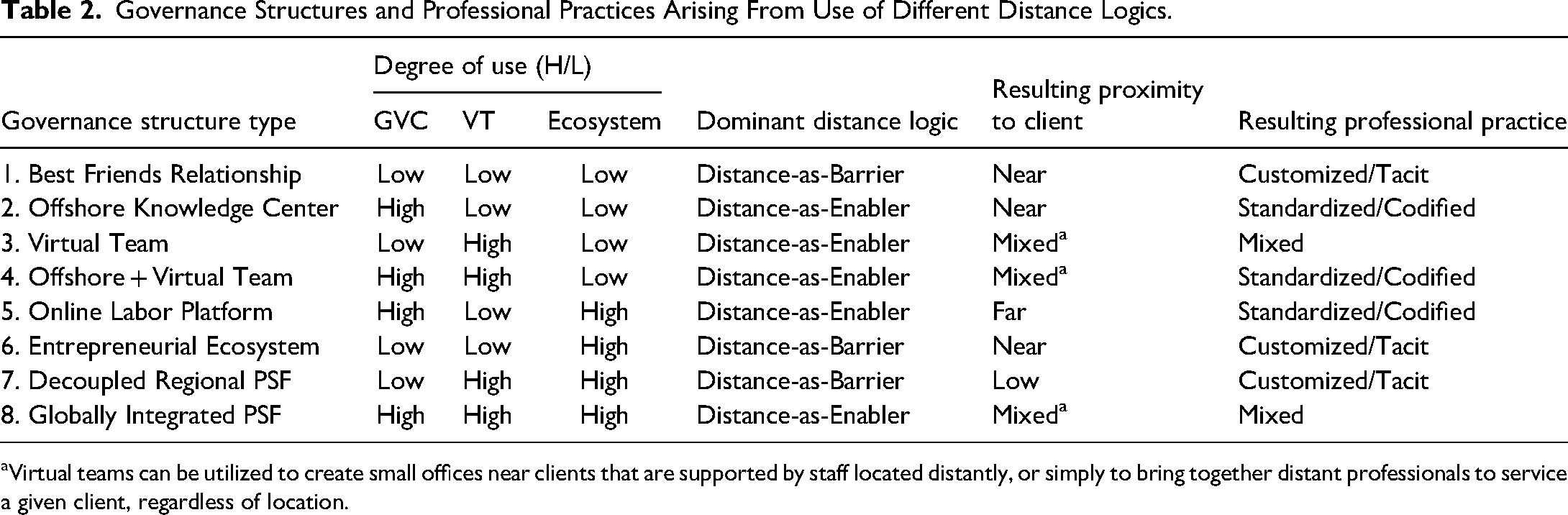
Virtual teams can be utilized to create small offices near clients that are supported by staff located distantly, or simply to bring together distant professionals to service a given client, regardless of location.
There are two different reasons that any firms, including PSFs, wish to internationalize. The first reason is access to inputs, and the second is access to final markets. For the first reason, firms wishing to access talent in offshore locations make use of GVCs, giving rise to the second governance-practice type, labelled “Offshore knowledge center” (see Table 2 and Figure 2b). PSFs cross national borders by creating their subsidiary “knowledge center,” or by offshoring to an independent third-party provider. In this case, the use of GVCs is high, while the uses of virtual teams and ecosystems are low. This assumes that the onshore front office located close to clients carry out work that is modularizable from the support work done by offshore offices.
The consideration for access to global talent may also lead firms to form virtual teams, with a team for each client project, our third governance-practice type (see Figure 2c). In consulting, for instance, this means that a project leader is located onshore near or at the client site, with members of the team distributed across multiple countries, not just in one offshore location; for example, talent for software development may reside in a different location from talent for sales and marketing. The logic of distance-as-enabler is leveraged in virtual teams. Virtual teams with members in the same time zone can continue with synchronous communication, while teams with members in different time zones would rely more on asynchronous communication and a clear sequential division of labor. It is possible that in the latter, the use of GVCs is combined with the use of virtual teams (see Figure 2d), our fourth governance-practice type.
Another technology-mediated mode to access global talent is to rely on transactional platforms such as the online labor platform, a fifth type (see Figure 2e). In such platforms, the use of platform-based ecosystem is central, but may be combined with the use of GVCs to exploit labor cost arbitrage. In online labor platforms, we expect professional work to be modular, standardized, and codified.
The sixth governance-practice type is an entrepreneurial ecosystem, which leverages social capital within a geographic ecosystem to function well, and does not make use of GVCs nor virtual teams (see Figure 2f). Co-location and/or the reliance on social capital facilitate professional practice that is customized and tacit, relying on private information for instance between venture founders and their early investors (see Table 2).
To present our last two governance-practice types requires shifting our attention from access to inputs to access to final markets with new clients in new locations. This is enabled by firms creating new offices in a new country, or acquiring or merging with firms in that country. Cross-border mergers are rife among law firms, and audit and consulting firms have continued to extend their international presence, opening practices in more emerging markets in different continents. This leads to a situation in which some low-cost locations that had initially been chosen as offshore locations become also locations for final market access. The logic of distance-as-enabler has come full circle to specify the same location for access to both inputs and final markets. In this case, GVCs is now low, while virtual teams may or may not be relied upon, and the use of ecosystems is high. This form of PSF may be called a “decoupled regional PSF” (see Figure 2g), in contrast to a “globally integrated PSF” in which the uses of GVCs, virtual teams, and ecosystems are all high (see Figure 2h). Professional practice may remain customized and tacit in the former, while the latter type requires a degree of standardization and codification to sustain PSFs’ global integration.
The above account of eight types is an exhaustive list of different combinations of the three governance modes, and it is important to remember that the successful adoption of each governance type requires adaption to the service delivery model. For instance, generally distant delivery requires greater codification and modularization of professional work, without which the nature of offshore–onshore interaction would have to be iterative. Our typology therefore facilitates an explanation of the co-evolution of professional practice and professional governance. In particular, best friends’ relationships leave bespoke and tacit professional practice untouched, whereas the use of offshore knowledge centers and online labor platforms requires a shift to modularizing and codifying some aspects of professional work. Virtual teams afford a variety of interdependent tasks within a team depending on time zone, leadership style, and trust within the team. Globally integrated PSFs require global standards in professional work quality, whereas decoupled regional PSFs could afford some variation in professional practice from region to region. These implications of professional governance for professional practice are spelt out in Table 2, in which the distance-as-enabler logic promotes codified and modularized practice, while the distance-as-barrier logic facilitates tacit and customized practice. Moreover, without the co-evolution of governance and practice, PSFs are likely to encounter barriers to shifting from one governance type to another.
Strategic and Structural Responses by PSFs
Our next task is to identify the factors that lead PSFs to choose one type of governance structure over another. The choice may arise from changes in external environmental factors. In order to highlight how these factors lead PSFs to shift from one governance structure to another, we examine the impact of AI and geopolitical risks. This exercise highlights shifts from one distance logic to another. In short, AI has reduced the importance of distance-as-enabler, at least in so far as labor cost arbitrage is concerned. Moreover, geopolitical trends have increased the salience of distance-as-barrier. We will illustrate how these factors have led PSFs to shift their governance structure.
Artificial Intelligence
As noted earlier in this paper, much of the initial outsourcing of work was to exploit opportunities for labor cost arbitrage. AI, and specifically generative AI, can now perform many of the operations the offshore offices were designed to take on. Instead of a lawyer in London giving fully elaborated instruction to a recipient based in India, the lawyer can now query the generative AI software from the monitor on her desk in the office or at home. Using chain-of-thought prompt engineering, legal work becomes more conversational, like querying another lawyer in the same room.
The use of digital technology, and AI in particular, may therefore open the possibility of re-onshoring of the BPO, LPO, and KPO work that had been offshored in the 1990s and early years of this century. And reshoring is due, not simply because work done by low cost labor is substituted by machines, but also because machines augment onshore professionals’ work. This would alleviate challenges associated with both temporal and cultural aspects of virtual teams and may reduce operating costs. Regulatory, cyber security, and data privacy requirements may further drive this transition as it may not be permissible, in the eyes of governments and/or clients, for the data used both in training and communicating with large language models (LLMs) to cross national borders. As a result, while all digital technology is distance-agnostic, AI in its current state of technology with concerns about safety and trustworthiness might lead PSFs to contract, rather than expand, its reliance on distant delivery. Counterintuitively then, advances in technology may lead to a more decoupled regional or national PSF structure akin to the traditional professional service model, in which loosely connected offices primarily service local clients under the banner of a global brand name.
Will the increasing potential of distant delivery continue in the age of AI? Our answer for now is that the conversational and interactive nature of generative AI software including GPT4 highlights the importance of proximity between humans using and interpreting the software tool and humans giving advice to clients using machine outputs.
Geopolitical Risks
Apart from the technological characteristics of generative AI for professional service use cases, the storage of data for training AI models within national borders has become an important consideration for geopolitical reasons. The US and the EU, for example, are at different stages in developing AI regulation, with the EU AI Act (“EU AI Act,” 2023) creating binding sets of rules based on defined risk categories while the US has a patchwork approach of executive orders and laws (House, 2023a, 2023b) that as of today remains more friendly to the AI industry (Ryan-Mosley et al., 2024). Meanwhile, China has thus far has taken a piecemeal approach, creating product-specific regulation when new products emerge, though a more comprehensive system may be forthcoming (Yang, 2024). These regulatory frameworks may lead to different regional rates of AI product development as well as limit the transferability of AI technology over concerns of national defense. The race for AI talent (Mozur & Metz, 2024) may also create imbalances in the ability to develop and implement AI in professional services based on local availability of capable workers.
Finally, LLMs may perform best when trained on large sets of native language documents (Du et al., 2024) and thus the models and tools available might also be location dependent and not work well across offices office of global firms. These conditions suggest that national goals may vary and that tensions may arise between regions where different policies are in place. This fragmented environment may favor firms consolidating operations within national boundaries and may lead to a governance model of regionally autonomous partnerships with loose connections among them.
Thus, new vulnerabilities in globalization arising from the COVID-19 pandemic and heightened geopolitical risks disrupt international trade and logistics. In this context, international business scholars have identified multinational corporations’ response in the form of “decoupling,” defined as the process of weakening interdependence between two nations or blocs of nations, with specific attention given to China–US relations (Cui et al., 2023; Witt et al., 2023). Decoupling for firms, including PSFs, implies structural, as well as geographic, adjustments, and includes: (a) incorporating a client-facing office separately in each significant final market, and (b) removing GVCs that rely on two or more locations that require decoupling.
Recent Examples of Structural Shifts
US–China tension and the resulting “In China for China” strategy provide a good backdrop for illustrating how specific firms are restructuring their global governance structure. The PSF examples below are all moves toward the “decoupled regional PSFs” (Type 7 in Table 2), in which proximity between final markets and technology/data assets is preferred.
Venture capital firms have been among the first to formally decouple their global structure, perhaps because a relatively small number of offices and low headcounts lower the cost of switching to decoupling than for other PSFs. Moreover, to date, venture capital firms have been embedded in entrepreneurial ecosystems (Type 6 in Table 2) which are already geographically bound, although they have simultaneously relied on centralized back-office functions (Types 2 and 4 in Table 2). Sequoia, the US venture capital firm, announced in March 2024 that it would split off and established separate partnerships in China and India (Wu et al., 2023), giving centralized back-office functions becoming “more of a hindrance than an advantage” as a reason. This was followed by a similar move by other US VC firms. GGV Capital would split its business into two, US (rebranded as Notable Capital) and Asia (rebranded as Granite Capital), so that “investors who still feel confident about the Chinese market can contribute capital to GGV's funds that cover China, while those who feel cautious about China now have the option to work with GGV's U.S. and Europe-focused business” (Wu & Liu, 2023). Similarly, Matrix Partners rebranded its regional entities in India and China, stopping short of a full spin-off à la Sequoia Capital and GGV Capital, amid a deepening technology divide between the US and China (Jiang, 2024). This move to decoupling emphasizes the localization efforts of regional teams, with each team's leadership operating “with separate decision-making and separate back offices from inception.”
In consulting, adjustments are slower due to greater reliance to date on offshore knowledge centers and virtual teams (Types 2 and 3 in Table 2). For instance, Bain has adjusted its business to comply with new regulations in China on data and cyber security, and are pulling back from advising in sensitive industries that are at the heart of geopolitical tensions (Foy & Foley, 2024). PwC is considering slashing up to half its financial services auditing staff in China, especially after Chinese regulators’ scrutiny of PwC for its role as the auditor of troubled property giant China Evergrande Group triggered the exit of some clients (Zhu, 2024). Along a similar vein, Forrester decided to close its office in mainland China after the country's government increased scrutiny on western consultancies, and plans to lay off the majority of its China analysts (Thomson Reuters, 2023).
Last and not least, in legal services, the number of foreign law firms with offices in China fell from 244 in 2017 to 205 in 2022, according to the Chinese Ministry of Justice (Shimizu, 2024). Orrick Herrington & Sutcliffe, Baker Botts, McDermott Will & Emery, Vinson & Elkins and Latham & Watkins are among those that closed at least one office in China. Instead of a closure, Dentons, the world's biggest law firm by number of employees, announced in summer 2023 that its China unit would operate as a standalone legal entity. The Chinese entity continues to operate under its current local name Dacheng, and partners with Dentons under a relationship that designates it as a “preferred firm” (Toh, 2023). Thus, while a best friends relationship (Type 1 in Table 2) governs the decoupled unit in China, the formal split of the Chinese unit is said to be a response to “new mandates and requirements relating to data privacy, cybersecurity, capital control and governance.”
In conclusion, a combination of AI technology (with its heavy reliance on data) and geopolitical risks has led international PSFs to rely less on distanced delivery using offshoring and virtual teams in recent years. Fragmentation resulting from hedging geopolitical risks led some firms to decouple their corporate governance. PSFs, when exposed to external environments that rebalance which distance logic could be privileged, reformulate their international strategy, which in turn results in changes to their internal governance structure and professional practice. Moreover, as we saw above, the speed with which PSFs in different sectors can shift their structure to new needs of decoupling depends in part on how reliant they had been on structures that are more global.
Discussion and Conclusion
In this paper, our aim was to clarify various mechanisms attributed to distance in PSFs’ global strategy and structure. Geographic distance is a physical fact, but it is often a proxy for other kinds of distance. We focused on geographic distance to clarify the two logics of distance-as-enabler and distance-as-barrier which exist in varying degrees in the three governance modes we chose to review, namely GVCs, virtual teams, and ecosystems. Combining these three frameworks enabled us to identify eight governance-practice combinations in use by PSFs. Each professional governance structure is associated with specific types of professional practice. For instance, distanced delivery via offshoring or in virtual teams, particularly if asynchronous due to different time zones, render professional service work packages to be more codified and modular, whereas proximity and/or synchronous interaction enable professionals to engage more effectively in complex work involving interdependent and at times tacit tasks.
To fully understand why PSFs shift from one governance-practice type to another, we devised a causal chain model with external environmental factors as triggers for change that facilitate or pressure PSFs to adopt a specific governance-practice type. We examined two factors, namely AI and geopolitics, and found that the interaction of these two factors has shifted PSFs’ attention away from use of the distance-as-enabler logic toward the distance-as-barrier logic. This shift has resulted in PSFs adopting, or considering adopting, the so-called “decoupled regional PSF” governance structure, facilitating professional practice that can be local, customized, and tacit.
Implications of our study for scholars center around considering geographic distance, not as objective reality out there in world but as logics, in the way similar to how scholars have characterized institutional logics (Thornton et al., 2012). In so doing, we can shed light on the impact of external environmental shifts on PSFs’ governance structure, as moderated by distance logics. Researchers may extend this logics perspective to include not just geographic distance but also other types of distances, including cultural, cognitive, and institutional. Avenues for empirical work are rife with environmental triggers that may go beyond digital technology and geopolitics, including other societal “grand challenges” such as sustainability with ESG (environmental, social, and governance) concerns, and EDI (equality, diversity, and inclusion).
Our study also has implications for practice. In particular, our framework and typology may help PSFs clarify that a shift from one governance structure to another requires also a shift in professional practice, without which the structural shift would encounter difficulties. We also clarify how an external environmental factor—such as digital technology and geopolitics—triggers a shift in PSF global strategy which in turn requires a modification in its governance. The typology (Table 2) and the causal model (Figure 1) we developed could be used to assist PSFs to make decisions about their governance and professional practice.
There are of course some limitations to our study, which can be highlighted here by making explicit its scoping conditions. First, we focus on geographic distance that tends to be bilateral rather than multilateral. In reality, PSFs face multiple clients and offices with different distances, and it is possible that aggregate distances and the number of distant relationships matter in our proposed governance structures. Moreover, time zones affect the nature of interaction, whereby being in the same time zone facilitates synchronous interaction and communication, regardless of distance (e.g., the UK and South Africa). These considerations give fine-grained nuance to a simplistic notion that the non-modular and tacit nature of professional knowledge requires proximity, or that the client's demand for customized advice undermines the potential for exploiting distance in professional work.
Second, by focusing on geographic distance, we did not fully elaborate its multidimensional character, with associated institutional and cultural distances. Third, while we account for the impact of time zones, we otherwise do not factor in the magnitude of distances nor the physical terrain that exist in covering those distances (e.g., whether travel is possible by car or flight) which may in turn have an impact on in-person meeting frequency. They become important if the number of distant relationships contributes to PSFs choosing their governance model. Future studies could take on these issues.
Fourth, there are some caveats to a focus on governance structure in our study. In particular, structural alignment may be necessary but not sufficient to bring about collaboration within virtual teams or ecosystems, or along GVCs. Evidence exists that shared goals and social norms are also necessary for collaborative communities to emerge (Adler et al., 2008) and for virtual teams to function well (Ben-Menahem et al., 2016). Also, we largely ignored the shifting boundaries of PSFs, whose governance structures are becoming complex not only with global presence, but also because international expansion takes place via diversification into multiple service lines (e.g., the Big Four with a legal advisory subsidiary, or consulting firms with an AI technology subsidiary). How diversification affects governance is a topic of further research.
In conclusion there have always been tensions between lowering transaction costs by exploiting advantages of coordination at distance and doing so with trust in proximity. PSFs, as they internationalize, have learnt to balance between expanding distances with the distance-as-enabler logic on the one hand, and consolidating distances with the distance-as-barrier logic on the other. Managing distances via making location choices can be fluid in strategy and structure. But in the current geopolitical and technological climate, the balance has tipped toward consolidating (rather than expanding) distances. Thus, PSFs do not necessarily progress monotonically toward globally integrated firms. Even if their global presence is preserved, our study shows that firms can choose strategically to adopt a more or less global governance structure, depending on the distance logic they adopt.
Footnotes
Declaration of Conflicting Interests
The authors declared no potential conflicts of interest with respect to the research, authorship, and/or publication of this article.
Funding
The authors received no financial support for the research, authorship, and/or publication of this article.
