




Abstract
Their positive potential often diminishes or even turns negative when antecedents of creativity are taken too far. Despite empirical evidence supporting such curvilinear effects on important outcomes of creative work at the individual and team levels, their theorizing remains rather incomplete, with more attention being paid to explaining the curves’ upward rather than downward slopes. By developing a multilevel antecedent-benefit-cost (ABC) framework that synthesizes 120 quantitative-empirical studies on curvilinear effects, this review guides creativity and innovation literature toward conceptual clarity and methodological precision across levels. This is important because the cost-related mechanisms of certain antecedents are still not well understood.
Employee creativity, defined as the generation of new and useful ideas (Amabile, 1996), plays an eminent role in the birth of innovations that almost all organizations to some degree require for long-term survival (Anderson et al., 2014). In order to gain a more competitive edge through creative work, organizations are asked to organize their employees in teams to better cope with the complexity and uncertainty associated with creative endeavors. However, collective work differs from that of individuals (Klein & Kozlowski, 2000), and innovation teams themselves may undermine their intended purpose by struggling with the demands that they face (Razinskas et al., 2022). Specifically, the social processes that are believed to help infuse the creative thinking and behavior of team members (e.g., cognitive stimulation from access to non-redundant, diverse knowledge) too often do more harm (e.g., cognitive inhibition due to pressure to conform). Instead of denouncing creativity literature as inconsistent due to such puzzling findings, drawing on these findings to establish a more elaborate theory about antecedents that bear both gains and losses in the creative work of teams and their members seems promising.
Two approaches may explain the ambivalent effects of certain antecedents. On the one hand, their effects may depend on moderators capable of attenuating or even inversing otherwise desirable consequences. This has given rise to primary research concerned with theory-driven moderators (e.g., task complexity, Chen, Liu, Zhang, et al., 2019; group longevity, Zhang, 2016) and meta-analyses designed to uncover study-related ones (e.g., type of performance measurement; O’Neill et al., 2013; van Dijk et al., 2012). While the review by Hennessey and Amabile (2010) is important due to establishing the idea that creativity is a multilevel phenomenon, the reviews by van Knippenberg (2017) and Zhou and Hoever (2014) help disentangle inconsistencies at the individual and team levels by following this moderator logic.
On the other hand, antecedents do not always require the presence or absence of certain moderators to differentially influence the creative work of teams. Sometimes, they simply reverse their own effect as a function of their magnitude. Following this explanation, it can be expected that enhancing such antecedents is beneficial up to a point (i.e., the inflection point) at which their associated costs start outweighing their benefits, so that further enhancing these antecedents results in an overall negative effect. In management literature, the inverted U-shaped effects that result are typically reasoned based on the “too-much-of-a-good-thing” (TMGT) logic (e.g., Grant & Schwartz, 2011; Haans et al., 2016; Pierce & Aguinis, 2013).
However, creativity literature too seldom applies TMGT logic in theorizing the perils of seemingly desirable antecedents of creative work (e.g., Kibatta & Samuel, 2022; Mo et al., 2019; Seo et al., 2020). Most studies still restrict their focus to the beneficial mechanisms of their antecedents and refer mainly to empirical rather than theoretical reasons that contribute to desirable effects turning negative (e.g., Corgnet et al., 2016; Petrou et al., 2019; Wang et al., 2018). This is problematic because practical recommendations based on such linear considerations are likely flawed and misleading if the changing direction of an antecedent’s effect is truly due to its magnitude (Busse et al., 2016). It is thus necessary to take stock of what we know about the potential costs contributing to curvilinear effects in order to reach a comprehensive understanding of the pitfalls waiting along the way to the creative outcomes that individuals and teams are expected to deliver.
I offer two contributions to creativity literature with this review. First, I draw on the antecedent-benefit-cost (ABC) framework by Busse et al. (2016) to organize the extant literature on curvilinear effects on the creative work of individuals and teams. In so doing, I develop theory that synthesizes the benefits and costs for their creative work associated with important individual- and team-level antecedents. The multilevel framework that follows from this synthesis helps better understand certain antecedents’ ambivalent role in creativity caused by competitive-mediation mechanisms that capture their benefits and costs. It further allows for synthesizing mechanisms that are mostly untested but argued to contribute to the effects of interest, which ultimately helps uncover important gaps in the literature.
Second, I show that studies on curvilinear effects at the team level largely use individual-level explanations to argue their cost-related mechanisms, thus diminishing conceptual clarity and methodological precision. For example, task conflict is argued to be beneficial for the creative work of teams up to a point at which the costs of team members’ cognitive overload (Hu et al., 2017) or distraction and self-focus (De Dreu, 2006) outweigh the benefits of openly debating issues. Therefore, my review critically informs more rigorous multilevel theorization and empirical testing of cost-related mechanisms (Klein & Kozlowski, 2000; Morgeson & Hofmann, 1999). Correctly specifying whether the costs of a collective antecedent occur within individual team members or obscure the social interactions and interrelationships among them is vital to better understand the innovative behavior in and the creative performance of teams.
Review Methodology and Framework
Review Scope
For a comprehensive overview of curvilinear effects on the creative work in and of teams, findings from the individual and team levels need to be integrated to prevent future research from overgeneralizing findings from one of these levels of analysis to the other one. In the context of collective work, insights from the individual level are particularly conducive to understanding the emerging cross-level research concerned with how certain antecedents differentially tax the creativity of team members depending on the antecedents’ magnitude. This is why I review the literature using a levels approach that considers quantitative-empirical studies solely conducted at either the individual level (e.g., Gao et al., 2020; Lin et al., 2017) or the team level (e.g., Baer et al., 2010; Chi et al., 2009), as well as first attempts on this topic that integrate both levels through cross-level designs (e.g., Li, Yang et al., 2018; Mao et al., 2021).
Moreover, the concept of employee creativity and the associated mechanisms that help or hinder the generation of ideas overlap with but also differ from that of innovation (i.e., the implementation of something novel; West & Farr, 1990). These overlaps and the consequential propensity to use both terms interchangeably require scholarly attention (van Knippenberg, 2017), since scholars are at risk of overlooking crucial insights on the creative work of individuals and teams when both terms are combined under the umbrella of “innovation.” Therefore, I attend to the differences between both concepts by also considering research that uses the term “innovation,” while actually studying the behaviors of individuals and teams leading to successful creative performance.
Literature Search
To select the body of literature for my review, I followed recent reviews (Forsell et al., 2020; Razinskas & Hoegl, 2020) and first systematically screened the literature in Web of Science based on a topic search that included titles, abstracts, and keywords. I specified a search string combining the type of effects (nonmonotonic OR nonlinear* OR curvilinear* OR inverted U OR U shaped OR too much of a good thing OR TMGT) with the desired outcomes (creativ* OR innovati* OR ideation OR divergent thinking). After excluding categories that obviously did not fit (e.g., optics, mechanics, thermodynamics), I manually screened the abstracts of some 2,700 research items that were published or in press by March 2022. During my screening, I excluded all studies that did not investigate curvilinear effects on creativity or innovative behavior, as well as those that did so only at levels of analysis above the team level (e.g., research concerned with the organizational or industry levels). After cross-checking whether similar searches in EBSCO and Google Scholar put forth additional research, I ended my systematic search with 119 quantitative-empirical articles and one dissertation. These 120 research items form part of my systematic literature review and are marked with an asterisk in the reference list.
Given the interdisciplinarity of this topic, the articles came from a wide variety of journals. 31.1% of the articles were published in organizational behavior journals (e.g., Journal of Applied Psychology and Small Group Research), 45.4% in management journals (e.g., Academy of Management Journal and Creativity and Innovation Management), 19.3% in psychology journals (e.g., Group Processes & Intergroup Relations and Personality and Social Psychology Bulletin), and 4.2% in journals from other disciplines, like education and psychiatry. 53.3% of the studies were conducted at the individual level and 46.7% in team settings, with 80.4% of the latter looking at relationships solely at the team level and 19.6% of them investigating cross-level models. It should be mentioned that only four of the 11 studies looking at cross-level models actually tested curvilinear effects across levels. The other seven studies investigated how curvilinear effects at the individual level differ across teams.
With the exception of two individual-level studies from the last century (i.e., McCrae et al., 1987; Voss, 1977), all of the research on curvilinear effects in the context of creative work has been published within the last two decades. Figure 1 illustrates how this body of literature has evolved since the turn of the millenium. As it shows, there is not only heightened interest in curvilinear effects but also a trend toward studying them in team settings. Although the bar representing the year 2022 in Figure 1 only contains articles that were already published or in press by March 2022, it is already close to the bars of the previous years, suggesting that curvilinear considerations in creativity literature has gained further momentum.
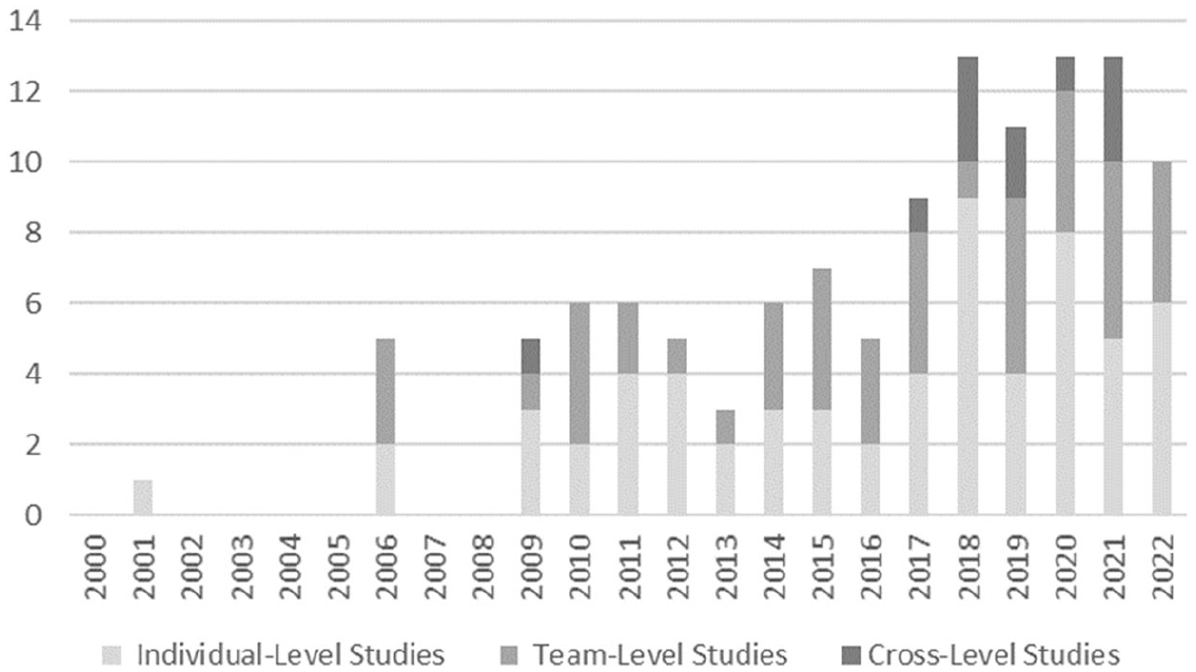
The evolution of curvilinear considerations in creativity literature by levels of analysis.
Literature Structuring
The multilevel antecedent-benefit-cost (ABC) framework in Figure 2 serves as the overarching structure for synthesizing the extant literature on curvilinear effects on indicators of creative work. In addition to structuring the studies using a levels-of-analysis approach (e.g., Anderson et al., 2014), I apply the ABC logic advocated by Busse et al. (2016). The combination of both these approaches is suitable to synthesize the mechanisms via which important antecedents of creative work are argued to show nonmonotonic consequences at the individual and team levels. Explaining TMGT effects with a competitive-mediation logic is at the heart of the ABC framework. More specifically, antecedents (A) showing such effects are expected to simultaneously involve benefits (B) and costs (C). As long as the benefits of an antecedent outweigh its associated costs, its effect on a desirable outcome is positive. Once its costs start outweighing its benefits, the antecedent’s effect turns negative, which results in the inverted U-shaped pattern typical for TMGT effects (Pierce & Aguinis, 2013). The application of this competitive-mediation logic at the individual and team levels constitutes an important contribution to this stream of literature. As shown in Figure 2, I consider the benefit- and cost-related mechanisms hypothetical because most of them have not been tested empirically but rather used to argue for why certain antecedents impact the creative work of teams and their members in nonmonotonic ways. By synthesizing the benefit and cost arguments put forth in this body of literature, my integrative review results in a comprehensive overview of these mostly untested mechanisms.
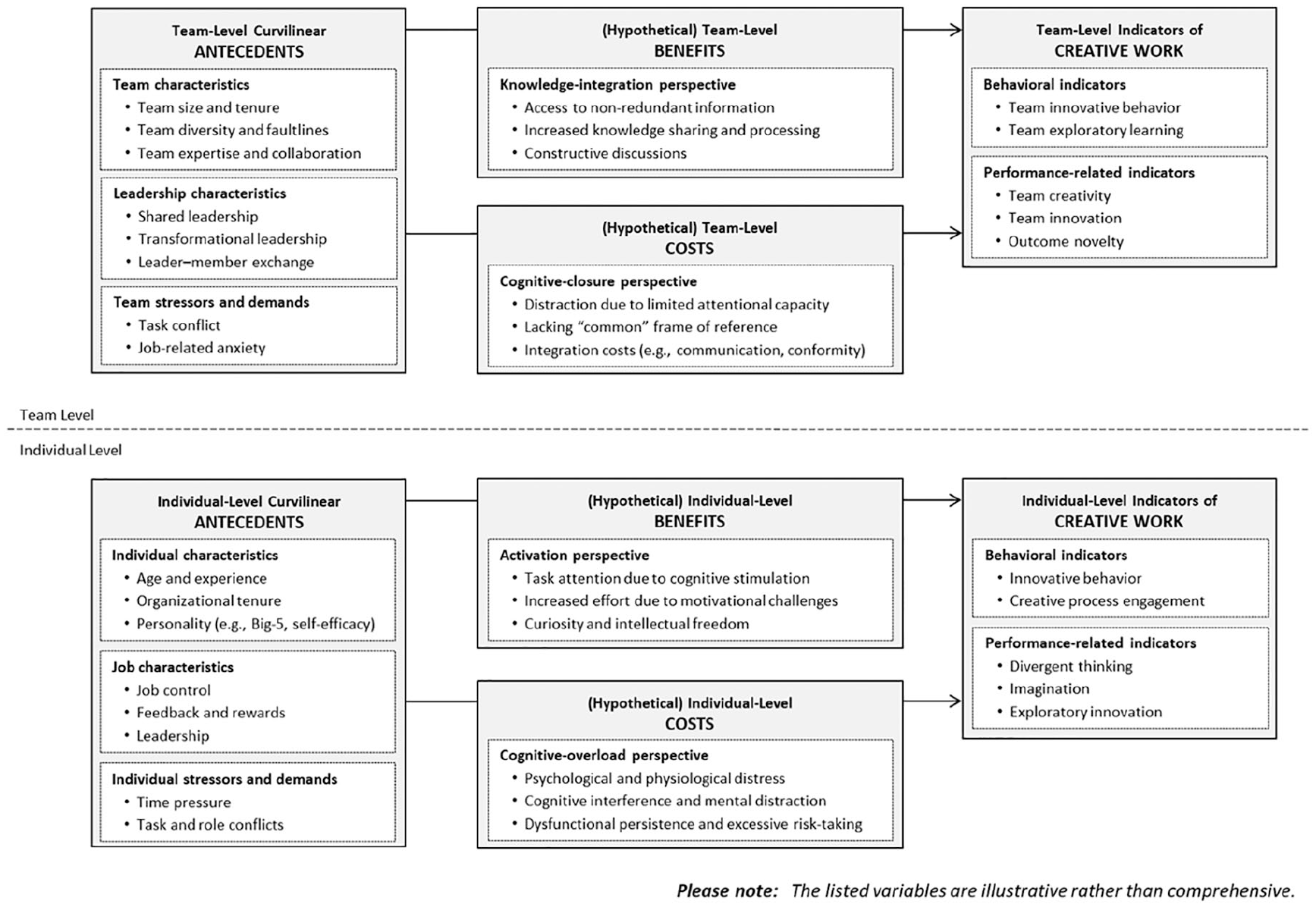
A multilevel antecedent-benefit-cost (ABC) framework of curvilinear effects on indicators of creative work.
Integrative Literature Review
In the following review of the extant literature on curvilinear effects, I develop the multilevel ABC framework from Figure 2 to offer a synthesized overview of three important aspects of the creative work of teams and their members. First, I present in an integrative manner the ways in which creative work is typically measured at the individual and team levels. Second, I comprehensively discuss the antecedents shown in this body of literature to impact the creative work of individuals and teams in nonmonotonic ways by clustering them into groups that are coherent in content. Finally, I synthesize the arguments put forth in this literature by offering a benefits-and-costs view that helps better understand the more abstract and often untested competitive-mediation mechanisms associated with important antecedents of creative work.
How Creative Work is Measured
Measuring creative work at the individual level
Individual-level studies (e.g., Leung et al., 2011; Montani, Vandenberghe et al., 2020; Wu et al., 2018) predominantly use Scott and Bruce’s (1994) innovative work behaviors to measure behavior-related indicators that describe employees’ intentional generation, introduction, and application of innovative ideas (AlEssa & Durugbo, 2021). Although the measurement of such behaviors includes aspects related to both individuals’ production of something novel and useful (i.e., the core essence of creativity) and their attempts to make use of it (i.e., innovation), my literature review includes research on such behaviors because “the distinction between the two concepts may be more one of emphasis than of substance (West & Farr, 1990)” (Scott & Bruce, 1994, p. 581). Further research on behavioral indicators of creative work at the individual level uses Zhang and Bartol’s (2010b) measurement of creative process engagement (e.g., Du et al., 2019; Yuan et al., 2018), which describes “employee involvement in creativity-relevant methods or processes, including (1) problem identification, (2) information searching and encoding, and (3) idea and alternative generation” (Zhang & Bartol, 2010a, p. 108). In the last group of studies (e.g., Form & Kaernbach, 2018; Wigert et al., 2012), Hocevar’s (1979) creative behavior inventory is used to measure behavioral indicators of individuals’ creative work. This measure contains activities and accomplishments that are commonly considered to be creative.
The vast majority of both individual-level (e.g., Aleksić et al., 2017; Baer & Oldham, 2006; Lin et al., 2017) and cross-level studies (e.g., Liang et al., 2021; Zhang & Zhou, 2019; Zheng et al., 2020) draw on the creativity scale by Zhou and George (2001) to measure the creative performance of individuals. This scale partly builds on Scott and Bruce’s (1994) scale, and therefore also contains some aspects of creative work related to the actual implementation of creative ideas. To capture individuals’ creative idea generation only, numerous studies at the individual level (e.g., Caniëls et al., 2021; Ohly et al., 2006; Shin & Grant, 2021) and those with a cross-level design (e.g., Feng et al., 2018; Hirst et al., 2009; Li et al., 2019) apply Tierney et al.’s (1999) creativity measurement, which is intended to operationally demarcate creativity from innovation. Measurements that purely assess individuals’ divergent thinking performance (e.g., McCrae et al., 1987; Voss, 1977) are also helpful in this respect. More specifically, studies in this area (e.g., Corgnet et al., 2016; Steffens et al., 2016; Yamaoka & Yukawa, 2017) evaluate individuals’ creativity based on the originality, fluency, and flexibility of ideas articulated when working on alternate uses tasks (i.e., test takers are asked to come up with as many uses as possible for a simple object, like a brick or a paperclip; Guilford, 1967). Finally, some of the reviewed studies (e.g., Wang et al., 2011; Yang et al., 2012) task trained coders or experts with evaluating the creativity of ideas developed by study participants.
Measuring creative work at the team level
Some studies assess the creative work of teams from a behavioral perspective, using measures based on Scott and Bruce’s (1994) innovative work behaviors. Janssen (2000) offers one such measure. Research in this area either uses the individual scores that team members report for their own creative behaviors and aggregate these scores to the level of their teams (e.g., Bednall et al., 2018) or relies on key informants like team leaders to report the creative behaviors of their teams (e.g., Chen, Liu, Yuan, et al., 2019). Further studies of behavioral outcomes at the team level consider the exploratory learning of teams (e.g., Kostopoulos & Bozionelos, 2011; Li, Li et al., 2018), which describes learning activities that develop new capabilities suited for accomplishing creative tasks.
In the extant literature, teams’ creative work is more commonly assessed in terms of their actual performance than their creative behavior. To perform survey-based assessments of the creative performance of teams, research often draws on Shin and Zhou’s (2007) measurement of team creativity (e.g., Mo et al., 2019; Yao et al., 2021), which assesses the newness, significance, and usefulness of the ideas generated by teams. Further research extends Zhou and George’s (2001) measurement of individual creativity to the team level (e.g., Cavazotte & Paula, 2021; Li et al., 2016) by applying a referent-shift consensus approach. Measurements using this approach shift the referent from the individual to the team prior to consensus assessment (Chan, 1998). Instead of providing their individual perceptions (e.g., “I feel. . .), respondents are thus asked to evaluate questionnaire items from the perspective of a higher-level entity (e.g., “My team feels. . .”) (Wallace et al., 2016). Furthermore, in the context of new product development, Moorman’s (1995) measurement of product creativity is commonly used to make inferences about the creative performance of teams tasked with research and development (e.g., Dayan & Di Benedetto, 2011; Dayan et al., 2017; Tang & Marinova, 2020). Finally, the creative performance of teams assigned to creative tasks is also assessed via the number (e.g., De Dreu, 2006; Vestal & Mesmer-Magnus, 2020; Xie et al., 2020) and/or novelty of ideas and products they produce (e.g., Lee et al., 2015; Seo et al., 2020; Tzabbar & Vestal, 2015). In some cases, this is done by inviting trained coders to evaluate team outputs (e.g., Baer et al., 2010; Goncalo et al., 2010; Mannucci, 2017).
The Types of Antecedents by Which Creative Work is Impacted in Nonmonotonic Ways
Antecedents at the individual level
A total of 188 curvilinear effects were tested in the 120 studies identified during my search for quantitative-empirical research on the creative work of teams. More than two-thirds of these effects relate to individual-level antecedents that broadly cover the characteristics of individuals and their jobs as well as the stressors and demands they are confronted with.
Individual characteristics
In the context of creative collaboration, the composition of teams in terms of their members’ characteristics is key to their creative success (Somech & Drach-Zahavy, 2013). The critical role of such differences between team members makes the rather small number of studies interested in the curvilinear effects of such antecedents at the individual level important to consider. As such, individuals’ age and tenure with their organizations (for a meta-analysis, see Ng & Feldman, 2013) tend to show nonmonotonic effects (Khan & Minbashian, 2021; McCrae et al., 1987; Miron-Spektor et al., 2022), suggesting that time and its passage play an important role in individuals’ optimal creative performance. More specifically, individuals require time to make new experiences, acclimatize to their organization, and gain knowledge conducive to their creative potential. However, the more time is passing, the more they are at risk of both being overloaded by all the informational resources acquired throughout the years and losing curiosity for, interest in, and commitment to their organization. Further studies showing curvilinear effects of individual-level antecedents look at individuals’ affect (Akbari Chermahini & Hommel, 2012; Chermahini & Hommel, 2010; Davis, 2009), cognition (Corgnet et al., 2016; Škerlavaj et al., 2014; Wang & Lau, 2021; Yang et al., 2012), and role in their networks (Chen, Chang et al., 2015; Stea & Pedersen, 2017; Wang et al., 2014; Zhou et al., 2009).
However, most of the research on individual characteristics is concerned with the controversial role that individuals’ personality plays in their creative work. Early meta-analytic evidence by Feist (1998) describes creative individuals not only as more open to new experiences, self-confident, and ambitious but also as less conventional and conscientious. More recent findings related to the role of Big Five personality traits in the context of individual creativity suggest that going away from pure linear considerations is warranted. In this regard, Coelho et al. (2018) show that increasing levels of individuals’ agreeableness (i.e., being sensitive toward others and concerned with their feelings; Costa et al., 1991) have diminishing returns for their creativity. In contrast, conscientiousness (i.e., being eager to succeed and seriously commit to one’s tasks; Costa et al., 1991) and extraversion (i.e., being energetic, social, and outgoing; Costa et al., 1991) seem to have increasing returns for their creativity. The authors further show that openness to experience (i.e., the need to continuously enlarge and examine one’s experiences; McCrae & Costa, 1997) is positively rather than curvilinearly associated with creativity, which underscores the importance of individuals’ curiosity for their creativity (Hagtvedt et al., 2019). Although the results by Coelho et al. (2018) are in line with the inverted U-shaped effect of agreeableness shown by Chang et al. (2014), they are at odds with the inverted U-shaped effects shown for extraversion (Gao et al., 2020) and openness to experience (Salter et al., 2015). These apparent contradictions point to moderators that may flip the curve of a personality trait (e.g., extraversion) from a U-shaped effect to an inverted U-shaped effect, and vice versa.
Although research on individuals’ personality could not confirm that multiple identities held by individuals (i.e., one identifies with more than one social group at the same time) impact their creativity in a curvilinear fashion (Steffens et al., 2016), many further characteristics of individuals show curvilinear effects. This holds for individuals’ temporal traits (i.e., personality traits that describe how one perceives, processes, and manages time; McKay & Gutworth, 2021) as well as their general (Lee et al., 2019) and creative self-efficacy beliefs (Li et al., 2020). Furthermore, individuals’ empathy (Form & Kaernbach, 2018), optimism (Rego et al., 2012, 2018), and perfectionism (Wigert et al., 2012) show inverted U-shaped effects on their creative work. Solving creative tasks requires individuals to show personal initiative and take risks. This makes it unsurprising that individuals’ action-state orientation (i.e., the response one tends to show when a situation one faces conflicts with one’s will; Bledow et al., 2022) and rebelliousness (i.e., the non-conforming tendency of individuals that causes them to resist authorities or break rules; Petrou et al., 2020) show inverted U-shaped effects, whereas a U-shaped effect is found for their loyalty to rules (Kirkhaug, 2009). This loyalty keeps individuals to comply with standard operational procedures rather than to delve into uncharted territory that could help develop more creative solutions. In terms of goal orientations that inform individuals’ goal-directed behaviors, inverted U-shaped effects are found for their orientation toward both learning (Hirst et al., 2009) and creativity goals (Gong et al., 2017). Finally, inverted U-shaped effects are also seen with negative traits like procrastination (Shin & Grant, 2021), mind-wandering (Yamaoka & Yukawa, 2017), overparenting (Zheng et al., 2020), and psychopathology (Acar et al., 2018), suggesting that getting one’s mind off a creative task can benefit creativity to some degree by allowing information overload to sort out and unconscious ideas to surface.
Job characteristics
Similar to what I reasoned for some of the personality traits presented above, inconclusive findings for some job characteristics seem to suggest that moderators exist that are able to initiate what is considered a shape-flip of the curvilinear relationship between two variables (Haans et al., 2016). Control over one’s job (Du et al., 2020) and job predictability (Caniëls et al., 2021) are shown to have inverted U-shaped relationships with individual creativity that are flattened and even flipped to U-shaped ones when receiving stronger encouragement of creativity from supervisors or support from coworkers. The support for creative thinking one receives from coworkers through dyadic interactions also impacts employee creativity in an inverted U-shaped fashion (Koseoglu et al., 2022). The variety in feedback sources, in contrast, shows a U-shaped relationship that flips to an inverted one as performance dynamism increases and creative time pressure decreases (Sijbom et al., 2018). Moreover, although the quality of the relationships that individuals have with their leaders seem to have a U-shaped effect on their creative work (Vanska & Hurmelinna-Laukkanen, 2021), numerous types of leadership show inverted U-shaped effects. This holds for more positive types, like transformational (Chung & Li, 2018; Ma et al., 2020), ethical (Feng et al., 2018), and humble styles of leadership (Yuan et al., 2018), as well as for more negative ones, like authoritarian leadership (Gu et al., 2020) and abusive supervision (Lee et al., 2013). These accumulated findings suggest that the experience of being led at all is beneficial up to a point at which leaders’ attempts at intellectual guidance interferes with their followers’ striving for latitude in creatively fulfilling their tasks, and that even the more negative leadership types may spark creativity by arguably motivating followers to break out of their routine.
Finally, the conflicts that individuals experience with their job or task at hand are consistently shown to be related with individual creativity in an inverted U-shaped fashion (Li, Yang et al., 2018; Petrou et al., 2019; Zhang & Zhou, 2019), which is similar to what is found for emotional conflicts at work (Wu et al., 2018). Effects of this type are also seen when individuals are granted flexible work arrangements (Wang et al., 2018) and extrinsic rewards (Zhou et al., 2011). Since the motivational potential of work flexibility and rewards tends to foster work engagement by satisfying individuals’ striving for intellectual freedom and recognition, it is unsurprising that work engagement is also consistently shown to curvilinearly impact individuals’ creativity (Kibatta & Samuel, 2022; Shimazu et al., 2018).
Individual stressors and demands
Early findings by Voss (1977) show an inverted U-shaped relationship between levels of activation and individuals’ performance on the remote associate test. This finding has largely infused the reasoning behind many “too-much-of-a-good-thing” (TMGT) effects that are explained by a competitive-mediation logic. The activation perspective follows the idea that an antecedent is activating (i.e., it offers benefits) up to a point at which distress (i.e., the costs associated with the attempt to realize an antecedent’s assumed benefits) prevails. Since originating from stress literature, the activation perspective is still widely used to explain how individual stressors and demands tax creative work. Stressors and demands are often seen as either challenging or hindering. This challenge−hindrance distinction proposes that challenge stressors motivate individuals to actively deal with the challenges posed on them, whereas hindrance stressors rather cause them to withdraw from the threatening situation that they face (Lepine et al., 2005; Podsakoff et al., 2007). Because of their more activating nature, it seems plausible that the activation perspective is better suited to explain the effects of challenge stressors than of hindrance stressors.
The most prominent challenge stressor showing TMGT effects on individual creativity is time pressure. Multiple studies show curvilinear effects of time pressure (Aleksić et al., 2017; Antwi et al., 2019; Binnewies & Wörnlein, 2011; Ohly et al., 2006; Paek et al., 2021), and some suggest that time pressure’s curvilinear effects are unleashed by the support for creativity one receives from supervisors and coworkers (Baer & Oldham, 2006) or the presence of creative demands (Boogerd et al., 2015). In contrast, findings for the curvilinear effects of workload are less consistent. Although Montani, Vandenberghe et al. (2020) detect an inverted U-shaped relationship for workload, Antwi et al. (2019) fail to confirm this finding despite using the same measure for the creative behaviors of individuals. Although both time pressure and workload are generally viewed as challenging (Lepine et al., 2005), the inconsistencies found for workload make it less surprising that—when both types of demands are paired to form a composite measure of challenge demands—these challenges affect individuals’ engagement in creative processes in a U-shaped fashion when they believe to have more control over their jobs (Du et al., 2019). Nevertheless, it is worth noting that quantitative demands—that is, situations in which individuals have too much to do in the time available, thus containing aspects of both time pressure and workload—affect the creative behaviors of individuals in an inverted U-shaped fashion when they perceive themselves being treated fairly (Janssen, 2001).
Some types of stressors are generally considered to be more hindering (e.g., role ambiguity and conflict; Lepine et al., 2005). Findings regarding the shape of their curvilinear effects are mixed and often depend on moderators. Some studies suggest that both role ambiguity and role conflict have U-shaped effects on the creative work of individuals for those who either are less mindful (Antwi et al., 2019) or lack support for innovation (Leung et al., 2011). Other studies show inverted U-shaped effects for both role ambiguity and role conflict. This holds for individuals with stronger tolerance of ambiguity being exposed to role ambiguity (Wang et al., 2011) and highly mindful individuals having to deal with role conflict (Montani, Setti et al., 2020). Finally, individuals’ creative work is also affected in an inverted U-shaped fashion when they perceive their identity as threatened. Such identity threats can be directed toward what they are doing (i.e., individuals feel overqualified for the job they are tasked with; Lin et al., 2017) and who they are (i.e., individuals perceive themselves being unfavorably judged by others; Byron et al., 2010).
Antecedents at the team level
Although research on team-level antecedents has increased in volume during the last decade (cf. Figure 1), only one-third of the curvilinear effects considered in my review pertain to the team level. These antecedents can be organized in characteristics of teams and their leadership as well as the stressors and demands that they face collectively.
Team characteristics
Compositional aspects of teams are featured most prominently in the research on team characteristics. While the size of teams is consistently shown to have an inverted U-shaped relationship with their creative work (Hu et al., 2021; Lee et al., 2015), team tenure (i.e., the time that has passed since team members started working together) tends to show U-shaped effects (Byron et al., 2022; Koopmann et al., 2016). Given the greater likelihood of diversity within larger teams, it is unsurprising that not only the size of teams but also their diverse composition with regards to different attributes show inverted U-shaped effects on their creative work. The diverse compositions of teams in terms of their members’ functional background (Carbonell & Rodriguez, 2006; Dayan et al., 2017; Li, Li et al., 2018), educational background (Luan et al., 2016; Lv & Zhang, 2015), organizational tenure (Chen, Hsiao et al., 2015; Chi et al., 2009), and geographic dispersion (Seo et al., 2020; Tzabbar & Vestal, 2015) are all shown to have inverted U-shaped relationships with creative work at the team level. Once differences among team members’ functional and educational backgrounds align with differences in their tenure, informational faultlines are formed that also tend to influence teams’ creative work in an inverted U-shaped direction (Yao et al., 2021). In contrast, cognitive diversity (Turkmen, 2014) and demographic diversity (Dayan et al., 2017) tend to have U-shaped effects. Consequently, when professional differences between team members align with demographic differences, the resulting faultlines also show a U-shaped effect (Mitchell et al., 2022).
Further characteristics of teams encompass their personality, expertise, and collaboration. In terms of personality, research shows that not only teams’ search openness (Salge et al., 2013) and self-efficacy beliefs (Park et al., 2017) but also their narcissism (Goncalo et al., 2010) have inverted U-shaped effects on team creativity. The same patterns are seen with collective expertise that is broad (Mannucci, 2017; Schulze & Brojerdi, 2012), diverse (Lee et al., 2015), or unshared (Vestal & Mesmer-Magnus, 2020). While international experience shows U-shaped effects (Suh & Badrinarayanan, 2014), inverted U-shaped effects are seen for team familiarity (Xie et al., 2020) and knowledge sharing (Tang & Marinova, 2020), arguably because trust (Hendarsjah et al., 2019) and psychological safety within teams (Kostopoulos & Bozionelos, 2011) show similar effects. Finally, collaboration within and beyond team boundaries also affects the creative work of teams in an inverted U-shaped fashion. In terms of collaboration within team boundaries, an inverted U-shaped effect is seen for the advice-giving within teams (i.e., team members willingly exchange ideas, knowledge, and suggestions to help others solve work-related problems; Wang et al., 2021), suggesting that inverted U-shaped effects may likely result when studying features of teams that describe their teamwork to be of high quality. It is thus unsurprising that similar effects are seen for teams’ ability to both raise concerns about dysfunctions at work (e.g., as expressed in prohibitive voice; Liang et al., 2019) and collectively process information in unconscious ways (e.g., as manifested in team intuition; Dayan & Di Benedetto, 2011). In terms of collaboration beyond team boundaries, collaboration breadth (i.e., the number of external sources teams draw on when solving creative tasks; Kobarg et al., 2019) shows an inverted U-shaped effect on creative performance at the team level. In line with this finding, a similar effect is shown for team members’ differential involvement in boundary-spanning activities (i.e., activities intended to connect with external sources that help teams better achieve their goals; Yao et al., 2022).
Leadership characteristics
The body of literature looking at curvilinear effects of collective perceptions of leadership characteristics shows a consistent inverted U-shaped pattern for the effect of shared leadership on creative outcomes at the team (Cavazotte & Paula, 2021; Mitchell & Boyle, 2021) and individual levels (Liang et al., 2021). Ethical leadership also shows this pattern (Mo et al., 2019), which confirms the aforementioned findings about the role of individuals’ perceptions of ethical leadership in their creativity (Feng et al., 2018). On the other hand, transformational leadership tends to have a U-shaped effect at the team level (Eisenbeiß & Boerner, 2010). The authors suggest that the striving for intellectual freedom by team members may be least threatened either in the absence of transformational leadership or in its strong presence, which allows highly transformational leaders to encourage alternative thinking approaches in their teams by strengthening team identification. However, it needs to be mentioned that the cross-level research by Bednall et al. (2018) does not confirm this U-shaped effect across levels for the creative work done by individual team members. In this regard, findings by Chung and Li (2018) show that team members’ individual perceptions of transformational leadership are more likely to impact their creative behaviors in an inverted U-shaped fashion. The authors suggest that high levels of transformational leadership may cause team members to feel dependent on their leaders, which undermines their sense of personal accomplishment and motivation to learn and create something new. Finally, although it appears to some degree beneficial for the creativity of teams when team leaders develop relationships with their members that vary in quality (i.e., leader-member exchange differentiation), team creativity starts to suffer beyond an optimum level of this kind of differentiation (Li et al., 2016).
Team stressors and demands
Although the scientific interest in understanding stressors and demands at the team level has increased (for recent reviews, see Razinskas & Hoegl, 2020; Roczniewska et al., 2022), studies concerned with their curvilinear effects still predominantly focus on conflicts in teams rather than the more traditional stressors discussed at the individual level. This stream of literature consistently shows that task conflict at the team level has inverted U-shaped effects on the creativity of teams (Chen, Liu, Yuan, et al., 2019; De Dreu, 2006; Farh et al., 2010; Hu et al., 2017; Kratzer et al., 2006; Xie et al., 2014) and their individual members (Li, Yang et al., 2018). This consistent pattern of results for the effects of task conflict at both levels may be explained partly by the fact that teams’ anxious feelings about tasks also show TMGT effects on creativity at both the team and individual levels (Mao et al., 2021). Finally, collective creative work is also affected in an inverted U-shaped fashion by relational conflicts within teams (Ye et al., 2020) and their conflicts with other teams (Baer et al., 2010).
The Mechanisms Through Which Creative Work is Impacted in Nonmonotonic Ways
Many of the curvilinear effects presented in the sections above are mainly argued based on inconclusive findings from previous research. Some studies yet offer theoretical arguments that describe their effects of interest using a competitive-mediation logic. More recent research (e.g., Gao et al., 2020; Kibatta & Samuel, 2022; Li, Yang et al., 2018; Park et al., 2017; Zhang & Zhou, 2019) is highly influenced by the TMGT logic introduced by Pierce and Aguinis (2013), and some first attempts (e.g., Mo et al., 2019) even apply the ABC framework by Busse et al. (2016) when theorizing about inverted U-shaped effects. Below, I offer a synthesized overview of arguments leading scholars to predict that the creative work of individuals and their teams is simultaneously impacted by benefit- and cost-related mechanisms.
Benefit-related mechanisms
My synthesis of the literature shows that benefit-related mechanisms at the individual level are mainly argued in light of what I call the activation perspective (e.g., Binnewies & Wörnlein, 2011; Janssen, 2001). By drawing on activation theory (Scott, 1966), this perspective suggests that elevated levels of antecedents are to some extent favorable due to stimulating “neural excitation in the reticular activating system of the central nervous system” (Gardner et al., 1988, p. 83). During my review of the literature, I found that the effects of antecedents pertaining to individual stressors and demands are commonly argued from this perspective. More specifically, quantitative stressors—such as time pressure (Aleksić et al., 2017; Binnewies & Wörnlein, 2011) and workload (Montani, Vandenberghe et al., 2020)—are argued to be cognitively activating because they stimulate neural activity. Such challenging demands are thought to increase individuals’ attention and efforts (Du et al., 2019), thereby contributing to their benefit-related mechanisms. Similar reasoning can be found in studies arguing for certain benefits inherent in more hindering demands, such as role conflict (Montani, Setti et al., 2020) and role ambiguity (Wang et al., 2011). Although benefit-related mechanisms at the individual level are predominantly discussed from the activation perspective, it is worth noting that the range of knowledge available to individuals tends to be cognitively activating and inspirational (Salter et al., 2015), which is why stimulating curiosity is believed to benefit the upward slope of certain TMGT effects at the individual level (Gao et al., 2020).
The role of knowledge is more prominent in team-level than in individual-level research. This is particularly true of studies looking at antecedents that cover such characteristics that provide teams with opportunities to access and integrate greater knowledge resources. I label this knowledge-integration perspective in line with the work by van Knippenberg (2017). Some of the reviewed studies (e.g., Farh et al., 2010; Lee et al., 2015) attend to this perspective, which assumes that teams are more creative when they can draw on and critically discuss more diverse (and complementary) knowledge, skills, and abilities (KSA). This appears to be more likely, for example, when the size (Lee et al., 2015) or diversity (Luan et al., 2016) of teams increase, or when conflicting views need to be negotiated within them (Hu et al., 2017). Under such circumstances, the broader knowledge and divergent opinions that teams must attend to are thought to foster greater exposure to novel input (Farh et al., 2010; Schulze & Brojerdi, 2012), richer sharing of non-redundant information (Mitchell et al., 2022; Vestal & Mesmer-Magnus, 2020), and greater efforts to find collectively satisfying solutions (De Dreu, 2006; Ye et al., 2020). Overall, the literature on curvilinear effects indicates that benefit-related mechanisms at the team level share some commonalities with those at the individual level (e.g., the idea of cognitive stimulation), but they also differ in important ways (e.g., the challenge to accommodate the needs of multiple individuals). Therefore, the integration aspect of the beneficial mechanism at the team level deserves closer attention.
Cost-related mechanisms
Research at the individual level often discusses potential costs in light of what I call the cognitive-overload perspective (e.g., Aleksić et al., 2017; Zhou et al., 2009). This perspective suggests that too much cognitive stimulation may result in distraction and distress, both of which tax the individuals’ capacity to create something novel. In the extant individual-level literature, this reasoning is especially prevalent for antecedents pertaining to individual stressors and demands. As individuals become cognitively activated, they are at heightened risk of being overstimulated in a way that causes cognitive interference (Montani, Setti et al., 2020) and narrowing of their focus (McKay & Gutworth, 2021), both of which can lead to suboptimal decisions and less original solutions. Although stress and conflict can be cognitively stimulating to some degree, elevated levels of such stimuli likely do more harm than good by burdening individuals with coordination challenges (Salter et al., 2015) and impairing both their motivation to perform (Ng & Feldman, 2013; Zhang & Zhou, 2019) and their health (Montani, Vandenberghe et al., 2020; Wu et al., 2018). Although some research focuses on how dysfunctional persistence and excessive risk-taking undermine the beneficial potential of individuals’ personality (Lee et al., 2019; Li et al., 2020), there is little theorization about how desirable effects of certain job characteristics turn negative when taken too far.
At the team level, a cognitive-closure perspective is often used to explain the downward slope of curvilinear effects (e.g., Chi et al., 2009; Goncalo et al., 2010). The limited attentional capacity (Li, Li et al., 2018) and heightened conformity pressure within teams (Park et al., 2017) are argued to offset the benefits that contribute to an antecedent’s upward slope. When more knowledge, skills, and abilities (KSA) are available to teams, teams are more likely to experience information overload that distracts and confuses them (Li, Yang et al., 2018), and they are less likely to arrive at a coherent solution (Farh et al., 2010). Differences in KSA among team members are problematic because they undermine a common frame of reference (Chi et al., 2009). The wider range of possibilities accessible due to these differences in KSA requires higher coordination and communication costs to be invested to leverage this potential (Tzabbar & Vestal, 2015). Once the pool of knowledge resources is too large, teams are less able to reach consensus (Lee et al., 2015) and achieve creative integration (Mannucci, 2017), which limits their ability to make constructive use of elevated levels of KSA. Although the reasoning behind this cognitive-closure perspective seems to apply to team-level antecedents from all three categories, it is rarely used in studies concerned with leadership characteristics. One notable exception is Eisenbeiß and Boerner’s (2010) study, in which they suggest that extensive transformational leadership may thwart teams’ cognitive flexibility by providing too much intellectual guidance. With regard to the innovation process, strong intellectual guidance is likely to be problematic in the first stage when teams are asked to generate creative ideas. However, this guidance shown by transformational leaders may be useful in helping their teams strive toward implementing creative ideas, as it likely helps overcome the conformity pressure teams typically face during the second stage of the innovation process.
Future Research Agenda
By synthesizing important new research directions, my review complements previous reviews that inspired both a more holistic understanding of creativity at multiple levels (Hennessey & Amabile, 2010; Zhou & Hoever, 2014) and an increased focus on important contingencies within desirable effects (van Knippenberg, 2017). Measuring the benefit- and cost-related mechanisms is perhaps the most apparent and pressing step for future research to take. A thorough account of costs is required to reliably inform practice about whether specific antecedents ultimately help (or hinder) the creative work of teams and their members. Better understanding competitive-mediation mechanisms will require more cross-level approaches, which help increase conceptual clarity and methodological precision in this field.
Testing of Competitive-Mediation Mechanisms
For the multilevel review presented above, I not only structured the antecedents shown to have curvilinear effects in meaningful clusters but also synthesized the arguments used to explain their underlying patterns of results in coherent mechanisms. These mechanisms, in turn, allowed me to build new theory on the complex effects that certain antecedents of creative work show across levels of analysis. Importantly, my review demonstrated that the competitive-mediation mechanisms at the individual (i.e., activation vs. cognitive-overload perspectives) and team levels (i.e., knowledge-integration vs. cognitive-closure perspectives) are hypothetical. Although the extant literature shows that certain antecedents affect the creative work of individuals and teams in curvilinear ways, the reasons for this remain to be explored. This is mainly due to the fact that only a few of the reviewed studies (e.g., Mo et al., 2019; Park et al., 2017; Xie et al., 2020; Zhang & Zhou, 2019) explicitly theorize about the associated costs that may outweigh an antecedent’s benefits by referring to the work by Pierce and Aguinis (2013) or the ABC framework by Busse et al. (2016).
Future research is thus asked to simultaneously observe mediators associated with both the benefit- and cost-related mechanisms when studying antecedents that are expected to show nonlinear effects. For both these mechanisms at the individual level, the synthesizing framework from Figure 2 seems to suggest that the emotions of team members play a role in causing antecedents to curvilinearly affect their creativity. To contrast the identified competitive-mediation mechanisms at this level, one could follow previous research on workplace stress (e.g., Rodell & Judge, 2009; Rosen et al., 2020) and measure prominent positive (e.g., attentiveness) and negative (e.g., anxiety) emotional states of team members using the extended form of the Positive and Negative Affect Schedule (PANAS-X; Watson & Clark, 1994) and the Job-Related Affective Well-Being Scale (JAWS; Van Katwyk et al., 2000). At the team level, a measure for teams’ elaboration of task-relevant information (e.g., the one by Kearney & Gebert, 2009) could be contrasted against one for their transactive memory system (TMS; e.g., the one by Lewis, 2003). Measuring the emotions of team members and, at the same time, the information elaboration of their teams seems promising because team members in positive rather than negative moods are more willing and open to share the information and expertise that only they possess (e.g., Dietz et al., 2017; Pfaff, 2012; Pillay et al., 2020). These informational exchanges then also facilitate the development of TMS (Yan et al., 2021).
Making use of measures of both benefit- and cost-related mechanisms is also important because the absence of one (e.g., task attentiveness or motivated effort) does not necessarily denote the presence of the respective other (e.g., mental distraction or withdrawal), and vice versa. Since “a curvilinear relationship between two variables may arise from the interaction of countervailing effects” (Meyer, 2009, p. 188), interactionist perspectives on creativity seem to become increasingly relevant for better understanding such relationships. The actor–context perspective by Zhou and Hoever (2014) details how creativity is affected by different configurations of characteristics of individuals and their context. Future research in this regard may extend this perspective by considering curvilinear effects on creativity in terms of different configurations describing the associated mechanisms and their extent. By using a simple two-by-two logic, research could start considering the four configurations that result when both the benefits and the costs of an antecedent are present, when either the benefits or the costs are present, or when both are absent. It is necessary to be aware of the competing effects that the antecedents reviewed above may have on the creative work of teams and their members when theorizing about and testing (inverted) U-shaped relationships (Haans et al., 2016). Attention should be paid particularly to the range of scores on which antecedents expected to show TMGT effects are actually tested (Pierce & Aguinis, 2013), since insignificant findings may simply be the result of the benefit-related mechanism being perfectly balanced with the associated cost-related mechanism (Meyer, 2009).
Extending Cross-Level Approaches
My review uncovers the need for more cross-level research regarding benefit-related mechanisms. As stated earlier, only four of the reviewed studies (i.e., Bednall et al., 2018; Liang et al., 2021; Li, Yang et al., 2018; Mao et al., 2021) were interested in curvilinear effects of team-level antecedents on individual-level indicators of creative work. The synthesized framework from Figure 2 yet raises expectations for individual creativity to be (curvilinearly) affected by an increase in the knowledge available to either the individual (e.g., via professional development) or their team (e.g., via an increase in the number of team members). A cross-level account of increasing the knowledge of the existing team members seems promising in this regard. Such a means may help increase the diversity of teams on job-related dimensions (i.e., “diversity in attributes that are related to the knowledge and expertise that are required to solve highly complex problems”; van Dijk et al., 2012, p. 39) without requiring them to integrate additional individuals. Diversifying teams without changing their personnel composition can reduce both financial expenditures and coordination challenges associated with a larger team size (Lee et al., 2015; Weiss & Hoegl, 2016). The idea of an evolving job-related diversity of teams will hopefully inspire future research given its notable relevance for practice.
More cross-level research is also needed to determine whether curvilinear effects at the team level are attributable to some team members being on their upward slope while others are already on their downward slope at discrete magnitudes of team-level antecedents. For example, team task conflict tends to have inverted U-shaped relationships with team creativity (Hu et al., 2017) and individual creativity (Li, Yang et al., 2018), suggesting that teams and their members must discuss dissenting views to reach optimal creative stimulation and the exposure to such views reduce premature consensus of teams (Farh et al., 2010). Yet, the creativity of individuals is shown to be affected by task conflict in a U-shaped fashion on days that they cannot reach out to their colleagues (Petrou et al., 2019). It is likely the case that—when increasing task conflict to reach optimal creativity at the team level—practitioners unconsciously harm the creativity of those team members who possess weaker social ties.
Instead of expecting every team member to be similarly stimulated by task conflict at every moment of collective work, practitioners are asked to be aware of the differences not only between team members (e.g., in terms of their general social embeddedness in teams) but also within team members across different days (e.g., in terms of their reduced ability to benefit from their social embeddedness when working from home). Scholars, in turn, are recommended to follow first studies (e.g., Binnewies & Wörnlein, 2011; Bledow et al., 2022; Petrou et al., 2019) that investigated curvilinear effects on the creativity of individuals by applying intensive longitudinal designs (Bolger & Laurenceau, 2013; Mehl & Conner, 2012). Such designs are well suited to understand how team members’ creativity is stimulated on one day and likely inhibited the other day despite being exposed to similar magnitudes of an antecedent at both days. Better understanding intra-individual variability in creativity seems essential to identify the means needed to leverage knowledge integration in teams and, at the same time, prevent them from experiencing cognitive closure. This requires knowledge about the optimal level at which team members are sufficiently activated but not unnecessarily overloaded.
Increasing Conceptual Clarity and Methodological Precision
The thematic closeness of cost-related mechanisms at both levels connects well to one of my earlier comments, speculating that the literature on curvilinear effects in teams struggles with identifying potential costs of truly collective nature. Literature on team stressors provides some explanation for this, suggesting that even a single—or a small number of—team member(s) can cause a team to derail (Razinskas & Hoegl, 2020). Future research should still more precisely specify and measure cost-related mechanisms at the levels at which they are believed to tax the creative potential of teams and their members. It is important to be conceptually clear about the cognitive-overload and cognitive-closure perspectives because the cognitive overload of some team members may not necessarily result in the cognitive closure of the entire team. Teams may also be able to bear the loss of the contributions of members who are cognitively overloaded. This is arguably the case if these members possess similar expertise to that of the others who remain more activated. Moreover, little interdependence among tasks may also reduce the detrimental consequences of cognitive overload in team members for the creativity of their teams.
It is crucial from a methodological perspective to be precise about the level at which the costs associated with desirable antecedents take their toll. Distributive information tasks (e.g., the architectural design firm task by van Knippenberg et al., 2010) seem suitable in an experimental setting when the creative work of teams is expected to be curvilinearly affected by a team-level antecedent. With regard to the cognitive-closure mechanism at the team level, Kearney et al. (2022) have shown that the withdrawal of teams working on this task undermines information elaboration and ultimately their performance. It seems yet plausible that the (un)conscious withholding of task-relevant information by a single, cognitively overloaded team member could decisively contribute to the suboptimal creativity of teams, thereby pointing to the cognitive-overload mechanism identified at the individual level. Therefore, distributive information tasks can also be of value if one’s theoretical expectations point toward what I call “one-bad-apple-spoils-the-bunch” phenomena. One has to be prudent though to best measure team-level effects that are expected to be driven by single team members. While the direct and referent-shift consensus models appear to be most popular in team literature (Wallace et al., 2016), a dispersion model—which draws on the variance of scores among team members (Chan, 1998)—should be used when aggregating individual-level data to the team level. In this regard, Harrison and Klein (2007) provide valuable guidance for conceptualizing, measuring, and analyzing constructs that make constructive use of lower-level variance rather than treating it as error.
Conclusion
The multilevel ABC framework developed in this review is intended to not only encourage further cross-level research contrasting the still more hypothetical mechanisms across levels but also provide more conceptual clarity and methodological precision. It goes beyond existing qualitative (e.g., Acar et al., 2019; Hennessey & Amabile, 2010; Ilha Villanova & Pina E Cunha, 2021; van Knippenberg, 2017; Zhou & Hoever, 2014) and quantitative reviews (e.g., Hülsheger et al., 2009; van Dijk et al., 2012; Wang et al., 2019) on this topic by providing a more balanced account of the benefits and costs simultaneously inherent in important antecedents of creative work. This more elaborate understanding is needed to help organizations optimize their collective efforts by illustrating the threat of these antecedents becoming too intense at some magnitude to use constructively. Missing out on learning from curvilinear effects could undermine best intentions to stimulate individuals (e.g., with rewards) and teams (e.g., by increasing the diversity of their composition) with the goal of maximizing their creativity.
Footnotes
Declaration of Conflicting Interests
The author declared no potential conflicts of interest with respect to the research, authorship, and/or publication of this article.
Funding
The author received no financial support for the research, authorship, and/or publication of this article.
